



Abstract
In this article, we present findings from an analysis of social media users’ own descriptions of having lived with social media for over a decade. In doing so, we draw upon the users’ reflections as related in data collected over 10 years. We present findings from a unique dataset of 36 stimulated-recall interviews, where we have studied the same group of informants in 2012, 2017, and 2022. While previous work on reminiscing, memories, and social media have relied on descriptions of practices as they are remembered, our approach has allowed us to follow and examine how users reflect upon their own practices over time. In this article, we focus on social media reminiscing practices and show how social media users seek and engage with previously posted social media content to reminisce and how their reflecting upon how their social media practices have evolved over time evoke ambiguous feelings. Drawing upon previous work and our own empirical material, we define and discuss social media nostalgia. We describe how social media users experience both personal social media nostalgia (referring to how I was), and historical social media nostalgia (referring to how it was) when reflecting upon past social media practices and demonstrate how social media users nostalgize as they interact with and through social media memories. Finally, we discuss our findings in relation to the interplay between reminiscing practices and technology and point to how social media memories represent a detailed insight into an ongoing social transformation of everyday life.
Keywords
Introduction
The massive adoption of smartphones has changed how people document and share their everyday lives. As the technologies and platforms have evolved over the last decade, so have the social practices involved when using social media. When studying social media practices, it is important to keep in mind that this is a field in constant change, in terms of both the platforms themselves and the practices that they afford. Previous scholars have described conduct of social media research as aiming to study a moving target (Hogan & Quan-Haase, 2010). In his anthropology of Facebook, Miller (2011) describes how the platform should not be considered a static, homogeneous entity. Rather, Facebook can be drawn upon in several different ways, developing into different genres of use within different groups and communities. In addition, Facebook has changed since it started as a pioneering college student platform and continues to change over the years. With the launch of Facebook in 2006 and Instagram in 2012, users of these social media platforms now have over a decade of social media content in their digital repositories. 10 years ago, approximately 1.4 billion people used social networks. 1 Today, the estimated corresponding number is 4.7 billion people (Chaffey, 2022) and more than 3.2 billion images and 720,000 hr of video are shared daily (Thomson et al., 2020). Thus, social media users of today are able to look back on, and reminisce over, what they once documented and shared—and sometimes even share it again. However, the idea of reposting previously posted social media content is not cutting-edge, and features that allow users to re-use, post, and share previously shared content again, years later, have been found both within specific applications that collect previous posts from a multitude of different platforms (e.g., Timehop), as well as in built-in features within specific platforms (e.g., Facebook Memories and On This Day on Instagram), and within operating systems (e.g., Memories in photo applications on iOS and Android). Social media users themselves have also enabled reminiscence by contributing to the distribution of previously shared content through popular user-generated hashtags such as #throwbackthursday, #tbt, and #flashbackfriday.
A prominent event in terms of the evolution of social media occurred at the end of 2012, when Facebook introduced Year in Review, a feature that allowed users to access and post an auto-generated selection of 20 highlights from the past year on their timeline. Three years later, in 2015, On This Day was launched as a way for users to reminisce over previous interactions, events, and posts. This feature, a development of the Year in Review, and an evolution of the Look Back video feature and the Say Thanks Video feature, allowed users to look back on, and share, previous status updates, posts, and photos posted 1, 2, or more years ago. 2 In 2018, the feature was developed into what Facebook users of today know as Memories. Another On This Day feature, similar to the one with the same name on Facebook, was introduced on Instagram in 2019. Also, both Apple (since 2016) and Google Photos (since 2019) auto-generate clips by scanning archived photos and creating slideshows of saved photos from earlier photographed events.
Despite a strong push toward reminiscing on various social media platforms, previous work on social media reminiscence has been limited in terms of both the type of data collected and the platforms studied. Also, previous work has primarily examined snapshots of current practices, mainly relying upon interviews at one moment in time, resulting in a more narrow temporal analytical scope. We believe that our unique longitudinal approach allows us to reveal the diachronic aspects of social media that previous methods have failed to uncover. In this article, we explore social media users’ own descriptions of having lived with social media for over a decade. In doing so, we draw upon the users’ reflections as related in data collected over a decade. We present unique data from a social media study consisting of data collected in 2012, 2017, and 2022, studying the same group of informants. This approach allows us to examine in detail the ways how users reflect upon their own social media practices over time. We show how social media platforms are used to support reminiscing and how users engage with social media memories. We focus specifically on the practice of reminiscence, which implies “a casual recalling of experiences long past, often with a sense of nostalgia,” 3 in and through social media. Through our empirical work we contribute to the field of social media memories studies by unpacking the interplay between social media, reminiscence, and nostalgia in a contemporary digital context.
Digital Media Reminiscence
In an early paper exploring the possibilities of a digital system especially designed to enable users’ reminiscing over social media content, reminiscence is simply referred to as “a type of remembering where we recall, interpret, and often share memories that are personally significant” (Peesapati et al., 2010). For this article, we rely upon the definition of reminiscence made by Bluck and Levine (1998), suggesting that reminiscence refer to “the volitional or non-volitional act or process of recollecting memories of one’s self in the past” (Bluck and Levine, 1998, p. 188). To further conceptualize reminiscing, we turn to the field of social media memories.
Digital Media Memories
Social media has changed how we create, keep, and engage with digital memories. As argued by Kaun & Stiernstedt, media technologies are “in a profound way about organizing and creating a sense of time” (Kaun & Stiernstedt, 2014, p. 1156). As early as 2007, Van Dijck (2007) theorized the mutual shaping of media and memory by introducing the notion of “mediated memories.” van Dijck described mediated memories as follows: Many people nurture a shoebox in which they store a variety of items signaling their pasts: photos, albums, letters, diaries, clippings, notes, and so forth. Add audio and video tape recordings to this collection as well as all digital counterparts of these cherished items, and you have what I call “mediated memories.” (van Dijck, 2007, p. 1).
highlighting the multiple layers that are sometimes added as traditional “shoeboxes” are exchanged for digital ones. Furthermore, she elaborates on the reciprocity between media and memory: “Media and memory, however, are not separate entities—the first enhancing, corrupting, extending, replacing the second, but media invariably and inherently shape our personal memories, warranting the term ‘mediation’” (van Dijck, 2007, p. 16).
Although social media is primarily associated with social interaction and sharing of digital media content, social media sites are not only used for live sharing of experiences and constructing immediate communication and sociality, but also for creating and keeping memories. For this article, we use the term “social media memories” when referring to previously posted social media content, such as photos, status updates, and other interactions stored and accessed through social media platforms, websites, and applications. In 2011, Bartoletti formulated the idea that: the web can constitute not only a place for communication, as is self-evident, but also a place for remembering and for the narration of life experiences—which can be individual and collective, textual and visual—through which the work of memory becomes visible (Bartoletti, 2011, p. 82).
A key element when narrating stories on life experiences and “making memories visible” (Bartoletti, 2011) in social media is taking, editing, and sharing photographs. This practice has been of interest for researchers for decades (see, for instance, Chalfen (1987) for interesting early work on how people take, edit, show, and store visual snapshots of their everyday life], yet is probably more in question today than ever before. This practice is often referred to as social photography (Avni, 2015; Jungselius, 2019; Weilenmann et al., 2013). Social photography is one of the most central features of social media interaction and the number of photos shared in social media has exploded during the last decade, with as many as 1,074 photos shared per second on Instagram in 2022. 4
In early social media memory work, the possibilities that were expected to come with digitization of memories were often in focus. For instance, comparing digital social media memories on Facebook to memories created with previous technologies within previous eras, Garde-Hansen et al. (2009) emphasized how the digitization made documenting and storing more available to many: Unlike in previous eras, where keeping the past was an expensive business with access provided often for only an elite, digital media technologies provide cheap data storage, ease in terms of the searching and retrieval of data—with digital and mobile networks providing unprecedented global accessibility—and participation in the creation of memories (Garde-Hansen et al., 2009, p. 1).
Facebook pictures and the practices connected to sharing photos online were described as ”performative exercises of identity and belonging, simultaneously declaring and corroborating shared experiences” (Mendelson & Papacharissi, 2010). Scholars showed that although people began creating a lot of digital content when it became increasingly possible, they rarely revisited it after it had been captured, usually due to storing overload, primitive organization, use of multiple storage systems, failing to maintain collections as well as users’ false beliefs about the ability to access photos (Whittaker et al., 2010). In an interesting piece of early work on social photography, Mendelson and Papacharissi (2010) examined the use of photo galleries as an instrument of self-presentation and a means of visual autobiography online. They showed that Facebook tagged photographs present more than just random moments in a person’s life, and instead provide visual evidence of social networks (Mendelson & Papacharissi, 2010). More recent work has focused on how people use their social media accounts and posted content as personal archives (Good, 2012; Zhao et al., 2013), and it has been argued that storing and curating personal archives in mobile devices matters to users (Beer, 2012). In a recent paper examining social photography on Instagram, Serafinelli (2020) describes how the platform is contributing to a fundamental change in how people think about and practice visual remembering, showing that sharing photos has become “synonymous with keeping memories” (Serafinelli, 2020, p. 7).
Technologies for Reminiscing
In this article, we focus on social media reminiscing practices, that is, remembering, storing, and interacting with and through previous posts made on social media. Central to the possibilities to practice reminiscence in social media are the affordances of the platforms where these practices play out. Previous work has suggested that modal, technical and social affordances of a social media platform shape how the platform is being used (Jungselius, 2019). Previous work has highlighted the fact that these affordances in turn are results of the business model developed for that specific platform. For instance, focusing on Facebook and presenting findings from a study of how specific media technologies afford specific temporalities, Kaun and Stiernstedt (2014) argued that: “Platforms foster exchange but not understanding and engagement with actual content” (Kaun & Stiernstedt, 2014, p. 1164). For this article, we rely upon the assumption that affordances of social media platforms are important contributors in shaping the reminiscing practices that people engage in using it.
How technologies are used to evoke reminiscence have been of interest within various fields. A majority of these studies are found within the medical field, where several studies explore remembering and the use of information and communications technology and multimedia as reminiscence-stimulating tools for older users with Alzheimer’s or mild cognitive impairment (Chonody & Wang, 2013; Smith et al., 2009) and dementia (Davis & Shenk, 2015; Lazar et al., 2014). In a partly related field, Human Computer Interaction, a considerable amount of previous work has focused on more design-oriented aspects of technologies supporting people’s reminiscing practices (Cosley et al., 2009, 2012; Peesapati et al., 2010). Previous work focusing specifically on social media memories and reminiscence have mainly focused on how digital nostalgia evoking features are being engaged with, especially on Timehop and Facebook (Jacobsen & Beer, 2021; Kaun & Stiernstedt, 2014; Migowski & Fernandes Araújo, 2019; Naini et al., 2019). Additional studies have focused on how nostalgia is being expressed in social media posts, for example, characteristics of memorable social media summary posts (Naini et al., 2019) and nostalgic content in Facebook posts (Davalos et al., 2015). One study showed that for many Facebook users, the social platform serves almost as a ”personal locker” that archives their personal and social memories (Zhao et al., 2013, p. 5).
Over the years, social technologies and features have evolved, and social media platforms have afforded different activities, contributing to shaping social media practices. One specific and defining adjustment occurred in 2016 when Instagram announced that the feed would no longer display content chronologically, but instead by using an algorithm to sort and present posts,
5
creating a new ecology on Instagram where users were suddenly in less direct control of what content they were exposed to. Taking a critical approach, Lee (2020) questions how algorithmic curated media has become considered to be “memories.” For instance, Lee distinguishes “memory” from memory, suggesting that algorithmically curated and by an application suggested photographs is not equivalent to human memories (Lee, 2020). Furthermore, Lee unpacks the concept of memory in algorithmic media and argues for a deeper understanding of cybernetics involvement in algorithmic memory practices, or “the socio-technical imaginary of the past” (Lee, 2020, p. 1). In a study of expressions of memory in digital environments, specifically focusing on the “Look Back” feature on Facebook, Migowski & Fernandes Araújo (2019) argue on a similar note that a deeper understanding of the reception of products derived from algorithmic sorting is lacking as “what algorithms do while sorting and selecting users’ content has various consequences, some of them more practical and visible, others more normative and subtle” (Migowski & Fernandes Araújo, 2019, p. 60). This suggests that algorithms have a great impact on user experience, not only as they decide what content is being presented but also in the long run by shaping what is being reminded. The same study also noticed a great variety in attitudes toward digital traces, highlighting a complexity in terms of feelings toward social media memories. Hoskins describes how digital media memories are now readily available: Social networking, messaging and all of life’s uploading together casts a continuous, accumulating, paradoxically real-time and dormant memory, of the multitude, lurking in the underlayer of media life awaiting potential rediscovery, reconnection and remediation, to transform past relations through the reactivation of latent and semi-latent connections (with ourselves and with others) (Hoskins, 2018, p. 88).
As this transformational last decade has passed, people have undergone life changes, created memories, and uploaded digital and curated content on social media, highlighting these events. In a recent paper, social media memory practices are explained as facilitators of “backwards glances to previous times, moments, and events” (Jacobsen & Beer, 2021, p. 1). Furthermore, it is argued that quantifying of social media memories, such as visualization of the number of “Likes” on a photograph, might add a dimension to the memory associated with the posted photograph, suggesting that in addition to shaping social practices around these technologies, social media might also shape user’s memories as well as how they feel about the memory (Jacobsen & Beer, 2021). It is also suggested that “quantification of memories (such as days on a streak, number of ‘Likes’) proved incentives to ‘dig into past content and to share what is found’” (Jacobsen & Beer, 2021, p. 6).
Conceptualizing Nostalgia
Related to memories, and of particular relevance for the practice of reminiscing in and through social media is the notion of nostalgia as “[n]ostalgia is related to the concept of memories, since it recalls times and places that are no more, or are out of reach” (Niemeyer, 2014, p. 21). Boym (2001) argued that nostalgia involves “a longing for a home that no longer exist or has never existed” (Boym, 2001, p. XIII) and suggested that nostalgia has a utopian dimension (Boym, 2001) as nostalgia is not really about wanting to return to a specific place, but rather involves yearning for a specific time (Boym, 2001). According to the Merriam Webster dictionary, nostalgia is defined as “a wistful or excessively sentimental yearning for return to or of some past period or irrecoverable condition.”
6
In the introductory chapter to the edited volume Media and Nostalgia: Yearning for the Past, Present and the Future, Niemeyer (2014) gives a thought-provoking tour of the concept of nostalgia, through its use in the medical discourse, where nostalgia was once seen as a psychological condition that could be cured, to its current connection to media and technology. Niemeyer (2014) argues that nostalgia: would not only be something we are or feel like, and it would be more than only a cultural product we consume, admire, or write about. It would, instead, be something we do actively, either superficially or profoundly, alone, with family or friends, or on a larger scale, with media (p. 29).
Although studies on social media nostalgia are few, research on nostalgia has been conducted within other fields. Within marketing, studies have examined nostalgia marketing on Pinterest (Youn & Jin, 2017), the role of social media in communication of nostalgic brands (Grebosz-Krawczyk et al., 2021) as well as nostalgia in online brand communities (Koetz & Tankersley, 2016). Nostalgic rhetoric has also been drawn upon in political communication (Menke & Wulf, 2021). One of the few studies examining social media nostalgia concluded that within nostalgic Facebook posts, people tend to express mixed emotions. In that study, approximately 40% of all nostalgic posts examined contained both positive and negative emotions, 37% contained only positive emotions, and only less than 6% of the examined posts contained only negative emotions (Davalos et al., 2015). In another study focusing on cultural heritage tourists’ travel experience sharing behavior on social media, Han and Bae (2022) found a link between nostalgia and authenticity in the sharing of photos on social media.
In an early study of nostalgia, Stern (1992) makes a first distinction between personal and historical nostalgia. Personal nostalgia deals with the experience of nostalgic feelings toward one’s own past life, whereas historical nostalgia refers to a collective memory from the past, even before one’s own birth. In short, personal nostalgia refers to “the way I was,” whereas historical nostalgia refers to “the way it was.” Stern (1992) points out that nostalgia involves an idealization of the past, “expressed by the individual’s attempts to recreate some aspect of the past in present life, either by reproduction of past activities or by the recollection of symbolic representation in memory” (p. 11). In another early study of nostalgia, conducted in relation to social photography, Schwarz (2009), described how personal digital photos on mobile phones were used by teenagers to evoke nostalgia. Schwarz (2009) concluded that “nostalgic feelings aroused by photos and videos are nothing new, but we are witnessing a replacement of the documentation and nostalgia regime” (p. 369). Furthermore, and in line with the work by Garde-Hansen et al. (2009), Schwarz (2009) explained how younger people’s increased use of camera phones, developments in production and storing possibilities, as well as lowered related costs, increased the number of “special moments” that were being encapsulated (p. 369).
“Mediated memories can become triggers for nostalgia,” according to Niemeyer and Keightley (2020, p. 1641). The term “nostalgizing” was coined by Niemeyer (2014) to capture a more active form of nostalgia, where nostalgia is being practiced rather than consumed. Niemeyer (2014) points out how: [t]his grammatical detail is very interesting, as nostalgia usually expresses a state of being and the adjective “nostalgic” is, of course, more passive than the active participle “nostalgizing.” A linguistic shift to employing the verb might, in this sense, indicate a social change. Nostalgia would be not only an expression of a feeling, but something you can do, an act of speech (Austin, 1965) that can potentially turn into a pragmatic creative process (p. 28).
Furthermore, Niemeyer (2014) describes how “media could become spaces to ‘nostalgize,’ including all kinds of imaginable temporal experiences of our contemporary world”. Additional scholars have tried to define the activity of “doing nostalgia” as well. Sedikides and Wildschut (2018) write: When nostalgizing, then, the individual brings to mind a fond and personally relevant (i.e., self-defining) occasion, typically involving their childhood or close other(s). The individual reviews the occasion with tenderness and rose-colored glasses, yearns for that time or relationship, and may even wish to return to it. The individual feels sentimental, that is, content or happy but with a tinge of longing (Sedikides & Wildschut, 2018, p. 49).
In this article, we focus on the interplay between social media, reminiscence, and nostalgia. Drawing upon our analysis of stimulated-recall interview data from a total of 36 interviews conducted on three different occasions between the years 2012 and 2022, we aim to contribute to existing work by conceptualizing social media reminiscence and nostalgia in a contemporary digital context.
Method: Studying and Analyzing a Decade of Social Media Use
For this article, we explore social media users’ own descriptions of a decade of social media use. We draw upon the users’ reflections as related in a dataset of data collected in 2012, 2017 and 2022. This approach allows us to examine in detail the ways in which users talk about and reminisce over previous social media content, events, and practice over time. In the following sections, we introduce the informants and describe how the data were collected and analyzed.
Data Collection and Participants
The analysis presented in this article is based on a total of 36 semi-structured in-depth interviews conducted in 2012, 2017, and 2022. In 2012, 16 social media users (see Table 1) were recruited to participate in a study concerning social media use in general, and social photography in specific. Eleven of the 16 users were women and five were men. The youngest participant was 19 at the time of the first interviews in 2012, and the oldest was 38 years old. Three of the participants were students, and 13 of them had a variety of occupations. A majority of our informants were so-called “heavy users” (Jones, 2002) and had, or were in the process of getting, training in media, marketing, journalism, and similar fields, suggesting existing interest in social media as a means for communication. The informants consisted of a rather homogeneous group of users in terms of social media experience, age, and geographical residence, which could be seen as a limitation of this study. Thus, the results should not be considered as necessarily generalizable across other user groups. Yet inviting these specific participants did allow us to gain access to rich descriptions of social media activities, interaction, and practices among Swedish heavy users.
Overview of Participants.
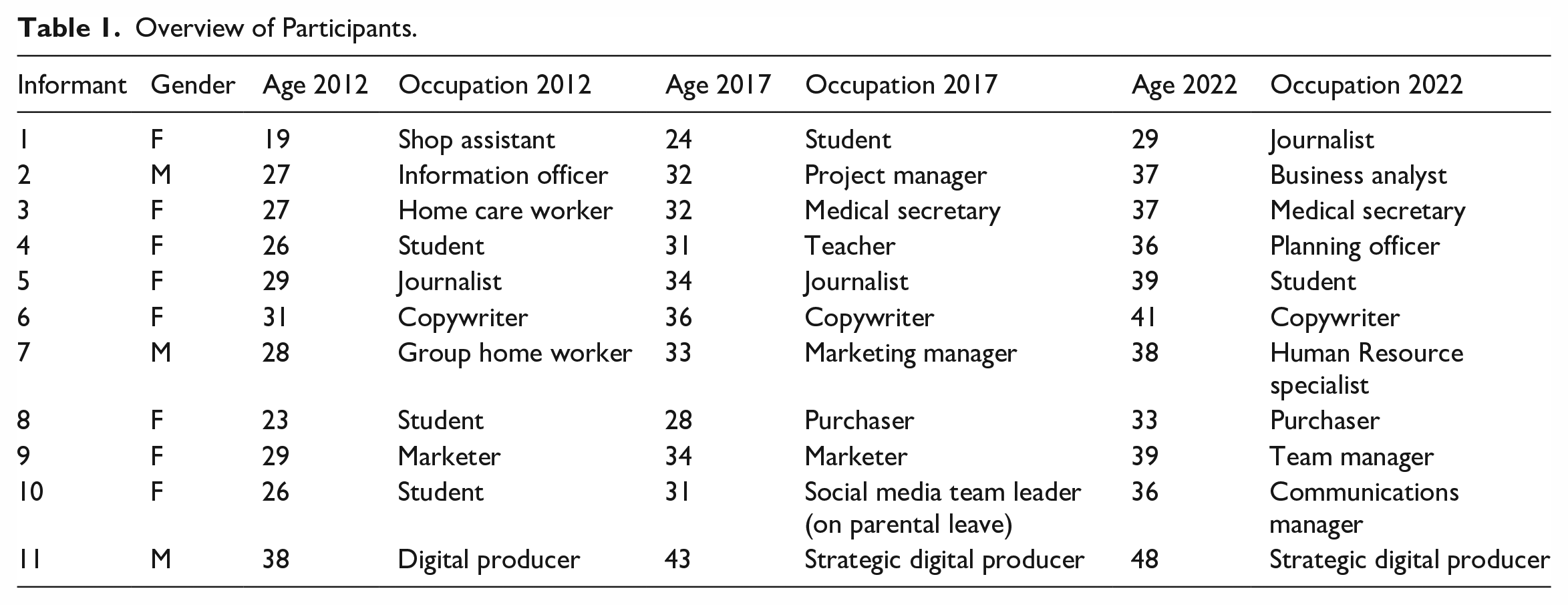
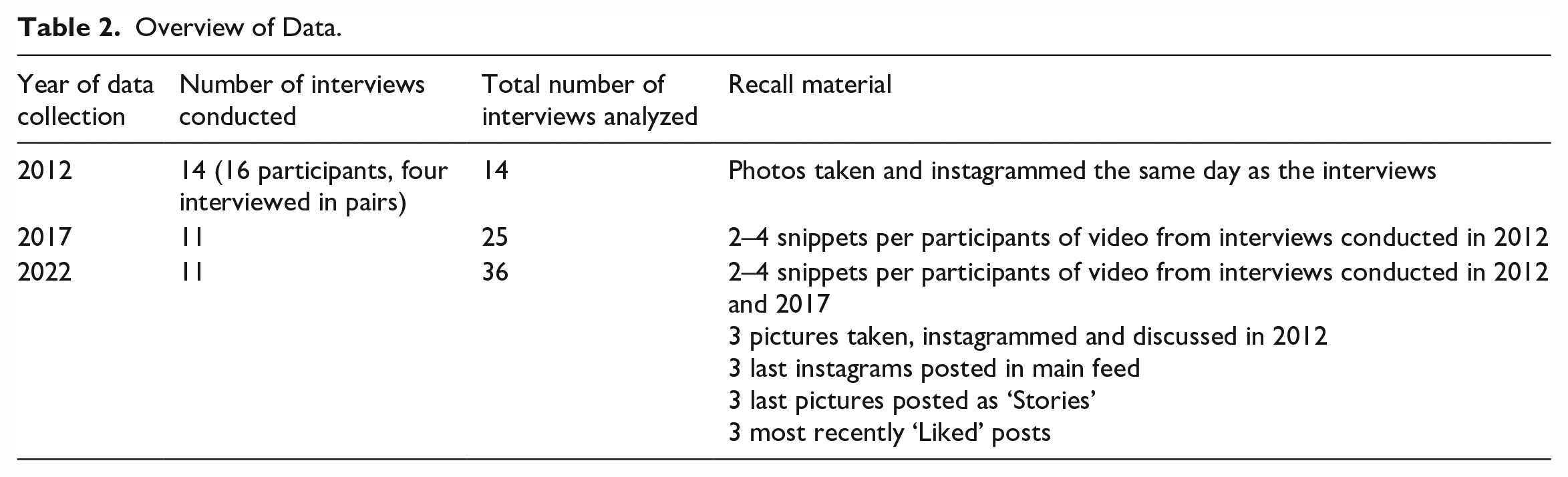
For the first study in 2012, each interview lasted about 1 hr and was conducted in a museum, in connection to an approximately 1-hr long museum visit. The participants were interviewed about their social media use, especially in terms of social photography, and the interview ended with a discussion about the photos they had taken during their museum visit. For the follow-up study in 2017, the same 16 participants were invited to take part in interviews again. Eleven of them accepted and participated in approximately 1-hr long interviews. Eight of them took place face-to-face and three of them were conducted remotely through video calls. In addition to answering questions regarding their social media use, the participants were shown, and asked to reflect upon, short snippets of filmed material from the interviews conducted with them in 2012. This was done to link their reflections to specific statements, events, and content and to minimize general reflections on previous social media use. In 2022, the same 11 participants as in the 2017 study were interviewed once again. This time, due to some lingering concerns from the coronavirus disease-19 pandemic, the interviews were conducted through video calls.
The interviews lasted approximately 1 hr respectively and consisted of 40 min of discussion on general social media questions as well as reflections on their past practices, before moving on to some more detailed questions concerning previous posts and practices. Previous to conducting the interviews in 2022, the interviews from both 2012 and 2017 were revisited by the first author. Three fragments from previous interviews were chosen per informant. During the interviews, a general discussion preceded showing these fragments from previous interviews. Questions were asked on their social media use as of 2022 and how that differed from 10 years ago. As their previous interviews showed, the informants were asked to comment on their reasoning five respective 10 years ago. They were also shown three of the pictures they posted in relation to their interview in 2012 and asked to reflect upon those. The same interview guide was used in 2012, 2017 and 2022, but was revised preceding the interviews each year. Adjustments were made over the years due to shifts from interest in social photography in the context of museums, to a more general interest in social media practice and technical developments. No specific questions on nostalgia were included in the interview guide or asked during the interviews.
The idea of ending each interview with reasonings on previous statements and posted content, was inspired by the stimulated-recall technique (Dempsey, 2010) to stimulate more detailed reasonings and link these to specific statements, posts, and content. Stimulating memory through visual content such as photos and video “brings informants a step closer to the moments in which they actually produce action” (Dempsey, 2010, p. 349). Therefore, at the end of the 2012 interviews, the participants were shown and asked to reason on pictures taken and posted on Instagram during their visit to the museum. The 2017 interviews ended with the participants being shown snippets from the interviews they participated in 5 years earlier and asked questions about previous reasoning. In 2022, they were shown three of the photos they had taken and posted on Instagram in 2012, their three most recently posted photos in the main feed on Instagram, their three most recently posted photos as “Stories” on Instagram, their three most recently liked content on Instagram as well as short extracts from interviews conducted in 2012 and 2017.
The data collection has been conducted adhering to the most recent version of Association of Internet Researchers (AOIR) ethical research guidelines available at the time. Over the years, as the field has grown, the ethical guidelines for conducting internet research have evolved. When beginning to collect the data in 2012, we relied on the document “Ethical decision-making and internet research. Recommendations from the AOIR ethics working committee” (Ess & The AoIR ethics working committee, 2002). During late 2012 a revised set of guidelines was developed (Markham & Buchanan, 2012), which helped us guide through ethical concerns in 2017. In 2022, these documents were complemented by an additional update of internet Research guidelines published in 2020 (franzke et al., 2020). Applying these guidelines on our own work has included filling out informed consent forms prior to conducting interviews, offering informants to opt-out at any time, and anonymizing handles when writing about and presenting excerpts, screenshots, and photos.
Data Analysis
Each interview was video-taped, and these videos were then fully transcribed with a focus on verbal accounts. Thereafter, the data were categorized and analyzed through thematic analysis (Braun & Clarke, 2006) using the CAQDAS software NVivo. This work was done following each of the three data collections. As the complete data set was analyzed following the latest data collection in 2022, themes related to memories and nostalgia clearly emerged. As part of this analysis, we searched within the data for specific mentionings of (the Swedish equivalents of) “nostalgia”, “remembering”, “memories”, and the similar. In addition to explicit use of these expressions, we also considered examples of informants reasoning with what we interpreted as a “nostalgic tone” in a way similar to that suggested by findings presented by Menke (2017). The first author did the thematic analysis following each of the three data collections, consulting the first author throughout the process (see Table 2 for an overview of how our work has been conducted and analyzed).
Overview of Data.
For transparency, we clarify that the material collected for the study in 2012 has partly been reported in (Weilenmann et al., 2013). Both the 2012 and the 2017 data have been part of (Jungselius & Weilenmann, 2018; 2019) as well as the PhD thesis of the first author, presented in 2019 (Jungselius, 2019). None of these previous publications deal with nostalgia, and the examples presented in this article have not been included elsewhere. Most importantly, data from the study conducted 2022 have not been published previously.
Most of the examples we present in the following section are from 2022, as no patterns of expressions of reminiscing or nostalgia were discovered in the data analysis following upon the data collections conducted in 2012 or 2017. However, we did find a few individual examples of social media reminiscence in the previously collected data when analyzing the complete dataset as a whole in 2022. By doing so, and by linking the informants’ reflections upon previous practices to our previously collected data on their actual practices through stimulated recall interviews, we are able to provide detailed examples of the diachronic quality of social media and reminiscing. It is our belief that our methodological design, which allowed the informants to look back on previous practices and social media use, invited them to reminisce, contributed to enabling these themes to appear clearly in the analysis following the data collection conducted in 2022. Since we are dealing here with social media memories and reminiscing in connection to social media, it is natural that the first year’s interview did not involve many reflections around these issues, since there was less social media material to look back upon at that time. Also, as we will show, social media practices have changed during these years, from active posting to more consumption of previously posted material.
Findings: Reminiscing in and Through Social Media
In the following section, the results from an analysis of a total of 36 interviews, conducted with the same social media users in 2012, 2017, and 2022 will be presented and sorted under two subsections capturing aspects of social media reminiscence and nostalgia. The findings include examples on how our informants describe their use of social media to reminisce as well as their reflections upon how their social media reminiscence practices have evolved over time. First, we show how social media users seek and engage with social media memories, that is, previously posted social media content, to reminisce. Second, we give examples of how social media users describe and relate to previous social media practices and highlight the duality of emotions involved when reflecting upon previous social media practices.
Using Social Media Memories to Reminisce: “When I Want to Feel Good, I Scroll Back on Instagram”
Within our data, there were several examples of informants engaging with social media memories and previously posted content in present time. During one interview, when the informant was asked to open the Instagram application on her phone and was requested to show the researcher her three most recently posted photos on her main feed she said, as she reached for her phone: “oh on main? How nice, this is what I do when I want to feel good, then I go, I scroll back on Instagram and it always makes me happy” (Informant 10, 2022). Another example of how an informant described how she actively seeks and consumes social media memories was found in an interview where the informant talked about her engagement with Facebook Memories. She said:
I usually check my memories now on Facebook, I usually do it every morning because it’s a bit fun and yeah
Those that just show up or do you go look for them in any way?
I go look for them because, like, memories from each year, what I posted that day
Okay, and why do you do that?
Well, it’s sort of fun to see what I’ve written before and like. Or maybe send them, just send them to a friend or on Messenger if there is a special memory that has to do with this person or something like that
So, this is a part of the daily routine?
Yes, you could say that.
(Informant 3, 2022)
In this quote, she describes that she actively seeks these memories almost every morning, and that her motives for engaging in this activity being that “it’s a bit fun” and “sort of fun.” What she is describing here is an active form of social media reminiscing, where she seeks these “triggers for nostalgia” (Niemeyer & Keightley, 2020) to revisit memories. We suggest that it is an example of social media nostalgizing, which is manifested by her actively looking for memories, rather than just passively receiving them. Furthermore, she describes that on some occasions, she also includes others in the reminiscing by sharing memories with someone else. In a similar way, another informant described “treating herself” to notifications of Facebook Memories. In a longer sequence, she reflects upon how she has changed her behavior on social media and how looking at her past posts provides her with pleasant memories: This is something that I treat myself to on Facebook, to get these like retrospect that you can get, that something shows up like something that you have memories this day with this and that person from like ten years ago, three years ago you posted this and it’s not much from these last two three years at all. Now, I don’t check this every day, but it is a lot from seven to ten years ago. Then something happened every day. You shared something or posted something where it was just a thought, and you posted that on Facebook then. But now, maybe I do that, like share a thought with someone on Facebook, or what do you call it, on your own wall, like once a month maybe and before it was probably almost every day, sometimes maybe multiple times per day. So, it’s like yeah, what, one-thirtieth? It’s like a real big difference (Informant 6, 2022).
She describes how turning on notifications for Facebook Memories is an active choice for her, and uses the words “treating herself,” suggesting that it arouses some sort of pleasant feeling. She also reflects upon the changes in her own practices when it comes to how often she shares things on Facebook, and how her previous almost daily postings now provide her with memories to look back at. When asked to elaborate she continued: I think it is super cozy and I think like this too: now I think that I am pretty boring on social media like really, what, who, why would anyone follow me? I don’t think anyone would be interested in that, but besides that I can also think that like yeah this was a bit funny and oh I was pretty amusing eight years ago (Informant 6, 2022).
Here, she reflects on her previous self, and how she sees herself, 8 years ago as a “pretty amusing” social media character, compared with the current “pretty boring” social media character she is today. Building upon Sterns’ (1992) definition, this could be described as a form of personal social media nostalgia, which involves reminiscing about the person she was and formerly displayed on social media. When asked to explain what she meant by this practice being “cozy,” she said: You get brought back to like maybe some funny jargon that you had, or you get reminded that so many have had kids now or have moved from the city that you sort of lose. You don’t lose them, but they are not as present in your life. You don’t go for coffee like once a week but like then you’re reminded of something, and you can just ping them in that eight-year-old conversation and be like hey you do you remember this and haha and then suddenly you have made dinner plans and like we need to catch up. Researcher: So, it’s almost like breaking the ice to be able to reconnect or Informant: Yeah, I think so. And I think that’s what feels like treating oneself. (Informant 6, 2022)
This example highlights how reminiscing over previous content and previous practices are often intertwined. She is reminded of “some funny jargon that you had with someone,” that she was “pretty amusing eight years ago” and uses the word “cozy” when referring to the feelings motivating her reminiscing. She also describes how this reminiscing sometimes leads to reconnecting with friends that are not present in her life to the same extent as before.
In another interview, as one of the informants was showing and talking about one of her most recently posted photos on Instagram, another interesting aspect of social media reminiscence emerged. The informant described how and when one specific photo had been taken and posted: Yeah so this is a picture of me and a friends’ dog on an amazingly beautiful winter day, I guess it was January or February something like that and I am out walking with a girl named Lovisa by uhm yeah by that lake somewhere and I was heavily pregnant and I just remembered that walk being so nice and then I shared it as one of those posts, on this day seven years ago, I guess it just showed up or that I thought about it being, I think It just showed up on my phone with some kind of like reminder that it was Researcher: Ah okay so this one is not posted- I: No, seven years ago. This is a day seven years ago; it says here I see. I think I posted it that day with Lovisa, she is really interested in photography, I think she might have taken it with a system camera uhm but yeah, no, this is posted now. (Informant 10, 2022)
In the discussion around this photo (Image 1), she described that it “showed up” as it was suggested by her iPhone (through iOS Memories) and later during the interview, she explained that the photo had been taken and shared on Instagram in 2015. She remembered and gave us a rich and detailed description of the beautiful winter day, that she was heavily pregnant, the name of the lake, the dog, who she was with, that person’s interest in photography, and so forth. In addition to remembering the event portrayed in the photo, she also has memories of re-sharing it on social media as a memorable post. What is interesting here, is how this example highlights how the informant refers to the event in itself as well as the event of posting the picture as a memory of a nice day, both being central to the practice of reminiscing.

Informant 10, 2022.
Although reflections on previous social media practices were particularly evident in the interviews conducted in 2022, there were also examples to be found within the previous interviews. In 2012, one participant described being an active user of Instagram and compared that to when she was active on another platform, “Bilddagboken” a few years before (“The Picture Diary” was a Swedish, commercial photo sharing community launched in 2004, no longer in service at the time of the interview in 2012). She said: Many many years ago, I had Bilddagboken and that stuff and I know that both me and my friends were very active on Bilddagboken like five, six years ago and we feel can feel like oh okay there is a new Bilddagboken now uhm what we did then, we were like around fourteen years old then, that was just taking a lot of photos of our or of ourselves all the time and looking as fierce and cool as possible and you can sort of feel that now, with Instagram, that these feelings come back. Fortunately, these feelings don’t turn into action, it’s rather these like, feelings of nostalgia (Informant 1, 2012).
Again, this person seems to be referring to the practice and activities surrounding the use of the platforms, rather than to the actual content posted there when she claims getting “feelings of nostalgia.” This highlights the fact that not only do the memories themselves matter, as suggested by Beer (2012), but so do the memories of the practice of creating them. As suggested in this latter example, from the interview in 2012, reminiscing over previous engagement with digital and social media seem to be connected to previous practices in addition to being connected to specific content or platforms. The “feelings of nostalgia” that are mentioned here are evoked by noticing a similar practice that the informant engaged in with her friends, years ago. Historical social media nostalgia deals with the general practices of the platform and how it was used previously, rather than the more personal social media nostalgia, that is connected to one’s own personal use and the personal memories posted on the platform.
Reflecting on Evolved Social Media Practices: “I Do Miss It a Bit”
In a similar way as in this last example, in addition to referring to previous events, there were several examples during the interviews of when the informants referred not only to the events portrayed in the posted photos, but also to the practices of creating social media posts of these events. During the interviews, especially in 2022, the informants often reflected upon how their social media practices had changed over time. For instance, one informant referred to her general use of social media around 2010, stating that back then, “you were supposed to update a lot, this was still at the time when we did albums on Facebook and like, you don’t do that today” (Informant 8, 2022). Another informant referred to a previous specific social media practice when scrolling her feed during one of the interviews. She said: “There are some pictures of food that show up here now but if you compare it to a couple of years ago, oh my god, every other day, everyone had to know what I ate” (Informant 4, 2022).
A third informant described his use of social media in 2022, comparing contemporary social media interaction to “the old way” of communicating, mentioning that in 2022, in his group of friends, they simply don’t use social media as much as before. Instead, they have returned to this referred “old way,” which he described as being when you call and talk to each other and tell someone that you have been to a hockey game rather than posting a picture each time you’ve been to a game or if you are out or at the movies or whatever (Informant 2, 2022).
During the interviews, some of the informants elaborated on their feelings and attitudes toward memories of previous practices. This is another form of personal social media nostalgia that often connects with a historical social media nostalgia of the platform and its use. One informant described “missing” how she previously used social media. She said: Yeah well, I do miss it a bit, that it was more like, you could write, when I look back at memories on Facebook now then sometimes it’s like, you like wrote directly on someone’s wall, like different things, like I can come visit you tomorrow or like yesterday was fun and whatnot. I could write that to friends, I see that now. I did that but you don’t do that now. Or at least I don’t. So maybe it was that my friends and like those that I hung out with, that they were more active on Facebook, that you like, communicated more. Now you might send a text instead about stuff that you don’t want everyone to see (Informant 3, 2022).
A similar example of reminiscing over previous use of social media was found in another interview, where a woman explained how she feels when exposed to memories on Facebook: When you get those memories on Facebook, then I think it’s almost like when you open a diary. When you find something in an old box. That it’s almost that you, oh that’s so cute that I wanted to tell people about that uhm I have toned down over these years so that I’m like but wait, not everyone is, should I really, after every time that I have been out for a run, then I posted that I had been out for a 5K run and some happy face and now I’m like well okay so who would be interested in that three times a week? But uhm I still sometimes post a picture on Instagram because I miss that pleasure surrounding it being a bit creative, you took a photo of your running shoes, so I did that the other day and thought that was, I was a bit nostalgic. Because I like this whole thing, it’s not like having to stop to post a line on Facebook or like, I feel like that has completely disappeared. I feel like, almost naked if I write something on Facebook. I don’t even remember the last time—oh yeah right it was, we had a break-in into our garage and then I wanted to tell the neighbors to look out because there are some mischiefs out now but that was more of like wanting to warn the public (Informant 10, 2022).
She mentions being “a bit nostalgic” when looking at “those memories on Facebook.” Interestingly, when saying that she “miss[es] that pleasure surrounding it being a bit creative,” what she is referring to is the practice of creating and posting content, rather than the activity she posted content about. Similar to what other previous work on social media nostalgia have been able to conclude, showing that many nostalgic social media posts contain expressions of both positive and negative emotions (Davalos et al., 2015); in this example, there are obviously ambiguous feelings involved. While she is describing “missing the pleasure,” she also refers to this previous, more frequent posting behavior, as “so cute that I wanted to tell people about that.”
Through our data, we have seen several examples of how previous social media posts invoke mere pleasure and enjoyable feelings. These positive and idealized aspects are a central part of nostalgia as a concept (cf. Stern, 1992). However, within our data, there are also additional examples of when the informants describe more complex emotions being evoked by social media memories. There are examples of how they themselves produce and share content that they have ambiguous emotions about. The duality of emotions related to nostalgia over social media content was visible within multiple interviews. One informant discusses feelings related to a decrease in produced and shared content in 2017, and describes that she used to create and post a lot more content before: I used Twitter for many years, so it is super fun to keep all that stuff as a memory and like go there and check sometimes uhm, but I am very keen on making it private. Because I find it a bit disturbing that I’ve kind of blown out a lot of stuff that I don’t remember and that maybe someone will find it (Informant 1, 2017).
Following this quote, she talks about previously writing a blog and how she appreciates and reads these old blog posts, but how she, as in a similar manner as with her tweets, have made these private: Yeah, that’s so much fun [. . .] it’s super fun, I do that and especially to be able to scroll back because I was so diligent with my blogging. And I was very personal and wrote like today I have hung out with this person and done this, and it was more like a diary and then to be able to scroll back, what did I do on September 25, 2008, is super fun (Informant 1, 2017).
She describes a number of positive aspects of reminiscing over old tweets and blog posts, such as it being “super fun,” that it is nice to “keep all of that stuff as a memory.” She enjoys being “able to scroll back” and appreciates that she posted such detailed descriptions of her life back then. In parallel however, she also mentions this transparency and frequent posting being “a bit disturbing” as she has “kind of blown out a lot of stuff,” and the thought of someone finding this makes her a bit disturbed. Therefore, she is very keen on making sure that these posts are made private and not accessible to anyone, anywhere. This suggests a tension between, on one hand, being glad and thankful for previously posting extensive amounts of detailed accounts of one’s whereabouts, yet, on the other hand, not wanting it to be publicly available anymore. Her reflections suggest that the content itself excites positive emotions, but the practice of posting it evokes negative feelings.
Another example of a described emotional ambiguity in terms of both appreciating that previously posted content was posted as it was back then, but also not being comfortable with posting content as publicly today, was found in one of the interviews where the informant described enjoying that the memories on Facebook where available to look back on, but also acknowledging that the practice of producing and sharing content has evolved and looks different today. She talks about people posting “very diary-like on Facebook,” and compares this to what she herself has shared on social media over the years: Generally speaking, it is a big difference if you get these like posts on Facebook that like you wrote this five years ago and I can get almost astonished that I was so, that it was so completely different than uhm what I would have chosen to post today [. . .] uhm saw this movie or was at this restaurant, like I was so open it feels almost like a diary sometimes. And I can reflect upon what some people write today on let’s say Facebook, that it is very like [. . .] very diary-like on Facebook [. . .] so that it has changed, so that you are much more choosey with what you chose to share there while with photos and maybe if its special holidays and so on that it should be a bit more spectacular to share a picture from Instagram to Facebook, but otherwise there is not a lot of like now I ran a run and you were happy about that and you had a need, a strong need I felt like, to share both if it was on Twitter for a while and then it was like Facebook for a while so that was a lot, I don’t have that strong urge to share in that way (Informant 10, 2017).
She reminisces around her own, previous social media behavior and older posts and describes “a strong need” to share a lot more previously than she does today. She also remembers sharing content on a multitude of social media platforms and compares her previous behavior to what others do in 2017. Likening what “some people” write today on Facebook to what you might find in a diary suggests that what she is saying here is that the perceived norm of a “right” level of disclosure has changed. A diary is usually written for oneself, and not meant to be shared with the world. Yet, what is posted on Facebook is often accessible to, if not the whole world, so at least a larger audience than only oneself. In these final examples, where the participants describe having ambiguous feelings in connection to their previous social media post, it seems that it is not primarily the memories themselves that provoke negative feelings. Rather, it seems to be the concern that one has been “over-sharing” or that certain events have been shared previously, during a time where sharing was more frequent than today, and that these memories are now available and exposed to others in a way that is not in line with one’s current more limited sharing practices.
Discussion and Conclusion
This article expands the understanding of the interplay between social media, reminiscence, and nostalgia by conceptualizing social media reminiscing practices and personal and historical social media nostalgia in a contemporary digital context. In the following section, we begin by discussing the practice of social media reminiscence, that is, how social media users use their social media memories to reminisce and how they reflect upon the diachronic aspects of their evolved social media practices. Second, we define social media nostalgia and discuss the active form of social media nostalgia, that is, social media nostalgizing. Third, we highlight the role technology and platform affordances play in social media reminiscence and nostalgia, and finally, we explain how visualization of mediated social media memories present a unique insight into an ongoing social transformation of everyday life.
First, we begin by conceptualizing social media reminiscence. In this article, when we talk about social media memories, we refer to previously posted social media content that evoke reminiscence. We have defined the practice of social media reminiscence as remembering, storing, and interacting with and through previous posts made on social media. Throughout our data, we have found numerous interesting examples of how our informants relate and refer to social media memories. Also, we have presented examples of how they reflect upon how these sharing practices in themselves have evolved and how remembering these, in turn, evokes ambiguous feelings. The informants talked about “wanting to feel good” and turning to their Instagram feed to accomplish that and getting “brought back” to a time that no longer is. Others mentioned “missing it a bit” as they reflected upon how they used to practice social media.
Second, we define social media nostalgia. Social media nostalgia refers to historical and/or personal nostalgia. Historical social media nostalgia refers to the way “it” was, which in this context points to the general practices of the social media platform and how it was used previously. Personal social media nostalgia, however, refers to the way “I” was and to one’s own personal social media use, the memories posted on the social media platform and to experiencing nostalgic feelings toward one’s own past life. Stern (1992) pointed out that nostalgia involves an idealization of the past, “expressed by the individual’s attempts to recreate some aspect of the past in present life, either by reproduction of past activities or by the recollection of symbolic representation in memory” (p. 11). Social media nostalgia can be used to describe the feelings that previous social media practices evoke. These include positive as well as negative feelings, often in parallel and/or in conflict, that users experience when looking back and reasoning on past sharing practices. The concept of nostalgia includes yearning for “times and places that are no more, or are out of reach” (Niemeyer, 2014), naturally sometimes evoking ambiguous feelings. Our informants describe feeling both embarrassed about what and how they shared snapshots of their lives, but at the same time also enjoying having access to this window into their past lives. It is confirmed in our work that social media memories found in digital archives evoke these sometimes-conflicting emotions. Our informants describe having positive memories related to their previous social media practices of producing and sharing content and claim to “miss it a bit.” Also, they express ambiguous feelings toward remembering writing, posting, and sharing a lot of details from everyday life and both appreciating having these memories to look back on, since this is not what they do anymore, but also experiencing feelings of embarrassment and being keen on “keeping it private” to make sure that no one other than themselves are able to read it. This is in line with previous work on social media memories, suggesting that nostalgic posts often evoke mixed (Davalos et al., 2015) and sometimes conflicting emotions (Migowski & Fernandes Araújo, 2019).
Continuing our conceptualization of social media nostalgia, we want to draw attention to the concept of “nostalgizing,” first coined by Niemeyer (2014), which includes an active form of nostalgia, where nostalgia is being practiced rather than a state of being. Building upon this idea, we present the concept of social media nostalgizing, which refers to when someone is actively using social media memories to evoke feelings of nostalgia. Although closely related concepts, there are differences in terms of what constitutes practices of nostalgizing as compared with other modes of reminiscing, memory, and remembering. Social media memory practices have been explained as facilitators of “backwards glances to previous times, moments, and events” (Jacobsen & Beer, 2021, p. 1). For this article, social media reminiscing practices have been defined as involving remembering, storing, and interacting with and through previous posts made on social media. Social media nostalgizing however aims to capture the more active and emotionally complex form of remembering and experiencing nostalgia, where nostalgia is being practiced rather than consumed (Niemeyer, 2014), and where the nostalgic feelings are often triggered by the technology and the platform affordances, yet brought to mind by the user. Nostalgizing, as compared with remembering, emphasizes an idealization of the past (Stern, 1992), and often involves “attempts to recreate some aspect of the past in present life, either by reproduction of past activities or by the recollection of symbolic representation in memory” (Stern, 1992, p. 11). Examples of social media nostalgizing have been found in our informants’ descriptions of how they draw upon their previous social media posts to feel good, and how their social media repositories work as a form of old diary that they enjoy having access to. From our findings, it is clear that social media users often refer to previous social media use when examining their use of today. Some of our informants describe how they remember an expectation to interact with others and post more frequently than today, thereby generating more social media content than what they do today. Some remember and describe the events and activities that they previously posted social media content about, while others look back on, and reminisce over, the ways in which they created this content. The memories of past events and past social media practices are often closely intertwined. Not only do users reminisce over the actual memories, but also over the practice of creating the social media representations of these memories. And clearly, as argued by Beer (2012), these digital archives matter to people.
Next, this study empirically demonstrates the enabling and central role that technology and platform affordances play in both social media reminiscing and social media nostalgizing. Our informants express feelings of nostalgia on several occasions over the years, some already in 2012. Feelings of nostalgia are evoked throughout life. The older one gets, naturally, the more memories have been created and constitutes a larger repository to dig into. In a similar way, having lived a longer life in social media, having documented and shared many events over a great number of years, would, in turn, have generated a great deal of mediated social media memories to look back on and reminisce over. Technology and the design of social media platforms play an important part here, as they afford social media memories to be created, shared, stored, revisited, and shared again, years later. Just like Niemeyer and Keightley (2020) have described that mediated memories can act as triggers for nostalgia, we have seen how the ways in which the platforms store and provide reminders about past social media posts create opportunities for nostalgia. These mediated memories make it possible to not only look back at events that are pleasant to remember, but also create potential for provoking negative emotions. Previous scholars have even suggested that in addition to shaping practices surrounding these technologies, social media might also shape users’ memories as well as how they feel about the memory (Jacobsen & Beer, 2021). The digital memories created and shared in social media are massive and somewhat easily accessible today. Most platforms have features suggesting revisiting, and sometimes re-sharing, previously posted content, suggesting that users of social media today have easier access than ever before to material that evoke nostalgia. Our informants primarily talk about the use of dominating platforms within their generation, but also refer to previously popular social platforms that are no longer in service. This leads us to speculate whether social media nostalgia might be a phenomenon not depending on the specific platforms, but rather on the social media practices that they afford. When conducting early studies of visual communication of everyday life, Chalfen (1975) wrote about the possible insights that can be gained from studies of culturally structured practices. Expressing the value for future generations, he wrote that “[t]his is so for any form of visual representation from which we try to gain knowledge about the past, present, or future state of the human and social condition.” (Chalfen, 1975, p. 100). As anticipated by Niemeyer in 2014, social media have now become “spaces to ‘nostalgize’” (Chalfen, 1975, p. 28), where both users and researchers have access to substantial amounts of content created around the narratives of our everyday lives. As social media is such an intertwined part of contemporary culture, studying these culturally structured digital archives in the future may give us detailed visual representations of everyday life, as lived in the 2010s and 2020s.
Finally, our findings point to an ongoing social transformation and evolving of social media practices. In the early days of social media, the present was more present; it was the days of sharing ongoing activities and status updates about “what are you doing now.” Similar to how Miller (2011) describes the development of Facebook “after an initial concentration on good news and things of the moment, Facebook is becoming an important site for people responding to death, loss and memorialization” (Miller, 2011, pp. 191–192), our informants describe how they used to view social media as a form of diary where they shared their everyday life, posted images, and created memories. In that sense, social media was initially one-dimensional, whereas today, there are layers of previous memories and events to look back and reflect on. Building upon van Dijck’s theorization of mediated memories from 2007, one could say that these digital shoeboxes of multiple-layered mediated social media memories of today allow for re-sharing of previous experiences, but also for re-sharing of previous re-sharings to a greater extent than ever before. Social media is undergoing a social transformation where its users’ relationships to past and present are being transformed, through the access to older, previously uploaded content as well as continual access to social connections. As argued by Kaun & Stiernstedt (2014), media technologies are “in a profound way about organizing and creating a sense of time” (p. 1156). From the analysis of our findings, it is our belief that social media challenges our perception of memory and sense of time. Our findings are in line with Miller’s early studies of Facebook, where he argues that social media allows for a transformation of the self and our relationship to time. Miller (2011) shows, through the eyes of one of his informants, how Facebook transformed itself and took on different shapes, as her life changed. Miller also made the connection to how the course of life changes, where life was once fun and interesting to share, but when less is happening, less is being shared and how this in turn, resulted in fewer postings, but more time to spend looking at what other people shared. Our findings support the same argument. In addition, Miller, who wrote about Facebook in 2011, only a few years after it was launched, mentioned that users were already then nostalgic about Facebook as a platform and remembering how it was used in the “old days.” Quoting Miller (2011) again: “As it develops its own history, it seems also to be turning its attention towards the past” (p. 192), leading us to speculate that social media, in a larger sense than only referring to Facebook, might continue to develop its own history, while simultaneously turning its attention to the past.
Through our empirical exploration of social media memories, we hope to have contributed to the growing understanding of the role of the smartphone in mediated memories, reminiscing, and nostalgia. The “smart phone is central to how we remember” (Hoskins & Halstead, 2021, p. 679), and is a “prism on our everyday experience and lives” (Hoskins & Halstead, 2021).
Footnotes
Declaration of Conflicting Interests
The author(s) declared no potential conflicts of interest with respect to the research, authorship, and/or publication of this article.
Funding
The author(s) received no financial support for the research, authorship, and/or publication of this article.
