



Abstract
This study proposed a novel typology that categorized online trolling into proactive and reactive types and conducted two studies employing qualitative and quantitative approaches to better understand the motivations behind these two types of trolling. Study 1 surveyed participants who had engaged in trolling (N = 90) and identified four motivations for online trolling through an inductive qualitative analysis: revenge, maintaining social justice, rebutting for disagreement, and thrill-seeking. Study 2 developed scales to measure the four trolling motivations and validated them through another survey of participants who had engaged in trolling (N = 455). The quantitative results supported the four-factor motivation of trolling and the proactive–reactive trolling scale. Structural equation modeling revealed that thrill-seeking and rebutting for disagreement were positively associated with proactive trolling, whereas revenge and maintaining social justice were positively associated with reactive trolling. These findings contribute to establishing theoretical connections between varying motivations and the two types of trolling behaviors and serve as practical guidelines for developing tailored strategies to reduce and regulate online trolling.
Online trolling—individual or collective online behaviors that “involve the use of antagonism, deception and vigilantism, or any reconfiguration of these social practices to provoke reactions from people or institutions” (Demsar et al., 2021, p. 1078)—has become increasingly prevalent and hazardous in social media and online forums in recent years (Quandt et al., 2022). Over a quarter of Americans have engaged in online trolling activities by posting malicious content to strangers (Gammon, 2014), and nearly one in three Australians have been trolled online (Morgan, 2019). The contagious and reciprocal nature of trolling is particularly concerning, with individuals who have been trolled or witnessed others’ trolling tending to engage in the same behavior (Cheng et al., 2017; March & Marrington, 2019). The victims of trolling often suffer severe psychological harm, including lowered self-esteem and increased suicidal ideation and self-harm (Coles & West, 2016; Thacker & Griffiths, 2012).
To better understand online trolling and develop effective intervention strategies, scholars have explored the motivations that drive individuals to engage in trolling behaviors. Previous studies have mainly focused on personality-driven factors, such as deriving pleasure from hurting others (e.g., sadism), as the primary motivation for trolling (Alavi et al., 2022; Buckels et al., 2014). However, recent evidence suggests that trolling behaviors can also be driven by diverse social–psychological motivations (e.g., revenge and ideology) beyond personal enjoyment (Cook et al., 2018; Fichman & Sanfilippo, 2016), indicating the need to further investigate the complexity of trolling motivations.
Moreover, trolling consists of multifaceted behavioral patterns, and several studies have suggested various typologies and methods for classifying and measuring trolling behavior (Demsar et al., 2021; Fichman & Sanfilippo, 2016; Hamarta et al., 2021; Manuoğlu & Öner-Özkan, 2022). Specifically, recent qualitative studies have shown that some users may take the initiative to provoke and harm others, while trolling activities can also occur in response to the provocation of others (Cook et al., 2018; Demsar et al., 2021), implying that trolling behaviors could be enacted in either a proactive or reactive manner. However, this typology of proactive-reactive trolling has not been thoroughly examined in existing research. Therefore, this study aims to address these gaps by (1) identifying the motivations behind online trolling on social media and online forums, (2) differentiating trolling behaviors into two subtypes: proactive and reactive, and (3) developing and validating the motivations and subtypes of trolling behaviors and examining their associations.
This study enhances our understanding of the typologies of trolling behaviors and offers a novel perspective on trolling as both proactive and reactive. In addition, this study uncovers the sociopsychological motivations underlying people’s participation in trolling behaviors and develops assessment scales for these motivations, going beyond the predominant focus of previous research on the impact of personality factors on trolling behaviors. Finally, this study illustrates that the motivations behind trolling behaviors take different forms within these behaviors.
Online Trolling: A New Typology
Definitions of online trolling have evolved substantially over time. Donath (1999) defined it as an identity game in which the troll endeavors to present themselves as a legitimate participant by posting bait comments to elicit emotional reactions from others. A decade later, the definition of trolling evolved to highlight its deceptive and disruptive characteristics. For instance, Hardaker (2010, 2013) depicted trolls as users who adopt a pseudo-sincere identity while engaging in computer-mediated communication with the intention of exacerbating conflicts and inciting disruption for amusement purposes. Some scholars have defined online trolling as a deceptive and destructive online behavior aimed at provoking hostile reactions from others and disrupting the flow of communication (Buckels et al., 2014; Hopkinson, 2013).
Recent studies have further refined the conceptualization of trolling by incorporating its aggressive and malicious characteristics and developing more unified definitions (Fichman & Sanfilippo, 2016). March and Marrington (2019) recognized trolling as aggressive and malicious behaviors that aim to distress victims by sending inflammatory and provocative messages. A meta-review study conceptualized trolling as deliberative, deceptive, and mischievous attempts intended to elicit reactions from others to benefit trolls and harm targeted individuals (Golf-Papez & Veer, 2017). An empirical work conducted by Demsar et al. (2021) defined trolling as social practices that encompass the use of antagonism, deception, and vigilantism to provoke reactions from other people.
Although scholars have varied views on what constitutes online trolling, the different conceptualizations of online trolling share some characteristics and commonalities. First, online trolling definitions are evolving, largely shaped by social, economic, and technological changes (Demsar et al., 2021). Second, trolling is a multidimensional construct that can be categorized into different forms and types. While most scholars consider antagonism (e.g., being aggressive, antisocial, or malicious) the salient feature of online trolling behaviors (March & Marrington, 2019), other types of behaviors, such as deception and retribution, can also be considered trolling (Buckels et al., 2014; Demsar et al., 2021; Golf-Papez & Veer, 2017). Finally, provocation is the principal mechanism underpinning different types of trolling behaviors, suggesting that the ultimate goal of online trolls is to provoke reactions (Demsar et al., 2021; Golf-Papez & Veer, 2017).
Online trolling is a complex and multifaceted phenomenon that can take many forms (Fichman & Sanfilippo, 2016). For example, scholars have classified online trolling into verbal and behavioral (Cook et al., 2018). Verbal trolling involves using words to harm others in online settings (Cook et al., 2018; Fichman & Sanfilippo, 2016). It is particularly prevalent on social media platforms and online discussion forums, where users can post inflammatory and offensive comments; engage in swearing, insulting, trash-talking, flaming, and spamming; and use other aggressive and abusive tactics to provoke emotional responses and disrupt conversations (Cheng et al., 2017; Cook et al., 2018; Sun & Fichman, 2020). In contrast, behavioral trolling typically occurs in online games or virtual reality environments, where players may engage in disruptive or harassing behavior that inhibits their teammates or aids the enemy (Blackwell et al., 2019; Cook et al., 2018). Trolling can also differ in its goals. Most trolling behaviors aim to elicit reactions by causing harm, distress, and sarcasm to others, although some are intended to be harmless or even entertaining (e.g., kudos trolling or humorous trolling; Bishop, 2014; Sanfilippo et al., 2018). Demsar et al. (2021) categorized online trolling into three types: antagonism (inciting hatred), deception (purposefully deceiving others), and vigilantism (seeking revenge). Similarly, Hamarta et al. (2021) developed a trolling scale with three subtypes: harm-, provocation-, and fraudulence-based.
Despite the various types, forms, and contexts of trolling, this study specifically focuses on verbal and aggressive online trolling—an online behavior intended to provoke reactions from others using malicious and aggressive words, such as swearing, insults, and personal attacks— because malice and aggression are the most common and salient features of trolling. For instance, March and Marrington (2019) conducted a qualitative thematic analysis of people’s conceptualization of internet trolling and found that a considerable number of their study participants perceived online trolling as an intentional and malicious behavior aimed at provocation and disruption. Demsar et al. (2021) examined historical archives of documents about trolling and discovered that the most predominant type of trolling within the archived documents is antagonistic or aggressive trolling. Furthermore, compared to other types of trolling (e.g., humorous, deceptive trolling), antagonistic trolling can result in more serious psychological consequences for the victims. Online trolling victimization has been found to be associated with lowered self-esteem (Thacker & Griffiths, 2012) as well as higher risks of suicidal ideation and self-harm behaviors (Coles & West, 2016). The prevalence of aggressive trolling, along with the potential severe outcomes it can cause for targeted users, led us to place more focus on aggressive and malicious trolling in the current study.
Recent qualitative studies have shown that in online gaming or consumer-brand interaction, individuals may take the initiative to troll even without any provocations from others, or they may troll in response to others’ provocation or threats (Cook et al., 2018; Demsar et al., 2021), suggesting that trolling can be viewed as proactive or reactive behavior. However, the proactive–reactive characteristics of trolling behaviors have not been fully captured by existing quantitative scales of trolling behavior. To fill this gap, the present study draws on insights from traditional offline aggression (Dodge et al., 1997; Raine et al., 2006) and attempts a novel approach to categorize online trolling into proactive and reactive types.
In the literature on offline aggression, reactive aggression refers to aggressive behaviors in response to (perceived) threats or provocation from others, while proactive aggression is described as initiating aggressive activities first without being provoked by other people (Dodge et al., 1997; Raine et al., 2006). Research has validated the proactive–reactive framework in offline aggressive contexts (Cima et al., 2013; Raine et al., 2006). Recent qualitative studies have further demonstrated that online trolling behaviors are motivated not only by proactive motives (e.g., personal enjoyment) but also by the need to defend against other people’s provocation (Cook et al., 2018; Demsar et al., 2021). Thus, online trolling can also be distinguished through the lens of the proactive–reactive framework, which may aid in understanding the current online trolling phenomenon in a more nuanced manner. Moreover, the proactive–reactive aggression framework highlights that motivations and goals play a crucial role in shaping different types of aggression (Dodge et al., 1997); therefore, this study aims to explore the specific motivations that may lead to proactive and reactive trolling activities in the online environment.
Proactive trolling refers to the online behavior of taking the initiative to provoke or harm another person using hostile or malicious words even without being provoked by others. It is a planned and intentional aggressive behavior that aims to achieve goals beyond simple provocation or harm. Some of these goals include pursuing social status, gaining a sense of dominance and control, and deriving personal enjoyment. For instance, trolls may use provocative or extreme language to draw attention to neglected social issues (Matthews & Goerzen, 2019), and stigmatized individuals may defame those with a higher social status to boost their own standing (Fichman & Sanfilippo, 2016).
Reactive trolling refers to the online behavior of provoking or harming others using hostile or malicious words in response to real or perceived provocation and threats from others. Reactive trolling is designed to counteract threats or provocations from others and is often associated with a lack of self-control, impulsivity, and heightened emotional arousal caused by being trolled by others. Cook et al. (2018) found that reactive trolling is a common retaliatory response to being trolled by other players in online gaming. In some cases, individuals engage in massive and collective online trolling movements to defend their loved ones. For instance, Sun and Fichman (2020) found that fans of a particular celebrity are more likely to troll users who post negative comments about that celebrity. Another study showed that social media users may mock and discredit a company for its public anti-gay statement (Demsar et al., 2021).
To gain a deeper understanding of the nature of trolling behavior, it is essential to differentiate between proactive and reactive types of trolling. This distinction enables online community managers and educators to comprehend the behavioral manifestations, emotional arousal, and psychological motivations that underlie trolling. Furthermore, it allows them to develop appropriate intervention strategies to address trolling issues. For instance, disregarding or blocking proactive trolls might prove more effective than engaging with them as they often seek excitement or enjoyment from the reactions they provoke (Binns, 2012; Golf-Papez & Veer, 2017). Conversely, responding with politeness and reason to reactive trolls could help reduce their anger and defuse the situation. In addition, raising awareness and fostering empathy among individuals might serve as deterrents against engaging in both proactive and reactive trolling behaviors (Sest & March, 2017).
Motivations of Proactive and Reactive Trolling
Understanding the motivations underlying proactive and reactive trolling can foster online civility by enabling community managers to develop tailored deterrent strategies based on diverse motivations. These strategies might involve monitoring threats, implementing content moderation, and promoting community guidelines (Golf-Papez & Veer, 2022). As different strategies can lead to distinct effects, it is essential to identify and understand what motivates online users to engage in trolling.
Most previous studies have focused on personality-related motivators. For instance, Buckels et al. (2014) investigated how the Dark Tetrad of personality traits (i.e., Machiavellianism, narcissism, psychopathy, and sadism) influences people’s trolling behaviors and found that psychopathy and sadism positively predicted trolling behaviors; this suggests that trolling is a common strategy to seek pleasure by hurting others and watching them. Other studies have also supported the association between Dark Tetrad personality and trolling (Alavi et al., 2022) and further discovered that other personal factors, such as negative social potency (Craker & March, 2016) and cognitive empathy (March, 2019), are positively related to online trolling.
In contrast to personality-related factors, several social and psychological motivations that drive trolling have been identified in earlier studies utilizing an in-depth qualitative approach. First, the pursuit of hedonic benefits is found to motivate trolling behavior. Trolls derive pleasure and amusement from vandalizing online communities (e.g., Wikipedia) and disrupting online gaming (Cook et al., 2018; Shachaf & Hara, 2010). They also experience enjoyment and excitement from provoking others and eliciting reactions (Sun & Fichman, 2020). Another motivation for trolling is the desire for revenge. Trolls often seek retribution against those who have trolled them first, which is a common reason for trolling in online games (Cook et al., 2018). In addition, forum moderators who have blocked trolls may become targets of harassment and provocation as trolls seek revenge for being silenced (Shachaf & Hara, 2010). Third, the desire to seek attention and support from others is another motivation for trolling. For example, Shachaf and Hara (2010) discovered that trolls vandalize Wikipedia communities to receive attention and social recognition from other users. Ao and Mak (2021) further demonstrate that online influencers engage in trolling behavior to garner support from their followers and increase their in-group identity.
Fourth, vigilantism, where trolls seek retribution against the wrongdoing of individuals or organizations, can be another motivation for trolling. In online gaming, some trolls specifically target other trolls with the intention of punishing them and reforming their behavior (Cook et al., 2018). Similarly, consumers may engage in trolling behavior to mock and shame brands for their transgressions in the pursuit of social justice (Demsar et al., 2021). Finally, ideology and social status are substantial motivations for trolling (Fichman & Sanfilippo, 2016; Sanfilippo et al., 2018). Trolls may be motivated by ideological goals to achieve specific political objectives (Sanfilippo et al., 2018); for example, trolling can draw public attention to overlooked issues, which can then pressure politicians and voters to change their behavior (Matthews & Goerzen, 2019). In addition, social status motivation refers to trolling as a tool can help increase social standing of disadvantaged individuals (Fichman & Sanfilippo, 2016).
Despite the prevalence and complexity of online trolling, limited studies have been conducted on this topic; they have primarily utilized qualitative approaches and focused on a specific context or platform, such as online gaming (Cook et al., 2018), crowdsourcing platform (Shachaf & Hara, 2010), and marketing (Demsar et al., 2021). Most of these qualitative studies have conducted in-depth interviews or analyzed online archives from the victim or bystander perspective (Demsar et al., 2021; Shachaf & Hara, 2010), with very few studies directly investigating trolling perpetrators. Consequently, quantitative evidence to validate multidimensional motivations for online trolling in a broader social media or online forum context is lacking. Therefore, this study aims to address the following research questions by employing both qualitative (Study 1) and quantitative (Study 2) approaches to identify trolling motivations and examine how they influence the two types of trolling behavior (i.e., proactive and reactive trolling).
In Study 1, we administered a survey with open-ended questions to individuals engaged in online trolling and conducted an inductive thematic analysis of the collected data to identify four major themes of trolling motivation. In Study 2, we developed scales for online trolling motivation and trolling behaviors based on the existing literature and the qualitative results of Study 1. We then validated the scales through an online survey and examined the association between multidimensional motivations and online trolling behavior.
Study 1: Qualitative Phase
Methods
Respondents and Procedures
This study first aimed to identify the motivations behind trolling behaviors using a qualitative approach. We conducted an online survey with open-ended questions to collect qualitative responses on online trolling motivations. We chose this method for data collection for several reasons. First, in comparison to other methods, such as in-depth interviews and focus groups, an online survey can be conducted in an anonymous online environment where respondents feel safer and are more inclined to share their online trolling experiences than they might be in face-to-face interactions with researchers. Moreover, given the asynchronous nature of computer-mediated communication, online surveys allow respondents more time to recall and elaborate on their trolling experiences. This contrasts with interviews or focus groups, in which participants are expected to offer relatively quick feedback to researchers within a short period of recall. Finally, in many instances, the sample size for an interview or focus group may not be sufficiently large to yield statistically meaningful results, whereas an online survey with open-ended questions can facilitate the collection of data from a broader and more diverse range of individuals.
The survey was distributed through various Chinese online communities (e.g., Baidu Tieba), where users could engage in discussions on different topic-based subsections. The survey link was posted and made available in several subsections on different topics (e.g., breaking news, politics, and celebrities). The survey link was also shared on various social media platforms, including Weibo and WeChat groups. We chose these platforms because they are the most popular social media platforms in China (The Global Statistics, 2023). Weibo, a Twitter-like microblogging platform, is a well-liked social media platform with over 500 million monthly active users and 200 million daily active users (Statista, 2023). It serves as the primary source of civic information on a wide range of topics in the country (Sun & Fichman, 2018). Similarly, Baidu Tieba (similar to Reddit) is the largest Chinese interest-based online community, boasting 1.5 billion registered users and 45 million monthly active users (Luo, 2019). These platforms have attracted users from diverse backgrounds in terms of age, occupation, gender, and location, giving researchers access to a representative and diverse sample. The popularity of these platforms has contributed to the proliferation of uncivil online interactions. A recent report on Chinese young adults revealed that a substantial number of WeChat and Weibo users have experienced insults and humiliation due to other users’ use of malicious and derogatory language (WHYNOT, 2022). This suggests the existence of a considerable group of users who have engaged in trolling behaviors on these platforms, as has been documented in prior studies (e.g., Q. Chen, 2022; Sun & Fichman, 2020).
At the beginning of the survey, respondents were presented with the following statement, outlining a widely used definition of online trolling behavior: “Online trolling refers to aggressive online behaviors that employ malicious and hostile language (such as insults, personal attacks, and swearing) with the intention of eliciting or provoking reactions from other users.” Respondents were asked if they had trolled others on social media in the previous 6 months, and those who reported trolling were included in the analysis. Next, respondents were asked to recall and elaborate on their recent experiences of trolling others on social media. They were then asked to answer two open-ended questions: (1) please describe the specific situations in which you trolled others and (2) what motivated you to troll others at that time. After 1 week of data collection in January 2022, 90 valid responses were collected from respondents who had engaged in online trolling and provided answers to the two open-ended questions. Their mean age was 30.51 (SD = 6.56), 44.4% were men, and most (75.6%) had a 4-year bachelor’s degree. This study was approved by the institutional review board of the lead author.
Data Analysis
This study employed an iterative and inductive approach to identify the themes that emerged from the open-ended responses. We followed the thematic analysis procedures detailed by Nowell et al. (2017). Initially, we devoted considerable time to reviewing the collected open-ended responses and identifying potential themes. Subsequently, in line with the guidelines of Syed and Nelson (2015), the lead author meticulously reviewed each response line by line and referred to the existing literature on motivations for trolling behaviors to develop an initial set of codes. These initial codes were formulated based on open-ended responses, encapsulating descriptions and summaries of the motivations underpinning trolling behavior. They were then discussed with the coauthors and refined as necessary. Two trained research assistants independently coded all responses using the developed coding scheme. The inter-coder reliability calculated using the kappa value was .674, indicating a satisfactory level of reliability of the coding procedures (Landis & Koch, 1977; McHugh, 2012). Any disagreements between the coders were resolved through discussion. Next, we sorted and compiled all the relevant coded data into overarching themes. Using an inductive approach, we merged specific initial codes to create a unified theme, while other codes evolved into distinct themes. This iterative process ultimately led to the identification of four themes associated with the motivations behind online trolling behavior. Finally, we revisited the coded data and refined the extracted themes derived from the responses.
Results
Regarding RQ1, our qualitative analysis identified four motivations for online trolling: (1) seeking revenge, (2) maintaining social justice, (3) rebutting for disagreement, and (4) thrill-seeking.
Revenge
The most frequently mentioned motivation for online trolling behavior was revenge. We found that trolling behaviors were largely motivated by a desire to take revenge on those who had previously trolled them, suggesting that individuals who had been victims of trolling were more likely to become perpetrators of trolling behaviors themselves. The desire for revenge was accompanied by negative emotions (mainly anger) when the respondents felt that they had been trolled or provoked by others. This motivated them to vent their anger using abusive and hostile language to provoke reactions from the person who had initially threatened or trolled them. For example, some respondents reported that they engaged in trolling behavior to “revenge disparaging and insulting remarks” (47, woman) or to “get back at the person who provoked them first and express anger” (28, woman). Another respondent echoed similar sentiments and mentioned that he used offensive and negative words to elicit reactions from those who provoked him first because he “could not control his emotions and felt very angry and wanted to vent anger” (21, man).
Furthermore, revenge-motivated trolling exhibited a defensive behavioral pattern, with some respondents reporting that they only engaged in trolling as a retaliatory response. For example, one respondent stated that she would not troll others first unless she were trolled (33, woman). Similarly, another respondent reported that he would “definitely troll back” if provoked first (27, man). In addition, successful revenge trolling could elicit satisfaction, with one respondent describing feeling “comfortable” when the aggressors stopped responding to his trolling behavior (27, man).
Maintaining Social Justice
We also discovered that online trolling was motivated by the desire to uphold social justice. When respondents observed other users’ comments or behaviors that violated social ethics or public norms (such as hate speech, discrimination, defamation, and the spread of fake information), they felt that their inner values of social justice were infringed upon and threatened, leading to unpleasant emotional experiences. Respondents were motivated by the need to restore the perceived loss of justice and became inclined to engage in trolling. They used hostile and malicious language to provoke responses from those who made transgressive comments or engaged in inappropriate behavior. This form of justice-motivated trolling serves as a means of punishment and verbal sanction against online transgressors of societal norms. For example, a respondent indicated that he trolled a commenter who expressed hatred toward people from Wuhan during the coronavirus pandemic, and he believed his trolling was a form of “punishment” for the haters and helped “society to be fair” (25, man). Similarly, another respondent reported that he insulted and provoked a user who intentionally spread fake information about a public issue and incited conflict among different groups of users. This respondent felt uncomfortable when he saw such misleading information, which triggered his responsibility to “uphold justice” by inciting anger in the commenter (30, man). Furthermore, respondents shared instances in which they trolled others after observing online behavioral wrongdoing. For instance, one respondent stated that she “felt disgusted and angry” when she found a user plagiarizing other people’s videos for their own use. To maintain “social justice,” she mocked and provoked the cheater severely and reported the plagiarized video (36, woman).
Rebutting for Disagreement
The results showed that rebutting for disagreement was another motivation for engaging in online trolling. When respondents encountered opinions that contradicted their own, they felt a strong desire to use malicious language to provoke reactions from people who held different viewpoints and persuade them to change their point of view. For instance, one respondent (21, woman) reported that she provoked reactions using vulgar language to refute a commenter’s opinion when she saw a comment disagreeing with her own viewpoint on child-free women. It was noted that the initial disagreeing comments from others did not target any specific individuals; rather, the comments simply expressed the commenter’s personal thoughts. This suggests that when respondents saw remarks with opposing opinions, they were less likely to interpret them as attempts to harm or provoke them; instead, they were prone to persuade and correct these points of view.
Moreover, a few respondents mentioned that rebuttal-based trolling activities often occur in extended conversations. One respondent shared that when confronted with comments opposing her own views, she initially responded with “respectful rebuttals and reasoned discussions” if the opposing viewpoints were expressed in a neutral or even civil tone (21, woman). However, if the other party persisted in their stance without yielding, the disagreement escalated into provocation using aggressive and malicious language to rectify and persuade the opposing side to acknowledge and support their perspective. Another respondent, an iPhone enthusiast, recounted an incident where he encountered a comment stating that iPhones were of inferior quality and overpriced. In response, the respondent politely countered that iPhones were not of poor quality and justified their pricing. Nevertheless, the commenter remained adamant about their opinion. The respondent felt that he was losing patience and eventually decided to provoke the commenter’s reaction through using “some malicious words to force the commenter to agree with him” (22, man).
Thrill-Seeking
The final motivation for trolling identified in this study was thrill-seeking. Some respondents engaged in trolling behaviors simply because they wanted to seek excitement and entertainment by provoking reactions from others, which is consistent with the literature on sadistic personalities. For instance, a respondent stated that he trolled because he “just wanted to seek fun and make other people feel annoyed and obey him” (30, man). These individuals value the pleasure and personal enjoyment of posting provocative comments to elicit responses and are satisfied with their role of observing other people’s reactions. Another respondent stated that “being a troll is fun; I do it for entertainment” (25, man).
Study 2: Quantitative Phase
In Study 1, we identified the four motivations underlying online trolling behavior through qualitative analysis. In Study 2, we developed scales to measure these motivations using the findings from Study 1 and the existing literature and then validated the scales through quantitative analyses.
Methods
Respondents and Procedure
As in Study 1, the respondents were presented with the following statement, outlining a widely used definition of online trolling behavior: “Online trolling refers to aggressive online behaviors that employ malicious and hostile language (such as insults, personal attacks, and swearing) with the intention of eliciting or provoking reactions from other users.” A screening question was then used to identify those who engaged in online trolling behaviors by asking the respondents about their frequency of trolling others on the internet during the previous 6 months, with a response scale ranging from 1 (never) to 5 (very frequently). Respondents who selected “never” were excluded from further analysis. To reach a larger sample of people who engaged in online trolling, a link to the survey was posted in online communities and forums where users discuss topics (e.g., news, politics, sports, and entertainment) that frequently generate uncivil discourses (Coe et al., 2014). After 3 months of data collection from March to May 2022, 455 respondents who had engaged in online trolling completed the survey. The mean age of the respondents was 26.07 years (SD = 6.556, range = 18–56), with 211 men (46.4%) and 244 women (53.6%). Most respondents had a 4-year bachelor’s degree (73.8%), 16.3% had a high school education or less, and 9.9% had a master’s or doctoral degree. This study was approved by the institutional review board of the lead author.
Measures
Motivations of Online Trolling Behaviors
To measure the motivations of online trolling behaviors (MOTBs), we generated initial items by utilizing the themes and responses identified in Study 1 and previously validated scales. We found that thrill-seeking and revenge motivations did not differ significantly from existing scales; thus, the four items for each of these two motivations were adapted from the work of DeMarsico et al. (2022) and Ohlsson and Ireland (2011). For the maintaining social justice motivation, we adapted four items from Okimoto et al. (2012) and Manuoğlu and Öner-Özkan (2022) and modified their wording to the trolling context based on qualitative responses from Study 1. The four items measuring rebutting for disagreement motivation were generated from the qualitative findings in Study 1, and other scales on aggressive motivations were also used to formulate the item wording (Stairmand et al., 2020). In total, we generated 16 initial items with four subscales (four items for each subscale) and measured them on a 5-point Likert-type scale ranging from 1 (strongly disagree) to 5 (strongly agree).
Proactive and Reactive Online Trolling Behaviors
Six items were adapted from the Global Assessment of Internet Trolling Scale (Buckels et al., 2014) and the Reactive–Proactive Aggression Scale (Raine et al., 2006) to measure proactive online trolling behavior. In addition, we used four items adapted from the subscale of the Reactive–Proactive Aggression Scale (Raine et al., 2006) to measure reactive trolling behaviors. Respondents were asked to rate the frequency of their engagement in each trolling behavior using a 5-point Likert-type scale ranging from 1 (never) to 5 (very frequently).
Normative Beliefs About Aggression
We used eight items developed by Huesmann and Guerra (1997) to assess the respondents’ general beliefs about aggression. We asked them to evaluate the appropriateness of aggression depicted in statements, such as “In general, it makes sense to use physical violence to take your anger out on someone else,” with response options ranging from 1 (it’s really wrong) to 4 (it’s perfectly OK). The average scores were calculated, and a higher score indicated that aggressive behavior was considered more acceptable (Cronbach’s α = .808). This construct was used to examine the measurement’s concurrent validity.
Control Variables
We measured the respondents’ demographics, including gender, age, education level, and monthly income. In addition, we assessed their experiences as victims of online trolling using a six-item scale adapted from the work of Hinduja and Patchin (2008). Respondents rated the frequency of online trolling victimization using a 5-point Likert-type scale ranging from 1 (never) to 5 (very often) (Cronbach’s α = .912).
Analysis Method
We followed a split-half validation procedure to explore and confirm the factor structures of the MOTB and Proactive and Reactive Online Trolling Behavior (PROTB) scales (Kupeli et al., 2013; LaBrie et al., 2012). First, we randomly split the original dataset into two data files. To determine the initial factor structures of the MOTB and PROTB, we conducted exploratory factor analyses (EFAs) on the first half of the split samples (N = 221) using the principal axis factoring method with direct oblimin rotation. In accordance with the recommendation of a minimum standard of 5:1 participant-to-item ratio (Carpenter, 2018), our sample size was sufficiently large to ensure sufficient power for the EFA.
Next, we conducted confirmatory factor analyses (CFAs) on the remaining half of the data (N = 234) to validate the factor structures identified in the EFA. Model fit was assessed using several fit indices, including the chi-square test, comparative fit index (CFI), Tucker–Lewis index (TLI), root mean square error of approximation (RMSEA), and standardized root mean square residual (SRMR). The values of CFI and TLI above .90, RMSEA, and SRMR below .08 suggest an adequate model fit (Hu & Bentler, 1999). We found no significant differences between the two split samples in terms of gender, age, educational level, or monthly income, demonstrating that the random split was successful.
Results
Exploratory Factor analysis
We assessed the normality of the initial 26 MOTB and PROTB items using descriptive analysis. The results showed that the skewness and kurtosis values were below the threshold of 2 and 7, respectively, indicating that the items were appropriate for further analysis (Kim, 2013). Then, we conducted an EFA on the 16 items related to online trolling behavior motivations. The analysis yielded a four-factor solution based on eigenvalues greater than one. Two items measuring thrill-seeking and revenge motivations were excluded due to low factor loadings (<.50) (Comrey & Lee, 1992). The remaining 14 items were subjected to another EFA, resulting in a four-factor solution that accounted for 71% of the variance, the Kaiser–Meyer–Olkin (KMO) measure of sampling adequacy was .857, and Bartlett’s test of sphericity was significant, χ2 (91) = 2,028.633, p < .001. The four motivational factors, namely “maintaining social justice,” “rebutting for disagreement,” “thrill-seeking,” and “revenge,” had high factor loadings (>.50). Table 1 presents the final items and their factor loadings. For the two types of trolling, a two-factor solution explaining 60% of the variance was obtained from an EFA conducted on 10 items, the KMO measure of sampling adequacy was .883, and Bartlett’s test of sphericity was significant, χ2 (45) = 1,119.888, p < .001. All items had high factor loadings, and none were removed due to low loadings. We labeled the two factors “proactive online trolling” and “reactive online trolling,” respectively. Table 2 presents the factor loadings for the final items.
Factor Loadings of the Motivations for Online Trolling Behaviors Scale.

Factor Loadings of the Proactive and Reactive Trolling Behaviors.

Confirmatory Factor Analysis
CFA was conducted using AMOS software to validate the factor model derived from the EFA. The CFA results for the four-factor model of the online trolling motivation scale indicated a relatively good fit: χ2 = 143.057, χ2/df = 2.015, CFI = .964, TLI = .954, RMSEA = .066, and SRMR = .060. The standardized factor loadings ranged from .70 to .92, and they were all significant (p < .001). Regarding the PROTB scale, the CFA showed that the two-factor model had an adequate fit: χ2 = 48.778, χ2/df = 1.435, CFI = .989, TLI = .986, RMSEA = .043, and SRMR = .043. The standardized factor loadings ranged from .69 to .85, and they were all were significant (p < .001).
We computed Cronbach’s alpha and composite reliability to assess the reliability of the two scales. As shown in Tables 3 and 4, the values of Cronbach’s alpha and composite reliability for each factor of the two scales exceeded .80, which surpassed the acceptable level of .70 (Fornell & Larcker, 1981). Therefore, both scales demonstrated good reliability. Furthermore, the average variance extracted (AVE) scores for each construct were greater than .50, and the square root of the AVE values was greater than the intercorrelation between the factor and all other factors (Table 5), indicating that the MOTB and PROTB scales exhibited good convergent and discriminant validity (Fornell & Larcker, 1981).
Confirmatory Factor Analysis of Motivations for Online Trolling: Standardized Factor Loading, Composite Reliability, and AVE.

Note. CR = composite reliability; AVE = average variance extracted.
Confirmatory Factor Analysis of Proactive and Reactive Trolling: Standardized Factor Loading, Composite Reliability, and AVE.
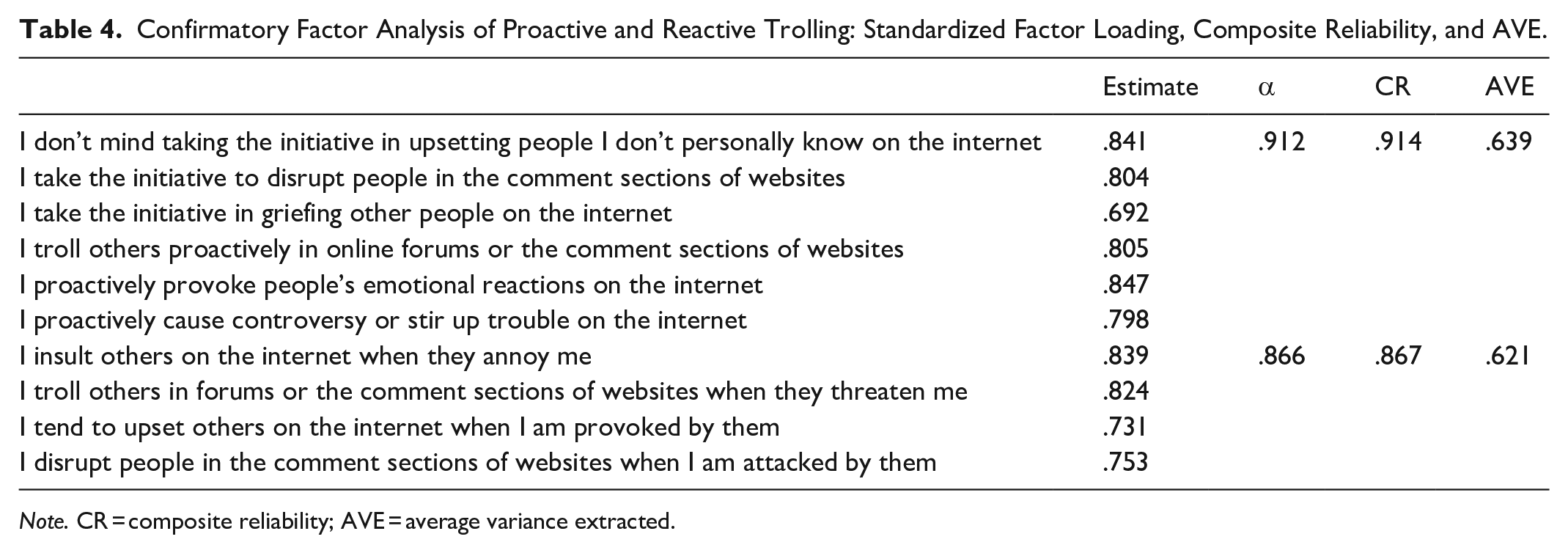
Note. CR = composite reliability; AVE = average variance extracted.
Discriminant Validity for Motivation of Online Trolling, and Proactive and Reactive Online Trolling.
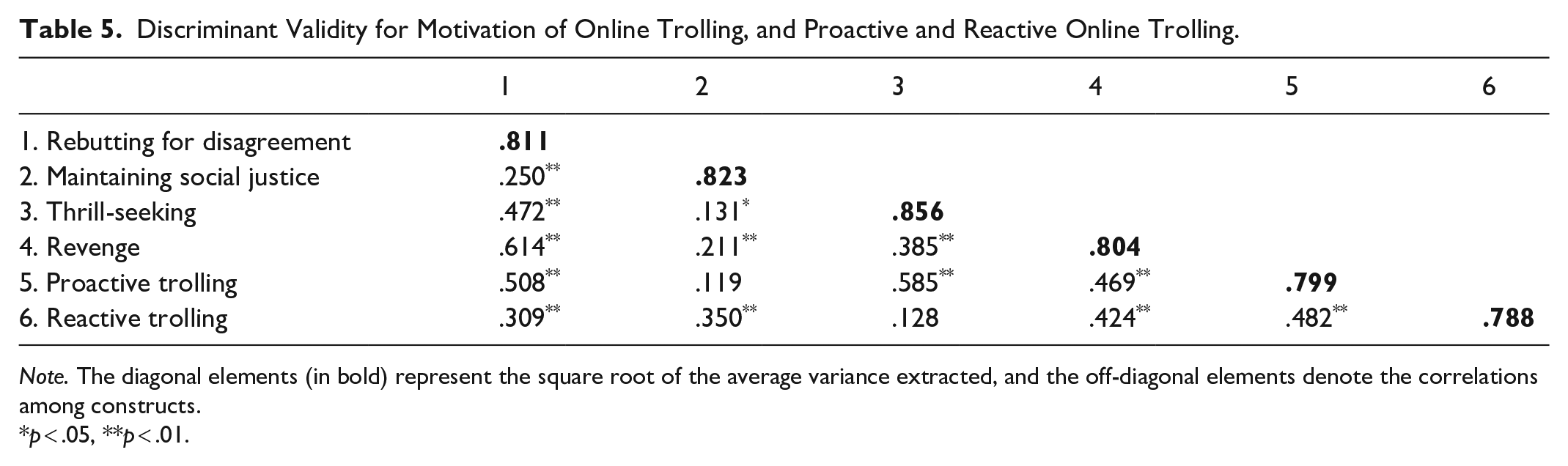
Note. The diagonal elements (in bold) represent the square root of the average variance extracted, and the off-diagonal elements denote the correlations among constructs.
p < .05, **p < .01.
In addition, we conducted a correlational analysis of the Normative Beliefs About Aggression (NOBAG), MOTB, and PROTB scales to assess their concurrent validity. The NOBAG scale measures individuals’ cognitive beliefs about the acceptability of aggressive behaviors and has been widely used and validated in aggression research (Huesmann & Guerra, 1997). Previous studies have shown a positive relationship between NOBAG and various forms of aggression and trolling (Hilvert-Bruce & Neill, 2020; Wright & Li, 2013). The correlational results revealed that NOBAG was positively correlated with proactive trolling (r = .54, p < .01) and reactive trolling (r = .18, p < .01). In addition, NOBAG showed positive correlations with rebutting for disagreement (r = .37, p < .01), thrill-seeking (r = .41, p < .01), and revenge (r = .40, p < .01), but it was negatively associated with the motivation to maintain social justice (r = – .14, p < .05). Most dimensions of the MOTB and PROTB scales demonstrated significant and moderate correlations with the NOBAG, indicating the satisfactory validity of our measures.
Structural Equation Modeling Testing
To investigate how the proposed motivations for online trolling influence users’ actual online trolling behavior, structural equation modeling (SEM) was conducted on the entire sample (N = 455), with gender, age, educational level, monthly income, and prior online trolling victimization as covariates. The results indicated that the research model had a satisfactory fit: χ2 = 660.614, χ2/df = 2.014, CFI = .955, TLI = .945, RMSEA = .047, and SRMR = .055. As shown in Figure 1, the SEM results showed that proactive online trolling was positively influenced by thrill-seeking (B = .243, p < .001) and rebutting for disagreement (B = .158, p < .001) but was not significantly impacted by maintaining social justice (B = –.048, p = .098) or revenge (B = –.003, p = .934). In addition, maintaining social justice (B = .231, p < .001) and revenge (B = .185, p < .001) had a positive effect on reactive online trolling, whereas thrill-seeking (B = –.077, p < .05) had a negative effect. Finally, the results revealed that rebutting for disagreement did not significantly impact reactive online trolling (B = –.017, p = .709).

Structural equation modeling of online trolling motivation and proactive/reactive trolling behaviors.
Discussion
The present study employed both qualitative and quantitative approaches to gain a deeper understanding of online trolling motivations and their relationship with the two types of trolling behavior. Our findings contribute to the existing literature by proposing a new typology that categorizes trolling into proactive and reactive behaviors and by developing and validating a four-factor scale measurement for trolling motivations. Specifically, our study identified revenge and thrill-seeking as common motivations for online trolling, consistent with previous studies on online gaming and crowdsourcing platforms (Cook et al., 2018; Shachaf & Hara, 2010). This suggests that personal enjoyment and revenge are prevalent motivations for online trolling across different online contexts.
We also uncovered two additional trolling motivations (i.e., maintaining social justice and rebutting for disagreement) that have not been fully delineated in the existing literature. Our finding that maintaining social justice was a motivation for trolling is similar to the idea of vigilante justice trolling found in Cook et al.’s (2018) study on online gaming, in which gamers trolled other trolls with the goal of reforming undesirable behaviors in the game community. Similarly, Demsar et al. (2021) discovered that customers engage in vigilante trolling to exact revenge against companies, utilizing tactics such as malicious mockery and public shaming on social media to provoke responses related to the brands’ positions on social justice issues and past transgressions. Our findings expand on these previous studies by revealing that the targets of justice-based trolling behaviors are not confined to online gamers or brand-related activities, but they also include individuals whose comments or actions breach social ethics and public morals. Furthermore, previous research has indicated that mocking or shaming functions as the primary strategy for vigilante trolling, provoking reactions to brand transgressions (Demsar et al., 2021). However, our findings show that justice-based online trolling can encompass other forms of verbally aggressive tactics, including insults and profanity. Moreover, our qualitative findings reveal that emotions, such as disgust and anger, arising from motivations to uphold social justice can fuel trolling behaviors. This result offers insight into the affective mechanisms behind justice-based trolling, warranting further exploration in future studies.
Another motivation for trolling behavior, which is relatively underexplored in the existing literature, is rebuttal for disagreement. Our study reveals that individuals may resort to trolling behavior to counter and assert their own viewpoints when confronted with opposing opinions (i.e., rebutting for disagreement). The qualitative findings reveal the underlying psychological processes behind rebutting for disagreement, which aim to persuade and correct individuals with different viewpoints to acknowledge their own stances. This often leads to the use of hostile and malicious language that provokes responses from others. Our findings are consistent with an earlier study that demonstrated how exposure to disagreement intensifies aggressive feelings and intentions to respond in an uncivil manner (G. M. Chen & Lu, 2017). Furthermore, our study found that when neither party could successfully persuade the other, trolling emerged as the ultimate strategy to assert dominance over the opposing stance. The dynamic and reciprocal nature of trolling behavior between perpetrators and targets resonates with recent research indicating that trolling behavior is a relational phenomenon involving interactions between various actors (e.g., trolls, targets, mediums) (Golf-Papez & Veer, 2022).
The development and validation of the proactive and reactive dimensions of trolling are also significant contributions of this study. Our quantitative results reveal a clear two-factor structure for trolling consisting of proactive and reactive dimensions. Proactive trolling is often characterized as intentional and deliberate and involves the initiation of harm or provocation without being provoked by others; by contrast, reactive trolling primarily involves defensive responses to provocations from others. While reactive trolling can also be intentional and purposeful, it is often associated with impulsive and instinctive reactions accompanied by heightened emotional arousal, such as anger. This proactive–reactive distinction of trolling indicates that the same trolling behavior can be performed in either a proactive or reactive manner. For example, this two-dimensional framework could potentially be applied to explore other proactive vs. reactive types of deceptive or sarcastic trolling (Demsar et al., 2021; Hamarta et al., 2021; Manuoğlu & Öner-Özkan, 2022), thereby opening avenues for further research. Furthermore, our findings demonstrate that the concept of offline proactive and reactive aggression can be extended to the study of online hostility (Dodge et al., 1997; Raine et al., 2006).
This study also contributes to establishing theoretical connections between trolling motivations and the two types of trolling behavior (i.e., proactive and reactive). While previous research has identified various motivations for online trolling, including revenge (Cook et al., 2018), personal pleasure (Shachaf & Hara, 2010), and vigilantism (Demsar et al., 2021), it has rarely examined how these motivations relate to specific types of trolling behavior. However, our findings reveal a relationship between motivation and trolling behaviors, demonstrating that revenge and the pursuit of social justice motivations are positively linked with reactive online trolling. These results complement earlier research that illustrated how revenge and vigilantism drove individuals to engage in online trolling as a way to seek retribution from those who had harmed them previously (Cook et al., 2018), which aligns with reactive trolling behavior.
Moreover, thrill-seeking and rebutting for disagreement have been identified as motivating factors for proactive trolling. The desire for excitement and pleasure can lead individuals to provoke reactions from others by posting hostile comments without any prior provocation, as demonstrated in earlier research indicating that personal enjoyment strongly motivates trolling (Cook et al., 2018; Shachaf & Hara, 2010). Furthermore, the motivation for rebutting for disagreement is associated with proactive rather than reactive trolling: proactive trolls motivated by rebutting for disagreement are less likely to perceive themselves as victims, whereas reactive trolls motivated by revenge and the pursuit of social justice respond to others because they believe they were targeted first. As our qualitative findings suggest, the underlying psychological process of rebutting for disagreement involves persuading those holding different viewpoints to alter their stance by actively using confrontational language to provoke reactions. Therefore, rebutting for disagreement aligns more closely with proactive trolling.
In addition to these theoretical insights, this study provides several practical implications for managing online trolling behaviors. Understanding the motivations and different types of trolling behaviors can aid in developing tailored strategies to mitigate malicious trolling content and foster an online atmosphere that deters such behavior (Golf-Papez & Veer, 2022). This study offers a comprehensive grasp of proactive and reactive trolling, along with their motivating factors, which allows online community managers and content moderators to more effectively evaluate the seriousness and potential harm posed by diverse types or motivations of online trolling.
The deletion of inappropriate and harmful trolling content is the most frequently employed technique in the majority of online communities. This strategy is applicable to trolls motivated by the pursuit of excitement and pleasure. These individuals tend to disrupt online communities and instigate conflict. Hence, the removal of the trolling content may discourage the desire for further provocation, subsequently reducing the number of potential trolling targets. Nevertheless, the removal of hateful content—especially in cases where trolling behaviors stem from a desire to uphold social justice—could potentially lead trolls to feel that their self-perceived righteous actions are being ignored, which may further increase resistance and additional trolling. Therefore, employing less intrusive methods could be more effective for regulation. For instance, online managers can opt to block and conceal individuals’ trolling comments, rendering them visible solely to the senders (i.e., the trolls themselves) and not to other users of the site.
In addition, community managers may consider fostering an online atmosphere of reduced tolerance toward online trolling. For example, explicitly stating the presence of online moderators and community guidelines that discourage or penalize trolling could be useful for curtailing detrimental behaviors driven by personal enjoyment. Furthermore, proactive trolling, which is prompted by the motivation to counter disagreement, occasionally occurs in debates and arguments. Therefore, it is pivotal for online community managers to closely oversee threads of heated debates and engage in moderation by, for example, explicitly acknowledging the inappropriateness of trolling behaviors and providing community guidelines that prohibit such conduct.
This study has several limitations. First, it only investigated trolling behaviors on Chinese social media and online forums, which restricts the generalizability of the findings to other online interaction settings. Further exploration is required to examine the motivations for trolling behaviors across different platforms and contexts, such as online video games or virtual reality. Similarly, our sample, consisting solely of young and educated Chinese people, limits the generalizability of the study findings to a more diverse population. Future research could collect a more representative and larger sample to explore the roles played by these motivations across different age groups as well as those with diverse educational and cultural backgrounds.
Evidence indicates that trolls are more likely to disclose their behaviors in immersive and longitudinal ethnographic studies (Coleman, 2014; Phillips, 2015). However, in our Study 2, we used a quantitative survey method to assess individuals’ self-reported trolling motivations and behaviors. This suggests the possibility that respondents might not have truthfully disclosed their motivations or behaviors because trolling would be perceived as problematic and unethical (Manuoğlu & Öner-Özkan, 2022). Such social desirability response bias is common in quantitative studies examining socially undesirable behaviors with self-report measures, such as aggressive behaviors, crime, drug use, and smoking (Gregoski et al., 2005; Krumpal, 2013; Poltavski et al., 2018). Future studies could include social desirability as a control variable or use more delicate measures to capture online trolling patterns, such as machine learning analysis of trolling discourse and the number of likes, comments, or shares.
Finally, this study focused primarily on malicious and aggressive trolling behaviors and their motivations. Other types of trolling, such as deceptive, vigilant, sarcastic, and humorous, require further exploration into their motivations. In addition, considering that our data were collected during the coronavirus pandemic, the unusual period may have affected the frequency and intensity of trolling; this could limit the generalizability of our findings to post-pandemic eras.
Footnotes
Declaration of Conflicting Interests
The author(s) declared no potential conflicts of interest with respect to the research, authorship, and/or publication of this article.
Funding
The author(s) received no financial support for the research, authorship, and/or publication of this article.
