




Abstract
While Dubai, the small emirate in the United Arab Emirates, tends to be associated with luxurious social media images of elite social actors, startling architecture, and consumer status symbols, this study addresses migrant, domestic, and service workers’ everyday digital placemaking. To explore these issues, a global semiotic framework reorientates traditional notions of the geopolitical context in terms of Dubai’s social mediascape. TikTok is taken as a case to explore a corpus of Dubai-related hashtags and content being shared by migrant, domestic, and service workers. The central argument of the article is that, while Dubai’s social media cultures reflect hegemonies of Gulf governance and TikTok’s algorithms, they are also infused by workers’ affective digital-placemaking as a form of neoliberal resilience to communicative capitalism and deterritorialization in the social media age. Overall, the article provides much-needed insights into how social mediashapes and is shaped by transnational social actors’ digital placemaking in the Middle East region.
Keywords
Introduction
Global cities consist of crisscrossing flows of imported labor, histories, technologies, economic practices, ideologies, and cultural “scapes” (Appadurai, 1990). In Middle Eastern North African and Gulf cityscapes, fragmentation is exacerbated by transnational migrant, domestic, and service workers from various countries who live in the emirate for decades at a time without hope of citizenship. To maintain links with their countries of origin while building local networks via digital placemaking, migrant, service, and domestic workers circuiting the region’s social mediascapes via hundreds of different languages, images, and applications, including TikTok—the short-form video-sharing app. However, there are limited insights into how these everyday social media constellations of digital placemaking constitute Dubai, the small emirate in the United Arab Emirates (UAE). To address this gap, this study takes the case of the Dubai cityscape to explore migrant, domestic, and service workers’ digital placemaking via social media. The central question asks, how can we understand the digital placemaking of migrant, service, and domestic workers in Dubai?
To address this question, the study first considers literature relevant to Dubai’s social mediascape. Second, taking TikTok as a case, the global semiotic framework is developed as an abductive method to explore a corpus of Dubai-related hashtags on the platform’s algorithmic “For You Page.” This is followed by the findings, discussion, limitations, and recommendations of the study. The central argument is that, while Dubai’s social mediascape reflects hegemonies of Gulf governance and TikTok’s algorithms, they are also infused by transnational workers’ affective digital placemaking. Theorizing conceives of digital placemaking as a form of neoliberal resilience within the ambivalences of communicative capitalism (Dean, 2014).
Dubaization
Scapes
Literature was selected from academic databases, journals, and reports. A thematic review indicates that the Dubai cityscape consists of workers from more than 200 different nationalities who are living and working in the same context while engaging in diverse lifestyles (Hurley, 2023). While cultural hybridity might be claimed by any global city, Dubai differs from older cities like New York, which can be defined by traditional media, older genres, industries, and subcultures, for instance, theater, the arts, hip-hop, and graffiti. Conversely, Dubai is a city in the Arabian Gulf that is coming to fruition during the social media age (Sujon, 2021). The Dubai government’s significant investments into platform capitalism are indicative of social media modernity, whereby a cityscape is designed, circuited, and promoted via a series of digital assets (Rose, 2022).
Appadurai (1996), while viewing modernity as a highly contentious term, suggests that it is defined by contrasting global cultural flows of ethnoscapes; mediascapes; technoscapes; finanscapes; and ideoscapes. Each of these “scapes” is a conceptual construct informed by historical, linguistic, and political facets of locations and divergent social actors’ deterritorialized communities and cultures. “Deterritorialization” refers to the forces bringing laboring populations into working-class sectors and spaces of wealthy societies (Appadurai, 1996). To understand the deterritorialized facets of digital placemaking, this concept will be discussed further.
Transnational Digital Placemaking
The argument that most cities, in varying respects, are digitally mediated is hardly new (Rose, 2022). Gulf states, like cities in South East Asia and South America competing with European and American hubs of finance, business, culture, and education, draw on the affordances of social media and digital economies. In the case of Dubai, the emirate benefits from some of the world’s fastest internet speeds and most advanced broadband infrastructure (Chamber.com, 2022). Moreover, 74% of its population are under the age of 40% and 98% of the population are active social media users (GMI, 2023). Thus Dubai, like other Gulf cities, has developed strategies for “reimagining” and “reimaging” itself as they compete in the global visual economy (Hurley, 2023). A key feature of this urban reimagining is Dubai’s “digital placemaking” on social media, and this will be outlined in the following section.
The concept of “placemaking” first appeared in geography/urban studies in the 1960s and was subsequently adopted as “creative placemaking” in the creative industries. Since 2015, it has appeared as “digital placemaking” in media studies (Basaraba, 2021). There has been an emerging focus on more creative applications of digital placemaking that involve the combination of resources (tangible and intangible), affective meanings (emotions), and creativity to capture public attention through performative content creation, including the production of geolocational tagging, image, and video production on social media. While digital placemaking is embedded within the architectures of social media platforms, for instance, via the short-form videos of TikTok or the stories feature of Instagram, digital placemaking involves bottom-up practices of social media users, creating narratives about the place. A “sense of place” can be a feeling or series of emotions, or affective digital labor, tied to a unit of space that results from human experience and history, which is often communicated or remembered through narratives, images, and media. Nevertheless, in digital environments, the self, embodied within place, are also being mediated via algorithmically directed feeds.
In computer science, an algorithm is a list of instructions, used to solve problems or perform tasks, based on the understanding of available alternatives. On platforms like TikTok, algorithms monitor how long users engage with specific videos to channel similar content and advertising into their feeds. TikTok’s dynamic short-form video format allows users to create 15 to 180 s of vertical video and a unique “For You” algorithmic wall that enables content to become highly viral regardless of the connections between users (Jaramillo-Dent et al., 2022). Algorithmically tailored content thus responds to the sensibilities of individuals and communities. Digital placemaking is entangled within TikTok’s algorithmic chains, fusing personal performance with commercialism via product placement, promotions, and in-stream marketing. It can therefore be considered as occurring at the forefront of platform capitalism, and as a form of affective digital labor (Jaramillo-Dent et al., 2022).
Consequently, digital placemaking can be difficult to define especially since it is marked by the absence of a traditional public sphere which can be characterized by rights, citizenship, and political voice (Habermas, 1962). Alternatively, digital placemaking involves a series of private spheres orchestrated by social media platforms’ digital architectures. This can include content that engages audiences in the workers’ countries of origin who may also be consuming, interpreting, and responding. It also constructs what Benedict Anderson (1983) referred to as an imagined community. Formations of Dubai’s imagined communities, via social media placemaking, are inextricably entangled with communicative capitalism’s ever-evolving search for new forms of profit, content, and affect (Dean, 2014). This integrates the personal and commercial and takes the “desires, emotions, and forms of expressivity” of users in digital spaces while these performances, practices and places become part of a wider economic infrastructure (Hearn, 2017, p. 63). To illustrate these processes, in the next section, we will consider the case of Dubai’s TikTok cultures.
TikTok Cultures
TikTok’s greatest number of downloads among users over 18 is in the Middle East (Hurley, 2023). The role of TikTok in diaspora communities is also a growing field of study (Aziz, 2022; Jaramillo-Dent et al., 2022). During the COVID-19 pandemic in 2021, an increasing number of migrants, domestic laborers, and service workers in the region turned to TikTok to express discontent (Donovan, 2021). Concurrently, TikTok enables brands to deliberately insert themselves within the growth of precariat communities (Jarrett, 2022). Owned by the Chinese parent company ByteDance, TikTok facilitates access to the global market and AI surveillance of users’ content preferences. Algorithms indicate how much time a viewer spends on each video to push more content and advertisements their way (Chen et al., 2021). TikTok’s architectures should also be understood in terms of platformed positivity and logics of the Chinese state; this includes both state-driven economic policies and content monitoring. All media, including social media platforms, are instructed to promote the state-promoted values of “positive energy,” patriotism, and a state-sanctioned aesthetic (Chen et al., 2021). TikTok thus represents a shift of cultural influence away from applications coming out of Silicon Valley. In the UAE context, it is embedded within changing political tides and closer relations between China and Gulf nations (Barakat & Menon, 2023).
Simultaneously, in political terms, the Gulf is defined by strict cyber laws and digital authoritarianism, whereby surveillance has been mobilized to regulate social behavior (Jones, 2022, p. 13). Nevertheless, this does not mean that TikTok is necessarily orientated to the surveillance of migrant workers. It is a social networking application rather than a form of spyware like Pegasus, for instance, which was developed by the Israeli cyber-arms company NSO Group to be covertly installed on mobile phones running on most versions of iOS and Android (Pegg & Cutler, 2021). Simultaneously, the Gulf’s social mediascape, like social media spheres in other contexts, is also an arena of distraction, counter-narratives, and oblique echo chambers whereby users unwittingly give up their personal data without being fully informed of the consequences (Sujon, 2021). But this does not mean that TikTok is necessarily strategically facilitating surveillance of Dubai’s migrant populations. Neither is there any evidence to suggest that TikTok’s modes of audience engagement necessarily align with the UAE’s traditions of strict social conformity. At the same time, the Gulf’s digital public sphere is ensconced within the politics of visuality. While the sheer volume of digital images can occur in terms of banality (Mirzoeff, 2011), visuality in the twenty-first century is routinely used to monitor, expose, censor, and discipline social actors and could therefore be considered as a “weapon for authority” (Mirzoeff, 2011, p. xiv).
Considering that visuality can be both a conduit for authority and a “means for the mediation of those subject to that authority” (Mirzoeff, 2011, p. xvi), there are instances of TikTok being instrumental in the surveillance of migrants (and other groups). A recent case in point is the incident of five Filipino ex-pats based in Sharjah (an emirate adjacent to Dubai) who were recently arrested after reportedly posting an indecent video on TikTok (Tesorero, 2023). This indicates that TikTok, as well as being a Chinese platform of influence in the Gulf, offers the UAE regime “affordances” for scrutiny and disciplining migrant populations when they share public content that does not adhere to certain social morality laws. Another example is the Dubai-based waiter who was sentenced to six months in prison, followed by deportation, for adding fake gunshots and voices of people screaming to his TikTok video clip at a parking lot in Dubai (Al Shouk, 2021). This indicates that TikTok indirectly facilitates affordances for algorithmic channels for surveillance. To consider the implications of these ambivalent visibilities, the following section will discuss Dubai’s working-class social mediascape.
In terms of lifestyle, Dubai’s transnational communities include Indian, Bangladeshi, Nepali, Sri Lankan, and Pakistani workers, who make up 90% of the workforce. There are significant variations of ethnicity, language, and culture within this demographic. 68.58% of migrant workers are male, and 31.42% are female (GMI, 2023). The majority of South Asian male migrants work on construction projects or in service jobs and are lured by the promise of higher salaries and opportunities to send money back to their countries of origin (Kathiravelu, 2015). Women tend to be domestic workers in households or work in service industries, including hospitality, leisure, care, cleaning, and beauty industries. With more than two million overseas Filipino workers, remittance inflows account for about nine percent of their country’s gross domestic product. 650,000 live in the UAE, the second-largest employer of Philippine ex-pats after Saudi Arabia (Aben, 2023). While Filipino workers in Dubai continue to work in hospitality, service industries, and households, the trend is now changing as an increasing number of young Filipino professionals are working in the emirate, including tech workers, creatives, teachers, and medical staff. Although this study focuses on working-class digital user laborers, middle-class expatriates, working as merchants and professionals, from Asia, Europe, Africa, and the Middle East also work in Dubai. Contrasting framings of Dubai, as hybrid variations of digital placemaking, are therefore available. While middle-class and wealthy expatriates in Dubai often reside in gated communities and villas in areas like Arabian Ranches, Silicon Oasis, The Springs, or The Palm, migrants, domestic helpers, and service workers in Dubai tend to live in low-cost neighborhoods like International City, Deira, Satwa, and Al Rigga.
In view of the dependence on an imported labor force, Gulf nations are often classified as rentier states (Ahmed, 2016). Under the Gulf Cooperation Council member nations’ so-called Kafala system, migrant workers are essentially “sponsored” by their employers, who are mostly private companies or individuals looking for sources of cheap labor (Robinson, 2022). As autonomous social actors, a disjuncture can occur between state articulations of migrant laborers, as free agents responding to demand in a global marketplace, and obligation to an employer (Kathiravelu, 2012). Concurrently, because migrant, domestic, and service workers can live in Gulf nations for decades at a time, despite little hope of political rights, they may still form attachments to these sites of employment as everyday places of belonging’ (AlMutawa, 2020, p. 44). Kathiravelu (2012) suggests that Dubai migrants demonstrate help and solidarity with one another, especially if they are of the same nationality, ethnicity, language group, and class. These affective practices and acts of care operate in informal ways and outside the formal structures of governance. Being a migrant, domestic, or service worker may also afford membership to new mobile networked lifestyles, as well as shifting economic and sociocultural opportunities (Ahmed, 2016; Polsen, 2016). Considering the above, there are thus co-constitutive relations between cities as sites of symbolic and affective images and as sites of social practices and technologies (Rose, 2022). These insights into the various facets underpinning digital placemaking inform the global semiotics framework of the study, which is outlined next.
Global Semiotics Framework
Social Media Signs
To develop semiotic enquiry, the study is rooted in global semiotics, which is broadly defined as the study of signs (Petrilli, 2017). Signs are defined as the images, words, sounds, or any phenomena communicating meaning (Hurley, 2023). Within global semiotics, abductive methods can help to go beyond a simplistic binary of social media representations as either sites of hegemonic domination or subcultural resistance. Since social media content of communicative capitalism is not merely generated by top-down forces of government, the military, and/or economic markets but also by users themselves, the abductive semiotic framework will help to conceptualize social media’s affordances for digital placemaking via expansive repertoires of images, videos, and geolocational hashtags at the scale, volume, and speed of hyper-modernity.
For the semiotician Yuri Lotman (2020, p. 188), the city is a complex semiotic mechanism and generator of hybrid culture that constitutes a cauldron of texts, codes, different languages, and sociocultural levels. However, while competing elements of digital placemaking are being reflected by diverse channels of content creation in the Dubai context (including businesses trying to attract workers, promotion of rental apartments, broad networks of individual user's performative practices, and more), this article will obviously not be able to address all these issues. Conversely, the focus on migrant, service, and domestic workers’ digital placemaking helps to theoretically zoom in on one aspect of the Dubai social mediascape.
To focus on domestic workers’ digital placemaking, the study is informed by an abductive semiotic approach. It builds on the semiotic concept of abduction, moving from logical inference and observation to a theory (Peirce, 1955). In abduction, in contrast to induction and deduction, the relationship between observable signs and their range of potentially varying interpretations is acknowledged (Petrilli, 2017). In other words, while any sign (e.g., image, meme, video, content, etc.) might mean one thing to one particular group of viewers, it could signify something entirely different to another, but the significance will tend to be contextual. This semiotic notion of abduction, in interpretation and meaning generation, will help to acknowledge the diverse interpretations possible within Dubai’s social mediascape and variations of digital placemaking. The approach aligns in several respects with walkthrough methods designed for critically analyzing apps, especially social media platforms (Light et al., 2018). Grounded in both science and technology studies, cultural studies, and semiotics, researchers can establish an app’s environment of expected use and intended purpose while also analyzing these arrangements with a critical lens. The following section will provide further details of these methods.
Methods
A thick description of migrant, service, and domestic workers’ digital placemaking in Dubai’s social mediascape will emerge from the fine-tuned abductive semiotic framework. In the case of TikTok, this framework can be applied to walk through the platform’s affordances for producing short-form videos of 15, 60, and 180 s to facilitate digital placemaking via audiovisual affordances. Like the earlier app Musical.ly, TikTok foregrounds unique audio features, including the rotating button on posts that links to the original video that first featured the audio clip. Clicking on “use this sound” enables tiktokers to create their own post via the same audio template. While TikTok differs from Instagram’s distinctly visual affordances, it clearly combines visuality with audible semiotic affordances (Hurley, 2022).
To explore the audiovisual affordances of digital placemaking in this study, posts were selected by searching popular hashtags on TikTok’s “For You Pages,” including #maids.at_uae; #dubailiving”; “#Dubairooms; #alriggadubai; and #ofwduabi.” The selection of these hashtags was premised on their foregrounding of “Dubai.” Since the study is concerned with migrant, service, and domestic workers’ digital place-making, searches started with the landing “For You Page” and typed in the search term “Dubai,” which led to the series of hashtags included in the study. Table 1 illustrates these hashtags; number of views; demographic sample; hashtags; audiovisual elements; social networks; and affective modes:
Digital User Laborers’ Dynamics.

In addition to returning to the author’s “For You Page” regularly throughout the 12-month case study, the author interviewed migrant, service, and domestic workers about their use of TikTok as a method of digital placemaking in the UAE (see Hurley, 2023; Hurley & Johnston, 2022). Although these interviews are not referred to directly in this study, they inform the iterations of semiotic abduction and walkthroughs to ensure that the data was not only constructed by the author’s algorithmic trail but also via domestic workers’ abductive engagement. The abductive semiotic framework helped to catalog aspects of digital placemaking in terms of three broad analytic nodes, which are outlined below:
Analysis of observable elements: identification of observable audiovisual and textual elements of the TikTok short-form videos and description of qualities (what they are like and what is happening).
Inference of objects of meaning: exploration of the objects of meaning that the audiovisual and textual elements’ meanings in relation to sociocultural constructs and interpretations of digital placemaking.
Abductive semiotic theorizing of interpretive meanings: conceptual links to how the observable audiovisual and textual elements and objects of meanings coalesce as contextual digital placemaking.
These abductive semiotic nodes are considered at discreet levels, as well as in combination, to address the research question asking, how can we understand digital placemaking of migrant, service, and domestic workers in Dubai? To address this question, ethical procedures were carefully considered. The study only draws on information widely available in the public domain, and interlocutors’ identities are anonymized. Having briefly outlined the study’s methods, the findings will offer some further insights to address this question.
Findings
The surface-level snapshot of hashtags, metrics, demographics, audiovisual elements, social networks, and affective modes, as given in Table 1, are abductive themes. They are by no means an exhaustive list of the huge volume of images and content being posted on TikTok. However, what the table does indicate is how the hashtags relate to one another and integrate with the other thematic nodes. Simultaneously, while all TikTok users are monitored by the platform, the table also articulates the samples of unique evidence-based examples of Dubai’s migrant, service, and domestic workers’ incorporation of digital placemaking specific to their sociocultural predicament. These specifics will be presented next.
#dubailiving
To first consider the observable audiovisual elements of migrant, service, and domestic workers’ digital placemaking, we can take the case of the algorithmic wall #dubailiving on TikTok. This hashtag includes 33.8 million videos, combining luxurious depictions, humorous stories, and thousands of videos made by Dubai’s transnational workers. One observable trend is the audio meme: “When I came to Dubai all I had was AED100 dirham in my pocket. And today, I have AED50!” This trend was shared and repeated by transnational digital user laborers from Africa, Asia, and other Arab countries to articulate the challenges of saving money in Dubai on the low wages available. In terms of objects of meaning, the audio meme embeds a subtle undercurrent of criticism while fostering a sense of community and digital placemaking by Dubai’s tiktokers. Yet, in terms of contextual abductive semiotic theorizing, this digital placemaking is not a public sphere of rights and state support, as imagined by Habermas (1962), but a performative series of exchanges about the challenges of surviving Dubai’s expensive economy.
Another example, under the hashtag #dubailiving, is the short-form video made by a 20-something-year-old Nigerian woman that received 104.5k views, 1,667 comments, 4,769 “favorite” bookmarks, and 2,755 shares. In terms of observable elements, this content occurs as a form of ambivalent digital placemaking as the woman in the video sits dejectedly on a carpet of clothes on the floor of a furniture-less apartment, looking out on a busy highway at night. The text caption reads: “When you only had money for the RENT.” The soundtrack echoes the words “ooohhhhh. Hahhhhh!!1 Oiiiiiii.” The next shot is of the woman sitting next to the kitchen sink with her head in her hands. The third image shows her standing fully clothed in a waterless shower. In terms of objects of meaning, these images illustrate the women’s lack of furniture; absence of running water and food in her kitchen. She conceals her face throughout the video to protect her identity while her body language and posture indicate her state of depression. Regarding objects of meaning, the text caption, “When you only had money for the RENT” communicates her state of poverty and distress at the lack of funds to buy basic amenities. In the comments section, her viewers offer her condolences, support, and ideas on how to generate neoliberal resilience and income necessary to survive in Dubai. The commentators are from a range of nationalities and not necessarily from the same ethnic background. These transnational viewers attest to having been or currently being in the same situation and the comments include statements like: “Lmaoooooo I’m crying cos this is me rn, no bed, nothing. But trust me it’ll all come together gradually.” Another viewer says: “You will get there. If no one told you today, you’re doing a great job and should be proud of your accomplishments.”
Abductive semiotic theorizing indicates that this video could be considered as a criticism of the high cost of living in Dubai. It represents a contextual shift in Dubai’s social media sensibilities, which tended to promote material abundance and luxury, prior to the COVID-19 pandemic, to a more critical form of digital placemaking to address the financial challenges and emotional struggles since the pandemic (Hurley, 2023). The multicultural network of followers engages in providing the dejected tiktoker affective digital care and support, which suggests how Dubai’s social mediascape has affordances for building transnational digital support systems as a form of collaborative digital placemaking. However, the video remains within the streams of communicative capitalism and TikTok’s parameters of positive sentiment, as the audio track lightens the mood with its uncanny digitized audio echoes. The comments section also illustrates a community of migrant, domestic, and service worker tiktokers living in Dubai, far from their home countries, and families. Viewing this video as a form of political resistance is thus complicated and arguably diluted by TikTok’s platformed constraints of performance, entertainment, community building, and neoliberal resilience. From this video, we will next move to the hashtag #Dubairooms.
#Dubairooms
#Dubairooms is the hashtag that links to adverts for rooms to rent. In terms of observable elements, this hashtag has 14 million views of videos depicting rentable partitioned rooms either for singles or couples. Although there are a few videos depicting luxury apartments and rooms in Dubai, depictions in most of the short-form videos stand in stark contrast to images of luxurious real estate options. Other observable elements of the #Dubairooms’ theme include images of low-cost, cramped, shared sleeping spaces kitted out with beds and mattresses. Some videos depict prayer mats, water coolers, small bathrooms, and wardrobes. The videos are overlaid with captions, including “Partition small room makeover”/“Available now”/“Contact us for viewing.” The soundtracks are overlaid in a variety of languages, including Hindi, Urdu, English, and Tagalog. The object of meaning of this content is that TikTok is playing an important role in the real estate listings of Dubai’s low-cost room rentals and social media word-of-mouth economy. It points to the role of TikTok in facilitating transnational micro-rental-economies operating across Dubai’s social mediascape. While some of these rooms are being promoted by Dubai’s landlords and official realtors, others are being shared by social media users who are engaging in the legal gray area of subletting their living spaces.
Regarding abductive interpretations of the #Dubairooms’ hashtag, we can build on the observable elements and objects of meaning to consider TikTok’s affordances for digital placemaking. These occur within and beyond the official definition it gives itself of being a community-building entertainment platform. While it facilitates a type of transnational networked community, it also enables gray areas of revenue for migrant workers subletting their living spaces. Simultaneously, Dubai’s working-class digital placemakers are networking within increasingly deterritorialized spheres, not necessarily linked to their nation-states of origin. This reveals a shift from the traditions of strong nation-state affiliations between migrant workers (Kathiravelu, 2015) to multicultural friendships. Next, the hashtag #alriggadubai illustrates further examples of hybrid-transnational digital placemaking.
#alriggadubai
#alriggadubai is another hashtag, with 20.9 million views at the time of writing, which links to other videos advertising low-cost studios and room partitions in the area Al Rigga. Al Rigga is a locality in Dubai, within the Deira district, and is home mainly to migrant, domestic, and service workers from South East and South Asia. Although only developed in 1981, it is considered one of Dubai’s most historical districts and home to the emirate’s first MacDonalds and shopping mall, indicating earlier iterations of residential capitalism (Nasir, 2019). TikTok short-form videos featuring this locality were found under the hashtags: #alriggadubai; #streetparty; #newyear; #hello2023. Observable elements of the videos include images of decorated balconies and Dubai’s multicultural migrant, domestic, and service workers from across South and South East Asia celebrating in the streets of Al Rigga. Each of the balconies is decorated with fairy lights, brightly colored balloons, and crowded with Dubai’s migrants, domestic helpers, and service workers celebrating the New Year in 2023. The post had 18.6k views; 327 comments; 692 bookmarked favorites; and 1,592 shares.
The objects of meaning involve celebration of the New Year and the coming together of various ethnicities from Dubai’s working-class migrant, domestic, and service working-class residents. The TikTok videos indicate the traditional celebratory practices of Filipino communities while forging new belongings and placemaking with the other diaspora communities living in Al Rigga. To usher in the New Year in 2023, Filipino residents and other nationalities shared content of themselves dancing in the streets, blowing horns, throwing confetti, and taking photographs for social media. Video footage of the 2023 Al Rigga New Year Celebrations can also be viewed on YouTube in a video uploaded by OFW Mangyan TV (2023). These celebratory videos indicate that the Al Rigga social mediascape is not necessarily a homogeneous ethnic group, which tends to feature in Dubai migrant scholarship (Kathiravelu, 2012). Conversely, it consists of crisscrossing transnational digital placemakers.
In terms of abductive interpretation, the video offers a departure from the visualities of highly wealthy residents often associated with Dubai (e.g., shots of luxury yachts, sports cars, and skyscrapers). Conversely, the TikTok short-form videos depict Filipinos’, and other transnational residents of Al Rigga from South Asia and Africa, developing collective resilience, ephemeral belonging, and digital placemaking in the Dubai social mediascape. Unique aspects of these videos are the working-class community’s coming together within the Dubai neighborhood and as digital content creators on TikTok. This indicates the important affective role of TikTok in facilitating Dubai’s working-class digital placemakers who are striving to define themselves in terms of neoliberal resilience beyond the boundaries of their nation-states. Nevertheless, it is also an example of communicative capitalism whereby the exchange of content is not just a means of sharing information but rather a process which is integral to the functioning of capitalism (Dean, 2014). The rise of social media like TikTok facilitates new channels of communicative capitalism for the circulation of information and formation of migrant, service, and domestic workers’ networks, while allowing capitalism to extend its reach and intensify its influence. Capitalist dynamics intersect with communication technologies, shaping the ways in which we consume information and participate in digital placemaking in the algorithmic age.
#OFWdubai
The acronym “OFW” included in the YouTube video mentioned above, stands for “oversees Filipino workers” and is another popular hashtag used across Dubai’s social mediascape on Instagram, Facebook, Twitter, Snapchat, and TikTok (Hurley & Johnston, 2022). TikTok offers more informal and vernacular affordances, and the hashtag #ofwdubai on the platform has over 326.5 million views. An example of a domestic worker posting under the hashtag is a housecleaner who has 31.9k followers. In one TikTok skit, she is wearing overalls and cleaning the toilet with a plastic toilet brush, while carrying out her work in the domestic sphere. In the humorous video skit, the toilet brush doubles up as a microphone as she sings and dances in mock defiance.
In terms of objects of meaning, the housekeeper’s satirical and affective sentiment correlates with TikTok’s formula for “relatable, diverse and unexpected” content, which will ‘brighten everyone’s day’ (TikTok, 2021). It abides by TikTok’s platformed positivity and placing of everyday people center frame and offers performative affordances for Dubai’s migrant, domestic, and service workforce. These trends indicate not only “in-jokes” of Dubai’s domestic workers but modes of digital placemaking in a locality that is not entirely “home.” In the case of TikTok, there is a distinctly ephemeral quality to TikTok content whose algorithms link users by trends and amusing sentiments rather than with people that they already know. This ephemerality aligns with the transience of Dubai’s domestic workers’ who are looking after other people’s homes. While they might not have their immediate friends and family nearby, they can connect and reflect, with other domestic workers in the Gulf, via TikTok’s affordances for digital placemaking. Moreover, behavior on TikTok’s Discover tab enables algorithmic analysis of content characteristics like captions, sounds, effects, and trending topics. While location, language, and content from the users’ country and language may be defined by trending sounds, captions and effects can help to make content more discoverable (Abidin, 2020). Thus, although TikTok’s algorithmic ranking signals are considered black-boxed and frequently changing, they are known to include signals from previous interactions with accounts or are marked as either interesting or uninteresting. While follower count is not a TikTok ranking signal, it does base recommendations on the number of followers or a history of previous high-performing videos. Although content creators with more followers are still likely to get more views, creators with fewer followers might also land on the app’s For You Page, and trending topics change rapidly. Domestic workers using TikTok in the Gulf can thus find themselves within a stream of content being pushed out by other domestic workers. At the same time, since domestic workers are not necessarily promoting sponsored content, within TikTok’s in-stream advertising and flows of communicative capitalism, their digital labor is the product.
As a form of digital placemaking, digital labor can occur at conceptual, unconscious as well as deliberate levels. Some domestic workers might be motivated by TikTok’s potential channels of revenue via sponsored content, but they are also expressing affective content about the ambivalences of digital placemaking. This content combines information about Dubai’s supermarkets, restaurants, and neighborhoods via popular dance routines, songs, and audio memes. While the Filipino community in Dubai is evidently not a homogeneous group, and they are certainly not all working-class or potential sponsored content curators, these narratives run counter to the perspective that all migrants, domestics, and service workers in Dubai are victims, devoid of belonging or community (e.g., Kanna, 2013). Moreover, the findings signpost unique modes of digital placemaking within Dubai’s transient, transnational neighborhoods. These points return us to Appadurai’s (1990) analysis of the shifting dimensions of localities occurring outside their immediate context and extending beyond the imaginaries of the traditional nation-state. With these issues in mind, next, we continue with a discussion of the above and address the research question of the article.
Discussion
This study’s abductive semiotic method has been designed to provide snapshots of Dubai’s algorithmic yet ephemeral social mediascape. It is suggested that the transient positionality of migrant, service, and domestic workers in Dubai aligns with the temporal affordances of TikTok. The framework is applied to locate these often-fleeting streams of digital placemaking, within the broader context of communicative capitalism constituting shifting conceptions of neighborhood, localities, and belonging. Observable elements, objects of meaning, and abductive semiotic interpretations of the TikTok short-form videos raise important questions and tensions about these ambivalent modes of digital placemaking. Findings illustrate Dubai’s migrant, service, and domestic social media users as being neither passive prosumers (imagined by Fuchs, 2021) nor “heroic” citizens of subcultures (Hurley, 2023). The affective resilience of digital user laborers is an evident theme running throughout each of the hashtags explored. Through exploring digital placemaking of migrants, service, and domestic workers in Dubai, this article challenges the conceptualization of the Gulf’s transnational working class exclusively in terms of deficit (see Kanna, 2013, for instance).
Nevertheless, within the flows of communicative capitalism, it is difficult at times to distinguish between users’ commercially orientated and personal content. As a result, a distinction between personhood and commodity loses viability within the broader domain of communicative capitalism, whereby all experience, activity, content, and labor are seemingly reduced to capital (Dean, 2014). The videos concerning high costs of rent offer examples of Dubai’s economic challenges for migrant residents. There are also tensions, ambiguities, and small pockets of dramatic resistance concerning these challenges. These ambivalences return us to Lotman’s (2020) semiotic cityscape as a generator of hybrid experiences and insights into how Dubai’s social mediascape can serve contrasting functions in the different lives of residents. Similarly, TikTok, like the cityscape itself, has various affordances for constituting diverse flows of texts, codes, micro-communities, and capital infusing digital placemaking. These diverse and overlapping spheres can be variously arranged and heterogeneous, belonging to differing geographical locations, languages, sensibilities, and political ideologies informing digital placemaking.
While there continue to be migrant groups marginalized by local governance, as noncitizens, analysis reveals migrant, service, and domestic workers’ unique framings of digital placemaking in the Dubai cityscape. This occurs via elaborations of existing visual matrixes, different visual grammars, conventions, and dialogic exchanges concerning digital placemaking in Dubai. Nevertheless, since these types of digital placemaking might be considered as a channel for communicative capital, they are not entirely orientated to disrupt entrenched social divisions or inequalities (Dean, 2014). Conceptions of the oblique audio-visibilities of Dubai’s transnational digital-user-laborers, in particular male migrant construction workers, are also vital, as is the recognition that insights into what transnational communities are doing on and through social media, in multiple languages and diverse gendered ontologies, are still emerging.
To gauge the algorithmic dynamics of Dubai’s social mediascape, we need to recognize that immersive spaces, like TikTok’s migrant, domestic, and service communities, are also being constructed anew by constantly shifting iterations of algorithms and communicative capital. Analysis needs to consider the “context” of digital placemaking as multidimensional and not limited to a single space, place, or algorithmic trajectory. For instance, while the OFW revelers of Al Rigga can share their celebrations with family members still in the Philippines via social media posts, these posts also carry significance in establishing the OFW’s new belongings and digital placemaking. To illustrate the overlapping contextual spheres of OFW’s Al Rigga social mediascape, the following diagram is depicted in Figure 1:
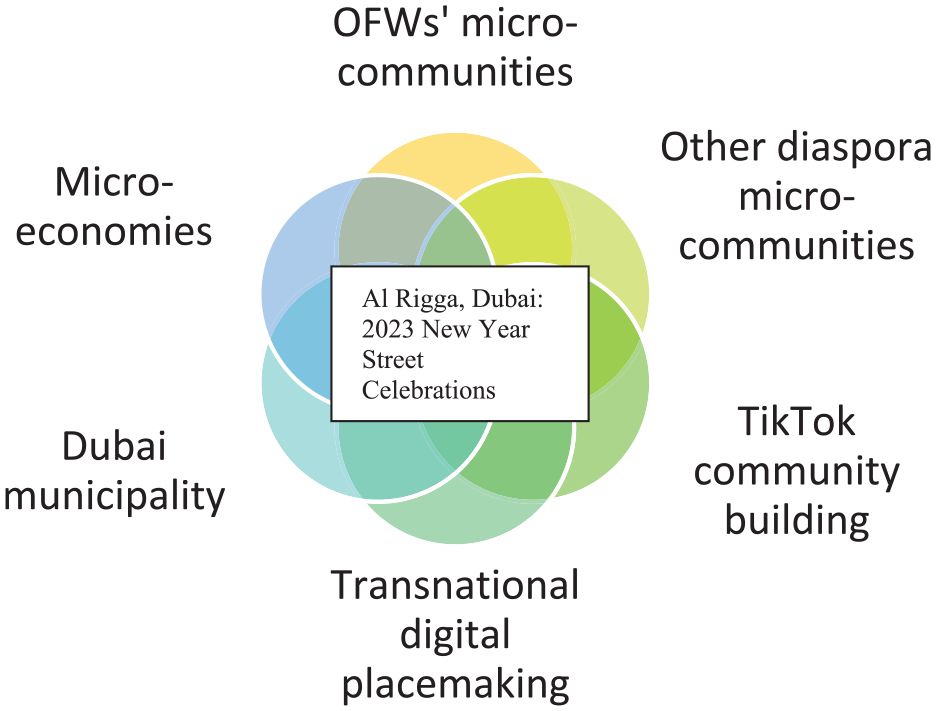
OFW’s social mediascape of Al Rigga, Dubai.
In Figure 1, we can observe that the OFWs of Al Rigga are able to express digital placemaking in relation to celebratory practices of the nation state in tandem with their immediate location in a Dubai municipality. This is integrated within the algorithmic platform affordances of TikTok’s short-form videos, community building, and micro-economies. OFWs and other diaspora residents of Dubai can engage with New Year celebrations in physical terms and via synchronous channels of the social mediascape and, simultaneously, while viewing, sharing, bookmarking, commenting, liking, and contributing to algorithmic chains being housed within the broader stacks of the platform which interconnect with other geographical locations. Consequently, the OFWs and diaspora of Al Rigga Dubai can occupy the street as both a lived and social mediascape and as a form of digital placemaking.
Significantly, while not meaning to overplay the political disruption of digital placemaking within communicative capitalism, we can acknowledge that occupying, celebrating, and reclaiming the streets has been a significant aspect of community building and channeling of power-from-below throughout modernity (Berman, 1982). Appadurai (1996, p. 193) describes these moments as “urban dramas” and reminds us that “the best moments” of city life “are owed to these migrants who are fleeing far worse places . . . Yet we know that the production of locality . . . is a highly embattled process” (p. 194). Despite conservative governance in Dubai, this New Year event is tolerated as a form of lived and digital placemaking since it is contained within a sanctioned festivity of micro-communities and micro-economies of the Al Rigga municipality. In terms of TikTok’s orchestration of community building and digital placemaking, the occasion also becomes a platformed drama, about celebration and togetherness, and thereby adheres to the positive sensibility of TikTok. However, not all the TikTok videos coming from Dubai’s diaspora necessarily offer such positive depictions. But a further outcome, whether intentional or not, is that TikTok video content provides a stream of surveillance and commercial promotion for Dubai governance.
An additional aspect to consider is that, along with being able to share these short-form videos with family and friends, the micro-economies and portion of the earnings of diaspora workers in the emirate will likely be sent to their nation-states of origin. The World Bank (2022) reported that remittances to low-and-middle-income countries (LMICs), like the Philippines, grew by 5% to $626 billion in 2022. Remittances are a crucial stream of revenue for households in LMICs, since they help to alleviate poverty, improve health, impact higher school enrollment rates for children, and help to build resilience in communities vulnerable to disasters. These points illustrate an expanded sense of community, neighborhood, locality, and digital placemaking, within which the social mediascape occurs. This broadened perspective of context brings us to the conclusion of the article, where some endpoints will be offered, as well as the limitations and recommendations of the study.
Conclusion
In conclusion, the abductive semiotic framework of the study helps us to appreciate that digital placemaking, while unfolding in the present, involves social actors’ engagements with inscrutable algorithms as well as the historic economic conditions of Dubai’s municipalities, transnational labor, and flows of communicative capital. In response to the central question, asking how we might understand digital placemaking of migrant, service, and domestic workers, the article does not claim that its data set is sufficient to make unique assertions about TikTok’s algorithms. However, considering that TikTok’s algorithms are constantly being adjusted, the study’s semiotic abductive framework can offer important insights into the need for expansive contextual interpretations of algorithmic cultures. This includes abductive interpretations of diverse content and digital placemaking by social actors on the margins of power. Exploring audiovisual affordances of TikTok enabled enquiry into the cultural, social, and lived practices embedded within digital placemaking. This helps to appreciate how, in the algorithmic age, digital placemaking is both a feature and response to the challenges of communicative capitalism, while continuing to perpetuate inequalities and reinforce existing power structures in varying terms (Dean, 2014). Simultaneously, it is important to clarify that, like other social media platforms, TikTok enables different forms of surveillance by different actors, and, in some cases, governments can use these affordances for surveillance of citizens even though the platform is not designed explicitly for this purpose.
Overall, the study develops important insights into migrant, service, and domestic workers’ ambivalent digital placemaking. Its semiotic framework could be relevant to other research agendas concerned with ephemeral digital localities. Limitations of the article are that it does not directly include voices of migrants, service, and domestic workers or drill deeper into TikTok’s algorithms. Nevertheless, abductive theorizing is a critical form of “thinking with” the ambivalences of digital placemaking. Future researchers are encouraged to carry out further walkthrough analysis of social mediascapes in the Gulf states and beyond. These insights are vital to conceive of the complexities of communicative capitalism and digital placemaking in the algorithmic age.
Footnotes
Declaration of Conflicting Interests
The author(s) declared no potential conflicts of interest with respect to the research, authorship, and/or publication of this article.
Funding
The author(s) disclosed receipt of the following financial support for the research, authorship, and/or publication of this article: This work was funded by the Policy Research Incentive Program, Zayed University and supported by the College of Interdisciplinary Studies, Zayed University.
