



Abstract
Several blockchain-based social media (BSM) platforms have emerged as alternatives to mainstream social media (MsSM) platforms in the recent past. Using blockchain architecture as a mechanism for governance and economics, these second-generation alternative social media (ASM) platforms aim to create social media platforms without advertising revenue or algorithmic governance. BSM platforms are relatively new and less popular than other platforms. They are, therefore, understudied in the disciplines of media studies, communication studies, platform studies, or cultural studies. This article traces changes to platform governance on DTube, a blockchain-based video-sharing platform. Using platform biography as a systematic framework and methodological approach, this article aims to understand the ever (re)configuring assemblage of technology, people, media, and economics on DTube, between 2019 and 2022. Platform governance on DTube changed from being manually driven by community members to a semi-automated process using bots. Although characteristics of blockchain technology influenced platform governance, the changes over time reiterated that user practices (not the technology itself) determined the platform’s functions. In the reconfiguration of platform governance, DTube articulated minor structures of feeling that aimed to produce an inclusive space over rapid scaling. Furthermore, it hints toward “agonistic pluralism” to govern a (transactional) community with differential ties.
Keywords
In less than three decades, the web has evolved from a decentralized information system into a dominant media and communication technology (Ankerson, 2018). It has become a “platformized web” dominated by platforms and platform companies (Helmond, 2015). Over the years, technology companies such as Google, Meta, Apple, and Amazon significantly shaped the “platform paradigm” (Burgess, 2015) and have become “powerful cultural shapers” (Burgess, 2021, p. 24). However, platformization, the algorithmic steering of user behavior (van Dijck, 2013, p. 145), along with difficulties in understanding the processes involved in its manipulation (Bucher, 2012, p. 76), motivated individuals and collectives to develop “alternative social media” (ASM) platforms (Gehl, 2015, p. 1). Although short-lived “Killer Hype Cycles” (Zulli et al., 2020) boosted ASM platforms, none have succeeded in replacing mainstream platforms. ASM platforms have failed to overcome scaling challenges, barriers to participation, and platform governance (Gehl, 2017). Yet, the efforts to develop viable alternatives to the large platform have not ceased altogether. The apocalyptic changes to Twitter with new ownership in 2022 substantially assisted the adoption and growth of ASM platforms such as Mastodon (Peters, 2022). Furthermore, financial technology innovations such as blockchain and cryptocurrency have provided viable economic foundations for blockchain-based alternatives (Guidi et al., 2020; Li & Palanisamy, 2019). This article examines one such blockchain-based social media (BSM) platform, DTube. Mainly, this article focuses DTube’s platform governance.
DTube is a video-sharing platform and an alternative to YouTube. It emerged from the first BSM platform, Steemit. 1 In July 2017, Steemit user @heimindanger (hereafter referred to as heimindanger) created DTube as a “decentralized application” or Dapp (Raval, 2016). Like ASM platforms from the past (e.g., Ello, Diaspora, GNU social), DTube was a response to the limitations of YouTube. By 2017, it was evident that YouTube’s algorithmic logic and incentivization mechanisms favored certain users over others (Bishop, 2019; Bucher, 2018; Burgess & Green, 2018). And the reconfiguration of YouTube to accommodate advertiser needs altered user practices and content. While YouTube was steering creators to produce advertiser-friendly content (Burgess & Green, 2018, p. 148), the changes after the “adpocalypse” (in 2017) further pushed creators to make content conforming to advertiser-friendly categories (Kumar, 2019, p. 9). Moreover, like other MsSM platforms, YouTube also (excessively) extracted user data for commercialization and increased personalized advertising (van Dijck et al., 2018, p. 11). For the developers of DTube, blockchain technology and cryptocurrency were foundational in creating a digital media platform without an advertising revenue model and “algorithmic recommendation algorithm” (Matamoros-Fernández et al., 2021). Therefore, DTube had the potential to be a censorship-free platform that operated through user-driven moderation (Seering, 2020) and rewarded participants with cryptocurrency.
Over the years, DTube has remained a minor platform (Nicoll, 2019). Although DTube started as a Dapp, it had all the characteristics of a platform defined by Poell et al. (2019, p. 3). It was (re-)programmable, facilitated and shaped interactions, and organized, processed, monetized (as cryptocurrency) and circulated data. DTube carried forward Steemit’s platform governance. It allowed users to share original and non-original videos. And users approved or curated content with an upvote and moderated or suppressed content with downvotes. DTube’s community, blockchain and platform governance underwent several changes. However, upvote and downvote functions remained the main drivers of platform governance during this study. Moreover, DTube did not grow exponentially, nor did it diminish completely. It remained a “minor platform” (Nicoll, 2019), that is, an assemblage of a community of users and technology that was oppositional to mainstream or the popular. The subversiveness was evident with the migration following the “deplatformization” of far-right users on mainstream platforms (van Dijck et al., 2021). The censorship-free position of alternatives such as Gab, Odysee, DLive, and DTube attracted far-right participants. Contemporaries of DTube, such as Odysee and DLive, became a haven for far-right users (Papadopoulou et al., 2022). The capitol hill attackers used the BSM platform DLive to stream their actions (Browning & Lorenz, 2021). DTube users, however, significantly moderated far-right content and hate speech. The community refrained from rapid scaling with the help of growing deplatformed users. At the same time, they did not exclude users aligned with far-right ideology completely. At the time of writing this article, in March 2023, roughly 100 users uploaded approximately 100–150 videos uploaded everyday. Therefore, DTube neither became a viable alternative to YouTube nor a far-right haven.
This article examines the changes to platform governance on DTube between late 2019 and early 2022. It aims to understand how DTube’s platform governance managed the far-right users without centralized mechanisms. It presents partial findings from my doctoral project that developed DTube’s narrative of change. The article has six parts. Part 1 presents a literature review emphasizing the importance of platform governance on BSM platforms. Part 2 discusses the historical significance of studying DTube. Part 3 elaborates on the theoretical frameworks applied in analyzing the changes to DTube. Part 4 details the methodology and ethical approach used in conducting this research. Part 5 develops the platform biography of DTube’s platform governance. Part 6 analyzes the change to DTube’s platform governance and illustrates the changes to user-driven moderation and the emergence of a transactional moderation influenced by the economic logics of blockchain technology.
Literature Review
There is overwhelming research and literature on MsSM platforms, given their magnitude. In tracing the early developments of the participatory web, early digital media scholars explored technologies or websites ranging from blogs (boyd, 2006a; Jenkins, 2006) to news-sharing websites such as Slashdot (Bruns, 2005), photo-sharing sites such as Flickr (van Dijck, 2011) and social networking sites such as a Hi5, Friendster, Myspace, and Orkut (boyd, 2006b, 2007). However, since the early 2010s, MsSM platforms have dominated the web, and scholars have produced extensive literature on Facebook (Bucher, 2012, 2021), Twitter (Burgess & Baym, 2020), Instagram (Leaver et al., 2020), YouTube (Burgess & Green, 2018), to name a few. Similarly, there is comprehensive literature on platform processes such as platformization (Helmond, 2015; Nieborg & Poell, 2018) and governance (Gillespie, 2018; Suzor, 2019).
Like MsSM platforms eclipse ASM platforms, research and literature around the alternatives are under the shadow of the former. Users found and adopted ASM platforms mainly in response to limitations on MsSM platforms. A key example of such adoption was the migration of Californian drag queens to Ello in response to Facebook’s imposition of real name policy (Cumming, 2014; Niedt, 2016; Salisbury & Pooley, 2017). ASM platforms such as Ello and Diaspora gained momentary traction as “killer” of mainstream platforms (Liu, 2012; Sevignani, 2013; Zulli et al., 2020) before they retreated (back) to the margins. Furthermore, little or no content moderation permitted pronounced hate speech and disinformation (Gehl, 2017; Robinson, 2022, p. 199; Trujillo et al., 2020, p. 2). Small platforms or apps that grew exceptionally popular in a short period were not well equipped to govern abusive or explicit content. 2 And as Gehl and Zulli (2022, p. 2) note, there is an “increasingly common conflation of alternative” with alt-right given the implications of changing US politics on social media platforms.
However, BSM platforms are understudied in media and communication studies or cultural studies. In analyzing blockchain systems, media and communication scholars have pointed toward the drawbacks of the technology that enabled the concentration of power (Swartz, 2017; Vidan & Lehdonvirta, 2019). Vidan and Lehdonvirta (2019) argue that temporary solutions employed to mitigate issues in moments of breakdown eventually serve as permanent fixes offering avenues for the concentration of power. Elsewhere, scholars have analyzed whitepapers published by blockchain initiatives to argue that these whitepapers “advocate” the virtues of the technology and produce “data money,” a unique form of money that relies on the concept of valuing the right to private and exclusive data transmission (Caliskan, 2022, p. 169). However, quantitative analyses of Steemit showed that community governance and cryptocurrency rewards nurtured a user culture of accruing cryptocurrency (Guidi et al., 2020; Li & Palanisamy, 2019). Furthermore, there is emergent literature on “user-driven moderation models on community-based platforms like Wikipedia, Facebook Groups, and Reddit” (Seering, 2020, p. 1). However, not enough publications focus on “self-moderation” or volunteer-based moderation (Seering, 2020) on ASM or BSM platforms. This article contributes to the literature on content moderation mechanisms of emerging BSM platforms.
Significance of DTube
DTube signified an “emergent culture” (Williams, 1977, p. 123). Williams (1977, p. 121) was critical of the “epochal analysis” or the emphasis on the “dominant” in grasping the “complexity of a culture” or cultural process. They defined the terms “residual” and “emergent” to recognize the stages, variations, and “internal dynamic relations of any actual process” that made or characterized the dominant (Williams, 1977, p. 122). Looking at the media environment of the 2020s from this perspective leads us to a dominant culture defined by digital media platforms or a platformized web. DTube represented an alternative to this dominant system or culture. It articulated a neo-platform paradigm by rephrasing the rhetoric of decentralized decision-making (Cammaerts & Carpentier, 2006, p. xv) and accessibility to media production and circulation (Couldry & Curran, 2003; Sandoval & Fuchs, 2010) as decentralization of network and accessibility to platform governance.
DTube accentuated the “generative” (Zittrain, 2013) potential of the Internet using blockchain technology. It was a site of convergence for ASM platforms and web3 discourse. As a blockchain-based alternative to YouTube, it introduced new meanings, values, and practices, representing an emergent system. Much like web3 innovations DTube signified (from an anthropological perspective) an “anticipation” to connote the “practical and material acting-in-advance” (Stephan & Flaherty, 2019, p. 2). Moreover, it anticipated new ways of relating, creating value, and structuring communities that could reshape digital culture. As an interdisciplinary researcher focussing on the relationship between platform development, emergent media, and cultures, it was easy to trace the changes from its early stage. Moreover, as an open-source project, DTube produced abundant material in documentation, blogs, and community interactions. These materials allowed reconstructing and analyzing DTube as a historical “object of study” (Helmond & van der Vlist, 2019, p. 24). Analyzing platforms like DTube can help us gain “unparalleled insight into moments of difference and discontinuity” (Nicoll, 2019, p. 13).
Theoretical Framework
The “Platform biography” (Burgess & Baym, 2020) approach provides a framework to simultaneously investigate technical (interfaces, backend), social and cultural (content, user practices, public discourse), and operational aspects of a platform. It provides frameworks to understand the ever-evolving socio-technical assemblages that social media platforms represent. This article presents partial findings from the platform biography of DTube, which is a descriptive and analytical account of changes to the DTube assemblage between 2019 and 2022. Considering DTube as a “minor platform” (Nicoll, 2019), I applied the theoretical frameworks of configuration (Suchman, 2012) and minor structures of feeling (Nicoll, 2019) to analyze its change over time.
The DTube assemblage was a site of configuration. In defining “configuration,” Suchman (2012) altered “us to attend to the histories and encounters through which things are figured into meaningful existence” (p. 50). The trope of “configuration could be understood as a device for articulating the relationship between the ‘insides’ of a socio-technical system and its constitutive ‘outsides’, including all of those things that disappear in the system’s figuration as an object” (Suchman, 2012, p. 55). As a site of configuration, the DTube assemblage represented the figuration of an alternative digital media platform. In developing and operating DTube, material artifacts (technical architecture, web interfaces, and monetary systems), production practices (development and maintenance of software, video production), and cultural imaginaries (community of creators, curators, influencers, and viewers) came together to shape each other’s experience and formed the digital platform itself.
DTube articulated minor structures of feeling. For Williams (1977, p. 123), emergent cultures or systems represented new meanings, values, practices, and relationships in continuous creation. Williams (1977) developed structures of feelings as a framework to define “social experience which is still in process, often not yet recognized as social but taken to be private, idiosyncratic, and even isolating” (p. 132). DTube users produced emergent shared meanings, values, and practices uncommon across mainstream platforms. Furthermore, minor structures of feeling help us understand the “suppressed, unrealized, or oppositional cultural and affective patterns” (Nicoll, 2019, p. 13) that DTube produced. It enables us to pay attention “to what people do or have done with minor platforms, or what they say or have said about them” (Nicoll, 2019, p. 14). DTube aimed to be an alternative to YouTube. In the process, it created a “utopian tale” (Iacono & Kling, 1995, p. 87) for a future social media platform that was subversive to dominant social media platforms. It was possible to understand the formation that DTube was articulating using minor structures of feeling.
Methodology and Ethical Process
Various platform features, functions, or aspects serve as key mediators in producing digital media platforms and the user culture around them. Burgess and Baym (2020) argue that platform features serve as “rich sites of controversy that can reveal much about the politics of the relationships between users, technologies, and cultures of use” (p. 35). Importantly, studying the protocols or features of a platform is manageable and can be as revealing as studying the entire platform and provides insights into its evolution over time (Burgess and Baym, 2020, p. 35). However, DTube did not have unique or novel platform features. The platform and the assemblage incorporated elements from different parts of the web. For instance, it borrowed YouTube’s interface, Steemit (and Reddit’s) platform governance, blockchain technology from open-source communities and file-sharing protocols from IPFS. Therefore, the “rich sites of controversy” for DTube were other aspects of the assemblage. The key elements that defined DTube were the forums (community), blockchain, and platform governance. Furthermore, transparency is one of the main affordances of blockchain systems that can potentially foster a self-governing system (Rozas et al., 2021). The DTube core team emphasized maintaining a transparent system. In the process, they produced abundant materiality (Discord discussions, GitHub code/issues, and so on) and archives (regular blog posts and trade press coverage). These can be analyzed alongside historical (impact of social media on society) and cultural contexts (various forms of digital cultures) to understand DTube’s change over time.
The research had three broad phases. Phase 1 aimed to identify the key aspects of the platform, and it had two components. First, I gathered publicly available material such as Steemit posts, trade press articles and DTube’s whitepaper. The second component involved ethnographic observations of the DTube community in semi-public spaces, namely, DTube’s discord server and Telegram group. While publicly available data did not pose a risk to participants, conversations on Discord and Telegram required risk assessment and research design as per the guideline in Australian Research Council’s (ARC) The National Statement on Ethical Conduct in Human Research (2007). I used an opt-out consent approach (Kligler-Vilenchik & Tenenboim, 2020) to gather notes from community conversations. I announced my presence as a researcher, provided details about the project, and invited users to opt out of the study if they did not wish to participate. Furthermore, this research did not involve the collection of any personal identifying data (or conversation). This observation was conducted after receiving approval from QUT’s University Human Research Ethics Committee (UHREC) in July 2020. Phase 2 involved semi-structured interviews and participation as a video creator. I conducted semi-structured interviews with four core team members and two video creators to gain insights into community members’ perspectives. In addition, I gathered videos of the community’s public meetings (two videos) and discussions among DTubers (approximately 10 videos by at least two active video creators). I also participated as a video creator on DTube to understand the workings of the voting system. This helped me interact with community members on DTube’s Discord server. I made observational notes from my experiences of using the platform and participating in the forum. Phase 2 was conducted after receiving approval for a second ethics application from QUT’s ethics committee in August 2021. Phase 3 involved analysis of the ethnographic notes, interview data, and other publicly available information to develop DTube’s narratives of change. All the key aspects of DTube went through the stages of incorporation, iteration, and contestation. In this article, I discuss, in-depth, the stages of changes to platform governance on DTube.
Changes to Platform Governance Over Time
Context and Terms
Throughout the article, I refer to different terms central to DTube. Some of these terms could have different meanings based on the discussion context. Here, I define various terms and provide a brief context without dwelling on the more profound history of the platform.
DTube: Decentralized-Tube, a decentralized version of YouTube. As per DTube’s Terms of Service (ToS) 3 document from 2019, it is a product of DCorp France Société par actions simplifiée. Apart from the ToS, DTube is a community-run initiative. In July 2021, the core team renamed the native token from DTube coin (DTC) to DTube. In July 2022, DTube transformed into a decentralized autonomous organization (DAO). Throughout this article, the term “DTube” refers to the BSM (video sharing) platform unless specified.
DTube’s blockchain: DTube was created as a Dapp (decentralized application) on Steem blockchain in 2017. For various reasons, DTube switched from being a single blockchain platform to supporting users from multiple blockchains (Steem and Hive). In 2019, a native blockchain, Avalon, was created to gain further autonomy.
Token: In 2017, DTube used a Steem-based dollar (SBD) as the token. The native blockchain Avalon came with the token DTube coin (DTC). The token was renamed to DTube in 2021 as a rebranding effort. Users from other blockchains earn their respective tokens.
Forums: DTube forums are central to the operations of the platforms. The DTube community primarily convenes on Discord for most discussions. Members occasionally use Telegram and Reddit. DTube’s official blog post also serves as a space for discussion.
DTube Blog: Steemit was the official blogging platform in the early days, followed by the Hive blog in 2019. Since mid-2020, PeakD 4 has been the official blogging platform.
Roles: Since DTube is not a traditional company, there are no clear roles. The community organizes itself into different roles based on the nature of its responsibilities. Leaders (referred to by pseudonym DL0x, x being number) are individuals who run the blockchain. Community members elected leaders to run blockchain by voting for members who nominated themselves for the role. Video creators (referred to by pseudonym DC0x, x being number) are users who create videos. The role of the curator is an ambiguous one. They are primarily users who watch and vote on videos. In some instances, curators were users who shared non-original content. Several members performed tasks such as writing technical code, governing, or moderating content on DTube, moderating discussions on forums, guiding new users, and so on. I considered these members as the core team. During my study, the composition of the core team varied over time.
Incorporation
Platform Governance on Steemit
In the beginning, as a Dapp DTube used Steemit’s platform governance. Steemit users shared news-like posts on the platform, curated content with upvotes, and moderated with a downvote. Steemit founders Larimer et al. (2016, p. 5) created a governance mechanism by combining Reddit’s voting system and Slashdot’s “meta-moderation” (Poor, 2005). For them, voting was a mechanism to arrive at “unambiguous agreement on a piece of information” (Larimer et al., 2016, p. 21). A variable yet limited entity called the Steem power (SP) was bound the vote buttons. SP was accrued based on the Steem tokens held by the user. This “weighted voting system” (McMillen, 2017) departed from binary voting logic and thereby restricted indiscriminate voting or voting bots. SP resembled the “credits” on Slashdot allocated to designated moderators (Stevenson, 2016, p. 12). However, everyone on Steemit had varying moderation abilities subject to their SP.
Steemit was found in numerous “libertarian” (Siebert et al., 1956) discourses. For Larimer et al. (2016), a “deterministic computer algorithm” (Larimer et al., 2016, p. 21) ideally governed the blockchain, the platform, and user practices. The community did not have clear moderation guidelines. Therefore, the upvote or downvote decision was at the users’ discretion. Reiterating “technological solutionism” (Morozov, 2013), Steemit founders assumed that the blockchain technology offered a definite “computable solution” or a “transparent and self-evident” approach that was easy to optimize (Morozov, 2013, p. 5). They did not foresee or “anticipate all the different ways in which users might behave that would prove harmful to the community” (Seering, 2020, p. 11). The financial achievements of Steemit (McMillen, 2017) endorsed deterministic assumptions and overshadowed the loopholes or open-endedness of platform governance.
Incorporating Platform Governance for a Video-Sharing Platform
DTube’s founder carried forward Steemit’s governance mechanisms, associated assumptions, and drawbacks. Unlike Steemit, DTube users did not share text content predominantly. Primarily, they shared videos, posted comments, and voted for the content (videos or comments). Voting (with SP) remained the primary mechanism governing content and user participation. Videos upvoted with large SP appeared on the popular videos list. Videos downvoted with small or moderate SP appeared blurred. Heavily downvoted videos were not discoverable quickly. However, given the immutability of the blockchain system, it was possible to retrieve the link to these suppressed videos on the blockchain. Since users hosted videos on a distributed network, permanent video deletion was challenging. At the same time, the open-ended content guidelines allowed users to share original or non-original content. Therefore, without centralized control or strict content guidelines, DTube users regarded it as a censorship-free platform.
Shortfalls of Steemit’s Platform Governance for DTube
The broad definition of content curation and moderation on DTube afforded various possibilities. An early DTube user recollected that despite non-functional or low-quality video playback, users uploaded and upvoted each other’s videos. Irrespective of video playback, users earned tokens and carried forward Steemit user practices of accruing Steem tokens (Guidi et al., 2020, p. 210262). Moreover, DTube did not have a “complex copyright enforcement system” (Kaye & Gray, 2021, p. 1) to restrict users from uploading copyrighted content. Since the core team focused on enhancing platform usability, “rule-making” (Sternberg, 2012, p. 166) or content attribution remained secondary. Without any mechanisms to report or moderate copyrighted content, few members reported copyright infringement issues (including popular content such as Game of Thrones episodes) as comments on the DTube announcement post (on Steemit). The core team’s response to such comments clearly illustrated that the downvote button did not afford content moderation sufficiently (Figure 1). Rather, user practices played a “generative role” in appropriating “affordances” (Bucher & Helmond, 2018, p. 248) of the voting button to maximize earning.
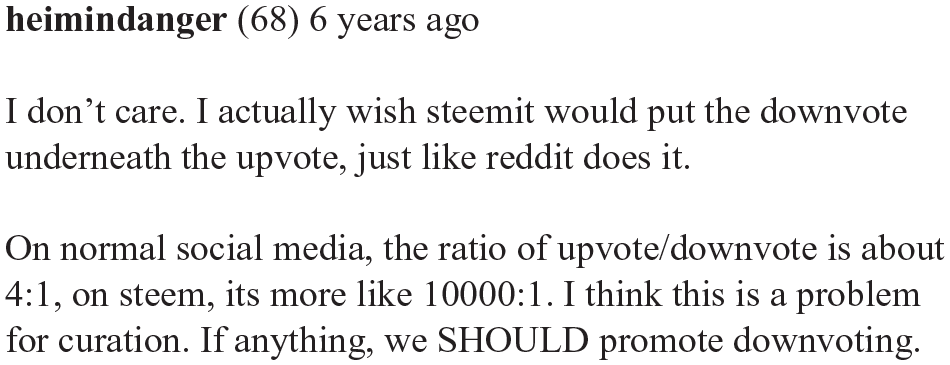
heimindanger suggesting the significance of promoting downvoting.
Increased participation on DTube put the shortfalls of Steemit’s governance to the test. In a follow-up blog, the core team acknowledged the significant presence of “copyrighted content” and the gradual emergence of “far-right winged” political videos usually censored on YouTube (heimindanger, 2017) and persuaded users to downvote videos they did not wish to see on the platform (see Figure 2). The vagueness in the definition of platform governance brought forward the tensions prevalent in DTube. One user criticized the use of the term “far-right” and hoped to extend an invitation to users on Gab. Such instances exhibit the prevalence and growth of far-right users on smaller platforms since 2017. However, as I will elaborate, DTube witnessed moderate “alt-right digital migration” (Kor-Sins, 2023). Despite DTube’s free speech discourse, it did not allow the “alt-right content to flourish” (Kor-Sins, 2023, p. 7). Furthermore, such interactions challenged the neutral (Gillespie, 2010, p. 348) or “value-free constructs” (van Dijck et al., 2018, p. 3). Although the founder and the core team reiterated a non-political position, political tensions became increasingly evident.
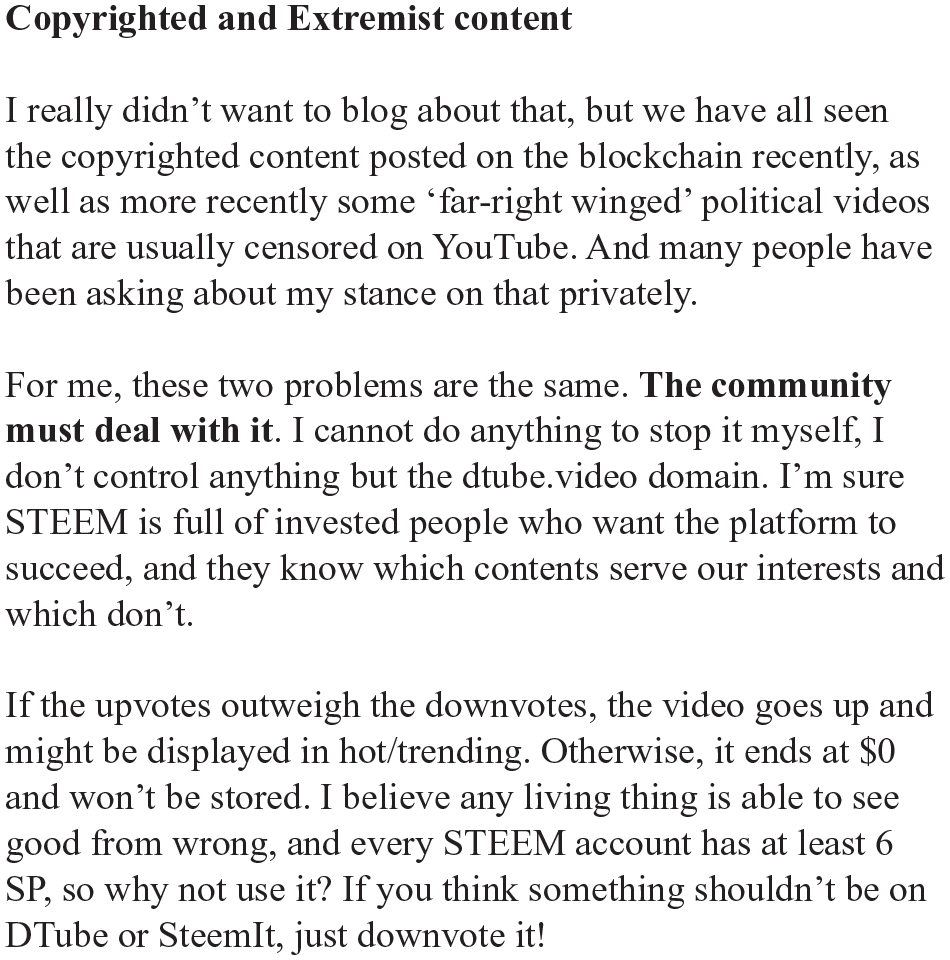
heimindanger suggests that users downvote to ensure extremist content does not stay on the platform.
The shortcomings of DTube’s earliest platform governance highlighted unintended user practices or contradicted the platform’s neutral position. There were minor changes to address digital millennium copyright act (DMCA) complaints and incorporate a content moderation team. The core team invited users to report pirated content (heimindanger, 2018) and reviewed the DMCA complaints to manually blacklisted the user or the content they deemed copyrighted. As per the reported data, 5 users reported fewer than 25 copyrighted videos. Indeed, much more non-original (pirated) content was available on DTube. They remained unchanged without substantial mechanisms of “rule-enforcement” (Sternberg, 2012, p. 134). Furthermore, there was no clear evidence to help us understand how this proposed curation worked. For the core team fixing bugs or enhancing user experience preceded changes to platform governance. They followed an “ad hoc approach” (Stevenson, 2016, p. 5) to find workarounds to improve platform governance, and voting remained the primary governance mechanism. Copyrighted content or a handful of popular movies did not attract legal proceedings against DTube, given the little traffic on the site. Therefore, the core team did not see a need to change governance mechanisms drastically. However, their aspiration to improve the platform’s quality of experience and content led them to make many significant changes.
Iteration
The DTube team published a whitepaper in June 2019 outlining modifications to the platform and the governance mechanisms. This publication was a significant move to establish new content curation and moderation mechanisms different from Steemit. For the core team, governance refers to mechanisms involved in regulating and operating the blockchain system. However, the whitepaper also listed significant changes to the voting system to manage content discovery, moderation, and incentivization. Through these changes, the core team attempted to make new rules as a reaction to and prevent the transgressions of “previously unstated, informal rules and norms” (Sternberg, 2012, p. 166).
New Governance Mechanisms
The new voting mechanism had three significant changes. The first change introduced a “Forced self-upvote” (Dtube, 2019) that mandated users to upvote their content while posting a video or comment. It was an upvote by default, and users had the choice of voting power (VP). However, using 100% VP brought maximum reward for the user. The second change was a new classification method. While uploading a video, users could classify the video as original and not safe for work (NSFW; see Figure 3). By checking the “Original Content” box, users declared the originality of a video. This categorization allowed content attribution and moderation. However, beyond the upload screen, this classification of videos as original and non-original was not explicitly clear. On the contrary, NSFW video would appear blurred by default (or hidden based on user preference). The third and most significant change was the new reward calculation. A complex calculation determined the reward based on the number of active users on the platform and the VP. The earliest vote with enormous VP earned more rewards and made the video popular. Video creators received rewards for their self-vote. Curation votes earned rewards to curators who voted on the video. Only veteran DTube users could understand the complex logic, making them powerful in the system.

Screenshot showing the upload screen in October 2020.
Drawbacks of the voting system and minor fixes
While new platform governance mechanisms were complicated and introduced new challenges. The revised rewards distribution allowed users to game the system. It was a deliberate choice to enable users to play a “curation game” where curators tried “to grow their influence power by earning DTC tokens through their posts, votes and tags” (DTube White Paper, 2019, p. 11). Such changes introduced new paradoxes on the platform. Although user voting denoted “democratic moderation” (Seering, 2020, p. 12), the community was anything but democratic. The complex voting and rewards system allowed a skewed power structure and uneven rewards distribution. DTC-rich members acquired and exercised “moderation power” (Matias, 2019, p. 2). In several instances, DTC-rich curators heavily downvoted videos to suppress them in the system. In doing so, the curator earned higher rewards. However, the creator of the suppressed video lost the rewards that they would have gained from the self-vote. Furthermore, there was no mechanism for users to contest the downvotes. However, new users possessed little or no DTC (therefore, weak VP). These tensions and other drawbacks of governance mechanisms were evident after the proposed changes became a functional system in October 2020. The new governance mechanisms and rewards distribution were biased toward DTC-rich users. The core team further implemented minor changes to overcome such drawbacks.
The addition of a “tip” function was the first notable change. The core team occasionally gifted DTC to encourage new users who did not understand the complex logic of the platform. Furthermore, they added a tip box to the vote button since manually gifting DTC was unsustainable. With the new change, in addition to choosing the VP, users could specify the reward percentage they wanted to tip the video creator. This function allowed curators to pass some of their rewards to video creators. The default tip percentage was 25. However, curators chose the percentage value (see Figure 4). A noteworthy example of a 100% tip was seen on videos by one DTube video creator from Ukraine as they vlogged about struggles to escape the Russian invasion in March 2022.
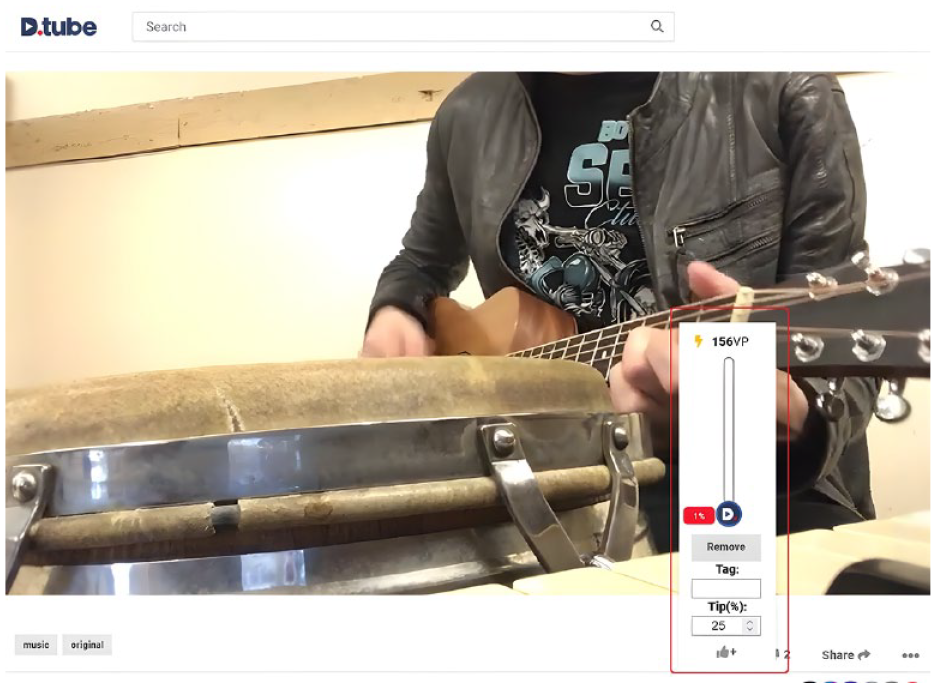
Screenshot of DTube video screen showing the dynamic voting power slider, tag, and tip box.
Whitelisting Process
Another significant change was the introduction of the “whitelisting” process. New users could sign up on DTube and participate as video creators, curators, or audiences. There were no screening mechanisms or restrictions to filter or segregate users into different categories. Video creators or curators could become influential and DTC-rich with consistent or excessive participation. DTC-rich users had incredible power in governing the platform’s content and participation. The core team introduced a new whitelisting process to encourage new users. This filtering process was also an attempt to promote original content creators. Any new user willing to join as a video creator or a curator had to write down the DTube username on paper and display it as an introductory video.
This process resembled the “embodied verification” (van der Nagel, 2020) followed by specific NSFW subreddits. The core team verified the user’s authenticity based on their self-representation in a video, rather than using real name policy or emphasizing “formal, legal, and bureaucratic systems of identification” (van der Nagel, 2020, p. 62). For NSFW, subreddits’ embodied verification was a strategic manipulation by individuals or identities at risk from systems of exclusion on large platforms. For DTube, embedded verification was a departure from the processes followed on MsSMs and a suitable alternative for the decentralized ideals. Moreover, much like other features on the platform, the core team borrowed this verification process from elsewhere. Figure 5 shows the screenshot from the verification video I shared while participating as a video creator.

Screenshot of a video screen showing the verification video I made for whitelisting on DTube.
Voting Bots
The DTube curation bot was made available to the community of users. Users with technical knowledge could set up a bot using their DTube credentials. The core team designed the bot to instantly vote on videos since the complex reward distribution favored the earliest and heaviest upvote. Users set up the bots to upvote videos from their preferred video creators. One creator shared that the option to use a bot for voting made it easy for them to upvote videos by their favorite creators. Different users set up bots to upvote creators who shared videos consistently. Users also set up the VP percentage and tip percentage differently for each creator, subject to the nature of the content and their relationship with the creator.
While the governance mechanism allowed gaming the system, introducing bots made the process faster. However, a few DTube members deployed curation bots to downvote videos that they perceived as problematic. They downvoted videos using bots for users who had previously uploaded videos depicting hate speech or violence, violated copyrights, and so on. Users voted for videos instantly (and automatically) using bots without watching the video itself. This widespread use of bots meant that the governance mechanism had changed from a purely community-driven curation or moderation to a semi-automated process. The semi-automated system furthered the inequality in participation, at the same time, introduced a form of censorship. The new changes to the platform, specifically the introduction of a semi-automated system, divided the community of users on ideological lines and socio-political perspectives. Therefore, what followed the iteration was a series of contestations. In the following section, I will discuss the contestations around governance mechanisms.
Contestation
In the initial phase, DTube members appropriated the platform as a space to earn cryptocurrency rather than for creating original videos. Users carried forward the practices from Steemit involving “passive social behavior” and a tendency to accrue economic value (Guidi et al., 2020, p. 210251). The enthusiasm around blockchain and cryptocurrency overshadowed governance mechanisms. SimonGhoul’s (2019) Reddit post explaining reasons to quit DTube is a notable criticism of early DTube. They clearly outlined technical drawbacks and participation barriers, yet hoped someone would fix them (SimonGhoul, 2019). As illustrated in the previous section, the core team implemented several changes to platform governance, which became a catalyst for discussion and debates around barriers to participation, the use of bots and the political spectrum of users.
New Barriers to Participation
New voting mechanisms further increased barriers to participation. Most active creators or curators on DTube were DTC-rich by mining the token or due to their long-term involvement on the platform. Therefore, under heavy votes, these users steered content popularity and rewards. New users frequently asked such questions to understand the rules of participation. Video creators could earn maximum reward from the first self-vote or by the generosity (tip) of the curators. Moreover, the popularity of a video did not fetch high rewards for the creator. The curator gained more rewards based on complex economics. In one instance, a new user figured out the complexities of rewards and suggested change. As a temporary fix, the core team made amends by gifting DTC to new users on whitelisting to reduce the paradox of participation.
The new governance mechanisms or the temporary fix did not resolve questions related to copyright and attribution. Users could share content by other creators or copyrighted videos to earn DTC. The inconsistencies with the voting process brought more questions. However, the curation bot voted for content without the user having to watch the video first. Figure 6 shows one instance of a user questioning relationship between the verification process and the originality of the videos. The whitelisting and onboarding process was done manually and became a mechanism to gatekeep community members. There was no mechanism to check the content whitelisted users shared.
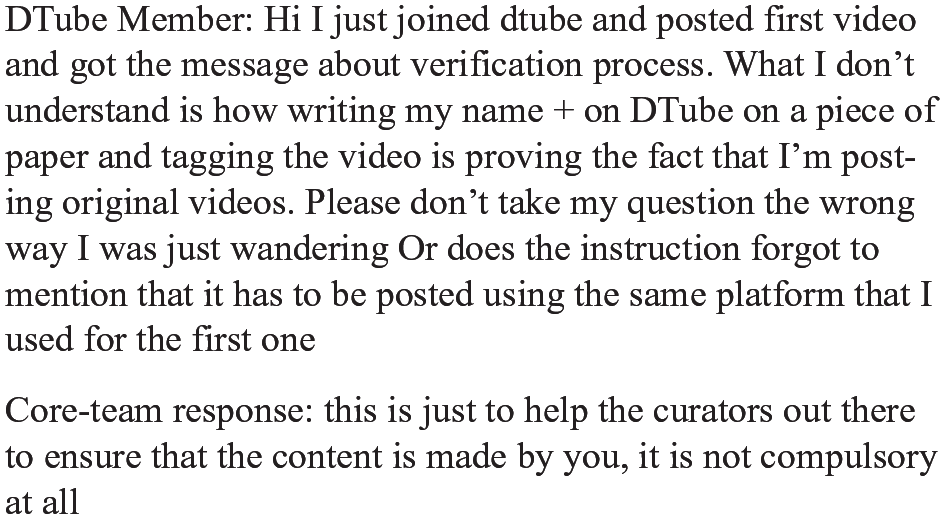
Discord discussion—one member asks a question about the relationship between the verification process and the originality of the videos.
The Far-Right Debate
The automated downvoting of far-right and copyrighted content brought a rift in the core team and the community (see Figure 7). As discussed earlier, user comments suggested the presence of users working toward expansion and links between fringe platforms such as Gab. Since DTube aimed to become a free speech platform without censorship, it resembled platforms like Gab and attracted users from fringe platforms. In the earliest stage of DTube, political ideologies did not become discussion topics on the forums. However, with an increased deplatforming on MsSM platforms, DTube witnessed the growth of far-right users. These users shared inappropriate content either produced originally or shared from fringe platforms such as Bitchute or videos dismissed on YouTube. One DTube leader DL03 (a key member of the core team and DTC-rich) deployed a bot to downvote videos by new members who shared far-right videos. These bots downvoted selected videos with very high VP and suppressed the video (preventing visibility on the trending list). The suppressed users reported this automated heavy downvoting as abuse since downvoting restricted their participation by other users with authoritative control. Figure 8 shows one instance of such abuse reporting.

Discord discussion—one DTube calling out voting with the bot as abuse.

Discord discussion—new user reporting abuse.
Leaders who used the (automated) bot to downvote far-right content differed in their approach. DL03 defended their action and noted that the new users had misused the original content flag or propagated hate speech and misinformation. Another prominent leader DL05 agreed that content in some videos propagated hate speech and misinformation; they disagreed with DL03’s actions of heavy downvoting. These actions certainly prevented the growth of far-right sub-communities within DTube. However, there were several ambiguities about the definition of inappropriate and non-original content or the means to regulate such content.
The core team had evident differences about moderating ambiguous content. Several leaders took a strong stance against far-right content on the platform. However, some leaders were conscious that the skewed DTC distribution entwined with the governance mechanisms and suppressed some content or users over others. Figure 9 shows DL06 agreeing about suppressing videos they deemed problematic yet taking a stand against heavy downvoting by other leaders. While there was consensus among DTC-rich community members to downvote far-right content, they also discussed with DL03 to adhere to community guidelines. They did not want to suppress all users aligned with right-wing ideologies without allowing them to participate.
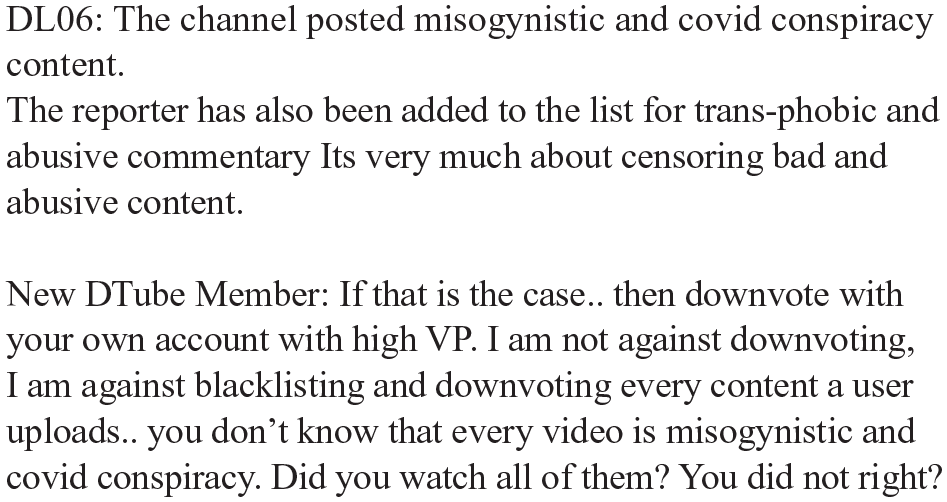
Discord discussion—DL06 clarifying reasons for automated downvoting.
However, DL03 was at the center of debate between the DTube team and suppressed users. While the user was trying to defend their content, DL03 defended their action, stating that the user copied the video from elsewhere. Such debates were common between late 2020 to late 2021 (see Figure 10). The core team and several community members considered DL03 a rogue since they did not adhere to community consensus. At the same time, there were no mechanisms to prevent leaders such as DL03 from heavy downvoting. DL03 continued to use the downvoting bot despite several requests to suspend the bot or reduce the VP percentage. Although the debates continued around governance mechanisms, no significant changes occurred until January 2022.

Discord discussion—one leader agrees with DL03’s downvote but disagrees with the heavy use of DTC.
Between October 2020 and late 2021, the core team worked toward improving content quality and simplifying the platform’s processes. There were minor experiments to improve platform governance. In the first (public) core team meeting of August 2021, they agreed on the ineffectiveness of community-driven moderation and acknowledged the presence of problematic content. Since the leaders lived in different parts of the world, they had different interpretations of problematic or gore content according to the legal frameworks defined in the country of their residence. The leaders agreed to disallow hosting videos depicting violence or hatred on their computers (as part of the peer-to-peer seeding) based on the laws of the country of their residence. However, users moderated all other content with a direct vote or voting through bots.
Discussion
For an uninitiated individual exploring DTube, the help (or wiki as listed on DTube) page Why-Is-Dtube-Uncensorable, presents DTube as a platform where users have complete control over the storage and visibility of content. As of March 2023, when writing this article, DTube presented itself as a platform governed by the community and free from censorship. Although DTube started with loose regulations and community-driven platform governance principles, as illustrated in the previous sections, user practices (re)configured platform governance over time. These changes were unique to DTube and somewhat different to patterns we may find on MsSM platforms or other BSM platforms. In (re)configuring the platform governance, DTube has deviated from its original goals. At the same time, it has refrained from rapid scaling by allowing deplatformed users to dominate. Technological and social factors influenced the (re)configuration.
Ambiguous Foundations
Initially, governance mechanisms on DTube conveyed “anarchic visions” (Vaidhyanathan, 2004, p. 20) with a tendency to avoid authority (p. 11). They resembled “libertarians, librarians, hackers, terrorists, religious zealots, and anti-globalization activists” who promoted “information anarchy” in the early-21st century (Vaidhyanathan, 2003). Steemit and, by extension, DTube were libertarian projects. DTube borrowed the visions and principles defined by Steemit and incorporated a distributed file system to allow users to control their data. Through these principles or visions, DTube resisted centralized control and proposed “governance through collaboration, deliberation, consensus, and common coordination” (Vaidhyanathan, 2004, p. 22). Moreover, DTube exhibited a sense of rejection of the law (Zittrain, 2013, p. 143) by entrusting decisions on copyrighted content just to a community of users. Thus, in its origins, DTube had seemingly anarchic visions.
For the core team, DTube was a radical blockchain project (Swartz, 2017). However, it was a social media platform, and the visions or ambitions of the project “aligned with bitcoin’s political themes: decentralization, autonomy, and privacy” (Swartz, 2017, p. 86). And it was imagined as a “holistic system of decentralized, non-hierarchical, autonomous self-governance” (Swartz, 2017, p. 86). The use of the words “decentralization” and “community-driven moderation” in the DTube white paper had the same sense of polysemy. They evocated “past dreams of alterity” as autonomous in radical blockchain dreams (Swartz, 2017, p. 92). DTube team (DTube White Paper, 2019) imagined it as a “blockchain-based entity run without any external control, instead guided by a set of incorruptible rules” (Swartz, 2017, p. 93) defined by “Cryptography and Maths” (DTube White Paper, 2019, p. 11). There were slipperiness and incoherence with DTube’s visions like that observed in radical blockchain projects by Swartz (2017). The slipperiness was made evident by considering social media activities as transactions without paying active attention to ownership issues, problematic content, or user practices.
The Influences of Data Money on Sociality
Moreover, upvote, downvote, and VP were the only governance mechanisms. These buttons were not a “binary device . . . to specify the either positive or negative value” (Graham & Rodriguez, 2021, p. 3). The variable entity of VP as a weight to the vote buttons on DTube afforded community-driven content curation and moderation. The vote buttons also afforded content “ratings and rankings” (Graham & Rodriguez, 2021) without a centralized algorithm or governance mechanisms. In addition, these buttons also afforded rewards for participation. Although the voting buttons had the “capabilities” of community-driven governance, they had other “possibilities” (Gaver, 1991, p. 79). Users “appropriated” (Burgess & Baym, 2020, p. 36) the upvote, downvote, and VP functions to maximize earnings.
The governance mechanisms allowed accruing of data money (cryptocurrency). DTube users reiterated Steemit’s user culture of maximizing cryptocurrency earnings over content moderation or curation (Guidi et al., 2020; Li & Palanisamy, 2019). Given the “limitations” (Gaver, 1991, p. 79) or openness of content attribution on DTube, users could earn cryptocurrency by uploading copyrighted content or popular movies without any consequences. The copyrighted content could remain unnoticed on DTube. Users played a “generative role” (Bucher & Helmond, 2018, p. 248) in steering the platform toward cryptocurrency earnings rather than a space for social interaction and cultural production.
DTube fundamentally changed after reconfiguring the voting system to reinstate platform governance. The configuration of the voting system on Steemit or Steem blockchain was not conducive to governing or regulating user-generated content or user behavior. The core team configured the vote buttons and VP in incremental iterations to encourage users to curate and moderate the content. In addition, they intervened “to enforce rules in particular ways that deter behaviour they want to suppress and reinforce values they want to encourage” (Suzor, 2019, p. 91). With these reconfigurations, they attempted to reinforce the original goals of making the platform a space for cultural production and social participation. While the new mechanisms encouraged downvoting, the configuration of VP and rewards allowed few users to concentrate power and steer the nature of content and participation. The DTube community reiterated Wikipedia’s shift in governance toward oligarchy, or the concentration of authority in a small group of administrators (Shaw & Hill, 2014).
By introducing new governance measures, DTube had moved away from an anarchist belief that “culture should flow with minimal impediments” to an oligarchic system that favored a “top-down approach” (Vaidhyanathan, 2004, p. 105). The hierarchical system preceded the formation of “local” (Zittrain, 2013, p. 143) or smaller interest groups on the platform. Despite reiterating decentralization as the core aspect of DTube, the new governance mechanisms had centralized decision-making. A handful of users played the role of “sysops” (Driscoll, 2022, p. 140) to gatekeep users and moderate content on the platform.
The contestation and debates restrained problematic content while the community exhibited plurality and inclusivity. The heavy (automated) downvoting discouraged the participation of deplatformed far-right users. Several new users left the platform after raising concerns about the barriers to participation and censorship. While most leadership had stepped away from a neutral political position to restrict far-right participation, they did not wholly disregard the far-right users. In this context, DL03 became an outlier as a far-left participant. A couple of core team members reiterated that DTube should be an inclusive space. Although they prevented the growth of far-right content, the community agreed to allow users aligned with right-wing ideology to defend their position. They exhibited characteristics of “agonistic pluralism” (Mouffe, 1999, p. 15). In doing so, there was a lot of deliberation on DTube forums to figure out ways to make the governance mechanisms inclusive. Therefore, making it a “transactional community . . . made up of acts of communication despite difference” (Swartz, 2020, p. 16).
Conclusion
The platform governance on DTube in 2017 is different from that in 2022. DTube started in 2017, intending to become a platform governed by community members without centralized control, algorithmic governance, and advertising revenue. In 2022, the platform governance was a mix of partial semi-automated votes and partial user votes. The founding principles guided the core team and the DTube community. And they exhibited characteristics of “experimentation and democratic participation” (Driscoll, 2022, p. 28) found on bulletin board systems from the 1990s. Notably, user practices shaped governance mechanisms influenced by the characteristics of blockchain technology. The “economic logic” (Plantin et al., 2018, p. 297) of blockchain technology made the sociality on DTube more transactional. Yet, the community reiterated the need for inclusivity and accessibility on the platform. Community members were “rooted in shared hopes for the future” (Swartz, 2020, p. 143). And through blockchain-based social media, they produced shared meanings, values, and practices. Cryptocurrency and distributed ledger held the community together. At the same time, the community’s existence was necessary for the value of cryptocurrency. The governance mechanisms held together these shared meanings and experiences, distinct to DTube. Finally, in the reconfiguration of platform governance, DTube articulates minor structures of feeling that aim to produce an inclusive space over rapid scaling.
Footnotes
Acknowledgements
The author is extremely grateful to Prof. Jean Burgess and Prof. Daniel Angus for their support in developing the project. He is also thankful to the reviewers and editors of this special issue for their valuable feedback.
Declaration of Conflicting Interests
The author(s) declared no potential conflicts of interest with respect to the research, authorship, and/or publication of this article.
Funding
The author(s) disclosed receipt of the following financial support for the research, authorship, and/or publication of this article: The author declared that the PhD research was supported by an Australian Government Research Training Program Scholarship through the Queensland University of Technology, Queensland, Australia.
