



Abstract
Despite the important role search engines play in finding health information, little systematic research has looked at the ways in which semantic media complicate this process. An investigation of information seekers from four counties with varying political associations in the state of North Carolina details how 42 people searched for information about abortion. We find that participant ability to find accurate information is primarily driven by their position (i.e., do they support terminating a pregnancy or not). However, our findings also indicate that search engine optimization and advertising make finding accurate abortion information a challenge.
Introduction
When Stephanie Moore typed “abortion near me” on her phone, she was looking for information regarding how to obtain an abortion—what she ended up getting was a website operated by a Christian nonprofit trying to end abortion in the United States (Cott et al., 2022). Called a variety of names, such “crisis pregnancy centers” (CPCs) rely on search engine optimization (SEO), targeted advertising, and websites to make their centers look like health clinics, what Daniels (2009) refers to as “cloaked websites.” In response to abortion restrictions across the United States, Google began to update its policies and began labeling whether organizations included in search returns offer abortion services (Love & Alba, 2022). Yet this article reveals that the context surrounding what constitutes abortion services is complicated by a seeker’s intentions, the words they use to start their search, as well as the ways in which search engines organize information.
Accessing effective abortion care is an essential part of maternal care. In a study conducted by Advancing New Standards in Reproductive Health at the University of California San Francisco, 13% of pregnant people considering abortion had visited a confirmed CPC. CPCs are organizations, typically religiously affiliated, that provide free or affordable non-clinical services to pregnant people. Most are not licensed medical facilities and are primarily staffed by volunteers who do not adhere to U.S. medical guidelines (Baggett, 2022). In the United States, there are approximately three CPCs for every one abortion clinic (Swartzendruber & Lambert, 2020). Pregnant people who visit a CPC were significantly more likely to still be pregnant and seeking an abortion 4 weeks later (Upadhyay et al., 2021). This discrepancy suggests that CPCs may mislead women about the care options available to them. Since abortion care is time-sensitive, and many states are trying to reduce the gestational limits for abortion, early access to timely and effective abortion services is critical.
Many people turn to search engines for health information (Murphy, 2019). Users conceive of search engines as a place to discover new knowledge, but search platforms can limit what we see, what we buy, and who we interact with (Introna & Nissenbaum, 2006; Noble, 2018; Tripodi, 2022; Vaidhyanathan, 2011). Algorithms co-construct reality and increasingly mediate our decision-making practices (Couldry & Hepp, 2017; Gillespie, 2014; Pariser, 2012; Sunstein, 2001; Zuboff, 2019). Understanding the important role search engines play when it comes to seeking out information about abortion is essential, yet limited attention has been paid to the importance of web searches related to abortion. Specifically, we are not aware of any research that attempts to understand how the “three-sided market” of search—what Rieder and Sire (2014) define as users, content providers, and advertisers—interacts with health-related search tasks.
This article begins to fill this gap, examining, documenting, and analyzing how people search for information about abortion (users); how organizations use SEO to reach potential users (content providers); and how advertisers try to attract visitors. In doing so, this article provides a nuanced and rich perspective of the “three sides of search” (Rieder & Sire, 2014) and the ways in which reproductive health is complicated by capitalist endeavors. Drawing on an analysis of interviews and search tasks with 42 individuals in four locations across the state of North Carolina, we argue that peoples’ ability to find accurate information about how to terminate a pregnancy is primarily driven by their position on abortion (e.g., do they support terminating a pregnancy or not). However, our findings also indicate that SEO and advertising make finding accurate information challenging as the top returns are frequently dominated by results that do not meet seekers’ needs.
These findings are further complicated by a shift in how knowledge is organized online. While, large media companies previously encouraged exploratory practices, they are increasingly trying to answer our questions directly—conveying certainty in the information returned (Ford & Graham, 2016; Haider & Sundin, 2019; Iliadis, 2019, 2022; Tripodi, 2022). This practice not only disincentivizes seekers from visiting other websites, but it also conveys information embedded with sociocultural biases as absolute truth (Iliadis, 2022; Lewandowski, 2017; Noble, 2018; Vaidhyanathan, 2011; Vang, 2013). By presuming to know what we want or what we are looking for, returns become “a matter of meaning” (Iliadis, 2018, p. 225). Given the precarity of abortion access in the United States, more research is needed to understand how the semantic web (i.e., the way data and content are linked across the web to enable features like virtual assistants and knowledge panels) interacts with “societal relevance” (Haider & Sundin, 2019; Sundin et al., 2021). By documenting firsthand how opinions influence search behavior, this article examines how advertisers’ interests complicate the meaning or understanding behind semantic media and whether the information procured best matches those intentions. Following the overturning of Roe v. Wade (1973), our data also document how search Goliaths like Google adapted how information returned was organized (Love & Alba, 2022). Understanding the connection between a user’s starting point and algorithmic ambiguity can provide insights into how search companies navigate what Haider and Sundin (2019) refer to as “frictions of relevance,” deciding when and how to elevate content that may match a query like “abortion information” when such information is fraught with political contestation as it currently is in the United States.
Theoretical Framework
People often use the internet as a diagnostic tool and source for health information. Nonetheless, studies document that this research can lead to inaccurate or misleading information (Adams et al., 2006; Dobransky & Hargittai, 2012; Fox & Duggan, 2013; Percheski & Hargittai, 2011). More recent data suggest that search engines are the primary way people access health information. Google, for example, handles over one billion health queries a day (Murphy, 2019).
Despite familiarity with the internet and inclination to search for health information online, research indicates that many people do not have the skills necessary to determine if the information they find online is trustworthy or accurate (see Wineburg & McGrew, 2019 for a review). Part of this disjuncture is tied to limited digital literacy—most adults have been taught strategies in digital discernment that were developed for libraries to determine which resources to put on their shelves (Caulfield, 2018). These strategies encourage website assessment by staying on the page, what researchers refer to as “vertical reading” (Breakstone et al., 2018). Vertical reading is the process of scrolling up and down and using strategies like reading the site’s “about page” or relying on the domain extension (e.g., .org signals integrity) to determine whether a website is credible (Breakstone et al., 2021; Brodsky, Brooks, Scimeca, Galati, et al., 2021; Brodsky, Brooks, Scimeca, Todorova, et al., 2021). While this research demonstrates peoples’ limited ability to evaluate a website’s reliability once they are on the site, it does not consider the path by which people arrive at the information returned to them.
The study of relevance has long been advanced within information science. Yet there is little agreement within the field on its definition, meaning, evaluation, and application of what constitutes “relevance” (Kagolovsky & Mohr, 2001). In its most classical use (i.e., the Cranfield paradigm), relevance is topical and system-specific, implying a fixed or static relationship between a query and the document that best matches it (Park, 1994). However, most information seekers do not understand the important role search terms play in shaping the type of results they will encounter (Hargittai & Young, 2012; Tripodi, 2018, 2022). As such, more studies on relevance are needed to capture the “real-world messiness” of search and the role search engines play in society (Sundin et al., 2021).
Understanding the power keywords have in shaping returns from contemporary commercial search engines is critical, particularly when it comes to reproductive health. In their study, Hargittai and Young (2012) found that college students without prior knowledge of emergency contraception had a greater potential for confusion and often overlooked relevant information because they were not aware of the accurate terms they should use when conducting their search. Hargittai and Young’s (2012) data also indicated that the positionality of the seeker influences their returns. For example, some college students who received a prompt related to a need for emergency contraception searched the phrase “adoption.” While this research is now over a decade old, and the search environment has changed dramatically, more research indicates the cultural significance of prompts and the ways in which one’s starting point is shaped by the way people see the world (Tripodi, 2022).
The sociocultural dynamics of queries intersect beyond health and hold grave implications for society. On June 17, 2015, Dylann Roof murdered nine Black Americans in their place of worship in Charleston, South Carolina. According to Roof’s manifesto, he was emboldened to murder these Black Americans following an investigatory search process for the phrase “Black on White crime,” which connected Roof to the Council of Conservative Citizens, an American White supremacist organization (Hersher, 2017; Noble, 2018). As Noble (2018) explains, the starting point “Black on White crime” was a query seeped in racist sentiment, but it was also what Golebiewski and Boyd (2019) define as a “data void,” an obscure word or phrase not frequently queried. Since credible informational sources about the concept “Black on White crime” do not exist, the void was entirely shaped by White nationalism and White supremacy. Intentional placement of the phrase on various websites affected SEO, ensuring that those who did their own research on “Black on White crime” would be connected to White supremacist websites (Golebiewski & Boyd, 2019).
Keywords have the power to shape present action, but they can also influence the past. In a comparative study of returns procured by Google and Yandex, a Russian-owned search engine, the phrases “annexation of Crimea” and “incorporation of Crimea” produced dramatically different results regarding the outcome of the 2014 Russian–Ukrainian war. The phrase annexation typically refers to the forceable acquisition of a state/territory through militaristic force, whereas incorporation implies the creation of a new city or entity. Russia’s government bans the use of the word “annexation” to describe the events that occurred in Crimea in 2014 (Toal et al., 2020). Search returns reflected divergent perspectives; the phrase “incorporation of Crimea” featured more links to pro-regime, state-media websites, whereas the query “annexation of Crimea” yielded predominately Ukrainian and Belarusian, nongovernmental, results (Zavadski & Toepfl, 2019). As these studies demonstrate, unpacking seekers’ starting points is key to understanding how search engines determine what constitutes “relevant” returns.
The rise of semantic media further complicates the notion of what constitutes relevant, accurate, information. Web infrastructure has undergone significant transformation over the past few years, changing how information is structured and represented. This digital makeover is enabled by what researchers refer to as “semantic media.” Semantic media are technologies that convey “facts, answers, meanings, and ‘knowledge’” directly without leading people to the sources these technologies are reliant on (Iliadis, 2022). As Iliadis, (2019, 2022) explains, the original goal of semantic media was about interoperability; applied computational ontologies (ACOs) provide rules for how data are organized and labeled. By relying on collaborative and consistent metadata and data labels, computers could use ACOs to try and understand an individual’s intent. Rather than simply keyword matching, semantic media is about understanding the “latent meaning” behind the text so that technology can anticipate our desires (Iliadis, 2022). Ontology-driven media—think Alexa, Siri, or Google—convey “facts” instantaneously and constantly without people visiting the source of the information.
Semantic media has drastically changed how search engines present information. Since 2012, Google (for example) has modified returns so that people are less likely to get a list of hyperlinked websites and more likely to receive informative summaries (Tripodi, 2022). Google’s Knowledge Graph tries to answer queries directly without the user navigating to other websites, making the search processes more convenient but not necessarily better or more accurate (Ford & Graham, 2016; Haider & Sundin, 2019; Vang, 2013). Not only does this shifting interface keep people from visiting other websites in a continuous product loop (which can hamper local traffic), semantic search also contains significant sociocultural biases (Iliadis, 2022).
Despite its goal to enable shared meaning across different websites and systems, semantic media like Google’s knowledge graph are less nuanced than the sources they are reliant on, changing the meaning of certain phrases from one source location to the next (Ford & Graham, 2016). Moreover, creating a semantically static and accurate ontology for ever-changing language(s) is a nearly impossible task (Iliadis, 2018). While semantic media may rely on information that is democratically sourced, they are also the new gatekeepers to knowledge (Ford & Graham, 2016; Iliadis, 2022).
Given the important role search engines play in how people find information about their health, more research is needed on how a person’s starting point (i.e., search terms) shapes their relevance path as well as the role semantic media plays in complicating this process.
In 1973, the U.S. Supreme Court ruled in Roe v. Wade that women had a right to decide whether to have an abortion. The court upheld that decision in Planned Parenthood v. Casey (1992). Both decisions were overturned on June 24, 2022, in another U.S. Supreme Court decision, Dobbs v. Jackson Women’s Health Organization, which led to changes in abortion policies in numerous states, and heightened tensions surrounding abortion access within the United States (Blazina, 2022). Since then, multiple states have dramatically reduced the gestational limits for abortion or banned it entirely. Given these dynamics, it is of utmost importance to (1) understand how returns surrounding abortion are shaped by a seeker’s position and (2) document the shift in informational returns in the months following the U.S. Supreme Court’s official reversal of Roe v. Wade.
Methods
This project is part of a larger study examining the ways in which political opinions shape keywords and contribute to ideologically siloed returns. From July 2022 through November 2022, our three-person research team conducted interviews and search tasks with 42 participants at four public libraries throughout the state of North Carolina. North Carolina is a nearly evenly divided state by political affiliation; in the 2020 U.S. presidential election, then-president Republican Donald Trump received 49.9% of votes, while his opponent, Democrat Joseph Biden, received 48.6% (“North Carolina Election Results,” 2020). Using 2020 election results by county as a benchmark, library locations were chosen based on political variation to ensure a mix of responses.
In all libraries, we provided a one-page flyer and smaller information cards that were then placed around the libraries. In those libraries that permitted further promotion, the study was mentioned in the library newsletter or similar publication, and/or mentioned on social media (e.g., the library’s Facebook or Instagram page). Interested patrons could pre-register using QR codes on the promotional materials or visit us on the designated study dates. In libraries with limited participant interest, we also spoke to potential participants one-on-one, and those interested in the study were invited to participate.
Following the work of Hargittai and Young (2012), we used interviews combined with participant observation, whereby a researcher would sit one-on-one with a participant in a private room in the library and perform a series of search tasks. During the tasks, we prompted participants to “think aloud,” a method often used to analyze information retrieval processes in detail as they are happening (Jaspers et al., 2004). The think aloud method was selected to gather rich verbal data about people with varying levels of search expertise to see how people formulate queries related to current events (Fonteyn et al., 1993). This method is an effective tool for revealing the process behind how people solve problems and is used in a variety of domains (e.g., Breakstone, 2014; Ericsson & Simon, 1993; Smith et al., 2019).
Our research team interviewed 50 participants in total. Of those interviews, eight were either test interviews or the participants chose to not complete the search tasks. Although participants were still compensated for their time, these interviews were not considered in our evaluation.
After conducting a practice prompt, participants were read a series of four scenarios concerning politically divisive topics on abortion, gun control, the outcome of the 2020 U.S. presidential election, and election integrity, in that order. Following each prompt, we would ask if participants had an opinion on the topic and then asked them to take some time to search for more information in support of their opinion. Before each task, we cleared the browser history, including cookies. Although the loaner laptops were associated with researcher OneDrive accounts, the primary internet browsers used (Chrome and Firefox) were not linked to personal accounts. For two interviews that occurred remotely, this process was slightly modified; the interviews took place on Zoom, while recording audio and video of the participants was switched off. In one of these cases, the participant cleared their cookies and browsing history. The other participant did not do so.
Across the 42 interviews evaluated, participants conducted 59 total abortion-related searches (some participants chose to search more than others). Between the practice prompt and the four scenarios for the 42 participants, we recorded approximately 17 hr of interviews. The shortest interview was approximately 10-min long, and the longest interview was approximately an hour. Interview length was determined by the number of searches a participant conducted for each task and the length of their verbal responses to researcher questions.
By discussing each topic in turn and then recording participant search processes in reaction to the prompt, we could make inferences about how presuppositions inform search queries as well as document how participants determined what constituted trustworthy information. Our interview analysis was guided by the principles of grounded theory with an emphasis on constructing thematic conceptions (Charmaz, 2006). Grounded theory makes space for iterative analysis where findings can emerge simultaneously during data collection (Charmaz & Thornberg, 2021).
This article focuses exclusively on the first prompt which read: A close friend of yours recently found out that they are unexpectedly pregnant and are considering terminating the pregnancy. Do you have an opinion on what they should do?
This prompt was constructed after careful consideration of several factors. We chose to mention that the participant is talking to “a close friend” to underscore the validity of having such a personal conversation with another individual. To avoid the perception of researcher positionality and the possibility of influencing participant keyword choice, we used the phrases “unexpectedly pregnant” and “considering terminating the pregnancy,” rather than phrases such as “unwanted pregnancy,” “surprise pregnancy,” or “considering abortion.” We also chose to use the pronoun “they” to avoid influencing participant impressions about the friend in this situation.
After hearing their opinion, we asked participants to search for more information about the topic and find information that would be useful to their friend. Search tasks were conducted on a loaner laptop using the library Wi-Fi network. To record responses, we used Open Broadcaster Software, a video recording software that captures audio and screen recordings of what participants were doing on the loaner laptop. These recordings were used to analyze participants’ positions on abortion, the words they used to form their searches, which returns they received, and which information they clicked on or identified as reliable.
This study was approved as exempt by the institutional review board at UNC Chapel Hill. Prior to participation, each prospective participant was provided a consent form to review. All participants actively consented to participation; verbal consent was also recorded at the start of each interview. The primary risk from this study was potential participant discomfort while discussing the subject matter of the four scenarios. To address this concern, participants were able to withdraw from the study at any point in the interview process and were informed that some topics might make them uncomfortable during the consent process. All participants received $15 cash for their time, including those who did not complete all the search tasks. To protect participant confidentiality, no personal information about any of the participants was collected, and we assigned each participant a number between 1 and 42.
We coded interviews to identify themes and patterns, evaluating factors including interview dates; participants’ stated views on pregnancy termination; the web browsers and search engines that participants chose to use; the keywords used by participants in their searches; the search results presented by a given search engine; and the websites that participants did/did not open for further investigation.
Findings
The most prominent finding was browser and search engine preference. Regardless of participant position on abortion, nearly everyone used Google’s Chrome for their browser and Google for their search engine, even though participants had the choice to use Google Chrome, Mozilla Firefox, or Microsoft Edge. Only two people opted for Firefox instead of Chrome. Only one participant did not use Google for search (Participant 39 relied on Bing). On two occasions, participants switched from Google to DuckDuckGo when they could not find the information they wanted through Google.
Data collected in this study backed findings from research conducted more than 10 years ago—that the keywords used to initiate internet queries dramatically changed the kind of information returned (Hargittai & Young, 2012). For those participants who held strong opinions on pregnancy termination, this greatly influenced the phrases that they used to find information they would consider sharing with their friend who was considering terminating their unexpected pregnancy.
Keyword Consistency among Supportive Participants
Slightly more than half of the people that we spoke with indicated that they would support their friend’s decision and help them find information about terminating their pregnancy.
Those who articulated a person’s right to abortion access had a remarkably high level of keyword consistency. Of those who supported their friend’s choice to terminate the pregnancy (21), eight relied on the phrase “planned parenthood” to help them find information for their friend. Seven participants who supported a person’s right to abortion access used the phrase “abortion” combined with a location keyword (e.g., “abortion services [city],” “abortion clinic [city],” “abortion near me,” or “abortion clinic near me”). In total, approximately 60% of participants who indicated support for their friend searched for either “planned parenthood” or a variation of “abortion” plus location keywords.
Below are examples of responses that indicated support for their friend, followed by their queries.
I would say if they’re not in the right financial state, or even emotional state, they need to do what’s best for them . . . and it’s your body your choice. If that’s the best way for them, do it that way. [query: planned parenthood]—Participant 6 I do [have an opinion], but I have a choice. So, my first thing to do is to go to Planned Parenthood and go to the official site. [query: planned parenthood]—Participant 14 I’m pro-choice 100%. One I’m a guy and I don’t think that a male politician or clergy should choose whether a woman can, or cannot, have an abortion. [query: planned parenthood near me]—Participant 15 I think women should have the opportunity to get abortions, if necessary, if they choose to terminate a pregnancy, so if I were helping that friend, I would look for available, you know, services available. [query: abortion clinic near me]—Participant 19 A woman's body is her body she has the right to make that decision. [query: abortion]—Participant 22 I think it’s up to the individual person to make that decision what’s right for the female and her family. [query: ending a pregnancy]—Participant 34 I would recommend they speak with their primary care provider and if they didn't have one that they visit planned parent for unbiased information. . .So I would open the browser, and I would go to Planned Parenthood. [query: planned parenthood] Participant 37
The Planned Parenthood Federation of America is a U.S.-based non-profit organization founded in 1916 that provides sex education and sexual and reproductive health care services (Who We Are, 2023). Some—but not all—Planned Parenthood locations provide abortions (Abortion Services, 2023). The Planned Parenthood Action Fund is an independent, not-for-profit advocacy arm of the Planned Parenthood Federation of America (Who We Are, 2023). Both organizations, often colloquially referred to as “Planned Parenthood,” are commonly referenced in debates surrounding abortion in the United States.
Six of the eight searches that included the phrase “planned parenthood,” returned advertisements for the Planned Parenthood Action Fund. The two exceptions were Participants 15 and 38, both of whom searched the phrase “planned parenthood near me” and did not receive any advertising. The top return under the advertising was the organization’s website (plannedparenthood.org) for all participants who searched the phrase “planned parenthood.”
Even though it was an advertisement for the organization they were searching for, all but one person who searched the phrase scrolled past the advertising, opting instead for the Planned Parenthood website. The one seeker who clicked on the advertisement (Participant 17) was interested in the 24-hr Chat feature that was listed as part of the advertising. Those who scrolled past the ads explained that they would want to share the “official website” with their friend (see Figure 1).

Screenshot of Participant 14 searching “planned parenthood,” scrolling past the advertising, and selecting the official website.
Two of the participants indicated support for their friend’s decision but told us that they would search for homeopathic alternatives. During their interview, Participant 16 explained that the overturning of Roe v. Wade influenced their desire to find their friend information about non-medicinal options. Specifically, Participant 16 stated homeopathic solutions would be most helpful if their friend resided in a state where abortion was no longer legal. Participant 16 remembered that there was a fruit that could cause a miscarriage but could not remember what it was. To help them remember, they conducted three subsequent searches including “natural remedy for abortion,” “natural fruit remedy for abortion,” and “seeded fruit causes abortion/miscarriages.” After searching twice on Google and not finding the information they wanted, decided to switch to DuckDuckGo. Interestingly, they also changed their query, but credited a switch in search engines for why they got the answer they were looking for—papaya (see Figure 2).
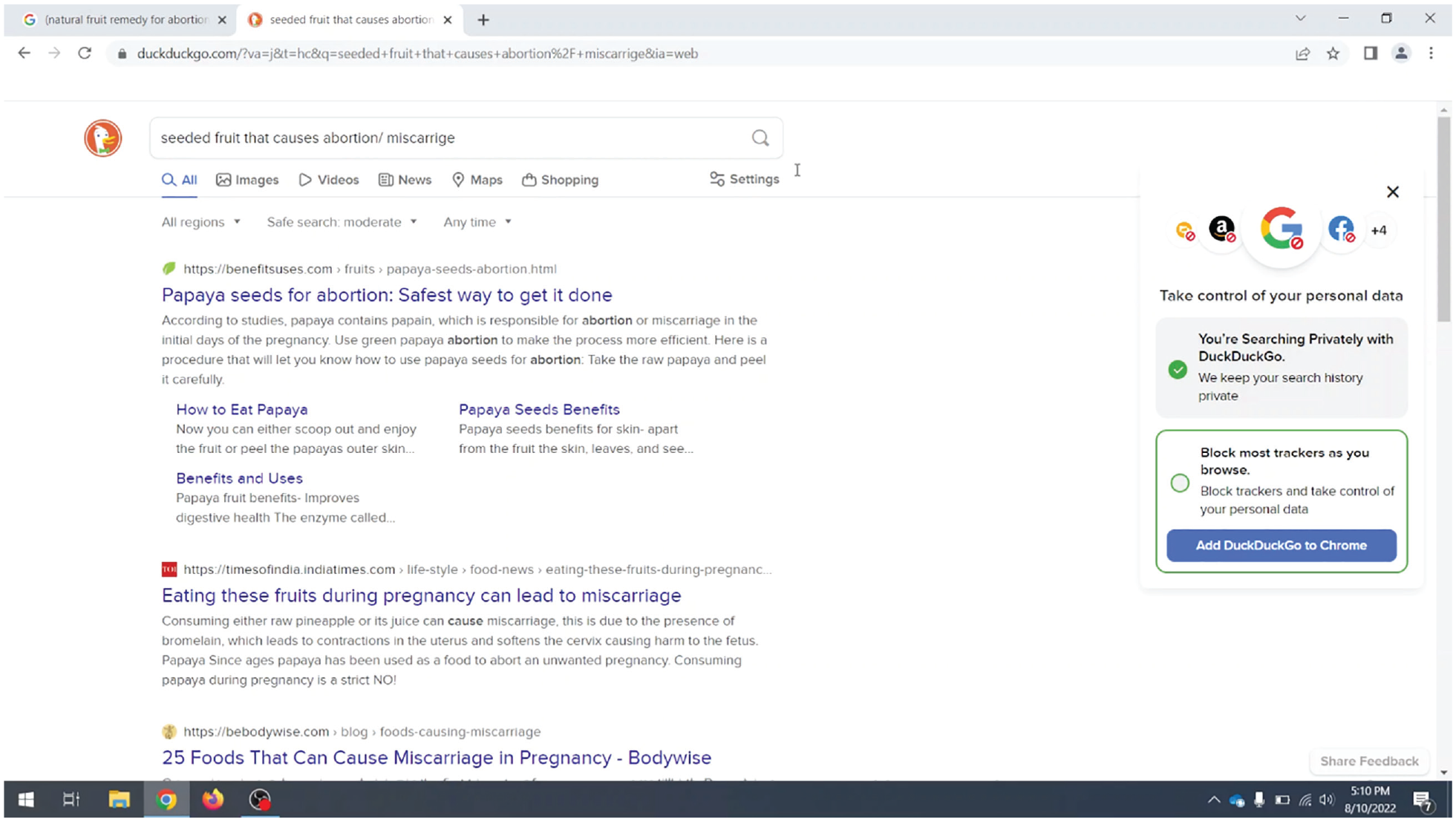
Participant 16 opening a new tab and switching to DuckDuckGo to find information.
Even though the queries that included the phrase abortion + location were used as frequently as “planned parenthood” among participants who supported their friend’s decision, the returns were much more varied. Some of this variation had to do with the role geolocation plays in determining relevance—obviously the returns for a search like “abortion near me” would be dependent on the participant’s location. However, the data collected for this article also documents the complexity of the phrase and how semantic media shape returns related to queries that include “abortion” as a keyword. Capturing live searches (as opposed to a controlled information-seeking environment) also allowed us to document what advertised websites are listed in abortion-related queries and what websites are considered “relevant” for searches that contain the phrase “abortion.”
Seven participants (1, 3, 9, 11, 19, 21, and 30) supported their friend’s decision and searched for more information using some variation that included the phrase “abortion.” All seven used Google to conduct their searches. Each of the seven received advertising for places that did not provide abortion services. For example, Gateway Women’s Care (www.gatewaywomens.care) and/or Health for Her (https://healthforher.org/) appeared in nearly all their returns. By going to the website and consulting with a local obstetrician we were able to classify these websites as CPCs. Even though CPCs were listed in advertising alongside organizations that offered abortions (e.g., abortionclinicservicesraleigh.com), all advertising was labeled with one of the following two phrases “Provides abortions” or “Does not provide abortions” (see Figure 3 as an example).

Listed advertising for the query “abortion clinic + location” conducted by Participant 19 with location information removed. Advertised websites included labels with a description of services offered.
In addition to being a consistent part of advertising, CPCs were also regularly returned in Google Maps. Our research documents a shift in how that information was displayed sometime during August 2022. All searches using a phrase that mentioned “abortion” conducted before August 9, 2022 (Participants 1, 3, 9, 11, and 19) had a CPC in their Maps results alongside clinics that provide abortions. Unlike the CPC advertisements labeled as not providing abortions, Google did not include a label for locations returned in maps. CPCs were listed alongside abortion clinics as places considered algorithmically relevant to searches for “abortion services” or “abortion near me.” Screenshots of these searches are not included as they included geographic information of participants.
Participants interviewed after August 24, 2022 (Participants 21 and 30) engaged with a different Google interface. Data collected on August 25, 2022, and through the date of publication now included a default filter with “Provides Abortions” so that when someone searched for abortion services, they only received locations that provide abortions. When Participants 21 and 30 conducted their searches, this was the default, and CPCs were not immediately listed in their returns.
It is important to note that two participants who used the phrase “abortion” in their searches did not necessarily support abortion but did support their friend’s decision. Likewise, one participant searched for “planned parenthood” but did not support pregnancy termination and was unsure that they would share the website with their friend. For example, Participant 1 indicated that they did not agree with abortion, telling the interviewer that they were “pro-life.” However, they also noted that they would not “push it on other people” and that they would be willing to help their friend find information about how to access abortion services nearby. After querying “abortion clinic [city, state]” they selected a website that could provide abortion services locally as the information they would send to their friend. Participant 30 replied that they “disagree with that [terminating the pregnancy], but it is what it is. If you can’t take care of it, I think you should at least give it up for adoption”; however, they searched for “abortion clinic” when it came to finding information for their friend and said they would choose the local Planned Parenthood as a resource to send to them.
Unsupportive Participants = More Variation
Nineteen participants indicated that they strongly opposed their friend’s decision to terminate the pregnancy. Most participants who did not support their friend’s decision used very different queries. However, there was some consistency. Two participants used the phrase “adoption” or “adoption in NC” (Participants 32 and Participant 41) and three used the word “counseling” as part of their searches (Participant 20 searched for “abortion counseling,” Participant 23 searched for “religious counseling,” and Participant 39 searched “unwanted pregnancy counseling”). Together, these searches made up approximately 26% of keywords used in queries. While there was less consistency among the phrases searched, the intent was clear—each of these participants was looking for information that would deter their friend from having an abortion.
Other examples of participants who did not support their friend’s decision are listed below, followed by their queries in parentheses.
If you lay down and had sex, you should be a mother. [query: learning how to cope when you find out about first pregnancy]—Participant 4 My opinion for that is life is life. Whether you choose to lay down and get pregnant willingly, or be so unprepared to the point where the person you are with does not use the proper protection, or you yourself does not even use a pill or any other sort of protection for yourself . . . [query: what would be the best alternative for abortion]—Participant 13 My opinion is no abortion. I’m against abortion. That’s my opinion. I’m religious. [query 1: is abortion a sin / query 2: what the bible about abortion]—Participant 27 I would make sure that’s what you want to do. Because once you do it it’s too late. [query: welcome baby]—Participant 29 I don’t believe in abortion, and I do believe that every child that’s conceived deserves to live. [query: adoption]—Participant 32 I think it’s sad that somebody would want to end the life of a baby . . . I just, it would break my heart to have a baby die and I think it’s sad for a baby to die when that baby could have lived, and even if the person didn’t want to raise them somebody else could have adopted that baby. So I really do believe that babies should be protected, at the same time I don’t think that the answer is necessarily to punish people who might’ve had an abortion. [query 1: resources for a person thinking of terminating a pregnancy/query 2: unwanted pregnancy counseling]—Participant 39
Given the lack of consistency among queries, there was also significant variation in the information returned. Among those who searched for information to help dissuade their friend, none of them clicked on the same website and many did not click for more information past what the search engine displayed, telling the researcher that they would just relay information they learned. While nearly everyone was successful in finding information that they would feel comfortable sharing with their friend, we noticed that participants who were not seeking out abortion services explicitly were more open to features of the semantic web, relying on prompts like “people also ask” and information summaries in the knowledge graphs.
For example, the top return for Participant 4 who searched “learning how to cope when you find out about first pregnancy” was whattoexpect.com, a website produced by the author of the famous book What to Expect When You’re Expecting. Yet Participant 4 instead relied on the information listed under “People also ask” which included a list of eight things to do as first steps, with step number 1 instructing people to “take a deep breath” (see Figure 4). They said they would talk to their friend about these strategies but did not look further into the source behind this advice.

Participant 4 searching for strategies to cope with pregnancy. They used semantic media to inform their friend.
Even participants who searched for information with similar phrases like “counseling” or “adoption” had very different returns. For example, Participant 20, who searched “abortion counseling” received information like the returns for the phrase “abortion services” (with CPCs and Planned Parenthood among the top advertisements and top returns). However, when Participant 23 searched for “religious counseling,” no information concerning abortion was among the returns. Participant 39 was the only participant to use Bing. Their search results for “unwanted pregnancy counseling” were primarily two Knowledge Graphs—one highlighting options to find a local church or parent support group online and the other highlighting pregnancy information from Wikipedia (see Figure 5).

Knowledge Graphs of returns for Participant 39, who relied on this information to inform their friend without clicking on the websites.
Despite using different browsers and search engines, both Participant 4 and Participant 39 relied on the knowledge graphs as accurate sources of information. Participant 39 said that they would suggest their friend connect with a local church. They did not visit the website the information was taken from (unplannedpregnancy.com). After the interview, we visited the website directly. While this website does provide information for people who need support after abortion services, it is framed as a decision made for medical reasons (poor prenatal diagnosis or maternal health problems).
Even the two people who used nearly identical phrases (“adoption” or “adoption in nc”) received different results. Participant 32’s (“adoption”) top returns were three advertisements (chosenpartsadoptions.com, adoptionplanners.com, and adopthelp.com), and they tried to click on the first website immediately. Unfortunately, that was blocked by the library firewall, so they went back and scrolled down. They scrolled past the local services included in Google Maps, which mentioned adoption agencies close by, and ultimately selected adoption.com as the resource they would share with their friend.
Participant 41 (“adoption in nc”) also used Google and received three advertisements (adopthelp.com, onetruegift.com, and pregnancyoptionsnc.com). Like Participant 32, they also clicked on the first website advertised. When this was blocked by the library firewall, they went back to their search and selected the first website returned, the North Carolina Department of Health and Human Services (www.ncdhhs.gov).
Unlike participants who supported their friend’s decision, those who were searching for information to discourage an abortion did not articulate a distaste for advertising and did not use language to describe a desire to find an “official” website.
Capturing Ambiguity
On a few occasions, people seemed to express support for their friend, but then relied on keywords meant to persuade their friend to make a different decision. For example, Participant 5 told the interviewer that they supported their friend and would “just try to find the best information that would help them” but subsequently searched the phrase “options instead of terminating pregnancy” and then chose a website (openarmsadoption.net) which was listed as promoting alternative options to abortion (see Figure 6). Likewise, Participant 40 told the researcher that “obviously it’s their body and they can choose” but also indicated that “if it’s feasible for them to have and put it up for adoption, I think that’s a great option.” When asked to find information for their friend they searched explicitly for a Your Choices Pregnancy Clinic and clicked on the local branch as the resource they would send to their friend. Per the description of services provided, and in consultation with a local obstetrician, we classified this as a CPC.

Participant 4 searching for alternatives to abortion.
One participant (Participant 35) did not have, or share, their position on abortion or what they would do for their friend, telling the interviewer that “it doesn’t matter what I think.” This participant’s search was more about general information and less geared toward helping their friend find resources. They queried “abortion statistics in the United States Wikipedia.” The Wikipedia page was the first return and they clicked on that as a reliable source.
Discussion
This investigation of how opinions shape keywords provides a starting point to better understand how content providers and advertisers anticipate abortion-related searches and the ways in which semantic media complicate this search process. Contemporary search results present information seekers with a wide array of information in different formats such as dropdown menus with suggested questions and answers; knowledge graphs that highlight suggested information from sources collected by the search engine; and the ordered, clickable, list of search results algorithmically determined relevant to the search query. These methods of surfacing information can be very useful, but we found that these features can also complicate seekers’ ability to find accurate information. Such considerations are particularly important for our results, given that information seekers may be engaged in exploratory search processes, or looking for a specific result or type of information.
While 42 participants are not a representative sample of all information-seeking practices concerning abortion, the data do reveal important insights into “the query, the contents, and the architecture of the system” (Rieder & Sire, 2014, p. 198). Given the overwhelming preference participants had for Google, both for their browser and their search engine, this article serves as an important investigation of how the tech giant orders information concerning reproductive health across the state of North Carolina.
When it comes to the importance of “the query,” our findings back White’s (2013) proclamation that the information-seeking biases of the user are just as important to consider as algorithmic bias. In all the interviews, the participant’s intention influenced their choice of keywords, which subsequently influenced the information returned to them. Those who supported their friend’s decision used phrases that would help their friend find a place that could terminate their pregnancy (e.g., “planned parenthood” or “abortion services + location”). Those who did not support their friend’s desire to terminate the pregnancy used language that led to resources that may have changed their friend’s mind (e.g., adoption services).
However, the bias of the seeker did not always align with their search returns as was evident in examining the “query-results-ads matching,” or QRAM. As research on semantic web indicates, structures represented online are symbolic sets of meaning ascribed to algorithms (Krämer & Conrad, 2017). Thus, the question then becomes, to what extent do users’ conceptions of what constitutes abortion services match how it is represented in search returns? To what extent does advertising revenue complicate what constitutes relevance? Our data indicate a disjuncture between user intent and information returned surrounding the query “abortion.”
While participants who did and did not support their friend’s desire to terminate the pregnancy used the phrase “abortion” in their searches, they combined the keyword with very different phrases. Participants who were looking for resources that would help their friend terminate the pregnancy used words like “abortion + clinic” or “abortion + services” along with a location (e.g., “near me”). Participants who did not support their friend’s wishes used the term “abortion + counseling” or “alternatives for + abortion.” Even though no one who tried to dissuade their friend typed in “abortion services,” CPCs were returned as places they could go for such services as of mid-August. After August 2022, CPCs were no longer on maps but still dominated advertising results and continue to do so as of publication.
In theory, semantic media should be able to differentiate between the intent of a seeker looking for abortion services and one looking for abortion counseling, since the goal is to move away from simply matching keywords to a system that ranks based on meaning (Iliadis, 2022). While Google’s Knowledge Graph and returns were modified during this study to capture seeker intent more accurately, queries that include the phrase “abortion” are still fraught with contestation. Although one could argue that CPCs do provide counseling, albeit information designed to discourage abortion, CPCs do not provide abortions, nor are they regulated like professional medical clinics. This suggests that the ontological structuring of the phrase “abortion” is greatly impacting social processes (Iliadis, 2018). How the tech giant chooses to engage with queries that include the phrase “abortion” and whether it will return CPCs alongside organizations like Planned Parenthood are continuous “frictions of relevance” (Haider & Sundin, 2019; Sundin et al., 2021).
To its credit, Google does label organizations now listed under nearby Places on Google Maps when searching the phrase abortion in the United States. However, our findings suggest that such a convenience structure can sometimes convey inaccuracies (Ford & Graham, 2016; Vang, 2013). For example, when we conducted a search for “abortion counseling,” it returned the local Gateway Women’s Care (a CPC), Planned Parenthood locations, and the organization ProChoiceNC (a non-profit advocacy organization that supports abortion). Gateway Women’s Care, Planned Parenthood Durham, and ProChoice NC were all labeled as “Might not provide abortions.” While some Planned Parenthood locations might not provide abortions, Gateway Women’s Care locations definitely do not. Such a label exemplifies the work of Ford and Graham (2016), who explain that a semantic web does not enable shared meaning across different sites but rather obscures and shifts the meaning from one location to the next, diminishing the context of the information. Trying to convey “facts” about the websites through a label that discourages exploratory search practices places the onus on the seeker to understand the difference between a CPC and a licensed health facility before their query begins.
When it comes to advertising, CPCs dominate results. Regardless of the seeker’s intent, advertised CPCs were returned for every query that included the phrase abortion, even when the participant was looking for information about how and where their friend could terminate a pregnancy. Failing to differentiate between a query like “abortion near me” versus “alternatives for abortion” suggests Google’s advertising structure connects and classifies CPCs to the phrase “abortion” regardless of the perceived intent. As research demonstrates, Google carefully calculates the placement and pricing of advertising based on a “quality score” designed to maximize profits (Rieder & Sire, 2014). This suggests that the placement of advertised CPCs is not accidental and reveals the important role corporate revenue plays in shaping the semantic web.
While Google does label advertising with the phrases “Provides abortions” and/or “Does not provide abortions” these labeling mechanisms could end up creating more confusion than clarity. For example, advertisements for Gateway Women’s Care (gatewaywomens.care) and an Abortion Clinic Locator (www.abortionfinder.org) were both returned for the search “abortion services near me” and both were labeled “Does not provide abortions” (see Figure 7). Neither are physical locations that provide abortions, but the same label implies a false equivalency. The Abortion Clinic Locator is a team of abortion advocates, public health experts, and researchers trying to make the process of finding an abortion easier. It is a free database of verified abortion providers that connects people to available resources based on their age, zip code, and how far along their pregnancy is. In addition to clinic information, they also have a “Good to Know” section that provides seekers with information on the laws in the state they reside, what procedures will work for them based on how far along they are, and links for accessing financial assistance. Gateway Women’s Care is a faith-based organization that promotes abortion alternatives.

An abortion advocacy website and a CPC with the same label, captured by the lead author to document the labels added on search returns.
Conclusion
This article evaluates participant abortion queries in real time in a non-laboratory setting to show how semantic media and advertising practices configure access to health information online. Future research could expand on these findings in a few ways. First, this study was conducted inside public libraries on a loaner laptop. This research design attempted to control for personalization; however, more research should be done through remote methods whereby users could search for information on their own devices. Such a study could determine how, or if, personalization impacts returns concerning reproductive health.
Second, this research was only conducted in English and in the state of North Carolina in the United States, thus failing to capture the cultural and contextual practices of seekers who speak other languages or live in other states and countries. Research on how Spanish speakers look for abortion services in the United States would be particularly useful, as there is already a language barrier in the United States when it comes to abortion access (Ayanna, 2022). Since access to abortion is changing rapidly in the United States and varies dramatically by state, more research comparing these findings to searches in other states is also critical. Further research on how people search for abortion information outside of the United States, and in other languages, is also needed. In addition to queries around reproductive health, more general research is needed on how open-internet queries are conducted in other languages and how this aligns with the intent of content providers and advertisers.
Finally, this research points to a shift in the way people search for information. Many participants used the voice feature to enter their queries, and other participants noted that they often search on a mobile phone. This supports other recent research that indicates an increasing reliance on mobile devices when it comes to search tasks (Tripodi et al., 2023). More research is needed on how people search for information via mobile devices and what applications they rely on to conduct those searches.
In sum, this project investigated how 42 people with varying political beliefs searched for information about abortion in North Carolina between July and November 2022. We found that participants’ views on abortion affected the search terms they used when starting their searches. Those who supported abortion access had much more search prompt consistency than those who did not. Likewise, the seeker’s position on reproductive health embedded in the prompt (i.e., “planned parenthood” or “adoption in NC”) affected their ability to find accurate information about abortion services.
Our data also document how SEO strategies and search engine advertising priorities further complicate this process. Results for every query that included the word “abortion”—regardless of participants’ position on the subject—always included advertisements for CPCs, which notably do not provide abortions. Despite Google’s decision to include contextual information that indicated whether a location may or may not provide abortions, such labels risk confusing the services offered by CPCs with health care centers that provide a wide range of reproductive and sexual health services, including access to exams, contraception, and testing for pregnancy and/or sexually transmitted infections. Given the variation of results based on user queries, confusion regarding services offered, and inaccuracies in advertising results, we argue that it is important for future work to consider the complexities that arise from both users’ information-seeking biases and corporate interests, and how this impacts their ability to obtain accurate information.
Footnotes
Acknowledgements
The authors thank Yuyu Yang, a PhD Candidate at the UNC-Chapel Hill School of Information and Library Science who worked as a research assistant during this project and helped with data collection and analysis.
Declaration of Conflicting Interests
The author(s) declared no potential conflicts of interest with respect to the research, authorship, and/or publication of this article.
Funding
The author(s) disclosed receipt of the following financial support for the research, authorship, and/or publication of this article: This study is supported by the Center for Information, Technology, and Public Life and its philanthropic supporters, including the John S. and James L. Knight Foundation, Luminate, and the William and Flora Hewlett Foundation.
