



Abstract
The condition of road infrastructure in New Orleans is recognized among citizens as unacceptably poor. This problem is one in a long list of problems with the municipal government and city services that have combined to create an atmosphere of distrust and deep frustration. On Instagram, “Look At This F*ckin Street” (LATFS) exists to document failing local infrastructure and has over 94,000 followers and an active culture of crowdsourced user submissions and regular engagement in comments and reposts. In this article, I utilize Multimodal Critical Discourse Analysis to explore all of the relevant discursive modalities seen in the account in order to uncover how they work to challenge and ultimately undermine power. Via an open coding process, I identify three main strategies employed by the anonymous account manager and the participating followers: Shaming, Mocking, and Exposing. Within each of these strategies, I explore the specific techniques observed within these discourses that contribute to the effectiveness of these strategies. I argue that LATFS is an effective and powerful participatory platform for exposing a broad range of systemic problems and their causes, allowing residents to take back the narrative of their city’s infrastructure challenges, diminish and demean the powerful interests responsible, and ultimately attempt to reclaim the power lost to negligent or even bad-faith municipal authorities in New Orleans.
“I would turn onto a street and it would just be completely removed or there would be a huge, you know, pothole or a huge pile of gravel. And I just found myself literally saying look at this fuckin’ street.” “The squeaky wheel gets the grease in New Orleans.”
Introduction
New Orleans’ municipal government is plagued by a crisis of trust due to systemic failures across city services and infrastructure. This has created fertile ground for citizens to discursively challenge the underlying power relationship through connective action. Look At This Fuckin’ Street (LATFS) is an Instagram account based in New Orleans with a stated mission of “documenting the cracked and sinking streets of the Crescent City.” As of this writing, it has more than 94,000 followers and has posted 1,560 times (not including Stories posts) since the account’s beginning in late 2019. These posts are a mix of photos and videos, all of which concern various infrastructure failures in New Orleans and nearly all of which are sourced via user direct message (DM) submissions. The account manager insists on public anonymity, but I received direct non-anonymous access to the manager for the purpose of this research along with full access to the entirety of the account’s data.
Literature Review
The case study offered here aims to contribute to scholarship across three primary areas. In the sections that follow, I will highlight this study’s contributions in the context of ongoing work.
Social Media and Political Engagement
First, I argue that LATFS represents a novel approach to political engagement on social media as a hyperlocal phenomenon that uses connective action (Bennett & Segerberg, 2012) fueled by humor and shaming to challenge the power of the municipal government. The account challenges power discursively as users exercise digitally mediated agency via the spatial self (Schwartz & Halegoua, 2015). In addition, it has active backdoor relationships with various city agencies and serves as a communicative liaison between citizens and these agencies, sometimes contributing to material change even as it challenges the city’s power. The account’s influence is primarily discursive, but this backdoor communication has strengthened the connection between city agencies and citizens as these agencies use LATFS as a tool to identify sites that need repair, respond to users directly in the comments section, and occasionally use DMs to encourage the account manager to be a mouthpiece that shares updates about significant repairs.
In addition to the more prominent examples such as the Arab Spring or Black Lives Matter, there are myriad everyday examples of political engagement being facilitated and accelerated by the use of social media (Highfield, 2016; Shirky, 2011). Even offline, the use of humor has long been used effectively to challenge power (Bergson, 1911; Critchley, 2002), destabilize dominant narratives (Critchley, 2002), empower marginalized groups (Gal, 2019), and address social divides (Corner, 2012).
The rise of online platforms has also led to a shift in social norms and behavior (Billingham & Parr, 2020), with the use of public shaming as a tool for enforcing these norms and holding individuals and organizations accountable (Blank, 2009). In addition, there has been a rise in political cynicism in contemporary society (Ausderan, 2014), which has an impact on political trust (Hafner-Burton, 2014) and democratic values.
Across time, location, and political contexts, there is a trend toward a stronger positive relationship between the use of digital technologies and political engagement (Boulianne, 2020). This can be explained by how these technologies have diffused to more and more people and by the possibilities for collective and connective action that social media affordances allow for. Political participation enabled and extended by social media is often oriented around what Highfield (2016) called “everyday politics,” wherein engagement is framed around one’s own perspectives and experiences. Given the increased research focus on “normal, everyday social media” (Brabham, 2015, p. 1), LATFS represents a site where the normal and everyday become political participation through user submissions of photos of their physical surroundings and experiences that are shared more broadly by the account. Shirky (2011) was correct to say that adoption of social media and other connective technologies will likely be a part of any political action or movements going forward and years since have added nuance to the ways that these technologies can enable and extend political action at a local rather than national level.
Existing scholarship indicates that analyzing social media and political engagement requires engaging with the affordances and practices that make this context distinct from other sites for political participation. Social media has become increasingly multimodal over time, its affordances allowing for discourse via visual, audio, and textual means. In the context of this research, there are two of these distinct elements that are most relevant. First, that humor on social media seems to have an outsized influence on “meaningful political work” (Davis et al., 2018). LATFS being fluent in the satirical and absurdist humor vernaculars of contemporary social media means that these posts are “ambivalent” (Phillips & Milner, 2017); that is, they can simultaneously be “antagonistic and social, creative and disruptive, humorous and barbed” (p. 10). Second, social media memes concerning current events and politics can be usefully understood through a narrative framework (de Saint Laurent et al., 2021). In this context, the case study findings point to a narrative oriented around ongoing dysfunction with departments and individual figureheads like Mayor LaToya Cantrell cast as the villains.
Social media can empower marginalized groups and challenge traditional power structures (Miladi, 2016) while also amplifying and extending political movements (Karpus, 2018), though these effects are not monolithic (Joseph, 2012). The public and aggregating power of social media in Flint proved to be more effective than years of citizen complaints in terms of amplifying via national media attention (Krings et al., 2019; Moors, 2019), which seems to mirror the situation in New Orleans, perhaps an example of how social media can “strengthen civil society and the public sphere” (Shirky, 2011, p. 32). That said, while social media grows the public sphere for political engagement, researchers should be wary of simple conclusions about who participates, what issues are discussed, and the level of complexity in these discussions (Schroeder, 2018), especially given how a platform’s profit motive may incline it toward promoting a false sense of togetherness that primarily serves the platform’s ends (Couldry, 2015).
Digital Media and Urban Space
Second, I contribute to ongoing work around digital media and urban space via analyzing how citizens as Instagram users engage in the ongoing shaping and reshaping of the city through LATFS. Boy and Uitermark (2017) call this “reassembling” and focus on how this occurs recursively via mobilizing representation of specific places. I suggest that this case study represents ad hoc and large-scale connective action that relies on the way that contemporary social life weaves together in-person and digital space (Lane, 2016) and how digitally-mediated cultural production destabilizes the meaning of cultural objects (Rose, 2016), ultimately undermining the city’s top-down power to shape discourse. LATFS is a case where Instagram images materially change the city in ways that de Souza e Silva and Sutko (2011) and Hoelzl and Marie (2015) describe, but I argue that it is unique insofar as using local space to stage performance relies on access (Boy & Uitermark, 2017) that isn’t validated by exclusive social circles or high socioeconomic status but instead by one’s ability to interpret and legibly engage with the humor and in-group knowledge that validates one’s status as an authentic local resident.
In the context of LATFS, humor also serves to directly attack the power dynamics between government and citizens and indirectly support the processes that users engage with as they are reassembling the city and participating in placemaking. Humor used politically for both offensive and defensive purposes (Speier, 1998). Arguments made through jokes elicit less resistance than those made through serious discourse (Zillman & Bryant, 1985) and can build and sustain connections across mediation (Phillips & Milner, 2017). Further, people perceive humor differently from serious discourse and apply different rules when processing it (Bryant & Zillmann, 1984). Journell (2019) argues that memes appeal to preexisting beliefs, strengthen group identity and bonds through sharing, and plant ideas in users’ minds that are difficult to counteract, drawing distinct lines between insiders and outsiders (Greene et al., 2021).
Maintenance and Repair
Finally, I aim to add to scholarship via a localized case study that foregrounds issues around maintenance and repair, the operation and politics of which are most often invisible (Graham & Thrift, 2007). Maintenance and repair of infrastructure involve choices that indicate underlying priorities and aim for outcomes that reflect what is most valued. There is a “politics of repair and maintenance” (Graham & Thrift, 2007) and I suggest that LATFS is a unique piece of this politics that is not present in other local contexts. Existing scholarship has established that crumbling infrastructure that causes or exacerbates disaster relies on conscious and ongoing choices (Russell & Vinsel, 2018), so the LATFS discourses around failed infrastructure demonstrate how repair and maintenance are both an engine and a reflection of racism, inequality, and unequal resource allocation. In the New Orleans context, this is particularly salient given the history of how infrastructure choices based on systemic and institutional racism led to disproportionate levels of harm to Black people resulting from Hurricane Katrina (Towns, 2019).
Social media texts should be taken seriously as a source of public opinion (Deng et al., 2017), even memes that may seem trivial (Shifman, 2013) or nonsensical (Merjian & Rugnetta, 2020) because they push mental work onto the reader by forcing them to decide whether the content is justified, humorous, or both (Greene et al., 2021). When brought to issues of maintenance and repair, these discursive approaches are effective at making the invisible politics of repair and maintenance more legible and engaging for citizens.
Local Context in New Orleans
The lack of trust in the municipal government has deep historical roots but is exacerbated by overlapping and interlocking recent instances of failure and corruption. Mayor LaToya Cantrell was recently the focus of a recall campaign (Bridges, 2022) related to multiple scandals and failures, including misuse of public funds (Masson, 2022; Myers, 2022), violations of city airfare (Fox 8 Staff, 2022) and hotel upgrade (Zurik & Sauer, 2022b) policies, schedule-related concerns (Zurik & Sauer, 2022a), and misuse of a city-owned apartment (Perlstein, 2022). Trash services were interrupted for upward of a month and recycling pickup was canceled entirely after Hurricane Ida (Daley, 2021), trash pickup frequency was permanently reduced a few months later (Fuentes, 2022), and the city is currently engaged in a complicated lawsuit with the previous trash service provider (Mcauley, 2022). In the aftermath of Hurricane Ida, citizens were asked to bring their own trash to a city-organized site, a plan that was met with fairly universal criticism from citizens (Ravits, 2021). The city’s Sewerage and Water Board (SWB) is plagued by frequent infrastructure breakdowns (Hammer, 2021), billing disputes (Wilson, 2022) as well as payroll fraud and allegations of sexual impropriety (Stein, 2023). Entergy has had frequent significant infrastructure problems (Blau et al., 2021) and was caught in an “astroturfing” scandal in their campaign for public funding related to a proposed power plant (Jackman, 2019). The New Orleans Police Department has been under a federal consent decree for nearly 10 years related to patterns of misconduct that violate the Constitution and federal law with no indication of the decree being lifted soon (Chrastil, 2022). In 1981, the city built 67 homes on top of a large untreated garbage dump that ultimately contained 149 toxic contaminants, 49 of which are carcinogenic. Even now, the city is still negotiating with these residents about funding their relocation from these dangerous homes (Fears, 2022).
The condition of road infrastructure is particularly problematic given how widespread it is throughout the city and the material ways that it affects nearly all citizens. These road issues are visible to all, often have physical consequences for vehicles, and persist across every neighborhood in the city. A 2017 study found that 69% of roads are in either poor or mediocre condition and 12% of the 774 bridges in New Orleans are in poor condition and are structurally compromised. Not only this, poor road infrastructure costs New Orleans drivers an average of US$657 in additional costs per year for repairs and decreased vehicle longevity (TRIP, 2019).
Given the broader municipal problems described previously, faith in city government to manage and maintain this infrastructure is quite low. There is a strong trend in contemporary media scholarship toward recognizing the ways that digital tools reinforce existing inequity (Benjamin, 2016, 2019; Noble, 2013, 2018). The city’s digital 311 tool, which lacks public transparency and requires a baseline level of technological access and skill, is one such place that allows the city to prioritize investments in repairs that neglect certain neighborhoods and perpetuate racial and economic inequities. These are the conditions that provided space for LATFS to emerge and grow.
LATFS Account Context
Descriptive Statistics
Of the account’s approximately 94,600 followers, 59.7% are women and 40.2% are men. The plurality (32.9%) of followers is in New Orleans, and the next largest regions are the city’s largest suburb, Metairie (5.8%), and Baton Rouge (2.6%). New York and Houston are the only other regions with more than 1% of followers. Just over two-thirds of followers are between 25 and 44 years old with the remainder split between 13 and 24 (10%) and 45 and above (21.9%).
Over the last 12 months, LATFS posted an average of 7.18 Stories per day, 74.62% of which were images and the remainder videos. In this same period, the account posted an average of 1.33 Feed posts per day with 58.52% of these as photos and the rest as either videos or Reels.
Local Reception
The account has made significant and often novel forays into the world beyond Instagram. The White House Office of Digital Strategy sent a DM to the account to set up a meeting in which they discussed the potential for a collaboration between the Department of Transportation and LATFS in the context of the November passage of the US$1.2 T Infrastructure Investment and Jobs Act. There have been Halloween costumes, collaborations with custom merchandise manufacturers, a locally-produced ice cream flavor, a beer collaboration, offers to judge various competitions, curated art shows, and multiple news articles and video interviews (all of which maintain anonymity). More significantly, the account has frequently engaged with the city offices responsible for infrastructure, including Roadwork NOLA, the SWB, and the Department of Public Works (Bartolotta, 2022). These offices also have shared posts internally to plan work and hold subcontractors accountable, have used the page publicly to communicate with citizens via comments, and have privately in DMs attempted to use the page’s operator as a public liaison.
Wider Overview
The account tends to use humor and visuals in tandem to effectively create a more publicly accountable visual version of 311. Relying on user submissions, it functions as a crowdsourced and real-time collection of the most egregious examples of deteriorating streets and sidewalks, failed repairs, and the like.
According to the LATFS account manager, the 311 system often lets problems linger for years because it lacks the urgency that comes with transparency and tangible visuals. The account manager claims that “there have been many instances of incredible timing—holes that have been there for months or years get repaired a day or 2 after a post goes up.” (Lewis, 2021) Anecdotally, there seems to be some level of practical effectiveness and meaning, a sense of “instant gratification from the community” (Bartolotta, 2022) that comes from seeing a person’s submission shared and received publicly.
In New Orleans, a much smaller and less humor-oriented iteration called FixMyStreets went dormant in 2018, but there are examples of similarly crowdsourced projects in other regions. In Montreal, “fucknomtl” is an Instagram account dedicated to posting images from around the city, both potholes and more. It has a much broader manifest but is similar in its tone—its creator was interviewed, saying that the account is oriented around the idea that “you can’t really love the city unless you hate it, and if you don’t hate it a little you probably don’t love it right” (Lad, 2018). In Pittsburgh, “pwsasinkholes” has a narrow focus similar to LATFS but lacks a large set of followers and tends to be more factual and less humorous. Puerto Rico seems to have similarly troubled road infrastructure and “adopta un hoyo,” hosted largely on Instagram, both crowdsources evidence of problems and encourages individuals to highlight these issues with spray paint and other markers to help drivers (WNYC On The Media, 2022). Both FixMyStreets.com and SeeClickFix (Mergel, 2012; National Public Radio [NPR], 2010; Sisson, 2017) are open-source platforms that allow regions to use the structure of the platform to create region-specific versions; Norway (Steinberg, 2011) and some states in India (The Hindu, 2022) have seen moderate levels of adoption.
These sorts of platforms, considered as “fluid, collaborative networks” (Johnson, 2012), may be effective in ways that governments and corporations have previously failed to be. However, I contend that LATFS is unique in both its wide adoption and relative success as well as in the discursive characteristics that drive that success.
Aims and Methods
Research Questions
Given this context, I am interested in looking closely at LATFS to address two core questions:
RQ1. How does LATFS serve as a discursive tool for people to challenge power relations between citizens and city agencies?
RQ2. Considered as a means of political engagement on social media, what discursive and material aims is LATFS capable of addressing?
Methodological Framework
To analyze my data, I employed multimodal critical discourse analysis (MCDA) to understand how the various textual and visual discourses found within LATFS challenge power relations within the municipal context. Foundationally, I take my approach from Fairclough’s (2003) socio-cultural approach to critical discourse analysis (CDA), which is a three-dimensional framework for the analysis of text and discourse and thus views discourse as simultaneously a text, discourse practice, and socio-cultural practice. More specifically, I am concerned with interrogating the relationship between discourse and sociocultural reality.
MCDA broadens analysis to all relevant discursive modalities (Machin & Mayr, 2012). In the case of LATFS, I will consider visuals, post metadata, comments, and captions. Bouvier and Machin (2018) have highlighted how social media’s rise has led to a decline in the top-down discursive power of state institutions and elites, resulting in fragmentation and decentralization of collective culture and the democratization of news production and dissemination. This in turn opens more possibilities for horizontal connective organizing and bottom-up discursive power. Given that visual displays are particularly powerful in supporting truth claims (Graves et al., 1996), this inverted dynamic is quite significant.
Given that MCDA has a critical and oppositional stance toward abuse of power (Blommaert & Bulcaen, 2000), Wodak and Krzyzanowski (2008) argue that CDA is an especially useful framework for analyzing language, power, and ideology in the political realm. Ultimately, the topical concerns of LATFS are based on the breakdown of municipal responsibilities in the political and economic realm, so I use this approach to understand how multimodal discourses are used to challenge political power.
Data Sources
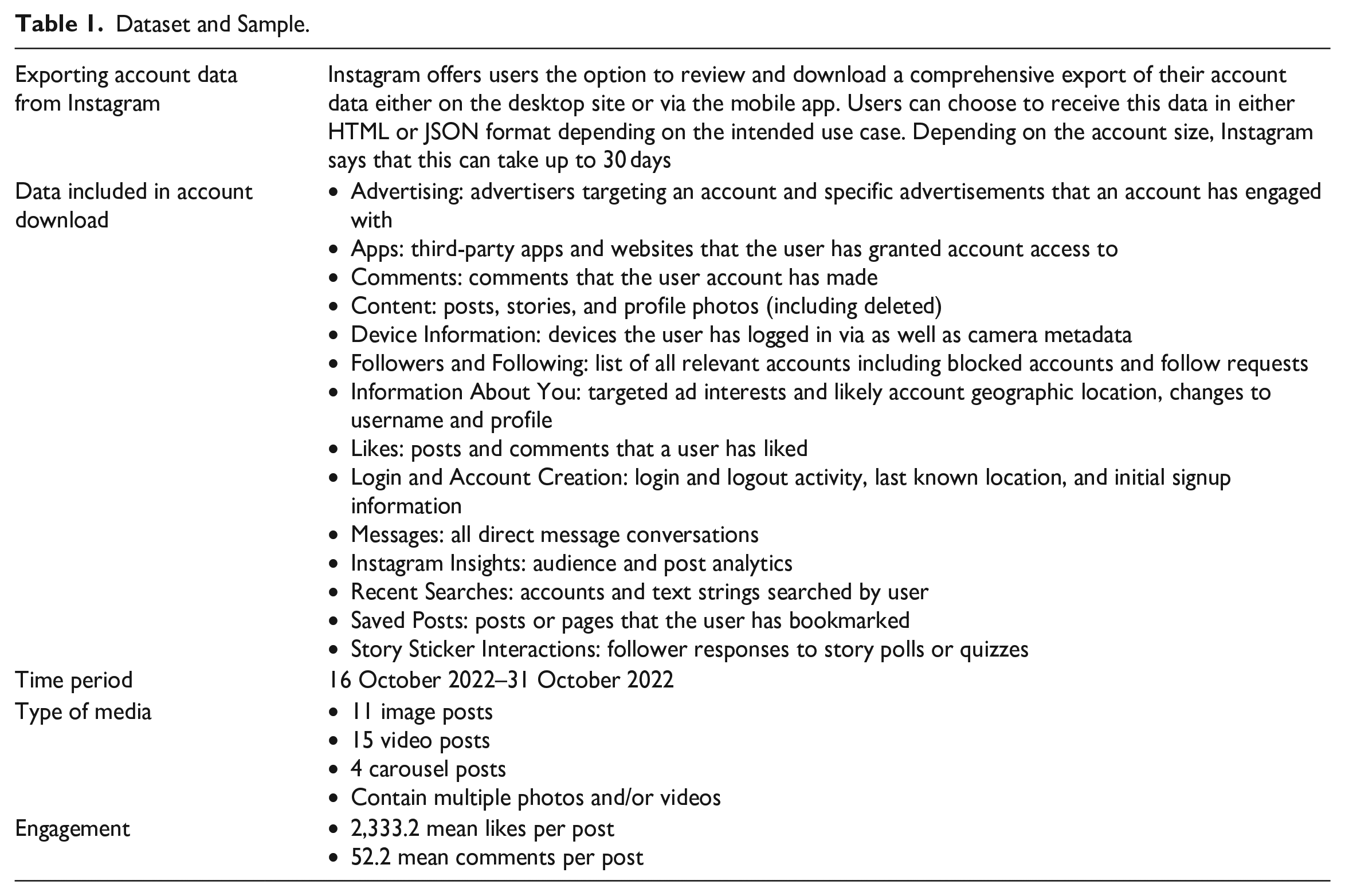
Via an existing personal relationship, I gained access to the anonymous account manager and initially communicated via DM. The exported full account data for LATFS were downloaded on 22 November 2022 and were passed to me in unmodified .zip files directly from Instagram. The size of the total data export is 15.9 GB. The use of donated data in social media research is relatively rare, but in the interest of treating this data ethically and protecting user privacy (Caddle et al., 2021; Zannettou et al., 2023), I have redacted usernames in screenshots and did not review or use any non-public follower data. Detailed information about this dataset and my sample can be found in Table 1.
Dataset and Sample.
Data Coding
I utilized an open coding process for analysis, which is based on grounded theory. The use of grounded theory is premised on the idea that data should be used to develop theoretical concepts rather than imposing pre-existing theoretical frameworks on the data.
Initial coding involved closely reading and interrogating the data to identify potential meanings and themes. The coding process is iterative, so subsequent readings involved honing in on specific concepts and themes that emerge through many readings of the multimodal LATFS texts and comparing and contrasting the codes, concepts, and categories to ensure saturation.
In my initial readings, I closely read these texts and tagged each segment of data with descriptive sentences or phrases, intending to be as thorough and open as possible in my descriptions. After two readings, it became most effective to split this initial coding into three categories: metadata (caption, location tag, music, submitter, and any topical notes), visuals, and comments. In the second phase, I used the most significant or frequent initial codes to sort, synthesize, integrate, and organize the data into broader categories. I identified three major strategies that characterized the multimodal discourses in these texts and numerous techniques within each of these strategies that describe how these strategies are enacted. Detailed information about this coding scheme is found in Table 2.
Coding Scheme for LATFS Data.

Emerging Themes and Discussion
LATFS represents a rare example of a site that organizes sentiment and gives individual voices a platform in such a distinct manner. The account manager is certainly one of these individual voices, but the effects of the page’s various discourses are given more power and amplified by followers as users, participants, and extensions of the social graph. Power is often undermined or challenged through tactics that social media is particularly well-suited for, especially given how power dynamics are often inverted on social media as it democratizes and expands discourse. Furthermore, these findings begin to illustrate what LATFS is ultimately capable of addressing as a form of political engagement.
In the following section, I will first discuss the three major themes in the discourses that my analysis uncovered: mocking, shaming, and exposing. Some data segments received more than one code to capture an appropriately granular description for analysis. Using this data, I identified the most frequent areas of code co-occurrence and will discuss these along with results from sentiment analysis within each section to identify relevant thematic trends.
Mocking
Mockery is a notoriously difficult concept to define but one that is easier to recognize in practice (Brock, 2008). As a starting point, I will take my cue from Khlopotunov (2019), who defines political mockery as “a variation of prosecution aimed at negatively presenting opponents, at destroying their reputation” (p. 61). As part of this negative presentation, we often see a playful approach characterized by humor, irony, euphemisms, and dysphemisms. However, it is ultimately intended to diminish a more powerful opponent and make them seem foolish.
In my data, I identified three techniques that comprise the general approach to mockery: joking, silliness, and factual information. I operationalize joking as humor that is devoid of anger or bitterness and is often part of a collective that shares variations on a thematically or discursively organized joke. In contrast, silliness is defined as absurd and irreverent joking. Finally, ostensibly factual information is used in this category to highlight failures that are humorous or ironic in nature.
Joking
Beginning with the name of the account alone, it is clear that the discourses on LATFS prioritize humor. Joking is effective at speaking to and undermining power for two reasons. First, it draws people in and builds an audience. Second, it creates a feedback loop because much of the joking seen here is participatory, encouraging users to comment and riff on a joke or theme. In this way, these tactics hold power both discursively and practically as this builds connective power across the audience in what Phillips and Milner (2017) call humor’s “constitutive” role.
In one video post, we see an overgrown marshy area with a significant leak spraying water into the air. After a few seconds, the video pans to show a residential street with a large flowing stream of water running toward the buildings. The caption ironically calls it a “peaceful pastoral scene,” a joke that is supported by the dramatic tension of only seeing the overgrown field before later realizing that such a messy scene is very close to an active neighborhood. In the comment section, users join in with jokes of their own. One user writes “. . . and up from the ground come a bubblin’ crude . . .,” a reference to the Beverly Hillbillies theme song and a play on how the spouting fountain of water looks like oil and is situated in what resembles a rural environment. Another user writes that “this is actually for dogs to take a water break,” another says that “it’s actually crucial to the local ecosystem so idk,” and a third references the background audio in the video, saying that “The bell chiming really ties the room together  .” These jokes aren’t targeted at any individual and do not seem to represent anger, but instead are a way of criticizing the city’s condition via emphasizing the ridiculous nature of what the video shows.
In another post, we find examples of jokes resulting from a caption and song working together; the video shows a very active bubbling water leak in the middle of a street, the caption describing it as a “cauldron,” and the song title referencing a witch. In another similar post, the choice of “Fountain of Sorrow” as song accompaniment reinforces the visuals in the post and the emotional response a neighbor may have to it. In other posts, comments such as “Welcome to NOLA Springs,” “the sidewalk must have had too many beers,” and “tourist trap” (this last one as a pun) serve as low-stakes and anger-free ways to make light of the reality on New Orleans streets that often feels more frustrating than funny for residents.
As a subcategory within this, some jokes are characterized by local-oriented humor that makes references to niche cultural artifacts and drives engagement as a shibboleth. One post relies on this as it asks for participation in the comments by referencing Morris Bart, a local injury attorney that famously uses a rhyming slogan. In response, commenters seemingly compete for the best rhyming joke to describe the large pothole pictured. Another comment lightly skewers a municipal priority that many residents are familiar with, the push for green infrastructure, by asking “is this #permeablepavement the city’s definition of green infrastructure?” The pavement in this case is not intended to be permeable and is leaking unidentified liquid through the freshly paved surface. Other jokes fill a similar role by referencing local foods and slang (“more cars than crawfish by my na na”), or even jokes about residents of distinctive neighborhoods.
Silliness
Silliness is a frequent presence in the comment section and serves as a sharp contrast to the typically self-serious official communication from the City of New Orleans and its various departments. Silliness makes an implicit claim that the object of the joke is not something worth taking seriously. It undermines power by suggesting that faith in its institutions is not a reasonable expectation. Instead, it embraces the absurd; it is ultimately based on a pessimistic mindset but uses humor instead of negativity to emphasize this.
Because of this, we find comments such as “If your asphalt ain’t sweating like this, I don’t even wanna drive on it  ,” “Don’t you know that’s how streets grow? You have to water them,” or “Drink it and live forever.” Neither the writers nor the readers are expected to take these at face value, so it serves instead to indicate disappointment. In another post, a small joke is hidden in the metadata; for a photo of pothole-oriented Halloween costumes, the account manager has tagged the official city accounts per usual but also chose to tag Spirit Halloween, a reference to a national Halloween chain store that is often referenced in online memes. In a video post, viewers see a scene that resembles a small resort with a swimming pool or lake, an umbrella, and beach chairs. However, the video pans out to show that these are all miniature figures and the water is a small section of a large puddle coming from an active leak.
Factual Information
Factual information is used not only to mock but also to shame and expose. Distinct here is the focus on using factual information to point out irony or incongruities in a humorous way.
In one post that shows an image of a traffic cone completely overgrown by vegetation, a commenter writes “guess it’s been there a while . . .,” noting the absurdity of how nature is overgrowing the plastic cone by bringing in a factual claim. In another, a commenter who lives near a submitted pothole writes “that hole is about to have its 11th birthday.” This user effectively uses a fact to mock the ineffectiveness of city reporting and management systems; it can be assumed that such a long-standing issue has been reported by neighbors many times and yet it remains unresolved. Finally, a commenter on a video of a malfunctioning traffic signal writes “I thought this was Claiborne and Esplanade.  .” Their initial assumption, one that rests on the fact that another major intersection has a similar issue, is a symptom of a city with such broad infrastructure problems that residents can no longer distinguish one from another.
Mocking: Thematic Trends
Among the techniques within this category, factual information tends to be the most negative; nearly 60% of the text in segments coded this way can be understood as either negative or very negative.
Relative to other mocking-related codes, images have the highest incidence of joking while silliness is found most often in posts that are not explicitly about roads or potholes. As I will describe later, these posts tend to feature subjects such as costumes or use posts for crowdsourced questions, which helps to explain why silliness is found so often here: it is an explicit opportunity for users to participate with irreverence and jokes.
Segments with mocking tend to most frequently overlap with shaming or exposing, while segments coded to factual information most frequently overlap with references to the mayor and tagging. Factual information provides an opportunity for users to mobilize their claims by blaming a specific person as well as tagging their Instagram username to attempt to bring them into the conversation or reference them. Segments with joking were most frequently coded to bitterness and cynicism (a subset of shaming) and jokes that rely on niche local knowledge were most frequently also coded with criticizing other city services and sarcasm, indicating a level of familiarity and frustration that aims to turn the mocking onto a different target.
Shaming
Per Scheff (2003), I understand shame as a complex emotion that can be defined as a negative evaluation of oneself or one’s actions that may result in feelings of inadequacy, inferiority, worthlessness, or humiliation. This is explicitly distinguished from guilt (a feeling tied to specific actions) and embarrassment, which is a shorter-term emotion confined to narrower social circumstances. Harris and Maruna (2005) add to this, noting the distressing and humiliating aspects of shame as distinct from other emotional states. Although these definitions are framed around individuals, the impulse toward shaming can be applied to groups or institutions such as governments. Simply put, the concept of shaming captures any discourse or action that intends to express disapproval, humiliate, or damage the reputation of another party.
Eight techniques characterize how LATFS enables shaming as a practice that seeks to undermine power: anger, bitterness, sarcasm, factual information, indignation, cynicism, criticizing other city services, and moving the account’s influence offline. As the differences between these techniques are at times subtle, I will briefly define how each of these is operationalized in my analysis before discussing the relevant texts and broader trends.
Anger
As an expression of frustration or antagonism, I stipulate that anger specifically refers to when these feelings are directed at a specific agent or situation. In some cases, anger is a blunt technique without nuance, but this is not true in all cases within these discourses.
In my data, I found that anger often arose in response to specific city offices. In some cases, I observed this in direct response to a city department such as Roadwork NOLA writing a comment on a LATFS post. In one such case, a user replied to a comment from Roadwork NOLA giving instructions about how to submit a claim to 311, writing: So, you are aware of the dangerous issue at this location and you refuse to do anything unless a citizen, on there [sic] own free time, calls 3-1-1 about this? Why does it need to be reported again if you already know about it now? Why don’t you just handle the situation since you know already about it?
In response to similar Roadwork NOLA comments on other posts, replies were shorter and more direct, such as “
Angry comments frequently target Mayor LaToya Cantrell. The current events context in the introduction is likely a cause of this, given that 51% of the comments using anger have specific references to the Mayor both as a figure that represents the city and as an individual that induces an intense emotional response.
Bitterness
In contrast to anger, bitterness manifests as anger that may or may not be directed at a specific agent but is most often characterized by long-standing resentment. In one case, the LATFS caption for a post about a school bus getting stuck on a road that was poorly repaired includes the phrase “yet another,” referring to the other school buses that have been documented on the page as stuck over the past 2 years. Another comment calls this out specifically, saying “Isn’t this the fifth one this year? Pathetic.”
Bitterness often involves personal criticism of the mayor’s behavior that is ostensibly tied to these infrastructure failures, such as one comment that reads “our taxes pay for Latoya’s purses not the infrastructure.” Although this is not factually true, it indicates a simmering sense of frustration directed toward her as a symbol.
Finally, some expressions of bitterness express frustration without naming any specific problem or cause; in these cases, the user is using the city’s failure to contribute to a narrative that leadership is incompetent and getting worse: What in the hell is going on in the City of New Orleans that they are not fixing the streets I just can’t fathom that I lived there for years and yeah there were potholes and the city was fixing them but it seems like there’s more and more and more potholes than there are homes now and it seems to be worse after Hurricane Katrina.
Sarcasm
Sarcasm is distinct from the type of joking found in the mocking category because it contains a level of vitriol and is typically directed toward an essential characteristic that the user believes the city should be ashamed of.
In a few cases, comments mobilize sarcasm to draw an ironic contrast against the city’s tourism marketing campaigns. In one video post that shows a completed repair that caused a new issue to emerge, a user writes “#halfass #nolacharm.” We find similar comments on other posts that show egregiously failing infrastructure, such as “nachrully Nawlins [sic],” “Only in NOLA  ,” and “the jewel of the city.” An example of one post that inspired such comments can be seen below in Figure 1.

LATFS post and comments from 20 October 2022 featuring an incomplete repair.
Some sarcastic discourse aims at completed repairs, implying that they are nothing but a band-aid over a chronic city-wide problem. These speak back to city communications that celebrate infrastructure improvements. For example, one user writes “this one has been fixed, a christmas miracle!.”
Factual Information
This technique is used differently for shaming than it is for mocking. More specifically, we find attempts to leverage facts to emphasize the length of unresolved problems and occasionally even push back against specific government communication.
In the case of the post about the stuck school bus, Roadwork NOLA quickly commented on the original post to recapture control of the story and emphasize their previous work and care: This work is part of the Central City Group A project. Crews previously coordinated with the resident to ensure access for her child. The resident wanted the bus to get closer yesterday morning, and the incident occurred. Work on subsurface utilities in Central City is expected to be complete by Monday, allowing the contractor to place temporary aggregate until permanent paving operations begin. Public safety is our top priority; barricades have been shifted to direct drivers and pedestrians.
In the case of a traditional press release, this kind of explanation would go unchallenged. However, LATFS offers a venue to directly challenge not only the affective approach that Roadwork NOLA takes but also their facts:
Other posts demonstrate how users mobilize facts toward shaming. For example, multiple users left comments about a very large pothole in the French Quarter: “It’s been there for months,” “I’ve shattered multiple bus windows on it,” and “I have a picture of a school bus stuck in it broke the axel [sic].” Each of these represents preemptive attempts to challenge any positive narratives as well as any claims that a problem represents something unusual. These three all say, in effect, that these are long-standing issues that cause material problems for residents and that they even have evidence to support both of these ideas.
Indignation and Cynicism
Although these are distinct codes, they frequently coincide. Indignation represents anger that is tied to a sense of unfairness, while cynicism represents a pessimistic attitude, one that is often characterized by resignation.
Cynicism is quite significant because it ultimately communicates that an individual has given up on any hope they may have for the city. In the face of rosy marketing images, cynicism and resignation represent a window into the average citizen’s perspective.
In one set of comments, we observe two sides of the same coin. Both users share a similar target for their frustration, but cynicism says: There’s not a contractor, construction crew, surveyor, dump truck driver, etc that knows what the hell they’re doing in this city. Not one. Can’t do it, won’t do it, don’t know how to do it.
While indignation adds a level of anger and aggrievedness to this claim: Get rid of the WORTHLESS Mayor and for God’s sake, immediately SUSPEND every single contact that has BOH Bros. Name in it. They are more WORTHLESS than the Mayor. This fuckin places [sic] makes me sick!
Other users take this indignation and specifically tag City Council members, such as one user who writes “@helenamorenola is this what our taxes pay for?.” Although they spoke directly to a figure that represents powerful interests, there was no reply.
In another case, a user employs cynicism to push back directly against the city’s marketing campaign, which calls it “the City of Yes”: I get so sleepy, what’s next in the line of NOLA city of yes! It’s clear that no-one [sic] in city hall is bothered and the government do [sic] not care about NOLA. Just leave, if someone don’t [sic] want stuff like this it’s obvious that staying is not the answer.
An example of one post that inspired multiple comments featuring indignation and cynicism can be found below in Figure 2.

Still from a 31 October 2022 LATFS video post and associated comments.
Criticizing Other City Services
Although LATFS is ostensibly concerned with road infrastructure, it has organically expanded to become an outlet for frustrated citizens to shame powerful interests in the city that are associated with many city services.
One frequent target is the SWB, which does not directly manage road infrastructure but whose work is closely tied to the roads because of underground water lines and other water management issues. In one such case, a user uses contextual facts to target SWB, writing that “We have something similar on Kerlerec near Burgundy. SWB have [sic] been out 3 times with a crew only to dump a pile of concrete on it. It’s still leaking.” Another comment criticizes a leaking water line and implicitly points to ongoing problems with SWB billing, writing “Someone boutta [sic] pay a huge SWBNO bill—that’s a house connection leaking.”
SWB is not the only target. Commenters point to Cox internet and cable outages, lack of consistent trash pickup, and extremely high unexpected bills from Entergy. The content of these criticisms is not as significant as the fact of their existence. By bringing in these additional problems, users express a lack of faith in the city whole and its ability to meet their needs.
Moving the Account’s Influence Offline
Over the lifespan of the account, costumes and pothole decorations have become an annual feature in posts, particularly around Halloween. In one such case, neighbors in an area with a chronic pothole have elected to decorate and give it various seasonal costumes. In my data, one pothole is decorated in the style of a character from a Charlie Brown movie, which doesn’t have any direct relevance; the fact of it being decorated at all is a way for neighbors to take power back from a city by shining an unusual spotlight on the problem. Similar examples of costumed potholes can be seen below in Figure 3.

Three LATFS posts from 21 October 2022 featuring decorated potholes.
In two posts within my sample, the account manager posted photos of many LATFS-inspired costumes and decorations, representing another tangible entry into the offline world for the account’s influence. In two of these photos, we find skeletons dressed in SWB uniforms and sitting in lawn chairs, pantomiming laziness and lack of care. In another, neighbors have dressed a traffic cone in the style of a scarecrow that holds a sign saying “beware,” both participating in the playfulness of the trend while pointing to the inherent danger of unfinished roadwork.
In other cases, citizens created Halloween costumes that either directly reference LATFS as an account or speak to infrastructure problems more generally. One post shows examples of people dressed as cones outside the Superdome, others dressed as “road closed” signs and barrels, and another dressed as a malfunctioning traffic signal, complete with the song that was posted on LATFS along with the original video of the traffic signal. Another prominent example that also illustrates how the account’s focus has expanded to criticism of other city services can be seen below in Figure 4.
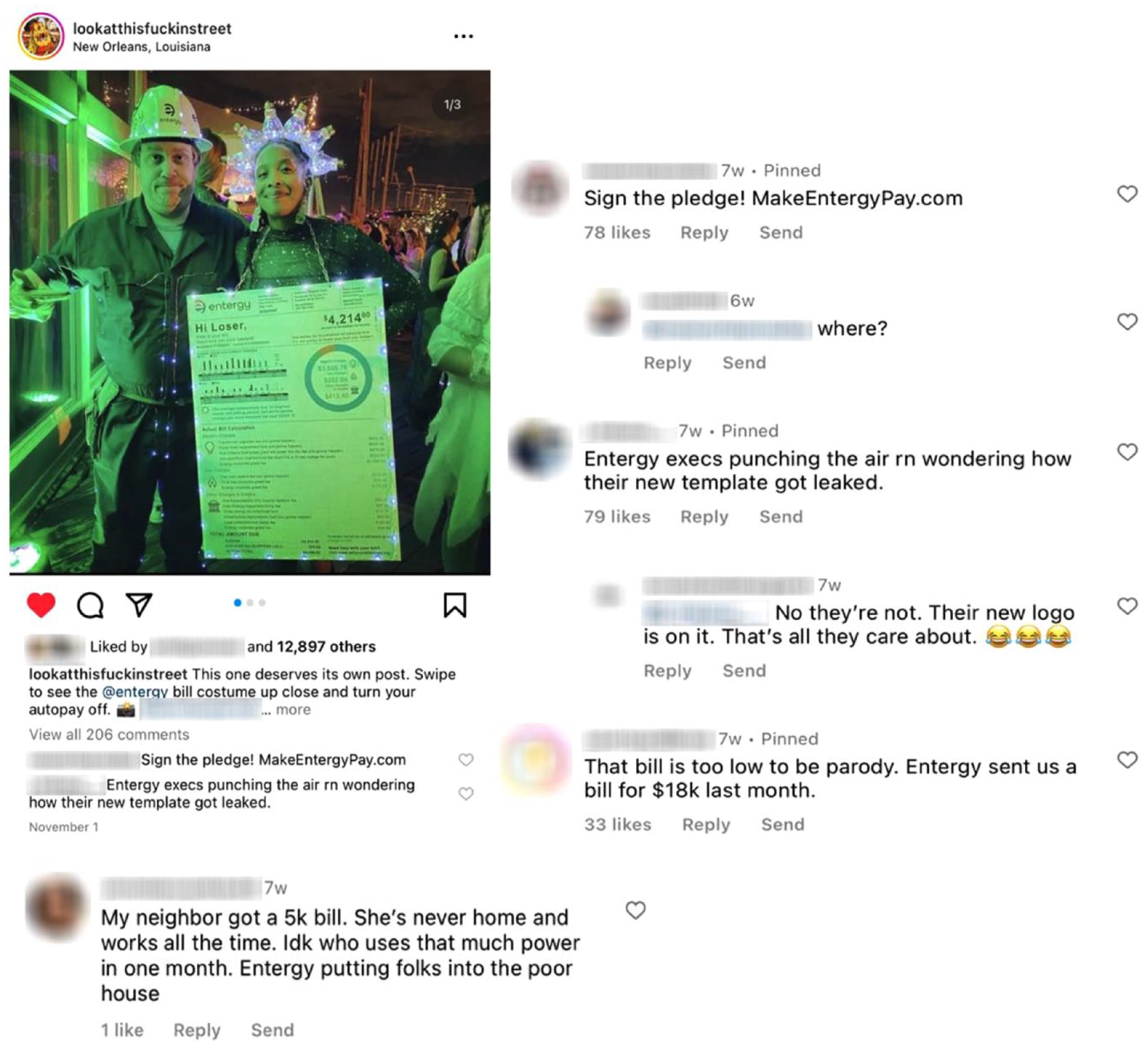
LATFS post and comments from 11 November 2022 featuring a costume criticizing Entergy.
These steps away from Instagram and into the offline world offer one of the clearest examples of how the account’s sizable follower base has translated into awareness of these problems and shaming of the city more generally.
Shaming: Thematic Trends
Among the techniques that enable shaming, discourses that are targeted specifically toward the Mayor have the most negative sentiment among all codes. Relative to other types of posts, criticizing other city services occurs most frequently in posts that represent the account’s entry into the offline world. Outside of this, the most significant trend in post type is related to posts where children are a main focus or concern: anger, criticisms of the mayor, and tagging are all most prevalent in these sorts of posts.
In addition, it is important to note how frequently anger co-occurs with cynicism and indignation, particularly as it relates to the Mayor. Bitterness is associated with factual information as well as indignation, perhaps indicating the mechanism by which bitterness not only grows but is communicated to those in power. Finally, criticism of other city services is enabled by nearly every shaming-related technique but also is associated with the use of niche local humor to produce this very particular and focused sort of shame.
Exposing
The third and final trend is the simplest and most intuitive. It most closely resembles citizen journalism, which Greer and McLaughlin (2010) define as the practice of everyday citizens producing and disseminating news. Citizen journalism is particularly important in that it gives individuals the power to challenge the official version of events and issues. Per Antony and Thomas (2010), citizen journalism often is used to not only challenge dominant interests but also to provide alternative or even contradictory versions of events from traditional media acting as “guard dogs” for powerful interests (Donohue et al., 1995). Citizen journalism offers a platform for the public to engage in political discussion and debate (Jacobs, 1996) and has the potential to create an active and meaningful public sphere. Exposing speaks most clearly to RQ2; it undermines the city’s attempt to control the narrative by spreading information horizontally, building connective political power.
Three techniques contribute to this. Just as with mocking and shaming, factual information is also employed here but with the intention of directly and objectively communicating facts free from emotional valence or editorializing about their meaning. Next, the use of explanations supports the work of exposing failures by describing the reasons for problems as well as (often simple) potential repairs. Finally, LATFS strategically employs visual framing in videos and images to provide fuller context on a problem and in doing so, preempts many excuses while highlighting the depth and scope of problems.
Factual Information
In contrast to how factual information is leveraged toward mocking and shaming, users employ factual information to expose by making direct factual claims that not only expose additional problems and build further context but also add to a growing body of evidence that regular readers of the page carry with them. This undercuts positive images of the city that they hold and contributes to a more pessimistic understanding of the city’s condition and possibilities, preemptively weakening future claims by the government or media that overlook or discount these problems.
Frequently, I found this tactic used in the comment section where users would share information about a similar problem in their area, such as in the case of a video post that shows water leaking out through the asphalt on a street that was repaired very recently. In one comment, a user asks, Why is it ALWAYS wet on Earhart under the interstate over by Home Depot. [sic] It won’t rain for weeks and yet every single time I take that exit off 90 from the Wank it’s always a wet puddly mess at that light?!
The person making this post likely knows that they are not going to receive an answer or a resolution based on this comment alone. Still, it is discursively meaningful insofar as it serves to expose.
In another post, LATFS shared a photo of a large moving truck with its back wheels stuck in a deep hole on an open street. Considered in isolation, a viewer might understand this as an unusual or exceptional event. However, the comments here contain another example of users leveraging emotion-free factual information to build context and further indict the city’s reputation: “This happened to us on Hampson street uptown back in 2001! We were paying by the hour and did not have a lot [of] money. It sucked!” The user’s choice to include the date 22 years prior underlines the chronic nature of the infrastructure issues.
In another example, the account manager responds to challenge a user who suggests that the problem is not a leak but instead is a result of humidity and weather, writing “I thought it was sweating til I saw that side shot?” This sort of comment draws on the domain-specific knowledge gained from managing the account for so long and effectively builds credibility.
Finally, in one prominent case, we see the content of a video utilize this technique as part of reporting on a school bus that was stuck in the sand from an open project during its morning route. While the post itself refrains from any sort of emotion, it presents factual information that is likely to elicit an emotional response from the reader. After showing the school bus and street, the video turns to an interview with the mother of a student with special needs, who describes her hysterical panic and pleas to get her son off the bus because “it’s about to tip over” and explains that she had already reported the issue to authorities in the past. The video ends with the reporter saying that “we’ve reached out to the city for answers, but we are waiting to hear back.” The use of strategically-employed factual information here leads the reader to a conclusion that challenges not only the city’s competence but also its interest in caring for the most vulnerable residents.
Explanations
The use of explanations is related to the use of factual information, but its effect is distinct in a subtle way. While the previous technique served to add context and build a body of evidence, explanations emphasize the relatively simple causes for issues and approaches that would resolve them.
In a previously mentioned post that shows a recent failed repair, one early comment reads “Fix the pipes under the asphalt!.” The implication here is that instead of addressing the root cause, the city has instead completed a band-aid fix that will eventually fail. Reading between the lines, the more damning implication is that if a resident is aware of this, city officials are aware of it as well and chose to instead undertake a temporary and insufficient repair.
In the comments of another video post that shows a steady stream of clean water flowing from a thick crack in a residential street, there is an exchange between a commenter and the account manager:
All this clean water coming out of the streets means broken water mains below the surface.
Just as in the previous example, this series of comments demonstrates relevant knowledge and points to the type of repair that would ultimately need to be done. Further, the account manager bringing in additional factual information adds significance to the original commenter’s claim as it makes the effects of the explanation clear.
Visual Framing
Finally, LATFS consistently uses Instagram’s platform affordances to its benefit to use various kinds of visual framing that supports the textual discourses. This particular technique is only used in the posts from LATFS, given that comments are not able to include any type of image. I discovered three primary ways that LATFS uses visual framing to expose.
First, video posts often focus on not only the epicenter of a problem but pan to show the broader context in the area. In a video of an incomplete repair, the video begins with a close-up shot of a large and leaking crack before the video moves to show additional context: nearby unrepaired cracks, evidence that only a small section of the street has been recently repaired, and views of the problem from other angles. This technique makes it very difficult to dispute the veracity or diminish the significance of the pictured issue.
Another way that the account uses visual framing is by strategically drawing contrasts. For example, Figure 5 is a screenshot of a post that shows an overgrown section in the middle of the street that effectively divides the road into two parts. The growth is large enough to indicate that it has been a problem for a very long time and the presence of a traffic barrel indicates that the city has been aware of the problem in the past and has visited it. In the background of the image, viewers see a calm and orderly residential neighborhood with homes, yards, and cars in good condition. The contrast between the care implied in the background and the neglect seen in the foreground is stark.
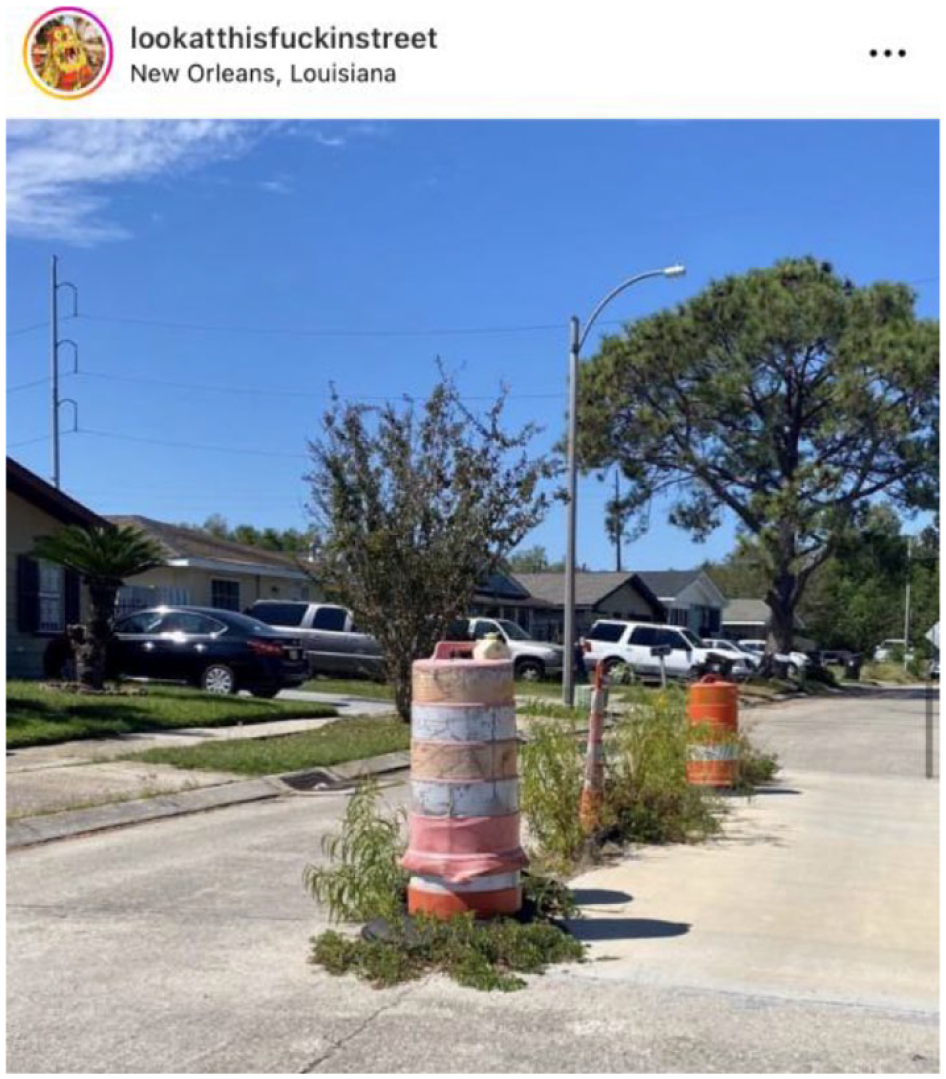
A LATFS post from 16 October 2022 featuring traffic barricades and overgrown plants in the middle of a neighborhood street.
Third, LATFS sometimes shares photos of an issue that feature other infrastructure problems in part of the photo that are not mentioned in the caption. We see this in Figure 6, a post that is ostensibly about a fallen tree but features evidence of disrepair and lack of care in the foreground of the image. The barrels, cones, and wood have been left behind by previous crews that did not even seem to complete their repair. This technique emphasizes the frequency and normality of these infrastructure problems in a subtle way that builds a sense that scenes like this are normal and expected across the city.

A LATFS post from 17 October 2022 featuring a downed tree in the background and traffic cones and other debris in the foreground.
Exposing: Thematic Trends
In terms of sentiment, there is an interesting divide between the techniques used to expose. Across my data, the use of explanations was characterized by predominantly positive language, while factual information and (textual descriptions of) visual framing tended to be negative or very negative. I speculate that explanations offer the user an opportunity to demonstrate their knowledge and superiority, which leads to a positive emotional valence despite the critical implications. Factual information and visual framing, however, are inherently negative because they intend to not only highlight problems but expand the scope and gravity of the subject matter.
The coding co-occurrences offer a related explanation. While discursive segments with explanations are rarely coded to any other techniques, data coded with factual information and visual framing are frequently also coded with bitterness, criticizing other city services, and even adding factual information that is intended to shame.
Conclusion
The findings of this analysis suggest that LATFS uses multiple discursive techniques to challenge the power dynamics at play in the ongoing infrastructure issues in New Orleans and undermine the competence and legitimacy of its municipal government. The account’s stated mission of documenting and highlighting the cracked and sinking streets of the city serves as a powerful tool for amplifying the voices and concerns of everyday citizens and holding those in power accountable. By bringing attention to these issues through the dissemination of user-submitted photos and videos, the account creates a space for open and honest discussions about the systemic problems that plague the city’s infrastructure.
An inherent limitation of this methodological approach is its inability to quantify the material effects of these discursive strategies, which limits my ability to sufficiently address RQ2. Given my ongoing access to the dataset, I intend to pursue this question further by matching specific posts with any relevant backdoor communication with agencies and on-the-ground observations of the status of the infrastructure in question.
The power dynamics involved in these issues are complex and multifaceted. On the one hand, the city’s governmental and infrastructural failures have contributed to a general distrust and pessimism among citizens. The current recall campaign against Mayor LaToya Cantrell, along with numerous other scandals and failures, has only served to further erode trust in the city’s leadership. At the same time, there are systemic issues like institutional racism and historical patterns of municipal government corruption at play that go beyond the actions of any one individual or administration. The underfunding and lack of investment in infrastructure, combined with the challenges of maintaining and improving infrastructure in a city prone to natural disasters, have all contributed to the ongoing problems.
The popularity of the account demonstrates the widespread frustration and concern among residents about the poor state of the city’s roads and other infrastructure. By using a multimodal approach to CDA, I considered each element of the account’s content and follower engagement to uncover a holistic understanding of how these discourses utilize a range of approaches intended to reveal the city’s incompetence and lack of concern for its (often vulnerable) residents.
Through these discursive approaches, LATFS functions as a way for residents to not only exercise agency but also to acknowledge that at least some of these attempts have little efficacy beyond the discursive. In doing the latter, the account leans into the absurd and humorous to leverage pessimistic, critical, and even cynical attitudes in the broader critique of power. Furthermore, LATFS seems to rely on a participatory and community-oriented structure, using techniques such as niche local humor as a shibboleth or the possibility of being tagged and reposted for one’s submissions to reward cultural knowledge and participation. That said, the effect of this page on the city is not only discursive; this case study has uncovered instances that have changed on-the-ground practices.
Per Moors (2019), place-based social media movements are most effective when they use the “affective process of storytelling” (p. 815) to allow citizens to stake a claim to their own material conditions and reclaim the narrative of these conditions and their causes. Given that the plurality of followers is not living in New Orleans, its suburbs, or nearby cities such as Baton Rouge, Moor’s work is also relevant insofar as it illustrates how “place-based storytelling [implicates] others as witnesses” (p. 819) in a dynamic that gives additional support to the broader critical project that LATFS is engaged in.
From this analysis, I argue that LATFS is an effective and powerful participatory platform for exposing a broad range of systemic problems and their causes, allowing residents to take back the narrative of their city’s infrastructure challenges, diminish and demean the powerful interests responsible, and ultimately attempt to reclaim the power lost to negligent or even bad-faith municipal authorities in New Orleans. Given the way that discourses tend to expand the critique beyond road infrastructure to criticism of various city services and utility monopolies, the page ultimately seems to serve as an outlet for frustration with a broadly dysfunctional city.
Footnotes
Declaration of Conflicting Interests
The author(s) declared no potential conflicts of interest with respect to the research, authorship, and/or publication of this article.
Funding
The author(s) received no financial support for the research, authorship, and/or publication of this article.
