



Abstract
As much as users and advertisers have flocked to it, TikTok has been a success. To this point, research on TikTok has been concerned with the nature of TikTok texts and the ways that laterally organized networks on TikTok have intermedia interface points. Instead of focusing on the text or the authors, this article argues that Raymond Williams concept of flow is critical for an initial characterization of a social media platform, proposing and implementing a Markov process model for critical media studies of the experience of TikTok flow. The result of this analysis challenges many commonly held ideas about what TikTok “is” and offers evidence that TikTok is television, not social media. We argue that this shift of perspective is important for advancing understanding of this platform.
Advertising arbitrage is critical for any social media platform, there needs to be some way for the platform to sell something that looks like an advertisement. Influencer marketing has to this point been iffy, for brands interacting with macro influencers (who often taking brands for granted) and micros getting caught up in cycles of buying mentions from macros. What is interesting is that experimental research suggests that disclosed sponsored posts by micro influencers are in fact more persuasive than undisclosed posts by macros (Kay et al., 2020). Macro influencers, with flashy numbers, have also come under scrutiny as more advanced metrics reveal that their followings may not be real (Field, 2019). Industry discourses have been shifting along these lines as well, with higher quality content created by increasingly professional advertising operatives replacing pseudo-celebrity as the core of the industry (Marinanne, 2019). At the same time, brand building is ascendant in a world where extensive tracking is being displaced by more coherent brand driven campaigns (Neff, 2021).
Enter the TikTok Creator Marketplace. Instead of leading with a programmatic arbitrage strategy or a focus on display products, the long-term viability of the TikTok platform comes from consolidating the business of buying influence. The appeal of the platform for all parties is the simplicity of connecting creators to buyers directly, creating a virtuous cycle (Sloane, 2020). Snapchat CEO Even Spiegel complimented TikTok, noting that it was ideal for “broadcasting talent” (Sloane, 2020). What is interesting is that characterizations of what TikTok is or how it functions are still very much in flux. The end goal for TikTok is that the halo created by positive brand relationships on the Marketplace will end in companies purchasing display products, especially videos inserted into a rapid flow of other videos. In this article, we have a deceptively simple research question: what is TikTok? Inspired by Raymond Williams, this article follows the logical structure of his work on Television considering the nature of flow, how we might record and analyze those flows, and what we can derive from an analysis of that flow.
In terms of a central theoretical construct, we are concerned with flow, as described by Raymond Williams (1974/ 2003). Investigating flow in this sense requires attention to the forms of causality inherent in the media product, the technology itself, and the uses of the technology. We see this as central to understanding a new platform, even if it risks the fallacious accusation of technological determinism, as the flow we encounter is very much a mixture of an inhuman apparatus and human media plans (Peters, 2017). The focus on technologies in media studies today enlivens discussion, just as it did for cultural studies in Williams’ context. What is television as a form/technology/practice is an important question that cannot be fully explored by asking about the viewers or the texts alone. Our analysis has four sections: a review of popular and scholarly discourses around TikTok, a theoretical discussion of the importance of reverse engineering flow processes as a form of critical/cultural computational communication research, the analysis the data set itself, and our discussion. Stylistically, we follow conventions closer to what one finds in Williams’ work because our use of mixed qualitative and computational methods and because we are presenting exploratory data science about a new focal area.
What is TikTok?
TikTok has quickly become a must have app. With its compelling trends and abundance of short comedic skits, there is something for everyone on the app. The world has quickly fallen in love with it, and fallen in love with talking about it. On every late-night talk show, or Saturday Night Live (SNL) skit there seems to be mention of TikTok. The overall sentiment seems to be positive. The public has observed the importance of working the algorithm. The substance of the app and the underlying algorithm was even written up in the New York Times: “It’s been a while since a new social app got big enough, quickly enough, to make nonusers feel they’re missing out from an experience” . . . “It is constantly learning from you and, over time, builds a presumably complex but opaque model of what you tend to watch, and shows you more of that, or things like that, or things related to that, or, honestly, who knows, but it seems to work.” (Herrman, 2019)
The app has become such an important part of the social sphere that Slate has produced an explainer for the non-teen for how to use this clearly important platform (Schwedel, 2018). Many brands have noticed the foot traffic that any video on TikTok produces, and have begun using it as a place for marketing. Zulli and Zulli (2020) argue that the core of TikTok is mimetic, that the core affordances of the user interface are intended to produce iterations on a single theme. Literat and Kligler-Vilenchik (2019) explore proto-TikTok, finding that hashtags organized mimetic political activity. TikTok as a site organized by cross-cutting discourses is fraught with peril and potential (Literat & Kligler-Vilenchik, 2019). TikTok may within the structure of a hashtag has similar publicity functions to other platforms, such as Twitter in the context of expressive engagement about climate change (Hautea et al., 2021). TikTok in these initial figurations is something like an extended form Vine or Twitter, participatory and organized by hashtags. These studies offer great insight into what individual videos mean and how hashtags may function, but they do not address the flow mechanics of the platform itself, which interestingly enough is what the popular discourses and ethnographic accounts of labor on this platform emphasize (Duffy et al., 2021).
Why Flow?
Unlike studies of particular texts or audiences, Williams historical, economic, and technical facility was dedicated to understanding television as a form. The text and the political economy of a platform, while important, were secondary to the analysis of the entire experience of television. Williams (1974/2003) insight that the logic of discrete media dominate media studies holds true today: Yet we have become so used to this that in a way we do not see it, Most of our habitual vocabulary of response and description has been shaped by the experience of discrete events. We have developed ways of responding to a particular book or a particular play, drawing on our experience of other books and plays. When we go out to a meeting or a concert or a game we take other experience with us and we return to other experience, but with the specific event is ordinarily an occasion, setting up its own internal condition and responses, Our most general modes of comprehension and judgement are then closely linked to these kinds of specific and isolated, temporary, forms of attention. (p. 87)
References to other modes dominate the analysis of social media as well, be it in the fixation on the analysis of the rhetorical impact of a particular Tweet, image, or hashtag when these are like studying a sandcastle to understand a beach. In his dissent in Google versus Oracle, Justice Thomas repeatedly uses discrete metaphors for the collective interactive work of an application programming interface (API), for the Justice, an API is just a film adaptation of a novel, nothing more (Google LLC v. Oracle America, Inc., 2021). If you can only see how media forms relate either to films or sound recordings, there simply are not conceptual tools available to deal with software services. If the US Supreme Court struggles to find the metaphors to deal with now-decades-old technologies, it seems reasonable that many audiences have a hard time understanding what media are. Williams (1974/2003) went on to argue that the experience of multiple media, like magazines, finding that flow as central to media was critical to understanding all public communication in the televisual era leading to the clear point that, “Problems of mix and proportion became predominant in broadcasting policy” (p. 89). Notice public and legislative concerns for social media bias and the concern over imagined “shadow bans.” The central issues in communication policy making are not related to very particular utterances but to the meta-level rules that govern those systems—protocols that produce flow.
Essential to both the technology of television and social media as we know it today are linear presentations. On television, this occurs through a limited visual presentation that changes over time, with social media there is also a time dimension and also a geometric dimension of the experience of scrolling through a timeline. These experiences of scrolling are important in themselves with at least three major patterns of interaction: time-based progression among ephemeral products (Instagram Stories and Snapchat), vertical strips (Facebook, Instagram Primary, Pinterest, and Twitter), and swipes (TikTok and Tinder). We tend to see each major platform as a different type of programming, akin to how Williams saw drama as separate from news.
Flow has other meanings in different contexts, in this study, we have chosen to pull closer to Williams and to empirical data. Much of Williams’ experience of flow was, as noted by Uricchio (2004), a result of the particular technological edifice of television at that time, which was challenged by the arrival of technologies like the remote control. Uriccho’s (2004) challenge to flow as used by other scholars was to return to the question of under what conditions to publics submit themselves to the experience of flow media, which is not to say that other scholars were wrong to use flow to mean other things (his example is Michael Curtin using flow to describe program traffic), but that we must attend to all of the meanings depending on the moment. In the context of the circuit model of cultural production, which has a long standing resonance in television studies, Julie D’Acci (2004) brings out two important implications for the study of flow: scholars should not open every study presuming that television is a new domain (there is a robust literature) while at the same time recognizing that some early television research depended too much on ideological positioning. The circuit model of cultural production would push scholars to recognize the independence of factors, especially the idea of the interplay of technology (from the remote to the Roku), the text, the audience, the industry, the legal system, and other factors. In the context of our study of TikTok, we are offering a very early examination of the form. Bhandari and Bimo (2020) and Peterson-Salahuddin (2022) have noted that the feeling of the algorithm and the ways that certain kinds of user are privileged weighs heavy on TikTok users, which is a powerful central theme in interview work. Schellewald (2022) argued that the ways of talk about algorithms on TikTok are an important form of sensemaking about the platform, which call for studies of these central mechanisms both as they are and as users experience them. As such, our study is situated in this context as a narrow and early investigation of flow. Rich, complex, circuit-informed work will develop around these contributions.
Approaches to advertising in the early twenty-first century are a juxtaposition of what came before, mass branding strategies and new programmatic strategies. The promise of programmatic advertising is straightforward: if you can individually target a particular customer with the right message at the right time, they may be more likely to buy. Around this concept formed the idea of the funnel, a system of assumptions about how people are persuaded to purchase a particular product that presumes that some general impressions eventually accrete into an intention to convert (purchase) and that the final messages before that conversion are the most important. Conceptually, this model is often stretched to the breaking point by media buyers when they attempt to access only those final clicks without any of the rest of the apparatus. It becomes clear why we continue to return to Byron Sharp’s core text on branding, focusing on the ways that branding is a continuous communication process (Sharp, 2010). Programmatic advertising planners are themselves trapped in the discrete logic of the print classified ads they replaced. This insight about advertising today, be it on Google or TikTok creator studio, is that this is all the same planned flow, it is also why branding continues to be a central element of communication planning, and why advertising is once again priced in cost per million (CPM) (Liffreing, 2021). This extends the logic of online advertising along the trajectory of personalization where blank spots are filled with display advertisements from a massive network. Much of what has been documented in the context of hyper-personalization depends on this discreet model of advertisement placement, yet as Turow (2013) has argued “it is no longer clear what watching television means” (p. 167). Surely, this will require some additional personalization, and we are also noting the contraction of creative around higher quality creative, which would signal diminishing returns for increasingly intrusive surveillance regimes (which is not to say that surveillance will not become even more intense). It is not so much that we are arguing that TikTok as we understand it is offering a new advertising scheme, but that the scheme, especially in brand building suggests an older one.
A Methodology for Individual Automated Flows
Flow exists on multiple levels. In the 1970s, flow existed across the days of a week or month, within the stream of programming for an evening, and within the dynamics of a particular program. Luckily for Williams, the flows were clearly established for the entire audience. Now, we find that every individual has a somewhat unique flow, we cannot engage in those micro levels of analysis and commentary because we simply do not know how the text was arranged. To this end, we designed a research methodology that would allow us to move in toward the sort of analysis conducted by Williams, without access to every individual screen. In this study, we use a stable central sample rather than studies of communities we might imagine, consider the studies already done of particular “toks,” which are organized around a particular theme or hashtag. This is aligned with Wu et al. (2021) in examining how users move among media platforms using a large data set to create a synthetic average use case. New methodologies in this space offer new possibilities.
Social media influencers are constantly “playing the visibility game” (Cotter, 2018). Although they do not know the specifics of the algorithm, through experiments and observation the ways the system works can be brought into focus. For our purposes, this required each member of the team to secure a burner email and to create a new TikTok account with that email. From there, each user over the course of a 10-day span, at assigned times, would use screen recording features of their phone operating system to record a TikTok session, approximately 10 videos or 10 min of material, paying attention to scroll to the next video immediately at the end of each clip. At no point would a researcher like or dwell on a video.
Our logic for selecting the new user experience depends on the idea of a bait, that whatever stream of content TikTok would select to send us as an initial user would be what they think of as the sine qua non of TikTok, and experience that is not personalized, but is still deeply compelling, the truth of the medium. We see this as a corollary to Safiya Umoja Noble’s argument that the categories within ostensibly neutral systems of recommendation are themselves produced by and produce power on the basis of the distribution identity (Noble, 2018). Exploring the seemingly neutral base appeal politicizes the platform, as Gillespie (2018) has argued effectively, an important dimension of our research is to challenge “the myth of the neutral platform” (p. 24). In the context of another popular video platform, Zynep Tufecki (2021) argues that many recommendation algorithm processes are themselves engines of radicalization that they attempt to isolate a single signal that a user wants, delivering them more and more extreme versions of that signal. Computational research on the YouTube algorithm would seem to confirm the extreme position taking problem as counter measures for extremism may actually increase exposure to radicalizing content (Schmitt et al., 2018). We distinguish YouTube from TikTok both by the length and user interface, and also by the textual quality of the platform where YouTube focuses on individual creators and TikTok features videos in a distinct flow (Guinaudeau et al., 2022). Closer to TikTok was Vine, which offered a core product of looped short videos. While this appears to be a similar product, research on the experience of LGBTQ+ users reveals a key insight about the nature of the platform: Vine was governed as an extension of Twitter, and Twitter at the time had uncontrolled hateful reactionary content (Duguay et al., 2020). This turn toward platform governance, and infrastructural elements, is broadly recognized as a key element in understanding platforms in society (van der Vlist et al., 2022). In this sense, the core governance of YouTube is to produce a binge watch (one show or creator along a trajectory) and Vine was a looped video of the toxic vibes of Twitter.
Recommendation engines are a computer information-filtering tool, which uses various algorithms to analyze and find matches. Your goal, to recommend a relevant product for a particular user. Recommendation engines can work in various ways, such as boosting traffic, engaged buyers, increased sales, conversion rates, and more. Increased sales are those that when offered a product relevant to their needs, they will not hesitate to buy it. Based on the philosophy, companies develop social bots and recommendation algorithms to offer a recommendation scheme for online users. Personalized recommendations based on the function of browsing history are essential for the development of recommendation algorithms. Its main benefit is to recommend a product or service to a user in a personalized way and increase its sales index. Personalized recommendation systems require a considerable amount of data, which is impossible to provide to new visitors. In the recommendations of news reports, it works the same way, where a user who likes to read about crime scenes is more likely to receive a greater amount of crime scene content than a person who is interested in show business. Recommendation engines rely on user preferences to build an effective recommendation chain based on the user’s own demands, so long as those demands increase profits.
It was vital to our data that our researchers did not engage in any of the videos. This restricted TikTok from engaging any personalized recommendation systems. Our goal was to observe the way TikTok’s most basic algorithm fed content to a presumably brand-new user. We wanted to know what videos TikTok believed would get us to stay on the app and become a loyal customer. Essentially, observing TikTok’s purest conversion tactics. TikTok is a highly personalizable app, taking the term “for you page” very literally. A large appeal to TikTok is its way to filter out any unwanted content, avoiding any interruption to a viewer’s flow. The process where one trains TikTok and is trained by it has been documented by Siles et al. (2022), which calls for further research into how the initial experience is enough to maintain the engagement of users. AJ Christian (2018) has argued that these attempts to excavate these algorithmic process are essential to understand Netflix, questioning the logic of hypersonalization in convergent television through the use of discrete “factors” in their system (p. 243). If we were to do this study using personalized accounts, we would be collecting data on ourselves, rather than TikTok. If we were to like every video rather than not like any, or share each video etc. the algorithm would not have any information to send us personalized content. Essentially, liking the videos would be the same as not liking them. By abstaining from any interaction, not even watching a video more than once, we can observe what the algorithm does without any user participation. This approach to examining the initial presentation of a platform has already been utilized in the analysis of the sign-in process for TikTok, the extension of this process to the experience of the video flow (Zulli & Zulli, 2020).
For example, the ways that a central process elects to deploy or not deploy news content into the flow is an essential element or further research. Habits in the consumption of technological implements have shaped our behavior as a society. The digitization of information has led to fewer people reading news through the press. Therefore, the way in which consumption patterns, reading habits, the time they invest in reading the news, and the selection of news of interest by people are determined is complex. The consumption of online news is considered an adopted pattern that causes significant changes in the relationship between the media and consumers of the news. Thanks to the technological boom, people can choose the desired news, observe it, and consume it, amplifying the constitutive effect. The media that followed the consumption patterns would be able to personalize the selection of news to obtain a more extensive audience. The most chosen media today are digital, with social networks, such as Twitter, Facebook, Instagram, and TikTok being media where information is consumed almost in real-time. One of the last cases of news consumption through TikTok was the civil rebellion and the protests that the Colombian people are experiencing. The news is known through the traditional news and the written press. Thanks to the management of social networks, the news was widely disseminated about events, such as the murder of civilians by the police and other serious crimes against society. When computer systems know the behavior pattern in social networks, a multiplying factor is generated that makes the news popular and vital around the world (Makhortykh et al., 2020). Automated means of flow production go both ways, they may be tied to profit and they also may produce new kinds of engagement and publicity for other groups. With this in mind, by operating as passive, new users on the platform, the researchers attempted to evade political and partisan consumption patterns from developing around their individual biases.
Assenmacher et al. (2020) describe the presence of social bots, known for being a Chabot used in social networks to generate automatic messages that seek to defend ideas, support campaigns, and modulate publics. Social bots are present on social networks, such as Facebook, Instagram, Twitter, and affect the form of communication by activating online interactions. The social bot is designed to establish unilateral or multilateral communications, determining a spectrum of types of social bots that can be simply automated, to affect people’s thinking through political manipulation and misinformation. The differentiation between social bots and users is more complex thanks to the learning factor used by bots on social networks. Bots promote fame, generate spam, cause mischief, skew public opinion, and limit free use, even if those bots are relatively simple. In addition, social bots aim to attack content, so that, people are misinformed with little information, causing mixed opinions that ultimately affect the information found on social networks. However, so that, social networks, such as TikTok have better control of bot management, a system designed that allows us to eliminate followers who are considered bots. Even if there are stores that sell them, they are eliminated together with the bots. Methods for TikTok flow analysis must include reverse engineering social bots, not simply focusing on creative human speakers.
By relating information about bots and social behavior, bots can affect information about behavior that people handle within social networks. The bots will alter a behavior pattern by generating null, inconsistent behaviors and supposedly being people with a behavior model. The data will not determine which news is relevant to society and will not allow the media to know the impact of the information issued. Social bots are considered as negative factors for the organic growth of a virtual platform, since they will not generate content and their interaction will be limited to simple basic messages. Bots continue to be a source of commerce for merchants who hope to profit based on the needs of companies and people who want their brand to be recognized in the market. Bots can be decrypted by their non-sharing of posts, stories, and linguistic incompatibility. Pages that are full of this type of supposed followers are strongly affected using them as a way to grow your brand. Instead of establishing organic growth, characterized by being slow but with real followers (Assenmacher et al., 2020).
It seems reasonable in this sense to adopt parts of what are likely to be the recommendation engine process as part of our version of playing the visibility game. Monetization systems, recommendation engines, and chatbots, all have core logics that worthy of analysis. Any attempt to generate a recommendation is an attempt to produce a signal from the noise inherent in the platform. In his foundational work on information theory, Claude Shannon (1948) used a Markov chain to describe the myriad of processes that would randomly produce a message. If we have a selection of probabilities for how the states of a system transition it is reasonable to assume that we could produce something that seems like a stream of messages that would make sense. While we are unable to know all of the dynamics of how the mechanism works, we think that it is important for research to represent in some way the abstract processes by which flows are produced, so that, we can establish some concrete way of holding these patterns in our minds. In this case, flow as produced by an autopoietic system is represented as a network diagram. A deep dive into the Markov process dimension of the flow likely offers powerful evidence for a broader critical/cultural position about a platform. Rather seeing systems as inscrutable we see these formulas and bots for what they are, quick and dirty methods for creating a signal.
TikTok: Distribution and Flow
The co-authors of this article systematically recorded the screens of their devices during use sessions of TikTok during January 2021. These sessions lasted approximately 10 min or 10 swipes, some more some less, for any variety of reasons (Figure 1). There were 1,598 distinct transitions coded in our data set between 11 January and 24 January. Researchers used burner e-mail accounts to access clean TikTok experiences, while it is possible that TikTok used other information from our devices to make inferences about who we were demographically, this was the best effort we could undertake, aside from the extensive use of virtual private networks (VPNs), IP spoofing, or synthetic device simulation to access a clean experience. Researchers then watched the sum of their recordings and transcribed relevant data to avoid artificial dwell times or other behavioral cues during capture. On the first pass (the second time each video was seen), each researcher produced a description of the content. This was used to produce an open-code. Researchers then went back along the data to use to produce a general class, eight–eight codes, for the data. After wild checking and researcher deliberation, we arrived at consensus that the general code was sound and collaborated to produce a reduced closed code. For the most part the coding elements are obvious, advertising inserts are coded as advertising inserts with complete agreement. In some edge cases, agreement would be difficult or impossible, these were assigned to a miscellaneous category.
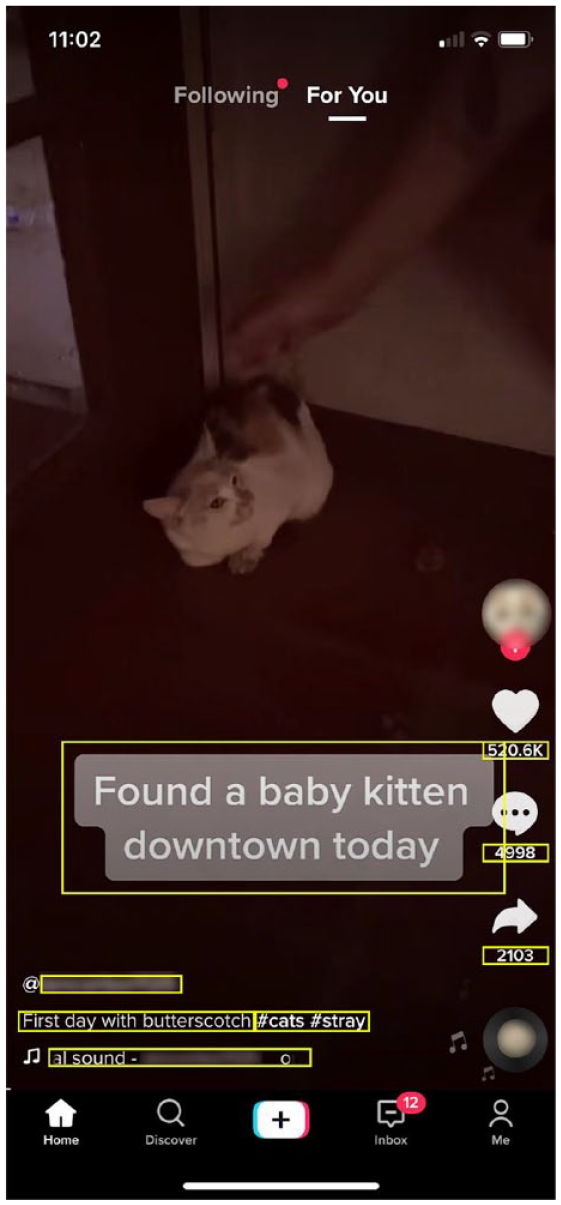
A TikTok interface showing key areas for data.
There were 23 meta codes logged for each of the 1,500+ TikToks in our data set. All of these meta codes fit into one of four input states: transcribed qualitative, interpreted qualitative, Boolean quantitative, and numerical quantitative. Transcribed qualitative codes are codes that are filled with text on the screen that is copied. This includes username, screen text content, posttext, replyto, hashtags, music, and filter. Interpreted qualitative codes are codes that are fulfilled with inputs generated by the video evaluator based on the content of the video, including description, primary class, secondary class, and general class. Boolean quantitative codes are sections that can only be satisfied with a true or false input. Meta codes that are Boolean quantitative codes include screen text, dance, two-part, advertisement, and verified. Numerical quantitative codes are self-explanatory and include state, date, time, likes, comments, and shares.
Our data set includes a “state” that is the position of a particular video in the flow, as an integer, as well as integer reports for likes, comments, and shares. Descriptive strings for: date, time, user, post-text, reply to, and hashtags used. Interpretive strings for the sound/music of each post and coder description. Binary responses were provided for the presence of any dancing in the content, the use of TikTok filter systems, and if the video was presented in a multi-part format. Our data set then includes general and specific codes.
Initially, it is useful to note characteristics of the data that help understand the data as a whole. First, is TikTok a platform for dance videos? The average number of likes on a “dance” tok is higher (5,478,530 vs 3, 869,171), but is not significant via t-test (p = .295). Explaining this are three high-like videos, two of which are the same video reposted. Without those videos, dance would underperform the rest. It is important to check this idea by noting that there are only 63 dance videos in our entire data set. Further checking of the data set found that of that population of dance videos, only 12 were “traditional TikTok dances.” This was a remarkable finding given the public perception of TikTok as a platform for dance videos. Furthermore, in our data set, there were zero videos, including the apparent dance leaders of TikTok Addison Rae or the d’Amelio sisters. A very small number of highly viewed dance videos seem to eclipse their role in the flow.
Second, there were very few meaningful correlations between easily ascertained textual features and success on the platform. A total of 1,416 videos employed no filter with an average yield of 4,036,193 likes. Aside from the Green Screen filter with 56 and inverted with 12, all other filters had fewer than ten uses. A number of videos of this type had tens of millions of reported views, despite only appearing once or twice in the data set. Green Screen performed well below unfiltered video. Given the availability of an integer count for the number of hashtags used, Pearson’s correlation coefficients were reasonable. There is a very slight negative correlation (–.103, p < .0006) between hashtag use and likes (note the high density of videos along the x-axis) (Figure 2).

Scatterplot hashtags to likes.
There was a single alien abduction story with 19 hashtags, but few likes. In terms of raw length of text on screen, there is no relationship between characters used and likes (Pearson’s = –.0549, p = .0554). Without going further into this category, as can be seen in the figure above, it is clear that there are a handful of posts on TikTok reported with very high like counts. Our team, given our extensive experience watching TikTok, has concluded that it is not the para-textual inclusions around the video content driving flow, but something about the videos themselves. While we could attempt to parse the text data and interface further; we believe that a finding here would be a false positive, and our null report here is quite useful for understanding the platform.
Third, we found little evidence of a network or collaboration. No user in our data set had more than seven entries. The most popular being the user “hereisyourmonkeycontent” featuring cute videos with a primate. The other users with multiple inclusions were advertisers like DiscoveryPlus, AppleCard, Lensa (job search), Relax (meditation app), River (news site), and ImperfectFoods, as well as uplifting influencer pammymac504, pudgywoke (a mischievous chihuahua), miadio (model and self-described baddie), and an account that was deleted for a former vine star. No other users appeared more than five times. No one in this network was not a professional media person, for this reason, we have few privacy concerns.
The structure of the network was derived from the address relationships between users and replies. The network density was .001, in our larger data set, the only nodes with meaningful connections were a new defunct cannabis business with 13 in-bound links and hereisyourmonkeycontent with five out-bound. Given the extremely low density and that the leading maker of connections for a network with nearly 16,000 connections was a single power user with five mentions, it is reasonable to dismiss the theory that TikTok is a connected mimetic social network. Mimesis in this sense seems much closer to using a format provided by an editing suite, than riffing with friends.
We considered that a system of relationships could exist in the comments, while we did not code the comments or capture them due to our approach, we do have comment and like numbers. Ratios or getting ratioed are important parts of life, especially on Twitter. In other practical experimental work, we have had some success with ratios in understanding algorithmic processes. We have real concerns as the “shares” numbers were often unavailable for our data set, the comment numbers may also be unreliable 15.6% of our data read out with zero comments with substantial numbers of likes. After removing the ostensibly uncommented content and a handful of extreme outliers (greater than 400,000 comments), the correlation of likes to comments is .598 p < 2.2e–16. While this may initially appear to be an important result, it really confirms that there is very little information communicated by TikTok comments. Each post received an average of 16,155 comments with an average of 4,140,940 Likes. We do not believe that there is a meaningful world of connections forming in the world of TikTok comments, it is far more likely that we should disregard the comments feature entirely as the numbers are odd and the comments are not displayed by default.
We are unable to find networks presented in the core flow.
Fourth, session state has an important impact. Generally, the longer a session lasts, the lower the mean likes on the content presented (Pearson’s = –.7, p = .0036), truncated for sessions with 15 or fewer transitions. On each date, we can see using the mean likes and standard deviation of likes the procession of the process over time (Figure 3).

Likes by day of the sample period, size is standard deviation.
By the final sessions of the project, the flow was no longer presenting the greatest hits, but was selecting increasingly niche content in an attempt to solve the riddle of the viewer (Figure 4). Notice the scale of the y-axis. Even in those final sessions, the videos presented still averaged nearly 80,000 likes, it was simply that the super hits that the flow leads with were just absolute smashes. In our discussions of the results, we had similar experiences, on those later days, in those later states, the content “got weird” especially when “zero like” videos would begin appearing. Among these were the most radical videos we saw including advocacy for various conspiracies including Qanon.

Network of transition states between major topics, color saturation is weight, each number indicates the weight of the directional transition.
Fifth, we can see that the flow moves users between multiple light affective states and the advertising condition.
This is a visualization of the entire process of walking across the network, rendered with the Fruchterman and Rheingold (1991) layout and a Louvain algorithm for adding some color based on detected community (Blondel et al., 2008). The central stream of the flow can be seen in the relationships between comedy and a handful of other nodes. Minor categories related to politics, social change, or even what was seen as the most important singing and dancing, are lost. The top weighted ties are given in Table 1.
Top State Transitions.

One immediate point to notice is the degree to which the network depends on self-loops. Comedy–comedy, lifehacks–lifehacks, and storytime–storytime. Of the meta codes, only 6 of 18 appear in the heart of the Markov process model; 18.8% of the experience is a variety show of comedy skits, hobbies, and lifehacks. When considered as the anchor point for the process, the system is either transitioning to or from comedy, 42.4% of the time.
These codes were developed during collaborative sessions among the authors. These particular codes resonate with the platform specific culture and flow of TikTok. Typically, users define their content with a label assigned to its particular resonance. In terms of these core elements, comedy refers to intentionally designed comedy skits, lifehacks are short advice videos, hobbies refer to crafting and display videos that are not intended to be instructional, transition refers to the end of a TikTok session either by exhaustion or app crash, ads are paid advertisements, and storytime refers to a particular genre where someone engages in a quotidian activity (like applying makeup) while relaying a narrative.
Political content, as well as singing, dancing, and celebrities are secondary to the basic flow. Conservative included both specific politics content (mostly related to Former US President Donald Trump and various conspiracy theories), social justice incorporated processive justice related messaging (we did not observe a great deal of left politics work), political was the category for things generally about politics that were not social justice or conservative, singing and dancing are videos of those, celebrity are videos promoting celebrities (in our sample window Jason Derulo was particularly popular), couples are videos related to relationship appreciation/advice, trends were quick meme videos that were not clickbait proper, and promotional were videos that were intended to lead users away from TikTok to some other location, such as Instagram or OnlyFans.
Consider five random walks using the Markov transition probabilities, aided by a common Markov chain library (Table 2) (Spedicato et al., 2021).
Five Random Walks, each column is a turn on the walk, each row is a walk.

Using the Markov approach, we can see what a typical TikTok session is really like: a musical variety show smoothly moving between several forms of lighter fare. The process does predict some early transitions (crashes were common during the research), for the most part, for experienced users, this is an accurate abstract model of the experience (Figure 5).

Network of transition states between selected topics, color saturation is weight, each number indicates the weight of the directional transition.
With this version of the graphic, limited to the nodes with the highest degrees, you can compose your own random walks. In as much as we might hope that the “misc.” category would provide highly engaging content, for the most part, these are quick videos that are hard to categorize with many likes, these are not political.
TikTok as Television
Among the research team there were real generational gaps, some of the team members grew up in the streaming era, only a few had the experience of using an antenna television. Flow was always to some degree at least at the control of the viewer. What was missed harkens back to Williams’ insight about the nature of flow analysis when one can only think in discrete metaphors: what if TikTok is not social media at all, what if TikTok is television? Specifically, the experience of late-night flow, riddled with commercials for low-end consumer products, reruns, and sketch comedy shows. This is not to say that the content at this time is trivial, as it has been established that late-night flow is a good place to access disinterested viewers: that mish-mash of content provided is well-suited for the disinterested (Parkin, 2010).
In the popular imagination, TikTok is social media where people dance and copy the dances of others, forming networks along those performative pathways. We did not find evidence of this. What we found was a highly concentrated world of one-way communication with comedy and lifehacks, the experience of flipping between (local channels) 13-1 Late Night with Stephen Colbert and 12-4 DABL Emerl Live. Included on occasion low-quality commercials, many of the same between the channels, bam.
For many younger users, they have never had access to an analog channel changing experience. Streaming media has been ubiquitous in the lives of young people, even then the televisions they had access to did not have the fast smooth channel changes of analog. If we take our definition of social media from boyd and Ellison (2008), we can go further to conclude that what we have identified in this map of flow is not in fact a social network, the profile is trivial on TikTok (users often delete almost all of their content) and there are minimal networks to connect with. Particularly, active TikTokers will claim ultra-niche community affiliations as jokes. It is entirely possible that ethnographic explorations of user communities will find tactical pathways where community is made, at least in the sort of demonstration of the greatness of the platform provided by TikTok, there is no such feeling. Our goal was to provide a model of the core flow of a popular platform and in this study we have demonstrated that the basic Markov chain logic of TikTok provides an entertainment experience of flow much like that of flipping through the channels on broadcast television with a remote control. For younger users, this would be fresh and new, older users might see the flow they continue to enjoy. Snapchat’s Spigel was right, TikTok is a great site for “broadcasting talent.” TikTok is television.
Our findings underscore the tensions in contemporary television studies. While it has been safe to assume that hypersonalization is a key element of future television, our conclusion would suggest that this is more complicated. Some systems use discrete rather than continuous categories, expectations in creative text are increasingly refined. Even as the text collapsed into gravity well of debt as described by Becker (2003), Amazon has relied on television industry open piloting (Christian, 2018). Amanda Lotz (2007) argued that the “trifructuration” of television by early on-demand efforts called for a return to understanding of what makes television a distinct thing rather than simply cinema at home (p. 99). Ambivalent flow was suggested by the literature about this platform and found in our research on recirculation. Anna McCarthy’s (2004) reading of television in reception areas and waiting rooms is especially resonant with our analysis as television in that context is best understood through the sites where you are exposed to it as a moderately interesting form that no one fully controls. When we say that TikTok is television we mean that it is the form of television that is not an on-demand feature film, but the cultural and technical form flow media for which you do not have full control. At this point, the literatures of early TikTok and television converge.
Our direction of data collection could have taken multiple avenues when it came to the approach and strategy used. Future research may expand or dispute our findings by simply adding more data (our approach is simple and public like Williams’ journals). The methods could be expanded using computational methods to improve the reliability of the data set or to add additional texture, especially with machine learning methods. Brute force could be used to produce even more detailed accounts of the video clips and their aesthetics. TikTok could also release their algorithm that would force a much more intense discussion about the particular computational dynamics of a flow engine and the experience of that circulation. Precarity on TikTok is pronounced then because the emphasis is not on seeding micro interactions but selling what amount to TV commercials. Lateral network analysis, while important is a lower priority when that affordance is on the fringe of the recommendation system.
As TikTok is a user-based platform with the intent of individual user personalization, we chose the method of least interference to uncover the most baseline algorithmic content TikTok would provide. Listed below are alternative routes we could have chosen when conducting this research, as all ultimately would lead to an inaccurate and altered data set. In comparison to our chosen method of not liking, commenting, or interacting at all with our TikTok feed, our data collection could have involved liking every video present. In doing so, such interactions would have ultimately produced the same results in creating an unrealistic portrayal of the baseline TikTok algorithm and an inaccurate personalization of the feed. Our collection method could have been focused on generating feature-centered data collection, such as looking for a particular hashtag, commenting on every video, liking every fifth video on the feed, and so on.
Doing so results in an inconsistent data set, which also does not aim to uncover algorithmic qualities but more feed personalization features of TikTok. In addition, our data collection could have been account specific, aiming to uncover the qualities of this platform based on the specificities of each unique user’s interactions. Finally, research on the TikTok algorithm could have been conducted on researchers’ individual accounts without creating brand-new, depersonalized accounts but in doing so, our data would have contributed to the research of our own personal algorithms, not the baseline of the TikTok platform in itself. Other alternatives also exist in which we did not state of possible TikTok algorithm data collection methods, but any alternative would not uncover and attribute to the baseline algorithm of TikTok. Our study uncovers how TikTok persuades a user to interact and use the app.
Although our research does not speak to the production dimension of TikTok as television, connecting the flow of content created as such should be situated within Christian’s framework as a possible form of scalable open television, although the finding as it relates to the algorithm here would suggest that like other post-network television systems, it is not in fact not that (Christian, 2018). In a similar vein, additional hypothesis driven research should determine the degree to which the dynamics of the ForYou page ever deviate from those of the base page and the degree to which discourses that resonate in the creator community of TikTok as being so heavy handed are in fact continuing to be true. In this sense, this study provides important computational support for arguments made by those including Peterson-Salahuddin (2022) particularly through the ways that it disrupts the defense of corporations to rely on a seemingly neutral or unknowable algorithm.
Finally, we hope that this study has rekindled an approach to understanding social media (or what we conclude not to be social media) through a focus on the central mechanics of flow for that medium, rather than a focus on discrete texts. Finding the core character of a platform is a useful exercise and one that contributes to critical/cultural research in an era where abstract methods for producing texts have taken the place of the texts themselves.
Footnotes
Declaration of Conflicting Interests
The author(s) declared no potential conflicts of interest with respect to the research, authorship, and/or publication of this article.
Funding
The author(s) received no financial support for the research, authorship, and/or publication of this article.
