



Abstract
This study provides insights into the role of political social media influencers (PSMI) as relatively new actors in political communication. It examines their content and motives in the context of elections. Considering the German federal election in 2021, it uses content analysis of 20 PSMI offers with 301 pieces of content and a supplemental online survey to explore how PSMI communicated on various platforms/formats (Instagram posts/videos, podcast episodes, TikTok, YouTube) in the 2 months before the election. The findings show that the PSMI in this sample, who were all nominated for an award, provided (basic) political knowledge for a broad target audience without significant prior knowledge. In line with this, the findings further reveal that while the content of the PSMI overall was characterized by a high density of information, their density of opinion or self-presentation was comparatively low, with platform affordances influencing these characteristics. This corresponds to the motives stated by the PSMI in the supplemental online survey. While the findings for the PSMI in our sample are to some extent in line with role conceptions of journalists in Germany—the sample spans from professional journalists to influencers without any connection to journalism—they diverge in other respects from routines of the profession. The findings of our country-specific contribution allow for a more systemic understanding of PSMI, especially in the context of elections, by highlighting that they can add to information sources available by offering (basic) political education, especially for a young target audience on social media.
Introduction
Opinion forming occurs increasingly in digital spaces and in a constantly diversifying digitalized field of communication. Within this field, political actors, such as individuals or parties, communicate with professional journalistic actors and a broader public (e.g., Haßler et al., 2023; Peeters et al., 2023). In this context, the undisputed influence of the major social media platforms (Nielsen & Ganter, 2017; van Dijck et al., 2018) influences power relations and opportunities as the platforms provide individual users and formats with quick access to the public and affect political image building (Bast, 2021). In turn, new actors have emerged who act as observers, critics, or supporters of politicians.
Against the backdrop of this development, this study provides insights into the role of political social media influencers (PSMI), their content, and their motives in the context of elections. Considering the German federal election in September 2021, it explores how PSMI as self-created brands on social media produce and distribute political content on the election on different platforms for a dispersed audience (for the definition, see also Bause, 2021, p. 296).
This study is mainly based on a content analysis of pieces of content published by PSMI about the federal election in Germany (September 2021) in the 2 months before the election. The sampling consists of the nominated work for the first-ever Hanns Seidel Foundation Award for Political Influencers, which to the best of our knowledge is the only award of its kind in Germany to date. This resulted in a total of 20 PSMI brands (PSMI who were nominated for the award) that can be differentiated according to their main platform/format (Instagram, podcast, TikTok, YouTube) and audience reach. In total, 301 pieces of content of these brands were included in the analysis. To complement the content analysis and gather some information on the influencers in the sample, an additional online survey was conducted among the 20 PSMI (response rate: 9 out of 20).
The findings of the content analysis show that the PSMI in this sample provided (basic) political knowledge for a broad target audience without significant prior knowledge. In line with this, the findings further reveal that while the content of the PSMI overall was characterized by a high density of information, their density of opinion or self-presentation was comparatively low, with platform affordances influencing these characteristics. This corresponds to the motives stated by the PSMI in the supplemental online survey. While the findings for the PSMI in our sample are to some extent in line with role conceptions of journalists in Germany, they diverge in other respects from routines of the profession. The findings of our country-specific contribution allow for a more systemic understanding of PSMI, especially in the context of elections, by highlighting that they can add to information sources available by offering (basic) political education, especially for a young target audience on social media. From this point of view, a further specification is important: in our article, we understand and examine PSMI from the perspective of journalism studies rather than from the perspective of political communication. This is also evident in our research material: we have analyzed almost exclusively formats that provide journalistic or journalism-like content and no formats of political institutions, parties, or members of parliament (in the sense of political public relations).
The article is structured as follows: in the first section, the literature review, we contextualize and define PSMI. We then address their motives, before we present first studies on the content they publish. In the following section, we deduce our research questions and describe the methods of the study. The findings are presented in the next section, before we summarize and interpret them, examine the study’s limitations, and look ahead to future research in the conclusion and discussion.
Literature Review
PSMI
Social media platforms allow media outlets and the broader public to publish their own content at low cost. As a result, new actors have emerged, partly at the boundaries of journalism, complementing the reporting of professional journalists in established media outlets (Bruns, 2018). Research on such actors shows that they can support as well as challenge journalistic practices (Holton & Belair-Gagnon, 2018). One category of these new actors is social media influencers (Cunningham & Craig, 2019).
Social media influencers make use of the fact that social networks have become increasingly important for news use. Data from the 2021 Reuters Institute Digital News Report across 12 countries show that over two-thirds of respondents (66%) are consuming, sharing, or discussing news on social networks or messaging apps (Newman et al., 2021, p. 22). News use on social media platforms can take place through selective but also incidental exposure, referring to situations of news use in which users did not actively search for news but just came across it in their feed (Bergström & Jervelycke Belfrage, 2018; Bode, 2016; Valeriani & Vaccari, 2016). Empirical findings from audience research on social media influencers show that they indeed play an important role for young people regarding their information behaviors and opinion forming (Andı, 2021, pp. 53–54; Schmuck et al., 2022), and the use of such content is linked to a perceived social duty to keep informed (Wunderlich et al., 2022).
Goanta and Ranchordás (2020, pp. 6–9) differentiate social media influencers according to four categories: (1) the topics they cover (e.g., fashion, beauty, and food), (2) the origin of their popularity (i.e., whether they are celebrities who were already famous outside social media but use social media as a promotion tool or influencers who only became popular through their activities on social media), (3) measurements of their reach or popularity (e.g., the number of followers/subscribers, views, likes, and retweets), and (4) their legal status linked to their business model (i.e., influencers with companies, freelancers, and pure consumers).
This article focuses on a subgroup of social media influencers: PSMI. Bause (2021) defines them as “users who became well known in social media and, as self-created personal brands, regularly distribute self-produced political content with which they reach and potentially influence a dispersed audience” (p. 296).
Motives of PSMI
Previous research argues that the communication role of (political) social media influencers can be viewed through the lens of opinion leadership as “a form of mediated, (semi)professional public communication based on strategic self-staging” (Bause, 2021, p. 297; see also Winter & Neubaum, 2016). In this respect, Winter and Neubaum (2016) found concerning the motives of the mainly young Facebook users in their sample—compared to the classic theory of opinion leadership (Katz & Lazarsfeld, 1955; Lazarsfeld et al., 1944)—that information and persuasion played a predominant role as well as self-presentational motives. “[T]he large audience and the affordances of SNS [social networking sites] might particularly strengthen the role of impression motivation in opinion leadership” (Winter & Neubaum, 2016, p. 9). Apart from that, they found that the predominant motives varied with personality traits and according to features used. For example, private messages on social networks were motivated mainly by spreading information, while the writing of status updates was connected to the motive of self-presentation in a positive light (Winter & Neubaum, 2016, p. 9).
In the wider context, Kümpel et al. (2015) conducted a systematic review of scientific, peer-reviewed articles between 2004 and 2014 on the topic of news sharing and social media. They found that some of the analyzed empirical studies explained news sharing by a need to pass on important information and, in this respect, information-oriented motives (e.g., boyd et al., 2010; Holton et al., 2014). However, Kümpel et al. found more empirical evidence for self-presentational and persuasive motives of opinion leaders or those who perceive themselves as such. A picture of “self-serving status seeker[s] emerges” (Kümpel et al., 2015, p. 8) that tries to draw other users’ attention to their own ideas and opinions (e.g., Lee & Ma, 2012; Ma et al., 2011).
Weeks et al. (2015) similarly found in a two-wave US panel survey that highly active users on social media believe they are influential in their social media networks and are also more likely to try to influence others. This highlights persuasive motives for social media engagement. However, Penney (2018) concluded, based on qualitative focus groups with young users, that how persuasive young users perceive themselves largely depends on how they conceptualize viral influence. Those with more skeptical views about their influence on others holding opposing views stressed that they were lacking reach on social media. In contrast, those who were more optimistic about their impact on others highlighted the network effects their political posts can have among supporting peers.
Most recently, Lichtenstein et al. (2021) interviewed 16 journalistic YouTubers within and without the German public broadcasting network “funk.” They found that informing their audience, contributing to opinion-building, and encouraging public participation were the main motives of the YouTubers in the sample.
In sum, the studies do not show a clear picture, but rather, depending on the sample, evidence for various motives from persuasion to self-presentation but partly also information.
Content Characteristics of PSMI
There are only very few studies that address content characteristics of PSMI. Suuronen et al. (2022) suggested in an exploratory analysis of political topics among Finnish social media influencers that they address two types of topics: formal political topics (i.e., those relating to political processes, institutions, or actors) and lifestyle-based political topics (i.e., those referring to any issue that they think is a collective concern and impacts the wider society).
Lewis (2020) analyzed in a case study the implications of micro-celebrity practices employed by three political and ideological influencers in the United States on YouTube. Her findings show that participation is not necessarily inherently progressive, but the selected YouTubers in her sample adopted micro-celebrity practices to stress relatability, authenticity, and accountability to align them with a reactionary political standpoint and differentiate themselves from the mainstream media.
In a further study of content characteristics, Fischer et al. (2022) analyzed videos of German- and English-speaking political YouTubers. They identified two main types of political YouTube videos: “partisan mockery” and “engaging education” (Fischer et al., 2022, p. 259).
These findings highlight that PSMI move along the boundaries (see also Banjac & Hanusch, 2022 and in more general Holton & Belair-Gagnon, 2018) of (possible) journalistic professionalism, reach-calculated logic, and an individual agenda that are also underlying the above definition. Their content can be journalistically dominated, journalistically influenced, or also created far away from journalistic norms.
In this respect, PSMI and their content can, more broadly, be viewed and analyzed through the lenses of quality research in news media (e.g., Bachmann et al., 2022) and political media coverage in particular (e.g., Jandura & Friedrich, 2014), for social media posts explicitly (e.g., Steiner, 2020), or for participatory content (e.g., Borger et al., 2019). Many of the studies on quality in journalism deduce quality criteria from the normative ideal of a deliberative democracy, for example, relevance, contextualization, professionalism, or diversity (Bachmann et al., 2022). At the same time, those quality criteria have also guided research on audience participation to better understand whether and how their content differed from those standards and better understand “boundary work” (e.g., Borger et al., 2019). Consequently, they are also integrated in adapted forms as part of the operationalization of this study.
Research Questions and Methods
Building on the previous stocktaking on the growing importance of social media for news and social media communication, this study aims to contribute more insights into PSMI, their content, and motives—and does so in the relevant context of elections, an area where empirical research on this subject is still very scarce. Considering the German federal election in September 2021, it aims to explore how PSMI communicated on different platforms in the run-up to the election. There are two overall research questions:
RQ1. What content did PSMI in Germany convey in the 2 months leading up to the election?
This first research question builds on the literature on content characteristics and aims to give a first overview of the content, especially topics, policy fields, parties, and chancellor candidates covered by PSMI, to analyze what they offered to their audience in the context of the election. This is deepened by an analysis of the density of information, opinion, entertainment, and self-presentation of the PSMI content. The density of information and opinion was coded in each case using a four-point scale (very low/low/high/very high). Anchor examples were selected for each platform, taking into account that there are natural limits depending on the platform/format (e.g., 30 s of TikTok versus 30 min of podcast). In addition to proving information about the nature of their content, this can also serve as a first hint to the PSMI motives explored in the second research question.
RQ2. How do the PSMI in the sample describe their own motives, goals, and organization?
This second research question not only analyzes the motives discussed in the literature in the concrete context of an election but also adds the perspective of how they organize their production. This includes the aspects of equipment, time management, finances, and staff and offers a new facet to the literature by viewing PSMI as individuals not only producing political content but also considering the organizational contexts of their content creation. The analysis is situated at the intersection of journalism studies and political communication. The focus and the material are somewhat more influenced by the journalism perspective; at the same time, influences from political communication are also found in the category system (e.g., in the differentiation of actors and institutions or in key political statements).
While the first research question is based on a content analysis, the data for the second research question come from a supplemental survey, as explained in the following section. A final note in the interest of transparency of the research process is as follows: we, as authors of the study, are not employed by or otherwise dependent on the Hanns Seidel Foundation. We were asked to serve as jury members for the announced award and conducted the selection of the award winners, as well as this study itself, without any influence from the Foundation.
Content Analysis
This study is mainly based on the analysis of content on the federal election in Germany (September 2021) published by PSMI in the country in the 2 months before the election. In this election, for the first time in 16 years, Angela Merkel did not run as the CDU/CSU (Christian Democratic Union/Christian Social Union) candidate for chancellor. The election ended with a coalition of SPD (Social Democratic Party of Germany), Bündnis 90/Die Grünen (Alliance90/The Greens), and FDP (Free Democratic Party).
The sampling of our study consists of the nominated offers for the first-ever Hanns Seidel Foundation Award for Political Influencers, which to the best of our knowledge is the only award of its kind in Germany to date. According to the call for entries, the special focus of the award was on content that is of merit in terms of political information and opinion forming. From this point of view, the prize was unique in Germany. The Hanns Seidel Foundation is a foundation for political education that is close to the CSU, a Christian democratic and conservative political party in Bavaria that forms a parliamentary group with the CDU in the German Bundestag. The other parties in the German parliament also have a political foundation close to them. The Hanns Seidel Foundation itself merely announced this award; it had no influence on the nominations. Self- as well as third-party nominations were possible by anyone; not all nominated influencers therefore completed an application themselves. The only condition was that nominees must have independently produced and published regular content on politics in Germany in 2021. This resulted in a sample with nominees being partly full-time journalists, partly freelancers. However, in about half of the cases, they had no connection to journalism or media brands.
The nominations resulted in a total of 20 PSMI offers that can be differentiated according to their main platform/format (Instagram, podcast, TikTok, YouTube) and audience reach (nano <10K, micro <100K, or macro ≥100K PSMI).
Specifically, the sample consists of the following influencers listed in Table 1.
Overview of the Analyzed PSMI in Germany.

PSMI: political social media influencers.
Follower figures have been rounded off; nano <10K, micro <100K, and macro ≥100K. Neither the podcast platforms nor the podcasters mentioned here give concrete numbers on reach.
A total of 301 pieces of content (Instagram posts/videos, podcast episodes, TikTok videos, YouTube videos) by the PSMI from the 2 months prior to the federal election on 26 September 2021 were identified as relevant for further analysis. This ensured a complete sample (all pieces of content during this period with reference to the election were analyzed; 36 pieces of content with no reference to the topic were ignored) and at the same time covered a comprehensive phase of the election campaign. Each piece of content was coded only into one category (YouTube video, TikTok video, podcast, or Instagram post). The respective variables were the same regardless of the platform/format. However, to consider the different possibilities and limitations of the platforms/formats, individual coding rules were defined for each platform/format in the codebook. The distribution of the 301 pieces of content (24 July to 26 September 2021) is shown in Table 2.
Distribution of Content (N = 301).

Deviations from 100% result from rounding to whole percentages.
The number of pieces of content increased immediately before the election. Only 14% of the pieces of content of the overall sample (N = 301) were published in the first 2 weeks of the analyzed period (24 July to 6 August 2021). In the last 16 days of the sampling period (11–26 September 2021), 32% were posted (see Table 3).
Weeks of Analysis 2021 for the Content Analysis (N = 301).

Week 10 does not comprise 7 days but only 2, due to the election day on 26 September 2021.
The unit of analysis was the single piece of content. The category system for the analysis included 35 variables and had, beyond the formal variables, a specific focus on the main topic, the main political field addressed, the parties and chancellor candidates referred to, as well as characteristics of the content (density of information, entertainment, opinion, and self-presentation, each measured on a four-point scale of very low/low/high/very high). In addition, qualitative references to the material in the sense of a mixed-method approach were included in the analysis. In this respect, this study builds on studies on quality in journalism that include, for example, relevance, contextualization, professionalism, or diversity (Bachmann et al., 2022) and on those analyzing participatory journalistic content from the perspective of content quality (Borger et al., 2019). The main variables are briefly described below:
Main topic of the contribution: The overall political focus of the content was differentiated between electoral law/election process, election programs, chancellor candidates, other politicians, various policy fields, and other topics. Only one main topic could be chosen.
Main policy field addressed: The topic variable was supplemented by this variable focusing on the specific policy field addressed in a contribution, if any. Domestic policy, foreign policy, economic policy, environmental policy, social policy, health policy, or education policy, as well as other policy field or no policy field, could be chosen as the focus. Only one main policy field could be chosen.
References to political parties: It was possible to choose the parties in the German parliament (in order of their mandates in parliament (2017–2021): CDU/CSU (Christian Democratic Union/Christian Social Union), SPD (Social Democratic Party of Germany), AfD (Alternative for Germany), FDP (Free Democratic Party), Die Linke (The Left), Bündnis 90/Die Grünen (Alliance90/The Greens) as well as other parties). Not just one but multiple options could be chosen.
References to chancellor candidates: Similarly, references to the three chancellor candidates were coded, namely Armin Laschet (CDU/CSU), Olaf Scholz (SPD), and Annalena Baerbock (Bündnis 90/Die Grünen). Again, more than one option could be chosen.
Density of information: To measure information density, the unit of analysis was examined along three central news values—temporal (“How timely is this?”) and spatial (“What does that mean for the population in Germany?”) proximity as well as political/social relevance. At the same time, the respective context was considered, as a comparably brief Instagram post is immensely limited in scope compared to a podcast episode of, for example, 30 min. Furthermore, the information reference was seen in politics itself (and not in the influencer)—that is, a post by an influencer in front of the Reichstag building was coded as very low if there were no further references. Although more qualitative in nature, the density of information was measured on a four-point scale (very low/low/high/very high).
Density of entertainment: The entertainment value was measured along three criteria: “emotion,” “action,” and “unusual & curious.” Important for the coding process was only the content presented, not the presumed effects on the user. The criterion “action” basically refers to movement in the depicted motif. Like density of information, the density of entertainment was measured on a four-point scale (very low/low/high/very high).
Density of opinion: This variable refers to the clear positioning of an influencer along a cause or person. This includes election appeals, comments, or generalized/subjective attributions. The opinion could but did not have to be clearly identified as such. As with the density of entertainment, the density of opinion was measured on a four-point scale (very low/low/high/very high).
Density of self-presentation: This is understood as a clear positioning of an influencer within the unit of analysis. In this context, self-portrayal (“I” sentences, self-description, etc.) was assessed as a form of subjective expression in relation to objective elements. The more pronounced the ego reference in relation to objective elements, the higher the characteristic expression was coded. In parallel to the density variables above, the density of self-presentation was measured on a four-point scale (very low/low/high/very high).
The 301 pieces of content were coded along the 35 variables by one of the researchers. A test for intracoder reliability, in which the pieces of content should be coded again after 1 month (Lacy et al., 2015, p. 806), was carried out with 30 random pieces of content to check the consistency in the coding of the actual coding researcher. In addition, the other researcher coded the 30 pieces of content as well to calculate the reliability between both researchers and check whether they understood the codebook in the same way.
The relevant test of intracoder reliability showed a perfect reliability of 1 according to Krippendorff’s alpha for most variables. Only six of the variables scored below but still within the good or acceptable range (α ≥ .800 or, where tentative conclusions are still acceptable, α ≥ .667; Krippendorff, 2004, p. 241). The variable on the policy area in focus scored a Krippendorff’s alpha of .948, direct reference to one or more parties .934, density of entertainment .892, density of self-presentation .757, density of information .754, and the one on density of opinion scored the lowest with .737. Measured with a simple percentage of agreement (Holsti), density of opinion still reached 90% of agreement, and all other variables scored higher.
Furthermore, the additional comparisons of the coding between the actual coding researcher and the other researcher showed a perfect reliability for most variables and a still good or acceptable score according to Krippendorff’s alpha for a few further variables.
Supplemental Online Survey
To complement the content analysis and gather information on the influencers in the sample, an additional online survey was conducted. All 20 PSMI in the sample were invited to take part in the online survey in January 2022 via email. Nine of them accepted the invitation (11 either did not respond, even after another email reminder 10 days later, or declined) and revealed valuable information, for example, about their professional backgrounds, motives, and funding. Of course, this does not allow for generalizable conclusions, but it can be helpful to provide some context for the findings of the content analysis. The variables of the questionnaire discussed in the empirical section are briefly described below:
Motives of the PSMI: To analyze the motives of the respondents to engage as PSMI, a respective scale by Winter and Neubaum (2016) was used and the wording slightly adapted to the target group of the questionnaire. It included seven items for information as a motive (e.g., “. . . to inform my audience about political topics”), three items for persuasion (e.g., “. . . to convince others of my opinion toward the topic”), and five for self-presentation (e.g., “. . . to show others that I am interested in political topics”). Each of the 10 items was measured on a five-point Likert-type scale, spanning from strongly disagree (1) to strongly agree (5).
Information about the audience: To measure how the PSMI inform themselves about their audience, a scale by Weischenberg et al. (2006) was adapted. It included, for example, direct contacts with the audience as well as online comments, the analysis of analytics, or more traditional audience research. Multiple options could be chosen.
Perception of the audience: The perception of the audience was measured by a scale from the same study (Weischenberg et al., 2006). Respondents were asked to rate eight dichotomously constructed adjective pairs such as politically interested/not politically interested on a five-point scale.
Organizational context and funding: Respondents were asked to provide information on the number of persons involved in the production process for their channel, an average contribution, and in which functions (e.g., camera and editing). Furthermore, they were asked about their sources of income for their offer, if any, beyond their own resources.
Personality strength: Noelle-Neumann’s (1983) personality strength scale was used to measure to what extent people perceived themselves as self-confident in leading and influencing others (e.g., “I usually count on being successful in everything I do”). Each of the 10 items was measured on a five-point scale.
Used sources and main source of news use: Adapted from the questions and scales of the Reuters Institute Digital News Report (e.g., Newman et al., 2021), respondents were asked which sources (categorized according to media types) and which main source they use to inform themselves, at least weekly, about news.
Findings
Content Analysis
Main Topic of the Contribution
Regarding the topical focus of the content, more than half of all pieces of content (N = 301) focused on electoral law (e.g., “How do you vote?” “What is a two-vote system?” “How do votes become mandates?”) or the election programs of the parties. The influencers did so less from a traditional point of view and topic areas and more from the perspective of young people (“What do the parties want for young people?” “What are you doing for young people, Mr. Laschet?”). The chancellor candidates, Armin Laschet (CDU/CSU), Olaf Scholz (SPD), and Annalena Baerbock (Bündnis 90/Die Grünen), were the main topic in only 11% of the pieces of content. Other politicians, especially Christian Lindner (FDP), were emphasized in just under 13% of the pieces of content (see Table 4).
Main Topic of the Content (N = 301).
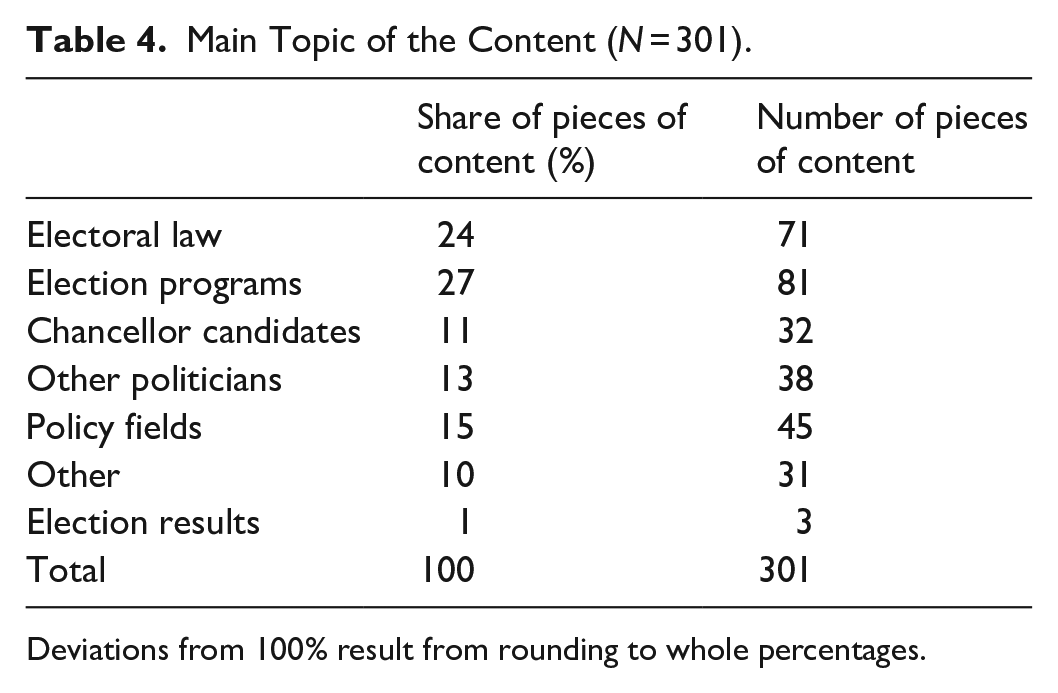
Deviations from 100% result from rounding to whole percentages.
Main Policy Field Addressed
The results were further specified regarding the various policy fields. Here, a strong focus on the two topics of environment/climate and economy/finance was evident. Among those pieces of content that showed a clear reference to policy fields (n = 156), the following distribution emerged: environment/climate (32%) and finance/economy (18%), followed by foreign policy (14%) and home affairs (12%).
References to Political Parties
Looking next at the political parties and their presence in the sample, the following is striking: the small parties have an above-average presence in relation to their strength in parliament (2017–2021) and in some cases are even almost on a par with the last governing parties of ex-chancellor Angela Merkel (CDU/CSU and SPD) (see Table 5).
Parties by Mandates in Parliament and Occurrence in the Sample (N = 301).
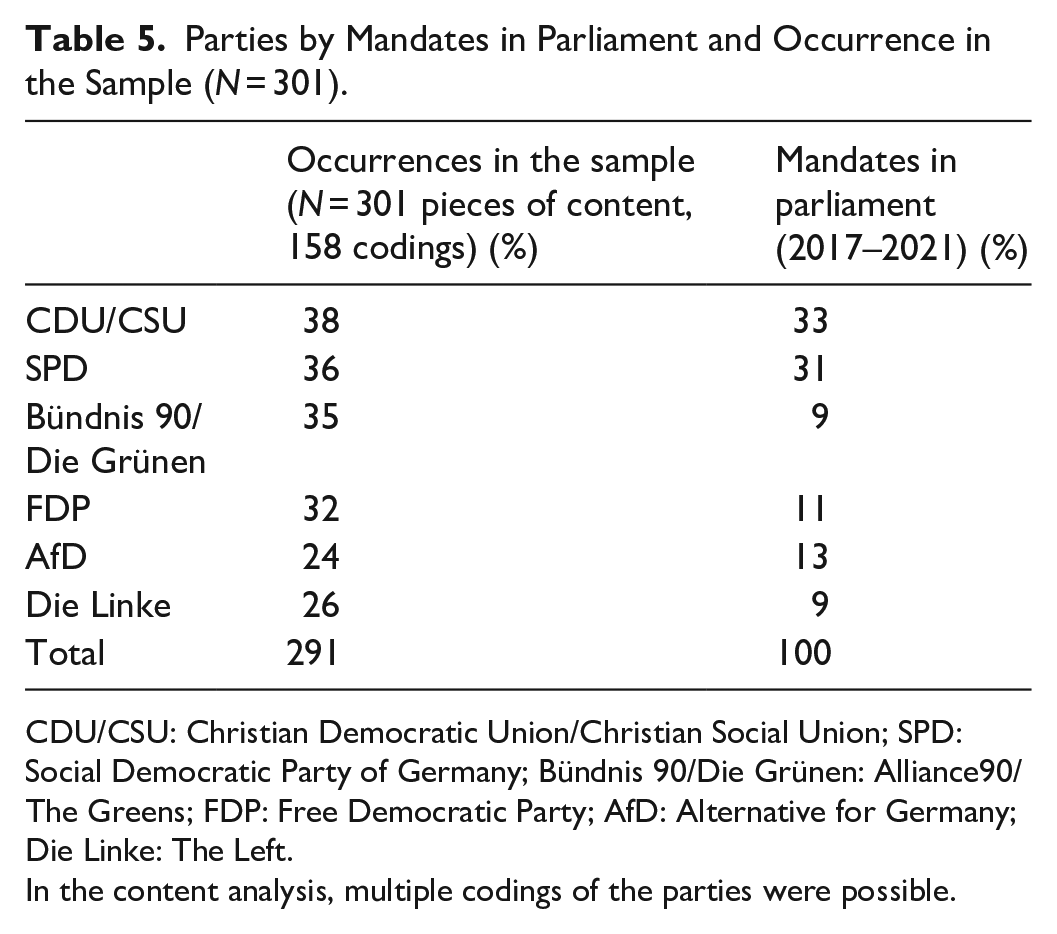
CDU/CSU: Christian Democratic Union/Christian Social Union; SPD: Social Democratic Party of Germany; Bündnis 90/Die Grünen: Alliance90/The Greens; FDP: Free Democratic Party; AfD: Alternative for Germany; Die Linke: The Left.
In the content analysis, multiple codings of the parties were possible.
This is an interesting finding, as the state of research for Germany shows that small parties are generally less visible in professional journalism than large parties. Moreover, several studies show that governing parties are more present in the media than opposition parties (for an overview, see Jandura & Leidecker, 2015, pp. 39–41). Small parties were in the opposition during the 2021 federal election campaign. As a result, the PSMI studied deviated from this distribution with their content. One of the reasons for this is that numerous pieces of content compared the election programs of all parties, ultimately strengthening the scope of the small parties.
References to Persons and Especially Chancellor Candidates
In general, Angela Merkel still played a central role in the pieces of content in the run-up to the election. Although the chancellor announced early on that she would not run again, she was named in just under 15% of the pieces of content (N = 301), for example, as a person of reference, and thus was almost as present as the three chancellor candidates who competed for her succession in the 2021 election. In concrete terms, however, only 26% of the pieces of content had a reference to the chancellor candidates. Laschet (CDU/CSU, 20%), Scholz (SPD, 18%), and Baerbock (Bündnis 90/Die Grünen, 18%) were given roughly equal consideration, although Laschet was mentioned more often in the context of Merkel.
Density of Information
A high density of information (M = 2.98, N = 301) was found, with 32% of the pieces of content with a rather high and 37% with a very high information density. This was particularly evident in the details and precise information on the topics of electoral law (e.g., voting process, votes, and seats in parliament; M = 2.90, n = 71) and policy fields (M = 3.25, n = 45).
Density of Entertainment
The entertainment orientation was rather low in the coded pieces of content (M = 1.70, N = 301). The entertaining elements tended to occur as a side note (ironic remarks in podcasts, funny filter effects in TikTok videos) and were each very quickly abandoned in favor of the technical and factual level. Only in 12 of the 301 pieces of content (4%) was the value for entertaining coded higher than that for information.
Density of Opinion
The findings further show that influencers were reserved regarding integrating evaluation and opinion in their pieces of content (M = 1.69, N = 301). A rather high density of opinion could be found in only 18% of the pieces of content, and a very high density in an additional 4%.
There were clear separations between information and opinion in almost all cases with a very high density of opinions: in two instances (n = 11), there was no indication that the opinion expressed was the individual’s own. In the German context, the strict and transparent separation of information and opinion (Pöttker, 2005) is regarded as a guideline that was prescribed by the Western Allies after World War II (Blöbaum, 2002) and is seen as a quality standard. The influencers thus integrated this principle into their own actions and left the formation of opinion largely to the audience itself, or they actively encouraged them to do so, for example, at the beginning or end of their format. At the same time, it is important to emphasize that our study cannot provide representative findings for German PSMI and their content at this point (see limitations in the “Discussion and Conclusion” section of this article).
Density of Self-Presentation
The average value for the self-presentation (M = 1.96, N = 301) of the influencers was only slightly higher than that for entertainment. Across the sample, only 18% had a rather high value of self-presentation, and an additional 4% had a very high value of self-presentation. Examples of this are TikTok dances in front of the Reichstag building, joint pictures/selfies with chancellor candidates, or videos showing the influencers at work. Particularly high values of self-presentation were recorded in TikTok formats. Here, the proportion of high and very high self-presentation (28%, n = 22) was higher than that for the other platforms/formats. This is also shown by the respective mean values: the density of self-presentation in TikToks (M = 2.28, SD = .74, n = 80), podcasts (M = 2.21, SD = .73, n = 56), and YouTube videos (M = 2.00, SD = .00, n = 41) was clearly higher than that in Instagram posts (M = 1.44, SD = .72, n = 72) and Instagram videos (M = 1.87, SD = .97, n = 52).
A Kruskal–Wallis test showed that the density of self-presentation is indeed influenced by platform/format of the contribution, χ2(4) = 57.740, p < .001. Subsequent post hoc tests (Dunn–Bonferroni tests) showed that the groups “Instagram posts and YouTube videos” (z = −4.330, p = .000), “Instagram posts and podcast episodes” (z = −5.952, p = .000), “Instagram posts and TikTok videos” (z = −6.737, p = .000), “Instagram videos and podcast episodes” (z = −2.857, p = .043), and “Instagram videos and TikTok videos” (z = −3.279, p = .010) differed significantly; therefore, Instagram differed from the other platforms in this respect. Post hoc tests for other group combinations were not significant.
Furthermore, the length of a contribution and the density of information were only weakly related. The same was true for the correlation between the length of a contribution and the density of opinion. More specifically, Pearson correlations showed that the more extensive (in minutes) the contribution, the higher the information density (r = .189, p = .001, N = 301) and opinion intensity (r = .197, p = .001, N = 301). This can be interpreted in the way that more time allows PSMI to include more information or a higher density of opinion, while in shorter formats, it is important to highly edit to fit into shorter timeframes and, thus, present only the most important information or argument. In other words, this might be influenced by platform affordances, although platform characteristics were already considered in the coding process (see “Research Questions and Methods” section).
The highest average information density was found in YouTube videos (M = 3.54, n = 80), followed by podcasts (M = 3.32, n = 56). The lowest information density was found in Instagram videos (M = 2.50, n = 52). There was further differentiation according to the type of contribution. In podcasts and YouTube videos, references to the three chancellor candidates were significantly more frequent than those on the other platforms (Cramer’s V = .490, p = .000): more than half of the podcast episodes (61%, n = 56) and YouTube videos (52%, n = 80) addressed the question of the future German chancellor. This was less the case in Instagram posts (6%, n = 72), Instagram videos (12%, n = 52), and TikTok videos (18%, n = 41).
In addition, the influencers were central protagonists in most of the content. They could be seen in 53% and/or heard in 67% of all pieces of content (N = 301). Influencers could be both seen and heard in 43% of the cases (videos with influencer voices). The influencers often worked with their own interviews, regardless of the type of contribution. In more than 30% of the video and audio pieces of content (n = 229), guests from journalism, politics, or society were interview partners.
Supplemental Survey
The findings of the content analysis were complemented by the online survey. The PSMI who responded in the survey (9 out of 20) were on average 28 years old, and nearly all (eight out of nine) had gained experience in journalism through internships. Here, the special importance of Instagram becomes apparent for production routines. Almost all the respondents use Instagram for their content and interaction with the audience. Moreover, their activity as PSMI is continuous: only two of the nine influencers said they publish irregularly, and all the others publish at least several times a week. The primary genres are explanatory pieces and interviews. All respondents publish these two genres regularly.
Motives of the PSMI
Regarding motives for their engagement as PSMI, the following statements received the highest agreements; the statements are all information oriented: “I create my content to inform my audience about political issues,” “I create my content so that people discuss more about political issues,” “I create my content so that certain political issues get attention,” “I create my content to encourage people to engage with an issue,” and “I create my content so that the audience can deepen knowledge about politics.” Instead, respondents were more hesitant and cautiously dismissive of the following statements related to persuasive or self-presenting motives. They scored the following statements lowest of all statements: “I create my content to impress others,” “I create my content so that people with similar interests will like me,” “I create my content to show what I know,” and “I create my content to convince others of my opinion.”
As the number of respondents is limited, a more elaborated statistical analysis was not conducted. In addition, the sample consisting of nominations for an award valuing political social media information is, of course, not representative but might be biased in this respect. It is, therefore, also difficult to compare them to the findings on influencers more generally from the literature review. Nevertheless, it shows that PSMI in the sample clearly have the motive to inform and put less emphasis on persuasion and self-presentation. At this point, of course, it is important to point out the limitations of this survey. In the sense of social desirability, respondents can consciously or unconsciously adapt their own answers to optimize their own brand, the hoped-for self-portrayal, or the attribution of others.
Personal Strength
In a self-assessment, the surveyed influencers see themselves as politically interested and curious in their search for topics, and they perceive themselves as communicative, optimistic, and assertive—which corresponds to what is known from research on opinion leaders (e.g., Noelle-Neumann, 1983).
Information About and Perception of the Audience
All respondents emphasized the importance of learning about their audience. They stated that they (almost) always read the direct comments/feedback on their own content and analyze the analytics from, for example, Instagram or Google. Asked about their perception of their audience, the respondents rated it as young, rather progressive, educated, and information oriented. They believe there is a relatively even balance in terms of political orientation (left/right) and wealth (rich/poor) in their audience. It might first sound contradictory that they rate their audience as rather progressive and even balanced in terms of political orientation (left/right) and wealth (rich/poor). The term “progressive” was not further defined, and it is possible that the respondents understood it in general terms, including, for example, their media use, and not necessarily related to a political attitude.
Organizational Context and Funding
In the context of planning and production, almost all respondents receive help, mostly for camera, with design and graphics, or even with researching topics. Nevertheless, all these formats are only created in small teams with a maximum of four people, and all the respondents finance them almost or exclusively with their own resources. Three of the nine respondents said they receive financial support from individuals or companies.
Sources and Main Source of News Use
As sources and/or main sources to inform themselves about news, the respondents named public service media offerings, websites of major newspaper and magazine brands, and social media channels. Accordingly, commercial radio and TV play no role for this purpose.
Discussion and Conclusion
This study contributes more insights into the role of PSMI, their content, and their motives in the context of elections, an area where empirical research on this subject is still very scarce. Considering the German federal election in 2021, it explored, based on a content analysis and a complementary online survey, how PSMI communicated on different platforms in the run-up to the election.
The findings show that the PSMI in the sample offered (basic) political education, especially for a young target audience on social media. Almost all formats explained how the electoral system works, what the two votes are, what postal voting means, and how parliament is composed. The focus on the young target group could be seen almost everywhere. Thematic references and backgrounds to people and parties were carefully elaborated and prepared for a broad target audience without significant prior knowledge. Fittingly, the qualitative perspective on the material revealed that PSMI treated the election programs much more intensively than the candidates for chancellor and did so from the perspective of young people.
In Germany, the media coverage during the election campaign was characterized by criticism. It focused more on mistakes made by Baerbock, Laschet, and Scholz and less on political positions and perspectives (see, e.g., Schlieben, 2021). The same could not be found in the context of influencers. Here, the candidates only played a minor role, and their mistakes were mentioned in very few pieces of content. This can be interpreted in the way that media coverage was more influenced by a selection according to news values such as references to persons, negative issues, and so on (see, e.g., Eilders, 2006; Galtung & Ruge, 1965; Harcup & O’Neill, 2001, 2017), while PSMI put the educational aspect described above more in the foreground.
In addition, the analysis revealed that while the content of the PSMI overall was characterized by a high density of information, their density of opinion or self-presentation was comparatively low. In this respect, the content focused less on the publication of opinions and more on the potential of opinion forming. Viewers should approach this in a detached manner. Almost all the influencers in the sample transparently separated information from opinions and then (especially in the case of the election programs) almost always pointed out that people must form their own opinion. This is in line with role conceptions of journalists in Germany, as they perceive themselves merely as facilitators of information and less as interventionistic (Lauerer & Keel, 2019, p. 115). At the same time, the separation of information and opinion is an important norm in the German context (Pöttker, 2005), which was prescribed by the Western Allies after World War II (Blöbaum, 2002).
The finding that longer pieces of content (in minutes) were related to a higher density of information and opinion than shorter ones points to platform affordances, although platform characteristics were already considered in the coding process. More time, for example, on YouTube, allows PSMI to include more information or a higher density of opinion, while in shorter formats, such as on TikTok, it is important to heavily edit to fit into shorter timeframes and, thus, present only the most important information or argument.
The findings of the content analysis are in line with the motives stated by the PSMI in the supplemental online survey. This contrasts with the perspective of opinion leadership taken in previous studies (e.g., Winter & Neubaum, 2016), as persuasion is a main aspect of the concept (Katz & Lazarsfeld, 1955; Lazarsfeld et al., 1944). Of course, a methodological problem of surveys that never can be completely ruled out is social desirability, as it is possible here that respondents consciously or unconsciously adapted their own answers to optimize their own brand, the hoped-for self-portrayal, or the attribution of others.
In addition, the focus on information might be influenced by the sampling, as discussed in the limitations below. The findings of our country-specific contribution allow for a more systemic understanding of PSMI, especially in the context of elections, by highlighting that they can add to information sources available by offering (basic) political education, especially for a young target audience on social media.
One limitation of this study is that it only included PSMI and their content that were nominated for the Hanns Seidel Foundation Award for Political Influencers 2021. In this respect, the sample does not necessarily represent the whole bandwidth of PSMI in Germany (see partly differences to Fischer et al., 2022) or for other countries. However, the sample showed that popular PSMI in Germany were included.
In addition, the study focused only on content on the federal election in Germany in September 2021. Therefore, it cannot be generalized to their political reporting in non-election times. Furthermore, while the sample of the content analysis was substantial, the online survey could only be seen as complementary to provide some context to the findings of the content analysis. Finally, regarding limitations, we also point to reliability, which was not optimally implemented in view of one coder (including an intracoder reliability test) and an additional recheck of a non-coder (1 month later) despite satisfactory ratios (Krippendorff) in both cases.
Future research could extend the sample regarding PSMI analyzed, period covered, and possibly also countries included. In addition, the study gave hints that most PSMI in the sample fund their activities just by their own resources. Most recently, a study of German- and English-speaking political YouTubers by Fischer et al. (2022) showed that they start to build an economic income by advertising and building their brand through cross-media activities. However, they also emphasized that channels with a broader international audience appeared more successful in this respect than those limited to specific countries or language regions such as the few German-speaking countries. Future research, therefore, could explore organizational and business factors in more depth and over time to examine whether the engagement of individual PSMI, especially in non-English-speaking markets, is sustainable.
Footnotes
Declaration of Conflicting Interests
The author(s) declared no potential conflicts of interest with respect to the research, authorship, and/or publication of this article.
Funding
The author(s) received no financial support for the research, authorship, and/or publication of this article.
