



Abstract
Studies examining the self-branding efforts of women producers of online content have proliferated in recent years. Typically focused on the production of content by young, white, and highly educated middle-class women in the West, such scholarship has predominantly conceptualized women’s online self-branding as a function of neo-liberal and postfeminist values centered around notions of “commodified femininity” and “mediated intimacy” along with consumerism and individualism. In contrast, this article examines the sociocultural values underlying the self-branding practices of Turkish Muslim “housewives” from relatively underprivileged backgrounds who have recorded, performed, and monetized their cooking skills and arguably their values on YouTube. Drawing on in-depth interviews with 12 leading Turkish women vloggers, combined with digital ethnographic research into their online profiles and content, my analysis reveals the importance for these vloggers of ensuring their online performances and personae comply with and embody the Islamic values of feminine piety and modesty. By highlighting the importance of social positionality in research on gendered self-branding, my findings problematize dominant conceptualizations of women’s online self-branding as a postfeminist undertaking. In reality, Islamic values are active online, embodied by Turkish Muslim women cooking on YouTube in a way that is empowering for them but also under negotiation through the participatory culture of the Internet.
I could hardly get an education up until secondary school due to my elder brother’s oppression. Since my mother was working as a housekeeper, I had to clean the home, do the laundry, and cook for the others after coming home from school. I have cookbooks dated more than 30 years ago. Whenever I could get a penny, I was saving them to buy cookbooks. I baked my first cake and pizza during those years. I also got recipes from neighbours and friends over time. That’s how it developed. (Nergis, a 39-year-old Turkish woman, cooking vlogger on YouTube)
Social media platforms have been hailed as spaces with the potential to amplify marginal voices and thus enhance cultural diversity, including by facilitating individual empowerment through self-branding. YouTube, for example, provides an accessible way for users to not only publish their own audio-visual content, including recordings of their own bodily performances but also to interact with their audience, thus creating an additional opportunity for vloggers to build their own self-brands (Burgess & Green, 2009). In recent years, these platform affordances have given rise to what some call “participatory cultures.” As Poell et al. (2021, pp. 8–9) point out, the logic of this culture aligns with the business logic of digital platforms in that their value is derived primarily from content created or generated by social media users. Social media platforms are widely seen as creating spaces for cultural diversity and empowerment by enabling users to express and present themselves and share their creativity (ibid). As such, social platforms such as Instagram, Twitter, Tumblr, and YouTube have increasingly become not only sites for sharing but also sites of self-branding (Banet-Weiser, 2018, p. 29).
“Self-branding” is approached here as “a strategy of success in which one thinks of oneself as a brand and uses social media to promote it, through creating, presenting, and maintaining a strictly edited self” (Marwick, 2013, p. 16). In extolling “can-do” and “always-active-and-productive” woman role models, postfeminist discourses urge women to self-brand themselves through “mediated intimacy” which also engenders them to compete for attention on digital media platforms (Banet-Weiser et al., 2020), “offering [their] personal lives for consumption by unknown others” (Kanai, 2017, p. 296). These and other findings suggest that being seen as sexually alluring and fashionable is what young women widely want to accomplish (Ringrose, 2011; Tasker & Negra, 2007). Furthermore, Duffy and Hund’s (2015, p. 2) research, based on the self-branding activities of women fashion bloggers residing in the United States, expounds on how these bloggers put effort into constructing their online representation “through and for consumption” over commodified femininity and individualism.
On the other hand, self-branding not only requires visibly displaying oneself online but also entails revealing details about one’s life to one’s followers as part of the effort to appear “authentic” in the eyes of one’s target audience. For instance, Pahwa (2019) shows in the case of a Saudi woman self-branding on YouTube without revealing her identity, that women can use clothing or beauty products to manage their online representation while upholding gendered modesty. Yet, this conceptualization which is predominantly based on how self-branding is performed by women in the West (Gibson, 2019), overlooks the very different ways in which digital media are used by women outside the West and from less advantaged backgrounds, including the role of socioeconomic and cultural factors in their efforts to maintain their self-brands. In sum, prevailing accounts of women’s self-branding on digital platforms have neglected to consider diversity in social positionalities.
While the sociopolitical structures of patriarchy and neoliberalism impact women worldwide, in this study, I show how challenges and situations have been distributed and tackled differently. I explore how self-branding enables Turkish women to reconstruct gender power relations by exercising their agency virtually. I demonstrate the importance of examining the women’s use of social media platforms from perspectives beyond prevailing neoliberal and Western concepts. This article investigates the online practices of Muslim women in Turkey who have established and maintained popular cooking channels on YouTube. Drawing on in-depth interviews with 12 Turkish cooking vloggers, combined with digital ethnographic research into their online videos, pages, and profiles, I investigate the dynamics of these women’s self-branding practices in relation to their specific socioeconomic, cultural, and religious contexts. In exploring the dynamics of women’s self-branding in a non-western sociocultural context, I aim to address the following research question: How do Turkish Muslim housewives make a career of vlogging their domestic labor while incorporating modesty and piety in their self-branding?
All the women in this study defined themselves as “housewives,” including those who were single mothers or divorcees. The average age is 41 and most have limited formal education and few employment opportunities. For the Turkish Muslim housewives, I interviewed, therefore, vlogging their cooking on YouTube first and foremost provided a means of gaining an income for their otherwise unpaid labor and skills. Video-creators are entitled to a share of the sales revenue from ads generated by views as part of the YouTube Partner Program (Burgess & Green, 2018, pp. 39–41). Consequently, all the women vloggers in this research were either already earning or hoping to earn an income in this way. They also refrained from collaborating with brands so as to preserve their authenticity.
Since monetizing cooking or other skills through embodied performances in YouTube videos entails gaining a sufficient number of views to generate revenue from ads, vloggers typically invest considerable efforts in creating and curating online “branded selves” to attract and retain viewers. To increase their channels’ visibility, they think strategically about their channel names, video headlines, subtitles (generated with Google Translate), striking/catchy texts, and flashy emojis, in addition to paying careful attention to the aesthetics of their food and background sets. Therefore, as my study explores an aspect of “the lives of women whose desire, affect, and will have been shaped by non-liberal traditions” (Mahmood, 2001, p. 203), the performance and maintenance of online self-brands inevitably involve the embodiment of cultural values prevalent within the vlogger’s milieu and their (more or less homogeneous) intended audience. In the case of Turkish Muslim women vlogging their cooking skills, such self-branding efforts include taking great care to not only avoid offending prevailing norms and gender expectations but also to meticulously ensure that their online performances and brands embody the virtues of piety and modesty which are central to Islamic notions of femininity.
The Islamic concept of modesty refers to a women’s worthiness of respect from others, in particular by staying apart from and avoiding the opposite gender in accordance with deep-rooted cultural concepts of family honor (Abu-Lughod, 2013, p. 117). This virtue would seem inherently at odds with displaying one’s body online, especially since what constitutes appropriate conduct in public is mostly constructed through social codes embedded in women’s lives in Turkey within Islamic and patriarchal discourses (Sehlikoglu, 2015). However, it is crucial to note here that cooking vloggers do not necessarily need to reveal any part of their bodies other than their hands.
Overall, my research shows that Turkish housewives monetize their cooking skills by embodying their cultural values, rather than by using the strategies for feminine self-branding promulgated in postfeminist discourses. My investigation found that these women’s initial motivation to stage their cooking skills online was a financial need in most cases, though some were motivated by a desire not to be idle. These self-branding efforts later expanded into modes of self-expression and self-realization for them. And while discussions of visibility in digital media content have generally focused on cases of women’s self-exposure online, the Turkish Muslim housewives I interviewed who vlog their domestic labor prefer to be as invisible as possible on account of sociocultural and religious concerns. For the same reason, they assume an air of moral detachment in their presentations in place of pursuing intimacy. Their cooking performances in public are conducted in a modest and pious manner. Rather than through their physical appearance, they prefer to exercise their agency through the performance of cooking, narration, and materials on the video. In this way, on the other hand, their (re-)presentations are disputed online in connection with the societal values of Turkey.
Self-Branding: The Pious Self
The online and offline personae of vloggers are intertwined in their virtual interactions, with the vlogger performing authenticity, familiarity, and sincerity to attract and maintain audiences (Duffy & Hund, 2015). This tension between the need to present oneself as “authentic” while presenting a persona in accordance with audience expectations, including gender-related norms, becomes multidimensional in contexts in which religious customs and norms prevail. In addition to gender, therefore, religion also plays a significant role in vloggers’ self-personae since both are subtly embedded in manners and visibly marked on bodies, especially in Islam. In connection to this, Kavakci and Kraeplin (2017) and Waltorp (2015) state in their research that when Muslim women appear on social media as influencers, they typically maintain modest dress and curate their profiles so as to be inspirational while managing their acts on the basis of their faith. As opposed to other social spaces dominated by men, Lewis (2015) and Piela (2017) point out that social media platforms provide a relatively safe space for Muslim women to communicate with others and curate their own modesty norms. In pursuing this opportunity, Salam (2020) argues that Muslim women vloggers challenge the idea that women belong only in the private sphere.
In contexts in which there is widespread surveillance of social behavior, both on digital platforms and in society, Muslim women need to invest special efforts in impression management online. In constructing their online identities, as Pearce and Vitak (2016) state, they need to calculate the costs and benefits through the use of privacy settings and paying close attention to the social codes prevailing in their environments. This includes careful self-monitoring and limiting their sharing on social media in accordance with the honor-culture aspect of their societies (Günsoy et al., 2015; Waltorp, 2015). This active detachment of themselves from the public on social media platforms that are accessible to anyone could also result in diminishing patriarchal and religious domination over these women while creating their own public image.
In presenting and embodying a pious and modest self, there is nothing contingent in any gestures or expressions, or in comportment and style, that features the person’s relationship and religious code. To be able to perceive the connection between the self and the structure of social authority, it is crucial to understand the embodiment of self-conception (Mahmood, 2005, p. 120). Leading a virtuous life in accordance with Islam means the practice of piety. Since religious cognizance regulates moral action and virtuousness in daily life, the self-cultivation of a Muslim woman takes the form of the gendered performance of Islamic values. This entails cultivating the Islamic virtue of al-ḥayā, that is, modesty, shyness, and humility, including through bodily acts such as donning a headscarf (Mahmood, 2001). Defined as “the Islamic virtue of female modesty” (Mahmood, 2005, p. 23), al-ḥayā is strongly associated with femininity (Abu-Lughod, 2016, p. 118). This is partly because, as Fatima Aziz (2019, p. 136) has observed, “from an Islamic cultural perspective . . . female sexuality is considered more potent than those of males and is therefore highly regulated.” Based on this assumption, a woman’s voice alone is viewed by some as having the potential to arouse male lust (Mahmood, 2005, p. 65), while it is expressly forbidden (haram) for women to invite or return the gaze of any man other than a close male kin member ((a) mahram) with whom marriage would be considered haram (Tobin, 2016, p. 81).
According to the Quranic verses, women should behave modestly in public by lowering their gaze, covering themselves appropriately, and eschewing any trappings of glamor. The virtue of piety is gauged according to how a woman’s demeanor embodies humility, honesty, and reverence (Ahmed, 1992, pp. 54–57; Mahmood, 2005, pp. 100–123). This echoes the belief that emotional states such as shyness, modesty, and chastity reflect a person’s inner disposition and piety. And since desires, sexuality, and any deviance from Islamic principles are understood as manifesting in a person’s bodily performance, a person’s piety can be judged from their physical presentation and manners. Repeated physical acts of piety, as in rituals, are critical in reproducing social norms in Islamic society (Mahmood, 2005, pp. 153–164).
Veiling oneself in public is perhaps the most obvious—albeit often simplistically related—example of physically manifesting Islamic piety as a woman. While acknowledging that the meanings and practices of veiling differ greatly across societies, not only within religious customs but in relation to culture, economics, and politics (Almila, 2017), it can nonetheless be generalized that veiling practices relate to the requirement for women to live and publicly comport themselves in a modest way. In acknowledgment of the vernacular aspect of religion, it is worth noting that religious practice is embedded in sociocultural identity and is thus diverse beyond its scriptural explanations. In Turkey, which is nominally a secular country by law, veiling has been a controversial topic in terms of socio-politics for decades, as we will see in the next section.
The Sociopolitics of Piety and Modesty in Turkey
The wearing of headscarves by women in Turkey was a topic of discussion following the establishment of the Republic of Turkey up until the era of modernization in the 1960s, which is connected to Westernization and secularization. Religious clothes and accessories were banned in public in accordance with the principle of “laicism.” As a representative of the modern Turkish nation, women were discouraged from wearing headscarves, as though veiling communicated obsolete values. Between 1920 and 1945, the ideal Turkish woman was portrayed as being secular, educated, raising decent children for the country, and being a good wife (Alkan & Çakır, 2017). However, even though these kinds of top-down regulations were introduced in the urban regions at that time, women continued to wear their traditional clothes, including headscarves, in more rural areas. The type of headscarf most often worn was called “başörtüsü,” which is “a scarf loosely knotted under the chin” (Bucar, 2017, p. 127).
In the 60s, as people living in rural areas began to migrate to urban areas, the range of clothes from “modern” to “traditional” worn by women diversified in the cities (Gökarıksel & Secor, 2015). Thus, a modest style for Muslim women known in Turkey as “tesettür” [pious fashion] was pioneered in the late 1960s. This trend gained support from religious groups as it could encourage other women to aspire to perform piety and modernity. Over time, the headscarf in tesettür, which later evolved into a “türban” [hijab] that covers all hair, shoulders, and bosom with opaque fabric in muted colors, has gained a symbolic character as a representation of the politics of Islam (Altinay, 2013). Due to the government’s regulation of dress in public after the military coup in 1980, women wearing hijabs were not allowed to attend university and faced barriers entering into public institutions. This led to demonstrations and the rise of the Islamic movement (Saktanber & Corbacioglu, 2008). Furthermore, as the government pursued neoliberal implementations in the 1980s, the Islamic elite began to emerge and gain economic power. Therefore, modest fashion began to burgeon at the beginning of the 1990s. The modest apparel industry initially appealed to the upper class. Over time, the industry grew as proponents of conservatism increased in power and the desire for modest fashion spread from the higher class to the lower class. Yet, with the migration from rural to urban areas from the 1960s onward, “başörtüsü” began to be linked with women’s lower socioeconomic level, more advanced age, and rural origins (Gökariksel & Secor, 2010). 1
Modest Fashion in Turkey
In the 1990s, the modest fashion diversified and “softened” tesettür along with the liberalization of international trade, the rise of Islamic politics, and urbanization. The trend of modest fashion opened up a space for women to express themselves in everyday life through their clothing. It allowed them to be modern, feminine, comfortable, chic, and virtuous with their modest dresses in different shapes and colors, as well as active and cosmopolitan with their leisure activities (Sandikci & Ger, 2010). Fashion shows featuring fashion models in slim-fit modest clothes took off and gained popularity. Yet, wearing red lipstick and nail polish in pious fashion was still a taboo as recently as the 2000s (Gokariksel & Secor, 2015, pp. 2590–2591).
Furthermore, acknowledging the impact of socioeconomic and cultural status on modest women’s fashion, Bucar (2017, pp. 130–135) ethnographically observed the diversity in clothing styles in Istanbul in the 2010s. Some hijabi women were wearing coats and shoes, and carrying handbags or accessories from luxury brands like Burberry, Louis Vuitton, and Gucci paired with sunglasses and jeans. The textiles varied between silk, satin, fur, and leather and were worn in vivid colors and patterns. On the other hand, the plainness of tesettür was also evident as some women continued to wear plain overcoats and loose headscarves in muted colors and without fancy labels.
Recently, as political scientist Kütük-Kuriş (2021) explains in her research on how neoliberal pious subjectivity has activated Muslim fashionistas in Turkey, “caring, entrepreneurial and philanthropic” mothers who consume globalized tastes comprised of “halal” leisure activities have been idealized in connection with the discourse and implementations of the AKP. However, as Sandikci and Ger (2010) point out, demographics, the years of veiling, political opinions, and access to cultural and economic resources all appeared to impact how each woman approached covering.
Methodology
This research draws on in-depth interviews with 12 Turkish housewives who vlog their cooking on YouTube. The study participants were selected through YouTube comment sections, Instagram, e-mail services, and WhatsApp. I selected which women to get in touch with after identifying relevant content with the keywords “Türk yemekleri” (Turkish cuisine). Based on the results, I followed the YouTube recommendations until the results returned the same profiles recursively. This process lasted for 2 months, from December 2020 to January 2021. I used purposive and snowball sampling to recruit interviewees. The number of subscribers to the YouTube channels of the women I contacted ranged from 1,000 to 1 million (with a median of 126 K—see Table 2 in the Appendix). Semistructured interviews were used to encourage the participants to reflect on their digital self-presentation. I conducted the interviews via WhatsApp and recorded them online, with the duration of the interviews ranging from 1 to 4 hr. Data were transcribed by a translation and interpreting company in Turkey which agreed to sign a nondisclosure agreement.
Starting from the premise that the Internet can be understood and explored both as culture and a cultural artifact (Hine, 2000), I adopted digital ethnography based on the perspective of the “embodied, embedded and everyday Internet” developed by Hine (2015). To complement my in-depth interviews, I extended the investigation through a structured observation of the participants’ YouTube accounts, including the content of their videos by watching 10 videos uploaded to each channel at different times and constructing word clouds 2 of the salient dialogues in the comment sections below the videos. I undertook qualitative data coding and categorization by hand. Throughout my analysis, I regularly reviewed the literature as data emerged. In this process, I mainly focused on the concepts of “self-branding online,” “in/visibility,” “piety,” and “modesty.” Applying iterative-inductive reasoning (O’Reilly, 2009, p. 21), I referred back and forth between existing theory and the data emerging from my research into the case studies.
Presentation of the Participants
The participants were aged between 24 and 59 (at the time of interview), with an average age of 41. They reside in suburban areas of various cities in Turkey. Most of them had experienced cross-cousin marriage. Half of the sample are single mothers, one of whom had been widowed and the others divorced and mostly unsupported by their ex-husbands. Except for two women (Nefise and Merve), 3 all have only high-school-level education or below. One woman (Nefise) was on maternity leave from her job in the public service sector at the time of the interviews, and two (Nazan and Sebile) were working temporarily outside the home as servants running errands for families in the neighborhood in addition to their YouTube channels. Sebile and Semahat, who have been friends for years, appear in videos together as they cook for the benefit of Sebile. Four of the interviewees (Derya, Hasibe, Semahat, and Lale) had never experienced working outside their homes. Except for Nefise and Merve, who expressed being able to read written English, and Lale who has Arabic language skills, none of the participants could speak any language other than Turkish.
All of them lead modest lifestyles and had grown up in a traditional working-class family, notably Derya, Mualla, Semahat, Nergis, whereas Lale emphasized her upbringing in a rural environment. Half of the women veil, and only Mualla and Tenzile appeared “fully,” in person in their videos. Mualla, who emphasized her awareness and criticism of politics and news, was wearing “başörtüsü”—“like her foremothers,” as she said. Tenzile, who mentioned having wanted to go to an Islamic secondary school [Imam Hatip Ortaokulu] but not being allowed to be veiled due to the headscarf ban in schools in the 1990s, appeared in videos wearing softened tesettür including pastel-colored, plain but aesthetically pleasing, and non-branded clothing plus light makeup. On the other hand, Nazan explained how she began veiling, saying that “after primary school, my dad told us to cover ourselves up. Therefore, I and my sisters got veiled. We were not conscious of modesty. However, there we go.”
During the interviews, most women wore no make-up or nail polish and were in casual dress. In connection with their less privileged circumstances, they were not prone to choosing luxury clothing (Sandikci & Ger, 2010). Only Mualla had a formal cooking qualification. While my participants expressed that, for the most part, they did not receive any support from their relatives or community members until beginning to generate an income, they opened their YouTube accounts either after receiving positive comments on dish photos they shared on their Instagram pages, or based on a woman acquaintance’s suggestion.
Findings and Analysis
“Idle Hands Are the Devil’s Playthings”
Having learned how to cook either as children taking care of their families or after marriage, the women I interviewed regarded the task of preparing food at home as part of fulfilling the gendered norms assigned to housewives in their culture. Since the study participants were thus already accustomed to cooking for family members, posting cooking videos online offered them a way of sharing their embodied skills with others, while for those women married to male “breadwinners” (Toksöz, 2016) it was also an opportunity to contribute to the family budget. For the single mothers in my sample, their primary motivation for vlogging was their need to secure an income. As single mothers struggling to get by and support their children, Hasibe, Nazan, Nergis, and Merve pointed out that what they showed with fancy visuals might not reflect their reality. For instance, Nazan had developed significant health problems including herniation and depression due to her combined work routine in the service sector and on YouTube after her problematic divorce and the lack of support for her children from her ex-husband: I’m the one who shoots videos under the most difficult conditions. Because they’re merely housewives, not like me as a servant outside during the day. When I come home from work, what should I make, should I make sweet or savoury? It is very difficult to take a video of it and bring it to the table. It takes effort, I don’t have a proper tripod at home. My kitchen and my light are not good. People pay attention to the light, plate, and table. That’s what I’m trying to fight for.
More concretely, she was trying to keep her visuals aesthetically pleasing with the flowers she put in the background—illustrated in Figure 1.

A screenshot from Nazan’s YouTube video, she fries stale bread with “a surprising sauce”—I covered her channel name.
Merve explained that when she was married, she used to cook secretly with bottled gas because her jealous ex-husband would not allow her to work outside the home. When he was at work, recording cooking videos for YouTube enabled her to ease her feeling of loneliness and being stuck at home. Nergis explained her move into recording cooking videos after her divorce in the following way: I rented a small house when I divorced. The house was very dark and depressing. I couldn’t record videos in the kitchen. I even fried the fish in the living room. It was really hard, but I was comfortable, it was my earnings. I never said that I can’t fry fish in the parlour. My house, my income, I do what I want. At first, I didn’t have a table, I filmed on the floor or on the coffee table. But thank Allah, I kept going. Precisely, I vomited blood but said I just drank cranberry sherbet.
4
In addition to financial and empowerment motives for vlogging, another catalyst for video-sharing interviewees cited was a desire to avoid being “idle.” They were generally critical of women who are not industrious. The interviewees were proud of not being interested in or wanting to go out merely for fun or to wander around in shops. Tenzile and Nefise, for instance, felt that randomly surfing the Internet was a waste of time, preferring to produce content to share with others and criticized women who use social media just for fun. Hacer said she had never liked being idle, while Lale expressed that the more she worked the more she preferred it to not working. Interestingly, Mualla linked her aversion to idleness with her self-ascribed personality type: I’m not a person like an introvert sitting at home. . . . Please don’t misunderstand me, but I’m not a person who just sits staring at the television screen like a fool. To be active like this is better.
Although the participants’ initial motivation to vlog their cooking was mostly economic and divorcees, in particular, admitted that they felt empowered by their independent income, most of the interviewees were hesitant to disclose their economic incentives, fearing they might be criticized for aiming to earn an income from their domestic activities. As social anthropologist Jenny White (1994) has elucidated, the meaning of “giving labor” is culturally constructed in Turkey as part of a housewife’s duty to do (unpaid) housework for family. As such, while explaining themselves, the participants regarded their labor and productivity as a contribution to their family. The main justification expressed for their online activities was to contribute to grocery shopping for their households.
Digital platforms have the potential to provide marginalized women with the opportunity to earn an income in more secure, convenient, and functional ways (Lewis, 2015; Webster & Zhang, 2020). This was especially the case for the Turkish housewives I interviewed since their lack of educational qualifications otherwise confined them to precarious work without any insurance. Their child-rearing and household chores were additional reasons they gave for seeking home-based work since they could not easily leave their homes for many hours. Vlogging on YouTube thus served as a way for them to generate income by drawing on resources that go unvalued in their daily lives, but which have attained new value in virtual settings. Their quest to be productive in ways that fit within the role socially assigned to women, together with financial needs, provided the key motivation for them to share their cooking online. For these women, therefore, self-branding is a form of self-expression and self-realization.
“What’s It Got to Do With My Face Anyway? I’m Cooking Here!”
All of the women vloggers I interviewed described having had apprehensions about producing online videos. These reservations stemmed both from their sociocultural environment and their lack of confidence regarding their tech skills. Although they had social media accounts before taking up their YouTube activities, they did not tend to use these accounts to share their lives because they were concerned about their privacy. For this reason, they all worked hard to control their (in)visibility on the Internet. As in the cases researched by Günsoy et al. (2015), Waltorp (2015), and Salam (2020) based in honor culture settings, my participants invested considerable efforts in self-monitoring and censoring themselves to avoid posting anything online that could possibly harm their reputation. For instance, Nazan said she had been very upset when she learned that her neighbor did not want her own husband to talk to Nazan because she is divorced. Such neighborhood gossip greatly exacerbates the difficulties of being a single mother in Turkey. Even though she is invisible in her videos, Nazan still felt she needed to pay close attention to her behavior since she is single and has children who might be affected by any behaviors deemed inappropriate on her part. When taking the stage in the public space of the Internet, all of the women vloggers I interviewed thus felt a strong need to manage the impressions they make in accordance with prevailing sociocultural norms (Pearce & Vitak, 2016).
In regulating their online self-presentations, the interviewees practiced al-ḥayā (modesty) whenever they interacted with the audience (Mahmood, 2005, p. 23). In addition to covering their bodies in different ways, with significant variations among individual vloggers (see Table 1 in the Appendix), they worked hard to avoid attracting any male gaze, since being looked at by men other than mahram is seen as a misdeed (Tobin, 2016, p. 81). For example, when Tenzile had first begun vlogging some 6 years prior to the interview, she did not even talk in her videos and only showed her hands alongside text. For her, this discretion was meant as an embodiment of her inner disposition of modesty and piety (Mahmood, 2005, pp. 157–161). At that time, Tenzile felt that talking or showing herself online was illicit (haram) and could cause “fitne,” that is, “disturbance” (Tobin, 2016, p. 74). Since reaching 100 K followers, she has started to appear in her videos and to talk when there is a need to describe the cooking process (Figure 2). Wearing a hijab, she speaks in the Istanbul dialect with a flat and neutral tone of voice because she ascribes to the Islamic belief that a woman’s voice can be seductive to men (Ahmed, 1992, p. 65; Mahmood, 2005, p. 100). Overtime, her sisters and mother have occasionally begun to appear alongside her in her videos. Her videos documenting reliable and authentic recipes, in her own words, “pay off well” and thereby enhance her social reputation: My husband works in a tyre factory. His managers and bosses are my followers. When a manager passes by him and says, “we watched and listened to what your wife did, and we did it too.” My husband is getting honoured when the manager comes from among so many workers and talks to him in that way.
Tenzile recounted that before obtaining a higher number of views and thus earning the income necessary to purchase technical tools like lighting, a professional camera, headphones, and microphone, she was trying to record her videos before “evening azan time” to benefit from daylight.

Tenzile and her mother cook a dish for the Feast of Sacrifice [Kurban bayramı]—her plaque, which was awarded by YouTube for reaching 100 K subscribers, hangs on the wall.
Most of the women (including Tenzile, Nergis, Lale, Nazan, and Hasibe) preferred not to show their forearms in their videos—as portrayed in Figure 3. They did so not only to comply with the Quranic teaching that women should cover themselves up to the wrists to maintain their pious embodiment (Abu-Lughod, 2016, p. 320) but also because they might receive obscene comments just for showing their arms. Reflecting a widely shared attitude among these Turkish Muslim women regarding physical display, Lale commented that “I just did not feel a need to show my face”—“What’s it got to do with my face anyway? I’m cooking here!.” Nergis also reported that some men who had viewed her videos had been affected by her voice and made indecent proposals to her by text. However, she did not hesitate to share a photo of her mother online (Figure 4) as norms for covering in Islamic understanding are less strict for elder women (Sevinc, 2021).

Lale prepares dishes from her region.

Nergis’ mother with homemade baklava [Turkish dessert with nuts].
The Norms of Piety in Question
The interviewees were also vulnerable to criticism of their clothing in connection with hygiene, which is regarded as a significant prerequisite for worship in Islam (al-Nawawi, 1990, cited in Mahmood, 2005, p. 55). For example, Nergis has been criticized in the past for wearing long sleeves instead of showing her forearms on the basis that her clothing is likely to come into contact with the food. Although Mualla, wearing a shalwar and “başörtüsü,” rolls up her sleeves while cooking in a village garden—illustrated in Figure 5, some of the comments on her vlogs refer to her as a “peasant” for her alleged lack of hygiene. By the same token, some viewers (mostly men) leave even harsher comments suggesting she dresses inappropriately and is thus immodest. However, Mualla has also received criticism for including a man performing prayer in her videos, with commenters accusing her of disrespecting worship, and has been questioned by some audience members as to why she consistently says “if Allah permits” in her videos. To this, her precise answer was: “I cannot do anything if Allah does not permit.” On the other hand, she has also received comments that it is better if a person performs ablution (Islamic cleansing ritual) before starting to make pickles. In this way, conversation and debate about how to worship and perform piety emerged around the videos.
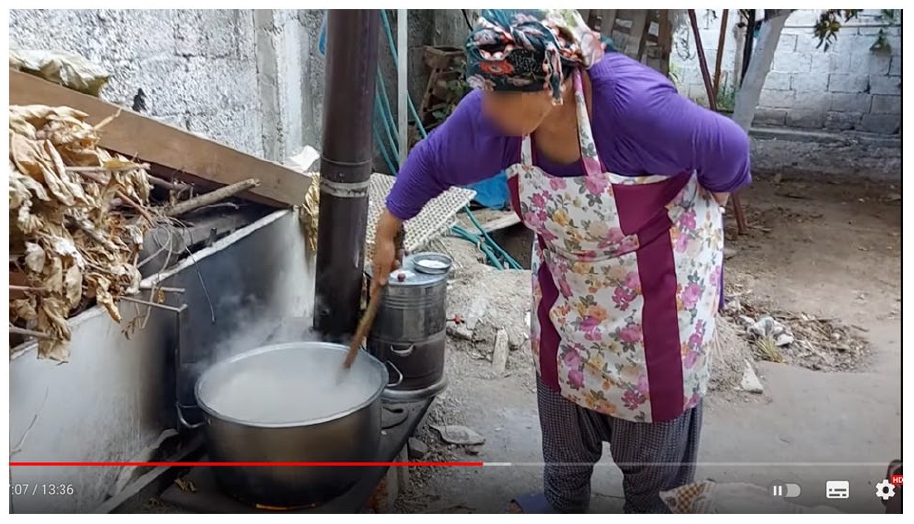
Believing that reciting the prayer Ettehiyyâtü gives abundance in food, Mualla cooked “aşure” [ashura] while referring to the prayer and Prophet Noah’s story, which is written in the Quran and the Bible (Fieldhouse, 2017, pp. 41–43).
Making use of prayer in various ways during cooking in their videos, the vloggers cultivate their piety. For example, Mualla believes praying before starting to prepare food renders the food more delicious. While she is leavening any food, she declares “This hand is not mine: it is Mother Fatima’s!” (in reference to the first daughter of the Prophet Mohammad). Because Fatima’s hands are believed to be blessed with healing and purifying properties (Durbilmez, 2013), Muslim women pray to replace their own hands with those of the daughter of Mohammed. Lale also opens her recordings by saying As-salamu alaykum (“Peace be upon you”) and recites Bismillah (“in the name of Allah”) with her rural accent before cooking in the belief that food will become abundant. When she first started vlogging, however, Lale says she hesitated to utter these blessings publicly and did so only quietly. She later tried reciting Bismillah aloud in her videos and continued to do so when she found that people liked it. For Nergis, who also starts her recipes by reciting Bismillah, trusting in God, having hope, and praying are the most important things. Once Nergis uploaded a video cooking a soup called Telbine, which is known as a “sunnah”—the practice of the Prophet Muhammad (sunnah) for curing sick people (Tuncay, 2019, p. 117). After posting the video of the healing soup, she was contacted by one of her followers who was an elderly religious woman. Since she felt a connection to Nergis, the woman wanted to visit and in fact stayed at Nergis’ home for two days.
In general, all the vloggers declare their gratitude to Allah in their videos and wish His grace and blessing to their audience. Furthermore, because most of them believe that praying can provide an abundance of food—seen as the sign of God—they express eagerness for a good result from their cooking by invoking God’s will through the use of the term Inshallah. However, numerous debates also arise in the comments with viewers questioning whether the vloggers exploit religion to get more followers. These arguments in the comment section show that long-standing discussions around “başörtüsü”/the headscarf, religious norms, and societal values in Turkey (Gökariksel & Secor, 2010) continue today in the online sphere.
As they exercise their agency by sharing content on YouTube (Pahwa, 2019), the women vloggers also elicit many questions about their physical selves including their profile photos, hands, and voices, and about the accessories and decorations that appear in the videos (which may imply religious or ethnic belonging). Through the videos, their age, marital status, beliefs, and lifestyles are subject to be interpreted. In Figure 6, for example, Merve holds a tray: in addition to her young-sounding voice, her visible bracelet might lead the audience to an interpretation that she is young. As a way of self-monitoring and managing their impressions, my participants sometimes delete and block content they have previously shared if it has attracted inappropriate and prurient messages. This careful editing is in addition to their efforts not to post any content that might cause offense or provoke erotism, going so far as to not post photographs of carved cucumbers or stuffed meatballs (which could be interpreted as suggestive).

Merve cooks her mother’s cake recipe.
In relation to the choice of the dish being prepared and the manner of expression, religious discussions often surface in the comments. This again reflects the importance of religious rituals and the meaning of repeated acts in reproducing social norms (Mahmood, 2005, pp. 161–166). For instance, Hacer reported having been sarcastically asked whether she was Christian rather than Muslim when she cooked turkey during the Christmas period. However, she expressed that she focuses only on talking knowledgeably about food in her videos without religious connotations. In particular, she expressed the impact that YouTube had made on her: After YouTube, when I passed 100 thousand subscribers, I learnt not to wait for approval from anyone. I’m already successful, and I’m doing it well. I got more self-confidence. I’m not passive towards people anymore, not the person who is constantly waiting for approval, but the person who has already received approval. Whether you like it or not, I’m quite in this mood, no lie.
Therefore, when a man “keyboard warrior”—to use her term—accused Hacer of being “arrogant” on account of her assertive answers, adding that Allah does not approve of such behavior, she responded with a flower emoji and wrote that she had never been an arrogant person in her life. She asked him how he reached that opinion, but the question went unanswered.
Overall, although the recognition gained for their labor through vlogging has increased their confidence and determination to attain economic independence, in their self-branding effort, the women do not aspire to display their femininity through the “can-do” model of womanhood that prevails in white postfeminist discourse in the contemporary neoliberal era (Banet-Weiser & Arzumanova, 2013). Instead, they develop and control their self-branding activities, adjusting their behavior through modesty and piety in accordance with the social and cultural norms of the society they inhabit, which have remained in constant negotiation online in connection with the current sociopolitical context of Turkey.
Conclusion
My research on Turkish Muslim housewives in this paper shows the importance of social positionality in the different ways people make use of the Internet (Gajjala, 2014). Rather than using their femininity to create mediated intimacy, articulating postfeminist arguments, and fostering consumerism through individualistic motives, as in the prevailing critique of women’s self-branding activities on social media (Duffy & Hund, 2015), the Turkish Muslim vloggers I interviewed chose instead to adhere to their sociocultural values of modesty and piety in their own self-branding activities online. Thus, we see how cultural authenticity can operate as a means to self-realization for vloggers in observing the cases of Turkish women from less privileged backgrounds whose cultural capital derives from both their cooking and their piety. This counters the idea that personal branding online requires a separation of the self from cultural norms.
Social positionality also influences the ways in which people engage in the so-called attention economy. As they have diverse positioning in terms of education level, age, marital status, financial backing, support networks, level of modesty and piety, and residence location, each person’s ways of self-branding have been shaped according to those circumstances. Although the vloggers in my study acknowledged that greater visibility on their part could make their channels more popular, they prefer not to show themselves immediately, or at least until they have reached a certain number of followers to bolster self-confidence. In their view, their invisibility in videos does not negate their agency since they can convey their sociocultural values through their online sharing. Indeed, their practices evidence a capacity to negotiate and resist the visibility typically imposed by platform capitalism. Furthermore, beyond the recognition of their labor by others, the more that these women engage in social and cultural exchanges in the participatory environment of social media, the more the sociocultural norms they adopt may change. 5 This shows that the online transmission of social and cultural values, which are constantly in flux, has changed as the Internet has become embedded and embodied in everyday life (Hine, 2015).
Footnotes
Appendix
Information about the vloggers’ YouTube channels.

| Channels | Subscribers | Start date | Views | Videos (with over 1 million views) |
|---|---|---|---|---|
| Tenzile Elmas Kaya | 919 K | 2014 | 187 M | 43 |
| Yummy virtual foods | 517 K | 2017 | 85 M | 28 |
| Domestic delicacies | 387 K | 2016 | 89 M | 23 |
| Local life | 183 K | 2018 | 28 M | 1 |
| Master hands | 163 K | 2017 | 29 M | 5 |
| Keep desire | 126 K | 2018 | 27 M | 6 |
| From Nazan’s hands | 15.8 K | 2020 | 1.7 M | 1 |
| Hasibe’s kitchen | 5.7 K | 2019 | 576 K | – |
| Merve’s recipes | 2.5 K | 2019 | 578 K | – |
| Delicious cuisine world | 1.28 K | 2020 | 58 K | – |
| Recipes of the buddies | 1.12 K | 2020 | 41 K | – |
Acknowledgements
Besides my research participants sharing their life stories with me, I am grateful for the assistance of Ana Alacovska, Claudia Eger, Deniz Duru, Nanna Bonde Thylstrup, Robin Steedman and Zizi Papacharissi plus the support and suggestions of TechSoc Cluster members at the Department of Management, Society, and Communication at Copenhagen Business School. I also want to thank the anonymous reviewers for their constructive and helpful feedback.
Declaration of Conflicting Interests
The author(s) declared no potential conflicts of interest with respect to the research, authorship, and/or publication of this article.
Funding
The author(s) disclosed receipt of the following financial support for the research, authorship, and/or publication of this article: This research was funded through a stipend provided by the Department of Management, Communication and Society at Copenhagen Business School.
