



Abstract
This mixed-methods study examines social media use among public mass shooters in the United States as an extension of a comprehensive database of 170 mass shooters from 1966 to 2021. Here, we report findings from a systematic content analysis of public data and detailed timelines that were constructed for 44 mass shooters’ social media habits and changes to those habits during the period of time leading up to their shooting. The paper also presents as a case study, a sentiment analysis, and term-linkage network for one perpetrator’s total 3,000 tweets. Several themes were found in the data—there were shooters who changed their posting habits and in some cases, stopped using social media entirely in the lead up to their crime; shooters who used hate speech and were “radicalized” to violence online; shooters with a demonstrable interest in violence, who referenced past mass shooters in their own communications; shooters who exhibited signs of mental illness and suicidality; shooters who were already known to authorities; and shooters who like those described above, actively posted while shooting, presumably to boost their own celebrity status. The findings from this study provide insight into commonalities among mass shooters in terms of their social media usage, which could lead to new pathways for prevention and intervention.
During Friday Prayer on 15 March 2019, two consecutive mass shootings occurred at mosques in Christchurch, New Zealand. A gunman killed 51 people and injured 40 more in an attack that he live-streamed on Facebook from a head-mounted camera. In the highly disturbing video, the gunman drives to the first mosque, walks inside, and shoots multiple people before leaving the scene in his car and narrating his journey to the next mosque. The video was taken down within 20 min by Facebook, but anything posted online leaves a digital fingerprint, so versions of it stayed live (Peterson & Densley, 2021b). Within 24 hr, Facebook banned 1.5 million versions of the video footage—1.2 million of which the company stopped from being uploaded at all (Peterson & Densley, 2021b). However, one copy of the video lingered on its platform for 6 hr, and another on YouTube for 3 hr. The quick and seemingly unstoppable spread of this video typifies how social media has changed mass public shootings: they can be watched unedited and go viral.
In addition to live-streaming their attacks, mass shooters in recent years have posted online while perpetrating them. The perpetrator of the 2018 mass shooting at the Borderline Bar and Grill in Thousand Oaks, California, which killed 11, checked his phone and made two posts to social media during the incident (Ventura County Sheriff’s Office, 2021). During the 2017 attacks at Pulse, a nightclub in Orlando, Florida, which killed 49, the shooter checked Facebook and Twitter to make sure his massacre was going viral (Peterson & Densley, 2021b). In addition, having already stabbed his two housemates and another man to death, the 2014 shooter in Isla Vista near UC Santa Barbara, filmed himself from behind the wheel of his BMW and uploaded to YouTube his intent to exact “retribution” on a world he believed had wronged him (Garvey, 2014). The video spawned copycats and in parts of the internet, the shooter is worshiped as a hero.
Mass shooters have also posted on social media before their attacks. In 2015, 5 days after a gunman shot and killed two television journalists in Virginia and posted footage of the shootings on Facebook and Twitter, the man who went on to shoot and kill nine people at an Oregon Community College posted the following message to his personal blog (as cited in Peterson & Densley, 2021b): On an interesting note, I have noticed that so many people like him are all alone and unknown, yet when they spill a little blood, the whole world knows who they are. A man who was known by no one, is now known by everyone. His face splashed across every screen, his name across the lips of every person on the planet, all in the course of one day. Seems the more people you kill, the more your’re [sic] in the limelight. (p. 111)
The message is chilling in hindsight, in part because after his own attack, the Oregon shooter’s social media profiles started to go viral, especially a photo of him posing with a rifle on his MySpace page.
Prior research has found that communication of intent to do harm is common among mass shooters (Peterson & Densley, 2021a) and in the age of social media such “leakage” (Meloy & O’Toole, 2011) can occur via online social networks. There is debate about whether mass shooters post online owing to some sort of narcissistic thrill- or fame-seeking imperative (Bushman, 2018; Silva & Greene-Colozzi, 2019), or as a “cry for help” with their underlying social and psychological problems (Peterson & Densley, 2021b). There is no question mass shootings attract attention (Lankford, 2016; Schildkraut et al., 2018); platforms such as Facebook, Instagram, and YouTube incentivize public displays generally, and in some cases, posting online may be integral to the mass shooting itself—a form of “performance crime” (Surette, 2015). At the same time, prospective mass shooters may use online social networks innocuously for the same reasons most people use online social networks—to keep in touch with others, read news, or pass time.
This mixed-methods study examines social media use among public mass shooters in the United States as an extension of a comprehensive database of 170 mass shooters from 1966 to 2021 (see Peterson & Densley, 2021a). Here, we report findings from a systematic content analysis of public data and detailed timelines that were constructed for 44 mass shooters’ social media habits and changes to those habits during the period of time leading up to their shooting. The paper also presents as a case study, a sentiment analysis, and term-linkage networking for one perpetrator’s total 3,000 tweets. Several themes were found in the data—there were shooters who changed their posting habits and in some cases, stopped using social media entirely in the lead up to their crime; shooters who used hate speech and were “radicalized” to violence online; shooters with a demonstrable interest in violence, who referenced past mass shooters in their own communications; shooters who exhibited signs of mental illness and suicidality; shooters who were already known to authorities; and shooters who like those described above, actively posted while shooting, presumably to boost their own celebrity status. The findings from this study provide insight into commonalities among mass shooters in terms of their social media usage, which could lead to new pathways for prevention and intervention.
Mass Shootings and Social Media
Mass shootings are a statistically rare and “extreme” form of homicide (Fox et al., 2018). There is no universally accepted definition of a mass shooting (see Huff-Corzine & Corzine, 2020), but the term is most commonly used to reference the “mass killing” of four or more people—not including the perpetrator—by the same offender(s), perpetrated with a firearm (vs other means), in public (vs in a private, domestic, setting) and outside of the realm of gangs or organized crime (Krouse & Richardson, 2015). The United States now averages about six of these events every year (Peterson & Densley, 2021a).
Evidence suggests mass public shootings are getting more frequent and more deadly (Peterson & Densley, 2021a; Duwe, 2020; Lankford & Silver, 2020) and these trends may be correlated with the rise of the internet and social media. The 1999 mass shooting at Columbine High School in Colorado was the “first mass shooting of the internet age” and after the shootings, “a fandom for the shooters emerged on a fledgling internet, and it has only grown in the decades since” (Peterson & Densley, 2021b, p. 98). There are “Columbiners” who cosplay the shooters for Halloween, posting memes, fan art, and fan fiction about their crimes (Raitanen & Oksanen, 2018). Many divulge Columbine fantasies online, but never carry them out; however, some do. Columbine has become the “blueprint” for many mass shooters (Peterson & Densley, 2021b, p. 98), in part because the original shooters left behind legacy tokens of their act—multiple and detailed diaries filled with drawings, personal reflections, poems, violent rants, and kill lists, and “basement tapes” of their preparations for others to consume (Langman, 2009).
Prior research has examined how the general public interacts with mass shootings on social media, typically through the lens of collective trauma (ElSherief et al., 2021; Thompson et al., 2019), but not necessarily how mass shooters themselves interact with social media. Studies show that smartphones and social media have changed other offenders’ “criminal and routine activities” (Pyrooz et al., 2015), creating a “hybridized” pattern of offending (Lusthaus & Varese, 2021; Roks et al., 2020). Studies have also documented copycat tendencies (Langman, 2018) and generalized imitation (Meindl & Ivy, 2018) among mass shooters, with both mainstream media (Fox et al., 2021; Towers et al., 2015) and social media (Garcia-Bernardo et al., 2018) as vehicles for mass shooting contagion.
Lankford and Silver (2020) argue that the rise of celebrity culture in the age of social media has led to more mass public shooters who are motivated to kill large numbers of victims for fame or attention; and to more shooters who have been directly influenced by past mass shooters (Lankford, 2016). Case studies show mass shooters share a common interest in violent media (Rocque, 2012) and previous studies have found that some mass shooters were radicalized online (Holt et al., 2019).
There is now a fairly large and robust literature on online radicalization to violent extremism (e.g., Densley, 2021; Klausen et al., 2020; Peterson & Densley, 2017), including how “filter bubbles” (i.e., the algorithmic architecture of online social networks; O’Callaghan et al., 2015; Pariser, 2011) and “echo chambers” (i.e., ideologically circular online social networks; O’Hara & Stevens, 2015; Sageman, 2008) influence the priority, frequency, duration, and intensity of “differential associations” online (Pauwels & Schils, 2016). Exposure to violent media is a significant risk factor to cognitive radicalization (Wolfowicz et al., 2020) and research finds social media use may normalize behaviors or attitudes ordinarily deemed unacceptable (Alfano et al., 2018; Eckberg et al., 2018), thus inciting people to violent action.
When contemplating or even planning their crimes, many mass shooters “leak” or make public declarations of their intent (Peterson et al., 2021). Less than 6 months before 17 people were fatally shot at a high school in Parkland, Florida, for example, the shooter posted a comment to a YouTube video that read, “Im [sic] going to be a professional school shooter.” The shooter also proudly proclaimed he would become “the next school shooter,” in cell phone videos he made of himself just before the attack. It would be easy to dismiss such expressions as examples of teenage hyperbole or fairly common online rhetoric—only with hindsight are they read as serious indicators of violent intent (Schildkraut et al., 2022). However, research has shown that the words people use can be used as indicators of their underlying psychological state (Tausczik & Pennebaker, 2010), and social media posts have been used to diagnose individual personalities (Azucar et al., 2018; Park et al., 2015), personal beliefs, opinions, and values (Kakar et al., 2021), even mental illness (Edwards & Holtzman, 2017).
A survey study of adolescents in Finland found that youth who threatened a mass shooting online were different than those who threatened a mass shooting in person—they planned more and had risker intentions, they were also more likely to be bullied and suffered from depression (Lindberg et al., 2012). The mental health of mass shooters is extensively scrutinized (see Peterson et al., 2022) and pathway, fixation, identification, novel aggression, energy burst, leakage, and directly communicated threats are all warning behaviors that can signal a threat of violence (see Meloy et al., 2021). However, these warning signs have not yet been examined in the context of mass shooters’ social media activity. In the closest studies to date, Kupper and Meloy (2021) analyzed the written and spoken manifestos of 30 targeted violence offenders to test the utility of a behavior-based threat assessment instrument, the Terrorist Radicalization Assessment Protocol (TRAP-18), and Collins and Clark (2021) examined the words of an “incel” (involuntary celibate) killer using the same instrument.
The Current Study
The current study aims to systematically examine mass shooters’ relationship with online social networks to identify the themes, patterns, and commonalities among mass shooters’ social media content in the days, weeks, and months leading up to their crimes. Based on themes from prior research into social media use among mass shooters, this exploratory study specifically examines radicalization on social media, fascination with violence, posting about past mass shooting perpetrators, mental health, specifically depression and suicidality, changes in social media use prior to the mass shooting, and using social media to increase notoriety.
How mass shooters use social media and the role of social media in mass shootings are emerging areas of research that could influence the practice of violence prevention and intervention. As discussed, prior studies have found that mass shooting perpetrators may imitate past mass shooters or be inspired by them, and mass shooters often telegraph violent intent in advance, especially online. Social media may also play a facilitating or enhancing role in mass shooters’ radicalization and mobilization to violence (Peterson & Densley, 2017). There is an entire industry of social media monitoring companies using algorithms to analyze social media posts for threats of violence (Byars et al., 2020) and the findings of this mixed-methods study begin to lay the groundwork to help us understand some of the common factors in social media usage among mass shooters. This content analysis is one of the first in-depth studies of the public social media posts of all mass shooting perpetrators who used social media. Sentiment analysis and term-linkage networking were performed on one perpetrator’s extensive Twitter profile in an effort to highlight new directions for empirical mass shooting research.
Method
This study was approved by the Institutional Review Board at _______ Hamline University and extends one of the largest and most comprehensive databases of mass shootings in the United States. Built from August 2017 to December 2021 using public records and open-source data with funding from the National Institute of Justice, The Violence Project Mass Shooter Database (Peterson & Densley, 2021a) includes every multiple homicide incident in which four or more victims are murdered with firearms—not including the offender(s)—within one event, and at least some of the murders occurred in a public location or locations in close geographical proximity (e.g., a workplace, school, restaurant, or other public settings), and the murders are not attributable to any other underlying criminal activity or commonplace circumstance (armed robbery, criminal competition, insurance fraud, argument, or romantic triangle) from 1966 to 2021. (Krouse & Richardson, 2015, p. 10)
The 170 perpetrators of the 168 mass public shootings in the database are coded on 166 independent variables, constructed from open-source data. This includes first-person accounts, such as the perpetrators’ diaries, manifestos, suicide notes, social media posts, audio and video recordings, interview transcripts, and personal correspondence. Secondary sources such as existing mass shooter databases, media coverage, documentary films and podcasts, biographies, monographs and academic journal articles, court transcripts, federal, state, and local law enforcement records, medical records, school records, and autopsy reports were also consulted. The full database and detailed methodology and codebook are publicly available at www.theviolenceproject.org.
AOL Instant Messenger was released in 1997. Yahoo! and MSN Messenger followed in 1999. Friendster launched in 2002; MySpace, LinkedIn, and 4chan in 2003; Facebook in 2004; Reddit and YouTube in 2005; Twitter in 2006; Instagram in 2010; Snapchat in 2011; Tinder in 2012; Gab and 8kun in 2016; TikTok in 2017; and Parler in 2018. There were 107 mass shooters in total in The Violence Project Mass Shooter Database between 1999 and 2021, and 44 (41%) of them were known to be active on online social networking sites in the days, weeks, months, or years leading up to their attacks (Table 1). These 44 perpetrators are the focus of the current study. In support of “No Notoriety” and concerns about fame-seeking copycat shooters (see Lankford & Madfis, 2017), we do not name them in this article and instead refer to each mass shooter by the date and location of their shooting.
Social Media Used by Perpetrators of Public Mass Shootings 1999–2021.
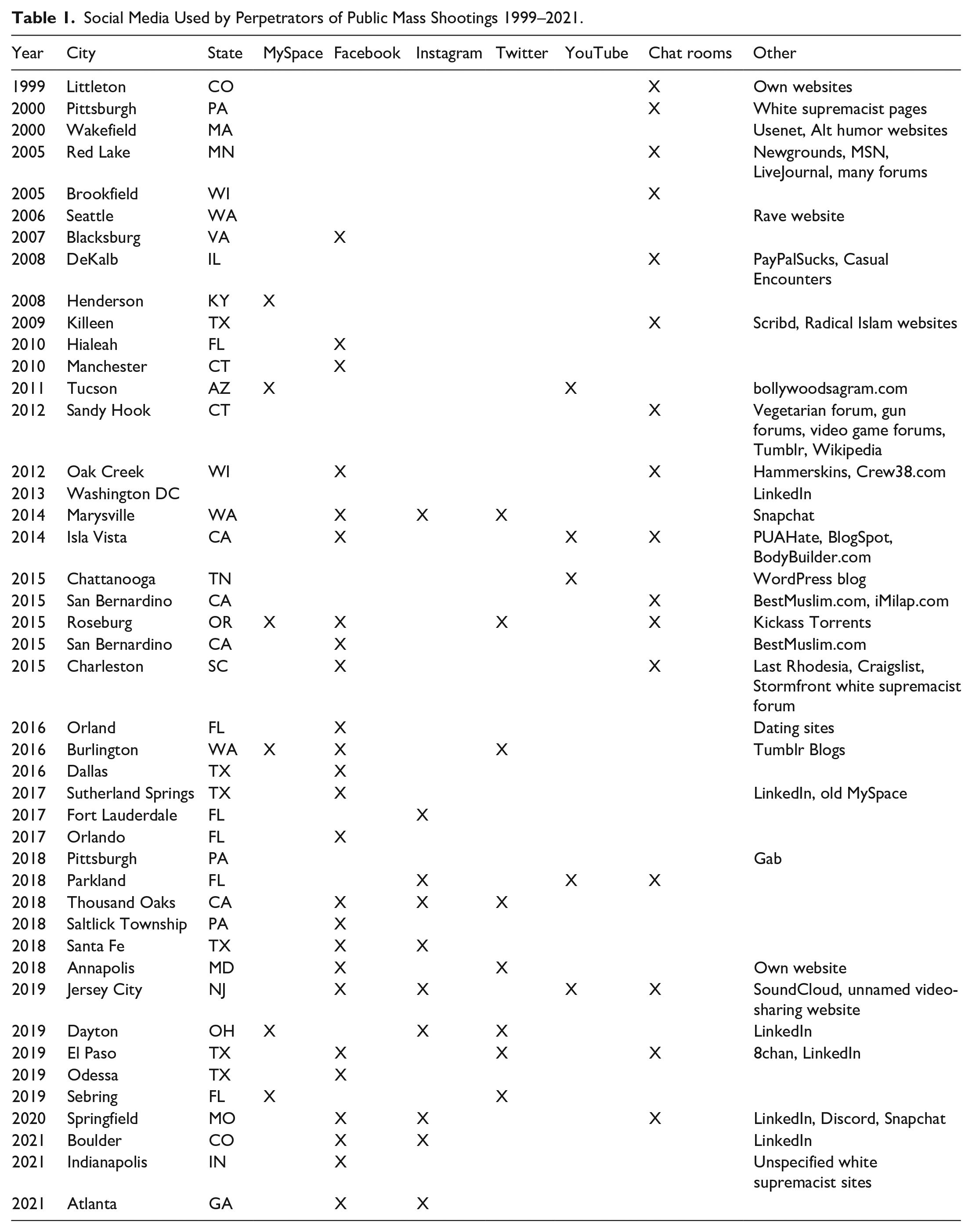
The authorship team scraped the internet for any and all information about the nature and extent of the 44 mass shooters’ online social network use. The team purchased subscriptions to newspapers.com, the archives of leading national papers, plus the local newspaper of record in proximity to each shooting. We also searched published research, law enforcement records, court transcripts, and in some cases, full archives, screengrabs, and transcripts of social media accounts and activity. Every possible step was taken to locate, verify, and fact-check the data. Of the 44 cases with available data, 14 perpetrators were determined to use social media very little or to use social media innocuously, or to have very limited data available for analysis. For the remaining 30 cases, a detailed timeline was created of all known online social network activity and social media posts, including emojis, hashtags, and people tagged in each post.
The study then followed the commonly recognized approach of manual thematic analysis (Miles et al., 2014). First, inductive open and axial coding was used to identify the most salient themes and categories in the data about behaviors (e.g., violence), cultural ideas (e.g., white supremacy), and general topics (Bryman, 2016; Strauss & Corbin, 1990). Three of the study authors completed the initial coding individually and then compared emerging themes with each other. We then all engaged in a directed content analysis phase, where emerging but overarching themes were interpreted in light of the existing literature on mass shooters (Hsieh & Shannon, 2005). Following MacDonald et al. (2019), this interpretive process did not lend itself to standardized reliability measures; instead, it involved a constant moving back and forward between the entire dataset and the coded extracts of data and the analysis of that data (see Braun & Clarke, 2006). The findings are organized below in accordance with emerged themes.
Data Structuring and Natural Language Processing
Twitter data have been used for a wide range of analyses, including but not limited to healthcare, retail marketing, stock trading, education, and politics (Rahman et al., 2021). One mass shooting perpetrator in the sample had 3,000 tweets from the 5 months preceding their shooting publicly available for a more in-depth analysis. The analytical methodology was centered around an open-source philosophy for flexibility in application, transparency, and a no-cost start-to-finish solution for other investigators. R (R Core Team, 2022) via RStudio (RStudio Team, 2022) was used for the project because it is open-source and contains a host of functions for reading, visualizing, and analyzing textual data (Welbers et al., 2017).
The raw tweet data were unstructured; therefore, they were imported into R and structured according to Natural Language Processing (NLP) standards. The processed structured data included the tweet body and associated metadata: the date, source link, retweet status, tagged users, and external directed links. Once structured, the tweets were manually tokenized and cleaned using methods and functions of the “tm” (Feinerer & Hornik, 2020; Feinerer et al., 2008) and “NLP” (Hornik, 2020) packages in R. Each tweet string was split into words, punctuation was removed, the case was normalized, stop words (e.g., “a,” “is,” “the”) were removed, words were stemmed (i.e., reduced to respective base), and excess whitespace was removed. Finally, the data were compiled into a corpus, a collection of documents (tweets) containing natural language text, for analysis.
Twitter Data Analytics
Tweet examination began with a time series analysis. Daily totals of tweets and interactions were compiled to measure whether social media usage by a perpetrator changed in the time leading up to or planning the incident. The resultant frequency time series can also be compared to the known timeline of actions by the perpetrator.
Next, a term-document matrix was created from the corpus. A term-document matrix is a mathematical matrix that describes the frequency of terms that occur in the corpus where the rows correspond to unique terms and the columns correspond to the document (tweet). The term-document matrix was then used to assess word frequency to reflect how important a word is to a document in a collection or corpus and develop term association linkage networks.
Finally, text-based sentiment analysis was performed on the corpus using two different approaches integrated into the “Syuzhet” package (Jockers, 2020). The package provides four sentiment dictionaries with crowdsourced lexicons developed by the National Resource Council Canada and a method for robust, but computationally expensive, sentiment extraction, and analysis (Jockers, 2020). The first approach treated tweets as separate sentences and measures their sentiment ranging from positive to negative valence using a dictionary approach (Jockers, 2020). Essentially, each tweet is assigned a continuous score within a range from a minimum negative value (−4) to a maximum positive value (+4).
The second approach consisted of categorical classifications of tweets into the following sentiment classes: anger, anticipation, disgust, fear, joy, sadness, surprise, trust, negative, and positive. Both approaches for sentiment analysis rely on the lists of words and phrases with positive and negative connotations. The valence shifters (i.e., negators, amplifiers [intensifiers], de-amplifiers [downtoners], and adversative conjunctions) were considered because they affect the polarized words. The equation used by the “Syuzhet” package algorithm to assign value to the polarity of each sentence first uses a sentiment dictionary to tag and account for polarized words (Jockers, 2020). Robustness to polarized words was a primary reason for using the “Syuzhet” package algorithm.
Results
Table 1 shows the online social networks used by each mass shooting perpetrator in the study. Overall, 17 mass shooters were active on Facebook, 14 frequented online chat rooms, 7 posted on Instagram, 6 posted on Twitter, 5 used YouTube, and 3 updated MySpace. However, 10 of the 30 mass shooters perpetrated their crimes on K-12 school or college/university campuses, 4 targeted houses of worship, 4 were workplace shooters, and 12 attacked other locations, including retail establishments and restaurants.
The 44 mass shooting perpetrators active on social networking sites from 1999 to 2021 were different from the 63 mass shooters in the database not active on social networking sites in several ways (see Table 2). First, they were significantly younger with a mean age of 28 versus 38 years, which is perhaps unsurprising given that young adults were among the earliest social media adopters and continue to use these sites at high levels (see Pew Research Center, 2021). Perpetrators active on social media were more likely to show an active interest in firearms. They planned their attacks more and they also killed significantly more people on average. Perpetrators who used social media were also more likely to include a symbolic or performative aspect to their shooting, such as living behind a “manifesto” to be read or, indeed, live-streaming the violence. While this perhaps speaks to fame-seeking motivations, perpetrators active on social media were more likely to be suicidal and to be motivated by racism than their non-social media counterparts.
Comparing Perpetrators of Mass Shootings Who Did and Did Not Use Social Media From 1999 to 2021.

Seven primary themes were identified from the inductive coding and analysis of the social media timelines: (1) hate speech and radicalization; (2) fascination with violence; (3) posting about past mass shooting perpetrators; (4) depression and suicidality; (5) a marked change in posting behavior or stopped posting prior to the shooting entirety; (6) posting during the shooting to increase fame/notoriety; and (7) authorities being aware of concerning posts. Each theme was reviewed and defined, then the 44 timelines were organized beneath them, as follows.
Hate Speech and Radicalization
Eight perpetrators posted hate speech on social media, and their engagement with online social networks demonstrated a radicalization toward violent extremism. For example, the former immigration attorney who in 2000 conducted a racially motivated shooting spree in Pittsburgh, Pennsylvania created an account on the white supremacist website Stormfront less than 3 weeks before his shooting. His consumption of online content encouraging violence toward nonwhite people increased dramatically in the months before his shooting.
The 2014 Isla Vista shooter shared his views on the unfairness of life and his hatred of women primarily through YouTube videos but also on two sexist and misogynistic online forums (PUAHate and BodyBuilder). The 2017 Texas Church shooter was active on Facebook. In the months leading up to the attack, he added strangers and old friends to his network then started picking fights with them, frequently posting anti-Christian content. In 2015, he told someone on Messenger that he wished he had the nerve to do a mass shooting.
Similarly, the 2015 Charleston Church shooter had a Facebook account, an account on the white supremacist website Stormfront, and ran his own website, the Last Rhodesian, a reference to the former white supremacist state in Africa. The Last Rhodesian was created 2 months before the shooting. On the site, he posted a 2,500-word rant degrading Black people and glorifying slavery. He also posted photographs of himself posing with guns, the Rhodesian flag, the Confederate flag, and the number 1488, which has numerological significance for white supremacists. The shooter further messaged childhood friends on Facebook in the month before the shooting, trying to reconnect with them.
Just hours before he opened fire at Walmart, the 2019 El Paso shooter published a racist screed full of white supremacist talking points to the hate-filled online message board 8chan. The shooter then drove 11 hr to a border community from his hometown near Dallas, Texas to fire at shoppers inside the store. Most of the 23 people killed that day were Latinx and the shooter confessed he was targeting Mexicans in “response to the Hispanic invasion of Texas.” The word “invasion” was one that President Donald Trump had just used to describe migrants seeking entry to the United States from Mexico.
In the months before his crime, the 2018 Pittsburgh synagogue shooter was very active on Gab, a social networking service known for its far-right user base. Most of his posts referenced conspiracy theories, advocated for violence, and made anti-Semitic and anti-refugee claims. Immediately before he attacked a synagogue, he posted a message on Gab indicating that he was “going in.”
Fascination With Violence
Over half of the mass shooters coded showed interest in violence in their posts. For example, the 2005 Red Lake shooter participated in a number of online forums dedicated to discussing Nazism, sharing violent animations, writing zombie stories, and dissecting violent video games. In the year before the shooting, he was active for a few months on Nazi.org and a forum for conspiracy theories. He would frequently post to a forum or website for a few months and then stop using it without warning. His posts were often about violence, self-harm, suicide, and ideas of racial purity. He never threatened to commit a school shooting directly, but he did mention school shootings in his fiction and animations.
This pattern was common among younger K-12 school shooters in particular. The 2018 Parkland Shooter had at least four Instagram accounts, where he posted photos of himself with guns, participated in a racist group chat, said he wanted to kill people, and posted a photo of a mutilated frog he had killed. He shared photos of dead animals and videos of himself shooting animals on Snapchat, and pictures of cutting himself after a breakup.
The 2018 Santa Fe High School shooter used Facebook and Instagram. In the weeks before the shooting, he posted photos of guns, violent games, a shirt reading “Born to Kill,” and a trench coat with pins relating to violent regimes. One of the 1999 Columbine perpetrators had multiple AOL and WBS pages where he shared his desire to commit violence, vented about things he hated, and posted updates on the pipe bombs he built. He showed his anger and desire to hurt people, but did not share specific plans for murder or post any direct threats.
The 2011 perpetrator who shot U.S. Representative Gabrielle Giffords was active on MySpace and YouTube in the months before his attack. He was active on an online gaming forum but suddenly stopped posting 6 months before his attack and after he had shared his concerning and paranoid personal philosophies and other users encouraged him to get professional help. He posted disjointed videos on YouTube about conspiracies, one of which got him expelled from his community college. A month before the shooting, he said he was glad he did not kill himself and said he was ready to kill a cop, adding, “see you on national tv.” On the morning of the shooting, he posted a goodbye note saying the literacy rate is below 5% and telling people to plead the fifth.
Posting About Past Mass Shooting Perpetrators
Twelve perpetrators posted about other mass shooters on social media. For example, the 2019 Dayton shooter talked about the perpetrators of the 2017 Las Vegas and 2019 El Paso shootings. The 2019 El Paso shooter posted about the Christchurch, New Zealand shooting from 5 months prior, stating that the perpetrator’s manifesto “had the right message.” The 2015 Umpqua Community College shooter studied and posted about the Columbine and Virginia Tech shooters. The 2012 Sandy Hook Elementary shooter also posted about Columbine. The 2019 Jersey City shooter talked about the 2018 Borderline Bar shooting stating, Exactly . . . If those cops had not lived by the sword, they would not have died by the sword. They literally made their living by the sword. (Perpetrator) did not live by the sword, he was an entrepreneur but he saw an injustice that needed to be corrected, and he obeyed the commandments of TMH God.
Depression and Suicidality
Six of the perpetrators were identified as posting about depression or suicidality in the days, weeks, months, or years leading up to the shooting. For example, the 2019 Dayton shooter posted 3 months before the shooting: “Self-care is killing yourself so you don’t have to face life’s problems anymore.” A 2014 high school shooter posted a picture of his suicide note on Snapchat the day before his shooting, saying that he did not want to live anymore but needed to take his “ride-or-dies” with him. The 2011 perpetrator who shot Representative Gabrielle Giffords posted 4 months before the shooting on MySpace: “I thought about attempting suicide again . . . notice the again . . .” The 2017 Parkland High School shooter posted on Snapchat cutting his arms and saying he wanted to buy a gun the year before the shooting.
However, 4 months before he walked into a Bible study at Mother Emanuel African Methodist Episcopal Church in Charleston and shot and killed nine people, the 2015 shooter anonymously posted an ad on Craigslist that he was seeking a companion to join him on a tour of historic Charleston. “Jews, queers, or [N-word]” need not apply, he wrote. The tone of the ad troubled a retired child psychologist, Dr Thomas Hiers, who responded to the post and struck up a correspondence, hoping to help. In response to the continued racist and anti-Semitic comments, Dr Hiers even offered to pay the shooter to watch online TED Talks as a way of expanding his view of the world. The shooter politely declined. “I am in bed, so depressed I cannot get out of bed,” he wrote. “My life is wasted. I have no friends even though I am cool. I am going back to sleep.”
Stopped Posting Without Warning
Twelve perpetrators stopped posting in the 18 months leading up to the shooting, showing a marked change in their social media use. For example, the Parkland shooter, who was very active on social media, suddenly stopped posting a month before the shooting. The 2019 Jersey City shooter was active on YouTube, Instagram, Facebook, Soundcloud, and a video-sharing site. His last known comment was on YouTube 2 months before the attack in which he praised anti-Semitic attacks. The 2012 Sandy Hook Elementary School shooter posted frequently on internet forums and had Tumblr blogs named after school shooters, which he deleted a month before the shooting. The 2020 perpetrator who killed five people at a Missouri gas station was extremely active on Discord, where he played military simulation games and made Nazi references. He posted memes, inspirational quotes, and music on his Instagram. He was not on Discord (or any other site) at all in the week leading up to the shooting, and this absence was noted by his friends.
The 2018 Capital Gazette shooter used Twitter aggressively for years, but suddenly stopped about 18 months before the shooting. He used Twitter to threaten and berate people he viewed as enemies, especially the Capital Gazette newspaper. He posted on Twitter again right before the attack, saying “fuck you, leave me alone.”
Posted During the Shooting
Only three perpetrators posted on social media during the actual shooting. The 2018 Borderline Bar shooter posted on Instagram and Facebook twice during the shooting, speculating as to what people would say about him and admitting he had no real motive. One of the 2015 San Bernardino shooters pledged allegiance to the leader of the Islamic State in a Facebook post during the attack. Also, the 2016 Pulse nightclub shooter had multiple Facebook accounts, which he used during the shooting to see if the attack was trending. He also used one or more of these accounts to post allegiance to the Islamic State during the shooting.
Authorities Aware
Officials were made aware of the postings of five of the perpetrators examined in this study. The Federal Bureau of Investigation (FBI) was twice alerted to the alarming social media activity of the 2018 Parkland shooter: first, when he said he wanted to be a school shooter on YouTube; and second, when a friend was concerned the shooter would hurt people and gave police all of his Instagram account names. The local police were also told of a Snapchat or Instagram where the shooter threatened to shoot up a school. The FBI was also aware of the 2009 Fort Hood shooter, who posted a comment under his own name defending suicide bombers. He browsed radical Islamic forums and chat rooms. The FBI investigated him after seeing his blog and emails but determined that was not a threat.
The 2007 Virginia Tech shooter used his Facebook page to harass female classmates, which both campus police and the local police department were made aware of. A month before the 2014 Isla Vista shooting, the perpetrator’s mother contacted local police regarding her son’s concerning YouTube videos, prompting a welfare check. The 2017 Sutherland Springs Church shooter frequently posted anti-Christian messages. As far back as 2012, his military superiors were concerned by the things he posted on Facebook. In 2015, he told someone on Messenger that he wished he had the nerve to do a mass shooting. In 2016 and 2017, he threatened his old United States Air Force supervisor over Messenger.
Perpetrator Twitter Data Analytics
About 3,000 tweets from one perpetrator, across a 5-month period preceding the 2019 Dayton shooting, were examined in this study. 1 Summary characteristics and statistics from the constructed corpus of tweets are given in Table 3. Most notable is that the majority of activity by the user is actually interactions with other users.
Tweet Analytics Summary Data.

Time series were created to evaluate changes in social media usage leading up to the event. Given that a majority of social media usage (55.16%) was interaction with other users, time series were constructed for all usage and retweet frequencies. The time series for overall usage, retweets, and original content is provided in Figure 1. Observable in the time series data is a slight increase to a local maximum in original content generation by the user approximately 2 months prior to the incident. After this maximum, there is a decrease to a local minimum in all activity approximately 1 month before the incident. Following the local minimum, there is a steady increase in retweets leading up to the incident.

Daily time series of perpetrator tweet activity by overall usage (top left), retweets (top right), and original tweet content (bottom).
After the creation of a term-document matrix, it was possible to evaluate the word usage throughout the tweet archive. A bar plot of the most frequently used words is given in Figure 2. In these plots, there is little suggestion of a racial or political narrative, suggesting that these were not motivating factors. In addition, there is little evidence of a difference between the verbiage used in original content and retweets. The word frequencies are further exhibited through word clouds in Figure 3.

Word usage frequencies in the constructed term-document matrix by all content (left) and original content (right).

Word clouds constructed from the term-document matrix by (a) all content (left) and (b) original content (right).
Next, the most frequent words from the term-document matrix were plotted to visualize correlations between terms within the matrix, a further form of count-based evaluation methods in the text mining architecture of the “tm” R package. A network was created using terms that were correlated as occurring together. A plot of the term-document matrix which visualizes the correlations over 0.5 between frequent (co-occurring at least six times) terms is given in Figure 4 for both original and all content. Overall, there appear to be fewer and less connected terms in the original content. The network suggests there is potentially more diversity in the original content due to lower counts of used words.

Word association networks from the term-document matrix by all content (left) and original content (right). The linkages depict terms used concurrently in tweets. Term nodes that do not show links (“new” and “yeah”) are used with several of these terms yet lack a direct association.
Another important aspect of the content posted by the perpetrator is the sentiment of the tweets. The sentiment extraction and analysis were performed using the algorithm and lexicons developed by the National Research Council. The frequency of instances in which categorical sentiment classifications were recognized is provided in Figure 5. Most notable is that the highest sentiment associated with the tweet archive is “positive,” for both original and all content. The next highest sentiment detected is “negative.” This suggests that the individual was tweeting in a polarizing manner by simultaneously tweeting both highly positive and highly negative content. This is evident from the high frequencies observed of the terms “good” and “well” in Figure 2 in combination with the context of the tweets. For example, the tweet: “How can anyone see this as a good luck charm? We are an idiot species” illustrates an array of sentiment. In this case, the following sentiment scores were computed: anger—0, anticipation—2, disgust—1, fear—0, joy—2, sadness—0, surprise—2, trust—1, negative—1, positive—3. Most notable in this tweet are the scores for “joy” and “positive” while demonstrating both “disgust” and “negative” sentiments. This trend was observable throughout the tweets, as both “positive” and “negative” sentiments were of the highest frequencies throughout the archive.

Text-based sentiment analysis by National Resource Council sentiment type for all content (left) and original content (right).
In addition, tweet sentiment was evaluated by valence using a dictionary approach where each tweet was assigned a continuous score (−4 to +4). A sentiment score was calculated for each tweet and aggregated by day. Figure 6 provides a time series of the daily range of sentiment and the overall sentiment trend of the tweets. The analyses suggest that on average, tweets were characterized by neutral sentiment. However, there are instances throughout the time series where there are polarizing tweets with sentiment of high positive or negative valence. The daily sentiment score associated with original tweets is in general far more neutral than the overall content, suggesting that when the shooter was interacting with other users, he did so in a much more polarized manner. In addition, the daily sentiment score for all content shows numerous instances of highly negative sentiment (approaches −4) in the month leading up to the incident.

Time series with continuous score-based sentiment analysis for all content (left) and original content (right). Each plot illustrates the range of sentiment for a given day, trend, and weekly rolling average for sentiment extents.
This phenomenon was further evaluated using the sentimentr (Rinker, 2021) package in R to calculate text polarity within the sentiment valence. The sentiment attributes identified that approximately 12% of tweets were polarized, predominantly demonstrating a negator in about 16% of cases and an adversative conjunction in an additional 5% of tweets. A negator flips the sign of a polarized word (e.g., “I do not like it.”). Negators and adversative conjunctions can lead to the entire sentiment of a clause being reversed or overruled, which may lead to inappropriate modeling of the sentiment appropriately when co-occurring with polarized words, potentially changing, or even reversing and overruling the clause’s sentiment. This is likely why both “positive” and “negative” sentiment valence are occurring in such high rates for tweets ahead of the mass shooting incident.
In contrast, the average user demonstrates far less polarization across their social media interactions. The Sentiment140 (Go et al., 2009) general population tweet archive was used to model the sentiment of the average twitter user in contrast to the perpetrator examined. These tweets were classified using the same approach as the mass shooting perpetrator resulting in a mean numerical sentiment score of −0.009 across the 1.6 million miscellaneous tweets in the archive. Conversely, perpetrator tweets demonstrated a mean numerical sentiment score of 0.006. These results are somewhat surprising in that a mass shooter has a higher/more positive sentiment across their tweets that the general population. However, the main distinction is in the polarization. The sentiment attributes across average user tweets identified that approximately 6% of tweets were polarized, demonstrating a negator in about 2% of cases; far lower than the mass shooter tweets of 12% polarized and 16% negated.
Discussion
This study aimed to systematically examine mass shooters’ relationship with online social networks. The themes that emerged from the analysis of 44 mass shooters’ social media habits complement previous findings about warning signs and psychosocial life histories of mass shooters (e.g., Peterson & Densley, 2021b). Some mass shooters displayed a fascination with violence, even posting about previous mass shooters; others were radicalized online. Many changed their posting habits in the days and weeks leading up to their crimes and several mass shooters stopped posting suddenly and entirely. This is consistent with the finding that mass shooters show a marked change in behavior in the days and weeks leading up to the shooting (Peterson & Densley, 2021a). Other perpetrators posted during the shooting, furthering findings from previous research on fame-seeking among mass shooters (Lankford & Madfis, 2017). Several perpetrators were on the radar of authorities, owing to leakage of their plans or violent intent. Most perpetrators were struggling in life with depression and suicidality (Meindl & Ivy, 2018). Overall, these findings are consistent with previous studies demonstrating that online activity is rooted in real-world experience (Peterson & Densley, 2017). The online and offline lives of mass shooters are not mutually exclusive, but rather one and the same, with the same themes and warning signs emerging in both spaces. This has important implications for mass shooting prevention, intervention, and future research.
Implications for Prevention
In the wake of the 2019 mass shooting in El Paso, President Trump called on social media companies to “detect mass shooters before they strike” (Rom, 2019). The president wanted tech companies to develop new algorithmic tools for surfacing red flags that could enable authorities to act earlier to prevent mass casualties. The current study illustrates the challenges inherent in this task. Shifting through thousands of posts and decoding the words, images, and emojis people use to express themselves is time- and labor-intensive work. Any context or nuance can drastically alter the meaning of artifacts posted online, which means law enforcement will need support from “domain experts” who can help separate the signal from the noise (Frey et al., 2020).
The data show a large number of mass shooters posted some kind of indication of their thinking on the internet prior to shooting and some spelled out their violent intentions explicitly. However, threats or concerning posts on social media must be examined in context because only patterns over time, not the single posts in isolation, can capture changes in behavior from baseline. Beyond changes in posting habits, the findings indicate that expressions of combined suicidal and homicidal ideation may be of particular importance. While social media platforms will flag to law enforcement items, the suspect indicates a specific threat to self or others, there are no federal laws requiring them to alert authorities or to take any other action in response to violent content posted on their platforms. Instead, law enforcement relies on tips—someone saw a threat and contacted them about it. The public can and will only report if they know the process and trust in the response.
At the same time, the data show law enforcement has missed opportunities to prevent violence by not taking seriously past social media missives that promised violence. This is where behavioral threat assessment, a process designed to evaluate whether someone may engage in targeted gun violence, plays a role (National Threat Assessment Center, 2018). Threat assessment is a deductive process focused primarily on a person’s behavior and communications rather than on characteristics, and what they tell us about that person’s potential to do harm (Meloy & O’Toole, 2011). However, the findings of this study show that a narrow focus on “threats” alone is insufficient. Many mass shooters changed their social media habits in the lead up to their shooting and some of their posts were interpreted as a cry for help with underlying social and psychological problems. For example, most of the 2019 Dayton shooter’s 3,000 tweets were retweets (80%) in which he tagged more than 1,600 different users (96% of tweets), clearly trying to connect with anyone who would listen to him. In contrast, a recent study (Mention Solutions Inc, 2018) reported that only 32% of tweets tag another user. Furthermore, the tweets demonstrated a higher amount of polarized language than the general population. In addition, the frequency of retweets undergoes a changepoint prior to the commission of the incident. Garimella and West (2021) found that the frequency of retweets of a user tends to decay over time. This is observed until approximately a month prior to the incident where a local minima and an increase in interactions takes place. This context and theme become important for authorities assessing the risk of potential violence.
Also important is addressing the online radicalization process to prevent individuals from reaching the point of considering mass violence. Social media platforms profit from a form of confirmation bias—the natural human tendency to seek, “like,” and share new information in accordance with preexisting beliefs (Modgil et al., 2021). This creates an echo-chamber where previously held beliefs get reinforced and bolstered in an individual’s mind. To tackle hate-motivated mass shootings, and prevent the radicalization process online, the findings of this study suggest that investments in cultural awareness, digital and media literacy, and countervailing messaging of tolerance and unity may be helpful.
Limitations
This study has several limitations. Most importantly, this analysis is limited to social media posts that are publicly available, and only 3,000 tweets from one perpetrator were examined in this exploratory study. Social media companies often remove profiles of perpetrators after public mass shootings, so the content of publicly available information is limited to screen grabs or leaked documents. To our knowledge, these data are the only archive available for usage. Public–private partnerships that make full social media profiles available to researchers for analysis are an important area for future research. This study uses the conservative definition of mass public shootings, but many factors influence the number of people killed in a public setting, including the aim of the shooter or the proximity to the nearest trauma center. A broader definition of “mass shooting” would allow for additional analysis of social media posts. In addition, the analysis of Twitter data (due to availability) does not represent the totality of the 2019 Dayton shooter’s online social network use. Any study using Twitter data exclusively may be unable to provide a comprehensive understanding of overall social media usage.
Furthermore, there are limitations in the tweets examined. The tweet archive did not allow for the visualization of media (e.g., images and videos) shared by the user. It is likely that tweets with high-text-based sentiment scores were in reference to negative content (e.g., other mass shootings). Next, sentiment analysis is often unable to pick up nuanced or ambiguous meanings (e.g., slang, misspellings, nuanced or ambiguous meanings, Twitter lexicon, inside references, current events, intention, mood) of the tweets which can give misleading information. This is primarily due to the most developed libraries for NLP being composed of standard and formal language. Finally, the results of a single perpetrator cannot be generalized to a population scale. However, the outlined methodology does provide a preliminary examination of social media usage by perpetrators of mass shootings.
Future Directions
Despite these limitations, this study has provided an important baseline for understanding social media use among mass shooters. The Twitter analysis case study demonstrates the type of in-depth analysis that could be conducted with full access to perpetrators’ social media profiles. Further research and data access is needed to conduct more detailed examinations of the full extent of social media use among mass shooters over time, including analysis of differences with comparison groups. Future research also needs to examine the rate of false-positives among social media users. We need more data to know how exclusive this social media behavior is to mass shooting perpetrators and how many users share the same behavioral pattern on social media without committing any crime. With states beginning to mandate threat assessment and the majority of threats of violence taking place online, understanding how to evaluate social media profiles and the context around concerning posts is a critical area of future research.
Supplemental Material
sj-pdf-1-sms-10.1177_20563051231155101 – Supplemental material for How Mass Public Shooters Use Social Media: Exploring Themes and Future Directions
Supplemental material, sj-pdf-1-sms-10.1177_20563051231155101 for How Mass Public Shooters Use Social Media: Exploring Themes and Future Directions by Jillian Peterson, James Densley, Jamie Spaulding and Stasia Higgins in Social Media + Society
Footnotes
Declaration of Conflicting Interests
The author(s) declared no potential conflicts of interest with respect to the research, authorship, and/or publication of this article.
Funding
The author(s) disclosed receipt of the following financial support for the research, authorship, and/or publication of this article: Research supported by the National Institute of Justice under Award No. 2018–75-CX-0023.

Supplemental material
Supplemental material for this article is available online.
Notes
Author Biographies
References
Supplementary Material
Please find the following supplemental material available below.
For Open Access articles published under a Creative Commons License, all supplemental material carries the same license as the article it is associated with.
For non-Open Access articles published, all supplemental material carries a non-exclusive license, and permission requests for re-use of supplemental material or any part of supplemental material shall be sent directly to the copyright owner as specified in the copyright notice associated with the article.
