



Abstract
Pictures of violence form an important element in today’s news media and political online discussions. Many of these images are uploaded by bystanders, that is, people without clear links to the events. In this article, we investigate publication intentions of bystanders when confronted with disparate violent scenes. Using a two-step approach of online survey and follow-up interviews, we illustrate how bystanders rationalize the possible publication of violence online along individualized and socialized rationales. The resulting framework offers a systematic view on conditions that shape publication and non-publication intentions. Overall, our study offers important contributions by linking individual and collective perspectives on online content production as well as a re-appreciation of bystanders that includes the possibility of non-publication as moral choice.
Introduction
As channels for quick, wide-spread, and cost-free dissemination of content, social media have become a powerful tool for citizens and social activists to voice their grievances, mobilize participation, and redress injustices (Bennett & Segerberg, 2011; Theocharis et al., 2015). Examples such as the Arab Spring (Alaimo, 2015) or the Black Lives Matter movement (Mundt et al., 2018) demonstrate the potential of social media to rally publics and impact political realities. An important element of online discourses about injustice are image materials (i.e., pictures or videos) that are shared through platforms such as Facebook, Twitter, YouTube, or Instagram. As Smit et al. (2017, p. 2) observe in the context of conflicts in Syria, “witnessing has increasingly become something one does with a camera (phone) in hand,” while Sasseen (2012) called the development a “crowd-sourced video revolution.” Despite some critique of social media protests as pure feel-good “slacktivism” (e.g., Kligler-Vilenchik & Thorson, 2016), online postings of violence have become an integral element of political action and interaction.
The question is what motivates or hinders individuals to consider posting pictures of violence online? Our article investigates this research question by integrating two relevant but separated literatures: the perspective of collective action frames, which focuses primarily on motivations for actions against state actors, and the perspective of bystander research, which aims to explain (in)action by individuals observing single acts of crime. Our study was motivated by the observation that considerable research has investigated motivations for content production in the context of collective protest movements (e.g., Khazraee & Novak, 2018; van Zomeren et al., 2008). Yet, in many cases, material is uploaded by unorganized actors, that is, people who are not associated with a specific movement or political cause. These individuals can be considered “bystanders” in the sense of someone “watching something that is happening but is not involved.” 1 The objective of this study is to understand (1) when and why bystanders consider the online publication of violence as (un)acceptable and (2) what role the context of the violent situation plays in increasing or decreasing bystanders’ publication intentions. We focus on publication intentions to obtain a window into the sense-making processes of individuals before a possible posting or non-posting decision. Especially, the latter remains an under-researched area. Our work combines collective and individual perspectives to create an integrated framework for online publication intentions. It explains how and why social media may become platforms for personal or political action by explaining the very first crucial step, namely, the reasons of individuals to make violence public or not.
Background
Social Media as Channel for Posting Violence
The usage of social media tends to be linked to motives of entertainment, information-seeking and information-sharing, emotional support, as well as the building or maintenance of personal and professional relationships (e.g., Lin & Chu, 2021). At the same time, depictions of violence are common, including extreme forms (Duncombe, 2020). In the first quarter of 2022, Facebook alone removed violent and graphic content 26.1 million times globally. 2 The most infamous cases are videos by extremist groups who employ gruesome depictions for intimidation and recruitment. In addition, violence also frequently appears on social media during conflicts, crises, or unrests, often on accounts of private individuals (e.g., Kharroub & Bas, 2015; Scott, 2019). Some platforms even generate systematic collections of violent acts, for instance, as visual evidence of perceived police injustice (e.g., r/policebrutality, “Auditing Britain” on YouTube). While the total amount of violent material on social media is unclear, these few examples illustrate the breadth in purposes and contexts in which depictions of violence can be found.
Leaving criminal actors aside, our interest is in understanding why bystanders may consider posting different situations of violence online. In our view, it is vital to understand the sense-making of bystanders, as it is often individual or unaffiliated actors who are the source of influential material on social media, and who drive and sustain online mobilization (e.g., Kharroub & Bas, 2015; LeFebvre & Armstrong, 2016).
Motivations for the Posting of Violence
Motivations for the posting of violent visual materials have received attention primarily in the context of collective protest movement. In the following, we shortly review discussions on this collective perspective based in the framework of action frames. As we will argue, this perspective is important but limited. We therefore also introduce bystander research as an individual-level perspective to add explanatory scope.
The Collective Perspective: Action Frames
The framework of collective action frames (Snow & Benford, 1988) offers a window into the processes by which social actors interpret situations and guide actions. The approach is relevant in the context of publication intentions for violent material as action frames are explicitly conceptualized as “action oriented sets of belief and meaning that inspire and legitimate activities” (Benford & Snow, 2000, p. 614). We refer to this perspective as collective, as action frames reference shared beliefs among actors, which should create mobilization (Benford & Snow, 2000).
In this line of reasoning, the motivation for posting violence on social media is linked with the assumption of a positive link between transparency and democracy (Castells, 2007; Heemsbergen, 2015) in the sense of participatory or citizen journalism (Andén-Papadopoulos, 2014; Borger et al., 2016) and sousveillance (Mann & Ferenbock, 2013). The idea is that by making publics aware of problematic behaviors by individuals or organizations, it should become possible to enforce accountability and exert pressure and control over wrongdoers. Visual material in this setting offers powerful diagnostic frames identifying what is wrong as well as motivational frames suggesting what needs to be done to redress perceived injustices (cp. Benford & Snow, 2000). Publication intentions according to this framework center around mobilization to action, enacting democratic control, and the redressing of injustices (Bennett & Segerberg, 2011; Theocharis et al., 2015).
The model of collective action frames has several gaps when aiming to explain bystanders’ publication intentions of violence. First, the framework is generic and can therefore not explain posting motivations for this specific type of material. Second, social media are used also to express personal grievances (e.g., Munar & Steen Jacobsen, 2014). Posting or non-posting as individual decision may be impacted by such personal motivations rather than perceptions of collective injustices. As Bennett and Segerberg (2012) argue, organizations with clear boundaries are increasingly replaced by “large-scale, fluid social networks,” in which digital media act as “organizing agents” (p. 752). Collective actions are thus replaced by connective actions based on personal action frames offering “different personal reasons for contesting a situation that needs to be changed” (Bennett & Segerberg, 2012, p. 744). The perspective of action frames does not explain why individuals may consider the step from observing to posting and crucially, can also not explain reluctance to make observed violence public. To understand the “personal reasons” to publicize observed violence online, we instead need to turn to frameworks on the individual level.
The Individual Perspective: Bystander Model
An established framework to investigate individuals’ decisions to act in a situation of observed violence is the bystander decision model (Latané & Darley, 1970). The bystander model is useful as it aims to explain why individuals may act or not act to singular incidents of violence. Its focus is on specific observations of violence, which contrasts and complements the collective framing discussed above. Since the seminal studies of the bystander effect by Darley and Latané (1968) considerable research has tried to understand why people who see violent behaviors either intervene to help victim(s) or choose to remain passive (e.g., Cramer et al., 1988; van Bommel et al., 2012). While interventions may be more frequent than often assumed (Philpot et al., 2020), not every observer will act. The original bystander decision model (Latané & Darley, 1970) proposes that for bystanders to intervene they must successfully accomplish a series of steps: (1) become aware of the situation, (2) recognize a need for help, (3) feel a personal responsibility, (4) believe they are able to help, and (5) consciously decide to intervene. The model thus not only proposes clear steps but also highlights the complexity of the process required before any decision to act.
The primary focus in bystander research is to understand why people “watch” instead of “act,” with the former often perceived as a moral failure. What the model does not consider is “active watching,” that is, a conscious decision to watch and report. In contrast to interventions as an immediate reaction to solve the situation at hand, “active watching” allows to fix and preserve the situation, and makes it possible to report, review, and reflect on the event (Rentschler, 2017). In this view, watching becomes a conscious act that—in contrast to walking away or passively observing—aims to contribute to a solution by fixing information and potentially collecting evidence. This is related to the increasing relevance of media witnessing in which events are made visible to distanced audiences through pictures or videos posted online (Frosh & Pinchevski, 2008). Many societal movements strategically employ bystander recordings of violence to drive political and social change (e.g., Neumayer & Rossi, 2018), while police and news media rely heavily on bystanders as eyewitnesses, regularly requesting materials through social media (Cullen, 2019; van de Velde et al., 2015).
Few studies have explicitly investigated bystander motivations for the online posting of violent materials. Some indications may be gained from the offline area about the motivations of bystanders to report a crime to police. These find that situational factors such as crime seriousness, the gender of victims, or the number of offenders (e.g., Galvin & Safer-Lichtenstein, 2018) play an important role affecting willingness to report. In an online context, Chang et al. (2018) investigated bystander decisions to react to distressed online posts, highlighting factors such as perceived seriousness of the content, the assumed motivation of the poster, and the own capacity to provide support. While not directly related to our context, these observations highlight that bystander motivations tend to be multi-faceted and situation specific.
Considering the two streams of literature, it is apparent that—while both aim to explain motivations for action—they clearly focus on disparate situations. The collective perspective concentrates on violence within broader social issues often in the context of state actors, while the individual perspective focuses on singular criminal acts. Critically, both do not provide guidance about motivations to not post. This raises two questions: whether sense-making across such disparate situations aligns, and what are rationales that lead to increased or decreased publication intentions? In the following, we outline our methodology to investigate our research questions, followed by a comprehensive presentation of results and their consolidation into a framework for online posting intentions. We end with a discussion of contributions, as well as pointers for future research.
Methods
Design
Our investigation used a mixed-method sequential design in two steps: In the first step, we administered a quantitative survey to investigate the link between the situational context in which violence is observed and publication intentions. In the second step, we interviewed participants from Step 1 to obtain a more detailed picture of personal motivations as well as barriers for the online publication of such material. The qualitative follow-up allowed us deeper insights and additional explanations for factors that shape publication intentions observed in the quantitative survey data. We thus used the qualitative data to explain and contextualize the quantitative findings employing an explanatory sequential design (Edmonds & Kennedy, 2017).
Sample
Survey participants were recruited through Facebook using snowball sampling. Facebook as recruitment channel was chosen for two reasons. First, we wanted participants to be familiar with posting online content to ensure that they were accustomed with the activity and were able to judge the impact of posting online. Facebook recruitment facilitated that the participants in our study had at least some online posting experience. Second, Facebook also has the benefit that its userbase covers a very wide range of demographic groups allowing access to a more diverse group compared to other widely used social media platforms. 3 In total, we received 156 reactions. Of these participants 53.8% were female, 46.2% were male. While the sample represents a considerable diversity in ages (M = 26.2 years, SD = 6.0, range: 19–54 years), it has to be noted that 75% of respondents were younger than 28 years, thus biasing the sample toward younger age groups and students (64%). The sample contained participants from multiple countries, the majority of which were from Germany (56.4%), followed by Greece (7.7%) and the Netherlands (6.4%). The remaining 29.5% were spread across 25 other countries. Most participants were consistent and frequent internet users with an average of 6.5 hrs per day spent online (SD = 5.0) and posting on average 10.2 pictures per week (SD = 16.0).
Data Collection and Analysis
Material for the Questionnaire
To test the effect of disparate contexts on online publication intentions, we varied two aspects: type of perpetrator (organizational actor versus citizen) and number of perpetrators (individual versus group) resulting in four scenarios. As examples of organizational violence, we used police aggression during a demonstration (group) and aggression by a security guard against a shoplifter (individual), while scenes for violence by co-citizens showed aggression by a female youth gang (group) and aggression of a co-worker against a colleague (individual). To avoid biasing effects due to the features of the victim (cp. Galvin & Safer-Lichtenstein, 2018), all victims in the scenes were individuals and female. The four scenarios were pre-tested to ensure that they were recognizable as either organizational or co-citizens and showed an equal level of aggression/emotional appeal. The four situations were shown as pictures to represent the visual materials our participants would publish online. Each participant saw all four scenarios (within-subject design), however in a randomized sequence to avoid systematic influences due to order-effects. The four scenarios are shown in Figure 1. Each scenario was shown on a separate page with questions about the scenario presented below the picture. In a second step, participants were asked to rank the scenarios according to the likelihood they would publish the picture online. The final part of the survey collected demographic information.
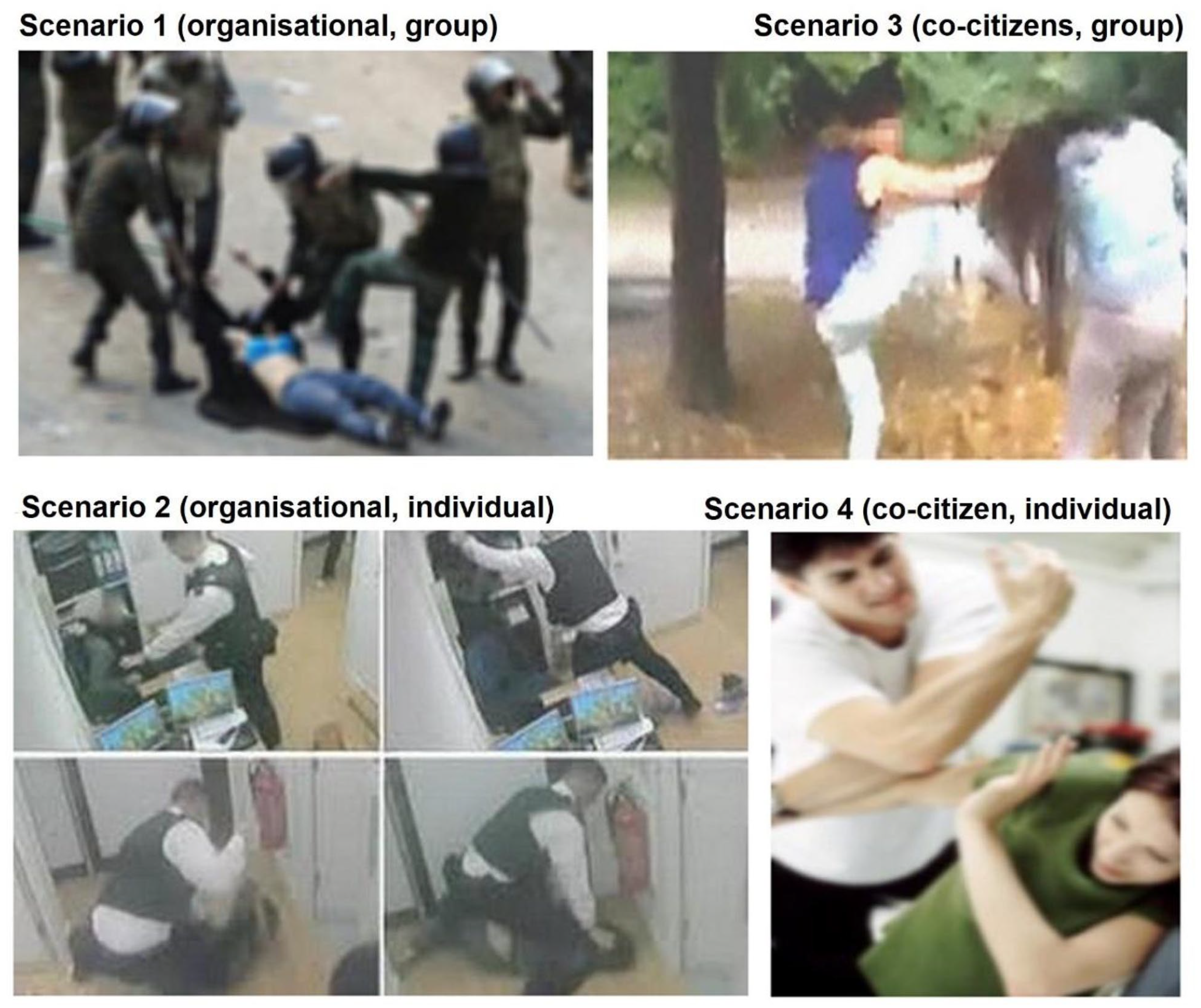
Scenarios used in the study.
Variables and Items
Behavioral intentions for posting violent material were measured using three items addressing the willingness to upload, share, and spread content with the shown behavior (e.g., “I intend to share such behavior when I see it,” α = .84–.90 across conditions, average: .87). Three further items measured acceptance of publication by others (e.g., “I think it is important that people make others aware of the depicted incident,” α = .73–.78, average: .76), while general attitudes toward online publication of violent content were assessed using five adjectives in form of a semantic differential (e.g., “harmful–beneficial,” “ethical–unethical,” α = .85–.90, average: .86). We further measured social norms with two items (e.g., “It is expected of me that I share this incident online,” α = .63–.75, average: .72). To control for the offensiveness of the behaviors, we also asked participants to evaluate the behavior with two items (“I perceive the behavior in the picture as offensive/problematic,” α = .76–.87, average: .80). All items were assessed on a 7-point scale. Except for the semantic differential, these were Likert-type scales from 1 = strongly disagree to 7 = strongly agree. To obtain an additional, direct measure of comparison across the four scenarios, we further asked participants to rank the four situations with respect to the likelihood they would share them (Rank 1 = most likely, Rank 4 = least likely). Demographics were captured in terms of gender, age in years, country of origin, and occupation. As control variables, we assessed number of hours online per day and number of photos uploaded per week.
Follow-Up Interviews
While the survey provides an overall understanding of factors that impact posting intentions, to answer our research questions, we also needed to understand the motivations and decision-making processes underlying the differences in posting intentions observed in the survey. At the end of the survey, we therefore asked whether the participant would be willing to take part in a follow-up interview. The follow-up interview had two purposes: first, to capture and better understand participants’ motivations for their answers in the survey, and second, to allow the emergence of additional boundary factors beyond the ones tested in our survey (i.e., type and number of actors). Forty people indicated their willingness to be interviewed. Of these, we selected 34 participants based on theoretical grounds, namely, whether the person showed very high or very low intentions of online publication. Half of the interviews were conducted in person, either face-to-face (eight interviews) or over Skype (nine interviews). For the other half, personal contact was not possible. In these cases, the interview questions were emailed, and answers received the same way (17 interviews). The sample consisted of 23 female and 11 male participants. Most of them came from Germany (13 interviewees), a majority of them were students (20 interviewees, in line with the full sample).
All participants were asked the same questions, except that during the personal interviews follow-up questions were allowed. The interview protocol contained six questions to capture attitudes and motivations toward the online publication of violent material (e.g., “What do you think about other people publicizing such scenes/events? Do you appreciate it? Why yes or no?”) and own experiences (e.g., “Please tell me about your own posting behavior. Have you done it already? What were your experiences? If not, would you do it?”). Recorded interviews were transcribed verbatim prior to analysis and all transcripts and written answers thematically coded by two of the authors.
Findings
Intentions of Publishing Violent Content Online: Survey Results
To test for the differences in acceptance and attitudes across the four scenarios, we conducted repeated measures analysis of variance (ANOVA tests for within-subject designs; NCSS, n.d.). The results showed that acceptance of online publication differed significantly across scenarios, F(3,465) = 11.93, p < .001. The highest acceptance emerged for the police scenario (M = 5.26, SD = 1.2) followed by the youth gang and colleague. The lowest acceptance was found for the security guard (M = 4.70, SD = 1.4; see Figure 2, top). Publication of the situation portraying police violence at a demonstration was thus more likely to be accepted than any of the others, although publication of the youth gang incident and violence at work was still more accepted than the scene with the security guard. This may also explain why a paired-sample t-test revealed no significant difference in acceptance for authorities compared to fellow citizens, 95% confidence interval [CI] = [−.084, .156], t(155) = .596, ns. On the other hand, acceptance of publication was significantly higher, if the scene depicted a group than an individual, 95% CI = [−.452, −.159], t(155) = –4.12, p < .001.

Attitudes and intentions toward online sharing (top: comparison across scenarios; bottom: comparison across boundary conditions).
Comparing behavioral intentions to publish violent behaviors online, results aligned with findings for publication acceptance. Publication intentions were significantly higher in case of police violence than in any of the other three situations, F(2.71, 27.21) = 14.34, p < .001 (see Figure 2, top). Moreover, scenarios depicting authorities elicited higher publication intentions than did depictions of fellow citizens, t(155) = 2.85, p < .01, as did depictions of group attacks compared to an individual attacker, t(155) = 3.39; p < .01 (see Figure 2, bottom).
We found a similar picture for attitudes toward the online publication of violent material in terms of its usefulness, worth, and value. Averaged over all scenarios, participants were positive toward the sharing of the depicted content (M = 4.68, SD = 1.06), but attitudes varied considerably across situations. Sharing was more positively perceived if the scenario depicted organizational rather than co-citizens’ violence, t(155) = 3.32, p < .01. Furthermore, as with publication acceptance and intentions, the value of publication was rated higher if it depicted a group of actors rather than an individual, t(155) = –2.41, p < .05 (see Figure 2, bottom). Again, the sharing of the police scenario was perceived as the most valuable followed by the security guard and subsequently the two citizen scenarios, F(2.66, 14.23) = 8.04, p < .001 (see Figure 2, top).
Analyzing the order in which participants ranked the four scenes according to the likelihood with which they would share them, we found that scenarios depicting authorities ranked more often at the first and second places than the citizen scenarios, supporting the higher likelihood of publication for organizational situations found in our previous analyses (see Figure 3). Yet, interestingly, the ranking of the security guard scenario was less consistent than the police scenario, which suggests a more ambivalent stance of participants toward this scene. As Figure 4 illustrates, all scenarios were rated as problematic and offensive, although the scene depicting the security guard to a significantly lesser degree; F(2.6, 25.7) = 12.99; p < .001. This contrasts with our previous findings in which violent behavior by authorities was the most likely to be shared. A possible explanation was found in the interviews, namely that people take the (assumed) relationship of the perpetrator and the victim into account as well as likely consequences for both when deciding to publish or not (see below findings from interviews).

Ranking positions by likelihood of sharing (in percent of mentions).

Evaluations of the behavior in the four scenarios.
To investigate the factors affecting publication intentions, we conducted linear regression analyses for each of the four scenarios using acceptance of publication, attitudes toward publication as well as social norms and evaluation of the behavior as predictors. Across all four scenarios, two factors emerged as consistent predictors: attitudes toward sharing and social norms (see Table 1). Acceptance of publication played a role only in case of violence by police or a colleague, whereas the overall evaluation of the behavior played no role for publication intentions. The lacking influence of evaluation may be an artifact of the comparable level of offensiveness across the four scenarios.
Hierarchical Regression Analysis Predicting Intention for Publication.

Note. Standardized regression coefficients are shown. N = 148.
p < .05. **p < .01. ***p < .001.
Comparing demographic characteristics did not provide a clear picture. While women evaluated all behaviors more negatively than men, attitudes and intent did not differ between genders. Also, daily hours spent online and photos uploaded per week were uncorrelated to any of the investigated concepts. Occupational group and country of origin yielded some significant differences, but also resulted in no clear pattern.
Sense-Making About Drivers and Barriers: Interview Results
The thematic analysis of the follow-up interviews provided crucial insights into drivers and barriers for publication intentions across the four scenarios. The two groups—one favoring, the other critical toward online publication—did not differ in the amount of personal experience with the online publication of such material, most of them not having published comparable material yet. Differences in attitudes are thus linked to personal attitudes, not disparities in concrete experiences. In the following, we present the reasons given for different levels of acceptance, motivations for the potential (non-)publication of the material, and considerations about the preferred publication channel and distribution process.
Reasons for High or Low Acceptance of Online Publication
Reasons for (non-)acceptance with respect to the publication of the four experimental scenarios circled around six themes: (1) motivation for publishing such scenes, (2) their content, (3) the medium, (4) the distribution process, (5) potential consequences of publication, and (6) assumed location of responsibility. Most participants clearly differentiated between the authority-based and the citizen scenarios, frequently referring to the former as “public” and the latter as “private” or “personal.” Generally, acceptance was higher for the “public” scenarios, due to the disparate positions or responsibilities of the two groups (e.g., “I cannot accept qualified people to be violent in comparison to ordinary people”; Participant 1, low-acceptance group). The idea of privacy also formed the prevalent motivation for rejecting publication in the low-acceptance group linking publication with potentially negative consequences for the perpetrator(s) and/or the victim. This concern even stretched so far as to include the wider organizational context, especially in the case of the co-worker scenario. This was expressed most clearly by Participant 6 in the high-acceptance group: The office is a special scene, and I think there is a danger of being blackmailed for someone who’s acting like the man [perpetrator in the scenario]. So I think, if you publish this, you can lose control of the working areas.
Motivations for the publication emerged as the second important theme in affecting publication acceptance. Publication “for revenge,” “public humiliation,” or “fun and gimmick” was considered as clearly unacceptable in both groups. In contrast, if posters aimed simply to inform about events, provide documentation or even (legal) evidence, publication seemed acceptable at least in the high-acceptance group. This adds to the finding in the survey results about the role of normative considerations: not personal profit, but societal benefits seem to create room for publication; although tampered by the potential negative consequences for the poster and/or the people involved.
Issues of distribution and medium were named only sporadically, and here especially in a negative sense by the low-acceptance group. Publishing such disturbing scenes was appreciated, but only if it did not happen too frequently, especially on social networks like Facebook. Facebook was largely considered as a private medium for socializing with friends and family, and in this context, violence should not intrude too often (“I do not necessarily appreciate it, since it is something disturbing that comes on your normally nice, simple newsfeed”; Participant 13, low-acceptance group).
Considered problematic was also that online publication often removes or neglects to elaborate the exact context of the recorded behavior. The internet thus lends itself to an “escalation” of discussions and “a loss of control” over the content—since “once posted, you never can undo it” (Participant 9, low-acceptance group). This again speaks to the perceived responsibility of the poster to consider the potential consequences of putting material online, which seemed to be a strong motivation for low publication acceptance. In this context, another interesting aspect emerged, which we refer to as “location of responsibility.” While participants generally agreed that all depicted behaviors were problematic, they differed in their ideas about whose responsibility it is to act. On one hand stood a strong sense of personal responsibility, while on the other, responsibility was re-located to “proper authorities”: Mostly I would do it because probably [the incidents] affect my life and therefore somehow I have to have the need to engage into raising awareness in this particular incident. (Participant 1, high-acceptance group) In all the cases [scenarios], people need to be made responsible, but not by internet users, who take it out of context, but by people whose job it is to find an appropriate punishment. (Participant 8, high-acceptance group)
Overall, acceptable content seemed linked to critique of institutions (in contrast to individuals), presentation of the scenes in its right context, when the information is known to be correct, if the violence was inappropriate or unprovoked and when the scenes depicted people in power. These differences in scenario acceptability were explained based on the scenario content, that is, public situation, differences in responsibilities of the perpetrators, and disparate motivations or “degrees of fairness” for the aggression. The latter seemed also to clarify the more ambiguous stance of survey participants toward the security guard scenario. The aggression shown by the security guard appeared somewhat motivated, as the victim herself was not entirely blameless: “The case with the woman who steals in the shop, this could be one of the cases which is shared the least, because she cheated right from the beginning, did something wrong” (Participant 4, high-acceptance group). Participants thus assumed a co-responsibility of the victim, which may be one cause for the less critical evaluation of this scenario and the lower willingness to share it.
Participants would share if they knew the content to be correct (e.g., if they knew the people or had experienced the situation themselves), deemed the behavior to be clearly wrong and if the cause was “relevant” enough to be of interest to a general audience (e.g., “I would not want to send something not too interesting to people, which have nothing to do with the issue”; Participant 5, low-acceptance group). Participants further mentioned the own emotional engagement with the issue as a deciding factor (“If something happened to me that really affected me and I would be passionate about,” Participant 6, low-acceptance group). Thus, despite a feeling of general moral obligation, for some interviewees, publication remained reserved for matters that directly affected themselves or their closest environment: I know it’s not the right behavior. I mean we all should do something about these things, but for me it’s too far; it’s not my problem. I prioritize my problems and ignore these kinds of things, because they’re not happening next to me in my country and my culture or to my friends. (Participant 3, high-acceptance group)
Finally, issues of distribution played a role. The main concerns were here the convenience of sharing (“I did it [. . .] because I had access to some videos where people were shot in front of the camera,” Participant 4, high-acceptance group), whether it could be done anonymously, whether the victim had given permission and the number of posts already available on the same event (“I think, my posting should be productive. If there are several videos already like mine, there is no point in uploading more of it, other than vanity,” Participant 13, high-acceptance group).
Differentiating Publication Rationales
Interviews highlighted an important difference in the perception of the four scenes: either as generic issues, in which such incidents serve to illustrate “systemic faults” in the makeup of a society or system, versus as personal issues, where wrongdoings may affect a specific person at a specific point in time. Publication intentions thus seem grounded in two disparate logics, which we refer to as “socialized rationales” versus “individualized rationales.” The two rationales for the online sharing of materials emerged throughout the interviews. Personal or “individualized” rationales on one hand emphasized redressing individual wrongs, while general or “socialized” rationales emphasized the societal relevance of the material and their publication. A comparison of participants’ considerations linked to the two forms of rationales is shown in Table 2.
Rationales for the Online Publication of Violent Material.

As the overview demonstrates, the two rationales assume a very different spread and severity of effect. Individualized rationales focus on solving the situation at hand and on helping the people immediately affected by or involved in it. Accordingly, functions of individualized rationales focus on (1) information, (2) punishment, (3) restoration of justice, and (4) help. Socialized rationales, in contrast, extent outwards with the aim to reach and influence a broad, albeit often diffuse audience. Four distinct functions emerged: (1) create awareness (i.e., inform as wide an audience as possible), (2) serve as an initiator of action to motivate people to act against violence and achieve change, (3) act as an instrument to create or support communities of likeminded people by setting up discussion platforms or by communicating shared moral standards, or (4) serve as democratization instrument in the sense of democratic control.
Considerations on Distribution Channels and Target Groups
The majority of interviewees named social media as the preferred channels for publications and here particularly the two best-known services Facebook and Twitter. The main reasons for choosing social media were their perception as “fast” and capable of “reaching a big audience” in short time. Others simply stated that “nothing better is out there.”
One participant reasoned that social media are an important source for journalists, offering the chance that the material would be picked up by traditional press. This strategic approach was exceptional, however. Instead, the prevailing notion was convenience, as publication on social media was linked to low effort—not least because these services and their functionalities were already highly familiar and cost little effort to reach a large audience (“It is very easy to like and share postings on these platforms, which allows information to be spread extremely fast and to a huge community,” Participant 13, low-acceptance group). This contrasted social media favorably with more traditional (offline) channels such as newspapers or leaflets.
Still, although in the minority, there were also voices more critical toward social media. In this group, journalists, lawyers, and police were seen as more appropriate targets. Especially, newspapers were seen as an alternative, as they were credited with higher credibility, a more interested audience and thus higher chances of success: Even though there are lots of officials and politicians on Facebook, I think that Facebook is not the right platform. It’s not the official way. It’s not that formal, so maybe it wouldn’t lead to anything. So better write an article and publish it in the newspaper or go directly to the police. (Participant 7, high-acceptance group)
Relatedly, the wide reach and open nature of the audience also led to concerns about who might view such disturbing scenes: I am not sure if [Facebook] is the right media channel to share such events, because the range of people looking at the posts is very broad, and it can be that minors or sensible people will look at it. (Participant 14, low-acceptance group)
Participants thus proposed to strategically tailor postings to include or exclude specific groups such as described by Participant 7 (low-acceptance group), who passed on videos of the Arab spring: “I only excluded some people, when they are old or friends of my parents.” Interestingly, most participants preferred this more targeted approach, and most of them considered friends or people they trusted as their primary target group. Posting to “everybody” was perceived as an intrusion into an already crowded media space and thus rather a nuisance instead of a useful activity. Hence, although social media were described as preferred distribution channel exactly because they allow reaching a broad audience, when considering the actual sharing of material interviewees were much more cautious and selective. This observation speaks to the difficulty on social media to negotiate the sensitive boundaries between private and public spheres.
Rationales for Non-Publication
While individuals may be in favor of online publications, they may never themselves take the step to become an active poster. By differentiating between “acceptance” and “intentions,” our data offer important insights into possible barriers to online publication. In fact, only seven people deemed all scenarios equally fit for publication. The remaining 27 participants preferred publication of the “public” scenarios, and here especially the police context, in parallel to the survey results. Negative consequences emerged as a strong deterrent for own active sharing and here specifically consequences for the posters themselves, which reached from unfavorable opinions of friends to fears of state retaliation: I prefer to post positive things, so that people see me as a happy person. (Participant 11, low-acceptance group) I would [post] in all situations except for police, as I would not want to be victimized by police officers. (Participant 9, high-acceptance group)
On the other hand, lacking intentions for actual sharing were also linked to the perception that posting had no actual consequences, that is, the feeling that online publications “do not change anything.” This reason was voiced exclusively in the low-acceptance group, which preferred alternative methods, especially for the “private” scenarios. Such alternatives were either active personal involvement to stop the violence leaving “no time for filming” or reliance on respective authorities: The only one that I think would be less common to publicize would be the workplace, because it would generally be dealt with or should be dealt with by the law and by the company, and we should rely on the fact that that would be done. (Participant 6, low-acceptance group)
This again links publication to an individual’s sense for the location of responsibility. Clear intentions for publication were often founded in a sense of own responsibility, whereas some “non-posters” clearly considered it as the task of others, thus relegating responsibility to external actors or groups. Related to the issue of responsibility and consequences, intentions were also influenced by own moral values such as a reluctance to propagate or support violent behaviors and the feeling that online publication would only draw undeserved attention for the perpetrator.
Integration of Findings
Together the survey and interview findings provide wide-ranging insights into bystanders’ intentions to post violent behaviors online. Integrating these findings, we can develop a systematic view on bystander publication intentions that differentiate between (a) individualized versus socialized publication intentions and (b) rationales for publication versus non-publication. Figure 5 summarizes our findings into a consolidated framework to explain bystanders’ online publication intentions by illustrating the factors individuals consulted in their sense-making about possibly posting disparate situations of violence online.

Framework for online publication intentions of violent behavior (–, assumed negative relationship; +, assumed positive relationship).
Discussion
Our study makes important theoretical contributions to understanding why and under which conditions bystanders consider posting disparate violent situations online. Contextual features emerged as a critical factor, with significantly higher publication intentions in case of authorities as aggressors compared to citizens and for groups compared to individuals. Contrasting individualized versus socialized publication rationales moreover informed preferences for audience and channel choices. Importantly, our research also offers insights into the under-researched area of non-publication by demonstrating how disparate interpretations of situations inform non-publication intentions. Most relevant were the perceived legitimacy of aggression and questions of responsibility as well as potential consequences of postings. Responsibility impacted intentions in two ways: as locus of responsibility for action (i.e., the poster or others), mirroring observations from bystander research (e.g., Fischer et al., 2011), and as co-responsibility of the victim which may justify aggression. Critical were also potential consequences of online publication, not only for the poster themselves, but equally for the victim, perpetrator and/or audiences of the material. Concerns about negative consequences demonstrate that bystanders make active, conscious choices about non-publication and that they can contain moral considerations of why, in a given situation, it may be more appropriate not to act. Such considerations contradict the prevailing narrative of the non-active bystander as morally problematic and open up new perspectives to re-think “passivity” as valid expressions of care and concern.
By studying the sense-making of individuals about publication and non-publication intentions, we are able to integrate and expand collective and individual perspectives on content production. Action frames are conceptualized as collective devices to drive action. Our study adds a critical foundation in investigating the underlying “personal reasons” (Bennett & Segerberg, 2012) of connective actions by demonstrating how individuals develop and rationalize collective framings through factors such as situational context, social norms, and considerations of legitimacy, responsibilities, and consequences. In fact, individual and socialized rationales can also exist next to each other, as evidenced in some of participants’ quotes. On the flipside, the same factors can also help explain why some framings may remain individualized and not lead to mobilization and action. Taken together, this demonstrates that a separation in individual and collective framing is artificial and insufficient to understand bystander publication intentions. We therefore advocate for a shift toward an integrated approach that considers personal and collective factors to ensure a comprehensive treatment of publication intentions.
Our investigation moreover contextualizes and expands the bystander model for the online context. The bystander model has been successfully applied in online contexts (e.g., Brody & Vangelisti, 2016), but tends to remain firmly focused on the question of “acting” versus “non-acting.” Given our findings, this binary outcome perspective should be expanded by adding the idea of “active watching” or witnessing as third valid bystander reaction.
Our study also has some limitations. First, we focused on publication intentions rather than behaviors. This means we cannot establish why bystanders actually post or not post. Our findings instead elucidate the process beforehand, that is, explain the foundations that inform (non-)publications decisions. Applying our framework of publication intentions, future research should study how these translate into personal as well as collective action. Second, using four disparate situations may raise questions of comparability. This choice was driven by our intention to understand bystanders’ publication intentions broadly, not reduced to specific contexts or actors. Going forward, our findings of systematic contextual differences can guide more targeted investigations into specific contexts. Third, our sample was skewed toward younger people which may impact some considerations that affect publication intentions. A comparison among broader demographics may reveal additional aspects driven by diverse experiences and backgrounds.
Conclusion
Overall, our study highlights the complex net of considerations by bystanders that either increase or decrease their willingness to share depictions of violence online. The framework for publication intentions we put forward systematizes these insights to provide a significant springboard for the further, systematic investigation into publication intentions across disparate contexts of violence, and especially rationales for non-publication, which remains an under-researched area. Our study also invites more critical reflections on the linkages between individual and collective framings as well as a re-appreciation of bystanders that includes the possibility of non-publication as moral choice.
Footnotes
Declaration of Conflicting Interests
The author(s) declared no potential conflicts of interest with respect to the research, authorship, and/or publication of this article.
Funding
The author(s) received no financial support for the research, authorship, and/or publication of this article.
