




Abstract
The article revisits the theory of hybrid space and looks more closely at the process of integration of physical and virtual spaces. It argues that the formation of hybrid space is not unidirectional but cross-directional. It also aims to address some of the concerns raised by Humphreys about how studies on mobile social networks have mainly been location-based, while increasingly, the use of socializing apps is non-locative. This concern is addressed primarily by offering a non-location-based approach to study mobile spatiality and sociality. This approach involves studying spatial integration afforded by smartphone chat apps with their “ubiquitous connectivity, portability, and fluidity.” While content analysis showed that cross-directional hybrid space exists and that the elements from the physical space migrate to the virtual space, the use of space-event text matrix further helped in unraveling the nature of cross-directionality more closely.
Introduction
Mobile Sociality and Location-Awareness Tool
Sociality through a mobile device has been a spatial concern. The early mobile devices allowed sociality primarily through the feature of the location-awareness tool (Humphreys, 2013, p. 21). A user checked in virtually and announced their location in the physical space (PS) to find services in the vicinity along with socializing opportunities. Some examples of such location-based mobile social networks are Foursquare (Frith, 2012), Dodgeball (Humphreys, 2007), Loopt, Brightkite (de Souza e Silva and Frith, 2010), and Yelp. As location-awareness was one of the early features of mobile sociality, the tool has been the central prism through which mobile-based socializing activities have been explored.
However, the relevance of location-awareness for mobile social media was questioned by Humphreys in 2013 when WhatsApp was at an early stage of development, and Facebook (FB) and Twitter have recently gone mobile. She asserts that while location-awareness features are available on FB and Twitter, these are not their central functionalities (p. 22). Despite this, she says that the majority of mobile social media studies have been location-centered studies, and that “non-location-based mobile social media have not been widely examined” (p. 22). Her concern becomes poignant in 2022 when people are increasingly socializing via mobile apps rather than desktop using non-locative social media chat applications.
The sociality of contemporary social media and chat applications does not merely rely on announcing where one is located in the PS (which is the basis for location-awareness social media tools). Instead, it is based on constant net connectivity and pervasive computing facilitated by mobile devices, as Farman (2021) announces in his recent book—“The contemporary era of computing is social” (p. 68). Such “always-on” connection when one moves through a city transforms our experience of space by enfolding remote contexts inside the present context and creates “hybrid space” (de Silva, 2006, p. 262). Hybrid space is defined by de Silva (2006) as spaces that are “created by the constant movement of users who carry portable devices continuously connected to the Internet and other users.” This constant net-connectivity provides an alternative approach to locative mobile social media study. It is not just about where one is located that facilitates mobile sociality but “the constant movement of users who carry portable devices continuously connected to the Internet and other users” (de Souza e Silva, 2006).
Revisiting Hybrid Space to Conceptualize Cross-Directional Hybridity
Unidirectional Migration of Elements and the Formation of Hybrid Space
Movement of elements, or as Silvia calls it “migration” of elements from one space to another, has been central to the theory of hybrid space. It is this movement of elements that blurs “the borders between digital and physical spaces” and is essential for the creation of hybrid space (de Souza e Silva, 2006, p. 263). In essence, the two spaces merge as the elements from one space cross their boundaries and coalesce meaningfully forging connections. Unless the elements from one space migrate to another, the two spaces will not merge. However, this migration has been conceptualized unidirectionally by de Souza e Silva (2006) that is, movement of elements from virtual space (VS) to physical: Hybrid spaces arise when virtual communities . . . migrate to (our emphasis) physical spaces because of the use of mobile technologies as interfaces. (p. 1)
Such uni-directionality is mirrored in Farman’s (2021) conceptualization of virtual-physical spatial relation in his recent book. While he argues that VS and PS are not “opposites” (p. 24), he stops short of conceiving their relation as merging. Instead, he asserts that the “production of virtual space at ‘unprecedented levels’ leads to an experience of ‘multiplicity.’” Such conceptualization of virtual-physical spatial relations where the VS is produced over the physical indicates that the two spaces are being perceived as separate and not merged.
the virtual is not the opposite of the real; instead, it is a component of experiencing the real. The virtual serves . . . to layer and multiply an experience of that which is already realized. (p. 24)
Such conceptualization, which perceives the two spaces as distinct where the VS is a layer over the physical, stems from a unidirectional approach to virtual-physical spatial relations. However, if we adopt cross-directionality, we do not see them as separate anymore. VS is not produced outside the PS, rather, the two spaces are merged. Cross-directionality shows that the movement of elements is not one-way but two-way. In other words, the elements not only move from virtual to physical but also from physical to virtual, leading to the merging of the two spaces. The below-given diagrams—one and two shows the differences in the unidirectional and cross-directional conceptualization of virtual-physical spatial relations.
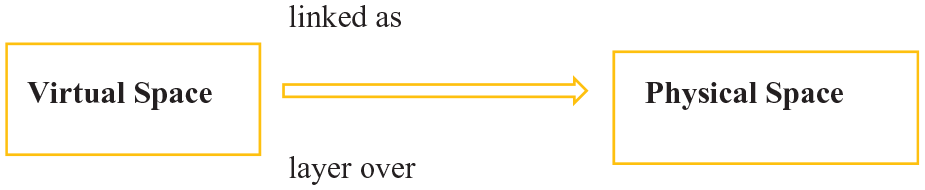
Farman’s unidirectional conceptualization of Virtual-Physical spatial relations.

Cross-directional conceptualization of Virtual-Physical spatial relations.
Hints of Cross-Directionality in Locative Social Media Studies
Location-based mobile games have been instrumental in the conceptualization of hybrid space. They have provided a (near-) tangible phenomenon that captures the essence of hybrid space. Virtual objects located in the PS and mobile devices as a compass to locate them. de Souza e Silva (2006) demonstrates this phenomenon by hybrid reality games such as Botfighters and Mogi. In these games, virtual objects/elements from the VS are engulfed/enveloped by the PS causing a fusion.
While de Souza’s (2006) conceptualization of hybrid space is unidirectional, locative social-media studies suggest that the formation of hybrid space is not anymore unidirectional but cross-directional. In other words, it’s not just the virtual elements that cross over to the physical world (as shown by de Souza in her original preposition), but elements from the PS also cross over and form part of the VS. While the concept of hybrid space was originally proposed based on locative mobile games where virtual elements populate and activate the PS for the players, its use in locative mobile social media has extended this application albeit the other way round—people are engulfed by the VS and activate it. For instance, it is by getting in/appearing in the virtual location-detecting “check-in” feature that they signal to the other users about their physical location; in other words, they have already arrived in the PS but it is by checking-in the VS that they establish a connection and get activated with other users.
However, is this phenomenon of cross-directional migration in which elements from the PS migrate to the VS exists just in mobile social media tools with location awareness or does it also exist in routinely used non-locative mobile social media and chat applications? If yes, then can these elements be captured in data? So, the article asks the question:
RQ1: How do elements move cross-directionally in a chat application and facilitate the creation of cross-directional hybrid space?
“Implacement” in Cross-Directional Hybrid Space
“Implacement” is the placing of virtual elements in the form of data/new media into the physical space, enhancing the experience of the physical space (Farman, 2021). This “implacement” is facilitated by the provision of additional contextual information in the form of data. Such additional contextual information is also key to “transforming space by giving it a sense of place”(p. 43). Farman (2021) uses the mobile-based tool of Augmented Reality (AR) to explore this phenomenon and says that a PS is imbued with meaning when “places are augmented by data overlays” (p. 43). He uses the example of how such tools are being used to enhance our museum experience. One such tool is the iPhone application, Steetmuseum. This tool overlays images from the past onto the contemporary PS; past is “juxtaposed with our present-day context” (p. 43). This additional contextual information does not come from our immediate geographical location but from “data overlays” facilitated by mobile devices. This data is the media converted into computable data or, as Farman (2021) calls it, “new media” (p. 49)—texts, moving images, sounds, and so on. Laying emphasis on the contextual information, Farman (2021) says, Our lived experience of space, especially in the online realm, is very much a situated experience always contextually informed. (p. 43)
Thus, additional contextual information is the key to “implacement”; such contextual information comes in the form of data or new media formats such as texts, images (moving or still), sound, and so on. In the era of pervasive social computing via a mobile device (Farman, 2021, p. 68), our geographical location no longer determines “who and where we are socially” (Campbell, 2019, p. 10). The place is now “socially produced” as locative mobile media “lay digital content onto and into physical settings” (Campbell, 2019). However, the current article argues that apart from locative mobile media and AR mobile tools, routinely used mobile-based chat applications are also creating social spaces which are not tied to one’s geographical location, instead they lay elements from the PS onto and into the VS. So, the article poses the question:
RQ2a: How does “implacement” take place cross-directionally in a chat application and facilitate the creation of cross-directional hybrid space?
From a unidirectional perspective, embodied implacement is transformative in several ways. When the implacement is carried out through AR on mobile, it “augments the meanings of places” (p. 43). It also provides new ways of visualizing information. Locative mobile media tools give us “a sense of direction in a particular place” (p. 43). This transformative quality is largely talked about in terms of enhancement and improvement as it enhances our experiences of the PS but does the cross-directional implacement also transform by way of “enhancement.” So, the article poses the question:
RQ2b: How does cross-directional “implacement” transform our experience?
Materials and Methods
Preliminary Study
A preliminary study was conducted with 21 participants for over 4 days to finalize the mode and diary structure of the WhatsApp diary. MS OneDrive emerged as a suitable mode for participants to enter their diary entries. Participants reported that they are comfortable with entering details of three chat streams in a day. Some aspects of the diary structure were modified based on the feedback of participants of the preliminary study.
Measures Were Taken to Safeguard Participants’ and Their Chat Partners’ Privacy
Considering the sensitive nature of the data that are collected and put on analytical display, the article has used several measures to safeguard the identity of the participants and their interaction partners. All information is withheld, which can reveal their location. Several other identifying aspects from their chat codes have been either removed or modified. Names have been removed or modified, while gender and relations with their chat partners have been modified. Following the principles of the democratic research process (for details, see “Harnessing the opportunities . . .”), participants were involved in the process through data reduction (for details, see the above-mentioned section). Such an involvement added a layer of privacy filter. Participants were also oriented on day 1 of the study about not revealing any conversation that is too personal in nature.
Participants
For the main study, a registration drive was carried out in India. The location and other details of the drive have been screened considering the sensitive nature of data collected and put on analytical display. Prospective participants were informed that they had to make diary entries about their WhatsApp activity for 6 days. Eighty-two participants showed interest and enrolled in the study. Out of 82, 4 showed an unwillingness to use a computer, 3 did not have/were not able to provide WhatsApp numbers, and 12 did not come on any day of the study, leaving 63 participants for the final study. Out of 63 participants, 27 participants completed all 6 days of the study; 22 completed 5 days; 9 completed 3 to 4 days, and 5 completed only 1–2 days. Participants were profiled based on gender, English language proficiency (as English is their second language), and knowledge of using a computer. There were 42 male and 20 female participants (1 participant was non-responsive in the profiling survey). Fifty-eight participants reported that they studied in an English medium school, while 4 reported a vernacular language in India to be their medium of instruction in the past. Fifty-six participants reported having received formal training in the use of a computer.
Procedure
Participants were asked to report two to three chat streams of one day with an individual or a group irrespective of time lags and change of topics. They were asked to keep the stored chat data by smartphone chat app—WhatsApp in front while making the diary entries about their chat content. The diary structure asked them to list and describe their chat content and media use. To encourage and elicit detailed responses, the question on message content was asked in multiple ways, such as list and describe the forwarded message, jokes, happenings in life, and information shared. They were also asked to provide counts of their message exchange (selection of message exchange automatically generates a count). Identifying details on the chat streams were asked; however, this has not been used anywhere in the data display.
Data Analysis
Chat streams were moved from OneDrive word document into Excel rows for convenient coding; one chat stream was brought into one Excel row. “Incident to incident coding” (Charmaz, 2006, p. 47) was adopted to develop conceptual insight into data. Looking for incidents and comparing them with previous similar incidents can help in identifying unique features of an emerging concept; thus, helping in developing a concept (Charmaz, 2006). Integration of mediated conversations with events and activities in non-mediated space emerged as an interesting category needing closer inspection.
This larger category of integrated communication was then subjected to axial coding in which various subcategories evolved. Axial coding around the integration of mediated and non-mediated communication generated various indicators which confirmed the presence of matter from PS or NMS in our mediated virtual interactions. These indicators were further categorized based on commonalities between them.
Analyzing Spatial Integration Through Space/Medium and Event Text Matrix
To analyze the spatially integrated data, we propose a text matrix “space/medium and event matrix.” Simply put, a “text matrix” is a table containing text/qualitative data. The text data placed in a table/matrix should help in explaining the data by exteriorizing/bringing forth the relations between or among its constructs. Our proposed matrix is derived from Miles and Huberman’s (1994) time-ordered within case display. The time-oriented display does “event-listing” and captures the flow of an event (Miles & Huberman, 1994). As we wish to pin down events in a chat stream, such a display format is highly relevant. Within-case displays focus on single cases (Miles & Huberman, 1994). In our study, we define a single case as a single chat stream within which we do the pinning of events based on their spatial origin. The creation of a matrix in which space/medium is segregated from event/response can help in pinning down what happened in which space or medium. We believe that such a pinning down of activities, events, and responses with/to space or medium can further provide more in-depth insights than what is possible with the existing methods. It has the potential to reveal if or how a chat content/event is influenced by space/medium and vice versa.
Harnessing the Opportunities and Addressing the Ethical Issues Through Democratic Research Methods
Mobile methods are said to be in use when a study adopts mobile phones through its apps for data collection (Boase & Humphreys, 2018). It is a great tool for in situ data collection as its “temporal closeness of the self-report with the phenomenon itself enhances validity” (Boase & Humphreys, 2018, p. 155). The use of WhatsApp chat log diaries to excavate a chat stream as close to the original as possible has helped in providing an incisive understanding of the spatial integration facilitated by mobile media and the creation of cross-directional hybrid space. However, any study adopting hyper-intrusive mobile methods face, as Boase and Humphreys (2018) call, “weighty ethical” issues. Prime among them and most relevant for the current study is the privacy of the participants. Traditional ethical practices such as taking informed consent of the participants and masking their identity are relevant for mobile method studies as well. However, the researchers believe that given the nature of the analysis of their study, such conventional ethical practices are necessary, but they are not sufficient as the current study uses a data display method of analysis (Miles & Huberman, 1994).
Data display is considered important for making the qualitative research process transparent as it helps in retracing the analytical steps which were used by the researcher to arrive at a conclusion (Miles & Huberman, 1994, p. 257). However, such data display becomes problematic when they are not field notes but participants’ chat content with the non-participants of the study. So, while such a study will have higher ecological validity (Boase & Humphreys, 2018) and higher transparency (Miles & Huberman, 1994), it will also have ethical issues. An important key to addressing this ethical issue is adopting what is called a “democratic research process” (DRP) (Phillips & Zavros-Orr, 2012, p. 61) which empowers the participants. It essentially means involving participants in the research process.
The current study involves the participants in the first stage of the text-matrix analytical method. This analytical method has three stages (Miles & Huberman, 1994, p. 24)—data reduction, data display, and conclusion drawing. Data reduction is “the process of selecting, focusing, simplifying, abstracting and transforming the data.” Participants were involved at this first stage of data reduction. Keeping their chat streams in front, they were at liberty to make a selection of the chat content that they wanted to share. Unlike automated data collection methods where the data directly travels unfiltered from a participant’s device to the researcher (Bouwman et al., 2013), the use of diary helps in providing participants with complete control of their data, giving them complete freedom to choose which data (in this case chat stream) they want to share.
In addition, participants were sensitized in the orientation session about being careful about the chat streams they select to write about primarily in two ways—first, to remember that the diary content will be used in research and that they should not write about issues they deem private and second, while making entries they should keep in mind the privacy concerns of the third party. Thus, the diary entries and the chat content data that is displayed for analysis are not the original chat content but chat codes that capture the essence of a chat filtered by participants themselves. This helps in masking anything sensitive and private while still providing useful incisive data. In the absence of an ethical review board at the participants’ host institution, the head of the institution gave the approval for the study.
Results
Nature of Elements Moving Cross-Directionally
Our first aim was to explore how are elements moving cross-directionally and facilitating mobile sociality. This will help in determining whether mobile sociality is non-locative.
The content analysis of the chat streams revealed the following entities that originate in the PS and over which a larger part of the mediated chatter seems to be built:
People
Place
Happenings, Activities, and Events
Material objects
These elements/entities seem to be relatively static in comparison to the mediated chatter that surrounds it and gives it its meaning and color.
People
People are individuals who are being talked about in a chat stream. They are captured in texts or images. They can be either present and are part of the chats or talked about in their absence.
Below are some of the instances: He shared 3 photos of his childhood and shared stories of that particular photo. One of his photo was of 8th standard so he had glasses at that time so he was looking very funny and weird s compared to now, so I laughed and said “is that you . . .! Really?” He was like yes it is me but that time I was small so I look damn different . Then he said that “mai bachpan mai choota tha” so I asked “is it ?” I was toh big in my childhood and we both laughed. Screenshoot [sic] of {name}’s chat{2 pic}. . .making fun of {name}. (Making fun) Jokes on members of group. (Making fun) The guys were talking about girls in our class and were cracking jokes. (Gossiping and making fun of individuals possibly not in the group) Sarcasam [sic] on our frnd [sic]. (Making fun) Memes on our college friends. (Making fun) . . . As my niece got promotion in her job that thing she shared on the group and everyone congratulated her on the group. (Self-talk/Showcasing) Our dance teacher shared that her papers related contribution of india [sic] in field of classical dance is accepted on international level and s/he has to give presentation related that next week. (Self-talk/Showcasing) I shared the reason of being absent yesterday in the class as I was sick. (Self- talk/Sharing info about self)
There are also instances of self-talk where individuals talk about themselves. There also seem to be a pattern in the manner in which people are being talked about, but this needs to be separately investigated. Some of the manner that the content analysis revealed are “making fun” or roasting, “back bitching or gossiping,” info-sharing about one’s availability and showcasing or bragging when doing self-talk. The multiple media in which people have been captured are images, texts, and memes.
Place
Mediated chatter seems to be also grounded in a place. Places are sometimes centerpieces of a conversation other times places are a solid background to other activities. Below are some of the instances: Places as centrepieces of conversations: pics of class because she was wants to see my class room reason she wants to see was that she stays in Surat [sic] . . . Pics of my college class room. Pics hotel where we are staying at. Places are solid background to other activities such as reliving past experiences, making fun sharing life experiences: Talk on school lives with shared experiences reliving the past. Messages were about the memories in school life, . . . she shared her experience of an hotel she visited day before yesterday. We are starting chats after a long time and we are discuss about the using of like app and remembering our memories of junior college, discuss about our parents and planning about the movie and hangout. The all media is about our pics of junior college classroom And snaps and canteen pics and the last pic is for good night greeting. College related memes.
As we see in the above quotes, chunks of places in the PS have been captured in media and texts and sent across in the VS. They become centerpieces of conversations wherein textual discussions take place over pictures of places. Captured in image form, they also act as background to other discussion activities such as reliving past experiences, making fun sharing life experiences.
Material Objects
Material objects from PS become part of VS. These objects are captured in the form of images and are made part of chats. Below are some of the instances: Asking that how was the suit which was been made for sons wedding, the suit cloth was purchased from Raymond for 14000 rs, Asking which shoes to wear, Replying that the colour of shoes and belt should match, meme . . . Photo of suit. (Material object—Suit) . . . As I made cake yesterday, I shared a picture of that with her, she said “It seems to be yummy.” (Material object—Cake) The media is about the index page of account book. . .And discussing the which topic we are going to study. (Material object—Book page)
The above quotes show how material objects such as suit, cake, and book page from the physical world are captured in image form and sent to the VS for discussions in textual form.
Happenings, Events, and Activities
Various happenings in the PS also become part of the virtual mediated chatter. Events and activities of the past as well as planned for the future are chatted about in the mediated space. Social coordination for an activity appears to be a prominent subject of chatter. Below are some of the instances: She told me that she is going for shopping and for a dinner with her family. I said her about my Sunday plan as I was going for an outing with my office friends. (Disclosure of planned events) She informed me that the date of 2nd semester exams have been postponed . . . She informed me the date & time table of ATKT exams. (Sharing information about a future event) We are discuss about our study account subject we are discuss about which topic we are going to study and deciding the timing for study. (Coordinating for a future planned event) I also told her about the new movie (Total Dhamaal) I watched. As there is wedding going on in my family there is a dance practice. So after the practise the videos are been sent of practise. Regarding videos and pictures chat has taken place and also with funny videos. (Activities that one has undertaken or plans to undertake)
Past events from the PS such as wedding dance practice is captured in video form and sent to the VS for discussion. Similarly, future events such as joint study and movie watching are planned using textual mode.
Cross-Directional “Implacement”
The second question aimed to find how “implacement” takes place cross-directionally. While the chat app chattees are not sharing same PS, they are sharing a common context, albeit virtually and the VS is being used to provide additional contextual information for the shared common context. As mentioned earlier, provision of additional contextual information is central to “implacement.” The below Space-event matrix (Table 1) provides a detailed analysis of such data captured from diary entries of the participants:
Space-event matrix.

Transformative Quality of Cross-Directional “Implacement”
The third aim of the article was to explore how cross-directional migration of elements transform our experience. The previous table demonstrated how cross-directional “implacement” is transforming activities by shaping them and facilitating goal achievements. However, does cross-directional migration and implacements of elements have the ability to influence relationships, or is it only limited to shaping activities and facilitating goal accomplishments?
Using the event trigger and response table (see Table 2), the findings indicate that the migration of elements from one space to another has distinct trigger-response relations. One space triggers an event, while the other space is used to respond to the trigger event.
Event Trigger and Response Table: Analysis of a Chat Stream Using Space-Event Chart.

Discussion
Mobile social media studies have broadly adopted location-based approach in which the location-awareness feature has been the key to studying mobile sociality. However, with the increasing usage of non-locative social media and chat applications such as WhatsApp, FB, Twitter, and so on, the relevance of locations awareness tools for mobile sociality has been questioned (Humphreys, 2013). Contemporary mobile sociality is dependent on “always-on” net connection more than location-awareness of the mobile user. There is a need to adopt a newer approach to study mobile sociality, which is not dependent on the location-awareness feature of the mobile device.
The new approach proposed in the study is based on the theory of hybrid space (de Souza e Silva, 2006). The article argues that the original conceptualization of hybrid space is unidirectional in the sense that it focuses on the movement of elements from VS to PS. This approach has been helpful in showing that mobile devices strengthen our attachment with our surrounding/proximal PS (Campbell, 2019, 2020) as elements move from the VS to the PS. This was unlike the earlier studies on mobile phones, which focused on how they detach us from our immediate physical surroundings. This way, the concept of hybrid space provided a new theoretical direction to locative mobile media studies. However, as mentioned earlier, constant net availability is defining the new mobile-based sociality, and to study this, a newer approach is required.
The theory of hybrid space hints toward such an approach. The theory provides two important conceptual tools—migration of elements from one space to another and constant net connection, which form the basis for the creation of hybrid space. De Silva (2013) defines hybrid space as “created by the constant movement of users who carry portable devices continuously connected to the Internet (our emphasis) and other users” (p. 262). She also says that “Hybrid spaces arise when virtual communities . . . migrate to (our emphasis) physical spaces because of the use of mobile technologies as interfaces” (p. 1). Based on these two key conceptual tools, the article proposes the concept of cross-directional migration and argues that in an always-on net-connected mobile device, migration of elements happens the other way round, too, that is, from PS to the VS. Content analysis of the WhatsApp-based diary entries of participants showed the types of elements that are moving cross-directionally—people, places, events, and material objects. These entities from the PS are being converted into new media—text, images (moving or still) and are sent across the VS.
Farman’s concept of “implacement” helps in the conceptualization of cross-directional hybrid space. First, it helps in showing the manner in which elements in the PS are captured. While constant net connectivity helps in the migration of these elements from the PS to the VS, these elements first take the form of new media—text, images (moving or still), sound before they migrate. This conversion is an important condition that needs to be met before the elements can migrate from the PS to the VS. Second, it shows that the placing of data/new media onto the PS is not without consequence. Such “implacement” provides additional contextual information and “augments the meanings of places” (p. 43). The article explores whether such implacement is happening cross-directionally that is, elements from the PS are being implaced in the VS and whether such implacement is providing additional contextual information. The findings suggest that not only elements are getting implaced, but additional information around these implaced elements is being shared. For example, the sharing of a “sketch” (a material object captured in the image form and implaced in the VS) is followed by the provision of additional information—how to improve the sketch.
The above findings indicate that the cross-directional migration of elements is not without consequence. So, when a sketch is captured in an image form and moved to the VS, it receives feedback for improvement. Similarly, when an identity card from the PS is captured in image form and shared across the VS, it facilitates certain goal accomplishment in the PS. So, we see that cross-directional migration is shaping activities and facilitating goal accomplishment. However, apart from activities and goals, does cross-directional “implacement” have concrete transformative quality? Or is its influence limited to only activities and goal accomplishments? What does cross-directional hybrid space mean for relationships? To explore the deeper influence of cross-directional migration of elements, the study uses a trigger-event and consequence table in which participants’ diary entries are segregated based on the specific trigger-event and response to the trigger-event. The table pins trigger-events and their response to the relevant spaces that is, PS or VS. If it happened in VS, it also records what was the media form used? The findings show very clear segregation in which one space acts as a trigger avenue for the event to happen and the other space acts as an avenue for its response. For example, a command to control behavior is given via VS, but resistance to the control is carried out in the PS. Similarly, mischief is carried out in PS, and the response to the mischief, that is, hunt for the culprit, is carried out in the VS.
Limitations of the Current Study and Scope for the Future Studies
The current study is limited by its research methods. While the diary method allows somewhat ethical access to WhatsApp chat content which allows for closer inspection using the Event-space matrix table, other methods such as interviewing and focus group discussion can provide even deeper insight, especially into the transformative nature of virtual-physical spatial integration in the form of cross-directional hybrid space. In RQ2b, we see one space is being used to trigger an event, and the response is carried out in the other space; a longitudinal study perhaps can provide insight into how this is affecting relationships.
Furthermore, this study can be used as a basis to explore whether mediated chatter in VS around entities from the PS is fulfilling the four relational demands—social coordination, impression management, regulating closeness and distance, and managing arousal and anxiety (Parks, 2017)? Hopefully, this study may initiate studies exploring how users are integrating the two space to navigate their social relations.
Footnotes
Acknowledgements
The authors are indebted to National Communication Association (NCA) for supporting the study with Dale Leathers Grant, 2020 of $ 676.
Declaration of Conflicting Interests
The author(s) declared no potential conflicts of interest with respect to the research, authorship, and/or publication of this article.
Funding
The author(s) received no financial support for the research, authorship, and/or publication of this article.
