



Abstract
Within the ubiquitous landscape of social media, far-right groups and actors have taken advantage of the ways content is produced and spread on mainstream social media platforms. Far-right groups, including the alt-right, are using social media in ways that entice people into far-right spaces that perpetuate hate online and in person. The alt-right spreads hateful messaging through Internet memes, and those who are unfamiliar with alt-right strategies may encounter these memes and engage with them. In this study, we examined whether parents of adolescents would engage with alt-right memes as well as if they understood the memes. We utilized a novel research design by presenting participants with memes and asking questions about engagement. We also included a measure of New Media Literacy to assess participants’ skills with navigating social media. Results reveal that a majority of parent participants would either knowingly interact with at least one alt-right meme or they were unable to discern the covert messaging in the alt-right memes. The impact of engagement with alt-right content on social media needs to be addressed in order to inform approaches to educate adults, especially parents, about how hateful ideologies spread on the Internet.
Far-right ideologies are based in hate and conspiracy theories that frame human inequality as natural (Arbeit et al., 2020; Burley, 2017; Lyons, 2018). Far-right groups, particularly the alt-right, use several strategies to boost content online, such as creating memes using cloaked language that allow them to circulate more widely than overtly hateful memes (Daniels, 2018; Lewis, 2018; Marwick & Lewis, 2017). Alt-right groups recognize the opportunities that new technologies grant them to spread their messages of hate, and as a result, alt-right memes can spread to mainstream social media platforms (Daniels, 2018). Alt-right actors use social media algorithms designed to keep users on their platforms to boost engagement and visibility (Marwick & Lewis, 2017). Even if users are not engaging with such content with the intention to spread hate, the impact of engagement is the same (Marwick & Lewis, 2017). Not every person who engages with or shares alt-right memes may explicitly identify with the alt-right, but they are still spreading hateful ideologies. Furthermore, even if alt-right actors are not explicitly intending to persuade new users into their movement, engaging with such content may still lead users into alt-right spaces. These hateful memes pose a threat to those unfamiliar with alt-right messaging, particularly adolescents, and a threat to overall social justice efforts as young people get entwined in the manipulative web of lies that is alt-right ideologies.
The aim of this study is primarily exploratory and descriptive, to ascertain parents’ proclivity to engage with alt-right memes on social media. We hope these findings can inform future studies about parents and adolescents’ consumption and understanding of alt-right content on social media. This study in itself does not intend to give us knowledge about how parents can halt alt-right recruitment of youth; rather, it is intended to provide information about how parents themselves may be engaging with alt-right social media content, and their perceptions of their adolescent children’s social media engagement. This study is part of a broader emerging research agenda to support parent and adult intervention in youth far-right recruitment pathways.
Understanding the Alt-Right Among Broader Far-Right Threats
The term “alt-right,” short for “alternative right,” was coined by a far-right reactionary in response to the 2008 presidential election (Hartzell, 2018). The alt-right primarily exists online and uses memes to spread their hateful ideologies (Lewis, 2018; Southern Poverty Law Center [SPLC], n.d.-a). Alt-right actors use academic language to distance themselves from traditional conceptions of White nationalism and to attract those not persuaded by overt White nationalist messaging (Hartzell, 2018). Former White supremacists recognize the recruitment tactics of the alt-right from their own experiences and confirm that the alt-right is repackaged White supremacy (Armstrong, 2017).
The alt-right falls under a broad umbrella of far-right ideologies that promote human inequality as natural and desirable and reject the legitimacy of the established political system (Lyons, 2018). Although no groups within the far-right have official membership lists or specific identifying criteria, they all hinge on the idea that human inequality is natural and that Western White civilization is the ideal and use a variety of means to seek domination over marginalized groups (Burley, 2017; Gorcenski, 2018, 2019).
Far-right movements use White victimhood narratives and express manipulative mythologies based on claims that White people face discrimination, have their rights denied, and are stigmatized for expressing White pride in ways that threaten the White race (Berbrier, 2000). The alt-right further creates conspiracy theories that blame Jewish people, political correctness, and multiculturalism for current social problems, which bolster their White victimhood narratives (Sunshine, 2017). These conspiracy theories and victimization narratives construct a web of lies used to bring followers further into alt-right spaces online (Arbeit et al., 2020; Wong et al., 2015). Although often subtle, the recurrent patterns in this web of lies may be apparent in alt-right content, if a person knew what to look for.
Alt-Right Memes
Memes are one way in which the alt-right exploits mainstream social media algorithms (Daniels, 2018). Memes are user-generated content which combine text and images as a mode of communication, with the intent of being funny and easy to grasp (Greene, 2019; Mihailidis & Viotty, 2017; Zannettou et al., 2018). Alt-right memes use humor to hide as harmless “jokes,” which helps them spread (DeCook, 2018; Drakett et al., 2018; Greene, 2019; Stewart, 2019). Then, the spread of these memes on mainstream social media platforms may imply to viewers that these messages are acceptable, allowing these memes to spread even more widely (Åkerlund, 2021; Daniels, 2018; Greene, 2019).
Outsiders exposed to this content may spread it without understanding the underlying ideologies. Understanding the true meaning or intention of such content is difficult (Greene, 2019). Investigating the truth of alt-right claims is complicated because search engines like Google or sites like YouTube do not filter out alt-right content (Daniels, 2018; Sutton & Wright, 2009). Furthermore, the influence of incorrect information, such as that touted by the alt-right, cannot be undone by simply pointing out the information is wrong (De keersmaecker & Roets, 2017). Therefore, an Internet user may not be able to undo the impact of alt-right White nationalist claims even when explicitly told these claims are wrong.
Engagement, or any form of interaction with content on social media platforms, signals to algorithms what to show and what not to show (Swart, 2021). While the exact mechanisms vary from platform to platform, the main goal of these algorithms is to tailor what content gets presented to each user. If a new viewer of alt-right content shares an alt-right meme, the social media platform will continue to present them with similar content. Importantly, social media algorithms do not take intent into account when suggesting new content to users (Marwick & Lewis, 2017). Regardless of user intent when interacting with alt-right content, any interaction spreads this content further due to the structure of social media platforms and their algorithms (Daniels, 2018; Marwick & Lewis, 2017).
Continued Threats Toward Youth
Alt-right figures have identified White male youth as prime targets for recruitment: Andrew Anglin said 10–30 years old is the target age range for recruitment; Richard Spencer emphasized targeting college-age youth (Hankes & Amend, 2018; SPLC, n.d.-b). The alt-right has not been the only far-right group to target young people. The “groyper army,” or the America First movement, led by Nick Fuentes, is primarily made up of college conservatives disaffected by mainstream Republicans (Lorber, 2021a; Tanner & Burghart, 2020). The American Populist Union, another brand of far-right actors, largely consists of Gen Z social media influencers (Lorber, 2021b).
To date, there is little empirical research about pathways of far-right youth recruitment or whether or how youth recruitment pathways differ from those of adults. While Arbeit et al. (2020) propose a theoretical model for how adults may be able to prevent or intervene in possible youth recruitment pathways, there are no data published thus far evaluating this model. Media literacy is a potential component of this model as online users do not need to look intentionally for far-right content in order to be exposed to it. Someone may be interested in video games or searching for dating advice and look to social media influencers or YouTube videos. What seems at first like reasonable advice could lead the user to veiled conspiracy theories or racist White supremacist mythologies that manipulate users, particularly youth, into sympathizing with far-right groups (Arbeit et al., 2020; Marwick & Lewis, 2017; Ribeiro et al., 2019). Thus, more research is needed on the skills that could help parents help youth resist online recruitment pathways, such as New Media Literacy (NML) skills.
NML and Understanding Alt-Right Content
“New media” refers to platforms where users can form networks and interact with anyone by consuming, engaging with, and creating content, which includes social media (Koç & Barut, 2016). NML theories build upon traditional conceptions of media literacy to consider how a user can handle the challenges of social media, as social media is more interactive, active, and productive than television, advertisements, and news media (Koç & Barut, 2016; Tugtekin & Koc, 2019). Therefore, NML refers to a person’s skills in both creating and consuming content in an online participatory environment, termed functional and critical “consumption” and “prosumption,” with functional skills referring to usage and critical skills incorporating analysis (Chen et al., 2011; Koç & Barut, 2016). Users with functional consumption skills can access media content and understand its superficial meaning, and those with critical consumption skills can also analyze and interpret the sociocultural and political consequences of media content online. Users with functional prosumption skills can participate in the production of content, and those with critical prosumption skills can also create online content that conveys their own beliefs and can consider the expected influence of the content they create (Chen et al., 2011; Koç & Barut, 2016; Lin et al., 2013; Tugtekin & Koc, 2019). For the purposes of this study, we are focusing specifically on NML skills in relation to social media.
To put alt-right content in the context of NML: Memes are participatory digital culture and serve a social role in social media platforms (Tugtekin & Koc, 2019; Wiggins & Bowers, 2015). The alt-right uses memes as a form of political participation (Drakett et al., 2018; Greene, 2019). Alt-right actors may not be intentionally using memes as a cohesive strategy to recruit new members, but engagement with these memes still has the potential to spread alt-right ideologies. New media users may either superficially understand alt-right content and memes, or if the user has critical consumption skills, may understand the sociocultural consequences of that content. The users who share alt-right memes may vary greatly in their ideological viewpoints, ideological understanding of the memes, and whether they share the memes with intentions to influence others. A user may “like” an alt-right meme because they find it humorous, demonstrating functional consumption skills, and a different user may understand that engaging with this content spreads hateful ideology, demonstrating critical consumption and critical prosumption skills.
This study focused on image-based, static memes, which are common on social media platforms where a user can share a static picture, such as Facebook, Twitter, or Instagram. The memes in this study were designed with Facebook engagement behaviors in mind. The facets of engagement on Facebook such as sharing, liking, and commenting are similar to engagement behaviors on other mainstream social media platforms. A user can like, share, and comment on posts on Instagram (which is owned by the same company that owns Facebook). Similarly, a person can like, retweet, or reply to tweets on Twitter. Furthermore, users’ engagement behaviors on social media platforms signal to the algorithms what to show and what not to show each user (Swart, 2021). Although people may share or like content with the intent of making fun of it or refuting it, social media algorithms do not consider intent (Marwick & Lewis, 2017).
Users with critical NML skills should be able to understand that sharing an alt-right post to make fun of it or to endorse it gives the same input to social media algorithms (Koç & Barut, 2016; Marwick & Lewis, 2017). Engaging with alt-right content suggests to social media platforms that this is content people are likely to engage with, and as a result, more alt-right content gets recommended to users (Marwick & Lewis, 2017). Critical NML skills should equip users with strategies for navigating and sorting through the barrage of content on social media (Chen et al., 2018; Tugtekin & Koc, 2019; Xiao et al., 2021), which should include understanding the social and political consequences of engaging with certain content. To the best of our knowledge, NML has not been examined in the context of parents’ intent to engage with alt-right social media content.
Current Study
This research examines whether parents would engage with (e.g., like or share) alt-right content presented through memes and whether parents believe their adolescent children would engage with such memes. Alt-right memes use humor and coded language to appear entertaining to social media users who may not consciously endorse alt-right ideologies. We also assess whether and to what extent parents’ NML skills are associated with their engaging with and understanding alt-right content. This study has four research questions:
RQ1. Would parents engage with alt-right content?
RQ2. Do parents understand alt-right content?
RQ3. Do parents believe that their adolescent child would engage with alt-right content?
RQ4. Is NML associated with various facets of engagement with alt-right content on social media?
Method
To examine our research questions, we used a quantitative cross-sectional survey research design in which participants viewed and responded to several memes.
Research Context and Rationale
As our research is based in the social sciences, and this line of research is new and emerging, we utilized self-report survey measures. Self-report surveys are one of the most common ways of gathering data in social sciences, but they are not exempt from valid concerns about how accurately self-report responses may reflect actual behavior (Fan et al., 2006; Morling, 2018; Weigold et al., 2018). However, even if answers do not perfectly reflect true behavior, assuming the responses are not intentionally dishonest, they still provide meaningful information about what participants think they would do in various situations (Morling, 2018). Furthermore, self-report measures are often ideal to ask about participants’ subjective experiences and feelings (Morling, 2018; Vazire & Carlson, 2011), such as whether they would like or share a meme. The purpose of this study is not to evaluate the utility of self-report surveys, but to gain some insight into whether or how participants anticipate they would engage with alt-right content on social media.
Participants
Demographic questions included participant age, gender identity, sexual orientation, political affiliation, and race/ethnicity. We allowed participants to choose more than one option for all demographic questions (except age) to account for the complexity in different aspects of identity. Demographic questions also included the options of “other” (for which we asked participants to elaborate in a text box) and “prefer not to answer.” Participants indicated the race/ethnicity and gender of the adolescent child they had been answering about in prior survey sections.
Ages of the participants ranged from 21 to 65 years old (M = 40.64, SD = 11.09). Participants reported having between one and five children in total (M = 1.78, SD = 0.62) and between one and five adolescent children (M = 1.28, SD = 0.59). See Table 1 for full demographic items.
Demographics (N = 126).

Procedure
Data collection was conducted in mid-October 2020. We used Amazon’s Mechanical Turk to recruit English-speaking adults in the United States. Participants who completed the study were compensated $0.75, based on Mechanical Turk compensation norms.
Potential participants answered two preliminary screening questions, such as “Are you a parent?” and “Do you have any children between 13 and 17 years old?” If they answered “yes” to both questions, they were presented with the informed consent. Upon agreeing to participate, they were presented with three alt-right memes and two politically neutral memes. Every participant was exposed to the same memes in the same order. Memes were presented one at a time, and each meme was followed by questions designed to elicit participants’ responses to the meme, and whether their adolescent children would like or would share the meme. Then we asked participants if they knew what the “alt-right” is.
After the meme exposures, participants completed the NML scale and answered demographic and social media usage questions. We organized the study to prevent priming effects of the demographic questions on the meme responses. A debriefing page explained the purpose of the study, the meaning of the memes, and what the alt-right is, as well as resources on supporting adolescents in navigating alt-right content on social media.
The survey was active for a total of 7 hr, receiving 287 responses. After using recommended best practices for screening Amazon Mechanical Turk samples (e.g., Aruguete et al., 2019; Mellis & Bickel, 2020) as well as manually scanning the responses for nonsense answers and potential trolls, we were left with an overall N = 126. The viable sample analyzed for this article consisted of these 126 responses, of which 107 were mostly complete and 19 completed the meme responses but not the scales or demographic items.
Measures and Materials
Memes
We created three memes in the style of typical alt-right content and two memes designed to be politically neutral (one cat meme and one Zoom meme). The memes were presented in the same order to each participant: neutral, alt-right, alt-right, neutral, alt-right. In January 2020, we consulted with an expert at Political Research Associates (politicalresearch.org) who critically analyzes alt-right and White nationalist content online. To inform our design of the alt-right style memes, we asked the expert about common themes in alt-right memes and how subtle White nationalist messaging was in alt-right memes. We used known hate slogans and symbols (as designated by the Anti-Defamation League; adl.org), as well as co-opted drawings that have spread online. The memes were crafted to not be explicitly White nationalist in tone, but rather to adopt alt-right strategies of using seemingly innocuous images or messages that provide a cover of plausible deniability when they are, in fact, meant to communicate hateful ideologies. Explanations of the alt-right memes were provided in the debrief form. We do not include the images in this article to avoid distributing this harmful content.
Responses to the Memes
Meme response questions were modeled after the questions used by Pennycook and colleagues (2018) in their study examining exposure to fake news. Participants answered four questions after being exposed to the memes: “Do you understand this meme?” “Have you seen anything like this meme before?” “Would you share this meme online?” and “Do you like this meme?”
Two questions assessed whether the participants’ adolescent children would like or would share the memes. Before presenting the memes, participants were given these instructions, based on similar techniques described in Cantor et al. (1996) and Silander et al. (2018): This survey asks you a number of questions about your 13–17 year old child. If you have more than one child ages 13–17, please answer these questions thinking about your 13–17 year old child whose birthday is closest to yours. You might even make note of that child’s name or initials on a piece of paper nearby, as we will be asking you to think about this same child at various points throughout the survey.
Familiarity With the Alt-Right
We asked participants if they were familiar with the term “alt-right.” The responses to the question included “Yes,” “No,” or “I’ve only heard of it.” In this sample, 85 (80%) participants were familiar with the alt-right, 6 (5.7%) had only heard of the alt-right, and 15 (14.2%) were not familiar with the alt-right.
NML
The measure of NML (developed by Koç & Barut, 2016) has four subscales: functional consumption, critical consumption, functional prosumption, and critical prosumption, but it can also be used as a unidimensional scale. Responses to items were measured on a Likert-type scale ranging from 1 = strongly disagree, to 5 = strongly agree. Items included “I know how to use searching tools to get information needed in the media”; “I can compare news and information across different media environments”; and “I manage to influence others’ opinions by participating in social media environments” (Koç & Barut, 2016).
For the item “I manage to fend myself from the risks and consequences caused by media contents,” we changed “fend” to “defend” to provide clarification to participants. Other researchers have made the same change (Buchanan, 2020). Item 35 was not included in this study. In our sample, the NML scale had an alpha of .93, indicating acceptable internal consistency (Cronbach, 1951; Koç & Barut, 2016).
To compute the scores for the overall NML scale, the item scores ( 1–5) were summed. Scores on the total NML scale (excluding item 35) have the potential to range from 34 to 170. In this sample, the distribution of scores was relatively normal, with scores ranging from 98 to 170 (M = 134.75, SD = 16.49).
Social Media Usage
Based on prior research (e.g., Rauch & Schanz, 2013; Zammit, 2016), we created a set of questions to assess which platforms participants were using from a list of popular social media platforms. The most common platform participants reported using was Facebook with 86 (68.8%) participants. Of the other platforms, 78 (62.4%) used Instagram, 57 (45.6%) used YouTube, 55 (44%) used Twitter, 26 (20.8%) used LinkedIn, 25 (20%) used TikTok, 22 (17.6%) used Snapchat, 18 (14.4%) used Pinterest, 15 (12%) used Reddit, 13 (10.4%) used 8chan, 13 (10.4%) used Discord, 13 (10.4%) used Twitch, 12 (9.6%) used Myspace, 11 (8.8%) used Tumblr, 7 (5.6%) used 4chan, 4 (3.2%) used VSCO, and 3 (2.4%) reported not using social media.
Participants were also asked to report what social media platforms they thought their adolescent child used. Of the options provided, 67 (53.5%) reported their child used Facebook, 46 (36.8%) reported their child used Instagram, 40 (32%) reported their child used YouTube, 30 (24%) reported their child used Twitter, 23 (19.4%) reported their child used TikTok, 14 (11.2%) reported their child used Pinterest, 13 (10.4%) reported their child used LinkedIn, 13 (10.4%) reported their child used Snapchat, 11 (8.8%) reported their child used 4chan, 11 (8.8%) reported their child used 8chan, 8 (6.4%) reported their child used Myspace, 8 (6.4%) reported their child used Twitch, 7 (5.6%) reported their child used Discord, 6 (4.8%) reported their child used Reddit, 5 (4%) reported their child used Tumblr, 4 (3.2%) reported their child used VSCO, 1 (0.8%) reported their child used another social media platform not listed, 8 (6.4%) reported that their children do not use social media platforms, and 13 (10.4%) reported they did not know which platforms their children used.
Results
Responses to the Memes
For descriptive statistics for each of the meme questions for both the parents and what parents responded about their children, see Tables 2 and 3.
Parents’ Responses to Memes.

N = 126, all participants were presented with the same memes in the same order.
Parents’ Responses to Memes on Behalf of Their Adolescent.
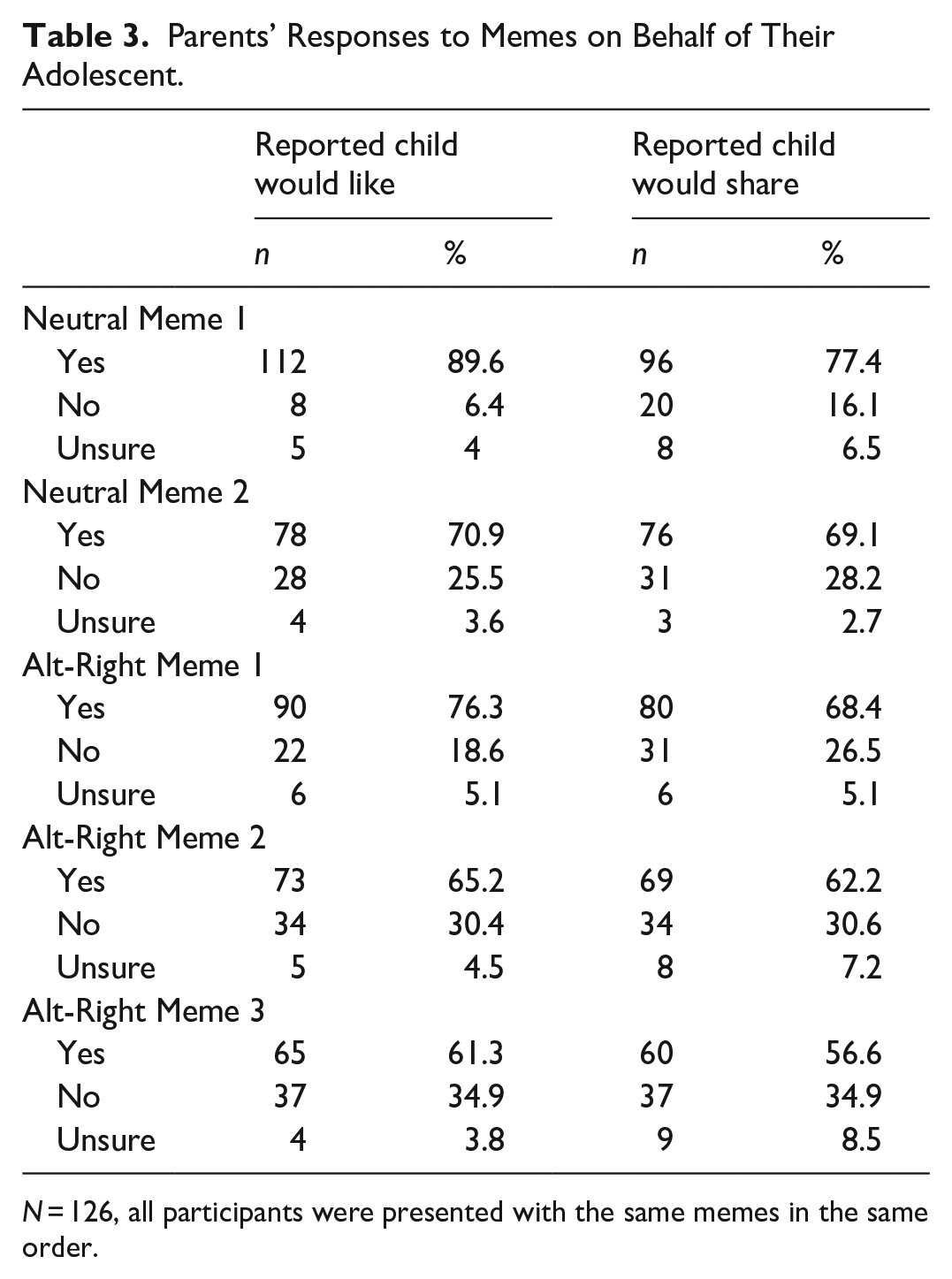
N = 126, all participants were presented with the same memes in the same order.
Preliminary Analyses
Composite variables were created to capture how many alt-right and how many neutral memes participants responded they would like, would share, had seen before, and understood, as well as if they thought their adolescent would like and would share the memes. “Yes” responses were coded as 1, and “no” or “unsure” responses were coded as 0. The responses for each question across all three alt-right memes were summed to create scores from 0 to 3, indicating for how many of the alt-right memes they answered “yes” for each type of interaction. Neutral meme responses were summed in the same manner, to create scores from 0 to 2 for each of the neutral memes, indicating for how many of the neutral memes they answered “yes” for each type of interaction.
Parents’ Intent to Engage With Memes
Alt-Right Memes
See Figure 1 for the frequency distribution of how many memes parents intended to engage with. As the figure shows, a majority of the parents would like, would share, had seen before, and understood at least one alt-right meme.

Frequency distribution of parents intending to engage with alt-right memes.
Neutral Memes
See Figure 2 for the frequency distribution of parents intending to engage with neutral memes. Similar to Figure 1, a majority of parents would like, would share, had seen before, and understood at least one neutral meme.
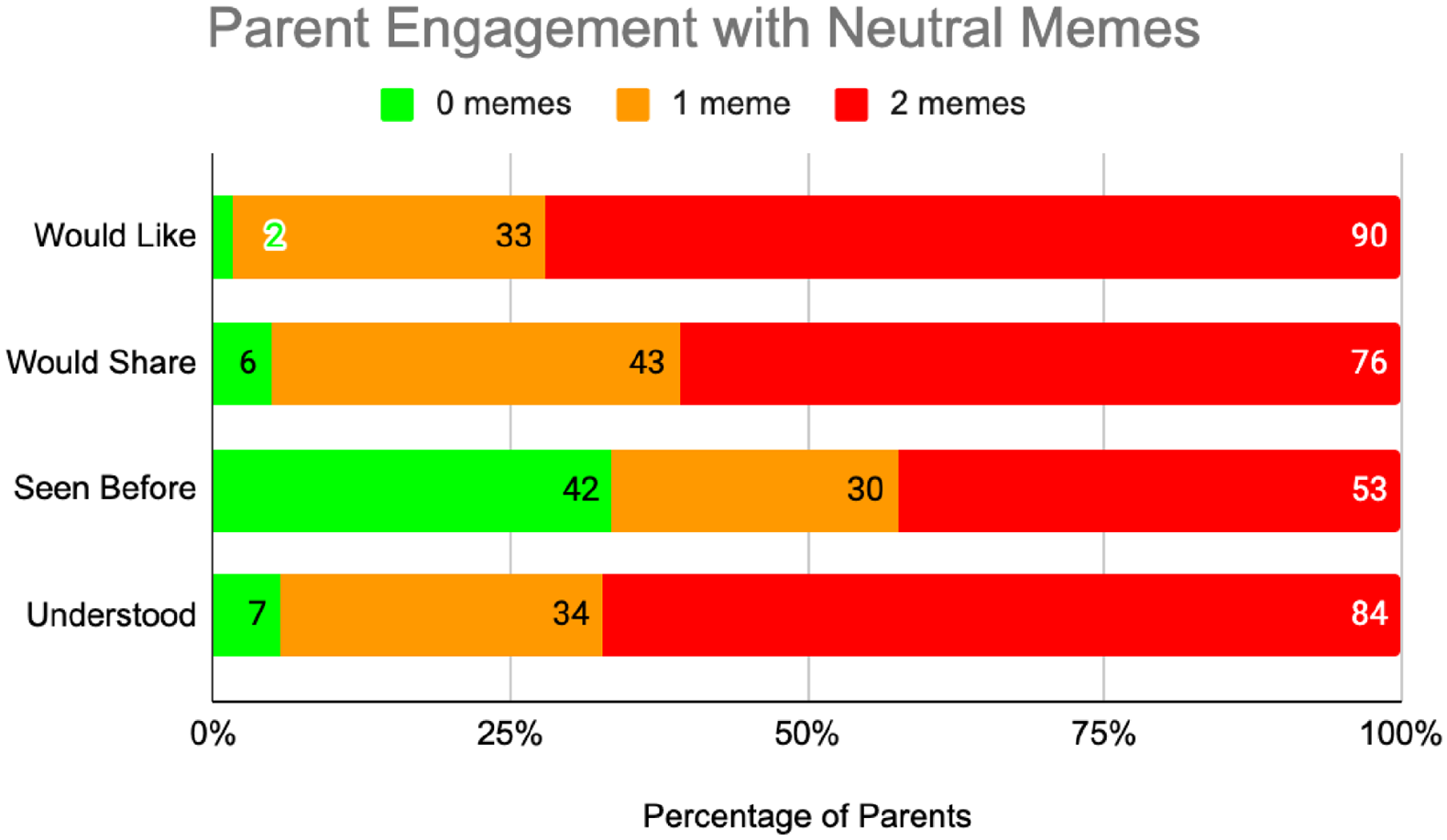
Frequency distribution of parents intending to engage with neutral memes.
Parent Reports of Children Intending to Engage With Memes
Alt-Right Memes
See Figure 3 for the frequency distribution of how parents reported their children would respond to the alt-right memes. A majority of participants stated they thought their adolescent child would engage with at least one of the alt-right memes.

Parents’ responses about how they thought their children would engage with the alt-right memes.
Neutral Memes
See Figure 4 for the frequency distribution of how parents reported their children would respond to the neutral memes. Similar to Figure 3, a majority of participants stated they thought their adolescent child would engage with at least one of the neutral memes.

Parents’ responses about how they thought their children would engage with the neutral memes.
Correlations
A series of Spearman rho correlations were conducted to assess associations among the composite variables of how many meme response questions parents responded “yes” to. See Table 4.
Correlations for Composite Meme Variables.

AR = alt-right, NT = neutral.
*p < .05, ** p < .001.
Hypothesis Testing
Regressions
A set of hierarchical multiple linear regressions was performed to assess the predictive impact of political affiliation, NML total score, and the interaction of political affiliation and NML total score on each meme engagement composite score. The first step in each of the 12 models was political affiliation dummy coded 1 = Republican and 0 = not Republican. We chose Republican as the referent point because the majority of participants endorsed this political affiliation. The second step in each model was the overall NML score. The third step in each model was an interaction term of dummy coded political affiliation and overall NML score. See Tables 5 and 6 for regressions predicting parent self-reported interactions with alt-right and neutral meme models, respectively. See Table 7 for regressions predicting parents’ responses to how their child would interact with the alt-right and neutral memes. Overall, NML was significant across most of the models, but political affiliation and the interaction term were not.
Summary of Hierarchical Regressions for Parent Alt-Right Meme Responses.

p < .05, **p ≤ .001.
Summary of Hierarchical Regressions for Parent Neutral Meme Responses.

p < .05.
Parent Responses on How They Thought Their Children Would Engage With the Memes.

p < .05, **p ≤ .001.
Discussion
Using a novel research design, we assessed whether parents of adolescents would engage with alt-right memes. Participants were presented with five memes (two neutral, three alt-right), and answered questions in response to the memes about their potential engagement and that of their adolescent children. We used a measure of NML (Koç & Barut, 2016) to assess the relationship between NML and engagement with alt-right content.
Social media is a pervasive part of daily life and a new context for assessing development in adolescents and within families. Although social media may function as a major socializing agent (DeCook, 2018; Xiao et al., 2021), to the best of our knowledge, there is scant empirical research about NML skills and engagement with alt-right memes. These findings provide preliminary insight into where media literacy skills could be strengthened or supplemented with specific attention to recognizing and resisting alt-right social media content.
With regard to the first research question about whether parents would engage with alt-right content, a majority of parents in our study would like or share at least one alt-right meme. Our second research question asked if parents believed their adolescent would engage with alt-right memes. We found that the majority of parents thought their adolescent would like or share alt-right content. This finding suggests parents may believe their children’s social media behaviors are similar to theirs. Our third research question asked whether parents understood the alt-right memes. A majority of parents responded they had seen something similar to these memes and that they understood them. However, based on our survey question, we are unable to discern whether they understood the covert messaging in the alt-right memes. Parents may have had only a superficial understanding, or they may have understood the alt-right content but would share anyway. These results appear to be unnerving; however, we cannot make claims as to whether the participants are actual alt-right sympathizers or just thought the memes were entertaining.
For the final research question examining the role of NML and various facets of engagement with alt-right content, several patterns emerge. Political affiliation did not predict engagement except for reporting their child would share alt-right memes, which indicates that regardless of political affiliation, parents may intend to engage with alt-right content to some extent. This finding suggests that certain political party affiliations do not make someone immune to alt-right social media manipulation.
Our sample displayed a relatively normal distribution in terms of their NML skills; however, most participants reported they would engage with alt-right content to some extent. In most of the models, NML significantly predicted engagement with both alt-right and neutral memes, in a positive direction. The interaction of total NML and political affiliation was not significant in any of the models, which could suggest there may be something beyond NML and political affiliation contributing to engagement with alt-right memes.
Refusing Neutrality in NML
We believe there is no room for neutrality in the face of alt-right content that promotes and justifies harm and violence toward marginalized groups. The alt-right spreads their hateful, harmful content through opportunities that social media platforms and their algorithms provide (Arbeit et al., 2020; Daniels, 2018). To date, alt-right actors have been effective in shifting the Overton window toward accepting increasingly overt hateful messaging (Daniels, 2018). This line of research builds on the theory of resisting far-right recruitment posed by Arbeit et al. (2020). Arbeit et al. (2020) highlighted the importance of adults explaining to youth the threats of far-right recruitment, which should include explaining how far-right groups, such as the alt-right, use social media to gain followers. This knowledge should be instilled in adults, including parents, so they can mentor and guide youth away from far-right influences.
A majority of parents responded that they liked, would share, and understood the alt-right memes. This high rate of parents reporting they would engage or that they understood the memes is shocking, but we have no way of knowing from the data if respondents genuinely endorse alt-right ideology. NML was significant for both alt-right and neutral meme engagement, which could suggest either that NML is not sufficient in detecting hateful content, or parents may engage with alt-right content knowingly. In other words, parents are either indiscriminately engaging with this content regardless of NML skills, or knowingly engaging with hateful memes in a similar manner to neutral memes. The memes were intentionally created to contain covert messaging through coded words and images commonly used in alt-right content, and we consulted an expert in this area of research to do so. These memes were not substantially different from what a parent could encounter on social media. The coded language that was employed in the memes may have either successfully duped participants into enjoying the alt-right memes by hiding the hateful implications, or participants may have sincerely understood and liked the hateful messages implied.
These findings highlight that the neutrality in the current conceptualization of NML skills is potentially harmful. NML skills, or critical media literacy skills in general, should be explicit in helping users combat hateful ideologies that may spread online. As demonstrated by our findings, NML skills as currently conceptualized may not be sufficient in helping a person detect hateful content.
Parent mediation of media refers to strategies that parents use to control, supervise, or interpret media for their children (Mendoza, 2009). There is evidence that parents can be influential in how their children interact with different manifestations of media, such as television and digital media (Clark, 2011; Daneels & Vanwynsberghe, 2017; Mascheroni & Ólafsson, 2014; Mendoza, 2009). Therefore, parents being neutral toward alt-right social media content could mean a missed opportunity for parents to engage in mediation strategies that deter their children from alt-right recruitment. Orlowski (2006) suggests incorporating value frameworks into critical media literacy development such as engaging in conversations with youth about how societal positionalities may influence political ideology and about the social and economic facets of political ideologies. If NML is supposed to help equip new media users to navigate the challenges of social media, then there should be an explicit anti-oppression and social justice frame added to or in conjunction with conceptualizations of NML assessing whether users can understand the values promoted by content they engage with. Adults, including parents, should be able to understand the hatefulness and harmfulness of alt-right social media content and reject it, to help their children do the same.
Strengths and Limitations
As this is a novel research design, parts of this study could be further developed in future work. First, this is a cross-sectional, correlational, survey design with a small sample and small effect sizes. Survey designs in social science research are extremely common, but they are not without valid criticism about accuracy of answers (Fan et al., 2006; Morling, 2018; Weigold et al., 2018). Second, our “understand” question regarding the memes could have been more specific; because of the way it was worded, we were unable to gauge whether participants understood the White nationalist undertones as opposed to the superficial humor. Furthermore, the “familiarity with the alt-right” question did not indicate whether participants agreed with alt-right ideologies. Third, asking parents to respond on behalf of their adolescent children does not actually indicate what their children would do. However, our findings are in line with prior research that shows evidence that parents have at least a general idea of their children’s behavior on social media (Barry et al., 2017). Because parents were asked to answer on behalf of their adolescent children, we are limited by the view of the parents and unaware of other social media platforms their children may be using. Also, we did not ask parents whether or how they talk about online participation and social media behaviors with their children.
Despite limitations, this study introduces an innovative research design. Iloh (2021) writes that memes are useful in qualitative research because they are culturally relevant, part of everyday communication, and imbue creativity into the research process. Memes can also be useful in quantitative research for the same reasons. At the time of writing, we do not know of another quantitative study using memes to assess critical media literacy skills. This research design also allows flexibility as researchers can replicate current relevant memes and adjust the messaging to suit their needs. Although this study was inspired by Pennycook and colleagues’ (2018) study of fake news headlines, they did not use memes. This novel research design assesses a different way the alt-right spreads their messaging online through images and “humor,” which are not addressed in fake news research.
Future Directions
We suggest several directions for future studies within this area of research. Because the sample size in this study was small, future studies with larger, randomly selected or representative samples of US parents of adolescents would provide findings with stronger generalizability and larger effect sizes. In future studies, researchers could ask adolescents directly about their attitudes toward memes and their social media behavior, and examine the matches and mismatches within parent–child dyads. Researchers could also incorporate measures of political knowledge or more in-depth measures of political ideology. Additional directions in this line of research could include designing ways to assess parents’ and adolescents’ intentions in relation to different types of engagement (e.g., liking, sharing, or commenting) with different forms of alt-right content (e.g., memes, videos, text) on different kinds of social media platforms.
Future research could also use qualitative methods to assess why parents might share these memes, for example, whether or not they intend to spread White nationalist messages. Identifying the intentions behind parents’ engagement behaviors would further inform the development of resources to help parents understand and resist alt-right content.
Echoing the Arbeit et al. (2020) theoretical frame for youth practitioners’ prevention and intervention efforts to interrupt far-right recruitment, this line of research can inform resources for youth practitioners and other adults in adolescents’ lives, including parents. The findings in this study point to two forms of support parents may need: (1) resources for parents who want to steer their children away from these hateful ideologies or (2) interventions with parents who are neutral or sympathetic toward alt-right ideologies to steer them away from these ideologies and subsequently steer their children away as well. For both of these forms of support, youth practitioners and researchers need to collaborate to better understand how alt-right social media content is being discussed and understood by parents and their children (Arbeit et al., 2020).
Conclusion
Social media bombards users with complex information. Alt-right actors know how to boost engagement and visibility of their content through plausible deniability and jokes. These manipulation techniques are concerning, yet ultimately effective. Combating the spread of alt-right content on social media requires an explicit values framework beyond the “neutrality” of NML. These findings demonstrate an urgent need to promote the development of not just NML but also a critical analysis of far-right ideologies, such as the alt-right, and related underlying ideologies such as White supremacy, in parents of adolescents.
Footnotes
Acknowledgements
Thank you to Emily Gorcenski, Lisette DeSouza, Ben Lorber, and Political Research Associates for input on research design and manuscript writing.
Declaration of Conflicting Interests
The author(s) declared no potential conflicts of interest with respect to the research, authorship, and/or publication of this article.
Funding
The author(s) received no financial support for the research, authorship, and/or publication of this article.
