



Abstract
This article examines the representation of the migrant caravan on Instagram showing how an aesthetics of otherness has prevailed in this representation. Aesthetics of otherness is the result of the interaction between platform users’ selections and platform affordances that creates a gap between the marginalized other and the user. Based on a qualitative content analysis of posts with the hashtags #caravanamigrante and #migrantcaravan, this research reveals that the two hashtags form parallel, although not alike, communicative spaces where migrant caravan representation is mostly mediated by professionals and organizations interested in promoting their own work and not by the migrants themselves. Despite this trend, users posting with #caravanamigrante were less likely to hijack the intent of the public, more likely to reference reasons for migration, and overall less likely to employ the aesthetics of otherness, which point to the possibility of circumventing the role of the platform in shaping the representation of marginalized people and social justice movements.
Keywords
Introduction
Instagram is commonly used as a platform for self-representation, but its popularity has also created an opening for groups fighting for social justice to share their stories. Instagram has seen a recent rise of primarily text-based images articulating socially progressive messages (Nguyen, 2020). These new and differentiated uses of Instagram call for communication and media studies scholars to investigate representations of marginalized people and social movements on the platform. In this article, we study the migrant caravan to understand the socio-technical aspects of contemporary representation of social movements on Instagram.
In 2018, the migrant caravan became a topic of discussion, especially after tweets from Donald Trump supporting a violent and massive border control in the United States and Mexico to prevent immigrants from Central America reaching the country. For years, people have traveled in groups to increase security during the journey, while traversing national borders in search of better life. The movement includes men, women, children, and lesbian, gay, bisexual, transgender, queer (LGBTQ+) people primarily from El Salvador, Guatemala, Honduras, and Nicaragua (Semple, 2018; Shah & Grinberg, 2018). Several hashtags have been used on social media to discuss this movement, including #caravanamigrante and #migrantcaravan. We approach these hashtags as a space for representation of publics that allow meanings to be shaped not only by users but also by the features, or affordances, of the digital platforms. Moreover, we start from the position that the impact of social media cannot be taken for granted in the discussion of migrants’ representations and needs to be considered a part of it to allow for a better understanding of its co-production role in the dynamic (Rosa, 2021).
We draw upon a qualitative content analysis of the hashtags #migrantcaravan and #caravanamigrante on Instagram in early 2020. Through the examination of three categories of analysis—immigration politics, migrant (in)visibility, and contested platform—we find these hashtags establish parallel communicative environments in which the migrant caravan image is mostly mediated by professionals and organizations interested in promoting their own work. Instagram features are inextricably linked to the platform’s aesthetics of otherness, which we define as the result of the interaction between platform users’ selections and platform affordances, that creates a gap between the marginalized other and the user. The aesthetics of otherness on Instagram encompasses specific choices in photography and video editing, hashtag citations, and connection with other digital publics that expand the limits of the caravan, while also demonstrating the role of the platform in shaping the movement.
Studying Instagram Affordances
Instagram is an application used to share photos and videos, especially known for the popularization of travel story sharing and the emergence of professional travel influencers who get thousands and even millions of followers converted into money through brand sponsorships (Fitzmaurice, 2017; Smith, 2018). Instagram consists of temporary Instagram stories and Instagram posts that feature pictures or videos. The app is owned by Facebook/Meta and has more than 1 billion users per month worldwide. As of May 2020, almost 18% of its users are from the United States, whereas 38% of Latinx Internet users are also Instagram users (Clement, 2020; Duggan, 2015). In Latin America, Mexico accounts for the second largest number of users, with more than 26 million, which represents the eightieth largest user base in the world. In Central America, the Dominican Republic, with more than 3.2 million users, and Guatemala, with more than 1.9 million users, are the countries that stand out (Navarro, 2020). In this vein, Instagram has also been used for activism purposes in Latin America, a trend parallel to the turn of social media from text to images—including text-based images (Gupta, 2013; Muñoz & Towner, 2017). Beyond picture sharing, Instagram provides several other features that must be considered, as they comprise a total set of platform affordances. The primary non-visual aspects are hashtags, captions, tags, and algorithms. All these affordances are highly relevant to studying representation on the platform, especially as we will show, of marginalized people and social justice movements.
Following the literature concerned with the politics of social media platforms (DeNardis & Hackl, 2015; Gillespie, 2010; Massanari, 2017), hashtag-based social movements should not be dissociated from the socio-technical architecture of digital platforms and their economy. Hashtags form communicative spaces that allow for the creation of content about marginalized people while also being associated with widespread topics present on Instagram, especially travel and advocacy. Hashtags were added to Instagram 1 year after its release in 2011 as a feature to “help users discover photos and other users” (Manovich, 2016, p. 145). On the web, there are numerous guides for Instagram users to boost their posts and use hashtags strategically, including lists to find daily hashtags, numbers advised per post, and advice on where to place the hashtags to make posts more appealing (Aynsley, 2018; Newberry, 2020). As of June 2019, the most common is to use one to three hashtags per post (Clement, 2019). Similarly, geotags also locate a post in a particular geographic location.
Hashtags are used not only to integrate the posts into a primary public but also to connect multiple publics through the listing of multiple hashtags in a post. Hashtags have been studied as a way of forming political counter-publics, where networked opposition to domination can be articulated on social media. Jackson et al. (2020) cite hashtags like #blacklivesmatter as examples of movements that emerge on Twitter, often generated by marginalized people on the platform and in response to dominant publics. These hashtags can generate new counter-publics where actors can quickly share and disseminate information by commenting, retweeting, quoting a tweet, and motivating action. In this way, hashtags can help engender new publics—although still constrained by platform politics. In the context of social movements, platform politics can be understood as one more layer of corporate media infrastructure that has shaped the web (Costanza-Chock, 2008). Hashtags also allow for the phenomenon of hashtag “hijacking,” where anyone can use a hashtag to advance their own agenda (Jackson & Foucault Welles, 2015). Hashtags can thus be extensions of already existing publics, generate new publics or counter-publics, develop networks between multiple publics, and also be used to contest meaning within a particular public. We approach them as a space of representation of the migrant caravan to understand the content that it affords to convey.
Instagram posts also include captions of up to 2,200 characters and a considerable hashtag limit—as many as 30. Instagram is a multidimensional platform that encompasses both text and visual components. In this regard, we follow the call for “media-specific analysis” (Hayles, 2004) when analyzing text, understanding that a caption is not detachable from the other elements of the post. Thus, captions are forms of user-generated commentary that can provide context, ironic detachment, or can even politicize a post. Captions are a space for Instagram users to express their intended meanings of images or videos. Instagram captions can thus be studied as a new genre for telling stories from a personal perspective, visualizing language with emoji, and creating a graphic new ecology (Barnwell et al., 2021).
Algorithms also play a key role in digital photo-making and photo-sharing apps (Gillespie, 2014; Manovich, 2016). Instagram’s algorithm is a crucial aspect in the articulation of an aesthetic of otherness and how it impacts Instagram users’ representation of migrants. As described by Gillespie (2014), algorithms are decisions that structure and organize digital information. Gillespie notes that in the case of Flickr, a comparable photo-based platform, most users have a desire for the photographs to be seen, either for personal or professional reasons. As a result, “photographers have an interest in being sensitive to the algorithm,” and therefore the site may “induce subtle reorientations of photographers’ practices towards its own constructed logics” (Gillespie, 2014, p. 184). Ultimately, user posts speak to imagined audiences online, a concept explored by Marwick and boyd (2010), who write that the online “audience is often imagined and constructed by an individual in order to present themselves appropriately, based on technological affordances and immediate social context” (p. 115). As Instagram users respond to a logic of maximizing followers, likes, and interactions, it is possible to suggest that the motivations generated by the algorithms will be embedded in Instagram posts, affecting the tenor of the post.
Representation of Migrants in Media
Representations derived from the mass media cannot be ignored, as they form a rhetorical and visual baggage with any study of social media representation of social justice movements and marginalized groups. In the case of this research, the press is notorious for its negative representation of immigrants (Clark-Ibáñez & Swan, 2019). In the United States, where migrant representation is often tied to Latinx representation, researchers found that 64% of Latinx-themed NBC Nightly News segments from 2012 to 2014 portrayed migrants as a “threat” to the country, “as criminals, illegal immigrants, or communists” (Negrón-Muntaner & Abbas, 2016, p. 2). Spanish-language news media in the United States and diasporic media are more sympathetic to immigrants, especially outlets closer to the United States/Mexico border (Branton & Dunaway, 2008; Fabregat et al., 2020). However, neoliberal narratives of citizenship and political agency were also present in the US Spanish news covering immigration protests that occurred in 2006. These narratives were then reflected in pro-immigration discourses by advocates, suggesting a framing effect in which mass media narratives infiltrate pro-immigrant discourses, such as emphasizing the economic benefits of migration (Baker-Cristales, 2009).
Britain’s right-wing press has often represented migrants as a threat to the nation (Berry et al., 2015, p. 8). Public opinion polls suggest that three-quarters of the population call for mitigation of immigration, showing the connection between national media representation and public opinion, as Europeans in countries with less-threatening discourses about migrants held less-restrictive attitudes (Kosho, 2016). In Australia, a content analysis of newspaper front pages found that refugees are often visually framed in medium to large groups where boats are also present (Bleiker et al., 2013). In contrast, “photographs of individual refugees with clearly recognisable facial features” (Bleiker et al., 2013, p. 413) accounted for only 2% of images. The authors argue that the prevailing representation visually dehumanizes the refugee.
Finally, while migrants are visualized in the mass media as threats to the nation (Chavez, 2013), they are also simultaneously invisibilized as sources for journalism. Thorbjørnsrud and Figenschou (2016) found that less than 10% of stories on immigration in the United States, France, and Norway include a migrant as a quoted source. Furthermore, Lind and Meltzer (2021) found “that women migrants are generally underrepresented in migration news coverage compared to their real share in the German population” (p. 14). This is in line with a recent study showing underrepresentation of women in US entertainment television, corresponding to 40% of women migrant characters versus 52% of migrant women in the population (USC Annenberg Norman Lear Center’s Media Impact Project & Define America, 2018, p. 8).
Social Media Representation
The dominant frames of migrant representation derived from mass media also appear in social media, albeit in modified form due to medium difference. Studies have started to connect the problematization of platforms’ affordances, or what they allow users to do, to the shaping of migrants’ and other marginalized groups’ representation. Guidry et al. (2018) use a quantitative content analysis to look at the distinctions between Syrian refugees’ representation on Instagram and Pinterest. They discovered that Pinterest content tended to use security frames, depicting refugees as a danger to the country, whereas Instagram posts were more humanitarian. The distinctions between the platforms were determined by the architectures and user bases of each social media site. Also, in their study on racial representation of Asian, Black, and Latinx people on YouTube in the United States, Guo and Harlow (2014) found not only that racial stereotypes commonly portrayed in the mainstream media were being reproduced by most (85%) of the content analyzed on the video sharing platform, but also that such content obtained more views and interactions. Furthermore, the authors warn that “the recommendation system and popularity-based search function on YouTube usually make the popular content even more popular” (Guo and Harlow, 2014, p. 299) which illustrates the platform affordance further entrenching racial stereotypes. Specifically, Guo and Harlow (2014) found that Latinxs were the main characters in most of the videos presenting stereotypes, and in 99% of these videos, content was used to reinforce rather than challenge stereotypes. Importantly, sexualized Latina bodies were the main kind of stereotype found in this study, suggesting that, beyond the overrepresentation of men migrants in the media, the presence of women by no means suggests lack of bias.
Jaramillo-Dent and Pérez-Rodríguez (2021) collected Instagram posts using the same hashtags as our study, during the fall of 2018, when the caravan was a high-salience issue in the news. The majority of posts sampled had a seemingly positive sentiment toward migrants but there was a juxtaposition of representation. Pro-immigrant posts on Instagram also reinforced the otherness of migrants through these representational choices. As they skillfully describe, otherness is constructed when “images are always taken from the perspective of an individual who is not part of the migrant community, or at least not explicitly,” and then is used as a “device to victimize the (im)migrant and appeal to the guilt or compassion of the reader” (Jaramillo-Dent and Pérez-Rodríguez, 2021, p. 16). They also claim that the prominence of the border wall in positive immigration postings signified otherness by drawing a physical barrier.
Regarding the effects of Instagram on the posts, Jaramillo-Dent and Pérez-Rodríguez (2021) assert that since the platform is popularly understood as one for self-representation, their findings “suggest that the migrant and human mobility as a whole are used as tools to establish the poster’s position toward the migratory phenomenon, while emphasizing his or her level of humanity and legality through strategies of otherness” (p. 16). In other words, the Instagram reward for performance of identity is what shapes the migrant’s image on social media platform Instagram. We further develop this idea as the articulation of the aesthetics of otherness that is a result of the interaction between users’ intentions and Instagram’s functions that is embedded in the design of the posts. As we explain, this includes the creation of the migrant as “other” through the use of dark coloring, obscuring of faces, presenting the migrant in groups, hashtag citations, and connection with other publics through hashtag hijacking. Aesthetics of otherness has been used to describe the representation of nation-states at museums disregarding the voices of immigrants (Naguib, 2004), and although not named as such, is also denounced in Smith (2018) when examining the reproduction of colonial discourses by Instagram influencers in their travel photography of the global South.
A Qualitative Instagram Affordance-Based Methodology
Following “small batch” qualitative studies of cultural practices on Instagram (Gibbs et al., 2014; Jaramillo-Dent & Pérez-Rodríguez, 2021; Soto-Vásquez, 2021), we adopted the common procedure of (1) collecting posts by determining a relevant hashtag and (2) developing overarching thematic categories and codes using variations of open-axial coding. Qualitative analysis of Instagram posts associated by hashtags is an emerging area of communication research (Laestadius, 2017). While computational “big data” methods of analyzing Instagram posts can shed light on mass usage patterns in tagging, likes, and network dynamics (Ferrara et al., 2014; Jang et al., 2015), the qualitative analysis of so-called “small batches” of Instagram posts can show depth in the cultural practices associated with the platform (Kitchin & Lauriault, 2015; Losh, 2015).
Data collection was done manually from 1 February 2020, through 30 April 2020, using the hashtags #caravanamigrante and #migrantcaravan. The data collected included the link to the post, date posted, caption, and hashtags. Our procedures of seeking out the hashtags as they are used and read at face value on Instagram replicate the experience of a user encountering the hashtags. The total amount of posts collected during the time range was 302, with 171 posts collected from #migrantcaravan and 131 from #caravanamigrante.
We then randomly selected a 100-post sample for an in-depth qualitative analysis, resulting in a total of 50 posts for each hashtag. We ensured that posts were not duplicated between the two hashtag samples. Unlike Jaramillo-Dent and Pérez-Rodríguez (2021), who employed a purposive sampling technique to filter migrant caravan posts depicting walls, we chose to analyze the entirety of content associated with the hashtags to capture the nature of representation of the migrant caravan in English and Spanish. Also, differently from this previous work, we chose to study the hashtags not at the peak of their issue salience but in a period when they were very low on the public agenda. As a consultation of “migrant caravan” on mediacloud.org (University of Massachusetts at Amherst et al., n.d.) demonstrates a few news pieces in the mainstream media covered the caravan between February and April 2020, with most days having zero stories. This was also a period that unintentionally coincided with the COVID-19 pandemic, which was addressed as one of the topics associated with the movement, among others. Finally, our data are global in nature with posts from the Americas, Europe, and Asia.
Following the topics that emerged in the literature on media representation, we generated a number of provisional descriptive codes to guide our first analysis of the posts, encompassing the photos, the captions, and the hashtags—the visual and the texts. With this material and a list of observations recorded while coding, we synthesized and refined five thematic categories that accounted for the elements that stood out from the data (Lindlof & Taylor, 2017). With our set of categories defined, we undertook one more reading of the Instagram posts to develop and refine sub-theme codes in each category. We then used these sub-theme codes to separately and independently code the 100-post random sample, with 50 posts from each hashtag. When coding, we read each post holistically, using captions, the image, and the hashtag. In some cases, we also read the user’s profile to determine whether applying the code was appropriate. In all cases, we adopted a conservative approach, meaning that if the post was not clear enough, we would code it as null.
We used ReCal (Freelon, 2010) to determine percent agreement between the two coders, then the two authors conferred to reach agreement on each sub-theme code. During code realignment, codes were discarded, reorganized, and refined, and new codes were created. The most significant question that led to such changes was the phenomenon captured as otherness in the literature. While we realized that such a phenomenon was happening, it went beyond the use of a humanitarian gaze and the depiction of walls, as captured by previous studies. There was a major co-production process between users’ intentions and platform affordances that also produced the aesthetics of otherness embedded in the posts. As a result, we created a qualitative and extensive codebook. Separately, we went through all the posts again, focusing on filling the new codes, then realigned our answers to generate Table 1, to be analyzed in the next section.
Sub-Theme Embeddedness Frequencies, Not Mutually Exclusive.
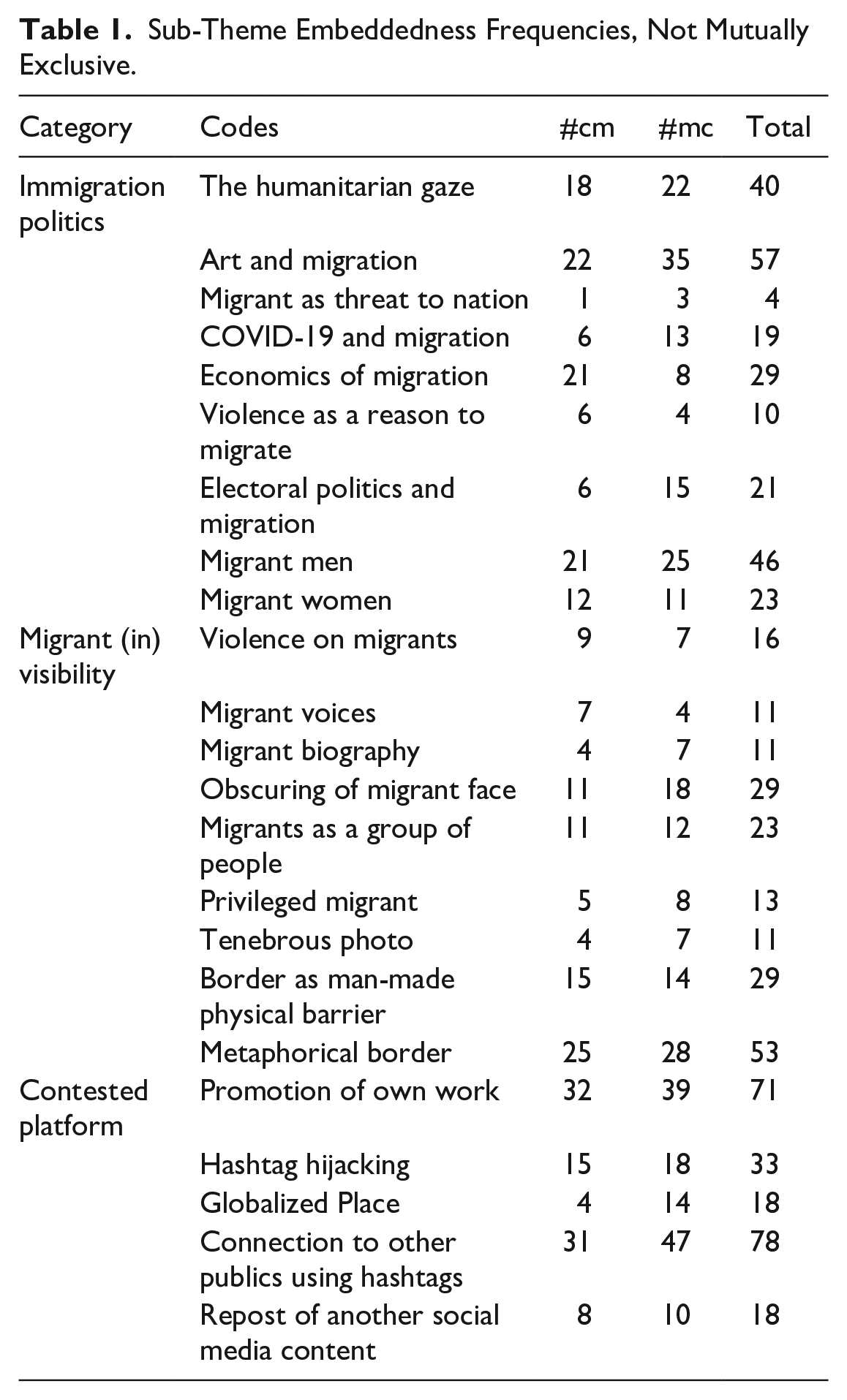
During the rounds of coding and until the final calculation of embedded frequencies, some posts were deleted from Instagram, and as a result were excluded from our dataset. While it is not possible to know if removal was a result of Instagram policies or users’ decisions, we understand that such posts should not be accessed anymore. When four removals happened in the first rounds of coding (one in the English hashtag and three in the Spanish), we replaced the posts with the next posts in line within our bigger sample. However, as removals continued to happen during the course of the project, we noticed it became counterproductive to replace them. We were aiming to keep the number of posts to be analyzed intact (n = 100), but our collection of manual posts transformed our sample into a dynamic object, which was last checked on 29 June 2020. The final number of posts that we analyzed was 92, comprising 44 in Spanish and 48 in English.
The Aesthetics of Otherness
The representation of the migrant caravan on Instagram is generated by accounts that sympathize with the movement while also establishing a mediated gap between the user and the migrant. The aesthetic choices regarding representation on Instagram are influenced by Instagram’s own functions—the ways in which Instagram regulates and prioritizes posts and profiles—and by Instagram users’ techniques to acquire likes and follows. Migrants are rarely heard and only partially seen, in part because of their absence from posts, but also because of aesthetic preferences driven by the platform. Their path is not always chronicled, but when it is, it is typically mediated by others. The mediators of the #caravanamigrante and #migrantcaravan communicative spaces are photojournalists, amateurs, advocates, businesses, and not-for-profit organizations (NGOs). Their posts demonstrate a variety of goals that, while matching the platform’s purposes like generating likes and follows, do not always focus on the caravan. As a result, the representation of the migrant caravan on Instagram is connected to numerous other issues and publics as our codes show (see Table 1). In the following sections, we discuss them in detail.
Immigration Politics
Benson (2013) describes the humanitarian frame in immigration news coverage as when immigrants are described as “victims of unjust government policies” (p. 88). Our coding scheme adapted Benson’s frame as the humanitarian gaze. These posts (n = 40) use liberal language to sympathize with migrants and their reasons to immigrate based on universal human rights discourses. For example, one post details the story of Octavio. He is quoted as saying, “We seek refuge because ‘in Honduras they kill us’” (our translation). The post reinforces the message that the migrants leave their country in search of a better life. Most posts coded with the humanitarian gaze generally refer to macro reasons for migrating, such as violence and corruption, rather than micro and personal reasons. As a result, the humanitarian gaze represents the migrant as a product of social forces rather than a shaper. Similarly, the economics of migration code includes the labor of migrants and the economic effects of migration in addition to economic reasons for migrating. Most posts emphasizing the economics of migration came from Spanish hashtag posts (n = 21), suggesting an emphasis on contextualizing the insecurity migrants face in their countries, but also a perhaps unintended connection with neoliberal discourses (Baker-Cristales, 2009). Some posts also discussed migrants fleeing violence in their home (n = 10). Fewer posts (n = 4) present the migrant as a threat to the nation. When posts do so, they use language to present migrants as dangerous to the nation’s way of life or as destabilizing (Chavez, 2013). Almost all posts using this frame did appear with the English hashtag (n = 3). The user @latinosforamerica, for example, expressed excitement about future US Immigration and Customs Enforcement (ICE) raids and used hashtags about sanctuary cities and illegal immigration in a post on 8 March.
The humanitarian gaze is closely associated with the presentation of migrant struggle as art (n = 57). This is especially and overwhelmingly present in posts tagged with #migrantcaravan (n = 35). In other words, the migrant journey became an object of artistic expression, especially in English. Most of the English hashtag posts were from professional and amateur photographers, usually showcasing their work from their personal or institutional profiles. For example, a post featuring a sequence of 10 photos has a caption saying “A selection of images that contributed to winning the [. . .] Awards in London. The series helped to tell the incredibly important story of the Migrant Caravan in 2018. [. . .].” Another post featuring a young migrant girl promotes an art gallery exhibition in New York City on migration. Both posts use hashtags like #fineartphotography and #photography. In this disjuncture, captions may advocate for migrants while the artwork has also the potential to commodify the movement.
Posts relating COVID-19 to migration also are present (n = 19), especially after March 2020. For instance, one post from 19 April by the NGO @xxtap_sol, a mutual aid collective operating in Tapachula, Chiapas, Mexico, states, “If anyone breaks the barricades for Central Park, a park that just weeks ago served as an all day and night space for migrants to sleep, socialize and make money, they are arrested or ticketed.” It is clear that the pandemic does not affect people equally, and that vulnerable social conditions and displacement require immediate answers and support wherever people are. The posts of this NGO further show how immigrant rights movements make use of the #caravanamigrante. While publishing within the Spanish hashtag, they wrote this post originally in English, networking the movement with other publics, such as #BlackLivesMatter. This is a recurring trend in their other posts. On 28 April, the voice of a migrant mother, with subtitles in English, explains how the organization’s work has helped her family successfully reach the United States in a journey that started in Africa. Also in English, some users thank the NGO in the comments and declare help. The language used implies an imagined audience of potential donors. Similarly, English is sometimes instrumentalized within the Spanish hashtag, taking advantage of Instagram’s global reach.
@xxtap_sol is one out of only two profiles to mention LGBTQ+ migrants in a post, listing this population as one of their targets for support in the caravans. In their videos, the movement’s flag also appears sometimes, shaping a limited representation of queer and trans caravans in our sample. In our study, over half of posts using the English and Spanish hashtags depicted men (n = 46) and many fewer posts featured women (n = 23). While very few men were depicted as caretakers of children, they were often represented as solitary or in large groups, a finding discussed later in more detail. Women were often presented as caretakers of children or as part of a family unit. As an exception, there is the appearance of a journalist being interviewed about her TV coverage of the caravan. Gender also appeared in the contrast between women photographers and men migrants, when the image of migrants as a threat was reinforced.
Migrant (In)visibility
The tension of representation of the migrant caravan on Instagram is one between invisibility and visibility. Visibility, however, can still produce the aesthetics of otherness. The journeys and stories of migrants are presented, but in limited ways that often reflect dominant frames in the news media. Depicting harm done to migrants can expose oppressive state violence but also reinforce threat narratives. Migrants on Instagram are otherized with pictures often concealing their faces (though this may be for security purposes) or as obscured figures in the background (n = 29). In captions, migrants are othered by not being identified by name; they are simply called the “migrant.” While their trip, difficulties, and encounters with border security are highlighted, migrant voices are only heard in certain situations (n = 11), usually in videos. Captions are written from the perspective of the poster, not the migrant, echoing the findings of previous research (Thorbjørnsrud & Figenschou, 2016) and suggesting a poster’s gaze. Posts rarely tell the stories of migrants using names, and when they do (n = 11), it is usually from the third-person perspective. However, we must acknowledge the previous aspects may be an attempt to preserve migrant privacy and prevent government surveillance by counterbalancing Instagram affordances.
Furthermore, we found that migrant men were often depicted in large groups. The migrants as a group of people code accounts for this and is embedded in 23 posts. Chávez (2019), along with numerous posters from our analysis, notes that migrants from Central America travel in large groups as a means of security, from attacks and financial extortion. However, once the caravan gained the spotlight in the media, the mass of the caravan was portrayed as a threat to the nation in US right-wing and mainstream media, echoing the “Latino threat” narrative (Chavez, 2013; Cisneros, 2017). In such a context, we noticed two trends. One is that as most of the posts analyzed were sympathetic to the migrant caravan, the Instagram posts featuring men in groups may also reassert the security frame of the caravan as protection from harm. For example, a caption from 13 March said, “Traveling in what was becoming known as the migrant caravans, they could travel safer and more families with small children dared to take on the dangerous journey.” The second trend shows that despite this intention, the presentation of migrants as a group can also contribute to the othering of migrants. These codes stand out as an example of mass-mediated representations influencing social media representation.
Migrants are further othered by the co-presence, and often centering, of privileged travelers in the caravan. We define privileged travelers as the (photo)journalists, activists, and academics who embed themselves with the caravans and include themselves in the stories they are telling. We found these present in 13 posts, slightly more in English (n = 8). While these numbers do not account for all posts published by professionals, with this code our intent is to identify when they make explicit their role as mediators between the migrants and the platform. They create proximity as characters of the stories, speaking out from the position of “travelling professional workers” (Uriely, 2001) who can ultimately be considered tourists with work purposes. We find this characterization important to demarcate the distance of this group of travelers in relation to the migrants themselves in terms of the reasons to join the movement. Such distance occurs despite the apparent intention of some posters to have a sense of belonging, as can be seen in a post of an academic saying “5 years ago I marched in my first migrant caravan” (emphasis added). What the privileged travelers illustrate is a segment of a common Instagram use, the reporting of travels, which on one hand publicizes dimensions of a reality otherwise not easily seen, and on the other hand may reproduce colonial travel discourses embedded in the search for an “authentic experience” and the production of “others” (Smith, 2018).
The platform incentives of Instagram contribute to such othering processes, which cannot be detached from the commodifying processes of posts and experiences through likes and engagement. Highly associated with the posts of privileged travelers are posts (n = 11) that used a color palette and aesthetic that could be best described as tenebrous. Tenebrousness is defined as the aesthetic of dark, shadowy, and obscure lighting and tone when applied to migrant representation. Man-made physical barriers also appeared in almost one-third of the posts (n = 29), mostly taking the form of fencing. For example, in a striking image of migrants taken from outside the fence, a group of migrant men are pressed up against the fence. The post contextualizes the photo saying that the men are waiting for their time to eat, and informing that certain shelters separate women, trans women, and children from men. However, the post does so using a darkly hued black-and-white photo, evoking a gothic, horrific, and even menacing visage, and connecting the movement to #fineartphotography_bw. In this case, the fencing also acts as a separation between the viewer and the migrant, producing an object distance to the figure of the migrant. In another case, the artificial barrier appears in the background, less ominous but ever present, as a migrant family returns from the Greek/Turkish border, present in our sample due to the use of the #migrantcaravan hashtag, as will be further discussed. Both kinds of barriers are visualized as objects in the migrant’s journey, made visible by the tying of migration to borders in posts and media in general.
Tenebrousness does not fit the Instagram aesthetic. Manovich (2016) uses “the term Instagramism to refer to the aesthetics of designed photos on Instagram and other platforms,” which he primarily argues convey mood and atmosphere over representation and emotion. Furthermore, designed photos on Instagram also have qualities of coolness, hipness, and flatness with a high use of pastel colors and gray-neutrals. In our analysis, the migrant journey is portrayed with sadness, resilience, and tenebrous conditions. A series of images from 4 March that could be described as cheery depicts migrant children smiling at the camera. Yet, the images were taken in a border encampment in Matamoros, Mexico, constantly reminding the user of the precariousness of the situation migrants face.
Finally, to account for borders functioning symbolically and affectively in addition to materially (DeChaine et al., 2012), we developed the code of the metaphorical border, tied to the depiction of migrants’ hardness and resilience. More than half of the posts were tagged this way (n = 53), making it the most prominent kind of mediated border we observed. Some posts coded with metaphorical border imply an empathetic barrier between those in Europe and the United States and those attempting to migrate, very often expressing a humanitarian gaze—another way in which bordering produces otherness and difference among migrants (see Figure 1).

Metaphorical border. Photo by @acevedogalante reproduced with permission.
Importantly, the aesthetics of otherness is less present in the Spanish hashtag, where there are fewer posts obscuring faces, featuring tenebrous photos or privileged travelers (Table 1). Collectives’ and NGOs’ posts using the #caravamigrante space to advocate for migrant rights contribute to such results by giving more voice to migrants and raising awareness about their realities, such as a map depicting a walk of 802 hr to reach the US border posted by @lamorada_e on 12 March, or the audio of the mother previously mentioned exemplify. Even when a mass of migrants is depicted, we notice a clear purpose of demonstrating migrants’ resilience, as in a video of 13 April replicated from @xxtap_sol where migrants position themselves as a wall in front of the Mexican police. If we think of the hashtag as just one more space where a multi-platform action and transmedia organizing by grassroot social movements is in place (Costanza-Chock, 2014), what we see materialized with the affordances of Instagram is a result of the domestication (Matassi et al., 2019; Silverstone & Haddon, 1996) of the design of the platform by these groups, and the negotiations resulting from that.
Contested Platform
The call to conduct medium-specific analysis informs the final category of codes, which focus on the affordances of Instagram as a platform. As mentioned earlier, many of the images depicting migrants were posted by professional photojournalists and amateur photographers. In 71 cases, we coded their posts as promotion of own work when the caption of the image mentioned the subjectivity of the photographer or used hashtags that indicated the poster intended for the image to be viewed as a part of a photographer Instagram public hashtag, such as #everydaylafrontera or #reportagespotlight. In addition, we found many migrant-focused NGOs using the platform of Instagram to promote their own advocacy on behalf of migrants, usually calling for financial support, as previous posts discussed exemplify. The high number of posts coded this way strongly suggests that the platform is being used by actors surrounding the migrant caravan and not by migrants themselves. As the majority of the posts are sympathetic to the movement, they work as a way to bring public attention to the causes while also doing self-promotion of their work.
The open nature of a hashtag also allows for the practice of hashtag hijacking. We found this concept inspiring to reflect on what we have seen in the use of #migrantcaravan and #caravanamigrante. More than one-third of the posts clearly hijacked the intent of the hashtag to network with other migrant movements, and intervene opposite opinions, or promote works and businesses (n = 33). Opinions opposing sympathetic views of the migrant caravan appeared in very few posts, all of which were in English. These included the already mentioned post from @latinosforamerica praising the US border patrol with the hashtag #buildthewall, and a post from @losmiamimemes on 12 April promoting misinformation about US politics. The low number of right-wing interventions found may have occurred because of the period of our data collection. In fact, the migrant caravan was not in the spotlight of the mainstream media from February to April 2020, which may have attracted fewer people interested in reframing the discussion on the platform.
However, when it comes to the promotion of their own works, one account posted several times using the English hashtag about the migrant caravan and the COVID-19 pandemic to promote their music—a result of two other Instagram affordances, the use of multiple hashtags, and the repost of other social media content. Other posts coded as economics of migration construct the United States as a place with jobs for migrants. In the Spanish hashtag, many posts are from @sunset_tech_center, a professionalizing school in New York that offers migrants the chance to learn new skills toward a career as a “#tecnicoelectricista” (see Figure 2). They use the hashtag #caravanamigrante as a way to advertise their coursework, imagining an audience of migrants looking for courses in Spanish and skilled work. They also reinterpret the mythology of the American dream to attract students to their school.
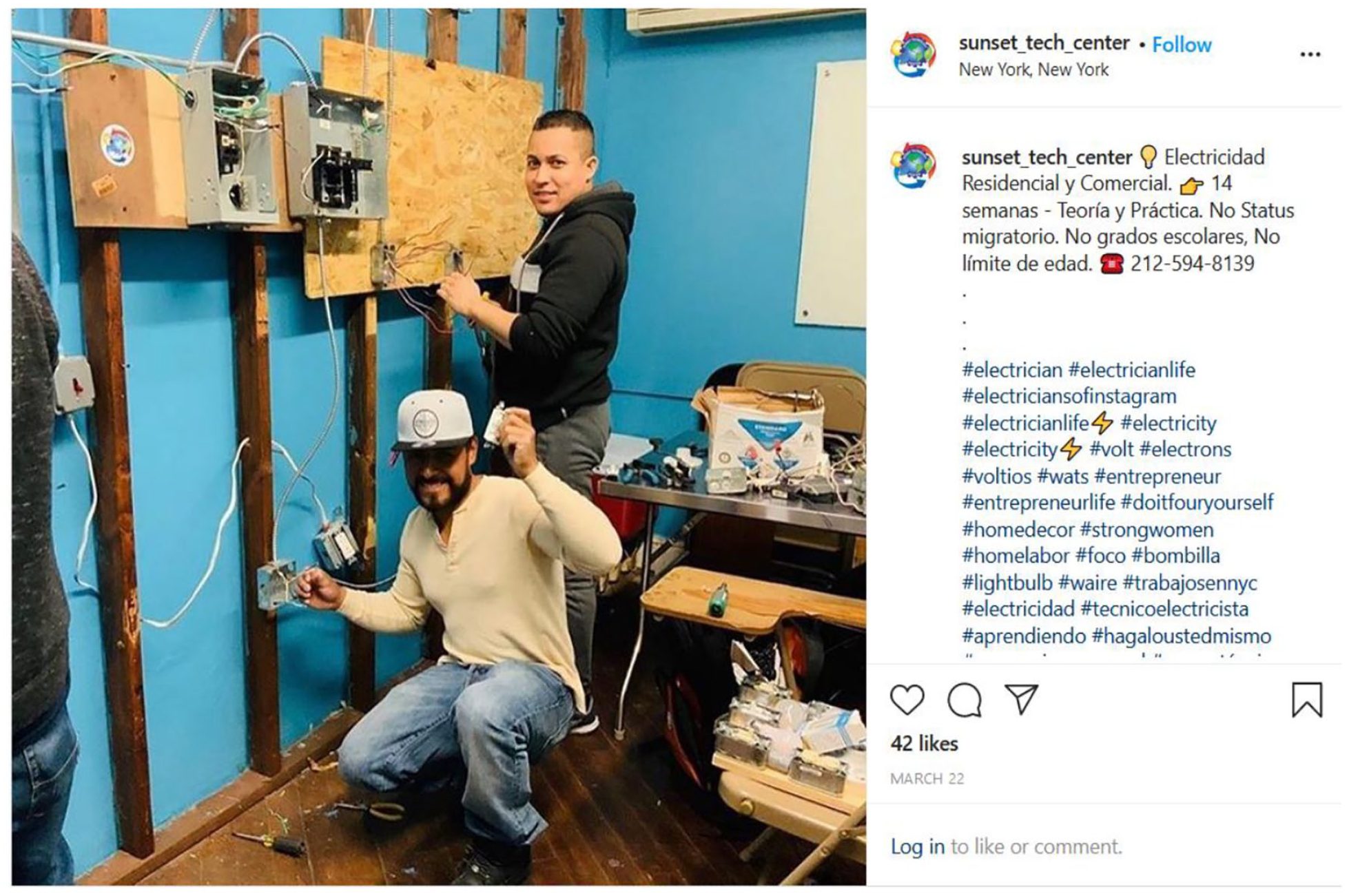
Hashtag hijacking. Photo by @sunset_tech_center, reproduced with permission.
Using hashtags on Instagram also can connect one post to multiple other publics, a fact that generates numerous hashtag citations on the platform. Connection to other publics using hashtags was very common in the posts (n = 78) using both the original English and Spanish hashtag. For example, a post with #migrantcaravan may also use #daca and #fineartphotography to connect the post to the publics of the Deferred Action for Childhood Arrivals (DACA) law and users interested in specific types of photographs. The average of hashtags in both languages is quite high: 18.6 in Spanish and 17.9 in English, generating as a result large connections with other publics that differ considerably among them. In Spanish, the hijacking of the professionalizing school shapes the hashtag networks. Words like #electricity, #electricianlife, #lightbulb dominate the cloud, while #defendthesacred, #humanrights, and #blacklivesmatter also call attention for connecting the movement to Indigenous and anti-racist agendas. In English, beyond #migrant, #mexico, #border, and #refugee, the connection with arts and photography publics stands out with hashtags like #documentary and #photojournalism. While #music and related hashtags result from the most recurrent hijacking in English, interestingly, the representation of publics of the English and Spanish hashtags vary considerably, as the word clouds below demonstrate (Figures 3 and 4).

#caravanamigrante hashtag connections.

#migrantcaravan hashtag connections.
Given platform affordances such as geotagging, Instagram is unique among social media platforms as a medium where place experience can be mediated and re-interpreted (Soto-Vásquez, 2021). In 18 posts, predominantly using the English hashtag (n = 14), the phenomenon of the migrant caravan was used to depict the experiences of migrants around the world. This included Syrian migrants waiting to cross into Turkey and Greece, and Indian migrants living under COVID-19 lockdown. In other words, the English hashtag became an inter-regional communicative space where the journeys of migrants could be connected across different geographic and political contexts, mirroring the use of hashtags to bridge publics. In contrast, the Spanish-language hashtag was more commonly used to speak intra-regionally to the Americas. Here, users seem to approximate different imagined audiences through language use in both text and hashtag. English language posts were more likely to connect with other migratory movements in the European Union, the Middle East and North Africa and in India, and thus speak to a broader politics of global migration. As Jarvis and Connaughton (2005) have discussed in the contexts of elections, even the use of English and Spanish by the same political figure implicates different audiences.
Finally, since Instagram only allows for posts to be uploaded from its mobile phone application, it also affords users the ability to post screenshots and images of other social media content. Furthermore, the repost as it exists in our sample (n = 18) also layers new meaning onto the original social media content. In the hijacking context, two reposts of the user seeking to promote their music on 30 March 2020, showed videos supposedly taken in New York at the peak of the pandemic with dead bodies being placed in trucks. In this COVID-19 spectacle, the aesthetics of death is used to promote a song, adding such intention to the representation of the migrant caravan on Instagram, while purposely hijacking the #migrantcaravan hashtag. Thus, the citation of hashtags means more than the interaction with Instagram algorithms to attract a certain audience to a post. It connects communicative spaces to each other, altering the hashtags’ publics, and in consequence, the representation of social phenomena mediated by them.
Conclusion
One key finding of this study is that in a self-representation and promotion-oriented platform such as Instagram, users posting to #migrantcaravan and #caravanmigrante are rarely migrants themselves. Those photojournalists, organizations, and other professionals who do use the hashtags construct the representation of the migrant caravan on Instagram mostly positively, but with a predominant aesthetics of otherness resulting from the interaction between users’ intentions and the platform’s affordances and economics of corporate social media. Considering the hashtag spaces that have emerged from that, we asked ourselves what makes it possible to overcome otherness. Differences between the English and Spanish hashtag versions shed some light on possibilities. The #caravanamigrante was much more receptive as a communicative space to contextualize the reasons for the movement, and it was more inclined to show migrants’ voices and less inclined to frame them as a threat. At the same time, it consistently used fewer frames that commodify the suffering with art, the obscuring of faces, the tenebrous photos, the privileged traveler, the promotion of own work, and the connection to other publics. In a more comprehensive way, the differences between the English and Spanish hashtags show how different users domesticate the affordances of a platform according to their cultural ideologies and political agendas. In this scenario, immigrant rights movements intervene by also creating multilingual representation and solidarity focused on raising awareness, creating rapport, and incentivizing donations to continue their work. Further research could focus on these specific groups to identify if their strategies go beyond circumventing the aesthetics of otherness, perhaps creating an alternative aesthetics of solidarity.
Within the larger context of both hashtags as spaces of representation of the migrant caravan on Instagram, the kind of activism observed beyond the grassroots movements has limited potential for leveraging broader social changes. Instagram’s commodifying incentives seems to create a specific kind of activism—one that attracts users representing the migrant caravan closer to an artistic genre to be consumed, along with businesses and individuals hijacking, and academics and organizations leveraging awareness based on different purposes. They signal identification with the values of the social movement or even interest in their successful results—which is not necessarily the same as actually advancing a social cause.
There are limitations to our approach. Our glimpse into migrant representation was influenced by the time period we chose to focus on, including the unexpected emergence of COVID-19 at the midpoint of data collection. Our work joins scholarship positing the limits of homogenizing representations and the mediation that prevents voices from being heard. It should caution researchers, designers, and users against ignoring the platform’s role in shaping representations of social justice movements and marginalized groups while also motivating them to continuously and actively shape social media platforms.
Footnotes
Acknowledgements
The authors would like to thank the anonymous reviewers for their perceptive recommendations and inspiring dialogue.
Declaration of Conflicting Interests
The author(s) declared no potential conflicts of interest with respect to the research, authorship, and/or publication of this article.
Funding
The author(s) received no financial support for the research, authorship, and/or publication of this article.
