



Abstract
An online experiment was conducted to examine the causal effects of digital content permanency on perceived anonymity, as well as the correlations between perceived anonymity, perceived consequences of anonymous cyber bullying, normative beliefs about cyber bullying, and cyber bullying intentions. College students in the United States were introduced to a social media platform described as featuring either non-permanent or permanent content. Results showed participants in the non-permanent (vs. permanent) condition were more likely to believe they would remain anonymous. People who believed they could remain anonymous were in turn less likely to believe they would face consequences of anonymous cyber bullying. In addition, normative beliefs about cyber bullying were related to beliefs about facing retaliation and family disapproval. Overall, this study disentangles different concepts related to anonymity and provides causal evidence that a unique feature in digital spaces—content permanency—can impact perceptions of anonymity, which are in turn correlated with factors known to influence cyber bullying intentions.
Social media use has been increasingly popular among young adult, college-age students. Research shows that 84% of young adults (age 18–29 years old) are users of social media (Auxier & Anderson, 2021), and YouTube, Facebook, Instagram, and Snapchat are particularly popular (Perrin & Anderson, 2019). Although social media can benefit users by facilitating social interactions and support (e.g., Nabi et al., 2013), cyber bullying has also been a problem, especially among college students (Doane et al., 2014). Studies have shown that around 9% to 23% college students admit that they have perpetrated cyber bullying and around 9% to 55% college students report being cyber bullied (e.g., Doane et al., 2014). Although the prevalence rates of cyber bullying vary across studies, cyber bullying has been considered as a substantial problem (Kowalski et al., 2014). Therefore, understanding the causes of cyber bullying among college students is critical.
Indeed, research exploring the causes and consequences of cyber bullying has exploded in recent years. Within that body of research, the issue of anonymity has received considerable attention. In general, and across a variety of contexts, people are more likely to behave aggressively online if they believe they can remain anonymous (e.g., Fox et al., 2015; Lapidot-Lefler & Barak, 2012; Zimmerman & Ybarra, 2016). As such, it is important to understand the scenarios that cause people to perceive themselves to be anonymous online, including the mechanisms through which perceptions of online anonymity lead to aggressive behaviors.
In the cyber bullying literature, a number of studies have shown correlations between beliefs about anonymity, beliefs about features of digital environments, normative beliefs about aggression, and cyber bullying behaviors (e.g., Wright, 2013, 2014; Wright & Li, 2013). However, due to the correlational nature of the data, we cannot yet make definitive statements about the cause and effect relationship between specific features of digital environments and perceptions of anonymity. In addition, the concept of anonymity has been conceptualized in multiple ways in the cyber bullying literature, leading to potential confusion. In particular, this study aims to disentangle two different concepts related to anonymity—perceptions of anonymity and perceptions of the consequences of anonymous cyber bullying.
Furthermore, the primary goal of this study is to experimentally test the causal effects of a specific digital media feature—permanency of digital content—on perceptions of anonymity. This study then tests perceived consequences of anonymous cyber bullying (e.g., punishment by authority figures, retaliation, family disapproval, and friend disapproval) and whether those consequences are related to normative beliefs about cyber bullying and cyber bullying intentions. In doing so, this study has the potential to make important theoretical and real-world contributions. If we can better understand how certain digital media feature affects cyber bullying intentions of college students through factors such as perceived anonymity, perceived punishment by authority figures, and perceived family disapproval, we can better harness educational, family, and community institutions to lessen or prevent this form of aggression.
Cyber Bullying Defined
There is a general agreement that cyber bullying is the intentional use of new information technologies to engage in aggressive behavior to harm others (e.g., Doane et al., 2013; Dooley et al., 2009). There is less agreement, however, on additional criteria in defining cyber bullying. For example, some argue bullying only occurs if the aggressive behavior is repetitive (see Olweus, 1993), whereas some research suggests it can be a one-time phenomenon (see Guerin & Hennessy, 2002). Some scholars argue there must be a power imbalance, whereas others say certain technology features (such as anonymity) remove the importance of power structures (see Dooley et al., 2009, for a review). Given this study’s focus on anonymity, we agree that the issue of a power imbalance is less relevant. Furthermore, we are testing the potential for a single aggressive act, consistent with the perspective that bullying can be a one-time event (e.g., Guerin & Hennessy, 2002).
Common examples of cyber bullying include spreading rumors, saying mean things, and sending threatening online messages, among other behaviors. Reducing cyber bullying is an important goal given victims often experience serious negative effects, such as depression, loss of self-esteem, drug and alcohol use, and lowered academic achievement (for a review, see Kowalski et al., 2014). Broadly speaking, cyber bullying research consists of studies exploring how cyber bullying impacts victims (e.g., Palomares & Wingate, 2020), whereas other studies explore the factors that cause an individual to engage in cyber bullying (e.g., Zimmerman & Ybarra, 2016). This study is an example of the latter.
In exploring the causes of cyber bullying, some scholars have drawn from extant research studying offline or in-person aggression. And indeed, individual difference variables appear to increase the likelihood that a person will engage in both offline aggression and cyber bullying, such as high-trait narcissism (e.g., Kowalski et al., 2014). However, online spaces provide users with unique affordances, or possibilities for goal-oriented action (Markus & Silver, 2008), not common in offline spaces. Thus, some of the factors that might increase the likelihood of cyber bullying are unique to online spaces. This study focuses on the following two such features: the permanency of content in the online medium and the anonymity of the aggressor.
Anonymity in Online Spaces
Suler (2004) proposed the “online disinhibition effect,” the idea that individuals “loosen up, feel less retrained, and express themselves more openly” when online (p. 321). According to Suler (2004), both dissociative anonymity and invisibility are factors leading to online disinhibition effects. Dissociative anonymity is defined by Suler (2004) as the ability to hide some or all of one’s identity, for example, withholding one’s name, age, gender, location, and occupation so that one cannot be identified (Lapidot-Lefler & Barak, 2012; Ponesse, 2014). Invisibility refers to individuals not being able to see one another online (e.g., through pictures or videos, Suler, 2004).
Experimental studies suggest anonymity increases the likelihood of aggressive behaviors online. For example, in an experiment by Lapidot-Lefler and Barak (2012), participants were either assigned to an anonymous online account with a fake alias or an identifiable account with personal information. Participants who were in the anonymous condition were more likely to use threatening language in an online debate than participants in the non-anonymous condition. Similar results have been found in experiments comparing anonymous and not anonymous scenarios in the context of online blogs (Zimmerman & Ybarra, 2016) and Twitter (Fox et al., 2015). Thus, the pattern of findings suggests a clear causal connection between anonymity and aggressive and hostile online behaviors.
Although experimental research has demonstrated a link between anonymity and aggressive behaviors online, several questions remain. For example, in the experiments described earlier, participants were specifically informed about their level of anonymity. In the real-world, however, individuals are not necessarily informed about a website’s policies regarding user identification. In addition, as scholars have argued (e.g., Hite et al., 2014), anonymity exists as a continuum, not an either/or situation. It is not the case that all online spaces either fully identify all aspects of a person’s life or keep every single piece of identifiable information hidden. Thus, although these experimental studies provided important evidence of a causal connection between anonymity and aggression online, in real online settings, users come to their own perceptions about their anonymity based on the features of different online environments.
Perhaps because of this, scholars have also employed cross-sectional or longitudinal survey studies to better understand how individuals develop their own perceptions about their anonymity when online. This body of literature has offered various approaches to conceptualize and operationalize the concept “anonymity.” For example, in a longitudinal survey, Wright (2014) included a measure called “beliefs about anonymity,” asking participants how easy it was to remain anonymous on several different platforms (SNS, email, mobile, etc.) when committing aggressive acts. In this study, therefore, “beliefs about anonymity” was a variable focusing on the perceived ease of anonymity. This study also included a variable called “anonymous cyber aggression,” referring to how frequently participants had remained anonymous while engaging in cyber aggression.
In a separate longitudinal study, Wright (2013) included a variable called “beliefs about anonymity” measured with the following two questions: “By being anonymous, I do not fear that these behaviors can lead me to being punished by authority figures” and “By being anonymous, I do not fear that these behaviors can lead to retaliation by the target of the behaviors” (p. 860). Thus, in this case, “beliefs about anonymity” was a variable focusing on the consequences of anonymous cyber bullying (punishment and retaliation).
In a longitudinal survey, Barlett and Gentile (2012) conceptualized anonymity as something individuals learn over time. Their cyber bullying model posited anonymity as an outcome of frequent cyber bullying, arguing that individuals who engage in frequent, repeated acts of cyber bullying will come to learn, over time, that they can remain anonymous. Their measurement asked a variety of questions related to anonymity. For example, similar to the approach taken by Wright (2014), one of the five questions appeared to assess ease of anonymous cyber bullying, asking participants “Sending mean e-mails or text messages is easy to do because I am not face-to-face with the other person” (p. 134). Another question asked participants the likelihood of them sending a mean email or text if their name would be identified. Thus, that item appeared to be measuring one’s likelihood of engaging in cyber bullying if they could remain anonymous.
Taken together, there appears to be several inter-related concepts addressing issues related to anonymity. One is the perceived ease of anonymity, or beliefs about how easy it is to remain anonymous, while engaging in aggression online (Wright, 2014). A separate concept is in the 2013 study by Wright: consequences of anonymous cyber bullying (e.g., retaliation and punishment). Another approach conceptualizes anonymity as an outcome that is learned over time (Barlett & Gentile, 2012). And finally, frequency of engaging in anonymous online aggression has been another concept used in this body of literature (Wright, 2014).
Given these various approaches to anonymity, a primary goal of this study is to disentangle some of these concepts. For example, we approach perceived anonymity similar to Hite et al. (2014), which focused on one’s perception about whether or not they can be identified. This approach separates perceived anonymity itself from the potential consequences of it (e.g., Wright, 2013) as well as potential causes of it (e.g., Barlett & Gentile, 2012). Therefore, we focus on the perception itself and conceptualize perceived anonymity as one’s beliefs about their ability to remain unidentifiable given the features of a specific digital environment (see also Cirucci, 2015). Consistent with the definitions reviewed earlier, this anonymity can be dissociative, invisibility, or both. That is, perceived anonymity can be regarded as a continuum, ranging from the perception of total anonymity (full dissociative anonymity plus complete invisibility) to the perception of no anonymity (being wholly known, both in terms of information and visuals; see Ponesse, 2013). Anonymity is context dependent (Cirucci, 2015) and can produce both negative and socially productive outcomes (Bachmann et al., 2017; Ponesse, 2014).
With a clear focus on anonymity as one’s beliefs about their ability remain anonymous given the features of a digital environment, one goal of this study is to understand how one specific feature of digital environments—the permanency of content—impacts perceptions of anonymity.
The Effects of Digital Content Permanency on Perceived Anonymity
Kowalski et al. (2014) argued that information has “relative permanence” when it “can remain online indefinitely” (p. 1074). Thus, for the purpose of this study, the permanency of content in cyber space is defined as the indefinite availability of content in cyber space. Based on this definition, content online is not permanent if it is erased or disappears at any point in cyber space, a scenario also known as ephemeral content (see Bayer et al., 2016). Social media sites such as Snapchat and Yik Yak feature ephemeral, or non-permanent content, as they erase content after a short period of time (Bayer et al., 2016).
Two longitudinal surveys (Wright, 2013, 2014) suggest beliefs about online content permanency are correlated with perceived consequences of anonymous cyber bullying, perceived ease of anonymity, and cyber aggression. Wright (2013) argued that someone who believes online content will disappear should be more likely to engage in cyber aggression, assuming the evidence of their bad behaviors would be erased. In that study, Wright asked participants whether they thought information in “cyber space” in general was permanent. Results suggested the more participants believed information in cyber space was not permanent at Time 1, the more likely that they thought they would not face consequences of anonymous cyber bullying and that they committed cyber aggression at Time 2. In the second longitudinal study, Wright (2014) found that participants who believed content on specific platforms (SNS, IM, email, mobile phones, and chatrooms) was not permanent at Time 1 indicated higher levels of anonymous cyber aggression on that platform at Time 2.
Given the correlational nature of the aforementioned studies, however, the causal order cannot be determined. In addition, one study conceptualized anonymity as ease of anonymity (Wright, 2014) and the other conceptualized it as consequences of anonymous cyber bullying (Wright, 2013). Therefore, this study employs an experimental method to test the causal effects of online content permanency on perceived anonymity—one’s belief in their ability to remain anonymous.
Scholars have only just begun to theorize the potential relationship between non-permanent or ephemeral media and perceptions of anonymity. Digital media users are increasingly aware that much of their online activities can remain permanent, and that this could lead to negative consequences (Shein, 2013). Ephemeral or non-permanent digital media, however, can facilitate a sense of “forgetting” among users (Bannon, 2006). This proposition is supported by research on attention and memory. For example, research on discussion boards such as 4chan and /b/ suggests that the ephemeral content on these sites can be “out of users’ attentional sphere quickly” (Bernstein et al., 2011, p. 56). Given the role that attention plays in memory encoding (Lang, 2000), short exposure time and low attention levels should indeed lower memory for ephemeral content. Information that can be used to identify the source of the content can also be “forgotten” (e.g., Blanchette & Johnson, 2002). In this sense, ephemeral or non-permanent content can promote a sense of unidentifiability and anonymity.
In addition, non-permanent, ephemeral media can reduce risks associated with data persistence, or one’s data or information being available online indefinitely, and therefore, non-permanent media can give users a stronger sense of privacy (see Kotfila, 2014; Morlok et al., 2018). Research suggests individuals engage in a privacy calculus whereby they weigh benefits and costs before revealing information online (e.g., Dienlin & Metzger, 2016). In the context of online self-disclosure, Ma et al. (2021) found higher perceived ephemerality of social media decreased the perceived negative costs (e.g., privacy intrusion) one might get from disclosing themselves online. Similarly, Xu et al. (2016) found that users of ephemeral social media (Snapchat) had fewer privacy concerns related to engagement in self-presentation. Although this study is not studying self-disclosure or self-presentation outcomes, one can argue that a similar calculus would be conducted prior to cyber bullying. In a permanent medium, one would perceive the potential for increased negative costs of cyber bullying. One such cost would be the loss of privacy, or anonymity. In comparison, users of a non-permanent medium would perceive fewer negative costs of cyber bullying. That is, they would be less likely to fear the loss of privacy, or anonymity. To be fair, there are some slight conceptual differences between the concepts of anonymity and privacy, but both involve identity concealment (Ponesse, 2013). Therefore, one can argue that when using a non-permanent (vs. permanent) medium, users will perceive themselves as being more likely to conceal their identity (i.e., remain anonymous).
Based on the research reviewed earlier, therefore, the following is proposed:
H1. Individuals will have stronger beliefs about their ability to remain anonymous if digital content is not permanent compared to digital content that is permanent.
Perceived Consequences of Anonymous Cyber Bullying
An additional goal of this study is to explore one’s perceptions about cyber bullying consequences when one is perceived to be anonymous. A number of theoretical approaches suggest that if people believe they are anonymous, they are less likely to think that they will face consequences for negative behaviors (e.g., Suler, 2004; Zimbardo, 1969). Social cognitive theory (Bandura, 1986) suggests a wide variety of potential consequences that influence the perpetration of aggression (Perry et al., 1990). This study focuses on the following four potential consequences: punishment by authority figures, retaliation, and facing disapproval from family and from friends. These four were selected because they have been the focus in prior cyber bullying research. Specifically, previous research suggests that sanctions from school authority figures, the possibility of retaliation, and reactions from family and friends are important potential consequences that one might consider for engaging in cyber bullying (e.g., Hinduja & Patchin, 2013; König et al., 2010; Wright, 2013). Therefore, the following are proposed:
H2. The more individuals believe they have the ability to remain anonymous, the less likely they believe they will (a) be punished by authority figures, (b) face retaliation, (c) face disapproval from their families, and (d) face disapproval from friends if they engage in cyber bullying.
The Effects of Facing No Consequences
When an individual perceives themselves as not likely to face consequences, it could alter the way they think about cyber bullying—more specifically, it could potentially alter their normative beliefs about cyber bullying (e.g., Suler, 2004). Normative beliefs are defined as individuals’ thoughts about the acceptability and appropriateness of various behaviors (Huesmann & Guerra, 1997). For example, individuals with high normative beliefs about cyber bullying believe cyber bullying is acceptable, normal, and appropriate. Although normative beliefs develop over time, often through social learning processes (Bandura, 1986), they are not static phenomena and can be situation specific (Huesmann & Guerra, 1997; Rimal & Lapinski, 2015). Furthermore, media play a significant role in impacting the formation of norms, and even subtle exposure to changing normative messages in the media can impact audience norms (Liu et al., 2019). Similarly, based on priming theory (Berkowitz, 1984), recent stimuli can change how norms are used (Huesmann & Guerra, 1997). Different environmental cues can temporarily prime different norms or expectations, and thus, norms can vary in the short-term under different primed circumstances (Bicchieri & McNally, 2018).
Therefore, based on the arguments earlier and from a priming theory perspective (Berkowitz, 1984), one can argue that a short-term change in normative beliefs could occur due to exposure to a new social media platform. If individuals are exposed to a social medium described as being non-permanent, strengthening perceptions of anonymity and beliefs about avoiding negative consequences, it could temporarily impact normative beliefs. This is consistent with the online disinhibition effect model (Suler, 2004), which says under online anonymity, moral sanctions of hostile behaviors are suspended temporarily. Taken together, when presented with an online space on which information is immediately deleted (thereby increasing confidence in anonymity and reducing the fear of negative consequences), one might be more likely to agree that inappropriate, aggressive behaviors are acceptable. Therefore, it is proposed that:
H3. There will be a negative correlation between normative beliefs and believing one will (a) be punished by authority figures, (b) face retaliation, (c) face disapproval from their families, and (d) face disapproval from friends. That is, the less likely consequences are perceived, the more likely they are to have higher normative beliefs about cyber bullying.
Finally, research has shown a positive correlation between normative beliefs and various forms of aggression, including cyber bullying (e.g., Williams & Guerra, 2007). That is, when individuals believe violence and aggression are acceptable, they are more likely to engage in those behaviors (e.g., Huesmann & Guerra, 1997). In a meta-analysis of cyber bullying, normative beliefs about aggression are one of the strongest predictors of cyber bullying behaviors (Kowalski et al., 2014). Therefore, it is proposed that:
H4. There will be a positive correlation between normative beliefs about cyber bullying and cyber bullying intentions.
In combining these hypotheses, this study proposes a mediated model in which digital content permanency is related to cyber bullying intentions as mediated by perceived anonymity, perceived consequences of anonymous cyber bullying, and normative beliefs. Specifically, the following is proposed:
H5. Non-permanent (vs. permanent) digital content will be indirectly correlated with an increase in cyber bullying intentions, mediated by perceived anonymity, perceived consequences of anonymous cyber bullying ((a) punishment by authority figures, (b) retaliation, (c) disapproval from families, (d) disapproval from friends), and normative beliefs.
Method
Participants
Approval for this study was obtained from the Institutional Review Board at an institution and the authors have complied with the American Psychological Association’s ethical standards in the treatment of human subjects. Informed consent was obtained for all participants. A total of 377 undergraduate students from a large midwestern university participated in the study, recruited from their undergraduate courses in exchange for extra credit. Participants were mostly females (n = 272, 72.1%). Others were males (n = 103, 27.3%), a person who identified as “other” in the gender category (n = 1, 0.3%), and a person preferred not to reveal gender identity (n = 1, 0.3%). The majority of participants were Caucasian/White (n = 308, 81.7%), with other participants identifying as Asian-American (n = 24, 6.4%), Hispanic/Latino (n = 5, 1.3%), African-American (n = 6, 1.6%), multiracial (n = 19, 5%), and “other” (n = 15, 4%). Age ranged from 18 to 29 (M = 19.93, SD = 1.42).
Design and Procedure
In both the cyber bullying literature (e.g., Palomares & Wingate, 2020) and in research studying aggression more broadly (e.g., Coyne et al., 2004), a common methodological tactic is to present participants with an aggressive vignette and ask them to imagine how they would respond to a fictitious scenario (see Pieschl et al., 2013, for an in-depth rationale for this approach). In addition, experiments testing causes of aggression (e.g., Coyne et al., 2004) sometimes provoke participants to create a scenario in which an individual might be tempted to engage in aggression. Similarly, this study asked participants to imagine a fictitious scenario in which they are provoked, and therefore, might be tempted to engage in cyber bullying.
In an online experiment, participants were introduced to a fictitious new social media app called “Mascot Chat.”1 Participants were told that to facilitate interactions among undergraduate students at their institution, a new social media platform called “Mascot Chat” was being developed by the university, and their participation in this study would provide helpful feedback for development purposes. All participants were informed that Mascot Chat was designed to resemble a combination of Tumblr and Twitter wherein users could use the homepage to post written messages, pictures, and videos. On the homepage, users could see the posts from all other Mascot Chat users. There would be no “friending” or “following” on Mascot Chat. All posts on Mascot Chat could be viewed by all other users on Mascot Chat.
After reading this description of the general features of Mascot Chat, participants next read one of two versions of a description of Mascot Chat’s content permanency features. In a between-subjects design, participants were randomly assigned to one of the two conditions: either the non-permanency condition (n = 185), in which participants were told that all posts on Mascot Chat would be permanently deleted 30 s after users see them, or the permanency condition (n = 192), in which participants were told that posts would not be deleted and would remain on the website indefinitely.
After the manipulation, participants were instructed to read three hypothetical vignettes related to the usage of Mascot Chat. The first two vignettes served as distractors designed to hide the true nature of the study (one was about the school’s basketball team, and one was about using the platform to obtain help in class). The third vignette created a scenario in which participants might be tempted to cyber bully against someone. Specifically, participants were instructed to imagine they were using Mascot Chat and happened to see a post written by a person with whom they had previously collaborated on a PowerPoint presentation for a class project. It was made clear that the former class project partner was insulting and making fun of the PowerPoint slides the participant had created.
After reading this vignette, participants were asked to complete the study’s measures, described below. Participants were then debriefed. Data of the study would be shared upon request to the corresponding author.
Measures
Cyber Bullying Intentions
Participants first answered 10 questions to indicate their likelihood of cyber bullying against the former group project partner (1 = extremely unlikely, 5 = extremely likely). Questions were adapted from previous research (Doane et al., 2013; Patchin & Hinduja, 2015) and included items such as “I would use Mascot Chat to threaten to hurt that person.” A “cyber bullying intentions scale” was created by averaging the 10 items (α = .91, M = 1.34, SD = 0.55). However, given the non-normality of the scale (Skewness = 2.25, Kurtosis = 5.14), Lg10 transformation was performed. The transformed scale had a normal distribution (M = 0.10, SD = 0.14), and will be used when testing all hypotheses. Higher scores indicated higher cyber bullying intentions.
After measuring cyber bullying intentions, to measure the two mediating variables—perceived anonymity and perceived consequences of anonymous cyber bullying, participants were next asked to imagine what would happen if they did, in fact, use Mascot Chat to engage in cyber bullying. The following instructions were given: On the page prior, you were asked to imagine that you were insulted by a person on Mascot Chat. We also asked you whether you would use Mascot Chat to get back at that person by doing things like making a mean post, uploading mean and hurtful pictures or videos, spreading rumors, and so on. Regardless of how you answered those questions, we would like you to now imagine that you
After reading these instructions, participants reported perceived anonymity and perceived consequences of anonymous cyber bullying, described below.
Perceived Anonymity
Perceived anonymity was measured using seven questions drawn from prior research (e.g., Fisher, 1993; Hite et al., 2014; Rösner & Krämer, 2016) on a 7-point scale (1 = strongly disagree, 7 = strongly agree). The question stem asked participants to report what they thought might happen, imagining they did use Mascot Chat to cyber bully the class project person. Example items included “My behaviors on Mascot Chat would be tracked back to me.” A “perceived anonymity scale” was created by calculating the mean of the seven questions after adjusting for reverse-coded questions (α = .88, M = 3.07, SD = 1.13). Higher scores indicated a stronger belief in perceived anonymity.
Perceived Consequences of Anonymous Cyber Bullying
Punishment by Authority Figures
Again, the question stem asked participants to report what they thought might happen, imagining they did use Mascot Chat to engage in cyber bullying. Participants responded to nine statements assessing whether they believed they would be punished by authority figures (1 = strongly disagree, 5 = strongly agree; for example, Wright, 2013). Question items included “I might be punished by an authority figure at the university.” A “punishment by authority figures scale” was created by averaging the nine questions (α = .94, M = 3.34, SD = 0.97). Higher scores indicated a stronger belief about the likelihood of being punished.
Retaliation
Once again, participants were asked to report what they thought might happen, imagining they did use Mascot Chat to cyber bully the person from the class project. Participants were presented with 11 statements assessing the potential of facing retaliation from the group project person (e.g., Doane et al., 2013; Patchin & Hinduja, 2015; Wright, 2013). Question items included “That person would probably retaliate against me” (1 = strongly disagree, 5 = strongly agree). A “retaliation” scale was created by averaging the 11 questions after adjusting for the reverse-coded item (α = .87, M = 2.93, SD = 0.71). Higher scores indicated a stronger belief about the likelihood of facing retaliation.
Family Disapproval
Once again, participants were asked to report what they thought might happen, imagining they did perpetrate cyber bullying against the group project person. This time, participants reported the potential for facing family disapproval, measured by four statements adapted from prior research (Ahmed & Braithwaite, 2005; Ohene et al., 2006; Wright, 2013). Questions included “My parents would be mad at me” (1 = strongly disagree, 5 = strongly agree). A “family disapproval scale” was created by averaging the four questions (α = .91, M = 4.08, SD = 0.99). Higher scores indicated stronger beliefs in the potential for family disapproval.
Friend Disapproval
Finally, participants also indicated the likelihood that they would face disapproval from friends, imagining they did use Mascot Chat to cyber bully. Participants responded to five statements inspired by previous research (e.g., Hughes et al., 2005; Wright, 2013), with items including “My friends would look down on me” (1 = strongly disagree, 5 = strongly agree). A “friend disapproval scale” was created by calculating the mean of the five questions (α = .92, M = 3.44, SD = 1.01). Higher scores indicated a stronger belief in the potential for friend disapproval.
Normative Beliefs
After the measurements of perceived anonymity and perceived consequences of anonymous cyber bullying, the last section of the survey included normative beliefs and demographic variables. On a 5-point scale (1 = strongly disagree, 5 = strongly agree), participants answered 10 questions taken from previous research (Barlett & Gentile, 2012; Wright, 2014; Wright & Li, 2013) to report their normative beliefs about cyber bullying (e.g., “It is acceptable to tease someone on social media”). A “normative beliefs scale” was created by averaging the questions (α = .85, M = 1.50, SD = 0.62) after adjusting for the reverse-coded item. Given the non-normality (Skewness = 1.66, Kurtosis = 2.92) of the scale, Lg10 transformation was again performed. The transformed scale had a normal distribution (M = 0.15, SD = 0.15) and will be used when testing all hypotheses. Higher scores indicated higher normative beliefs.
Gender
Participants reported their gender on a 4-point scale (1 = male, 2 = female, 3 = other, 4 = prefer not to answer).
Manipulation Check
Participants were asked four questions, on a 5-point scale (1 = strongly disagree, 5 = strongly agree), about the content features of Mascot Chat (“Once you post something on Mascot Chat, it stays there indefinitely”). A “level of permanency scale” was created by averaging the four questions (α = .97, M = 3.05, SD = 1.71). Higher scores indicated that participants believed that Mascot Chat featured permanent content.
For a full list of measurement items and descriptive statistics of major variables, see Table 1.
Measurement Items and Descriptive Statistics for Major Variables.
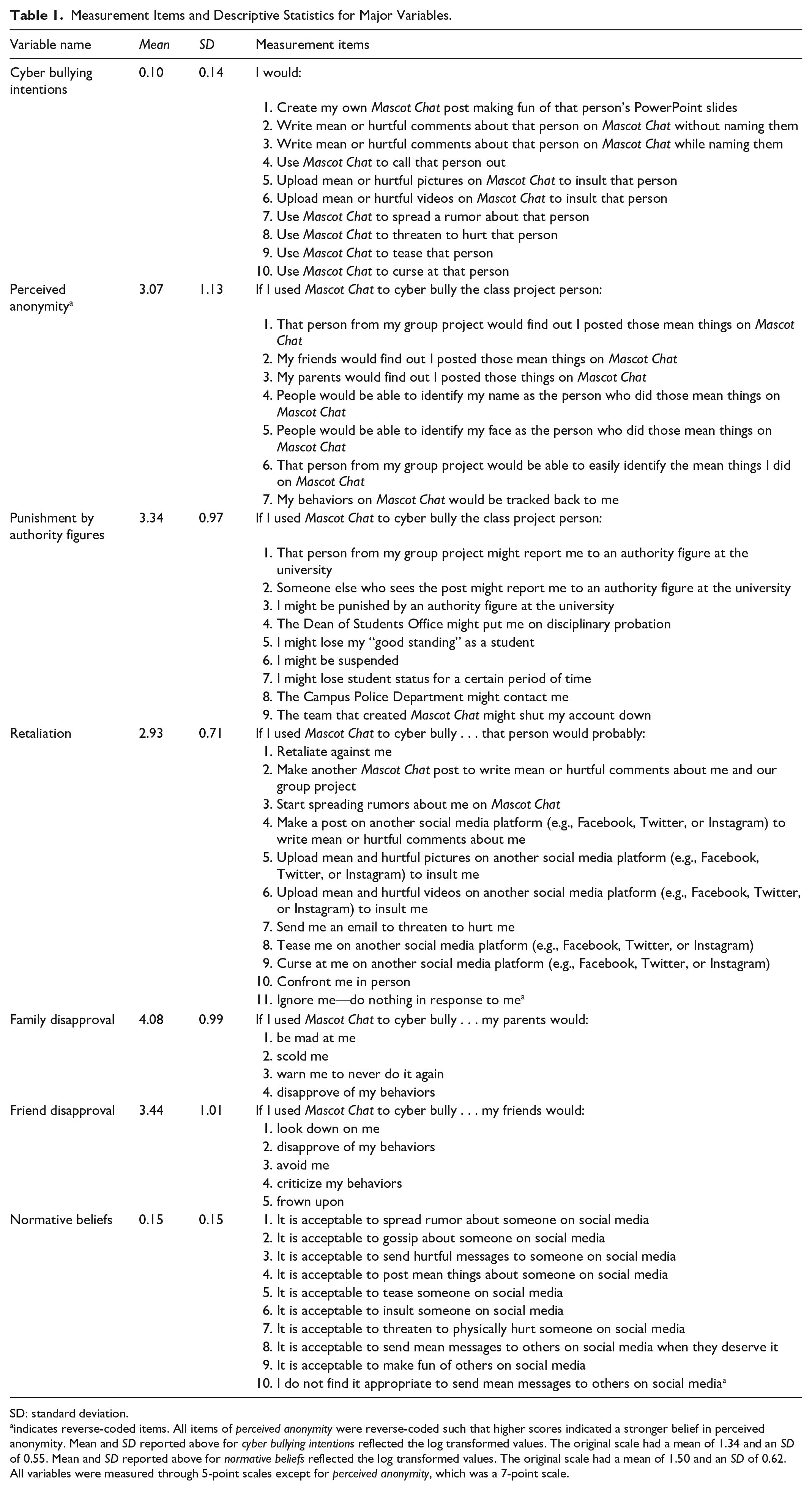
SD: standard deviation.
indicates reverse-coded items. All items of perceived anonymity were reverse-coded such that higher scores indicated a stronger belief in perceived anonymity. Mean and SD reported above for cyber bullying intentions reflected the log transformed values. The original scale had a mean of 1.34 and an SD of 0.55. Mean and SD reported above for normative beliefs reflected the log transformed values. The original scale had a mean of 1.50 and an SD of 0.62.
All variables were measured through 5-point scales except for perceived anonymity, which was a 7-point scale.
Results
Manipulation Check
An independent-sample t-test was examined to check the success of the manipulation. Results showed a significant difference between the two conditions on the “level of permanency scale,” t (339) = 32.78, p < .001. Participants in the non-permanent condition (M = 1.55, SD = 0.99) believed that the content on Mascot Chat was less permanent compared to those in the permanent condition (M = 4.50, SD = 0.73). Therefore, the manipulation was successful.
Hypotheses Tests
To test for mediators in sequence, Model 6 in PROCESS macro for SPSS by Hayes (2017) was used for all hypotheses tests. In initial analyses using 10,000 bootstrap samples, the confidence intervals for the overall indirect effects varied dramatically when rerunning the models, sometimes including 0 but sometimes not. As suggested by other researchers (e.g., Rousselet et al., 2019), this indicates that more bootstrap samples should be used. Therefore, 20,000 bootstrap samples were used in analyzing all hypotheses and the confidence intervals were more consistent upon re-runs.
Four models were run, one for each of the four consequences proposed in Hypothesis 2 (see Figure 1). In all models, the independent variable was the level of content permanency (0 = permanent, 1 = non-permanent) and the first mediator was perceived anonymity. The second mediator varied from model to model, depending on the specific consequence variable in H2. The third mediator in all models was normative beliefs, and the dependent variable in all models was cyber bullying intentions. Participants’ gender was a control variable for all models.
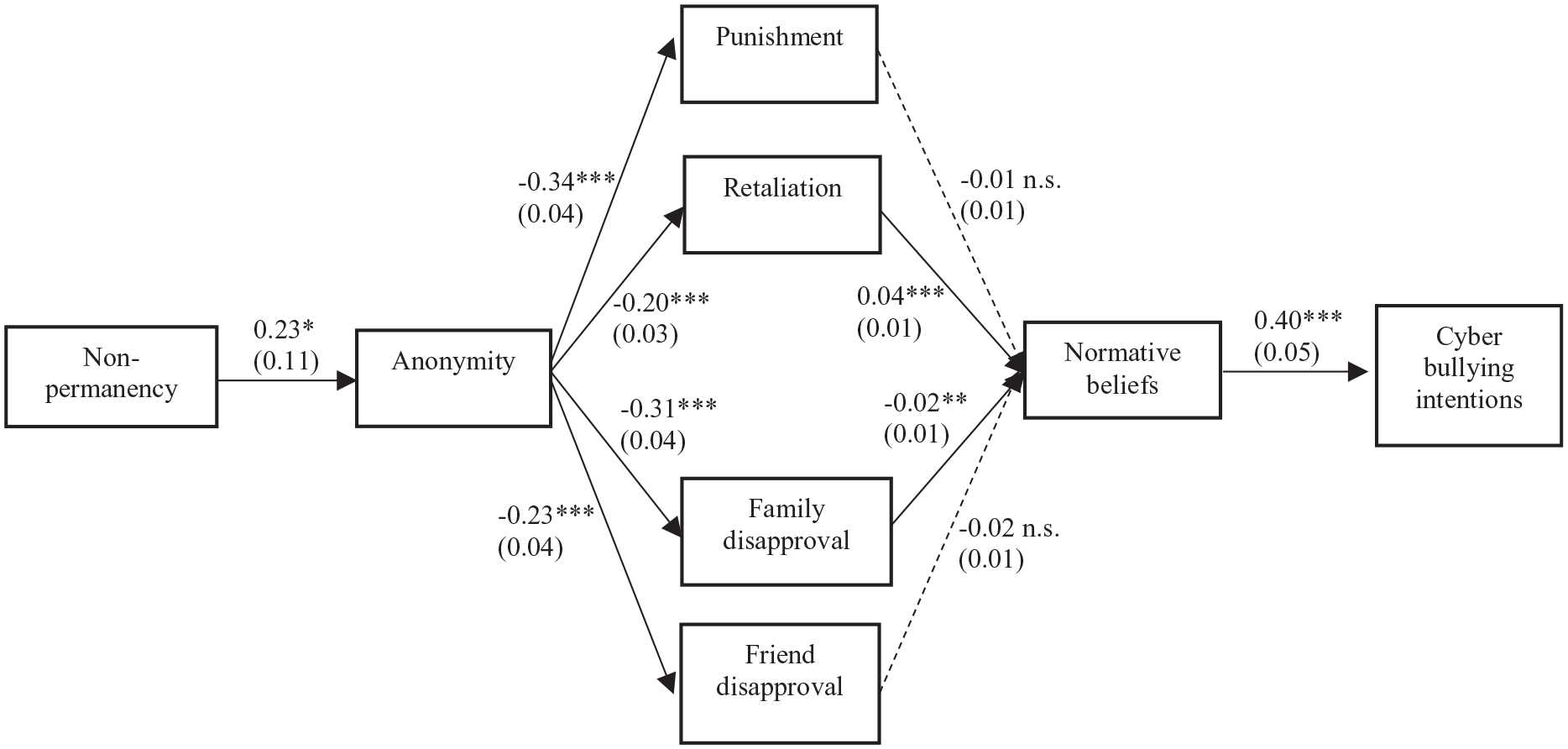
Effects of non-permanency on cyber bullying intentions.
The first model tested route A (see Figure 1), with punishment by authority figures as the second mediator. In terms of H1, results showed a significant and positive effect for the level of permanency on perceived anonymity, b = 0.23, t (374) = 2.00, p = .046, supporting H1. It should be noted that H1 was supported in all four models. Participants had stronger beliefs about their ability to remain anonymous in the non-permanent condition compared to the permanent condition.
In terms of H2a, PROCESS results testing route A revealed a significant and negative correlation between perceived anonymity and beliefs about punishment by authority figures, b = –0.34, t (373) = –8.23, p < .001. Thus, H2a was supported. The more individuals believed they were able to remain anonymous, the less likely they believed they would face authority figure punishment. In terms of H3a, results revealed a non-significant correlation between beliefs about punishment by authority figures and normative beliefs, b = –0.01, t (372) = –1.65, p = .10. H3a was not supported. In support of H4, there was a significant and positive correlation between normative beliefs and cyber bullying intentions, b = 0.40, t (371) = 8.93, p < .001. It should be noted that H4 was supported in all four models. Finally, H5a was not supported; there was no indirect effect of the level of permanency on cyber bullying intentions mediated by the three mediating variables in route A (indirect effect = 0.0004, 95% CI = [–0.0001, 0.001]).
The second model tested route B, with beliefs about retaliation as the second mediator. Results showed that there was a significant and negative correlation between perceived anonymity and beliefs about retaliation, b = –0.20, t (373) = –6.38, p < .001, supporting H2b. The more individuals believed they were able to remain anonymous, the less likely they believed they would face retaliation. However, H3b was not supported. Instead of a negative relationship, there was a significant and positive correlation between beliefs about retaliation and normative beliefs, b = 0.04, t (372) = 3.83, p < .001. The more individuals believed they would face retaliation, the higher normative beliefs they had. Finally, H5b was not supported; there was a significant and negative indirect effect of the level of permanency on cyber bullying intentions mediated by the three mediating variables in route B (indirect effect = –0.0007, 95% CI = [–0.002, –0.00001]). In the non-permanency condition, participants had higher perceived anonymity, and in turn, were less likely to think that the other person would retaliate, and in turn, actually had lower normative beliefs, and finally in turn, had less cyber bullying intentions.
The third model tested route C, with beliefs about family disapproval as the second mediator. Results showed there was a significantly negative correlation between perceived anonymity and beliefs about family disapproval, b = –0.31, t (373) = –7.24, p < .001, supporting H2c. The stronger the perceived anonymity, the less likely individuals believed they would face family disapproval. There was a significant negative correlation between beliefs about family disapproval and normative beliefs, b = –0.02, t (372) = –3.01, p = .003, supporting H3c. The less individuals believed they would face family disapproval, the higher normative beliefs they had. Finally, H5c was supported. There was a significantly positive indirect effect of the level of permanency on cyber bullying intentions mediated by the three mediating variables in route C (indirect effect = 0.0007, 95% CI = [0.00001, 0.002]). In the non-permanency condition, participants had higher perceived anonymity, and in turn, were less likely to think that they would face family disapproval, and in turn, had higher normative beliefs, and finally had higher cyber bullying intentions.
The last model tested Route D, with beliefs about friend disapproval as the second mediator. Results showed that there was a significant and negative correlation between perceived anonymity and beliefs about friend disapproval, b = –0.23, t (373) = –5.11, p < .001, supporting H2d. The higher the perceived anonymity, the less likely individuals believed they would face disapproval from friends. However, H3d was not supported. There was no significant correlation between beliefs about friend disapproval and normative beliefs, b = –0.02, t (372) = –1.95, p = .05. Finally, H5d was not supported. There was no indirect effect of the level of permanency on cyber bullying intentions mediated by the three mediating variables in route D (indirect effect = 0.0003, 95% CI [–0.00004, 0.001]). See Table 2 for a summary of the total effect of non-permanency on cyber bullying intentions, as well as the direct effects and indirect effects for each of the four mediation routes.
Total Effect, Direct Effects, and Indirect Effects of Serial Mediation Models.

LLCI = lower level confidence intervals; ULCI = upper level confidence intervals.
Additional Analyses
Although this study provided evidence of a causal relationship between experimental treatment (permanent vs. not permanent digital content) and perceived anonymity (H1), the remaining findings were based off correlations. It was hypothesized that perceived anonymity impacted beliefs about the consequences of anonymous cyber bullying, which subsequently impacted normative beliefs and then cyber bullying intentions. The order of the consequences variables and normative beliefs might be changed, however. In addition, non-permanency might have a direct effect on additional variables in the model.
To test these possibilities, several additional analyses were performed. First, a series of independent-sample t-tests were computed to see if the independent variable had a direct impact on other variables in the model (the four consequence variables, normative beliefs, and cyber bullying intentions). Results revealed no significant differences (p > .05) when comparing the permanent and non-permanent conditions on any of the other variables. Thus, non-permanency had a direct impact on perceived anonymity but no other variables.
Additional PROCESS analyses (Model 6) were performed to explore possible alternatives in the ordering of the variables. In the initial analyses, Routes B and C were found to be significant, with non-permanency exerting an indirect effect on cyber bullying intentions through perceived anonymity, beliefs about consequences (B = retaliation, C = family disapproval), and normative beliefs. In the case of Route B (retaliation), an alternative model was tested as follows: non-permanency → perceived anonymity → normative beliefs → retaliation → cyber bullying intentions. In this alternative model, all individual coefficients were still significant, suggesting again that normative beliefs, cyber bullying intentions, and beliefs about retaliation were highly correlated with each other. The indirect effect of this model was not significant, however, suggesting that non-permanency did not have an indirect effect on cyber bullying intentions through perceived anonymity, normative beliefs, and beliefs about retaliation in that order. In the case of Route C (family disapproval), the indirect effect was not significant when the model was run as follows: non-permanency → perceived anonymity → normative beliefs → family disapproval → cyber bullying intentions. The models testing Routes A and D (authority figure punishment and friend disapproval) were still not significant when altering the order of the variables in this way.
Discussion
This study contributes to the cyber bullying literature by providing evidence in support of a causal connection between digital content permanency and perceptions of anonymity. Whereas prior research has found a correlational relationship between these concepts (e.g., Wright, 2013, 2014), this is the first study to provide a causal connection. Consistent with what was hypothesized, college students exposed to a social media platform described as having non-permanent (aka ephemeral) content were more likely to think they could remain anonymous compared to college students exposed to the same platform but described as having permanent content.
Furthermore, this study found consistent correlations between perceptions of anonymity and perceptions about the consequences of anonymous cyber bullying. Consistent with past theories (Suler, 2004; Zimbardo, 1969), the more participants believed they could remain anonymous, the less likely they felt they would face each of the following four consequences: punishment from authority figures, retaliation, disapproval from family, and disapproval from friends. It should be noted that another contribution of this article is the clear conceptual separation between perceived anonymity and perceived consequences of anonymous cyber bullying. As mentioned earlier, some prior research (Wright, 2013) has combined these two concepts together. This article clarified the conceptual distinctions between the two concepts.
Interpreting the pattern of findings from the remainder of the analyses is less clear cut, and it should be noted that these findings were purely correlational. Still, some of the correlations were not as expected. For example, the four consequence variables were not consistently correlated with normative beliefs. The only consequence negatively correlated with normative beliefs (as predicted) was family disapproval. Thus, the more participants believed they would face disapproval from their families, the less likely they were to perceive cyber bullying as acceptable. This suggests that family or parents are an important source in affecting beliefs about the appropriateness of cyber bullying, consistent with past research showing that parents play an important role influencing an individual’s normative beliefs (Huesmann & Guerra, 1997). Based on our findings, for example, perhaps individuals who are raised in families that discourage aggressive or bullying behaviors will both (a) hold normative beliefs that cyber bullying is wrong and (b) be concerned about facing disapproval from family if they ever engage in cyber bullying.
Contrary to predictions, beliefs about facing retaliation were positively correlated with normative beliefs. Participants who thought the group project partner would retaliate had higher normative beliefs about cyber bullying. In retrospect, this finding is consistent with findings from previous research. In both face-to-face aggression and cyber bullying context, research has shown that individuals who think that retaliation is appropriate and expected are more likely to engage in aggressive behaviors, suggesting that individuals who find retaliation appropriate and expected also believe that aggressive behaviors are acceptable to do (e.g., Nicol & Fleming, 2010; Zelli et al., 1999). Indeed, based on Huesmann and Guerra (1997), stronger beliefs about retaliation are one of the characteristics of individuals with higher normative beliefs. That is, those who have higher normative beliefs tend to think aggressive retaliation as normal and anticipated. Based on the findings from previous research, therefore, it makes sense that in this study, individuals holding higher normative beliefs tended to believe that retaliation from the group project partner would be normal and to-be-expected.
However, normative beliefs were not correlated with beliefs about friend disapproval. This is unexpected, given that individuals who think that their friends engage in cyber bullying are more likely to engage in these behaviors themselves (e.g., Hinduja & Patchin, 2013). The lack of this connection in this study could be due to the fact that we did not specify the nature of the friends in question. In this study, participants responded to whether “my friends” would disapprove, without information about the nature of the friendship. Prior research suggests the strength and closeness of the peer friendship matter. Specifically, people are less likely to engage in cyber bullying if they have meaningful, high-quality attachments to their friends, but are more likely to engage in cyber bullying if they think that they and their friends are not close (Adiyanti et al., 2020; Wegge et al., 2015). Therefore, cyber bullying disapproval by close friends probably matters more than less-close, casual friends. Future research should explore whether varying natures of friendship matter in terms of moral approval or disapproval on cyber bullying.
Similarly, normative beliefs were also not correlated with beliefs about facing punishment from authority figures. Although one might expect those who find aggression non-normative to be more likely to expect to be punished by authorities if caught engaging in it, our results suggest otherwise. Instead, it appears that participants both high and low in normative beliefs equally expected to face punishment by authority figures if caught cyber bullying. In retrospect, this finding does make sense given the increased attention to the problems associated with cyber bullying in recent years. For example, many universities have created interventions designed to draw attention to and reduce cyber bullying on campuses (e.g., Cunningham et al., 2015). Indeed, many college campuses, including the university where data collection took place in this study, have offices dedicated to the elimination of harassment, including cyber bullying. Thus, it could be the case that all participants, regardless of their personal normative beliefs, have been socialized to expect punishment from authorities at the university if they engage in cyber bullying.
Given the aforementioned correlational findings, only two of the full mediation routes were significant. First, non-permanency had an indirect, positive relationship with cyber bullying intentions as mediated by perceived anonymity, beliefs about family disapproval, and normative beliefs. Second, non-permanency had an indirect, negative relationship with cyber bullying intentions as mediated by perceived anonymity, beliefs about retaliation, and normative beliefs. Again, many of these relationships were correlational. Nonetheless, it is possible that digital content permanency might have a causal impact on cyber bullying intentions. Future research should explore this further.
Practical Implications
Given the connection between content permanency and beliefs about anonymity revealed in this study, parents, educators, and other interested parties should pay close attention to online platforms on which content is deleted (e.g., Snapchat). If these types of environments foster a sense of anonymity, and in turn, the belief that one can aggress without consequences, these could be the online platforms on which cyber bullying is likely common. Parents or educators might want to limit college student use of these platforms, or closely monitor their use, or talk to college students to equip them with the tools to use these platforms responsibly. Parents should be aware of the potential for their children to be both an aggressor or a victim in these types of online environments.
Indeed, our results further support the important role that parents play in the correlation between normative beliefs about cyber bullying and the belief that one’s parents would disapprove if they engage in cyber bullying. Thus, this study suggests that family and parents may play a critical role in cyber bullying interventions and preventions. Of course, other roles in society can assist parents in minimizing cyber bullying. For example, administrators and policy makers can develop regulations that require parent control when college students are online, especially on website where content is deleted. Educators, researchers, and counselors can inform family or parents of the important role they play in reducing cyber bullying, and can motivate them to monitor and intervene their children’s online behaviors.
Limitations and Future Research Directions
This study has several limitations that must be addressed. First, this study was based on responses to a hypothetical vignette, and participant responses to this hypothetical scenario might not reflect what they would do in the real world. In addition, when measuring two of the mediating variables—perceived anonymity and perceived consequences of anonymous cyber bullying, participants were asked to “imagine” that they did engage in cyber bullying. These instructions to participants were designed to facilitate the measurement of participants’ perceptions of anonymity and perceptions of the consequences of anonymous cyber bullying, regardless of whether participants would ever personally engage in cyber bullying. Some participants’ responses might have been affected by the fact that they would never commit cyber bullying, however, and thus future research should attempt to measure these two mediating variables using different methods. Nonetheless, the pattern of correlations between perceived anonymity and perceived consequences of anonymous cyber bullying reflects patterns that align with theoretical predictions, suggesting participants might have been able to accurately respond to these questions despite being hypothetical.
Another limitation is that the scores on cyber bullying intentions and normative beliefs were low and the distributions were skewed. This might reflect social desirability tendencies, with some participants hesitant to admit or unaware of their true beliefs and behaviors related to cyber bullying. Furthermore, the hypothetical scenario used in this study was about a classmate of the participants. Participants may have different answers to the study’s measures if the scenario is about another person (e.g., a total stranger or a close friend). Future research should examine other contexts. In addition, the generalizability of this study is limited, with undergraduate participants who were mostly Caucasians and female. Finally, as mentioned earlier, the relationships found between perceived anonymity, perceived consequences, normative beliefs, and cyber bullying intentions were all correlational. Future research may implement a longitudinal design to better uncover the causal inferences of the relationships between these variables.
Conclusion
Cyber bullying is a serious and prevalent problem. By exploring the possible digital media feature that causes perceived online anonymity and the possible mechanisms through which perceived online anonymity subsequently relates to cyber bullying intentions, this study contributes to the theoretical understanding of cyber bullying and sheds light on actual interventions and preventions. This study also contributes to the conceptual clarity on the concept of “anonymity” by distinguishing between perceived anonymity and perceived consequences of anonymous cyber bullying. In addition, this study also provides insight into normative beliefs about cyber bullying, suggesting parents may play a critical role. Ultimately, it is the goal and hope of this study that cyber bullying can be more effectively prevented and intervened, thereby fostering a healthy and beneficial digital environment.
Footnotes
Declaration of Conflicting Interests
The author(s) declared no potential conflicts of interest with respect to the research, authorship, and/or publication of this article.
Funding
The author(s) received no financial support for the research, authorship, and/or publication of this article.
