



Abstract
The present study examined how individuals describe the nature of interpersonal violence perpetrated against them using the Twitter hashtags #NotOkay and #MeToo. Iterative qualitative coding of 437 tweets resulted in four major themes (i.e., the nature of violence and tactics utilized, the identity of the perpetrator, the location of the assault, and whether the perpetrator was held accountable). Subthemes nested beneath perpetrator identity included whether the perpetrator was known, as well as perpetrator gender identity. Subthemes nested beneath perpetrator tactic included the presence of multiple perpetrators, whether the assault was a crime of opportunity, engagement in physical aggression, utilization of psychological abuse, perpetration of sexual abuse, substance use at the time of the assault (victim and/or perpetrator), whether the abuse persisted, and whether the perpetrator used a weapon. Findings contradict stereotypes that frame interpersonal violence as a single occurrence committed by a stranger who planned an attack using a weapon.
Introduction
Interpersonal violence—defined as violence between family members, intimate partners, acquaintances, and strangers which is not intended to further the aims of a group or a cause (Waters et al., 2004)—is prevalent across the life span, with 43.9% of women and 23.4% of men experiencing sexual violence, and 22.3% of women and 14.0% of men experiencing physical violence during their lifetime (Breiding et al., 2015; Carney & Barner, 2012). Accordingly, the World Health Organization (2021) deems interpersonal violence a global public health concern. Interpersonal violence is linked to myriad negative outcomes, including posttraumatic stress disorder (PTSD), depression, anxiety, disordered eating, and substance use–related conditions (Dworkin et al., 2017; Hedtke et al., 2008). Moreover, both current and lifetime rates of psychological distress are elevated among victims of interpersonal violence compared to victims of non-interpersonal traumatic experiences (e.g., disasters, accidents; Dautenhahn, 2017; Kilpatrick & Acierno, 2003).
The process of disclosing experience of interpersonal violence may facilitate healing and positive psychological well-being, particularly when responses to disclosure are perceived as positive via listening, encouraging, or sympathizing (Taku et al., 2009). Most interpersonal violence victims disclose their experience to at least one person (e.g., Sylaska & Edwards, 2014) and often disclose to more (Ahrens et al., 2021; Filipas & Ullman, 2001). The most common recipients of these disclosures are friends and family (e.g., Ahrens et al., 2021; Fanslow & Robinson, 2010; Orchowski & Gidycz, 2012). Disclosure of interpersonal violence allows survivors to develop a coherent and contextualized narrative of their experience (Harp et al., 2018; Starzynski et al., 2005). Whereas research has investigated various factors associated with in-person disclosure, less is known about factors related to online disclosure.
Numerous studies document factors associated with the in-person disclosure of interpersonal violence. Broadly, assaults involving known perpetrators (friend, romantic partner, family) and substances are less likely to be disclosed compared to those involving verbal coercion, the presence of a weapon, and a perpetrator who is a stranger. For example, among women who experience childhood or adolescent sexual abuse, knowing the perpetrator or having a perpetrator who is a family member predicts delayed disclosure (Kogan, 2004; D. W. Smith et al., 2000). Among individuals experiencing victimization as an adult, the identity of the perpetrator (e.g., friend, boss) and the tactic(s) used to perpetrate violence (e.g., involvement of alcohol and/or physical force) are related to whether or not an individual discloses an experience of interpersonal violence (Demers et al., 2018; Starzynski et al., 2005). Ahrens and colleagues (2010) as well as Ameral and colleagues (2020) found that individuals who refrained from telling someone about their experience of interpersonal violence, compared to those who disclosed, were more likely to know their perpetrators, more likely to have been under the influence of alcohol or drugs during victimization, less likely to be physically injured, and less likely to have experienced violence with a present weapon. In fact, while alcohol use by the perpetrator during the incident related to greater odds of disclosure of both sexual assault and dating violence, the odds of disclosing decreased substantially—by 80%—when victims were older college students and when the perpetrator was a former or current romantic partner (Demers et al., 2018). Orchowski and Gidycz (2012) also found that the occurrence of victim and perpetrator alcohol use at the time of the assault is also positively associated with sexual victimization disclosure. Victims of alcohol-related rape and forcible rape are also equally likely to disclose to someone, while victims of verbal coercion are less likely to disclose (Brown et al., 2009). These studies highlight the importance of the identity of the perpetrator and the context of the assault as critical factors in the decision to disclose.
Perpetrator identity and the tactics utilized to facilitate an assault also impact to whom victims disclose. Among a community sample of adult sexual assault victims, those who experienced assaults perpetrated by strangers, felt their physical safety was in danger, or had a perpetrator use a weapons, were more likely to disclose to both informal (e.g., friends or family) or formal support sources (e.g., police or medical professionals; Starzynski et al., 2005) compared to victims of assaults involving other forms of coercion (e.g., substance) or known perpetrators (e.g., friend). Similarly, studies on sexual assault and dating violence among college students suggest that interpersonal violence experiences are more likely to be reported to the police (in addition to friends and family) when they conform to more “stereotypical assault” scripts—for example, when they include the presence of a weapon, physical force, injury, or an assailant who was a stranger (Fisher et al., 2003; Sabina & Ho, 2014). However, assaults where either the perpetrator and/or the victim used alcohol and/or drugs were more likely to be to friends but not to campus authorities. Broadly, instances of sexual violence which follow the script of a “real rape” (Bondurant, 2001)—involving physical force and perpetrated by strangers—are more likely to be disclosed to formal sources whereas assaults involving substances and known perpetrators are more likely to be disclosed to informal sources.
The type of violence experienced also impacts the likelihood of disclosure (Lelaurain et al., 2017). The Centers for Disease Control and Prevention (CDC; 2021) distinguishes between four types of violence: stalking, psychological, physical, and sexual violence. Stalking is defined as a pattern of repeated, unwanted attention and contact by a person that elicits fear or concern for safety of oneself or someone to the victim. Psychological violence occurs when somebody uses verbal and/or nonverbal communication to harm or exert control over another. Physical violence involves using physical force (e.g., kicking, hitting) to hurt or attempt to hurt a person. Sexual violence involves forcing or attempting to force someone to take part in a sex act, sexual touching, or a non-physical sexual event (e.g., sexting) when the person does not or cannot consent. Victims of stalking disclose more often than victims of psychological, physical, or sexual intimate partner violence (Flicker et al., 2011). Furthermore, women who experience physical or psychological intimate partner violence are more likely to disclose compared to women who experience sexual intimate partner violence (Vatnar & Bjørkly, 2008). In addition, victims are more likely to report psychological abuse when it occurs in tandem with physical abuse (Beaulaurier et al., 2007). However, for women experiencing multiple types of abuse, the co-occurrence of sexual and physical abuse is associated with decreased likelihood of disclosing to family (but not to friends). Separate from type of violence, frequency of violence also impacts disclosure such that increased frequency of violent events is associated with greater likelihood of disclosing (Lelaurain et al., 2017).
Taken together, the results of these studies indicate that interpersonal violence characteristics, especially perpetrator identity and coercion tactic used, impact whether a victim discloses, to whom the victim discloses, and when they disclose. The question remains, why do assault characteristics impact disclosure? Theoretical and empirical evidence highlight the role of interpersonal violence myths in underlying the relationship between assault characteristics and disclosure. Defined as “prejudicial, stereotyped, or false beliefs about rape, rape victims, and rapists” (Burt, 1980, p. 217), rape myths are widely prevalent among individuals, including law enforcement, clergy, and even mental health professionals (e.g., Buddie & Miller, 2001). One of the commonly held rape myths—stranger perpetration—dictates what a rape “should” look like. According to the “real rape” myth, a typical rape is perpetrated by a stranger who uses force or a weapon and physically injures the victims (Bondurant, 2001; Burt, 1980). Similar myths about intimate partner violence victims also exist which serve to “minimize, deny, or justify physical aggression against intimate partners” (Peters, 2008, p. 6). Commonly held myths related to intimate partner violence place blame on the victim if they are verbally aggressive prior to the incident and posit that women are responsible for their abusive relationships (Witte et al., 2006). Rather than exclusively impacting individuals or institutions, these interpersonal violence myths are pervasive in the broader sociocultural context and communicated to victims via dominant narratives, media representations, and stereotypes. Interpersonal violence victims are constantly inundated by these false beliefs before and after the assault occurs. While forming a narrative of their experiences, victims may turn to these widely available beliefs (Lebowitz & Roth, 1994), thereby precluding disclosure of the experience (e.g., Heath et al., 2011).
Whereas much is now known regarding the correlates of in-person interpersonal violence disclosure, individuals are increasingly turning to social media to share experiences of interpersonal violence (Bogen, Bleiweiss, et al., 2021; Bogen et al., 2018, 2019, 2020, 2022; Bogen, Orchowski, et al., 2021; Weathers et al., 2016). A range of social media platforms like Twitter, Facebook, and Reddit have been used by survivors to share experiences of intimate partner violence, sexual violence, physical abuse, workplace harassment, and obstacles to leaving abusive partners (Cravens et al., 2015; McCauley et al., 2018; Scarduzio et al., 2019). Nearly a decade after being founded by Black activist Tarana Burke, the #MeToo movement gained widespread recognition in October 2017, following the sexual assault and harassment allegations against the media mogul Harvey Weinstein. Similarly, the #NotOkay movement caught fire in October 2016 when Canadian writer Kelly Oxford sent out a tweet in response to the Access Hollywood tapes featuring then-presidential candidate Donald Trump discussing “grabbing women by the p**sy.” Oxford called on women to disclose their own experiences of sexual victimization via Twitter. Both movements led to an outpouring of disclosures of personal experiences of interpersonal violence, particularly sexual violence, across social media platforms.
Disclosure of interpersonal violence on social media differs from in-person disclosure in two significant ways. First, online disclosures can be directed toward a private group or broader public (depending on the user’s settings). As a result of the public nature of online self-disclosure of violence, victims risk losing control of who hears their experience and face potential legal consequences such as defamation lawsuits (McDonald, 2019). Second, social media offers victims the opportunity to share their story anonymously. The opportunity to remain anonymous when disclosing on social media may enable individuals a safe forum for accessing resources, connecting with allies and other survivors, as well as potentially receiving emotional support (Lee et al., 2013; McDonald, 2019; Naslund et al., 2016). Those who disclose interpersonal violence online often receive prosocial reactions to their disclosures, including emotional support, advocacy, awareness-raising, validation, and belief (Bogen, Bleiweiss, et al., 2021; Bogen et al., 2019), all of which may facilitate survivor healing.
Preliminary research examining the content of online disclosures suggests that individuals often share descriptions of the perpetrator, the type of assault, the age at the time of victimization, the location of the assault, the perpetrator tactics, beliefs about why the assault occurred, and the emotional impact on the victim when disclosing (Bogen et al., 2018, 2019). However, studies have largely overlooked examining specific details of the identity of the perpetrator, the perpetrator’s relationship to the victims, the type of violence that occurred, and what specific coercion tactics were employed. In addition, studies have not examined whether descriptions of perpetration online diverge from ingrained sociocultural myths about interpersonal violence. Understanding how individuals describe the perpetration of sexual violence on social media holds important implications for women, public health officials, clinicians, educators, advocates, and society at large. Not only does it inform advocacy efforts targeted toward increasing awareness and prevention of interpersonal violence, but it also allows for deeper understanding of the context of interpersonal violence and correction of myths regarding which perpetrator tactics constitute “real” or “legitimate” violence experiences for survivors.
The Present Study
The present study adds to research examining online disclosure of interpersonal violence by characterizing how individuals described factors relating to perpetrators of interpersonal violence using the hashtags #NotOkay and #MeToo on Twitter. Given different forms of violence often co-occur (Wilkins et al., 2014), disclosures under these movements sometimes went beyond sexual violence disclosure and included other forms of violence such as stalking. Whereas prior analyses have sought to provide a broad description of what individuals include in tweets that disclose victimization experiences online, the present study is the first to characterize how individuals describe the perpetrator, perpetration tactics, and perpetrator accountability when disclosing online. Specifically, descriptive analyses sought to understand how individuals describe factors relating to the perpetrator of violence, including the identity of the perpetrator, the behavior of the perpetrator, the types of tactics utilized, the location that the perpetrator chose to perpetrate the assault, any feelings toward the perpetrator of the abuse, and perceived social and institutional responses toward the perpetrator. Analyses were guided by the following research question: how do individuals use social media to characterize perpetration of interpersonal violence? A secondary aim of the study was to examine whether these characterizations of interpersonal violence aligned or departed from ingrained myths (i.e., violence perpetrated by a stranger in an alley with a weapon). Given the descriptive focus of the study, no specific hypotheses were proposed.
Method
Data Collection
Researchers utilized the NVivo Google Chrome toolbar addition NCapture to collect tweets for analysis. Tweets were included in the analyses if they included the hashtags #NotOkay and #MeToo. Further description of the data collection process is described in two previously published studies (Bogen, et al., 2018; Bogen, Bleiweiss, 2021). Tweets including #NotOkay were collected on five non-consecutive weekdays (between 11 and 20 October 2016), whereas tweets mentioning #MeToo were collected across five consecutive weekdays (16–20 October 2017), meaning waves of data collection were conducted approximately 1 year apart. Data were collected from publicly available Twitter accounts, and all potentially identifying information was removed from the dataset prior to coding. Tweets were excluded from the dataset if they were not in English, constituted a “retweet,” were not related to sexual violence perpetration, or consisted exclusively of a link or series of hashtags.
Random samples of tweets were selected for qualitative analysis. For details on the random selection process, see (Bogen, et al., 2018; Bogen, et al., 2019; Bogen, Bleiweiss, 2021; Bogen, Williams, 2021). Tweets in prior datasets were coded using iterative content analysis procedures (Mayring, 2000). Tweets were retained for reanalysis in the present dataset if they mentioned perpetration characteristics broadly, including identifying details related to the perpetrator, descriptions of the method of violence; and location of the experience. A total of 437 tweets across the two hashtags #NotOkay and #MeToo included details about the perpetration of interpersonal violence. This sample size is consistent with previously published qualitative thematic analyses of Twitter data (Bogen, et al., 2018; Bogen, Bleiweiss, 2021; Sharma et al., 2020). The study was considered exempt by the Institutional Review Board.
Data Analysis
Coding was guided by content analysis (Krippendorff, 2004) and deductive thematic analysis (Braun & Clarke, 2006) techniques utilized to identify and organize salient emergent themes. Braun and Clarke (2006) emphasize the six steps to deductive thematic analysis, including becoming familiar with data, assigning preliminary codes to describe the content, searching for patterns across participants, reviewing themes with a team, defining and naming themes, and compiling a report. Deductive thematic analysis enables coders to associate emergent themes with extant literature and theory (i.e., “test” a known theory), such that knowledge gained fills gaps in present understanding of a given topic, such as patterns and characteristics of violence perpetration. Krippendorff’s (2004) content analysis guidelines emphasize the use of communications—such as text matter, messages, and technology-supported social interactions—to address a preconstructed research question. Descriptive analysis hinged upon measures of frequency (counts, percent, and proportion of overall dataset) to establish what themes constituted normative responses (Driscoll et al., 2007). Word counts were generated by the NVivo coding software, which compiled all tweets coded beneath a specific theme heading and provided the most commonly used words per theme.
Consistent with these guidelines, the coding team began analysis and coding as a group to mutually operationalize emergent themes and establish a codebook. Coders began conducting individual coding once additional themes ceased to emerge (i.e., after coding approximately 25% of the dataset). Coders followed Braun and Clarke’s (2006) coding procedures of assigning preliminary descriptive codes and assess patterns across the data before coding individually. The coding team consisted of a primary, secondary, and consensus coder. All coders were familiar with the literature on violence perpetration; the consensus coder had extensive experience conducting Twitter analysis and provided guidance during codebook construction.
Coding resulted in 4 major themes and 18 subthemes. Major themes were established by team consensus related to the unique thematic contribution of each organizing concept (i.e., location vs. tactic) grounded in extant research on factors predicting disclosure of interpersonal violence. Each major theme met a minimum threshold of 15% representation across the dataset (n > 64). Subthemes were considered salient if they were referenced by coders 21 or more times (approximately 4% of the dataset). This cutoff was deemed necessary by the coding team, as the dataset would otherwise have excluded themes exploring important rape stereotypes (i.e., violence-related substance use by either the victim or perpetrator) and is consistent with similar thematic analyses of social media data addressing interpersonal violence (Bogen, et al., 2018; Bogen, Bleiweiss, 2021). Coding was not mutually exclusive, meaning that tweets could be coded across categories. Occurrences of major themes ranged from 77 to 397 times (subthemes 21–320). Counts were established by noting whether a tweet was coded as a theme or subtheme by at least one member of the coding team. The consensus coder established a minimum Cohen’s kappa of 0.61 for themes and subthemes, meeting Landis and Koch’s (1977) convention of substantial to almost perfect intercoder reliability. When intercoder reliability failed to meet a threshold of substantial, coders met to discuss disagreement and reestablish code operationalization to resolve discrepancies. Following conventions in deductive thematic coding, tweets were sorted into thematic categories named based on conventions in the gender-based violence literature. Interrater reliability ranged from very good to excellent, with a Cohen’s kappa of 0.64 to 0.88 across major themes, and a Cohen’s kappa of 0.62 to 1.0 across subthemes. Consistent with best practices in ethical web research, all tweets presented in this article were slightly reworded to ensure the confidentiality of the Twitter user (Ayers et al., 2018).
Results
Four overarching themes emerged in the data, including (1) perpetrator tactic (strategies used by the perpetrator), (2) perpetrator identity (relevant characteristics of the perpetrator), (3) location (where the perpetration took place), and (4) accountability (whether the perpetrator “got away with it”). The 4 major themes, 18 emergent subthemes, and affiliated example tweets are described and operationalized in Table 1. Unless otherwise indicated, percentages below connote the proportion of tweets in the overall dataset characterized as a given theme.
Example Tweets by Theme and Subtheme.
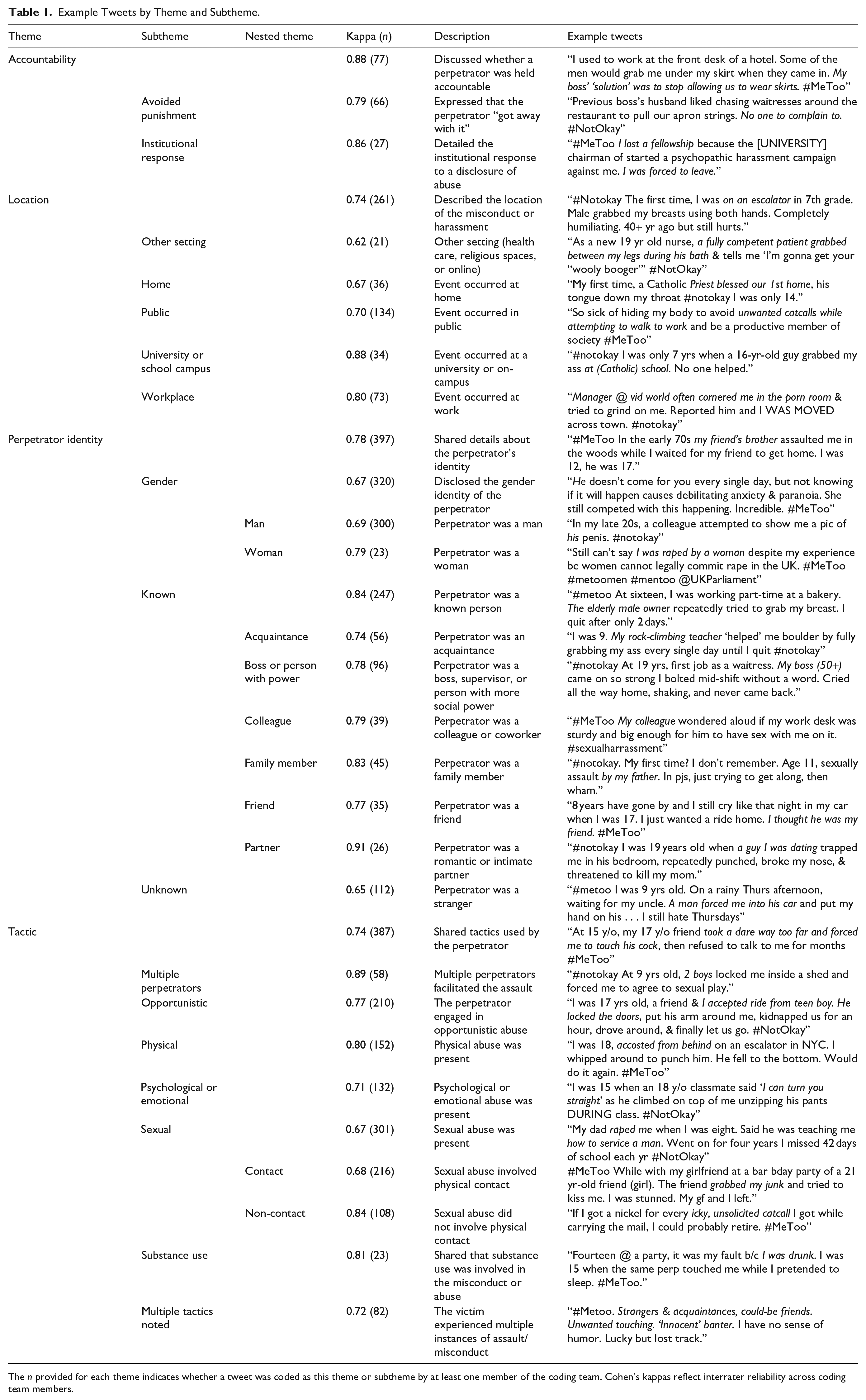
The n provided for each theme indicates whether a tweet was coded as this theme or subtheme by at least one member of the coding team. Cohen’s kappas reflect interrater reliability across coding team members.
Theme 1: Perpetrator Tactic
The perpetrator tactic emerged as a major theme (43.47%), with users sharing specific behaviors in which perpetrators of violence engaged, as well as descriptions of more specific strategies utilized to engage in violence. For example, one user tweeted, “first assault experience—I was 21, walking down a street in Madrid at 3 in the afternoon. Some dude comes up behind me & grabs my ass. He smiled at me.” Subthemes nested beneath perpetrator tactic included whether (a) the incident involved multiple perpetrators (3.49%), (b) was opportunistic in nature (i.e., the perpetrator perceived an opportunity in which they could get away with the abuse, which was not necessarily premeditated) (17.57%), (c) included physical abuse (3.04%), (d) included psychological or emotional abuse (10.02%), (e) included (contact or non-contact) sexual abuse (33.90%), (f) involved (victim or perpetrator) substance use (2.59%), (g) was sustained (i.e., persisted over time or the victim experienced revictimization) (8.75%), or (h) the perpetrator used a weapon (0.56%).
The NVivo coding software word count generator was used to identify commonly used words within each subtheme. These words reflect, descriptively, what was most likely stated within the tweet text and offer some additional insight into the characteristics of the perpetration reported. Notably, reports made via Twitter offer the survivor the opportunity to provide a limited amount of information (up to 140 or 280 characters) about perpetrators. Of tweets that described an incident involving multiple perpetrators, common words included “old” (n = 17), “boys” (n = 11), “men” (n = 10), “rape” (n = 9), “guys” (n = 8), and “assaulted” (n = 7), indicating that men and boys were more likely to perpetrate abuse with others, men perpetrators were frequently older, and instances were largely sexual in nature. Tweets highlighting opportunistic perpetration often included the terms “grabbed/grabs” (n = 60), “man” (n = 41), “old” (n = 35), “guy” (n = 32), and “friend” (n = 29), emphasizing the physical act, the gender and age of perpetrators, and that friends may perpetrate opportunistic abuse. In addition, tweets that discussed physical abuse were likely to include the words, “guy” (n = 7), “punched” (n = 7), “years” (n = 6), and “drunk” (n = 5)—Twitter users highlighted instances of physical abuse perpetrated by intoxicated men. Among tweets discussing psychological and emotional abuse, common words included “guy” (n = 22), “men” (n = 18), “think” (n = 16), “told” (n = 16), and “made” (n = 12), underscoring the messages that were communicated during these forms of perpetration and the identity of the perpetrator.
Within the present dataset, contact sexual abuse (24.32%) was over two and half times more common than non-contact sexual abuse (8.67%; e.g., verbal harassment, unsolicited explicit images). Commonly utilized words included “man” (n = 56), “old” (n = 56), “guy” (n = 53), “grabbed” (n = 48), “age” (n = 44), “sexual” (n = 44), “raped” (n = 43), and “friend” (n = 42), suggesting that sexual perpetration was likely to be committed by older men who made physical contact, and that the victim may have been younger or the perpetrator older at the time of the abuse. Tweets coded beneath the subtheme of substance use most often included the terms, “drunk” (n = 24), “told” (n = 8), “never” (n = 7), “party” (n = 7), “drugged” (n = 6), and “college” (n = 5). Twitter users described use of alcohol and other drugs, the setting of this form of perpetration, and whether victims disclosed their experiences. Tweets discussing whether the violence was sustained often included the words “years” (n = 21), “sexually/sexual” (n = 21), “age” (n = 20), “harassed” (n = 17), “many” (n = 12), and “men” (n = 12), accentuating the frequently sexual nature of repeat perpetration, the age of the victim, the frequency of occurrence, and the likely gender of perpetrators. Finally, commonly used words within tweets that referenced the use of a weapon included “still” (n = 8), “rape” (n = 6), “cold” (n = 3), “digging” (n = 3), “feel” (n = 3), “forcing” (n = 3), and “knife” (n = 3), describing not only the lasting impact of the perpetration but also the sexual nature of the abuse, specific weapons used, and physical sensations associated with the violent experience.
Theme 2: Perpetrator Identity
Three subthemes emerged under the major theme of perpetrator identity (44.49%), including (a) the gender identity of the perpetrator (36.37%), (b) whether the perpetrator was known (27.60%), or (c) whether the perpetrator was unknown (i.e., a stranger; 12.50%). For instance, one Twitter user shared, “because he was my uncle, my family wouldn’t believe me.” Within this dataset, Twitter users were 14.82 times more likely to discuss a man perpetrator (34.12% of the dataset) than a woman (2.59% of the dataset). Most commonly used words within tweets discussing perpetrator gender included “old” (n = 71), “man” (n = 66), “friend” (n = 62), “guy” (n = 60), “men” (n = 60), and “years” (n = 51), indicating that these tweets frequently overlapped with discussions of age, as well as relationship to the victim. Tweets highlighting that the perpetrator was a known person most often included the words “friend/friends” (n = 118), “age” (n = 48), “years” (n = 48), “old” (n = 41), and “raped” (n = 37). Known perpetrators within this dataset included acquaintances, bosses or people in positions of power, colleagues, family members, friends, and romantic partners. Among tweets disclosing that the perpetrator was an unknown person, commonly used words included “man/men” (n = 61), “grabbed” (n = 28), “guy” (n = 27), “street” (n = 18), and “years” (n = 18).
Theme 3: Perpetration of Violence in Specific Locations
The various locations where violence occurred also emerged as a major theme (29.29%). Tweets under this theme included some reference to the myriad locations at which the perpetration of violence occurred. One user tweeted, “I was 15. Guy grabs me @ the homecoming dance and yells in my ear ‘I’ll find you and rape you later.’ Thank goodness he didn’t.” Subthemes nested beneath the major theme of location included (a) public spaces (15.09%); (b) workplaces (8.22%); (c) home (3.95%); (d) schools, universities, or campuses (3.72%); and (e) health care settings (1.13%). Among tweets discussing perpetration that occurred in public spaces, commonly utilized words included “party” (n = 29), “street” (n = 23), and “walking” (n = 18).
Tweets sharing instances of perpetration that occurred at work frequently used the words “job” (n = 21), “work” (n = 21), “boss” (n = 20), “coworker” (n = 10), and “office” (n = 10), indicating not only workplace location but also the role of the perpetrator within the workplace. Tweets discussing workplace perpetration highlighted various forms of interpersonal violence, including contact sexual abuse, non-contact sexual harassment, physical abuse, verbal abuse, and emotional abuse. Tweets discussing perpetration that had occurred within the home frequently also shared details on family involvement with abuse, either identifying relationship to the perpetrator or that there were other victims within the home. Common words included “father” (n = 10), “friend” (n = 10), “house” (n = 10), “sexually” (n = 9), and “sister” (n = 7)—Individuals tweeting about abuse happening within the home were likely to highlight the sexual nature of this abuse, as well as whether and how other family members were involved. Tweets discussing perpetration committed at a school, campus, or university frequently used the words, “school” (n = 18), “college” (n = 16), “boys” (n = 8), “guy” (n = 7), and “teacher” (n = 7), perhaps emphasizing likely perpetrators within educational settings. Finally, among tweets highlighting perpetration within health care settings, common words included “doctor” (n = 7), “abuse” (n = 5), “sexual” (n = 5), and “team” (n = 5). Data were collected during the Larry Nassar trials (the doctor who notoriously perpetrated sexual abuse against women on the U.S. Olympic gymnastics team), which may have impacted commonly used phrases, as well as the emergence of this location as a salient subtheme.
Theme 4: Whether a Perpetrator Was Held Accountable
The major theme of accountability (8.56%) addressed whether a perpetrator was held accountable following their actions. For example, one user shared, “When I was three, I was repeatedly raped by a man who worked at my daycare. I never received justice and had daily nightmares.” Tweets included details of whether perpetrators were punished at or fired from work, excommunicated from families, faced legal charges, or were subject to discipline or sanctions. Emergent subthemes included whether the perpetrator (a) avoided punishment (7.43%) as well as characterizations of an (b) institutional response (2.93%) following a victim’s disclosure of violence. Users highlighted that they had shared their experience with family (especially mothers) and friends and emphasized the concept of belief. Notably, 71.15% of references to the subtheme of institutional responses were characterized by the coding team as an “insufficient response,” meaning that the Twitter user sharing their experience emphasized that this response did not meet their needs (e.g., a perpetrator not being fired from a job where the survivor still worked).
Discussion
The present study highlights how individuals characterized interpersonal violence perpetration via public posts linked to the hashtags #MeToo and #NotOkay on Twitter. Social media is now a common medium through which individuals share experiences of interpersonal violence, and it is vital that research explore the manner in which individuals characterize abuse experiences when disclosing violence experiences online. The current research adds to a growing body of literature examining the characteristics of social media disclosures of interpersonal violence victimization, which encompass a wide range of experiences from harassment to assault. This analysis is unique in its focus specifically on tweets that described factors relating to the perpetration of aggression. Given the brief nature of tweets, which allow for only 140 or 280 characters, the content included is likely that which is most salient to survivors about the violence they experienced, or the interpersonal or societal reactions following (e.g., responses to disclosure regarding perpetrator accountability). Furthermore, given the public nature of these tweets, it is likely that survivors elected to include information that they believed was most important for public awareness, or disclosed elements related to the perpetration about which they sought social support. Analysis revealed four major themes in individuals’ descriptions that are relevant to violence perpetration: the nature of violence, the identity of the perpetrator, the location that the assault was perpetrated, and whether the perpetrator was held accountable for their actions. Characterizations of perpetration, disclosed online, are important because of their potential to shape the public’s understanding of what constitutes interpersonal violence. In the case of #NotOkay and #MeToo, tweets demonstrated a rich and broad range of perpetrators and perpetration tactics that may help individuals feel validated in recognizing their own victimization and seeking support if needed and may combat misperceptions of interpersonal violence that set the stage for negative or dismissive reactions to disclosure.
Several subthemes emerged within the category of the nature of violence. The tactics utilized to perpetrate violence included (in order of frequency) sexual aggression, opportunistic engagement in violence, psychological/emotional aggression, violence that persisted over time, violence that was perpetrated by multiple perpetrators, physical aggression, and the utilization of substances (i.e., alcohol or drugs). Many trends noted in the tactics disclosed were consistent with the literature regarding interpersonal victimization (S. G. Smith et al., 2017). In other words, tactics described within these tweets were similar to tactics commonly investigated by studies focusing on interpersonal victimization. Only six tweets mentioned perpetrator use of a weapon—though assaults involving weapons do represent a small portion of overall victimization endorsed in national samples (S. G. Smith et al., 2017). Those who experience victimization involving a weapon are more likely to make formal reports than individuals assaulted by an armed perpetrator (Feldhaus et al., 2000), perhaps because armed assaults fit common rape stereotypes of perpetrators often using a weapon (Burt, 1980; Peters, 2008). Examination of the content of tweets in each category revealed details of common characteristics of each type of tactic. Friends were particularly likely to be identified as perpetrators in characterizations of opportunistic violence. Subthemes related to alcohol-involved assaults and physical contact offenses diverged from the prevalence literature. Although alcohol use by victim and/or perpetrator is present in over half of sexual assaults (Abbey et al., 2004), it was only mentioned in a small subset of tweets. This may reflect the greater range of interpersonal violence experiences described or may be explained by prior work that finds people are less likely to disclose experiences involving alcohol or drugs (Ahrens et al., 2010). Of note, contact sexual victimization was over two and a half times more likely to be disclosed than non-contact sexual victimization. Contact sexual victimization includes experiences with actual physical touching and non-contact sexual victimization includes experiences without physical touching (e.g., sexual harassment, exposing sexual parts of body to victim). This is somewhat surprising, given that experiences of non-contact victimization (e.g., sexual harassment) are more frequently experienced than contact victimization (Kearl, 2018). This could be explained by the cases of sexual violence described by both Kelly Oxford and Tarana Burke involving physical contact. Additionally, survivors may be less likely to label or report victimization on the non-contact end of the sexual aggression continuum, perhaps because these incidents violate the stereotype of sexual aggression as physically violent. Future work should explore the degree to which fear of negative social reactions guide the content of social media disclosures of sexual victimization.
Regarding perpetrator identity, three subthemes emerged, including gender identity, known perpetrator, and unknown perpetrator. We observed that Twitter users were nearly 15 times more likely to discuss a male perpetrator than a woman. A commonly expressed pattern of sexual violence involved a male perpetrator, often described as older, who made physical contact with a younger victim. There were about twice as many reports of known versus unknown perpetrators. Data from national surveys on sexual violence indicate that unwanted sexual contact, sexual coercion, and rape are all far more likely to occur by known perpetrators (Black et al., 2011). Non-contact unwanted sexual experiences are about equally likely to occur by a known or unknown perpetrator (Black et al., 2011). As has been found in prior work on in-person disclosure (Ahrens et al., 2010; Fisher et al., 2003; Starzynski et al., 2005), individuals may have been more likely to report assaults that involve strangers on Twitter because they fit a more “stereotypical” representation of what people expect. However, given that most tweets represented victimization by known perpetrators, it is possible that schemas related to sexual victimization are changing as many public figures have emerged to disclose victimization by known perpetrators during the #MeToo movement. Particularly, victimization involving perpetrators that have some power over the victims (e.g., boss) or are known to the victims (e.g., coworkers) are less likely to be disclosed in person (e.g., Kirkner et al., 2020). However, our results indicate that such disclosures are more common on social media platforms (given that most common perpetrators that were identified were bosses and coworkers). Hence, disclosure via social media has the potential to reshape public perceptions of interpersonal violence as incidents that violate traditional stereotypes of violence by involving perpetrators known to and perhaps trusted by the victim.
Subthemes nested beneath the major theme of location included public spaces; workplaces; home; schools, universities, or campuses; and health care settings. Qualitative analysis revealed that, rather than reporting on violence that occurred primarily in private settings, reported experiences of violence largely occurred within public settings where the perpetrator could have been caught or was in the presence of bystanders. Such locations highlight the brazen nature of these instances of violence and underscore the potential for effective bystander intervention to disrupt or prevent some of the violence that occurs. Following sexual victimization in public spaces, many survivors report a decreased perception of safety and increased sense of hypervigilance in those spaces, undermining their ability to engage in daily living (Edwards, 2020; Kash, 2019). It is difficult to conclude how representative these experiences are, or whether survivors are more willing to report about violence involving certain characteristics, such as more brazen assaults occurring in public settings.
The major theme of accountability was characterized by tweets about perpetrators avoiding punishment and institutional responses to the perpetration. The most present outcome reported was that the perpetrator avoided punishment or “got away with it.” Most references to the subtheme of institutional responses were characterized as “insufficient responses,” meaning that Twitter users indicated that these responses did not meet survivors’ needs. It is notable that most tweets referencing accountability referred to the lack of accountability that perpetrators experience. Due to the public nature of social media disclosure, others using Twitter and observing content from the #MeToo and #NotOkay movements likely took away the message that there is insufficient perpetrator accountability. Whereas a wish to hold perpetrators accountable may motivate individuals to report assault to police, low confidence that perpetrators will be held responsible for the harm that they cause may lead some to be less likely to disclose to formal recipients. This is supported by prior work indicating that individuals are less likely to report victimization to police if their assault is not seen as highly “believable” or if they believe it would be viewed as their fault (Fisher et al., 2003; Thompson et al., 2007). The lack of accountability that emerges in these situations may also exacerbate victims’ feelings of self-blame. However, public recognition of the need for more perpetrator accountability may lead to increased activist and policy-maker efforts to promote legal and institutional change. By sharing experiences and learning that many people agree with the unacceptability of a given behavior, people may be empowered to demand change. An example of this is the Time’s Up movement that seeks to end workplace sex-based discrimination, including harassment and assault (Maseda García & Gómez Nicolau, 2018). Furthermore, studies investigating the benefits of public sexual assault disclosure have highlighted its role in forging a resilient social advocate identity and reframing the victimization experience, both of which are deemed to be healing for victims (e.g., Gueta et al., 2020). Accordingly, demanding accountability and justice for perpetrators via social media disclosure may be an important component of healing.
Several limitations of the current study should be acknowledged. First, data for both #MeToo and #NotOkay were collected over the course of two week-long periods, during the initial trending of each hashtag movement. Thus, it is unknown of the perpetration characteristics disclosed using these hashtags changed over time as the movements evolved and the discussion around each of them grew. Relatedly, an important consideration is the impact of previous disclosures on subsequent disclosures within these movements. In other words, these were highly visible online movements and individuals may have modeled their disclosure based on what other individuals were sharing. Furthermore, as previously mentioned, Twitter only allows for 140 or 280 characters per tweet. While it is possible that this led survivors to post about the most salient aspects of their experiences, it could also be that certain characteristics were easier to communicate in few words or thought to resonate more with people reading the disclosures, resulting in an unrepresentative set of experiences (e.g., highlight only one prominent tactic, even if multiple tactics may be used). In addition, on Twitter, replies, retweets, and comment threads may contribute to the discussion and shift over time. Many disclosures may occur over a series of tweets (i.e., a thread which may or may not include replies) and include details of myriad forms of violence. As tweets were downloaded from Twitter’s public application programming interface (API), replies from individuals with private accounts were not available. Furthermore, as researchers analyzed a random sample of tweets including #MeToo and #NotOkay, full comment threads were not necessarily included within the randomly sampled datasets.
An additional key limitation is that our analysis focused solely on the content of publicly available tweets and no information about the users who posted those tweets was included. Without being able to ask these users about their demographics, other victimization experiences, or factors that contributed to their decision to disclose (and disclose what information), we cannot know the representativeness of the disclosed elements of perpetration, or reasons why some elements of perpetration were more often characterized than others. For example, gender, sexual orientation, and age impact whether an individual discloses in-person and whom do they tell (e.g., Mennicke et al., 2021; Starzynski et al., 2007). The current study was unable to provide and examine such contextual information. However, we have been able to contextualize these results among other investigations of characteristics that related to in-person disclosure. Although we may postulate that public disclosure on Twitter has the potential to influence cultural norms and beliefs related to sexual violence, the present work did not involve an analysis of whether individuals’ beliefs changed after reading tweets using #NotOkay and #MeToo. Future work should explore how rape myths and other beliefs related to interpersonal violence may change after exposure to numerous social media disclosures that characterize such violence in ways that challenge the idea of a “stereotypical” incident.
The phenomenon of victimization disclosure via social media is rather novel and, as such, little is known about the impact of such disclosure on victims and society. At the individual level, clinicians working with interpersonal violence survivors should be aware of social media as an avenue for disclosure and consider inquiring about such disclosure when assessing the ways that survivors have sought social support related to their experiences of violence. This is important because of the potential for positive reactions to disclosure to facilitate psychological well-being, while negative reactions can lead to harm (Taku et al., 2009). In the case of social media, disclosures are made to a larger number of people than in-person, which may increase the potential for negative comments or threats. Given the high volume of disclosures occurring in these contexts, individual negative comments may receive less scrutiny, and direct messages (i.e., inbox messages) including negative social reactions may be harmful to survivors, yet invisible to other social media users. At the societal level, the high level of participation in the #MeToo and #NotOkay movements may indicate a push by some to shift the culture toward social justice for survivors. This can be conceptualized as a reaction to a lack of accountability that many perpetrators experienced, a core theme revealed in the present work. Furthermore, by disclosing characteristics of perpetration in their tweets, users provided specific examples that may serve to combat the stereotypical image of an unknown perpetrator who uses weapons and causes physical harm (Fisher et al., 2003). Broadening the public’s understanding of what constitutes interpersonal violence perpetration may be beneficial in helping individuals recognize their own experiences as victimization, which could lead them to get connected to helpful services. It may also be indirectly beneficial to survivors, by increasing the likelihood that others to whom they may disclose will believe them and have a positive reaction to their disclosure. Given how integral social media has become in our lives, continued exploration of the impact of social media interpersonal violence disclosure will be an important and growing area for violence research.
Footnotes
Data Availability Statement
The data for the present study will be made available upon request to the corresponding author. There are no sources of funding to disclose. Prior publications of tweets utilized in the present data are noted in the paper. The current study represents a unique analysis of data resulting from the combination of two datasets.
Declaration of Conflicting Interests
The author(s) declared no potential conflicts of interest with respect to the research, authorship, and/or publication of this article.
Funding
The author(s) received no financial support for the research, authorship, and/or publication of this article.
