




Abstract
Empirical accounts point to the increasing weaponization of the “fake news” label—or unwarranted fake news accusations—by politicians to deflect critical reporting and delegitimize media outlets and achieve political ends. While research has begun unpacking the implications of such attacks, little attention has been paid toward avenues to counter them. Drawing upon the literature on misinformation and crisis management research and through an experimental survey (n = 1,460), this study explores strategies that media outlets can employ to protect themselves against unwarranted “fake news” accusations—specifically through various denial and attack responses. Results show that denial strategies significantly increase respondents’ belief in the initial critical report, increase support of the media while conversely decreasing support of the politician. While variants of more offensive attack strategies also led to these anticipated effects, simple denials were found to be more effective in protecting the legitimacy of the media outlet. This suggests that such strategies can constitute a simple first-level measure through which institutions can undertake to challenge unfounded fake news accusations.
Keywords
Introduction
Since the high-profile disruptions of the 2016 US presidential elections by the circulation of false news reports, the problem of fake news and mis/disinformation has acquired much societal salience. International organizations, from the United Nations to the European Parliament, have identified fake news as a current and growing threat (Haciyakupoglu et al., 2018). In contemporary times, however, following the increasing discursive abuse of the “fake news” term by politicians to discredit independent media outlets that challenge official narratives, the label itself has also become a negatively charged term in society. The distinction between fake news effects and fake news accusations follows Egelhofer and Lecheler’s (2019) conception of the fake news research agenda as a two-dimensional communication phenomenon, composing first of the fake news genre—which refers to analysis on the empirical effects of mis/disinformation—as well as the fake news label, which looks into the political weaponization of the term to delegitimize independent journalism outlets and dismiss critical reporting.
As a political tool, the fake news accusation aims to portray media outlets as organizations that deliberately spread misinformation to mislead audiences (Albright, 2017). Prominently, these include US President Donald Trump’s social media rhetoric and his infamous ridicules of the mainstream press through derogatory labels such as “fake media,” which Ross and Rivers (2018) argue is aimed at positioning himself as the sole source of truth. Unfounded “fake news” accusations against the media portend a slew of negative effects on the industry such as lowering its credibility and trustworthiness among the public (Farhall et al., 2019). However, Lischka (2019) notes that the journalism industry has often missed the opportunity to refute, rebut, or otherwise defend themselves from such unfounded attacks. Indeed, Egelhofer et al. (2020) show how journalists have been unwittingly “normalizing” such discursive use of fake news over time without problematizing it, contributing not only to the term salience but also to a questionable normalization process (see also Tsfati et al., 2020). While emergent research has begun unpacking the implications of unjustified “fake news” accusations against media outlets, little attention has been paid toward avenues to counter such attacks even as the term is being increasingly exploited by state actors to attack the journalism industry across the world.
To that end, this study seeks to explore strategies that media outlets and other targeted outlets such as civil society can employ to defend themselves against unwarranted “fake news” accusations. The rise of fake news and mis/disinformation is very much associated with social media, with the connectivity giving rise to the ability to spread false information rapidly, and with enclosed communities on social media facilitating echo chambers. It is in this context that this study sets out to analyze an aspect of the fake news crisis—the abuse of the “fake news label” leading to declining media trust—and understand how we can address this problem. Furthermore, newspapers all have social media presences, and understanding how we can refute politicized and “false” fake news attacks online is important.
This study thus has two key focuses: first, in response to an unwarranted “fake news accusation,” what discursive or rebuttal strategies can media outlets employ to defend themselves against these unwarranted accusations? Next, to what extent are these various strategies effective in influencing citizen’s support and trust toward not just the media, but also the politician?
These questions are addressed using an online survey experiment (n = 1,460) in the United States. The experiments used two real-world scenarios involving the use of unwarranted “fake news accusation” by US President Donald Trump against media outlets in the United States to deflect critical reporting about him. 1 Specifically, in the experimental setup, half of the respondents were randomized into viewing a report about Trump accusing the New York Times (NYT) of “fake news” regarding a recent NYT investigation which revealed that Trump had paid no federal income taxes for 10 of the past 15 years (Fottrell, 2020); another half was exposed to a report in which Trump accused Fox News of “fake news” over the outlet’s corroboration of a report that he had canceled a visit to pay respects at an American military cemetery outside Paris in 2018 (Aratani, 2020). Subsequently, various denial and attack response treatments attributed to the media outlet were applied to test their effects on the key outcomes of respondents’ belief in the original derogatory report, and support and trust of both the politician and the media outlet.
The results of this study show that denial strategies significantly increase respondents’ belief in the media report, increase support and trust of the media, while conversely decrease support and trust of the politician. In the experiment, variants of more offensive attack strategies also led to these anticipated effects. However, compared with these attack strategies that have been hypothesized to be more effective in the literature (Ki & Nekmat, 2014), simple denials were found to be more effective in protecting the legitimacy of the media outlet, suggesting that the usage of such strategies can constitute a simple first-level measure through which institutions can deploy to challenge unwarranted fake news accusations.
The article is organized as follows. The following section discusses the related literature leading up to the theoretical expectations for this study. The methodological design of this study is then presented. The ensuing sections present results from the online survey experiment, which, respectively, show the effects of a denial strategy in response to an unwarranted fake news accusation, the effects of a more offensive attack strategy, as well as a regression analysis on independent covariates. The final section discusses the implications of the study and presents avenues for future research.
The Discursive Weaponization of “Fake News”
“Fake news” is defined as false information disseminated as news with a malicious intent to deceive, mislead, or confuse (Gelfert, 2018). Fake news has become a negatively charged term in contemporary society, rendering it a powerful discursive tool for politicians who have used it to discredit independent media outlets that challenge official narratives. As a political tool, the fake news accusation aims to portray media outlets as organizations that deliberately spread misinformation to mislead (Albright, 2017). While political actors criticizing the media for being biased is not new, the extent to which it has occurred following the heightened salience of fake news post-2016 US presidential elections is unprecedented. In direct contradiction to societal norms governing democratic dialogue, abuse of the fake news label against media outlets are typically not substantiated with evidence or an explanation (McNair, 2017). Core journalistic authority—or the right to be listened to—is hence challenged. More broadly, the weaponized fake news label can be understood as a way to control the media as a source of information distribution (Jowett & O’Donnell, 2018). Denner and Peter (2017) suggest that the “associated trivialization of a term carrying such negative connotations is problematic and could help to establish it as an uncontested designation for the media.”
While the clearest example of the instrumentalization of the fake news label is by Donald Trump, it has been increasingly exploited by political actors in countries spanning from Hungary, Thailand, to China, whereby state institutions have employed the term to target not just media outlets but also a range of civil society institutions and political dissidents (Humprecht, 2019). The weaponization of the term has fundamental effects on the journalism industry beyond simple political debates, such as impeding the societal function of journalism and altering the bounds of political discourse. For instance, incessant fake news accusations against media outlets can prompt journalists to self-censor in a bid to deflect the pressure, and this has been evidenced even in countries with high levels of press autonomy such as Sweden (Löfgren Nilsson & Örnebring, 2016). In addition, due to the role elite rhetoric plays in priming and setting the agenda, political criticisms can influence how society perceives the accused outlet. Research has highlighted how accusations can increase perceptions of media bias as well as decrease public trust in the journalism industry (Ladd, 2012). Accusing media outlets as being producers of fake news has the effect of silencing future potential dissidents, who would be deterred from voluntarily subjecting themselves to the risk of persecution by reporting on developments contrary to official narratives (Neo, 2019).
Empirically, a limited number of studies has examined the fake news label so far. Lischka (2019) has analyzed how NYT deals with fake news attacks against itself by Trump and finds that although the newspaper perceives these accusations as unfounded attacks on its legitimacy, it misses the opportunity to counter the attacks. In studying Trump’s repeated ridicule of the mainstream press through derogatory labels such as “fake media,” Ross and Rivers (2018) assert that these terms have been deployed with the objective of deterring the public from trusting news reports, many of which are critical of his presidency, and to position himself as the sole source of truth. Across in Southeast Asia and Oceania, Neo (2020) finds evidence of the use of the term by authoritarians to justify censorship and crackdowns against independent media outlets, while Farhall et al. (2019) find that while Australian politicians’ use of the fake news term is rare; it is not only amplified by news media but, concerningly, is seldom contested. They argue that this has negative consequences for public debate and trust in media and political. Indeed, longitudinal research by Egelhofer et al. (2020) shows that journalists have been unwittingly “normalizing” such discursive use of fake news over time without problematizing it, contributing not only to the term salience but also to a questionable normalization process (see also Tsfati et al., 2020).
These studies have shown that fake news is not only about the malicious dissemination of false information, but also how the term is exploited to delegitimize the media to censor dissent and achieve political outcomes. Overall, while there is growing concern about the increase in discursive instrumentalization of fake news, avenues and means to protect media institutions or allow them to counter against such unwarranted attacks remain theoretically underexplored (Egelhofer & Lecheler, 2019). To that end, this study presents an initial examinations of strategies the media can respond to such unwarranted fake news accusations to protect the credibility and legitimacy of these important societal institutions. The next section draws upon the literature on crisis management to discuss theoretical hypotheses and expectations for the study.
Countering “Fake News” Accusations: Hypotheses
Rumors are defined as circulating stories, reports, opinions, talk of uncertain, and/or distorted truth; while seemingly trivial, the right rumor at the right time can cause catastrophic damage to any organization (Harsin, 2006). Fake news accusations emerge in the context whereby a political actor refutes a media report about an incident and instead accuses the media outlet of maliciously reporting false information. Assuming that accusations of fake news are unwarranted and false, they can be understood as a type of rumor crisis affecting a media outlet (Coombs & Holladay, 2011). Parallel to traditional rumors crises faced by companies, which have the potential to taint the company’s reputation, sway public opinion against the company and cost declines in revenue; false accusations of fake news against a media outlet can similarly sow distrust among the public toward the outlet, erode the outlet’s credibility, and also lead to lost revenues.
Media outlets may choose not to respond to fake news accusations against them, as they know that those claims are factually incorrect and will eventually die out. However, this might backfire if enough of the public develop a shared perspective and communicate about it (Coombs & Holladay, 2013, p. 451). Indeed, when enmeshed in such a “fake news”/rumor crisis, crisis response strategies have the potential to restore the public’s positive assessments and increase supportive behavioral intentions toward the organization (Park, 2017). Refutation strategies can prevent the rise of uncertainty and ambiguity that such attacks generate and lower the public belief of such false accusations (Vafeiadis et al., 2019).
Jin et al. (2020) suggest that when an organization faces false allegations, it can use a denial posture in which the organization denies or rejects any responsibility for the allegation, especially when the accusation is unfounded. The organization can issue a “simple rebuttal” by pointing out its lack of truthfulness and by claiming that the accusations are absurd or false. In addition, “factual elaboration”—providing supporting evidence and details about the incident—is also likely to be useful in obtaining or retaining the support of the audience (Lewandowsky et al., 2012). Therefore, our first set of hypotheses evaluates the effects of denial responses toward unwarranted fake news accusations:
H1a: Denial responses will increase belief in the initial report (which is critical of the politician), increase support and trust in the media outlet, and decrease support and trust for the accuser, compared with the control in which no denials are issued.
H1b: A denial response including factual elaborations will be more effective than a simple denial.
Beyond denial responses, institutions faced with unwarranted fake news accusations can also further adopt an offensive strategy. Attack strategies are considered the most aggressive crisis response strategy that a company can adopt, as it not only denies the veracity of the rumor but also attacks the accuser’s credibility through vilifying the individual who spreads false claims (Kim & Sung, 2014). Within the context of a fake news accusation against a media outlet by a political actor, an attack response would require the outlet to counterattack the source behind the accusation, putting the accuser in unfavorable light and discrediting both the source and its claim (Claeys et al., 2010). Indeed, Lischka’s (2019) research on how the NYT had sought to deflect unwarranted fake news accusations against the outlet by Trump revealed how it sought to employ negative or sarcastic narratives aimed at questioning Trump’s reputation, presenting him as unpresidential and his statements neither trustworthy nor reasonable, although the effects of this was not quantified. Finally, attack strategies can include a threat to use force such as a lawsuit against the accuser; due to the high commitment costs of legal threats, they can have the potential to positively influence the opinion of bystanders as well as discredit any false allegations (Coombs, 2014).
We argue that similar mitigating effects can emerge when media outlets use the attack strategy over a denial strategy when involved in a fake news crisis. Drawing from the theoretical expectations set out above regarding “attack” responses in relation to a fake news accusation, this study would thus test three variants of an attack strategy; in the first variant, the media outlet specifically cites and denigrates Trump’s history of disseminating false information (reputational attack), while in the second variant the media outlet threatens to file a lawsuit against Trump for slander. The last variant tested highlights and problematizes Trump’s usage of “fake news” as a discursive weapon against the media. It draws on recent work by Farhall et al. (2019), who find that news media outlets, when reporting about unwarranted fake news accusations by politicians, generally do not contest “fake news label” terminologies spoken by political elites. They suggest that problematizing the weaponization of fake news by politicians is a potentially useful way of refuting unfounded fake news accusations. Thus, for the second set of hypotheses:
H2a. The various attack responses will increase belief in the initial report (which is critical of the politician), increase support and trust of the media, and decrease support and trust of the politician. Presently, the literature provides little guidance about which variants would be more effective.
H2b. An attack response to a fake news accusation will lead to greater mitigating effects than will a denial response.
The last set of hypotheses pertains to how partisanship affects the evaluation of fake news accusations. Research in persuasion has argued that source credibility is related to attitude formation and change (Pornpitakpan, 2004), and that the communicator’s credibility has a significant influence on the belief in a rumor message (DiFonzo & Bordia, 2007). In addition, Nyhan et al. (2019) show that the source of the message matters in the evaluation of reports, rumors, and counter-rumors, whereby people are more receptive to sources that share their party affiliation or values than those that do not. Taken together, these findings indicate source credibility and partisanship to be a key influence on the effectiveness of rebuttal strategies against unwarranted fake news accusations. Thus, for the final hypotheses:
H3. Political inclination will affect how respondents’ react to the scenarios involving the politician (US President Donald Trump, who is a Republican) as well as the responses by the two media outlets (NYT and Fox News).
Research Design
The current study aims to explore these questions in the context of contemporary domestic American politics; to this end, we used actual real-life new reports, events, and statements issued by US President Donald Trump. We think it both ethically important and relevant to our study design to use real events and quotes where possible, choosing to deviate from the use of hypothetical scenarios as they could inadvertently generate responses that may not fully capture the dynamics of this study’s analysis of public opinion toward polarizing political actors. This study thus employs a 2 × 3 experimental design with main treatments being: the media outlet being subjected to an unwarranted fake news accusation (NYT or Fox News), and type of rebuttal the media outlet issues in response to the accusation (denial, attack or no response). Figure 1 shows this factorial design of our treatments.

Factorial design of experiment.
The treatments with no response message from the media outlets constitute controls that establish a reference for other types of response treatments. The specific wordings of the scenarios are described in the Appendix. While the base scenarios and fake news accusations by Trump were based on real-world events, statements issued by the media outlets in response to the fake news accusation—the various denial and attack responses—are not based on real communication by media outlets, and are instead realistic statements crafted to test this study’s hypotheses. Nonetheless, participants will be debriefed at the end in order to explain the researchers’ role in crafting the response, and its relevance to research on the important issue of fake news and media trust. For this study, our prime dependent variables are participants’ belief in the original news reports that are critical of the politician, trust and support for the politician, and trust and support for the media outlet.
Finally, it is worth reflecting further on the actual design and style of the rebuttals participants were exposed to in this study. In the experiments, participants were asked to read a short news report in which the media outlet reported about Trump accusing the outlet itself of “fake news” over a prior derogatory report it had published of Trump—a form of third-party reporting that is prevalent in contemporary journalism (Aratani, 2020; Fottrell, 2020). The rebuttal variants were then inserted as appendages at the end of the report, with stylistic highlight and emphasis. This experimental design allows for the targeted analysis of the effectiveness of various rebuttal and counterattack strategies in influencing key media legitimacy outcomes. The practical implications of rebuttals such as formatting and frequency considerations would be reviewed in the “Discussion” section.
Participants
Participants were recruited in October 2020 via Prolific, a crowdsourcing platform founded by researchers in the United Kingdom. Similar to Amazon’s Mechanical Turk, this site enables online subject recruitment, yet it specifically aims to meet the needs of academic researchers (Palan & Schitter, 2018). Survey data gathered from Prolific has been successfully employed in a variety of fields, such as psychology (Kim et al., 2017), food science (Simmonds et al., 2018), and economics (Marreiros et al., 2017). Recent studies have verified the quality of the data collected through Prolific. For example, Peer et al. (2017) compared the data quality between Prolific, MTurk, and another site called CrowdFlower, and they found that Prolific-sourced data showed higher data quality than data from CrowdFlower, and comparable to the data from MTurk. Prolific participants, specifically, were found to have lower tendencies to engage in dishonest behavior.
In this study, when recruiting participants via Prolific, we selected two prescreening criteria—nationality and age, to limit the sample to this study’s target audience group—American citizens based in the United States who are eligible to vote. The total sample in this experiment consists of 1,460 participants; 2 53.7% of the participants were female, whereas 45.1% of them were male (0.2% categorized as others). The age of participants was fairly split between three categories; in increasing order, 18–29 (24.5%), 30–40 (33.8%), and above 40 (41.7%). Pertinent to political inclination, the mean of the group is 51.2 across a 0 (left) to 100 (right) spectrum, representing a sample that is fairly moderate, which is important for evaluating the overall validity of the experiment results due to the likely influence of political inclination on participants’ evaluation of the politician, who is Republican. The full effect of political inclination on outcome variables would be controlled for in the later analysis. Descriptive characteristics of demographic variables are presented in the Appendix.
Overall, these demographic profiles are similar to online samples surveyed in other studies conducted in the United Kingdom and United States (Huff & Tingley, 2015). While recent works in the survey research show that while online samples can differ from population-based samples on certain demographic variables (Clifford & Jerit, 2014; Quek, 2021), these authors also show that scholars can still make credible inferences based on online samples. In China, a recent study of the emerging trend toward internet recruitment shows that online convenience samples generate attitude estimates that are highly consistent with national probability samples (Li et al., 2018). Importantly, while working with a nationally representative sample is ideal, it is not required for an experimental setup as the randomized treatments would rule out confounding by omitted variables by design (Horiuchi et al., 2007). To identify treatment effects (the net effect of misinformation/and the consequent correction), we simply look at the difference in means between the experimental groups.
Procedure
First, the ethics consent form mentioned that in this completely anonymous survey, participants would read a news report about US President Donald Trump and be asked to answer what they think about the report and as well as their feelings toward Trump and the media. Upon providing their consent, participants proceed to view a report that describes Trump accusing the media outlet of fake news over a recent report the outlet has published that is critical of Trump. Half of the participants are randomized into viewing the article involving the NYT, while the rest viewed the article involving Fox News. In each scenario, participants are then randomly allotted to one of the five experimental treatments which varies how the media outlet responds to the fake news accusation in the media report (short denial, long denial, attack reputation, attack fake news label, and attack lawsuit).
The five outcome variables are participants’ belief in the initial news report, support for, and perception of truthfulness of the politician, and support for and perception of truthfulness of the media. All outcomes employ a rating scale ranging from 0 to 100, where 0 indicates a complete negative where the respondent does not believe the story/support the politician whatsoever, and 100 indicates a complete positive where the respondent fully believes the story/support the politician.
Afterwards, participants answered demographic variables, including age, gender, race/ethnicity, marital status, education, and income. At the end of the experiment, a debriefing statement clarified the purpose and procedure of the study, and informed participants that while all incidents, responses, and reports were factually curated from real-life events, the various rebuttal statements by the media were realistic hypotheticals. They were also notified that they had an option to withdraw their data if they did not want their responses to be included.
Stimuli
Two factual incidents in contemporary American politics which involved Trump accusing a media outlet of “fake news” over reports that were critical of him—they are an incident in which Trump accused the NYT of “fake news” regarding a prior NYT investigation which revealed that Trump had paid no federal income taxes for 10 of the past 15 years (Fottrell, 2020), and another incident in which Trump accused Fox News of “fake news” over the outlet’s corroboration of a report that he had canceled a visit to pay respects at an American military cemetery outside Paris in 2018 (Aratani, 2020). Contextual details were added to the reports to facilitate reader comprehension, with both reports each totaling four to five sentences.
Five experimental variations were then curated to test this study’s hypotheses: they include a simple denial response in which the media outlet claims that it stands by its reporting, an elaborate denial response which provided more information about the report that was critical of Trump, and three variants attack responses that included the simple denial, as well as a short statement attacking Trump’s history of spreading misinformation, attacking him for abusing “fake news” accusations against the media, and finally threatening to file a lawsuit. The reports were stylized in the form of an abridged news article in which the media outlet reports about Trump accusing the outlet itself of fake news over an earlier derogatory Trump report, with some brief details provided. The rebuttal by the media is then included in bold at the end of the report. We ensured that the report and responses compiled relied on factual sources, and were presented as realistically as possible.
Results: Effect of Issuing Denial Responses
The first hypothesis seeks to investigate the effect of the media outlet issuing a denial response toward a “fake news” accusation by a politician, on the main outcome variables of the candidate’s belief in the original story, as well as support and trust for the politician and media.
Figure 2 displays the means comparisons of the five key outcome variables. The first panel shows the results of respondents’ belief in the initial news story. Relative to the control group in which no response was issued, a denial response from the media increased respondents’ belief in the story, with the mean effect size being 8.2 points on a 100-point scale. The second panel shows that a denial decreased respondents’ support for the politician by 1.6 points, while the third panel shows that a denial also decreased perceptions of truthfulness of the politician by 0.5 points.

Means comparison of outcome variables across two treatment groups.
Conversely, the last two panels show that, relative to the control condition, a denial by the media increased support for the media by 5.8 points, and increased perceptions of truthfulness of the media by 3.9 points.
Analysis of variance (ANOVA) confirms (Table 1) that effects of a denial response on respondents’ belief in the story (p = .001) and support for the media (p = .022) are statistically significant (p < .05), while the effect of a denial on respondent’s perception of truthfulness of the media can also be considered fairly significant (p = .092).
ANOVA p Value Calculation (Welch’s).

*indicates levels of statistical significance.
Simple Versus Elaborate Denial
The second part of the hypothesis compares the difference in effect between a simple denial and an elaborate denial, which provides more supporting information, on the main outcome variables of respondents’ belief in the media story, as well as support and trust for the politician and media.
Figure 3 displays the means comparisons of the five key outcome variables. Relative to the control group, an elaborate denial response increased respondents’ belief in the story by 6.1 points, while a simple denial increased it by 9.3 points. The elaborate denial decreased support for politician by 0.2 points, while the simple denial decreased it by 2.4 points. Relating to perception of politician truthfulness, the elaborate denial increased it by 0.5 points, while the simple denial decreased it by 1.0 points.

Means comparison of outcome variables across the three treatment groups.
Conversely, an elaborate denial by the media increased support for the media by 4.3 points, while the simple denial increased it by 6.5 points. Finally, the elaborate denial increased perceptions of truthfulness of the media by 0.9 points, while the simple denial increased it by 5.4 points.
ANOVA confirms that effects of a denial response on respondents’ belief in the story, support for the media, and perception of truthfulness of the media are statistically significant (p = .003, .05, and .047 respectively), while the effects on politician support (p = .69) and truthfulness (p = .86) are not significant.
In sum, the results of experiment confirm that issuing a denial in response to an unwarranted fake news accusation levied by a politician against the media outlet is effective in fostering belief in the original media report, and increasing public support and perception of truthfulness of the media outlet. While it also leads to a slight decrease in support and trust in the politician, the effects are minimal. Interestingly, the results also show that elaborate denials, while useful in their own right, are considerably less effective compared with simple denials across all outcomes of interest.
Effect of Issuing Attack Responses
The second hypothesis evaluates the effects of three types of attack responses—attack on reputation, attack which cites the fake news label issue and attack involving a lawsuit threat—on the main outcome variables of candidate’s belief in the original story, as well as support and trust for the politician and media.
Figure 4 displays the means comparisons of the five key outcome variables. Relative to the control group in which no response was issued, a reputation attack led to an increase in respondents’ belief in the story by 3.6 points; a fake news label attack led to an increase of 10.3 points, and a lawsuit attack led to an increase of 4.6 points. Regarding support for politician, a reputation attack conversely increased it by 1.5 points; a lawsuit attack also increased it by 2.5 points. Only a fake news label attack decreased support for politician by 3.1 points. Regarding truthfulness of politician, reputation attacks and lawsuit attacks also led to increases of 1.7 points and 2.3 points, respectively, and only a fake news label attack led to a decrease of 2.9 points.
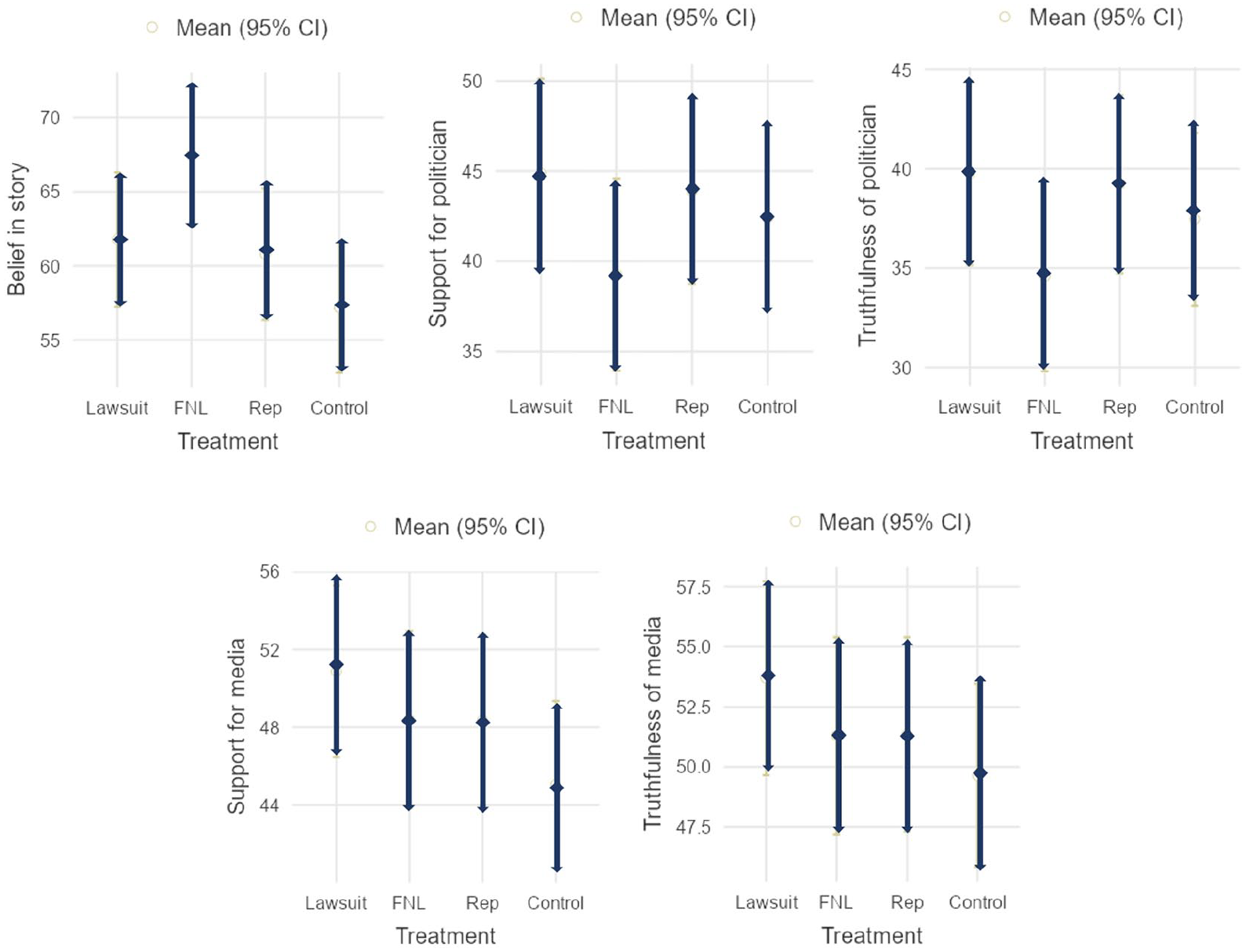
Means comparison of outcome variables across the four treatment groups.
Regarding media outcomes, all attack strategies led to an increase in media support—reputation attack 2.9 points, fake news label attack 2.9 points, and lawsuit 5.8 points. Similarly regarding media truthfulness, reputation and fake news label attacks led to increases of 1.8–1.9 points, while a lawsuit attack led to an increase of 4.1 points.
ANOVA confirms that effects of attack strategies on respondents’ belief in the story is statistically significant (p = .017). As the difference in means comparisons (and thus effect size) for the other outcome variations—support for politician (p = .48), truthfulness of politician (p = .41), support for media (p = .32), and truthfulness of media (p = .56)—are lower, they can only be considered statistically significant in much larger sample sizes.
Attack Versus Denial Responses
The second part of the hypothesis presents a comparison of the effectiveness of attack strategies against denial strategies on the main outcome variables of respondents’ belief in the media story, as well as support and trust for the politician and media.
Figure 5 displays the means comparisons of the five key outcome variables. Relative to the control group, denial responses increased respondents’ belief in the story by 8.2 points, while attack responses increased it by 6.1 points. Denials decreased support for politician by 1.6 points, while attacks increased support by 0.3 points. Relating to perception of politician truthfulness, denials decreased it by 0.5 points, while attacks increased it by 0.4 points.
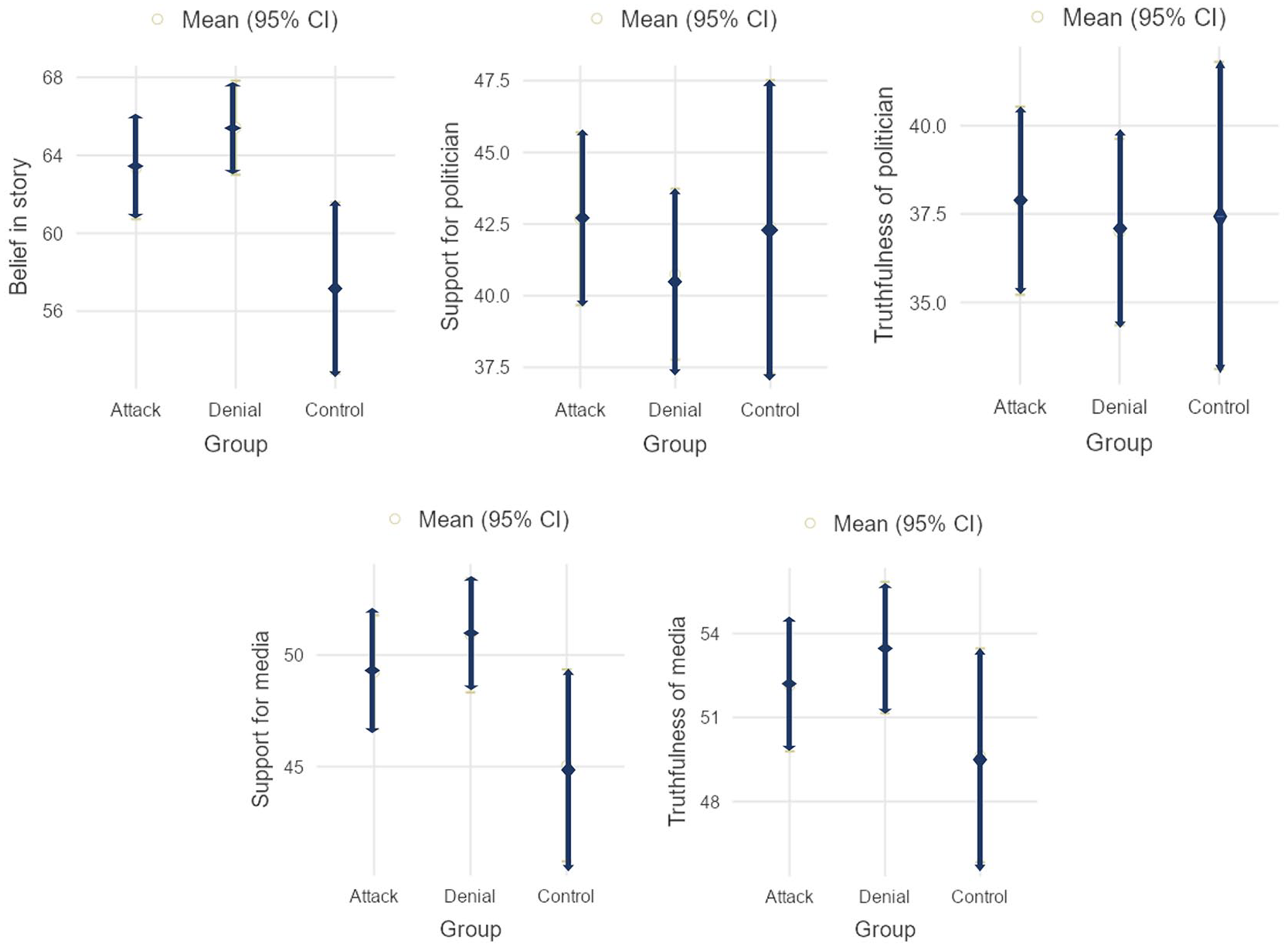
Means comparison of outcome variables across the three treatment groups.
Conversely, denials increased support for the media by 5.8 points, while attacks increased it by 4.1 points. Finally, denials increased perceptions of truthfulness of the media by 3.9 points, while attacks increased it by 2.5 points.
ANOVA confirms that the relationship is statistically significant for respondents’ belief in the story (p = .006) and support for media (p = .07). The rest of the outcome variables—support for political (p = .65), truthfulness of political (p = .90), and truthfulness of media (p = .23)—have smaller effect sizes and are not considered statistically significant.
Overall, the results of experiment confirm that issuing an attack response in the face of unwarranted fake news accusations levied by a politician is effective in increasing belief in the original media report, and increasing public support and perception of truthfulness of the media outlet. The use of lawsuit attacks generated the highest amount of support and trust in the media, while an attack which cites the abuse of the fake news label by politicians is most effective in increasing belief in the story, and decreasing support and trust in the politician. However, when contrasted with denial strategies, attack strategies are less effective in effecting all outcomes of interest.
Effects of Partisanship
Finally, for additional robustness checks and to control for the theoretically relevant variable of political inclination, we ran an ordinary least square regression on respondents’ belief in the story, support, and trust for the politician and media, controlling for a set of covariates. 3 The baseline in the regressions is the control group (no response issued). In the regression models, we include demographic variables including political inclination, gender, age group, education, income level, and marital status. Table 2 shows the regression results.
Outcome Variables, Controlled by Treatment Groups and Covariates.

and ** indicates levels of statistical significance.
The results are consistent with the prior analyses: denial responses are effective in increasing belief in the media report* with an average treatment effect (ATE) of +7.894, have minimal effects on support (−1.116) and trust for the politician (+0.235), and are effective in increasing trust* (+5.833) and support for the media (+3.978). Similarly, attack responses are effective in increasing belief in the media report* (+6.166), have minimal effects on support (+0.569) and trust for the politician (+0.966), and are effective in increasing trust (+2.819) and support* (+4.69) for the media.
Consistent with H3, political inclination is most significantly associated with the outcome variables that are related to the politician—each point in a 0–100/left–right scale of political inclination would lead to an ATE of −0.454* for belief in story, +0.852* for support of politician, +0.681* for truthfulness of politician, −0.005 for support of media and −1.94e−4 for truthfulness of media. In other words, the more conservative a respondent is, the more likely he will disbelieve the initial derogatory news report against the politician (in this case, Republican President Donald Trump), support him, and perceive him as truthful across the three treatment groups. Given that the total sample comprise equally of both Fox and NYT scenarios, the model confirms that political inclination does not affect outcomes specifically related to the media outlets (as the effects of left-leaning respondents being more favorable toward NYT and more critical toward Fox, and vice versa, would be canceled out as the scenarios are distributed equally between the two outlets). This result is consistent with the recent literature on the political effects of misinformation, which has shown how source credibility is related to attitude formation and change and that people are generally more receptive to sources of misinformation that share their party affiliation or values than those that do not (Ecker & Ang, 2019; Hahl et al., 2018; Nyhan et al., 2019). In this experiment, education and income levels are also generally associated with higher beliefs in the accusation, lower levels of support and trust for the politician (Trump), and higher levels of support and trust for the media.
Discussion and Implications
We conducted a survey experiment to explore strategies that media outlets can employ to defend themselves against unwarranted “fake news” accusations within the American political context, testing how variants of denial and attack strategies were effective in influencing public belief in the original news report, and support and trust of the politician and the media. The first hypothesis examines the effects of denial strategies in response to unwarranted fake news accusations; results show that denial strategies are particularly effectively in increasing belief in the original report and retaining the public’s support and trust in the media. They also led to slight reductions in favorability and trust of the politician. Interestingly, against our expectations, a simple denial performed significantly better than an elaborate denial (in which extra details of the original news report were provided) in all outcome variables of interest. This reflects a dynamic of information processing in play, which highlights how individuals typically process a limited amount of content based on their finite span of short-term memory and limited attention span (Lutz et al., 2020); if an individual is given more information than they can process within these resources—such as in this instance, additional details of the news report that they may not find particularly gripping—their ability to process and retain that information becomes greatly reduced. This also follows research by Lorenz-Spreen et al. (2019), who find that decreasing attention spans over past decades can have implications on the spread and effects of misinformation.
The next hypothesis examines the effectiveness of three variants of attack strategies—reputational attack, citing the abuse of fake news labels, and a lawsuit threat—on the key outcomes. Two findings of interest emerged—first, an attack response involving a brief mention of how such unwarranted fake news accusations that threaten media independence (the “fake news label” attack treatment) produced the greatest effect in increasing belief of the media report, and in decreasing support and trust of the politician. This is the only attack treatment that affected politician support in such a way, as other attack treatments had either minimal or inverse effects. In this context, it is likely that the additional information provided had stimulated critical judgment and cognition among audiences (Feldman et al., 2012). In studying the limits of elite and political framing, Nicholson (2011) shows that citizens can often arrive at well-reasoned positions on issues that are salient and broadly accessible to the public (as fake news accusations against the media are), particularly when relevant, trusted, and easy to understand information concerning the topic is provided. In addition, attack responses involving the threat of a lawsuit led to the highest increase in support and trust for the media, suggesting that they can be an effective response in situations where trust and credibility of the institution needs to be restored urgently.
An interesting deviation from this study’s expectations relates to the effectiveness of attack strategies compared with denial ones. Indeed, even though the literature has established that attack strategies are useful for discrediting the individual or organization making a wrongful claim, the effects of attack strategies on key outcome variables—particularly on trust in and support for the media—are significantly less than those achieved by simple denial strategies. A possible explanation for this inconsistency would be the attacks potentially triggering a backfire effect when perceived as defensive or not fair (Johar et al., 2010), especially for more Conservative respondents. Furthermore, attacking the politician’s reputation increases informational uncertainty and can foster a discursive environment of incivility, leading to decreased support for the accuser (Frimer & Skitka, 2018). This can explain why the attack strategies tested largely had the inverse effect of (marginally) increasing support and trust of the politician. In addition, it is notable that across both scenarios and all treatments, respondents rated the politician’s truthfulness lower, while rating their support of the politician significantly higher—even in treatment scenarios that question the politician’s truthfulness. This is consistent with recent studies demonstrating how veracity is not a particularly significant factor in a citizen’s support for a politician (Aird et al., 2018; Hahl et al., 2018; Swire et al., 2017). Interestingly, this effect is reversed with regard to the media, where respondents rated the truthfulness of the media consistently higher than their support of the media across both scenarios and all treatments.
This study presents important practical implications for the use of rebuttal strategies by media outlets and civil society faced with unfounded fake news accusations. As discussed previously, participants in this experiment were exposed to primary news reports about an unwarranted fake news accusation by Trump against the media outlet itself, showing that rebuttals inserted as appendages at the end of news reports are an effective form of countering unfounded fake news attacks. Building on emergent research on the adjacent issue of fact-checking (see, for example, Chan et al., 2017; Clayton et al., 2019; Vraga et al., 2020; Walter et al., 2020), further studies can systematically compare how stylistic differences in fake news rebuttals and counter-attacks—which can include masthead statements, tweets, social media messages, emails, and standalone short statements—influence the effectiveness of these rebuttals. Finally, the question of how often news outlets should engage in such counterattacks is worth reflecting upon further. While it may be hypothetically desirable that every unfounded accusation is met in kind with a counter response, this may not be practical due to cost considerations if accusations are repeatedly levied, and considering also that effectiveness of rebuttals may have a decreasing effect over time. Excessive counterattacks may also inadvertently generate a pseudo “Streisand effect” (Stewart & Bunton, 2016), particularly from more obsessive supporters of the politician who may be driven to attack the media. Therefore, it seems sensible that media outlets should prioritize countering unwarranted fake news accusations that have the greatest social salience, or attacks that have the highest potential to severely damage the institution’s legitimacy.
Conclusion
The rise of fake news and mis/disinformation is clearly associated with social media, with the connectivity giving rise to the ability to spread false information rapidly, and with enclosed communities on social media facilitating echo chambers (Auxier & Vitak, 2019). It is in this context that this study has set out to analyze an aspect of the fake news crisis—the abuse of the “fake news label” leading to declining media trust—and understand how we can address this problem.
This study contributes to emergent research on the political effects of the weaponization of the fake news label through experimentally evaluating the effectiveness of a series of relegitimization strategies (Lischka, 2019), and how these unwarranted fake news accusations impact how citizens perceive the media (Egelhofer & Lecheler, 2019). It provides evidence that denial and attack strategies are effective relegitimizing strategies that can increase public belief in the original news report, and positively retain public support and trust of the media. Specifically, the study suggests that media outlets are likely to gain the most mileage by issuing simple denials toward unwarranted fake news accusations, as well as by raising public awareness of the issue of politicians exploiting the fake news label to suppress independent critical reporting. In that vein, these findings and strategies are valuable to civil and human rights groups in adjacent contexts, such as when authoritarian governments attempt to undermine independent reports by human rights groups exposing injustices on the ground by claiming that they are “fake news” (Gabbatt, 2018).
More importantly, there continues to be a pressing need for research regarding the phenomenon and effects of fake news label attacks and how journalism responds to such attacks on its legitimacy. Other than potentially decreasing public support and trust for the media, how else do fake news accusations impact on the media industry—particularly with regard to internal industry practices? Furthermore, as highlighted by this study, citizens generally rate the truthfulness of the media much higher than their support for the media. If respondents do not base their support of the media on their truthfulness—then what heuristics are they instead using to judge the media? Further qualitative research can advance our understanding regarding this important societal issue.
Footnotes
Appendix
Acknowledgements
I am grateful to Enze Han for his guidance and comments. I would like to thank the editors and anonymous reviewers of Social Media + Society for their very thoughtful and valued comments. All mistakes and oversights are my own.
Declaration of Conflicting Interests
The author(s) declared no potential conflicts of interest with respect to the research, authorship, and/or publication of this article.
Funding
The author(s) received no financial support for the research, authorship, and/or publication of this article.
