




Abstract
One of the main challenges of studying journalistic roles in social media practice is that the profession’s conceptual boundaries have become increasingly blurred. Social media has developed as a space used by audiences to consume, share, and discuss news and information, offering novel locations for journalists to intervene at professional and personal levels and in private and public spheres. This article takes the “journalistic ego” domain as its starting point to examine how journalists perform three specific roles on social media: the promoter, the celebrity, and the joker. To investigate these roles in journalistic performance, the article situates their emergence and operationalization in a broader epistemological context, examining how journalists engage with, contest, and/or diverge from different professional norms and practices, as well as the conflict between traditional and social media-specific roles of journalists.
Various studies in the social sciences have focused on investigating the different layers of the human mind (Lo Dico, 2018). One of those layers is the ego, which is understood as the conscious part of the mind, awareness of one’s own identity and existence, and the part of the identity that comprises the “self” (Swanson, 1988). The ego is the opinion we have of ourselves and of our importance in the world. In psychoanalysis, this part of the conscious mind tries to match the desires of the unconscious mind in everyday life (Freud, 1989). Thus, performing the self “is a conscious act that required a careful and composed norm-driven construction of characters” (Marshall, 2010, p. 39).
In digital journalism, viewing the ego as a social domain opens the door for research on the professional and personal levels of the identities of news professionals and on the conflict between traditional and social media-specific roles of journalists. In the presentational culture offered by social media spaces, individuals confront an ongoing negotiation of their audience and the presentation of a public, private, and even transgressive intimate digital version of their identities (Marshall, 2010). Given the challenges in separating the personal and the professional in a networked, digital media environment, journalists inevitably shape both sides of their persona in the posts they share with their audience (van Dijck, 2013; Van House, 2009).
When journalists use their social media accounts, they behave in spaces that exist outside of professional institutional structures. Thus, they have the unique opportunity to show identities that tend to remain in the background of their work in traditional media because of the different logics and affordances of social media (van Dijck & Poell, 2013). In that regard, the journalistic ego can be closely linked to affective, social, and aesthetic roles that become crucial in social media (Hermida & Mellado, 2020; Mellado & Alfaro, 2020).
In this article, we explore how journalists on social media perform the roles of promoter, celebrity, and joker. While these roles have existed in established journalism in some shape or form, there is a pressing need to analyze how they play outside of traditional media spaces and consider the implications for how journalism is practiced and perceived. We suggest these are “novel” roles for journalists in the context of social media given the capacity for self-identity and self-expression in such spaces. These three roles cover different aspects of the journalistic ego and, at the same time, interact with one another. Although these roles can be observed on media platforms such as Twitter and Instagram (e.g., Molyneux & Holton, 2015; Olausson, 2018; Ottovordemgentschenfelde, 2017), they first become apparent through television, and, to some extent, to radio (Gamson, 1994). Each of these roles has been largely conceptualized by other disciplines and traditions within the communication field such as marketing, advertising research, and promotional culture studies for the promoter role (Wernick, 1991), cultural studies for the celebrity role (Gamson, 1994), and popular studies, folklore, and humor research for the joker role (Plester, 2016). Many studies on social media performance have analyzed how news media organizations cover different events using their institutional accounts. In this article we move to the individual level of analysis, since we are interested in proposing tools for the analysis of role performance by journalists through their personal accounts.
While these three roles may currently seem peripheral from a professional perspective and are more loosely connected to traditional journalistic norms, their study is advised as they are already being performed by journalists on social media (Al-Rawi, 2020; Carr & Bard, 2018; Highfield, 2015). As such, this article addresses a gap in the conceptualization of journalistic roles beyond the boundaries of news media institutions and the tensions and/or opportunities that arise from role performance on social media. Much of the literature in journalism studies is concerned with how these boundaries serve to define who is a journalist (Carlson & Lewis, 2015). One approach considers journalism as an ideology, based on core values of autonomy, immediacy, ethics, objectivity, and public service (Deuze, 2005). More recent work suggests that identity comes from the structure and logic of journalistic practices (Carlson, 2016; Lewis, 2012; Waisbord, 2013). Whether journalism is defined by values or practices, the intention is to delineate journalistic performance and identity from other communication practices.
Social media provides opportunities for practices that extend, or even go beyond, understandings of what a journalist is. In the context of traditional media, journalistic performance is understood as the collective outcome of specific newsroom decisions and the style of news reporting and as influenced by different internal and external forces (Mellado et al., 2017). Indeed, studies on journalistic role performance have focused on actions and behaviors within the boundaries of news institutions. Moreover, most of the conceptual work on how journalists perform their professional roles is located within the framework of journalism’s purpose in democratic media systems (Hanitzsch & Vos, 2016; Mellado, 2020). Instead, research on journalistic role performance both outside of the boundaries of professional journalism and beyond journalism’s presumed democratic purpose is largely underdeveloped. In social media spaces, the focus shifts from the institutional platform of the media employee to the journalists’ individual platforms, as they can run their own accounts as their own media outlet.
While the social media account reflects both the individual journalist and the parent news organization, it serves as a self-owned space that may be used to prioritize the journalist’s individual interests rather than of the public interest. Of course, professional roles are not solely affected by the technical characteristics of the platforms on which journalists interact. They are also impacted by the expected behaviors, genre conventions, and rhetorical practices behind those platforms (Hermida & Mellado, 2020). In contrast to traditional media platforms, social media spaces are not presumed to serve a democratic purpose. As Tucker et al. (2017) note, “social media are neither inherently democratic nor inherently undemocratic” (p. 48), serving instead as contested media spaces (Callison & Hermida, 2015).
The literature has shown that the norms and expected behaviors of journalists on social media may clash with those of traditional media (Hermida, 2010, 2014; Lasorsa et al., 2012; Molyneux et al., 2018; Singer, 2007). Waisbord (2013) notes that the normative models of the profession rest on “jurisdictional control” (p. 141) of journalistic practices within the news media. Meanwhile, social media spaces have stabilized as legitimate news media platforms by both the media and the journalists. Nevertheless “social media were not conceived to be used specifically by journalists.” They existed before journalism got into these platforms. As such, “journalists have negotiated working with norms and expected behaviors unique to the logic and the ‘rules of the game’ of these new media spaces” (Mellado & Hermida, 2021, p. 3).
In concordance with role performance research in journalism, all these arguments highlight the fact that norms are not fixed (Duffy & Knight, 2019; Hedman & Djerf-Pierre, 2013) and that professional roles are situational, historical, and can change across time and spaces (Mellado, 2020). Starting from there, it is possible to deduce that professional norms are not necessarily the same across all media logics and do not translate into the same role performances. This does not necessarily mean that the roles that journalists perform in offline media cannot be present in social media spaces. Rather, we argue that in adapting to the genre conventions of social media, journalists use the affordances provided by these spaces both to reiterate norms and practices and to develop new performances that do not resemble traditional professional norms, values, and practices.
For example, in traditional media, journalists reporting on a story are supposed to be impartial observers of events. On social media, they can be part of the story, becoming a topic themselves. Moreover, journalists may try to amass more capital and symbolic power by negotiating their multiple digital selves with their targeted audiences, as previous exploratory studies have shown (Tandoc et al., 2019). In doing that, professional performances on social media can clash with traditional professional roles, generating tensions over the boundaries between the personal and the professional, and increasing the separation between editorial and commercial sides in the journalistic field (Mellado & Hermida, 2021).
Journalism and Social Media Performances
According to Goffman (1959), people engage in frontstage and backstage performances of the self in any given situation. This can be analyzed in terms of the space that they occupy and the content they communicate to different audiences. In the case of journalists, the spatial context differentiates between more personal (outside their work spaces) and more professional contexts (their newsrooms, the publication where they work, reporting out on the street). The content varies depending on whether or not the journalist is involved in public communication, such as a professional spot on TV or their reporting in a news publication, or with more private or intimate elements of their lives. Using Goffman’s framework, it is possible to argue that the rigid frontstage and public presentation of the self associated with traditional media is transformed into a more complex and layered embodiment on social media. In these spaces, journalists curate the content that they share with their audience, developing their strategic position and credentials by displaying both frontstage and backstage performances through their posts (Collings, 2014; Hermida, 2008).
Given that the rules are not the same on social media and in legacy media and that traditional norms of reporting do not fit in to the social media logic of platforms such as Twitter or Instagram (Bruns, 2012; Hermida, 2014), it is important to recognize and analyze the social roles that emerge from their own logics for at least two reasons. On one hand, the boundaries that kept the editorial activities of journalists separate from the commercial activities of a media outlet and its relationship with advertisers have blurred. On the other hand, the ongoing struggle of journalists to maintain the status of their profession and develop their individual reputation and cultural capital through the use of digital platforms implies both an ethical and jurisdictional dilemma (Tandoc & Vos, 2016) since the interplay between their identities and endogenous and exogenous forces impact journalistic rules and behaviors.
So far, scholars have found that journalists are incorporating new practices when they use social media. For example, Holton and Lewis (2011) showed that journalists commonly use humor and sarcasm when they seek to connect and engage with the audience. Brems et al. (2017), Canter (2015), Hedman (2015), Molyneux and Holton (2015), and Ottovordemgentschenfelde (2017), among others, have also observed that journalists have a positive attitude toward branding on social media platforms. Meanwhile, applying the framework of celebrity studies to journalism, Olausson (2018) analyzes how journalists build celebrity identities on Twitter.
In the next sections, we situate the appearance and development of the promoter, celebrity, and joker roles within a broader theoretical context, discussing how they diverge from different social science disciplines and other traditions within the communication field. Subsequently, we move to the journalistic field, operationalizing how each of these roles can be measured in journalistic performance at the professional and personal levels in social media.
The Joker, Promoter, and Celebrity Roles in Journalism
The roles of promoter, celebrity, and joker have largely been considered in the context of public figures such as influencers, comedians, actors, and politicians. This study extends these roles to journalists, with a focus on social media where professional and personal contexts, as well as public and private spheres, merge. To analyze components of journalistic performance, it is possible to examine the news production process through the lens of ethnographic work or consider the news product as an outcome through content analysis or using another textual/visual methodology (e.g., Márquez-Ramírez et al., 2020; Reich, 2016; Ryfe, 2012). At the outcome level, previous endeavors have developed standards to measure traditional journalistic roles in the news. Specifically, scales have been used to analyze the presence of the interventionist, watchdog, loyal-facilitator, service, civic, and infotainment roles in journalistic practice (e.g., Mellado, 2020).
In this article, we analyze journalistic performance from the perspective of the individual journalistic outcome on their personal accounts. By combining the study of humor, celebrity culture, marketing, and advertisement research with studies on social media and journalistic role performance, this article conceptualizes and proposes the specific operationalization of three independent and non-mutually exclusive dimensions of professional roles as part of the journalistic ego in social media: the promoter, the celebrity, and the joker (see Figure 1).
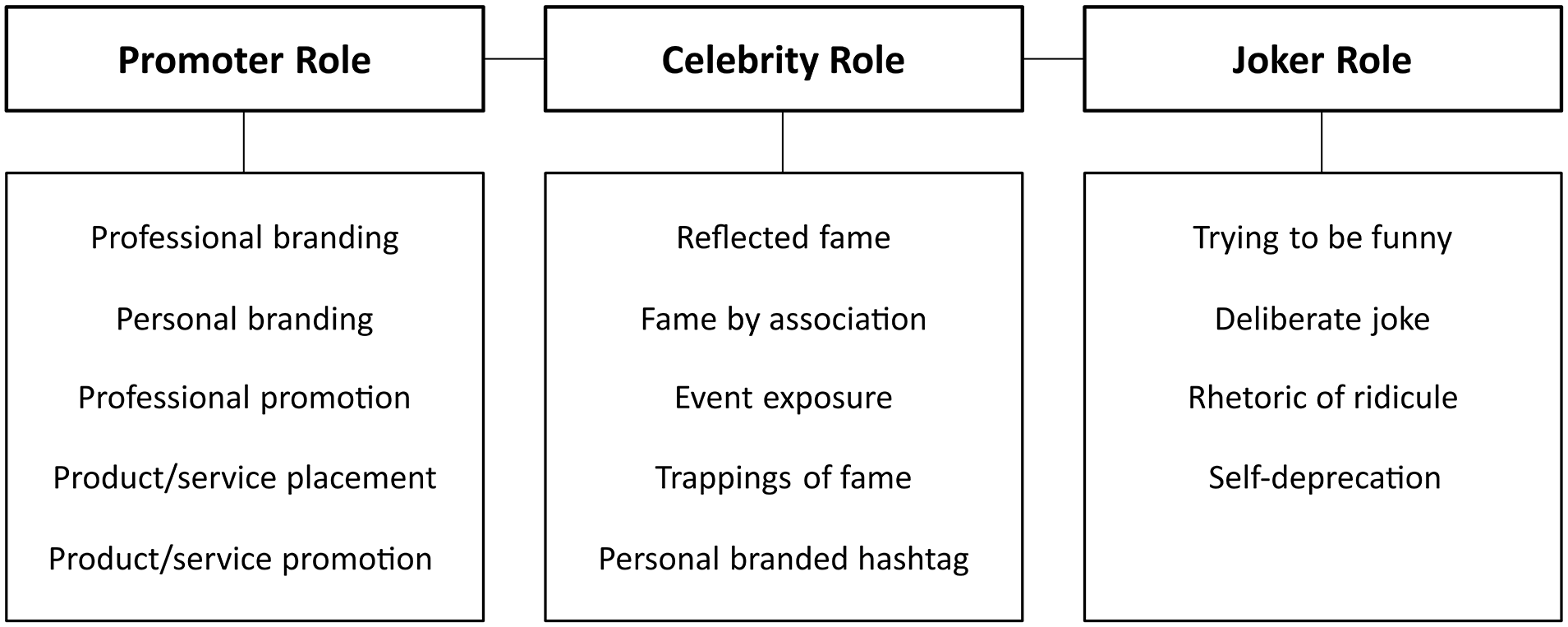
The proposed indicators address the various factors that give life to these roles. We operationalize these roles in terms of their practical manifestations in social media content. These indicators will allow scholars to conduct systematic comparisons of the presence and prevalence of the three roles in social media performance. They will enable researchers to build indices representing the position of journalists’ posts from each role and to test the validity of findings across and within cultures. To accomplish this goal, we developed an operational definition of each role based on different language-based, stylistic indicators and features unique to the social media platforms that can be associated with the performance of each role. Since professional roles are not discrete or mutually exclusive, each post can include multiple indicators from different roles simultaneously. For example, the celebrity role can be closely linked to the idea of commodification, product, and promotion of the self (Jerslev & Mortensen, 2016; Olausson, 2018), while the joker role can be also associated with promotion, power, and fame (Plester, 2016). Likewise, the proposed dimensions are seen as reflective measurements. This means that the roles exist independently of the indicators used, and where adding and/or dropping specific indicators do not change the conceptualization of the specific role (Wirth & Kolb, 2012).
While the following measures can be operationalized using different methods, our proposal follows basic principles of quantitative content research, considering the post as the unit of analysis. Each indicator can be measured on a dichotomous (presence or absence of the indicator) or continuous scale (intensity of the presence). The dimensions and categories displayed here can be applied to the study of specific cases or events that capture journalists’ attention and to everyday performance on social media.
Each of these roles can be performed in a more professional context or in a more personal context, depending on the platform, topic, and spatial context. Indeed, journalists may show themselves at their place of work or in a context not linked to news reporting. Regardless of the physical context, journalists may focus on information of public interest or aspects other than the news. Moreover, they can post about themselves and be the protagonist of the posted stories. Texts, producers, and audiences are equally relevant for the analyses of these three roles. We break our analysis down into key indicators in the following sections.
The Promoter Role
As a concept, promotional culture is linked to the marketing of product, services, and ideas through the performance of different discourses and practices (Fairclough, 1993; Wernick, 1991). While studies on promotional culture show that self-branding has increased because of the open scope of the digital world in which any person has the possibility to achieve visibility, they originally emerged as marketing strategies applied to companies and corporations through the medium of television (Hearn, 2008; Page, 2012). As the literature suggests, promotional culture and self-commodification discourses are important trends in digital media culture (Brems et al., 2017; Jerslev & Mortensen, 2016; Marshall, 2010; Molyneux & Holton, 2015).
Social media spaces support and, to some extent, encourage individuals to brand themselves by combining the perceived authenticity of everyday life with their commodification as a product to be consumed by the public. This process focuses on the interaction between the individual and the audience “as an aggregated fan base to be developed and maintained in order to achieve social or economic benefit,” thus increasing their market value (Page, 2012, p. 182). In that context, the different presentations of the self (Goffman, 1959) can be related to different types of promotion of the self.
In digital journalism, scholars have found that branding on social media is inevitable, but open to various forms of this practice (Ottovordemgentschenfelde, 2017). For example, the interplay between promotional culture and journalism can be associated with practices designed to increase the attention, reputation, and market value of the journalist’s work, news organization, and their own persona (Holton & Molyneux, 2017). Considering that a promoter is someone who endorses, advocates for, advertises, and supports something or someone (Wernick, 1991), this role is performed on journalists’ social media accounts when they develop their own “brand” promoting themselves, their work, their media outlet, or third-party work.
At the professional level, this role tends to be present when journalists promote their own work, the output of the media outlet where they work, or their colleagues’ work. At the personal level, this role is present when journalists promote, endorse, and advertise products and services outside of their professional work on their social media accounts. It also emerges when they publish elements of self-expression in their posts, such as sharing part of their everyday lives and tastes, fostering an association between themselves and a product or service. In both contexts, the journalist as promoter can be seen as a broker or commercial intermediary, or as a seller.
We propose distinguishing between professional branding, personal branding, self-media promotion, other media promotion, colleague promotion, product/service placement, and product/service advertisement as different characteristics of this professional role in social media. Five of these indicators are linked to the relationship between the journalist and their media organization, whether from a personal or a professional perspective. The first is professional branding, which is when journalists promote their own journalistic work. Promotion may be displayed in different ways. Journalists may promote their work through retweets or reposts (Lawrence et al., 2013). They may also repost or retweet other people’s links or tags to their news pieces as a third-party endorsement of their professional work (Holton & Molyneux, 2017) or promote work that they have published on their personal accounts or projects such as blogs, personal websites, other social media accounts, or other social media platforms.
The second indicator is personal branding (Molyneux & Holton, 2015), which journalists perform when they promote themselves by showcasing the activities in which they engage outside of the traditional journalistic realm. For example, they may highlight the fact they are an entrepreneur, father, volunteer, or athlete. In the case of professional or personal branding, journalists usually use strategies such as reposting positive comments from others to reinforce their image.
A third approach refers to the concept of media promotion, which can be operationalized through specific indicators. Journalists may engage in professional promotion to draw attention to and amplify the work or achievements of the media outlet(s) where they work, such as news coverage, programs, or specific features. This may also involve publicizing the work of other media outlets or promoting colleagues by advertising others’ professional work (Molyneux et al., 2018).
The two final indicators of this role refer to the relationship between the journalist and a product or service through which they do third-party promotion. This may be present in an implicit or explicit articulation. Product/service placement serves as an implicit form of promotion, with the journalist displaying a product or service to the audience without necessarily referencing it explicitly in the post. For example, journalists may place products close to them when they talk about any topic, or wear a specific fashion brand, simply showing them in their posts. Instead, when the journalist advertises a specific third-party product/service it includes an explicit promotion/endorsement of it in the post. For example, journalists may associate positive experiences with particular products or services, or claim to use them by praising their qualities.
The Celebrity Role
Celebrity culture has expanded to influence the performances of many different communities. As a genre, celebrity can be conceptualized as a discursive activity that attaches fame and cultural capital to people (Turner, 2004). The Internet has had a significant effect on celebrity culture, impacting the way celebrity is produced and practiced, with social media platforms contributing to the development and maintenance of celebrity status of people who lacked prior fame through the use of different strategies to interact with their fans (Marwick & boyd, 2011). In this context, celebrity is understood “as an organic and ever-changing performative practice rather than a set of intrinsic personal characteristics or external labels” (Marwick & boyd, 2011, p. 140, italics in original). This means that on social media, celebrity is not considered a fixed identity, and people can develop strategies to attain recognition, where “being” famous turns to be crucial (Olausson, 2018).
Performing a celebrity role is thus a conscious activity associated with elements such as manufactured authenticity, intimacy, and access, where fans and image curation become important factors to consider. Research has approached the study of celebrities as textual, visual, and interactive phenomena. Gamson (1994, p. 10) emphasizes that “the once essential differentiation between fact and fiction no longer operates usefully” when analyzing celebrity performance, and that while celebrities are a commodified product, they need to create the illusion of authenticity. While in the past fame was a result of achievement, Gamson argues that, in modern societies, elements such as hype, purchase, and manipulation are central elements of celebrity discourse and of the interplay between hierarchy and egalitarian democracy.
In journalism, this role emerges when journalists strive for fame or become stars because of their activity on social media, gaining social and economic capital (Gamson, 1994). Since “practicing celebrity and having celebrity status are different” (Marwick & boyd, 2011, p. 156), journalists may lack pre-existing fame but can perform the discursive characteristics of celebrities on social media to obtain symbolic power (Olausson, 2018). They do this by following a specific set of expected behaviors and rhetorical practices that echo those of famous entertainers (Molyneux & Holton, 2015).
We propose using eight indicators to measure journalists’ performance of the celebrity role on social media. The first indicator is reflected fame, materialized when journalists repost about themselves through retweets, shares, or screenshots of material published by others, preferably prominent figures, outlets, or brands. For example, the journalist may retweet or repost stories about their professional or personal life initially posted by a famous person (including other celebrity journalists), brands, leading media outlets (such as interviews made to them), or accounts from family, friends, or others (Bruns, 2012; Molyneux, 2015).
A second indicator is when journalist use elements of fame by association (Olausson, 2018; Wright, 2015). This may happen in at least two ways. Journalists may mention or tag celebrities or prominent figures in a post without including an image (Jerslev & Mortensen, 2016). They may also post an image, such as posed photo or a group selfie, where they are seen interacting with celebrities, implying the existence of a relationship between them, and thus gaining authenticity, transparency, and status as elements of their discourse of celebrification (Olausson, 2018).
While performing a celebrity role requires an important amount of interaction with the audience to create a fan–celebrity relationship, as an illusion of horizontal discourse, celebrities need to maintain vertical communication with the audience that allows them to stand in the role of celebrity and look to others as followers (Jerslev & Mortensen, 2016; Marwick & boyd, 2011; Page, 2012). Following the work of Olausson (2018), we suggest that a further indicator is asymmetrical communication between the journalist and the audience, using a communicative logic of one-to-many as a vertical relationship between them and their followers (Berglez, 2016). To maintain a differential status, the journalist will thus not reply to comments from the general audience on their content and will only interact with some of them, above all those who contribute a certain amount of celebrity capital.
Building on the indicator of fame by association comes event exposure. Here, the journalist seeks to gain celebrity capital by providing audience access to a manufactured backstage in which the journalists show themselves participating in social events. For example, their post may show them participating in public activities as a presenter at an awards ceremony or charity event. The post may also show them attending a more personal event, for example, as a guest at a dinner party, enjoying drinks at an upscale bar or backstage at a concert. By offering a glimpse into carefully curated parts of their private lives, journalists ostensibly provide the audience with access to their so-called celebrity lives.
Indeed, a further indicator of the celebrity role is the trappings of fame, when journalists perform activities that suggest they are enjoying the lifestyles of the rich and famous. For example, they may share photos of themselves wearing the latest designer clothes, eating in exclusive restaurants, living in breathtaking homes, driving expensive cars, traveling to exotic locations, be it for pleasure or work, or attending glamorous events (Gamson, 1994; Page, 2012). Maintaining the balance between inaccessible glamor and real life is a key part of keeping social media followers engaged.
In view of this, another aspect of the construction of the celebrity persona is being close to their fans, narrowing the line between themselves and their followers by including snippets about their everyday personal and private lives in their posts. Although journalists may share glimpses into somewhat privileged lives, they also need to demonstrate that they are just like everyone else and that they do the same things their followers do (Marwick & boyd, 2011). In that sense, journalists can post about everyday life settings, including images of themselves going to the grocery store or the gym, being tired, wearing sporty-casual clothes, commuting, taking their children to school, watching TV, or waiting in traffic.
Related to the notion of a celebrity lifestyle is the idea of using a personal branded hashtag. A journalist may create their own hashtag (Page, 2012), based on their name, nickname, or another signature characteristic. The use of a personal branded hashtag implies a level of recognition and fame. It helps to create a synthetic personalization (Fairclough, 1993), promote the visibility of the “celebrity,” and reinforce the illusion of a reciprocal relationship and mutual interest between followers and followed (Marwick & boyd, 2011).
The Joker Role
Humor is a multi-disciplinary field of research. As a social phenomenon, humor is a key form of communication and cultural process embedded in social relationships (Mulder & Nijholt, 2002). To exist, an individual or group of people must generate humor. One of the most important and classical figures of humor in history has been the joker. In general terms, being a “joker” refers to someone who likes telling funny stories, or at least stories that they believe are funny, or doing stupid things to make people laugh (Plester, 2016). According to Goffman (1974), humor frames everything someone says, as something that should not supposed to be taken seriously. The joker and the audience can thus use humor to negotiate the meaning of the content they produce and share (Paton & Filby, 1996).
Humor may serve many different functions. Besides entertaining others, it may involve a sense of humor, engage in play with others, facilitate conversation, increase being liked by others, express feelings, defend the ego against potential damage, and disclose difficult information (Graham et al., 1992). Humor can also be used as an tool to challenge power, show lack of agreement, protest or challenge the status quo (Holmes, 2000), as an expression of superiority at the expense of other people (Morreall, 2009), and as a way of addressing taboo topics (Kuipers, 2008).
Scholars suggest that the modern “joker” performs a role similar to the one played by the traditional court jester dating back to medieval times (Fisher & Fisher, 1983). Overall, the joker role is related to someone who loves to be funny and lighten the mood. While some see jokers as ridiculous or foolish, they are playing a game as professional performers. Being a joker is a rational choice to push the boundaries of humor by engaging in practices such as poking fun at authority figures, offering parodies, stating the truth, and challenging social mores, all while being seen as daft. They are expected to be funny in their posts and to challenge others without, seemingly, doing any harm. After all, they are “only joking.” They are allowed to feel proud about their sense of humor and tend to appear active, independent, and confident. Jokers can also start long threads in the comment sections of others’ posts and laugh while everyone gets mad (Plester, 2016).
While humor and satire can be found on modern-day late-night television shows hosted by TV celebrities (Faina, 2012), scholars have shown that journalists also use the affordances and logics of social media spaces to perform humor. Indeed, social media platforms have become important spaces for the performance of humor (Shiffman, 2007). Holton and Lewis (2011) and Mourão and Chen (2019) argue that humorous messages may help journalists to connect and interact with the audience.
At the professional journalistic level, the joker role is present on social media when journalists use humor while commenting on their work, workplace, colleagues or sources, or present themselves goofing around on set or in the office. At the personal level, this role is present when the journalist posts ridiculous videos or images of themselves outside of a work context, or when they include gaffes or irony in their statements about any aspect of their life. They tend to use exaggerated gestures, tone of voice, and elements drawn from entertainment genres, although the joker and infotainment roles are different. We propose four indicators to measure the performance of the joker role by journalists on social media: trying to be funny, deliberate joke, rhetoric of ridicule, and self-deprecation.
While humor is a central feature of popular culture and everyday life, and while comedy may take on different humorous genres, people differ significantly in what they think is funny or not funny. Humor means different things from culture to culture (Mintz, 2008), making it difficult to know if something is funny for everyone (Holton & Lewis, 2011; Mourão & Chen, 2019). Moreover, humor is situationally dependent, so what is perceived as humorous in one moment may seem not very funny in another (Meyer, 2000) even if it is shared within a common environment (Fry, 2010). Because of that, more than measuring whether something “is” funny, one important indicator of this role is if the journalist is trying to be funny, which refers to the presence of a sense of humor shown by the journalist when he or she posts something that is not serious in tone with that intent.
The journalist may make an attempt at humor through the use of words or textual elements in a post. For example, these may be written rhetorical expressions such as irony, sarcasm, oxymoron, cynicism or paradox, or informal expressions of laughing (Ritchie, 2004). The journalist may also try to be funny through the use of external visual elements such as memes, videos, gifs, and distorted images or through facial expressions, gestures, exaggerated postures, or sound elements.
A second indicator refers to the journalist making a deliberate joke in the post (Kuipers, 2002). As part of the commodification of humor, jokes are one of the most widespread genres of modern popular culture (Wickberg, 1998). Mourão et al. (2016) examined how political journalists use humor on Twitter and how jokes relate to other forms of social media interactivity. They also identified the targets of these jokes, finding that about one-fifth of the journalists’ tweets used jokes as a rhetorical device. The extent to which the joke is funny is not the point, but rather the explicit attempt at making a deliberate joke.
A less explicit way of performing the joker role is the rhetoric of ridicule, deployed to mock a prominent figure or to highlight the absurdity of a situation. Such an indicator is a common fare of late-night TV hosts, who harness sarcasm, irony, and satire to make droll quips to try to get a laugh. Waisanen (2009) argues that Jon Stewart and Stephen Colbert deploy three rhetorical strategies—parodic polyglossia, satirical specificity, and contextual clash. These three rhetorics of ridicule offer a way to identify the joker role on social media. Parodic polyglossia refers to the use of multiple personas and voices to parody a person or situation in a way that that may be both critical and sympathetic in tone. For example, a journalist may combine the authoritative voice associated with broadcast news with a daft comment within a post. By comparison, satirical specificity involves the use of satire in ways that “expose abstractions that public actors employ to gloss over the important details of policies and political actions” (Waisanen, 2009, p. 127). In this case, a journalist may ridicule a statement by a leading figure by seeking to point out inconsistencies in a humorous way. Finally, contextual clash involves juxtaposing seemingly incongruous factors for comedic effect (Waisanen, 2009). Here, a journalist may express a critical point of view by combining two discordant elements, such as a seemingly important political statement with an inopportune photo of a politician. Such expressions of ridicule may take the form of posts or replies to the comments on posts (Holton & Lewis, 2011; Ritchie, 2004).
The final indicator of this role is self-deprecation, with journalists seeking to laugh at or with themselves or to laugh at or with others in their posts. Laughing “at” something is used to express superiority and ridicule the other or oneself (Dore, 2018), while laughing “with” is considered positive and friendly behavior. In that sense, Glenn (1995, p. 48) emphasizes that “laughing at” and “laughing with” are not fixed but changeable and situational forms of humor, so that a humorous situation can turn disaffiliative laughter into affiliative laughter depending on the moment. People may laugh at others’ misfortune to show that they are better than someone else (Berger, 1993; Raskin, 1985) or to engage in satire (Mourão et al., 2016), setting up a context in which the humorous situation has a winner and a loser (Gruner, 1997) In this case, the winner is the one who successfully makes fun of the loser.
Discussion
While in traditional journalism the news becomes a collective outcome published in media outlets, in social media, content may be published through the accounts of individual journalists. This does not necessarily mean that journalists are operating outside of established and long-held influences at different levels. But individual social media accounts offer a window for scholars to focus on the outcomes at a more singular level. The interaction of the journalistic ego domain with more traditional roles that journalists perform on an everyday basis caused tensions over journalistic authority and disrupts professional norms and practices of traditional journalism, illuminating specific practices as a way to both reinterpret and redefine the journalistic profession in digital spaces (Mellado & Alfaro, 2020). How far journalists extend or go beyond established norms and practices to take on different roles on social media may vary across styles of journalism such as print, online, television, or radio; genres such as political or lifestyle news; types of media from elite to local, and in countries with different media systems (see, for example, Hermida & Mellado, 2020).
Approaching the journalistic ego domain as a starting point, this article has considered how journalists on social media spaces perform roles that do not align well with traditional journalism roles. Specifically, it operationalizes the performance of promoter, celebrity, and joker roles, and how these roles can be measured in social media performance at both the professional and personal levels of individual journalists’ accounts through multiple textual, visual, or audiovisual content indicators. While these roles are independent, they can overlap in practice, allowing journalists to perform multiple roles simultaneously. They can also be present alongside more traditional professional roles that can be expressed on social media, with journalists switching or combining roles depending on the circumstances and the specific moment in time (Mellado, 2020).
By drawing on journalistic role performance, humor, celebrity culture, marketing, and advertising literatures, we operationalize key indicators that characterize these three roles in a digital world and to apply them to journalists’ social media practices. Our aim is to provide an analytical toolkit for researchers in different parts of the world to critically address journalistic performance on social media across a range of cultural contexts.
The three role dimensions operationalized by this article can be used to analyze trends in the presence of specific performances within a single social media post. Indeed, the application of these roles to social media practices could answer key questions that need to be urgently answered. First, if social media is understood as an “influencer economy,” it is important to investigate whether and how far established journalism is losing ground to influencer-driven information, and what this means for how audiences receive, interpret, and trust content on social media. Such research would help to identify how established journalistic practices are shaped or are shaping an influencer-driven media space, as well as considering the consequences on journalistic practices.
In recent years, leading media corporations have set up in-house influencer marketing agencies. They include Condé Nast—publisher of Vogue, Vanity Fair, The New Yorker, and Wired—and News UK, publisher of The Times, The Sun, and the social media news agency, Storyful. The purpose of these initiatives has been to invest in their in-house talent, such as lifestyle journalists who have a significant social media following and enjoy a degree of credibility with their audiences. For example, Condé Nast aims to combine “the insight and influence of our editors with the exponential impact of our curated group of external influencers” (quoted in Condé Nast, 2018). For its part, News UK lists journalists as one of its nine faces of influence, described as a “professional writer or broadcaster for a news, magazine, online or TV company” (News, 2019, n.p.). This definition of the journalist locates it with the traditional boundaries of the profession—as a person working for a news media institution—with a reimagined role for a social media world. Such initiatives can be seen as a continuation of earlier efforts by media companies to respond to the growing public interest in culture, leisure and lifestyle news, information, and entertainment, particularly in prosperous economies (Bell & Hollows, 2005; Hanusch, 2013). Given that lifestyle journalism has been “a very successful area of journalism, both in terms of its economic success, broadening journalism’s financial base, and its cultural impact on people’s lives” (Hanusch, 2019, p. 194), it is hardly surprising that media companies are seeking to capitalize on the economic potential of journalists as influencers. The roles of promoter, celebrity, and joker offer a lens to examine the extension of journalism beyond the established boundaries of a profession through individual social media practices. Further empirical studies could examine how far this signals a break with accepted practices or a novel articulation of lifestyle journalism, which has itself grown within the journalism industry (Bradford, 2015; Hanusch, 2013; Kristensen & From, 2012). The confluence of journalist and influencer in the performance of these roles offers then a rich vein for research into whether this represents a revitalization of the funding of journalists or what Filloux (2019) describes as “the decay of journalism that goes along with the growing reliance to ‘influencers’” (n.p.).
Second, it would be important to further understand how the performance of these roles by journalists on social media plays out in different media systems, different media organizations, in legacy media compared to newer media organizations, and on different types of media platforms. For example, while television news anchors and presenters have taken on these roles previously, it is a timely moment to understand how journalists from other types of outlets are trying to perform them in their social media spaces, thus enhancing the symbolic value of their professional and personal brands. Similarly, it would be crucial to empirically measure the co-occurrence of more traditional journalistic roles with the three roles discussed and operationalized in this article.
Another factor to consider is journalistic beats and how far journalists can take on these roles considering the topics they cover. When it launched, the Condé Nast influencer agency said it would focus on fashion, style, and beauty (Condé Nast, 2018). However, since then, it is likely that the performance of these types of roles has extended beyond the boundaries of lifestyle beats given the extent of the influencer economy on social media. Indeed, there are indications of news professionals covering a myriad of topics, such as politics, sports, and business, performing these emergent roles. In that sense, the encroachment of the promoter, celebrity, and joker roles into the journalistic arena could open up new approaches to covering and presenting public interest topics and events.
Following this idea, an area for further research is the impact of individual-level characteristics such as age, gender, and experience. Hobbs (2019) suggests that gender is a key determinant for influencers. She argues that “the hard-bitten male longform journalist posting Instagram stories of unknown jungles is not treated or viewed as an influencer,” going on to conclude that “instead we have the age of the woman writer-influencer, both journalist and celebrity” (Hobbs, 2019, n.p.). How gender intersects with the role of promoter, celebrity, or joker in journalism is an underdeveloped area of research that should also be addressed.
The analysis of these roles will add an extra layer to examine how certain journalistic activities translated to social media platforms can actually enable different types of role performance across different media within different media logics. While the performance of these roles can be seen as empirical outputs to analyze new journalistic practices in social media, it is important for future endeavors to validate these analytical dimensions across social media platforms and cultures. More broadly, there is scope to apply the characteristics that give life to the three roles to other professions beyond journalism that are facing similar challenges and opportunities with the emergence and spread of social media.
Footnotes
Declaration of Conflicting Interests
The author(s) declared no potential conflicts of interest with respect to the research, authorship, and/or publication of this article.
Funding
The author(s) disclosed receipt of the following financial support for the research, authorship, and/or publication of this article: This work was supported by Chile’s National Fund for Scientific and Technological Development (Fondo Nacional de Desarrollo Científico y Tecnológico [FONDECYT]; Grant Number 1180443).
Author Biographies
 ). Her research focuses on journalistic cultures, professional roles, social media performance, and comparative research. Her last two edited Books are Journalistic Role Performance: Concept, Contexts, and Methods (Routledge, 2017) and Beyond Journalistic Norms: Role Performance and News in Comparative Perspective (Routledge, 2020).