



Abstract
Black women have historically used unconventional, everyday spaces as sites of Black feminist intellectual production. Today, one of the most common spaces in which Black women produce intellectual thought is social media. However, very little research has broadly examined the dynamics of these online communities for Black feminist theorizing beyond individual hashtag conversation. In this study, I conducted 21 semi-structured, in-depth interviews with individuals who engaged in eight different Black feminist hashtag conversations across Twitter and Instagram to expand our current understanding of how Black feminist intellectual production has developed and broadened through the affordances of social media. Findings suggest that while Black feminist hashtag discussions have allowed Black women to “talk back” to hegemonic mainstream and popular discourses about Black women, these conversations are constantly at stake of appropriation and co-optation replicating historical erasure of Black women’s intellectual production.
Introduction
In July 2017, HBO announced they would be partnering with Game of Thrones (GOT) showrunners, David Benioff and D.B. Weiss, to create Confederate, a show about an alternative world where the South won the Civil War and had seceded from the Union (Nevins, 2017). The announcement angered Shanelle Little, a Black woman and avid Twitter user. To Little, the show ignored how the legacy of slavery still shapes the lives of Black men and women in the United States (Hartman, 2008). Little was also concerned about potentially problematic representations of Black women on Confederate, based on Benioff and Weiss’ previous depiction of the only Black woman character on GOT, Missandei, a slave who died in a brutal lynching.
In response, Little got on Twitter and messaged four other Black women, all of whom she had met through the platform. Together they created the hashtag #NoConfederate, to foster public discussion and educate people around the problematics of Confederate. On Sunday, 30th July, the #NoConfederate campaign launched on Twitter during that evening’s GOT airing. By the night’s end, the hashtag trended #1 in the United States and #2 globally.
The story of #NoConfederate, from its networked conception to execution, illustrates several key dynamics of what I term “platformed Black feminist communities,” social media-based communities often formed around hashtags that discuss Black women and femmes’ lived experiences. Through semi-structured interviews with 21 social media users who either created or engaged in Black feminist hashtag conversations on Twitter or Instagram, I found these networked communities form through Black women seeking connection and forming care-based communities online; revolve around discussions of popular culture through the perspective of Black women and femmes; and allow Black women and femmes about to “talk back” (hooks, 1989) to popular discourses hegemonic mainstream and popular discourses about Black women.
While previous studies have examined the Black women, femmes, and queer folks use of hashtags to discuss specific topics from a Black feminist perspective (e.g., M. Clark, 2014; Conley, 2017; Jackson et al., 2020), no study has examined these interactions as a whole, across a range of hashtag discussions, from a user perspective. I build on previous research by investigating platform usage and experience patterns across several Black feminist hashtags to examine how the affordances of social media have broadly impacted Black feminist intellectual production online. I argue this user-centered approach is essential to understanding the full scope of Black feminist intellectual production online. Through this study, I illuminate the ways social media opens up new avenues for Black feminist intellectual production while simultaneously reproducing historical forms of oppression. From these findings, I argue for the importance of recognizing and centering intersectional communities in thinking about how online spaces reproduce societal inequities.
Black Feminist Theory and Thought
Black feminist theory is a line of intellectual thought developed from Black and women of color’s unique lived experiences that aims to develop integrated analysis and practice based upon the idea that the major systems of oppression, such as racism and sexism, are not separate but interlocking (e.g., Morga & Anzaldua, 1981; Combahee River Collective, 1982). One critical analytic developed from this lineage is intersectionality, a term and analytical framework created by legal scholar Kimberlé Crenshaw (1989) that examines how Black women’s social, political, and economic realities are shaped by multiple axes of oppression (Collins & Blige, 2016). Crenshaw’s work demonstrates how a single oppression analysis, such as race or gender analysis, cannot account for how these oppressions come together to shape the lives of Black women.
The analytical frameworks of Black feminist theory and Black women’s material knowledge production are linked through what Patricia Hill Collins (2000) terms Black Feminist Thought, a second-level analysis of the world defined by Black women’s distinct everyday experiences. While Black Feminist Thought is a formalization of Black women’s knowledge, Black feminist knowledge production occurs in the everyday material realities of Black women (Collins, 2019). Today, one of the most important Black feminist knowledge production sites are social media platforms, specifically through hashtags that prompt Black women to engage in knowledge production through public discussion (M. Clark, 2014; Conley, 2017; Jones, 2019).
Hashtag Publics and Counterpublics
Over the past decade, hashtags have played a significant role in developing online publics and counterpublics. Technologist Chris Messina created the hashtag function to form an online public sphere where topical social discussion could flourish (Habermas, 1962/1989; Messina, 2007). Platform users have invoked hashtags to start public conversations on a variety of topics, including politics (e.g., Small, 2011), activism (e.g., Jackson et al., 2020; Kuo, 2018; Rambukkana, 2015), culture (e.g., Brock, 2020; M. Clark, 2014), and current events (e.g., Burns & Burgess, 2015). The inclusion of a hashtag also allows a post to reach users outside of a person’s direct follower network (Burns & Moe, 2014).
Hashtags have also been key in creating online counterpublics (Brock, 2020; Kuo, 2018; Rambukkana, 2015). Taking up Michael Warner’s (2002) concept of the counterpublic and Nancy Fraser’s (1990) subaltern counterpublic, as public discursive arenas developed by subaltern and marginalized communities that develop in parallel to the dominant, hegemonic, public sphere, scholars have explored how marginalized social media users employ hashtags to create discussions about their social conditions (Graham & Smith, 2016; Jackson et al., 2000; Rambukkana, 2015).
Raced and Gendered Hashtag Counterpublics
As recent scholars have highlighted, technological platforms are often designed with the assumption that the default user is White, male, and middle-class (Brock, 2020; Gray, 2020). Thus, hashtags that create counterpublic discussions around gender and race represent an important space of critical resistance and community-building for marginalized peoples (Rambukkana, 2015).
Feminist hashtags counterpublics often create community by bringing private experiences of gendered oppression to the public’s attention (R. Clark, 2016; Khoja-Moolji, 2015). Antonakis-Nashif (2015) suggests the use of #outcry by young feminist activists in Germany to discuss their experiences with sexism helped reduce taboo around women publicly expressing emotions around sexism. Similarly, #WhyIStayed allowed women to publicly share personal accounts of intimate partner violence (R. Clark, 2016; Jackson et al., 2020). Khoja-Moolji (2015) argues that these feminist hashtags help create intimate publics, allowing women to build community through affective ties across the Internet. Thus, part of the discursive power of feminist hashtags lies in their ability to connect personal stories of gendered oppression to a larger network of similar stories to illustrate sexism’s systemic nature (R. Clark, 2016).
Raced hashtag counterpublics bring public attention to distinct cultural experiences and material realities of non-White social media users (Kuo, 2018; Rambukkana, 2015). One of the most noted raced counterpublics on social media is Black Twitter, an online community composed of Black Twitter users who actively use the platform to engage in discussions based on a sense of collective understanding of “Blackness” (Brock, 2020; M. Clark, 2014; Graham & Smith, 2016). Black Twitter is not synonymous with all Black Twitter users but rather those who actively engage in these discussions (Brock, 2020). These discussions are based on existing knowledge of Black culture and discourse, expressed through cultural vernacular linguistic cues such as playing the dozens, double-speak, and wordplay (Brock, 2012; Florini, 2014). While the entirety of Black Twitter cannot be reduced to conversations denoted with hashtags, hashtags offer topical coherence to in-group participants and make Black Twitter discoverable to out-group voyeurs (Brock, 2020).
Black Feminist Hashtag Publics
At the intersection of Black Twitter and feminist hashtag publics on social media exists what I refer to as “platformed Black feminist communities.” I define platformed Black feminist communities as social media-based communities, often formed around hashtags that discuss Black women and femmes’ lived experiences. Drawing from definitions of Black Twitter, platformed Black feminist communities are not synonymous with all Black women on social media but rather denote a specific group of users who actively use social media platforms to engage in discussions about common cultural understandings of Black womanhood. Furthermore, my use of the word “platformed” draws from scholarship on platformization as an organizing economic and infrastructural model online to denote how these community interactions are shaped by platform logics and imperatives (Helmond, 2015; Nieborg & Poell, 2018).
In Reclaiming Our Space, activist, writer, and influencer Feminista Jones (2019) argues that Black women and femmes have used Twitter to create hashtags that engage Black feminist knowledge production by building community and discussing Black women’s specific social location. Conley (2017) argues these Black feminist hashtags are a form of becoming, in which Black women rupture hegemonic understandings of Black womanhood. Thus, the Black feminist hashtag conversations that form the basis of platformed Black feminist communities draw attention to the intersectional dimensions of Black women’s lives, buttressing dominant, hegemonic narratives of what it means to be a Black woman (Jackson et al., 2020; S. Williams, 2015).
Within these hashtag discussions, social media users often enact key tenants of Black Feminist Thought, such as community care, self-definition, and accountability (M. Clark, 2014). For instance, #SolidarityIsForWhiteWomen, created by Twitter user Mikki Kendall, formed a networked discussion around how Black women have historically been marginalized in feminist spaces, and allowed Black women to engage in self-definition (M. Clark, 2014; Kuo, 2018). Similarly, #SayHerName, created by Kimberlé Crenshaw, allowed Black women and femmes to discuss the intersectional dimensions of their experiences with state-sanctioned violence; and #GirlsLikeUs, created by transgender right activist Janet Mock, allowed Black transgender women to publicly self-define their lived experiences (Bailey, 2021; Jackson et al., 2020). Furthermore, hashtag conversations about popular television shows, such as Scandal and How to Get Away with Murder, allow Black women and femmes to respond to popular representations of Black womanhood and hold mainstream media accountable for racist and sexist representations (Chatman, 2017; Liston, 2017; A. Williams & Gonlin, 2017).
In this study, I aim to broaden the findings of these previous studies by empirically investigating a broad cross-section of these hashtag conversations to further define the dimensions of platformed Black feminist communities, asking the following:
How do individuals who participate in Black feminist hashtag conversations on Twitter and Instagram understand their networked interactions on these platforms?
Why do individuals choose to create, popularize, or engage in Black feminist hashtag conversations on Instagram and Twitter?
What is at stake in how Black feminist hashtag conversations circulate on Twitter and Instagram?
Methods
To answer these questions, I conducted in-depth, semi-structured interviews with individuals who created, popularized, or participated in a Black feminist hashtag conversation on Twitter or Instagram. I chose Twitter and Instagram as research sites because of the prevalence of raced and gendered hashtag publics on these platforms (Conley, 2017; Jones, 2019; Olszanowski, 2015; Pham, 2015). Furthermore, I employed interviews, in line with the Black feminist assertion that qualitative methods allow insight into how the nuanced dynamics of multiple systems of oppression shape participants’ experiences in ways that large scale quantitative methods, which frame identity as additive, cannot (Bowleg, 2008). During interviews, I asked participants about their past and current engagement habits on Twitter or Instagram (depending on the platform on which they participated in the hashtag conversation), why they chose to create or participate in the hashtag conversation, and what they perceived to be possibilities and limitations of social media platforms for Black feminist discussions.
Recruitment
To recruit participants, I used a snowball sampling method, informed by network analysis. Since a key way platformed Black feminist communities are discoverable is through Black feminist hashtags, to begin recruitment, I searched Google and Google Scholar using the terms “Black,” “feminist,” and “hashtag,” to identify hashtags on Twitter or Instagram that previously had been identified as “Black feminist” in focus, or could arguably be called “Black feminist.” In addition, I solicited suggestions of Black feminist hashtags from other intersectional media scholars. I then removed all hashtags from the data set whose initial creators I could not verifiably identify. I then directly contacted all the individual(s) who created or popularized a hashtag on my list through a publicly available email address, website, or social media contact to inquire if they would participate in the study. These individuals represent the first node in my sampling network. After the initial interview with a hashtag creator, I employed a snowball sampling method—I asked the hashtag creator to refer me to three to five other people from their own Twitter or Instagram network who took part in their hashtag conversation. While not every participant was willing or able to identify other individuals for recruitment, if they were, these individuals were similarly contacted and invited to participate in the study. 1 I employed this snowball sampling method with every subsequent interviewee (see Figure 1 for illustration of recruitment networks). By employing this strategy, I could identify those who actively took part in platformed Black feminist communities through hashtag discussions and elucidate how hashtag meanings may shift over time while maintaining a qualitative methodology (Korn, 2015).
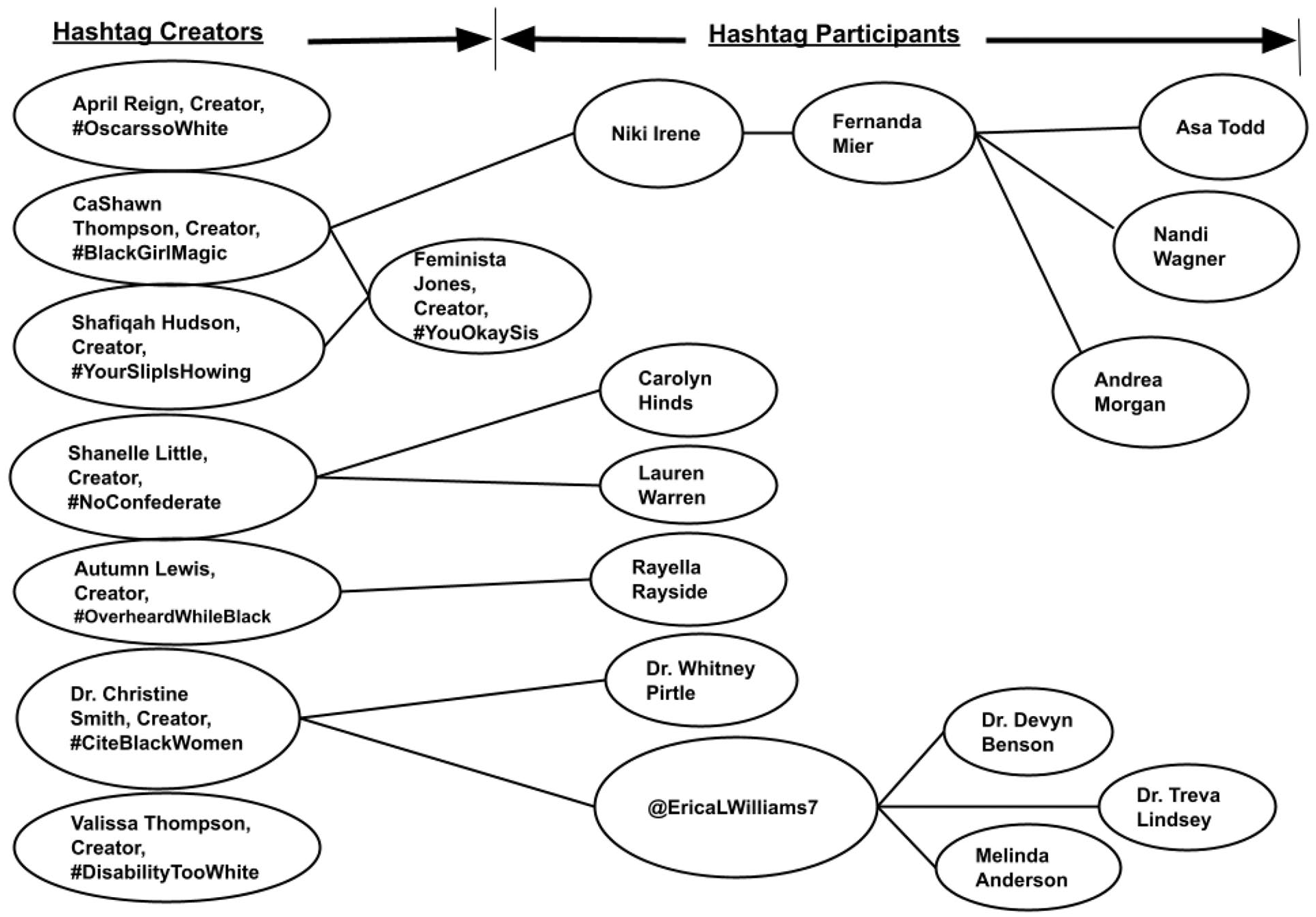
Hashtag networks derived through snowball sampling.
Participants
Recruitment resulted in interviews with 21 participants between July and November 2020 that lasted an average of 55 min. Interviews discussed eight Black feminist hashtags—seven originated on Twitter, and one originated on Instagram (see Table 1, columns 2–4). While I cannot confirm the reason for the discrepancy, potential reasons for the higher number of Twitter-based hashtags in the sample may be because the discursive and networked nature of Twitter, makes it easier to spark widespread hashtag discussions on this platform; and/or that Twitter may be a more popular platform for starting hashtag discussions since that is where the hashtag feature originated. Furthermore, while these 21 participants are only a subset of users that engage in platformed Black feminist communities, I argue that the range of hashtag conversations discussed allowed these interviews to reveal distinct patterns and reach a point of saturation.
Participants’ Platform and Demographic Information.
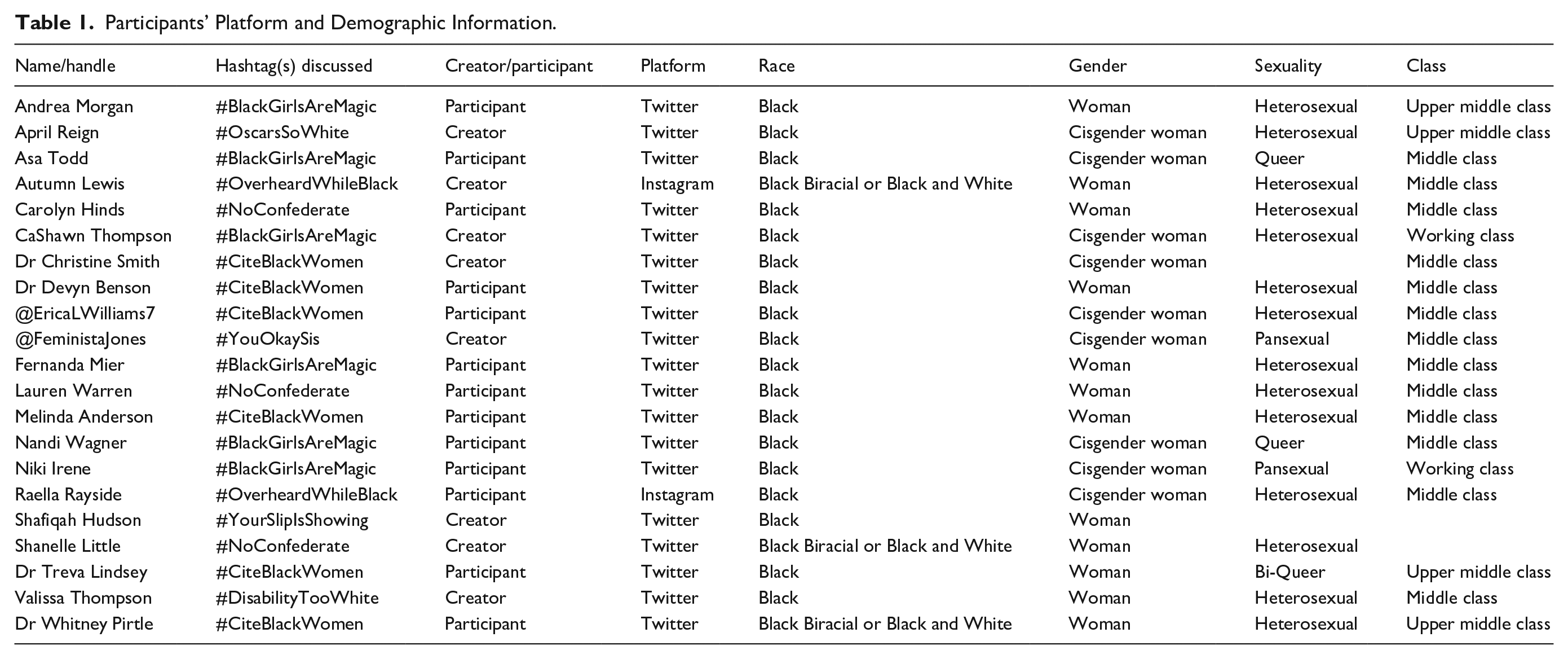
Since many participants were publicly associated with the hashtag they were interviewed about, I gave all participants the option of being identified by their full names, a social media handle, or being interviewed confidentially. I also asked participants to self-describe their demographic information (Table 1, columns 4–7). However, I also gave participants the option not to identify any information they were uncomfortable disclosing. All participants self-identified as Black women, despite the open-ended recruitment prompt to “suggest others in their network who participated in the hashtag conversation,” and verbally confirming for participants that the individuals recommended did not need to be Black or women. I argue this may indicate that most individuals who take part in Black feminist discourses on social media are, in fact, Black women. While some participants defined their gender as “woman,” other participants specifically defined themselves as “cisgender women,” meaning their gender aligns with their assigned sex at birth. This distinction does not mean participants listed as “woman” are not cisgender, but rather they chose not to disclose whether or not their gender assigned at birth is the same as their self-defined gender identity. While I did not ask why some participants called attention to this facet of their gender identity while others did not, possible reasons may be that some participants specifically wanted to call attention to a privilege they hold compared to transgender women or nonbinary femme individuals; or that some participants were unaware of this gender distinction.
Analysis
I analyzed interviews using qualitative thematic coding and grounded theory. I derived codes both deductively from previous literature on Black feminism and social media, and inductively as new patterns presented themselves. I constantly compared interviews until a final set of codes was set (Strauss & Corbin, 1997). I also analyzed data using intersectionality as an analytic to understand how participants’ social media engagement spoke to their specific positionalities (Collins, 2019).
Findings
R1. How do individuals who participate in Black feminist hashtag conversations on Twitter and Instagram understand their networked interactions with other Black women on these platforms?
Most participants joined Twitter approximately 10 years ago in 2009 and Instagram approximately 8 years ago in around 2012, a few years after each platform launched. Participants often joined these platforms because of pre-existing social connections on the platform or to find a new community of Black people, especially Black women, to engage with online. Initial communities formed between participants on these platforms were supportive networks based on an ethics of care and collective acts of resistance through public discourse. However, more recently, the dynamics of these networks have shifted toward more guarded forms of engagement, as the increasingly political nature of these platforms has given way to increasing instances of online policing and harassment.
Early Engagement: Networked Community, Ethics of Care, and Talking Back
Finding Networked Communities of Care
Many participants joined these platforms to find community with other Black people, especially if this community was not as accessible to them offline. For instance, when Shanelle Little began actively engaging on Twitter, she was the only Black person living in her Montana town, making social media “the only way to connect with friends.” Similarly, podcaster and writer Lauren Warren said, [Twitter] gave me a chance to meet new people, right? Like people on Facebook I’ve already known and being in Canada, I would say I was pretty isolated up there . . . Twitter gave me a chance to meet new people.
Twitter allowed these participants to find and create community with other Black women that they may not access in their offline lives or on platforms like Facebook that encourage networks based on existing offline connections. Echoing this sentiment, Autumn Lewis, creator of #OverheardWhileBlack, said she also decided to join Instagram to find Black networks: [it] is like another way to be tapped into your friends and new people . . . when I was growing up there was like “Black Planet” and like everything evolved into like . . . Instagram now. And now, like there’s Black Twitter, [there’s] always just another form of it.
In this way, participants saw joining these platforms as a new way of tapping into Black culture.
Participants often noted the supportive nature of the online connections made on these platforms. As author and activist Feminista Jones said, It’s like this shared experience and shared understanding of what it means to be women, and coming together to support each other in efforts to highlight those things is kind of like, that’s what we [Black women] do . . . . We all kind of rally around each other . . . and we met because of Twitter.
Similarly, Warren stated, Black women are family. And when you find a good group of Black women that are friends and collaborators, conspirators, troublemakers, it’s a wonderful thing.
Embedded in these descriptions of platformed Black feminist communities is what Collins (2000) describes as a Black feminist ethics of care. Within these networks, participants supported and affirmed one another as fellow Black women, expressing understanding and empathy for each other’s lived experiences.
“Talking Back” Through Discursive Resistance
Participants said their engagement within this network often formed around a shared cultural perspective of societal events. Historian Dr Treva Lindsey commented, A lot of these connections are formed in these kind of episodic instances . . . One of the things I’ve seen a lot of Black feminists tweeting about in this moment is patriarchy and Black male rappers coming out and supporting Trump. That has certainly kind of been a rallying cry for feminists like told y’all misogyny, patriarchy, the internalization of capital logic . . . even if they’re not sharing the same opinion, even if it’s confrontational more than collective, I feel like there’s this kind of amorphous collectivity that happens when incidents happen that put on the table issues like sexism, patriarchy, misogyny, Black women’s health, Black femme health, whatever that may be.
Other participants, such as artist and activist Niki Irene, recalled similar discussions through shared cultural interest: My personal sub-community became like Black feminist Twitter. It’s like Black Twitter . . . we’re all generally talking about the same thing. We listened to a lot of the same music, hip hop, R&B, Soul . . . We’re all watching TV shows that feature more Black people . . . we are all reading feminist texts.
As described, platformed Black feminist communities are formed in moments when Black women and femmes engage in collective conversations about popular culture that offer their dynamic perspective as Black women in cultural discussions. I argue these conversations are manifestations of what Black feminist scholar bell hooks (1989) terms “talking back,” speech act of agency and self-definition that act as a form of resistance against a history of oppressive objectification. Through choosing to partake in these collective discussions, participants came together to self-define their perspectives as Black women and “talk back” to racist and sexist narratives in mainstream popular culture.
Some participants attributed this dynamic to the open nature of these platforms, or the fact that you do not necessarily have to follow someone to engage with their content, as you do on Facebook. Speaking about Twitter, Nandi Wagner suggested, In 140 characters, there was a really easy way to have a conversation . . . because Twitter is just short, little, digestible nuggets of statements and information . . . because of the ability to search on hashtag, the ability to tag people and bring other people you want into the conversation . . . It was a really fun and easy way to have great conversation about how Black women see themselves.
In this way, the platform structures of Twitter and Instagram allowed participants to easily connect with other Black women to engage in collective “talking back.”
Recent Engagement: Navigating the Shifting Dynamics of Social Media
Socio-Political Shifts: Activism and Political Performativity
However, over time, participants’ experience of these platforms shifted from authentic networked connections to navigating fake performativity and harassment, leading participants to change their engagement styles. These shifting dynamics were precipitated by a simultaneous growth in follower count for many participants and larger shifts in the United States socio-cultural and political landscape, namely the 2016 election of Donald Trump and the murders of unarmed Black people by police starting in 2014. Talking about the role of the 2016 US Presidential election in these shifting platform dynamics, womanist and disability activist Valissa Thompson said, Twitter is definitely not the way it was four years ago. It’s not a very fun place anymore, and that’s something that me and a lot of people who I got to know and befriend during that time all collectively state now, and I think it probably happened in some part due to the election . . . You can’t really joke like you used to . . . people taking it very seriously. And it feels like people are very performative in that.
Several participants felt that since the 2016 election of Donald Trump, more people on social media performed political activism in ways that policed other users, hindering the authentic forms of engagement through which Black women connected with each other.
Participants also mentioned how increased online activism in the wake of murders of unarmed Black and Brown people by police, beginning with the murder of Michael Brown in 2014, shifted how they felt comfortable engaging on the platforms: People sort of got into this culture of dunking . . . Like being able to be the person that drives jokes . . . Marginalized people having a microphone and their pain being put out there, it’s real hard to go enter into a conversation around “End Game” and like how “End Game” sucks . . . the next week down, if someone’s dying, right? (Shanelle Little)
Comparatively, on Instagram as a visual platform, social media strategist Raella Rayside said Black death became overwhelming, “I’m seeing too many people that look like me dying too often.” These platforms’ change in orientation toward discussions of politics and Black death made it harder for participants to engage with their communities in the same fun and authentic ways. Participants felt they had to temper their engagement on these platforms to evade policing by other users and these platforms’ increasingly adversarial dimensions.
Platform Shifts: Harassment and Misogynoir
With these platforms’ increasingly political and combative dynamics came a unique form of harassment targeted at Black women. Writer Shafiqah Hudson, the creator of #YourSlipIsShowing, a hashtag meant to call out bot and troll accounts to impersonate Black women, said, “If you’re a Black woman, 15,000 followers or more, your life is probably complicated.” Almost all participants noted that being a Black woman on social media meant contending with racist and sexist trolling. Just as the open nature of these platforms allowed for easy networked engagement by participants, it also opened them up to vitriol by those outside of their direct network. As Carolyn Hinds, a film critic and podcaster, noted, One of the biggest issues, especially for Black women, we have trolls enter into our sphere like you have misogynist men, men make misogynistic comments, people make racist comments . . . racist, misogynistic comments cause it always usually comes in there the misogyny and the racism for Black women it always goes hand in hand.
Participants often experience this harassment when engaging in anti-racist and anti-sexist discussions. The word often used by participants to describe the nature of their attacks was “misogynoir,” a term coined by communications scholar Moya Bailey and popularized by Bailey and Twitter user Trudy (@thetrudz), to describe the distinct form of anti-Black misogyny directed at Black women in American digital and popular culture (Bailey, 2021; Bailey & Trudy, 2018). While it is important to note that participants experienced misogynoir differently and to varying degrees, especially based on variables such as follower count and light-skin privilege, 2 this was still a consistent online experience across participants. These findings parallel research, both inside and outside of the United States on Black women’s online usage experiences (e.g., Gray, 2020; Sobande, 2020).
Some participants attributed this harassment to the economic and infrastructural platformed logics of Twitter and Instagram. Hudson recalled after early instances of harassment, she and other women reported the issue to Twitter, with little to no response: [the harassment] was something that could have been handled by Twitter on the IT side pretty much the same day, but wasn’t, and the reason why is because . . . at that point, Twitter’s business model . . . was based on number of users and engagement. And that wasn’t based on IP addresses, it was just the number of users. So, there’s that.
Hudson believed that because troll accounts benefited Twitter’s bottom line, they failed to protect Black women on these platforms.
Participants also said the lack of nuance provided by Twitter contributed to the harassment Black women face. As Warren commented, “You can only say so much, and nuance doesn’t exist on Twitter. So, you can have an entire conversation, which you very plainly say: one plus one is two, and someone will find a way to twist it.” Comparatively, discussing Instagram, Rayside said the visual nature of the platform could evoke visceral reactions that lead to instances of harassment, “I think people are so excited to react that they don’t sometimes take a second to think about what it is that they’re reacting to.” Thus, just as the platformed logic of Twitter and Instagram evoked initial community-building, it also opened Black women up to particular forms of harassment and trolling based on racist and sexist reactions to their content.
Engagement Shifts: Say Less and Block
While most participants tried not to let trolling deter them from using social media to “talk back,” the threat of harassment changed how participants engaged on these platforms. Several participants posted less and were more intentional about their posts. Fernanda Mier, a writer, activist, and social work professional, said, I don’t tweet about as much because I have done a lot of learning on Twitter . . . So, I tweet less about topics I don’t know much about or topics that don’t involve the communities I’m a part of . . . I’m more likely now to . . . amplify a message from a community that I don’t belong to as opposed to speaking on it.
By posting about specific educational and cultural expertise topics, participants aimed to avoid being targets of harassment by avoiding problematic remarks.
Participants also said they are now less likely to engage with those outside their direct social network communities, especially around controversial issues. For instance, Social media strategist, Asa Todd, stated, “I definitely don’t argue on Twitter anymore . . . if somebody is trying to argue with me, I will mute the tweet or block the person.” Other participants similarly noted using platform affordances such as “mute” and “block” to avoid harassment. Through these strategies, participants aimed to leave their posts less open to misinterpretation by those outside their platformed Black feminist community and, in turn, harassment. However, in being more guarded with their engagement practices, some participants inadvertently shifted away from the open community-building that was a key to these communities’ early development:
R2. Why do individuals choose to create, popularize, and engage in Black feminist hashtag conversations on Twitter and Instagram?
Creating #Blackfeminist Discussions
All eight hashtag conversations explored in this study sparked discussions drawn from Black women’s lived experiences and enacted the resistant practice of “talking back.” When talking about the origins of #YourSlipIsShowing, Hudson stated, I had noticed a couple of tweets coming down my timeline that were from people or accounts rather I’d never seen with Black women as avatars, and . . . a couple of them were in really terrible AAVE [African American Vernacular English] . . . And it was just a lot of offensiveness. I posed a general question on my timeline. I was like, okay, who the hell are these people? What is this?
It was because Hudson’s experiential knowledge of AAVE, a dialect of Standard American English often spoken in Black communities and rooted in a history of slavery and Black diasporic culture (Jordan, 1981), did not align with how she saw it used on Twitter, that prompted her to start the hashtag.
Several hashtag creators recalled the organic way these ideas came to them, again based on their perspectives as Black women. April Reign, the creator of #OscarsSoWhite, explained, I was watching the Oscar nominations that morning . . . and it struck me that there were no people of color nominated for any of the acting categories. So, I grabbed my phone and jumped on Twitter and said, “Oscars so white, they asked to touch my hair,” and that was it.
In creating #OscarsSoWhite, Reign called upon the cultural referent of touching a Black woman’s hair to describe the experience of being othered, to engage in a larger political and social discussion around systemic forms of exclusion.
In other instances, participants said their hashtag was created through discussion among their network. Jones said after telling her story of intervening in an instance of street harassment with the phrase “You okay sis,” others in her Twitter network suggested she formalize it into a hashtag. Similarly, Lewis said that after posting about a microaggression she had experienced as a Black woman in public relations (PR), friends encouraged her to formalize the hashtag on Instagram. In this way, these hashtags were not necessarily representative of one Black woman’s experience, but represented a collective understanding of experiences Black and women of color face.
Collectively, these hashtags galvanized acts of “talking back” by calling on Black women and femmes experiences to offer resistant counternarratives to popular understandings of Blackness. Against the way mainstream media and popular discourse have stereotyped, mischaracterized, ignored, and silenced Black women, these conversations offered public counternarratives.
Spreading #Blackfeminist Discussions
Participants often chose to engage in Black feminist hashtag conversations for the following three, often overlapping, reasons: (1) the conversation centered the lived experiences of Black women, (2) the conversation resonated with their own experiences, and (3) they believed in the hashtag’s mission.
Centering Black Women
Discussing what she liked about #CiteBlackWomen, Melinda Anderson, an education communication professional, called attention to the hashtag’s specific focus on Black women’s intellectual labor, commenting, “I just thought it was a great way to use social media to kind of galvanize people’s attention around Black women’s intellectual debt.” Similarly, Todd said tweeted #BlackGirlsAreMagic because, The realities of being a Black woman is you don’t expect praise, or you just don’t receive praise unless you are doing something for other people . . . making this exclusive to Black women takes away the possibility of being overshadowed.
In this way, Anderson and Todd engaged with these hashtags because of how they intentionally centered and uplifted Black women.
Resonated With Their Own Experiences
Participants also engaged in hashtag conversations because they resonated with their own lived experiences. For instance, Jones said, I remember when [Shafiqah] started #YourSlipIsShowing, and I got involved with that because I was like I knew what was going on with 4Chan
3
. . . It was one of those situations where I was like, I can lend my platform to boost this and to talk about this, but also because it was personal, right? Like I’ve been a victim of trolls and those kinds of things.
Jones’ desire to amplify this conversation came from sharing similar experiences to Hudson. Likewise, Sociologist Dr Whitney Pirtle said, I definitely resonated with the experience of erasure of, minimization . . . of producing work and not having that engagement or seeing it happen to my friends like that with everything that the platform was standing for [#CiteBlackWomen] resonated with my own experiences.
Jones and Pirtle exemplify how participants often joined in these discussions because the circumstances and experiences the hashtags drew from deeply resonated with their own online and offline experiences.
Belief in the Mission
Finally, participants engaged in these conversations due to a belief in the underlying message of the hashtag. Talking about her engagement with #NoConfederate, Warren recalled, “I just felt, we all felt, it needed to be said,” she continued, The premise of the show, I felt, was irresponsible. I think as storytellers, people have a responsibility that sometimes they don’t want to accept that your images and your words are impactful and you mean things . . . This is not a story that needs to be told during this time with these things going on in the world.
Warren’s engagement in #NoConfederate stemmed from her deeply rooted belief that HBO and the showrunners of Confederate needed to be held accountable for the representations they put out into the world. Echoing this sentiment, @EricaLWilliams7 said, I immediately, you know, said “yes” [to being involved in #CiteBlackWomen] because I totally believe in the whole idea behind the project . . . simply, just citing black women, the idea that we shouldn’t be marginalized and shouldn’t be left out of cannons.
In this way, participants’ deep belief in these hashtag’s missions fueled their ultimate engagement.
By participating in these hashtags, participants sought to publicly affirm and bolster these conversations by acknowledging and amplifying them as fellow Black women, highly supportive nature of platformed Black feminist communities. This engagement encapsulates what Bailey (2021) terms digital alchemy, “a praxis designed to create better representations for those most marginalized through the implementation of networks of care” (p. 24). Networked engagement was a way of reinforcing, amplifying, and supporting the message of the hashtag creator.
RQ3. What is at stake in the ways Black feminist hashtag conversations develop on Twitter and Instagram?
The Stakes of Co-Optation
Many participants noted the crucial role these platforms had in amplifying their messages, helping them to reach new audiences. However, due to the unforeseen ways viral hashtags disperse online, hashtag creators said the meaning or use often changed over time. As Black feminist Anthropologist Dr Christen Smith, the creator of #Cite Black women, stated, “Twitter is a blessing and a curse . . . it is a place that can amplify your ideas and your dreams in ways you could never imagine. It can also grossly distort them and take them out of context.” For instance, Jones said #YouOkaySis has grown from a conversation about the street harassment of Black and Latina women to “sort of like [an] alert system . . . . we’re looking for this particular guy, this guy has been harassing women, or this guy has been exposing themselves,” which she says she is fine with as long as the conversation remains centered on Black and Latina women. Similarly, Reign said #OscarsSoWhite transformed from simple jokes about the Whiteness in the entertainment industry to “a rallying cry with respect to the lack of inclusion and representation in the entertainment industry.”
While in both of these cases, the creator did not take issue with how their hashtag developed, in other instances, the reappropriation and co-optation of a hashtag deterred the discussion’s original intent. CaShawn Thompson, the creator of #BlackGirlsAreMagic,
4
said the celebritization and commodification of the phrase by Black elites changed it from a message about how everyday Black women’s labor into an exclusionary celebration of “Black women excellence”: Women like me, woman from the hood, women who had babies early, that didn’t work high paying jobs, who didn’t graduate college and don’t do brunch every weekend . . . Women that someone might call ghetto, in a very pejorative manner, started reaching out to me and telling me that they felt excluded. And it kind of broke my heart . . . because those were the women that I was thinking about . . . The celebrity take on it really contributed to that.
As a result, many participants who engaged in this hashtag conversation said they would often police or “manage” the hashtag usage by calling out and correcting misuse.
The Stakes of Erasure
Participants also said that they were erased from the hashtag’s origin story as their hashtag went viral. For instance, after the popularization of #BlackGirlMagic, many people used the hashtag to market products and events without crediting CaShawn. Shanelle similarly said of #NoConfederate: I know who was in the room, conceptualizing this campaign [#NoConfederate] . . . And like, it was interesting to see later on all these people take credit for like, “look what we did” . . . So it’s like you had all these people start writing about it, and it was like, “guys, none of you were there.”
Thus, as these hashtags spread, the Black women central to their creation were erased from the narrative.
While both CaShawn and Little expressed frustration with this erasure, other participants were ambivalent. Reign noted, “The conversation about #OscarsSoWhite and using the hashtag doesn’t need to be started by me anymore.” Similarly, Valissa commented, “I don’t really keep a tight rein of [#DisabilityTooWhite] . . . I just ask to be credited for my intellectual property.”
Unpacking the tension between these two points of view, Lindsey noted, Many hashtags that have their own lives and kind of live in the social media universe. Now more of the contention around it is that sense of ownership . . . If I’m saying cite a Black woman, is that my citation of the CiteBlackWoman hashtag and movement . . . They’re very challenging conversations to think about proprietary practices and hashtags in the context of Twitter . . . particularly as they pertain to, like Black women, Black femmes because intellectual property has the story and often the damaging history.
This statement not only highlights the tensions between ownership and co-optation in social media spaces. On one hand, networked virality often makes it hard to verify the clear origins of a hashtag. On the other hand, this erasure parallels historical patterns within US society of erasing and taking for granted Black women’s intellectual production, such as the stealing of Black slave women’s inventions by denying them patents (Johnson, 2017), and academic archival erasure of Black women’s intellectual production from historical narratives of racial uplift in the 19th and early-20th century (Cooper, 2017).
Echoing Valissa’s comment about intellectual property, Jones attributed this issue, in part, to the fact that “you can’t patent hashtags.” Thus, virality in conjunction with the lack of protection for intellectual property produced on these platforms can obscure and erase the intellectual labor of everyday Black women on these platforms while allowing others to benefit monetarily from their work. While it is important to acknowledge that this lack of legal protection does not solely impact Black women, I argue the specific erasure of Black women’s intellectual production presents heightened concerns because it replicates historical forms of racialized gender oppression in which Black women’s intellectual labor has been erased and denied (Cooper, 2017).
Conclusion
Historian Britney Cooper (2017) argues, “If we want to take Black women seriously as thinkers and knowledge producers, we must begin to look for their thinking in unexpected places” (p. 12). Taking up Cooper’s call, in this study, I looked to platformed Black feminist communities on social media as a contemporary site of Black feminist knowledge production. I found that these social media communities allow Black women and femmes to form supportive care networks and use hashtag conversations to “talk back” to dominant, hegemonic discourses about Black womanhood. This mirrors findings by other Black woman scholars on the role of social media in allowing Black women and femmes to create public, resistant counternarratives to mainstream media (Bailey, 2021; M. Clark, 2014). However, as these spaces have become more politicized, these communities of joy have become buttressed by trolling and misogynoir, often leading Black women to engage less and in more guarded ways. Furthermore, as hashtags disperse through social media networks, they are often appropriated and plagiarized in ways that erase Black women creators from their origin narratives, replicating historical instances where Black women’s work has been overlooked (Cooper, 2017).
I suggest these findings point to the broader possibilities and limitations of social media platforms as a site of Black feminist knowledge production. While the underlying platform logics of Twitter and Instagram have allowed Black women to engage in self-definitional knowledge production, they also opened these Black women users up to raced and gendered harassment and the erasure of this intellectual labor. Furthermore, the observed shifts within these platforms underscore how material societal and political shifts impact online spaces. Online platforms are not just as neutral spaces that allow for more democratic public spheres, but a new power dimension within what Collins (2000) terms “the matrix of domination,” a framework for analyzing an individual’s relationship to power. Thus, I argue that when evaluating the platform logics of social media, and specifically the stakes of protecting intellectual production online, it is important to center the narratives of marginalized and intersectional communities to fully understand their societal impact.
While this article presents preliminary findings into the dynamics of platformed Black feminist communities, my methodological approach has limitations. First, while I examined platformed Black feminist communities based on hashtag interaction, Black feminist knowledge production on social media can also happen through non-hashtagged discussions. While I tried to account for this in discussions of participants’ general social media experience, this strategy may have biased my recruitment toward more popular or more easily discoverable conversations. Second, while my interviews reached a point of saturation, these initial findings are based on a small subset of social media members within this larger online community. Future studies should triangulate these findings using other methods such as surveys and ethnography to help gain a broader understanding of this social media community.
While scholars have consistently noted the ways social media platforms have provided a space for Black women’s community-building and collective action (e.g., Bailey, 2021; Jackson et al., 2020; Jones, 2019), over the past year, we have increasingly seen Black women, who engage in discourse and content creation across social media platforms actively call attention to the harassment they face, as well as the way their content is stolen, appropriated, and misused (e.g., Holmes, 2020; Pruitt-Young, 2021). The dialectical nature of Black women’s social media usage calls attention to the fact that while social media platforms have been integral in allowing marginalized people to more readily engage in the public sphere, their larger socio-political, cultural, and technological infrastructures often reproduce racist and sexist forms of oppression. In platformed Black feminist communities on Instagram and Twitter, while this networked counterpublic allowed Black women and femmes to engage in community-building and Black feminist intellectual production, it also allowed the continuation of historical and contemporary misogynoir-based harms. Thus, as scholars continue to explore social media platforms as an increasingly important site through which marginalized communities engage in public and counterpublic spheres, centering the intersectional nature of communities is critical when examining the potentiality of these spaces to redress social inequity. At stake in this research focus is the ability to fully address the dynamic ways systemic oppression continues to penetrate digital culture as an extension of our broader society.
Footnotes
Declaration of Conflicting Interests
The author(s) declared no potential conflicts of interest with respect to the research, authorship, and/or publication of this article.
Funding
The author(s) received no financial support for the research, authorship, and/or publication of this article.
