



Abstract
YouTube-based discussions are a growing area of academic attention. However, we still lack knowledge on whether YouTube provides for forming critical publics in countries with no established democratic tradition. To address this question, we study commenting to Belarusian oppositional YouTube blogs in advance of the major wave of Belarusian post-election protests of 2020. Based on the crawled data of the whole year of 2018 for six Belarusian political videoblogs, we define the structure of the commenters’ community, detect the core commenters, and assess their discourse for aggression, orientation of dialogue, direction of criticism, and antagonism/agonism. We show that, on Belarusian YouTube, the commenters represented a genuine adversarial self-critical public with cumulative patterns of solidarity formation and find markers of readiness for the protest spillover.
Introduction
My friend! You’re a major, aren’t you! You get it all! Stop the guys! To our beautiful sky! Forests! Fields! <. . .> I love my country so much! You too! You understand everything! Stop the guys! We have such a chance! We all have! We are for the truth! Power is in the truth! Stop the guys! And we will owe you! We, like you, are all Belarusians! Let's try to live the truth!
These words by an anonymous protester addressed to a special forces major were pronounced during the Belarusian street protest rally on the night of 10 August 2020, after the presidential elections, won by official vote count for the sixth time by Aliaksandr Lukashenka. The quote was publicized by Nexta, a Belarusian oppositional media now existing as a complex of Telegram channels but, in 2018, mostly active on YouTube. Starting from the election eve, the popular protest rose in Belarus; from that moment on, Nexta’s number of subscribers on Telegram grew in a rolling manner in real time for several days, soon reaching nearly 2 million users. This, for a 9.5 million Belarusians (even with the Belarusian diasporas and Nexta’s international followers), was an absolute record.
Such growth did not start from scratch. In the 2010s, Belarusian opposition was perceived by many as relatively disunited and existing only “off-system,” without casting any impact upon political decision-making. The formally oppositional parties in the parliament were built into the system of power and mostly supported the status quo. The non-systemic opposition found its shelter on social media, including Odnoklassniki.ru (“Classmates”), Twitter, and later YouTube and Telegram. In 2018 and 2019, Belarusian YouTube contained several Minsk-based and regional oppositional channels that contributed to preparing the soil for the post-election protest.
The quote above mirrored a strikingly peaceful mood of the Belarusian protesters who continuously emphasized that the protests were against a particular person and the regime associated with this person, not against fellow citizens. During the rallies, the protesters carried both the white-red-white symbols of the independent Belarus of 100 years ago and the current Belarusian post-Soviet flags, underlined the right of the regime supporters to hold their own rallies, brought flowers to the police, and took off shoes if they climbed upon benches. This made both international and domestic observers wonder what the Belarusian oppositional public and the consensus behind it were.
The protest seemed to touch various social groups, from plant workers to students, housewives, and owners of small businesses. Despite this, the public behind it was not amorphous, mostly because it was networked. On social media including YouTube and Telegram, the protesters discussed electoral agendas and protest facilitation, as well as criticized organizational patterns of everyday life and “mundane” discontent related to them (Smoliarova & Bodrunova, 2021), and such discussions were clearly making the discussants a critical public (Toepfl, 2020). However, their discourse differed substantially from both policy-critical and leadership-critical publics, as conceptualized by Toepfl for (semi-)authoritarian public spheres.
In this article, we aim at partly covering a gap that exists in studying autocratic public spheres and publics, including those of Belarus. To find out the features of the oppositional public that existed in Belarus before the protests, we collect and analyze YouTube comments to the popular Belarusian oppositional accounts and connections between their authors for the whole of 2018. The six YouTube accounts, Nexta among them, were selected with the help of YouTube statistics, expert evaluation by Dr Aliaksandr Herasimenka (University of Oxford, United Kingdom, as for 2021), and discussions with local activists. The number of the collected comments was 120,411 and the number of commenters was 34,770.
First, we assess the commenters’ interconnectedness, in order to define their formal structure as a closed-up community, random-user conglomerate, or a group with a more complex structure. Second, we look at the core group of cross-commenters and discursive features of their comments, including orientation to dialogue, aggression, and antagonism/agonism. Third, we ask whether this discussant group, allegedly the most critical to the regime, formed a policy-critical, leadership-critical, or other type of critical public.
The remainder of the article is organized as follows. The second section sheds light on the theory of critical publics in (semi-)autocracies and describes the recent developments in the Belarusian public sphere and politics. The third section goes deeper into the research questions, data collection, and methods of data analysis. The fourth section presents our results, followed by the concluding remarks.
The Belarusian Public Sphere and Social Media in the Late 2010s
Critical Publics in Non-Democracies
Today, studies of political publicness in non-democracies (Guriev & Treisman, 2020; Stockmann, Luo, & Shen, 2020) show that public discussion takes place there just as intensely as in democratic states, even if the balance between state-affiliated and “non-systemic” actors is significantly distorted. The very presence of publics in autocracies, including those on social media, is not in question any longer; however, we know little about the nature of such publics and their potential for social change.
Toepfl (2020) has suggested that autocratic publics vary by the level and direction of political criticism they express; this, in effect, means that, to become functional, a public needs to be critical. Distinguishing between uncritical, policy-critical, and leadership-critical publics, Toepfl also linked publics to their residential milieus, like networking platforms or media audiences, thus making place/environment a significant attribute of an authoritarian public.
At a birds-eye view, these milieus tend to be less intersecting than in democracies. In post-Soviet autocracies, political cleavages differ in their nature from the Western left–right patterns (Bodrunova & Litvinenko, 2015; Manaev, 2014) and, spurred by platformization, tend to create “thinking ghettoes.” One such cleavage is “the system” versus “non-systemic” actors (Ledeneva, 2013). The former includes the state, its security services, and state-affiliated political, media, and non-governmental organization (NGO) entities, including, for example, formally oppositional parliamentary parties. The latter are political parties outside parliaments, political activists, oppositional and underground media, and human-rights-watch and social-aid NGOs often aided from abroad, which allows for denouncing them as foreign agents (Egorov, Shutov, & Katsuk, 2017). Today, projects and discussion milieus on social media have joined this cohort.
In Karol Jakubowicz’s terms, the media system of Belarus has, till today, been “atavistic” with respect to the communist media systems (Jakubowicz, 2012, p. 21). Thus, public affairs newspapers are state-run for 93%, and TV channels are for 68% (Manaev, 2014, p. 210). They enjoy a major market share and preferential treatment, thus clearly defining public agendas (Shirokanova, 2015). In response, they face “natural” and “adequate” restrictions in news selection (Schimpfössl & Yablokov, 2014). As Jaromilek (2009, p. 89, emphasis in original) notes, “the postulated plurality of openness and access to information could not be reached at all. As a consequence, plurality of political meanings and communicative feedback was badly affected.” Also, Belarusian TV content has been significantly complemented by Russian channels and TV series throughout the post-Soviet time.
Along with that, autocratic strategies of working with dissent vary from repression to cooptation to “gardening” (Litvinenko & Toepfl, 2019) when moderate oppositional milieus/publics are tolerated or weakly supported to demonstrate liberalism. In such conditions, independent media cannot provide for substantial change, as they, with very rare exceptions, do not form wide enough publics around them. Non-systemic media actors choose between radicalization and formation of “parallel” (Kiriya, 2012) or “alternative-agenda” (Bodrunova & Litvinenko, 2015) discussion enclaves limited to their core interested audiences and lacking communication with the authorities (Shirokanova, 2015). Portals and whole platforms may become such closed-up milieus, but we have only scarce data on whether their users feel and behave as publics and can insist on self-assembly and self-expression (Shirky, 2010). Moreover, we lack knowledge on the nature of criticism and public dialogue on such milieus; in particular, whether they are antagonistic, agonistic/adversarial, or consensual (Mouffe, 1999), and to whom they address their criticism.
The “Egalitarian Nationalism” and Belarusian Identity in the 2010s
If publics depend on identities, Belarusians had for long put this under question. By the 2000s, Belarus was described as a “denationalized nation,” for which nation-building and country development did not depend upon national(ist) identity (Marples, 1999), and a country in between great powers, whose statehood experienced several false starts (Wilson, 2021, p. xi). By then, a wave of national revival of the early 1990s was reversed by Lukashenka’s policies planted on fertile ground: in the 1980s, Belarus was “the most ‘Soviet’ of the USSR (Union of Soviet Socialist Republics) republics” (Leshchenko, 2004, p. 337), with the highest standard of living among them. Successful exploitation of post-Soviet patterns in policing and economy was fostered by tolerance of Belarusians to the USSR and historic remoteness of the ideal of independent republic with its symbols, including the white-red-white flag and the Pahonia shield of the Dutchy of Lithuania of centuries ago. In as late as 2010, Belarus still “seem[ed] better suited to a more inclusive civic identity than an exclusive ethnic one” (Buhr, Shadurski, & Hoffmann, 2010).
As Leshchenko (2008) argued, in Belarus under Lukashenka, weakness of ethnic identity was used extensively by the regime. A special sort of national ideology—“egalitarian nationalism”—became a cornerstone of autocratic rule, failure of democratization, and authoritarian consolidation in Belarus. For domestic use, it “discarded Belarusian ethnic references, such as the language, and employed the ethical values of a collectivist repertoire instead” (Leshchenko, 2008, p. 1420; see also Kazharski, 2021). Restored Soviet policies, language (Russian), and symbols, as well as romanticization of Soviet-style Belarusianness (Gapova, 2017) and Lukashenka’s image of personal caretaker of the country, helped reach a feeling of continuity of the Soviet lifestyle for many Belarusians. Emphasis on the “national mentality traits” like non-adherence to materialism, consumerism, and individualism, has been combined with showcases of jailing of “corrupt” professorship, while disappearance of journalists and activists critical toward the regime remained under-covered in national media. East–West differences similar to Ukrainian were less salient, though not non-extant. Orthodoxy, Catholicism, and Protestantism’s peaceful co-existence contributed to depoliticization of the general public, despite the state’s growing hostility to the Roman Catholic Church and simultaneous political involvement of the Belarusian Exarchate of the Russian Orthodox Church (Vasilevich, 2016). The national language (excluding dialects) was taught at schools but spoken by less than 5% of the population; only after the Euromaidan events in Ukraine, it spread online, mostly by language enthusiasts.
As to the international arena, Lukashenka’s ability to maneuver politically and financially between the European Union and Russia became world-infamous and finally backfired in the late 2010s (Nizhnikau, 2020). This also became part of the forking national self-consciousness that fluctuated between East and West, just as between past and future; these dimensions were not always directly associated with each other. Bekus (2008) described not one but two pro-European philosophies of Belarusians. Thus, “Belarus is Europe” linked Belarusians to the Western neighbors by classic cultural, political, and values-based heritage. Alternatively, moving “from Russia towards Europe [in order] to reach neutrality,” meant Belarus to become a “meeting point of civilizations” and “a neutral and self-sufficient country” (p. 2). This avoidance of alienation and polarity is also mirrored in how Belarusians intertwine the Russian and Belarusian language (Bekus, 2014) not only in the widespread dialects like trasyanka but also on language-patchworked newspaper pages.
After Euromaidan in Ukraine and Russian integrational rhetoric of the late 2010s, the second option started to win the public mind. Instead of polarizing toward East/West, Belarusians started to talk of their own way and “letting Belarus alone,” choosing neither the “color revolution” scenario nor integration with Russia. This, of course, would be an over-generalization to say that a public consensus emerged; but, by 2018, many small-scale discussions on social media raised the issue of political, linguistic, and historic identity of Belarusians.
Aliaksandr Lukashenka: Between Cynicism and Fears of Turmoil
Toepfl (2020) tells of leadership-critical publics, and Belarus has had a leader that definitely evoked one. Lukashenka has retained his post since 1994, partly thanks to amendments of Constitution by referenda and pushing out oppositional parties (Korosteleva, Lawson, & Marsh, 2003). However, the grassroots support to Bats’ka (“father” in Belarusian, a popular Lukashenka’s nickname) who embodied the post-Soviet values of paternalism and “sturdy householding” must not be underestimated (Ohana & Generale, 2008).
According to Jaromilek (2009, p. 87), Lukashenka’s regime fully consolidated by 2009; after that, Belarus ceased to be the European Union’s primary post-Soviet target country (Marples, 2009). Wilson (2021) draws attention to how successfully Lukashenka has combined political repression (never formally proven as coming from him directly), elimination of challengers from political scene, and “authoritarian public goods” like clean cities or absence of open corruption (reached, we would add, by Draconian measures like show-off anti-corruption campaigns in universities or extremely high punishments for small bribes). Within the authoritarian-populist welfare state (Hort & Zakharov, 2019), the policies supporting byudzhetniki (people on state-funded salaries) have ensured him a wide frontier of support before the 2010s. However, the misbalances in the Belarusian economy created by this approach could not allow for economic growth, and, after the Donbass conflict started, Lukashenka has changed the social contract from “power in exchange for growth of real income” to “power in exchange for peace and security” (Nikolyuk, 2015).
Yet, despite being labeled “the last dictator of Europe” (Wilson, 2021), Lukashenka has experienced a peculiar treatment by Belarusians, as, for many, he was tolerated rather than supported. Similar to popular jokes and late-Soviet anecdotes, he was cynically described as a part of “the system,” a distant but unavoidable curse, in clear accordance with the post-Communist mind-set (Schöpflin, 1995). This signaled the rise of a public that did not link criticism toward leadership to constructive policy criticism.
Oppositional Political Parties Versus Being Oppositional
Weakness of the Belarusian opposition, both party-based and unorganized, dates back to the Brezhnev era, as the dissident movement was weaker in Belarus than in Russia or Ukraine, and even the Chernobyl disaster has not created any significant oppositional consolidation (Korosteleva et al., 2003). Since the early 2000s, Belarusian parties, despite the wide political spectrum they represented, experienced extremely low support and were detached from ruling legal restraints for peaceful oppositional action, lack of resources, and inability to reach intra-party consensus.
Belarusian Popular Front (BNF) and several other non-systemic parties survived throughout the Lukashenka era; but they have been marginal, just as the systemic oppositional parties were toothless. Selective repression was accompanied by allowing some personal freedom to citizens subject to their abstaining from politics, to further discourage activism and label the opposition as “noisy” (Bedford, 2017, p. 381), freak, and renegade. Mostly due to this, being oppositional started to be seen as independent from parties, while institutionalized oppositional leaders were marginalized by various means (Kazharski, 2021, p. 5). However, “ghettoization” of activist opposition (Bedford & Vinatier, 2019) does not equal to hushing popular political criticism. In Belarus, grassroots opposition to the “system” beyond “systemic” and “non-systemic” parties needs to be taken into account. Thus, led by oppositional leaders from time to time only, political protest has accompanied Lukashenka’s presidency nearly throughout its five terms, with peaks at elections and also in 2010, 2011, and 2017 (Kazharski, 2021, p. 6).
Internet in Belarus: A State-Controlled but Contested Terrain
Internet, a commonly recognized soil for free assembly, reached, by optimistic measurement, 79% (Smorgunov, 2020) by 2018. In official polls of 2018, Internet rocketed to 60.4% as the second main information source defeated only by TV which, though, was losing its positions (72% against 85.7% in 2016), just as print press and radio were (Hradziushka, 2019, p. 190). Also, 2018 was the year when, on one hand, YouTube peaked in popularity and, on the other hand, the state enforced a new wave of Internet regulation.
Internet control in Belarus has been infamous for its strictness and absurdity, like online access by passport in Internet cafes. This was a result of a complex of laws that gradually tightened control over “illegal content” without providing a definition for it. Thus, since 2010, all Internet sites created in Belarus had to register and store their data in Belarus, and these were used to partially block, for example, Gmail, VK.com (ex-VKontakte.ru), or political news portals. In 2014, “a new edition of the Law on media < . . . > raised the status of blogs to that of media” (Shirokanova, 2015, p. 15); in 2015, banning web pages after three warnings was introduced. However, there had been no multiple legal prosecutions for online posts (unlike in Russia), and Chinese-like firewalls were never implemented. American platforms, including YouTube, operated in a climate where restrictive laws were used arbitrarily, and pirated content flourished (Iosifidis, 2011, p. 625). Commenting on YouTube was not restricted beyond the platform limitations and the necessity to register your identity when getting online—which, though, did not prevent creating nicknames for YouTube accounts.
The Belarusian Public Sphere and Social Media
The public sphere of Belarus has mostly been studied within the “post-communist media in transition” paradigm (Sparks, 1997). It has been critically distorted due to unhindered dominance of state-owned media and state actors, as well as intrusion of ideology into education: “[D]e jure and de facto dominance of the presidency < . . . > entrenched the state’s discursive hegemony in the public sphere” (Burkhardt, 2016, p. 463). Thus, for a long time, the development of the public sphere in Belarus followed the polarizational “pro/contra system” pattern described above. Scholars mostly describe its actors as belonging to either pro-state or oppositional realms, not those that bridge political positions (Lesnikova, 2011; Ohana & Generale, 2008).
Since the fall of the USSR, the Belarusian public sphere has passed several stages of development, on which various actors played the leading roles. Thus, since late 1990s, oppositional media either resided abroad like Charter97.org or were a new breed of samizdat, or undercover publishing, and played both informational and facilitational roles creating networks of co-thinkers around themselves (Lesnikova, 2011, p. 68). By 2008, the activist part of the public sphere consolidated as internally polarized (Jaromilek, 2009), and most pro-Western NGOs and oppositional media were relegated to nearly underground existence (Ohana & Generale, 2008) becoming largely irrelevant for the general public.
Despite that, street protests, as stated above, have been there nearly throughout the Lukashenka era. They started to be facilitated by e-mail no later than 2006 (Shirky, 2011, p. 29). With the advent of social networks, the latter became facilitators of oppositional street actions, either linked to nationalism or otherwise. Such events included Livejournal-based protest flash mobs of 2006 (Shirokanova, 2015), the applauding flash mob of 2011 discussed in Vkontakte.ru and the following protest rallies (Lesnikova, 2011, p. 69; Shirokanova, 2015), or celebrations of the 100th anniversary of Belarusian Republic in 2018 discussed on Twitter and YouTube.
In between street rallies, platforms like VKontakte.ru and Facebook gave a shelter to activism and wider politicized discourse, mostly within the younger population strata over-represented in Bynet. Many older-age Belarusians remained non-involved in political discussion beyond chatting in kitchens, and political agendas alternative to TV, as Shirokanova (2015) notes, remained nearly invisible for the majority of the population. Also, apolitical Odnoklassniki.ru quickly became very popular in Belarusian countryside, contributing to platformization of the society and depoliticization of online presence of Belarusians, even if cleverly used by the opposition for hidden network building (Herasimenka, 2019, p. 236). Thus, social media have been home for oppositional discourse, but at the same time contributed to scatteredness of oppositional powers and platform-based divides between social strata. By 2018, no platform could be called a home of opposition.
By 2018: An Emergent Consensus
We also need to add that the public mood in Lukashenka’s Belarus was closer to consensual than in Putin’s Russia or post-Maidan Ukraine. Before 2020, oppositional rallies did not gather thousands, and non-systemic parties could not provide for an alternative vision of future shared by many; thus, no large-scale “gardening” was necessary. In the society with no huge rich–poor gap, widespread critique of the political regime at “kitchen chats” was, before a certain moment, counter-balanced by an equally widespread feeling of “anything but not war.” In this feeling, the unprecedentedly huge trauma of World War II (when, by Soviet-time calculations, circa 25% of Belarusians were killed) reinstated itself in fears of Ukraine-like political turmoil dismissed as irrational, economically maleficent, and leading to a real war. To our viewpoint, social peace and feelings of shared (mis-)fortune, rather than attractive prospects for future, prevented radicalism, nationalism, and “non-systemic” politics to become the main force for the oppositional consensus before 2020.
However, it is not that, before 2020, Belarusians remained constantly tolerant to Lukashenka and its policies. Thus, the first “anti-systemic” turn in public opinion was noticed in the after-recession 2009–2010, along with a decline in the standard of living; at that moment, agreement with the state policies dropped, and preferences toward Europe rose. This movement was, presumably, partly reversed due to the Crimea and Donbass crisis. By 2017, a growing feeling of uncertainty and instability was properly addressed neither by the authorities nor by the opposition (Manaev, 2017); the “light-version” reforms that started in 2017 stopped in 2018 (Belarusian Yearbook, 2019).
And, as stated above, by 2018, a consensus of another sort had started to form in Belarus. Wilson (2018) points out that it emphasized the concept of sovereignty. Neither Russia “rising from its knees” nor Europe widely considered as intermingling into the Ukrainian politics provided an attractive model of future. It was a gradual but rather fundamental turn since the mid-2000s when only 7% rejected closer ties with both Russia and the European Union (Rontoyanni & Korosteleva, 2005, p. 225). Below, looking at YouTube talk of 2018, we will try to show what the essence of this consensus was and whether there was a public that was its bearer.
The Research Questions and Methodology
The Research Questions
As said above, and in accordance with the literature review, we have formulated the following research questions (RQs).
RQ1. Was the pool of commenters to oppositional channels on the Belarusian YouTube a closed-up community, a group of random visitors, or a conglomerate with a more complex structure?
RQ2. Was there a core group of commenters and, if yes, was it dialogue-oriented? And what was the nature of the dialogue—was it antagonistic (confrontational), adversarial (recognizing differences), or consensual (expressing agreement and/or movement to another political position)? What was the constellation of these modes in commenting?
RQ3. Did this discussant group, allegedly openly critical to the regime, formed a critical public? Was it policy-critical, leadership-critical, or another critical public?
We do not state any research hypotheses, as our research is exploratory.
Data Collection
In selecting the YouTube channels for our dataset, we have used the following logic. First, not only Minsk-based but also regional channels had to be represented. Second, it had to be media-like channels, as those of oppositional parties were more oriented to party members; we also wanted to see how people comment on media content alternative to official TV, as media-like content continues to be publicly attractive and is perceived as pursuing public interest, not private political interests. After initial monitoring, we also followed the expert advice by Aliaksandr Herasimenka, a Belarus-born researcher on Belarusian opposition and media.
As a result, we have chosen the following six channels:
Belsat, a Polish satellite channel in Belarusian, of clearly oppositional stance;
Nexta (Minsk);
Garantiy net (No guarantee, Homel);
Narodny reportyor (Popular reporter, Brest);
Leave the Vagon! / The Belarusian Experimental Field (rural area);
Rudabelskaya pakazukha (Rudabelka show-off, rural area).
The dataset was collected and pre-processed via a specialized web crawler with changeable modules (Bodrunova, Litvinenko, & Blekanov, 2017; for the use on YouTube, see the study by Bodrunova, Litvinenko, Blekanov, & Nepiyushchikh, 2021). The number of comments was 120,411, and the number of commenters was 34,770; beside this, data for cross-account commenting and data for graph metrics were uploaded. The only limitation was that the markers of the position of comments in threads (root comment/response) could not be uploaded; however, this was a minor limitation for us, as we were interested more in the discursive reciprocity than in formal interactivity.
Data Analysis
To address RQ1, we have used web graph reconstruction (the Gephi library, ForceAtlas2, and OpenOrd algorithms). Within the graph, we have detected how many users have commented on several accounts, thus interlinking the accounts and creating an all-encompassing discussion core. The latter comprised the users who commented on at least five of six accounts. We have also qualitatively assessed the graph structure, the user metrics curves, and the key commenters to see whether the discussion core was separated from its periphery and corresponded to the structure depicted by Belarusian authorities.
To address RQ2, we have coded all the posts of the discussion core for dialogue markers. First, we defined presence of appeal to another user in the comments—as stated above, it differed from formal belonging to comment threads. Second, we coded the antagonistic OR agonistic/adversary OR consensual nature of comments. After pre-reading, we coded:
As antagonism (including calls for unification) both against the authorities/media/security services and against the fellow commenters;
As willingness to discuss. questions to commenters and mentions of their arguments;
As agreement with statements, expressions of approval and support to authors of videos were excluded if they lacked substantial claims.
Third, we have coded the posts for presence of aggression and have checked the correlations (Spearman’s rho and Pearson’s) between aggression, on one hand, and overall orientation to dialogue, antagonism, agonism, and consensus, on the other hand. For coding posts, pairs of coders were trained and their agreement rate tested (Cohen’s kappa ranging from .72 to .93 for all the variables).
For RQ3, after preliminary self-informing reading and suggestion on the types of critical publics, we have coded the posts in the discussion core for the addressees of criticism. Correlations between the type of addressee and the RQ2 variables were also tested. Interpretive reading and elements of discourse analysis were employed for qualitative assessment of user statements and referrals (Evolvi, 2017). K-means clustering was used to find sub-publics and assess the relative contribution of the discursive features into types of sub-publics.
The results of our study are presented below.
The Results: A Self-Critical Public
RQ1: A Community or a Public?
As mentioned above, we have uploaded the users’ comments together with their metadata, created a web graph of commenting (see Figure 1a), and assessed the resulting user metrics.

The discussion web graph: (a) by the ForceAtlas2 algorithm and (b) by the OpenOrd algorithm.
As Figure 1 shows, attractiveness of the channels was unequal. Six of 10 commenters commented to Nexta, and Nexta only (59.34%). Belsat (11.54%) and No guarantee (5.35%) came next, while Popular reporter (3.62%), Leave the Vagon! (2.14%), and Rudabelka show-off (0.86%) were least popular. This is explainable, given the latter channels’ local status.
Beside these users, circa 17% of commenters united the channels and formed an inter-channel discussion core, as they commented to more than one channel. Thus, 7,076 users (16.96%) commented on two to five channels; 75 users commented on all the six channels. The latter sub-sample will be used in our studies of the nature of Belarusian oppositional public.
To further clarify the core/periphery constellation, we have reconstructed the graph by another algorithm, OpenOrd (Figure 1b). Figure 2 shows two modules, one comprising four channels and one with the two remaining ones, with gray and red users in between bridging densely the two nebulae. The periphery links mostly to Nexta and Belsat, the two channels closest to classic media by format. Activist channels create denser commenting publics, but they are all interlinked.

Cross-commenters’ metrics curves: (a) betweenness centrality (K), user long tail cut at user #553 (K = 0.0001); (b) pagerank centrality (M), user long tail cut at user #410 (M = 0.00001); (c) indegree centrality (N), user long tail cut at user #610 (N = 10).
To avoid algorithms-induced distortions in our judgment, we have also assessed the curves of user graph metrics, namely betweenness, pagerank, and degree centralities (Figures 2a to c, respectively). Graphs of betweenness (“user-as-crossroads” importance) and indegree (number of incoming comments) centralities show smooth decline, which means that the borders of the core are not sharp. The pagerank graph shows five important users (all being ordinary citizens) and a group of ~70 users of secondary importance. Overall, the graphs reveal that the commenters were not a closed-up community the way that Belarusian authorities often depicted them but a public with a cross-commenting core and a wide but active periphery (3+ comments per user on average).
Also, we have assessed the top 100 users by the three centralities, to see whether they represented foreign institutions or citizens whose presence would support the claim of “foreign agents” used by the authorities to discredit the opposition. To our best possible judgment, within the three top 100 lists, there were several media-like channels (Belarusian world, Real Belarus! Homel Society, and Selvestor Vivat of oppositional stance, West Polesian focusing on folk culture, fanzone fanzone on sports, and RadioDestroyer on self-made radio stations) and three foreign users (one male from Poland, one mum with a little daughter from Germany, one unidentified). One alleged “foreign-agent-like” account, Biełarus z-za miažy (Polish “Belarus from abroad”), indeed, was present within top 100 pagerank pages, but we could not learn its stance, as it was completely unavailable in 2021. One Polish account was also found among 76 cross-commenters.
Thus, the active public we have discovered was genuinely Belarusian, with only minor presence of foreign users and media-like initiatives.
RQ2: The Conflictual Nature of the Public
Our coding of 8,644 posts shows that antagonism was highly salient (3,131 posts or 36.2%); thus, the discourse was, indeed, permeated by conflict. However, agonistic/adversarial mood was also salient enough (1,112 posts or ~13%); but it manifested only in readiness to discuss (posing questions and reacting to statements in a responsive mode or partial agreement), not in readiness to recognize differences. Consensual claims beyond emotional support (198 posts or 2.9%) related exclusively to agreement with co-thinkers and authors of the videos, not to agreeing with ideological counterparts.
Two other dimensions of agonism/antagonism were presence of dialogue markers (2,087 posts or 24.1%) and aggression (883 posts or 10.2%). The share of aggressive posts resembles that on the Russian political YouTube (Bodrunova et al., 2021). Interestingly, correlations (see Table 1) show that dialogue is linked to both antagonism and agonism. For antagonism, this is due to aggressive rebuttals toward alleged pro-Russian trolls; and this explains why dialogue is also linked to aggression. For agonism, it is genuine dialogue with questions to fellow commenters. Expectedly, for individual comments, aggression directly correlated with antagonism and inversely with agonism, thus proving that posing substantial questions lowers aggression (even slightly more than agreement does!).
Correlations of discursive features: on the level of a comment.

p ⩽ .05; **p ⩽ .01. Correlations supported on the aggregate level are in bold.
To check whether discursive features depended on the number of comments by one user, we aggregated the comments by user, calculated percentages of comments for each feature, and checked the dependencies (see Table 2). The main correlations were supported and only involvement into dialogue grew substantially when the number of comments by a user grew.
Correlations of discursive features: on the aggregate level.
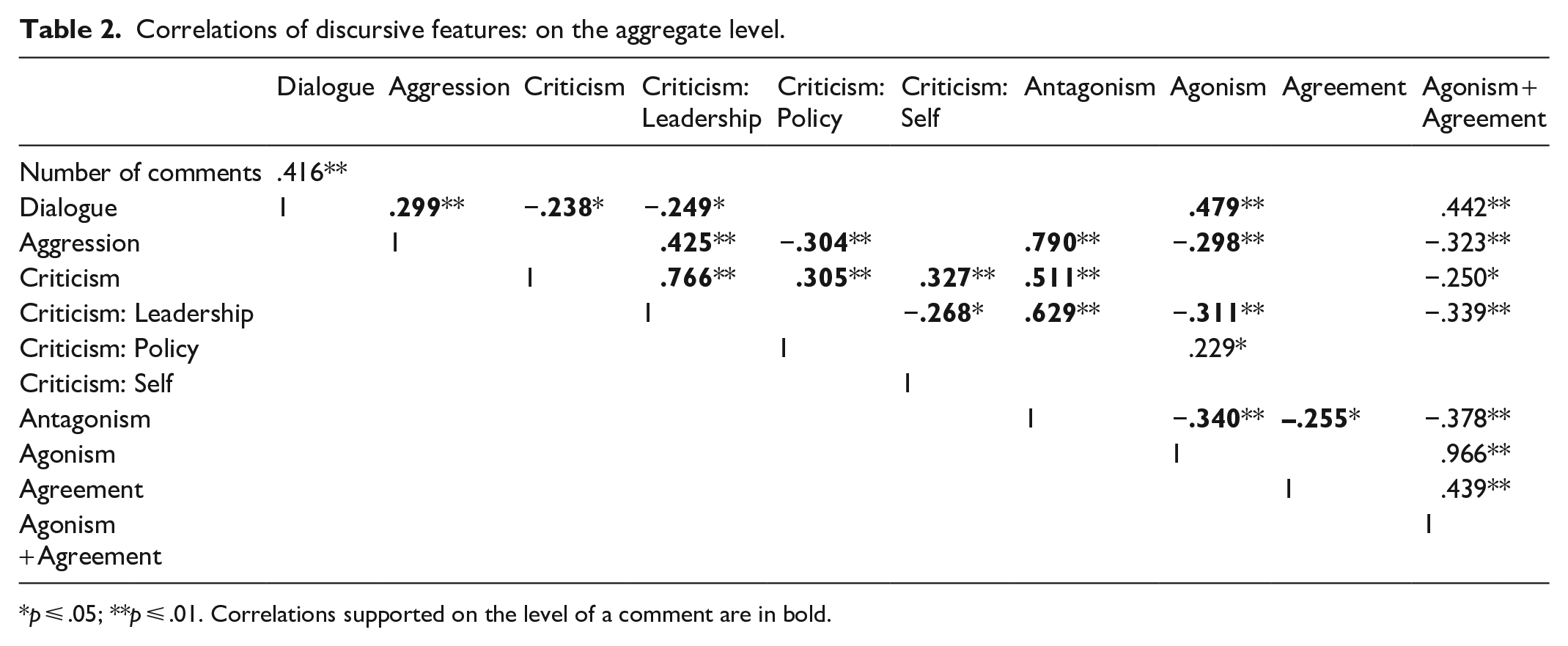
p ⩽ .05; **p ⩽ .01. Correlations supported on the level of a comment are in bold.
Median percentage for dialogical comments per author was less than 10% (9.6%), even if 25 of 75 users had ⩾ 20% of dialogue-oriented comments. Aggression was much lower (median = 4.5%), with 10 users posting ⩾ 20% aggressive comments. However, antagonism was high (median = 33.4%), with 64 users allowing it in ⩾ 20% comments and 13 reaching ⩾ 50%, only partly compensated by agonism and agreement (combined median = 11.9%).
Altogether, the shape of conflict on Belarusian oppositional YouTube was antagonistic, with commenters’ firm conviction of particular views, not seeking agreement with opponents, and dialogue mostly aiming at rebuttals toward alleged trolls. However, it was relatively non-aggressive and, in many cases, showed readiness to pose questions to opponents and co-thinkers.
RQ3: Direction of Criticism and Discursive Clusters
However, the true main feature of the discourse was criticism. It differed from aggression (“The Ministry of Education and the education departments [of local administrations] are destroying our Belarusianness”), and was not always antagonistic.
Following Toepfl’s (2020) division of authoritarian publics into uncritical, policy-critical, and leadership-critical, we have coded presence of criticism and its direction. After preliminary reading, however, we have added one more category, which was self-criticism—critique addressed to “us ourselves,” Belarus as a country/society, or oneself personally. Strikingly salient in the dataset, self-criticism sharply distinguished the Belarusian discourse from, for example, the Russian one of 2019. For the reasons of objectivity, we have also coded support to authorities as a counterbalance.
The latter, though, was expectedly next-to-absent, found in 17 comments, with 3 among 494 comments by one user as a maximum. Criticism, on the contrary, was present in 3,801 comments (~44%), with only one user having ⩽ 20% of critical posts, and 36 users of 75 being overwhelmingly critical (⩾ 50% comments). However, the direction/addressee of this criticism varied.
The highest amount of criticism was evoked by the “system” (Ledeneva, 2013), with the median = 27.7%. This included Aliaksandr Lukashenka himself; authorities in general and civil servants in particular; militiamen; and pro-Russian trolls. Lukashenka is described as “tsar” and peresident (“over-sitter”), ne Bat’ka (as “parents are not elected”), lukashescu (reminiscent to Ceausescu), and lukavy (“cunning”) afraid of his own people. More troubling, though, are rare descriptions of lukanomics and demands for dismantling of presidency as an institution, along with support of fair elections and freedoms: . . . Turnover of power, or, better, absence of presidentship in Belarus is key to normal statehood.
The authorities are described as arrogant, shame-evoking, thieves who “feed themselves at the trough” while lying and imitating work, oppositional to people, and powerless to decide. Militiamen are compared to jackals and Hitlerjugend. Often, together they are compared to occupants, and the country is called “occupied” and people “enslaved.” Antagonism in the dataset was mostly linked to descriptions of power as insane, incompetent, barbaric, showing-off, mistrusted, unduly rich, incapable of negotiation, and laughable at. The hopeless mood of “the further the worse” was dominant.
Many comments are addressed to alleged pro-Russian commenters, while, in the core, there was only one pro-Russian user. Pro-Russians were shamed (sometimes aggressively) as trolls and bots, while recognizable responses to (pro-)European or (pro-)American commenters were extremely rare (six of all). This might be a sign of pro-Russian “trollization” of the periphery of the discussion, opposite to the authorities’ claims of European impact upon online communication. In contrast to trolls, oppositional bloggers are a “punch in the gut” to the “system.”
In Toepfl’s theory, leadership-critical publics, presumably, appear where policy-critical publics already exist. However, we have discovered a leadership-critical public without policy criticism. For a Western observer, this is a paradox; for autocratic publics, though, cursing “the system” without assessing its individual shortcomings is characteristic, due to absence of traditions of publicly discussing policies. For policy criticism, the median = 5%; the users only mentioned some examples of bad policy decisions, without giving reasons or suggesting alternatives.
Self-criticism was more impressive. It stably spread through the dataset, with the median = 9%, and included sarcasm toward official slogans like “Belarus—a country for living,” criticizing pamyarkounasc’—forbearance and long-suffering viewed as traditional for Belarusians, and, most often, stating citizen’s responsibility for letting the country into its current state: Quite livable here—for an American pensioner. [I feel] shame, because we are all responsible that our country is ruled by exactly this [person]. Everyone wants change but no one wants to do anything. We need, in general, an alternative Belarusian national life.
The narrative of self-victimization intertwined with two more narratives—the necessity of unified efforts and deeds instead of words within legal boundaries—
I agree this is scary, but law needs to be our weapon, if we do not follow the law, we will become them. Alas, most probably, no way via the courts, as this is their arms against ordinary people. <. . .> our only armament against the system is solidarity. We need to find other ways. It will anyway depend fully on people’s activity. Even a critical mass of amoebae will never explode.
—and the narrative of the aforementioned “third way” for Belarusians: We will go another way. Not to NATO, not to the Russian Federation. How about this option? Neutralism.
The users state that they want to “make friends, not enemies” with “all the countries of the civilized world,” including Europe, the United States, and Russia—which, regretfully for the commenters, choses more and more a way to self-isolation. In such statements, neither policy criticism nor self-criticism is linked to aggression (see Table 2), and the more leadership criticism is present, the less self-criticism is expressed by the users.
Another addition to Toepfl’s view is that discursive features like dialogue or aggression/antagonism need to be used in combination with criticism to define the types of autocratic publics. By using k-means clustering, we have shown that these features allow for seeing difference between actively aggressive-critical, passive-critical, non-aggressive dialogical modes of discussion (see Figure 3).

Sub-clusters of cross-commenters by discursive features.
Discussion and Conclusion
In general, what we have seen on Belarusian oppositional YouTube of 2018 was, to our viewpoint, the graduate cumulation of opinion that, in August 2020, reached a threshold and spilled over to Belarusian streets.
We have shown that, at least for 2018, the oppositional public on Belarusian YouTube was open but non-random; genuine but already highly alert against trolls and bots; detached from political parties but reaching the critical point of politicization. It bore the markers of readiness to massive protest, such as acknowledgment of people’s own guilt and calls for solidarity against the “system.” Without much dialogue on policing, criticism toward the systemic features of the state combined with unusually high self-blaming and non-acceptance of Belarus and Belarusians themselves in their long-suffering. The commenters’ positions reflected what later formed a countrywide consensus and partly laid a foundation for the 2020 protests.
Studies like ours allow for capturing the public mood better than polls or political party research; we have detected a combination of readiness for change, “adversarial antagonism,” and self-criticism. The Belarusian case demonstrates that antagonism on social media is a double-edged sword: it allows uniting in hatred but eliminates chances for deliberation of participants with opposing standpoints.
Our additions to the theory of autocratic publics include presence of leadership-critical publics without policy criticism in their discourse, lack of policy-and-leadership criticism, importance of self-critical narratives, and multi-dimensionality of discourses and (if publics are characterized by discourses) of publics. The linkages between antagonism/agonism and criticism of various directions need to be further explored, too. And, last but not the least, tracing today’s changes in the Belarusian oppositional discourse online would provide a unique chance to see how such discourses mutate after a relative failure (or victory?) of a nationwide resistance wave.
Footnotes
Acknowledgements
We are grateful to Dr Aliaksandr Herasimenka for his consulting efforts.
Declaration of Conflicting Interests
The author(s) declared no potential conflicts of interest with respect to the research, authorship, and/or publication of this article.
Funding
The author(s) disclosed receipt of the following financial support for the research, authorship, and/or publication of this article: This research was supported by Russian Science Foundation, grant 21-18-00454 (2021-2023).
