




Abstract
In this study, we address the role of emotions in political news sharing on Facebook to better understand the complex relationship between journalism, emotions, and politics. Categorizing Facebook Reactions (particularly, the Sad, Angry, Love, and Wow Reactions) according to the discrete emotions model, we evaluate how positive versus negative political content relates to emotional responses, and how this consequentially influences the degree to which articles are shared across social media in the context of an election. We focus on the landmark 2018 Mexican elections to enable a nuanced conversation on how cues of user emotion predict the far-reaching dissemination of news articles on Facebook during a moment of heightened political attention. Our findings demonstrate a negativity bias in news sharing and engagement, showing an outsized prevalence of anger in response to political news. In addition, we provide evidence of a novel sadness bias in the sharing of political coverage, suggesting that emotions considered as deactivating should be reevaluated in the context of social media.
Introduction
How people engage with political news on social network sites (SNSs) has become a major subject of academic attention. Most work has focused on “sharing,” “liking,” and “commenting” of content, as these staple interactions are available across a plethora of SNSs (e.g., Facebook, Twitter, Reddit, and Instagram). Much less has been said about Facebook’s Reactions feature that was introduced in 2016 (we distinguish between Facebook’s “Reactions” feature and “reactions” in general by capitalization). Through these Reactions, users can describe how a post makes them feel by clicking one of five icons: “Angry,” “Love,” “Haha,” “Sad,” and “Wow,” providing much more versatile feedback than the traditional “Like” (Sturm Wilkerson et al., 2021). Based on these Reactions, researchers have studied the link between emotions and posts by political parties (Eberl et al., 2020), scientific literature (Freeman et al., 2019), news consumption feedback (Larsson, 2018), and controversy in news (Basile et al., 2018; Sriteja et al., 2017). In a way, these studies use Reactions as simplified yet differentiated crowdsourced data on human expression. As indications of specific emotions, they make the task of identifying types of human reaction to content online much simpler. Despite these inroads, more work is required to understand how Reactions are used in relation to political news, especially considering the crucial role played by emotions in political content engagement on SNSs (Papacharissi, 2016). The recent focus on emotions in journalism studies has also brought emotions and news content to the forefront of communication studies, highlighting the need to understand how audiences engage emotionally with the media, especially on sites such as Facebook (Wahl-Jorgensen, 2020).
In this study, we ask how we can better understand Facebook Reactions as expressions of online sentiment during moments of political mobilization: elections. We focus on Reactions to political news during the 2018 Mexican general election. Despite emotional engagement with news during elections having implications for the political process, little work has sought to explore the links between political news and this new form of online emotional engagement. We ask, How did Facebook users use the Facebook Reactions feature to engage with political news content during the 2018 Mexican Election?
Emotions can also impact news sharing. Emotions in news articles impact their “shareworthiness” (Savolainen et al., 2020; Trilling et al., 2017), and, in general, emotional news is more popular on Facebook (Gupta & Yang, 2019). While work on general news sharing has demonstrated that the presence of either positive or negative content leads to higher sharing (Bakshy et al., 2011; Berger, 2012; Kümpel et al., 2015), studies focusing exclusively on political news have shown that negative content receives more attention on websites, with some initial evidence that this attention translates into news sharing on SNS (Harcup & O’Neill, 2017; Ørmen, 2019; Trussler & Soroka, 2014). These preliminary results linking negativity and political news sharing are far from surprising—decades of research in psychology have documented the outsized impact that negative messages have on individuals.
Reactions can help us take our understanding of the relationship between emotions and news sharing beyond the typical measures of negative–positive classification of content commonly used in the news sharing literature. Accordingly, Soroka et al. (2015) have highlighted the need for more nuance when it comes to emotions and news. For example, within negative emotions, news causing sadness will have qualitatively different effects on audiences than news causing anger. With the distinctions made by Facebook Reactions between these two emotions, we can address the nuances in emotional reactions correlated to the sharing of political news. We ask, How do emotional Reactions to political news articles help us understand how these articles are shared across Facebook?
To do so, we collected
Theoretical Framework
Facebook Reactions and Emotion
The field of computer-mediated communication has long recognized the important role that emoticons play in general expression (Walther & D’addario, 2001), but particularly in communicating emotion (Aldunate & González-Ibáñez, 2017; Derks et al., 2008; Provine et al., 2007). These can help individuals communicate how they are feeling by providing “paralinguistic cues to convey emotional meaning” (Aldunate & González-Ibáñez, 2017, p. 1). Facebook Reactions are similar. Introduced in 2016, Facebook users can click–react to content beyond the classic “Like,” using the “Angry,” “Love,” “Haha,” “Sad,” and “Wow” Reactions (Larsson, 2018). Sturm Wilkerson et al. (2021) argue that these Reactions enable “affective affordances”—the capacity for users to interact emotionally with content, “making possible the expression of feeling in relation to content through discrete, preconfigured emotional choices” (p. 15).
Studies have made use of these Reactions to understand how publics engage with a wide variety of material on Facebook, including posts from political actors (Eberl et al., 2020; Jost et al., 2020), and news articles (Larsson, 2018; Savolainen et al., 2020; Sturm Wilkerson et al., 2021). While several have broadly categorized Reactions into positive (Love, Wow, and Haha) and negative (Angry and Sad) sentiment (Eberl et al., 2020; Savolainen et al., 2020), we argue that these Reactions can be better understood as discrete choices rather than on a simple negative–positive scale.
Discrete-Emotions Models of Affect (Frijda, 1986; Lazarus, 1991) add to the positive–negative divide in affect by linking emotions to behavior. While also conceptualizing emotions as broadly pertaining to negative versus positive affect, they add a second dimension to emotional reactions, not only typifying them by affect (positive vs. negative), but also by high and low arousal (Russell, 1980). For example, within positive affect emotions, happiness produces bask and bonding action tendencies, while contentment is linked to immobility; anger and sadness, both negative valence emotions, result in different action tendencies, the former leading to attack and rejection, while the latter invokes revisiting and doubt (Oatley, 1992; Roseman et al., 1994; Scherer, 1984).
When it comes to negatively valenced discrete emotions, work has long distinguished between anger and sadness. The distinguishing feature most discussed is the level of arousal between the two (Shields, 1984). This arousal impacts judgment and social information processing strategies (Bodenhausen, 1993). Assuming the Angry Reaction represents anger, we can classify the Reaction not only as negative, but also as high-arousal, while the Sad Reaction—assuming it represents sadness—also negatively valenced, can be understood as low-arousal (Russell, 1980).
In past work, the Love Reaction has been discussed as symbolizing positive valence. While some work has pointed to the different degrees of arousal that are associated with emotions such as happiness (Bjalkebring et al., 2015), other work has posited that positively valenced emotions such as satisfaction, happiness, and gladness are categorized by their low- to mid-arousing properties (Russell, 1980, 2003; Russell & Barrett, 1999). Therefore the Love Reaction—assuming it represents a mix of happy, content, and pleased emotions—can be understood as representing positive valence and low- to mid-arousal. The Wow Reaction is most closely related to surprise, astonishment, and alarm. While clearly representing high-arousal states (Russell, 1980; Russell & Barrett, 1999; Watson et al., 1999), they are harder to categorize on a valence scale. Some have argued that these states are both negative and positive (Watson et al., 1999), while Russell and Barrett (1999) claim that “rather than both positive and negative, surprise is neither positive nor negative” (p. 816). Therefore, we understand the Wow Reaction as being high in arousal, but ambivalent in its valence.
These ideas are represented in broad strokes in Figure 1, where we match each Reaction to their closest description within Russell’s Circumplex Model (Russell, 1980). This is by no means a definitive categorization of Reactions, but offers a rough guide to how arousal and valence diverge across Reactions. We excluded the vague Like and Haha Reactions.

Facebook Reactions mapped onto the Russell’s circumplex model (Russell, 1980).
Emotions in the Press, Reactions on Facebook
While scholars have long recognized the role that emotions play in journalism (Pantti, 2010), only recently has there been an emotional turn in journalism studies (Lecheler, 2020; Wahl-Jorgensen, 2019, 2020), with scholars seeking to understand the role of emotion in audience engagement. These studies emphasize that, due to the interactive and digital nature of today’s media, news increasingly relies on emotion to convey meaning to readers. Lower participation barriers, demand for new journalistic formats, and the ease of emotional audience participation on SNSs have made actors recognize and embrace the role of emotion for audience engagement, storytelling, and public captivation (Wahl-Jorgensen, 2020).
Work in this area has sought to document how audiences react emotionally to news as well as how emotions in news can affect audiences. Highlighting the importance emotion in the media, Wahl-Jorgensen (2019) makes the case for studying “mediated emotions,” arguing that emotional portrayal in the news impacts citizens’ understandings of politics. Studies have also sought to understand how users engage with emotional news on Facebook. Work on “emotional appeals” has shown that heightened emotional content results in higher news sharing, at least in the case of the viral “Icebucket Challenge” (Kilgo et al., 2017). This is also true for partisan (Hasell, 2021) and hyperpartisan news (Sturm Wilkerson et al., 2021), with high emotional appeals in content resulting in distinct behaviors on Facebook. Such news is shared more, and is also engaged with more, with Reactions being in line with the emotion present in the article.
The idea that media messages can produce emotional reactions is not new. Experimental work on the persuasion of audio–visual effects has analyzed the role that “high-arousal” content plays in emotional reactions, showing a relationship between exposure to high affect images and persuasive emotional reactions (Nabi, 2003). Framing Theory also informs our understanding of the relationship between news and audiences, studying, for example, how valence in news affects emotional responses (Gross & D’ambrosio, 2004). Positive framing in journalism results in positively valenced emotional reactions (Lecheler et al., 2015); frames emphasizing the negative aspect of a story result in negative emotions and opinions (Brader et al., 2008).
The valence of Facebook Reactions is usually in line with the content they are Reacting to (Giuntini et al., 2019). The popular Love and Angry Reactions have been shown to be commonly used with positive and negative political party posts and news (Eberl et al., 2020; Muraoka et al., 2021; Savolainen et al., 2020). Much less has been said about the Sad and Wow Reactions. The Sad Reaction can be convincingly linked to negative valence due to the clear link to sadness. Interpretation of the valence of the Wow Reaction is harder, with work in psychology highlighting the ambivalence of surprise. We hypothesize as follows:
Hypothesis 1a (H1a): Negative political news is associated with negative Reactions, such as Angry or Sad.
Hypothesis 1b (H1b): Positive political news is associated with positive Reactions, such as the Love Reaction.
Because of the lack of work on the Wow Reaction, as well as the ambivalent valence of surprise, we pose the following research question:
Research Question 1 (RQ1): How is the Wow Reaction used in relation to positive and negative political news content?
The existence of a negativity bias (Tversky & Kahneman, 1992) has long been recognized, with negative content dominating attention (Neuman et al., 2018), and having a stronger impact on political behavior (e.g., Ansolabehere et al., 1994; Lau & Rovner, 2009). Similarly, negative news results in stronger reactions than positive news (Soroka et al., 2015). Therefore, we hypothesize as follows:
Hypothesis 1c (H1c): Negative political news will elicit stronger emotional responses than positive political news.
Emotions and News Sharing Behavior
Studies aiming to understand what content characteristics influence news sharing often take a news-value approach and argue that there are structural characteristics that make a story more “shareworthy” (Trilling et al., 2017). In this context, the effect of the valence (i.e., positivity and negativity) of news has been studied extensively. Of course, other characteristics such as—to just name a few—geographical location, topic, conflict, or actors (e.g., Araujo & van der Meer, 2020; García-Perdomo et al., 2017; Trilling et al., 2017; Valenzuela et al., 2017) can play an equally or even more important role than the valence, and quite intuitively so: news from a remote location, involving unknown people, on topics that one does not care about is unlikely to catch one’s interest, even if it is more positive or negative than a story much closer to one’s life. In our study, though, many of these factors are relatively constant, as we study domestic political news only. Therefore, we will focus on the valence.
Also from a conceptual point of view, positivity and negativity as news factors play a central role in the shareworthiness literature. Eilders (2006) argues that news factors serve as a “relevance indicator” (p. 5). In particular, she argues that “Damage can affect an individual directly, and since we have learned to be better off attending to negative events, we assign relevance to damage” (p. 15). This argument can be extended to sharing behavior, as Bobkowski (2015) points out that “informational utiliy” is a major force that drives sharing. While the relevance of positive news may be a bit less obvious, Harcup and O’Neill (2017) show that positivity is a news factor as well. Trilling et al. (2017) argued that sharing of positive news may be explained by the desire of the sharer to construct a positive image of themselves.
In spite of the inclusion of valence in multiple studies, the jury is still out, with some studies finding that positive valence is linked to more sharing (Bakshy et al., 2011; Berger, 2012; Kümpel et al., 2015), while others provide evidence for both negative and positive news increasing sharing (Trilling et al., 2017), and others argue that arousal, regardless of valence, is what drives sharing (Berger, 2011).
This possible bias for positive material, however, is found on content encompassing a variety of topics. The literature focusing exclusively on politics has extensively documented the stronger effect negativity has on individuals. This translates into SNSs, with negative content driving a variety of engagement metrics (e.g., sharing, commenting, and liking) (Ørmen, 2019), confirming previous findings from the negativity bias literature. When looking explicitly at political news, studies conclude that negative political news stories receive more attention on websites, with some initial evidence that this attention translates into more news sharing on SNSs (Harcup & O’Neill, 2017; Ørmen, 2019; Trussler & Soroka, 2014). Because we study solely political news, we expect a stronger propensity for users to share negative news:
Hypothesis 2a (H2a): Negative political news articles are more likely to be shared than positive political news articles.
We also expect this relationship to be present in the valence of Reactions:
Hypothesis 2b (H2b): Political news articles producing Sad and Angry Reactions are more likely to be shared than political news producing the Love Reaction.
According to the Discrete-Emotions Models of Affect, external stimuli produce emotional reactions that create action tendencies that help us understand how emotions guide behavior (Frijda, 1986; Lazarus, 1991). Depending on the degrees of arousal, researchers have different expectations as to how individuals will react when experiencing, for example, anger or sadness, with the former producing more arousal than the latter. Taking a differentiated approach to discrete emotions is especially relevant considering recent work showing how similarly valenced emotions, such as anger and sadness, have different impacts on how people engage on social media (Hasell, 2021; Hasell & Weeks, 2016; Wollebæk et al., 2019). While studies have sought to differentiate between these emotions by manually coding content (e.g., Hasell, 2021; Kilgo et al., 2017), this is a challenging task for human coders, let alone machines, considering their internal bias: a news piece that represents something sad to one person might anger another. One approach to circumvent this bias can be to use crowdcoded data rather than expert-coded data for sentiment-analysis-related tasks (Haselmayer & Jenny, 2017).
To differentiate between these qualitatively different emotions, we reduce our efforts to coding texts as simply negative versus positive, and then rely on the Facebook Reactions feature to identify the discrete emotions produced by the texts themselves, as a pseudo-crowd-sourcing manner of data collection on emotional reactions. Treating Facebook Reactions in this manner, we can obtain a more nuanced understanding of how valenced news content leads to news sharing—is negative news shared more because it induces sadness, or because it leads to anger? Because of the activating properties of anger as opposed to the deactivating nature of sadness, as well as literature that has demonstrated the link between anger and sharing (Berger, 2011; Hasell & Weeks, 2016), and the general activating nature of anger in the political world (e.g., Lecheler et al., 2013; Soroka et al., 2015; Trussler & Soroka, 2014), we expect the following:
Hypothesis 2c (H2c): Political news articles that produce Angry Reactions are more likely to be shared than political news articles that produce Sad Reactions.
The same logic applies to non-negative Reactions—with the modestly low arousal produced by happiness in comparison to the highly-activating surprise, we expect:
Hypothesis 2d (H2d): Political news articles that produce Wow Reactions are more likely to be shared than political news articles that produce Love Reactions.
Why the Mexican 2018 Elections?
The 2018 Mexican elections were the biggest celebrated in the democratic history of the country (Greene & Sáchez-Talanquer, 2019). We focus on them for two main reasons. First, it was an election marked by high emotions: the anti-systemic rhetoric employed by victor Andres Manuel López Obrador brought to the forefront the extreme corruption, violence, and poverty in the country. Fury, hope, and disappointment intermingled in a highly polarized electorate—an ideal case study for understanding the role that emotions play in people’s Reactions to political press on SNSs. They were especially marked by corruption—with large-scale corruption case brought against a main contender—and violence, with the assassination of 120 elected officials, 45 candidates, and 351 unelected officials making it the most violent campaign period in the country’s democratic history (Esteinou, 2019; Valli & Nai, 2020).
Second, the election witnessed an unprecedented level of online SNS engagement. With growing digitalization of political and news consumption activities in non-Western countries, we need to understand the role of digital technologies outside the typical Western research focus. With the fifth most Facebook users in the world, Mexico presents such an opportunity. de León et al. (2021) demonstrated that elections significantly alter the sharing of political news, especially in Mexico. Glowacki et al. (2018), analyzing Twitter and Facebook in the lead-up to the election, confirm that this election indeed witnessed unprecedented levels of online engagement, especially when compared to “routine” political periods (de León et al., 2021). How emotions were channeled on SNSs, however, still remains an open question.
Method
Data
As most SNS news engagement was with established mainstream news brands (Glowacki et al., 2018), we focus on five major Mexican news sites—El Universal, El Financiero, Proceso, Milenio, and Excelsior—collecting articles published during the official campaigning period (1 March 2018–1 July 2018). We did so through Archive.org’s “Wayback Machine,” which archives past versions of websites, allowing us to scrape past versions of these news sites’ frontpages (Grusky et al., 2018, de León et al., 2021). Focusing on the frontpages could have arguably introduced some bias in our sample, potentially overrepresenting top stories (see Supplemental Appendix 1). This resulted in a total of
We used supervised machine learning to identify political articles. A stratified random sample of
We used the CrowdTangle API to retrieve Facebook interaction data for all articles, receiving information for each “public” post that included the respective link, and information on how many times the post itself was interacted with by private accounts. This has implications for our study, as we cannot make assertions as to how people interacted with news throughout all Facebook, only on public posts. This is, however, a lot more information than what is available through Facebook’s public API (Supplemental Appendix 3).
Variables
We operationalized Facebook’s Reactions feature as distinct emotional reactions. We focus on four of them: Angry, Sad, Wow, and Love. Shares represent the number of times a given news article was distributed on Facebook. Shares are composed of both the amount of times a news article was posted by public pages on Facebook, and the number of times these posts were then shared again by private users. We also account for the number of days since
Content Variables
Negative news is understood as news that deals with particularly negative topics, such as crime, defeat, or loss, or news that has particularly negative connotations, while positive news refers to articles that report on successes and victories. We follow previous work (e.g., González-Bailón & Paltoglou, 2015) using supervised machine learning to classify articles by their valence. Manual coders labeled a total of
Finally, we note the high prevalence of negative news in the sample, with 8,019 negative articles, which is in stark contrast to the 1,207 articles identified as positive news. This low occurrence can be explained through the low recall of the supervised machine learning classifiers used: for positive news the recall was of 0.25, meaning that only around a quarter of all cases were identified. Nevertheless, the high precision of the classifiers suggests that we can be certain that the majority of cases that were identified were done so correctly, meaning that estimates produced will be more conservative. We also rerun our analyses using only hand-coded articles in Supplemental Table A5 as a robustness check.
Results
Article Content and Emotional Reactions
We first refer back to the descriptive statistics in Table 1 and Figure 2, as they provide initial insight into how people interact with political news on Facebook in the form of Sharing and Reactions. Figure 2 showcases the volume of Reactions and shares: the Angry reaction is clearly the most used reaction in political news, with a total of almost 1.3 million Reactions in comparison to the 0.5 million Love and 76,000 Sad Reactions. These, however, pale in comparison to the total number of shares received: at over 4.5 million total shares, it is clear that Facebook users share political news more often than they use the Angry, Love, and Sad reactions. These are all much smaller than the number of Likes, however, the staple interaction on Facebook, but not a focus of this study.
Descriptive Statistics of All Variables in the Data Set.

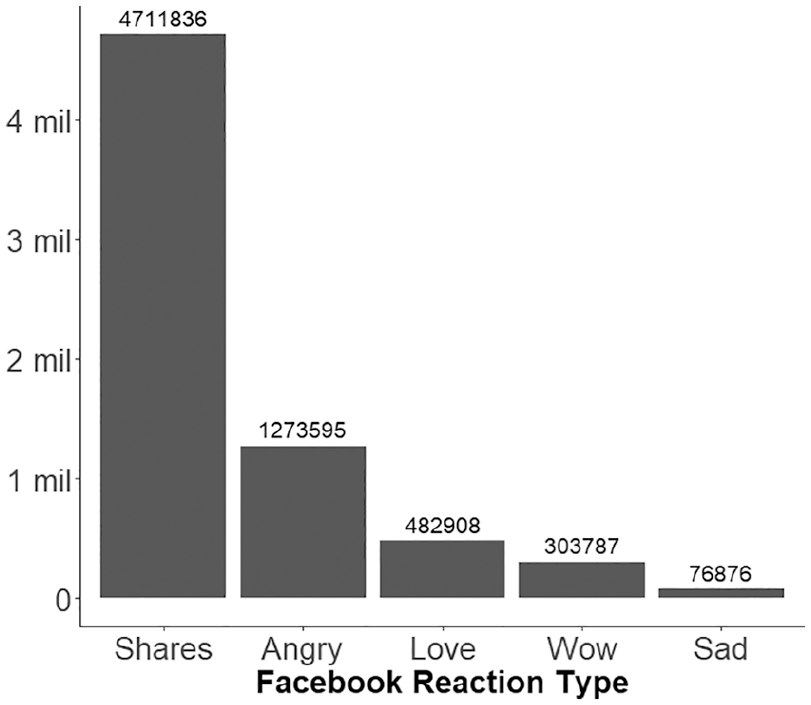
Total count of Reactions in sample.
This first section of the analysis seeks to understand the effect that valence in political news content have on how individuals react emotionally on Facebook. Table 2 presents five negative binomial regression models predicting the effect of content on Reactions received by each article on Facebook. As an independent variable in the model increases by a single unit, the expected value of the dependent variable has to be multiplied by the incidence rate ratio (IRR). Therefore, an IRR of 0.8 means that a one-unit increase in the independent variable leads to only 80% of expected Reactions (a negative effect), while an IRR of 1.2 results in 120% of expected Reactions (a positive effect).
Negative Binomial Regressions Predicting the Number of Reactions on Facebook.
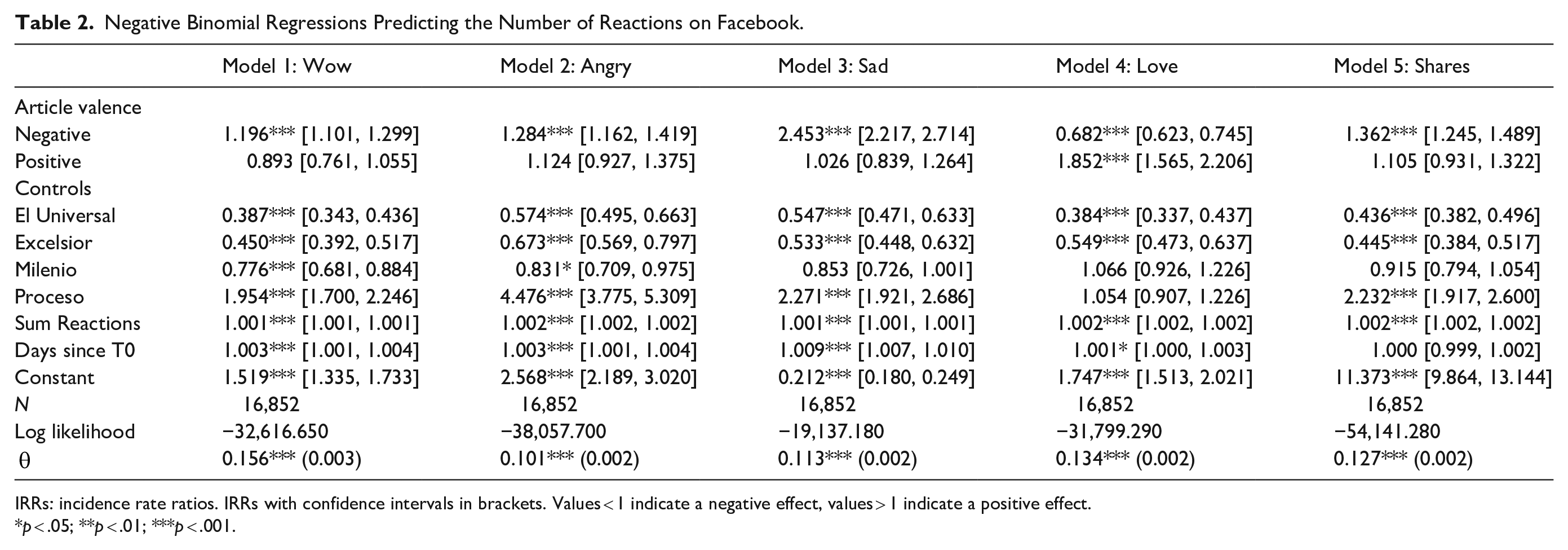
IRRs: incidence rate ratios. IRRs with confidence intervals in brackets. Values < 1 indicate a negative effect, values > 1 indicate a positive effect.
p < .05; **p < .01; ***p < .001.
H1a predicted that negative news will result in negatively valenced emotions; here, the Angry and Sad Reactions. Models 2 and 3 confirm this hypothesis: the effect on Angry Reactions is an IRR of 1.284 (negative news articles are expected to receive 28% more Angry Reactions). Similarly, Model 3 shows a positive relationship between negative political news and Sad Reactions—here, however, the effect is five times the magnitude, with an IRR of 2.453 (a 145% increase in expected Reactions). Both these results support H1a: the Angry and Sad Reactions are used to engage with negative political news.
H1b focuses on the effect of positive news on Reactions, hypothesizing that positive political news is linked to positively valenced reactions: here, the Love Reaction . Model 4 supports this hypothesis, showing a positive relationship between positive news and Love reactions, with an IRR of 1.852. When an article is positive, it is predicted to receive 85% more Love reactions; nevertheless, negative news leads to a 68.2% decrease, allowing us to confirm H1b. With RQ1, we enquire into the relationship between article valence and the Wow Reaction. Model 1 shows that positive political news has no effect on Wow Reactions, while negative news has a positive effect on Wow Reactions, with an IRR of 1.196 (receiving 19.6% more Wow Reactions). This suggests that the Wow Reaction is more closely associated to negative news.
H1c addresses the relative strength of effects produced by positive and negative news. Comparing the effect sizes of positive and negative news across Models 1–4 one can appreciate that on one hand, the effect of positive news on Love Reactions (1.852) is smaller than the effect of negative news on Sad Reactions (2.453). This effect, on the other hand, is larger than the effect of negative news on anger (1.284) (these differences are deemed significant as the 95% confidence intervals do not overlap). Because the effect of positive news on Love is bigger than the effect of negative news on anger, we do not have enough evidence to conclusively support H1c. As a robustness check, models were replicated using only the hand-coded sample of articles
Emotional Reactions and News Sharing
Before addressing the relationship between Reactions and sharing, we first look at the effect of content and sharing. Specifically, H2a expected that negative content would be positively related to sharing: Model 5 (Table 2), which displays the effect of content variables on article sharing, allows us to evaluate this relationship. With an IRR of 1.362 of negative news on sharing, negativity increases the expected number of shares an article receives by 36.2%, while positive news has no significant effect on sharing. We can confirm H2a.
With Table 3, we address the difference emotional valence and arousal have on political news sharing. We first tackle differences in the negative–positive valence division: when it comes to the most popular Reactions, namely, Angry and Love, the negative-valenced reaction has a stronger impact on political news sharing, with an IRR of 1.0002, while Love reactions have a negative effect on sharing, with an IRR of 0.9996. Similarly, the Sad Reaction, with an IRR of 1.0009 is a stronger predictor of sharing than the Wow Reaction, with an IRR of 1.0007. This provides evidence that negative-valenced Reactions are stronger predictors of sharing—this is especially the case considering that the Wow Reaction can also be considered as negatively valenced, considering its strong relation to negative political content identified above.
Negative Binomial Regressions Predicting the Number of Shares on Facebook.

IRR: incidence rate ratio. IRRs with confidence intervals in brackets. Values < 1 indicate a negative effect, values > 1 indicate a positive effect.
p < .05; **p < .01; ***p < .001.
Our categorization of Reactions allows us to explore the nuances in emotional arousal. In H2c, we expected that Angry Reactions would be a stronger predictor of sharing than Sad Reactions, as anger is understood to be more arousing than sadness. The model does not support this hypothesis, since Sad Reactions have the strongest IRR of all reactions, at 1.0009. In H2d, we expected that political articles producing Wow Reactions would result in more sharing than those producing Love Reactions, as amazement is a more stimulating reaction than happiness. With an IRR of 1.0007 for Wow Reactions compared with the 0.9996 for Love Reactions, we find support for H2d. 1
While small, these IRRs need to be interpreted in the context of SNSs, where articles receive high volumes of reactions that range into the several thousands. In this model, a 1,000 increase in Sad Reactions, for example, leads to a 146% increase in the number of expected shares
A 1,000 unit Reaction increase is more common among certain reactions than others (see Table 1). To account for these drastic differences, it is important to interpret the results in relation to the relative distribution of each Reaction using the standard deviations (SD) of each. For the Angry Reaction, the model estimates that a two-SD increase in Reactions leads to an increase of 21% of shares (
Discussion and Conclusion
In this study we explored the relationship between political news valence, Facebook emotional Reactions, and news sharing during the 2018 Mexican elections. Through a large sample of political news (
Does political news sentiment affect an audience’s emotional reactions on social media? The results presented in this article suggest a resounding yes—Positive News leads to positive emotional responses on Facebook, while Negative News is linked to negative responses. When it comes to the emotionally clear-cut Angry and Love Reactions, our findings support previous work noting the effect valenced political content has on the prevalence of Angry Reactions and Love Reactions (Eberl et al., 2020; Heiss et al., 2019; Jost et al., 2020), with the Angry Reaction linked to negative political news, and the Love Reaction to positive political news. In addition, we study two Facebook Reactions that have been widely overlooked: the Sad and Wow Reactions. We find a very strong relationship between negative news and the Sad Reaction, as well as between negative news and the Wow Reaction. This last finding suggests that, when it comes to political news, the Wow Reaction is used as a negative expression—disbelief rather than amazement.
Evaluating the use of Reactions themselves, we find a strong dominance of the Angry Reaction in our sample of political news, which is telling of an election marked by corruption and violence. With almost 13 million Angry Reactions, anger was expressed at a rate over 250% of the next leading Reaction, Love, with only 5 million interactions. Work on negativity in politics has pointed to citizens’ willingness to express outrage (Hasell & Weeks, 2016; Neuman et al., 2018; Soroka, 2009; Soroka et al., 2015; Valentino et al., 2011), and that anger is prevalent among emotional reactions to news articles (Hasell, 2021). With the ability to publicly express displeasure at the click of a button, it is becoming easier for affective publics to voice their discontent (Papacharissi & De Fatima Oliveira, 2012). This speaks of the rising body of literature that documents the prevalence of anger as an emotional expression on Facebook in relation to political news (Savolainen et al., 2020; Sturm Wilkerson et al., 2021) and politician posts throughout the world (Eberl et al., 2020; Heiss et al., 2019; Jost et al., 2020; Muraoka et al., 2021).
The second contribution this article offers is in the area of news sharing, by assessing the influence of both content and Reactions on political news sharing. We find that negative political articles are shared more often than positive ones. Although future research needs to rule out alternative explanations (such as other news values that we did not include), this finding has implications for our understanding of both news sharing and the 2018 Mexican elections. Focusing on political news, our evidence suggests that, unlike findings in the broader news sharing literature where positive stories inspiring hope and happiness are shared relatively often (e.g., Trilling et al., 2017), citizens are more likely to engage with negative political content. There is no doubt that the sharing of negative news is linked to the size and quantity of scandals that dominated media coverage in the 2018 Mexican election, reflecting the general level of exasperation felt throughout the electorate (Esteinou, 2019). In this context, it is natural to expect citizens to be more concerned about allegations of corruption and acts of political violence, to the point where these news stories become viral.
In addition, we disentangle the effects of articles producing sadness and anger, two different emotions that are often grouped under the umbrella of negativity. While both psychological understanding of emotions (Russell, 1980) and work on discrete emotions on social media (Hasell & Weeks, 2016; Kilgo et al., 2017; Wollebæk et al., 2019) suggest anger would lead to more sharing than sadness, this was not the case in our study: the effect of Sad Reactions on sharing is larger than that of Angry Reactions. There are numerous explanations for these differences: the use of self-reported sharing behavior (Hasell & Weeks, 2016), and measuring emotion in content instead of Reactions (Kilgo et al., 2017; Wollebæk et al., 2019) are some of many. In addition, media-induced sadness might not be as deactivating, triggering “different motivational goals than sadness in response to real events” (Zerback & Wirz, 2021, p. 39).
The literature on people’s desire to avoid conflict on SNSs also helps contextualize this counter-intuitive finding. Since Facebook is mostly made up of “close ties” (Valenzuela et al., 2018), users are less likely to publicly share political material deemed to be controversial (Valenzuela et al., 2017). Sharing a political article inspiring anger might lead to conflict with Facebook contacts. Users might therefore be more likely to redistribute news producing sadness instead. Other scholars have discussed the sharing of especially negative news: “people may feel more personally touched by disastrous news, and they may also feel more need to discuss and contextualize it, both things which might provoke sharing (Bright, 2016, p. 348). Although their own findings reject this hypothesis, we find some support for this idea. Referring directly to articles with most Sad Reactions, one finds headlines on Donald Trump’s child separation policy, the murder of local political candidates, and analyses of policies failing to reduce poverty. These articles, while political, are devoid of ideological interpretations, addressing issues that are tragic in nature. Perhaps users of Facebook are more inclined to share tragic stories to collectively express and participate in the grief caused by such news.
Overall, this finding suggests that when understanding political news sharing on Facebook, it is important to look beyond the “stuff that makes you laugh and stuff that makes you angry” (Newman, 2011, p. 24), also considering the stuff that makes you sad. This is inline with the recent findings by Zerback and Wirz (2021), who show that themes of sadness are more strongly associated with sharing than themes of anger in political party postings. This sadness bias in the sharing of political news informs the news sharing literature in several ways. First, it speaks of the role that controversy (or articles that make you feel anger) has on reducing sharing (Valenzuela et al., 2018) in comparison to articles inducing grief. Second, this unexpected result highlights the need to further explore the commonly overlooked role that sadness can have on social media platforms, as existing work is limited and mostly focused on emotional appeals in articles themselves (Kilgo et al., 2017; Sturm Wilkerson et al., 2021), rather than user-expressed emotion on SNSs.
Finally, we assessed the effect of positive political news and emotions on news sharing. Focusing on the Love Reaction, we find that the Love Reaction leads to a decrease in news sharing . Regarding the valence-ambivalent Wow Reaction, we find a strong positive effect on sharing. Moreover, our analysis revealed that Wow is more closely linked to negative than positive content. It is possible that it is the negative use of the Wow Reaction that is leading to higher shares. Studies that have found a relationship between positive news and increased sharing usually address a sample containing a variety of news topics, where political news is shared less than lifestyle news (Bakshy et al., 2011; Berger, 2012; Kümpel et al., 2015; Trilling et al., 2017). We show that when it comes to political news, Facebook audiences share less stories resulting in Love Reactions, opting instead for those that produce negative emotions. This finding further provides evidence for emotional engagement theories that argue that, when it comes to politics, positive emotions are generally deactivating.
While we believe we contribute to the literature on shareworthiness by adding valuable nuance, unlike Trilling et al. (2017) and subsequent studies (e.g., Araujo & van der Meer, 2020; García-Perdomo et al., 2017; Valenzuela et al., 2017) we did not incorporate other factors of shareworthiness. In addition, we want to highlight that by not coding articles on a discrete emotion basis, but rather on a simple positive–negative–neutral classification, we cannot fully explain what characteristics in articles are linked to discrete Facebook Reactions (i.e., what separates articles that get Sad vs. Angry Reactions). Relatedly, the low recall of our positive news classifier suggests we might be capturing a sub-concept of positivity. Future research could aim at further exploring dimensions of positivity in news. Lastly, we wish to highlight that we do not want to imply that the Reactions mediate the relationship between content and sharing, as we did not explicitly test this in a mediation model (for a conversation on the nuances of mediation with count data, see Cheng et al., 2018).
Supplemental Material
sj-tex-1-sms-10 – Supplemental material for A Sadness Bias in Political News Sharing? The Role of Discrete Emotions in the Engagement and Dissemination of Political News on Facebook
Supplemental material, sj-tex-1-sms-10 for A Sadness Bias in Political News Sharing? The Role of Discrete Emotions in the Engagement and Dissemination of Political News on Facebook by Ernesto de León and Damian Trilling in Social Media + Society
Footnotes
Declaration of Conflicting Interests
The author(s) declared no potential conflicts of interest with respect to the research, authorship, and/or publication of this article.
Funding
The author(s) received no financial support for the research, authorship, and/or publication of this article.

Supplemental Material
Supplemental material for this article is available online.
Notes
Author Biographies
References
Supplementary Material
Please find the following supplemental material available below.
For Open Access articles published under a Creative Commons License, all supplemental material carries the same license as the article it is associated with.
For non-Open Access articles published, all supplemental material carries a non-exclusive license, and permission requests for re-use of supplemental material or any part of supplemental material shall be sent directly to the copyright owner as specified in the copyright notice associated with the article.
