




Abstract
In this article, we explore the relationship between social media use and participation in protests in Chile. In October 2019, Chile faced the most massive protests since the country’s return to democracy. Due to its magnitude, the media and analysts refer to this process as the “social outburst.” Although these protests engaged broad sectors of the population, most of the protesters were young people. Using a probabilistic and face-to-face survey applied to young people aged 18-29 years, we find that the only social media platform associated with participation in protests was Facebook. Our analysis also shows the importance of the specific activities that people engage in social media. Taking part in political activities on social media is strongly associated with attending protests but using social media platforms to get information or share common interests with other users is not. Furthermore, we examine whether social media has an indirect impact on participation through interpersonal conversation. The results show that Instagram—one of the most popular social media platforms among young Chileans—spurs interpersonal conversation, which in turn increases the likelihood of participating in protests. Our findings suggest that social media still plays a role in shaping people’s political behavior despite changes in the social media environment and in social media consumption patterns.
Introduction
The year 2019 will be remembered, among other things, for the massive protests that took place around the world. In places as diverse as France, Lebanon, Colombia, Barcelona, and Hong Kong, thousands of citizens took to the streets in major cities, protesting with such dissimilar goals as removing officials, dismantling controversial measures, and calling for structural change. Despite political, economic, and cultural differences, these events took place in locations around the globe, and Chile was no exception.
In October 2019, Chile experienced a true “social outburst.” Major protests took place in various cities in the country for nearly 2 months (Deutsche Welle, 2019). Although the protests began as high school students’ response to the subway fare hike in Chile’s capital, Santiago, they quickly evolved, incorporating new issues and actors. After several days, the idea of having a new Constitution became the primary demand. Eventually, the government and the opposition agreed to hold a constitutional referendum as a way out of the crisis.
As a large number of studies demonstrate, social media use is closely linked to political participation, especially “unconventional” forms of participation such as protests. Studies show that the use of Facebook and Twitter is a strong predictor of political involvement. Research on Chile reaches the same conclusion among young people (Navia & Ulriksen, 2017; Valenzuela et al., 2012, 2018). Although these findings are robust despite the political, social, and economic differences among political systems (Ekström & Östman, 2015; Xenos et al., 2014), a significant portion of the evidence comes from studies conducted when social media penetration was considerably lower than it is today. This leads to the question of whether social media still correlates with political participation in a context in which the media has changed in recent years and new social media platforms have been introduced.
In this study, we focus on social media use and protest participation among young Chileans in the context of the 2019 “social outburst.” Besides the massiveness of these protests, one of their most significant features was the lack of recognizable leaders or organizations. We argue that given the absence of formal organizations and solid political identities, social media would emerge as an important mechanism for organization, socialization, and mobilization. As such, social media use would be a relevant factor in explaining people’s involvement in protests during the social outburst.
Building on previous research, we evaluate whether in Chile (a) social media use correlates with participation in protests, (b) specific uses of social media platforms are more strongly associated with participation in protests, and (c) the relationship between social media use and political participation operates through interpersonal conversation, as suggested by the citizen communication mediation model (Shah et al., 2005, 2007). Since social media platforms have unique features, attributes, and affordances, rather than understanding social media as a homogeneous set of platforms, we assess these hypotheses using the five most popular social media platforms in Chile: Facebook, Twitter, WhatsApp, YouTube, and Instagram.
To test our theoretical expectations, we rely on data from the 2019 Youth, Participation, and Media survey, a public opinion study conducted by Universidad Diego Portales. Our results show that Facebook is the only platform associated with participation in protests and that Instagram has an indirect effect on protest involvement through interpersonal conversation. We also demonstrate the importance of the specific activities that people perform on social media for explaining citizens’ engagement in protests. These results suggest that social media still plays a role in shaping people’s political behavior, but the magnitude of that relationship is weaker than the one found in studies conducted at the beginning of the past decade.
Political Participation in the Age of Social Media
Citizens’ political participation stands at the “heart of democracy” (Verba et al., 1995, p. 1). Broadly speaking, political participation can be understood as any activity oriented toward affecting politics (Van Deth, 2014). Although voting is the most widespread expression of participation in contemporary democracies, the variety of ways in which citizens can influence public decisions has significantly increased over the past few decades (Dalton, 2017; Theocharis & Van Deth, 2018). Nowadays, citizens participate in various actions such as protests, blocking streets, boycotting, community activities, among other activities, revealing the ongoing expansion of modes of participation available to citizens (Theocharis, 2015; Theocharis & Van Deth, 2018).
Political communication research suggests that social media use relates to citizen involvement in politics. Social media has not only expanded opportunities for people to get involved in online activities but also has become a vehicle that facilitates participation in a wide range of offline actions (Theocharis & Van Deth, 2018). Metanalyses conducted over the past few years show a positive relationship between social media use and participation in political and civic life (Boulianne, 2015; Boulianne & Theocharis, 2020; Skoric et al., 2016). Yet, results depend significantly on which social media platforms and modes of participation are examined.
Previous research suggests that social media offers various affordances and resources for users to engage in political activities. For instance, social media reduces the economic costs and time required to organize collective activities and contributes to the replicability and scalability of content (Ellison & Vitak, 2015; Gerbaudo & Treré, 2015). Similarly, social media facilitates the creation of networks allowing the exchange of information and opinions and favors the development of collective identities (Bennett & Segerberg, 2013; Vraga et al., 2015). As such, social media use may contribute positively to the decision to get involved in public affairs, it adds new venues to engage in politics, and it complements traditional modes of political participation (Gil de Zúñiga et al., 2017).
Social media makes political information more accessible. Existing research demonstrates that social media platforms facilitate exposure to political news that stimulates political involvement (Dimitrova et al., 2014), even when users are only incidentally exposed to that information (Valeriani & Vaccari, 2016; Xenos et al., 2014). In addition, social media allows people to access alternative news sources. Social media can also build trust among members, increasing online and offline social capital. As previous research notes, social media spurs online social capital, which fosters offline social capital (Gil de Zúñiga et al., 2017), an important determinant of political involvement (Putnam, 2000).
Although a large body of empirical evidence supports a positive association between social media use and participation, some studies suggest a more nuanced approach. Research shows that several factors affect the direction and intensity of the relationship between social media use and participation. Scholars hold that such relationships are contingent on individual attributes such as personality traits (Kim et al., 2013) or motivations such as interest in politics (Boulianne, 2011). Moreover, connections and networks people form on social media platforms (Valenzuela et al., 2018), or specific uses given to social media sites (Gil de Zúñiga et al., 2013; Scherman et al., 2015) emerge as relevant moderators. For example, Ekström and Östman (2013) find that, among adolescents, participation through social media differed depending on whether individuals use social media platforms to consume information, talk with other users, create content, or look for entertainment.
The importance and role of social media in contemporary democracies can be explained by the cultural transformations experienced in modern societies. Bennett and Segerberg (2013) hold that the logic of connective action characterizes modern societies. Two characteristics would be crucial for explaining the emergence of this logic. On the one hand, political parties and traditional organizations lose their grip on individuals, leaving room for other institutions to organize citizens’ political action (Dalton et al., 2011). On the other hand, social connections have become increasingly more fluid. Both characteristics are highly relevant for Latin American countries like Chile. In such countries, political parties do not enjoy the levels of institutionalization and legitimacy that they have in advanced democracies (Mainwaring, 2018), and the levels of social and political trust are lower than in other regions (Letki, 2018). In that context, social media is a valuable resource for complementing or replacing traditional institutions in fostering citizens’ engagement.
The Political Context of the Chilean Social Outburst
In October 2019, a wave of mobilizations shook Chilean democracy. A US$0.40 subway fare hike in the capital city of Santiago triggered a series of protests that spread throughout the country (Ulloa, 2019). Unexpectedly, Chile experienced the largest protests since the end of the dictatorship in 1990.
Since its return to democracy, Chile has been one of the most stable countries in Latin America. In economic terms, the country has increased its per capita gross domestic product (GDP) and substantially improved various socioeconomic indicators (Gonzalez & Le Foulon, 2020; Navia, 2014). In political terms, the country has faced no democratic interruptions, which contrasts with other countries in the region. Indeed, the Economist (2019) placed Chile in the “full democracies” category in the 2019 Democracy Index. However, despite the economic and democratic advances, inequality continues to be very high compared with other countries in the region (Roberts, 2016; UNDP, 2015). The World Inequality Database (2020) ranks Chile as one of the most unequal countries in Latin America, only behind Brazil.
Previous analyses suggest that economic and political factors are closely linked to the 2019 protests (Somma et al., 2020). Regarding economic factors, the presence of demands related to access to health care, education, or pensions suggests that inequality and economic grievances were central to mobilizing people (Somma et al., 2020). Inequality operates both in material terms and subjectively. Research shows that the more disadvantaged groups suffer from mistreatment and humiliation by wealthier sectors (UNDP, 2017). Concerning political factors, the country exhibits a growing distance between citizens and political elites. Chileans show low levels of party identification (Bargsted & Maldonado, 2018) and trust in political institutions (Segovia, 2017). Voter turnout has systematically decreased since 1990 (Morales, 2020). Political parties have lost the roots that they had in society (Luna & Altman, 2011), and their links to social movements have weakened in past years (Disi, 2018). Corruption in public and private sectors affected trust in political institutions and contributed to widespread malaise with the democratic system (Joignant et al., 2017; Morales, 2020). Finally, the country has experienced an intense questioning of social hierarchies based on gender or ethnicity over the past few years (Reyes-Housholder & Roque, 2019; Somma et al., 2020).
Although the social outburst stands out because of the magnitude of the protests, Chile has seen an upswing in the number of social protests over the past few years. For instance, in 2006 and 2011, the student movement brought thousands of students into the streets to demand better education and social justice. Technology played a huge role in organizing those protests and making visible students’ demands. While 2006 protesters relied on SMS to communicate and organize demonstrations, 2011 participants used social media platforms such as Facebook or Twitter to achieve such goals.
Two characteristics of the Chilean social outburst are compelling for assessing social media’s role in Chileans’ political involvement. First, although the protests engaged a heterogeneous group of people, there was remarkable participation of young people: Most of the demonstrators were socialized in the massive student protests that took place in the country over the past 15 years (Palacios-Valladares, 2020). Second, the protests lacked the presence of leaders or formal organizations. Indeed, the role of social movements and political parties was marginal in these events.
Given these antecedents, social media may not only have played a role in organizing mobilizations but also partially replaced traditional leadership in the call to protest (Somma et al., 2020; Valenzuela et al., 2018). Prior research suggests that Chilean young people are active social media users and that they take advantage of such platforms to engage in political activities (Scherman et al., 2015; Valenzuela et al., 2012, 2018). Indeed, social media use is extensive throughout Chilean society. Among the youth, the most popular platforms are WhatsApp (96%), Facebook (86%), Instagram (77%), and YouTube (76%), followed by Twitter (21%) (Journalism UDP-Feedback, 2019).
Youth, Social Media Use, and Protest Involvement: Theoretical Expectations
Social media has been particularly important for understanding the participation of citizens in protests around the world (Anduiza et al., 2014; Bennett & Segerberg, 2013; Enikolopov et al., 2020; Jost et al., 2018; Scherman et al., 2015). Given the centrality that new technologies and social media have in young people’s lives, one would expect the impact of social media use on political participation would be more significant among the youth than in older cohorts (Kruikemeier & Shehata, 2017). Indeed, there is a growing interest in how these new technologies affect and shape political involvement for the youngest members of society (Boulianne & Theocharis, 2020; Scherman et al., 2015; Xenos et al., 2014). Since young people are digital natives and more intense social media users, they are more likely to exploit social media to get interested in public affairs and engaged in civic actions (Bennett & Segerberg, 2013).
Under the label of social media exists several platforms with unique attributes and affordances. These features affect not only their adoption but also the way individuals create content, share information, and interact with other users (Ellison & Vitak, 2015). Since each social media platform has different features, we would expect the relationship between social media and political behavior to differ among platforms.
Social media platforms differ in several dimensions. For instance, Facebook spurs asymmetrical relationships between users given that they must agree to become friends on the platform. Moreover, Facebook networks tend to produce homogeneous groups, which give some members a great deal of influence over others due to the nature of their offline bonds. This has led scholars to label Facebook a strong-ties network. Unlike Facebook, Twitter is considered a weak-ties platform. Twitter users can interact with people they do not know in their daily life such as politicians, celebrities, or journalists, but the ties they form in the network are weak and can break easily (Valenzuela et al., 2018).
Prior research shows that Facebook and Twitter are associated with participation in protests (Scherman et al., 2015; Valenzuela et al., 2012, 2018). Similarly, Phua et al. (2017) demonstrate that Facebook users have higher levels of social capital than Twitter users. Furthermore, Yarchi et al. (2020) find that political polarization patterns are different among Twitter, Facebook, and WhatsApp.
Recent research provides a mixed picture on the relationship between WhatsApp use and political participation. Vermeer et al. (2021) find no evidence that conversations on WhatsApp were associated with political engagement in the Netherlands, although they do observe a positive relationship between WhatsApp use and readings news content. On the contrary, Valenzuela et al. (2021) show a significant and positive relationship between WhatsApp use and participation in protests as well as other political behaviors in Chile.
The relationship between Instagram use and political engagement has received less attention. Instagram is characterized by more polished and complex visual content than other social media platforms (Bossetta, 2018). Existing research suggests a positive between Instagram use and political information consumption. However, the relationship between Instagram use and political involvement remains unclear. Like Instagram, prior research has paid little attention to YouTube use and political participation.
We suggest that there is a relationship between social media use and protest engagement. Furthermore, we argue that given the differences among platforms, the relationship between variables varies depending on the platform under study. Building on previous research, we posit that
Previous research suggests that the effect of social media on participation is contingent on the motivations of users (Gil de Zúñiga et al., 2013; Shah et al., 2009). In general, research on mass media use, especially on television, shows that media use for informational reasons is associated with higher levels of participation. On the contrary, media use for entertainment or fun is not related to political participation or is negatively associated with political involvement (Prior, 2013; Zhang & Chia, 2006). Despite this, some analysts suggest that the pro-civic effects of media consumption are not exclusively restricted to the consumption of information on public affairs (Shah et al., 2009). Consumption of soft news or programs such as talk shows can facilitate access to information on public affairs, resulting in higher levels of political participation.
Research on social media’s uses shows similar results regarding political participation (Gil de Zúñiga et al., 2013). Valenzuela et al. (2012) analyzed the case of Chile and found that using Facebook to obtain information or socialize with others is associated with an increase in protest participation while using Facebook for self-expression is not. Given the different uses people assign to social media platforms, our second hypothesis states that
Prior research puts forward the idea that interpersonal communication is “the soul of democracy” (Shah, 2016, p. 1). Building on the communication mediation model, Shah and colleagues (2005, 2007) propose a theoretical framework in which media use and interpersonal communication predict individuals’ political engagement. This model looks at media and interpersonal communication as interdependent and complementary factors. Specifically, the model places interpersonal conversation between information consumption through mass media and involvement in political affairs, suggesting that media use does not only influence individuals’ participation but also operates through interpersonal conversation (Shah et al., 2017). Thus, the model emphasizes the importance of both the media and interpersonal communication in explaining political involvement (Shah et al., 2017).
Similar to mass media, interpersonal communication is a valuable source of political information. Interpersonal conversation, therefore, shapes attitudes and political behavior (Eveland & Hively, 2009). Getting involved in conversation contributes to knowledge about political affairs (Eveland & Hively, 2009). It helps to understand complex topics, concepts, and others’ opinions (Carpini et al., 2004). It also contributes to persuading others (Gil de Zúñiga et al., 2018; Thorson, 2014). All these aspects contribute positively to civic and political involvement (De Vreese & Boomgaarden, 2006; Mutz, 2006; Pattie & Johnston, 2009).
Although the model has found empirical support (Gil de Zúñiga et al., 2019), Shah et al. (2017) recently suggested changes to the original model based on recent transformations in the media environment. Specifically, the authors suggest that the model should include the emergence of social media as a new source of information, the changes experienced by traditional media, and the growing tendency of social media to produce more homogeneous discussion networks that reinforce political predispositions. Based on the citizen communication mediation model, we suggest that
Method and Data
Sample
To test our hypothesis, we used the Young People, Participation, and Media Consumption Survey conducted by Universidad Diego Portales and Feedback, a professional polling firm. The survey was applied between November and December 2019, a few weeks after the beginning of protests, to a probabilistic sample of 1,000 people aged 18 and 29 years who live in the country’s three main urban centers: Metropolitan Santiago, Valparaíso, and Concepción. These areas represent 63% of the Chilean population. Questionnaires were applied face to face and the response level was 51%. The survey included questions on political involvement, news consumption on traditional media, and social media use (see Appendix A in the Supplemental Material for additional information about the survey).
Measures
Participation in Protests
This is a binary variable representing whether individuals participated in public protests during October 2019 (the largest protests began on October 18). The survey shows that 48.9% participated in the protests, 43.4% did not participate, and the remaining 7.7% did not answer the question (see Appendix B in the Supplemental Material for descriptive statistics). Participation in protests is the dependent variable of this analysis.
Social Media Use
We used a scale that measures the intensity of use of each of the social media platforms. The scale has a minimum value of 1, representing no use, and a maximum value of 7, indicating a daily use. The results for each of the social media platforms are Instagram (M = 5.5, SD = 2.38), Facebook (M = 5.6, SD = 2.12), WhatsApp (M = 6.7, SD = 1.09), YouTube (M = 4.9, SD = 2.39), and Twitter (M = 1.9, SD = 1.9).
Specific Uses of Social Media
To measure the specific use of social media, we use a battery of 10 items. These items measure different social media uses on a scale of 1 (never) to 10 (always). We rely on a factorial analysis to evaluate the existence of latent dimensions. The original 10 items were grouped into four variables: (a) getting information, which includes the item, “Staying informed about current events and political affairs” (M = 5.94, SD = 2.95); (b) contacting people with family and friends, which relies on the item, “Being in contact with family or friends” (M = 7.65, SD = 2.90); (c) sharing interests, which corresponds to an index based on the items, “Finding new people with whom to share interests” and “Having discussions with people who think differently” (M = 4.03, SD = 2.52; Cronbach’s α = .684); and finally, (d) engaging in political activities, an index based on the following items: “Participating in political and social causes,” “Reposting a political commentary written by someone else,” “Sharing opinions on political, public or civic topics,” and “Sharing articles or news” (M = 4.33, SD = 2.42; Cronbach’s α = .871).
Interpersonal Conversation
We compute an interpersonal conversation index based on six questions. These questions capture whether respondents had conversations with others about the mobilizations taking place in Chile during the last quarter of 2019. These questions ask whether respondents held conversations with (a) friends (yes = 80.8%), (b) relatives (75.2%), (c) neighbors (44.9%), (d) colleagues (39.8%), (e) classmates (42.3%), and (f) strangers via social media platforms (34.2%). The resulting index (M = 3.18, SD = 1.8; Cronbach’s α = .864) has a minimum value of 0 (did not speak with anyone about the topic) and a maximum of 6 (spoke with all types of stakeholders at least once).
Media News Consumption
To measure news consumption, we rely on daily hours of news consumption in traditional media and alternative internet sites. Daily news consumption for network television was M = 0.91 and SD = 1.138, radio: M = 0.74, SD = 1.293; print newspapers, M = 3.2, SD = 0.737; and alternative internet sites, M = 1.06, SD = 1.52.
Political Variables
First, we incorporate political interests. We compute a simple index based on two questions: interest in political news and interest in discussing the Chilean political situation with family and friends. Both questions were measured on a scale of 1 to 5, with 5 as the highest level. The new variable has an average of 3.16 and a standard deviation of 1.29 (Cronbach’s α = .667).
Next, we include the respondents’ ideological position. We rely on the left-right scale, where 1 indicates Left and 10 represents Right. Given that 40.3% of respondents answered either “Don’t know” (DK) or “No answer” (NA), we recoded the variable in four categories: (a) Left = 19.5%, (b) Center = 33.6%, (c) Right = 6.6%, and (d) DK/NA = 40.3%. We employ this last category as the reference in the regression analyses.
We also incorporate an index of trust in institutions based on people’s confidence on 10 national institutions (see Appendix C in the Supplemental Material for additional information). Each institution was measured on a scale of 1 (none at all) to 4 (a great deal). The resulting index has a mean of 1.45 and a standard deviation of 0.45 (Cronbach’s α = .859). Finally, we add the evaluation of the country’s economic situation. We asked respondents whether the Chilean economy was stalled, progressing, or declining. The variable was recoded in two categories: declining = 42% and all other responses = 58%.
Sociodemographic Variables
Statistical models also adjust for the age, sex, and socioeconomic level of individuals. Respondents’ average age is 23.7 (SD = 3.4) years. Men represented 50.7% of the respondents and women 49.3%. The socioeconomic level is distributed as follows: 20% low income, 43.3% lower middle income, 24.5% middle income, and 12.3% high income. For all wording questions, see Appendix D in the Supplemental Material.
Statistical Approach
To test H1 and H2, we employ logistic regression models. Given the binary nature of the dependent variable, logistic regressions are well suited for the analysis. To evaluate H3, we use a mediation analysis. We perform the analysis using the R package mediation (Tingley et al., 2014).
Results
Table 1 shows the regression results for protest engagement. 1 Model 1 includes social media use variables and Model 2 adds specific actions on social media. Tables report odds ratios and confidence interval.
Regression Models on Protest Participation.

Note. SES = socioeconomic status.
p < .05. **p < .01. ***p < .001.
Our H1a suggests an association between social media use and protest involvement, whereas H1b posits that the relationship is more robust for Facebook than other social media platforms. Results provide partial support for such hypotheses. After jointly analyzing social media use on protest engagement, regression analysis shows that only Facebook is statistically associated with participation in the October 2019 protests. Based on Model 1, regression results indicate that those who use Facebook daily are about 18 percentage points more likely to participate in protest than those who do not use such a platform. The remaining social media platforms are not statistically associated with protest involvement. However, the coefficients of all social media platforms are positive, as we expected.
We further look at each social media platform independently, as shown in Table 2. Again, results indicate that the only platform related to participation in protests is Facebook. The remaining social media platforms show positive coefficients as well, but they do not reach the conventional statistical thresholds.
Social Media Use and Participation in Protests.

Note. SES = socioeconomic status.
p < .05. **p < .01. ***p < .001.
Regarding the second hypothesis (H2), results clearly show that the type of activities in which people engage on social media platforms has substantial consequences for political involvement. On one hand, Table 1 reveals that engaging in political actions on social media is positively and statistically associated with participation in the 2019 protests, such as participating in political or social causes, reposting a political commentary, sharing opinions on political, public, or civic issues, and sharing articles or news. On the other hand, using social media to share interests with other people (such as “finding new people to share interests with” and “having discussions with people who think differently”) has a negative effect on participation in protests. The remaining actions, being informed about public affairs and maintaining contact with friends and family, are not associated with participation in protests. To sum up, our results suggest that how people engage on social media platforms has a more significant impact on political participation than social media use alone.
To facilitate the interpretation of regression coefficients, we plot the predicted probabilities of participation in protests based on social media activities according to Model 2 in Table 1. Panel A of Figure 1 illustrates the predicted probabilities for sharing interests, while panel B exhibits the predicted probabilities for engaging in political actions.
Panel A shows that as sharing interests on social media platforms increases, the likelihood of participating in protests decreases. The likelihood of participating in protests drops by about 0.5 among those who always use social media platforms to interact with other users compared with those who say that they use it for that purpose rarely. Panel B exhibits that engaging in political actions on social media is associated with an increase in the likelihood of participating in protests.

Predicted probabilities of sharing interests and political activities on protest involvement.
Finally, our third hypothesis suggests that interpersonal conversation can mediate the relationship between social media use and participation in protests (H3). Mediation models control for the same variables included in Model 1 in Table 1. Results from mediation analysis only provide partial support for H3. Considering the five models analyzed (one for each social media platform), only Instagram shows a significant result (see Appendix F in the Supplemental Material for additional information regarding the mediation analysis). Figure 2 shows that the use of Instagram does not directly affect participation in protests (b = −0.004 and p = .98). However, it does have an indirect effect through interpersonal conversation (b = 0.008 and p < .0001). Concerning the remaining social media platforms, interpersonal conversation does not mediate the relationship between social media use and participation in protests.
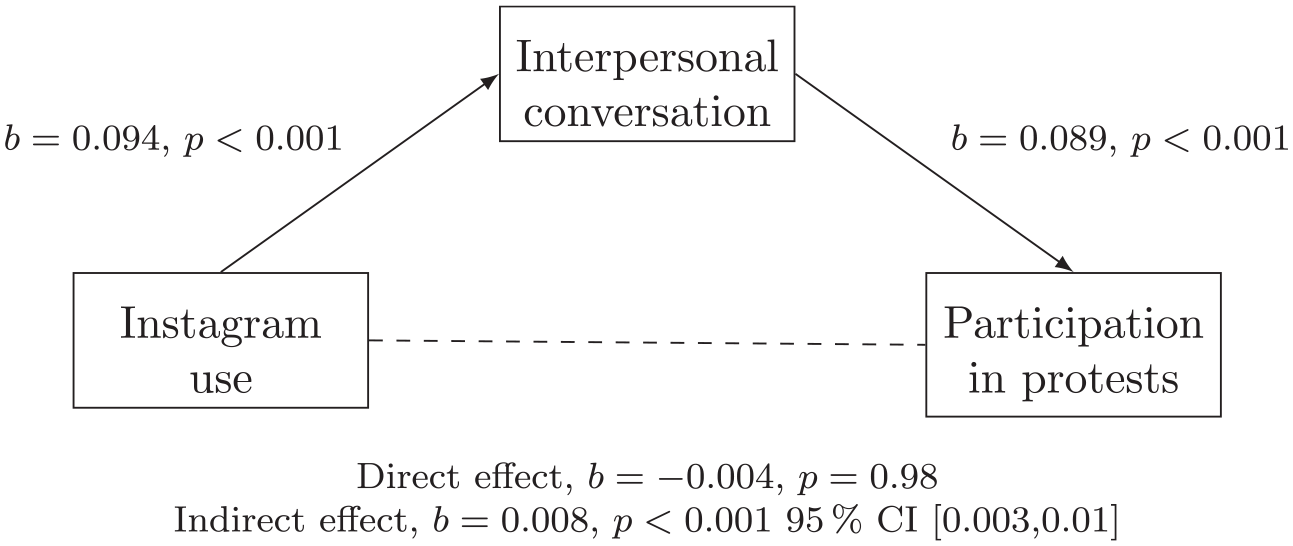
Mediation model for Instagram use and participation in protests through interpersonal conversations.
This result evidences the relevance that Instagram has acquired over the past few years and its potential for political mobilization. First, it is the social media platform that has gained the most ground among the youth and has been quickly displacing Facebook. For individuals aged 18-24 years, Instagram use reaches 83%. Second, the predominantly visual nature of this platform may encourage more conversations. The diffusion of high-impact images, such as depictions of police violence or large crowds gathered for social/political causes, may spur interpersonal conversation more easily than large texts. Finally, artists and celebrities have made Instagram a protest site, which impacts their followers’ political behavior.
Regarding control variables, the models reveal important results. Political variables, such as interest in politics and trust in institutions, are statistically significant. Respondents who exhibit more interest in public affairs and those who distrust political institutions are more likely to get involved in protests. Political identification also is a relevant variable in explaining participation in protests. Individuals identified with the left are more likely to participate in protests than those who do not identify politically. In contrast, respondents identified with the right are less likely to get involved in protests. Furthermore, interpersonal conversation is also positively linked to participation in protests. The results show that as participants discuss the country’s social-political conflict with more people, the likelihood of participating in protests also increases.
Concerning news consumption, television is the only media outlet statistically significant. The results suggest that those who spend less time getting information from television are more likely to attend protests. One potential explanation for this result is the intense dispute between participants in marches and television broadcasting companies during the mobilization period. Participants in protests accused television of focusing almost exclusively on violent aspects of demonstrations and failing to report on police repression. Indeed, during that period, trust in television reached a historic low, as various public opinion studies registered.
Discussion and Conclusion
In this study, we look at the relationship between social media use and participation in the mass protests that took place during the Chilean “social outburst.” To get a more comprehensive picture of the relationship between social media and participation, we examine five of the most popular platforms among young Chileans. Looking at platforms other than Facebook and Twitter is crucial to better understanding the role of social media in political behavior given the recent changes in the media environment ecosystem and social media use patterns. Indeed, Instagram and WhatsApp have become the most popular platforms among young Chileans over the past few years.
The results show that Facebook is the only social media platform positively linked to participation in protests. This finding supports prior research and suggest that, despite the emergence of new social media platforms and changes in social media consumption patterns, Facebook use is still relevant for noninstitutional participation among young Chileans. Results suggest that difference between Facebook and other platforms might be explained by the nature of the ties that the network allows users to create (Campbell & Kwak, 2011; Valenzuela et al., 2018). Our results suggest that strong-ties networks are more likely to be associated with greater participation in protests.
Unlike previous studies in Chile and elsewhere, Twitter use is not statistically related to participation in demonstrations. A potential explanation for this result is the lower capacity of Twitter to increase social capital among its users, which is a key factor for explaining participation in protests (Phua et al., 2017). An alternative explanation is the low levels of Twitter usage among young Chileans. Only 21% of our survey participants say they use Twitter, making this the least popular social media platform among Chilean youth. Despite the popularity of Twitter among political elites, young Chileans are moving away from it, reducing the platform’s potential mobilizing effects.
Our findings also challenge the results of recent research on the relationship between WhatsApp use and political participation conducted in Chile (Valenzuela et al., 2021) but are consistent with findings in other settings (Vermeer et al., 2021). We suggest two possible explanations for this. The first is the content and nature of the interaction on WhatsApp. Although WhatsApp may be characterized as a strong-ties network, it produces conversations that are more oriented toward personal issues than public ones. The second is the features of the sample used in the analysis. Given that our study only includes young people, it is possible that the relationship between WhatsApp use and protest involvement might be conditional on the user’s age.
Our results offer partial support to the Citizen Communication Mediation Model. We find that interpersonal conversation mediates the relationship between social media use and participation in protests only in the case of Instagram. As such, this result suggests that the visual content of Instagram posts needs to be socialized to shape young people’s political behavior. Therefore, the analysis shows that Instagram and interpersonal communication complement each other and highlights the importance of interpersonal conversations as drivers of political participation. Regarding the remaining social media platforms, a possible explanation for the null result is the survey item used to measure social media use.
Furthermore, our results shed light on how changes in the media environment ecosystem are reshaping the relationship between media consumption and participation. First, the consumption of newspapers, radio, and alternative online media outlets is not associated with protest involvement. More importantly, our results indicate that the more time young people spend watching TV news, the less likely it is that they will participate in protests. Although this pattern may stem from structural changes observed elsewhere, contextual factors are also relevant. During the social outburst, television newscasts received a great deal of criticism from protesters, who accused networks, news anchors, and journalists of disproportionately focusing on protesters’ violence, disregarding peaceful demonstrations and other issues such as police brutality. Indeed, during the last quarter of 2019, people’s confidence in TV reached the lowest levels ever recorded in public opinion polls. For instance, the Young People, Participation, and Media Consumption Survey indicates that about 11% of respondents trust TV news. The Centro de Estudios Públicos (CEP, 2019) survey shows that only 9% of Chilean adults trust TV networks.
These findings allow us to better understand the role of social media in citizens’ political involvement. The fact that no association was observed between Twitter and WhatsApp use and participation in political protests is particularly noteworthy. Although some of these results can be attributed to the sample’s characteristics, future research is needed to assess whether these null results represent structural transformations in the relationship between social media use and political participation or are contingent to the political situation in which the survey was conducted.
Our findings also indicate the relevance of paying attention to new social media platforms when studying the relationship between social media use and political participation. As mentioned, Instagram use emerges as a relevant variable to explain involvement in protests. As evidenced by the Chilean, there is an overall process of social media migration among young people, leading Instagram to be the most popular social media platform in Chile over Twitter or Facebook. Future research on social media and participation should increasingly consider the emergence of new platforms and the use given by social groups to understand better how social media platforms shape political participation.
Our results provide insights to understand citizens’ political involvement in contexts where representative institutions such as political parties do not have the support usually found in more advanced democracies. Our research shows that in scenarios where the public expresses low trust in political parties, social media platforms can partially replace the mobilization and representation functions that political parties have traditionally claimed for themselves. Given the crisis of political representation and the lack of trust in political parties in many countries, it is possible that social media platforms may continue to shape citizens’ political involvement.
Taken together, these results suggest that social media continue to shape political involvement among young users. Although the social media has gone through important transformations in recent years, social media platforms still offer resources and opportunities for users to engage in political activities. However, our findings suggest that the relationship between social media use and participation among young people is weaker than the one found in studies conducted at the beginning of the past decade, when social media use rate was lower than it is today.
Finally, the study has limitations that should be addressed in future research. First, we rely on cross-sectional data, which prevented us from establishing causal relationships between social media use and participation in protests. Second, given the nature of the sociopolitical process in Chile at the time when the survey was conducted, answers regarding participation in protests and media consumption patterns may be subject to desirability bias.
Supplemental Material
sj-pdf-1-sms-10.1177_20563051211059704 – Supplemental material for Social Media Use and Pathways to Protest Participation: Evidence From the 2019 Chilean Social Outburst
Supplemental material, sj-pdf-1-sms-10.1177_20563051211059704 for Social Media Use and Pathways to Protest Participation: Evidence From the 2019 Chilean Social Outburst by Andrés Scherman and Sebastian Rivera in Social Media + Society
Footnotes
Acknowledgements
The authors thank the anonymous reviewers for their constructive feedback. The authors also show gratitude to CICLOS UDP (Research Center in Communication, Literature, and Social Observation, Universidad Diego Portales) and its director Dr. Teresa Correa, for the support provided in the development of this work. A.S. thanks Maite de Cea, director general of research and doctorates at Universidad Diego Portales.
Declaration of Conflicting Interests
The author(s) declared no potential conflicts of interest with respect to the research, authorship, and/or publication of this article.
Funding
The author(s) disclosed receipt of the following financial support for the research, authorship, and/or publication of this article: The work of A.S. was supported by Fondo Nacional de Desarrollo Científico y Tecnológico (Grant No. 1210923). S.R. appreciates the support by the National Agency for Research and Development (ANID), Scholarship program, DOCTORADO BECAS CHILE, 2018-72190453.

Supplemental Material
Supplemental material for this article is available online.
Notes
Author Biographies
References
Supplementary Material
Please find the following supplemental material available below.
For Open Access articles published under a Creative Commons License, all supplemental material carries the same license as the article it is associated with.
For non-Open Access articles published, all supplemental material carries a non-exclusive license, and permission requests for re-use of supplemental material or any part of supplemental material shall be sent directly to the copyright owner as specified in the copyright notice associated with the article.
