




Abstract
Social media, as sources of political news and sites of political discussion, may be novel environments for political learning. Many early reports, however, failed to find that social media use promotes gains in political knowledge. Prior research has not yet fully explored the possibility based on the communication mediation model that exposure to political information on social media facilitates political expression, which may subsequently encourage political learning. We find support for this mediation model in the context of Facebook by analyzing a two-wave survey prior to the 2016 U.S. presidential election. In particular, sharing and commenting, not liking or opinion posting, may facilitate political knowledge gains.
Social media have emerged as important sources of news and political information, as well as sites of political discussion for a substantial portion of individuals in many countries, including the United States (e.g., Shearer & Matsa, 2018). At the same time, many people have expressed concerns that inaccurate and misleading information tends to be distributed on social media (Allcott & Gentzkow, 2017), leading to questions about whether people can meaningfully learn about politics on social media platforms. In fact, social media provide numerous opportunities for individuals not only to seek out political content, but also to be inadvertently exposed to news (Y. Kim et al., 2013; Tewksbury et al., 2001; Weeks et al., 2017). Social media users can further engage with the political content they are exposed to with their network members rather easily by liking, commenting on and sharing it (Bode, 2017; Theocharis, 2015; Vaccari et al., 2015). Social media thus may allow its users, especially those who are not very interested in news and politics, to learn about politics (see Bode, 2016; also see Feezell & Ortiz, 2021). Yet, numerous early reports fail to find evidence that mere exposure to political content on social media promotes significant gains in knowledge about politics and public affairs, which raises questions about these platforms’ ability to contribute to a well-informed citizenry (e.g., Bode, 2016; Cacciatore et al., 2018; Edgerly et al., 2018; Gil de Zúñiga et al., 2017; Lee & Xenos, 2019; Shehata & Strömbäck, 2021).
What explains the failure to find a relationship between social media political information reception and knowledge gains? In this study, we explore the possibility that simple passive exposure to political content on these sites is not enough to promote learning. Instead, we argue that in order for individuals to reap the benefits of such exposure they must take an additional step and actively engage in political expression afforded on social media. According to the communication mediation model, political expression, like interpersonal discussion, may allow users to pay attention to and reflect on received content and further discuss political ideas with other users, resulting in political knowledge gains (Eveland, 2001; Eveland et al., 2005; Oeldorf-Hirsch, 2018; Shah et al., 2007, 2017). Furthermore, we note that social media afford users to engage in different types of political expression (i.e., liking, sharing, commenting, opinion posting) that require different levels of effort and allow varying levels of engagement with existing content. It may be that certain types of political expression are more likely than others to facilitate political learning on social media.
This study is designed to shed additional light on the question of if and how political social media use is associated with knowledge during an election season. We leverage two-wave panel survey data that were collected during the 2016 U.S. presidential election. We focus on Facebook because not only was it the most widely used social media platform in 2016 in the U.S., but also it affords users to engage in a wide range of expressive behaviors from liking, sharing to commenting and opinion posting (Pew Research Center, 2017). Our results hint that active political expression on Facebook—particularly sharing content and commenting on others’ content—may be an important factor in whether or not learning takes place on this platform. Overall, we help clarify the mixed findings regarding political learning on social media and suggest that not all political expression is equal in promoting learning.
Political Learning on Social Media
In offline contexts, it has been demonstrated that exposure to news may facilitate political learning and increase political knowledge (Brians & Wattenberg, 1996; Chaffee & Kanihan, 1997; David, 2009). Despite empirical evidence that being exposed to information online might also be connected to gaining political knowledge (Horrigan et al., 2004; Kenski & Stroud, 2006), the nature of the link between information exposure and political learning in social media contexts remains unclear. While scholars generally agree on the potential for news exposure on social media to increase political knowledge (Bode, 2016; Lu & Lee, 2019), empirical evidence suggests that exposure alone may not be enough to lead to political learning (Cacciatore et al., 2018; Lee & Xenos, 2019; Oeldorf-Hirsch, 2018; Shehata & Strömbäck, 2021).
Prior scholarship is split on the relationship between exposure to news and political information on social media and political knowledge with three camps of studies suggesting a positive, negative or no link, respectively. First, a few studies demonstrated a positive link between information exposure on social media and political learning. For example, reading news using online sources, including social media, positively predicted political knowledge in a correlational study among young adults (Baumgartner & Morris, 2010) as well as in a study using panel analysis (Beam et al., 2016) and an experiment (Anspach et al., 2019). In addition, experimental studies have suggested that incidental exposure to political information on social media may help participants recall political information (Bode, 2016; Lu & Lee, 2019), which may in turn increase the likelihood of more sustained learning effects. In contrast, another set of studies found a negative link between political use of social media and political knowledge. These studies included evidence from both correlational (Cacciatore et al., 2018) and panel analyses during an election season (Shehata & Strömbäck, 2021). Finally, the last set of studies found no significant relationship between political information exposure on social media and political knowledge. Correlational evidence suggested that political knowledge was not significantly related to either active news seeking or incidental exposure to political information on social media platforms including Facebook and Twitter (Oeldorf-Hirsch, 2018). Panel analysis suggested that both general and political Facebook use did not have a statistically significant relationship with political knowledge (Lee & Xenos, 2019). Longitudinal experimental studies also found that incidental exposure to political information on social media did not promote political learning (Feezell & Ortiz, 2021).
While these conflicting results highlight the need for further exploration of the relationship between exposure to political information on social media and political knowledge, a few factors may potentially explain the inconsistent findings: different study designs and operationalization of political knowledge, and the role of engagement. As reviewed above, the study designs ranged from cross-sectional and panel surveys to experiments (Shehata & Strömbäck, 2021), demonstrating correlational evidence of political learning, over-time changes in political knowledge, and short-term effects on knowledge gains respectively. Relatedly, operationalization of political knowledge may matter. Experimental studies might check participants’ simple recall of political information they were exposed to. While survey studies can employ established indexes of factual political knowledge (Bode, 2016; Lu & Lee, 2019), they could also measure structural political knowledge, tapping news elaboration (Beam et al., 2016), or current affairs knowledge measuring the degree to which respondents have learned new information about emerging issues and events (Shehata & Strömbäck, 2021).
Importantly, prior scholarship also hints at the possibility that political information reception on social media may lead to knowledge gains if individuals further engage with the received information. For instance, although Oeldorf-Hirsch (2018) did not find evidence of political learning, this study reported that news exposure on Facebook and Twitter positively predicted news engagement on the same sites—measured as liking, commenting on and sharing of news stories. This news engagement in turn positively predicted cognitive elaboration (Oeldorf-Hirsch, 2018), which might further relate to political knowledge gains. In the same vein, Beam et al. (2016) found that sharing news on social media positively predicted structural political knowledge. Taken together, engagement with received political information on social media—through sharing, commenting on and liking it—may help individuals elaborate on and discuss the political information with their network contacts, which then may lead to political learning. This is in fact the premise of the Communication Mediation perspective, to which we turn in the next section.
The Communication Mediation Perspective in the Context of Social Media
A long tradition of communication research has argued that individuals are not simply passive recipients of media messages, but rather active agents who use the information in their environment to make social meaning (Fry & Fry, 1986). Studies in political communication have been particularly attentive to the possibility that the most powerful effects of media on political behavior may stem from the discussion and sharing of news that takes place between citizens (Shah et al., 2005). One important way that individuals make sense of the political information they consume is by reaching out to their networks to share their thoughts and learn about the perspectives of others (Cho et al., 2009; Eveland, 2004). Ultimately, reception of political information has been found to motivate political discussion with others (J. Kim et al., 1999).
The communication mediation model demonstrates the indirect effect of exposure to news and political information on cognitive and participatory outcomes through interpersonal discussion of public affairs (Eveland et al., 2005; Shah et al., 2007, 2017). According to this model, talking about received information is an essential precursor to political learning. In-person discussion allows individuals not only to mentally elaborate on the received political information but also to collectively deliberate on public affairs, which may result in political knowledge gains (Eveland et al., 2005; Shah et al., 2007). While the original communication mediation model deals with the interplay between information reception from mass media and interpersonal talk, the revised model highlights the need to consider information exposure and discussion online (Shah et al., 2017). In particular, social media can be an ideal environment in which individuals are exposed to political information and express themselves politically.
Political expression on social media has the potential to play the same role that interpersonal political talk plays in the communication mediation model. Upon receiving political information, political expression on social media can allow individuals to satisfy certain human motivations such as the need for social interaction and the need to be accurate just as interpersonal conversation (Garramone et al., 1986; Weeks & Holbert, 2013). As individuals put their political thoughts into words on social media, they may further engage in political discussion with other users to satisfy social interaction needs. Also, receiving feedback on their political expression may help users to stay accurate.
With these arguments in mind, we apply the communication mediation model in the context of social media (see Chen & Chan, 2017; Park & Kaye, 2019; see also Shah et al., 2017). In doing so, we first examine the potential link between political information reception and expression on social media. Empirical work suggests that the internet and social media provide particularly rich environments for connecting reception of political information to political expression (Gil de Zúñiga et al., 2012). For example, Rojas and Puig-i-Abril (2009) found that those who used the internet for informational uses were more likely to engage in expressive participation online. Bond et al. (2012) demonstrated that the reception of targeted political ads could stimulate political expression between users. There is also evidence that those who receive political information on social media are also likely to engage with and disseminate news through expression with their online social networks to make sense of the received information (Oeldorf-Hirsch, 2018; Weeks & Holbert, 2013). Accordingly, focusing on Facebook, we advance the following hypotheses.
Furthermore, the communication mediation model would predict that social media political expression—as a comparable phenomenon to interpersonal discussion—leads to political learning. Similar to interpersonal discussion, political expression on social media may involve mental elaboration and open up the possibility of collective deliberation with other users, both of which should allow in-depth processing of information to result in knowledge gains (Eveland, 2001; Mutz, 2006; Shah et al., 2017).
Nonetheless, there are growing concerns over forms of political expression and discussion on social media that are not always deliberative or fruitful. Such communication may aid in spreading mis- or disinformation along with radicalization and animosity (Allcott & Gentzkow, 2017; Benkler et al., 2018). For instance, research has found that out-group animosity strongly predicts engagement with posts by news media and U.S. congress members on social media (Rathje et al., 2021) and that the Facebook pages of extreme-right political parties offer outlets for hate speech and radicalization (Ben-David & Fernández, 2016). During the 2016 presidential campaign, the top-performing fake election news stories on Facebook generated more shares, reactions, and comments than the top stories from major news outlets (Allcott & Gentzkow, 2017), although engagement with false content on Facebook decreased sharply from 2016 to 2018 (Allcott et al., 2019).
Despite the concerns, we believe the potential deliberative benefits of political expression on social media may be strengthened due to the unique characteristics of communication on social media. While individuals’ social interaction and self-presentation is adjusted based on the time and place, and importantly, the witnessing audience (Goffman, 1959), social media users in particular tend to think of audiences who will be able to observe their activities before taking any action (Marwick & boyd, 2011). Although during interpersonal discussion, comments are only accessible to those who participate, political communication on social media is visible to a larger network of users who are observers rather than participants (Ellison & Vitak, 2015). While it is rather difficult for social media users to know exactly whom their audience will be (boyd, 2011; Litt & Hargittai, 2016), potentially all of their social networks can observe and monitor their political expression to form impressions about them, and respond to their expression (Vraga et al., 2015). This may lead users to be more careful before political expression (Yu, 2016) and feel that they can be held responsible for their comments. Accordingly, users may take a significant amount of time and effort in creating and editing their messages on social media. In fact, because communication on social media is often asynchronous and persistent, users can take as much time and effort before expressing themselves (Pingree, 2007).
In addition, once users have engaged in political expression on social media, they can be notified when other users chime in to provide further information, offer additional insight, or correct their thoughts. Overall, expressive social media users can learn from their discussion partners, and together, they can collectively interpret and deliberate on political information and ideas they have received to lead to more sustained gains in political knowledge (Eveland, 2004). We thus hypothesize that political expression on Facebook will result in an increase in political knowledge at a later time:
Finally, applying the communication mediation model, we test whether political information reception results in increased political knowledge through political expression on social media.
Typology of Political Expression on Facebook
We further pose an exploratory question as to whether the proposed model of political learning works uniformly across all political expression on Facebook or only for certain types of political expression. It has become common practice for researchers to use indexes of political expression on social media that aggregate different types of expressive behavior, despite the possibility that behaviors may have distinct antecedents and effects. Indeed, in this study we devised an index of political expression on Facebook by combining four types of political expression—liking content, opinion posting, sharing content, and commenting on others’ content. However, we also acknowledge that these behaviors are distinct and vary by at least two aspects: required effort and engagement with existing content by someone else (Table 1). Although some prior studies viewed most expressive political behaviors on social media as low-threshold due to their low costs compared to high-threshold political behaviors taking place outside of social media (e.g., Vaccari et al., 2015), a closer look reveals that expressive political behaviors on social media may still vary in the effort they require. For one, liking and sharing content are relatively easy to do because they can be technically accomplished with one click (Kümpel et al., 2015). Opinion posting and commenting may take more cognitive efforts, because users need to compose a message for these expressive behaviors.
Typology of Political Expression on Facebook.
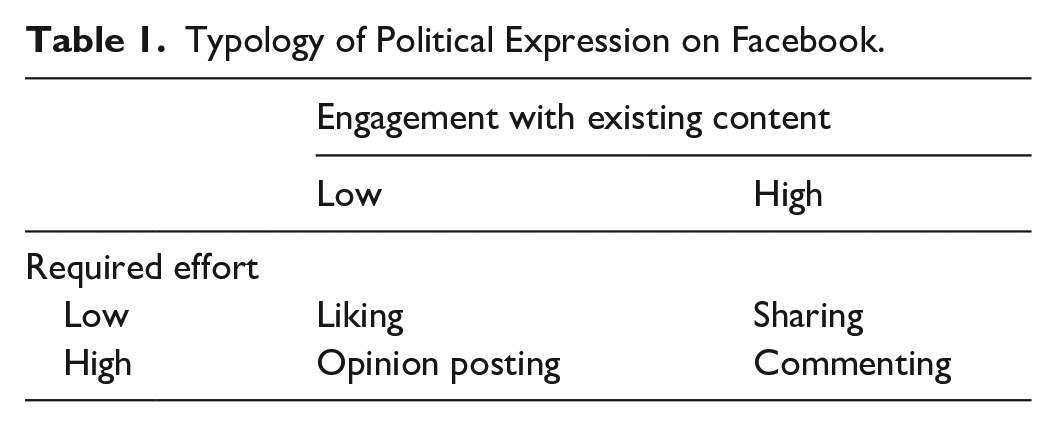
Next, expressive behaviors vary in the extent to which they require engagement with existing content by someone else. Sharing content and commenting on others’ content denote relatively high levels of engagement, for example, with news stories, content with visual elements, or social media posts, all of which are created by others. Through sharing and commenting, users can re-contextualize existing content by reframing, repurposing and reevaluating it (Choi, 2016). Through sharing or commenting on content created by someone else, users act as active agents of information processing and externalizing (Choi, 2016); users repackage the pre-existing content from their own perspective to further circulate their take on it. Liking content and engaging in opinion posting, however, are two behaviors that may denote relatively low levels of engagement with existing content by somebody else. Liking content does not necessarily require users to give substantial attention or thought to that content (Bode, 2017) and often denotes simple endorsement rather than meaningful engagement (Choi, 2016). Users’ posts of their own opinions and experiences also does not necessarily require engagement with existing content such as news articles or other users’ posts. Users can rather freely express their political views and experiences without citing existing political content by someone else. 1
With these observations in mind, we advance an exploratory question of whether the hypothesized indirect relationship between political information reception on Facebook and political knowledge is mediated by certain types of political expression based in part on whether they require: (a) effort and (b) engagement with pre-existing content. For instance, political expression requiring more effort (i.e., opinion posting and commenting) may lead to political learning than liking and sharing which can be done with a click (Bode, 2017). The other possibility is that political expression characterized by high levels of content engagement (i.e., sharing and commenting) likely comes with deeper processing and elaboration of content created by someone else (Oeldorf-Hirsch, 2018), which should help with political learning (Beam et al., 2016; Eveland, 2001). With these possibilities, we advance the following exploratory research question:
Method
Sample
The current study analyzes data from a two-wave national online survey conducted in the United States during the 2016 Presidential election campaign. The research company YouGov was contracted for data collection with their online panel. Quotas were applied for age, gender, race, income, and education to ensure that the sample resembled the American population based on U.S. census data. Specifically, consistent with the U.S. Census Bureau’s 2015 American Community Survey (ACS), the sample demonstrated a median age of 51 (ACS: 45 to 54 years old), a median household income between $50,000 to $59,000 (ACS: $53,889), and a median education level of some college among respondents who were 25 years old or older (ACS: some college). In terms of gender, the sample consisted of slightly more women, 56.8%, compared to 51.4% in the ACS.
In late September, the first wave was collected with 1,800 respondents from 6,213 individuals who received initial invitations (Response rate: 29%). In early November, the second wave was collected with 1,293 respondents (Retention rate: 71.8%). To ensure that respondents provided valid data, our sample was then limited to 1,434 respondents in W1 who passed an attention check. Our final sample was limited to the 1,389 respondents (W1) who used Facebook in the past 30 days.
We focus on Facebook because the platform was by far the most widely used social networking site in 2016 with 76% of online adults using it (Pew Research Center, 2017). Facebook is an important social media platform where exposure to (diverse) political information and viewpoints as well as political influence take place (Bakshy et al., 2015; Bond et al., 2012). Importantly, Facebook is a platform which allows users to engage in a wide range of expressive behaviors from liking, sharing, opinion posting to commenting.
Measures
Political Information Reception on Facebook
To measure the degree to which respondents received political information on Facebook, respondents were asked, “In the past 30 days how often have you used Facebook to get information about social issues and politics?” Responses were measured on a six-point scale (1 = “never,” 2 = “once in the past 30 days,” 3 = “2-3 times in the past 30 days,” 4 = “once per week in the past 30 days,” 5 = “a few times per week in the past 30 days,” 6 = “every day in the past 30 days,” W1 M = 3.60, SD = 2.02).
Political Expression on Facebook
The degree to which respondents engaged in political expression on Facebook was assessed using the average of five items that asked, “in the past 30 days, how often have you (a) clicked “like” on status updates or links about social issues or politics that were posted by a friend (Liking: W1 M = 2.35, SD = 1.63); (b) posted your own opinion or experiences about social issues or politics (Opinion posting: W1 M = 2.13, SD = 1.58); (c) and commented on a news story or political information that was posted by a friend” (Commenting: W1 M = 3.04, SD = 1.81); (d) shared or posted a link to a news story or website about political or social issues; and (e) shared or posted a photo, video, or meme related to social issues or politics created by someone else (Sharing: W1 M = 2.23, SD = 1.52, r = .80). Sharing was measured by averaging the fourth and fifth items. Responses were measured with the same six-point scale used previously. An index of political expression on Facebook was created by averaging the five items (W1 M = 2.40, SD = 1.44, α = .93). 2
Political Knowledge
Respondents were asked about the issue/policy positions of two presidential candidates from the Republican and the Democratic parties. Respondents were asked, “Below are questions about various policy proposals and candidates. Please tell me whether Hillary Clinton and Donald Trump support or oppose each proposal. If you are unsure on a proposal, you may indicate as such.” Four policy proposals were considered in each wave: increased background checks for gun sales (W1, W2); raising the federal minimum wage (W1, W2); forcing Syrian President Bashar al-Assad out of power (W1); approving the Trans-Pacific Partnership (TPP) trade agreement (W1); lowering the business tax rate from 35 percent to 15 percent (W2); and pulling out of the current “Iran nuclear deal” (W2). Response options included “support,” “oppose,” and “I am not sure.” A composite index ranging from 0 to 8 was calculated by counting the correct responses (W1 M = 3.57, SD = 2.09, α = .72; W2 M = 4.77, SD = 2.57, α = .83).
Control Variables
First, we controlled for demographics including age, gender, and education. Also, we controlled for political interest and news media use that may theoretically relate to the mediating dependent variables: political expression on Facebook and political knowledge. Prior literature demonstrates that political interest and news media use are positively related to both political information sharing on social media (Hasell & Weeks, 2016) and political knowledge (Eveland et al., 2005). Political interest was measured as the degree to which respondents agreed with the statement, “I am interested in politics,” on a seven-point scale (W1; M = 4.90, SD = 1.82). News media use was measured with an index of news use of five sources: national, local, and cable television news programs, daily newspapers, and online news sites. Responses were measured on a five-point scale (1 = “I have not used this source,” 2 = “once in the past 7 days,” 3 = “2-3 times in the past 7 days,” 4 = “4-6 times in the past 7 days,” 5 = “I use this source every day,” W1 M = 2.63, SD = 1.01, α = .67).
Results
To test the theoretical model, we used model 4 of the Process macro for SPSS (Hayes, 2013). While this macro utilizes ordinary least squares regression, it is important to note that we have conducted lagged dependent variable analyses by taking advantage of the panel survey data. Specifically, we controlled for prior levels of the dependent variable, political knowledge (W1), in predicting political knowledge (W2). This analytical approach offers an advantage over cross-sectional analyses (Eveland & Thomson, 2006).
We began by examining H1, which hypothesized that political information reception on Facebook (W1) would be positively associated with political expression on Facebook (W1). We found support for H1 (b = .34, SE = .02, p < .01, Table 2 first column). Individuals who received political information on Facebook were more likely to engage in political expression on Facebook, as assessed by our index that included liking content, expressing opinions, sharing content, and commenting on other users’ posts. We then tested H2, which predicted that political expression on Facebook (W1) would be positively related to political knowledge (W2). We found that individuals who engaged in political expression on Facebook more frequently were more politically knowledgeable in the second wave (b = .14, SE = .05, p < .05, Table 2 second column).
Predicting Political Expression on Facebook (W1) and Political Knowledge (W2).

p < .05. **p < .01.
Finally, we examined H3, which hypothesized that political information reception (W1) would be indirectly associated with political knowledge (W2) through the influence of political expression on Facebook (W1). This was tested with 10,000 bootstrapping samples and 95% confidence intervals (Table 3, first row). We found a significant indirect relationship between political information reception on Facebook (W1) on political knowledge (W2) with a point estimate of .04 (.02) because the 95% confidence intervals did not cross zero [.005, .069]. However, we found no direct relationship between political information reception on Facebook (W1) and political knowledge (W2), as the confidence intervals crossed zero with a point estimate of -.02 (.03) [95% CI: -.085, .048]. Taken together, individuals who more frequently received political information on Facebook in W1 showed evidence of higher levels of political knowledge in W2 if they engaged in political expression on Facebook in W1.
Indirect Effects of Political Information Reception (W1) on Political Knowledge (W2) Through Types of Political Expression on Facebook.
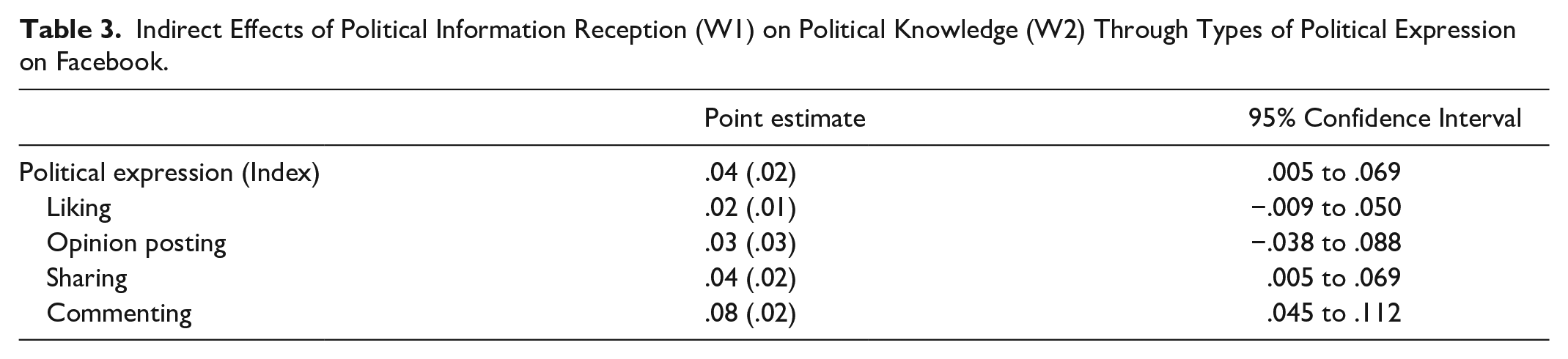
Furthermore, we tested RQ1, asking which type(s) of political expression on Facebook would mediate the influence of political information reception on Facebook (W1) on political knowledge (W2). For this, four types of political expression on Facebook were individually entered into four different mediation models. As shown in Table 3, the results demonstrated that only two types of political expression on Facebook (W1)—sharing and commenting—mediated the effect of political information reception on Facebook (W1) on political knowledge (W2). Specifically, there was a significant indirect effect through sharing with a point estimate of .04 (.02) [95% CI: .005, .069]. There was also a significant indirect effect through commenting with a point estimate of .08 (.02) [95% CI: .045, .112]. Overall, political information reception on Facebook was related to political learning primarily through two types of political expression on Facebook, sharing content and commenting on other users’ posts. Liking and opinion posting, however, did not mediate the path from political information reception on Facebook to political learning.
Discussion
Although social media can potentially be sites of political learning, empirical evidence regarding the relationship between political information reception on social media and knowledge gains has been mixed at best (e.g., Bode, 2016; Edgerly et al., 2018; Gil de Zúñiga et al., 2017; Shehata & Strömbäck, 2021; Thorson & Wells, 2016). The current study is one of the first to clarify the mixed findings and suggest that for people to learn about politics on social media, one more step may be needed—political expression. By applying the communication mediation model (Eveland et al., 2005; Shah et al., 2007, 2017), we demonstrate that passive exposure to political information on social media is related to political knowledge gains via political expression on social media during election contexts. Furthermore, we show that not all political expression is equal in promoting learning on social media. Sharing and commenting, not liking or opinion posting, mediate the path from information reception to political knowledge. Overall, in line with the communication mediation model, our results highlight the importance of engagement with received content for political learning.
First, our results demonstrate that those who use Facebook as a source of political information are more likely to express themselves politically on the site. This finding is in line with previous research, which suggests that political media use can stimulate political expression (J. Kim et al., 1999), and that this possibility is particularly likely on social media where users are afforded a multitude of ways to voice their opinions and discuss politics with their network (Bond et al., 2012). The positive relationship between political information reception and political expression we observe suggests that social media function not simply as another channel for political media, but as a social context for making sense of the world of politics (Weeks & Holbert, 2013).
Overall, we find support for the indirect path from political information reception on Facebook to political knowledge through political expression on Facebook. These results extend prior scholarship on the communication mediation model, theorizing the cognitive benefits of in-person discussion through both intrapersonal elaboration on the received political information and interpersonal deliberation on public affairs (Eveland et al., 2005; Shah et al., 2007, 2017). In our study, we theorize political expression on social media as playing a similar role to in-person discussion, in that it may also offer important cognitive benefits. Several unique characteristics of social media support this interpretation. Political expression on social media is often visible to a large social network (Ellison & Vitak, 2015); accordingly, users may feel they should be socially committed to and be held accountable for their expression on platforms like Facebook. Individuals may experience mental elaboration prior to and during expression, and potentially engage in collective deliberation with other users after expression. Taken together, there are reasons to expect that political expression afforded by social media, following political information reception, can result in political learning, and we find empirical support for this communication mediation perspective in the context of Facebook.
Our results also suggest that not all types of political expression mediate the link between political information reception and political knowledge gains. Looking closely at the four types of political expression that we considered in this study as an index, they vary by levels of engagement with existing content created by someone else and required effort. Specifically, in line with the communication mediation model, high levels of engagement with preexisting content may be the key to political learning; not liking and opinion posting, but sharing of and commenting on content, are found to mediate the indirect path from information reception to political knowledge. Our findings related to liking are consistent with previous studies reporting that liking is not a significant predictor of political outcomes because it typically denotes ambiguous or otherwise weak public commitment rather than meaningful engagement (Choi, 2016). Although opinion posting may entail high cognitive effort and intra-elaboration, it does not involve interaction with existing content; it may be opinionated without necessarily relying on engagement with third party evidence, which could hinder political knowledge gains (see Conroy et al., 2012 for the case of political groups on Facebook).
However, being informed with content by someone else, as in the cases of sharing (see also Valenzuela et al., 2021) and commenting, may be essential for political learning on social media. Such behaviors offer users a chance to acquire new perspectives and information, rather than being limited to their own ideas. Commenting on other users’ content was a particularly strong mediator of the indirect path. Commenters may receive cognitive benefits in two ways: First, by interacting with other users and the political content these users posted, commenters might be introduced to novel perspectives and information sources that they themselves were not familiar with (Ellison & boyd, 2013). In addition, commenters may learn from other users who have initially posted content, as these posters will likely come back to commenters to provide feedback. In case commenters have provided inaccurate beliefs and misinformation, they may receive feedback from posters that challenges or corrects such beliefs and misinformation. Overall, our results suggest that lumping all political expression types together may hide important differences.
Despite its theoretical contributions, the current study is limited in a few aspects. First, our sample consists of Facebook users, limiting the generalizability of the results. Although Facebook has the largest user base in the United States, most of whom get news on the site (Pew Research Center, 2017), it would be worthwhile to test our model in other platforms such as Twitter. Second, this study relies on a panel survey, and bears limitations that are inherent to self-reported data. In particular, self-reported measures of Facebook use might be imperfect (Neuman, 2016; Prior, 2009). In future research, it would be worthwhile to corroborate self-reported survey data with behavioral data from experiments. Experiments will also help clarify the mechanisms behind the varying mediating effects of different political expression types on Facebook, linking political information reception and knowledge. Importantly, we speculate that mental elaboration before and during political expression as well as collective deliberation with other users after expression may be essential to the observed effects, which will merit further investigation (see Park & Kaye, 2019). Also, the current study did not capture the informational quality of political content respondents consumed and posted, which likely played a role in their ability to learn from social media.
Finally, although our utilization of panel survey data provides insights into political learning on social media beyond those possible using cross-sectional data, some of our W1 and W2 items for political knowledge overlapped. When we conducted a post hoc lagged dependent variable analysis predicting a new W2 political knowledge measure excluding the repeated items, the findings remained the same. Specifically, we found a significant indirect relationship between political information reception on Facebook (W1) on the new political knowledge measure (W2) with a point estimate of .05 (.01) because the 95% confidence intervals did not cross zero [.023, .074]. This provides additional support to the finding that individuals may gain political knowledge over time as a function of political information reception and subsequent expression on Facebook.
Future extensions of the current study may investigate whether political expression prompts learning in different social media contexts, involving incidental exposure, social awareness streams and exposure to ideologically (in)consistent information. First, recent experimental research demonstrates that incidental exposure to political information on social media does not lead to political learning (Feezell & Ortiz, 2021). Also, another experimental study finds that social awareness streams—notably Facebook’s News Feed with its brief article preview, are sufficient to facilitate modest, yet statistically significant political knowledge gains (Anspach et al., 2019). Future research may investigate whether incidental exposure to politics on social media as well as article previews on social awareness streams prompt substantial knowledge gains if followed by political expression. Finally, the revised communication mediation model (Shah et al., 2017) notes that today’s new communication ecology is increasingly polarized, and social media in particular may allow ideologically homogeneous information and expression to thrive. This may lead to concerning consequences such as learning of ideologically consistent facts at the expense of being ignorant of ideologically inconsistent facts (Shah et al., 2017). While the current study demonstrates that political learning can take place on social media if users politically express themselves after receiving information, it would be worthwhile to further investigate the ideological homogeneity of received information and political expression on social media, and if ideological homogeneity levels indeed lead users to learn different facts. Relatedly, future research is encouraged to take into consideration the informational quality of political content, posts and comments on social media, including their truthfulness, depth and relevance, when examining political learning effects on social media (see Conroy et al., 2012). Finally, given the peculiar position Facebook found itself in the context of the 2016 presidential campaign, future research could examine the role of algorithmic curation (Thorson & Wells, 2016) in predicting social media users’ exposure to (diverse) information, expression and political learning.
Conclusion
For many individuals, social media serve as important sources of political information and sites for political expression and discussion. Despite social media’s potential for political learning, prior studies presented mixed findings. Clarifying the mixed findings, the current study suggests that political expression following information reception could be the key to political knowledge gains on social media. The findings also highlight the relevance of the communication mediation model in the context of social media. Like interpersonal political talk, political expression on social media—particularly sharing of and commenting on existing political content created by someone else—may allow users to internally reflect on and further collectively deliberate on the received content, which is critical for political learning. For individuals to gain political knowledge on social media, passive information reception is not sufficient—they need to cognitively engage with the received information through active political expression.
Footnotes
Author Note
Nojin Kwak is now affiliated to the University at Buffalo, State University of New York.
Declaration of Conflicting Interests
The author(s) declared no potential conflicts of interest with respect to the research, authorship, and/or publication of this article.
Funding
The author(s) received no financial support for the research, authorship, and/or publication of this article.
