




Abstract
Fan producers engaged in monetization, or what Suzanne Scott has termed “fantrepreneurs,” struggle with legal mechanisms for brand-building given the limitations of both copyright and platform moderation. These challenges have been amplified during the COVID-19 pandemic, which has fundamentally changed the way that cosplayers, or fans who dress up as characters from their favorite television shows or movies, market themselves in an increasingly online space, as opposed to their initial public platforms of conventions. Restricted by digital platforms and their various moderation and monetization methods, cosplayer fantrepreneurs have developed new, multi-platform methods for sustaining their content and community connection. One prominent platform significant to this turn is OnlyFans, which is billed as a “peer-to-peer subscription app,” and allows users to “Sign up and interact with your fans!” Through a sample analysis of 50 cosplayers, this case study considers the approaches of cosplayers on integrating OnlyFans as part of a multiplatform struggle for economic viability. When we contextualize this platform labor in the history of cosplay, we note the hypersexualized labor that has always been central to monetization in this space, and the media franchise exploitation that profits from that labor at the expense of the fan producer, demonstrating the fundamental, gendered exploitation of the trend toward a patronage economy.
Beginning in March 2020, widespread shutdowns across the United States due to COVID-19 fractured the expected patterns of fan spaces, disrupting not only media industry profit models but also the work of fan producers that Suzanne Scott refers to as “fantrepreneurs,” or “one who openly leverages or strategically adopts a fannish identity for [their] own professional advancement” (Scott, 2015a). Scott notes that women are frequently distrusted or suspect when perceived as trying to occupy this position, and women are, not coincidentally, also those most impacted by the pandemic labor disruptions more broadly. The labor of fantrepreneurs has always been driven by online community, but this dependence is amplified by the current contexts. Critics of online fan conventions note the biggest lost is the “third space,” observing: the lack of visual signifiers, and the emergent experience of cosplay and performative displays throughout the social environments of the convention, is difficult to remedy (Johnston, 2020).
Fantrepreneurs seeking economic sustainability frequently rely upon multiple platforms to fill the gap of this “third space,” and already marginalized cosplayers are particularly reliant upon social media platforms that exploit their labor in turn. This case study considers the rise of OnlyFans as part of the multiplatform branding and economic model sustaining cosplayers and reveals the gendered inequities of that labor. OnlyFans was created in 2016 by Fenix International Ltd., which was later bought out by the owner of MyFreeCams. It is currently based in London and the CEO of the company is Timothy Stokley. OnlyFans is billed as a “peer-to-peer subscription app,” and became more widely used during the pandemic as many creators joined to supplement or replace lost income—the site reported a “75% uptick in model sign-ups in early April” (López, 2020). The platform benefits substantially from the rise in interest: OnlyFans is classed as a “digital patronage” platform, which provides for financial exchange for creative expression, with the platform taking a percentage (Bonifacio & Wohn, 2020). In the case of OnlyFans, the percentage is 20%, while other digital patronage platforms—Twitch.tv, YouTube, Patreon, and so forth—offer different terms. Fans reply on all of these platforms for commercial viability, and the status of “professional,” as streamers able to earn their primary income from Twitch are dubbed, is frequently coveted (Johnson & Woodcock, 2019). Most fantrepreneurs will not reach those heights, and their labor becomes the uncompensated value of the platform.
OnlyFans is particularly important for understanding the exploitation of fantrepreneurs because of the platforms own reliance upon the discourse of fandom. The platform’s tagline “Sign up and interact with your fans!” promises creators control (Figure 1), and their fans exclusivity and intimacy. Designed as the “adult” Instagram, the underlying premise is not unlike the practice of paying for photo sessions with celebrities at conventions, but with a clear emphasis on the pornographic (Lykousas et al., 2020). Given the moderation limitations of Instagram, this study seeks to track the rates of adoption of the patronage model presented by OnlyFans, and to document the potential influence on this economic model on the efforts of fantrepreneurs more broadly. Do the adult content regulations, and lack of easy monetization models, drive fantrepreneur migration? To consider this potential movement, we started this case study through Instagram, and documented multiplatform usage. Through a sample analysis of 50 cosplayers (pulled from the Instagram hashtags of #cosplayers, #malecosplayers, #gaycosplayers, and #femalecosplayers), we look at their approach to monetization (including promotional methods and pricing), as well as their use of cosplay and fandom-centered content in their self-presentation across platforms. When we contextualize in the history of cosplay, we note the hypersexualized labor that has always been central to monetization in this space, and the media franchise exploitation that profits from that labor at the expense of the fan producer.

OnlyFans homepage. On the right hand, the tagline “Sign up to make money and interact with your fans” is below the logo. This page also highlights monetization strategies as “features” that can be enabled or disabled by the content creator—a neoliberal vision of financial and creative control we critique through our examination of labor exploitation.
Hypersexualization and Cosplay
Cosplay is driven by the existing costumes of media franchise characters, though cosplay practices involve both high-fidelity reproduction and dramatic reinventions, remixes, and mash-ups that transform the original design. High-fidelity reproduction is frequently highly gender performative by default, as the source material for many major franchises draws on comic art with a history of performative exaggeration: as Brown (2011) notes, “To point out that all modern comic book women are extremely fetishized is almost redundant. Nearly every female character in comics is illustrated as an adolescent fantasy of the perfect woman” (p. 174). Transformative efforts by fans as makers can embrace these extremes, or reimagine them, and fans with bodies othered by this depictions frequently err on the side of resistance: cosplayers who practice what Kirkpatrick terms “[dis]play” pose “a powerful challenge to the textual, canonical supremacy of the affluent, white, male, cishet [cisgender and heterosexual], nondisabled, youthful superhero and superhero fan” by subverting canonical cosplay through racebending and other acts of cosplay as critique (Kirkpatrick, 2019). However, such cosplay is frequently on the margins, and rarely centered in the post-convention image sets or cosplay competition winners’ circles.
The hypersexualization of commercially viable cosplay around geek franchises is thus almost inevitable given the corresponding hypersexuality of character costumes themselves, which frequently exaggerate sexual characteristics to the point of anatomical impossibility in media such as superhero comics (Salter & Blodgett, 2017). Marcus (2018) writes that costumes of women superheroes are tied not only the recognition of their characters, but also “questions of morality surrounding [their] worth as a role [models] for girls and women” (p. 55) Historically, Wonder Woman’s costume is intrinsically connected to her womanhood and her position within a matriarchal and feminist society: her golden bracelets are tied to the Amazonian’s past as slave captors by men; her costume is constructed by her mother, Hippolyta; her magic girdle gives her the abilities to triumph over men in combat (p. 57). This costuming was echoed in Patty Jenkins’s Wonder Woman (2016), where actress Gal Gadot emphasized a physical regime that built body mass and the costume design that added in the flexibility for a superhero to fight, kick, and move (Hoo, 2017). Despite the feminist origins and evolution of the costume, Wonder Woman is still seen as “sexy” by consumer culture, or perceived as a dominatrix (through her association with her lasso), and always purposefully as a heterosexual sexualized character. In recent films, Batman v. Superman: Dawn of Justice (2016) and Justice League (2019), fans complained that Gadot did not have big enough breasts or was not as curvy as the original cartoon, and director Zack Snyder included several “up-the-skirt” shots in Justice League of Gadot, as well as revealing leather bikinis for the Amazonian warriors (as compared with the cuirass, girdles, and skirts developed by Wonder Woman’s lead designer, Lindy Hemming) (Hoo, 2017; Schubart, 2019).
The hypersexualization of characters (and their availability to the male gaze) had made social media platforms hostile to visible women, as emphasized by culture war #GamerGate and the corresponding conflict of #ComicsGate, both purported to respond to perceived feminist threats to industries understood by white men “fanboys” as driven by their interests and presence as auteurs. #GamerGate started as a personal attack on game designer Zoe Quinn by their ex-partner, who mobilized a hate mob in response to their Twine game Depression Quest (Quinn, 2017). The attacks escalated to include attacks on other visible women, queer, and BIPOC (Black, Indigenous, People of Color) game designers, as well as members of related industries including games journalism and academia (Chess & Shaw, 2015). The attacks were couched in ethical frameworks, but employed harassment, doxing, and silencing tactics across platforms to push back against any effort perceived to decenter white men, demonstrating what Blodgett notes as a “toxic and angry mindset of entitled masculinity” aligned with alt-right and manosphere discourse (Blodgett, 2020). This type of conflict is part of the growing visibility of reactionary fandom, which Stanfill notes reminds us to push back on narrow interpretations of fandom as a space for “progressive” or transformative work (Stanfill, 2020).
The examples of hypersexualized woman’s bodies are numerous, and while there are exceptions to those listed above, fans continually seek out characters to cosplay that they identify with, hypersexualized or not. Cosplay, or costume play, is a fannish activity where fans dress up as characters from various geek activities. The first World Science Fiction Convention in 1939 hosted the first fans wearing cosplays to a convention: Forrest J. Ackerman and Myrtle R. Douglas (who was known later on as Morojo) wore “futuristicostumes,” which were green capes and breeches and based on the 1936 film Things to Come. Morojo had designed, created, and sewed the costumes herself (Culp, 2016). Cosplay continued at conventions from that point on and heavily featured female fans. Television shows like Star Trek in the late 1960s and early 1970s helped popularize cosplay and additionally increased the involvement of female fans in more generalized science fiction fandom (Bacon-Smith, 1992).
The rhetoric of empowerment often associated with cosplay falters in the face of the economic realities of how cosplay and fan labor are exploited: cosplayers are featured in event marketing for conventions; photographed for endless features on fandom and media blogs; and can even be hired for their appearances. Arguments that cosplay is transformative frequently center on the expressiveness: in documenting fannish making, Bode notes that the “relaxation” of societal expectations in cosplay “leaves women free to express elements of their identities on the out shell of their corporeal body” (Bode, 2014). However, the reality of that expression is much more limited, particularly as the societal norms embedded in the textual costumes is inescapably part of play.
Cosplayer as Fantrepreneur
The categorization of fan labor as a labor of love correspondingly invites exploitation, and as Stanfill and Condis note, “fan work is a bargain for the industry” (Stanfill & Condis, 2014). Cosplayers seeking to monetize their labor rely upon social media to establish an identity and following, relying upon similar tactics to brand influencers and frequently relying upon Instagram (Haborak, 2020). Hostility to paid fan labor, and particularly to the fan labor of women, threatens to further exacerbate marginalization and misogyny within the community. It also frequently serves to “other” those perceived as profiting off their labor within the community: repeatedly, GamerGate supporters evoked the image of the “booth babe” or attractive woman cosplayer as an exemplifier of the “fake” geek unwelcome within their spaces. Similarly, geek entitlement to the bodies of those women occupying geek spaces such as gaming and comic conventions has led to repeated reports of harassment. The “Cosplay is not Consent” signs at New York ComicCon, initiated in 2014, serve as a reminder of those assumptions (Mulkerin, 2017). The labor implications of paid costumed characters complicate this discourse, as well as the assumptions made about the availability of cosplayers occupying a space to other fans’ requests.
Historically, conventions have been the place for cosplayers to receive the most attention and in turn revenue for these services. As Lamerichs (2018) notes, many members of the gaming and media industry have taken notice of the well-made costumes and devotion of their fans, and in turn, have begun using cosplayers for promotional activities and at conventions, where modeling agency girls used to dominate the booth spaces (p. 201). Cosplayers also participate in other monetarily motivated convention activities, like fashion shows, photography sessions, and cosplay acts. There are many articles that new cosplayers can read that tell them the steps of how to monetize their hobby. One states that if a cosplayer wants to get noticed by an agent at a convention, they should
make your own outfit and make it well;
choose a character you really love;
pick a character that suits your body type;
put a unique spin on a well-loved character; and
collaborate with a group.
The article also suggests that the person should also be “exceptionally attractive” when looking to catch the eye of an agent (Krige, 2020). Another writer suggests that cosplayers use influencer websites like Famebit and Activate, which require that users already have some threshold of followers; for example, Famebit requires that you sign up with a YouTube or tumblr account with at least 5,000 followers (Tiffani, 2019). In an interview, Leon Chiro, a famous cosplayer known for his work with Capcom, 2K, Ubisoft, and Sony, he notes that the company he is working for often pays for his expenses like “rate of pay for the work he performs, the costs required to attend a convention, from flights to hotels [and] the cost of his costume, which he still makes himself” (Plunkett, 2016).
However, the reality of high paying sponsorships and convention deals is not always the case for many cosplayers, especially BIPOC cosplayers. Yet, in the spirit of competition that goes hand and hand with cosplay, some cosplayers may commission their cosplays for conventions from art sites or other cosplayers, and as Lamerichs writes:
the process of looking into diverse costumes or finding the right seamstress also requires effort. Cosplayers who purchase their outfits tell me that they are often quite picky, negotiate with seamstresses who sell custom outfits, and wait in suspense until their wig or outfit arrives. (p. 224)
Cosplay involves monetization even after one attends a convention and wears the costume. While some may choose to preserve their costumes or save them for a future convention, many cosplayers may resell their parts of or even their whole costumes to other fans (p. 225).
Platforms of Fantrepreneurship
Fan crafts are visible as commercial objects across platforms, though often coded in search terms that discourage visibility from copyright owners while inviting fellow fans to connect and, importantly for the fantrepreneur, purchase whatever content or merchandise the fantrepreneur creates. For example, designers of fan fabric on Spoonflower rarely references copyrighted icons but instead choose tags like “geek fabric” to indicate their content, while other fan designers use private Facebook groups to announce their sales and thus escape moderation. Other crafters sell their work on Etsy and other marketplaces for their work, and frequently escape corporate intervention only through trademark holder disinterest (a search for “Baby Yoda” in November 2020, for instance, returns over 44,000 results, in spite of the character’s clear profitability and extensive official merchandising.) Fantrepreneurs occupy an uneasy relationship with copyright holders under the best of circumstances, but are even more subject to scrutiny when their work is deemed “adult”: makers of popular fandom-themed dick fabrics
The social media platform Instagram and its parent company, Facebook, have recently come under fire for their content policies that prohibit “adult content” from circulating across the app. Instagram is increasingly popular among fans to sell fan crafts, especially with a platform refocus on the marketplace aspect of the app in late 2020 (McVicker, n.d.). Many cosplayers who use the app also use it as a hub for their other social media accounts through third-party software like Linktree (which allows for a user to list all of their social media and internet going-ons in one space for followers to easily access). Furthermore, because of the visual aspects of the app, cosplayers thrive in this format, as compared with other sites like Twitter or Facebook, which are not as visually oriented as Instagram. Similarly, Instagram is a more accessible site than something like Snapchat, tumblr, or Patreon, where users must search for individual accounts instead of having access to the broader search functions, follower referral process, and tagging features that Instagram provides.
Social Networking
In examining the patronage platforms for the following case study, we found that Twitter and Instagram are most popular among this grouping of cosplayers; many did not link to their tumblrs in their linktrees, so while tumblr has a large amount of fan users, we were unable to determine whether these cosplayers also used the platform. While Instagram has been historically a useful platform for cosplayers because of its visual nature, Twitter has seen a rise in both fandom and cosplay related content. Between January 1, 2016, and December 31, 2019, Twitter saw a 233% rise in expressions of fandom and a 332% rise in mentions of the word “stanning” (Twitter, 2020). Live action role-playing (LARPing), 1 which often involves a form of cosplay, saw a 102% increase in expressions during the same period. Some LARPers showcased their costume making skills, while others acted out pop culture moments as their characters. Furthermore, Twitter has developed two functions which make it easier for cosplayers to navigate the website and stay in touch with their fans: topics and lists. Topics allow for the personalization of Twitter for your profile specifically. On the home timeline and in search results, users can see prompts to follow various Topics. When a user chooses to follow a topic, the website personalizes the Twitter experience with relevant tweets, events, and ads. The social media platform algorithm may also match a user with other Topics that it thinks you could be interested in based on profile and activity, such as the tweets a user views or likes. In 2020, Twitter added over 4,100 different topics, many of which are related to fandom or cosplay. For example, one topic is Entertainment, which further breaks down into Entertainment Franchises, with various popular franchises highlighted as Topics to follow (Figure 2).

A screenshot of Twitter Topics underneath Entertainment Franchises. Some of the franchisees, like Marvel, expand into Marvel Cinematic Universe, Loki, and MODOK.
Lists function similarly to Topics, in that they allow a user to see multiple accounts across a different topic. However, all Lists are user-generated and curated by a certain user. Twitter Lists allow a user to organize and prioritize the Tweets they see in on their timeline. Users can view a list timeline, which will limit their view to tweets from only the accounts on the list. They also can pin the list at the top of their timeline so that they always see the List’s tweets first. Each of these customization options allows for fans to interact with the content that they want the most, and allows for those, like cosplayers, to customize and tailor their content for their specific followers.
As of August 2021, there are over 51.6 million posts containing the hashtag #cosplay on Instagram, with 7.1 million containing the hashtag #cosplaygirl and 403 thousand with the hashtag #cosplayboy. These hashtags generally provide a good look at who is cosplaying; in a survey done by event-hosting platform Eventbrite in 2015, cosplayers are more likely to be women (~64%), between ages 23 and 39 (60%), and fans of either anime/manga (29%), comics and genre-based media (21%), or science fiction/fantasy (18%). They also enjoy videogaming (60%) and comics (58%) and “nearly 60% describe themselves as super-fans, and [. . .] 28% have been to five or more fan events in the past 12 months” (Salkowitz, 2015). Furthermore, this trend of who is cosplaying follows the gender lines in fandom: as Grady writes, “men who are involved in fandom are more likely to participate in curative fandom. They end up on Reddit, ranking every Doctor on Doctor Who” (Grady, 2016). They go on to argue that women, as many fan scholars have argued, are more interested in the transformative aspects of fandom: they are more likely to end up on tumblr dream-casting a racebent version of Doctor Who, or writing fan fiction, or in the belief of this article, creating cosplays. Instagram allows for the sharing of these transformative parts of fandom, as visuals are important to the construction of transformative fandom.
Online Marketplaces
Instagram has also recently been developed into an online marketplace, which has allowed for a new form of usage across the platform. Released in 2020, Instagram Shops allow for brands to integrate their product catalog with their profile. They then can promote their products directly to Instagram through posts, Stories, the Explore tab, as well as the newly introduced Shop tab. Brands can also provide direct links through tagging on photos, which then can allow for a brand to connect directly with their consumers. Some fans and cosplayers may have begun using Instagram in this way, but it is not commonplace. Yet, as Shahzadi (2020) argues, Instagram is now one of the most important places for artists to sell their art; many are using the social media to also promote and connect with their buyers. In the future, Instagram will become a shopping platform that fans use to connect with their audiences and to sell their fan-related works, like fanart or cosplay pieces, and could replace the more traditional platforms of a personal website to sell those items. However, at the point of this study, it was important to include the personal websites of cosplayers, as that is often a place where they sell prints, fanart, or generate other forms of income.
Patronage Sites
Patronage sites historically have been thought in opposition to online marketplaces; however, sites like OnlyFans or Patreon rely on the mutual agreement of some type of good or service for payment. The front page of Patreon states that creators can “[s]tart a membership business to develop a direct relationship with your biggest fans,” echoing the OnlyFans tagline and again breaching the fan/creator relationship. On Patreon, some users might have donation opportunities, but mostly rely on tiers which patrons can pay a varying amount for. Cosplayers may use Patreon to give their fans early or special access to the content that they are publishing. Some cosplayers may also gift physical items to their patrons through specific tiers like photographs, posters, fan art, or pieces of their former cosplays. Patreon does allow 18+ or NSFW content, but asks that users mark the content as “patron only” and “18+” when publishing it. They do not “allow pornographic material or sexual services on Patreon, which we define as ‘real people engaging in sexual acts such as masturbation or sexual intercourse on camera’” (“Community Guidelines | Patreon,” n.d.). Patreon has various levels for users looking to sell content, with each tier having a different percentage of overall monthly fees that Patreon keeps: the lite tier is 5%; the pro is 8%; and the premium is 12%. Furthermore, Patreon takes a payment processing fee from all patrons (“Standard rate” or any amount over $3: 2.9% + $0.30; “Micropayment rate” or $3 or less: 5% + $0.10), which has led to some users leaving the platform, as they feel that Patreon takes too much from creators. Therefore, many creators have turned to OnlyFans, as they feel that it takes less overall from both the creators and the patrons.
While Patreon and OnlyFans represent a more traditional form of patronage sites, Twitch, a videogame streaming site, has become increasingly popular and innovative in the monetization of playbor. While some fans use Twitch every so often, those who hope to make money from the site have two avenues of approach: affiliate or partner. Affiliate is the lower tier and allows for users to build their audience as they advance to partner. To apply for affiliate, users must “have at least 50 followers and over the last 30 days; at least 500 total minutes broadcast; 7 unique broadcast days; and an average of 3 or more concurrent viewers” (“Twitch Affiliate,” n.d.). To apply for partner, users must “stream for 25 hours; stream on 12 different days; and have an average of 75 viewers (concurrent viewership excluding hosts, raids and embeds)” (“Achievements,” n.d.). Those who are partners earn their money through subscriptions to their channels; subscription pricing startsand at $4.99 (USD), Twitch takes 50% of subscription earnings. Currently there are over 27,000 partners on Twitch with over 80% of total users identifying as men (“Audience—Twitch Advertising,” 2018). Users can also earn money through a variety of other Twitch activities including donating and cheering, advertising, sponsorships, competitions and targets, unpredictable rewards, and channel games—as Johnson and Woodcock (2019) write, “such a wide variety of monetization methods is possible because the platform is relatively devoid of explicit rules or regulations preventing streamer behaviors, allowing for consistent innovation and change within the broader structure of the live stream” (p. 8). Twitch as a platform has developed innovative monetization methods both for works and the platform holders and can give insight into how fans and general users produce and consume on the internet.
It’s Hard Out Here: Platforms and NSFW Content
The moderation of platforms like Instagram, Twitter, or Twitch discourages overtly sexual content and makes it difficult to monetize “adult” oriented cosplay. Thus, other platforms frequently benefit from the need of content creators for more welcoming moderation policies. While OnlyFans might seem at first to be a uniquely exploitative platform for sexualized labor, its mechanisms are consistent with other platforms that have historically profited from the labor of women broadly and fans in particular. Notorious early exemplars such as Suicide Girls encouraged say performative, hypersexualized, personalized erotica, offering a similar framework of empowerment while profiting off its “Girls” undercompensated labor (Magnet, 2007). While this discourse of feminist, empowered pornography alongside deceptive labor practices deserves further attention, our focus here is on how these labors reshape (and erase) the labor of cosplayers along gendered lines.
In broader fan monetization, platforms such as Patreon are frequently used by fan artists, with erotic and “NSFW” art particularly prevalent on the platform. The platform promises to “Change the Way Art is Valued” by allowing digital artists to make work available through what is effectively a personal subscription service, even as the platform takes fees ranging from 5% to 12% from every artist’s payment (in addition to the actual transaction processing fees). Patreon has also been associated with supporting the controversial or outright unemployable: at one point, misogynist right-wing figurehead Jordan Peterson was reportedly making $1 million a year through his subscribers (Hern, 2018). Unsurprisingly, these platforms tend to sustain only the most successful.
OnlyFans may also have become increasingly popular, as sex work policing actions across the internet caused fans to turn to the private British website. One such website that used to host “NSFW” content was tumblr. In 2013, it was reported that with nearly 23% of incoming traffic in to the website is from “NSFW” websites and almost 17% “of the traffic that visits Tumblr takes place on adult blogs” (Perez, 2013). While that was not the website’s explicit purpose, it was not uncommon for many users to be following, be followed by, or have their own porn blogs. In 2013, Yahoo! acquired tumblr for $1.1 billion with the promise to add advertisements to the website, but tumblr creator David Karp doubled down on the lack of NSFW regulations on the website stating that
When you have [. . .] any number of very talented photographers posting tasteful photography [. . .] I don’t want to have to go in there to draw the line between this photo and the behind the scenes photo of Lady Gaga and like, her nip. (Martineau, 2018)
Adult content continued to occur on the website and many sex workers “found a home” on tumblr, calling it a unique, safe space. However, in 2017, tumblr began a new program that allowed users to use a feature called “safe mode,” which automatically blocked users from seeing any NSFW content. Users had to manually go through their settings and uncheck the box for safe mode before finding NSFW content (Martineau, 2018). This discouraged some users from continuing their usage of the website, but in general, many users stayed.
In March 2018, the United States Congress passed the “Fight Online Sex Trafficking Act” and the “Stop Online Sex Trafficking Act” (FOSTA-SESTA), which was hailed as a way to curb sex-trafficking and child pornography on the internet. However, the laws also had adverse effects. These effects included the murder of 13 sex workers a month after the law’s induction, independent sex workers facing unsolicited demands to traffic them, and numerous sex workers being left without homes, being raped, or being assaulted, according to Chamberlain (2019, p. 2174). Many sex workers who used Tumblr and other social media sites (like Craigslist personals, subreddits, and Facebook) found themselves choosing between jail time (because they posted NSFW content) and homelessness (because they did not post). Tumblr initially did not act upon these laws because they felt that their “safe mode” function would prevent their website from being tagged as a primarily NSFW website; at the same time, Tumblr saw an increase in porn and NSFW blogs from those looking for a safe space from FOSTA-SESTA regulations. Then, child pornography was found on the website. The Apple App Store delisted the Tumblr app, causing the tumblr staff to scramble to get the app relisted. They deleted many safe-for-work (SFW) and NSFW blogs and accounts (unrelated to child abuse or pornography), pushed out a new update for Android users that forced them to put their blog into “safe-mode,” and restricted access to NSFW content. Then, they banned all porn and adult content on the website (Martineau, 2018). tumblr’s new regulations for NSFW content are as follows:
Don’t upload images, videos, or GIFs that show real-life human genitals or female-presenting nipples — this includes content that is so photorealistic that it could be mistaken for featuring real-life humans (nice try, though). Certain types of artistic, educational, newsworthy, or political content featuring nudity are fine. Don’t upload any content, including images, videos, GIFs, or illustrations, that depicts sex acts. (“Community Guidelines,” n.d.-a)
The way that tumblr moderates this content was through a flagging system, which, as the website describes, is a “mix of machine learning and human moderation.” Nevertheless, many blogs and accounts were banned for NSFW content—even if it did fall under the protected content as put forth by the website. Ultimately, these new regulations led to many users abandoning their blogs on tumblr and turning to other websites like Instagram, Twitter, or adult content websites like Pornhub, XHamster, and Youporn. Overall, between 2018 and 2019, the average number of unique monthly visitors to Tumblr’s website decreased by 21.2% and the average monthly traffic volume to the Tumblr login page by U.S. visitors dropped 49% (Tiffany, 2019).
During the COVID-19 pandemic, sex work came under further scrutiny on a variety of platforms. In April 2020, Pornhub began the long process of removing any non-consensual material from their website: using an outside reviewer, the porn giant looked to examine all of their nearly 14 million videos to eliminate any videos that were found to be violating their terms of use (Haylock, 2020). Furthermore, in December 2020, the website cracked down further on illegal content, proposing that “we will only allow properly identified users to upload content . . . We have made some key expansions to our moderation process” (Pornhub, n.d.).
The changes as of December 2020 are the result largely of a New York Times opinion article which followed the lives of child sexual abuse victims whose abuse had been uploaded to Pornhub. This article led to MasterCard and Visa beginning an investigation into illegal content on the site, before declaring that they would both stop processing payments on the site as well as other adult content sites in the MindGeek network, including Redtube, Youporn, Xtube, and Brazzers. Pornhub declares that there have only been 118 incidents of child pornography on their website between 2017 and 2020, whereas Facebook was reported to have over 84 million instances of child abuse material on their website in the same period (Pornhub, 2020). Despite this, unverified users’ content has been removed from the website, which many “amateur” sex workers may have relied on for visibility and income.
Furthermore, Instagram instituted additional terms of use to update their policy alongside parent company Facebook’s (“Community Guidelines,” n.d.-b; “Terms of Use,” n.d.). Facebook states that users cannot post sexually explicit and implicit content, “including suggestive emojis or references to ‘wetness’ or an erection” (Facebook, 2020a, 2020b). This makes it increasingly hard for sex workers to use the platform as a place to promote their sex work. Instagram has further had a history of censoring and shadowbanning 2 sex workers on the platform before, especially queer creators, but the new updates further that battle that Facebook, Instagram, and many other social media sites have waged on sex work. Sex workers note not only the impact on their livelihoods but argue that censoring information about sex education does more harm to society than good (Iovine, 2020; Taylor, 2019).
Case Study: OnlyFans, by Fans
In this examination of 50 cosplayers, the cosplayers were identified initially through presence, visibility, and number of followers on Instagram. They were found via hashtags like #femalecosplayers, #malecosplayers, and #gaycosplayers. Some were identified through posts on cosplay compilation accounts, where account owners tagged the cosplayers either in the photo or in the caption for the photo. The choice of platform reflects the discoverability of cosplayers through this space: users tag their content clearly, and Instagram’s multi-tagged content is well-suited to the circulation of their work. To some extent, we acknowledge that the initial choice of platform is arbitrary: however, by starting with a highly popular, but not easily monetizable, platform, we sought to uncover the extent to which fantrepreneurship and multiplatform labor is proliferating in this community. We note the limitations here are significant: there are likely OnlyFans, Patreon, and Twitch users not discoverable through Instagram as a primary platform, and the scale of our study is limited to an initial group determined through number of followers (for our study, a minimum of 1,000 followers was needed to be included), excluding less-followed accounts.
In Tables 1 and 2, cosplayers are identified by an anonymized identifier (“WC” for woman cosplayer and “MC” for a man cosplayer) and charted by use of additional platforms: OnlyFans, Patreon, Twitch, and personal websites. In addition, their self-identified gender is included. In the case of OnlyFans or other paid platforms, documentation of charges, fees, or information about types of content available is briefly summarized.
The table lists 25 women cosplayers and the various platforms that they interact with. A “Y” indicates that they have an account on that platform, while a blank space indicates that an account with that platform was unable to be found.
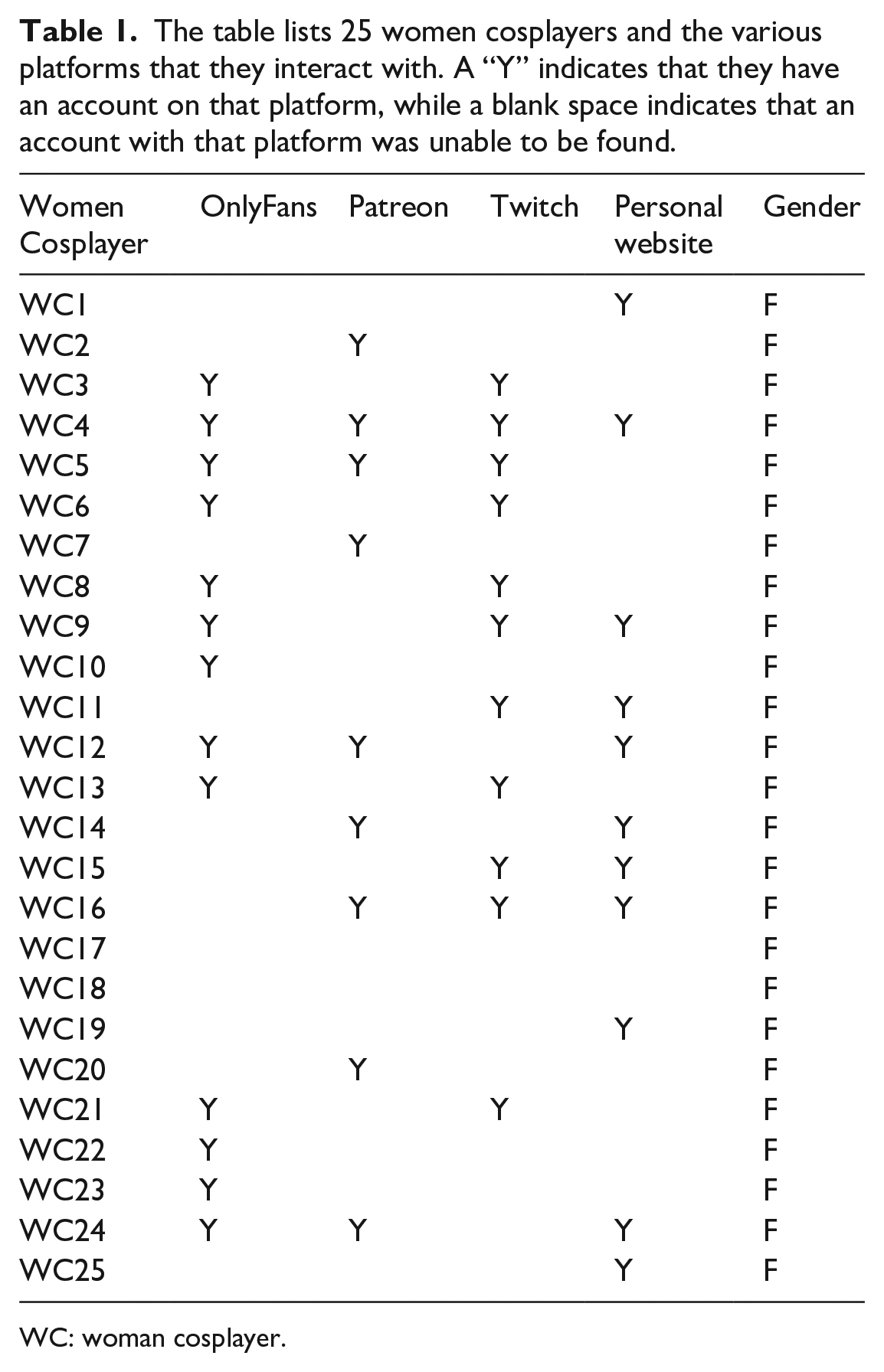
WC: woman cosplayer.
The table lists 25 men cosplayers and the various platforms that they interact with. A “Y” indicates that they have an account on that platform, while a blank space indicates that an account with that platform was unable to be found.

MC: man cosplayer.
The majority of cosplayers identified for use of patronage platforms are women, and the most popular platform of choice is OnlyFans, which suggests the platform has proliferated quickly as a viable option for the cosplay fantrepreneur. Typically, more established, well-known cosplayers center on one mechanism for monetization rather than using multiple platforms, which in part reflects the commitment content production for each platform represents: this also likely reflects historical investment in building these networks over time, although one limitation of this methodology is that we did not obtain the account start dates of each service. In addition to these patronage-style platforms, additional mechanisms for “patrons” to provide financial support are often made available. An exemplar account, WC21, lists both an Amazon wishlist and her CashApp information on her Instagram profile. These direct mechanisms are still subject to some platform fees, but do not offer the same opportunity for exchange of content for funding.
Generally, across the sample, women cosplayers were more likely to use services like linktree and share their various social platforms in one convenient space for their fans to find. They were also more likely to be found under the same username across multiple platforms; something fans often do, as it allows for them to build a “brand-like” presence across the internet. One cosplayer, MC22, used a different variation of his name on each platform; for example, on Facebook, he used MC22 Cosplays; on Instagram, he used MC22; and on Twitch, he used MC22 Games. Men were also more likely to choose a single character (or a small handful of characters to rotate through) to cosplay and reflect that cosplay (often times what they refer to as “their best one”) in their username.
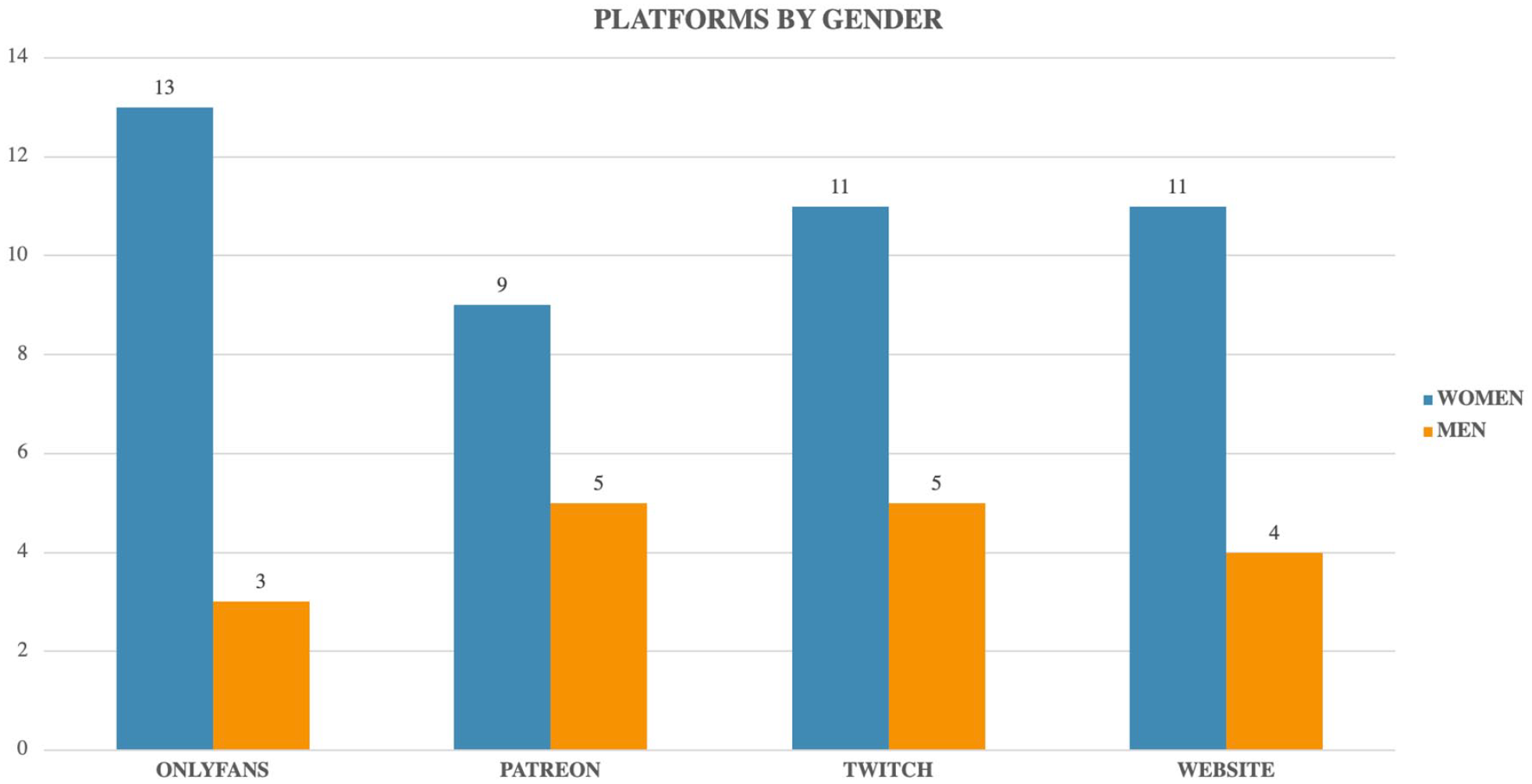
A graph that compares the social media accounts between women and men cosplayers from the tables above. Women consistently use the social media platforms than men across the platforms examined in this article (visualization by authors).
Women were also more likely to link their Twitch accounts to their Instagram accounts. They also were more likely to host chatting sessions on Twitch, where they worked on crafts, their cosplays, or other activities and chatted with subscribers, instead of streaming them playing a game (which men were more likely to do). However, men were more likely to use Twitch and stream than women were: in the period between January 1 and January 15, 2021, 3 out of 5 men cosplayers streamed at least once, as compared to 6 out of the 11 women cosplayers who shared their Twitch accounts.
Women were also more likely to vary their content based on the platform that they used. As boyd argues in her work, It’s Complicated, the context of a social media platform matters to the users: “what matters not is the particular social media site but the context in which it’s situated within a particular group of youth. The sites of engagement come and go, are repurposed, and evolved over time” (boyd, 2014, p. 39). boyd goes on to state that (teen) users use specific platforms because they have heard it is good for one thing over another. This view of social media platforms is increasingly apparent in this case study: Instagram is the hub for many cosplayers as it is a visual platform; captions are typically disregarded, especially when scrolling a feed. Facebook has lost popularity especially among younger users; Twitter remains a platform that is dominated by stream of conscious thoughts; and tumblr is known for a myriad of content, but is not specific in its limits to types of posts. Because of the context, the content posted varies widely across a cosplayer’s platform repertoire, giving users a holistic look at their lives.
On the other hand, the men cosplayers were more likely to engage in creating and selling various fan crafts; for example, MC6 creates pieces or parts of specific cosplays and then advertises them on his Facebook page for other fans to buy. Male cosplayers were also more likely to link their virtual stores where they sold fanarts that they drew (whether digitally-rendered or hand drawn). However, most of the men surveyed in this sample did little platform interaction like the women cosplayers. Most of the men surveyed in this sample only had Instagram accounts or Facebook profiles where they interacted with their fans. Furthermore, many of the men cosplay only at conventions, which means there has been little to no activity on their accounts due to the pandemic. They were also less likely to have daily posting schedules, with the exception of MC10 who regularly posts content and updates across his Instagram (including profile and stories), Patreon (including page and Lenses 3 ), and OnlyFans.
One interesting fan craft that both men and women participated in is the selling of high quality, professionally photographed pictures. These pictures (commonly referred to as prints) are often the cosplayers in various costumes and can be bought in a variety of sizes (from picture wallets to large almost-life size posters). More established household cosplay names like MC Bourbannis, Harley’s Joker, or Yaya Han sell these prints on professionally produced and designed websites, where accounts like WC5, MC10, or MC21 sell them on their Patreons. Women were more likely to sell “lewd” prints on their OnlyFans or Patreons as compared with the men, but this correlates with the fact that they are more likely to have OnlyFans accounts as compared with men.
Some of the cosplayers use other mechanisms to connect with their fandom: WC3 uses OnlyFans alongside an Amazon wishlist, Discord, notations page, and Twitch streaming. Her streaming approach emphasizes the multifaceted potential of Twitch as a platform: she features both traditional game streaming and cosplay related streams, including crafting.
Discussion
The intersection of fandom with adult content is well-documented: discussions of fan fiction frequently focus on sexual depictions, and “Rule 34” offers the internet truth: “If it exists, there is porn of it” (Tropes, 2020). The making of pornographic content has become one of the few reliable mechanisms for monetization for content-makers: webcomic artists such as Davis Willis (of Shortpacked and Dumbing of Age) rely on erotic comic subscription sites such as SlipShine; Amazon is rife with self-published e-books stretching the limits of the romance genre; and Archive of Our Own is host to PWP (plot what plot?) fan fiction with tags that defy description. And of course, OnlyFans is only the latest iteration of a patronage model that goes hand-in-hand with an era of crowdfunding.
However, the strict sexual politics of many social media sites have driven sex workers and cosplayers alike from their platforms and to more exploitative ones like OnlyFans and Chatterbaute, among others. Yet, the sheer amount of creators on the website caused for the platform to become saturated, and what had seemed like a quick money fix for many people became a huge time commitment with little to no guaranteed profit. Furthermore, many users have noted that their social media profiles on other platforms (where they would initially lure their fans from) do not have the robust fan base that would allow for them to do well on OnlyFans. As Friedman (2021) writes,
The most successful content creators are often models, porn stars and celebrities who already have large social media followings. They can use their other online platforms to drive followers to their OnlyFans accounts, where they offer exclusive content to those willing to pay a monthly fee—even personalized content in exchange for tips. OnlyFans takes a 20 percent cut of any pay.
Some content creators use external tipping apps (which may additionally take a percentage of the pay from users), but again, this relies on a large fanbase and the labor and effort put into the account by the user. If this is common across the platform, then the only people who are truly profiting off the labor of marginalized user groups are the owners, which in this case, is Tim Stokely, a white man whose net worth is estimated to be 120 million dollars.
Suzanne Scott has termed the move toward fan-driven funding as “fan-ancing” and notes that it creates “a moral economy . . . when fans are explicitly courted as a project’s primary backers” (Scott, 2015b, p. 168). OnlyFans takes the economics of “fan-ancing” even further: cosplayers are judged simultaneously on their performance of “fan” and subject to the expectations of their own fans, who in turn can impose their expectations on what is produced. Understanding OnlyFans through the lens of “fan-ancing” evokes the specter of “fan service”: fans are paying for the pleasure of desiring an alternative to the media industries’ current understanding of fan “engagement” (Scott, 2015b, p. 179).
Crowdfunding has proven to be par from an unproblematic mechanism for transformation: the expectations placed by fans are frequently unsustainable. Creators using crowdfunding platforms are often subject to economic challenges with no solution that does not lead to anger: cutting back on funding campaign promises is framed as betrayal. In fandom at large, similar issues occur even in non-funded experiences: fans asking where updates are for fan fiction where there has not been activity on the story (even if there has just been an update) or demanding fan crafts to be produced at an increased speed.
Both crowdfunding and fan-ancing rely heavily on the morality of the content that is posted; fans are quick to turn on things that they may or may not socially agree with. For some cosplayers, especially BIPOC ones, this might be fans turning on them for doing race or gender bent costumes. But adding sex into the equation furthers these discussions of morality, as “sex is always political” (Rubin, 1998). For example, in January 2021, Belle Delphine, a “gamer girl” and OnlyFans influencer, who has become publicly known for selling her bathwater for $30 a jar (and selling out in just three days), posted a photoset to her Twitter that many in her fanbase called a rape fantasy. In the photoset, Delphine is bound with rope and put in the back of a van before being pushed up against a tree by a hooded and masked assailant. For many of her fans, this was much too “far” on the morality scale: Delphine has been known for her internet stunts (which include playing with a dead octopus and graffitiing a van), but fans did not like this exploration by Delphine into BDSM being so public.
The division of content into “adult” and general categories across platforms has always come at the expense of marginalized voices in those spaces. Fandom communities in particular have frequently migrated in response to purges such as that of LiveJournal and later Tumblr, a type of fandom migration that Fiesler and Dym note as driven by “push-based factors” (Fiesler & Dym, 2020). Frequently, efforts at building followings and successful monetization are further disrupted by platform moderation policies, as in the case of YouTube’s continually changing policies (which have particularly targeted queer content).
It is tempting to compare the deplatforming of adult content creators with that of other users whose platform access has shifted as a result of their content production, such as members of QAnon banned from Facebook, Twitter, and other spaces in the wake of 2020–2021 violence. However, such false equivalency perpetuates the othering and marginalization of sex workers and adult content creators broadly. Platform moderation’s failure to distinguish between harmful material and adult content continues: to recall our attention to Pornhub, their new requirement for “verified uploaders” directs anyone interested in continuing to create content to their “Model” program promising “65%” of video sales and custom videos (Pornhub, 2020). Once invested in the platform, it is very difficult for models to transfer their following. Further controversy over Pornhub has led to credit card bans on the platform that threaten those sex workers, as Mary Moody’s campaign has highlighted: “I personally stand to lose thousands each month, but I want to spotlight the many workers who will be losing the income they rely on for survival, especially during the pandemic” (Thomas Fabbri, 2021).
This dependence of content creators upon hostile ecosystems and rapidly changing policies draws attention to the connected challenges facing fans, sex workers, and platform workers more broadly. While it is hardly new to draw attention to the role of platform politics in crafting financially unsustainable labor markets, the intersection of these particular content spaces highlight the significant roles both misogyny and morality policing play in heightening this exploitation. Fan-ancing and fandom influenced spaces, far from being a solution to this devaluing of labor, threaten even further marginalization. The OnlyFans platform’s metaphor of patronage, rather than offering meaningful content creator freedom, threatens to perpetuate the influence of the entitled fan as consumer-controller.
Ultimately, the examination of influence of patron-fans upon fantrepreneurs’ platform decision-making warrants further study. In the examination cosplayers from this study, we found that to gain the following to sustain a multiplatform branding, we found that cosplayers rely on the parasocial relationships formed between patron and creator. Defined by Horton and Wohl in 1954, a parasocial relationship is a relationship that are described as an “illusionary experience, such that media audiences interact with personas as if they are engaged in a reciprocal relationship with them” (Horton & Wohl, 2016, p. 215). In starting on Instagram, we found that the cosplayers maintained relationships with their potential patrons by liking or responding to their comments, and promoting their work. However, in turning to sites like OnlyFans or Patreon, we found that the creators engaged in differing forms of affective conversation; they treated their patrons like their friends and reciprocated their donations with intimacy through personal messages or tier specific rewards. These moments unveiled the often gendered and invisible emotional labor that goes into maintaining a brand, Furthermore, as Hair (2021) found, while intimacy allows for fans to feel like they are more connected, “it may also add invisible labor for creators, especially those who feel uncomfortable self-disclosing personal information or constantly engaging with fans” (p. 209).
The need of fantrepreneurs seeking economic sustainability to rely upon extensive, multiplatform branding is demonstrated not only in the distributed efforts of the cosplayers examined in this case study, but in the broader demands for labor equity and compensation by workers across platforms. The pandemic amplified attention to these struggles (and the dependence of some workers on these platforms), but it did not create the exploitative models of gig labor at the heart of these systems.
However, the answer to these challenges might be found in exemplars of feminist infrastructure in fandom: returning to Fiesler’s work, we are reminded that Archive of Our Own arose in part as a space where meaningful content moderation and tagging might coexist with creative expression, suggesting a different path forward for platform ownership (Fiesler et al., 2016). Examining the approaches of AO3 offers an important rejoinder to “all or nothing” content moderation policies, though it offers no better solution to the problem of the fantrepreneur: those seeking to profit from their fan fiction are more likely to turn to competitor platform Wattpad, which leverages the dreams of authors seeking audiences and Netflix deals for endless content generation. The fundamental cynicism of these platform’s economics is amplified by crisis: let us hope that the attention the inequities has drawn does not diminish with the envisioned “return to normal.”
Footnotes
Declaration of Conflicting Interests
The author(s) declared no potential conflicts of interest with respect to the research, authorship, and/or publication of this article.
Funding
The author(s) received no financial support for the research, authorship, and/or publication of this article.
Notes
Author Biographies
 .
.