




Abstract
With a focus on the online phenomena of scamming and scambaiting, this article explores users’ communicative activities on Reddit’s r/scambait subreddit. Drawing on a representative corpus viewed through grounded theory, we establish the basic categories of posts and then unpack those further to reveal the deceptive practices being undertaken by both scammers and scambaiters, as well as Redditors’ untruthfulness in their fabricated posts. The analysis reveals that the r/scambait subreddit exists as a site of humorous entertainment arising from various forms of deception. Scammers’ deceptive strategies are depicted as amusingly naïve and inefficient, while scambaiters’ deceptive messages targeted at scammers demonstrate great creativity and wittiness. In both cases, scammer-victims are disparaged for being immensely gullible or downright stupid; and Redditors earn online plaudits for submitting the most upvoted posts. Our significant finding is that posts such as those at r/scambait should never be taken at face value due to their inherent epistemological ambiguity, to which the users choose to remain oblivious or indifferent. Furthermore, on a general plane, this study indicates a potential shift in the emic understanding of the concept of “scambaiting” from a punitive measure and an educational instrument to a creative practice geared toward posters’ kudos and users’ joint humorous experience through “baitertainment” and “scamusement.”
Keywords
Introduction
The last two decades have seen an influx of research in psychology and communication studies on online/digital deception, that is, deception performed on the internet (e.g., Hancock, 2007; Hancock et al., 2008; Toma et al., 2019; Whitty & Joinson, 2008). Thanks to the anonymity that it affords, the internet offers fertile ground for a whole range of deceptive practices, which involve various kinds of verbal and multimodal message deception, very often starting with identity deception (Dynel, 2016). Thus, having built a fake identity, a deceiver submits one or more false-believed messages so that the target of deception should develop the required false beliefs as if they are true and act accordingly. Deception can occur in diverse interactional contexts, serving various purposes (cf. Utz, 2005), both communicative and practical. Two salient contexts occasioning deception are the romantic one (e.g., Sharabi & Caughlin, 2019; Toma, 2017) and the financial one, which is when deception is typically dubbed, and studied as, fraud or scam.
While “fraud” is a legal term, “scam” seems to work as a universal notion used in both popular parlance and in academic literature to denote “a deceptive scheme that seeks to trick a person(s) out of money and/or personal information which is unethical and may also be a civil, regulatory or criminal issue too” (Button & Cross, 2017, p. 7). Scams may be of various kinds, pertaining to various spheres (see Beals et al., 2015): consumer investment, products and services (e.g., fake tickets or products that are paid for but never arrive), employment (e.g., model agency work that turns out to involve sexploitation), prizes and grants (e.g., fake lotteries or 419 scams, 1 which are based on promises of riches after transferring processing fees into bank accounts), debt collection (e.g., bogus demands for payment of debts or taxes), charity (fake charity organizations without a legitimate cause), and relationships (fishing for money under a romantic pretext).
The prevalence of online scams has given rise to scambaiting, a form of digital vigilantism (Loveluck, 2020; Trottier, 2017)—also known as “digilantism” (Sorell, 2019), “cyber-vigilantism” (Chia, 2020; Smallridge et al., 2016), “internet vigilantism” or “netilantism” (Chang et al., 2018)—an offshoot of standard offline vigilantism, that is, “a social movement giving rise to premeditated acts of force—or threatened force—by autonomous citizens” (Johnston, 1996, p. 232) that comes into being in response to legal norm violation by others. Digital vigilantism is best defined as “direct online actions of targeted surveillance, dissuasion or punishment which tend to rely on public denunciation or an excess of unsolicited attention, and are carried out in the name of justice, order or safety” (Loveluck, 2020, p. 4). Therefore, it is punishment through online exposure of what one recognizes as wrongdoing in front of an online audience, whose members are expected to share the same critical moral judgment (Sorell, 2019). Overall, digilantism encompasses various forms such as crowdsourced vigilantism (through collaborative user searches), hacktivism (facilitated by users’ insight into internet technology), and most importantly, for the present purposes, scambaiting (Chia, 2020; see also Sorell, 2019).
Based on a diachronic study, Byrne (2013) reports that scambaiting has been employed since the late 1990s as a countermeasure to scams, notably to the 419 scam and other activities not amenable to standard law enforcement (see also Loveluck, 2020; Smallridge et al., 2016). Scambaiters attempt to outwit scammers (Loveluck, 2020) and waste their time (Smallridge et al., 2016) when involving them in prolonged interactions (e.g., via email or chats). Hence, scambaiters act as if they are genuinely interested in scammers’ offers (Smallridge et al., 2016), seemingly oblivious to the mischief; they do so to frustrate scammers, ridicule them, and/or cajole them into disclosing personal information, sending demeaning—typically sexualizing—pictures of themselves (Loveluck, 2020) or performing other humiliating actions offline, such as waiting at the airport in vain (Chang et al., 2018). When engaged in interactions with scammers, it is also scambaiters that employ deception (Chia, 2020); as Smallridge et al. (2016) aptly put it, “scambaiters counter deceit with deceit” (p. 60). Scambaiters may act thus, at least initially, for personal satisfaction only or—more likely—deliberately with a view to sharing the fruit of their creative labor on social media platforms. Indeed, scambaiting victories are typically reported and scammers are publicly exposed by users on relevant websites (Juliano, 2012; Smallridge et al., 2016), such as 419eater.com.
It is important to note the reach that new media platforms (e.g., YouTube and Reddit) have afforded scambaiters, with the practice developing alongside advances in technology. In the earliest stages, scambaiters undertook their activities via one-to-one email exchanges with the scammers. Now, one of the most salient practices involves a scambaiter video-recording themselves as they participate in a phone call with the scammer as each party carries out their actions (Ross & Logi, 2021). When we consider that such scambait calls are regularly replayed to large audiences, the potential for a much more significant impact becomes apparent.
Tuovinen and Röning (2007) list scambaiters’ four potential motives, which can be divided into two general categories. Besides doing community service (educating and protecting potential victims) and seeking revenge (after the baiter or someone from his or her entourage has fallen prey to a scam), a scambaiter may aim for amusement at the scammer’s expense through his or her clever scambaiting tactics, as well as for status elevation and admiration by fellow scambaiters (and other users) for outmaneuvering the scammer. The thrust of this is that apart from being the punitive measure deployed by digilantes, scambaiting is a source of fun and humor at the scammers’ expense enjoyed by scambaiters themselves, as well as all “lurking” website visitors. The twofold purpose of scambaiting has also been recognized in other research under different labels: “civic duty engagement” and “amusement” (Smallridge et al., 2016, p. 60); “shaming” the scammer and “entertaining” users (Chang et al., 2018, p. 107); “punitive revenge for the scammer” and “online humour” and “laughter” for scambaiters (Yékú, 2020, p. 248). Scambaiting may then be deemed “fun” (Byrne, 2013) and a “comic art form” (Sorell, 2019, p. 155).
However, the different notions such as entertainment, fun, amusement, humor, or comic art, should not be taken as inextricably interconnected and should not be rashly considered relevant to all scambaiting reports. Notably, the degrading, often sexualized, images of African scammers can be regarded as spectacles of shame elicited and displayed so that multiple users can ridicule the (alleged) scammers, who will go to any lengths only to accomplish their financial goals (Nakamura, 2014; Yékú, 2020). While affording the social media users a sense of superiority over the (presumed) scammers, the sharing of such photographs is tantamount to “digital lynching” (Loveluck, 2020, p. 20) and tends not to show much humorous potential per se (gauged based on the presence of humorous incongruity, see, for example, Martin & Ford, 2018), some photographs being more inflammatory than humorous. What stands more chance of being humorous is creative deceptive exchanges between scammers, who become scammer-victims, and scambaiters, that is, the would-be scam victims.
Many a skilled individual has earned a reputation as an online celebrity thanks to their creative scambaiting practices publicized on personal websites. This is indicative of the progression away from scambaiting as a practice with retributive and awareness-raising goals toward one with a singular focus on the amusement of online audiences. Relevant cases in point include Mr Sodini who exhibits his scambaiting stunts on Ebolamonkeyman.com and Anthony DiSano, who documents his antics on TheScambaiter.com. Another scambaiter growing rapidly in popularity is Kitboga, an American Twitch streamer and YouTuber famous for his scambaiting on the phone which is streamed and recorded for his viewers on Twitch and YouTube (see Ross & Logi, 2021). Such celebrity scammers’ selected feats are also shared among the posts of anonymous users on the r/scambait subreddit, where greater evidence can be seen of the shift away from scambaiting as an educational and corrective practice and toward humorous entertainment for its own sake. Having contextualized the practice of scambaiting as reported in previous research, in the remaining sections of this article, we explicitly focus on the specific platform of Reddit, namely the r/scambait subreddit, to explore the forms and functions of the scambaiting performed there.
Scambaiting on Reddit’s r/scambait
Reddit is a social news aggregation site, organized in different communities—or subreddits—each founded on a common interest. Each of the independent subreddits (as of January 2021, there are over 2,620,000, cf. https://backlinko.com/reddit-users) has its own motives, goals, and functions ranging from informative to purely entertaining, and each is subject to independent analysis (e.g., Dayter & Messerli, 2021; Dynel, 2020a, 2020b; Dynel & Poppi, 2019, 2020), while no sweeping socio-cultural generalizations should be made about the numerous communities (whose individual demographies cannot possibly be discovered) or the totality of users operating on Reddit. The only generalization that can be made about this platform is that all subreddits hinge on user-generated content (whether original or reposted) that must follow the jointly negotiated rules holding for a given subreddit; each item can be duly commented on, upvoted (or downvoted) and given awards, whereby Redditors generate their Reddit “karma” across the subreddits on which they are active (see Dynel & Poppi, 2019; Kilgo et al., 2018; Massanari, 2015).
This article takes the subreddit r/scambait as its focus, the largest of the subreddits devoted to scambaiting, with the continually growing community consisting of 96,500 members in May 2021. The “About Community” section describes scambaiting as the practice of feigning interest in a fraudulent scheme in order to waste a scammer’s time and resources to keep them away from real victims. Share your scambaiting success stories, workflows, techniques, or post questions to other members of the group.
This definition of the act of scambaiting, albeit quite narrow compared with the thrust of the academic conceptualizations (see Introduction), makes clear the objective of the subreddit, which is for users to share among each other their own experiences with scammers and their scambaiting tactics. This aligns most closely with the kind of community service that Tuovinen and Röning (2007) suggest is one of the key aims of scambaiting, along with wasting scammers’ time (Smallridge et al., 2016). However, it can also be easily observed based on the nature of the posts, as well as user reactions to them, that there is primarily a humorous entertainment aim (see Byrne, 2013; Chang et al., 2018; Sorell, 2019; Tuovinen & Röning, 2007; Yékú, 2020) involved at r/scambait.
Each post on the subreddit comprises a multimodal item coinciding with a scam and/or scambait component, as well as the post’s title/header, which contextualizes the former. Although there are certainly r/scambait posts that fulfill the official purpose of the subreddit, in practice, the posts are not restricted to this basic purpose. The user-generated content is much more diversified, and it is this diversity that this study seeks to investigate. In line with our desire to explore the forms and functions of the scambaiting performed at r/scambait, we propose the following research questions which underpin the analysis:
By undertaking this close analysis, we strive to gain insight into the use of the specific subreddit as a site for sharing scammer and scambaiter practices and their inherently deceptive nature that may be primarily consequent upon posters’ activity per se.
Methodology
The corpus for this study was built between 30 November and 1 December 2020. Before commencing the research project, the first author attained permission from Reddit to utilize Reddit data for academic research. The data were collected from the public domain, having been shared with no restrictions by users hiding behind nicknames suppressed here to guarantee the users full anonymity. Thus, in collecting the corpus data, we were conscious of ethical considerations inherent in Internet-based research and were guided by Franzke et al.’s (2020) principles of standard ethical practice.
The corpus comprises the screenshots of the subreddit’s top 50 posts of all time. Sorted by the “top” criterion, the corpus represents what Redditors had upvoted, awarded, and commented on most often when the data were collected. Thus, the top posts were those considered by the community the best and most relevant to the subreddit, being thus indicative of its envisaged content, which may be diversified still. It is very unlikely that the online community would have upvoted irrelevant, albeit still interesting, items. However, it cannot be denied that a lot of potentially excellent content passes unnoticed if not brought to the fore through immediate upvotes, which duly proliferate based on the snowball effect.
Both authors duly annotated the data using a grounded-theory approach and iterative coding, so that the relevant categories describing the posts could emerge from the dataset in several analytic steps. Redditors’ top comments, including those coming from the post authors, were also examined for the sake of a better understanding of the posts. The coders discussed problematic examples to arrive at a unanimous decision about each, in many cases allowing for multiple equipotential labels. Among the 50 cases, we ultimately disregarded two isolated examples, which did not belong in any of the categories and whose epistemological status was impossible to determine. Finally, to validate the saturation of description, one of the coders duly vetted another batch of top posts, specifically those ranked 51–100, which reflected the previously discerned categories and did not necessitate new labeling (with three dubious examples escaping classification). Also, a further validity test based on randomized content (amounting to over 100 r/scambait items) performed by the first author and her research assistant confirmed the adequacy of the proposed classification.
The initial coding process and the first stage of analysis involved first identifying the rudimentary division of posts within r/scambait based on their basic content displayed in Table 1. These are the categories that the users of r/scambait, presumably, need to recognize as they make sense of the various posts.
The Basic Division of r/scambait Posts.

These mutually exclusive categories are rather clear-cut and capture the basic content of the posts on the subreddit. However, when the analysis was deepened and the posts were analyzed in greater detail, more nuanced interpretations emerged, most notably in relation to the deceptive activity of the scammer, the scambaiter and the poster. These categories based on the nature of deception can be seen in Table 2.
Division of Deceptive Content by Scammers and Scambaiters/Redditors.

The categories displayed in Tables 1 and 2 are applicable concurrently since the two classifications are based on different criteria (e.g., a Reported Scam qualifies as a Scam Proper or a Prank Scam). Also, while the activities listed in Section B and Section C in Table 2 are mutually exclusive, a scambaiter’s deception can co-occur with a scammer’s deception in one (complex) post, especially when a scammer–scambaiter interaction is reported. Furthermore, specific examples tend to be characterized by epistemological ambiguity, and it is impossible to determine which one of the alternative categories within Section B or C represents the original author’s genuine intention behind the content in a given post, with more than one conflicting category being plausible. This has resulted in two or more equipotential labels for the majority of the posts.
Analysis
This section showcases the variety of the posts at r/scambait through a selection of representative examples. These posts serve to highlight the deceptive practices used by both parties (scambaiters, who present themselves as would-be scam victims operating on the subreddit, and scammers, currently scammer-victims) as well as, in many instances, the epistemological ambiguity embedded in the interpretation. The examples presented here may typify the (alleged) artifact of the scammer, scambaiter, or both, being reports (as predicted by the subreddit’s description), general suggestions, or revelations. Many of the examples bring to light the epistemological ambiguity inherent in user posts (see also Dynel, 2020a, 2020b), wherein it is almost impossible to verify the true nature of the scam and/or the bait by accessing the mental states (intentions, goals and beliefs) of the participants and their resulting activities, but where humorous entertainment remains center stage.
Reported Scam
The first category concerns scams reported by Redditors, which, on some occasions, are displayed in their entirety; while, on others, just components of the scams are shown. The posted images (e.g., in the form of screenshots) display the artifacts that the Redditors claim to have received, with themselves cast in the role of the scambaiters. Within this category, there is no evidence of any interaction between the scammer and the scambaiter. The examples in Figure 1 are in the form of fake IDs supposedly sent by the scammers. This seems to be a prevalent scammer practice. On a relevant note, Sorell (2019) indicates the need for scammers to use fake IDs in various scams to assist them in their project to dupe the scam victims.

Reported scam example involving fake IDs.
In Figure 1a, the Redditor claims to have received the identification at hand in response to a request for “bank credentials.” Even a cursory look reveals some glaring problems in the alleged ID of a US citizen including, most obviously, the subject in the image, the accompanying name—Adolf Hitler—and the date of birth, which would make Herr Hitler 131 years old. Owing to the obvious falsehood of the ID, which refers to one of the most infamous figures in world history, this may be an example of the peculiar Prank Scam category. If this did come from the scammer, the question must be asked why this identity was chosen from countless anonymous ones that would be readily available online. The response to this resides in the realization that the alleged scammer may have had a deceptive—but not mischievous or malevolent—intent, being more a troll seeking self-entertainment (see Dynel, 2016 and references therein) than a scammer, who would never sabotage their own scam. This Prank Scam consists in holding the target’s interest only to submit the overtly fake credentials. The prankster’s playful motives are misunderstood by the Redditor. A further consideration is inspired by one of the comments following the Reddit post. The comment suggests that this ID may have been sent to the scammer by a scambaiter within a prior scam, and the scammer actually had no idea who Hitler was (as unlikely as that may seem) and thought it appropriate to use it in a subsequent scam. In such a case, this specimen qualifies as a Scam Proper. In pursuing this interpretation, it can also be concluded that if the scammer truly believed that this could possibly deceive anybody, then they only succeeded in proving their own extreme ignorance. An alternative interpretation of Figure 1a could be as a Fabricated Scam, with the ID created by the Redditor and shared under the guise of having been produced by a scammer, which is the most likely interpretation.
Figure 1b appears to be a hybrid ID card and business card for a funeral parlor, also being an instance of a Scam Proper, a Prank Scam, or a Fabricated Scam. This ID displays a celebrity—the American comedian and actor Aziz Ansari—who is reasonably well-known in Western countries. Although the ID might not be completely convincing, it can be considered the scammer’s serious attempt at deception and may well prove to be successful depending on the recipient. For example, the prime target of scammers is typically the elderly due in part to their reduced cognitive ability and social isolation (Bidgoli & Grossklags, 2017; Button & Cross, 2017). It is very likely that the elderly are not familiar with Aziz Ansari and may also find it more difficult to notice idiosyncrasies in the ID such as the photoshopped insertion of the image. However, like the Hitler example, this could also be interpreted as a Prank Scam and might even fall into the category of a Fabricated Scam, which is a post constructed by the Redditor for the fun of it. This is because the ID itself is too unbelievable to be a scammer’s genuine attempt at deception given the rainbow background and the merging of funeral business with personal identification.
Reported Scams also appear in other forms besides fake IDs at r/scambait. Figure 2 shows two of these, with the former being an invitation to an investment opportunity, and the latter being apparent evidence of a package to be sent to the scam victim. Figure 2a presents a received email, dubiously sent from Donald Trump—the “Prime Minister” of the United States. Although this clearly raises authenticity suspicion, this example can be a Scam Proper for it looks like the kind of email that can appear in one’s spam folder. Chiluwa (2019) points out that this kind of phishing email is increasingly common and differs from normal spam in its crime-oriented nature, attempting to lure scam victims into clicking the link and then handing over money. Indeed, those who pay less attention may actually see the email as an endorsement from a successful investor.

Reported scam examples beyond IDs.
Figure 2b showcases another instance of epistemological uncertainty. On one hand, it can be seen as a Scam Proper—the scammer is putting their questionable Photoshop skills to use on an image of a package with an almost illegible address and a disproportionately large barcode, assuming that it suffices to deceive the scam victim. This is in line with Button and Cross’s (2017) observation that Photoshop and other related technologies are now essential tools for scammers, regardless of their competence in using them. On the other hand, the address of “Penile Street” and the ambiguity it causes, based on the near-homophones (the reference to male genitalia and to the punishment of offenders, cf. “penal”), might be seen as a clue to this example being a witty Fabricated Scam, with the baiter inserting this twofold reference as a means of attracting a response from Redditors.
Reported Scammer–Scambaiter Interaction
The category dubbed “Reported Scammer–Scambaiter Interaction” is a merger of a Reported Scam (cf. the previous section) and a Reported Bait (cf. the next section), often involving multiple turns. Redditors post screenshots of what they depict as (parts of) their interactions with scammers held through various online platforms. Each participant is on their deceptive scheme, but it is the scambaiter that is shown to be the party that ultimately outwits the opponent. Regardless of who starts the interaction, the scammer or the scambaiter (who thus sets up a trap), the latter sees through the deception and confounds the scammer’s plans.
In Figure 3a, a text-based interaction occurs seemingly within the chat function of Instagram. On one side of the exchange, the scammer is attempting to lure their supposed victim into a bitcoin scam through following their standard conversational script (cf. Zingerle & Kronman, 2013). The scammer follows their scamming script about the business opportunity of bitcoin, while the scambaiter pursues their desire to appear confused, as evidenced by their irrelevant posts, ranging from a jocular picture of a cat to nonsensical self-revelations. Clearly, through this uncooperativeness, the scambaiter is poking fun at and teasing the tenacious scammer, who is not willing to concede on their aim. Thus, this is an example of a Scam Proper and three instances of Bullshit Baits, whereby the scambaiter aims to deceive the scammer about his or her enterprise and shows no concern for the truth of what he or she is communicating (on bullshit, see Frankfurt, 1986/2005; for a discussion, see Dynel, 2018a). Ultimately, the scammer withdraws following the baiter’s final Bullshit Bait, effectively nullifying the scam.

Reported Scammer–Scambaiter Interactions.
Another example of a Scam Proper culminating in the scambaiter’s victory can be found in Figure 3b. The scammer pursues a romance scam and attempts to have the scam victim produce a photograph of himself, validated by a name card in his hand. The scambaiter proceeds to use a picture of a man selected at random (as he explains in his capacity as a Redditor in an exchange following his post) to frustrate the scammer with the patently fake image; the drawn fingers and name indicate that the picture features someone else. This message, taken as a whole, is hardly an attempt to deceive the scammer about its content but represents a Bullshit Bait. In response to the unsatisfying photograph, the scammer attempts an act of multimodal deception by sending a picture of a woman with an evidently Photoshopped hand. The scambaiter uses this as the basis of his second even more ludicrous manipulation, with the male face overlaid on the image of the woman sent by the scammer, in tandem with a carefree, overtly insincere apology. The remainder of the interaction is not visible on Reddit, but—based on the Redditor’s report—it ended here with the scammer realizing they were the victim of their supposed victim’s prank and that the tables in the scammer’s deceptive game had been turned.
Figure 3c is also classified as a Scam Proper progressing to the female (based on the profile picture) scambaiter victory through an Ambush Bait. Posing as the prospective victim’s “Chair of Department,” the scammer seeks payment in the form of a gift card, which is a preferred practice of scammers (Bidgoli & Grossklags, 2017; Ross & Logi, 2021) in contemporary online scams. Presumably because the attempted victim has no Chair of Department or it is a completely different person (called otherwise and with looks other than the face in the icon), she easily sees through the attempted deception. However, the scambaiter plays along by deceptively pretending that she has believed the scammer’s identity (note the very artificial, tongue-in-cheek form of address and the hyperbolic commitment in the scambaiter’s opening turn), albeit questioning the scammer’s pursuit of a Google Play gift card based on her alleged personal knowledge of the addressee. The scambaiter then fabricates a detailed story about her experience at the 7–11. All these deceptive messages qualify as Ambush Baits. The last communication, first typed and then showcased in a manipulated picture, is the epitome of the Prank Bait, which the scammer seems to naïvely take as a genuine code to use, thus letting themselves be deceived and failing the wit test. This is because, on close observation, when the letters are extracted from the code they read “GO FUCK YOURSELF,” representing the final and the only truthful message communicated to the scammer.
Reported Bait
Within the posts labeled “Reported Bait,” Redditors publicize only their punchlines or the end result of their interactions with scammers. Figure 4a shows what the scambaiter presents as his or her product: an official-looking money transfer form fabricated for the scammer to complete to receive money. When observed closely, the questions are in many instances ludicrous and often lewd, deliberately composed with the aim of amusing the prospective scambait audience. Nonetheless, the form seems to have been filled in by an unwitting scammer (with the identifying information obliterated in the Reddit post), fixated on his/her financial aim. Again, the inherent epistemological uncertainty comes to the fore here. If it is indeed the case that the scammer completed the form sent to them, they appear to have been true to his/her aim of proceeding as quickly as possible through the exchange to potentially trick the victim out of money, as evidenced by the high number of the easy “NA” answers and blank spaces left. In failing to recognize the falsehood of the form, the scammer exhibited extreme gullibility and fell for the baiter’s Prank Bait. However, this post can also be interpreted as a Fabricated Bait (the form) and a Fabricated Scam (the answers in the form), which may suggest that this scam never even occurred, and the Redditor has posted this creative form purely for the response it would garner from the online audience.

Reported Bait examples.
Figure 4b is another fake ID reported to have been used in a scam, as indicated by the title, albeit this time by the scambaiter, rather than the scammer (cf. Figure 1). While fake IDs may be used by scambaiters to protect their anonymity (Smallridge et al., 2016) through identity deception (see Dynel, 2016), this scambaiter has another aim and uses more sophisticated means. The pop culture reference embedded here is to the British actor Sir Ian McKellan, most famous worldwide for playing Gandalf in The Lord of the Rings, with the actor’s true image, first name and date of birth used, but with a doctored surname—“Mellon”—which is a linguistic creation of J. R. R. Tolkien and is the Elvish word for “friend,” which is used as part of a riddle within the original story. It could be suggested that the scambaiter is also using the word as part of a riddle in this enterprise. Except for this “borrowed” image and first name, which serve as evident—at least, to Westerners—cues to the deception, as well as the subtler cue available to Tolkien’s fans, the fabricated ID does look legitimate with the coat-of-arms truly representing the independent sovereign state of Sealand, a peculiar micronation located off the coast of Suffolk in the United Kingdom that has been described as the world’s smallest country with a population of approximately 25, consisting only of an artificial platform. The apparent authenticity of the ID is further supported through features such as the realistic expiry date, with forms of identification typically remaining valid for periods of 5 or 10 years in most contexts. This is, clearly, the operationalization of a Prank Bait, with the scammer likely to be deceived into believing the ID to be genuine if they miss the various cultural references. This post is also offered to Redditors as a Pre-emptive Bait for future use.
Pre-emptive Bait
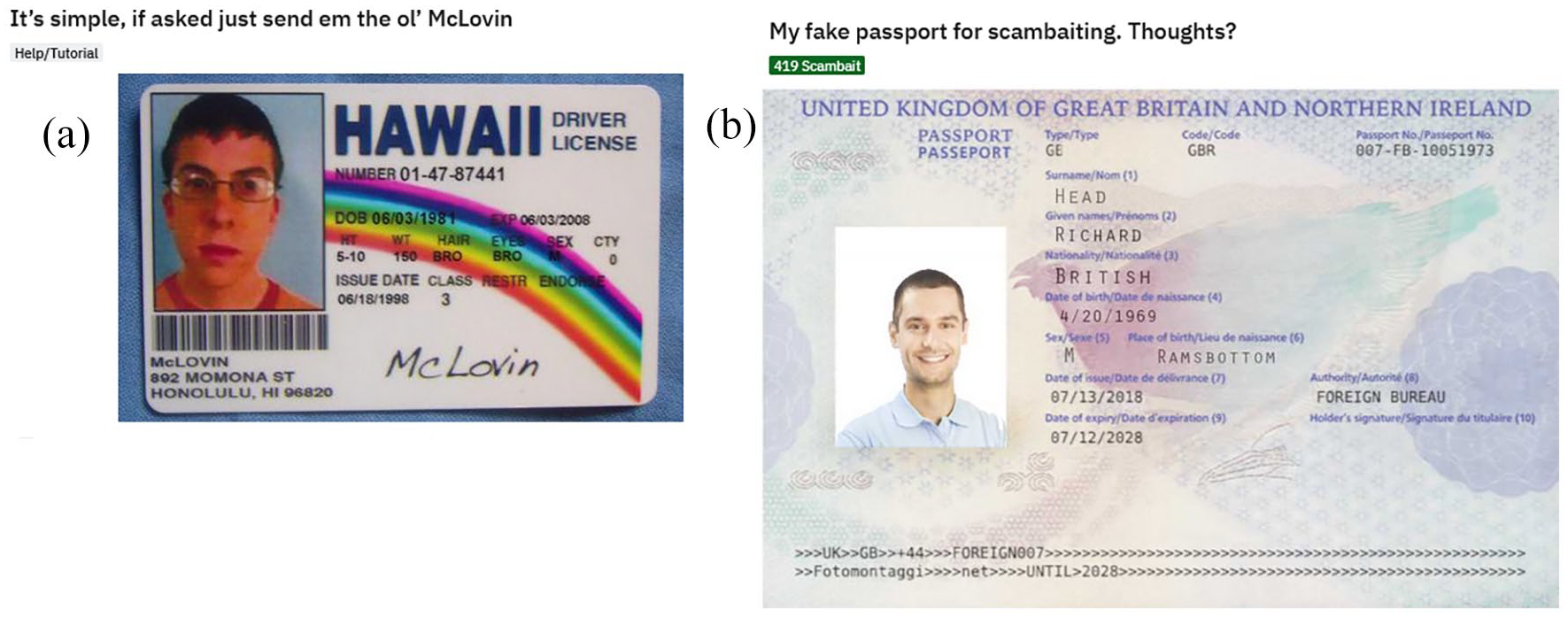
Pre-emptive Baits revolve around the provision of scambaiting tools and resources for other scambaiters to utilize in future activities. Alternatively, these are purely jocular posts that could hypothetically be used to tease scammers. In either case, the posts in this category constitute mainly clever Prank Baits that often rely on cultural references to Western cultures or cultural “inside-jokes,” both unlikely to be picked up on by scammers, who are presumed to be extremely gullible and uneducated about the cultures. Figure 5 displays salient examples of this category.
Pre-emptive Bait examples.
The driver’s license offered in Figure 5a is an overt allusion to the US comedy Superbad, where one of the teenage characters owns a fake driver license to be able to buy alcohol regardless of its evident falsehood (cf. the blatantly fake McLovin surname and the rainbow next to the character’s picture). The license in the post is precisely what is shown in the film and could simply have been acquired from a Google image search. The Redditor’s canniness here resides in deploying the humorous allusion to poke fun at the extreme naïveté of anybody (a fictional character in the film or, more importantly, a scammer) who could possibly consider the driver license genuine. Moreover, the Redditor’s deprecating assumption is that scammers might evince blindness not only to the evident absurdity of the license per se but also to the popular intertextual reference, which may not be cross-culturally available.
In Figure 5b, the poster purports to seek feedback from the Reddit audience before, supposedly, utilizing the fake ID in his or her own scambait. Unlike in Figure 4a, the ID is very much the product of the scambaiter’s Photoshopping skills. A visually convincing UK passport is presented with the name of Richard Head from Ramsbottom. Thanks to these names, the post qualifies as a Prank Bait and a prospective test for the scammer. When shortened, the name becomes “Dick Head,” and the location of Ramsbottom is a reference to homosexuality; these are the sexual innuendoes that a scammer (coming from a different linguistic and cultural background) is expected to miss in the otherwise convincing ID, much to the subreddit community’s amusement.
Scam Revelation
Scam Revelations, exemplified in Figure 6, are those posts that can be juxtaposed with Reported Baits, which typically indicate the scambaiter’s discovery of the scammer’s scheme. Scam Revelations, by contrast, are the scammer’s own actions, whether or not deliberate, that prove their scammer identity and confirm to the scam victim that he or she has been engaged in a scam.

Scam revelation examples.
Figure 6a presents the final stage of a scam executed through remote desktop computer access, which is a common component of many online scams. This scammer must have become so frustrated and angry as to scribble all over the would-be scam victim’s screen. This example then shows the scammer’s unequivocal revelation that ultimately ends the interaction.
Figure 6b is a post that, as its author claims, reveals the faces of the scammers that appeared on the screen when they accidentally accepted the scambaiter’s video call. This is what the post’s title and the scambaiter’s comments following this post suggest. These also indicate that the advance fee fraud scammers claimed to be awarding “federal grant money” to the victim. With no evidence of the interaction preceding this revelation, Redditors are resigned to taking the scambaiter’s assertions at face value, and in doing so, they subject themselves to the racist overtones, with the origin of the scammers suggestive of West African origin, thus aligning them with common scams such as the 419 or Nigerian scam (Button & Cross, 2017; Yékú, 2020). However, due to the luck required to expose the identity of scammers, combined with the lack of evidence of an exchange, this could also be classified as a Fabricated Scambait, which further highlights the epistemological uncertainty captured in many r/scambait posts.
Discussion and Conclusion
The current study has drawn on a collection of top rated posts from the r/scambait subreddit to explore how users present various experiences with, or perceptions of, the practices of scamming and scambaiting. The posts at times do adhere to the official stated purpose of the subreddit (i.e., sharing scambaiter success stories), but they also display a high degree of diversity, encapsulating humor and deception. The coding of the data established a general classification of posts on the subreddit (cf. Table 1) consisting of (1) Reported Scam, (2) Reported Scammer–Scambaiter Interaction, (3) Reported Bait, (4) Pre-emptive Bait, and (5) Scam Revelation. Within these categories, the posts depict diversified deception-based content (cf. Table 2) comprising (1) Scam Proper, (2) Prank Scam on the scammer’s part, (3) Prank Bait, (4) Ambush Bait, (5) Bullshit Bait, (6) Fabricated Scam, and (7) Fabricated Bait on the scambaiter’s part. The diversity of the posts on the subreddit indicates that, regardless of its official description, Redditors do not share only genuine scambaiting posts per se.
The basic division of posts, reflecting what is submitted and ostensively presented by Redditors is rather clear-cut. However, determining the actual nature of the content, together with the deceptive practices therein, is much more problematic. By default, both scammers and scambaiters are engaged in deception, having covert goals and intentions. Scammers take on fake identities and make covertly untruthful statements to cajole their victims into performing actions to the scammers’ benefit. For their part, scambaiters covertly pretend (Dynel, 2018b) to believe the scammers and perform various types of deception, which may also involve what they regard as overtly untruthful messages, based on the assumption that this untruthfulness may not, and likely will not, be obvious to the scammers. However, our data also indicate that it is Redditors who may perform communicative acts that show untruthfulness through sending posts with fabricated content in relation to both scams and scambaiting. This is not to say that they intend to deceive anybody; rather, they are driven by the need to share interesting content, as if indifferent to the deceptive potential their posts can have if someone should believe the specimens to come from authentic interactions with scammers. Redditors on the reception end may choose to believe r/scambait posts to be chunks of genuine interactions with scammers, or at least tacitly choose not to consider them in terms of their authenticity; this is all because they are primarily oriented toward deriving humorous pleasure from the content they find.
Furthermore, the deception-based or fabricated content also brings into focus the issue of epistemological ambiguity. As our analysis has revealed, there is no way of categorically knowing that a given post contains content of a specific type, for instance whether it is a Scam Proper or a Fabricated Scam that a Redditor has shared. Where there is evidence of interactions with scammers included (e.g., screenshots of exchanges via messaging apps or email), the posts are afforded a higher degree of authenticity and credibility. However, although less likely, even reported interactions that look legitimate and authentic could potentially have been fabricated for the sake of entertainment, so this possibility should not be discounted. Many types of posts are, in fact, likely to be Redditors’ creative fabrications. However, while the data certainly include some dubious Reported Baits, other posts qualified here as Pre-emptive Baits are presented by Redditors honestly as being only potential (rather than as having been implemented). An implication of this epistemological uncertainty of the posts has led to equipotential labeling of examples. This is because we can never be entirely sure about the genuine authorship of the deceptive content in the posts nor about the true assumptions of the (alleged) scammers and/or scambaiters about the messages duly reported as the content.
Users’ entertainment on the subreddit rests on humor being derived from the deceptive behavior that both scammers and scambaiters engage in. Deceptive activities carried out by scammers, typically in the later stages of unfolding scammer–scambaiter interactions (as opposed to their initial exchanges), are humorous for what is showcased as the apparent stupidity involved and the unlikelihood of success. In contrast, the deception performed by scambaiters is typically an attempt at being witty and clever, often involving a degree of creativity and/or canniness, frequently through the reproduction of creative units. The key to the deception in scambaiting is also that the entertained users are privy to the deception, unlike its target (cf. Dynel, 2018a). Thus, scammer-victims are depicted as gullibly believing whatever they are sent, preoccupied with, and blinded by, their own deceptive scheme and (typically, financial) plan. It follows that it is the scammers who are the targets of ridicule and are the “butt of the joke” to be appreciated by the subreddit users (cf. Byrne, 2013; Chang et al., 2018; Smallridge et al., 2016; Sorell, 2019; Tuovinen & Röning, 2007; Yékú, 2020). Those users jointly make fun of scammers’ inefficient deception and gullibility.
More generally, it should be noted that although the practices of both scamming and scambaiting have developed significantly in recent years, the data at hand echo the racist trend reported in previous research on African (more specifically, Nigerian) scamming (Byrne, 2013; Loveluck, 2020; Nakamura, 2014; Tuovinen & Röning, 2007; Yékú, 2020), including scambaiters’ humiliating (for the scammer) trophy-hunting escapades (Nakamura, 2014). However, while humiliation is not as much of a focus at r/scambait, there is certainly a focus on disparagement of scammers in the sense of highlighting their greed, naïveté and, often, downright stupidity. An example of this can even be seen in Pre-emptive Baits that include intertextual or pop culture references (e.g., McLovin in Figure 5a) assumed to be inaccessible to the scammer. This is often carried out on the basis of presuppositions made by scambaiters and/or Redditors.
Given the above, the scam and scambaiting sharing practice at r/scambait can be neatly explained in the light of classical humor theory, namely “superiority theory,” which has roots in philosophy and is amply studied by psychologists (see Dynel & Poppi, 2020; Ferguson & Ford, 2008; Martin & Ford, 2018). Essentially, humor and amusement arise “through the denigration, derogation, or belittlement of a given target” (Ferguson & Ford, 2008, pp. 283–284). However, Zillmann (1983) argues that perceived superiority is not, ultimately, the reason why humor succeeds. Rather, it facilitates humor, whose essential conditions are incongruity, novelty and surprise (see e.g., Martin & Ford, 2018). Incongruous juxtapositions arise out of either human stupidity or human wit, and the posts at r/scambait are no exception in this regard.
On one hand, the posts depict scambaiters’ (attributed) naïveté in how they construct their deceptive messages, which stand little chance of actually deceiving anybody (cf. the message from Prime Minister Donald Trump in Figure 2a). On the other hand, scambaiting Redditors evidently aim to display their wit and creativity through sharing their posts, which applies to all the categories thereof. For example, consider Figure 4b with Ian McKellan (Mellon). The scambaiter had the option of using an image of a completely unknown face, which would have posed no threat in terms of the scammer recognizing it but would not have tested the scammer’s cultural knowledge (about the actor and the film) in the way scambaiters are usually wont to do and, crucially, would likely not have received the same attention from the Reddit audience. Also when fabricating a scam, a bait, or even a scammer–scambaiter interaction, a user has the same overarching goal: to submit a humorous post that will generate many upvotes, awards, and comments from other Redditors. This seems to explain the users’ focus on the stupidity of the scams and the canniness of the baits, rather than on their potential falsehood.
Typically, the various types of baits, as well as Fabricated Scams (posts wittily designed to reflect/emulate scammers’ ignorance), testify to Redditors’ creativity (e.g., Dynel & Poppi, 2019; Vásquez, 2019). A socio-psychological understanding of the term “creativity” concerns the human ability to generate new behaviors and utterances based on the combination of patterning and innovative transformations of previously encountered ideas (Vygotsky, 1967/2004). These are manifest for instance in intertextual references (see Tsakona & Chovanec, 2020), which are used in new contexts (cf. McLovin in Figure 5a) and in innovative combinations (e.g., Hitler’s ID in Figure 1a, following the Fabricated Scam interpretation). However, even when the previous concepts cannot be easily identified and attributed to their sources, humorous posts naturally combine diverse constructs and pattern arrangements, giving rise to surprising incongruities (cf. the replies to the “head of the department” in Figure 3a), sometimes verging on absurdity (cf. the funeral parlor card in Figure 1b).
R/scambait is then a platform which enables poking fun at the (alleged) attempts at scamming and enjoying Redditors’ creativity. Overall, an underlying motivation and purpose of all posts is the sharing of humor and the pursuit of online recognition, which is not always paralleled by reported attempts to punish and/or frustrate scammers. Users’ overriding aim is to impress fellow Redditors and generate digital plaudits. This is achieved through the affordances of the platform with the capacity for upvoting and downvoting posts, which then contributes to users’ karma across Reddit more broadly, should they be active on more than one subreddit. According to Van der Nagel (2013), this is an overarching measure of peer approval and social capital on the site (see also Kilgo et al., 2018; Massanari, 2015). The humorous content on the social media platform bears similarity to the websites and channels of celebrity scambaiters (see Ross & Logi, 2021), whose primary aim is to entertain the general public. At r/scambait, any user can become a local celebrity with a post that reaches the top of the ranking list thanks to other users’ positive reactions.
It follows that the community-serving, punitive vigilante function of scambaiting (e.g., Smallridge et al., 2016; Tuovinen & Röning, 2007; Yékú, 2020) is tangential, if not completely irrelevant, to Redditors’ activities. Prior reports on scambaiting placed in a central position the retributive and punitive functions, together with community awareness-raising about the pernicious scamming practices. Emphasis would often be laid on publicly shaming law-violating individuals in pursuit of some form of social justice and/or elucidating for the audience the key elements and characteristics of scams as a means of raising social awareness and enabling individuals to protect themselves from similar scams. By contrast, at r/scambait, this focus has now shifted to the periphery, and the concern is less on the particular scammers and the mechanics of scams and much more on humor and having fun. Little can be learned here of the nature of scams at r/scambait; the audience are exposed only to what is considered the humorous part of the (alleged) interaction, scam or bait. In terms of the absence of the punitive function, the scammers (if genuinely responsible for what is shared on the subreddit) will typically be anonymized and, likely, oblivious to the reposts that share their messages in the new participatory framework (Ross & Logi, 2021). Moreover, many posts put on display solely creative baits, which may never have been sent to any scammers, specifically for Redditors to enjoy.
Therefore, the contents at r/scambait provide evidence of the gradual shift in how the term “scambaiting” is interpreted by users, from their emic perspective, and thus, also how it should be seen from the academic etic vantage point (on the emic/etic distinction, see Pike, 1990). As a consequence of this shift, there is a need to differentiate between traditional and emergent emic understandings of the practice. In the light of this, we suggest that it may even be useful to coin new terms for humor-focused activities related to scambaiting on sites such as r/scambait. We thus propose “scamusement” and “baitertainment” to capture the means of deriving humorous pleasure from extremely inefficient scams and creative baits respectively, regardless of their genuine provenance and authorship.
To conclude, this study has revealed the r/scambait subreddit to be a site of humorous entertainment revolving around deceptive practices central to online scams and scambaits. The primary motivation of Redditors is to have some fun at the expense of scammers (sometimes, taken collectively, rather than any specific scammers to be ritually punished) through humorous practices capitalizing on various forms of deception. In achieving this goal, the posts are reflective of the users’ presumptions and biases. Another important finding of our study is the recognition of the epistemological ambiguity inherent in the majority of posts. This offers a valuable lesson to both everyday internet users and researchers of online behavior: one should never take any user-generated content at face value.
Limitations and Future Research Directions
The current study has presented a fine-grained analysis and exploration of the most popular content on the r/scambait subreddit. However, this is not to say there are no limitations inherent in the study. The most significant potential limitation relates to the size of the corpus examined. The top 50 posts may be considered too small a sample, albeit corroborated with 50 extra posts vetted by the first author, and another 100 examined with the help of her research assistant as part of additional validation of the proposed classification of the data, so that the saturation of description could be guaranteed. However, the close qualitative analysis that we sought to undertake necessitated a sample of this size, and the posts themselves were complex and required significant inferencing, discussions and negotiation of (often multiple) tagging. This is also why the precise inter-coder reliability measure cannot be provided.
Another limitation can be said to relate to the focus on only one subreddit about scambaiting, the topic of our case study. However, we prefer to see this not so much as a limitation but more as a direction for future research on similar subreddits such as r/Scambaiting and r/Scamthescalpers, or the related but different r/Scams. In our preliminary investigations, we had found that there was overlap between these subreddits and r/scambait, while the other scambaiting communities were much smaller; this added further strength to our rationale for selecting r/scambait as the object of our study. Future research might explore similarities and differences between the other scambaiting subreddits, or perhaps the contrast between those purely seeking to inform about scams as opposed to engaging in scambaiting.
Footnotes
Acknowledgements
The Authors would like to thank Gosia Krawentek for her assistance.
Declaration of Conflicting Interests
The author(s) declared no potential conflicts of interest with respect to the research, authorship, and/or publication of this article.
Funding
The author(s) disclosed receipt of the following financial support for the research, authorship, and/or publication of this article: This work was supported by the National Science Centre, Poland (Project number 2018/30/E/HS2/00644).
