




Abstract
Scholarly attention to hashtagging on social media sites has focused on their catagorization affordances. Grounded in the literature on online identity, this article examines how Tumblr users tactically use hashtagging architecture for publicity and privacy in self-expression. The analysis is based on Tumblr posts and their corresponding hashtags, combined with text-based, synchronous interviews with users. We find that participants use hashtags as a form of intimate expression, offering “secret whisper” spaces. Participants acknowledged a distinction between these spaces of intimacy and the more conventional space of the post. Extending on Goffman’s dramaturgical approach, we argue that this intimacy practice is a form of stage whispering, which is neither front- nor backstage, but implies and assumes intimacy while on the stage, as an actor might imply and assume intimacy stage whispering to her audience.
Introduction
Since its inception, microblogging and social media website Tumblr has marketed itself as a platform for artistic work, which can be posted without the website itself claiming copyright over the uploaded artworks, and as a place for freedom of expression (Tumblr, 2019). Although there has been an emphasis on the platform as a space for artists, Tumblr’s own “about” page describes potential users’ ability to “[j]oin millions of people in millions of communities across millions of #tags” (Tumblr, 2019). Previous studies have pointed out how Tumblr has been “a gathering point for multiple niche groupings and marginalized identities” (Neill Hoch, 2020), including LGBTIQ+ users (Cho, 2018; Dame, 2016; Oakley, 2016), patient groups (Gonzalez-Polledo, 2016), fandom communities (Hillman, Procyk, & Neustaedter, 2014; Kunert, 2021), and political movements (Keller, 2019; Neill Hoch, 2020).
Tumblr’s default setting is that posts are publicly discoverable and viewable, regardless of whether the discovering user even has a Tumblr account. While the platform is technically more public than other social networking sites due to fewer privacy controls, it tends to be difficult for outsiders to navigate (Mccracken, Cho, Stein, & Neill Hoch, 2020). This trait makes it attractive to many marginalized groups, who experience this opacity as protective (Cho, 2018). Tumblr is distinguished by its blog format, and its tagging affordances. Users have their own blog, but access the website primarily through their “dashboard” (Figure 1), which reverse-chronologically curates the Tumblr posts (and reblogs) made by that person’s “followed” users. Users are free to scroll past, “share,” like, comment on, or “reblog” these posts. Reblogging a post sends it and any appended commentary to the user’s own blog and followers, retaining the original creator’s name. It does, however, remove the hashtags from the previous poster, creating a “clean” space for the reblogger to write their tags in, if desired. Reblogs, likes, and comments (but not the use of the “share” button), each add a “note” to the post (lower left, Figure 2), to count the number of interactions as a sort of measure of the popularity of the post. Users have the option of appending a page to their blog’s domain, which could theoretically be used to write an “about me” section. However, “about me” pages are not a standard or site-suggested element of users’ accounts. This contrasts with platforms like Facebook, which center on a user’s profile page (Oakley, 2016).

An ordinary Tumblr dashboard page.

A typical post, beside its “reblog” page (annotations added in red).
This article investigates online intimacy practices on Tumblr. We present findings from a netnography of Tumblr hashtagging practices among a collaborative writing community, which reveals how users often express themselves in tags in ways that we cannot appreciate as aiding simple keyword searches. For instance, the tag “#Fucking hell this is my Boy’s entire aesthetic,” is not traditionally searchable (Figure 2). We first address the affordances of the tag-based architecture of Tumblr introducing how users practice hashtagging. We then foreground our analysis in previous studies of identity work in online environments. Our analysis presents content creation and sharing practices among fandom and collaborative writing users; the need to keep the body of posts on brand; and the use of tags for various forms of “clutter,” most notably users’ inner thoughts and emotions. We then show how users articulate the tags as spaces of greater intimacy, adopting the metaphor of “whispering.” Taking and extending Goffman’s (1959) analogy of front- and backstage identity, we suggest that “lower volume” hashtags are neither front- nor backstage, but are a form of stage whispering that gives users license to express themselves beyond their blog’s theme.
Affordances and Uses of Tumblr’s Tag-Based Architecture
Hashtags are a form of written text preceded by a hash symbol, which usually appear at the end of traditional post content on social networking sites. The term hashtag began on twitter, when it was suggested that the “tag” be preceded by a symbol sometimes (in UK English) referred to as a “hash.” They became, literally, hashtags (Doctor, 2013). Tumblr was created several months prior to the advent of the Twitter hashtag, so at least originally, its tagging system would have been using tags, but those tags now appear preceded by the hash symbol (“#hello,” “#it’s me”), so the community has come to use the terms “tag” and “hashtag” interchangeably.
Traditionally, scholars have mostly viewed hashtags as media for categorization (Eda, Yoshikawa, Uchiyama, & Uchiyama, 2009; Spiteri, 2007). Through this lens, users can make use of this affordance—that is, the uses that are designed into the technology—to assist in the “spreadability” of content online (Jenkins, Ford, & Green, 2013) and increase the likelihood that content can be “seen,” accessed, and spread, supporting ordinary people to potentially become micro-celebrities (Marwick, 2013; Turner, 2010). However, hashtags are not equally searchable on all platforms, inviting us to question how and why users practice hashtagging.
Only a handful of studies have investigated the use of hashtags for other purposes. Huang and colleagues (2010) demonstrated how Twitter tags can be first “conversational” (“It happened to #MeToo”), with their function in categorization secondary only where tags become “micromemes.” Dame (2016) showed how transgender Tumblr users’ confidence in narrating their trans* identities is supported by a trans-specific folksonomy (#trans, #mtf, #ftm), though this has been observed as a site of contestation and a field in which a smaller group of users may have the power to define the folksonomy’s development. Bourlai (2018) was the first to examine practices with respect to what she terms comment tags, identifying three categories of use: opinions, reactions, or asides. The tags that we address in this article relate principally to such comment tags, and so we adopt this language throughout.
On Tumblr, users are able to write up to 140 characters into one hashtag, and up to 30 hashtags—a total of 4,200 available characters. This means users are able to create whole clauses within one hashtag, as well as constructing short stories or whole paragraphs within the tagging space itself (see Figures 3 and 4). In addition, as in Figure 3 (lower right), hashtags that appear on the dashboard are displayed only until a certain point, after which they are hidden under a “see all” button, which expands the post (Figure 4). Hashtags appear as gray text on a white background, at the very bottom of a post, and are not spreadable (the hashtags a user appends to a post do not “come with” a reblog, see Figure 2, right). The tags that are appended to a post are not actively made discoverable; the native search function of the Tumblr website is designed to search through only the first five tags of an original post, so the hashtags appended to a reblogged post are not searchable within the wider platform. When searching on a particular user’s blog, this search function is improved to the first 20 tags, meaning there are still 10 tags, which are not discoverable using any of Tumblr’s native tools.
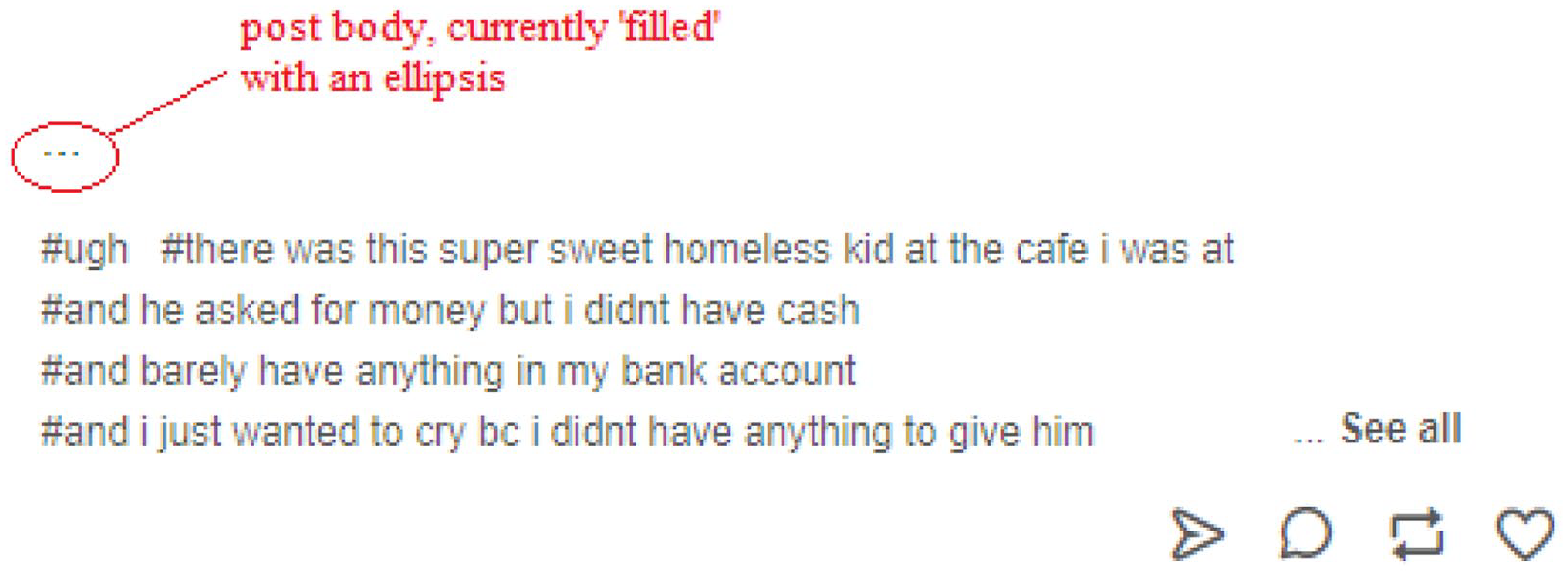
A user uses the tags to talk about their bad day (notation added in red).

The post in Figure 3, fully expanded.
For Tumblr users, these hashtag affordances provide a space where users can type “naturally” (e.g., using abbreviations like “bc” for “because”). They also offer a space for expression that is not overly public. Tumblr users themselves have commented on the less public nature of tags, perhaps with some ire (Figure 5).

A popular Tumblr post about the ineffective Tumblr search function.
Tagging as Identity Work
When users choose how to tell their story, they choose it with reference to their imagined audience. This is encapsulated in Goffman’s (1959) conceptualization of front- and backstage identity, where the front-stage performance of identity in a work environment would be different to the backstage (relatively more relaxed) performance of identity at the “after-work happy hour” (Marwick & boyd, 2011, p. 123). The nuance of relationships and social contexts helps to guide individuals to make decisions about how they express their identity on or near their “stage.”
To varying degrees, online environments dissolve the nuance of social, work, and family spheres—a phenomenon termed “context collapse” (Marwick & boyd, 2011). Users often have the option to be “friends” (or “follow”) or not be “friends” with somebody, conflating all contacts into one group regardless of whether they are genuine friends, employers, or great grandmothers. To discriminate for only “genuine friends” online is inadvisable, as it means sacrificing one’s social inclusion in other groups’ online lives (boyd, 2006; Hanckel, Vivienne, Byron, Robards, & Churchill, 2019; Livingstone, 2008; Marwick & boyd, 2011). Marwick and boyd’s original analysis of context collapse examined the case of Twitter, though many have since pointed to the relevance of this phenomenon to other platforms such as Facebook (Duguay, 2016; Marwick & Ellison, 2012). Where users feel this context collapse, writing identity in these spaces complicates the frontstage/backstage performance, as participants of online social media are being constantly socially surveilled (Marwick, 2012; Tokunaga, 2011) by everyone on their friends list. Decisions about what to post, and when, become practices of self-surveillance as an actor works to “preserve or present a certain kind of desired selfhood” (Lupton, 2015, p. 178) in the context of her imagined audience.
While the potential for social surveillance introduces privacy concerns, the ability to reach everybody in one’s social network all at once can also be viewed “as a reward, rather than as a punishment” (Bucher, 2012, p. 1174). Exploiting context collapse, users can choose to access various communities of audiences by developing a carefully constructed “self-brand” (Marwick, 2013, pp. 192–193), where they socially locate themselves as the producers or curators of a particular sort of content (e.g., beauty vloggers produce beauty content). These users then use that forward-facing “brand” to market (and commodify) themselves. However, in these circumstances, users must manage and potentially alter their expressions of self to ensure they conform at least broadly with the expectations imposed by both their self-brand and their variously collapsed social groups or risk backlash.
However, this expectation is difficult to meet on a permanent basis. In response, studies have captured how users can adopt strategies to achieve “more private” spaces online. On Facebook, well-documented privacy-protective strategies include adjustments to users’ privacy settings, choosing not to share certain information, profile “pruning,” selective acceptance of “friend” requests, and reading only (boyd & Hargittai, 2010; Maslen & Lupton, 2019; Masur & Scharkow, 2016; Young & Quan-Haase, 2013). This work is complicated as users are re-presented with performances of identity they did in the past, as with the Facebook Timeline, whose introduction had months- or years-old content appearing again on users’ Facebook feeds (Zhao et al., 2013). At the time these posts were created, they contributed to the user’s desired selfhood. When re-presented later, they are rendered unhelpful exhibitions of identity about events long-passed or in-jokes, which no longer make sense. Some users went so far as to characterize portions of their exhibited identity as “not nice to look at” or “not clean” prior to removing them from public view (Hogan, 2010; Zhao et al., 2013).
Tumblr’s affordances and the nature and practices of the communities that gather in these digital spaces have important implications for online identity work. First, on Tumblr, identities are more often “closeted, collective, obscured, or evanescent” (Renninger, 2015). Tumblr users typically adopt pseudonyms, or names that make sense in the context of a URL, rather than real names. Users can also have multiple or collaborative Tumblelogs, rather than each account being linked to a singular identity (Renninger, 2015). As such, there are fewer issues with context collapse in the classical sense of personal, work, and family lives colliding. This does not render Tumblr users entirely free in their expression. On one hand, Tumblr is lauded as a space for users to be their “true self” (Oakley, 2016). On the other hand, communities have community-regulated and generated labeling practices (Oakley, 2016). Building on previous contributions, this article investigates how users manage their identity on Tumblr through hashtagging practices, particularly with respect to content that they view as “off-brand” or out of step with their community-regulated norms.
Methods
Netnography
We selected a netnographic approach. A netnography is a sort of digital ethnography, where the researcher draws on her lived experience as a part of a community to better understand, from a phenomenological perspective, the social fabric that knits together, and is knitted by, users, their actions, and interactions (Kozinets, 2010). The data we collected included Tumblr posts and hashtags, as well as elicited data in the form of 10 semi-structured interviews. At the time of research, the first author had been using Tumblr for 10 years, participating in fandom—and specifically, collaborative writing—social circles. This experience on the platform helped us to explain linguistic nuance and provided richer context to our findings. This project was approved by the relevant University Human Research Ethics Committee.
Data Collection
Tumblr posts and their attached hashtags were identified as a part of the first author’s participation in the community or through a search using Tumblr’s own search function. Tags themselves are only searchable under the presented rules, but it is possible to search the entirety of a text of a post (Tumblr’s native tools differentiate this as looking for posts “tagged” as something versus “search”ing). For instance, navigating to http://tumblr.com/search/book will present any post with the word “book” in it (prioritizing popular posts), whereas http://tumblr.com/tagged/book will generate a reverse-chronological list of all posts which are tagged with the specific tag, “book.” Many of the posts collected as field notes were posts that the first author had come across previously due to their sheer popularity, and the duration and extent of her use of the platform. These were discoverable using remembered keywords and the search function. These data were used to examine when and how users made use of comment tags, and their content.
In addition, we conducted the online, synchronous interviews using participants’ preferred communicative tools—the instant messaging service, Discord—to increase the comfort of participants and encourage authentic answers in a research setting (Eder & Fingerson, 2001). This also helped to broaden the scope of available participants, as online interviews are not limited by geographic location. The use of text-based interviews is often critiqued as the interviewer risks missing the depth of tone modulation and body language in interviews (O’Connor & Madge, 2017), as well as the opportunity it allows participants to de- and re-construct their responses. Our synchronous text-based approach meant that the time that participants may have had to de- and re-construct their answers was reduced.
Participants and Recruitment
Participants were selected for the research using a purposive sampling method, discriminating for participants who had previously engaged used tags for commenting. We posted an open call for participants on Tumblr using the first author’s blog, which had been active for 7 years at the point of the research, attracting a little under 6,000 followers. After reviewing their blogs for evidence of tagging practices, participants were approached through Tumblr’s messaging system for interview.
All participants were regular Tumblr users who are at least 18 years of age. Ten participants were recruited, which is roughly consistent with the number of participants used in comparable studies (Williams, 2006; Zhao et al., 2013). Eight participants identified as female; two as male. Participants’ length of use of Tumblr ranged from 14 months to 10 years. Due to recruitment taking place through a collaborative writing blog, all participants were actively involved in the fandom side of Tumblr, reblogging others’ and uploading their own posts. One more regularly reblogged than uploaded content because of changes to her life circumstances (Fiona). Nine of the ten participants (with Fiona as the exception) participated in fictional writing for fandom or about their chosen franchise(s), mostly collaboratively. Depending on the popularity of the blog, the franchise in which it is situated, and how long it has existed, blogs had anywhere from 100 or 200, up to several thousand followers. The collaborative writing community served as context in interviews.
The names of interview participants are pseudonyms. The archival and fieldnote data were not taken from interviewee blogs, to better ensure confidentiality. The inclusion of screenshots of public posts, public metadata, and public tags is in line with Tumblr’s terms of service and privacy policy, but to protect against potential risks for users who did not anticipate their uploaded content appearing outside of Tumblr, we black out or replace Tumblr usernames. Users were also made aware of a research presence within the community, through the use of frequent posts made by the first author on her blog.
Data Analysis
The transcripts from the interviews, and the archival data, were examined using inductive thematic analysis (Ezzy, 2013). Informed by our reading of the literature, we looked for users’ descriptions of the affordances of hashtags on Tumblr, how this influenced their use of tags, and their reasoning behind this strategic use. Emergent themes related to use of comment tags to guard against “mess” or “clutter” on other users’ dashboards. Users also adopted aural metaphors to describe writing in the tags as a form of intimate expression, which we examine in relation to Goffman’s dramaturgical analysis.
Findings
Fandom and Collaborative Writing Social Circles on Tumblr
Fandom social circles on Tumblr span several franchises (Doctor Who; Harry Potter; the Marvel Comic Universe; Disney, just to name a few). Drawn together by their enthusiasm for their respective topics, users produce and consume content about their selected franchises, such as .gifs (moving images), edited photos and graphics, opinions, fanfiction, fan theories, and thoroughly debated analyses of character motivations and development arcs. Colloquially and in day-to-day usage, the word “fandom” is used to refer to a specific franchise’s fan community (“the Doctor Who fandom,” “the Supernatural fandom”), but here it is used to span all franchises.
Some users create franchise-specific blogs where they will (largely) only produce and share content related to that franchise, while others might create a fandom blog for multiple franchises, which they select and prioritize according to interest as time goes on. The franchises that are most predominant for a particular blog are often included in the blog’s short “description” to help to describe the blog’s content for other users, so that they can curate their dashboards as they prefer: Broad range nerd. Supernatural. Doctor Who. Sherlock. Lucifer. among others. I love many things in life but here [on this blog] you’ll only find video games. The ones I played, the oones [sic] I wish to play, the characters that took me on a journey with them. For more general content and personal stuff, you should check [pseudonym], my main account. Climate justice + human rights babyyyyyy // I love Detroit: Become Human and Good Omens too much // I also like LIS, Umbrella Academy, The Good Place, Sanders Sides, and MCU but I’m not as obsessive about them lol.
It is common for a participant in fandom culture to have more than one franchise that they identify as a “fan” of, and not all franchises have an equal number of fans. This means it is likely that a user’s social circle—the users with whom they interact, and whom they follow, usually because they have a franchise-in-common—will include users who identify as being part of the fandom for franchises that the fandom participant will find unfamiliar. Participants of the fandom community navigate these different franchises and interests while maintaining a connection to other members of the fandom community through their shared level of enthusiasm for their respective content (Figure 6, where a “mutual” is someone who a user both follows and is followed by).

Fandom bloggers appreciate each other’s enthusiasm for their respective franchises.
Collaborative writing circles overlap significantly with fandom circles. Collaborative writing (colloquially known as “roleplaying”) is the practice of two or more users taking turns writing a portion of a fictional story, where each user individually writes in either a third- or first-person limited point-of-view that focuses on their particular character. The author in this case is referred to colloquially as a “mun,” and the character who is being written is a “muse.” This back-and-forth constructs a collaborative narrative, which can help to explore characters and worlds from multiple perspectives. Some users like to borrow their selected character from existing media, while others create original characters to write with. Most collaborative writing features at least one character based in fandom, as this makes writers more discoverable and interaction more likely. Users will typically have a dedicated blog intended for collaborative writing, which, as well as writing for one (or more) character(s) in a collaborative writing sense, usually creates and shares content related to their chosen character (that is, fandom content, if the character originates from or is intended to write with a particular fandom). The character, the character’s fandom (if applicable), and the act of collaborative writing becomes the “theme” of the blog’s content, often appearing in the “description” box just as it does on fandom blogs, to help other users to curate their dashboards. These descriptions can present the name of the character being written, how selective the author is when choosing partners to write with, and important information about how the author chooses to write their character.
Ginny Weasley (Canon Divergent) / Gryffindor / Pureblood / Healer at St. Mungo’s Hospital . . . Multifandom [open to writing with multiple fandoms]. Multiship [open to multiple romantic pairings with their character]. DONNA TEMPLE-NOBLE post-metacrisis, journey’s-end fix-it, very head canon heavy [all three of these describing how the character is written in the context of their franchise]; selective & low activity. highly selective ask & rp [roleplay] blog for JOSH RANDALL of the 1958 western WANTED: DEAD OR ALIVE.
When penning a post that forms part of a story, all text included in the post body for that particular story-post is “in character.” This means that when actively writing a story, there is no space in the traditional posting style for commentary that does not “fit” the fictional story actively taking place. Collaborative writers also post or share content that is not “in” character or related to their character (including posts about their personal lives), but “out-of-character” posts tend to support the “theme” (collaborative writing) of their blog: for instance, describing rules for the collaborative writing community, detailing preferred topics or styles of storytelling, or prompting other writers to start a story (Figure 7).
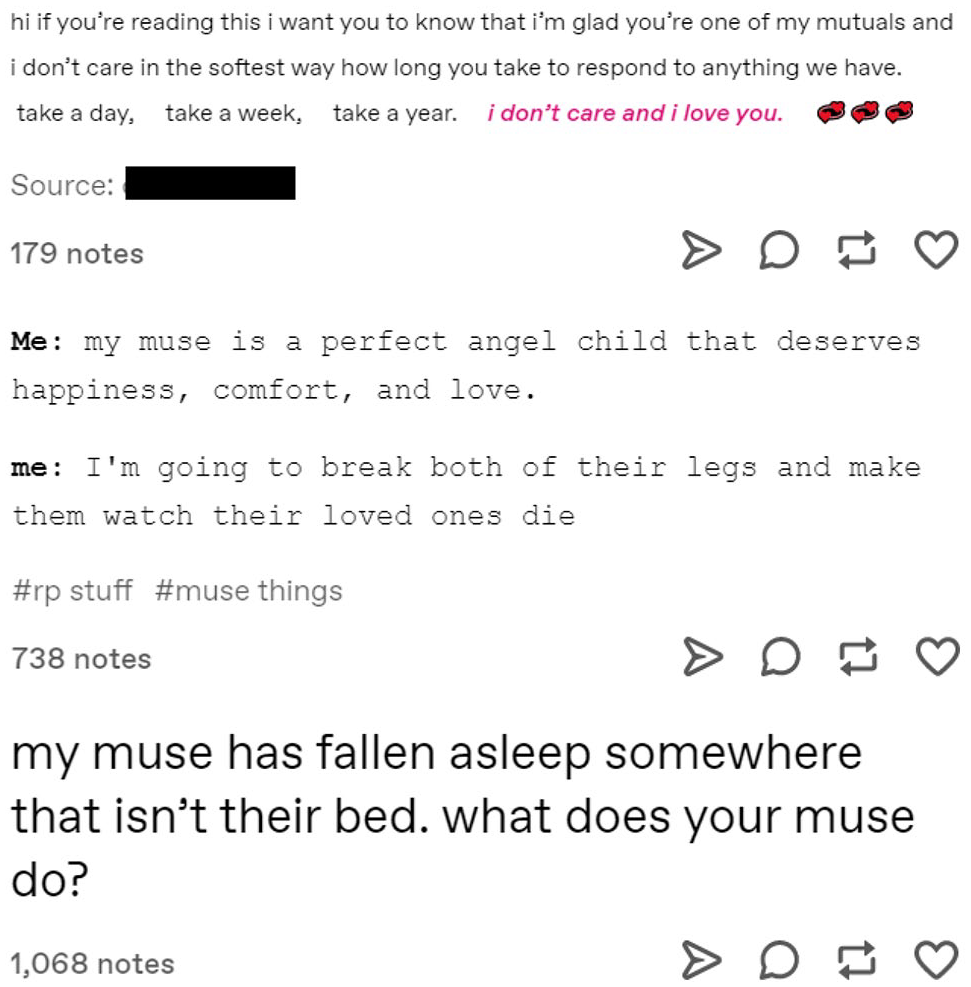
“Out-of-character” posts from collaborative writers are often still focused on the writing.
Keeping Posts on Brand
In online spaces, individuals selectively perform their identities so as to idealize their images and navigate the expectations of themselves and their imagined audience. Figure 8 depicts an extremely popular Tumblr post, which explains a user’s attachment to their URL (the equivalent of a username) on Tumblr, using the word “brand” to speak about the constructed selfhood they are seeking to preserve. This post has been reblogged over 470,000 times.

Tumblr users retain the meaning attached to their identity performances by safeguarding their URLs.
This need to present and preserve a desired selfhood raises questions about what users do with conflicting thoughts and emotions. Collaborative writers, for instance, develop a selfhood that indicates for others that they are the (or an) authority on their chosen character, but they grapple with how to best express content that does not “fit” this theme. Catherine and Basil, below, express that there’s a “time and place” for content that does not fit. This suggests that there is a time and place for this content, and that they do not immediately dismiss it as unshareable.
sometimes it’s good to make yourself heard? But there’s also a time and place for it—if that makes sense? (Catherine, Tumblr user for 4 years) people feel . . . like their main body needs to be relevant to their blog content? and reserving the tags for [unrelated] stuff? (Basil, Tumblr user for 7 years)
Users said that this content did not belong in post bodies, that it was better expressed in the tags, reasoning in terms of the experience of other users.
I’ve seen [comment tags] . . . on accounts that stick to a pretty rigid theme . . . but they want to say something about their personal lives, or just rant, so they . . . just say what they want to say in the tags . . . I would say [they do this because of] the pressure they put on themselves to maintain a blog that [has a theme] and the fear that they’ll lose followers. (Edward, Tumblr user for 14 months)
As blogs focus on their selected theme, users involved in these activities practice posting so as to maintain that focus. Users Jane and Basil articulated their consideration of the experiences of other users consuming their or others’ posts in terms of avoiding “mess.”
Permanent comments can stack up into the biggest messes—and it takes forever to get [scroll] past it all. Not to mention, not everyone wants to see “AHHH OMFG [oh my fucking god]” “I LOVE IT SM [so much]” “THANK UUUU~~~” 20-30 times every other post. (Jane, Tumblr user for 8+ years) [Comment tags are] a sort of unspoken agreement to keep everyone’s dashes as clean as possible, because if everyone went about adding to main posts, we’d never be able to scroll anywhere, i think it genuinely just is a common courtesy thing. (Basil, Tumblr user for 7 years)
Anne (user for 8 years) drew a distinction between her reasons for using Tumblr and the obligation she feels to respond to other users, slipping seamlessly between personal and social motivations: Tumblr specifically is about carefully curating your dash[board page, Figure 1] to your interests, and seeing that kind of stuff [emotional content in post bodies] all the time is far from catering to the interests of the masses.
Users curate their dashboard by looking at blog descriptions, posts, other blogs with whom the blogger has previously interacted, and so on. They do this to get an idea of what content they can expect from the blogs they follow, so for these users, it can be “messy” to post about other content: they “dump” their thoughts in the tags. Comment tags do not need to be “clean,” so they used tags to post content that they wanted to avoid having to post in the bodies of posts—the more traditional space for content creation.
Hashtags as Intimate Expression
Chief among this “messy” content destined for the tags were expressions of emotions or inner thoughts. Some users, like Katrina, Fiona, and Georgia, were concerned with expressing their emotions or inner thoughts privately. Georgia, in particular, considered the tags as a less visible space for expression.
it’s definitely easier for me personally to dump my emotions into the tags, no matter the post. I guess that’s what I say I use them for, actually: an emotional response. (Katrina, Tumblr user for 6 years) generally what I write in the tags is coming right out of my mind, no filter or anything. On the main text I tend to be a little more careful, since more people can see it. (Fiona, Tumblr user for around 4 years) The tags . . . feel less monitored, less exposed to the public, and more safe to express ideas that otherwise don’t quite fit. (Georgia, Tumblr user for around 10 years)
Others considered expressing emotions and inner thoughts in hashtags from the perspective of their imagined audience. They chose to express their inner thoughts and feelings in the tags to maintain the “theme” of their blog, to respect the curation work that others had done for their dashboards.
[Tags are] a way to communicate thoughts/feelings without stepping on anyone’s toes. (Basil, user for 7 years) I’ll share about myself or my thoughts in the tags . . . because I know a lot of people like a clean dashboard and don’t want to read things that’re cluttered up or super long. (Catherine, Tumblr user for 4 years)
Jane, who had been using Tumblr for collaborative writing for around 8 years, said that if another user was to read the tags, this would be “like getting a peek at the person behind the blog, what their personality is, what their thoughts say.” This observation was supported by fieldnote data (Figure 9), which depicts a post made shortly after the research began, reaching 17,000 notes in a couple of months (implying it is a well-received, successful Tumblr post).

This user suggests a user’s personality is “stored” in the tags.
Each of these participants connected the use of the tagging architecture with the expression of content that they considered more intimate or personal than would be otherwise appropriate. Only one of the interview participants avoided this practice himself, as he worried it could identify him online due to stringent social media requirements from his employer. However, prior to the interview, this user was observed using comment tags to denote agreement and disagreement with reblogged posts.
Tags are also useful in the expression of negative or critical content, to the extent that some users use tags and profiles exclusively for this purpose. Users spoke about using hashtags to “vent” or “get off their chest.” Figure 10 shows a post made by a user who responded to a negative experience they had while using one Tumblr account, by logging onto another, unrelated account to “complain in the tags” about their experience. Note that the body of the post is filled only with a period (“.”). Making posts whose “main” content is contained in the hashtags is not an unusual behavior, though users sometimes fill the body of posts with other punctuation, a small image (as was in Figure 11, with the image now cropped out to better preserve the user’s identity), and so on. When they create these posts, the content is typically about some emotion, thought, or opinion that is negative: sadness, anxiety, regret, or dissenting opinions. Of the users interviewed, only Fiona was unfamiliar with such space filler posts.

A user has a negative encounter on account A and uses unrelated account B to post in the tags about it.
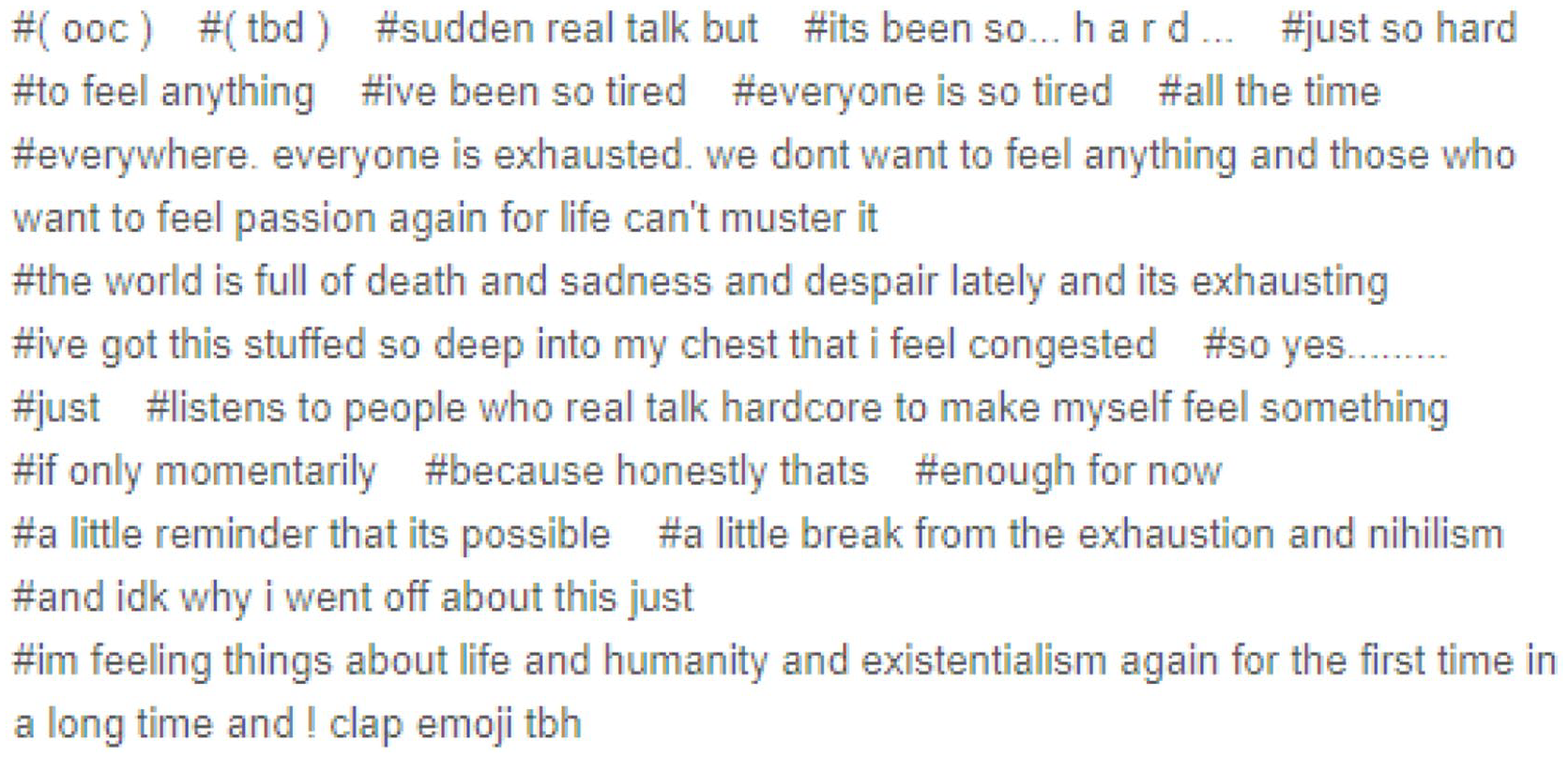
An example of negative emotions contained in the tags.
In the interview, participants gave insights into the circumstances under which they would select this mode rather than another. Basil and Catherine explained the significance of self-presentation. They felt that other users expected them to “have [their] shit together,” meaning to appear positive and composed. In this context, hashtags were a place to express incompatible elements of their lives: some people think that if you’re healthy and everything is supposedly great, that you’re not allowed to be negative, so they go into this space that no one looks in [(the hashtags)] and . . . leave their negativity there. (Catherine, Tumblr user for around 4 years) [I] present myself a lot more “together” in the main body and use the tags for the “hahahaha i do not have my shit together” kind of rambling. (Basil, Tumblr user for 7 years)
Writing is a form of catharsis. This is a mode of expression where users saw benefit in expressing a full spectrum of experience and emotion. For many users, they also wanted this writing to be, at least partially, private.
[They’re a] way for people to rant/express their thoughts but keep them solely on their blog. So they still get the cathartic feel after writing, and still share their feelings/words but people can’t easily share it further. (Anne, Tumblr user for 8 years) If it was something that I really needed to get off my chest . . . I would be more comfortable putting that in the tags where it’s less likely for people to see it. (Edward, Tumblr user for 14 months) often if you want to put something really . . . difficult onto tumblr, like you’re not feeling great or something upsets you—you use the tags so it can’t be reblogged and shared. (Daisy, Tumblr user for 8 years)
These users look to the hashtag affordances of Tumblr to be able to express aspects of themselves and their emotions that they feel are intimate.
Writing in Lower Volume
Users articulated the content in the hashtags as feeling like it is at a lower “volume” than content expressed in traditional post content. This lower volume helped the tags to feel more intimate, and like a space where they were confident to express content they would generally not want to be readily “heard.” Users used phrases like “thinking” or “whispering” instead of “talking” or “yelling.” To express the intimacy and privacy of tagging, users traded analogies of visibility for audibility.
It feels more real if its [sic] in a post, and less real if you’re in the tags. To compare to spoken word, it feels like the difference between yelling and whispering. [. . .] tags feel more intimate [and that] may be because tags are harder to see unless you’re actively looking at them. (Helga, Tumblr user for 5 years) The only way I can describe it is imagine you’re in a big pub . . . tags are you talking to the people at your table, [while traditional] posts are you taking a mega phone and blasting it across the whole pub. (Daisy, Tumblr user for 8 years) tags feel more like a thought, while the main body of the post feels like you’re speaking out loud. (Fiona, Tumblr user for around 4 years) the main body has a . . . louder presence than the tags, so it’s more public, more permanent, and that’s a different environment. (Basil, Tumblr user for 7 years)
Another participant spoke about “making [themself] heard” when using the body of the post, but not when writing in the hashtags. These analogies of volume in the tags were supported by this comment from Georgia (Tumblr user for 10 years), who offered up this analogy, reminiscent of frontstage/backstage identity (Goffman, 1959), without prompting: It’s like the difference between talking on the sales floor at work to another associate versus an idle chat in the breakroom. The tags/breakroom feel less monitored, less exposed to the public, and more safe to express ideas that otherwise don’t quite fit with the blog/work area.
Who users might imagine “hearing” their comments helped to guide their decisions about where to position different types of content when posting to Tumblr. When their perceived audience was smaller (or where they felt their words were “less exposed to the public”), they said they felt more confident to share more intimate thoughts, ideas, and opinions.
A thematic link to volume was also evident in fieldnote data, including one (Figure 12) that has gained upward of 247,000 notes on the website at the time of writing. Figures 13 and 14 serve as samples of Tumblr posts, which make direct mention of the “whispering” of hashtags. It is unclear whether the user in Figure 14 was purposefully referencing the (popular) post in Figure 12. Nonetheless, these and other data demonstrate a cognizant categorization of hashtags as a space of perceived privacy, as well as a space of “lower volume.”

A popular Tumblr post about the hashtags as a “secret whisper space.”

A post that makes reference to the “whispering” of the hashtags.

A user speaks to their friend in the tags, lamenting the loss of their “secret whisper section.”
While being interviewed, users sometimes included throw-away lines to acknowledge this faux privacy. For instance, while Catherine (Tumblr user for 4 years) was talking about why she chooses to use hashtags, she said, usually [I’d say the content of the tags] stays sorta just there where only a few see, despite the fact that in reality anyone could see it.
Another participant, Georgia (10 years), explained, It’s [using the tags is] . . . usually just to actually make a post about a thought, but without [it] being something most people are going to actually bother reading.
Georgia and Catherine agreed that using hashtags was not a way to “hide” content, but said activating that space instead of traditional post bodies for their content was a way to upload content where people did not “see” or “bother reading” it.
Users’ use of comment tags is about the practice of concealment, activating their perceived “lower volume” medium not to reduce accessibility—hashtags are still, hypothetically, visible to anybody—but to signal the level of intimacy they expect for content shared and consumed in that medium. To take Daisy’s analogy above, yelling across a pub about one’s emotional journey over the past several years could be considered annoying, but expressing it to a small table is perfectly acceptable. It is not expected that a stranger will be eavesdropping.
Discussion
Users make tactical decisions about how they will perform their identity on Tumblr. The fandom users observed as part of this research make use of the hashtags to do so. Users are interested in maintaining a desired selfhood (Lupton, 2015) on their blogs, but not at the expense of being able to upload content that does not “fit.” In collaborative writing circles, blogs describe themselves as being about writing a certain character(s), so their content should largely relate to writing and to that character. Hashtags are a place where users are able to express content outside of these boundaries, including dissenting opinions or emotions that they might find “difficult.”
Previously, scholars have observed users concealing “unclean” content from public view on other platforms (Hogan, 2010; Zhao et al., 2013). Our study found that users “dump” content that does not fit their online identity in the hashtags. This is an important distinction because they are not deleting an “offending” post, or refraining from uploading it. In effect, they sweep the “mess” under the post. This takes place at two levels. First, content that sits outside of the blog’s selected theme is seen as “clutter.” Users understand Tumblr hashtags as a space where they can write outside of the theme of their blog because it does not markedly change the nature of the content that will appear on the dashboards of their social circles. Second, users described tags as a place where they are able to express things at a lower “volume,” cognizant that they will not be read by all users. The tags are more private spaces, safe for intimate expression.
We can appreciate these freedoms of expression through the aural metaphor of whispering. When considered in the context of front- and backstage identity, the idea of “volume” seems at first to fit well, with the “whispering” of the hashtags a form of backstage identity, while users present their best, most performed self in traditional posts (frontstage). Throughout the interviews, however, participants demonstrated an awareness of the actual, public availability of their tags. This reflexivity suggests that users are not simply selecting whether to perform front- or backstage (Goffman, 1959), because there are not sheer lines between those two “locations” on Tumblr, and Tumblr users are aware of it. Instead, users are choosing a “volume” at which to speak by way of choosing whether to write in the hashtags, or the post.
Writing at a lower volume signals to their audience that they are intending for their content to be treated as “intimate,” or that they have license to deviate from their frontstage self/blog’s theme, without actually restricting who is able to “hear” them: that is, users are stage whispering. When on stage, an actor who wants to whisper will whisper loudly enough for all the audience to hear, but because it is a stage whisper everybody understands that it is pseudo-private, and that they ought to treat it as such. Whispers in tags differ slightly from those in a theater that are diegetic in nature. Online environments are more diffuse, more fractured, and so the idea of a user speaking to a group, all of whom are paying attention, does not hold up in this space. While the metaphor is more complex, more fractured than in its original usage, it gives us a means to conceptualize how users activate tags in a way that signals to the imagined audience that what is said in the tagging space is a designated exception to the rules, and that often it is more intimate in nature.
Conclusion
Hashtags on Tumblr provide a space for users to strategically express thoughts, opinions, and emotions with greater intimacy, even when writing in a space on the platform that they know to be public. The very act of selecting the tagging architecture is a mode of strategic identity performance, where users do not necessarily remove the “ugly,” “messy” bits of their identity as is suggested in many online identity studies (Hogan, 2010; Zhao et al., 2013). Users reveal unclean or cluttering parts of their “self” in acceptable places, at acceptable volumes, stowing inner thoughts, in particular, in the tags. This use of hashtags to create a “quiet,” off-brand space is almost the antithesis of the dominant way scholars have considered tagging previously, that is, as a tool to enhance the “spreadability” of content online (Eda et al., 2009; Spiteri, 2007).
The findings presented here are just some of the ways that users might understand hashtags as a space for identity expression, as described by collaborative writers on Tumblr. As Tumblr is home to a variety of social groups each with their own norms of expression, the use of comment tags in other communities also warrants attention. Future research could also investigate use of non-traditional spaces of content creation for further practices of identity expression, such as the use of HTML title-text on hyperlinks (which appears only on hover), the use of transparent text (which must be highlighted to be seen), or sub- or sup-text in online forums. Examining these areas could help to advance understanding of how humans negotiate, and interact, with digital technologies in a contemporary space, where it is necessary at once to be digitally responsible for one’s constructed selfhood, and to form authentic relationships through the use of digital technologies.
Footnotes
Acknowledgements
Thank you to the Tumblr users who participated in this study for sharing their experiences and practices. Thanks also to Glen Fuller for his guidance on earlier stages of the work, and to the two anonymous reviewers for their thoughtful comments on drafts of this manuscript.
Declaration of Conflicting Interests
The author(s) declared no potential conflicts of interest with respect to the research, authorship, and/or publication of this article.
Funding
The author(s) received no financial support for the research, authorship, and/or publication of this article.
