




Abstract
In this work, we challenge the assumption that weak ties play uniquely important social support roles on social network sites, particularly regarding informational support. To overcome methodological limitations of earlier research, we present a mixed-methods study. Forty-one participants were interviewed and asked to identify five weak, medium, and strong ties each and to report on perceived and actually received social support (emotional, informational, instrumental, and appraisal) associated with each. Complicating traditional understandings of “the strength of weak ties,” the qualitative analyses of actual support events show that both emotional and informational support is provided by strong ties. In an additional quantitative between-subjects study design, 352 participants were asked about various aspects of a weak, medium, or strong tie. These results indicate that participants valued their strong ties more regarding every form of support. Although there were only weak correlations between perceived and recalled actually received support, people also report actual support events with strong ties to be more helpful—overall suggesting the strength of strong ties.
Social network sites (SNS) enable users to build and maintain social relationships by providing opportunities for interaction (e.g., status messages, comments, likes, or private messages; see Ellison & Vitak, 2015). As there are lower costs for maintaining relationships (Tong & Walther, 2011), SNS-enabled networks can be escalated to so-called “social supernets” (Donath, 2007) which would be difficult to support without technological assistance. This goes along with a change and re-configuration of one’s social network as these novel opportunities first and foremost increase the number of weak ties (acquaintances, colleagues, and distant friends) that one can stay in contact with (Donath & boyd, 2004; Manago et al., 2012). These larger networks are associated with increases in social capital and greater access to emotional and informational support. Indeed, several studies demonstrated that the usage of SNS is positively connected to individual social capital (for a review, see Antheunis et al., 2015).
What is currently still debated, though, is what kind of support is provided by different kinds of ties in the context of SNSs. The traditional assumption in offline contexts is that strong ties like family and close friends provide emotional support (associated with bonding social capital; Putnam, 2000) whereas weak ties are sources of informational support (associated with bridging social capital; Putnam, 2000). This understanding, however, may not be the case for the networks and interactions supported by SNSs such as Twitter, Facebook, and Instagram. As Utz and Muscanell (2015) claim, “these assumptions might no longer hold true on social media where different contexts and audiences collapse, individuals tend to have larger and more heterogeneous networks, and they can communicate in varied and newer ways than previously” (p. 420). In line with this, the specific opportunities and affordances of SNSs (Ellison & Vitak, 2015) might shape the way people build and maintain social capital—leading to different dynamics and thus outcomes. Based on this assumption and the specific potential of SNS to facilitate contact with acquaintances and activate latent ties (Ellison et al., 2007, 2011; Haythornthwaite, 2005; Manago et al., 2012), Granovetter’s (1973) notion of the strength of weak ties—in the sense that they can be especially useful in providing information which the inner circle of friends does not possess (e.g., regarding jobs or restaurants)—has been understood to be all the more true for SNS-mediated relationships (Ellison, Vitak, et al., 2014).
In empirical research, results on the benefits of weak ties are mixed: While some studies in SNS environments support the classic assumptions by Granovetter (1973) and Putnam (2000), more recent work implies that it is first and foremost strong ties which are perceived to provide all forms of support, including informational support (Blight et al., 2015; Carr et al., 2016; Gee et al., 2017; Krämer et al., 2014). We suspect that these heterogeneous results are due in part to methodological differences and shortcomings. Methodological weaknesses of work in this vein focused on SNS use include, for example, the fact that tie strength is measured merely as a dichotomous variable and that the studies usually do not consider both perceived and actually received social support (for an exception, see Stefanone et al., 2012). This, however, is important as it has been shown that perceived social support is only loosely correlated with actual reception of social support (Haber et al., 2007; Lakey & Cassady, 1990; Lakey & Heller, 1988). Therefore, results of prior studies cited above (Carr et al., 2016; Krämer et al., 2014) might underestimate the amount of support actually offered by weak ties as they only measure to what degree this support is subjectively perceived as support.
The article strives to amend social capital related theorizing by combining Granovetter’s assumptions with social psychological approaches to social support (House, 1981). The aim of the current empirical research is, therefore, to contribute to the question of how tie strength is related to different forms of social support on Facebook, utilizing an improved methodology which avoids some of the shortcomings of earlier studies. To this aim, we conduct two studies: (a) a mixed-methods study in which participants answer a survey and are interviewed in depth regarding a selection of ties and the perceived and actual social support they lend and (b) an online survey with a larger sample to consider additional influencing variables and moderators in a quantitative between-subjects approach.
Social Capital and the “strength of weak Ties”
The term social capital was coined as an analogy to economic and cultural capital by Hanifan (1916), but popularized by Bourdieu (1986). It can be defined as resources that are available in social networks, such as emotional support or information. Social capital is associated with positive outcomes, as people high in social capital have been found to have higher education levels, more access to jobs, and better health (De Silva et al., 2005; Granovetter, 1974; Granovetter, 1973; Lin, 1982; Putnam, 1993; Stanton-Salazar & Dornbusch, 1995).
Tie strength has traditionally been closely connected to the discussion of social capital since social capital is associated not only with quantity of relationships, but also with quality. Putnam (2000), for instance, distinguishes between bonding social capital and bridging social capital. Bridging social capital is characterized by weak ties which are more likely to represent different network clusters and thus serve as “bridges” across different groups or as brokers, spanning structural holes (Burt, 1995). However, in Putnam’s framing, as these weak tie relationships lack depth, the bridging social capital they represent is not associated with emotional support—unlike bonding social capital provided by strong ties (Putnam, 2000).
Granovetter (1973) defines the strength of a relationship as “a (probably linear) combination of the amount of time, the emotional intensity, the intimacy (mutual confiding), and the reciprocal services which characterize the tie” (p. 1361). He differentiates between “strong ties” (close relationships such as family, partners, and close friends) and “weak ties” (relationships with acquaintances, colleagues, and former class mates). Strong ties are associated with bonding social capital, especially because strong ties are more likely to provide social support (Laireiter & Baumann, 1992) and can provide more different forms of support (Cohen & Wills, 1985; Wellman & Wortley, 1990). However, Granovetter (1973) distinguishes between strong and weak ties, arguing that with regard to the provision of novel, nonredundant information, weak ties might be more powerful than strong ties. As weak ties possess information that the person’s inner circle might not have (due to homophily and other factors), they are more beneficial as information providers. These assumptions were supported by Granovetter’s (1973), Granovetter’s (1974) own empirical evidence as well as by more recent studies (Yakubovich, 2005).
Social Support
Social support has been defined as “perceived or actual instrumental and/or expressive provision supplied by the community, social networks, and confiding partners” (Lin, 1986, p. 18). Social support is related to better health, subjective well-being, and mortality (e.g., Berkman, 1985; House et al., 1988; Schwarzer & Leppin, 1991; Wang et al., 2003). As Trepte and Scharkow (2017) argue, social support is a central dimension of social capital: “If social capital can be considered as a resource mobilized by individuals in order to obtain certain benefits, then one of the central benefits of individual social capital is social support” (Trepte & Scharkow, 2017, p. 307).
Social support needs to be conceptualized as a multidimensional construct. There are numerous systems for categorizing social support (see, e.g., Tardy, 1985; Weiss, 1974), with one of the most prominent suggested by House (1981). House conceptualizes social support as “an interpersonal transaction involving one or more of the following: (1) emotional concern (liking, love, empathy), (2) instrumental aid (goods and services), (3) information (about the environment), or (4) appraisal (information relevant to self-evaluation).” All have different causes and consequences, and therefore, this study will address all of them, with a special focus on emotional and informational support—as these correspond most directly with the conceptualization of weak/bridging and strong/bonding ties as providing informational versus emotional support, respectively.
Usually, social support is conceptualized and measured as subjective belief instead of objective events (Cobb, 1976). Kaplan et al. (1977) add that social support is only perceived as such if it meets a person’s social needs (in the sense of a “person–environment-fit”; Schwarzer & Leppin, 1991). However, numerous studies have demonstrated that perceived (subjective) and actually received (objective) support can differ (Lakey & Cassady, 1990; Lakey & Heller, 1988). Lakey and Cassady (1990) conclude that only a small part of perceived social support can be explained as stemming from actual supportive behaviors of others. We assume that this might be due to several mechanisms: First, the self-reported perception of support is not necessarily reflective of the support that was actually received—for example, because people might forget support events or might not perceive support as supportive. Second, expectations might play a role such that people might receive more or less support than they expect, altering their assessment of a specific support event (Leppin, 1994). Empirical research indeed yielded low to moderate relationships between perceived and received support (Barrera, 1986; Haber et al., 2007; Sandler & Barrera, 1984). It is, therefore, important to measure both perceived and received social support. As the collection of objective data is, however, difficult to accomplish, it is not uncommon to measure both actual and received social support via self-report (Norris & Kaniasty, 1996).
Social Capital and Social Support on SNSs
There is a clear empirical relationship between SNS/Facebook use and perceptions of social capital. More recent work in this space has focused on specific uses and practices (as opposed to general measures of use) and has developed more nuanced understandings of SNS use as it relates to specific dimensions of social capital and social support. Large-scale studies (Hampton et al., 2011) confirm that people who use Facebook perceive more social support than those who do not use Facebook. This is true for emotional support and companionship but not instrumental support. Similarly, Manago et al. (2012) observe that number of friends on Facebook is positively correlated with perceived social support. Other studies, however, did not show a relation between Facebook usage intensity and perceived (bonding) social capital (Vitak et al., 2011). Kim and Lee (2011) detect a curvilinear relation indicating that either too low or too high number of friends is detrimental for the perception of social support. More recent work highlights the importance of considering specific practices on the site; for instance, Vitak (2012, 2014) showed that both direct communication (interaction via private messages, likes, comments) and passive consumption of information (browsing profile and photos of a Facebook friend) are related to increased perception of emotional, informational, and instrumental social support. Similarly, Ellison, Gray, et al. (2014) demonstrated that intentional attempts to access social capital by asking for help is an important social capital factor, as Facebook users who had posted a request in the previous 28 days reported significantly more bridging and bonding social capital than those who had not. Finally, the motivation driving use is key: Aubrey and Rill (2013) indicate that using the network for companionship/contact is positively related to bridging and bonding social capital, whereas using the network to impress others has no relationship to perceived social capital.
Bridging Social Capital and SNS Use
Ellison et al. (2007) were the first to examine perceptions of bridging and bonding social capital (and additionally maintained social capital) and SNS use. Results demonstrated a relationship between intensity of Facebook usage and the perception of social capital—especially strong for bridging social capital. In addition, it was demonstrated that SNS use can have positive outcomes for psychological well-being, especially for people with low self-esteem. Steinfield et al. (2008) confirm with longitudinal data that the intensity of Facebook usage is likely to be implicated in perceptions of bridging social capital.
Further studies also present support for the hypothesis that Facebook usage specifically strengthens the perception of bridging social capital. Burke et al. (2011) demonstrate that the perception of bridging social capital only increases when there is direct communication. None of the activities were able to predict the extent of perceived bonding social capital. Guo et al. (2014) show that there is a relation between SNS usage and perceived bridging social capital only when the network was used for social interaction but not when it was used for entertainment. High and Buehler (2019) show that preference for weak tie support plays a role in perceptions of social capital and informational, emotional, and esteem support, noting that preferences for weak tie support shape users’ impressions of the benefits they might receive from their networks as well as, potentially, how they construct their SNS networks. Similarly, Wright and Rains (2013) demonstrate that in computer-mediated support groups, especially in case of health-related stigma there was a preference for weak tie instead of strong tie support networks.
Altogether, the majority of studies therefore seems to suggest that SNSs are particularly suited to strengthen perceptions of bridging capital.
Evidence for the Strength of Weak Ties
Due to the way they were conducted, the studies summarized above do not necessarily speak to the question of whether weak or strong ties are more important for increasing perceived social capital and social support. Other work has, however, addressed the strength of weak ties more explicitly. In a qualitative study, Vitak and Ellison (2013) found that indeed weak ties are perceived to provide support. In a quantitative approach, Ellison, Gray, et al. (2014) showed that although only the number of Facebook Friends who were considered to be “actual friends” (and not the total number of Facebook Friends) predicts bonding and bridging social capital, this does not necessarily suggest that weak ties are not influential, as on average 75 of 300 friends were characterized as “actual” friends by the participants (therefore most probably also including weak ties). Consistent with Granovetter’s thesis, Bakshy et al. (2012) confirmed in a field study that weak ties provide information people would otherwise not have received, while exposure through strong ties was redundant with information already known. Gray et al. (2013) also relied on field data and asked participants to evaluate comments they received after requesting help on Facebook. Answers by weak ties were evaluated as more helpful than postings by strong ties, although there was no relationship between participants’ perception of how satisfied they were with the response and their reported closeness to the comment-provider. The most compelling evidence that weak ties can be particularly supportive in the Facebook context is presented by Rozzell et al. (2014). In their analysis of SNS interactions, they found that weak ties in total provide more supporting comments than strong ties and that these do not differ in perceived quality. The analyses, however, do not distinguish between different forms of social support.
In total, therefore, numerous studies support Granovetter’s notion of the strength of weak ties and Ellison et al.’s (2007) assumption that SNSs are especially beneficial in terms of maintaining contact with weak ties who provide relevant support. What the literature does not clearly explicate, however, is the differentiation of the support forms.
Evidence for the Benefit of Strong Ties
Regarding the quantity of support from different ties, Blight et al. (2015) demonstrate that the majority of answers to a support-seeking status update came from strong ties and only 32% from weak ties. Other studies focused on the perception of support from others and imply that people might value strong ties more than weak ties: Panovich et al. (2012) had their participants post a request and evaluate the quality of the comments they received. Comments by strong ties were perceived as more useful and as providing more novel information, potentially because strong ties were able to tailor the answer to the participants’ prior knowledge and needs. Vitak (2012, 2014) demonstrated a significant positive relationship between perceived tie strength and perceived social support. In the context of finding a job, Burke and Kraut (2013) showed direct communication with strong ties (measured objectively via Facebook interaction data) reduced stress and increased perceived support (except for directly after the event of job loss). Also, communication with strong (as opposed to weak) ties is associated with finding a new job more quickly. This suggests that strong ties are more effective regarding both bridging and bonding support. Based on critique that tie strength should rather be seen as a continuum instead of as a dichotomy, Krämer et al. (2014) had participants select weak, medium, and strong ties from their network and evaluate how much emotional and informative support they receive from them. Inconsistent with the assumption of strong ties providing merely emotional and weak ties providing first and foremost informational support, results showed that weak ties were reported as providing neither form of support, whereas strong ties are evaluated to provide both emotional and informational support (see also Carr et al., 2016). The data do not, however, identify the reasons: It is still unclear whether this is merely a subjective evaluation that is driven by the wish for consistency (strong ties that are liked are seen as particularly helpful, whereas useful support from weak ties is forgotten), whether people actually receive less support from weak ties (either due to the fact that they actually provide less support or due to algorithms that filter out or hide content from weak ties), or whether support from weak ties is objectively less helpful as it is not as well tailored to people’s needs. It may also be the case that responses from strong ties are given the “benefit of the doubt,” regardless of the actual content of the response. In sum, the literature includes compelling data that suggest that strong ties are valued as more helpful in providing support, both emotional (which is in line with previous theoretical reasoning) and informational (which contradicts the notion of the strength of weak ties regarding bridging social capital).
Methodological Shortcomings of Earlier Research
In general, earlier research showed a positive relationship between the usage of SNSs and perceived social capital (Burke et al., 2011; Ellison et al., 2007; Johnston et al., 2013; Lee et al., 2014; Liu et al., 2013; Steinfield et al., 2008). However, prior results do not yet allow us to definitively ascertain which kinds of support are best provided by strong and weak ties. While this has been scrutinized in offline environments (Wellman, 1992; Wellman & Wortley, 1990), studies on SNS typically have not differentiated between different ties and different support forms. To begin with, some studies look at social support on a global level and do not distinguish between different forms of emotional, informational, appraisal, and instrumental support (Sutcliffe et al., 2018; Weng et al., 2018). While some studies show the power of weak ties, others stress that, in comparison, strong ties are more influential—with regard to both emotional and informational support. In the following section, studies stressing that it is first and foremost strong ties that provide social support are critically analyzed. These studies have several weaknesses which might have led to the misleading impression that strong ties are more important than weak ties and thus require further investigation. Methodological issues include the following:
- Most studies merely look at the dichotomous categories of weak and strong ties, but do not treat tie strength as a continuum (which would enable both more sophisticated analyses and a more nuanced theoretical understanding).
- Many studies do not differentiate between forms of social support in the sense that informational, emotional, appraisal, and instrumental support are considered systematically. Some studies only look at ties in the aggregate and more generally ask about the bridging/bonding potential of groups of people.
- Some studies do not sufficiently distinguish between weak ties and “familiar strangers” (Milgram, 1972) who can also be part of the Friends list but can barely be remembered.
- Several studies measured social support or bridging/bonding capital not specifically for Facebook, but in general—which means that the relation of tie strength and social support in the strict sense is analyzed independent of the SNS context.
In addition to the above, studies in the area of social media typically do not systematically distinguish between actual and perceived social support. There are certainly many studies measuring either of these forms, but only seldomly they are considered together. This is especially important as the predominantly used approach is to let people provide self-reports regarding the level of support they perceived, typically asking participants to either evaluate specific events or remember past support in the aggregate. Both forms, however, are prone to biases as users might be inclined to evaluate their strong ties as more helpful even if objectively they are not. Research has indeed shown that perceived social support is only loosely correlated with actual reception of social support (Haber et al., 2007), with perceptions of social support being more important than actual support provisions with regard to outcomes such as mental health (McDowell & Serovich, 2007). This might be due to the fact that when estimating social support, people do not necessarily reflect on the received support but rather consider whether they feel accepted by this person (Brock et al., 1998; Sarason et al., 1991).
The goal of this study is to present an in-depth analysis of perceived and actually received social support, building upon existing work and using a method that addresses some of the previous methodological shortcomings. One aim of this analysis is to reconsider the question of how tie strength is related to the perception of the different support forms. In addition, our goal is to operationalize social support in a more detailed way by relying on the distinction suggested by House (1981): In terms of methodology, we consider all four forms of social support (on the level of specific ties instead of in the aggregate), consider tie strength as a continuum, exclude the consideration of familiar strangers as weak ties, and focus on social support on Facebook. We target all kinds of support behaviors, not just those which were granted upon request. We derive our hypotheses based on several studies which come to the conclusion that it is first and foremost strong ties that are perceived as providing different kinds of support (Carr et al., 2016; Krämer et al., 2014).
H1. Tie strength has a positive relationship with perceptions of (a) emotional, (b) informational, (c) instrumental, and (d) appraisal support.
To be able to uncover parts of the mechanisms behind this relationship at least for the most discussed forms of emotional and informational support, Study 1 additionally zooms in on the nature of the received social support. Here, we pose research questions as actually received social support has not been systematically considered in prior research:
RQ1. Does tie strength correlate with the quantity of actually received (a) emotional support and (b) informational support?
RQ2. Does tie strength correlate with the quality of actually received (a) emotional support and (b) informational support?
Only a small number of studies have addressed the relationship between perceived and actually received social support in the context of social media use (Jung et al., 2013; Stefanone et al., 2012). They considered, however, only instrumental social support (Jung et al., 2013; Stefanone et al., 2012). All studies document a lack of correlation, but there are no data yet on the relationship of perceived and actually received support at the level of single, specific ties. We therefore ask:
RQ3. Is there a relationship between perceived emotional support on Facebook and the quantity of recalled actually received emotional support on Facebook?
RQ4. Is there a relationship between perceived informational support on Facebook and the quantity of recalled actually received informational support on Facebook?
In total, the studies partly replicate the procedures of Krämer et al. (2014) and Carr et al. (2016) with an improved methodology: Study 1 analyzes the relationship between perceived and recalled actually received social support by means of a mixed-methods study that combines qualitative and quantitative measures and addresses H1(a)–(d) as well as RQs1–4. Study 2 tests whether there is a linear relationship between tie strength and perceived social support and additionally considers the influence of potentially moderating variables in a larger sample with quantitative measures (addressing H1(a)–(d)). In the following, the methods are presented subsequently, while the results are presented structured alongside the hypotheses (first H1(a)–(d) for data of Study 1, followed by results of Study 2 data, then RQs1–4 based on Study 1 data).
Study 1 Method
The first study was conceptualized as mixed-methods within-subject design that was conducted in the laboratory. To overcome limitations of prior research (Krämer et al., 2014) participants were instructed to choose 15 Facebook contacts (five weak, medium, and strong ties) for which they quantitatively reported perceived support and qualitatively described actual support. This design was meant to better foster participants’ memory for actual events and to overcome the prior limitation that the chosen contacts might not have been representative (e.g., too “weak”). In addition, participants were asked to not choose “familiar strangers.”
Sample and Procedure
Participants were recruited via email and Facebook groups at a large European University. Forty-one students from different study programs (22 females; age 19–33; M = 22.22) took part in the study. Participants reported being Facebook members for approximately 6 years (M = 5.85, SD = 1.72, range = 1–10) and reported an average of 321 friends (M = 321.01, SD = 1,164.29, range = 31–699). Most (63.4%) reported being logged into Facebook all day. Reported active usage was about 1 hr a day (M = 56.78, SD = 45.02, range = 8–180). Participants received either course credit or €15 for their effort. Data were collected in spring 2017.
After they had given informed consent, participants completed an online questionnaire containing socio-demographics and Facebook usage behavior. Guided by the interviewer, they then chose five contacts each for each category (weak, medium, and strong) based on a figure depicting the Inclusion of Other in the Self (IOS) scale (Aron et al., 1992; see Figure 1). The figure clarified that weak ties would only be loosely connected to the self, strong ties would be very close to the self, while medium ties are characterized by a relation that is neither very strong nor weak. In addition, the figure indicates that “familiar strangers” are not object of the investigation. The interviewer then asked questions on the nature of the relationship. These were quantified in an additional set of questionnaires which also included questions about perceived social support (specified below). Then, the interviewer inquired about actual social support. This procedure was followed for each of the 15 contacts with the interviewer in random order. If participants were not able to remember one event of informational support for the 5-weak ties, they were asked whether they remembered any event by any weak tie. This procedure was chosen to ensure that we did not miss support events by weak ties because the specific 5-weak ties did not show support, but others did. This was not mirrored for strong ties as it was not expected (and in fact did not happen) that no events were remembered.

Inclusion of Other in the Self scale.
Quantitative Measures
Socio-demographics
Participants’ age, gender, formal education level, current occupation, and migration background (i.e., whether the participant or his or her parents immigrated to Germany) were assessed.
Facebook Usage Behavior
Participants were asked to report date of account creation, average number of daily visits, daily usage duration in minutes, and current number of Facebook friends.
Strength of Relationship
Based on the IOS scale (Aron et al., 1992; see Figure 1), participants rated their relationship strength (on six levels, excluding the “familiar strangers” category on the left pole of the scale).
Interaction Parameter
For each of the 15 ties, participants reported duration of the relationship and geographic distance. Online and offline interaction frequency as well as appearance on the News Feed were assessed on a 5-step Likert-type scale (ranging from 1 = never to 5 = frequently).
Perceived social support
Based on established measures (Carr et al., 2016; Shakespeare-Finch & Obst, 2011) and our original items, we constructed a scale including 12 items to assess the quality of the four social support forms differentiated by House (1981). All items had to be rated on a 5-point Likert-type scale (1 = I do not agree at all to 5 = I agree completely). Each category (emotional support, informational support, instrumental support, and appraisal support) was measured by three items. Only appraisal feedback showed low internal consistency (Cronbach’s α <.6).
Qualitative Measures
Origin and Nature of the Relationship
After reporting their general communication behavior on Facebook, participants were asked to report the origin of the relationship for each of the 15 contacts as well as changes of tie strength throughout the relationship.
Recalled Actually Received Social Support on Facebook
The interviewer asked participants to remember one informational support event (e.g., reception of new, relevant information, such as job ads or restaurant recommendations) and one emotional support event (e.g., sympathy, consolation) on Facebook for each of the 15 contacts. After describing the event, participants rated how helpful the support was (from 1 = not at all helpful to 10 = very helpful) and how often they had received that form of support from this particular person.
Data Analysis
After transcribing the interviews, they were content analyzed by means of MAXQDA 12. Categories (see Table 6) were built by a procedure that combines deductive and inductive processes. Grounded in theory, initial categories were developed, which were amended and optimized while coding the data.
Study 2 Method
The second study was conceptualized as an online survey that enables the generalization of results as well as the systematic incorporation of potential control and moderating variables. To see whether attributes of the person or relationship-related aspects would override the differential effects of weak and strong ties, we first and foremost assessed information about the participant and their media behavior (gender, age, Facebook usage duration, and number of Facebook contacts) as well as basic data on the relationship (relationship duration, distance, relationship strength) and, most importantly, the interactions of the participant and the tie on Facebook (Facebook communication and News Feed presence).
Compared with Study 1, however, the number of targeted contacts was smaller to allow for more detailed scales and items.
Sample and Procedure
The sample was recruited as a convenience sample via Facebook groups. We targeted large groups on diverse topics in which we posted a study announcement. A total of 573 participants filled in the questionnaire. After excluding people who did not finish the questionnaire (38.57%) and deleting four additional questionnaires due to implausible entries, 352 participants (221 females, age: M = 28.95, SD = 8.70, range = 17–68) remained. Approximately half of the sample were students (n = 169; 48%) and half employees (n = 161; 45.74%). The sample is rather highly educated with n = 162 (46.02%) possessing a college degree and an additional n = 153 (43.47%) having earned a college entry certificate. Participants have on average been registered on Facebook for six and a half years (M = 6.65, SD = 2.09, range = 1–20, n = 351) and report to be on Facebook about an hour a day (M = 54.97, SD = 58.58, range = 0–450). Participants were invited to take part in a raffle for a €50, €30, or €15 cash award/gift card.
The study was conducted as an online survey using the Socsci Survey platform (https://www.soscisurvey.de/) in spring 2017. After the instructions, including informed consent, participants were asked to login to Facebook to be able to confirm responses such as number of friends. The questionnaire started with socio-demographics and Facebook usage behavior. Then, participants were instructed to choose a person they would classify as weak tie (n = 110), as medium tie (n = 122), or as strong tie (n = 120). For this tie, they had to write the name in a text field so that it would be displayed in the corresponding places in the subsequent questionnaire. For this contact, participants answered questions on the nature of interactions and perceived social support.
Measures
Socio-demographics and Facebook Usage
The same items as in Study 1 were utilized to assess socio-demographics and Facebook usage behavior.
Tie Strength
The IOS scale (Aron et al., 1992) was used in its original form to assess closeness by means of choosing one out of seven pictures. In addition, the Unidimensional Relationship Closeness Scale (URCS) by Dibble et al. (2012) was employed, which consists of 12 items (7-point Likert-type scale from 1 = do not agree at all to 7 = completely agree). Internal consistency was α = .983.
Relationship Parameters
People were presented with open-ended responses fields and asked about the duration and origin of the relationship as well as geographical distance between their homes. In addition, participants answered on a 5-point Likert-type scale (1 = does not apply at all to 5 = applies completely) whether they would have a problem with deleting [name] from their friend list.
Interaction Parameters
Based on Krämer et al. (2014), frequency of contact was measured by five items for online contact (e.g., “How often do you interact with [name] via email or WhatsApp?”; α = .780) and two items for offline contact (e.g., “How often do you meet [name] in person?”; α = .834), both on a 5-point-Likert-type scale (1 = never to 5 = very often). In addition, Facebook communication frequency was assessed by four items (e.g., “How often do you interact with [name] via comments?”; α = .817) on a 5-point Likert-type scale (1 = never to 5 = very often; Vitak, 2014). The Facebook Relationship Maintenance Strategy Scale (FRMSS; Vitak, 2012, 2014) was employed with three of its subscales: Supportive Communication (seven items, for example, “When I post that something good happened, [name] will like it,” α = .874), Shared Interests (six items, e.g., “When I see something online, I think [name] would find interesting, I send him/her a message on Facebook,” α = .883), Passive Communication (four items, e.g., “I browse through the profile of [name] to see what he/she does,” α = .885). All items were rated on a 5-point Likert-type scale (from 1 = I do not agree at all to 5 = I agree completely). We added one item on the News Feed: “How often does your News Feed contain contributions (status updates, comments, links) or likes by [name]?” to be rated on a 5-point Likert-type scale from 1 = never to 5 = very often.
Social Support
We used a modified version of the perceived social support scale that was developed for Study 1 to which we added several items. The scale was validated by a confirmatory factor analysis. Emotional support was measured with five items (M = 3.19, SD = 1.21, α = .912), informational support with five items (M = 3.17, SD = 1.05, α = .864), instrumental support with two items (M = 3.28, SD = 1.35, α = .871), and appraisal support with three items (M = 3.11, SD = 1.18, α = .802). All items had to be rated on a 5-point Likert-type scale (1 = I do not agree at all to 5 = I agree completely).
Results
H1: Differences Between Ties Regarding Perceived Social Support
Study 1 Findings
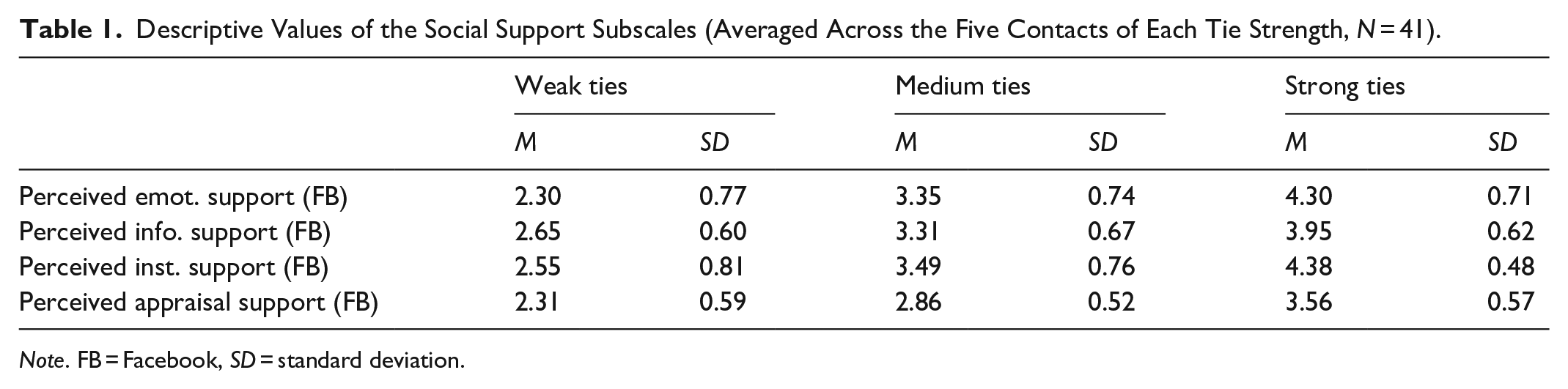
Repeated measurements analyses of variance (ANOVAs) show a significant effect of the different kinds of tie (averaged across the five ties of one kind) for perceived emotional support (H1(a)), F(2, 80) = 131.57, p < .001, partial η² = .767, perceived informational support (H1(b)), F(2, 80) = 94.86, p < .001, partial η² = .703, perceived instrumental support (H1(c)), F(1.74, 80) = 122.34, p < .001, partial η² = .754 (Greenhouse–Geisser corrected) as well as for perceived appraisal support (H1(d)), F(2, 80) = 88.73, p < .001, partial η² = .689 (for aggregated means and standard deviations, see Table 1).
Descriptive Values of the Social Support Subscales (Averaged Across the Five Contacts of Each Tie Strength, N = 41).
Note. FB = Facebook, SD = standard deviation.
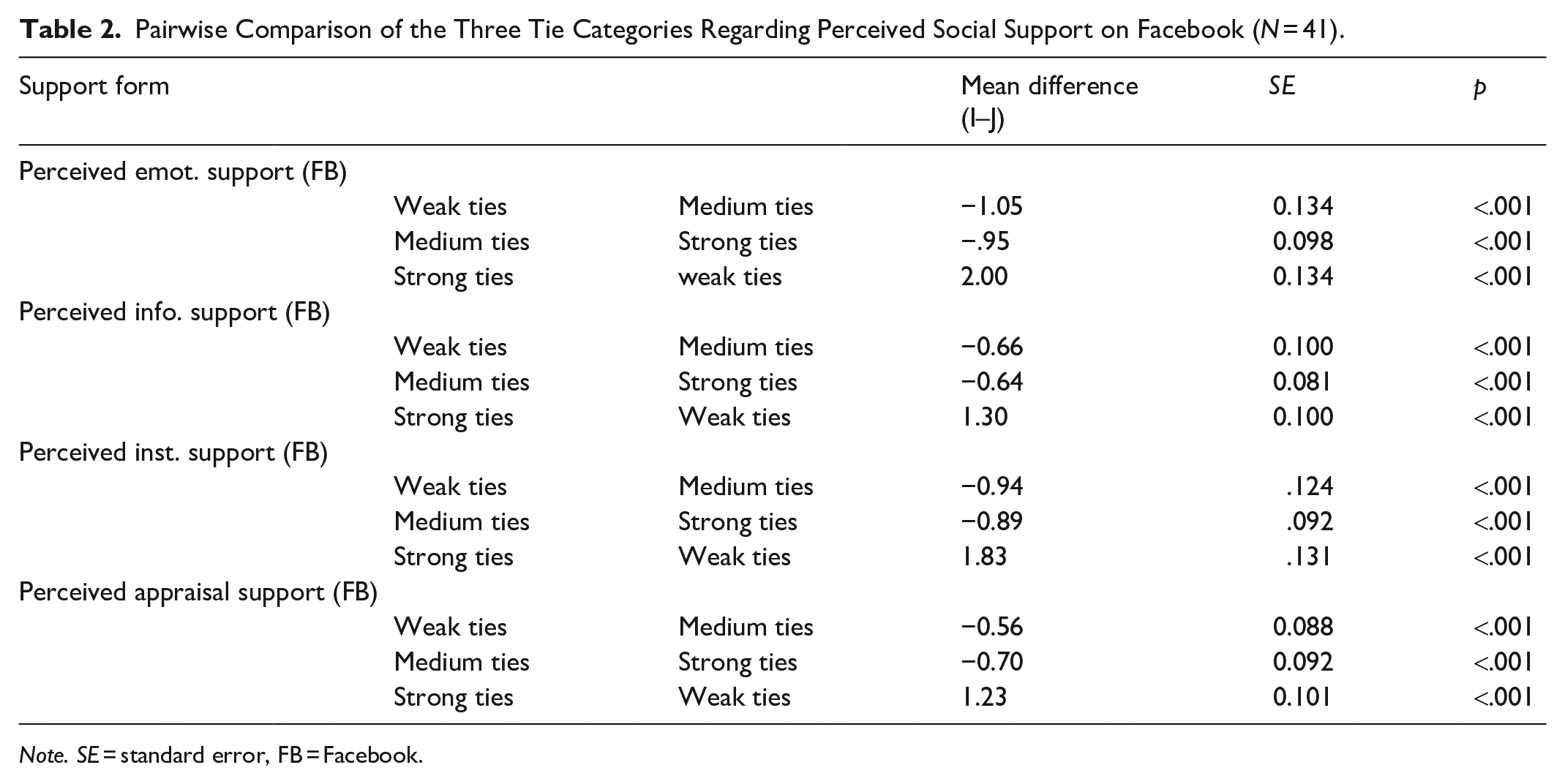
Post hoc analyses show that for all four support forms, all three tie categories (weak ties < medium ties < strong ties) differ from each other in the expected direction (see Table 2). H1(a)–(d) is, therefore, supported by the data of Study 1.
Pairwise Comparison of the Three Tie Categories Regarding Perceived Social Support on Facebook (N = 41).
Note. SE = standard error, FB = Facebook.
Study 2 Findings
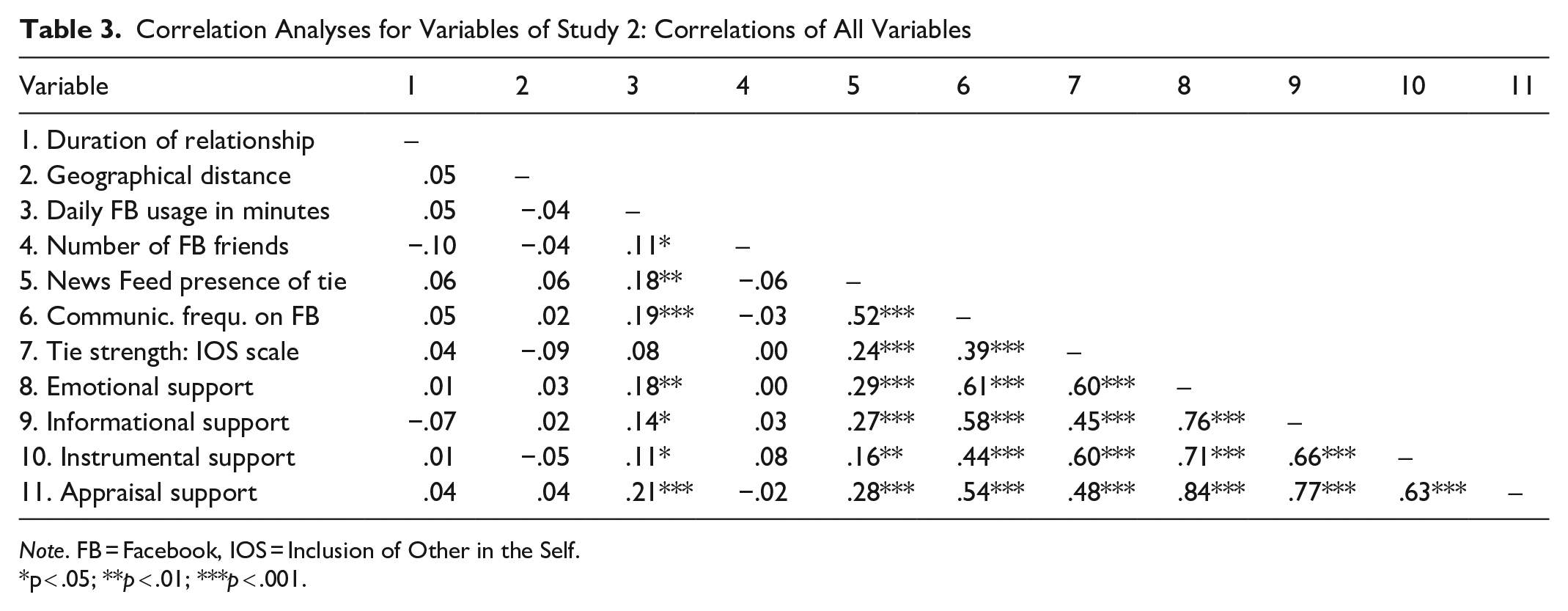
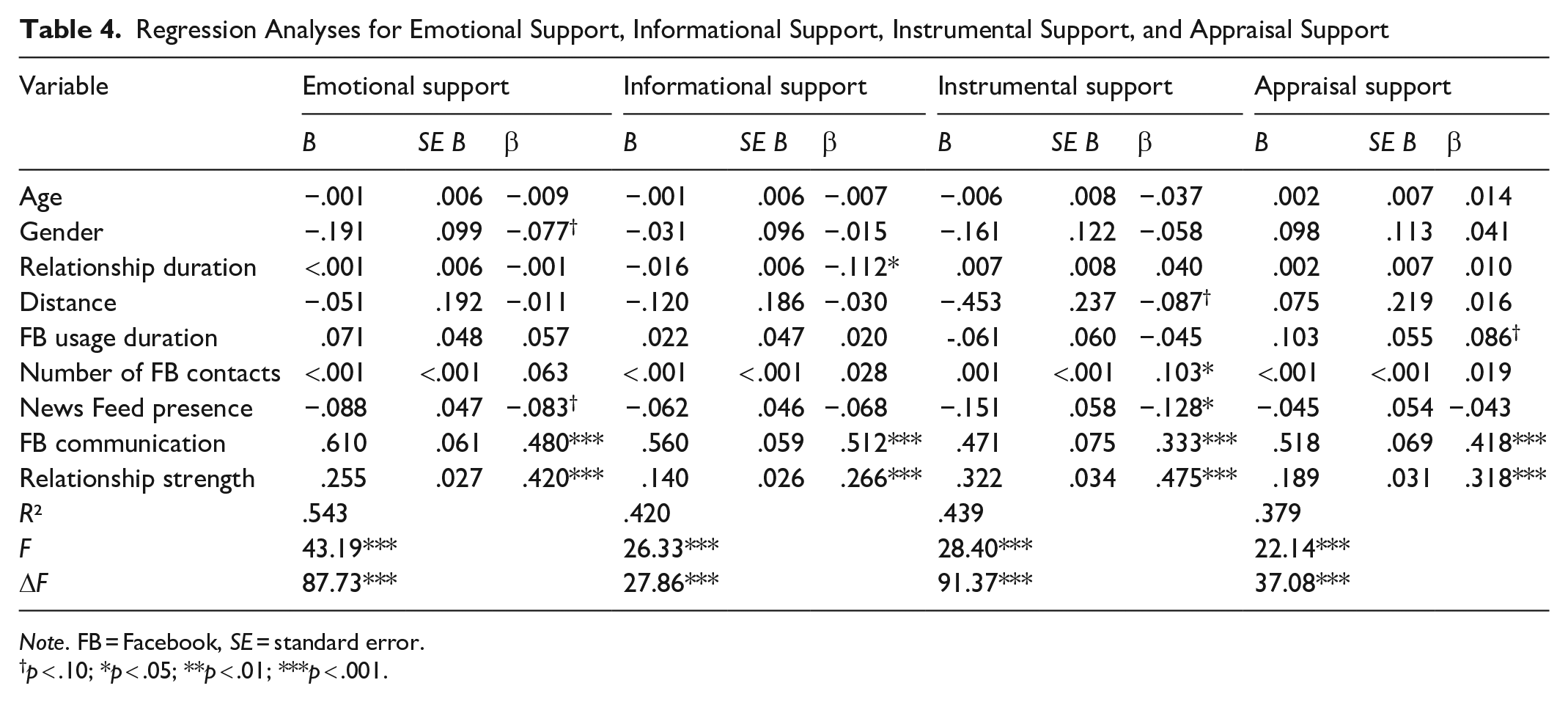
The same hypotheses as tested in Study 1 (H1(a)–(d)) were tested here again with (a) a larger sample, (b) that is not biased by repeated measurements, (c) that operates with optimized assessments by scales that underwent confirmatory factor analysis, and (d) that considers the potential influence of additional variables by controlling for them in the calculations (see a correlation table of all variables in Table 3). To this aim, we calculated four regression analyses, one for every social support form. In each analysis, we first entered the socio-demographic and relationship-specific variables of age, gender, relationship length, and geographical distance. In the second block, we entered general Facebook use variables (daily Facebook usage in minutes and number of Facebook friends). In the next two steps, we entered more specific Facebook interaction assessments (News Feed presence of the tie in Step 3 and communication frequency on Facebook in Step 4). In the fifth and last step, the variable of interest, the closeness of the relationship (as measured by the IOS scale), was entered (see Table 4).
Correlation Analyses for Variables of Study 2: Correlations of All Variables
Note. FB = Facebook, IOS = Inclusion of Other in the Self.
p < .05; **p < .01; ***p < .001.
Regression Analyses for Emotional Support, Informational Support, Instrumental Support, and Appraisal Support
Note. FB = Facebook, SE = standard error.
p < .10; *p < .05; **p < .01; ***p < .001.
Those variables that were skewed (usage time and geographical distance) were transformed before entering. There was no multicollinearity, but 15 participants were identified as outliers (Mahalanobis distance reaching a critical value) and were excluded.
H1(a): Relationship of Tie Strength and Perceived Emotional Support
Supporting H1(a) (stating that strong ties yield more emotional support), in the final model only communication frequency on Facebook (β = .480, p < .001) and tie strength (β = .420, p < .001) are significant predictors for emotional support. The model explains 54.3% of variance and shows a high effect size of f² = 1.19 (Cohen, 1988).
H1(b): Relationship of Tie Strength and Perceived Informational Support
Significant predictors for informational support are communication frequency on Facebook (β = .512, p < .001), duration of relationship (β = −.112, p = .013), and, supporting H1(b), relationship strength (β = .266, p < .001). The model explains 42.0% of variance and has a high effect size of f² = .72.
H1(c): Relationship of Tie Strength and Perceived Instrumental Support
Supporting H1(c), relationship strength is a significant predictor for instrumental support (β = .475, p < .001). In addition, communication frequency of Facebook was positively related to the criterium (β = .333, p < .001), while presence on the News Feed was negatively related (β = −.128, p = .010). Also, the number of Facebook contacts emerges as predictor (β = .103, p = .020). The model has a high effect size of f² = .78 and explains 43.9% of variance.
H1(d): Relationship of Tie Strength and Perceived Appraisal Support
The last model explains 37.9% of variance and has a high effect size of f² = .61 (Cohen, 1988). Significant predictors are relationship strength (β = .318, p < .001; supporting H1(d)) and communication frequency on Facebook (β = .418, p < .001).
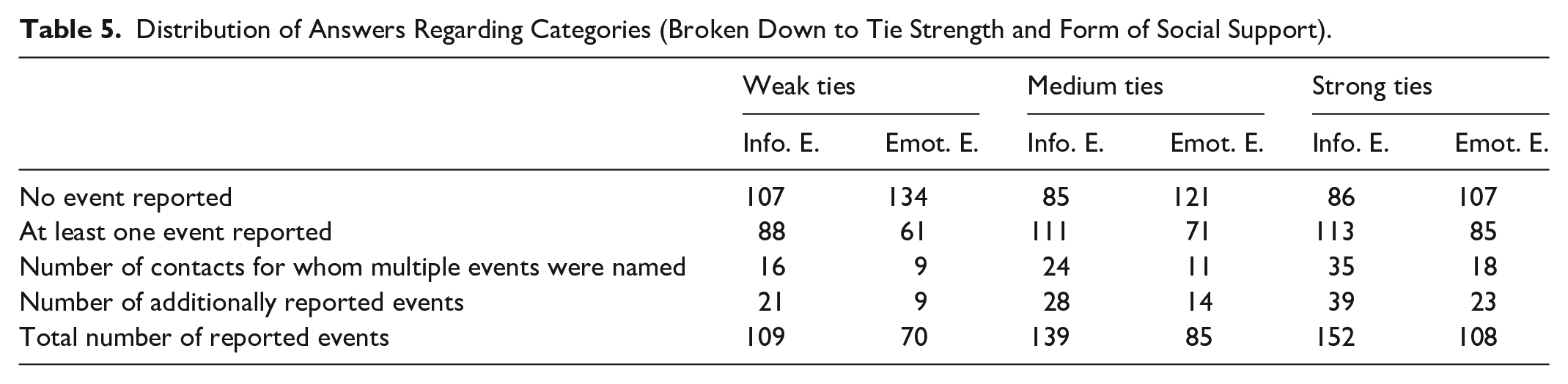
Distribution of Answers Regarding Categories (Broken Down to Tie Strength and Form of Social Support).
Informational Support
For the altogether 615 targeted Facebook contacts, in total 296 informational support events were reported (372 events when considering when more than one event was named per tie).
Emotional Support
Emotional support was recalled less frequently. For 217 of the 615 contacts, an emotional support event was reported (263 if considering more than one event that was reported per person).
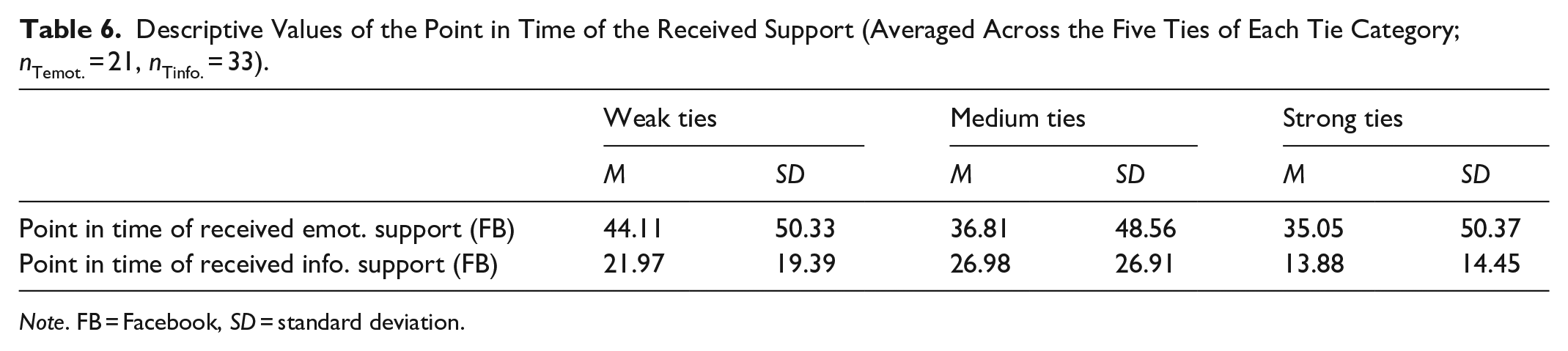
In addition, the emotional support events occurred less recently than the informational support events. Recalled support events were most recent for the strong ties (13.88 weeks for informational support and 35.05 weeks for emotional support, see Table 6). Repeated-measures ANOVAs, however, only show a difference for the ties for informational support (F(2, 64) = 5.49, p = .006, partial η² = .146), not for emotional support (F(2, 40) = .47, p = .631, partial η² = .23). Post hoc analyses show that informational support events were more recent when they occurred with strong ties as opposed to weak ties (p = .064) and medium ties (p = .015).
Descriptive Values of the Point in Time of the Received Support (Averaged Across the Five Ties of Each Tie Category; nTemot. = 21, nTinfo. = 33).
Note. FB = Facebook, SD = standard deviation.
In Tables 7 and 8, the content of the informational and emotional support events is displayed. Here, several things are observable concerning the kind of support reported by participants. Regarding informational support, the most commonly reported kinds of information were in the arenas of university course work as well as leisure activities, such as music and partying—which is not surprising given that the sample largely consists of students. With regard to emotional support it is striking that superficial support seems to be common (e.g., positive reactions to postings), while support in difficult life situations is not recalled as often—probably due to the fact that opportunities are fewer. Here, participants report that in these cases, other channels (e.g., face-to-face, telephone, messenger) are used to interact with medium or strong ties (nmt = 101 resp. nst = 165). For example, one male participant summarizes “not in, not in Facebook. We would rather use the telephone.”
Content Analysis of the Informational Support Events.

Content Analysis of the Emotional Support Events.
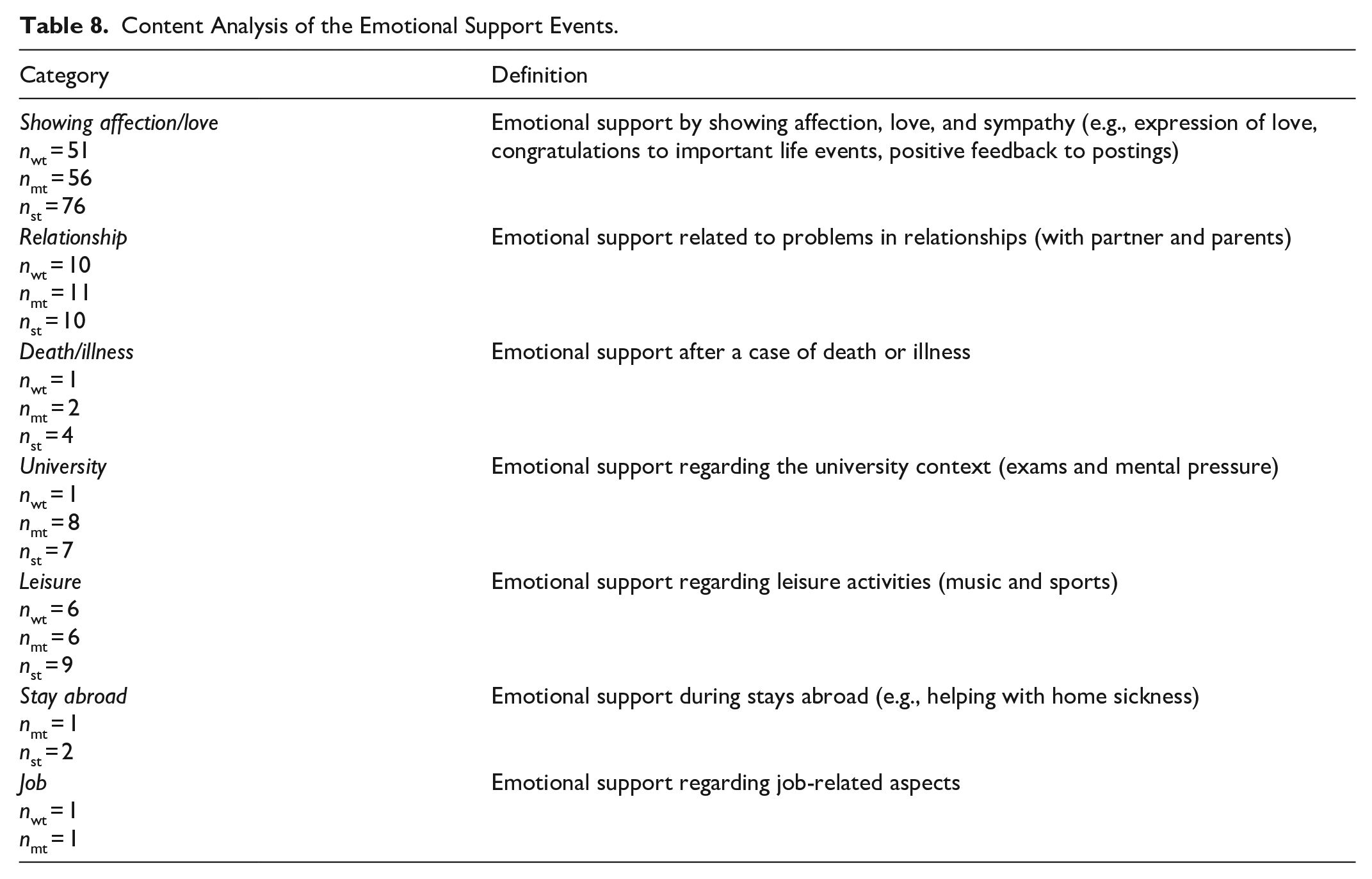
Regarding the weak ties, however, participants report that the rareness of emotional support is due to the fact that the relationship is superficial (n = 109 utterances). One female participant, for example, states, “It is because we don’t know each other actually. It is not someone I would go to or I would expect that from.”
There is also evidence that indeed support from weak ties might not be as accessible as that from strong or medium ties. Several participants reported that due to the algorithms they might not receive messages from weak ties or see filtered feeds such that messages from weak ties are hidden (see assumptions by Krämer et al., 2014).
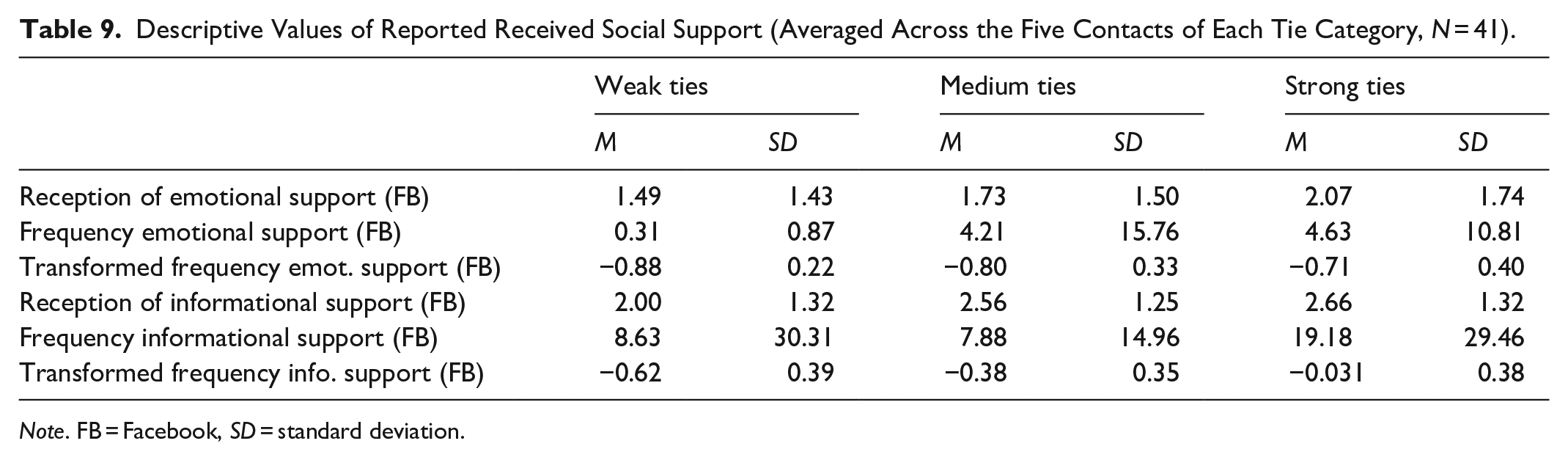
Regarding actual reception, we calculated repeated-measures ANOVAs regarding the number of contacts of each tie category that was recalled to have given emotional and informational support (descriptives can be seen in Table 9; please note that ANOVAs were calculated for transformed values [negative inverse] due to differences in variance).
Descriptive Values of Reported Received Social Support (Averaged Across the Five Contacts of Each Tie Category, N = 41).
Note. FB = Facebook, SD = standard deviation.
For the actual reception of emotional support (RQ1a) the tie categories indeed differed significantly, F(2, 78) = 3.64, p = .031, partial η² = .085. However, post hoc analyses show differences between strong and weak ties were significant only at the .10 level (p = .064). A similar pattern was found for the question how often participants had received emotional support from the particular tie, F(2, 78) = 3.64, p = .031, partial η² = .085. Here, post hoc analyses also merely yielded differences at the .10 level, with participants reporting receiving more frequent emotional support from their strong ties than from their weak ties (p = .058).
Regarding the actual reception of informational support (RQ1b) the tie categories also differed, F(2, 80) = 4.27, p = .017, partial η² = .097. Post hoc analyses show that weak and strong ties differ significantly (p = .026,) while weak and medium ties only differed at the .10 level (p = .064). Participants therefore are more likely to receive informational support from their strong or medium contacts (from three of the five contacts) than from their weak contacts (on average from two of the five contacts). The same pattern, again, is visible for the frequency of informational support, F(2, 80) = 9.75, p < .001, partial η² = .196. Post hoc analyses indicate that weak and strong ties (p < .001) as well as weak and medium ties differ significantly (p = .011) with strong and medium ties more often providing informational support.
Descriptive Values of Quality Ratings of the Received Social Support (Averaged Across the Five Contacts of Each Tie Strength).

Note. FB = Facebook, SD = standard deviation.
For both emotional support (FF2a), F(2, 42) = 22.35, p < .001, partial η² = .516, n = 22, and informational support (FF2b), F(2, 64) = 8.66, p < .001, partial η² = .213, n = 33, our data confirm a significant difference between tie categories regarding the helpfulness of the recalled received support. Post hoc analyses for emotional support indicate that weak and medium ties (p = .013), medium and strong ties (p = .003), as well as weak and strong ties (p < .001) significantly differ in the expected direction. Also for informational support, post hoc analyses demonstrate that strong and weak ties (p = .002) as well as medium and weak ties (p = .015) differ significantly. There is a linear trend to evaluate the helpfulness of support from strong ties as higher than from medium ties and from weak ties.
Discussion
The goal of this study was to contribute to the debate of whether weak ties provide informational support on SNSs and—following Granovetter’s (1973) notion of the strength of weak ties—whether they might even be more helpful than strong ties in this regard. The article therefore challenges a widely held theoretical assumption about the effects of social capital. While prior results concerning the strength of weak ties on SNS were mixed, those studies which found that weak ties are not perceived as particularly supportive (neither with regard to emotional nor informational support; Carr et al., 2016; Krämer et al., 2014; Vitak, 2014) suffered from methodological shortcomings that were addressed by our study design.
Therefore, our research started by replicating the procedures of Carr et al. (2016) and Krämer et al. (2014) by means of (a) an in-depth within-subjects mixed-methods approach and (b) a quantitative online study including additional variables. In the mixed-methods laboratory study participants were asked to name five contacts for each tie category of strong, weak and medium ties. Extra caution was taken that the selected weak ties were not composed of “familiar strangers” (Milgram, 1972) which would not be expected to provide any kind of support. The corresponding H1(a)–(d) was confirmed in both samples: strong ties were perceived to provide more emotional, more informational, more instrumental, and more appraisal support. Weak ties were perceived as providing less support than medium ties, indicating a linear relationship. It is noteworthy that this relationship did not only appear in a larger sample (in which participants, however, only had to evaluate one single tie), but also in the mixed-methods study in which a smaller sample of participants rated five contacts of each category. It has to be acknowledged, though, that in the regression analyses of the larger online study not only tie strength emerged as a predictor for the perception of social support, but that direct communication also was a decisive factor predicting the perception of emotional, informational, and appraisal support with even higher effect sizes than tie strength. This supports earlier results by Vitak (2012, 2014) and is an indication that tie strength by itself might not be influential but that only ties which are strong and/or with whom users interact often are perceived to be lending support (see also Burke & Kraut, 2016). It is, however, noteworthy here that tie strength and communication frequency were not particularly highly correlated. While their correlation (r = .39) was only moderately high, they both showed much higher correlation scores with each of the support scales (ranging from r = .44 to r = .61).
It has to be noted that—in general—emotional support situations seem to occur seldomly. This might be related to the positivity bias on Facebook, due to which people are less likely to disclose negative experiences which would translate into requests for emotional support (Reinecke & Trepte, 2014). This, however, affects both strong and weak ties and does not explain the differences we found. However, in line with what media multiplexity theory would predict (Haythornthwaite, 2005), participants report that in case of need, they use other channels (such as face-to-face, telephone) with medium and strong ties.
In total, the notion of the strength of weak ties for especially informational support as proposed by Granovetter (1973) and assumed to be all the more true on SNS was not supported. This allows for the conclusion that with regard to the perception of social support, weak ties are evaluated as less supportive compared with strong and medium ties. However, Krämer et al. (2014) discuss that this does not necessarily mean that weak ties actually do not provide valuable support. Instead, weak ties might be underestimated in the subjective evaluation, based on different kinds of systematic biases in the perception of social support (e.g., the wish for consistency and the corresponding notion that a person who is close is also more supportive). Therefore, an important goal of the present Study 1 was to compare subjective perceptions of social support of different tie categories to more objective measurements by asking for specific supportive events—thereby rendering self-reported support more reliable (see Table 8). In RQs 3 and 4, both measures were correlated for emotional and informational support (for the three tie categories separately). Consistent with doubts about the validity of perceived support as a proxy for actual support, both measures did not correlate significantly (only on 10% level in some cases). This supports earlier results on instrumental support by Jung et al. (2013) and Stefanone et al. (2012) and extends them to emotional and informational support on SNSs.
Still, although the lack of correlations raises expectations that the pattern of the relation of tie strength and recalled actually received support might look different than the relation of tie strength and perceived social support, this was not the case. When considering the supportive events recalled by the participants for each of the selected ties, it becomes apparent that here, also, strong ties are reported as providing both instrumental and emotional support, while weak ties seem to provide neither. Our qualitative data suggest that participants assume that this results from weak ties potentially not seeing their broadcasted status updates. Also, when—again employing subjective measures—asking for quality in terms of helpfulness, the same linear pattern of strong ties being most helpful and weak ties least helpful appears.
Therefore, in total, our research yields evidence that indeed strong ties are more important regarding social support in online realms than weak ties. This is not only true for the subjective perception of social support but also for more objectively measured actual supportive events—at least as assessed via recall of the participants.
These results do not only have important implications for the theoretical understanding of the mechanisms of tie strength and social support, but may also have consequences for future usage of SNSs: The finding that strong ties are perceived as more supportive might—together with prior results suggesting that a considerable number of weak ties are perceived as easily dispensable (Krämer et al., 2014)—allow for a forecast what will happen to “traditional” SNSs such as Facebook. The current usage of SNS primarily as a platform for interacting with close rather than distant friends might contribute to making Facebook even more marginal in future—especially if users have the impression that other services better cater for the need to interact with a small group of close friends.
Limitations
Although we are able to address some methodological limitations of earlier work, we were not able to address every shortcoming. Probably, the study’s most important limitation is that although we tried to assess actually received social support, we did not measure this by objective means but relied on participant’s memory. We still see the procedure of asking about specific events with specific contacts as an important improvement compared with the more general questions and subjective evaluations in previous studies. Nevertheless, future studies should incorporate behavioral measures, such as social media trace data. Another, related, problem is the fact that it was not possible to formulate measurements of perceived and received social support in a complete parallel way as one is based on earlier, general measures of perceived support while the other focuses on the recall of actual events. Still, we tried to avoid confounds by focusing on quality (instead of amount or frequency) with both measures. Another important limitation is that both studies are only cross-sectional in nature. We cannot, therefore, make any causal claims. This was, however, not the aim of the studies.
The sample size of Study 1 is low as elaborate in-depth interviews were conducted. This is a limitation for the accompanying quantitative analyses of these 41 participants. This is the reason why the second study was conducted with a larger sample size and a quantitative between-subjects design. The convenience sample largely consists of students, so generalizations to other populations should not be made. The answers during the interviews allow for the conclusion that most participants use Facebook rather passively and usually do not ask for support. This is a limitation as active usage behavior can be seen as a prerequisite for the occurrence of support events (Burke et al., 2011) and past work has examined asking for help as an important component of social capital exchanged on Facebook (Ellison et al., 2014).
Also, it needs to be acknowledged that not the whole network of the participants was discussed but only a small part (15 people, five each of each tie category). This is an improvement compared with earlier studies which merely looked at one tie per category (Carr et al., 2016; Krämer et al., 2014), but still could be extended for greater validity. While the most important strong ties might have been comprehensively assessed, weak ties—which amount to a larger quantity of the contacts (Manago et al., 2012)—might not have been represented reliably.
While we aimed at addressing all kinds of social support events, it might be interesting in future studies to more specifically target those forms of support which are granted following an explicit request via SNS. We would also like to acknowledge that we are aware that there are platforms (such as help-seeking forums for minority groups) that are better suited to cater for weak ties. However, we neither wanted to strive for a systematic comparison of different platforms nor do we doubt that weak ties can be valuable at all.
Finally, we would like to highlight that although we implicitly suggest that it is the structure of the SNS which shapes the way people maintain their bonds, we have not critically tested this influence (e.g., by comparing different SNSs with different structures or by comparing with offline networks). Therefore, two aspects warrant attention in future studies: First, affordances need to be addressed more explicitly in their indirect influence on people’s social capital, and, second, algorithms and their direct influence also need to be understood better, in that help-seeking is only successful if the request is visible to others, and under some circumstances, it may be that posts are hidden (unbeknownst to their authors).
Conclusion
By improving several methodological procedures, the two studies have contributed to our theoretical understanding of social capital dynamics on SNSs. By partly replicating earlier studies with improved methods, the validity of those studies (Carr et al., 2016; Krämer et al., 2014) was confirmed. Our results indicate that strong ties are valued as providing all kinds of social support while weak ties are perceived to be less helpful regarding emotional support (as expected) as well as concerning informational support (contradicting Granovetter’s assumptions regarding subjective evaluations of social support). Adding to the state of the art, additional analyses also suggest that besides tie strength also direct communication is decisive for perceived social support.
Concerning the relation of perceived social support and recalled actually received support, the analyses showed that there was no significant relation between both, supporting doubts that merely asking for the perceived social support is prone to biases. Nevertheless, the analyses of actual support events show that both emotional and informational support is rather provided by strong ties. Also, the helpfulness of specific support events is perceived as higher for strong ties. Although this is not a completely new finding, it further confirms the as yet still debated relative weakness of weak ties and strength of strong ties with regard to every dimension of social support.
Footnotes
Declaration of Conflicting Interests
The author(s) declared no potential conflicts of interest with respect to the research, authorship, and/or publication of this article.
Funding
The author(s) received no financial support for the research, authorship, and/or publication of this article.
