




Abstract
This study highlights the challenges of computer-mediated communication for vulnerable individuals and groups, by studying boundary work in stigmatized communities online. Five stigmatized online communities with different affordances were studied: (1) “pro-ana” blogs; (2) an infertility discussion board; (3) a Facebook group for bereaved parents; and (4) two WhatsApp groups for Israeli veterans of war with post-traumatic stress disorder. In-depth interviews with members and administrators (n = 66) revealed that social media affordances such as low anonymity and high visibility may marginalize those living with stigma. While research literature applauds social media for allowing the formation and maintenance of social capital, our study highlights the paradox caused by these very same affordances. To offer safe and functioning environments of support, the communities must guard against impostors whose presence threatens their safe havens. Simultaneously, this may make these groups inaccessible to those who truly need support and remove such groups from the public eye.
Introduction
Research indicates that social media empowers stigmatized individuals by serving as a means to find others in a similar situation and exchange social support. However, little is known about how affordances such as anonymity (Scott, 1998) and visibility (Treem & Leonardi, 2013) may configure stigmatized groups’ boundary maintenance and determine access to social support for stigmatized individuals in need of it. This study highlights the challenges of digital social interaction and networking for vulnerable individuals and groups, by studying practices of boundary work in stigmatized communities online. We have studied five communities supporting stigmatized individuals operating on four different platforms online. The platforms vary in their affordances, that is, the multidimensional relationship between the object or technology and the user, including the way in which this relationship offers possible (and actual) outcomes (i.e., what emerges from the user’s interactions with the object) (Evans et al., 2017). Two of the communities use platforms that support some degree of perceived anonymity (cf. Andalibi, 2019)—(1) open-access “pro-ana” blogs, hosted by blog-hosting platforms and (2) a sign-up infertility discussion board (text-based)—while two operate on identified social media platforms (Andalibi, 2019)—(3) a sign-up closed Facebook group for bereaved parents and (4) two WhatsApp groups for Israeli veterans of war with post-traumatic stress disorder (PTSD), one of which was closed and the other was invite-only. The empirical material consists of semi-structured interviews (n = 66) with members and administrators of these five communities. The present study focuses on the following research question: How do affordances determine boundary work in stigmatized communities online?
Theoretical Approach
The theoretical approach in the present study draws upon the concepts of stigma and affordances, defined in the following sections.
Stigma of the Groups Studied
Stigma is defined as the mark, the condition, or status that is subject to devaluation (Goffman, 1963). The concept of stigma has been differentiated as public stigma—stereotypes, prejudice, and discrimination endorsed by the general population and sometimes referred to as community or cultural stigma (Corrigan et al., 2006; Pescosolido & Martin, 2015; Ritsher & Phelan, 2004)—versus self-stigma—experienced by the stigmatized individual, who perceives others to view them as having lower value or worth, and suffers from diminished self-esteem and self-efficacy as a result. As Pescosolido and Martin (2015) stress, research literature on the threat of stereotypes is based on the idea that stigmatized individuals are aware of expectations and act in ways that reinforce prejudice and stereotypes (Corrigan & Watson, 2006; Major & O’Brien, 2005). Hence, when we study the stigma of individuals it is important to realize that the stigmatized person may not necessarily encounter actual stigmatization and discrimination in his or her immediate surroundings, but is often pitied by his or her community or may encounter the stigmatized views in indirect contexts through stigmatizing media representation or cultural values.
This article is based on data collected for four different studies of stigmatized online communities, investigating stigmatized individuals’ coping strategies and online boundary work. The communities included in the present study offer social support to individuals who suffer from various types of conditions or experiences which can be regarded as stigmatized: eating disorders, infertility, bereavement, and PTSD. The stigma of these groups is characterized in two ways: (1) as coping with discreditable (hereafter, concealable) stigma, and (2) members of these groups are often viewed as personally responsible for their condition when their stigma is exposed (Griffiths et al., 2016; Leyser-Whalen et al., 2018; Mittal et al., 2013; Scholtes & Browne, 2015). Concealable stigma involves attributes that are not immediately observable by most other people in everyday life (Goffman, 1963). People with concealable stigma experience social isolation as they try to hide their condition from others and, therefore, they are less likely than those with visible stigma to be in the company of others with similar conditions (Hatzenbuehler, 2009). This social isolation and fear of exposure may explain the finding that—compared with other types of stigma—concealable stigma is associated with the greatest range of online support types (Yeshua-Katz et al., 2020).
In addition, previous research has demonstrated that the following labels are commonly directed toward members of the communities investigated in the present study:
Eating Disorders
Mental illness research has provided robust evidence that stigmatizing beliefs about people with eating disorders are widespread (Griffiths et al., 2014). Individuals with eating disorders are frequently told that they are silly or childish (Griffiths et al., 2016). Women with anorexia have been routinely portrayed as irrational and in denial of their behavior, and there is controversy concerning the severity of the disorder. In addition, recent research has revealed growing evidence for the process of self-stigmatization—the acceptance of the public view of eating disorders—among those affected by it (Griffiths et al., 2016), such as feeling alienated, socially withdrawing from others, and feeling ashamed or embarrassed because of their eating disorders.
Infertility
Women with fertility issues are often viewed as desperate and unfulfilled (Letherby, 2002). The failure to reproduce leads to a social stigma that consists of being perceived as unable to progress through life according to accepted societal norms (Bute, 2013; Pacheco Palha & Lourenço, 2011). These norms are reinforced by others and can lead to self-stigma and acceptance of the public views of infertile women (Leyser-Whalen et al., 2018).
Bereaved Parents
Mander (2007) argues that in most contemporary Western societies, attitudes to death tend to be similar to the Victorian attitude to sex—death is “the ultimate unmentionable” (p. 1). Death is thus treated as a near-taboo subject, and the death of a child is even more unspeakable. Implicit norms govern acceptable behavior, and in most Western societies, grieving too openly, too intensely or for too long is considered pathological behavior and therefore leads to self-blame among the bereaved (Scholtes & Browne, 2015). Bereaved parents often experience a lack of support and understanding for their situation, and an expectancy that they should move on, let go of their deceased child and get back to normal as soon as possible (Christensen et al., 2017).
PTSD
Common stigmas of treatment-seeking veterans of war with PTSD include labels such as violent or crazy; a belief that these individuals are responsible and therefore are blamed for their own PTSD (Mittal et al., 2013); or are un-deserving “frauds” when they seek mental health services and disability benefits from the military system (Gallagher, 2016). Similar to the other three groups in the present study, in addition to the public stigma, PTSD symptoms correlate with a higher frequency of feelings of alienation, which—in turn—have an impact on the severity of depression (Bonfils et al., 2018).
The stigma characteristics of the communities in the study—efforts to conceal information about the stigma and societal attitudes of blame—result in a need to protect their online communities from people who are outsiders, and thus to exercise online boundary work, as discussed below.
Online Boundary Work
We define online boundary work as the discursive attribution of selected qualities to online group members for the purpose of drawing a rhetorical boundary between (1) in-group members who consider themselves authentic and stigmatized and (2) other less authentic members who are perceived as not sharing the same stigma (Boero & Pascoe, 2012; Gieryn, 1983). A key reason for boundary management is the need for online support groups to negotiate group identity to preserve peer-only environments. Identity negotiation processes take place and through in/out group comparison, social groups attempt to differentiate themselves from each other (Lamont & Molnár, 2002; Tajfel, 1982; Tajfel & Turner, 1986). The segregation between “us” and “them” is rooted in the pressure to evaluate one’s own group positively. The process of identity construction assists the group in establishing norms of communication. These behavioral norms are important for the organization of online groups. To sustain themselves and grow, online communities admit new members regularly (Honeycutt, 2006). Inauthentic newcomers seeking admission to an established community have the potential to cross boundaries and threaten the identity of the group, and thus potentially destroy the community. If new members fail to adhere to the established behavioral norms, boundary work is needed to protect the group. For example, Boero and Pascoe (2012) found that pro-ana group members routinely publicly identify “wannarexics” (members who are perceived as wanting to become anorexics) based on their lack of knowledge around weight-loss strategies. Members tease or respond to them with sarcasm and false information—a sort of “wanna-baiting” in which non-wannarexic members engage with and lead on wannarexics and then expose them.
Affordances of Online Support Groups
Support groups on various platforms online have been around for decades and are becoming increasingly recognized as legitimate tools for therapeutic support for people coping with stigma. A growing number of communication scholars have used an affordance-based approach to study online support groups (OSGs) (see, e.g., Evans et al., 2017; Meredith, 2017; Scarlett & Zeilinger, 2019). Affordances are defined as “the multidimensional relationship between the object or technology and the user,” and they relate to the way in which this relationship “offers possible (and actual) outcomes (i.e., what emerges from the user’s interactions with the object)” (Evans et al., 2017). Since being coined by the cognitive and ecological psychologist J.J Gibson (1977), the term “affordance” has been contested and developed and the meanings associated with the term affordance have begun to significantly diverge from the original definitions Gibson offered (Scarlett & Zeilinger, 2019). The most nuanced writings on the relationship between technology and online communities today emphasize Gibson’s relational character of affordances (Hogan & Quan-Haase, 2010; Pearce & Vitak, 2016). In this view, affordances are not exclusively properties of people or of artifacts—they are constituted in relationships between people and the materiality of the things with which they come into contact. “Materiality” here refers to the features of a technological artifact—whether that artifact is a piece of hardware or software. According to this concept, materiality exists independent of people, but affordances do not (Treem & Leonardi, 2013).
Using a relational approach to affordances to compare how members of OSGs for stigmatized individuals manage boundaries of new technologies is useful for building on theoretical knowledge in at least four ways: first, focusing on affordances that arise as stigmatized individuals begin to use features of a new technology helps explain consistency of effects within and across digital platforms while avoiding deterministic images of technology. Second, focusing on the relationship between a user and a technology’s material features avoids privileging social determinism in explaining boundary work and ignoring the properties of the technology itself. Third, focusing on affordances, rather than exclusively on either material features or social practice, develops theories of socio-material dynamics, as opposed to theories of specific technologies (which may soon become obsolete anyway) or theories of online communities that ignore the empirical reality that most boundary practices are associated with the use of particular technologies (Treem & Leonardi, 2013). Finally, an affordance approach encourages researchers to look at communicative actions enabled by the relationship between OSGs for stigmatized individuals and a technology’s functionality. In other words, this approach focuses on the question of what combination of material features enables people to do things that were challenging or impossible to do without the technology (Leonardi, 2011; Scarlett & Zeilinger, 2019).
We argue that defining OSGs by describing what kinds of online boundary work the groups typically employ across various stigmatized populations is one way that researchers can transcend the particularities of any technology or its features, and focus on communicative outcomes. In addition, defining online communities by detailing their affordances may allow for a nuanced understanding of when, why, and how online communities adapt their boundary work practices.
Anonymity and Visibility
Communication scholars have offered a range of concepts to describe how affordances shape mediated environments. In this study, we chose to focus on two types of affordances that are relevant to boundary work: Anonymity, which is the degree to which a communicator perceives the message source to be unknown and unspecified (Scott, 1998), and Visibility, which focuses on whether a piece of information can be located, as well as the relative ease with which it can be located (Treem & Leonardi, 2013). OSGs for stigmatized individuals can easily be found by individuals who are not relevant to the support group, and who may be trolls or friends and relatives of those who are stigmatized (Marwick & Ellison, 2012; Yeshua-Katz, 2016).
These two affordances provide a useful way to think about stigmatized individuals’ motivations to share online content and, by extension, to consider how they interact with other group members regarding such content. Essentially, everything they post online will remain online in some form (e.g., on a Facebook server). However, the more important question for OSG members is probably how easily others may find what they post online in relation to their stigma.
Previous Studies of OSGs
Previous studies of OSGs have been primarily conducted on support groups operating on e-mail listserv or discussion boards. In these e-mails and postings, conversations tend to focus on a specific health theme and leave little room for one-to-one interaction, rendering group-level social identity much more salient than the personal identity of the individuals (Spears & Lea, 1992). In these older-generation OSGs, users are often known only by their usernames and interactions occur through “many-to-many” e-mails and online postings. Older-generation OSGs offer anonymity and enable online communication under a nickname without revealing a person’s identity (Lawlor & Kirakowski, 2014). That is, anonymity facilitates increased self-disclosure by creating a safe environment where individuals can express themselves without inhibition, as they do not risk exposing themselves to the negative repercussions which they fear might occur in their everyday lives as a result.
By contrast, newer-generation OSGs operating on platforms such as Facebook afford high levels of visibility and make more personal information public by exposing the users’ friends, location, and photos. Studying women who have experienced pregnancy loss, Andalibi (2019) showed that disclosing stigmatized experiences or identity facets on identified social media (e.g., Facebook) can be risky and inhibited, although also beneficial for the discloser. Andalibi (2019) argues that platforms like Reddit, Tumblr, or Instagram support some degree of (perceived) anonymity which allows disclosure of distress in relation to stigma, connection with similar others, and identity work when facing stigmatized life transitions. Disclosure on such platforms is less risky than disclosure on identified social media (such as Facebook and WhatsApp) where multiple audiences (e.g., friends, family, or colleagues) co-exist—creating what is known as “context collapse” (Marwick & boyd, 2014; Marwick & Ellison, 2012; Vitak, 2012). In context collapse, it is impossible to differentiate self-presentation strategies, creating tension as diverse groups of people flock to social network sites and expose the group membership to their own social graph—the global network of links between all individuals within a system (Fitzpatrick & Recordon, 2017).
The Catch-22 of OSGs for Stigmatized Individuals
Two of the groups that we investigated in the present study would appear to correspond to Andalibi’s category of anonymous social media (the pro-ana blogosphere and the infertility discussion boards), while the groups on Facebook (bereaved parents) and WhatsApp (veterans of war with PTSD) belong in the category of identified social media. Lawlor and Kirakowski (2014) argue that while engaging in support groups online may help to challenge self-stigma and encourage support seeking, there is a “Catch-22” situation as participation in support groups may require the disclosure of one’s mental illness or condition. For some individuals, participation in support groups may not be a viable option for seeking social support “because by definition they will be unable to participate due to fear of disclosure [experienced by] those struggling with self-stigma” (Lawlor & Kirakowski, 2014, p. 153). Thus, clearly newer-generation OSGs present opportunities and challenges for stigmatized individuals, and research into the ways in which affordances of these new technologies influence interactions among stigmatized individuals is currently lacking.
For these communities to offer support, they need to be both accessible to those who need support and safe from inauthentic intruders. To be safe from intruders, community members have to protect their group by erecting boundaries between those who are perceived as authentic group members and those who are not.
Methods and Material
The stigmatized communities in the present study vary in terms of their affordances and include (1) open-access “pro-ana” blogs, operating via blog-hosting platforms; (2) a sign-up infertility discussion board (text-based); (3) a sign-up closed Facebook group for bereaved parents; and (4) two closed and invite-only WhatsApp groups for former Prisoners of War. The focus was not, however, on cross-cultural comparisons, but on what constraints and opportunities affordances might present for support-seeking stigmatized individuals.
Procedure
This study focuses on investigating how affordances determine boundary work in stigmatized communities online. The empirical material is based on semi-structured interviews with members and administrators of five OSGs that were recruited for studies that had a different scope from that of the present study. In total, the interview data in this study include 66 in-depth interviews exploring the role and use of online support groups.
Pro-ana bloggers, fertility patients, and men with PTSD were recruited by posting recruitment messages in their respective online groups. In the pro-ana group, potential participants e-mailed or called the researchers to express interest in the study. Twenty-two participants chose the option of e-mail interviews to protect their anonymity. The researchers communicated with each participant by e-mail to make sure that all the questions were answered clearly and completely. Members and administrators in the bereaved parents’ group were invited for an interview as a follow-up after taking a survey, presented in other publications (Christensen et al., 2017; Hård af Segerstad & Kasperowski, 2015).
The interviews were either face-to-face (n = 22), over the phone (n = 17), via Skype (n = 5), or via email (n = 22). The groups varied in size due to the platforms’ technicalities, which limited the possible size of the group. All interviews, except those by email, were audio-recorded with the respondents’ informed consent. The interviews were transcribed verbatim and de-identified. For an overview of the data, see Table 1.
Information About the Support Groups.
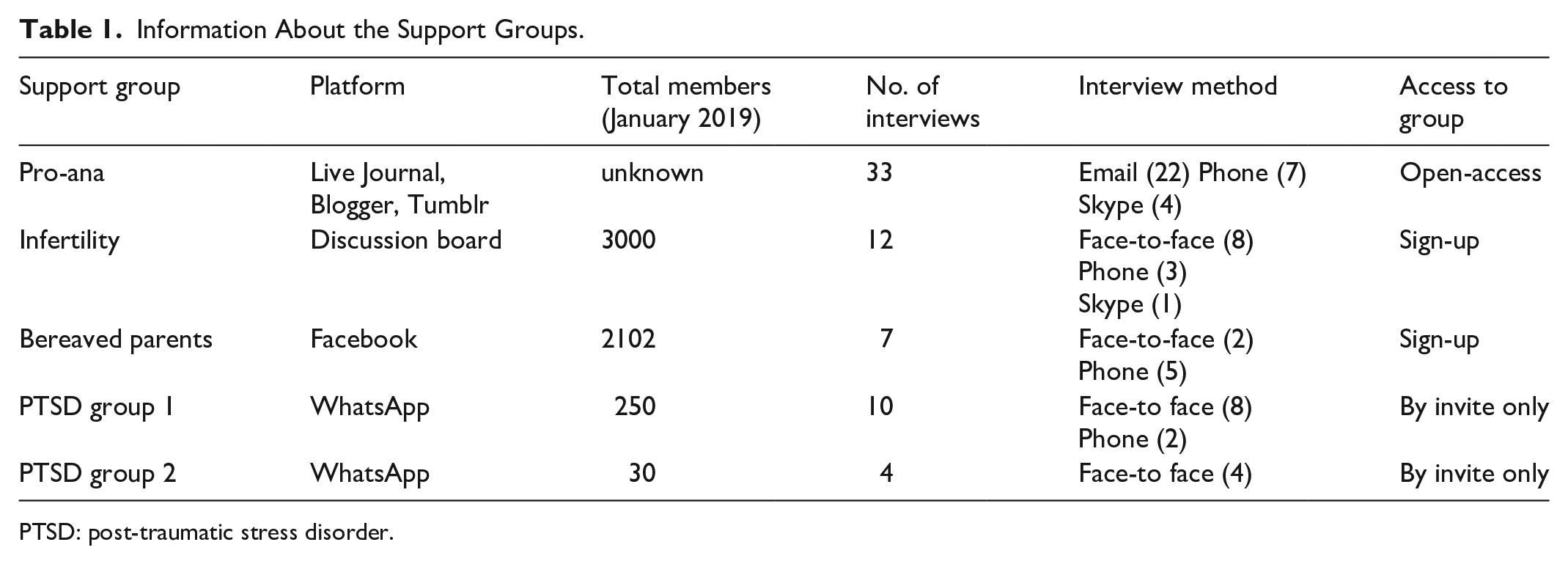
PTSD: post-traumatic stress disorder.
Thematic Analysis
To identify the themes emerging from the interview data, we conducted an inductive thematic analysis (Braun & Clarke, 2006; Pfeil & Zaphiris, 2010). First, the authors read their own interview data and identified two themes—online boundary work and affordances. Then, both authors imported the transcriptions to a software package for qualitative analysis (Atlas Ti), to be read and re-read in detail. The analysis units were words, sentences, or paragraph-long statements that provided a context to the idea. Through discussion and comparison, overlapping categories were collapsed until six coding categories were agreed upon. Finally, three main themes through which interview participants discussed online boundary work and affordances were identified: monopolization, removal, and finding online support. Once these main themes were identified, both authors read the transcripts again and discussed the findings. Excerpts presented in this article have been translated into English from the original material, which was in either Hebrew or Swedish. To identify the salient features of the subjects, we noted next to each quote the participants’ gender, age, role in the group, and interview method. To ensure confidentiality, the audio recordings of the interviews were not kept after transcription.
Findings
Although affordances of online communities—such as immediacy, reach, and scalability—offer new opportunities and contexts to support stigmatized individuals, we found that two main affordances configure how members in these stigmatized communities use their groups—affordances connected to anonymity and visibility. In all five communities, it was found that both administrators and members strove to protect group boundaries. This was done in two main ways: By monopolization of the networked public and by removal of those who are considered “pseudo” members, or impostors. In the following sections, we will illustrate how members and administrators of the five online support groups express—in their own words—their boundary work efforts to protect their communities.
Monopolization
In communities hosted on open-access platforms such as pro-ana blogs, members were aware of the high visibility that facilitated the presence of outsiders. One of the members in the pro-ana group commented that
You also worry about the kind of attention-seeking “wannarexics” reading your blog. You don’t want to write what could be conceived as “tips and tricks” because it would attract the kind of people who idolize (for some unknown reason!) people with eating disorders and they would make your blog less valid in a way. It makes you seem like you’re faking it to hand out “eating disorder advice.” (Female, 19, blogger, email)
To avoid these unwelcome users, such as very young girls, some of the pro-ana bloggers used features on their blogs to construct technological barriers such as disclaimers:
I don’t want people who are in recovery treatment to visit my blog. I don’t want younger girls to read it. I put a disclaimer warning that people who are younger than 18 years old should not visit the blog. But I still have it up publicly. (Female, 22, blogger, phone)
Due to the high visibility in the blogosphere, pro-ana bloggers were also aware that their online content could potentially be observed by family and friends. Therefore, they constructed new online identities whenever they felt the threat of their anonymous online activity being exposed:
Some of my readers were and are my friends so I do publish it despite them knowing who I am. Having said that, I often moved to a new blog to get some privacy and so that I could write what I really felt. I suppose really, when writing eating disorder-related content, it’s much easier to do it anonymously because then you don’t feel like your behavior will be challenged or threatened. No one has any power to stop you. I felt that I kept that control over my own behavior by moving to a new blog every time I felt threatened. (Female, 18, blogger, email)
When the pro-ana bloggers interacted with what they perceived as outsiders, they reacted to them in different ways. Some blocked communication, while others did not. In some cases, the response was quite aggressive:
some of the girls are very defensive about their eating disorder, and they consider someone that wants to become like that very offensive. I don’t hate those girls. I talk to them. A lot of girls start off as wannarexics and I’d rather talk to them than send them hate mails. (Female, 22, blogger, phone)
The opportunity to find publicly available support and avoid exposure was also available in the Israeli infertility support forum. In contrast with the pro-ana blogosphere, the affordances of the text-based discussion boards enabled the group admins to function as gatekeepers and carry out higher-level boundary work. The online forum is visible and easy to find using search engines, but access to the group is by sign-up. Hence, to become group members, users must have a profile or create a new one and ask permission to join the group. In essence, due to the high level of anonymity, a user of the discussion board is able to have multiple profiles without any identifying information. Affordances thus provide the admins with the ability to control the access of new members to the group but the text-based, reduced cues environment also requires substantial guesswork, as one of the admins explained: “If we are sure it’s okay and it sounds like a real story, we approve the user. When we approve a user, the member is free to post anything” (Female, 37, admin, face-to-face). Sometimes, this boundary work was not effective and the group had to deal with aggressive outsiders who threatened the group’s communication:
One troll attacked the former admin. I went to the defense of that admin and then the same troll attacked me. There were all kinds of wars with her. She was a psycho from the internet, what can we do, but it bothered the group very much. (Female, 35, member, face-to-face)
In both the pro-ana blogosphere and the text-based infertility support forum, support-seeking individuals could remain anonymous. By contrast, in online support groups operating in closed communities on platforms such as Facebook and WhatsApp, members were required to reveal their identities (real name, profile picture and Facebook friends, etc.) to gain access to social support within the communities. In these groups, the lack of anonymity enabled group admins to protect the group in even stricter ways. In the closed Facebook group for bereaved parents, the admins decided to protect the group by requiring those who applied to join the group to answer three filtering questions, requesting newcomers to disclose their name, address, and phone number. However, as one of the administrators revealed, this information proved insufficient to safeguard the group from inauthentic members: “At first, we didn’t do any check-up on who approached the group, but then weird people who pretended to be a grieving family appeared” (Female, 45, Admin 2, phone). The affordances of Facebook provided the admins with the option to look up the new members by cross-checking Facebook profile information with answers to the filtering questions. However, sometimes outsiders managed to cross these boundaries despite admins’ monopolization efforts:
It’s like, if you spot that the name. . . it seems to be a fake name and then you can find out if it is: you ask about that, you ask for an address, for a phone number—those are the three questions we ask, we don’t ask for their story. But that’s the part we have to add now—that you’re required to write a few lines about the reason for applying [for membership], because recently there was a woman who gave us all the information we asked for but pretty soon it turned out that she was the cousin of a deceased child! (Female, 45, Admin 2, phone)
To protect group boundaries, group administrators in the bereaved parents’ community often engaged in extensive guesswork of new members’ posts:
You can read between the lines. Especially now that I’ve been doing this [being a moderator] for such a long time and then we have cases where someone has written “I have lost a sibling,” meaning they still haven’t understood that this is a group for parents and they have submitted all the information we asked for and everything. (Female, 40, Admin 1, phone)
The strictest form of monopolization appeared in the PTSD WhatsApp groups. New group members were only able to join if they were invited by one of the group admins. The group admins knew all the new members personally and only granted access to those dealing with PTSD themselves—or their close family members:
The group members are people I accompanied or mentored. I’m not a non-profit organization, I do not know how it came to this but I went to the hospitals, I went to the houses, I took people out in real time just before they committed suicide. Some of the group members were in denial of their PTSD. They would shut themselves up in their houses, and their mothers would contact me. (Male, Admin 1, 40, face-to-face)
In some cases, when the group admin felt the potential new members were not yet ready to face the interaction and content in the groups, they even blocked their access to the group: “There are lots of PTSDers who are with me in one on one . . . who are not in the group. They are not ready to deal with all the troubles of everyone” (Male, 40, Admin 1, face-to-face). Or as the admin of the second PTSD WhatsApp support group revealed,
I add them to the group after I talk to them. I ask what the situation is with them and whether he is treated and [. . .] I hear his stories and I decide if he can take part [in group interaction]. If not, I tell him “listen, in the meantime you and I are one on one.” (Male, 55 Admin 2, face-to-face)
As the quotes above highlight, the boundary work practices of the online communities investigated in this study varied. The more advanced the technological features offered by the platform for controlling access were, the stricter the monopolization efforts. However, when these efforts failed to protect the groups, and users perceived as outsiders managed to enter, further boundary work practices were needed to remove those who did not fit the group’s identity, which will be explored in the section below.
Removal of Inauthentic Members
In open-access online communities such as the pro-ana, the bloggers identified those who did not belong to the group by their information requests and clues in their online presence. Once the outsiders were identified, three different methods were used to remove them from the group: blocking communication; sending hate mail; or posting screenshots of their posts under the label “wannarexic.” Hence, boundaries are maintained by removing those who try to join the group but are considered to be inauthentic, or wannarexics:
I look at their profiles, and sometimes they will be overweight, they will be like 180−190 pounds, and instead of dieting normally they go to these pro-ana blogs and try to starve themselves, which does not work, ’cause it is not a diet. Yes, I mean some people really hate them, and want them off the site. (Female, 20, blogger, email)
The presence of the unwanted members threatened the authenticity of the group and some of the members felt that their mental disorder was belittled as a result of this threat. In turn, the response to these outsiders ranged from efforts to communicate with them to removing them completely:
I feel bad for them. I try to talk to them. There is a strong reaction against them because people have been suffering from this disorder and don’t want to have the disorder. And they don’t understand why someone else would want this. (Female, 22, blogger, phone)
In the semi-public group for Israeli women with fertility issues, removal took place by deleting posts, as the admin reported:
We have some of those who were going through treatments and now want to offer the group members different kinds of paid services. We quickly tackle them. First, we send them a warning in private messages. If they continue, we delete their messages or forward them to the business section of the platform Business, which is the section for financial services. (Female, 37, Admin 1, face-to-face)
Removal of outsiders also took place in the closed group for bereaved parents. The admins monitored the interaction in the group, sometimes with the help of community members notifying them of suspicious behavior with the request that a certain member should be banned. Once the impostors are identified, they are removed from the group. The admin of the bereaved parents’ group described the removal process of a member who turned out to be a cousin of a deceased child, and thus did not fit in as a member of the bereaved parents’ group:
She only gave me the information I asked for and I thought, like “she has read through all the information [required for membership application]” and I assumed that she really understood that this is a group exclusively for bereaved parents. But soon there was another parent [in the group] who made us aware of this and who contacted me. And they contacted the mother of the [deceased] child and asked if this was someone who belonged to her family, and then it turned out that it was a cousin. So that mother contacted her [the cousin] and she left the group. (Female, 45, Admin 3, phone)
Another way to remove users who did not fit the group’s identity was to request them to move to a more suitable group, as the admin explained: “I usually link them over to the siblings’ group.” (Female, 45, Admin 2, phone).
If the administrators become suspicious of a new member’s activity—bearing in mind the vulnerability of their members—the admins take precautions to avoid the risk of potentially exposing or expelling an individual who is in a truly vulnerable state. They contact the person “backstage” via private messaging and ask clarifying questions. It was found that the same caution was taken in the group for Israeli women with fertility issues.
Unlike the bereaved parents’ closed Facebook group, the selection process before admittance to the PTSD WhatsApp support group was based on personal acquaintance and thus even more controlled. Therefore, the admins were not able to point to any cases of outsiders entering the group. The admin could only describe one case of removal that took place when a member violated the group’s norms.
As a result of the boundary work efforts described above, our study reveals that all groups were erecting online boundaries in various ways. However, in the case of closed groups on social media, the very same boundaries that provided protection to existing members in effect limited access to online support, as discussed next.
Finding Online Support
As discussed above, online support groups offer contexts and platforms where stigmatized individuals can reach communities of peers and form their own networked publics (boyd, 2010). The anonymity offered to stigmatized individuals in the pro-ana blogosphere motivated new members to join and stay in the online community, as one member explained:
I think a lot of people wouldn’t search for such things if they were not anonymous, for example if their parents knew about it then it wouldn’t happen. The “pro-ana” community would probably not exist if it weren’t for anonymity as they would be so heavily scrutinized for believing in such a way of life. (Female, 25, blogger, email)
Nevertheless, it is important to note that upon becoming an active pro-ana blogger, providing some personal information was valued as it secured the perception of authenticity:
Most pro-ana girls have a second Facebook account with ana, mia, bones, thin, etc., as either the first name or the second name of their account. That’s a pretty useful way of getting support and allows you to share pictures and things with other users. I don’t think any pro-ana bloggers or members would really pay much attention to someone who’s completely anonymous—you have to create an identity of some sort, even if it’s not a real one. (Female, 19, blogger, email)
In a sense, the high level of anonymity and visibility of the pro-ana blogs is a double-edged sword. On one hand, for those in need of social support, the public nature of the community made access to online support easy. On the other hand, it was hard for pro-ana bloggers to block unwanted anonymous members who threatened to disrupt the smooth running of the forum. When the researcher asked a blogger whether she thought vulnerable people should be warned before visiting a blog, the blogger replied: “Probably. It’s a hard question. Maybe. The disclaimers don’t really help. You just click on OK and you go into the blog. I don’t think I have ever read them before” (Female, 21, blogger, phone). Some of the bloggers were even concerned because of the easy access to the group: “Kids who are in difficult situations in their lives, who are just looking for something to hold on to . . . I am terrified that they’ll find my blog” (Female, 20, blogger, email).
Unlike the pro-ana community, the relatively easy access to the fertility support group—simply requiring a new user to create a profile on the discussion board platform—offered those who deal with their fertility issues easy access to support. When in need of support, as the following fertility support group member described, high level of visibility affords a simple Google search that leads to similar others:
My GP recommended a fertility specialist but I wanted to see what they [fertility forum members] thought about him and I wanted to know what my future held. Obsessive in my interest, it was just a place to put it out there, express, think, and be with girls like me. Then it became a daily entry. (Female, 30, member, face-to-face)
It is important to note that the high level of visibility of the fertility support group enabled new members to find the group easily but was also often a concern to existing members who disguised their personal information as a safeguard:
My username at the Fertility Forum is confidential because someone who does a search for my username will find details that I prefer to keep very, very private. I wrote things that no one but my husband knows. (Female, 35, member, face-to-face)
Unlike the pro-ana blogosphere and fertility discussion board, low visibility of the closed groups for bereaved parents on Facebook and PTSD on WhatsApp made these groups hard for new members to access—or even resulted in the groups being inaccessible. Getting to know that the bereaved parents’ group existed was comparatively easy. Since it is maintained by the physical grief support organization, information about it could be found by a simple online search, and through leaflets containing the same information provided by, for example, a hospital where the child died. Becoming a member in the PTSD community, however, required a membership application process. For those who cope with PTSD, the only way to join the group was by receiving an invitation from a group admin, as one of the group members recounted: “I met him [the admin] at the hospital. He and I quickly realized we had a lot in common and he is the one who added me to the group” (Female, 32, member, face-to-face). One of the PTSD group participants described his dire need of social support before learning about the support group: “You are alone in this whole thing, all alone. I don’t have friends who are post-traumatic, I do not know people in this world [of PTSD]” (Male, 32, member, face-to-face). Another way of discovering the PTSD support group was to be referred to it by current members:
I posted in a public veterans Facebook group a post in which I wrote that I was willing to help PTSDers. Then one member asked me if was OK to publish my post in the WhatsApp group. They posted it there and the admin called me and that’s how we got in touch. He told me about the group. I joined the WhatsApp group because I wanted to share my insights of [living for] forty years with this disorder called post trauma. I was there, just like them and now I want to help them. (Male, 65, member, face-to-face)
Discussion
The present study investigated the way affordances determine boundary work and offer ways for stigmatized individuals to protect their digital safe havens. The five stigmatized OSGs in the present study varied with regard to the level of anonymity and visibility of their online content. Taken together, these differences seem to determine boundary work strategies as well as the level of access to the groups. In all five communities, we found that both members and administrators work actively in several ways to maintain group boundaries. In communities hosted on open-access platforms such as pro-ana blogs, members watched the newcomers’ interaction to see if they abided by the norms of the group. In the infertility forum, affordances provided the admins with control of the forum content, but the anonymous text-based environment also required substantial guesswork. To gain access to social support in closed online communities on Facebook and WhatsApp, prospective members were required to reveal their identities (real name, profile picture or phone number) and—in the case of Facebook—to expose their own social graph (the global network of linkages between all individuals within a system) (Fitzpatrick & Recordon, 2017) and Facebook friends to the other group members. In these closed Facebook and WhatsApp groups, this low level of anonymity enabled group admins to check if new members were authentic stigmatized individuals and members and we found that admins and members work together to remove pseudo-members.
Based on these findings, we argue that platforms with high level of anonymity and visibility (blogs and discussion boards) offer public and accessible support to stigmatized individuals that can be easily found through a simple Google search, but simultaneously allow potentially unwelcome participants to join the groups. By contrast, platforms with low visibility and anonymity levels (closed Facebook and WhatsApp groups) afford the groups closed and private spaces to find online support; however, at the same time, these affordances make the groups completely inaccessible for those who are unaware of their existence, or for those who have no social connections with current group members. This low level of visibility is the result of the members’ efforts to hide their concealable stigma, while benefiting from social media affordances of a low level of anonymity. Consequently, social media affordances may actually limit access to support for individuals coping with concealable stigma who are not prepared to relinquish information about their real identity.
Andalibi (2019) argues that disclosing distress in relation to stigma on platforms which support some degree of (perceived) anonymity is less risky than disclosure on identified social media. The platforms used by two of the communities investigated in the present study were on anonymous social media (pro-ana blogs and infertility discussion board), and two groups operated on what is, according to Andalibi’s definition, identified social media (bereaved parents on Facebook and PTSD on WhatsApp). However, as per Andalibi’s (2019) definition, the particular settings and aims of the two latter groups mean that they lie somewhere in between anonymous and identified. These groups are moderated, closed groups of peers only. Despite having to part with identifying information, the high levels of online boundary work provide the groups with the potential to become digital safe havens for stigmatized individuals. In these spaces, disclosure of stigmatized conditions and experiences is the norm. At least in groups that are very large, such as the bereaved parents’ group, similar others can be seen as semi-anonymous. The social media affordances of these groups, in combination with the safety of a peers-only environment, may offer a type of refuge which is unmatched offline—or indeed unmatched on open identified social media.
Our findings indicate that social media affordances are making OSGs not only less accessible to those in need but also less public to those without that particular need for support. One of Andalibi’s (2019, p. 6) findings was that disclosure by stigmatized individuals on their Facebook wall facilitated constructive conversations and reflections leading to attitude changes on relevant topics in their networks. However, our study indicates that stigmatized individuals tend to shift to closed groups on social media to protect their digital safe haven. Hence, the function of social media providing public spaces to influence opposing values about stigmatized topics is becoming less likely to occur, due to low anonymity and visibility in the closed groups. The discourse in OSGs for stigmatized individuals on closed WhatsApp and Facebook groups is in a sense removed from the public eye, unlike with communication on blogs and discussion boards that is visible and searchable for people who are not part of the group. Hence, the shift to closed online groups may limit the role of social media in de-stigmatizing these vulnerable communities by educating the public about the realities of stigmatized conditions (Ladea et al., 2016; Pavelko & Myrick, 2015).
As with all studies, this one has its limitations. First, it investigated groups located in various parts of the world (see Table 1). The focus was not on cross-cultural comparisons, but rather on teasing out differences and similarities in the experience of online boundary work across groups with concealed stigma operating on platforms that vary in their communication affordances. Our findings highlight that all groups made efforts with regard to online boundary work, but differences between them occurred because of a variation in affordances. Second, the study is based on interviews with those who are included in the OSGs, rather than those who are locked out. Third, age and gender could play a part in moderation capabilities but this was beyond the scope of the present study. We recommend that future studies about online boundary work try to reach people who are being locked out of online groups and examine the relationship between admins’ age, gender, and moderation skills.
Conclusion
Social media may offer easy access to new contexts and opportunities for individuals seeking social support for stigmatized conditions. However, our findings reveal that stigmatized individuals may actually not find support from social media groups. While previous research has applauded social media platforms as spaces for the formation and maintenance of social capital (Ellison et al., 2010; Ellison et al., 2007), and for enhancing perceptions of social support (DeAndrea, 2015; DeAndrea et al., 2012), our study highlights a kind of a Catch-22 situation, or paradox, caused by social media affordances (Cabiddu et al., 2014). To offer safe and functioning environments supporting individuals living with stigmatized conditions, the communities have to guard against impostors as their presence threatens the safe havens. At the same time, this action may make these groups inaccessible to those who truly need support, if they are too vulnerable or too guarded to provide the information requested to obtain membership. Paradoxically, our findings indicate that compared with blogs and discussion boards, in this way the affordances of social media may marginalize those living with stigma by—in effect—locking them out of online support groups.
Footnotes
Declaration of Conflicting Interests
The author(s) declared no potential conflicts of interest with respect to the research, authorship, and/or publication of this article.
Funding
The author(s) disclosed receipt of the following financial support for the research, authorship, and/or publication of this article: Research supported by the Israel Science Foundation (grant number 958/17).
