




Abstract
This article investigates user-generated political satire, focusing in particular on one genre: fake political accounts. Such fakes, created as social media profiles, satirize politicians or political organizations by impersonating them. Through interviews with a sample of Italian fake accounts creators, I explore how the fakes navigate their fakeness vis-à-vis the affordances of social network sites and their publics. First, I map how the publics of the fake accounts react to the satire along two axes: one referring to the public’s understanding of the satire and the other to the uses that the public makes of the satire. Second, I show how fakeness is part of everyday interactions in networked publics. Third, I argue for fakeness as a playful, powerful, and sincere critique of the political and its pretense to authenticity. By focusing on fake political accounts, this article provides insights on the place of fakeness in online communication beyond the debate around “fake news.”
Introduction
Journalists, commentators, politicians, and ordinary citizens have always used political humor to express their criticism of politics. But the affordances of new technologies and the abundance of user-generated satirical content suggest that we might need to rethink satire in a new media context. This research is concerned with one type of user-generated political satire: fake social media profiles of politicians and political organizations. These political fakes are defined as “humorous social media accounts that satirize a politician or a political organization by impersonating him/her/it” (Ferrari, 2018); additionally, they satirize anyone who interacts with the fake account by treating it as the “real” one (Ferrari, 2018). This type of satirical intervention in the public sphere is becoming increasingly popular in different countries (see Ferrari, 2018; Wilson, 2011). Given the heightened popular and academic concern with fakeness in online interactions—often connected to the fraught notion of “fake news”—how can we make sense of satirical practices that are based on faking?
In this article, I bring together research on satire, on fakeness and authenticity in online interactions, and on “networked publics,” that is, publics who are restructured by the affordances of networked technologies (boyd, 2011), to make sense of the relationship between fake accounts, social network sites (in this case, Facebook and Twitter), and the publics of the accounts. Using semi-structured interviews with a sample of authors of Italian fakes, I explore how they navigate fakeness vis-à-vis the platforms and the public. First, after identifying two modes of faking, mimetic and explicit, I map how the public of the fake accounts reacts to the satire along two axes: one referring to the public’s understanding of the satire and the other to the uses that the public makes of the satire. Second, I show how fakeness is part of everyday interactions in networked publics. Third, I argue for fakeness as a playful, yet powerful critique of the political and its pretense to authenticity. By focusing on how the creators of fake accounts navigate their fakeness and interact with their publics, this article challenges deterministic notions of how publics interact with online fakeness and argues that fakeness can be a productive political practice, not solely a threat to democracy.
Satirical Fakeness
Political humor has emerged as a key area of interest for the literature, which has predominantly examined satirical and parodical TV shows in the American context, such as The Daily Show and The Colbert Report (Colletta, 2009; Young, 2014, 2019) and investigated their effects on the public’s political attitudes and knowledge levels. This article builds on the literature on US-based political humor to examine a form of user-generated satire—fake political accounts—and cases outside of the American context.
Fake political accounts on social network sites should be thought of in the context of long-standing traditions of impersonation as a satirical device (e.g., Schechter, 1994). They are a digital form of “identity nabbing,” that is, a technique for political agitation in which activists pose “as people they are not” (Day, 2012, p. 22) to foster public discussion and political engagement. They can thus be considered an activist media practice (Ferrari, 2018).
However, political faking is not always seen as a political activity or a positive one. For Wilson (2011), political faking is “an activity by and for political fans” ( p. 452), which he categorizes as a form of fandom, not of political engagement. Boni and Ricci (2015), who examine the Italian satirical Facebook page Siamo la gente il potere ci temono, which is dedicated to satirizing the perceived image of the supporters of the populist party Five Star Movement (5SM, Movimento 5 Stelle) characterize it as elitist and divisive.
Furthermore, the public debate on “fake news” has also fueled concerns about satirical fakeness, the public’s ability to understand it and its potentially harmful effects. Scholars have been addressing the issue of whether satire should also be considered a form of disinformation or misinformation. Young (2019) argues that, while satire does not constitute a deliberate attempt to mislead the public, it can still unintentionally become a form of misinformation. Others more definitively consider political humor on social network sites as a type of online misinformation (Garrett & Poulsen, 2019). In this article, I argue that, despite these legitimate concerns on the intersection between misinformation and satire, satirical fakeness should be considered as a political practice that strengthens the public debate, instead of undermining it.
Faking as a Mode of Online Interaction: Authenticity, Sincerity, Intent
Long before the term “fake news” rose to prominence in the aftermath of the 2016 US Presidential Elections to describe instances of online misinformation and disinformation, discussions around fakeness as an online practice were already prominent in the research on online interactions. Concerns around faking as a mode of online interaction abound in the literature on computer-mediated communication, given that online spaces require their users to construct their identities mostly through textual interactions. The concept of “identity tourism” developed by Nakamura (1995) captured one way in which some Internet users performed different racial identities as a recreational activity, and pointed to the problematic nature of such practice. As Phillips (2015) chronicled, the threat of deception was also crucial to early accounts of trolling—and to some extent, it still permeates the way we think about trolls. Speaking of that early research, she explained: Not only were these trolls a threat to the utopian dream of early cyberspace, they gestured to the norms against which their behaviors were said to transgress—namely that “true” identities do not deceive, that any form of deception undermines community formation, and even more basically, that pure communication is naturally and necessarily preferable to some inauthentic alternative. (Phillips, 2015, p. 16)
There is thus a long-standing anxiety that surrounds the notion of fakeness in online interactions and that equates fakeness with insincerity. Banet-Weiser, (2012) argues that, perhaps paradoxically—given the ubiquity of commercial branding and a widespread postmodern ironic stance—“the concept of authenticity remains central to how individuals organize their everyday activities and craft their very selves” (p. 10). In her study of anarchist lifestyle activism, Portwood-Stacer (2013) explored how the quest for authenticity underlies many of the practices of anarchist communities, and also how these activists combined an “ironic self-awareness of the limitations of authenticity” (p. 103) with a commitment to sincerity. Similarly, I argue that satire—and indeed fakeness—is not incompatible with sincerity.
A more productive way of looking at fakeness in online interactions is to consider questions of intent. A case in which fakeness is deployed in a harmful way is that of cloaked websites (Daniels, 2009; Farkas et al., 2017). Focusing on white supremacist websites that spread racism online, Daniels (2009) defined cloaked websites as those which are “published by individuals or groups that conceal authorship or feign legitimacy to deliberately disguise a hidden political agenda” (Daniels, 2009). The political fakes I consider are not cloaked websites: their intent is to produce satire, not propaganda. While devising policy interventions around the notion of intent might present challenges (Caplan et al., 2018), intent is nevertheless helpful in distinguishing between authenticity and sincerity: even inauthentic content can be sincere. This is not to underplay the legitimate concerns expressed by many: “identity tourism” is racist, trolling can be disruptive, cloaked websites can spread hatred, disinformation can poison the political arena. But it is not fakeness or a presumed lack of authenticity per se that makes such phenomena dangerous.
A good example of faking as a playful strategy is that of Fakesters, fake user profiles that emerged on the social network site Friendster (boyd, 2008). Such profiles, often portraying fictional characters (e.g., Ali G) or subcultural references (e.g., Burning Man), were shut down by the platform because they “complicated the network structure” and “created an appearance of unreliability, which irritated both the company and individuals” (boyd, 2008). But Fakesters also conveyed a powerful critique of authenticity on the social network, epitomized by the quote “None of this is real” which gives the title to boyd’s piece. In other words, faking allowed Fakesters to highlight how all profiles on Friendster were, in fact, a performance through which users consciously decided to highlight some aspects of themselves over others. As boyd (2008) asked, “why should we judge Fakesters as more or less authentic than awkwardly performed profiles”? The relevance of this critique is heightened when it is directed at the political world: political fakes highlight the carefully manufactured nature of contemporary politics and unmask its pretense to authenticity.
Fakeness and Networked Publics
Concerns with authenticity and fakeness should be addressed in the context of the peculiarities of the digital technologies that enable user-generated content, and thus, this type of user-generated political faking. The characteristics of social network sites give rise to what boyd (2011) termed “networked publics,” and that make it difficult to employ traditional ways of assessing and understanding the context of our interactions, as well as determining one’s audience (boyd, 2011, p. 51). First, on social network sites, satirical content is presented without obvious contextual cues that can explicitly mark it as satirical (Young, 2019). The absence of satirical markers and the difficulty of assessing the context of satirical content leads to a concern that readers will regard fake content as authentic. In this article, I explore how people react to the satirical fakeness of political fakes and draw lessons that are relevant to online fakeness more generally.
Second, the “context collapse” that characterizes social network sites also generates tensions related to one’s self-presentation and authenticity, thus leading users to adopt different tactics to assess and manage their audience and their online identities (Marwick & boyd, 2011). Context collapse thus creates challenges for all users of social network sites, who are confronted with the necessity of crafting and performing their identity within the constraints of these platforms. This means that, while the creators of the fake accounts are undoubtedly engaged in a complex performance, so are the “regular” users who interact with the satire of the fakes: they are also performing their identity and navigating their audience. In other words, they are not merely engaged in “getting” or “not getting” the satire of the fakes, they are also engaged in a variety of performative actions. This article examines the relationship between the political fakes and their publics, by highlighting the performative nature of this relationship and showing how satirical fakeness opens up avenues for political critique for both the authors of the fake accounts and their publics.
Methodology
In this article, I investigate how the authors of eight Italian fake political accounts navigate the issue of fakeness vis-à-vis the social network platforms they use and the publics they encounter. To do so, I conducted semi-structured interviews with a purposive and convenience sample of 12 creators of political fakes, who manage the eight accounts considered in this article (see Table 1): some fakes are managed by multiple people, and in such cases, I tried to interview more than one person. Although relatively small, the final sample includes the most prominent political fakes as identified by the media (Benvenuto & Bracconi, 2015); it also provides a range of diverse accounts in terms of their popularity, as shown in Table 1, and of their preferred social network site. The sample can thus speak to the broader spectrum of fake political accounts, although it is worth mentioning that the creators of one of the most famous fakes—L’Apparato—decided to not take part in the study; other relevant accounts could not be included in the research due to a variety of reasons, including their unwillingness to participate. As detailed in Ferrari (2018), the motivations of the creators of these fake accounts are ludic, social, and political: these satirists are not profit-driven, but rather see the fakes as a form of activism.
Measures of popularity on social media for the fake accounts and number of interviewees for each account.
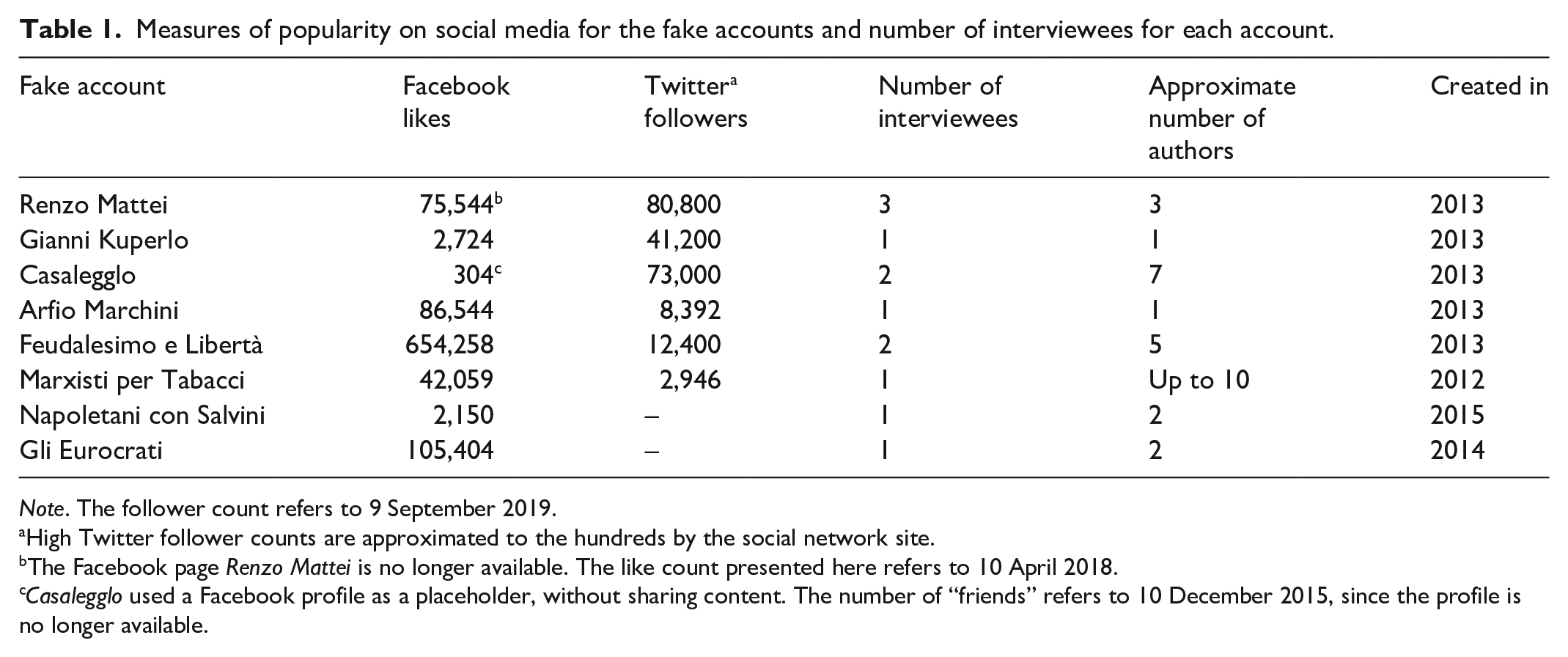
Note. The follower count refers to 9 September 2019.
High Twitter follower counts are approximated to the hundreds by the social network site.
The Facebook page Renzo Mattei is no longer available. The like count presented here refers to 10 April 2018.
Casalegglo used a Facebook profile as a placeholder, without sharing content. The number of “friends” refers to 10 December 2015, since the profile is no longer available.
Interviews were conducted in Italian in person or via Skype. Each lasted about an hour and was recorded and transcribed. The interviews were then coded for emergent themes (Corbin & Strauss, 2008). I refer to the interviewees by their account’s name, as opposed to their personal one.
Italy’s Real (and Fake) Politics
The political fakes considered here emerged and prospered between 2012 and 2016, a period marked by the 2013 general elections, the rise to prominence of relatively new key political players and the marginalization of Silvio Berlusconi. The 2013 general elections were a turning point: they saw the success of the populist formation 5SM, that gathered 25% of the popular vote; the defeat of the center-left coalition, expected to win but unable to get enough votes to form a government; and the end of the bipolar party competition that characterized Italy for two decades (Di Virgilio & Giannetti, 2014). One of the key actors in this phase of Italian politics was Matteo Renzi, General Secretary (2013–2018) of the center-leftist Democratic Party (Partito Democratico, PD) and Prime Minister (2013–2016); his government was supported by a coalition of parties, which included some of Silvio Berlusconi’s former allies. The PD—itself a relatively new (2007) fusion of two older parties, heirs to the communist and Christian-democratic traditions—was characterized by sharp internal debate (Bickerton & Invernizzi Accetti, 2014); the party also experimented with primary elections to select its leaders and candidates (sometimes in conjunction with other left-wing parties). Besides the 5SM and its leader, comedian Beppe Grillo (see Natale & Ballatore, 2014), another populist formation reinforced its position among the ranks of the center-right in the 2013 elections: the League (Lega), guided by Matteo Salvini, which campaigns on an anti-immigration platform. The striking popularity of populist parties in Italy can be partially explained as a response to the pro-austerity technocratic government led by Mario Monti (2011–2013), and the subsequent short-lived coalition government led by Enrico Letta (2013–2014; Bickerton & Invernizzi Accetti, 2014).
After 20 years of Italian political satire dedicated to him, Silvio Berlusconi has largely been ignored by fake accounts creators. On the contrary, it was the new players who became the subject of satirical impersonation: not just Renzi (while Prime Minister), but also those who contested his leadership in different primary elections (Gianni Cuperlo and Bruno Tabacci); the eminence grise behind the rise of the 5SM, Gianroberto Casaleggio; and others, to whom I return below.
Mimetic Versus Explicit: The Evolution of Political Faking
Italian fake political accounts started to gather public attention in early 2012. The first famous fake account was a parody of the (then) Mayor of Rome, Gianni Alemanno. The fake Twitter account @AIemannoTW closely mimicked the real account (@AlemannoTW), to the point that Alemanno’s staff issued a press release via Facebook, denouncing the fake as identity theft and asking users to report the account as spam (Staff Tecnico Gianni Alemanno, 2012). The fake @AIemannoTW is a good example of the first wave of fake accounts that can be described, borrowing the term from one of my interviewees (Gianni Kuperlo, 11 August 2015, Personal Interview) as mimetic fakes. Mimetic fakes impersonate the politician without disclosing that they are fake; they attempt to trick the public into believing that they are the real thing. Three of the fakes I examine—Casalegglo, Gianni Kuperlo and Napoletani con Salvini—are mimetic accounts, at least in their initial stages. Over time, however, mimetic fakes have become rarer, and now most of the fake accounts are created as explicit fakes. Explicit fakes impersonate the politician (or the political organization), but do not attempt to hide the fact that they are fake. For instance, their names are close to the real names of the politicians, but different enough to be identified as fakes: the fake account impersonating the Prime Minister, Matteo Renzi, is called Renzo Mattei, a recombination of name and surname that has since become a classic tactic for fakes.
As mentioned above, the mimetic phase of fake accounts had a limited duration: first, the public (and the media) grew accustomed to fake accounts as a satirical genre, thus attuning their expectations; second, the mimetic fakes largely exploited the fact that many politicians were initially reluctant to adopt social media, especially Twitter. In some cases, this also influenced the choice of which character to create, as is evident from the story behind Casalegglo and Gianni Kuperlo.
Casalegglo was a fake account created on Twitter ahead of the 2013 general elections by a collective of writers and artists called diecimila.me. The account impersonates the late Gianroberto Casaleggio, one of the key figures behind the emergence and the electoral success of the 5SM. At that time, the real Casaleggio did not have a Twitter account and this proved crucial. In its first mimetic phase, which lasted 10 days, Casalegglo managed to attract 20,000 followers before finally revealing itself as a fake (Casalegglo2, 28 August 2015, Personal Interview). Negotiating the mimetic phase, however, was not straightforward. The same collective had previously created a less successful fake account, @Pontifex_xx, which satirized Pope Benedict XVI. The collective revamped the fake on the occasion of Pope Francis’ election, tweeting one single line that joked on the alleged left-wing orientation of the new Pope: “Hasta the Holy Mary Siempre”; 40 minutes after the publication of the tweet, the account was shut down by Twitter (Casalegglo2). With that experience in mind, the collective was very conscious of managing the mimetic phase of Casalegglo. One of the authors explains: [. . .] fakes were different before, now they are already created as a parody. [. . .] Before it wasn’t like that. Before, the fake was alternative to the real character, to the point that we tried not to make people understand it was fake. I remember that when we got to the choice of the profile picture, the background image, and all the graphical elements. . . at the beginning we put his face [of the real Casaleggio] and a neutral background. Then, I mean, a little scared about the closure of the Pope’s fake, I put a modified picture with blackened eyes. And a weird background. [. . .] Because, those who looked at the picture without paying attention could maybe confuse the account [with a real one]. . . but those who took the time to check could see it was fake. So I was protecting. . . in a way, I was guaranteeing the prolonged existence of the fake. (Casalegglo1, 21 July 2015, Personal Interview)
Gianni Kuperlo also started as a mimetic fake, in the context of the primary elections held by the Democratic Party in Fall 2013 to select its new leadership. All the candidates soon were parodied by a fake account, including Gianni Cuperlo, who was the runner-up in the primary. Gianni Kuperlo was created as a Twitter account at a time when the real Cuperlo did not yet have an account on the social network. As his creator explains, Kuperlo was created with the intent to deceive the public and successfully managed to do so. The mimetic nature of the fake was also at the center of the conversation that the creator of the fake had with the real Cuperlo. As reported by the satirist: He told me that because of the primary elections’ campaign he needed to launch his Twitter account and asked me . . . told me I could write whatever I wanted but that I should try . . . he asked me to try not to exaggerate in passing for him, in order to not create too many incidents [in the campaign]. (Gianni Kuperlo)
After the primary elections, the fake shifted toward a less mimetic impersonation of the real Cuperlo and a more autonomous satirical persona. His “About” section on Twitter is explicit about his fakeness, stating he is a “Fake intellectual of the PD” and, more recently, a “parody account” (Gianni Kuperlo, n.d.).
It is interesting to note that the ability of these fakes to be mimetic is closely connected to the affordances of Twitter. The authors of Casalegglo negotiated the fakeness of the accounts in different ways over time, by changing the profile picture and the background, and by changing the Twitter bio, adding and removing the word “fake” from the description. As highlighted in the quote above, they were doing so to protect the account from being shut down by Twitter like their previous impersonation of the Pope. Another fake account examined in the article, Gli Eurocrati (the Eurocrats), was shut down on Twitter, but survived and thrived on Facebook. Other, less obvious features of Twitter helped the fakes to be mimetic. For instance, the default font in which Twitter displays usernames and names is sans serif, and thus there is no way to distinguish between a capitalized “i” and a lowercase “l.” This is the trick that allowed both @AIemannoTW and Kuperlo, whose username is @GianniCuperIoPD, to mimic so effectively the names of their targets, but without actually using their “real” name.
The other account in the sample that openly chose to be mimetic and deceive the public is Napoletani con Salvini (People of Naples with Salvini), a short-lived account created in May 2015. The Facebook page portrayed the existence of a fake organization based in Naples that supported the leader of the League, Matteo Salvini. The most prominent satirical component of the fake is the paradoxical support of a group of people from Southern Italy for a party, the League, which historically fought for the interests of the Northern regions against the central government and the South. The page never acknowledged itself as parody until it ceased operations (Atte, 2015). The popularity of Facebook as a mainstream, all-encompassing social network site was particularly appealing to the creators of Napoletani con Salvini, in contrast to Twitter, which is less popular in Italy. Napoletani con Salvini was particularly successful in deceiving the public, including real Southern supporters of Salvini and the representatives of other parties in Naples.
The other fakes examined in this article can be defined as more explicit, in the sense that they do not conceal their fakeness. As highlighted above, Renzo Mattei impersonates Prime Minister Renzi; Arfio Marchini satirizes the Rome-based politician Alfio Marchini; although their names are close to those of the originals, the difference is significant. Marxisti per Tabacci (Marxists for Tabacci), Feudalesimo e Libertà (Feudalism and Freedom) and Gli Eurocrati are similarly explicit in their fakeness, mostly because the organizations they impersonate are rather implausible. Marxisti per Tabacci poses as a Marxist collective that employs Soviet iconography in support of Bruno Tabacci, a centrist politician; Feudalesimo e Libertà is a fake party dedicated to upholding feudal values; Gli Eurocrati impersonates the bureaucrats of the European Union by employing an exaggerated pro-austerity discourse. Yet, as we will see below, despite the fact that these accounts do not intend to deceive the public, and that they often provide contextual cues of their satirical nature, many members of the public—and also politicians and journalists—have regarded these fake accounts as real.
Satire, Fakeness, and “Networked Publics”
Do They Get It? What Do They Do with It? A Map of the Publics’ Responses to the Fakes
All the interviewees describe their publics as highly heterogeneous. They often distinguish between the loyal followers of the fake account—the fans—and those who interact with it less frequently. More importantly, they describe their publics as a diverse mix of those who get the satire, those who do not understand it and an undetermined gray area of people whose level of understanding is difficult to ascertain. They also describe a variety of uses that members of the public, politicians, and journalists make of their satire, which can be arranged on a continuum between “instrumental” and “non-instrumental” use. A visual representation of this mapping of the publics, as it emerges from the interviews, can be seen in Figure 1.
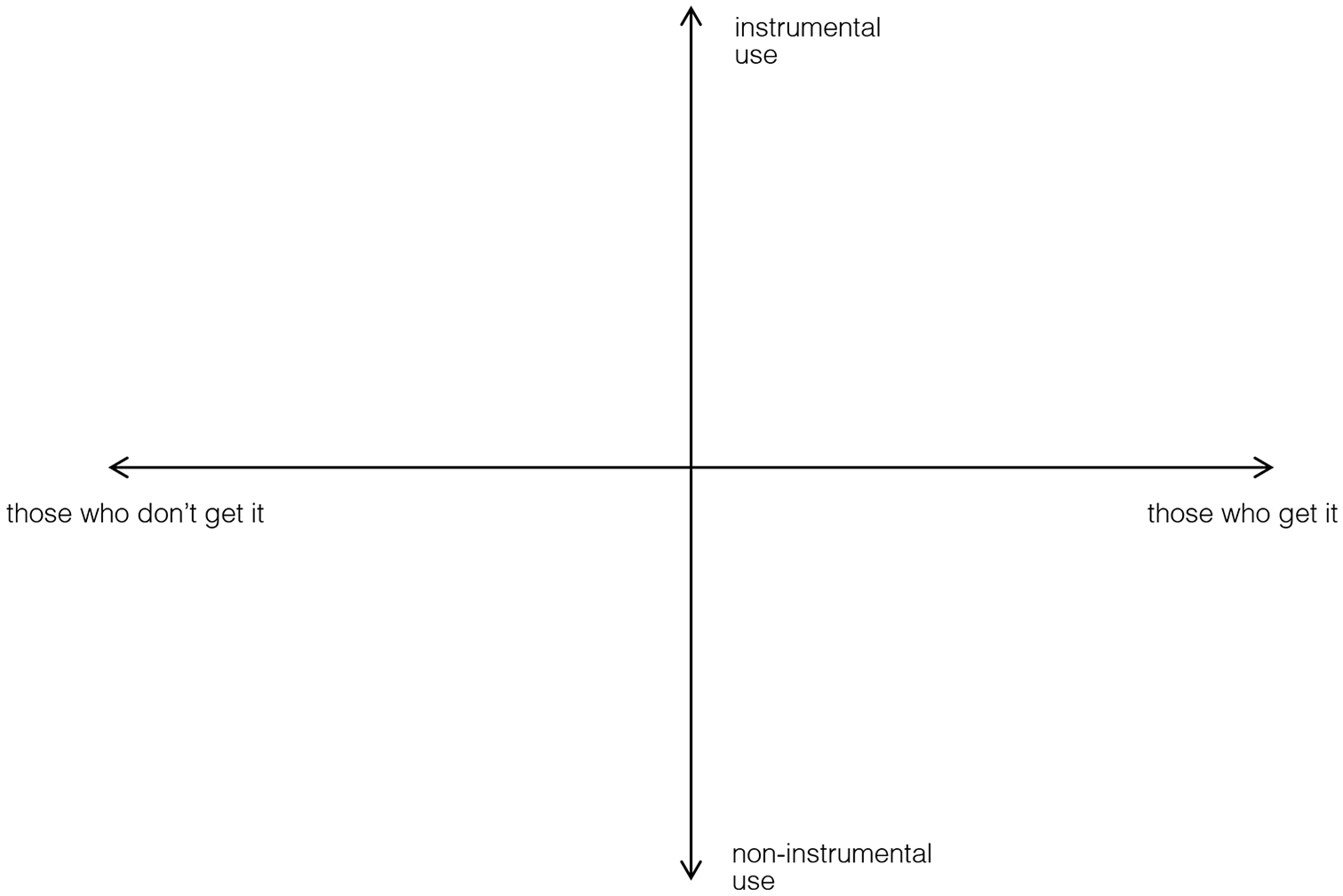
Map of the publics of the fake accounts.
The first axis, ranging from “those who don’t get it” to “those who get it”, charts the degree to which members of the audience understand the satirical nature of the fake accounts; the second axis ranges from “non-instrumental” to “instrumental” and maps the way in which users use the satire of the fake accounts. The map allows us to identify five broad categories (the four quadrants and the area of uncertainty at the intersection of the axes).
The obvious limitation of this map of the publics and their reactions to the satire of the fake accounts is that it is the result of how interviewees make sense of them, and thus might not correspond to what individual members of the public experience. Nevertheless, there is a certain uniformity in the descriptions given by the interviewees that indicates that the map might be a good starting point for the exploration of satirical fakeness and networked publics. Furthermore, the descriptions provided by the interviewees rest on hundreds of interactions that these satirists have had with their publics over years of engagement: their insights can give us a bird’s eye view of a phenomenon that will need to be further examined, for instance, by directly analyzing the textual traces of the interaction between the fakes and their audience.
The map conveys the idea that, within networked publics (boyd, 2011), the fake accounts creators are confronted at the same time with a range of potential reactions and interactions. The publics of these fake accounts have agency beyond the act of laughing or not laughing: they have different motivations to consume, use, and deploy the satirical fakeness they encounter.
Those Who Get It and Just Enjoy It
We would traditionally think of this section of the public as the real public for satire: its fans. This group includes people who understand the satirical nature of the account, who use the satire for their own enjoyment and might even actively contribute to the fake, for example, by suggesting topics to the creators or by arguing with those who comment negatively about the page. This is the portion of the public that feels closer to the fake account creators. For instance, different authors describe their fans as “marvelous” (Arfio Marchini, 22 July 2015, Personal Interview), “intelligent” (Gli Eurocrati, October 3 2015, Personal Interview), and “fanatics” (Casalegglo1). But they also underline how they feel that their fans share certain common characteristics with them, whether demographic (Feudalesimo e Libertà, August 13 2015, Personal Interview), occupational (Gli Eurocrati), or political (Marxisti per Tabacci, 29 September 2015, Personal Interview). This affinity between the fans and the fake accounts creators can take an even more active role, as is the case in this participatory campaign launched by Marxisti per Tabacci: We launched a campaign [. . .] with the sentence “I’m a Marxist for Tabacci and I’m proud of it,” and they [the fans] sent us something like 300 pictures, in which they posed with the sign [with the sentence], maybe even with symbols or things that reminded them of the socialist iconography . . . someone took a picture under Marx’s statue in Berlin, or in front of the Red Square in Moscow, with a graffiti of Che Guevara and so on . . . (Marxisti per Tabacci)
Fans can also take an active role in helping the accounts police the negative comments they receive. Several of the interviewees say that they do not really respond to negative comments but allow fans to step in and enforce some sort of informal community standards against negative or offensive commenters.
Those Who Get It and Use It for Their Own Ends
The satire of the fake accounts is also consumed by people who use it as an instrument to achieve their goals, whatever they might be. For instance, politicians might interact with the fake accounts in accordance with their own agenda, as highlighted by the creators of Renzo Mattei (20 July 2015, Personal Interview), who suggest that politicians who oppose the real Matteo Renzi used the satire of its fake to further their criticism: You really can’t generalize on politicians, because there are some, for instance, who interact with our profile instrumentally, for their political aims . . . I don’t know . . . [politicians of the center-right], or other MPs of the Popolo della Libertà use our tweets for political propaganda. Also several MPs of the Five Star Movement who actively follow the profile and retweet it . . . use that satire for political goals. (Renzo Mattei)
Several of the satirized politicians (or people close to them) have also tried to co-opt the accounts satirizing them, presumably in an effort to improve their public image. The most explicit, in this respect, was Bruno Tabacci, who promoted the satire of Marxisti per Tabacci and invited the authors to appear with him on different media outlets. Other accounts, like Arfio Marchini and Renzo Mattei were also pressured in the direction of helping out the politicians they satirized.
Although this category seems dominated by politicians, even regular users can make an instrumental use of satire, while still understanding it as satire. Using satire instrumentally is not necessarily a negative thing, as evidenced by the creator of Arfio Marchini, who underlines how the public of the page reached out to him to air grievances: And so they are beautiful, often moving, because they tell me about their things, the problems they have . . . sometimes they ask me to write about difficult situations . . . if they are unemployed, they ask me to raise awareness . . . (Arfio Marchini)
Thus, there are multiple ways in which the satire of the fake accounts can be used by members of their public; even if they understand and appreciate the satire, they can use these fake accounts as much more than simple instances of satirical content.
Those Who Just Don’t Get It
Whether mimetic or explicit, the fakes always encounter a portion of the public who does not understand the satirical nature of their work. The authors of the fakes spend a considerable amount of time in the interviews talking about this issue, which puzzles them greatly. Below, I reconstruct some of the explanations that the satirists employ to make sense of the people who “don’t get it,” and suggest thinking about the issue in relation to the characteristics of “networked publics” (boyd, 2011), which bring formerly distinct audiences together, without necessarily offering appropriate contextual information.
The creators of the fake accounts recount similar experiences: they constantly face a portion of the public which does not understand the point of their satire; although this portion tends to decrease over time, people who do not understand that the fakes are fake continue to show up and interact with them. This phenomenon is not limited to members of the public; it also extends to journalists and politicians. And crucially for the dynamics of the fake accounts, instances in which people—especially famous people—appear to not understand the satire become themselves an opportunity for more satire. For example, one of the creators of Casalegglo recalls a particular instance in which the fake account, in its typical hyperbolic and absurd style, tweeted “Looking for a lawyer to write laws. Desired: experience with Times New Roman.,” to which a lawyer promptly and publicly replied with his name and qualifications, adding “If you want to contact me, we can talk about it. Thanks!” (Diecimila.me, 2013). Episodes like this prompted the creators of Casalegglo to devote a section of their website to collecting the interactions of Casalegglo with the followers who did not understand that the account was a fake, thus creating further satirical commentary. The authors of Feudalesimo e Libertà used Facebook memes to do something similar (Feudalesimo e Libertà, n.d.). Even the more explicitly fake accounts encountered similar reactions. Feudalesimo e Libertà ironically celebrates the values of medieval feudalism, and yet received more than one instance of appreciation for their positions. For instance, they describe two such cases: There was also someone who took us seriously and was happy of the fact we existed. [. . .] This guy wrote to us that he was of noble lineage, and that he would have liked to reacquire some lost privileges . . . [. . .] or a friar who wrote that he . . . that he agreed that decadence had begun with the French Revolution, that he was in favor of the monarchy . . . (Feudalesimo e Libertà)
An experience common to all fake accounts creators is to receive insults from those who do not understand the satirical nature of the fakes. The creator of Gli Eurocrati says: We have a series of rather creepy characters who write to us via private [Facebook] messages, with things like “I hope your children die,” and so on . . .. . . and then when I check their accounts I can see that they are all close to Forza Nuova [far-right party] or other similar groups. Then there are a bunch of people who sympathize or are involved with the Five Star Movement, that believe that we really think the things we write, and so leave comments along the lines of “shame on you, you’re making people starve.” I mean, sometimes we try to argue with them—jokingly—but they never stop . . . they go on with the discussion very seriously, maybe they are convinced they are talking to Juncker [former President of the European Commission]. (Gli Eurocrati)
As mentioned above, journalists, celebrities and politicians also occasionally fail to understand the satire of the fake accounts. A senator of the center-right, Maurizio Gasparri, is notoriously active in replying to fake accounts, including Renzo Mattei and Arfio Marchini.
Those Who Instrumentalize the Satire They Don’t Get
The fake accounts also gather a small crowd of users who don’t understand the satirical nature of the fakes, yet still attempt to use it for their own goals—usually related to politics. A striking example is how a political party (Noi con Salvini Napoli) tried to co-opt Napoletani con Salvini, believing that they were a real political group (Napoletani con Salvini, 22 July 2015, Personal Interview). But regular users are also using the satire of the fake accounts instrumentally. For instance, one of the creators of Casalegglo recalls: The most absurd were those who tried to suggest that ours was like a code, through which [the real] Casaleggio tried to communicate with grassroots supporters. And so for them it was a sort of ciphered message. And so they were replying seriously. It was unbelievable. (Casalegglo1)
The author of Gli Eurocrati also points to a similar pattern, in terms of users reposting their satire and adding their own commentary, with comments like: “Look, they don’t even try to hide”—showing that they consider the fake account to be a real account that speaks on behalf of the European institutions (Gli Eurocrati).
Uncertainty: do they mean it?
The last big chunk of the public identified by the satirists is the one they struggle to understand the most. In short, a lot of the authors describe instances of public reactions that they could not quite interpret fully. This happened frequently with media coverage. In two separate occasions, both Feudalesimo e Libertà and Casalegglo have seen some of their content included in the opening segment of the weekly political TV talk show Ballarò. For the creators of both accounts, it was difficult to determine whether the authors of the TV show understood that the accounts were fake, since this was not made explicit in the segments. Similarly, the creators of Feudalesimo e Libertà had to explain to multiple producers of a radio program that their posts were satirical, before being interviewed on the show.
And the uncertainty can be even greater when it comes to regular followers of the accounts. Even for the authors of the fakes, it is sometimes difficult to determine whether the person interacting with the account understands the satirical nature of the account and why they are interacting with it. As the creator of Gli Eurocrati sums up, talking about the insults he receives: “it is difficult to understand which ones are the trolls who are doing it consciously” (Gli Eurocrati). Another interviewee explains: I saw politicians commenting our tweets. There were people convinced this was the real one . . . or at least milking it. Meaning that maybe they knew it was fake, but thought “hey, I am gonna play on the fake one,” because then people will fall for it and think I am attacking the real one . . . who knows. It’s a big question mark. (Casalegglo2)
The same lack of contextual information that presumably makes the fakes’ satire difficult to understand for some, also prevents the satirists from fully understanding what some members of their publics are doing with their satire.
Furthermore, this category of uncertainty highlights the multiple meanings and motivations that users can attach to user-generated content. In this respect, as highlighted in the quote from Gli Eurocrati, it is interesting to also consider that even the public of the accounts has a public, that is, that users adjust how they interact with the satire of the fake accounts according to their specific audience and their motivations. It is entirely possible that some people who do get the satire of the fakes actually choose to “play dumb” just to see how other people will react. In this sense, they are also involved in a form of playful faking as a tactic for managing their online self-presentation (Marwick & boyd, 2011; but also Goffman, 1959).
The Visibility of Misunderstanding in Networked Publics
The creators of the fake accounts all discussed at length the people who seem to not get their satire and the reasons why they thought it happened. Broadly speaking, they identify five problems that prevent people from understanding their accounts as fake (and satirical): (a) lack of technical knowledge and/or media savviness, (b) lack of political knowledge, (c) lack of general knowledge, (d) lack of attention, and (e) lack of venues for the expression of disagreement and anger. The lack of technical knowledge and the lack of political knowledge highlighted by the interviewees are central to the studies on the fake page Siamo la Gente il Potere ci Temono, whose creators highlight similar criticism of the public they encounter on social networks (Boni & Ricci, 2015; Ricci, 2013). But while for the creators of Siamo la Gente, the lack of technical and political knowledge is a primary motivation for satire (Ricci, 2013), my interviewees discuss it mostly in terms of possible explanations of why not everyone is able to get what they do.
The explanations put forward by the interviewees likely highlight some general structural problems in the Italian population; such problems have also been central to several explorations of satire and its cognitive complexity (Young, 2004). But the most interesting issue that needs to be tackled here is relative not to the fact that certain people do not understand the satire of the fake accounts, but rather why this has become such a central element in how the fakes think of themselves and their public. And I argue that this can be addressed by exploring how the emergence of digital networking technologies has reconfigured the public. Social network sites not only allow users to generate content but they also make visible the existence of a multiplicity of potential publics.
A more traditional understanding of the public of a satirist would probably only include one quadrant of the map illustrated in Figure 1: the fans. But “networked publics” extend way beyond that and allow the satirists to get in touch with people who they would have never been able to reach before. However, not all the people that they can reach will be equally predisposed to understanding their satire. The fact that some people get the joke and some people do not has always been part of satire: not everyone appreciates it in the same way (Day, 2011, 2012). But on social network sites, those who do not appreciate it can become more visible—to the point that they can themselves become targets of humor. Because of how social media sites collapse different social contexts that would otherwise be separated, those who get the satire and those who do not come to inhabit the same space. People who are critical of satire or do not understand it have always existed but have never found such a direct contact with the satirists like the kind they have now through social network sites. Some people have always been excluded from the joke, yet now they are included in the potential audience of the joke and thus more visible to those who create satire.
Satire—even offline—is fundamentally a participatory practice, in which the public co-constructs the satirical performance with the satirists; to a large extent, it is the reaction of the public that determines whether we can understand a performance as satirical (Colletta, 2009, p. 860). If, as Day (2011) underlined, satire “depends on a discursive community willing to participate in creating the ironic reality together” (p. 180), it is evident that networked publics alter the experience of homogeneous discursive communities by exposing satire to a wider public. And while online satirists certainly hope to develop a large following and try to harness the power of social media to attain it, there is no guarantee that this wider public will “get” what they are doing.
What’s Fake? What’s Real?
As underlined above, by participating in networked publics we are all involved in degrees of faking. The interviewees address the thin boundary between fakeness and reality as it pertains both to politics and to society in general. For example, the creator of Gli Eurocrati underscores the difficulty of doing parody when “you’re dealing with a political system that already goes beyond parody” (Gli Eurocrati). But others offer an even more philosophical reflection, which is in line with the literature on satire (e.g., Colletta, 2009), and questions the boundary between the performative nature of politics and that of satire. For instance, the creator of Arfio Marchini states: Of course, a fake is false, bogus, but on the web and on social media what is true? This should be the question. I don’t think that Arfio Marchini is faker than Alfio Marchini. I don’t think that Arfio Marchini is faker than the real Matteo Renzi. I don’t think that Arfio [. . .] is faker than politics that auto-represents itself. Or than life, a life that is representational and not real. (Arfio Marchini)
Perhaps the fakeness of the satirical accounts can help highlight the fakeness of “real” politics, thus telling “a small piece of truth” (Gianni Kuperlo). In the words of the creator of Napoletani con Salvini: I mean, Facebook cannot escape from experiments like this [the fake] that constantly remind you that everything is an enormous lie, if you don’t take the time to seriously verify what you read and what you post. (Napoletani con Salvini)
Compared with the manufactured nature of contemporary politics, the fakeness of the fakes is, in a way, a form of sincerity. In performing fakeness, the fake accounts remind us that official, “real” politics is also a performance of reality—and not necessarily a more authentic one. The fake accounts ask us to critically interrogate “real” politicians and “real” political messages, to fact-check them, as suggested by the quote above, and to be critical readers and citizens. As Day (2011) put it, such satirical forms of interventions are “poking holes in the spectacle” that is contemporary politics. By making us question the boundary between “fake” and “real” politics, they can facilitate defiance toward power and open spaces for activist dissent.
Conclusion
By focusing on how fakeness is negotiated by the creators of user-generated political fakes in relation to both their publics and the affordances of social network sites, this article contributes insights on the place of fakeness in online spaces. The current debate on algorithmically-driven deception has been summarized in both popular and scholarly (Lazer et al., 2018) venues under the term “fake news.” However, “fake news” is an imprecise term that was fraught even before Donald Trump seized it to undermine mainstream media reporting. More productive terms that have been recently suggested are “viral deception” (Jamieson, 2017) and “strategic disinformation” (Corner, 2017), but they have yet to become widespread outside of academia. Unfortunately, the popularity of the term “fake news” in the public debate has cast a negative light on the idea of online fakeness, with the risk of both demonizing practices of faking that are directed at satirizing and questioning power and obscuring the existence of degrees of fakeness in daily online interactions. The findings of this article speak to both aspects, inviting us to reclaim the notion of fakeness as a productive practice of political critique.
First of all, the findings of this article show that networked publics have multiple ways of reacting, interacting, and engaging with satirical fakeness. As evidenced by my interviewees, there are multiple uses and motivations that people can attach to satire and to user-generated content in general—and not all of them are straightforward. It is not just the creators of satirical political fakes that are active, but there are also possibilities for everyone to reimagine, reuse, and give meaning to user-generated content. Networked publics have agency beyond correctly assessing whether a post is satirical or not; this complicates how we study people’s ability to navigate online fakeness.
The great attention that both contemporary commentators and my interviewees pay to those “who don’t get it” shows how much networked publics have reconfigured how we think about publics. While we might usually think of something’s public as the group of people who are in agreement with it and that attend to it for their enjoyment, networked publics are potentially broader. This is interesting for satirists, because they can reach people they would not otherwise reach, but at the same time, networked publics bring together a number of people who are not necessarily predisposed to understanding satire. Naturally, this has always happened—there have always been people who did not get satire—but within networked publics, they acquire great visibility and contribute directly to how satire is created and how it is perceived by others. Whether in agreement with the satire or not, they play an active role in shaping it. The point is that these behaviors are more visible in networked publics: social network sites alter how satire is consumed and created.
Second, when used as a mode of satire, fakeness can be a playful and effective intervention that criticizes those who lay claims to authenticity, particularly in the political sphere. As highlighted by the interviewees, the existence of a digital impersonation of a politician invites us to question the “real politician” and their performance of reality. What if the fake representation of a politician is sincerer than the actual, real politician? This is the big political question posed by fake account creators. Fakeness can be a powerful activist media intervention in the public debate (Ferrari, 2018). I thus suggest we reclaim the label “fake” as a productive practice of political critique.
Third, while the satirists considered here are certainly faking, there are parts of their publics who are faking, too: there might be people who get the satire, but pretend they do not, because they want to see what will happen in the subsequent interactions with other people. Maybe they want to stimulate more satire; maybe they just want to have fun—there are many possible motivations. Because of its methodological choices, this article cannot fully examine these motivations, but they are a promising topic for further research. The findings of this study remind us that online publics have agency, and they also highlight how fakeness is inevitably a part of online communication—because it is part of daily life in general (Goffman, 1959). Fake accounts negotiate their fakeness on a thin line between being popular and being biting, between being understood and being critical. But this is true also for “regular users”: they also have a public; they also adjust their online persona by negotiating different levels of fakeness to achieve their goals. Fakeness is part of our daily interactions as part of networked publics—and it is not necessarily a marker of insincerity.
Footnotes
Declaration of Conflicting Interests
The author(s) declared no potential conflicts of interest with respect to the research, authorship, and/or publication of this article.
Funding
The author(s) received no financial support for the research, authorship, and/or publication of this article.
