




Abstract
Despite extensive literature on content creators’ identities, strategies, and activities, there remains a gap in understanding how the constantly changing platform environment impacts their brand subjectivities. Against this backdrop, our article explores how evolutions in platforms—including constant updates to their affordances—shape the activities and interpretive processes of content creators. Drawing on interviews with 35 Chilean content creators in the field of fashion and lifestyle, along with an analysis of their Instagram images (N = 165) and stories (N = 150), we show how creators feel compelled to enact different versions of their brand subjectivities. Our findings show how creators experience platform changes based on three interrelated levels: in the form of communicative styles, as a sense of temporal acceleration, and as a constant negotiation with other actors in the social network through which commercial activities are configured. Thus, when platforms tend to make changes to improve their commercial viability, content creators have to adapt their brand subjectivities and practices across platforms and affordances. In addition to shedding light on the new routines and intensified economic pressures demanded of today’s digital workers, we also reveal how the ideal of creation has been supplanted with intensified competition amid constantly changing technological, social, and commercial ecologies.
Introduction
In recent years, the term “content creator” has emerged as something of a catch-all to describe digitally enabled cultural producers who create and circulate content on social media platforms, driven by an entrepreneurial spirit and desire to generate their own “media brands” (Craig, 2019). However, despite the tendency to group creators into a singular category, these cultural producers have traditionally operated quite idiosyncratically, evinced through their efforts to enact what Scolere et al. (2018) describe as “platform-specific self-brands.” Notions of platform-specificity highlight a broader reality about YouTubers, Instagrammers, and TikTokers—they are overwhelmingly considered what Nieborg and Poell (2018) conceptualize as platform dependent, that is, their creativity and hence their success is hitched to particular platforms of cultural production. It is despite—or perhaps because of—such platform dependence that creators are beholden to constant changes in the social media ecosystem, from technical features and algorithmic configuration to renewed terms of service and policy restrictions.
In the context of Instagram, some of these affordances and innovations are publicly visible: both the stories feature and design updates have been widely hyped by the company. Others are strategically obscured to creators and users alike, such as when algorithmic shifts determine the order of content in the feed and, consequently, exposure (Bucher, 2012; O’Meara, 2019). Highlighting the impact of the latter platform change, Coldeway (2019) described the “behind the scenes machinery” of Instagram’s algorithms that relies upon user preferences and complex behavioral patterns to present recommended content to users via the Explorer tab.
Recent research on Instagram’s algorithmic architecture and the work of content creators and influencers describes how creators develop interpretations and forms of resistance when understanding and playing the “visibility” game, instead of being cast as “victims” of algorithms (Cotter, 2019; Petre et al., 2019). For instance, O’Meara (2019) identified the “engagement pods” that work on Instagram; grassroots communities that agree to mutually collaborate to like or share their content to game Instagram’s algorithm as a form of “cooperative algorithm hacking.” Such findings on creators’ navigation of algorithms suggest the crucial need to better understand how content creators respond to constantly changing platform environments and new platform features impact what we call as their brand subjectivities, that is, the ways of thinking about themselves and their media brands.
Against this backdrop, our article explores the interpretive processes of a group of Chilean content creators reflecting on how platform evolutions impact them as a community of cultural producers. Our use of the term “community” signals that the activities of content creators are oriented toward becoming professionalized, commercialized, and monetized, achieving indexes of success better and faster than other content creators (Lobato, 2016). Drawing on these data, we analyzed how platform evolution entails processes of professionalization and constant re-organization of content creators’ activities, within the “circuits of commerce” (Zelizer, 2011, p. 348–351) they are part of, regardless of whether or not they aim to participate. Sociologists deploy the circuit metaphor to describe a social network through which commercial activity is configured based on specific practices, information, and forms of media. For content creators, these circuits of commerce are constituted by branding agencies, brands, followers, and platforms (Arriagada & Ibáñez, 2019). Agencies, for instance, connect content creators to clients for “endorsements, sponsorships, and social media marketing campaigns” (Abidin, 2018, p. 75). We specifically take “commerce” that means the social and economic exchanges among actors, which Craig and Cunningham (2019) define as the “social media entertainment industry,” where creators develop content-based businesses across different social media platforms and in relation to different actors (e.g., intermediaries, audiences).
Chile represents a compelling context—within which to study this case—given the country’s high levels of social media use, burgeoning culture of influencers, and localized creative industry (Adimark-UC, 2016; Aspillaga, 2014; García & Muntal-Lordán, 2017). Indeed, with 17 million inhabitants, Chile has been in the forefront of Latin American internet penetration, embracing digital and social media platforms faster than almost any other country in the region. In 2009, 30% of Chilean households had access to internet connections (Subsecretaría de Telecomunicaciones [SUBTEL], 2016); by 2017, this figure had ballooned to 87%, with smartphones as the main device for internet connections (SUBTEL, 2018). Chilean teenagers eagerly adopted photo blogging sites in early 2000 and by 2008, Chile had the most Fotolog accounts worldwide (4.8 million), used mostly to establish, build, and present identities for themselves and relative to their peers (Donoso & Ribbens, 2010).
There are 6 million users of Instagram in Chile, with 65% between 18 and 34 years old (Satista, 2019). Social media influencers have also become an important part of these platforms, with 56% of Chileans stating they follow celebrities or influencers. While 55% of Instagram users distrust influencer advertising practices (“strongly disagree” or “disagree” trusting them), 15% purchased based on recommendations, and 37% of the user base have purchased an item in the last 3 months because they saw it on Instagram (Cadem, 2019).
Our analysis is informed by existing literature on self-branding, authenticity (Banet-Weiser, 2012; Hearn & Schoenhoff, 2016; Marwick, 2013b; Scolere et al., 2018), and algorithmic cultures (Bucher, 2017; Cotter, 2019). Empirically, we draw upon in-depth semi-structured interviews with a total of 35 Chilean content creators (fashion and lifestyle bloggers, Instagrammers, and influencers) and a random sample of Instagram pictures (N = 165) and Instagram stories (N = 150) posted by six of these creators. Drawing upon Bucher and Helmond’s (2018) notion of a “platform-sensitive approach,” we probe how the process of moving across different platforms, or within evolving platforms, redefines or transforms the activities of the community of content creators, social media influencers, and cultural producers writ large. Our results show how creators adapt and negotiate their identities and activities, developing sets of tools for content creation and different styles of communication. Thus, when platforms tend to make changes to improve their commercial viability, content creators have to adapt their brand subjectivities and practices across platforms and affordances. We conclude by analyzing how these results shed light on the routines and economic pressures for today’s digital workers, giving critical attention to how their visibility becomes susceptible to the powerful infrastructures and economic forces, which are part of today’s social media economy.
Subjectivities of Content Creators: Authenticity and Entrepreneurship
A content creator looking to monetize is driven by two imperatives that work as strategic advantages for their commercial activities: authenticity and entrepreneurial spirit (Duffy & Hund, 2015). Authenticity—though a fraught concept—tends to rely upon the impression of realness to construct a sense of intimacy and connection with their followers (Abidin, 2016; Marwick, 2015). Being authentic also works for bloggers and influencers as a form of distinction from traditional media celebrities, with their trappings of top-down influence (Duffy, 2017). The entrepreneurial ideal is based on a model of self-enterprise, whereby one engages in continuous self-labor, promoting oneself to succeed and be profitable (Banet-Weiser, 2012; Duffy, 2017).
Thus, authenticity and entrepreneurship are the two guiding principles of self-branding and, as Hearn (2008) and others have made clear, are the dominant forms of communication in the post-Fordism capitalism. The reification of the entrepreneur self, an individual that considers work not a threat to freedom, but rather as an essence for self-realization (Miller & Rose, 1990), sees social relations are “central to value production” (Gandini, 2016, p. 125). The worker is thus re-imagined as a highly motivated individual who derives gratification by providing their audiences with a range of desired goods or services (Fairclough, 1993). When the self is treated as a brand and amplified through digital communication platforms like YouTube, Instagram, or Facebook, the guiding ethos is “authenticity,” indeed central to digital communicational practices (Duffy & Hund, 2015; Marwick, 2013a). For instance, users present themselves through social media profiles as they “really are,” feeling empowered as a result of communicating their crafted identities (Banet-Weiser, 2012).
Social media platforms are a crucial component of crafting these visible self, connecting private and public performances, blurring the boundaries between personal and commercial communications (Banet-Weiser, 2012). It is in this dimension where content creators like bloggers and so-called “social media influencers” converge. Influencers market themselves as “authentic” consumers of brands and goods that can also communicate and represent brands’ values as authentic experiences, producing and circulating meanings. Herein the practices of content creation and branding interact as the result of the sociality that takes place in social media platforms based on affect and publicity (Gandini, 2016). In the case of social media influencers, they construct an audience based on presenting themselves as authentic and affective consumers (Abidin, 2018; Duffy, 2017), building a reputation qualifying themselves as brands of authentic lifestyle and acts of consumption in varied ways. The efficacy of such qualifications can be measured through a set of metrics (e.g., likes, shares, reproductions) that are subject to valuation by marketing agencies or other commercial entities (Carah, 2014; Gandini, 2016; Hearn & Schoenhoff, 2016). Social media platforms like Instagram thereby become “attention economies,” in which attention is an “intrinsically scarce resource,” and in this vein “money flows to attention” (Goldhaber, 2006). Those who can levy their self-presentations to sustain audience attention, thus become a valuable resource for commercial actors and intermediaries looking to amplify commercial messages.
Through these latter frameworks, it is thus apparent how platforms and users are mutually configured. However, it is not clear how this mutual configuration works across different platforms—especially when creators’ ways of thinking about themselves and their media brands are subjected to a constantly changing platform environment. The catalysts for such change range from technical features and algorithmic configuration to renewed terms and conditions; collectively although they impact what we understand as brand subjectivities.
From “Bloggers” to “Influencers”: From Self-Representation to Self-Branding
Given this study’s focus on platform evolution, it seems necessary to briefly trace the transformation of fashion and style-related content creation over the last decade. The emergence of bloggers and influencers as content creators is, in part, made possible by technological transformations that blur distinctions between producers and consumers of content (Bruns, 2009; Jenkins, 2008). Thus, the activity of content creation crafts and represents identities—versions of the self—(Marwick, 2013a) based on the images and auto-biographical content (McCosker & Darcy, 2013). For example, fashion bloggers construct identity and different versions of femininity by posting pictures of themselves, documenting their style (Rocamora, 2011). More recently, with the emergence and evolution of social media platforms, creators can promote themselves as personal brands, sharing their curated identities (Abidin, 2016; Duffy & Hund, 2019; Marwick, 2015). The self-branding activities of creators become “a form of affective, immaterial labor that is purposefully undertaken by individuals to garner attention, reputation, and potentially profit” (Hearn, 2010, p. 427).
The relationship between technological infrastructures and individual self-branding practices takes on special relevance for content creators in different markets and forms of sociability. Early research on fashion blogging, for instance, highlighted how these seemingly “new” voices were eclipsing the work of mainstream journalists as consumer sources of information (Rocamora, 2011), through the expression of fashion, tastes, and “looks” online using “personal narration to capture an audience” (Abidin, 2018, p. 74). This type of content creator shared a particular vision of fashion (Ramos-Serrano & Martínez-García, 2016), presumably turning their passion into an online business (Brydges & Sjöholm, 2018). This is achieved by the promotion of brands “receiving freebies in exchange for shout-outs and mentions, engaged for endorsements and sponsorships” (Abidin, 2018, p. 74). More recently, with the rise of Instagram, fashion creators are widely recognized for their pursuit of imaginaries related to achieving “insta-fame,” a form of micro-celebrity that works as a strategic set of self-presentation practices to increase followers’ attention and to gain online status (Marwick, 2015; Senft, 2013). The idea of influencer marketing is thus predicated on the idea that the micro-celebrity of digital influencers–another label for content creators—can orient followers’ tastes and consumption decisions (Hearn & Schoenhoff, 2016). In short, content creators may influence, achieve micro-celebrity online, and/or profit through paid editorial content (Abidin, 2018).
While these studies have helped to shed light on what Nieborg and Poell (2018) might describe as the “platformization” of fashion content, it seems important to understand the processes of platformization amid rapidly evolving social media ecology. For instance, with the rise of Instagram Stories, creators are confronted to a new set of possibilities for content creation that can be compared in perspective with their past experiences with different platforms and how this impact their brand subjectivities.
Method
Data Collection and Analysis
In-depth, semi-structured interviews were conducted in 2017 with 35 social media content creators (mostly fashion and beauty bloggers) based in Santiago, Chile, whom we identified through snowball sampling in three stages. First, we selected a group of 10 experts in the fields of advertising and fashion (designers, advertising executives, retail managers, and famous influencers) to interview; members in that group were asked to identify other relevant important content creators and we invited the people named for a second wave of interviews. In total, we contacted 50 people by e-mail, of which 35 agreed to be interviewed. All participants were connected to agencies (receiving products and participating in small campaigns, paid or unpaid), but only half were consistently paid for their work as influencers. All but one of the interviewees told us they started as bloggers and by the time of the interview, were active on Instagram.
Our sample included a majority of women (n = 26, versus nine men); they were all college-educated, mostly working in the media sector (digital advertising agencies, marketing agencies, and journalism). For privacy reasons, participants’ real names and identifying characteristics are not reported; however, their age, number of followers, and years of activity are included (Table 1). Interviews were conducted in person and recorded with participants’ consent. Interview topics included participants’ backgrounds and expertise; the transition from blogs to Instagram and Instagram Stories; processes of content creation, distribution, and promotion; self-presentation strategies; and their relationships with brands and branding agencies.
Participant Information.
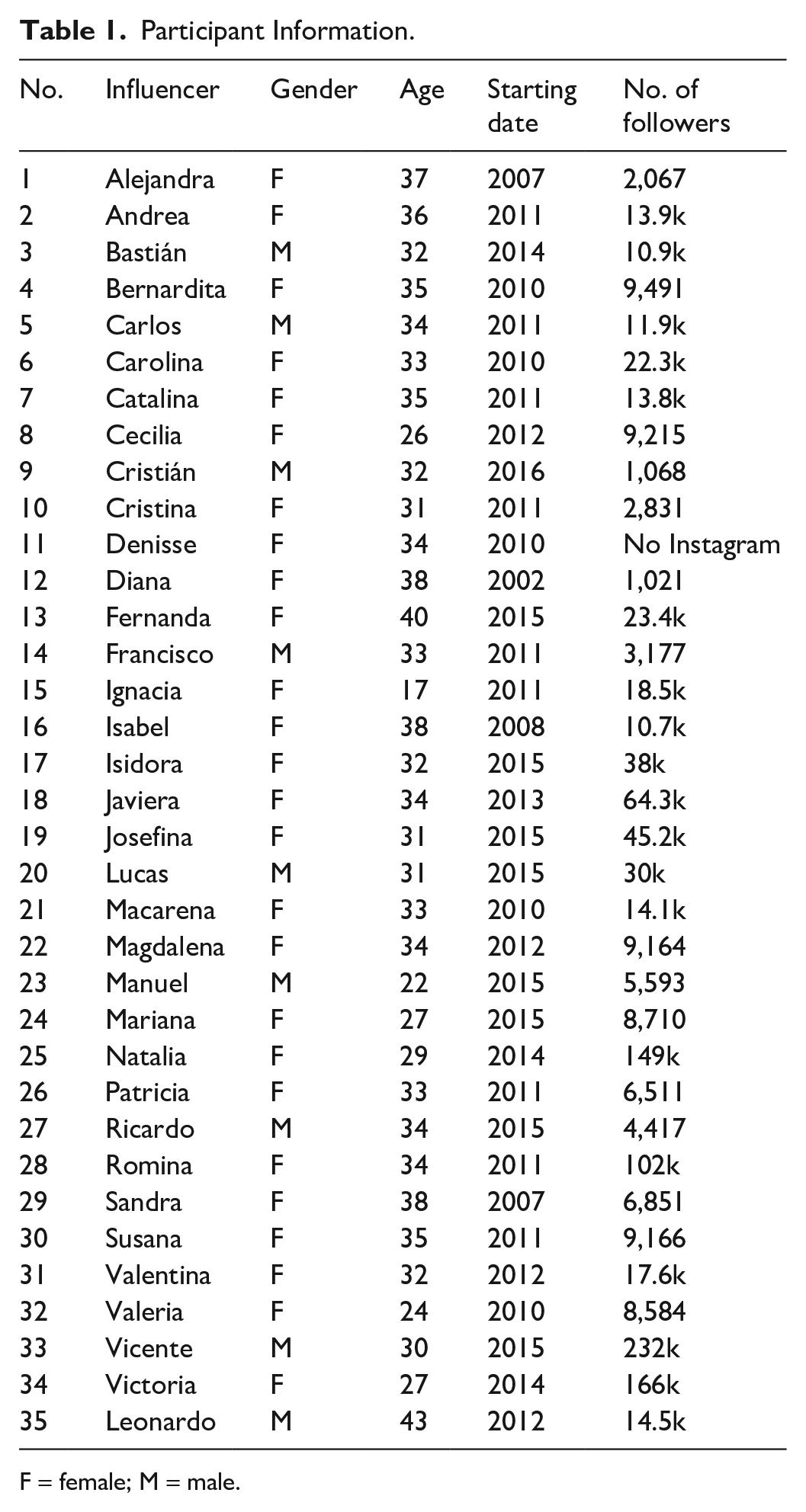
F = female; M = male.
In working with interview data, we initially examined how content creators experienced platform evolution and enacted different content creator identities following Flick (2013, p. 157), whose work suggests that content creators have a stock of knowledge about their practices and relation with social media platforms. Interview transcripts were coded and analyzed using a grounded theory approach, contrasting interviews (Glaser & Strauss, 1969). To understand how platform evolution shapes content creators’ identities, we used Bucher and Helmond’s (2018, p. 18) “platform-sensitive approach,” to explore how “action possibilities come into existence by drawing together (sometimes incompatible) entities into new forms of meaningfulness”. For our study purpose, a platform-sensitive framework toward social media affordances involves questioning how moving across different platforms, or within evolving platforms, redefines or transforms the activities of the community of content creators, social media influencers, and cultural producers, writ large. Thus, for the analysis of interviews data, we developed a set of category codes that varied from the materiality of platforms, transitions across platforms, temporality, and actors’ self-presentation strategies.
Second, after interviews, a group of six content creators was selected for Instagram and Instagram Stories content analysis. Selection criteria were content creation background across varied platforms and whether amateurs or professionals. Pictures and stories were collected over a 6-week period (December 2017 to January 2018), and coded using Airtable, a platform that collects and organizes text and images. For Instagram Stories, which expire after 24 hr, screenshots were taken three times daily for each participant (late morning, late afternoon, and late night) as start and end points (Highfield & Leaver, 2016).
During the data collection period, 540 Instagram Stories and 200 Instagram pictures were collected (N = 740). A random sample from each of the six social media influencers was taken for 20 “Instagram Stories” (N = 120) and 20 “Instagram photos” (N = 120). This sample was analyzed considering the visual and textual elements of each “story” and “picture.” The coding sheet was based on previous research (Duffy & Hund, 2015) and designed to understand how platform affordances (Instagram and Instagram Stories) facilitated content creator topics and goals (e.g., self-branding, community building, and product or brand qualities) as well as communication and emotional style (e.g., passionate, happy, sad, and so on).
Findings: How Content Creators Experience Platform Changes in the Social Media Ecology
Most interviewees explained that they started creating content on blogs and then moved across different platforms (e.g., Tumblr or YouTube) before consolidating on Instagram. Indeed, the majority expressed an understanding that blogs are declining in relevance within today’s social media ecology, and most importantly, within the circuits of commerce defined as the “influencer economy” where creators represent a “shoppable life” (Hund & McGuigan, 2019). Some reported continuing to update their blogs, but the majority have switched to Instagram because “people are always there now” and that is where “the business happens.” Of note, not one of our interviewees referred to themselves as influencers, but rather as “bloggers.” It is not by chance that interviewees’ defined themselves under this term; they began when blogs were the newest digital platform for content creation. As lifestyle or fashion bloggers, they genuinely described products, properties, and qualities. Under new platforms, they were soon defined by mainstream media and branding agencies as “social media influencers.” A commercially driven label attempting to convert their micro-celebrity into money, “influencers” is a concept the creators seemed to feel was externally imposed upon them. As given below, content creators experience platform changes based on three interrelated levels: in the form of communicative styles, as a sense of temporal acceleration, and as a constant negotiation with other actors in the circuits of commerce of which they are a part. For instance, Valentina started using Instagram Stories when Instagram’s algorithm changed because, “It helps you a lot to have more reach for people to see your stories (and to promote your new content through them). It is a strategic thing . . . for that reason I’m also using it more.” Similarly, from statistics given by Instagram, other creators change strategies based on the best time for uploading a picture to increase engagement, likes, or comments; or on the type of products to include based on their followers’ profiles.
Platform Changes and Communicative Styles
As the preceding section makes clear, the content creators we interviewed experienced staggering changes in communication style and tools. Such shifts required them to adapt processes of content production and sharing, develop new marketing strategies, and conceive novel means of communicating themselves to digitally networked audiences. In discussing the move from text to visually oriented communication and the focus on self-image, interviewees sought to validate their work in the influencer economy. Indeed, one salient aspect of Chilean content creators in the field of fashion and lifestyle is how ambivalent they seemed about their activities. While they feel “connected” to the work of fashion influencers globally, or part of the “network” of people trying to promote the qualities of global brands and products, they are also aware of the lack of Chilean fashion industry, where fashion trends and garments are “imported,” and the difficulty in being paid for their activities. Indeed, interviewees know Chile is not a big market for the global fashion retail brands they promote on Instagram (Arriagada & Ibáñez, 2019).
Despite this recognition, interviewees distinguished themselves from other content creators who only started creating content and building reputations on Instagram, as an authentication strategy. This means some of them reported being “more authentic,” because they have been participating in creator culture longer. One early blogger thus set herself apart from “the people who started creating content only for Instagram.”
Interviewees, moreover, spoke of the different styles of communication—visual or textual—as facilitated by each platform. As one interviewee describes, Having a blog was the basis of everything . . . all my content is there . . . if you didn’t have a blog, you’re nobody. On Instagram you can invite people to read your content through images.
Other interviewees reflected on the differing labor requirements of blogs versus Instagram. Bloggers thoroughly prepare their material, investigate beforehand, compile sources, and prepare drafts. As one interviewee explained, “I used to read all the historical facts about a garment before writing about it on my blog.” Some interviewees were proud of the work they invested in these posts, particularly their practices within the text-focused blogging community; this was more salient in contrast with their activities on Instagram’s image-focused communication.
Interviewees saw blogs as a central base for storing content and other platforms as hubs for promoting content. For Mariana, a blogger-turned-influencer on Instagram, different platforms allow creators to showcase variable forms of communication and skills: For instance, on Instagram I can share a picture of an outfit because Instagram is a visual platform. However, on my blog I write about seven reasons to use that outfit, I can give more details on a blog-post. On Instagram I give less details, only the picture, but I can invite my audience to visit my blog.
Thus, creators’ communication adapts to platform characteristics, fostering networks of new strategies for content creation. While blog content is rolled out at once, on Instagram it is more labor-intense with planning tools. For instance, the use of stock images has been replaced entirely by a new emphasis on photography, creating a demand for professional photographers and make-up artists, generating several days’ worth of photos in one session. For fashion influencers, Instagram Stories motivated a general shift in Instagram activity and necessitated increased content volume—that is, less planning, where content production relies only on content creators and emphasizes “natural,” instantaneous, and even rough or amateurish communication (Abidin, 2016).
Randomly sampled posts showed differences in communication styles based upon perceived platform affordances. Blogs concentrated on useful informational texts for audiences, with supplemental images for contextualizing or comparing content. On Instagram posts, meanwhile, this relationship is inverted; it is the text that helps the image. The content is what happens and appears in the image, while the text might list elements or offer clues on tone, highlighting things like clothes, places, and people. An image caption might not even refer to these elements: it can be a short phrase, song lyrics, or other manifestations of mood, more eloquently substantiating influencer identity and feeling than would current fashions or lifestyle trends. Text was also used to link photos with other influencers, brands, as well as concepts and campaigns through tags and hashtags. Figure 1 shows a typical post focusing on looks, products qualities, and branded content.

Content creators’ Instagram pictures promoting brands and products.
The stories presented a more hybrid structure, with text and image in the same frame. Although written material contextualizes the image, its information is incomplete and partial. In general, context comes from stories themselves, in juxtaposition to each other. Compared to blog entries and traditional Instagram posts, it is harder to understand stories in isolation—while perhaps related to other stories or to other publications or events, brands, or people, they are unintelligible when read individually. This has to do with the way information is contained in each medium: individual posts, uploaded less frequently, are denser in information, while stories are small tokens of information constantly available and renewable during their 24-hr lifespan.
Finally, as noted previously (Duffy & Hund, 2015), thematically different content coexists on Instagram, from the mundane to the luxurious, from amateurish to expert. An expert communicative narrative requires that day-to-day life act as a canvas. Interviewees speak of trial and error, accumulating knowledge on the tools of each platform, how to produce adequate content, as well as to understand the desires and responses of both the brands they promote and their own audiences. This process of moving across platforms works as a form of re-mediation (Bolter & Grusin, 2000) where knowledge around different forms of media—blogs, Instagram, and Instagram Stories—are seen as part of a continuum where new innovations or platforms comes from their predecessor.
Platform Changes and Temporality
Platform changes and transitions across platforms create a new relationship with time for creators. In general, interviewees stated that moving from blogs to Instagram changed both their content creation strategies and their attachment to that content. For instance, blogs demand more time for research compared to the more instantaneous processes for Instagram and Instagram Stories. Paradoxically, this instantaneity means more work for creators: they must constantly create content, spend time looking at reactions to their publications, and measure audience impact. Interviewees described how platform changes impacted the cultural producer community by accelerating the time needed for content creation. They reflected how these changes were conducive to the professionalization and democratization of their practices that, before Instagram, were reserved for smaller groups. This is likely due to the slightly greater technological literacy needed to access and maintain blogs.
More conscious about temporality in the process of content creation, the transition from blogs to Instagram demanded content creators become part of the content they produce. The shift from stock pictures in written content to Instagram selfies became most obvious with the emergence of Instagram Stories. As one interviewee explained, stories work as an “always-on” TV show: It’s fun, Stories are like the new TV, and they are automatically deleted after 24 hours, and everything starts again after that. That’s fun. Also, you get instantaneous feedback from your followers.
Other creators felt that audiences demanded this constant availability and accessibility to their lives. For instance, according to interviewees, it a daily practice to upload 10–15 stories on Instagram and one or two pictures. Changes in temporality are visible in relation to interviewees’ practices of content creation and in their imaginaries around audience behavior. The word “time” was constantly used by interviewees to describe: first, how audiences spent time reading blog articles, and second, the more frequent consumption of many Instagram Stories. Ricardo noted how: A blog with one or two posts per week can survive, but on Instagram, uploading one or two pictures per week, you’re dead. You need at least one picture daily.
As Ricardo describes, without daily content, creators cease to exist for the platform and their followers. Being always-on in creating content is a subjectivity through which creators’ think about themselves as a product—one which constantly re-invents itself across platforms and practices (Duffy, 2017; Hearn & Schoenhoff, 2016; Marwick, 2013a).
Gaining audiences’ attention demands a constant stream of content by the content creators. Instantaneity, the acceleration of time felt by creators and audiences based on platform evolution, is as an external force pressuring online activities. Patricia described how time suddenly became scarce and how moving across platforms represented different stages: During the blog era, people had time to sit and drink a coffee reading your blog for half an hour. Now people know about you on Instagram or Instagram Stories, where content is even faster, shorter, and more disposable. So as the consumer has less time to hear from you, you have to give him much more information that is dosed, liquid. It is no longer possible for us to dedicate ourselves to write for 3 hours and share important data.
Patricia’s description of content as “liquid”—instantaneous and disposable—attests to the way content creators perceive the acceleration of time around their activities. The focus is strictly on creators’ day-to-day life; one-off fashion events and trends, by contrast, are no longer central to content (Figure 2). As Catalina—a blogger and now active content creator on Instagram—describes being “always-on” (Gregg, 2011) and the consequently expanded range of topics: (The bloggers) that began around the same time as me, we were like “we love fashion;” now everyone is like “we love going out for dinner and we love doing a bunch of other stuff.” There is a lot of content that’s organically generated like I don’t know, I’m walking in the street, and I stumble upon a cafe and I liked it.
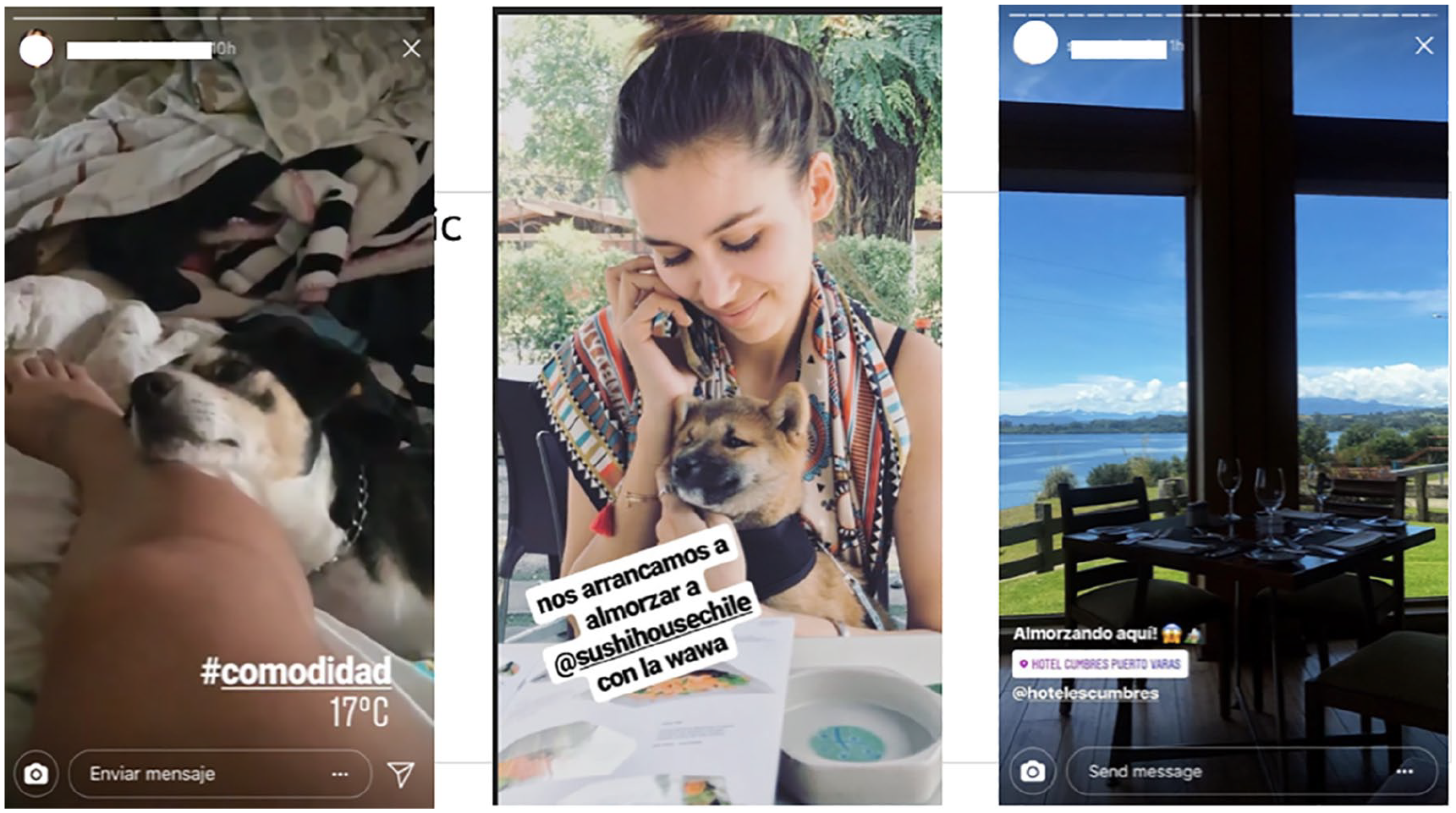
Example of a temporal Instagram story sequence from a content creator.
Feedback with and among followers has also undergone noticeable changes throughout the years. Instagram gives content creators instantaneous exchanges with their followers through direct messages or “reactions,” clearly not the time separation of comment boxes on blogs. Although Macarena considered Instagram instant messaging useful, it still takes her a couple of hours answering almost “40 direct messages daily.” Content creators feel compelled to answer all the messages as a form of “relational labor” (Baym, 2015) to sustain a relation with followers to build a career as content creators. During an interview, Carolina spoke about the number of pending messages she had in her Instagram inbox: “I just published a story and now I have nine direct messages, but I start answering them 2 or 3 days after received.” The emergence of reaction buttons across platforms such as “likes” and “hearts” facilitates quick relationships with followers and helps to resolve the burden that some interviewees feel answering messages and comments. However, creators’ sense of intimacy—in the form of quantifiable sociality through “likes” and “hearts”—may, reminiscent of Wittel (2001), move toward connective rather than conjunctive sociality.
Creators saw these burdens as part of the emergence of new platforms and platform affordances, which, together, necessitated more time in content creation regardless of the type of content. As one blogger describes, “keeping up a community is tons of work. . . I spent days writing a post and working to have good-quality pictures.” Similarly, these statements outline how bloggers invest considerable time on one or two posts per week, where that technical infrastructure facilitated slower content creation cycles.
Platform Changes as Part of Circuits of Commerce
For interviewees within circuits of commerce, new or different platforms expanded social and economic relations. Moving across platforms legitimized their position as content creators within their circuits, a practical strategy to hold their followers’ interest, inviting them to consume content at different moments and through different senses (e.g., textual versus visual, pictures versus live videos). Creators can thus offer more promotion possibilities to agencies. For instance, some explained that since Instagram is currently the most important platform for branded content, they “have to be there” to catch both the agencies hiring and content consumers, who move away from unfashionable platforms.
For interviewees, changes to platform functionalities require renegotiating relationships with audiences, agencies, and the platform itself; knowing how Instagram understands its audiences, Instagram metrics, are thus the key to maintain relationships of exchange with branding agencies, and changes in algorithms can be detrimental to their value as content creators. Similarly, changes also affect how agencies value their work by redefining the categories that represent that value. This process is described in detail by Macarena, an experienced content creator who started a blog in 2010 and then started using Instagram in 2015: People like me that create content on Instagram are characterized by the platform and by branding agencies based on the amount of followers. Thus, we are treated as “big influencers,” ‘average influencers,’ and “micro influencers.” For instance, a micro influencer has 5,000 to 100,000 followers, a big influencer has more than a million followers. When Instagram started to explode, brands were looking only for big influencers, people with lots of followers. However, micro influencers interact constantly with their followers compared to big influencers who never interact with them. Agencies realized that . . . they need consumers engaged with our content, and now agencies are giving to micro influencers more attention and work.
Interviewees feel an imperative to be flexible to learn and understand the structure, operation, and differences between the formats of each platform to maximize the followers. In this process, content creators come to realize how platforms structure access to content. For instance, Carolina was unaware of the reason why Instagram changed her personal account into a business account, allowing her to track detailed follower interactions with her content and other features. This change in the configuration of her account—according to her—facilitated different exchanges with branding agencies: If an agency asks me about the impact of my publications, I can share the report of my metrics with them and then keep talking.
However, this change also gives branding executives an opportunity to use metrics to surveil her work, not only to check if she does her job, or to evaluate the range of interactions and content reach, but also as part of the negotiations between content creators and agencies before the start of a new campaign.
Moving from blogs to Instagram requires dealing with new algorithms and interviewees reflected on the challenges posed by this. They realized how the algorithm redistributed and controlled content dissemination, encouraging them to create more content, more frequently to “beat the algorithm” and be involved in the social media platform economy. Valentina, a content creator since 2011, describes this learning process: If you are not uploading content constantly, (Instagram’s algorithm) punishes you . . . before that you upload your picture and you can see it immediately, but now depends on the number of people who “likes” the picture and my kind of followers. You can upload a picture and if I don’t “like” it maybe I will not see your content for a long time.
Content creators bemoaned what they experienced as a circuit of commerce negatively affected by algorithms, resulting in a kind of homogenization in the operation of platforms. While reflecting the findings of Scolere et al. (2018) on content creators in the United States, our interviewees lament the loss of spontaneous interactions. As Leonardo describes, “that ability can’t be bought” from platforms algorithmic configuration. For Cristina, algorithms are Instagram’s technical infrastructure to force users pay for being visible, “they manage to distribute (attention) to some people, not to all my followers . . . because they want me to pay them for being displayed in the platform.” These statements are common among content creators, where Instagram and its algorithms operate as a “socio-technical” environment that structures user experiences (Bucher & Helmond, 2018). However, content creators play the “visibility game” (Cotter, 2019) by developing strategies to understand how algorithms work-shaping platform uses and how followers interact with their content.
Conclusion
This article explored the interpretative narratives of a group of Chilean content creators as a community of cultural producers driven by internal and external commercial motives. We provided a case study for how content creators experience the transition across and within platforms—particularly given the continuing platformization of cultural production (Nieborg & Poell, 2018). Our interview data revealed that although research participants may believe the term “influencer” is externally imposed industrial rhetoric, “blogger” and “influencer” are two ontologically and temporally distinct categories for content creators in the wider context of platform ecology. Indeed, related to platform infrastructure and technical features that affect the production, distribution, and circulation of content.
Content created for different platforms is subdued to any mobilization of entrepreneurial and authentic ethos (Duffy, 2017) as activities increasingly become “platform dependent” (Nieborg & Poell, 2018). This dependency relies on the fact that content circulation and visibility are subject not only to the terms and conditions of a small group of platforms (e.g., Blogger is owned by Google, Instagram is owned by Facebook), but also to algorithmic infrastructures. Thus, content creation is “contingent” upon platforms conditions for distribution, analysis, and re-circulation (Morris, 2015). This dependency—according to our interviewees—also reinforces creators’ constant presence online, particularly in the case of Instagram Stories.
Bucher and Helmond’s (2018) “platform-sensitive approach” was used to describe how creators experience platform changes. The different technical possibilities of each platform, tend toward “circuits of commerce,” structure, and organize how creators behave and understand themselves as a community of cultural producers. Platforms’ new features like Instagram Stories, as well as Instagram’s algorithmic configuration, reinforce the commercially driven character of content creators’ activities. Thus, when platforms and creators seek profit through their activities online, all content creations take on new meaning in the context of social and commercial relations with other actors (e.g., branding agencies, followers, and platforms itself). Moving their activities from blogs to Instagram to Instagram Stories moves their goals from mostly identity construction and representation (Rocamora, 2012) to mostly dealing with platformization as a structural organization for commercial communication. Indeed, the emergence of platforms, features, and algorithmic configurations reinforces such commercial aspects in creator activities. Furthermore, they feel compelled to understand those changes, to adapt their activities to this new ecology, and to develop competitive strategies within it to profit from their activities. In addition, such changes and configurations are not just isolated technical features: they are social and economic relations —or circuits of commerce (Zelizer, 2011)—through which the activities of creators are constantly negotiated and subject to valuation by different actors (branding agencies, platforms, audiences, and creators). In this context, creator activities are shifted away from creation, toward competition, in a constantly changing technological, social, and commercial ecology.
In that sense, we identified three categories through which platform evolution has affected Chilean creators. First, transitions emerged as moments when creators became self-reflexive of platform-dependent communication styles, especially regarding the supplanting of textual with image-based communication. As the case of Instagram Stories attests, creators transitioned to becoming part of their own content creation, sharing more mundane moments of their everyday lives. Where fashion was once the entry point into content creators’ lives, it is now their life as students, their work environment, meals, and random thoughts—embellished by the use of emojis, stickers, masks, and other editing tools—that serve as raw material for content. Second, changes redefined creators’ sense of temporality; more specifically, platform-dependent demands for content creation across blogs, Instagram, and Instagram Stories entailed more demanding and exhausting routines to achieve cross-platform presence or visibility. Third, in the case of Instagram, the emergence of content visibility algorithms, and changes thereto, impacted content creator activities by re-organizing relationships among branding agencies, followers, and platforms and the categories through which content creation is valued in such circuits of commerce; and by demanding creators practice different strategies to play the “visibility game” as a form of resistance to algorithmic architecture (Cotter, 2019).
In summary, creators, as professional cultural producers, are at the forefront of how we understand the commercialization of visibility and reputation in the attention economy (Hearn & Schoenhoff, 2016). Being a professional content creator means trying to make a living by creating content constantly across different platforms, learning how to deal with new technical configurations and algorithmic architectures, and negotiating their identities as part of circuits of commerce at the expense of maintaining a community of followers around themselves, their activities, and their branded content. Further studies may analyze how creators deal with newly automated technologies that potentially challenge their activities as cultural producers. Indeed, in the constantly changing technological ecology—up to and including the emergence of artificial intelligence—creators have here been shown to be the bellwether for susceptibility to the interests of different actors in circuits of commerce (e.g., commercial demands and market valuations).
Footnotes
Acknowledgements
The authors would like to thank Brooke Duffy for her editorial guidance, the anonymous reviewers for their productive recommendations, and the participants in the Platformization of Cultural Production workshop for their invaluable feedback.
Declaration of Conflicting Interests
The author(s) declared no potential conflicts of interest with respect to the research, authorship, and/or publication of this article.
Funding
The author(s) disclosed receipt of the following financial support for the research, authorship, and/or publication of this article: The authors would like to acknowledge that financial support for the writing of this article came from Comisión Nacional de Investigación Científica y Tecnológica (CONICYT); Fondo de Fomento al Desarrollo Científico y Tecnológico (FONDECYT grant number: 11150095).
