




Abstract
Since its invention, photography has always maintained a close relationship with the concept of preserving memory of the past and stopping the passage of time. In the digital age, this function is influenced by the arrival of the internet, social media platforms, and smart phones. Considering recent technological developments, this article explores the practice of photosharing on Instagram and how this popular platform is changing the way people think about and practice visual remembering. To do so, this article explores these issues qualitatively, using netnography, computer-mediated interviews, online participant observation, and visual content analysis. Findings show that digital photography does not walk away from its traditional function of maintaining memories of the past—instead new and creative practices have developed. In allowing users to share visual narratives, Instagram has led to the creation of “networked archives” of both personal and collective memories.
Introduction
Throughout history, thinkers and philosophers have investigated the concept of time in numerous ways, from the perception of the flow of time (Bergson, 1911) to the correlation between time and memory (Joyce, 1975; Proust, 1913–1927), and its relativity (Einstein). The invention of photography marked a turning point in the way people thought about the flow of time, specifically of how the memory of the past is maintained because of its capacity to transform happenings into objects. These traces, as Barthes (1980) defined them, certify the existence of what they represent, that is, that a certain event (represented in the photo) really happened during a precise moment of the past (Barthes “has been”). Initially, photography was considered mostly a practice restricted to family remembrance: a cultural ritual connected to family roots and belonging to the family’s pastime (Sontag, 1979). Shortly after its invention, photography turned into a popular communicational channel and started to incorporate other functions, such as documenting, informing, and promoting social life (Wells, 2017).
In On Photography, Susan Sontag (1979) explored what she termed the remembrative function of photography in mass culture (i.e., it facilitates memory). Throughout her collection of essays, Sontag emphasized the function of photographs as melancholy objects that hold distance in term of space and time with the subject/s photographed. In fact, the distance produces an effect of melancholia given by the absence of something or someone. In particular, the experience of melancholia in relation to photographic objects referred to images that were experienced as separated from the actual reality. In Sontag’s (1979) argument, photographic objects replace a certain absence, and so, therefore, they are potent tools to evoke emotional responses. Photographs, as emotional bridges between the past and the present, were also helpful ways to tell people’s stories and to maintain connections with what was temporally and/or spatially distant (Sontag, 1979).
With the arrival of digital technologies of reproduction, the conception of time is subject to further considerations. The simultaneity of communication and instantaneity of content sharing afforded by digital technology were initially thought of as the main characteristics that were changing the perception of the flow of time. For example, writing about telecommunications, Castells (1997) advanced the idea of “timeless time,” arguing that the experience of time was changed radically as a result of interactions with new communication technologies. In this phenomenon, new digital technologies were responsible for breaking down our embodied sense of time, as well as its chronological progression. This fluid approach to the flow of time is relevant to the use of social media and the associated alterations in content sharing and content management.
For generations, people have stored memories in photo albums, diaries, and shoeboxes to retrieve at a later moment in life. In the digital age, these practices have undergone substantial changes. Digital cameras, smartphones, tablets, and computers quickly replaced analogue equipment, extensively changing the means of capturing, sharing, and archiving photography. In line with these developments, scholars have started to reflect on the values and meanings of what happens to our memories in this digital environment. For example, Van Dijck (2007) has argued that photoblogs, photosharing applications, and social media platforms started to affect people’s approach to remembering things from the past and their use of memory tools. Others have shown that advances in digital technology have had a significant impact on the way people interact with each other (Ellison et al., 2007), share information (Anderson, 2013), build their self-identity (Turkle, 1997), and experience new marketing strategies (Ryan & Jones, 2016). Similarly, the use of photography and the practice of photosharing constantly changes, influencing the ways in which people tell stories (Balabanovic et al., 2000), maintain social relationships (Serafinelli, 2017), and represent themselves (Van House, 2007). Thus, the use of digital technologies and the internet has myriad effects on social and cultural practices. For example, even the concept of memory and the use of photography as mnemonic resource (Keightley & Pickering, 2014) have witnessed significant alterations due to the increased use of camera phones (Van Dijck, 2008) and photosharing sites like Flickr (Van Dijck, 2011).
Following in the footsteps of previous studies that have investigated the relationship between photography and memory, this article contributes to the existing literature exploring whether and how the use of mobile technology further shapes new ways of remembering. This discussion does not aim to explore issues related to the ephemerality of memory in the digital age (Ibrahim, 2018). Rather, it focuses on the analysis of the practice of photosharing on Instagram. It explores the ways and extent to which Instagram, through its various functions (e.g., hashtags, geo-tags), is guiding users to develop new creative ways of maintaining visual memories and managing the flow of time.
Photography in the Digital Age: Online Photosharing
Throughout the history of photography, advances in digital technology have had a profound impact on people’s perspectives on and use of photos. The propagation of smart mobile technologies allowed users to take photographs anywhere and at any time, making possible the creation of what Huang and Hsu (2006) defined as digital personal daily memories. The mobility of new devices allows people to capture their everyday activities, events, and friends in order to preserve moments of their past. The subsequent practice of photosharing online is the act that lets them engage with, produce, reproduce, and invest meaning in their memories, whether personal, cultural, or collective.
As everyday memories can occur anytime and anywhere, the mobility of digital technologies can become a significant element in how they are experienced and captured. For example, Olsson et al. (2008) conducted an empirical study of mobile platforms to explore people’s behaviors with managing and sharing everyday memories. With the growth of online sharing platforms, digital memories are supplemented by context-related information (i.e., metadata). Therefore, the presence of tags, geo-tags, and hashtags also become part of digital memory sharing. These markers help users to consider the management of their everyday memories in a more structured way (Olsson et al., 2008). These online memories are usually motivated by personal growth, identity construction, the strengthening of social ties, the expression of self, and getting attention from others, and are mainly clustered into three classes: details to aid in taking care of errands (short term memory), happy moments, and life history (long-term memory). Olsson et al.’s (2008) study showed that what motivates people to share their everyday memories online diverges from the traditional functions of photography. Instead, everyday memories shared through mobile technologies are used for both maintaining memories of the past and producing emotions to share with others, adding social and affective dimensions to the practice of remembering.
Online photosharing is often guided by the technique of (visual) storytelling. Huang and Hsu (2006) recognized in the practice of photosharing the most effective way to translate daily happenings into life stories. They argue that “every photo tells a story. A collection of photos may tell a more interesting story spanning across time, location, and people” (Huang & Hsu, 2006, p. 1). Their study explored the increased use of visual memories online confirming users’ tendency to use social media platforms and mobile technologies to manage their life memory. This approach gives rise to what Van Dijck (2008) defined as “distributed memories.” Such memories are distributed across devices and platforms as a way to further enhance communicative mediated experiences.
This context of mediation establishes a new dynamic between digitality and memory that Van Dijck (2008) theorized as “mediated memories.” Van Dijck defined mediated memories as “the activities and objects we produce and appropriate by means of media technologies, for creating and recreating a sense of past, present, and future of our selves in relation to others” (p. 27). This definition highlights the progressive inclusion of digital technologies in support of memory maintenance, taking the place of previous material ways of remembering (e.g., printed photos and photo albums). In particular, this progression can be observed in the use of social media where the collection of everyday experiences takes the form of digital diaries, photo streams, and photo galleries, just to mention few, which are often made available to other users.
Moreover, throughout a prominent part of Van Dijck’s (2008) work, the connection between the preservation of memory and the construction of self-identity is a constant phenomenon of this medium, together with other commemorative functions. In fact, mediated memories play an important role in the construction of individual and collective identity as “they are creative acts of cultural production and collection through which people make sense of their own lives and their connection to the lives of others” (Van Dijck, 2010, p. 262). Digital technology sees people identifying more as active producers and collectors of their personal mediated memories.
However, in the same context of digital transformation, Hoskins (2009, 2011) questioned the idea of collective memory, introducing the terms “networked” (Hoskins, 2009) and “connective memory” (Hoskins, 2011) to describe the changes that technology and media brought to the structure of traditional memory systems (such as archives). The digital turn has also meant that memory is now structured within digital networks and is fundamentally based on the relations between human and technology. The notion of networked memory helps to describe people’s ways of sharing memories within digital environments. In this sense, Hoskins (2009, 2011) expanded Van Dijck’s (2007) concept of mediated memories, arguing for a new mediatised age of remembering.
Hoskins (2009) proposed the term “new memory” in the context of digital temporality because of its continuous state of alteration and update. In fact, he used the metaphor “on-the-fly” to describe this new memory as progressively and constantly changeable. Hoskins discussed the visual and aural immediacy of mass media (the television broadcast), arguing that they guide us toward a continuous state of present. In conjunction with this, he described the internet as a “temporally dynamic networked archival infrastructure” (p. 98), which brings into consideration a different mechanism of memory management where digital objects might always be altered, changed, updated, and, therefore, ephemeral. Hoskins’ (2009, 2011) reflections are innovative in highlighting the rise of a type of memory characterized by dynamic interactions between past and present. He proposed rethinking memory in relation to the ubiquitous state of permanent connectivity afforded by the internet, social media, and smart technologies.
In addition to this approach to online memory as a dynamic connection between past, present, and future, Van Dijck (2011) remarked on the importance of connectivity in shaping new social uses of visual memories online. Analyzing Flickr and its functions, Van Dijck (2011) emphasized the capacity of platforms to work as memory tools. She conceptualized the platform within a connective environment where using the adjective “connective” rather than “collective” seems to offer an adequate description of the progression of mediated ways of remembering. Considering the shift from the idea of collective memory to connective memory, the interpretation of social media platforms brings to the surface a more dynamic and socially engaging view of remembering that is reminiscent of Sturken’s (2008) idea of memory as active practice. This arguably changes the way social media users think and relate to their online memories.
Overall, a critical analysis of the literature on memory in the digital age shows that technological advancements are generating new ways of managing visual memories across devices and platforms, having a profound effect on social practices. Initially, the instantaneity of new communication technologies seemed to declare the end of melancholy (Sontag, 1978) due the use of photography as means for instant communication (Keightley & Pickering, 2014; Van Dijck, 2008). However, the relationship between photography and its function as memory keeper remains a strong constant. Instead, alterations occur in the ways social media platforms’ functionalities encourage users to develop new forms of managing and experiencing their visual memories. In fact, through the ubiquitous use of smart mobile technologies photographs become personal daily memories (Huang & Hsu, 2006), taken anytime and anywhere (Olsson et al., 2008) and shared across platforms with the intent of creating new connective commemorations (Hoskins, 2009, 2011).
Methodology
This study employs a qualitative approach informed by netnography (Kozinets, 2015), online participant observation (Kathleen et al., 2002), computer-mediated interviews (Curasi, 2001) and visual content analysis (Van Leeuwen & Jewitt, 2000) to explore the practice of online photosharing and, specifically, whether and how Instagram is facilitating new ways of maintaining, sharing, and archiving visual memories.
To explore the online exchange of photographs, this study followed and adapted traditional ethnographic procedures to a netnographic approach. Netnography is a qualitative online research method usually employed to analyze social interactions in digitally mediated contexts (Kozinets, 2015). This methodological approach was originally developed to investigate cyberspace. Subsequently, social scientists realized that integrating the internet and computer-mediated communication in their research was crucial to properly comprehending contemporary social and cultural practices. Thus, netnography was used to define the context of the present analysis and to critically explore the practice of online photosharing.
The fieldwork was conducted entirely online. Since Facebook bought Instagram (April, 2012), there has been a substantial growth of “Igers” (Instagram users) groups on Facebook, typically categorized by country or city (e.g., Igers London and Igers Italia). As the aim of the data collection was to gather active Instagram users, the call for participants was spread across Igers groups on Facebook. The target population of the study was active Instagram users with a smartphone, without any restrictions in terms of gender, age, race, or other demographic characteristics.
A sample of 44 Instagram users took part in this study. About 29 participants were interviewed via Skype and 15 participants responded to open questions sent via email. Participants were asked whether and how Instagram was changing the ways they capture, share, archive, and think about visual memories. They were also asked to compare the ways they were using the platform in relation to other storage systems, such as computer folders, external hardware, and memory sticks. A computer-mediated interviewing technique was used to adhere to the principle that to explore an online phenomenon, it is preferable to use a research method that imitates the natural setting of the investigation (Geiser, 2002).
The research method design of this study followed the notion of visual ethnography that Pink (2007) advanced in relation to qualitative social research. Pink (2007) argued that in social science, there is often the criticism that the analysis of images alone does not provide clearly understandable or useful findings. Pink referred to intangible elements such as emotions and feelings, social relations, and power dynamics. Because of the importance of these data for the critical analysis of visual content, Pink emphasized the necessity to contextualize verbal discourse and other forms of knowledge alongside the visual elements. Therefore, in this study, interviews and visual materials are analyzed together.
Participants were asked to complement and support their interview responses by providing concrete visual examples. Then, their responses and their photosharing activities were compared at the data analysis stage. Participants that agreed to be interviewed via Skype were asked to provide their Instagram nickname to be observed (followed) online by the researcher. Given the abundance of visual content, visual data collection was limited to 2 months for the 29 participants who responded to the in-depth interviews. For the 15 participants who were interviewed via email, only the visual examples they specifically mentioned were considered. No textual comments or other personal data have been collected.
The analysis of participants’ photosharing substantially enriched the findings. Visual data provided additional insights on the dynamics and types of interactions among users and ways of communicating visually. According to Kawulich (2005), the technique of participant observation allows the researcher to check definitions of terms that participants use in interviews; observe events and situations that participants explain; and, eventually, evaluate distortions or inaccuracies. Observing participants’ photosharing for 2 months provided a better understanding of the general context of interaction (Instagram) and the phenomenon of study (the practice of photosharing). To observe participants’ photosharing, participant observation (Gold, 1958) was identified as the most suitable stance that enabled participants’ photosharing to be examined within the Instagram platform.
The data analysis consisted of a critical response analysis of participant interviews and a visual content analysis of their photosharing. Following Rubin and Rubin (2005), participant interviews were thoroughly compared. The analysis looked at the frequency of concepts that were directly or indirectly mentioned during the interviews and also at the emergence of common patterns and/or themes that could suggest new concepts, symbols, and stories. Subsequently, participants’ photosharing data were interpreted through the classification of visual content and the contextualization of participants’ communicative acts (Bowler, 2010). The analysis of participants’ visual content was employed to understand the characteristics and meanings of images and how they were communicated. Moreover, this study employed Kress and van Leeuwen’s (2006) method of visual content analysis to provide the appropriate framework for a descriptive analysis of the photographs. In this, a qualitative approach determined common visual elements, reduced the number of visual elements into thematic groups (using keywords), and interpreted the predominant visual content within the thematic groups to identify accurate patterns.
The combination of computer-mediated interviews and photosharing content analysis was chosen following Pink’s (2007) argument in Doing Visual Ethnography that images alone do not reveal the same complexity of information and meaning that they can confer when linked to other types of knowledge, which, in this case, was participants’ perspectives on their practices.
Networked Memory on Instagram: Online Photo Archives
Before the development of digital technologies, photographs were generally stored in photo albums or in shoes boxes, while nowadays visual memories are located mainly within digital archives and online photo albums. In this shift, participants perceived the solidification of memory through the mediation of social media as a natural continuation of human literacy and adaptation to new technologies, in line with McLuhan’s (1964) prescient analysis.
For example, Rich, an American journalist in his 40s, believes that the passage toward digitality is amplifying the remembrative foundation of photography. Similarly, the majority of other participants also showed a positive consideration of digital photography as memory keeper and they described the attachment to images that they share online with strong empathy. In particular, online photosharing was intended to give additional validation to the subject/s portrayed. Since the partnership with Facebook, Kevin Systrom (Instagram CEO) described Instagram as a photosharing application that allows its users to share creative artwork, connect and keep their memories—using the present tense. This grammatical choice of words gave the sense that nowadays photography and photosharing allow the maintenance of social relationships through visual memories.
Instagram by definition is structured to function as an instant photosharing mobile application. However, it has feeds that simplify and support the exchange of visual memories. Instagram presents a simple interface and organization of photosharing. As can be seen on the “home page,” when users upload images, the latter are going to be part of a publicly available stream of photos (if users do not decide to set up a private account). They appear within the “home page” as a flux of images that follow the chronological order of their upload. In addition, Instagram has hashtags and geo-tags as a way to organize photographs. These are useful to group photographs under specific labels (hashtags) or specific locations (geo-tags). These two feeds are considered by users an important apparatus to group and divide public and personal images. In addition, they facilitate users in the research of specific content.
Instagram does not allow users to save photographs within thematic folders and this can be seen as a confusing archiving system. Popular hashtags and geo-tags, such as #newyork, #party, and #friends might group thousands of images that complicate more specific searches. When users intend to find an image, they need to search using the “find” tool for a specific hashtag or location to have access to a restricted group of photographs. Considering the high number of photos and the publicity of the platform, customized hashtags are often used to group personal memories, as several participants reported.
In relation to this practice, Alessandro, an Italian digital strategist in his early 40s, described the use of hashtags and geo-tags to store images, pointing out that using #barcelona2012, for example, to label personal holidays is pointless because it is a general hashtag that is likely to be used by other users as well. He believes that if he uses a personalized hashtag, it is not going to be used by anyone else. In that way he is sure to find easily only his photos. From this response, it can be seen how the hashtag apparatus is considered an efficient way of organizing and archiving that allows users to use the platform to collect images in a customized categorization. Alessandro, describing the practicality of hashtags, said that with his girlfriend they have created a hashtag to find all photos that they shared when they were in Barcelona on holidays with a couple of friends. They were collected under a unique customized tag that they have created for their Instagram memory book. Alessandro emphasized that Instagram gives him the possibility to keep and virtually share photos with a customized use of hashtags with those friends that know the hashtag. The story of his holiday in Barcelona shows the intent of creating a memory book shared among friends, reminiscent of the concept of networked memory advanced by Hoskins (2009). At the end of their holiday, indeed, they decided to collect all their best photos under the same hashtag and this allowed them to access the photos individually even after their return.
On the contrary, a less personalized use of hashtags gives a wider access to photos that can be used to share collective memories. Other users would not be interested in Alessandro’s holiday in Barcelona specifically. They would rather be keener to see images of Barcelona from a more general perspective. An example of this can be observed in Giampiero’s experience, an Italian computer engineer in his middle 40s. The Italian Brigata Ariete (Aries Brigade, my translation) contacted Gianpiero to do a pre-established media tour organized with other photojournalists. He went to Lebanon between June and July 2012 to document the Italian Army’s experience and share on Instagram the first Italian #InstaReportage. According to Gianpiero, the purpose of that request was to tell the story and evoke the lived experience in Lebanon through the eyes of an amateur photographer. In this case, the use of Instagram shows the progressive interest in the platform also as a means of communication. Gianpiero decided to use an easy recognizable hashtag #lebanonmediatour to collect all the photos he took there. Consequently, the photos were easily and widely accessible as an online collective memory book.
The connection between hashtags and visual collective memories was expressed in term of potential future access. Gianpiero described this in bringing as an example a photo he posted in 2014 but took in 2012. He posted the photo with the caption: “A boy in #Naffakhya. Memories from my #LebanonMediaTour, July 2012.” Using the original hashtag, he aimed to encourage users to search for that hashtag and to go back to all the photos collected 2 years earlier. He used this technique as a commemoration of the “Lebanon Media Tour” (See Figure 1).

A boy in #Naffakhya. Memories from my #LebanonMediaTour, July 2012.
As can be seen, Gianpiero played with the use of hashtags and the principle of connectivity (Van Dijck, 2013), creating a digital networked memory book that has been shared collectively allowing users to get access to both the commemoration (present) and the photo shared initially (past).
Memories of Emotions and Journeys: Instagram as Mobile Memory Tool
Emotional involvement with events, scenes, and objects is widely reported by participants as what motivates them to share their visual memories on Instagram. They recognize such images as integral facetsa of their lives and, consequently, as worthy of being saved. Giulio, for instance, an Italian University student in his early 20s, explained his connection with the platform by describing Instagram as both the photographic story and archive of his life. From this response, Instagram again emerges as a means to maintain memories, as Van Dijck (2008) argued in discussing the related functionality of other platforms. Giulo’s use of visual storytelling is combined with the ability of social media to manage and share stories. The empathy he has with the photosharing was given precisely from his use of the platform as a daily memories keeper.
Relatedly, Giulio stated his emotional engagement with Instagram photosharing based on the differences between the photographs taken with a camera and those taken with a smart phone. He stated that his Instagram account collects all visual memories of situations connected with his emotions. Whereas the folders that he has on his computer are more visual records rather than emotive stories, that is, photographic narrations of events he has been part of. The emotional attachment described by Giulio with Instagram was reported by other participants as well. The majority of them commonly agreed that sharing photos on Instagram gives emotional validation to the scenes portrayed.
The act of sharing photos seems to determine the significance of the moment that was captured in the image, testifying to the importance of making a mental note of it instantaneously. For instance, Moritz, a German management assistant in his middle 30s, described the emotional attachment toward his photosharing by saying that the photos he posts on Instagram are those ones he wants to share the most; those through which he wants to express “the emotion of the moment.” His definition of a photograph as “emotion of the moment” is similar to what Deleuze (2005a, 2005b) defined as “affection image,” which in cinema studies explains the way the subject experiences events from inside, between one image and another one. This can be expressed through faces but also through spaces using colors, lights, and shapes. Indeed, Moritz’s sharing is formed mainly by landscapes, architecture, and food. Even without sharing convivial moments or portraits, he stated an emotional involvement with his photos. This shows that shared photographs acquire importance as much for the moments that they remember as for the subject portrayed.
Moreover, photosharing gives validation to moments and emotions for the production of future memories. As Van Dijck (2008) argued in discussing the concept of cinematic hindsight, people capture moments of their lives to have memory of specific moments in the future. This approach happens in the present but is projected toward the future. In relation to this, the majority of participants declared that the range of photographs that they decided to share on Instagram carry emotions that they intend to keep for a long time. For instance, Nicola, an Italian web marketing consultant in his late 30s, stated that capturing and stopping the time in a precise memory reminds him of what the person in the image was doing and who that person was with in a sort of “digital romanticism.” His use of the term “romanticism” illustrates the emphasize on emotions and individualism as well as the glorification of the past, harking back to the “romantic” artists and intellectuals of the 18th century. These images are also used as a means to visually freeze emotions that cannot be communicated verbally, adding further layers of interpretation. Participants reported that Instagram users often employ editing applications and filters to let emotions surface more explicitly from their images. This was particularly evident in Gianpiero’s experience in Norway. During a cruise around the Fjords, he described his visual experience and his intention to portray that scenario, trying to include in the photographic frame the emotions that he was experiencing in that moment.
Only three participants claimed no connection between their photosharing, emotions, and visual memories. This assertion emerged from the fact that these participants share mainly images that (as they stated) do not have any involvement with their personal life (Figures 2 and 3 are examples of this). Uwa, a German statistical researcher in her 40s, for example, described her style, visible in Figure 3, as urban photography. Urban photography is a popular style that documents contemporaneity, attempting to capture everyday life that generally includes city skylines, metropolises, architecture, and people.

Urban architectures.
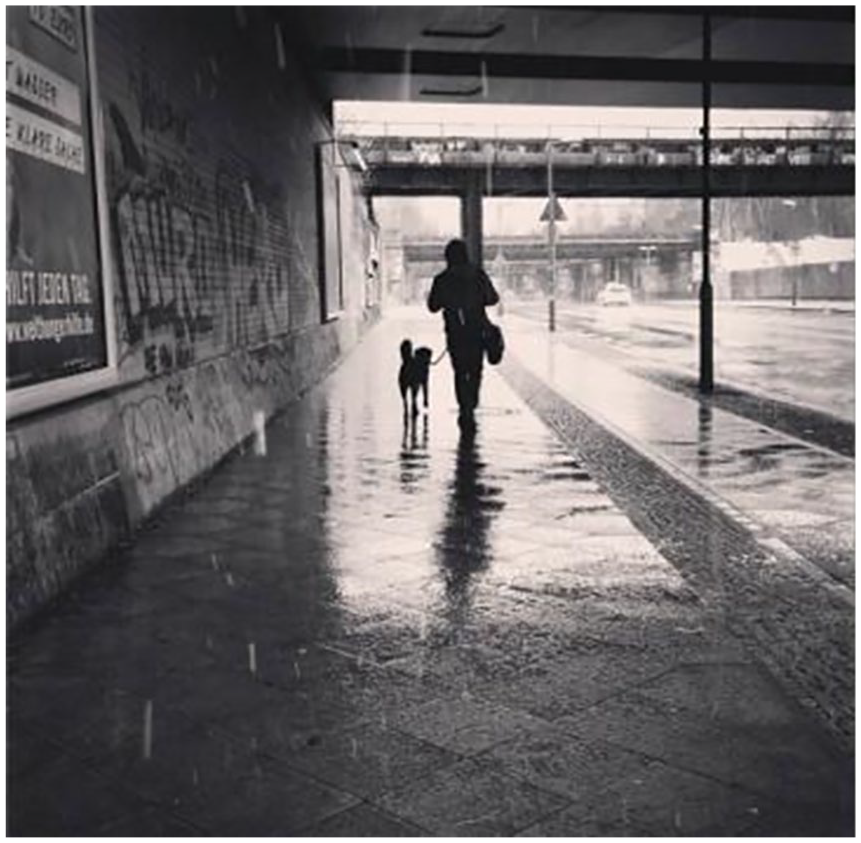
Urban cityscape.
Similarly, Andreas, a Danish University student in his 20s, did not report any emotional engagement with his photographic production. He identified himself as press photographer. Similar to photojournalism, it is a type of photography that tells a news story through images. Because of his job, he does not feel the need to maintain memory through his photosharing. Because of the nature of their photographic style and work, and in contrast to the majority of participants, neither Owa nor Andreas had any interest in keeping memories of their photos for the future.
Historically, one of the main applications of photography was for documenting the unknown, hidden, or difficult-to-access places to share images with those who are otherwise unable to travel and see the world. Even now, in combination with a continuing desire for worldly knowledge, photography is used to maintain memories of what could potentially disappear, such as natural and cultural heritages. Both these motivations, widely discussed by Sontag (1979) in her seminal essays, are still vibrant and strongly connected with the theme of journey. Indeed, those who share photographs are often interested in sharing and remembering the experience of traveling. The mobility of smart phones undeniably facilitates the documentation of journeys and gives people the possibility to photograph new scenes “on the move,” as Moritz claimed. This suggests that the element of mobility is crucial to capturing new visualities that, in turn, people are more willing to preserve and share.
The majority of participants mentioned the relationship between photography and memory in reference to their travels. The theme of journey is not new. It has a constant presence throughout the entire history of photography. While photography was originally experienced in situ, with subsequent technological developments and the recent arrival of smart phones, the link between photography and travel found its completion. This was supported by the participants, who confirmed that they regularly document and keep memories of their explorations. Travelers and commuters described common behaviors and visual themes in photographing their surroundings. In addition to images of the new or the other, traveling with a smartphone brings the new theme of waiting. During their travels, participants reported that they usually photograph particular scenes in relation to the place that they are visiting, producing touristic images (Sheungting et al., 2011). In addition, they described that the waiting periods that are typical of public transportation systems facilitate the production of photographs. This produces a range of images that are not part of the traditional traveler’s journal. This can be observed through the series of photos at train stations (Figure 4 is one example) shared by Mimmi, an Italian University student in her 20s, using the hashtag #DietroLaLineaGialla (“behind the yellow line,” my translation).
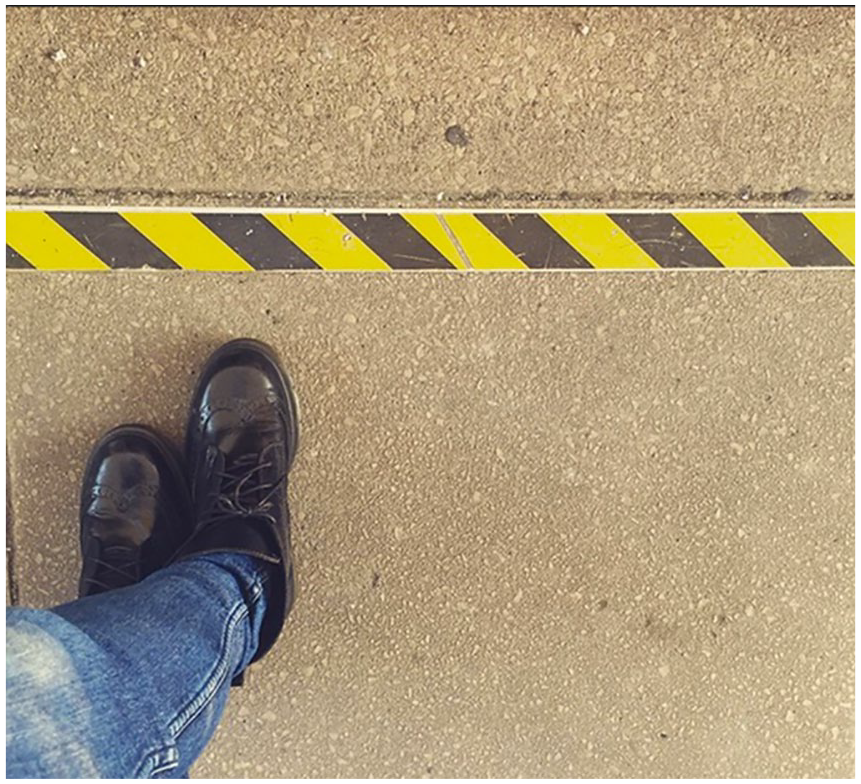
#dietrolalineagialla. Behind the Yellow Line.
In the same way, Emanuela, an Italian social media manager in her 20s, believes that the use of Instagram to maintain memories is particularly effective for travelers. Nowadays, she thinks no one prints photos anymore and that users believe that if they do not share photos immediately, the photos will remain within their hard disk and no one will ever see them again. This is what, according to Emanuela, makes Instagram a digital memory box, reminding us again of Van Dijck’s (2007) idea of mediated memories. For Emanuela, sharing images online is tantamount to “keeping memories alive.”
Similarly, the majority of participants consider Instagram to be the new mediated memory box of their travels. Following this approach, sharing photos becomes synonymous with keeping memories. For example, Nicola thinks that sometimes he is a bit naïve when he shares photos. He does not think about his followers and their thoughts about his photo stream. He sees Instagram as part of himself, like his personal memory box. He is aware that it is visible to many people, yet he feels compelled to share images and so he does. Despite the fact that followers can see people’s personal memories, in many cases users still share their private images because they use Instagram as their digital memory box.
However, the majority of participants think of Instagram as a photosharing platform for uploading high-quality images that others will see. This perspective affects their sharing of memories. Therefore, only a considered selection of visual memories are actually uploaded. The careful photosharing that participants operate guides them toward the upload of what the majority of them defined as their best memories. This makes photosharing on Instagram a series of ‘selected memories’—a process of socially visible curation (Cassinger & Thelander, 2015).
Instagram has a feed that allows users to tag photographs geographically and gather them on a world map (Photo Map) that showcases the places where photos have been taken. Participants described this as one way they organize their visual memories. The most frequent explanation participants gave of the use of geo-tags was as follows: “So, I will remember where I have been.” In combination with the use of hashtags, geo-tags represent a supplementary useful way to structure visual memories by location. Sharing images on Photo Map, indeed, gives the precise documentation of places and scenarios that users have seen. For instance, Andreas uses geo-tag considerably. He said that if he has a new spot and he knows he is going there for a photoshoot, he will take his camera with him to take high-quality pictures to be uploaded on his personal blog. When he is on the spot, he takes pictures with his phone as well to document, through the geolocation, where exactly he was when he took those pictures.
Even Photo Map is considered a helpful means for remembering by location. Mimmi, for example, commutes every day to go to the University from Pisa to Milan. She admitted that, since traveling has become part of her daily life, she photographs much more compared with the past. Visiting different places pushes her to take more photos capturing different perspectives. Her hometown does not give her stimulus to take many photographs. In her opinion, “except if the Tower of Pisa falls down,” there is not much to capture in Pisa. This is the main reason why she finds traveling a good incentive to keep record of different experiences. She described the connection between the use of Photo Map and her visual memories saying that the map feed gives her the opportunity to see, for instance, that in Milan she took 190 photos. This helps Mimmi to remember that in the last year or two she went to certain places. As other participants also reported, Photo Map is widely used as a “voluntary memory” (Proust, 1913–1927) activator where images remind users of memories of the past via clusters of photos organized by location.
Following the techniques used by the participants to cluster and categorize their photographic memories (customized hashtags and geo-tags), it can be seen how Instagram becomes a digital visual memory archive. Even if all participants agreed with the use of Instagram to maintain visual memories, the idea of using Instagram as an online archive divided the participants. On one hand, positive responses came with the idea of selecting their best memories. Meanwhile, negative responses emerged with the anxiety of losing memories because of the ephemerality of the internet. For example, Euge, a young woman living in Bologna and passionate about social media, described the way she archives photographs, saying that Instagram is enough for her as it is her unique archive. Similar to Alessandro, Euge emphasized the fact that she is not interested in the quantity of photographs, as she prefers to choose a select few (perhaps out of 300 photos of a trip). From Euge’s response again emerged the tendency to prefer selected memories and to combine memories and travels, which is consistent with the theme of the travelog and the technique of visual storytelling often explored in popular uses of photography (Van House et al., 2004).
Participants keep memories of their travels to have a personal visual diary of their experiences. For example, Mimmi described her spontaneous archiving, bringing as an example something that happened to her once when she was photographing a shoe. She was in London and observed a shoe she liked a lot that was lying on the ground. Spontaneously, she photographed it and posted the image on Instagram because she really wanted to remember it forever. The memory of her phone was full, so the only way to save that image was to share it online. In this case, Instagram represented the container of visual memories precisely in the way Van Dijck (2008) described people’s use of digital technologies for future memories. Mimi wanted to preserve her memory of that shoe in London forever.
Despite the majority of participants considering Instagram a useful archive for personal memories, some reported its limitations—the lack of family photography, for example. The majority of participants, indeed, did not mention family images in their daily photosharing as they tend to protect private environments and their loved ones from the publicity of the platform. Marwick and boyd’s (2011) concept of “context collapse,” which describes how social media collapses multiple audiences into single contexts, can help to explain why this is the case, as users find it difficult to appeal to different audiences simultaneously. Considering this general lack of family photography, Instagram was described as a limited archive. Whether many participants considered the selectivity a positive practice to restrict the sharing to a few high-quality memories, for others this restriction had a negative connotation. For Mary, a Finnish publisher in her 40s, for instance, the selectivity forces her to keep intimate and personal images (like family photographs) away from the platform. A major part of her memories is missed out, and therefore, Instagram cannot be considered a complete archive.
Instagram for Collective and Connective Memories
If the publicity of the platform was considered a limitation for the sharing of personal and private memories, it is instead considered (precisely because of its visibility and publicity) an effective channel for sharing collective memories. Mary, for example, felt that Instagram is not an archive for her in the traditional sense, but comes into its own as an archive of big events. Similarly, Moritz believed that from an intellectual point of view, Instagram is an archive as there are many images and stories of people that is worth keeping for future interest. He stated that in 2100, it would be interesting to reflect on what 2011 really “looked like.”
A relevant example of how Instagram can be considered an effective communicative channel for collective memories can be observed in the photographic project ‘Law and Disorder: A People’s History of the Law in Pakistan’ carried out by the journalist Asim Rafiqui (interviewed for this study), an independent photographer who was awarded a 2015 Magnum EF Grant. Through this project, he aimed at experimenting with innovative forms of narratives on Instagram under the name of @pakistanjusticeproject. This work is an individual’s exploration of the state of law in Pakistan. Covering a vast area of the nation’s social and economic geography, Asim’s work intended to turn the public’s gaze to the lived realities of some of Pakistan’s most marginalized and impoverished communities. His photosharing explored how social and economic injustices and inequalities were a result of specific political and economic design.
To accomplish his innovative work, Asim approached Instagram as his personal daily diary without following traditional forms of documentary photojournalism. Asim’s main idea was that his Instagram followers could, by clicking on the links he was sharing in the captions, go to the official project website to reach more information about his portraits and related stories. On the @pakistanjusticeproject Instagram account, each photo has a brief description in the caption that aims at arousing users’ curiosity to move to the official website. Similar to the technique of selecting visual memories that is adhered to by many participants, Asim intended to develop a selection of images and stories to facilitate the consumption of information for readers/viewers. Through this project, Asim was trying to give readers a consistent bite-sized user experience. Therefore, instead on 1,000,000 different images in 100 days, he was giving to his followers 100 photographs in 100 days, and every photograph was bite-sized. Through this selectivity and timescale, he was hoping to put his followers in a constant state of thought and in the condition to remember every single image (see Figure 5).
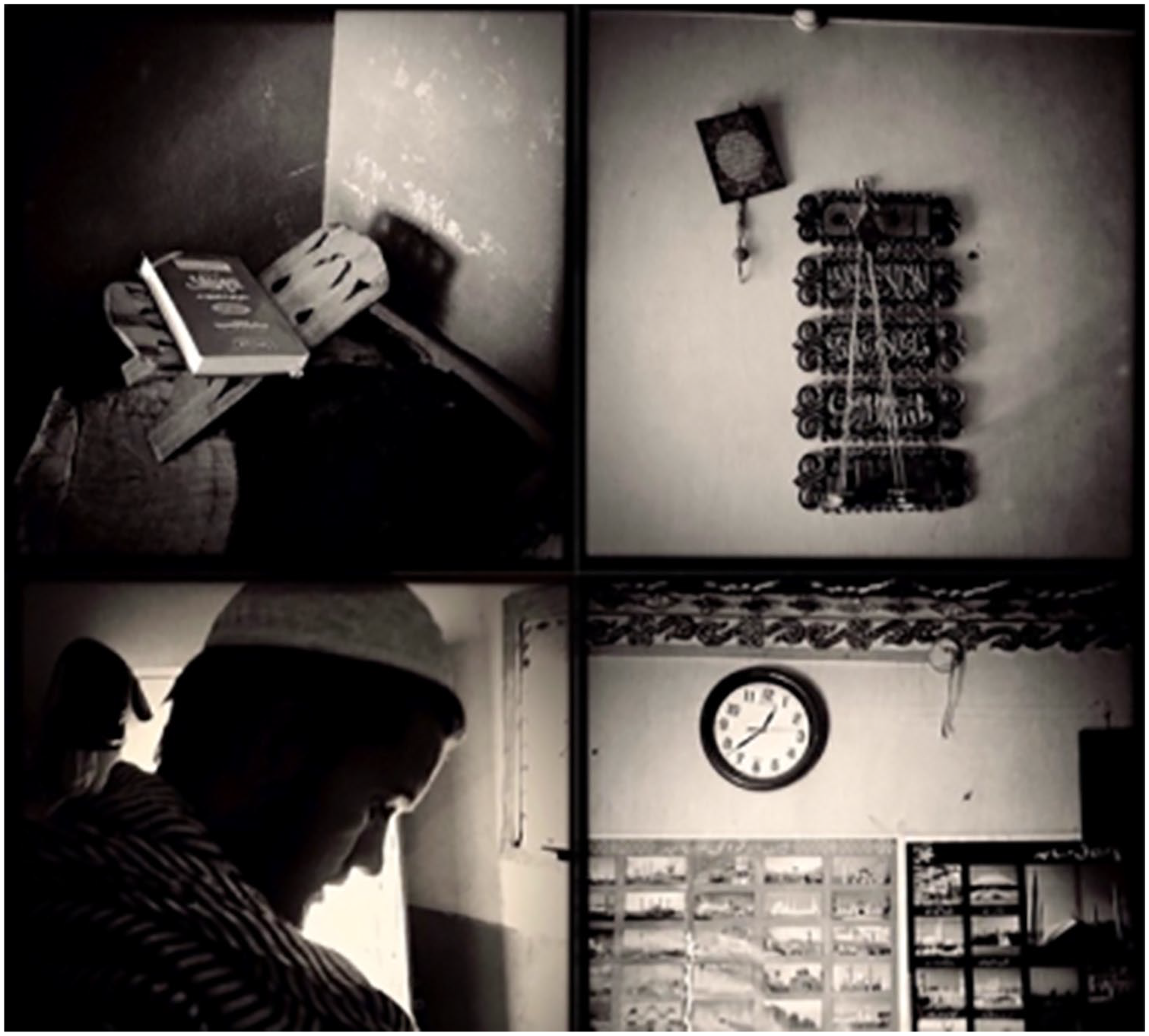
#pakistanjusticeproject and collective memories.
In offering a selected amount of information, Asim was giving to his followers a space to reflect on images and construct their own feelings around them. Asim’s goal was to use the platform as a means to document the stories of Pakistani people and their families, exploring experimental models of visual storytelling.
Conclusion
The main objective of this article was to explore how Instagram is facilitating the development of new and creative ways of managing our visual memories of the past. The qualitative analysis of 44 Instagram users’ perspectives on their use of the platform for capturing, maintaining, and sharing visual memories in the form of photographs showed significant changes compared with traditional conceptions and practices. This demonstrated that advancements in smart mobile technology foster changes in people’s daily practices as they can offer new and innovative ways of managing online data, as they are fast and easy to use (Van Dijck, 2008; Olsson et al., 2008), and offer instant communication (Keightley & Pickering, 2014; Van Dijck, 2008).
The arrival of digitality showed the developments of new objects and practices that gave life to novel notions of mediated memories (Van Dijck, 2008), networked memories, and connective memories (Hoskins, 2011). Exploring how digitality and Instagram changed the traditional dynamics between photography and memory, this article aimed to expand on previous theories with empirical research that discussed how devices, feeds, and platforms’ functionalities shape new and original ways of managing the flow of time in a period of ubiquitous and instantaneous communication (Turkle, 2008).
The findings showed that, compared with the traditional uses of photography, nowadays the relationship between photography and memory is related to the intensification of life experiences, and that new mobile technologies are an integral part of this transformation. While historically photography was considered the means to maintain traces of the past (Barthes, 1980), with the arrival of smart applications and online photosharing platforms, photography is now widely understood and used as medium of social communication, as Van Dijck (2008) anticipated. This trajectory, facilitated by online platforms, has not completely annulled the traditional remembrative function of images, as participants reported. Rather, it has given life to new visual practices. This is why, it is safe to argue, Instagram has contributed to the emergence of new social practices of sharing and maintaining visual memories.
Furthermore, the findings showed that new mediated ways of experiencing photographs online have been observed in the use of hashtags and geo-tags for a customized way of gathering personal visual memories and for an interconnected method of accessing collective memories, expanding the ideas of networked and connective memories advanced by Hoskins (2009, 2011) toward an organized and structured way of managing visual content online. In addition, findings revealed that Instagram users, in the process of sharing their memories, tend to follow the technique of visual storytelling to give sense to their intensification of life experiences. This helps them to locate their everyday happenings in a sort of networked visual diary. This is observable also in the fact that the proliferation of taking photographs is no longer a practice dedicated to the maintenance of family and domestic memories. On the contrary, a remarkable number of people seem unable to do without maintaining visual relationships with the events that characterize their daily life, for example, from the coffee cup during their coffee break to drinks with friends. This general preference for everyday life images over family and domestic photography is what pushed the majority of participants to define Instagram as a limited photo archive due to the lack of private moments.
However, findings showed that even if the publicity of the platform does not facilitate the sharing and storing of private memories, photosharing as such is nonetheless still a useful practice that allows users to remember their photographs. This selectivity is also prompted by the tendency to share high-quality images on the platform. Together with choosing “beautiful pictures,” Instagram users tend to use filters and edit their photos to produce images that carry the emotions they felt when capturing a certain scene. In this, Instagram users photograph objects, landscapes, and particularities to portray feelings that are worthy of being captured and preserve in their memories. This practice pushed participants to define their Instagram memories as their “best memories.”
Overall, the memories users share on Instagram undergo a continuous daily update that seems to be progressing toward new forms of social visual narratives, well-organized and curated by hashtags and geo-tags. This is in contrast to the notion that digitality results in an endless stream of transient content. Social visual narratives allow users to maintain distinctions between personal and collective visual content. In this, filters and editing tools contribute users’ active management of evoking their best memories. Unquestionably, the connectivity and mobility afforded by smart mobile technologies enhance the practice of photosharing, and as a mobile and connected platform, Instagram has in turn played a key role in the transformation of photography into an agent that structures our day-to-day visual heritage.
Footnotes
Declaration of Conflicting Interests
The author(s) declared no potential conflicts of interest with respect to the research, authorship, and/or publication of this article.
Funding
The author(s) received no financial support for the research, authorship, and/or publication of this article.
