




Abstract
Commentators and scholars view both social media and cities as sites of fragmentation. Since both urban dwellers and social media users tend to form assortative social ties, so the reasoning goes, identity-based divisions are fortified and polarization is exacerbated in digital and urban spaces. Drawing on a dataset of 34.4 million interactions among Amsterdam Instagram users over half a year, this article seeks to gauge the level of fragmentation that occurs at the interface of digital and urban spaces. We find some evidence for fragmentation: users form clusters based on shared tastes and leisure activities, and these clusters are embedded in four distinct lifestyle zones at the interface of social media and the city. However, we also find connections that span divisions. Similarly, places that are tagged by Instagram users generally include a heterogeneity of clusters. While there is evidence that Instagram users sort into groups, there is no evidence that these groups are isolated from one another. In fact, our findings suggest that Instagram enables ties across different groups and mitigates against particularity and idiosyncrasy. These findings have important implications for how we should understand and study social media in the context of everyday life. Scholars should not only look for evidence of division through standard network analytic techniques like community detection, but also allow for countervailing tendencies.
Although social media corporations and their representatives continue to argue that their platforms incubate a global community, commentators and scholars nowadays stress that social media are at risk of undermining cohesion and democracy. The behemoth Facebook is a case in point: CEO Mark Zuckerberg published a lengthy manifesto about his company’s role in fostering global community at the start of 2017, just a little over a year before he was called to testify before Congress about the company’s role in the American political crisis. Danah boyd’s (2017) verdict was merciless. She called Zuckerberg “naive as hell” for believing in the dream that “he could build the tools that would connect people at unprecedented scale” (n.p.). A large and growing literature documents how social media’s penchant for reinforcing assortative ties results in polarization, balkanization, echo chambers, and filter bubbles (Del Vicario et al., 2016; Pariser, 2011). Such concerns over social media-induced fragmentation dovetail with anxieties about geographic segregation. While titles like American Apartheid (Massey & Denton, 1998) signal long-standing concerns about racial segregation, more recently commentators have expressed worries about lifestyle segregation. In the United States, progressive coastal states are pitted against the conservative Midwest and South. Looking at a lower level of granularity, stark divisions between progressive inner-cities and conservative suburbs light up. The city of Amsterdam, our case study area, also exhibits plain contrasts between overwhelmingly left-leaning inner-city areas and more right-leaning outer boroughs. These differences in political preferences are tightly coupled with differences in lifestyles and identities, resulting in “lifestyle enclaves” (Bellah et al., 1985; DellaPosta et al., 2015). It seems plausible, perhaps even inescapable, that processes of self-segregation online and offline work together to generate increasingly fragmented social landscapes.
This article addresses these concerns by studying social relations of Instagram users in Amsterdam, examining how they form groups, segregate, and claim different places within the city. While we find some evidence of “lifestyle enclaves” among Amsterdam’s Instagram users, we also highlight connections between groups and processes of integration. In short, we try to answer the question to what degree and in what ways processes of fragmentation and integration shape the relations of Amsterdam-based Instagram users. In the following, we start by presenting our perspective on fragmentation and integration. We specifically focus on the interface of Instagram and the city, examining whether Instagram users indeed self-segregate online and in the city. Using concepts and methods that are widely used in contemporary debates on polarization and social media, we then empirically show that Instagram users in Amsterdam do, in fact, sort into groups with specific appearances and lifestyles. We further demonstrate that these groups construct zones at the online–offline interface, that is, symbolic and material domains that serve as stages for the enactment of identity and the performance of status. While our analyses, therefore, confirm that tendencies toward fragmentation are present, we go on to complicate this conclusion by dissecting its conceptual and methodological premises. To put it bluntly, we find fragmentation, but only if we neglect any countervailing processes. The second part of the empirical analysis, therefore, takes a different angle in analyzing our dataset and demonstrates that there are indeed formidable processes of integration at play. The Instagram city, we argue, may be a much more integrated, and much more boring, place than the tidings of fragmentation and conflict would suggest.
Understanding Fragmentation and Integration in the Instagram City
As social media allow us to associate with like-minded people, so communis opinio holds, we are inadvertently yet ineluctably drawn into echo chambers or filter bubbles. To make things worse, algorithms reinforce our propensity to associate with those like us by suggesting we befriend our friends’ friends or read more from the blogs we just visited. Social media, then, feed on our differences and reinforce them, resulting in fragmentation (Pariser, 2011; Sunstein, 2001). While we are increasingly connected to others who are just like us, the distance to others grows. American communication scholar danah boyd (2017, n.p.) sums up this pessimistic diagnosis: Ironically, in a world in which we have countless tools to connect, we are also watching fragmentation, polarization, and de-diversification happen en masse. The American public is self-segregating, and this is tearing at the social fabric of the country.
These concerns about fragmentation sound all too familiar to students of the city. The scholars of the Chicago School of sociology argued in their classic works that the disintegrating forces of modernity—as observed by first-generation sociologists like Ferdinand Tönnies and Émile Durkheim—reached their apex in cities. Robert Park (1915) wrote of cities that “every social group tends to create its own milieu . . . The processes of segregation establish moral distances which make the city a mosaic of little worlds which touch but do not interpenetrate” (p. 608). While the village community suppresses differences, the city reinforces and amplifies them (Fischer, 1982; Wirth, 1938). This process makes for extraordinarily vibrant environments of highly diverse subcultures, but also results in fragmentation and its associated evils of anomie, collective paralysis, and failures of empathy.
It is no coincidence that contemporary anxiety over social media echoes historical concerns over cities. The move to cities and the development of modern communication technologies are essentially two sides of the same coin: both developments emancipate people from the communities they were born into and allow them to associate with people of their own choosing. It is plausible that, when the city and social media become intertwined, differences are multiplied, reinforcing mechanisms of fragmentation (Bastos et al., 2018; De Waal, 2014; Graham, 2005; Kitchin & Dodge, 2011; Wang et al., 2018). In this article, we pursue this line of thought by examining how subcultures emerge at the interface of cities and social media (Boy & Uitermark, 2016, 2017). We show how different social groups claim their space and mark their territory. Places figure into this story as stages for expressing individual status and group belonging. Social media users generally do not picture quotidian activities like visiting the supermarket, but rather share experiences of places for aspirational consumption (see also Boy & Uitermark, 2016, 2017; cf. Currid-Halkett, 2017). Social media, in this line of thinking, are hyper-segregated: by selectively displaying where social media users are, they reflect and reinforce segregation on the ground.
However, the evidence of a connection between social media use and fragmentation is moderate and mixed, even in the United States context, on which most of the work in this field is focused (Boxell et al., 2017; Garrett, 2009). We therefore need to develop a perspective that allows not just the possibility of fragmentation but also of its opposite, that is, integration. In addition, concerns over fragmentation are typically voiced in relation to Facebook and especially Twitter (Tufekci, 2014), much less in relation to other platforms, including Instagram. Since Instagram is much more visual than either Facebook or Twitter, we may expect that it is less likely to induce acrimonious debate. The budding research literature on Instagram emphasizes that the platform is not a staging ground for symbolic resistance (Manovich, 2016, p. 23) but gives ample space to corporate-sponsored influencers to shape tastes and desires (Abidin, 2016; Boy et al., 2018) while compelling users to enact idealized selves and hide stress and strains (Duffy & Hund, 2015). Whereas many studies on Twitter highlight polarization, this literature on Instagram conjures up the image of users connecting in an environment where beauty, wealth, and success are celebrated and estheticized (cf. Boy & Uitermark, 2017; Marwick, 2015).
When we speak of “integration,” we therefore do not necessarily mean a benign process where people with different preferences and interests come together in harmony. We view social media as stages for the expression of status that are characterized by mutual monitoring, the collapse of private–public distinction, and, most importantly, stratified systems of rank (Boy & Uitermark, 2019). What is essential to social media is not that people share images of posts, but that these contributions are appraised by proximate and distant others. “Integration” means that people come to depend on and surveil one another. Although this process may be harmonious, it can also involve competitive individualism and breed anxiety as social media users are compelled to anticipate appraisals by others.
We should thus take seriously the possibility that the social media promote integration and breed conformity instead of amplifying difference. There are prima facie reasons to consider the scenario. A number of commentators have observed how, in the age of social media, radical and deviant subcultures have withered away. For instance, Jessa Lingel (2017) has written about several groups that used to make a home on the open web during the 1990s, only to be gradually displaced by the ascendant social media platforms when the 2000s came along. One of her studies focuses on extreme body modification, a subculture that for many years had a virtual meeting place at Body Modification Ezine (BME). The founders of BME positioned the platform as an “online haven for outsiders” (Lingel, 2017) where members could share their experiences with face tattoos, scarification, subincisions, stretched ears, piercings, flesh pulls, split tongues, and the like (p. 37). The platform flourished in the late 1990s but faltered as Facebook rose to prominence. Although the story of BME’s decline is complicated, it is clear social media feature prominently. The promise of a wider audience pulled members away from BME and onto social media like Facebook where body modifiers’ sense of alterity and community dwindled.
Writing on Rotterdam’s gay scene, Ferrie Weeda (2018) also relates the ascendancy of social media, and specifically the dating app Grindr, to the disappearance of a subcultural milieu. After the dating app Grindr allowed its users to seek hook-ups and partners online, the number of gay meeting places dropped precipitously. One after another, gay bars and clubs have closed down. While LGBTQ folks may benefit from the efficiency of the dating app to arrange a tête-à-tête, more radical and collective expressions of difference lose their place within the city. Grindr allows its users to search for specific “tribes” (otter, bear, geek, twink, trans, etc.), but its effect is less to reinforce difference than to have LGBTQ people retreat into privacy or blend into the public.
These examples suggest social media may spur the integration of deviant groups into the mainstream and contribute to the dissolution of subcultural milieus. Difference does not so much disappear but comes to be expressed through ever more subtle and individual strategies of distinction—a process Elias (1994) captures with the phrase “diminishing contrasts, increasing varieties” (pp. 382–386). The ambiguous evidence of social media-induced polarization as well as ethnographic case studies thus suggest that social media do not solely amplify difference but could also facilitate integration and promote conformity. We therefore examine both fragmentation and integration at the interface of Instagram and the city. Before we do so, we discuss our methods and data.
Methods and Data
Our analysis in this article is based on a corpus of 709,348 geotagged Instagram posts gathered over half a year, between 1 December 2015 and 31 May 2016. On Instagram, users can opt into geotagging (attaching a location to posts) on a post-by-post basis. Since our main interest is in how city dwellers use locative social media in their everyday lives, our corpus only includes posts by users with at least two geotagged posts at least 4 weeks apart to eliminate likely tourists. The total number of users in our corpus is 78,207, equivalent to about one-tenth of Amsterdam’s population. On 1 June 2016, Instagram severely restricted the data that could be accessed through its application programming interface (API), which is why we focus on the period up to 31 May 2016.
With our corpus, we can investigate how social media is implicated in the creation of subcultures and social divisions. Our main data are the 34.4 million “likes” and comments among the users in our dataset. While we acknowledge that the meaning of likes and comments varies across contexts and situations, we pragmatically consider a reciprocated tie (I comment on, or like, your post and you comment on, or like, my post) as a proxy of affinity between users. Out of the interactions in our data, 130,665 are reciprocated, and we use these mutual ties to identify groups and the relations between them. Since we use different methods to study fragmentation and integration, respectively, we provide further details on these methods in the following, empirical sections.
Fragmentation
There is plenty of evidence of fragmentation if we look for it. The network of reciprocated likes or comments has a modularity score of circa 0.6, a relatively high score (Newman, 2006), suggesting that interactions tend to occur within relatively more densely knit subgroups of users and providing prima facie evidence of the fragmentation often associated with city life and social media. We can identify subgroups thanks to a procedure called community detection. By applying the Louvain method of modularity optimization to the undirected network of reciprocated ties (Blondel et al., 2008), we find a total of 31 clusters with at least 200 users. We subsequently engage in qualitative coding. We identify the 10 most central users in each cluster, look for commonalities among them, and characterize the clusters accordingly. For instance, when we spot pictures of people flexing their muscles in gyms and references to “personal body plans” in bios, we label the cluster as “fitness enthusiasts.”
Through such qualitative coding, we are able to characterize these clusters in terms of shared interests and lifestyles. In addition to the nine largest clusters shown in Table 1, we identify several smaller ones. They include, in order of decreasing size, international students (1,120 users), Amsterdammers of Turkish descent (821), coffee aficionados (769), Russian-speaking expats (519), evangelicals (395), CrossFit adherents (350), and electronic dance music enthusiasts (304). Table 1 shows that users in the cluster organized around “refined lifestyles” have somewhat more followers than users in the other clusters. However, the greatest inequality is found within clusters rather than among them: all the clusters have very uneven distributions of both likes and comments. We thus find that Instagram users self-organize into clusters of different sizes but all with a median number of followers between 403 (the CrossFit adherents) and 857 (the cognoscenti of refined lifestyles). While there are differences among the clusters in terms of follower count or activity, what stands out are qualitative differences in terms of interests and lifestyles.
The nine largest clusters of Instagram users.

Since we are especially interested in the interface of online and urban spaces, we subsequently examine which places these different groups tag. A place tag is a predefined location name that can be attached to a post. This is a form of metadata that enables geographic exploration on Instagram, but also enriches individual posts with additional information. 1
In line with the perspective we outlined, we do not interpret place tags as “trace data” that can be used to track users’ trajectories through the city, but as features of status displays. Users typically do not post about their daily shopping at the supermarket or their ride to work, but selectively and strategically use Instagram as a platform to live out their identities and showcase their social contacts, sense of style, achievements, or new purchases (cf. Boy & Uitermark, 2017; Hochman & Manovich, 2013; Zasina, 2018). Different kinds of places offer resources (props and audiences) for different kinds of displays that garner esteem and prestige in different social scenes. Places are not just physical settings, but also social situations that encourage contextually appropriate expressions of conformity and distinction.
When users within the same clusters use places as staging grounds for their status displays, we assume a link between those places; the more links between places, the more likely they are part of the same zone. We construct a proximity matrix of places based on how frequently they are tagged by people in the same cluster. We then apply the same method of community detection as discussed above, first turning the proximity matrix into a co-occurrence network. This yields four clusters of places, three of which are of roughly equal size (between 500 and 600 places), and one that is smaller. These zones are not contiguous areas, as in Parks’ “natural areas” or Burgess’ concentric zones model (Park & Burgess, 1925), but sets of places in the city that figure into status displays on Instagram. See Table 2 for an overview of the four zones, which also presents some additional data on the places we sourced from Yelp, the popular social reviews site. 2 Before considering in greater detail how these zones and the places that make them up are bound up with status displays in the city, we first describe their features.
Zones at the interface of the city and Instagram.
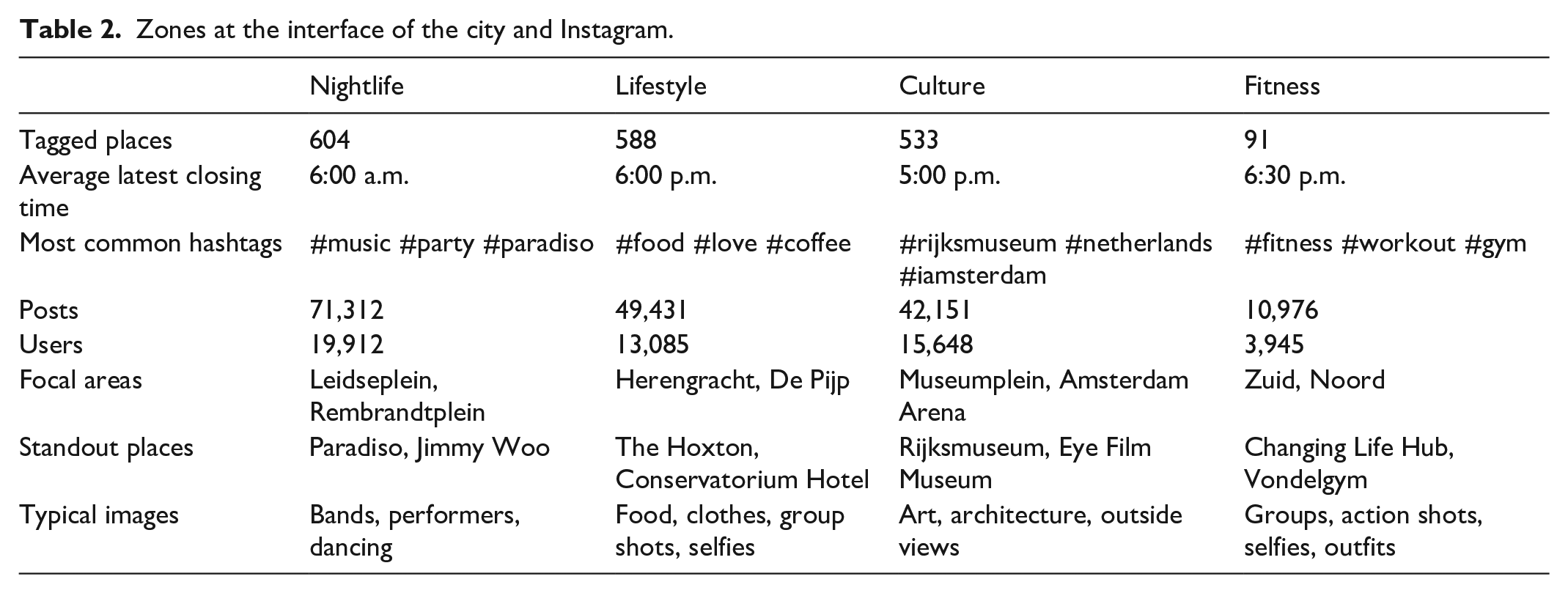
The nightlife zone consists, at its core, of places associated with the city’s clubbing scenes. According to Yelp, the review site that we mined for additional data on places tagged by Instagram users, a typical closing time for places in the nightlife zone is 6:00 a.m. Concert venues like Paradiso and Melkweg and clubs like Jimmy Woo, Bitterzoet, and Club Air are at the center. Generally, we find most of the city’s dance clubs and a high number of bars and cafes within this zone. Footwear and sportswear stores carrying local brands also rank highly, suggesting that some sartorial and consumer choices predominate in the city’s clubbing scenes and serve as a source of subcultural capital (Thornton, 1996). Images tend to show performers and groups swept up in the action. More than in any other zone, the images taken here show moments of collective enjoyment.
If the nightlife zone is about dancing, the lifestyle zone appears to be about eating. The yuppie’s favorite meal, brunch, is an important occasion to frequent places in this zone, in which hotels, cafes, and restaurants that serve brunch staples like poached eggs and pancakes predominate. At the center of this zone, we find a number of upmarket hotels—the Conservatorium, The Hoxton, and W Hotel—where patrons like to picture beautifully plated French toast and bespoke cocktails. Boutique coffee places, such as Coffee & Coconuts in De Pijp, as well as a slew of restaurants serving various cuisines also form part of this zone. Several locations on the city’s luxury shopping street, the P.C. Hooftstraat, are among the lifestyle locations, as are other places associated with fashion and design, such as the Dutch headquarters of Hearst, publishers of Elle, Harper’s Bazaar, Esquire, and Cosmopolitan; a showroom of Dutch design; and a fashion retailer specializing in “the good things in life.” Looking again at Yelp reviews, places in this zone have comparatively high ratings and high prices. 3 Images foreground moments of consumption, often conspicuous, or at least indicative of sophistication (Currid-Halkett, 2017; Veblen, 1899/1934).
The cultural zone revolves around the city’s museums, with the iconic Rijksmuseum at the helm. Alongside it are other well-known landmarks and cultural institutions—the zoo, botanical garden, opera house as well as the public library’s central branch—which are frequented by the city’s cultural connoisseurs and pictured for distant audiences who appreciate images of Amsterdam cityscapes and sights. Users tagging these locations frequently invoke the city brand #iamsterdam, which in its sculpture form is an inescapable sight on Instagram, serving as a metonymy for the city as a whole (which lacks instantly recognizable landmarks on par with the Eiffel Tower or Big Ben). They are tagged by expats and people with a more international audience, suggesting they signal well to these international audiences as markers of being in Amsterdam.
Finally, the smallest of the four is the fitness zone, which unsurprisingly revolves around sports clubs and gyms. Amsterdam’s CrossFit gyms and yoga studios can be found in this zone along with Yoghurt Barn franchises. This zone comprises not only places appealing to the health-conscious but also establishments that cater to other practices involving the body, such as tattoo parlors and a cryotherapy center (where customers can subject their bodies to temperatures of 110°C below zero for 3 min). More than in other zones, the ideal of expressive individualism shines through in the displays from this zone (Turner, 2011).
The uneven presence of clusters in different territories supports the assumption we made at the outset of this investigation: that places are used strategically for displays that play to different social scenes, garnering rewards in the form of esteem or recognition. The fitness zone, in particular, stands out as the preferred domain of several clusters that revolve around fitness and tattooing, suggesting that esteem in these groups is bound up with particular places and their affordances—in this case, getting and maintaining an attractive, fit, and healthy body. The three larger zones which revolve around nightlife, culture, and lifestyle also show clear, albeit less pronounced, tendencies. Nightlife locations are tagged by users in the Hedonist Lifestyles cluster and the Clubbing cluster, while locations in the culture zone are tagged by the cluster of City Imageers as well as internationally oriented clusters of expats and foreign-exchange students. Lifestyle locations are tagged by various clusters of apparel and fashion enthusiasts and the CrossFit cluster (which branches out from the fitness zone into other territories). Unsurprisingly, we also find the cognoscenti of refined lifestyles represented here.
This aspirational dimension of Instagram use comes out not only in the places that are tagged but also in what is portrayed in these places and how. We could start with the most notorious genre of social media post, the selfie. Generally, commentary on the selfie is out of proportion to its actual prominence on most social media, and in our data, too, selfies account for only a small proportion of the total volume (cf. Boy & Uitermark, 2017; Manovich et al., 2014). In the fitness zone, however, posts bearing a #selfie hashtag (or ironic variations like #shamelessgymselfie) can be found much more frequently, which speaks to the centrality of the physical self to status displays staged in this zone. 4 In the culture zone, architectural details and outside views predominate because here recognition hinges on one’s identification with the branded image of Amsterdam. In the lifestyle zone, bands, performers, and party people literally take center stage—here, esteem is rewarded on evidence of hedonistic pursuits. Unlike in the selfie-saturated fitness zone, portraits are more likely to show groups than individuals. Finally, in the lifestyle zone, still-lifes of desirable items—especially food, fashion, and furniture—speak to the ways in which conspicuous consumption continues to be an avenue toward prestige. In short, by combining community detection with geographic analysis, we can show how subcultural groups use digital technologies to mark their territory within the city, demonstrating that fragmentation occurs not only through residential segregation but also through more complex spatial sorting on the interface of social media and the city (Graham, 2005; Wang et al., 2018).
Integration
There is a large literature that directs our attention to divisions online and in the city. Part of the impetus for this literature is the concern that society will fall apart into different groups that at best live past one another, and at worst will clash. The smartphone, as a territory device (De Waal, 2014), is believed to further buttress these divisions by algorithmically reinforcing and fortifying urban dwellers’ propensity to find kindred spirits. We have a range of tools and measures at our disposal to capture such tendencies toward fragmentation. For instance, like many other researchers, we use community detection to identify different groups. However, we need to appreciate that a community detection algorithm will identify communities even in random networks. Identifying groups and their places within the city, as we have done above, risks overemphasizing the differences and fragmentation. We need to look more closely, and we may also need to look differently, if we are to understand the relational structures that social media users spawn.
There are good reasons to not only look at fragmentation but also integration. While we preferentially connect with like-minded people on social media, strangers are never far away and our audiences are always multiple, at least potentially. As we explained above, social media insert users into systems of standardized rank and into each others’ purview (Boy & Uitermark, 2019). Social media users know this all too well and tend to adjust their posts accordingly. Through their exposure to multiple audiences, social media users have to cope with or internalize different kinds of expectations and pressures. Acknowledging that social media bring different people together, we can write a different story of the same network, using different measures and data points.
For instance, while we followed convention by characterizing clusters according to their most central nodes, we could also look at randomly selected rank and file users. When we know which cluster they belong to, it is usually not so difficult to see why that would be so. For example, users in the cluster of “gay performers” might present themselves as gay or performers. However, gay people and performers are also to be found in other clusters, which means it is very difficult to guess which clusters randomly designed users belong to, suggesting that the communities we find through community detection are not status groups in Weber’s sense or tribes in Mafessoli’s sense (Maffesoli, 1988/1996; Weber, 1921/2010).
What is true for community detection also holds for our strategy of identifying zones: it is a method designed to highlight difference by filtering out similarity. When we look at the spatial footprint of the different clusters, as we do in Figure 1, we get a different sense of how Instagram users are positioned within the city. What is remarkable is that the heat maps are so much alike: all clusters have their center of gravity in the center of the city. There are a couple of clusters that also show a lot of activity in Amsterdam South East because of the concert venues in that neighborhood but this is hardly distinctive. If there is one cluster that stands out, it is a cluster with Amsterdammers of Turkish descent (16) that shows a lot of activity in the Western part of the city. However, this cluster, too, gravitates to the center of the city. While both classic writings on the city and contemporary writing on social media would lead us to expect stark differences, we do not at all find that groups sort into internally homogeneous “natural areas.”

Heat maps of Instagram activity for different groups centered on the same coordinates. Hotter colors indicate more place tags.
One might counter that the maps in Figure 1 are not at the right scale. Perhaps different clusters all tend to post from the city center but from different places within it. The mixing of different groups in the city center would, in this scenario, reveal profound processes of segregation operating at a lower scale where people might keep out others by constructing of a parochial realm (Lofland, 1998). Although members of different clusters traverse the same spaces in the city’s center, they might ultimately self-segregate into different places—a pattern referred to in the literature as “social tectonics” (Robson & Butler, 2001; see also Jackson & Butler, 2015). However, when analyzing at the level of places, we do not find strong support for this scenario. If we look at the 100 places that are tagged the most (in at least 309 posts), we find not a single place where posts originate from one cluster only. While some places are more parochial than others, as a general rule, members of different clusters rub shoulders in bars, squares, restaurants, parks, clubs, or boutiques.
While it is now clear that members of different clusters traverse the same spaces and rub shoulders in places, perhaps segregation operates in still more subtle and insidious ways. The literature suggests that urbanites who move around in the same neighborhood and even frequent the same places still may have little to no contact. They may “live together apart” as they use digital devices to carve out their parochial domain (De Waal, 2014). If this would be so, there should be little online interaction between members of different clusters. This is, again, contrary to what we actually find. Although the network of interactions has a relatively high modularity score of 0.6 (as reported above), remarkably a whopping two out of three interactions are between, not within, clusters. The clusters observed through communities may be distinct, but they are also perforated and interconnected. As we can see in Figure 2, even though nodes within each community cluster together, nodes of different colors are also interspersed, indicating that there are numerous ties between communities. Similarly, while we can identify zones that serve as the domain of specific groups, we should also tell a different story. The place network—where different places are connected when they are tagged by people in the same cluster—has a modularity of only 0.15, signaling that there are many connections between places.

A graph representation of Instagram users in our dataset.
Communities are neither bubbles nor bounded fields, and interactions frequently span across clusters. Amsterdam Instagrammers organize into clusters according to their lifestyles and backgrounds but neither on Instagram nor in the city are they far removed from others. People may have a primary reference group that is most consequential for how they understand and comport themselves, but this primary reference group is not apart from rest of the social world. While they associate with people with similar interests and lifestyles, they generally do not form enclaves. The entangled networks documented in this article are the structural backdrop of the cross-pressures that users experience as they consider posting to the platform. The aggregate result of these cross-pressures is that Instagram breeds conformity: the platform is used for a range of purposes by different groups but it nevertheless has aesthetic and social norms that all users have to reckon with (Manovich, 2016).
Conclusion
Both social media and the city are widely seen as spaces of fragmentation. In these spaces, commentators expect and fear, people will flock to each other, forming enclaves or bubbles, losing touch with the wider society. Departing from this perspective, this article traces the formation of groups at the interface of the city and Instagram. We indeed find that we can discern distinct groups around specific foci like hobbies, professions, or lifestyles. We further identify distinct zones: sets of interconnected places that serve as the domain for particular kinds of groups. And yet, that is not the whole story. Our findings do not conform to the dystopian image of deep and algorithmically fortified divisions. Even when users socialize in a community of CrossFit fanatics, they are never far from users with other interests, such as Beliebers or coffee aficionados. Users coalesce into groups, so much is true, but the boundaries of such groups are fuzzy. This casts social media in a different light; perhaps they are best seen as vehicles of integration rather fragmentation.
We come to our conclusions based on computational analysis of a slice of data produced by a specific population in a particular place using a platform designed to facilitate visual communication. In grounding our study in Amsterdam, we have chosen a location that at least historically has resisted tendencies toward disintegration and growing inequality (Uitermark, 2009). Today Amsterdam is known as a liberal city, and perhaps our results would have looked differently if we had focused on a more divided city. Considering these specificities, we concede that our case is likely not representative of other populations or platforms. But the same is true for other research based on data sourced from, say, Twitter or Facebook, that informs tidings of fragmentation. One way to account for the differences between our observations of Instagram and others’ observations of Twitter and Facebook is to trace them back to the affordances of different platforms (cf. Van Dijck, 2013; Wellman et al., 2003). On this reading, the patterns of interconnection and pressures toward conformity we observe are peculiar to Instagram and the specific functions the application offers its users. Although we readily agree that platforms have different affordances, we nevertheless feel this kind of argument is limited by its privileging of the technological underpinnings of social relations. Theorizing of affordances originated from the need to move beyond technological determinism and explicitly acknowledge that the same technological set-up allows for different kinds of social relations to emerge. And yet, technology remains the starting and end point of analysis—whatever happens, happens because technology affords it, leading researchers to scrutinize design decisions in minute detail.
While we do not take issue with this interpretation, we do want to consider another. There certainly are important variations between platforms, but it is nevertheless possible to discern trends. While the internet initially functioned and felt like an alternate reality, it is now increasingly woven into everyday life. Social media accounts make the internet more personalized, intimate, and visual, while also making interdependencies more extensive, differentiated, and dense. The relational patterns we identify here emerge within this structural context: as we construct our personae and connections through social media, we are compelled to take into account the views of proximate and distant others. The processes and mechanisms we identify on Instagram may be less salient on other platforms, but we surmise they are present there, too. So what is the use of our case? We would suggest that Instagram provides an alternative starting point for theorizing. Where researchers of political communication on Twitter or Facebook use their specific cases to theorize about fragmentation, we can use our study of Instagram to highlight mechanisms of integration. Where researchers of political communication view social media posts as expressions of opinion, our case pushes us to consider them as status displays. Our theoretical perspective applied to a specific set of data enables us to identify processes and dimensions that may not have caught the attention of researchers working from a different theoretical perspective and studying different platforms.
Yes, there are radical or outlandish views even on Instagram, 5 but there are also powerful pressures toward conformity that render countercultures precarious. Users pursue distinction, but in a conformist way—they know what the norms are and they abide by them. In this article, we bring into view the wider set of relations through which norms are maintained: the fine-grained and cross-cutting linkages within and between communities. The sorts of communities discussed at the beginning of this article require a degree of closure to shield its participants from the dominant gaze and have low chances of survival within this constellation of the fine-grained and cross-cutting linkages. Instagram users in Amsterdam form an integrated, albeit differentiated, social world. Social media are the interface through which we negotiate what is acceptable, exceptional, or beautiful. The aggregate outcome of these processes of negotiation is not an online space partitioned into a wide range of communities that each have their own ideas or norms, but an expanding web of relations that bring people into dependence and implores them to take others’ views into account.
Footnotes
Acknowledgements
We are grateful to Petter Törnberg and Willem R. Boterman for taking the time to read this article and provide us with helpful feedback and suggestions. We also thank Special Issue editor Alessandro Caliandro for his gracious and incisive comments, and the anonymous reviewers for numerous suggestions for improving the article.
Declaration of Conflicting Interests
The author(s) declared no potential conflicts of interest with respect to the research, authorship, and/or publication of this article.
Funding
The author(s) disclosed receipt of the following financial support for the research, authorship, and/or publication of this article: We gratefully acknowledge funding from the ODYCCEUS Project as financed through the European Union’s Horizon 2020 program (grant agreement no. 732942).
