




Abstract
This article considers the history of donation management tools on the livestreaming platform Twitch. In particular, it details the technical and economic contexts that led to the development of Twitch Bits, a first-party donation management service introduced in 2016. Two contributions to research on the platformization of cultural production are made. One, this article expands the empirical record regarding Twitch by chronicling the role of viewer donations in livestreaming since 2010, as well as the many tools that have facilitated this practice. It is argued that this history traces the complex and co-productive interactions between Twitch as a sociotechnical architecture and a political economy. Two, by considering how the first-party donation tool Twitch Bits has gradually challenged the dominance of the third-party tools that preceded it, this article theorizes the notion of platform capture, a critical rereading of platform envelopment, a popular concept in business studies. Ultimately, it is argued that platform capture demonstrates how platform owners leverage power asymmetries over dependents to aid in their platform’s technical evolution.
Introduction
The Evolution of Platforms
As the literature on platforms—defined, in their broadest sense, as digital infrastructures that facilitate interactions between users while also collecting data on these interactions—has grown over the last decade, scholars in a variety of fields have begun to address questions of how platforms evolve as technological artifacts. Although scholars have long recognized that the technical features of platforms are constantly in flux, the actual processes and trajectories by which platforms evolve over time are comparatively understudied (Helmond et al., 2019). By problematizing how platforms evolve—that is, by seeing certain modalities of change as neither natural nor inevitable, but shaped by specific contexts—it becomes possible to ask questions about on whose terms and to what effects the technical evolution of platforms occurs.
This article does not attempt to offer a comprehensive theory of how platforms change, nor does it lay out a typology of processes within the broader heading of platform evolution; there is no one way, no necessary trajectory, along which all platforms evolve. Rather, this article’s purpose is to consider platform capture, one way among many that platforms accrue new features through complex interaction with other actors in a platform ecosystem. In my definition, platform capture denotes a process in which (1) complementors within a platform marketplace, such as developers who create applications using boundary resources like APIs, develop new features that create value for a platform ecosystem by extending its capabilities; (2) platform owners create first-party versions of these features that direct new value to themselves; and (3) third-party tools are forced into competition against first-party offerings in a platform marketplace that is biased toward its owners. Taken together, platform capture describes a cycle in which the technical architecture of platforms evolves through the exploitation of power asymmetries between platform owners and dependents, raising questions about the monopolistic tendencies of platform ecosystems.
Taken purely as a description of actions undertaken by platform owners, platform capture has much in common with what scholars of strategic management call platform envelopment (Eisenmann et al., 2010). Whereas scholars in this tradition tend to see platform envelopment as a business tactic, this article offers a more critical eye on this practice by situating it within what David Nieborg and Thomas Poell (2018) call the platformization of cultural production. This holistic framework, which synthesizes key insights not only from business studies but also from political economy and software studies, aims to systematize inquiry into platforms in order to make their impacts on cultural production more visible. By reconceptualizing platform envelopment as platform capture, it becomes possible to connect this process to broader concerns about the accumulation of power and influence in the information technology sector, as well as technology firms’ role in producing, maintaining, and exploiting the widespread precariousness that characterizes the contemporary conjuncture.
Research Object and Contributions
To illustrate platform capture, I consider the history of donation management tools on Twitch, an Amazon-owned platform that hosts user-generated broadcasts of live video game play (Figure 1). In the company’s words, [Twitch is] a global community of millions who come together each day to create their own entertainment: unique, live, unpredictable, never-to-be-repeated experiences created by the magical interactions of the many. With chat built into every stream, you don’t just watch Twitch, you’re part of the show. (Twitch, 2020)
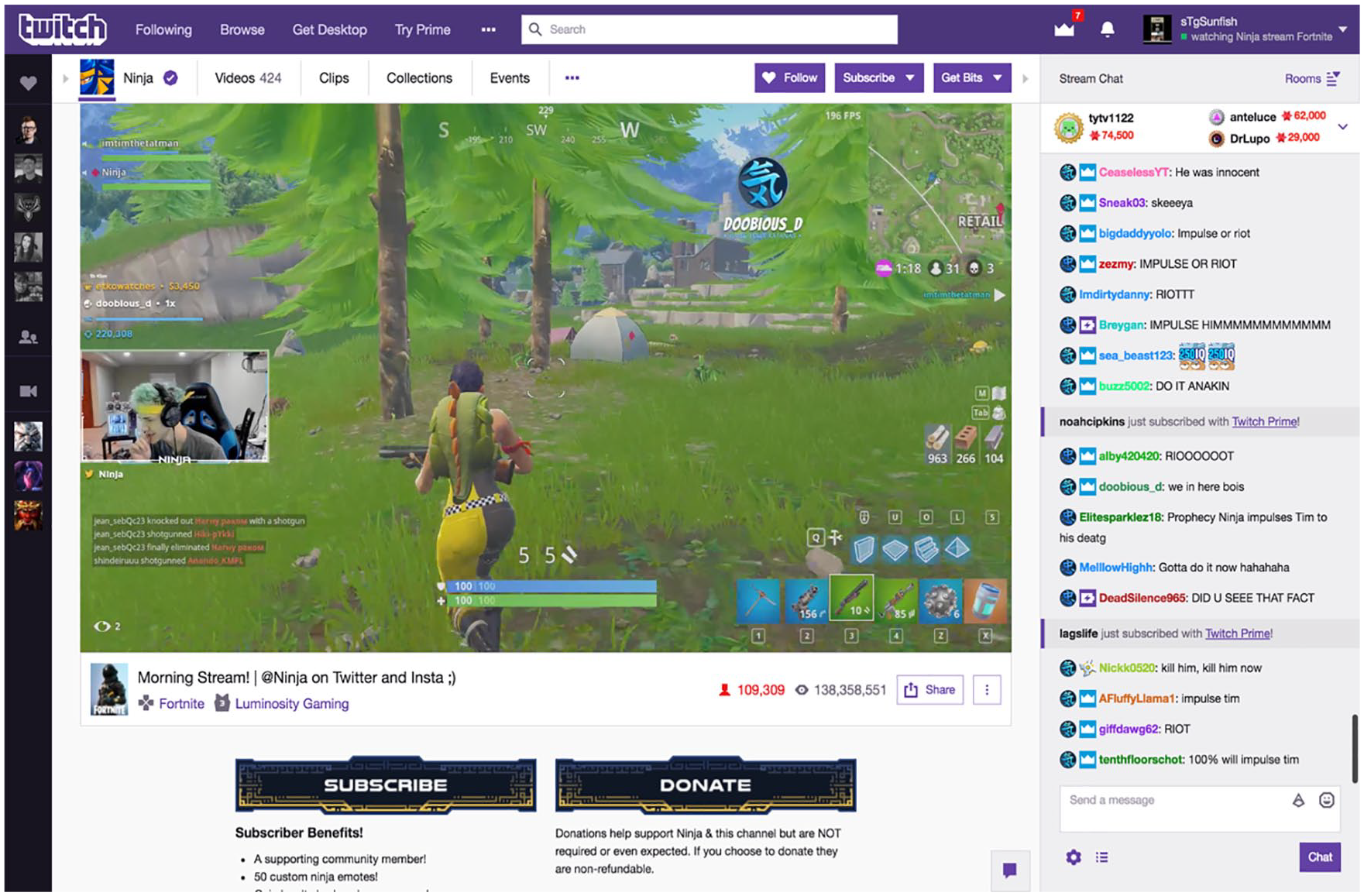
Screenshot of Twitch’s interface (as of April 2018), showing a live video feed and accompanying chat box.
While Twitch is less influential than its most direct competitor, YouTube, the platform is nevertheless enormously popular. In May 2019, more than 3 million broadcasters, an elite slice of whom stream on Twitch as their full-time career, delivered close to 1 billion hours of content to an average of 1.3 million concurrent viewers on the platform (Twitch Tracker, 2019). Top streaming celebrities earn millions broadcasting their skillful gameplay and affable personalities, while game publishers have adapted to the growing influence of livestreamers as cultural intermediaries for judging and promoting new titles. As TL Taylor (2018) argues, Twitch has “offered players of all kinds an opportunity to build audiences interested in observing, commenting, and playing alongside them . . . [transforming] their private play into public entertainment” (p. 6).
This article makes two contributions to the literature on the platformization of cultural production, one empirical and one theoretical. In the first, this article expands the empirical record on Twitch by chronicling the vital role of donations on the platform since 2010. This history traces the complex and mutually shaping interactions between Twitch as both a sociotechnical architecture and a political economy, culminating in the development of Twitch Bits, a first-party donation management system introduced in 2016. The literature of Twitch is in its infancy, and this article encourages scholars to remain sensitive to how the political economy of Twitch shapes the conditions and experience of labor for streamers and viewers alike. In the second, platform capture is theorized as an alternative to platform envelopment by drawing on perspectives in the platformization of cultural production. In particular, this article considers how platform capture, as a modality of platform evolution, creates “new” technical features by exploiting power asymmetries between platforms and their dependents.
Methodological and Analytical Approach
While scholarship on platforms often relies on case studies that examine specific moments in a platform’s history, other studies chronicle a single platform’s development over time (e.g., Brügger, 2015). Scholars writing these “platform histories” have reflected on the considerable methodological and empirical challenges writing these histories entail. As Axel Bruns and Katrin Weller (2016) suggest, scholars must “find useful sources that enable them to understand the evolutionary processes,” in spite of platforms’ constant flux (p. 186).
This article takes inspiration directly from recent work on Facebook’s gradual evolution from social networking site to “platform-as-infrastructure” (Helmond et al., 2019; Nieborg & Helmond, 2019). Taking as a given that platforms “evolve via a complex interplay among users, technologies, infrastructures, organizational structures, and various social, cultural, and economic practices” (p. 125), I adopt a holistic view of Twitch that does not reduce its technical evolution to a single cause, but, rather, sees this process as taking place within and through a broader platform ecosystem that includes not only Twitch-the-company (itself a subsidiary of Amazon) and Twitch-the-platform, but also viewers, streamers, and application developers. Likewise, this article also draws upon textual boundary resources from developers working with Twitch, professional streamers’ public statements on donation tools, and Twitch’s own announcements. This approach reveals (1) that, like Facebook’s own growth into a platform-as-infrastructure, Twitch’s own evolution as a platform has been an incremental process, not a revolutionary one, and (2) that Twitch has gradually consolidated power and influence over its ecosystem.
Even so, there are distinctions between our approaches that stem from differences between Twitch and Facebook. While this article does see Twitch as an ecosystem of interdependent actors, it is not offering a general history of Twitch. Rather, it traces a single practice—donating to streamers—across a period of several years to highlight the various tools that have facilitated it. In addition, whereas Helmond et al. emphasize the “boundary work” that applications do in expanding Facebook’s data infrastructure, this article is more concerned with how fiat or virtual currency enters and circulates in the Twitch ecosystem. Finally, Twitch’s reach is substantially more modest than Facebook and, as a consequence, is not “infrastructural” to the same extent. Even so, an infrastructural perspective on platforms is useful (Plantin et al., 2018). Infrastructures establish “contexts for practice” (Murakami Wood & Monahan, 2019), shaping, though never quite determining, the conditions in which dependents act. Moreover, as Lauren Berlant (2016) suggests, infrastructures, like politics, are systems for distributing (in)security, an observation that highlights the power asymmetries that are vital to both the conditions and consequences of platform capture.
Part I: A Brief Techno-Economic History of Donations on Twitch
Twitch emerged in the late 2000s out of the livestreaming site Justin.TV, where users hosted everything from pirated sports broadcasts (Bruns, 2009) to live video blogs. Yet the site’s gaming portal, then known as Twitch.TV, proved both most popular among viewers and, even better, less prone to copyright violations. As a result, in 2011, the company limited its focus to video games and rebranded as Twitch. Unlike YouTube, where viewers primarily access uploaded videos, Twitch hosted live content and made it possible for viewers to communicate in real-time with a broadcaster using a chat window that accompanied a video feed (Ford et al., 2017). As Taylor (2018) writes, “audiences—and their interactions with broadcasters—were themselves becoming integrated into the show” (p. 6). Twitch broadcasts, in other words, have always been co-productions between broadcasters and audiences and this assemblage of human and non-human actors shapes the labor of livestreaming, the content livestreamers produce, and the political economies in which that content circulates.
The Professionalization of Networked Broadcasting
To understand why and how Twitch Bits emerged when it did, it is necessary to place the product within a longer techno-economic history of donations. The financial incentives and business strategies of actors within the Twitch ecosystem are not always aligned with one another, but these misalignments have often been productive of new technical features like Twitch Bits, which capitalized on the long-standing practice of donating to livestreamers using third-party tools but offered Twitch a means of capturing some of these revenues. This orientation challenges any simple division between “exploiter” and “exploited,” given the complexity of various actors’ entanglements with one another. Even so, one overarching trend is the gradual consolidation of Twitch’s economic influence over its own ecosystem through the platform’s technical evolution, reflecting the accumulative tendency of platforms noted by critical political economists (Fuchs, 2017).
As Mark Johnson and Jamie Woodcock (2019) note, donations are only one way in which streamers monetize their content. They also draw upon alongside advertisements, subscriptions, and sponsorships from endemic and non-endemic brands. More recently, signing exclusivity contracts with distribution platforms have emerged as an important revenue stream as other GAFAM (Google, Amazon, Facebook, Apple, and Microsoft) companies attempt to dislodge Twitch’s dominance of the livestreaming market (for a popular press account, see Grayson, 2020). The relative importance of each form of monetization varies from streamer to streamer, depending on a wide variety of factors such as audience size, content type, and contractual obligations (Sjöblom et al., 2017). Importantly, however, the techniques by which streamers monetize content for themselves do not always align with how Twitch monetizes content for itself. This tension is vital to understanding how and why Twitch’s political economies, and the technologies that support them, have evolved.
Justin.TV (and, later, Twitch) was not the first company to host user-generated livestreams, but its network architecture made it far more cost-efficient than predecessors like uStream and LiveStream.com. Justin.TV usurped these sites in part by reducing the cost of delivering an hour of video to less than a penny, cheap enough to “service constant video to a mass audience as an ad-supported business” (Rice, 2012). Yet if advertising clicks afforded Twitch a viable business model in its early years, it was not enough to also support the career ambitions of early adopting livestreamers. Even so, Twitch’s staff recognized that they were reliant on an emerging class of aspiring livestreamers to “fill out” the platform with content, which would have otherwise been an empty software shell. Thus, similar to what Hector Postigo (2016) notes of YouTube, Twitch had to strike a balance between monetizing itself, while also enabling its content producers to generate revenue.
Initially, Twitch’s platform offered two primary means for livestreamers to monetize broadcasts: subscriptions and on-air advertisements. In practice, however, the economic prospects of aspiring streamers were dim because bumper advertisements—on-air video ads played either when a viewer initially tunes in or at a streamer’s discretion—were an unreliable source of revenue for Twitch and streamers alike. Then CEO Kevin Lin (2012) revealed in a forum post that the company prioritized a revenue-sharing model with streamers (as opposed to flat fee) at a reported rate of $20 CPM (Cost Per Thousand; i.e., streamers would receive, in Lin’s example, $20 for every 1,000 ad impressions that appeared on stream). But the prevalence of ad blocking software—ubiquitous among Twitch’s tech-savvy audience—meant that the effective CPM for streamers was much lower. Although subscriptions helped top off streamers’ total compensation, most fell far short of a living wage.
Stories of the financial precarity that streamers faced in the early 2010s are plentiful, told openly by successful and failed ones alike. Popular streamer Roberto “Towelliee” Garcia, who began broadcasting on Twitch in 2010 after being laid off during the global financial crisis, told The New Yorker that, initially, he streamed 16 hr a day to build his viewership. After a year, he had a regular audience of 700 but was still “desperately broke” (Clark, 2017), a predicament familiar to the vast underclass of aspiring but impoverished streamers. To supplement their revenues, many streamers turned to donations. “Tip Jars” began to appear on streamers’ profiles in the early 2010s, the same moment in which donations were emerging across the social web as a means of supporting content creators. Platforms like IndieGogo (launched in 2007), Kickstarter (2009), GoFundMe (2010), and Patreon (2013) promised to manage crowdfunding at scale, interpellating supporters as patrons of deserving creatives. Such platforms—all of which were backed by venture capital—were not, of course, purely altruistic in their motivations, but did offer cultural producers a new means of accessing stabilizing their incomes.
By 2012, links for PayPal donations were a common sight on Twitch streamers’ pages, incentivizing streamers to construct a public persona that would present themselves as deserving of donations from viewers. Popular streamer Sean “Day[9]” Plott’s “About” section, for example, then read, Day[9]TV has been and will always be free. The subscription revenue, while helpful, only partially defrays the cost of operating Day[9]TV. If you have the means to offer additional support so that Day[9] can continue his efforts to grow eSports, we invite you to make a one-time personal donation to his tip jar (or, better still, a recurring donation!!). (Day[9]TV, n.d.)
Above this gentle request, the site reminds users that “This is not linked to Twitch!” PayPal, then and now, did not charge donators for its service. Rather, as itself a multisided platform market, it took a 2.9% cut plus 30 cents from each transaction from the receiver’s earnings. In this way, PayPal was integrated into the assemblage of networked broadcasting. Streamers now had a new means of generating revenue for themselves, one that brought fiat or virtual currency into the Twitch ecosystem but did not directly benefit Twitch itself.
Twitch as a Donation Economy
Throughout 2012 and 2013, donations became increasingly normalized across Twitch. Incomes for popular streamers rose, allowing more broadcasters (in absolute terms) to forge a sustainable career on Twitch. Then, in mid-2013, Twitch seeded its API to third-party developers (Figure 2), marking Twitch’s transition from a user-generated content platform into a programmable software architecture, echoing (as an example) Facebook’s launch of its Development Platform in 2006.
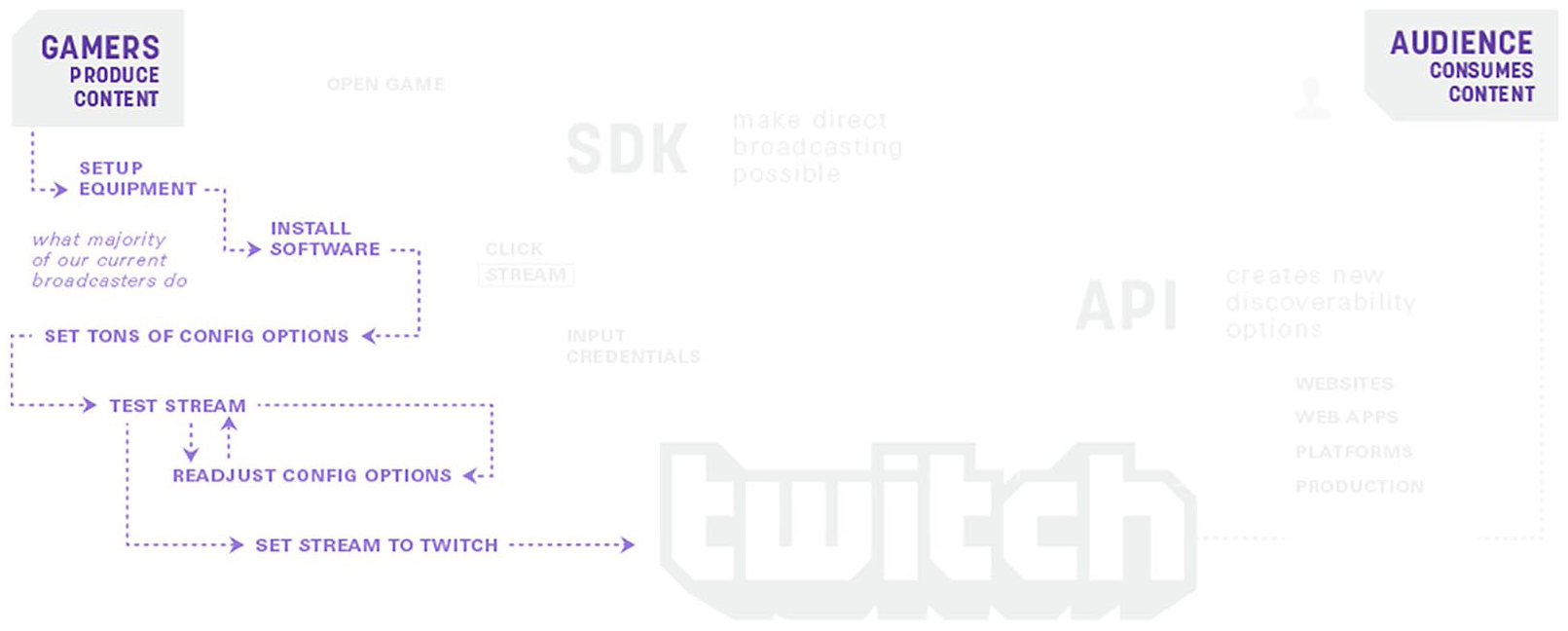
Twitch’s “Developer Page” as of 19 June 2013. Accessible at https://web.archive.org/web/20130619113339/https://dev.twitch.tv/
Immediately, enterprising software engineers took advantage of the tools the Twitch API and SDK afforded them, converting the “Tip Jar”—which, until that point, had been a relatively static tool accessible only through a streamer’s “About” page—into an interactive service. As the description of one popular tool, StreamDonations (later known as StreamTips), read on 28 December 2013, A lot of people collect contributions to further the advancement of their streams on Twitch. This tool serves to help automate donations by alerting you and automatically updating text files which can be imported into many streaming programs to display on the cast. (StreamDonations, 2013)
Video tutorials from this period for similar tools like Twitch Alerts and StreamerSquare offered step-by-step guides on how to set up on-screen donations, which continued to be handled by PayPal. Crucially, these tools enticed donations by enabling viewer messages to appear on-screen as part of the broadcast, enabling audience members to perform what Crystal Abidin (2016) calls “visibility labor,” the work of becoming visible to others on social media. These tools thus not only altered the content of streams but also the complex web of relationships between viewers, streamers, and technical tools.
Over the next two years, donations became a key source of income for streamers, while donation management services began raising capital and diversifying their services. (TwitchAlerts, for example, rebranded as Streamlabs and began offering interactive overlays and on-screen polls to increase viewer engagement). In a 2017 blog post, Streamlabs founder Mike Le (2017) offered a slew of statistics revealing how large the donation economy on Twitch had become. Tipping volume processed by Streamlabs jumped 84% from $43.6 million in 2015 to $80.2 million in 2016, while the number of unique channels generating at least $1 in income through Streamlabs grew 78% from 99,725 to 177,814. On the high-end, channels generating more than $10,000 annually grew 89% from 2015 to 2016. During this period, the average revenue per follower also grew dramatically, rising 93% for non-partnered streamers, and 72% for partnered streamers.
To be sure, venture-backed complementors like Streamlabs were hardly non-commercial actors. By positioning themselves between streamers and viewers (a position afforded to complementors via Twitch’s API), application developers hoped to someday profit from these relationships through revenue sharing of donations, or, better yet, by being acquired by a larger technology firm once a sufficient user-base had been established. Even so, because Streamlabs and its competitors were mostly pursuing a “growth over profits” strategy popular among technology startups due in part to a macroeconomic environment fueled by low interest rates and cheap capital (Srnicek, 2016), these services took no cut of donations and only charged streamers for credit card processing fees.
Same-side competition among application developers was, in other words, good for streamers, who benefited from cheap donation management tools. At the same time, these tools offered only indirect boons to Twitch. Although donations aided in the professionalization of livestreaming, Streamlabs and comparable services did not offer Twitch direct revenues. Rather, the movement of value from audiences to Twitch streamers was mediated by third-party platform markets in which complementors like Streamlabs and StreamElements functioned as financial intermediaries between streamers and viewers. That was soon to change.
Introducing . . . Twitch Bits
In June 2016, Twitch debuted Twitch Bits. Sold as a boon for the thousands of aspiring and professional streamers who generate revenue on the platform, Twitch Bits enabled viewers to tip (or “Cheer”) streamers using a virtual currency, “Bits,” built directly into the interface for every channel on Twitch (Figure 3). As the company wrote in its blog announcing Bits, Bits are a virtual good you can buy and use to Cheer. A cheer is a chat message that uses Bits and includes animated emotes to amplify your voice in chat and celebrate the moment. Cheering is another way to support [professional and aspiring livestreamers], similar to subscribing. (Fontaine, 2016)
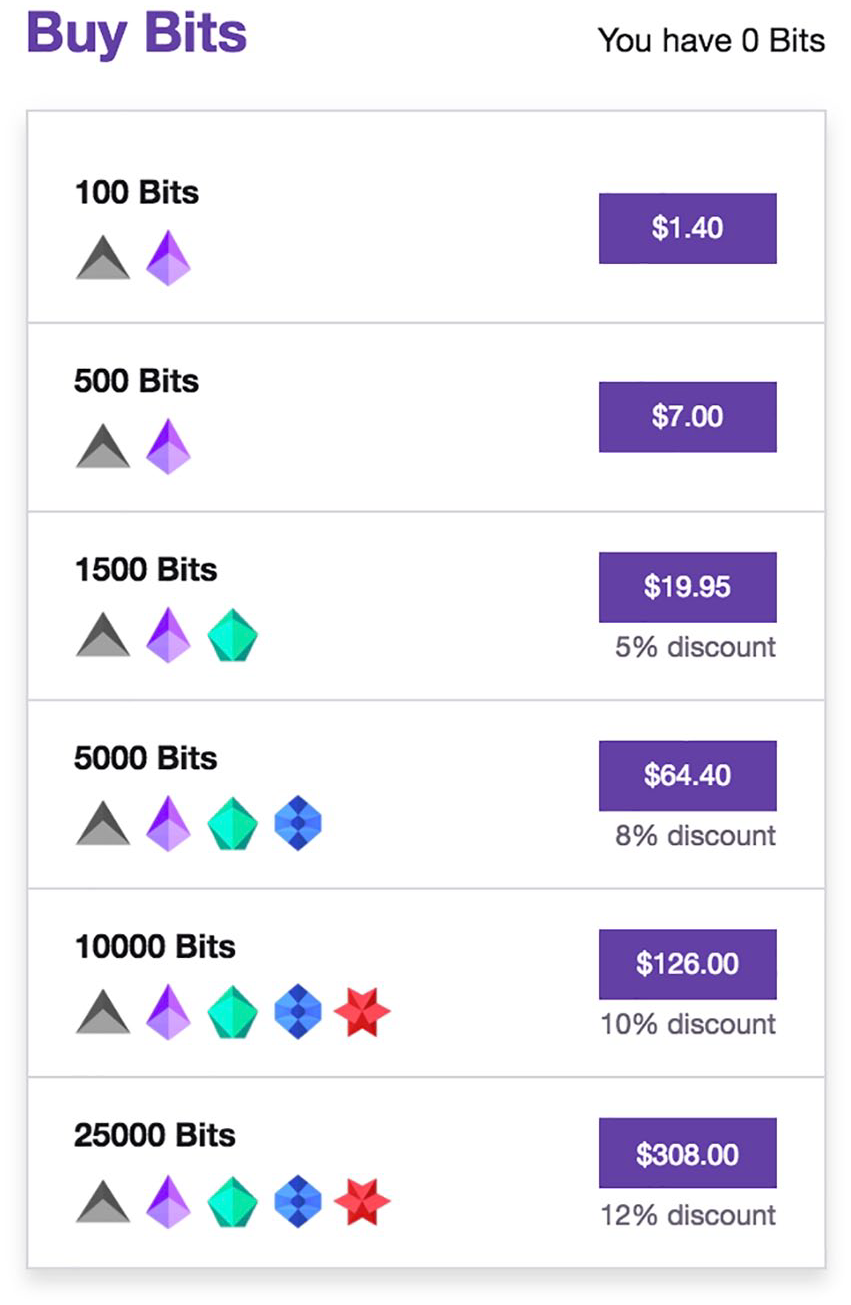
Purchase panel for Twitch Bits, which also shows the special icons that accompany each level of purchase.
Out of context, one might reasonably think that Twitch Bits would be welcomed by streamers, who, after all, were being offered a new way to monetize their broadcasts. Against a longer economic history, however, it’s not hard to see why Bits received a cool reception from streamers and the gaming press alike. Unlike prior donation management tools, Twitch took a reported 30% of every donation processed through Twitch Bits. As a result, many viewed Twitch Bits as a thinly veiled attempt to co-opt streamers’ income and crowd out third-party services by encouraging would-be donors to use a self-serving, first-party tool. Despite initial wariness, however, Twitch reported that viewers “Cheered” between 84 and 96 million Bits (~$12 million) during the program’s first 10 months (Spangler, 2017).
Beyond these direct revenues, Twitch Bits offered a number of additional benefits to Twitch. Amazon Prime subscribers, for example, received discounts on Twitch Bits, and the platform encourages would-be donors to use the Amazon Payment system, enriching the value of these services. Amazon’s status as a monopolistic digital ecosystem affords not only significant possibilities for cross-promotion but also integrations with Amazon’s proprietary payment system that more traditional forms of media consolidation cannot recreate. In addition, Twitch now organizes special promotions around its own media properties using Twitch Bits. For Overwatch League, an esports tournament for which Twitch reportedly paid $90 million for broadcast rights, Twitch implemented a promotion that would release in-game virtual goods whenever the global amount Twitch Bits donations reached certain thresholds, enrolling the entire fan base of Overwatch League in a kind of community “metagame” (Boluk & LeMieux, 2017). Most importantly, because donation management tools were initially developed by third-party organizations like Streamlabs, Twitch did not have access to the depth of data these apps collected about donations. Twitch Bits gave Twitch access to data that were previously processed beyond its reach, territorializing donations into its “digital enclosure” (Andrejevic, 2009).
Part II: From Platform Envelopment to Platform Capture
Business Studies Confronts Platforms
Long before terms like “platform capitalism” (Srnicek, 2016) entered academic discourse, scholars of business studies and strategic management were examining the importance and intricacies of platform markets. In this tradition, platforms are understood not necessarily as software suites but as facilitators of multisided markets, or “matchmakers” (Evans & Schmalensee, 2016), that connect unlike parties for economic exchange. For this reason, platforms were, initially, not exclusively associated with digital technologies. eBay is a multisided market, but so is a phonebook or a mall. Even so, multisided markets share an affinity with digital technologies because of software and algorithms’ ability to organize user interactions at scale, as well as being able to collect data on these interactions.
Scholars in business studies quickly recognized that platform markets, once established, were difficult to dislodge because of their strong winner-take-all tendencies, network effects, and high barriers to entry. Accordingly, many believed that the only way to “break” an entrenched platform market’s dominance was by creating a new one that offered revolutionary functionality, thereby enticing consumers away from an aging platform in spite of the value they derived from incumbencies. In an important study, however, Thomas Eisenmann et al. (2010) describe an alternate approach to inter-platform strategy, which they labeled “platform envelopment” (Figure 4). Rather than invest in technologies that offer revolutionary capabilities, certain platforms—especially very large ones upon which other, second-order platforms relied—could strategically “envelop” complementors, capturing their market share in the process. As Eisenmann et al. write, Platform providers that serve different markets sometimes have overlapping user bases and employ similar components. Envelopment entails entry by one platform provider into another’s market by bundling its own platform’s functionality with that of the target’s, so as to leverage shared user relationships and common components. Dominant firms that otherwise are sheltered from entry by standalone rivals due to strong network effects and high switching costs can be vulnerable to an adjacent platform provider’s envelopment attack. (p. 1)
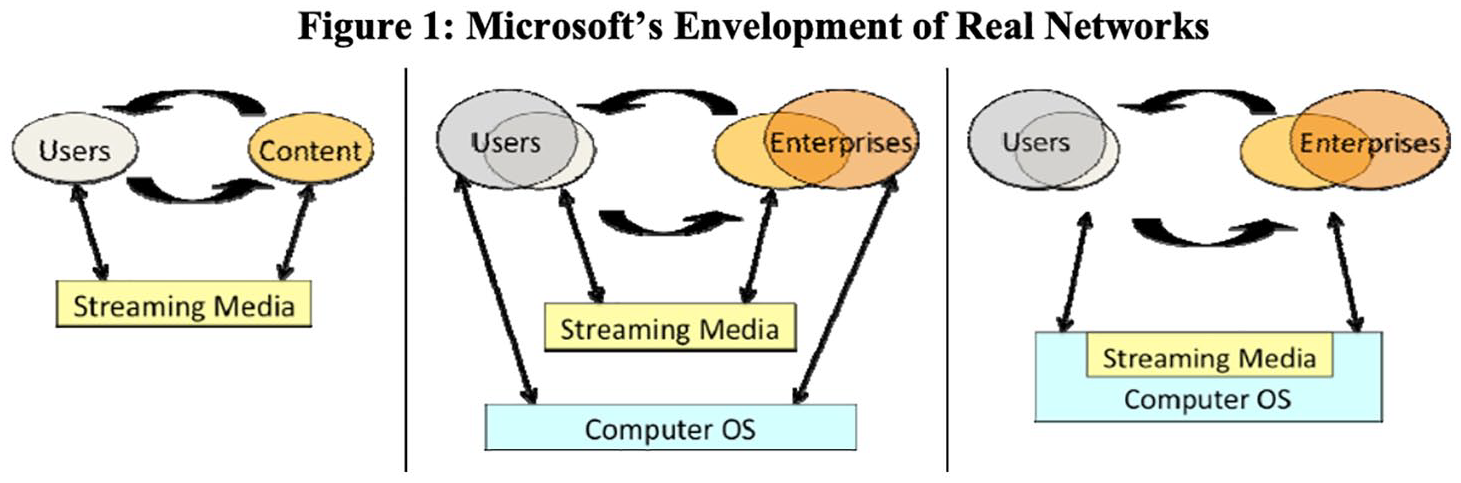
Eisenmann et al.’s diagram of platform envelopment.
To illustrate platform envelopment, they describe how Microsoft enveloped Real Player (RP), a streaming media program that was introduced for Windows in 1995. Upon its release, RP functioned as a classic example of a successful multisided platform, built upon another platform (Windows). End-users of RP were able to use the service for free, which attracted large numbers of listeners; content owners, by contrast, leased server space from Real Networks in order to gain access to this large user-base. The strategy was successful and, by 1998, RP had more than 90% market share of the streaming media market.
That dominance was not to last. Microsoft soon launched an attack by bundling Windows Media Player (WMP) with new versions of Windows, echoing the controversial “embrace and extend” tactics the company had long been associated with. Although WMP offered no real improvement over RP, Microsoft leveraged shared user relationships (i.e., RP users were necessarily Windows users) and common components (i.e., reliance on Windows OS) to direct users toward WMP instead of RP by pre-installing the program and making it the operating system’s default media player. This platform envelopment attack was successful, and Real Networks saw their market share absorbed by Microsoft (Figure 4).
For Eisenmann et al., envelopment is an inherent feature of platform markets and their relationship to the practice is primarily descriptive, offering a general outline of how platform envelopment works, the conditions under which it is likely to succeed, and a number of examples of the practice in action. As a result, they are not particularly interested in critiquing the practice or connecting it to broader concerns about the concentration of corporate power and widespread precariousness associated with platformization. In particular, their relative ambivalence toward how power asymmetries between the “enveloper” and “enveloped” are productive of (and reinforced by) the process they describe offers an opportunity for this article’s critical intervention.
Twitch Bits as Platform Envelopment
Seen from this perspective, Twitch Bits is a classic example of platform envelopment. In this scenario, the third-party developers who initially created and refined Twitch’s donation management tools (Twitch Alerts, Streamlabs, and StreamElements) are analogous to Real Networks in that they successfully created two-sided markets that enrolled streamers and viewers. And while there was competition for users among these developers, they were not, initially, in direct competition with Twitch, which “merely” provided development tools and access to a user base. Twitch, by contrast, plays a role akin to that of Microsoft. Just as RP users were also Windows users, anyone using a donation service—whether viewer or streamer—was, by necessity, also a Twitch user. And just as RP was built on Windows operating system, automated donation management services were themselves reliant on Twitch’s own API in order to function, meaning that they already had many technical components in common with Twitch. As a result, once third parties proved the viability of these services and began operating them at scale, Twitch was able to integrate similar tools into its platform, rebranding them as Twitch Bits in the process.
As Annabelle Gawer (2014) has suggested, this kind of behavior poses a challenge to how some literature in business studies conceives of and analyzes multisided markets as simple intermediaries. As she writes, . . . the economic theoretical perspective posits that platforms fundamentally create value by acting as conduits between two (or more) categories of consumers who would not have been able to connect or transact without the platform. Platforms create value by coordinating these groups of consumers and in the economic view this coordination is effected through pricing. (p. 1241)
While technical design and user agreements may set the terms of these exchanges, platforms are still imagined as agnostic toward the markets they facilitate. It is primarily market actors, rather than the platform owner, who are given agency in this formulation. But similar to how Tarleton Gillespie (2010, 2015) argues that platforms are not egalitarian spaces but agents that actively shape users’ experience of social media through moderation, platform owners are hardly apathetic toward what happens in the markets they facilitate. Over time, the temptation—to say nothing of the competitive pressures—to intervene into these markets is significant. As a consequence of the tendency to downplay the agency of platforms (and their owners), much of the economic literature on platforms overlooks the numerous ways in which competition arises between platform owners and their complementors.
Gawer’s paper comes as part of a larger attempt to integrate economic and engineering perspectives to develop an “integrated conceptualization of platforms that allows multi-modal interaction between agents within and across platforms, and that would allow scholars to study the ways in which competition and innovation shape the way platforms evolve” (p. 1245). In the engineering perspective, “platforms are products that meet the needs of a core group of customers but can be modified through the addition, substitution, or removal of features” (p. 1242). Twitch is exemplary on this point. Like many “innovation ecosystems,” the platform is a modular technological architecture that is composed both of a stable core component and variable peripherals. The release and frequent updating of Twitch’s API (now on its fifth major version) have made it possible for a range of third-party developers, many of whom have taken on significant capital to support their efforts to develop new tools that extend Twitch’s capabilities.
Gawer describes a four-part ideal-typical model that encapsulates the economic and technological interactions in a platform ecosystem, one possible outcome of which is envelopment. As she describes it, 1. As platform interfaces become more open, more agents will be attracted into the platform ecosystem, and the platform leader will be able to access a larger set of potentially complementary innovative capabilities. (p. 1246) 2. While a large proportion of the platform ecosystem’s agents will innovate in ways that are complementary to the platform, a number of them will start innovating in ways that become competitive to the platform. (p. 1246) 3. Emergence of competition from complementors will depend on the governance of the ecosystem, as collaborative governance will increase complementors’ incentives to innovate in platform-enhancing ways. (p. 1247) 4. Emergence of competition from former complementors is in turn likely to create a reaction by the platform leader to start competing back with these former complementors-turned-rivals, either by enveloping them, or by closing its technological interface, in effect moving away from being an industry platform towards becoming a supply-chain platform. (p. 1247)
Gawer concludes by noting that these theories could be “tested empirically by future scholars.” One objective of this article has therefore been to illustrate the general validity of this model by way of an empirical example. What is more, this framework could be applied to a wide variety of developments on Twitch over the last decade. Indeed, many of the platform’s recently introduced technical features, such as Twitch Clips, a first-party recreation of the platform-dependent application OddShotTV, which created sharable “highlights” from live broadcasts, could also serve as examples of platform envelopment.
Theorizing “Platform Capture.”
Even so, Twitch Bits also points to the limits of platform envelopment as a concept. As Nieborg and Poell (2018) suggest, business scholarship is relatively quiet not only on the relationships between platforms and complementors but also on how complementors enter into competition with platform owners as the complex dynamics between technological innovation and economic competition unfold across a platform’s lifespan. Likewise, power relations are not a significant concern within this literature, impeding scholars’ ability to connect platform envelopment to broader concerns over the concentration of power in technology firms and the ubiquity of precarity under so-called “platform capitalism.” Instead, key concepts in the platformization of cultural production—namely, infrastructure, platform governance, and critical political economy—offer an alternative evaluative framework for platform envelopment.
One challenge to Gawer’s model of platform evolution is a conception of competition that elides the conditions through which competitive relationships between platform owners and complementors emerge. Contra Gawer’s suggestion that some “complementors will start innovating in ways that become competitive to the platform” (p. 1246), StreamElements and other donation management services did not “become competitive” to Twitch so much as Twitch interpellated them as competitors through the introduction of Twitch Bits to the technical architecture of their platform.
This change in frame suggests that one way in which platforms may incrementally evolve is premised on the conversion of some “boundary resources” into the “core” architecture of a platform, thereby turning formerly complementary relationships into competitive ones. But the frame of “becoming competitive” misses how Twitch’s status as platform owner affords them a unique ability to define, both through their own platform infrastructure and its governance, the contexts for practice in which platform dependents act, a power asymmetry that preceded the introduction of Twitch Bits, rather than being produced by it. Indeed, this very power differential is baked into platforms by virtue of the dependencies they instill in complementors. Likewise, platform owners’ consolidation of power and influence through uneven competitive dynamics is a common thread in political economic literature on platforms.
This infrastructural perspective on platform ecosystems is also useful for considering what happens after the expansion of a platform’s technical architecture redefines the relations between itself and complementors in competitive terms, with little possible recourse from platform dependents. Importantly, Twitch did not expel StreamElements and other donation management tools from Twitch, just as Microsoft did not simply expel RP from Windows. Rather, Twitch benefited from several uneven market dynamics and technical features that drove users toward its own service. One, while Twitch streamers must select from among and opt into third-party donation management tools, all professional or semi-professional streamers on Twitch are automatically enrolled into Twitch Bits program. Two, because third-party donation management systems compete among themselves to enroll streamers into their services, there are still strong competitive pressures against taking any cut from donations. Three, because of Twitch’s ability to redesign its own user interface at will, Twitch Bits receives superior visibility in the Twitch UI, driving interest (and donations) to the service. Donation messages appear not only in real-time on a broadcast but also in its accompanying chat panel, maximizing viewers’ opportunity to perform visibility labor. Likewise, the most recent donors of Twitch Bits to a channel are displayed directly above that channel’s chat box (Figure 5), giving increased visibility to donators that third-party tools are unable to offer. Each of these gave Twitch’s own donation management tool a significant competitive advantage and ultimately ensured its widespread adoption.

The highest donations in Bits afford donors persistent visibility above Twitch’s chat interface (as of August 2019).
This dynamic forms some of the basis for legal scholar Lina Khan’s (2017) well-known note on Amazon’s “antitrust paradox.” (It is no coincidence that Twitch is owned by Amazon, and that the process of platform capture I’ve described took place following Twitch’s acquisition in 2014). In brief, Khan argues that current legal frameworks surrounding antitrust focus exclusively on consumer welfare and fail to recognize many of the underlying techno-economic dynamics of platform companies, where concerns over anticompetitive structures are most apparent. As she suggests, Because online platforms serve as critical intermediaries, integrating across business lines positions these platforms to control the essential infrastructure on which their rivals depend. This dual role also enables a platform to exploit information collected on companies using its services to undermine them as competitors. This dual role also enables a platform to exploit information collected on companies using its services to undermine them as competitors. (p. 710)
While Khan does not engage with Gawer directly, the tendency for successful complementors to end up in direct competition with the platforms upon which they are technologically and economically entangled is an example of the anticompetitive practices with which her note is concerned.
Finally, it is worth noting the role of precarity and insecurity in platform capture. As Lauren Berlant (2016) argues, all infrastructures are arrangements for the distribution of (in)security and they are political insofar as they allocate resources differentially. Reacting to rising concerns over the precariousness in contemporary life (Butler, 2006; Kalleberg, 2009; Lorey, 2012), scholars of platformization have established that precarity is part and parcel of platform ecosystems, whether in the production of cultural content (Duffy, 2017) or other sectors in which platforms operate (Rosenblatt, 2018). Even in the comparatively wealthy technology sector, many workers have found that their labor is increasingly insecure (Neff, 2012) and that insecurity is increasingly borne by individuals, rather than organizations. And while there are important differences between the working lives of Twitch streamers and employees of venture-backed firms developing applications for Twitch, both are bound by a common precariousness not shared by Twitch as platform owner. If the underlying infrastructure of Twitch’s ecosystem engenders (and exploits) precariousness in its dependents, it also affords security to itself.
A techno-economic history of donations on Twitch is therefore not only instructive of how and where precarity exists for many actors within a platform ecosystem. Rather, this history also points to how that very precarity may be leveraged in the incremental evolution of platforms. Soliciting donations from viewers, after all, first emerged as an attempt by streamers to make their work less precarious; seeing a market opportunity, application developers, once given access to the Twitch API and SDK, stepped in to develop tools to manage donations at scale and integrate them directly into broadcasts. That these venture-backed firms were attempting to capitalize upon streamers’ precarity by developing more sophisticated tools to manage a growing number of donations does not change the fact that the risk borne by these firms ultimately benefited Twitch. In short, Twitch’s platform affords its owners the capacity to shift the risk of developing new features to dependents. Seen from a critical perspective, this history suggests that it is not necessarily third parties who are parasitic on platform owners, but, rather, platform owners who are parasitic on third parties.
By theorizing “platform capture” as an alternative to “platform envelopment” through the theoretical apparatus offered by the platformization of cultural production, there emerges an alternate set of concepts through which to evaluate the terms on which platform evolution may occur, one that enables us to see platform ecosystems as infrastructures for accumulation premised on power asymmetries expressed as platform dependency. To recount, platform capture, in this article’s definition, denotes a process in which (1) complementors within a platform marketplace (such as developers who create applications using boundary resources) develop new features that create value by extending the capabilities of a platform; (2) platform owners create first-party versions of these features that create greater value for themselves; (3) third-party tools are unwillingly forced into competition against first-party offerings in a platform marketplace that is biased toward its owners.
This definition is related to, but ultimately differs from, mere user appropriation (as in Twitter’s appropriation of the #hashtag) because it is meant to draw attention to the techno-economic dynamics by which complementors may be interpellated as competitors by platform owners should complementors’ innovations turn out to be valuable for platform owners and not simply themselves. Likewise, platform capture differs from copying smaller companies’ innovations (as in Instagram copying Snapchat Stories), since platform capture (like platform envelopment) relies on having a common user-base and technical architecture. These dynamics are always uneven, and that the power asymmetries baked into platform ecosystems is productive of the incremental evolutions of a platform’s technical architecture through platform capture.
In sum, differences between platform envelopment and platform capture are in part connotative, but are also intended to make visible power asymmetries as productive of platform evolution and link it to broader concerns about the concentration of power and influence in a small number of information technology firms. Just as platform metaphor encourages users, advertisers, and regulators alike to see platforms as open spaces that facilitate the free exchange of ideas, “envelopment” implies a kind of inevitability whereby the small are subsumed by the large. Capture, by contrast, draws attention to the active work performed by platform owners, guided by capitalist imperatives, in leveraging the ways in which platform ecosystems develop. (As Karl Marx might have put it, platform capitalism always contains the platform capitalist.) If “platform envelopment” speaks to the “embrace and extend” philosophy, platform capture highlights what is excluded by this formulation—“embrace, extend, and extinguish.” This speaks to how the evolution of platforms as technical objects is tied to their consolidation of control over platform ecosystems, given how technical titivations built on and out of platform dependencies may interpellate complementors as market competitors to platform owners, further solidifying these firms’ social and economic power.
Conclusion
During the process of writing this article, Apple announced that “Screen Time,” a screen-tracking and parental control tool whose features recreated those of a number of third-party apps, would be packaged with its forthcoming iOS 12 (Welch, 2018). Shortly after, Apple removed a number of comparable apps from its App Store, citing privacy concerns (Hollister, 2019). Although many of these apps were reinstated after public (and developer) outcry, their return to the App Store did not change the underlying techno-economic dynamics that gave Screen Time, now standard on all iOS devices, a significant competitive advantage over third-party device management tools that users must seek out and opt into for themselves. For scholars interested in platform power, a focus on the “hard power” of Apple to exclude complementors-turned-competitors through policy choices must not come at the expense of examining how company continues to exert “soft power” over complementors through uneven competitive dynamics.
While this article has focused on Twitch Bits as exemplary of platform capture, the controversy over “Screen Time” shows that platform capture is not limited to Twitch. Rather, platform capture occurs throughout GAFAM companies, as well as other platform-based companies whose ecosystems are composed of complex techno-economic dynamics between platform owners and complementors. What this reveals about platforms more broadly is that power asymmetries between platform owners and complementors can be (and often are) leveraged in order to aid in the evolution of platforms as technical objects. As this article has suggested, that observation in turn opens onto broader questions about the worrying concentration of power in large information technology firms, their monopolistic tendencies, and the precariousness endemic to the age of the platform.
Footnotes
Acknowledgements
This article originated in Dennis Mumby’s graduate seminar “Organization, Work, and Power” in Spring 2018. I am grateful to him, as well as to Torin Monahan, Alice Marwick, and Nicholas Taylor for their comments. In addition, I would like to thank the editors of this special issue, whose patience and wisdom made this paper possible, as well as my anonymous reviewers, who provided generous and constructive criticism.
Declaration of Conflicting Interests
The author(s) declared the following potential conflicts of interest with respect to the research, authorship, and/or publication of this article: In 2020, I received a Graduate Student Research Grant from Twitch worth $5,000. All research and writing for the present article was completed prior to this applying for grant.
Funding
The author(s) received no financial support for the research, authorship, and/or publication of this article.
