




Abstract
This article studies “fake news” beyond the consumption and dissemination of misinformation and disinformation. We uncover how the term “fake news” serves as a discursive device for ordinary citizens to consolidate group identity in everyday political utterances on Twitter. Using computational linguistic and network analyses, we demonstrate that over the period of 2016–2018, there is an uptrend in the use of identity language in US Twitter users’ discussions about “fake news,” manifested by the increased frequency of group pronouns in combination with issues and sentiments that boost one’s ingroup and derogate the outgroup. Furthermore, as opposed to the conventional wisdom that “fake news” is a right-wing term, we uncover two disconnected retweet networks surrounding liberal and conservative opinion leaders. Like-minded individuals selectively amplify ingroup messages to claim the power to define falsehood and make group-serving blame attributions. We discuss the theoretical implications of our findings and offer new directions for future research on “fake news,” misinformation, and disinformation.
Keywords
Introduction
The online media landscape has been increasingly characterized by the prevalence of misinformation that travels faster, deeper, and broader than true stories (Vosoughi et al., 2018). The situation is further exacerbated by state-sponsored influence campaigns (Tucker et al., 2018), the attention-guided marketplace (Webster, 2014), and fragmented partisan networks (Conover et al., 2011). Starting from Donald Trump’s 2016 presidential campaign, “fake news,” a term that had previously made various appearances in American media history, rose to prominence in the contemporary political discourse, contributing to the concern of a broader “information disorder” in the US and around the world (Wardle & Derakhshan, 2017).
As the global awareness of “fake news” continues to rise, a burgeoning line of research has examined various dimensions of the problem, including the scope of “fake news” consumption, the motivations behind and the content of online “fake news” diffusion, as well as the potential for social media curation to debunk “fake news” (Allcott & Gentzkow, 2017; Chadwick et al., 2018; Machado et al., 2019; Marwick, 2018). Alleviating the initial concerns about its detrimental effects, recent evidence suggests that “fake news” consumption is confined to a small subset of audiences and that “fake news” websites have limited power in setting the agenda of online media outlets (Nelson & Taneja, 2018; Vargo et al., 2018).
However, questions remain about how “fake news” evolves as a discursive device that adversely affects the political information ecosystem above and beyond low-quality information (Farkas & Schou, 2018). As a popular catchphrase, “fake news” not only serves as a rhetorical strategy widely adopted by political elites, but also grows into a contested theme in the vernacular discourse (Nielsen & Graves, 2017). While the public generally agree on the severity of the “fake news” problem (Stocking et al., 2019), disagreements and ambiguity persist in discussions about what exactly “fake news” is and who should be responsible for it (Farkas & Schou, 2018).
We contribute to the current scholarship on “fake news” by demonstrating how group identity is articulated and consolidated in ordinary US citizens’ utterances about “fake news” on Twitter, a platform where the term has been strategically used by Donald Trump and generated heated public discussions (Ross & Rivers, 2018; Wells et al., 2016). While past research has carefully examined the role of social media in facilitating the spread of “fake news,” we have limited knowledge about how social media offers a public sphere for citizens to deliberate and contest the concept of “fake news.” Our results suggest that over the period of 2016–2018, there is an uptrend in the use of identity language in ordinary citizens’ “fake news” discussion, manifested by the increased frequency of group pronouns in combination with issues and sentiments that boost one’s ingroup and derogate the outgroup. Furthermore, as opposed to the conventional wisdom that “fake news” is a right-wing term, we uncover two disconnected retweet networks surrounding liberal and conservative opinion leaders. Both sides selectively amplify ingroup messages and attribute blame to their opponents through self-serving thematic and linguistic choices. We discuss the theoretical implications of our findings and offer new directions for future research on “fake news,” misinformation, and disinformation.
The Evolving “Fake News” Discourse
The conceptual boundaries of “fake news” have been evolving. Before Donald Trump reintroduced the term in 2016, one of the earliest appearances of “fake news” in American media history was associated with yellow journalism in the late 19th century. Writing in Arena, an influential monthly at the time, commentator J. B. Montgomery-McGovern (1898, pp. 240–251) used “fake news” and “fake journalism” to describe “the most sensational stories” in metropolitan Sunday papers that were “absolutely false” and could “mislead an ignorant or unsuspecting public” (Love, 2007).
Since the late 1990s and the early 2000s, “fake news” has also been used to label genres that mimic the style of traditional news while using irony and humor to offer implicit critiques of politics and social issues (Young, 2018). These include news satire (e.g., The Daily Show), which provides “direct commentary on current affairs,” and news parody (e.g., The Onion), which “plays on the ludicrousness of issues and highlights them by making up entirely fictitious news stories” (Tandoc et al., 2018, p. 143). Although satire and parody are “fake” or counterfeit in their news formats, they are “genuine” in expecting the audience to never take the ironic text literally (Young, 2018). Reviewing past uses of the term, Tandoc et al. (2018) identified two dimensions in defining “fake news”: factual inaccuracy of the information and the author’s intent to deceive. News satire and parody, although involving different levels of fabrication, are generally without the intent to deceive; news fabrication and sensationalism, on the other hand, are regarded as having both low facticity and high deceptive intent.
Against this backdrop, the term “fake news” rose to prominence during the 2016 US presidential election and took on new meanings in the contemporary political discourse. While early post-election research still looked for facticity and intentionality as two important dimensions of “fake news” in a rather literal and objective sense (Allcott & Gentzkow, 2017), many quickly noted that the term has been increasingly weaponized by both the American right and left to discredit and denigrate the political opponent (Wardle & Derakhshan, 2017).
On the one hand, this weaponized use of “fake news” finds clear manifestation in Donald Trump’s attacks on the news media. During his campaign, Donald Trump routinely accused the mainstream media as being dishonest, hostile and “fake” in speeches and interviews, stirring up heated discussions on social media platforms regarding media credibility and bias. After his election, Trump’s “war on media” persisted as he kept using “fake news” as a catchphrase on various occasions. On 10 December 2016, as president-elect, Trump first tweeted about “fake news,” saying “Reports by @CNN that I will be working on The Apprentice during my Presidency, even part time, are ridiculous & untrue—FAKE NEWS!” A month later, Trump famously said to CNN’s reporter Jim Acosta “you are fake news” during a press conference. The antagonistic use of “fake news” continued throughout Trump’s presidency: The “fake news” rhetoric was bolstered by Trump’s “Fake News Award” given to six mainstream news outlets and also became a major theme in his re-election campaign (Scott et al., 2019). Summarizing Trump’s remarks on “fake news,” research found that the term has been used to complain about the lack of acknowledgment of his positive actions, refute the challenges of his claims, allude to a media conspiracy, and as a cover for his own false claims that are framed as truth (Holan, 2017; Ross & Rivers, 2018).
On the other hand, the American left has also attempted to redefine the discourse by framing “fake news” as a right-wing phenomenon and transforming the meaning of “fake news” from criticizing the media to critiquing Trump’s own remarks. Growing in popularity after Trump’s election, efforts to identify “fake news” often blurred the line between fabricated information and right-wing opinions (Oremus, 2016). For example, The New York Magazine’s website extension that “flags fake news sites” based on Melissa Zimdars’ viral “fake news list” regarded the entire sites of conservative blogs such as Breitbart and Red State as “fake news” (Feldman, 2016). Moreover, liberal commentators have appropriated the term “fake news” to denounce Trump’s electoral victory as the beginning of a “fake-news presidency,” while referring to him as “the leading purveyor of fake news” and “editor-in-chief of the fake news movement” (Milbank, 2016; Seward, 2016). With the impending 2020 election, liberal critics regarded “fake news” as “the hidden menace threatening Democrats’ bid to beat Trump in 2020,” calling on people to stay hypervigilant of “fake news” from Trump and his allies (Lizza, 2019).
As a consequence of elites’ weaponization of the term “fake news,” the public’s understanding of “fake news” is also divided along the partisan lines as both sides increasingly view “news they don’t believe” as “fake” (Nielsen & Graves, 2017). To illustrate, in the United States, a recent survey showed that Republicans are more likely to associate “made-up news” with the news media, while Democrats tend to attribute it to Donald Trump and his administration (Stocking et al., 2019).
Given how the term “fake news” has been deployed in contemporary partisan contexts, scholars have theorized “fake news” as a “floating signifier,” a concept proposed by Laclau (2005) in reference to a signifier simultaneously articulated within different discourses of opposing political projects (Farkas & Schou, 2018). Unlike a signifier with a fixed meaning, a “floating signifier” implies that none of the rival actors have succeeded in defining its meaning, creating opportunities for reinterpretations (Farkas & Schou, 2018). The meaning of “fake news” is still “floating,” as it has been constantly weaponized by both the political left and right to discredit opponents and construct a preferred version of social reality (Farkas & Schou, 2018). The current controversy over “what fake news is” thus signifies a competition for the power to classify truth and falsehood for one’s own side. In this sense, judgments on accuracy and intentionality, the two primary components of the scholarly definition of “fake news,” depend on whether the information fits into the reality accepted by one’s ideological group. In other words, “fake news” is in the eye of the beholder.
The Social Identity Approach to “Fake News”
Social identity theory (Tajfel & Turner, 1979) provides a useful framework to understand the contested nature of “fake news.” At its core, social identity theory suggests that people tend to see themselves and others in terms of groups. When a specific group identity becomes salient, individuals tend to derive their self-concept based on prototypical ingroup traits and are motivated to maintain a positive distinction between their ingroup and the relevant outgroup (Tajfel & Turner, 1979). This cognitive-motivational process promotes a category-based thinking and a sense of “us against them,” which colors the perceptions of social reality against which the veracity of media content is judged (Green et al., 2002).
Political identification is one such important social category shaping media perceptions (Greene, 2004). Political identity has played a central role in criticisms of the media even before the rise of “fake news.” Research on hostile media perception has long suggested that people blame the media for untruthful reporting even in the absence of actual bias (Giner-Sorolla & Chaiken, 1994). Motivated to protect their group, those with salient political identity tend to make credibility judgments by contrasting their group’s position with the media content, falsely concluding that the media are unfairly biased against their side (Vallone et al., 1985). Several psychological processes are suggested to be at play, such as selective recall of unfavorable content, selective categorization of the valence of the news story and different standards for what constitutes a fair story 1 (Schmitt et al., 2004). Salient group identity also makes one more susceptible to elite cues that attack unfavorable content as biased or untruthful, prompting them to evaluate media based on such heuristics (Watts et al., 1999).
Based on previous research on individuals’ perceptual and evaluative biases, we argue that citizens inevitably understand “fake news” through an identity lens. First, people may use their ingroup prototypical position as an anchor in making credibility judgment. Any stories that do not clearly support their group are likely to be interpreted as “fake” (Giner-Sorolla & Chaiken, 1994). Second, even with identical content, people may judge information from an outgroup source as “fake” yet view it as trustworthy when it comes from an ingroup source (Swire et al., 2017). Third, even when sharing the same concern over “fake news,” people may disagree on its cause and selectively attribute blame to politicians and media from the opposite side (Bisgaard, 2015). Finally, ingroup-protective motives may cause individuals to surround themselves with pro-ingroup messages, which further foster ingroup favorability and negative outgroup evaluations (Wojcieszak & Garrett, 2018). Together, these processes contribute to identity-driven views of “fake news” in the political battleground.
The Current Study
In this study, we propose a social identity approach to understanding how ordinary Twitter users construct and interpret discourses about “fake news.” While previous studies have examined public consumption of “fake news” (Nelson & Taneja, 2018) and their susceptibility to elite cues (Van Duyn & Collier, 2019), less attention is paid to how the public take an active role in interpreting and using the term “fake news” (but see Nielsen & Graves, 2017). Our attention to the discursive aspect of “fake news” expands the existing scholarship that mainly focuses on the psychological mechanisms of media criticism.
We focus on Twitter for several reasons. First, Twitter has been embraced by Donald Trump as a powerful tool to communicate with the public (Wells et al., 2016). “Fake news” has emerged as a consistent, major theme in his tweets and spiked a large number of Twitter discussions. Second, Twitter’s platform features, particularly its high anonymity and low social cues, heighten the need for users to engage in expressions that manifest their group identity, providing a fertile ground for identity-based biases (Klein et al., 2007).
We examine two aspects of the public “fake news” discourse. First, we ask how group identity is expressed and sustained through a powerful linguistic device—pronouns that signify group membership. While pronouns are commonly used in everyday language, research has shown that pronominal choices reflect relationships between self and relevant others (Íñigo-Mora, 2004). As such, they are not merely categorical references but always represent power struggles among groups (Pennycook, 1994). Often, the use of pronouns shows the speaker’s intention to claim where one belongs to, who are good/bad, and set normative expectations such as what one should feel, say, or act (Chilton, 2017). Specifically, people use “we-pronouns” to invoke ingroup solidarity and “they-pronouns” to keep distance with the outgroup, both of which are usually embedded in contexts that imply the superiority of one’s own side (Klein et al., 2007).
Following this line of thought, our first two hypotheses address how the use of pronouns in “fake news” discussions manifests ordinary Twitter users’ attempts to express and reaffirm a sense of “us against them.” Recent evidence shows that the issue of “fake news” has been increasingly used as strategy talk by political elites and widely covered by the media as a central issue to party conflicts (Van Duyn & Collier, 2019). Importantly, the public have also begun to understand “fake news” as a divided issue that distinguishes their ingroup from the opponent (Stocking et al., 2019). As the concept of “fake news” becomes more contentious, we expect an increase in group pronouns (“we,” “our,” “they,” “their”) in the public “fake news” discourse on Twitter (H1).
Furthermore, if group pronouns become more prominent over time, what are the contexts in which these pronouns are embedded? Social identity theory suggests that once a specific group identity is made salient, people are motivated to secure a positive self-image through a comparison process that attributes favorable traits to their ingroup yet associates negative ones with the outgroup. As such, we expect that ingroup pronouns (“we,” “our”) are more likely to be used together with words that connote positive sentiments, whereas outgroup pronouns (“they,” “their”) tend to be associated with negative sentiments (H2).
Second, we are also interested in how group identities are expressed in the opposing “fake news” discourses advanced by the American left and right. Specifically, we look at users’ retweeting behaviors through which they participate in diffuse conversations online (Boyd et al., 2010). Since people tend to engage with content consistent with their political beliefs or coming from an ingroup source by commenting, sharing, or retweeting (Rafail & Freitas, 2019; Yuan et al., 2019), retweet networks are usually segregated into ideology-based clusters with a low level of connectivity (e.g., Conover et al., 2011). Hence, we expect that, as ordinary Twitter users tend to share messages from their ideological group, the two “fake news” discourses propagated within the liberal and conservative retweet networks should be highly disconnected (H3).
Finally, if Twitter users do engage in separate networks when discussing “fake news,” how do they construct identity-based discourses within these networks? Past research shows that partisans selectively share favorable messages that cheerlead their group yet form hostile perceptions when the information undermines their side’s political standing (Shin & Thorson, 2017). We argue that in defining what “fake news” is and who is responsible, partisans will (1) pick on issues disadvantageous to their opponents and (2) use languages that resonate with their ingroup. Specifically, we ask: What are the topics and language features within the liberal and conservative retweet networks that consolidate an ingroup identity and attribute blame to the outgroup (RQ1)?
Method
Data
We collected our data based on several criteria. First, we searched for any tweets containing the keyword “fake news” through Twitter Premium Search API. This enabled us to capture ordinary Twitter users’ utterances about “fake news” in general, including, but certainly not limited to, when they interacted with the main drivers of “fake news” discourses, such as Donald Trump.
Second, the keyword was used to collect data ranging from 8 October 2016, one month before the 2016 US presidential election, to 20 January 2018, one full year after Trump’s inauguration. As argued above, a large number of social media discussions were generated by Trump’s verbal use of “fake news” during his 2016 campaign. Starting one month before his election enabled us to cover such Twitter buzz around “fake news” even before Trump took the rhetoric to the platform on 10 December 2016 after his election. It is worth noting that while data from 8 October 2016 to 10 December 2016 covered a wide range of Twitter discussions on “fake news,” it was only possible to see simple retweets of Trump’s tweets on “fake news” after 10 December 2016 when Trump first tweeted about the term.
The data contained 234,893 tweets with approximately 500 tweets for each day within our time frame, including 45,869 original tweets, 176,941 retweets, and 12,083 quote tweets. As we were primarily interested in ordinary Twitter users, for the purpose of text-based analyses, we removed the large number of duplicate retweets (i.e., retweets of the same content) to prevent biases coming from counting a highly popular tweet repeatedly. The remaining data contained 101,566 tweets in total, including 45,149 original tweets, 44,378 retweets, and 12,039 quote tweets. We also extracted users’ account handles from all retweets (including duplicates) to construct retweet networks, which gave insights on popular tweets and high-profile users.
Textual Analysis of Identity Language
All tweets went through standard preprocessing procedures before subsequent analyses. We first explored the longitudinal trends of the frequency of pronouns used in Twitter users’ discussion of “fake news.” For each day, we averaged the number of times each pronoun (“we,” “our,” “they,” “their”) was used per tweet.
To explore the contexts in which our focal pronouns were used, we used collocation analysis to identify co-occurrence patterns surrounding the pronouns of interest. After removing common English “stopwords,” we identified contiguous sequences of two adjacent words (“bigrams”) that begin with the focal pronouns. Although frequency is the most intuitive way to understand collocations, words can co-occur out of mere chance. Therefore, we used statistical techniques proposed by Manning and Schütze (1999) to test for the probability of a certain collocation appearing in the corpus. For each pronoun, we focused on word collocations which (1) were among the top 20 most frequent collocations and (2) passed all three significance tests proposed by Manning and Schütze (1999) (Likelihood ratio, Chi-square, Student’s t-test) at the p < .001 level.
Furthermore, we conducted sentiment analysis to detect affective differences among tweets using distinct types of pronouns. We used a widely adopted sentiment analysis tool, VADER (Valence Aware Dictionary and sEntiment Reasoner), a lexicon and rule-based tool specifically attuned to sentiments expressed in social media, including emojis, punctuations, capitalized letters, sentiment-laden initialisms and slangs (e.g., LOL, sux), and booster words (e.g., very) (Hutto & Gilbert, 2014). We used the “compound score” reported by VADER, which is a standardized metric ranging from −1 (extremely negative) to 1 (extremely positive) and calculated the sum of positive, negative, and neutral lexicon scores for each tweet.
Retweet Amplification and Opposing Discourses
To construct the retweet networks, we first extracted the most frequently retweeted users in our dataset. For the purpose of graphical presentation, we only retained users who were retweeted more than 500 times and their retweeters, and also filtered out inactive retweeters with only one appearance in the dataset. These steps helped us focus on a subset of highly visible information flow in the discourse. The resulting network contained 6,017 nodes (representing users) and 10,965 edges (representing their retweeting behavior). Furthermore, for a total of 27 users who were retweeted more than 500 times, two coders manually coded their ideological orientations as either conservative or liberal based on textual descriptions and hyperlinks in their profile. We plotted the node-edge structure with Gephi, a popular open-source application for exploring and analyzing networks, using the Fruchterman–Reingold force-directed layout algorithm (Bastian et al., 2009).
Finally, we explored whether the liberal and conservative discourses demonstrated distinct language patterns. To do so, we generated 50 most frequent words in the liberal and conservative retweet networks, respectively. These words were then combined into a “common word” list (n = 67). For each word in the list, we calculated its proportion in the corpus of liberal retweets and conservative retweets.
Results
The Increased Use of Affect-Laden Pronouns
H1 proposes that pronouns signifying group membership have become more prevalent over time in Twitter discussion of “fake news.” Over the period of October 2016 to January 2018, there was an increase in the use of group-identity pronouns (Figure 1). The frequency of pronouns signifying outgroup (“they” and “their”) increased gradually, growing more than two times during the period. On the other hand, pronouns signifying ingroup (“we” and “our”) showed little variance from October 2016 to October 2017, but showed a mild growth from October 2017 to January 2018, coinciding with the time period when mentions of “they” and “their” peaked.
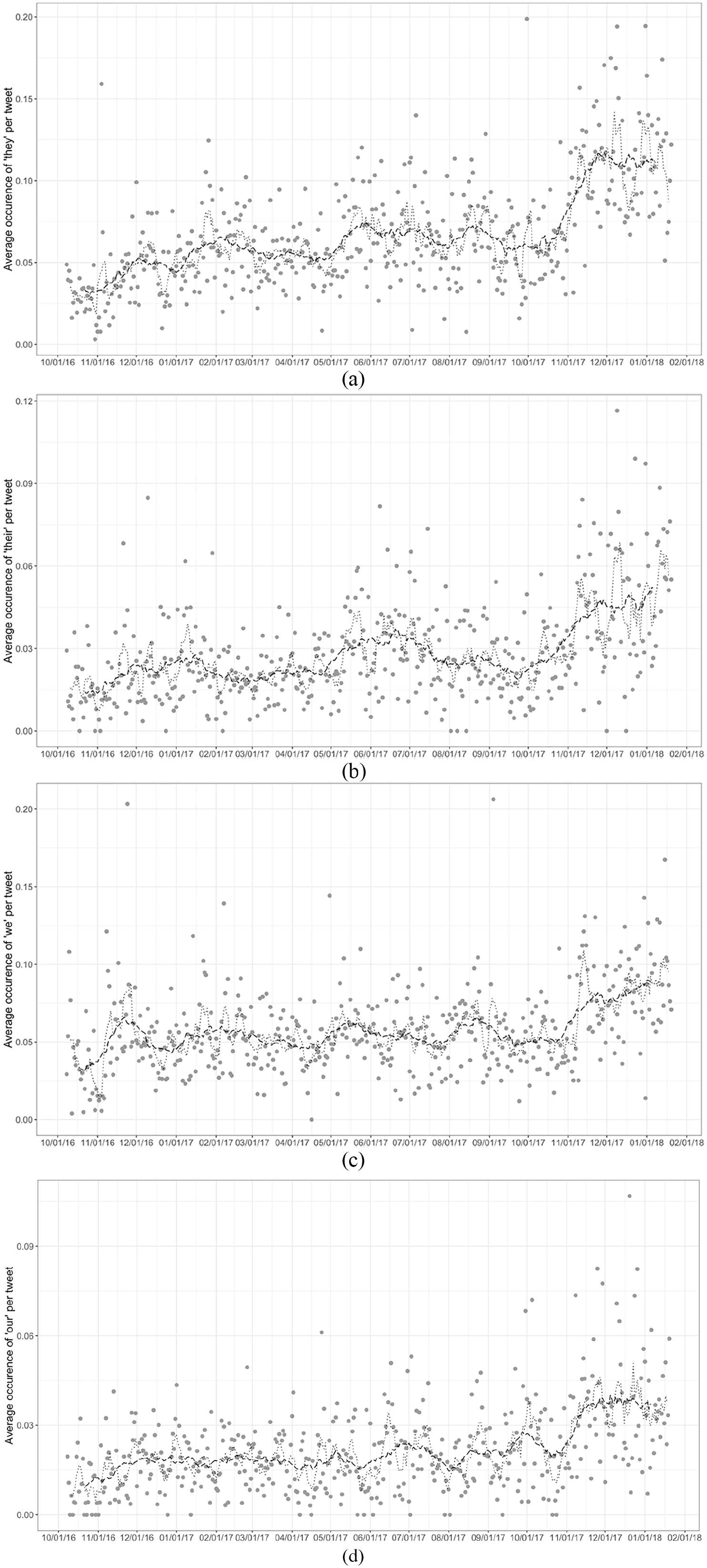
Average occurrence of (a) “they,” (b) “their,” (c) “we,” and (d) “our” per tweet per day (dots), the 7-day moving average (gray dotted line), and the 30-day moving average (black dashed line).
Importantly, these pronouns are not merely categorical references; instead, they are affect-laden markers of an identity-driven discourse (H2). We first explored words that collocate with the four pronouns to discover the context of their appearance (Table 1). Nouns collocate with “we” and “our” often highlight a sense of ingroup identity. This comes from both the conservative side, for example, “Funny, NPR telling us how to uncover fake news!
Word collocations of group pronouns.

Note: Words with * represents the word stems obtained through stemming process. For example, “continue” “continued” and “continues” are reduced to “continu*” and counted as one stem.
On the contrary, words that collocate with “they” and “their” highlight a sense of contempt, blame, and hatred targeting the outgroup. This involves both condemnation of the liberal and mainstream media, for example, “Fake News Media is a Hate Group.
The function of pronouns in expressing ingroup favoritism and outgroup derogation is further demonstrated by sentiment differences in tweets that contain (1) only ingroup pronouns (“we,” “our”), (2) only outgroup pronouns (“they,” “their”), (3) both ingroup and outgroup pronouns, and (4) none of the group pronouns (one-way analysis of means not assuming equal variances: F = 64.268, p < .001). Figure 2 shows that compared to tweets that contain none of the group pronouns, tweets with only ingroup pronouns are significantly more positive (p < .001), while tweets with only outgroup pronouns are significantly more negative (p < .01). Tweets with both ingroup and outgroup pronouns are more negative than tweets with only ingroup pronouns (p < .01) but do not differ from the other two categories.

Sentiment differences in tweets with only ingroup pronouns (we, our), with only outgroup pronouns (they, their), with both ingroup and outgroup pronouns, and without group pronouns. Error bar represents 95% confidence interval.
Moreover, Figure 3 confirms that the above differences are not driven by extreme values at specific time points. Over the whole time period of our data, the 30-day moving average of sentiment expressed by tweets with only ingroup pronouns (orange line) is almost always more positive than the moving average of tweets containing none of the group pronouns (black line), while the moving average of tweets with only outgroup pronouns (green line) is mostly more negative than the moving average of tweets containing none of the group pronouns (black line), although to a lesser extent.

Sentiment differences (30-day moving average) in tweets with only ingroup pronouns (we, our), with only outgroup pronouns (they, their), and without group pronouns.
To sum up, identity-based pronouns have been increasingly used in ordinary Twitter users’ “fake news” discussions. These pronominal choices reflect a weaponized “fake news” discourse that serves group interest, demonstrated by the context and sentiments associated with these ingroup and outgroup markers.
Features of Liberal and Conservative Retweet Networks
Network analysis reveals two distinct communities of Twitter users who retweet either the liberal or conservative accounts (Figure 4). The conservative cluster forms a larger, more enclosed and densely connected network, which is approximately nine times the size and the density of the liberal counterpart. 2 Notably, only a very small proportion (4.02%) of Twitter users engage in cross-retweeting where they share messages from both liberal and conservative accounts, while the majority of the users only retweet accounts from one side. This confirms the expectation of a low level of connectivity between the two opposing discourses (H3), suggesting that Twitter users, especially from the political right, are motivated to only spread ingroup messages when talking about “fake news.”
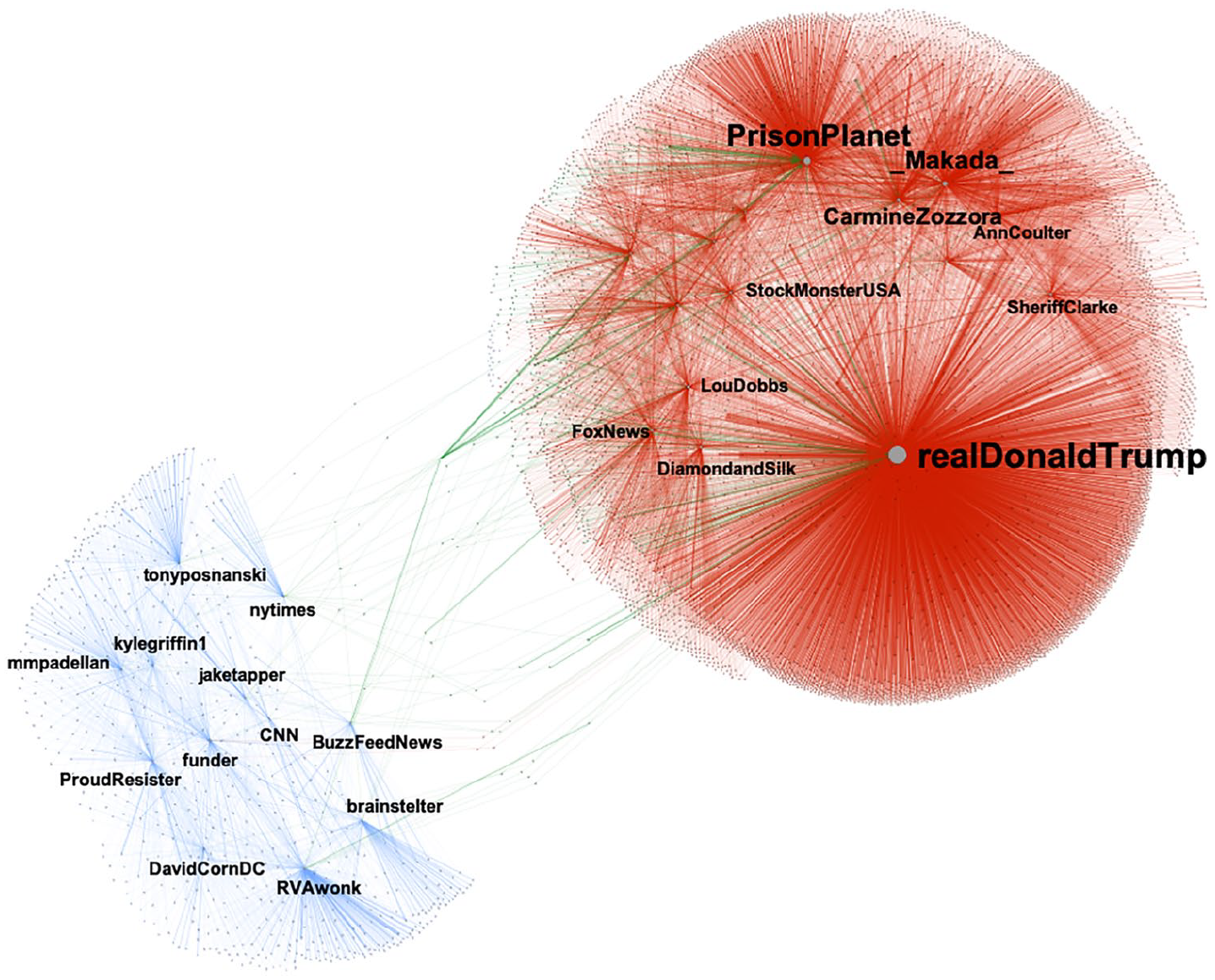
Retweet networks of individuals who have retweeted the most influential accounts (defined as receiving more than 500 retweets) at least once in our dataset. Colors are used to distinguish users who only retweet liberal accounts (blue), those who only retweet conservative accounts (red), and those retweeting both types of accounts (green). Nodes are sized by in-degree. Edges are weighted by the number of times retweet behavior occurred between two nodes.
Interestingly, in both the left and the right clusters, a great majority of most retweeted accounts are social media personalities and activists. In contrast, major news organizations such as CNN, the New York Times, and Fox News, despite the amount of attention they receive in the “fake news” debate, do not top the list of the most retweeted accounts. Looking separately, Donald Trump (@realDonaldTrump) is the most retweeted individual on the right, followed by YouTube personality and alt-right conspiracist Paul Joseph Watson (@PrisonPlanet). Similarly, Ryan Knight (@ProudResister), a progressive radio talk show guest, and Scott Dworkin (@funder), the co-founder of the Democratic Coalition, appear to be the strongest influencers on the left. The fact that those with a strong personality and clear political stance tend to have greater capacity to dominate the discussions among their ingroup members provides additional support for the identity-driven aspect of “fake news” discourse.
Furthermore, both sides leverage the “fake news” buzz by strategically choosing advantageous issue topics and languages (RQ1). The most commonly used hashtags within the political left and right retweet network reveal that both sides use rally cries to establish solidarity and attack opponents. While the conservative network uses #maga, #trumptrain, #americafirst, and #makeAmericaGreatAgain together with “fake news,” the liberal network uses #resist, #getreadyforimpeachment, and #fakepresident to advance a competing discourse. In terms of partisan issues, the conservative network frequently brings up the #pizzagate conspiracy and the #taxreform, whereas the liberal network focuses on the #trumprussia collusion and the #phoenixrally.
Next, the most frequent terms from each cluster further demonstrate how both sides choose words in a self-serving manner (Figure 5). The most striking pattern is that both sides attribute the “fake news” problem to their political opponents: The liberal network mainly attributes blame to Donald Trump, Fox News, and Breitbart, for example, “BREAKING:
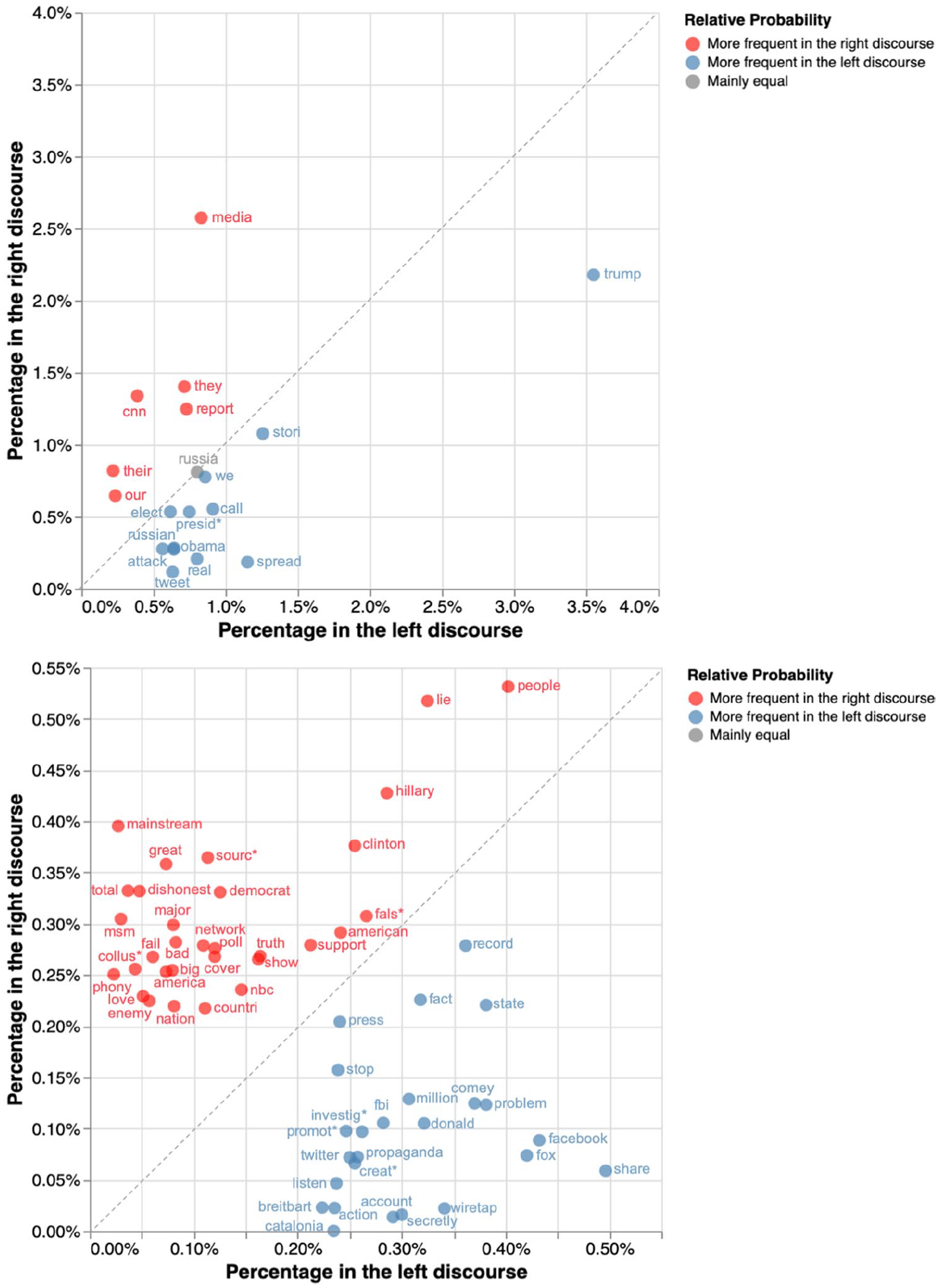
Percentage of most frequent words in the liberal (x-axis) and conservative (y-axis) retweet network, split into two plots (based on frequency) for clearer visualization.
Relatedly, the Russian interference with US election is more frequently discussed within the liberal discourse, illustrated by the frequent use of words such as “FBI,” “investigation,” and “Russian.” In contrast, the conservatives capitalize on issues such as Hillary Clinton’s email leaks to downplay Russia investigation and cast doubts upon the opponent, for example, “The entire ‘Russian hacking’ fake news story is a MSM diversion from the actual CONTENTS of the leaked emails!
The role of social media is also understood drastically differently by both sides. The liberal network frequently retweets news reports about social media’s role in spreading misinformation. For example, “Oxford study says Russian-linked fake news targeted U.S military groups on
Finally, compared to the liberal counterpart, the retweeted content on the right employs more identity-based and affect-laden language. For example, those consistently retweeting conservative sources are about three times more likely to use group-based pronouns (e.g., “our,” “their” and “they”) such as in “President Trump beat Crooked Hillary, Fake News, the Democrats, the Republicans, the corrupt FBI, and the Justice Department! It’s the greatest victory in the history of
In sum, as opposed to a common understanding of “fake news” as a weaponized term mainly utilized by Donald Trump, we revealed two disconnected “fake news” discourses among ordinary citizens. The competing liberal and conservative retweet networks reflect identity biases through selective message amplification as well as self-serving thematic and linguistic choices.
Discussion and Implications
Our discursive approach to “fake news” broadens and enriches the current understanding of the challenges “fake news” brings to the political system in important ways. While we recognize the constraints of the descriptive nature of this study, our findings lay crucial groundwork for a new line of research above and beyond the consumption and dissemination of factually incorrect messages: We demonstrate that the scholarship on “fake news,” misinformation, and disinformation should not only concern how societies ought to deal with falsehood but also examine how notions such as “what defines falsehood” and “who to blame for fake news” are discursively assembled, redistributed, and reinforced in a networked public sphere. Our data collected before the 2016 election and during Trump’s first year of presidency allows us to delineate a critical period of heightened partisan confrontation when “fake news” took on new meanings. Our findings on the uptrend of identity language use and the disconnected partisan networks during the popularization of “fake news” point to potential future challenges about how the increasingly weaponized discourse exacerbates polarization and impacts democratic processes in the long term, above and beyond false information.
Studying the public’s utterances about “fake news” advances what we know from a long-standing scholarship on media criticism and identity bias. Traditionally, research from the hostile media phenomenon has focused on the micro-level psychological processes underlying biased perceptions of media content. The rise of social media, however, has enabled digitally situated citizens to witness judgments about falsehood and credibility from their peers on a larger scale, and take an active role in exchanging opinions and seeking validations. This means factors such as platform affordances and network features may guide contemporary citizens’ expressions about “fake news” and evaluations of media performance. As one noted example, research has found that social media users need to actively “imagine their audience” due to the context-collapse nature of the platform (Marwick & Boyd, 2011). Our finding on the increased use of group pronouns in the “fake news” discourse implies that ordinary Twitter users expect an ingroup audience when they capitalize on the demarcations of “us against them” in their “fake news” discussions, attempting to seek solidarity and positive feedback from the audience. This process likely reinforces confidence in one’s own side, elevates group identity salience, and polarizes opinions (Cho et al., 2018).
Moreover, to our knowledge, this study is the first to empirically demonstrate the existence of a liberal “fake news” discourse among the public, suggesting that the term is not monopolized by conservatives, but becomes a discursive device used by both sides to advance their interests. Furthermore, the opposing discourses are highly disconnected, interacting with fairly distinct actors and focusing on separate topics to achieve identity-relevant goals. Our observations echo the notion that “fake news” is indeed a “floating signifier,” a device articulated within and debated in-between distinct discourses of conflicting political projects (Farkas & Schou, 2018). Hence, while opposing sides share the same concern over “fake news,” they may not be thinking and talking about the same problem. Given this, while we readily agree with scholars’ recommendation against the use of the term, the issue may lie deeper than an ill-defined catchphrase used by politicians. The identity-driven understanding of the term has penetrated into and is supported by separate networks of like-minded individuals who not only view “fake news” differently but also reinforce their views by selectively amplifying congenial messages.
The strong presence of ideologues and online personalities also raises the concern about who holds the power to define “fake news.” Compared to mainstream media organizations, online personalities are not governed by norms of balance and objectivity and can appeal to their ingroup audience by highly opinionated and polarizing comments. It is worrisome that public discourses about “fake news” are primarily driven by partisan sources that (at least in part) establish credibility through the use of identity language.
On a broader note, our study highlights another potential role social media play in exacerbating the troubling consequences of “fake news.” Thus far, existing research has focused on the role of social media in facilitating the dissemination of “fake news.” Our study shows that social media also serves as a networked public space for opposing parties to define, contest, and strategically leverage the “fake news” label to their respective interests. In particular, besides its anonymous and de-individualizing environment that encourages identity expression (Klein et al., 2007), social media tends to reward extreme and hyper-partisan contents with visibility and attention due to its market-driven nature (Webster, 2014). These together promote an extended public sphere where partisan hostility and group norms are easily witnessed on a greater scale. In this way, the weaponized discourse about “fake news” becomes a challenge to democracy in itself as it preys on and adds fuel to the already divisive society.
Limitations and Future Work
Our study has a number of limitations worth noting. First, we focus our analysis on the United States, where “fake news” has sparked heated discussions; however, we recognize that the identity-driven language and like-minded networks demonstrated in this study may not be limited to the United States, and that our approach should be applicable outside of this specific case. As “fake news” has become an issue of global significance, future research can benefit from adopting a comparative perspective and looking at a variety of political contexts (Chadwick et al., 2018; Nielsen & Graves, 2017).
Second, although Twitter is frequently used by political elites and the public to discuss “fake news,” it is certainly not the only online space where such discussions happen. As platforms such as Facebook and YouTube become important actors in the “fake news” debate, future studies should expand our findings to other online platforms. Moreover, our data collected using Twitter Search API do not give a representative sample of tweets during a given period of time. Therefore, the findings of longitudinal linguistic trends and network prominence should be interpreted relative to our dataset as opposed to the whole Twittersphere of “fake news.”
Importantly, future studies should build on our documentation of an identity-driven “fake news” discussion to advance the new research agenda we proposed here that looks at discourses around misinformation and disinformation. As online spaces become important venues for identity work and self-performance (Klein et al., 2007), judgments over bias and falsehood are not purely products of psychological mechanisms but need to be considered alongside group processes and network effects. This raises important questions for future research: For example, what kinds of messages about misinformation and disinformation are more likely to be propagated? How does talking about misinformation and disinformation within a like-minded community erode media trust and lead to polarized evaluations of media content? We believe this new research direction not only offers a unique perspective on theorizing “fake news,” but also has the potential to integrate various fields related to misinformation and disinformation, media bias, and political expression.
Conclusion
Serious concerns have been raised about the role of “fake news” in the democratic processes, most notably the 2016 US presidential election. We join the effort in studying “fake news” by focusing on how “fake news” has been defined and articulated by ordinary citizens in the Twittersphere. Over the period of 2016–2018, the US Twitter discourse about “fake news” is increasingly characterized by identity-driven and affect-laden language from both the liberal and conservative side. Furthermore, like-minded individuals selectively amplify ingroup messages to claim the power to define falsehood and attribute blame in accordance with group interests. Talking about “fake news” goes beyond elite strategy and becomes a deeply political practice adopted in ordinary citizens’ online discourses.
Footnotes
Acknowledgements
The authors express their gratitude to Michael W. Wagner, Dhavan V. Shah, Michael A. Xenos, Swee Kiat Tay, Lucas Graves, and two anonymous reviewers for their valuable insights and helpful comments on this project.
Declaration of Conflicting Interests
The author(s) declared no potential conflicts of interest with respect to the research, authorship, and/or publication of this article.
Funding
The author(s) received no financial support for the research, authorship, and/or publication of this article.
