




Abstract
The prolific growth of social media in recent years has provided new forums which allow engagement in local town discussions; particularly via community Facebook groups. This study seeks to understand the role of community Facebook groups in a regional town in the Northern Territory (NT) of Australia; particularly how they are used to portray youth, and their relevance to a grassroots youth justice reinvestment process. This research arose due to direct concern from a community working group. Seventeen semi-structured interviews, with 18 participants, were conducted with service providers in Katherine, NT. The data was then inductively thematically analyzed, resulting in six themes: staying informed in a regional context; vilifying youth and combating this; racism; impact on youth; tensions in positioning youth: right versus left; and adopting a strengths-based approach to youth. Community Facebook groups were noted as an important factor for staying informed in a remote context. As a key medium within the town, Facebook groups should be considered a source of community discussion and an appropriate avenue to influence community opinion. The racialization of community discussions about “problem youth” indicates a segregation issue in the town, which has been noted for many years. Community education and the promotion of the youth justice work currently being implemented in the town were considered key in changing mindsets and ultimately behaviors. Importantly, research and community development programs alike should consider the community Facebook group as a medium for positive social action.
Introduction
Aboriginal and Torres Strait Islander Australians experience poorer health outcomes than their non-Aboriginal counterparts (Zhao et al., 2016). This disparity is mirrored in the justice system, for both youth and adult populations (Australian Bureau of Statistics (ABS), 2017). Many of the catalysts for both poor health outcomes and engagement with the justice system are the same, rooted in issues of social justice and include disengagement with school and prosocial activities, unsafe environments, lack of appropriate care, and systemic oppression (Jee-Lyn García & Sharif, 2015). The racial contrast in outcomes are particularly visible in the Northern Territory (NT): at the time of writing this article, 100% of the 38 youth detainees in the NT were Aboriginal (Estimates Committee, 2018); and the life expectancy gap between Aboriginal and non-Aboriginal Australians was 14.0 years in remote and very remote areas compared to 7.2 years in major cities (ABS, 2018). The NT youth justice system has aroused considerable controversy, with reports of abuse of juvenile detainees sparking a Royal Commission into the Protection and Detention of Children in the NT in 2017 and two recent riots at the youth detention center (Northern Territory Police, Fire and Emergency Services [NTPFES], 2018; White & Gooda, 2017).
A consortium of youth frontline service providers working in Katherine (NT) are in the early stages of a justice reinvestment (JR) project for local youth. The consortium is known as the Katherine Youth Justice Reinvestment Working Group (KYJRWG). JR is a data-driven approach to change the way government engages in criminal justice expenditure. JR requires reallocation of funding traditionally spent on punitive measures, such as correctional facilities, toward the reinvestment of these funds in communities to address underlying causes of criminal activity (Triggs & Quiggin, 2016). The KYJR project provides both quantitative and qualitative data to inform strengths-based early interventions. Strengths-based practise directs focus to the “rich social domain” which often exists in tandem with levels of social disorder (Cowlishaw, 2003) and highlights individuals as resourceful and resistant, rather than focusing on a deficit discourse (Brough et al., 2004). For more information on the project, see Allison (2016) and Smith et al. (2018, 2019).
Katherine is a remote town (according to the Australian Bureau of Statistics remoteness measurements; ABS, 2016), approximately 300 km south of Darwin. Traditional owners of the Katherine area include the Dagoman people (to the south), Jawoyn people (to the east), and Wardaman people (to the west). Katherine town itself is a convergence of these lands. For brevity, the term Aboriginal will be used to refer to all individuals who identify as Aboriginal and/or Torres Strait Islander, recognizing that this overarching term does not indicate homogeneity and includes multiple diverse groups. The town has an estimated resident population of 10,571 (ABS, 2017 in Smith et al., 2018), 22% of whom identify as Aboriginal. In 2016, 19.6% of the general population were “youth” (aged 10–24 years), 31.6% of whom are Aboriginal (ABS, 2016 in Smith et al., 2018). Katherine town functions as the regional hub for several surrounding remote Aboriginal communities, cattle stations, and smaller townships in the Katherine region. Crime is an issue in Katherine, but this is also true for other towns in the NT. Table 1 outlined regional crime statistics for July 2017–June 2018.
NT regional crime statistics July 2017 – June 2018.
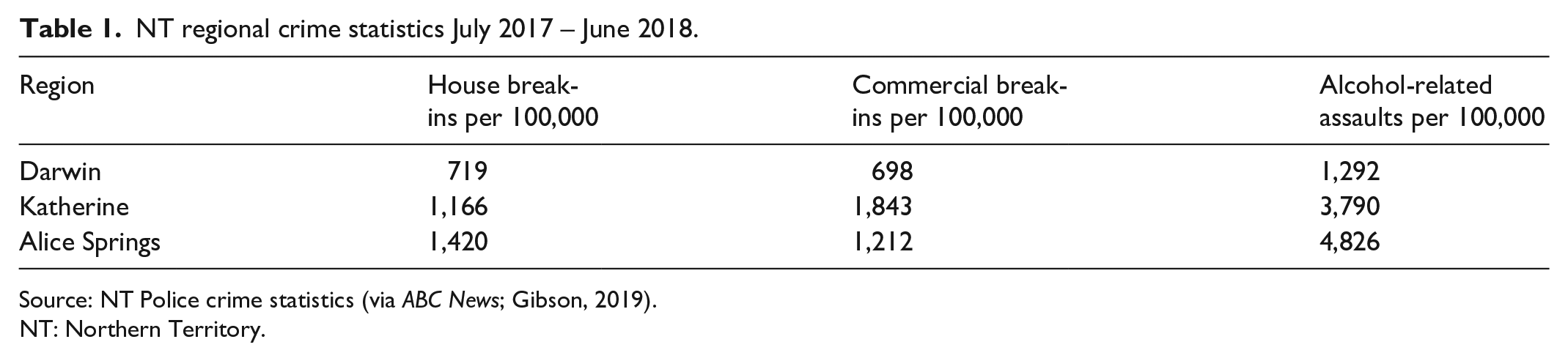
Source: NT Police crime statistics (via ABC News; Gibson, 2019).
NT: Northern Territory.
Popular media outlets often publish articles with inflammatory titles which indicate a dire situation in regard to crime rates in Katherine, including “Local crime is off the charts” (McLennan, 2019); “Murder rates in NT towns of Katherine, Tennant Creek worse than US, Government figures show” (Zillman, 2017); and “Drunk anti-social behaviour rife in Katherine: Mayor” (Roberts, 2017). Katherine Council and other local services have also been directly accused of being discriminatory toward Aboriginal people in the media (Rawlinson, 2013; Smith et al., 2017), while academic publications have noted the towns racially motivated segregation of housing (Morrissey, 2006), and alcohol policies which informally target Aboriginal people (d’Abbs, 2012).
Social media, particularly Facebook, is an important aspect for connectivity in smaller communities (Bird et al., 2012). However, it also may be more problematic in this context too, as people in regional areas of Australia are more likely to have witnessed bullying or harassment on social media (23% vs. 15%) and twice as likely to have been bullied themselves (9% vs. 4%) compared to those in urban areas (Sensis, 2017). Facebook functionality allows the creation of “groups” which allows members to view and post on a page. In Katherine, there are a number of these groups, which allow for information sharing relevant to the town, and facilitate community discussion. The phenomenon of “neighbour/community Facebook groups” is not an isolated occurrence, and popular media suggests that they are common across Australia (Kelly, 2016; Kleeman, 2018). Many of these groups also double as neighborhood watch, with posts regarding suspicious people loitering or break-ins (Shaw, 2017). Popular media sources suggest that in a number of regional and remote towns, particularly in Northern Australia, this neighborhood watch function has developed into a more sinister encouragement of vigilantism (Atkin, 2016; Dunlevie, 2016; Lynch, 2018; Smee, 2014). In Katherine, this issue was raised by the KYJRWG as a concern, particularly in the way community members portrayed local youth on “Town and Territory Matters.” 1
This research sought to investigate the role of community Facebook groups in facilitating and broadcasting community discussions regarding youth in Katherine. The aim was to provide more detailed information regarding how youth in Katherine are depicted through social media, and present possible strategies to encourage constructive community opinion about youth, and JR, on social media. The specific research questions were as follows:
How does the community depict its youth on these groups?
How can social media be used to support the work of the KYJR Project?
Methods
Study Design
This research project used Collaborative Research (CR) as the guiding methodology, which has previously been used successfully with both community-based organizations and youth (Harper & Carver, 1999; Sanstad et al., 1999). CR by definition involves collaboration between the researcher and the researched (Jean-Louise & Lomas, 2003) and recognizes the underutilized but important lived experience of the individuals affected by an issue (Byrne, 2017). This methodology is synonymous with contemporary discourse about co-design, which is the preferred method of engagement in strategy and policy development in the social services (Blomkamp, 2018).
The CR approach requires sustained engagement with local stakeholders to identify and co-design strategies. This engagement has been ongoing since March 2018. It has involved attendance of the researcher team at monthly KYJRWG meetings, a relevant community forum, as well as liaising with individual local service providers. Concerns about the frequent discussions of negative and potentially harmful stereotyping of youth on a local community Facebook group “Town and Territory Matters” were noted by researchers at a monthly working group meeting (April 2018) and recorded as a priority issue to address at the KYJR strategic planning session held on 18 May 2018. The data collection process was supported by a number of KYJRWG members who facilitated access to participants and provided a local lens to interpretation of the data.
Sampling and Recruitment of Participants
Individuals were invited to participate because of their involvement in the previous community consultations about JR (Allison, 2016), involvement with the current KYJRWG, or based on recommendations from the KYJRWG. We used a combination of purposeful sampling to identify individuals with rich knowledge or experience of youth and youth justice (Cresswell & Plano Clark, 2011), and snowball sampling for additional participants (Marshall, 1996). We chose to interview only service providers who work with disengaged youth rather than youth themselves, as providers can provide useful insights about their client groups in ways that may be difficult to explore directly with youth without existing relationships. Given (2016) suggests that saturation is reached when there are no new emergent themes, though new codes may contribute to existing themes. Concurrent collection and analysis ensured researchers were satisfied that the themes were well developed prior to completion of data collection, and subsequently refined by the final seven interviews, taking into account the limited participant pool available.
Data Collection
Semi-Structured Interviews
This method allows for an exploration of the research question(s) with the flexibility to investigate particular responses further if warranted (Gill et al., 2008). This encourages depth and richness of responses (Bryman, 2012). It also enables reciprocity between the interviewer and the interviewee (Kallio et al., 2016), by recognizing that the interviewee’s experience of the topic gives them “interview knowledge” (Kvale & Brinkmann, 2009), and allows the direction of the interview to be partiality controlled by them. This is particularly important in the context of CR, which emphasizes the active participation of those being researched to be just as important as that of the researcher (Jean-Louise & Lomas, 2003). To prevent the overburdening of participants, the questions related to social media were incorporated into the semi-structured interview schedule of the broader ongoing study about strengths-based service provision for Katherine youth (Smith et al., 2018).
As part of the overarching study, 21 in-depth semi-structured individual interviews (one paired interview), with 22 participants, have been conducted over a 6-month period. Seventeen of these interviews included the social media–specific questions, giving this sub-study 18 participants, three of whom also identified as youth (aged between 17 and 24) and two who identified as Aboriginal.
They were conducted at a place of the participants choosing and convenience, ranging from offices to outdoor settings. The majority of the interviews lasted between 1 and 1.5 hr, and all were recorded, with the consent of the interviewee. Researchers also took field notes for triangulation during the analysis stage. These field notes focused on the researchers interpretation of the discussion, as the verbatim transcripts produced through the recorded audio are void of the nuance of pauses, tone, and nonverbal cues. These notes were compared to the transcript as a validation exercise to improve both understanding and accuracy of the data collected (Heale & Forbes, 2013; Oliver-Hoyo & Allen, 2006).
Data Analysis
Both the interviews and focus group were recorded and subsequently transcribed by an external professional transcription service, with the social media portions of the interview transcripts then thematically analyzed by S.C. Thematic analysis is a method for “identifying, organising and offering insight into patterns of meaning (themes) across a data set” (Braun & Clarke, 2012, p. 57). It allows researchers to draw out participant’s perspectives and identify similarities and differences, as well as highlight unanticipated insights (Braun & Clarke, 2006; King 2004 in Nowell et al., 2017). Thematic analysis is only a method, rather than an entire approach to conducting qualitative research (Braun & Clarke, 2012), which was preferred for this sub-study, as it was already underpinned by a CR approach. This method is particularly accessible for wider audiences, which in a collaborative approach, is essential (Braun & Clarke, 2012). The research team had to be able to feed back appropriately to those who are not trained researchers but whose engagement with the data is crucial.
In line with our underpinning methodology of CR, Inductive Thematic Analysis was used to preference the “experienced and meaning of [the participants] world, as reported in the data” (Braun & Clarke, 2012, p. 59), rather than orientating toward the researcher or theory-based meaning (Braun & Clarke, 2012). Due to the nature of the CR process, and tight timeframes, simultaneous data collection and analysis occurred. This is a standard practise in many qualitative studies with the emerging findings used to refine the subsequent data collection processes (Suter, 2011). Braun and Clarke’s (2012) six-phase approach to Thematic Analysis was undertaken:
Familiarizing yourself with the data. S.C. listened back to all audio recordings, read all transcripts, and compared these mediums to her field notes to improve understanding and validity of the data. J.S. and B.C. read all transcripts and similarly compared their field notes.
Generating initial codes. Transcripts were uploaded to the data analysis software NVivo 12 and reviewed multiple times to identify codes.
Searching for themes. On NVivo 12, similar codes were categorized together, and codes began to be identified as “parent” nodes (overarching codes, akin to themes) and “child” nodes (more nuanced codes which fit under a parent node) (Cunningham et al., 2016).
Reviewing potential themes. Initially, six themes were identified by S.C. These were subsequently refined and developed with input from J.S. and B.C. to ensure coherence and sufficient meaningful data.
Defining and naming themes. The themes were presented back to members of the KYJRWG by S.C., and the language used to describe themes was refined once more. The final six themes were established as follows: Theme 1: Staying informed in a regional context Theme 2: Vilifying youth and combating this Theme 3: Racism Theme 4: Impact on youth Theme 5: Tensions in positioning youth: right versus left Theme 6: Adopting a strengths-based approach to youth
Producing the report. This work was originally completed as part of S.C.’s research component of a combined coursework and research Master of Public Health (MPH), and as such a number of iterations of this work have been developed. Braun and Clarke (2012) assert that writing and analysis must be interwoven in qualitative research, which occurred through the development of work which was fed back to the KYJRWG and subsequently refined. Markers comments on S.C.’s submitted MPH work have also been incorporated to strengthen this article.
To protect the identities of individuals they have been assigned numbers. Participant numbers are consistent with their identification in the overall study, so despite there being 18 participants in this sub-study relating to social media, the participant numbering extends up to 22. Importantly not all participants are explicitly quoted in the analysis, as quotes were selected for their richness and rigor.
Results
Theme 1: Staying Informed in a Regional Context
This theme does not directly relate to either research question but is integral to conceptualization of the context of social media in Katherine. Facebook was the most frequently discussed social media platform, noted in 14 interviews. It was also the platform that older participants talked about the most, consistent with international evidence that younger people use Instagram and Snapchat more often (Alhabash & Ma, 2017). Participants’ level of personal involvement and experience with the platform became apparent throughout interviews, as those participants who chose to abstain from a Facebook profile discussed the topic negatively: I see the trouble that it causes my grandkids and other youth that I know, and I hear what other adults are saying. (Participant 5)
The mention of social media frequently brought up the Facebook group “Town and Territory Matters,” explicitly named almost immediately by nine individual interview participants. Although a “closed group” and only viewable by members, “it’s very public, because there’s not many people that aren’t on it” (Participant 9). This was not the only community Facebook group discussed, but certainly is of notable importance; 12 participants either stated or implied they were members of this group. Those who were part of this group did so predominantly to stay connected to the community; whether that be about receiving community news updates, or more nuanced observations of community behavior and portrayed worldviews: I don’t read the newspaper and [Local News] doesn’t get put up on TV or anything like that. Facebook is pretty much my only way of finding out what’s going on . . . For a lot of young people I think it’s very much a chain of communication between organisations and young people and pretty much every organisation has a Facebook page that they use to update what’s going on and different events and stuff like that. (Participate 7) I choose to be part of the “Town and Territory Matters” page . . . just to sort of hear—at [workplace] and in our town social bubbles, we’re associating with very like-minded people, and so I like to have a reminder, sometimes, that not everybody thinks that way. (Participant 8) I think being in a slightly more left-wing circle of friends and colleagues in town, I’m often a bit shocked. So I think it’s a part of town that I don’t really understand. (Participant 16)
Individuals who were Facebook users but chose not to join the “Town and Territory Matters,” tended to point to the drama and stress of community politics as reasons to avoid the group; “I’m not even on it because it was so toxic” (Participant 22). Many interviewees, including those who were members of the group, were quite blunt about their distaste for the group, though as the conversation continued some did conclude there were some positive aspects.
How Does the Community Depict Its Youth on Community Facebook Groups?
Theme 2: Vilifying Youth and Combating This
A major issue identified within the interviews was the way in which community crime was dealt with on this forum. As noted by an Aboriginal Service Provider, a significant issue with “Town and Territory Matters” was the common practise of uploading photos of individuals committing crimes, in an effort to “name and shame”: I’ve seen victims posting video footage or photos of youth who have committed the crime . . . it’s essentially creating a witch hunt or man hunt. (Participant 4) Identifying young people, some under 18, as criminals, with images, CCTV footage, some by name, some just with images. (Participant 6)
The youth demographic received the greatest negative attention on the group, with most crimes attributed to them: Any time young people are mentioned, it’s really been really negative and people who have the same view as the [person posting] hopping on and furthering this hatred. (Participant 8) However, the ones that were actually doing a lot of the offending weren’t actually youth, they were young adults that were over the age of 18 or adults . . . I think it’s easy for us to assume that it’s kids. (Participant 9)
While many participants were horrified by this behavior, others expressed sympathy for the dissatisfied community members who were posting these photos: I fully understand where they’re coming from because there’s nothing worse than living in fear of repeated break-ins and not feeling safe in your own home and many people feel like that in Katherine . . . when they see a lack of action they vent and use social media to do that. (Participant 11) There’s no one that’s out to kill kids . . . I think people are frustrated. I think people are sick of their houses being broken into. (Participant 20)
This perceived lack of action was attributed to the tenuous reputation of diversion and other justice measures in the town; “diversion is nothing in Katherine” (Participant 11). It appears that posts regarding crime often descend into an aggressive and abusive commentary by community members. One participant detailed an incident where online violence moved from cyber threats to physical violence: It ended up with something like 200 and something comments within the first 12 hours, everybody, of course, had an opinion. It ended up with the parents being assaulted. (Participant 9)
No other participants gave examples of physical violence but many were concerned about the extremity of the threats and the subsequent impact on a population, who are vulnerable and still maturing. It was noted that the majority of youth who were identified in this Facebook group may already be lacking more social supports than some of their peers: When someone says “my house was broken into” and this and that, the response to that is “break their legs, take a whip to their back, just flog the piss out of them” and that’s a horrible response for anyone, but for that to go towards a young person who may not have had the upbringing we had. (Participant 4)
The accuracy of this information was discussed with a number of participants noting that the reliability of posts, names, and photos were rarely called into question. Stereotyping, assumptions, and fear mongering were common: . . . news travels very, very quickly . . . whether something is true or not is irrelevant. (Participant 14) . . . because there was obviously a lot of break-ins at about that time and, of course, that one kid now got blamed for the whole communities offending. (Participant 9)
This stereotyping of youth people was often perceived as racially motivated.
Theme 3: Racism
Some participants discussed the stereotyping as being largely based on the young person’s ethnicity, specifically whether or not they were Aboriginal. The quote below is from an Aboriginal Service Provider: Adults just stereotyping everybody. And unfortunately it’s jump people of colour, so young Indigenous people. The majority of that I’ve seen either are racist or they’re borderline . . . most of it is targeting young Indigenous people. (Participant 4)
The exclusionary attitude by non-Aboriginal members of the community, “definitely comments about, us and them” (Participant 6), was highlighted in a number of interviews, and appeared to be of greater concern than any overtly racist comments on the page. Statements such as “we, the people of Katherine” (Participant 6) portray a group of non-Indigenous, “law-abiding” citizens as the true residents of the town, isolating and excluding the Indigenous youth who are being named and shamed online: All you do is make people feel like they belong to a different group of people. History is littered with examples of how that can be very positive or be very negative. So it’s hard to say which direction it will go on, but it definitely unites people, whether or not you unite them in feeling well fine, we’ll continue to be these terrible people, or you unite them in feeling yes, we are difficult and welcome to Katherine Black Panthers 2.0, I don’t know. But it creates a clear division. (Participant 15)
This very public exclusion of an already marginalized group was concerning for service providers.
What Is the Role of the KYJR Project in This Space?
Theme 4: Impact on Youth
Several interviewees were oblivious to the number of young people who were members of “Town and Territory Matters,” and therefore bearing witness to the antisocial behavior of a number of adults on that group. However, an interviewee who was a young person themselves (Participant 7) indicated they were a part of these groups: From what I see young people that would be most impacted . . . aren’t a member of that site and aren’t active. [If a young person were to see this content] it would be shocking. There is some really vile stuff that is said in that space . . . swearing or being racist or being derogatory. (Participant 3) I know personally that a lot of the Facebook pages, especially the closed groups that I’m in are very free with talking about how bad young people are and how bad they can be. (Participant 7)
A few adults were unbothered by the concern that it may be negatively impacting youth; “I don’t think it does very much damage to the youth” (Participant 16), with some service providers stating that, not only were the youth aware, but that some thrived on the attention: Some of them . . . will boast and gloat and say, “Hey they got my photo on” . . . because they got off with it so it’s, “Hey, I’m one up . . . I’m king of the gang.” They get a bit of respect from their peers. (Participant 11)
The majority of service providers, however, were very concerned about both the short and long-term impact of this negative attention for these young people. Short-term concerns included impacts of the threat of violence, the possibility of actual violence, and isolation of vulnerable youth. If the above suggestion is validated, that is, certain young people are being encouraged to commit crimes because notoriety on these groups receive peer endorsement, then this also poses a concern for young people. Common long-term concerns related to long-lasting negative labels attached to “badly behaved” individuals; and the perpetuation of an unhealthy culture of, and tolerance for, stereotyping and damaging assumptions: If we’re forever treating them like, “you’re that kid,” they don’t get past that. (Participant 9)
A nuanced observation from a local youth noted that this issue is not new; but that social media has intensified it: All you will hear about . . . young people is how horrible they are . . . it’s been the same for decades . . . but now it’s a more prominent platform. (Participant 14)
Theme 5: Tensions in Positioning Youth: Right versus Left
A clear division within the community, based on worldviews, was evident. The people who were posting photos in an effort to “name and shame” or venting their frustrations regarding crime in the town were summarized by some participants as “the ‘lock them up’ brigade” (Participant 21), while those who took issue with this online activity were similarly grouped: “my mum calls them the Hairy Armpit Brigade” (Participant 20). Facebook groups appeared to be spotlighting this difference, in a way that had been impossible prior to social media, making differing opinions constantly very visible to all community members. This is consistent with current evidence which suggests social media compounds a polarized political landscape (Bail et al., 2018): What I think it does is further kind of unifies the right-wing voice, the harsh voice, the condemnation, in what I think is probably a minority of people in town. You see the very sharp edge of the problems of prejudice in town. (Participant 16)
The participants spoke about the demographic who were engaging in this negative behavior as being “very well-known adults in town.” (Participant 16) Unfortunately in Katherine, the people over here saying lock them all up are all the people who control our political parties . . . who own the businesses in town . . . the people with money . . . the people who people listen [to] (Participant 20)
The adult participants in this study were overwhelmingly resistant to neoliberal ideology and favored social solidary in their commentary on the issue (Baum, 2005), unsurprising given the majority held roles in youth or community services, where principles such as equity and social justice are commonplace (Bennett et al., 2011).
Theme 6: Adopting a Strengths-Based Approach to Youth
The focus of many of these conversations revolved around the highly negative skew of Facebook posts. Interviewees suggested a need to contribute to change in the conversation about youth, to provide a positive element to balance the overtly negative portrayal: Somebody needs to drive that [positive role models] in a coordinated way. We’ve got an amazing female AFL Indigenous team down there. (Participant 22)
The role of community education was also suggested a number of times. Service providers were very self-aware of their unique understanding of the factors contributing to a young person’s decision to engage in criminal activity. Many suggested community education was required to combat this issue: We need to do more community education. Put your hand up instead of banging them and bashing them. It’s about having more and more people talking in a positive slant. If we can be strategic and collaborative about using social media to do that we can influence public perception. (Participant 11) People just don’t understand that kids are out on the street because it’s a safer place for them to be than their homes. (Participant 22)
A participant whose workplace did engage with social media discussed the vitality of this engagement for both promotion of programs and justification to funders, aspects which are both essential to the JR project: For businesses and for organisations like ours, there is a need for us to have a social media presence, a) for the consumer and the kids to see this is what [organisation] does, b) for the government and us to justify what you’re investing in. (Participant 20)
It was also felt the strong community ownership of youth focused work should be promoted, given the frequency with which outsiders come and go from Katherine, leaving legacies of ambitious and unsustainable projects:
2
They’re looking to come to the Northern Territory, get their skin name for their resume and go back down south, once they’ve had their ‘I’ve had Indigenous experience’ written on their resume. (Participant 20) [JR should be promoted to the community] not [with] American accents overdoing it and things like that, with actual Katherine local people who are involved and are seeing the overarching benefit. (Participant 15)
Overall Facebook and social media was viewed as a positive tool for the KYJRWG, if resources were invested in ensuring the use was appropriate and going to be impactful.
Discussion
Community Facebook groups are perceived as a major medium of community communication. The relevance and role of community Facebook groups in Katherine was consistent with what has been established in other regional areas, as easily accessible specific community information is extremely important when mainstream media services “only cover the larger communities” (Bird et al., 2012, p. 32). Interestingly, some participants also discussed the Facebook group as a reminder of other worldviews and opinions, when they existed in social and employment circles that seemed to exhibit high levels of homogeneity. The idea that people with similar worldviews congregate in certain professions and social groups is not new (Vaisey, 2008), but the level of self-awareness portrayed by these participants is important. Bird et al. (2012) discusses these groups as “an important resource to tap into and review informal communication, something that was previously inaccessible” (p. 27). These Facebook groups, therefore, are likely to be worthwhile sources of public perception, akin to thematic analyses of popular media. Miranda et al. (2016) discuss social media as a place “where ordinary people in ordinary social networks (as opposed to professional journalists) can create user-generated news” (pg. 304). In smaller communities that do not have extensive media coverage, Facebook groups should be considered as a data rich source to be utilized for planning, implementation, and evaluation purposes. Facebook could be used in the KYJR project in this way.
At this junction, it is important to highlight that the use of Facebook data to inform research is contentious. An investigation of the Facebook group itself would have provided richer data, and this was the initial intention of this research. This approach, however, was problematic to pursue from an ethical standpoint. Communication on this platform can and does have important implications both for perpetuating overt and covert discrimination (Ben-David & Matamoros-Fernández, 2016; Tynes et al., 2013), and for empowering previously marginalized voices (Betton et al., 2015). The impact of the platform must be adequately captured, and yet we must balance this with privacy considerations. To what extent do we assume that members of these groups expect their comments to be kept private? These Facebook groups are well known and include thousands of members (Town and Territory Matters reportedly has approximately 6,600 members, Katherine town only has approximately 10,000 residents). As highlighted by participants, it is perceived as a public forum because of the number of people who are part of the “closed” group. While previous academic literature has argued that “public” social media data should be available to researchers, “private” data (based on the individuals privacy settings) is far more contentious (Solberg, 2010). Yet, as Facebook becomes more ubiquitous and town “meetings” and “discussions” occur online, with membership of more than half the town, is it still regarded as private? It has been regarded as such for the purpose of this research, but there is a need for further discussions on these emerging intersections of public and private spaces on social media.
Within the current climate of youth justice in the NT, the preference is to keep youth from punitive punishments, and instead focus on early intervention and diversion (Allison, 2016). In the NT, diversion programs are contracted out to a number of non-government organizations (Northern Territory Government, 2018) and as highlighted in the interviews, have varying levels of success. Participants discussed the frustration felt by Katherine residents, who were venting their anger on Facebook. The depiction of youth that was described, though potentially harmful and certainly heavily negatively skewed, is less aggressive in tone than other depictions recently portrayed in popular media. For example, in direct reaction to a perceived increase in youth crime, community members were reportedly organizing night crime patrols in Darwin and Palmerston via Facebook groups (Dunlevie, 2016; Smee, 2014). In Alice Springs, paramilitary groups have been advertising themselves on the community Facebook group, looking for individuals “with firearm experience” (Kurmelovs, 2015). It should be noted that these examples are portrayed in popular media and therefore likely to “alarmist headlines” to capitalize on shock as a method of generating engagement (Livingstone & Brake, 2010) and subsequently generating income. No academic research has been conducted on these specific groups to establish the frequency and outcomes of these posts. Despite this caveat, the level of violence relayed as appearing on Katherine community Facebook groups remains concerning, particularly given racial undertones.
These online discussions feed into a damaging narrative perpetrated since the beginning of colonization, regarding the innate criminality of Aboriginal Australians (Cunneen, 2006; Cunneen & Russell, 2017). This occurrence on social media is known as “platformed racism” (Matamoros-Fernandez, 2017), which is extremely concerning given the triangulated link between racism, poor health outcomes, and involvement in the justice system (Jee-Lyn García & Sharif, 2015). This is not a new occurrence in Katherine. In 1975, an anthropologist described Katherine as a town “where white people hurried about their business and talked, with various levels of sympathy or anger, about problem of the Aborigines” (Cowlishaw, 1997). As a study set in Katherine, Tennant Creek and Nhulunbuy highlights; The political economy of remote NT towns may not be adequately understood outside a racial economy perspective . . . patterns of socioeconomic disadvantage are patterns of racial disadvantage, alcohol management is racial management, and economic exploitation of remote towns is inevitably racially patterned. (Young et al., 2011)
Despite being a closed group, the impact of these very visible online discussions on media and public discourse cannot be underestimated. From a macro perspective, these may have serious health and social impacts on young Aboriginal Australian’s, as negative stereotyping further perpetuates racist beliefs and actions, subsequently impacting health and justice outcomes (Cunneen, 2006; Larson et al., 2007; Paradies et al., 2008; Phelan & Link, 2015). When young people are attached to negative labels, particularly ones regarding criminality or violence, it can become a “self-fulfilling prophecy,” resulting in further antisocial behavior (Bolzan, 2005). The self-image developed in adolescence, impacted on by communication from adults, is intrinsically linked to long-term self-esteem, achievement of realistic goals, and maturity (Sandu et al., 2015). The next steps should be an investigation of the overt and covert impact of these discussions on young people, as interpreted by youth in Katherine.
As discussed by a participant, this exposure was encouraging division in the town to a point where there was “no amicable ground” (Participant 20). The ideological division discussed between “left” and “right” wing factions within Katherine appeared to be what was causing a level of concern among service providers. It is likely that social media is making these views more visible to individuals who previously would not have been exposed to this. Social media is emotional space, which encourages “ideologically homogeneous echo chambers” (Wollebæk et al., 2019). An important space where JR could be beneficial is in building community cohesion, which is a contributing factor to reducing poor health and justice outcomes in all demographics (Burnett, 2004; Cantle, 2005).
Participants perceived that the majority of Katherine community were members of, or are at least aware of, the major community Facebook group, and therefore it is an ideal access point for engagement. The most commonly suggested solution to the frustration and stereotyping portrayed on this group was education about what the service providers already know from their professional lives: that these young people are often facing a raft of physical, social and emotional pressures that lead to their engagement in criminal activity (Burke, 2016); have faced significantly traumatic experience in their lives; and that stereotyping Aboriginal youth as criminals contributes to a problematic narrative that reinforced systems of colonization (Cunneen & Russell, 2017).
Conclusion
Community Facebook groups are active in Katherine. The ability to share town-specific news was highly valued in this particular context. The rhetoric of “young, Aboriginal and criminal” which is being perpetuated in these Facebook groups should be a concern of the KYJRWG because of the negative narrative and culture it fuels. The active nature of these Facebook groups in Katherine offers an opportunity to examine community opinion, and to positively change the narrative. This could involve community education, and promotion of the KYJR project, alongside other “good news” youth stories and projects. Highlighting that it is a Katherine local workforce who are driving this is particularly important in a remote context, where there is a large transient workforce.
The vilification of young people on this platform is problematic and the tendency to target Aboriginal youth speaks to a larger social issue in Katherine. The racially divisive element of the Facebook group content is not a new or unique phenomenon in Katherine or, indeed, across Australia. Rather, people’s tendency to associate with individuals who share similar worldviews appears to otherwise shield many service providers from the extent of the racism within the town. Having this racial (and ideological) divide highlighted via Facebook group, while confronting, does provide an opportunity for a better understanding for those whose White privilege (Moreton-Robinson, 2000) has previously protected them for the realities of the towns racial divide. Continued understanding and recognition of the realities of racism in Australia today is vital if we are ever to move forward as a society, and truly close the gap.
Footnotes
Acknowledgements
The authors would like to acknowledge the time and commitment of the Katherine Youth Justice Reinvestment Group and related Working Groups in support of this project. In particular, we would like to thank Mr. Franklin Hooper, Mr. Stanley Law, Ms. Toni-Anne Walker, and Ms. Thomasin Opie for their dedication and assistance.
Declaration of Conflicting Interests
The author(s) declared no potential conflicts of interest with respect to the research, authorship, and/or publication of this article.
Funding
The author(s) disclosed receipt of the following financial support for the research, authorship, and/or publication of this article: Australian Red Cross provided funds to support this research.
Ethical considerations
Ethical approval was granted through the Charles Darwin University Human Research Ethics Committee (H18044) on 8th June 2018. Reciprocal ethics approval was gained from the NT Department of Health and Menzies School of Health Research Ethics Committee (HREC 2018-3191) on 19th July 2018. Noting that youth services often employ young people, the approval specified that participants aged between 16 and 17 years would be considered sufficiently mature to provide informed consent, rather than requiring a parent or guardian’s signature. This is acceptable practice for research involving youth in this age range (Spriggs, 2010).
