



Abstract
While officially classified as a right-wing movement, the German Identitarian Movement (GIM) claims to be neither left nor right wing but rather identitarian. The social movement stands for what they call “ethno-pluralism,” communicated online without intermediate gatekeepers, in supposedly socially acceptable messages. Without a clear classification to a political wing, some Internet users encountering information created by the GIM could have difficulties assessing what this movement really stands for and what identitarian means. That is why this study examined strategic frames in a full sample of memes (N = 511) posted by the movement on their Facebook page, because memes (here: image macros) have been the GIM’s main form of communication on Facebook. This study identified six strategic frames that represent a plurality of different social issues; some of them call for immediate action. Hence, the movement’s strategic framing goes far beyond emphasizing “ethno-pluralism.” The findings elucidate the overall communication strategies of the movement and show that the frames represent characteristics and semantics of the New Right. These frames also triggered different levels of social media engagement.
In May 2018, Facebook deleted the official page of the German Identitarian Movement (GIM; Identitäre Bewegung Deutschland). Facebook stated that reasons for taking this step were organized hate and extremist content that they identified on that page (e.g., Bailey, 2018). In Germany, the GIM regularly tries to increase its popularity, for instance, through controversial public demonstrations. In 2016, the movement climbed the iconic Brandenburg Gate in Berlin and chartered a ship to embark on a Defend Europe Mission. 1 Most people do not know that these public demonstrations are initiated only to share them online (e.g., Hentges, 2018; see also Maly, 2019), using direct communication without intermediate gatekeepers (see also Gaby & Caren, 2012; Harlow, 2011).
With its roots in a patriotic youth movement known as the Génération Identitaire 2 in France in 2012, the GIM is one of several related groups in European countries today (e.g., Castelli Gattinara & Pirro, 2019; Klein & Muis, 2019). What all these movements have in common is not only a focus on so-called ethno-pluralistic issues or the use of the Greek letter lambda (Λ) 3 as part of their corporate identity (e.g., Bruns et al., 2015; Hentges, 2018) but also a strategic presence on the Internet and on social media in particular, especially to reach younger people (e.g., Pfeiffer, 2016; Virchow, 2015). Ethno-pluralism, the central ideology of the movement, is the supposedly natural diversity of cultures and cultural identities (e.g., Bruns et al., 2015; Castelli Gattinara & Pirro, 2019; Elgenius & Rydgren, 2019). The notion of identity, in this context, can be traced back to the French writer Alain de Benoist, who defined identity as belonging to a culturally homogeneous collective, which is usually defined by a nation’s borders (e.g., Kitsaras, 2017). This identity, so they say, is threatened “by the progressive disappearance of the diversity of the world” (de Benoist, quoted by Hentges, 2018, p. 80). However, in order not to explicitly be considered racist, Identitarian Movements do not claim the superiority of one race over another (e.g., Pfeiffer, 2016); rather, they attempt to frame statements in supposedly socially acceptable ways. Identitarian Movements stand against the choice of many Europeans to remain childless, cultural mixing, nontraditional gender roles, multiculturalism, and the increasing migration of people to Europe, which allegedly increases the so-called Islamization of the continent (e.g., Schneiker, 2019; Virchow, 2015).
Several political institutions, researchers, and journalists have classified the GIM as either New Right (Neue Rechte in German, Nouvelle Droite in French) or right-wing movement (e.g., Bundesministerium des Innern, für Bau und Heimat, 2019). The New Right represents a spectrum of political movements and individuals that distance themselves from the Old Right through modernized strategies and ideologies (e.g., Maly, 2019). For instance, the New Right does not share the ideological cornerstones of the Old Right, such as biological racism, antisemitism, and National Socialism. Nevertheless, the New Right is defined by an ethno-pluralistic ideology (e.g., Bruns et al., 2015), based on ideas put forward in the “Conservative Revolution” by Armin Mohler in 1950 and reactivated by Alain de Benoist in the 1980s as “Cultural Revolution from the Right” (Fuchs & Middelhoff, 2019).
In contrast, Identitarian Movements strategically create confusion about their political stance. They identify themselves as being neither left nor right wing but rather identitarian (e.g., Bruns et al., 2015). Moreover, they claim to be democratic and patriotic but not nationalistic (e.g, Kitsaras, 2017); they also claim to be 100% identitarian but 0% racist (e.g., Pfeiffer, 2016). The movement has even been found to apply forms of actions that traditionally have been associated with the radical left, such as squatting and flash mobs (e.g., Hentges, 2018; Schneiker, 2019).
Without a clear (self-)classification to a political wing, Internet and social media users who explore (supposedly socially acceptable) posts created by Identitarian Movements might be uncertain about the messages these movements want to convey (e.g., Hentges, 2018; Schneiker, 2019). In a context in which such movements use direct communication to users (e.g., Harlow, 2011), this can be seen as a strategic move. Users might even, in some cases, end up supporting these movements without understanding what they really stand for. In May 2018, shortly before GIM’s official Facebook page was deleted, it counted more than 65,000 likes and had more than 68,000 followers. Although there are only about 100 active members of the GIM, they resonate as if there were hundreds of times as many (Fuchs & Middelhoff, 2019).
Based on the dissonance between how political institutions, journalists, and Facebook describe the movement compared with how members officially brand the movement and subsequently communicate strategic messages, this article places an emphasis on the information that the GIM itself shared online. The aim is to understand how the movement spread its messages, got attention, and tried to recruit new members. This study is exploratory, applying the framing approach (e.g., Entman, 1993) to identify salient, strategic frames the GIM employed to communicate their messages. While the GIM maintains a presence on many social media sites (Pfeiffer, 2016), they reached the largest number of people by far on their Facebook page (i.e., Identitäre Bewegung—Deutschland). The German version of the movement was even founded on Facebook, in October 2012 (Hentges, 2018). Most of the posts on this Facebook page were so-called memes (Bruns et al., 2015; Virchow, 2015), that is, image macros combining images and text designed especially to attract younger Facebook users (e.g., Hentges, 2018). Thus, this study will analyze the frames used in such memes. The sample was collected shortly before Facebook deleted the page, so this study is based on a full sample of all the memes posted by the GIM.
Social Movements and Online Communication
Grounded on a shared collective identity, social movements, that is, individuals, groups, or organizations aim to enact or resist social change (e.g., Ackland & O’Neil, 2011). Most social movements use collective identity frames and have clear political demands (Bennett, 2012; Elgenius & Rydgren, 2019; Snow & Benford, 1992) that challenge the interests and beliefs of elites and authorities. A collective identity, which is part of what Tajfel and Turner (1979) called social identity, is based on shared norms, symbols, and representatives of the group (e.g., Caiani, 2019; Gerbaudo & Treré, 2015) as well as definitions of “us” and “them” (e.g., Gebhardt, 2019). For some scholars, movements such as the GIM are classified as social movements (Castelli Gattinara & Pirro, 2019; Fuchs & Middelhoff, 2019; Pfeiffer, 2016; Schneiker, 2019).
In recent years, social movements have increasingly made use of the Internet for diverse purposes, sharing their collective identity, recruiting new members, initiating and maintaining transnational coalitions, and mobilizing (non-)members among them (e.g., Ackland & O’Neil, 2011; Caiani, 2019; Priante et al., 2018). The Internet is perceived largely to improve the effectiveness of communication, at the same time reducing the costs of communication. Large and disperse audiences can be reached, bypassing traditional media and other gatekeepers (e.g., Gaby & Caren, 2012; Haller & Holt, 2019; Harlow, 2011). In online contexts, traditional mobilization agents are replaced by online and social media activities. Since the Internet provides important tools for more direct and strategic communication and expression of social identity, it can be utilized as a platform for mobilizing people and stimulating collective action—both online (Gaby & Caren, 2012) and offline (Brunsig & Postmes, 2002).
These new dynamics have been described using the concept of connective action (Bennett & Segerberg, 2012; Priante et al., 2018). Among the characteristics of connective action are the use of general instead of political content frames, hence, frames that can be personalized and adapted to various situations; the use of digital media and social networks with less formal ties, bringing distant people closer together; and self-organization without central or leading actors (see also Anduiza et al., 2014; Bennett, 2012). It is supposed that connective action networks require less organizational resources to reach social movement goals (Bennett & Segerberg, 2012; Fuchs & Middelhoff, 2019).
Social media allow for easier access to participation and spreading messages in personal networks (Bennett & Segerberg, 2012). In this specific setting, for instance, on Facebook, often a single click decides if one becomes part of a group or not, while another click can result in sharing and thus spreading messages. Hence, becoming a member or follower seems rather easy, creating more loose networks (Anduiza et al., 2014) that are unaffected by time and space. Gaby and Caren (2012) refer to “reduced costs of participation” (p. 369). The content of social movements in online contexts is usually (semi-)public (Harlow, 2011), often resulting in social media activism (Gerbaudo & Treré, 2015) and offline counterparts (Ackland & O’Neil, 2011; Brunsig & Postmes, 2002). In this context, social media activism refers to the “key site where protest identities are created, channelled, and contested” (Gerbaudo & Treré, 2015, p. 866).
Some characteristics of connective action apply to the GIM. Anduiza et al. (2014) stated that connective action movements are more recently created and have an Internet-based nature. They also tend to use digital media to replace political organizations and traditional media for protest mobilization. These points are all true for the GIM (e.g., Bruns et al., 2015; Hentges, 2018). Other characteristics—the lack of clear central leaders or use of the Internet for transnational cooperation (Bennett, 2012)—also apply to the GIM (e.g., Pfeiffer, 2016; Sieber, 2016). These trends might lead to a change regarding the sociopolitical profile or protesters (Anduiza et al., 2014), for instance, regarding their age. Since the GIM was mainly communicating its messages using memes on Facebook, we can assume that they especially wanted to reach younger people (e.g., Virchow, 2015). Ultimately, one goal of the GIM is to use social media strategically to increase the number of followers, potentially also increasing the number of participants in offline activism (e.g., Pfeiffer, 2016).
Strategic Framing
The objective of this article is to analyze specific patterns in the communication of the GIM on its Facebook page. This type of communication can be considered strategic communication (e.g., Wright, 2009). The framing approach was deemed a useful tool to analyze this kind of communication. Before describing this in detail, the framing approach will be introduced first.
There are, in general, four points in the communication process at which frames can be identified: the communicator, the message (i.e., the text), the receiver, and the culture (Entman, 1993). The literature on framing draws from a variety of fields, which may be one reason for the lack of a clear conceptualization and operationalization of frames. This has, in fact, led to a number of distinctly different studies with contradictory conceptual definitions of frames and framing (Scheufele & Scheufele, 2010). In general, the approach has its origins in sociology (e.g., Entman, 1993) and psychology (e.g., Tversky & Kahneman, 1981; see Borah, 2011, for an overview). While the sociological origin analyzes frames in texts, the psychological one investigates frames in individuals’ minds.
Since this article focuses on frames in memes, this aligns with the sociological origin of framing. The GIM and other communicators can potentially choose from a huge repertoire of frames (e.g., Kühne, 2014). Frames, in this context, might be defined as interpretation packages, that is, a set of central organizing ideas that give meaning to an issue (Gamson & Modigliani, 1989). However, since a large number of frame definitions do not automatically lead to an operationalization of frames, this study follows the ideas put forward by Matthes and Kohring (2008). These authors operationalized Entman’s (1993) well-known definition: framing stresses certain aspects of reality and neglects others. Framing defines an issue through selection, exclusion, and emphasis (e.g., Harlow, 2011). Four so-called frame elements constitute a frame: problem definition, causal attribution, moral evaluation, and treatment recommendation (Entman, 1993). Problem definition refers to issues and actors, causal attribution defines who or what is responsible for a problem, moral evaluation recommends ways to evaluate an issue, and treatment recommendations indicate how best to solve a problem (e.g., Kühne, 2014).
What Matthes and Kohring (2008) argue is that frames are patterns that can be found across several texts/objects; these patterns comprise the frame elements. This is the reason the authors propose to code these elements with several variables in a content analysis and use a clustering technique to identify frames. Identified patterns, the frames, are the product of selection and construction by communicators. The way specific elements are grouped together as a frame can have different effects on receivers of such information (Kühne, 2014; see also the psychological origin of framing, Borah, 2011).
Strategic framing relates to the idea that communicators (such as social movements) intentionally use frames to gain public attention, to legalize viewpoints on certain topics and problems, and, finally, to persuade potential followers (Matthes, 2014; see also Wright, 2009). The strategic goal of social movements might be to motivate individuals to join them in action or demonstrations (Caiani, 2019; Caiani & Della Porta, 2012). After all, social movements stand for social change that they want to either enact or resist (Harlow, 2011). If communicators are successful in the sense that journalists or groups of the public adopt these strategic frames, then researchers refer to frame building and frame setting, respectively (Matthes, 2014; Tewksbury & Riles, 2018). The problematic relationship between mass media and movements leads movements to seek alternative channels of communication to spread their information, call for action, interact and mobilize, or build networks, raise funds, and recruit new members (e.g., Caiani, 2019). Social movements apply strategic framing to gain public recognition and approval, to define enemies, and to highlight the movement’s own role in reaching its goals (e.g., Wright, 2009). Snow and Benford (1992) introduced three core-framing tasks in the context of social movements: diagnosis, prognosis, and motivational framing (see also Caiani & Della Porta, 2012; Caiani & Kröll, 2017; Elgenius & Rydgren, 2019). The idea underlying framing theory is that how a social problem is diagnosed will affect the proposed solution (prognosis) and rationale for collective action. Strategic frames, in line with Entman (1993), define problems, offer solutions, and should be able to motivate individuals (Matthes, 2014).
This Study: Strategic Frames in Memes
This study will analyze strategic frames the GIM used in memes on their Facebook page. While the meaning of the term meme is still contested (e.g., Seiffert-Brockmann et al., 2017), what researchers agree on is that memes have their origin in the work of Richard Dawkins (2006). He describes the biological evolution of genes in terms of their development and links this to the development and spread of sociocultural information. Dawkin’s concept was adapted to digitalization. This resulted in Internet memes—combining pictures, videos, hashtags, and texts, often from different environments, adapted and redesigned in a way to fit an identity (e.g., Hentges, 2018). Online, memes spread by liking, commenting, and sharing (Shifman, 2013; Spitzberg, 2014); thus, they flow from person to person, for instance, through copying or imitation (e.g., Gal et al., 2016). The combination of picture and text, the so-called image macro, seems to be the most frequently used meme (e.g., Wiggins & Bowers, 2015). Internet memes can be defined “as units of popular culture that are circulated, imitated, and transformed by [. . .] users, creating a shared cultural experience in the process” (Shifman, 2013, p. 367). Memes seem to be especially attractive for both political expression in general (e.g., Seiffert-Brockmann et al., 2017) and the online communication of right-wing groups in particular (e.g., Klein, 2019). The reasons for that are manifold, ranging from the characteristics of memes to the potential for direct communication to reach members and recruit new ones (see also Lamerichs et al., 2018). Using the framing approach, as proposed in this article, is especially valuable because, following Shifman (2013), scholars should not study single ideas but groups of memes that share content and characteristics.
In this article, applying the framing approach to the outward communication of the GIM in memes on their Facebook page involves analyzing how the GIM defined problems, named causal attributions, evaluated problems, and developed treatment recommendations (see also Entman, 1993) in the context of connective action (Fuchs & Middelhoff, 2019; Gerbaudo & Treré, 2015). If the frame elements align in patterns across several memes (see also Spitzberg, 2014), then they represent the strategic frames the GIM used on its official Facebook page. These frames might contain the potential to recruit new members or initiate protest and other actions in offline contexts with the goal to enact or resist social change (Ackland & O’Neil, 2011; Harlow, 2011). One assumption is that ethno-pluralistic issues will dominate the strategic framing of the GIM in memes on Facebook (Bruns et al., 2015; Klein & Muis, 2019; Pfeiffer, 2016). Another would be that the GIM will clearly make a distinction between “them” (e.g., opponents such as politicians, migrants, an elite—an out-group) and “us” (e.g., the self, ordinary people, the Germans—an in-group; see also Caiani & Della Porta, 2012; Caiani & Kröll, 2017; Sieber, 2016).
Scholars have started to investigate the outward communication of Identitarian Movements. For instance, Schneiker (2019) explored to what degree the Generation Identity in the United Kingdom strategically promotes an exclusive understanding of human rights. This right is only attributed to particular people, based on their identity. Comparing comments on Facebook pages of right-wing parties and non-institutional groups across four European countries, Klein and Muis (2019) showed that on non-institutional pages such as the one of the GIM, anti-immigration, and anti-Islam issues were discussed frequently. Caiani and Kröll (2017) included the GIM’s website and blog in their analysis of the relationship between populist (people vs. elites) and nationalist (ethno-national people vs. others) frames. The authors showed that the GIM predominantly uses a nationalistic rhetoric, directed against immigrants, refugees, and a multicultural society. In addition, there is research focusing on similar movements in Germany and elsewhere, such as the German Patriotic Europeans against the Islamization of the Occident (e.g., Haller & Holt, 2019; Schmidt, 2017) or the Flemish Schild & Vrienden movement (Maly, 2019). Furthermore, many research studies focus on right-wing parties and, for instance, analyze how they frame ethno-pluralism (Elgenius & Rydgren, 2019).
However, no literature has been dedicated specifically to the strategic framing of the GIM in memes on their Facebook page. With respect to the relevance of this issue, the first research question (RQ) asked: Which strategic frames did the GIM use in memes on its official Facebook page?
Since Frames are subject to change over time (e.g., Entman, 1993; Matthes, 2014), the second RQ asked: How did the strategic frames the GIM used in memes on its official Facebook page change over time?
In online environments such as on Facebook, new interactive metrics (i.e., contextual cues) such as likes, comments, and shares can be considered as indicators of engagement (Gaby & Caren, 2012; Harlow, 2011), and these metrics affect the circulation of strategic frames (Tewksbury & Riles, 2018) and in some cases even user’s interpretation of online posts. Analyzing memes on a Facebook page offers the chance to additionally analyze the numbers of likes, shares, and comments of strategic frames, and interpret them as an indicator of engagement with content. This links well to the interactive nature of memes (Shifman, 2013; Spitzberg, 2014): identifying the memes (i.e., the strategic frames) that get liked, commented, and shared most often indicates to some extend to what degree these memes did spread on Facebook.
Hence, the third RQ asked: What kind of engagement did frames the GIM used in memes on its official Facebook page produce?
Method
The RQs were answered by conducting a quantitative content analysis. Due to the exploratory nature of the study, frames were not predefined but identified by means of a cluster analysis of frame elements (Entman, 1993) to improve both the reliability and validity of the analysis (Matthes & Kohring, 2008).
Sample
According to official reports by the German government (e.g., Bundesministerium des Innern, für Bau und Heimat, 2019), the GIM has approximately 600 members with different websites and social-network accounts. Comparing likes and followers, the Facebook page, before it was shut down in May 2018, received most attention. That is why this page was initially chosen for this study. When we compared different posts on this page, memes were used most frequently, and for this reason, they were selected for investigating the strategic frames used by the GIM.
All memes that were posted by the GIM on its Facebook page were captured via screenshots. This resulted in a database of the full sample of all memes posted by the GIM, the first one posted in April 2013 and the last one in March 2018, with a size of N = 511. It is, however, important to highlight that all results that will be presented are based on screenshots taken on 1 May 2018. No changes earlier or later than this date will be shown in the data.
Most of the memes used a photograph (n = 308; 60%), fewer used a drawing/graphic/figure (n = 147; 29%), while some memes had no picture at all (n = 55; 11%) and one meme showed a statistic (0.2%). The label (n = 374; 73%), the lambda symbol (n = 433; 85%), and the color scheme (n = 330; 65%) were frequently used in the memes as well as descriptive text (n = 378; 74%). On average, the textual element of the meme contained 13 words (standard deviation (SD) = 15.66), the number of likes was 197 (SD = 271.94), the number of comments was 12 (SD = 20.62), and the number of shares was 107 (SD = 266.97).
Content Analysis
A codebook was used to analyze the GIM’s strategic communication in memes. Formal categories (Neuendorf, 2017) were collected at the level of the post. These included external characteristics attributed to the entire post: the date; length of the text; type of image; label (GIM); lambda symbol; color scheme (black and yellow; Bruns et al., 2015); number of likes, comments, and shares (Harlow, 2011); and descriptive text. The formal variables have already been used for the description of the sample in the previous section.
Content-specific categories (e.g., Neuendorf, 2017) referred exclusively to the level of the meme. Here, the frame elements (Entman, 1993) were coded. The analysis followed previous work on framing (Matthes, 2014; see also Harlow, 2011); the variables were coded dichotomously. The frame element problem definition included coding the main topics and actors. Main topics were politics, multiculturalism and identity, migration, traditional values, or the GIM itself, while actors (i.e., people and groups of people that were either referred to in the meme or that were represented in [in]direct speech) were either politicians, members of the GIM, media, prominent people, or migrants/refugees. In addition, indirect and direct speech used in the memes was coded. The frame element causal attribution included actors (e.g., politicians, media, or migrants/refugees) and situations that were deemed responsible for the problems. The frame element moral evaluation included the connotation of memes: it was coded if there was a positive, negative, neutral, or no evaluation. For the frame element treatment recommendation, proposed solutions and addressees of recommendations were coded. Solutions included protests and funding the GIM, steps against migration, recollection of traditional values, or ethno-pluralism; addressees were none or a nonspecific mass.
Based on sample coding, the codebook was extended and adapted in several stages. Before coding, three coders underwent training to familiarize themselves with both the codebook and the sample. A reliability test (intercoder reliability) was conducted using both Cohen’s kappa (ĸ) and, for a check, Holsti (CR), after the coders coded the same 76 memes (15% of the sample). The following results were obtained: formal categories (ĸ = .88; CR = .95) and content-specific categories (ĸ = .80; CR = .91). No value for a single category was lower than ĸ = .62 (CR = .81). The level of coder agreement allowed for independent coding, in which each coder randomly coded a third of all memes.
Data Analysis
A cluster analysis was performed to identify the strategic frames the GIM used in memes on its Facebook page. First, all frame-related variables were checked for frequencies and, in some cases, recoded to reach appropriate frequencies (i.e., more than 5%). Then, single-linkage procedure was carried out to identify outliers, and one case had to be excluded from the frame analysis. The remaining 510 memes were then cluster-analyzed using Ward’s method for binary variables. The elbow criterion recommended a six-cluster solution, which was deemed to be a good fit for the data. Hence, six strategic frames were identified. Both means and t-values were taken into account to describe the frames. F-values were checked as a measure of homogeneity; the clusters were internally homogeneous (see Table 1). In addition, discriminant analysis was used to validate the frame solution; it yielded a rate of 92% of correctly identified cases, indicating a good cluster solution.
Frame identification by means of a cluster analysis.
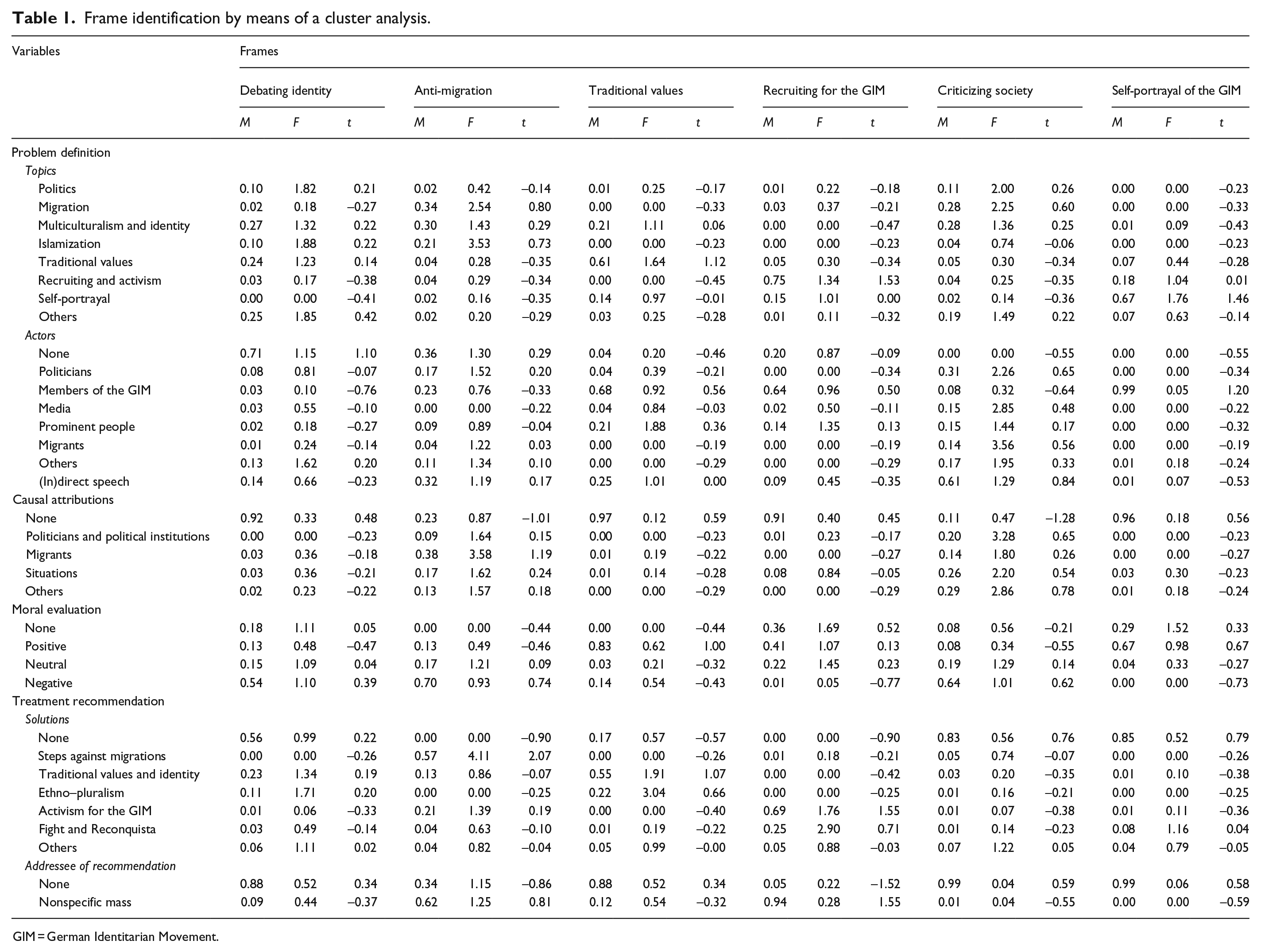
GIM = German Identitarian Movement.
Results
To find an answer to RQ1 and to identify patterns of variables with reference to the frame elements, as described earlier, a cluster analysis identified six strategic frames. Typical examples of the frames can be found in Figure 1.

Typical examples of identified frames.
Frame 1: Debating Identity (n = 119; 23%)
This frame focused on the issue of the so-called debate about identity. The most frequently mentioned topics were multiculturalism and identity itself (27%), traditional values (24%), Islamization (10%), and political issues (10%). These topics were predominantly presented without any actors (74%). In 92% of the memes, no causes for problems were attributed. Overall, the memes had a negative (54%) or neutral/nonexistent (together 23%) evaluation. Over 50% of the memes included neither a solution (56%) nor an addressee of the recommendation (88%). If solutions were given, they were aimed largely at traditional values and identity (23%), as well as at ethno-pluralism (11%). A typical example—as shown in Figure 1—is a meme referring to the past to be a time of ethno-cultural identity. Other memes would present figures about the increasing percentage of Muslims living in Germany or claim that multiculturalism destroys the variety of European countries. Hence, this strategic frame debates identity in an ethno-pluralistic context.
Frame 2: Anti-Migration (n = 47; 9%)
The smallest of the frames specifically argued against migration. The main topics were related to migration (20%), multiculturalism and identity (30%) as well as Islamization (21%). 4 There were either no actors (36%) or politicians (11%) and other actors (11%) such as authors, scientists, and religious leaders mentioned in these memes, often using (in)direct speech (32%). Responsibility for the problems was assigned to migrants (38%), situations such as wars (17%), and politicians (9%). The evaluation was negative (70%). Clear recommendations were expressed: a nonspecific mass (62%) was addressed to take steps against migration (57%) or asked for protesting and funding of the GIM (21%). Thus, persons were addressed directly to mobilize concerning the problems mentioned. For instance, a meme would ask people to defend themselves against becoming a minority in their own country (Figure 1). Other memes would ask people to name them cases of asylum abuse or ask for joining the GIM for protest against migration. Other examples represented quotations of scientists stating that a successful integration of migrants into the German society would be an illusion.
Frame 3: Traditional Values (n = 77; 15%)
In this frame, traditional values (61%) were the main topic. In a fifth of all memes, topics related to multiculturalism and identity (21%) were mentioned. Actors are members of the GIM (68%) and prominent people (like authors; 21%), such as Alain de Benoist, Friedrich Schiller, or Davi Kopenawa. No causes (97%) were given for the problems. The evaluation was predominantly positive (83%). While no addressees for solutions were mentioned (88%), the solutions presented related to traditional values and identity (55%) and ethno-pluralism (22%). Figure 1 shows a typical example of a quote by Edmund Burke, highlighting that traditional values of our ancestors should be kept alive. Other examples include criticism of gender mainstreaming and media. Hence, this frame stresses an extremely conservative worldview.
Frame 4: Recruiting for the GIM (n = 87; 17%)
Self-promotion of the GIM and its activities were the focus of this frame. The GIM, its recruiting (especially of young people and women), and its activism served as the main topic (75%), main actor (64%, next to prominent people at 14%), and main solution (activities for the GIM: 69%, Reconquista: 25%) for problems. In most memes, there were no causal attributions (91%). The addressees of the recommendations form a nonspecific mass (94%) since recipients were addressed in an informal way and asked for donations or participation in demonstrations. Evaluations were positive (41%) or neutral/nonexistent (together 58%). Examples include memes asking for donations, participation within the movement, announcement of demonstrations (see Figure 1), and advertising items of the GIM’s online shop.
Frame 5: Criticizing Society (n = 107; 21%)
This frame presented a variety of social problems that were almost entirely negatively evaluated (84%): political issues (11%), migration (28%), and multiculturalism and identity (28%). As a result, politicians (31%), media (15%), prominent people (15%), migrants (14%), and others (17%) were presented as relevant actors. The causal attributions were manifold, ranging from politics and political decisions (20%) to migrants/refugees (14%), and situations (26%). No solutions were proposed (83%), and thus, there was no addressee of a recommendation (99%). This frame represented broad criticism of the society without any suggestions for improvement. Examples of this frame criticize, for instance, missing border controls, Internet censorship (depicted in Figure 1), the work of non-governmental organizations (NGOs) in the Mediterranean Sea, and activities of left-wing protestors.
Frame 6: Self-Portrayal of the GIM (n = 73; 14%)
In this frame, the image and self-portrayal of the GIM were the main topics (67%). The GIM was the only actor represented in the memes (99%). There were no causes mentioned; evaluations were predominantly positive (67%) or nonexistent (29%). This frame covered self-promotion, without any solutions being represented (85%). Hence, there were no addressees of solutions (99%). Common examples of this frame include memes that highlight various channels where interested audiences can follow the GIM (such as newsletters and blogs), graphs showing how the GIM and its regional groups are organized, and slogans that they use such as “zero percent racist, 100 percent identitarian,” which is shown as an example in Figure 1.
Regarding RQ2, there were significant differences regarding the frequencies of frames in certain years, χ²(505) = 91.619; p < .001; V = .213 (see Figure 2). 5 The GIM posted much more memes in the early years (2013–2014) than they did in the later years. In 2013, there was a peak of all frames except for Anti-Migration, which peaked in 2015. This is related to Chancellor Angela Merkel who did not close the German border to Syrian refugees who were held in Hungary in August of that year. As can also be seen in Figure 2, the frame Traditional values was more important in the early years, while frames such as Debating identity, Recruiting for the GIM, Self-portrayal of the GIM, and Criticizing society have occurred nearly every year. Before the Facebook page was shut down in 2018, Criticizing society was the most dominant frame.
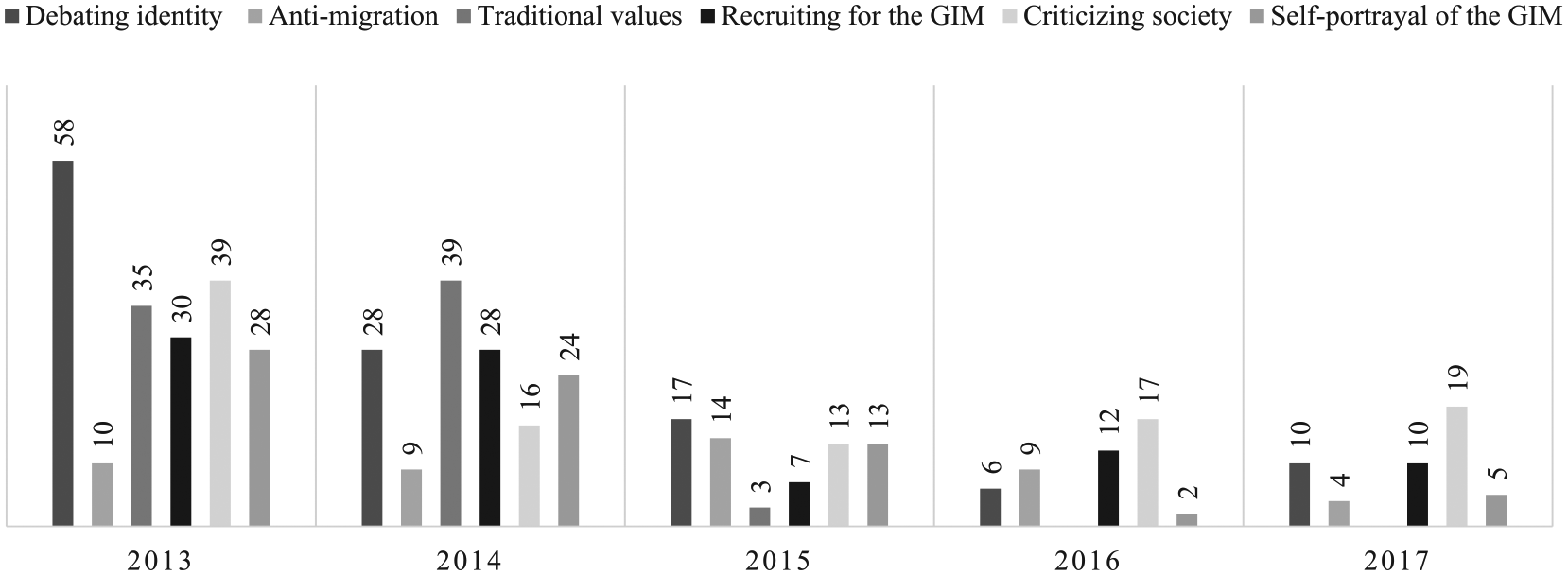
Frequencies of frames within the years considered in the sample, except for 2018.
To find an answer to RQ3, it was tested if the identified frames varied with respect to indicators of engagement with online content (see Table 2). Looking at the number of likes, F(504) = 4.302; df = 5; p < .01; η2 = .04, the results showed that most of the likes are recorded for the frame Criticizing society, while the lowest number of likes occurred for the Traditional values frame. When the number of comments was considered, significant differences, F(491) = 10.256; df = 5; p < .001; η2 = .09, indicated that the frame Criticizing society triggered comments most frequently. The lowest numbers of comments were recorded for the frames Traditional values and Self-portrayal of the GIM. The number of shares also showed a significant difference among the frames, F(493) = 4,419; df = 5; p < .01; η2 = .04. Both memes framed as Traditional values and Self-portrayal of the GIM were shared the least often. Memes framed as Anti-migration were shared the most often.
Differences among the frames regarding their engagement on Facebook.
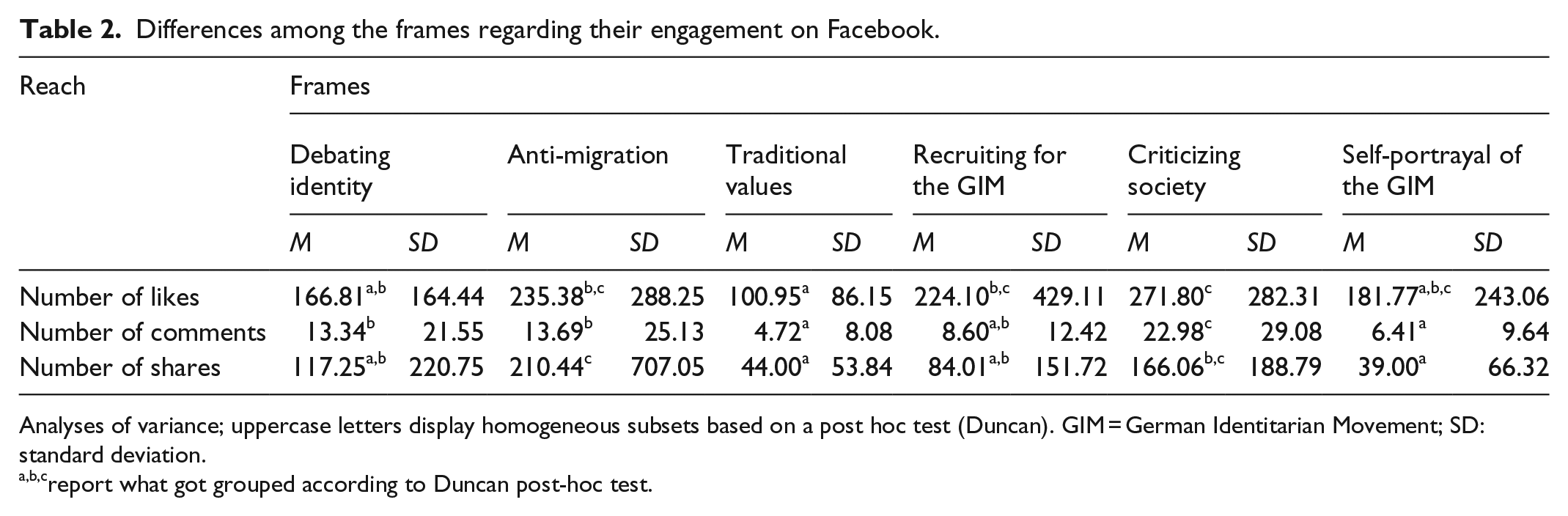
Analyses of variance; uppercase letters display homogeneous subsets based on a post hoc test (Duncan). GIM = German Identitarian Movement; SD: standard deviation.
report what got grouped according to Duncan post-hoc test.
Discussion
In the past, Facebook has deleted pages of right-wing extremist movements, often leading to these movements using alternative online platforms, such as VK.com (e.g., Pfeiffer, 2016). The GIM and other identitarian and far right movements are also (still) active on Twitter (e.g., Bundesministerium des Innern, für Bau und Heimat, 2019). Hence, audiences can still get in contact with posts of this movement, and these audiences might be uncertain about the clear intentions of the GIM—a movement, which intentionally creates confusion about its political stance.
The GIM is a comparatively new movement, showing some of the characteristics of connective action (Bennett & Segerberg, 2012). It differs from similar movements since it was founded on Facebook and prefers direct communication, using cooperate identity and modern communication tools that are part of popular culture, such as memes (e.g., Bruns et al., 2015; Pfeiffer, 2016). The movement has its own online shop selling clothes and other items (Fuchs & Middelhoff, 2019). Most of these points relate to the fact that the GIM is a youth movement.
The formal categories analyzed in this study are part of what Bruns et al. (2015) called the GIM’s cooperate identity: the frequent use of the label, the lambda symbol, and the color scheme. The content-specific categories, clustered to strategic frames, showed that frames related to traditional values and the GIM itself are the ones positive in evaluations; only one of these frames offered solutions, which is supporting the movement. At the same time, there are frames with a negative evaluation, two with no solutions put forward and one that clearly called for action against increased migration. Based on this, the six strategic frames can be arranged in a matrix considering their evaluations and calls for action (see Figure 3). Regarding the axis of evaluations, this matrix supports the distinction between “us” (the positively evaluated frames, predominantly referring to members of the GIM without causal attributions) and “them” (the negatively evaluated frames, with more variety of actors and causal attributions; see Caiani, 2019; Caiani & Della Porta, 2012; Schmidt, 2017). At the same time, the six frames emphasize that the GIM did not focus only on ethno-pluralistic issues (Bruns et al., 2015).

Differences among the frames regarding evaluative tone and call for action.
As the analysis showed, posts created by the GIM reached sufficient reactions. Interestingly, from Table 2, it seems that the frames with a negative evaluation, Criticizing society and Anti-migration, often produced higher engagement. Hence, these memes did spread more on Facebook than other memes. However, this should be interpreted with caution, because these frames have been rather dominant in the later years considered in the sample, at a point in time when it is very likely that the Facebook page had higher numbers of likes and followers than in the early years (compare also Figure 2).
Together, the frames represent social media activism (cf. Gerbaudo & Treré, 2015; Maly, 2019) in that sense that some of them ask for taking steps against migration (Reconquista; Bruns et al., 2015). Interestingly, the two most frequent frames (Debating identity and Criticizing society) do not offer treatment recommendations. This might be a strategic move, implemented to reach a wide variety of potential new members based on broad criticisms of social problems. Nevertheless, the frames clearly represented characteristics of the New Right: a focus on extremely conservative, traditional values that need to be recollected; clear statements against multiculturalism, migration, and especially Islamization; a dominance of ethno-pluralistic issues; and asking masses to take steps against migration. Political institutions and others had already classified the GIM as right wing (Bundesministerium des Innern, für Bau und Heimat, 2019); the strategic framing this study identified and the ethno-pluralistic topics can be seen as a modern version of racism: cultural racism (e.g., Bruns et al., 2015; Elgenius & Rydgren, 2019; Schmidt, 2017; Virchow, 2015).
Frames such as Anti-migration and Recruiting for the GIM prove that the GIM clearly used its Facebook page to initiate offline collective action (Harlow, 2011; Priante et al., 2018; Virchow, 2015). However, there are no indicators showing how successful they have been at reaching these goals. Collective action usually requires the long-term commitment of a group’s members and this might be hard to reach online. Under what circumstances online participation turns into offline collective action remains an open question (e.g., Gaby & Caren, 2012; Harlow, 2011), and deserves more attention by research in the future.
Several limitations of this study may also influence potential future research. First, this study analyzed only the memes of the GIM. Future studies could take into account different types of posts. In addition, the memes used for this study were collected using screenshots. This type of data collection could not consider if memes were edited or deleted before 1 May 2018. Second, the study was carried out in a German context. An interesting future research project would be to compare different countries (e.g., Klein & Muis, 2019). Third, while the framing approach, and strategic framing in particular, proved to be suitable for answering the RQs, it should be highlighted that how frames can be best defined is still contested (Scheufele & Scheufele, 2010). In the same vein, it should be added that the definition of what constitutes a meme is also contested (Seiffert-Brockmann et al., 2017; Shifman, 2013). In this study, the interactive character of a meme and how it spreads was only investigated in light of social media engagement. To what extend users altered these memes or elements of it when sharing them (see Gal et al., 2016), or maybe even created counter-memes, was not part of the study. Fourth, based on the exploratory nature of this study, variables collected in the content analysis were drawn from the broader framing literature, sample coding, and codebook development. This approach cannot guarantee that all relevant variables were captured. A future study could also take other platforms such as Twitter into account (e.g., Crosset et al., 2019). Fifth, regarding frame building and frame setting, future studies could combine a content analysis of posts with a content analysis of media coverage about the GIM and/or a survey among Internet users liking or following a page or a channel combined with representative surveys.
The GIM, although it was founded only in 2012, had already reached tens of thousands of people on Facebook. Hence, researchers should continue investigating their outward communication on different Internet platforms.
Footnotes
Authors’ Note
The authors wish to thank their editors and anonymous reviewers for their good recommendations, as well as Franziska Schmidtke for reading and commenting on an earlier version of this article. We would also like to thank Gudrun Hentges and Fabian Virchow for fruitful exchange of ideas.
Declaration of Conflicting Interests
The author(s) declared no potential conflicts of interest with respect to the research, authorship, and/or publication of this article.
Funding
The author(s) received no financial support for the research, authorship, and/or publication of this article.
