



Abstract
Whether they know it or not, the legal rights and responsibilities of users of websites and services, including social media, are defined and controlled by the terms of service of these online service providers. But despite the importance of these provisions, studies have shown that users rarely review terms of service, or think about their meaning. This study took advantage of a major website’s “simplification” of its terms of service to determine whether the changed language increased users’ understanding of the intended meaning of the terms of service. Using the Elaboration Likelihood Model, we evaluate the effectiveness of simplification of terms of service as a method to encourage users’ understanding on these terms.
Introduction
Virtually all web sites, including social media sites, require users to agree to legally binding terms of service (ToS) and privacy policies (Bayley, 2009). 1 Yet ToS and privacy policies are frequently complex and legalistic. As a result, users often do not read them (Fox-Brewster, 2014; Germ, 2012; Hoffman, 2012; Lomas & Dillet, 2015; J. Martin, 2010; McDonald & Cranor, 2008; Obar & Oeldorf-Hirsch, 2018; Sauro, 2011; Stevenson, 2014) or understand what they say or mean (Fiesler et al., 2016; McRobb, 2006; Pardes, 2018; Pew Research Center, 2014).
But it may be possible to simplify ToS to make them understandable to users, while preserving legal predictability (Rozansky, 2011; Siegel & Etzkorn, 2013). Google attempted such a simplification of its ToS in 2012.
We took advantage of this change to determine whether such simplification actually worked in increasing users’ understanding of the legal meaning of ToS.
Literature Review
Reading and Understanding of Terms of Service
The anecdotal conclusion that social media users often do not read or understand ToS and privacy policies has actually been subject to little empirical research (Gillette, 2004; Korobkin, 2003; Moringiello, 2005). But what research has been done verifies that users actually do not usually pay attention to website ToS (Big Brother Watch, 2012; Madden, 2013; Microsoft Inc., 2014; Obar & Oeldorf-Hirsch, 2018). For example, Böhme and Köpsell (2010) found that half of users viewed a 200-word notice of a change in ToS for less than 8s before clicking to accept or reject it, strongly implying that most users did not actually read the notice. Sauro (2011) found that users spent a median of 6s on the ToS screen before proceeding with installation of software, strongly indicating that the screen was not actually read. Obar and Oeldorf-Hirsch (2018) found that 74% of subjects chose a “quick-join” option for a website rather than accessing ToS.
There are likely several reasons why users ignore—or, at best, pay scant attention to—ToS. Remsen (2016) delineated several of these:
I do not want to read this entire long, confusing legal document.
There are 500 million people using [the service], so they all must have signed this thing already.
Everyone I know who is on [the service] likes it, and none seem to have suffered terrible consequences from signing this.
If the terms were really bad, people would not be using the service.
The first point is supported by the findings of several studies (e.g., Jensen & Potts, 2004; Pappas, 2011). For example, a 2014 study of 30 popular websites featuring user-generated content found an average ToS length of 3,851.7 words (Fiesler & Bruckman, 2014).
Besides their length, understanding ToS usually requires high comprehension skills. Both Jensen and Potts (2004) and Fiesler and Bruckman (2014) found that privacy policies were written at the level of reading and comprehension expected of a college junior. 2 Meanwhile, 34% of the US adult population has either “basic” or “below basic” proficiency in “the knowledge and skills needed to perform prose tasks (i.e., to search, comprehend, and use continuous texts)” (U.S. Department of Education, 2006).
McRobb (2006) found that even when users read the policies they often did not agree on their meaning. “The broad implication,” he concluded, “is that neither the organisations that publish privacy policies nor the individuals who read them should be confident that they are being clearly understood in the way that they are meant to be understood” (p. 224).
As to Remsen’s remaining factors, it is important to note that the ToS that all prior users of a service (such as Google or Instagram) have agreed to are a gateway to use the service. The other users have all agreed to the ToS because agreeing to the ToS is a prerequisite to using the site. Also, there is no way for new users confronted with a site’s or service’s ToS to know about prior users’ objections to any of the provisions (Wilkinson-Ryan, 2017).
There are likely several other factors leading to users’ failure to read ToS. One may be the futility of doing so, since the ToS are non-negotiable (Solove, 2013; Wilkinson-Ryan, 2017); and are subject to change (Bar-Gill & Davis, 2010). Also, the sheer number of sites—and ToS—that most Internet users interact with on a regular basis (Solove, 2013) means that confronting such contracts has become so ubiquitous that most users now accept ToS without serious consideration (Kim, 2013, p. 59). Another factor is the human propensity to accept default options over alternatives that require additional effort (Thaler & Sunstein, 2008, pp. 7–8, 83–87). For example, Petty et al. (1993) showed that mere repeated exposure to a message (or a similar type of message) can create a classical conditioning effect which leads to user to accept the message.
Finally, reading ToS and privacy policies may just be too much of a hassle for many users:
Relative to the small scale of most Internet transactions, such as buying a book or simply visiting a website, comprehending a privacy policy is much less acceptable than when buying a house or getting significant medical treatment. Simply put, in the time you could read and check Amazon.com’s privacy policy, you could drive to Barnes and Noble and buy the book.
Application of the Elaboration Likelihood Model to Terms of Service
Since a ToS document or a privacy policy is a form of message, it is reasonable to examine how it is processed by applying the Elaboration Likelihood Model (ELM), a theoretical framework which explains how recipients’ conative and cognitive processes related to a given piece of information affect their understanding of the message.
ELM suggests that an individual’s motivation and capability to process information determines whether she invests any effort in actually analyzing the message to make decision(s) in reaction to that message. Such analysis of the message is known as the ELM “central processing route.” When an individual is either not motivated or not equipped with sufficient skills to analyze the message, ELM suggests that she takes the “peripheral route,” in which information is processed with less effort, elaboration, and contemplation. Instead of deep analysis of a message, the peripheral route uses only external factors (“heuristics”) to process the message. Such factors, for example, can be symbols which are often irrelevant to the meaning of the message, or the behavior or perceptions of other people (social references).
Whether a user actually understands such a document can be understood as the result of their level of analysis (“elaboration”) in ELM terms. While the central route requires higher levels of analysis, the peripheral route includes mainly low levels of elaboration.
ELM has been applied in various studies on users’ understanding of online activity (Angst & Agarwal, 2009; Gu et al., 2017; Lowry et al., 2012; Sanbonmatsu & Kardes, 1988; Zhou, 2012). For example, Zhou (2012) examined how the specific permissions that users must accept to use mobile applications influences their perceptions of privacy assurance through both the central route and the peripheral route. Gu et al. (2017) found that users employed the central route to form an understanding of privacy hazards and privacy assurance, based on their understanding of the permissions for an app, and that users utilized the peripheral route to make judgments on the quality and other aspects of a particular app, based on factors such as the fame of the app developer. In another study, Zhou (2017) found that both the central and peripheral routes were used in the development of users’ concerns about privacy.
But Yang et al. (2006) found that customer’s initial trust toward online retailers was mostly based on extrinsic cues (peripheral route) rather than considered examination (central route). Lowry et al. (2012) found that understanding of privacy “seals of approval” (attesting that an e-commerce site adheres to good privacy practices) was mainly processed through the peripheral route, based mainly on the appearance of the websites.
Legal Impact of Terms of Service
In the United States, the legal validity of a ToS provision is determined based on whether the user had adequate notice of the provision, and whether the user assented to it (Balasubramani, 2015). This is known as “notice and consent.” The law does not, however, concern itself with whether the user actually read or understood the provision.
Regardless of whether users understand the ToS, the document has profound legal consequences. For example, in 2012, a federal appeals court held that a customer was liable for credit card fees that he was unaware of because they were disclosed in an online “terms and conditions” document that he did not read, despite having clicked a box verifying that he had read the document (Davis v. HSBC Bank Nev., 2012).
Our study applied the ELM model to examine users’ understanding of ToS, and whether users understood the ToS provisions as they have been interpreted in actual legal cases.
Users’ Reactions to Terms of Service
A number of studies in legal and social science literature have examined how users conceive of and react to ToS when confronted with them.
Spiekermann et al. (2001), Acquisti (2004) and Acquisti and Grossklags (2005) each concluded that users are often willing to sacrifice long-term privacy interests for short-term gains. Tsai et al. (2011) found that users of retail websites preferred sites with prominently displayed and clearly written privacy policies, even the sites’ prices were higher. Others have found that the amount of money that users sought in return for giving up private information varied according to their individual perception of how much privacy they already had (Acquisti et al., 2013), and that willingness to give up privacy depended on how much users trusted the entity seeking private information (Joinson et al., 2010), or a pre-existing relationship with the entity (Binns et al., 2017).
Research Questions and Hypotheses
One important limitation of previous ELM studies about users’ understanding of online service policies is that they relied on survey questions that assumed respondents were aware of central route processing. For example, Zhou (2017) operationalized the central route with a series of questions asking if “the privacy policy provided by the service provider clearly and completely describes how users’ privacy would be protected and used by it.” (p. 518). But respondents could answer without actually reading the privacy policy. In other words, their response to the “central route” questions could be a result of peripheral route heuristic assessments. To give more robustness to such tests, our study examines both the effect of the mere existence of ToS, and also the effect of simplification of legal jargon in ToS to make them more understandable.
Google—then the most frequently visited website in the United States (Nielson Company, 2012)—thoroughly rewrote its ToS document in 2012, replacing one adopted in 2007 (Chavez, 2012). The new 2012 version was meant to use more “plain English” and contain less “legalese” (Whitten, 2012), and thus be more understandable to users. 3 Google’s attempt to simplify the ToS can be considered as a direct response to the “ability” problem that its users could have: the assumption is that ToS simplification would increase users’ relative ability to understand the legal text, as it would decrease the text’s grammatical and lexical complexity of the text and the time required to read it.
Our study examines whether users who are forced to view a provision of the ToS will have higher levels of understanding than users who do not read ToS. It then goes further, examining whether the simplification of ToS language leads to higher levels of user understanding. (Which is the stated goal of ToS simplification.)
These are expressed in the following research questions:
RQ1: Does exposure to terms of service lead to higher levels of understanding of meaning, compared to no such exposure?
If the users do read the ToS and tried to understand the text, they would be engaging in a higher level of elaboration than mere exposure: at that time, the user’s ability to understand the ToS message contributes to another important determinant, among other factors. This study thus partially focuses on mere exposure to ToS and the conditioning of relative ability to elaborate as key concepts.
RQ2: Does exposure to “simplified” terms of service lead to higher levels of understanding of the meaning of terms of service, compared to exposure to a “unsimplified” version?
It may seem that simplification of the language of ToS would increase understanding of the meaning of the ToS. This study tests that notion.
Thus our study examines whether users who are forced to view a provision of the ToS will have higher levels of understanding than users who do not read ToS, and whether users who view a simplified version of a ToS provision will have higher levels of understanding than users who see an unsimplified version of the same provision.
Existing literature linking ToS comprehension directly with ELM provides some evidence that guided our current research. It is plausible that users are already accustomed to using heuristics to reach fast decisions regarding ToS. Thus users not exposed to ToS will develop an inaccurate or less developed understanding of the policy. For users who do read ToS, the complexity of the language may deter central route processing, and simplification of ToS language could lead to higher levels of understanding.
Based on previous studies, we hypothesize that when users view a ToS provision they will become more thoughtful (utilize the ELM primary route) about the meaning of the provision. We also hypothesize that viewing simplified ToS will lead to higher levels of user understanding of ToS.
These are expressed in the following hypotheses:
H1: Exposure to ToS leads to higher levels of understanding than non-exposure.
H2: Exposure to “simplified” ToS leads to higher levels of understanding than exposure to an “unsimplified” version.
Our research questions and hypotheses examine the effect of existence of ToS (H1) and the effect of the simplification of ToS (H2) on participants’ understanding. In H1, the exposure to ToS is the independent variable; in H2, the independent variable is the version of the ToS to which respondents were exposed. The dependent variable in both H1 and H2 is the participants’ understanding of the meaning of the ToS provision.
Materials and Methods
To test these hypotheses, we conducted three separate studies measuring comprehension of ToS.
The three studies correspond to three real-world legal cases and scenarios. Each study focused on a different legal issue, and used ToS provisions relevant to that issue. Study 1 involved a ToS provision regarding scanning of e-mails for advertising purposes. The legal issues in Studies 2 and 3 involved copyright issues. In Study 2, the issue was the website’s use of content created and posted to the site by users. In Study 3, the ToS excerpts for this study involved user’s ability to use material posted by other users.
Use of Users’ E-mails
The first ToS provision tested regarded Google’s use of e-mails sent and received by Google users through the company’s Gmail service, which were analyzed and used to display advertising to the Gmail users. While neither the 2007 nor the 2012 Google ToS directly addressed this issue, 4 Google later argued in court that provisions of both the 2007 and 2012 ToS allowed this. 5
Retention and Use of User-Generated Content and Data
The second ToS provision tested involved the retention and use of user-generated content and data. While the ToS used in the study were from Google, this legal issue arose in two legal actions against Facebook. In one lawsuit, several users sued the company over its “sponsored stories” program, in which users’ names and/or profile photographs were displayed in advertisements on the site. 6 Another case against Facebook, filed with the Irish Data Protection Commission, alleged that various Facebook policies, including its retention of user-posted material even after it was “deleted” by the user, violated European privacy laws. 7
In both of these cases, Facebook argued that its ToS allowed use of material posted by users in both of the ways described earlier. Google would likely have made the same argument regarding its ToS, since this position is consistent with the policies of most other websites that allow users to post materials (Fiesler & Bruckman, 2014; Fiesler et al., 2016).
Users’ Ability to Use Material Posted by Other Users
The third provision tested addressed the issue of users taking images found online and using them for their own purposes.
Under current US law, the creator of a work automatically gets a copyright upon completion of the work. Thus, virtually, all material found on the web is protected by copyright, and is not usually available for reuse without permission of copyright owner. Generally, reuse without such permission is copyright infringement. 8 Copyright infringement is particularly problematic when a copyrighted image is used without authorization as part of an item offered for sale, such as an image imprinted on t-shirts. 9
These legal issues were based on actual legal proceedings involving Google and other online media companies. The “correct” understanding of the ToS was the one taken by the online media company in the legal proceeding, based on the assumption that the company’s arguments in the legal proceedings indicate what was intended by the ToS language. 10
For each of the three legal issues, we examined whether exposure to a provision addressing that issue from either Google’s 2007 or 2012 ToS led to increased understanding of the intended meaning, compared to no such exposure. We also examined whether there was any difference in understanding between the 2007 and 2012 versions.
Experimental Design
Factor and Stimuli
The article consists of three single-factor experiment studies (Study 1, Study 2, and Study 3). Within each study, each individual respondent in the sample for that study was randomly assigned into three conditions: two treatment conditions, and a control condition.
Methodology
Within each study, the sample for that study was divided into three groups. One group was exposed to a provision from Google’s 2007 ToS regarding the legal issue (Treatment I), 11 another group was exposed to a provision from Google’s “simplified” 2012 ToS on the same issue (Treatment II), and a control group was not exposed to any ToS provision (Control). Those in the control group were told to answer the questions based on their (unassisted) memory and understanding of the ToS of the website that they used most often. 12 The three sets of questions measuring levels of understanding of ToS are shown in the Appendix. As implied by the hypotheses, our interest is the effect of the different versions of the ToS as a factor is the level of understanding of the ToS. After the exposure (or no exposure in the case of the control condition), each subgroup was asked two questions, which asked whether a specific activity was permitted under the ToS provision that they had just read (or, in the control group, conceived of). The “correct” answers were determined based on Google’s actual or likely position, based on real-life legal cases. Incorrect or missing answers (e.g., where the response was “don’t know” or no answer was given) were coded as “incorrect,” since they showed failure to understand the intended message of the ToS provision.
We then calculated a pseudo-continuous dependent variable, in the form of a “score of understanding,” for each respondent, which indicated how many “correct” answers each respondent had given. A score of 0 indicated no correct answers, a score of 1 indicated that the respondent correctly answered one of the two questions, and a score of 2 indicated that the respondent correctly answered both of the questions in the study.
Participant Demographics
Our studies were included in the 2014 Cooperative Congressional Election Study (CCES), a national United States stratified sample survey (N = 50,000+), administered online by YouGov/Polimetrix. Our questions were presented in the post-election wave of the survey, conducted in mid-November 2014, to a subset of the overall sample (n ≈ 1,000), resulting in 837 useable responses (n = 837). 13
The inclusion of our study in a one-time election survey barred a pre-test to determine whether our respondents had any prior exposure to or understanding of the legal issues that we focused on. But this limitation has little effect on our conclusions, since it was the respondents’ understanding of the legal issue after viewing the applicable ToS provision that we were measuring. In other words, we were measuring the effectiveness of the provision in conveying its message, not the respondents’ legal knowledge.
All 837 respondents participated in Study 1 (N1 = 837), while members of our sample were randomly assigned to either Study 2 (N2 = 405) or Study 3 (N3 = 432). This was done for budgetary reasons and to avoid exposure to questions regarding copyright issues in Study 2 priming respondents for questions on a related issue in Study 3.
As shown in Table 1, the exposure and control groups in each of our studies were generally equivalent in terms of gender, age, and education level. The groups were also similar in terms of Internet access at home and at work, frequency of usage of web portals, and self-reported practices regarding websites’ ToS. The demographics of our samples were, however, somewhat different from the United States national population as a whole: our samples had higher median ages, 14 and had higher levels of home Internet access. 15
Demographic Information of Study Samples.
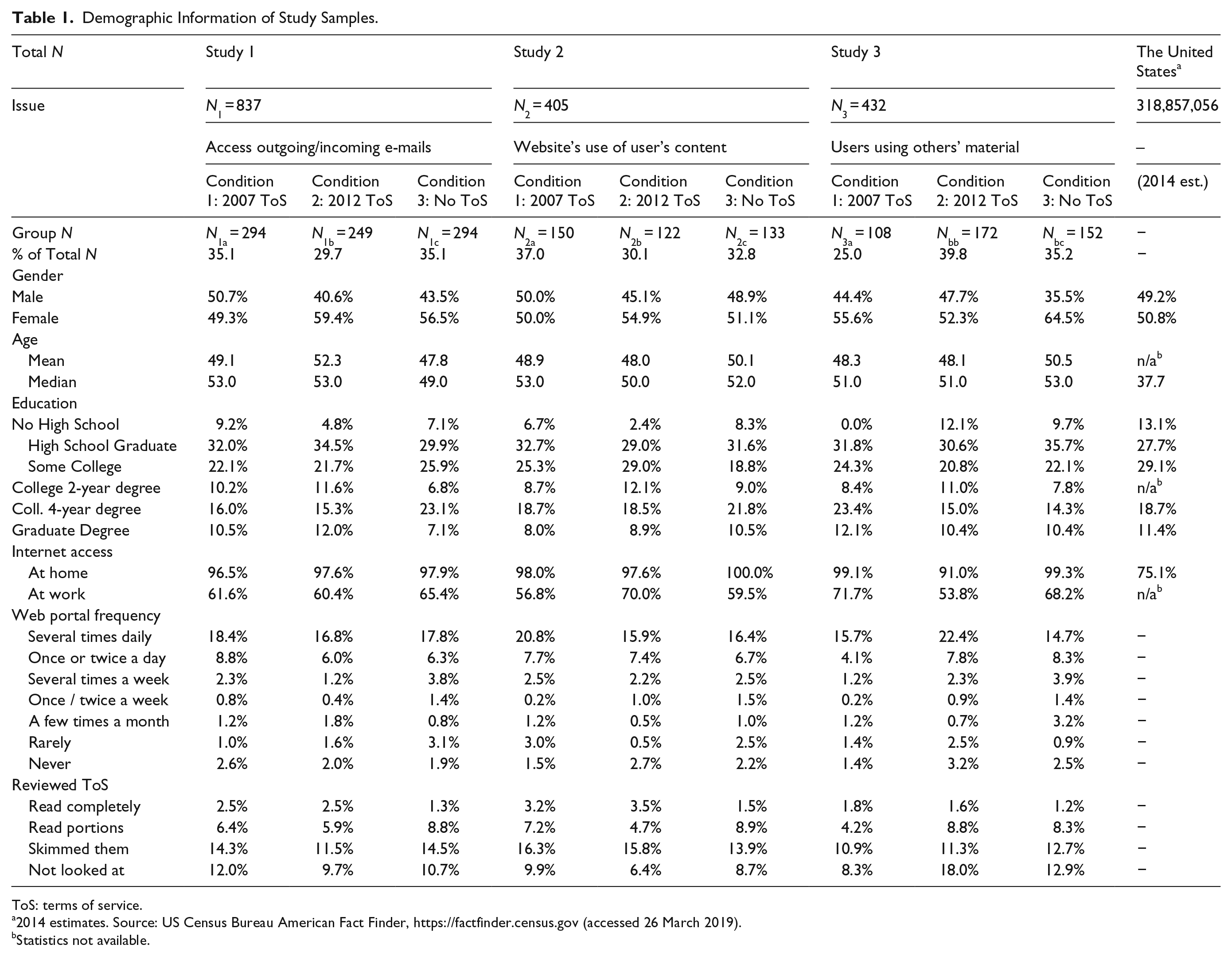
ToS: terms of service.
2014 estimates. Source: US Census Bureau American Fact Finder, https://factfinder.census.gov (accessed 26 March 2019).
Statistics not available.
Results
The share of each group that gave the “correct” answer for each question is shown in Table 2.
Study Design and “Correct” Response Rates.

Bold value indicates the highest percentages for each question within each study.
ToS: terms of service.
Within each study, each respondent’s answers were used to determine that respondent’s “score of understanding” in that study, as described earlier and in the Appendix. These scores were then used to test the hypotheses.
Hypothesis Results
The results of all three studies are summarized in Table 3.
Summary of Results.

SD: standard deviation; ToS: terms of service.
In Study 1, the 2007 Terms of Service was significantly effective in increasing “correct” answers, but the 2012 Terms of Service was not.
To test H1, independent sample t-tests were performed for each study to compare group means of understanding levels between the exposure group (Treatments I and II combined) and the non-exposure control group (Treatment III). As shown in Table 3, the results of all three t-tests for Studies 1, 2, and 3 were significant at p < .01 level. Thus H1, the proposition that exposure to any ToS—either the 2007 version or 2012 version—led to higher levels of understanding than non-exposure, was supported. 16
To test H2, we performed independent t-tests to compare group means of understanding levels in each of the three studies between the 2007 ToS exposure groups (Treatment I) and the 2012 ToS exposure groups (Treatment II). Table 3 shows the results of these tests: in all three studies, there was no significant difference in understanding between the 2007 ToS group and 2012 ToS group. Thus, H2, that exposure to the 2012 “simplified” ToS would lead to higher levels of understanding than exposure to the 2007 “unsimplified” version, was not supported.
Limitations
While we are confident that our results are indicative of the role that exposure to ToS plays in user understanding, it is important to mention the limitations of our studies.
One possible limitation comes from the nature of our sample. First, the overall sample excludes those under age 18, the minimum national voting age in the United States. This limitation makes our samples somewhat unrepresentative, since younger individuals are more likely to use online services, including social media (Jiang, 2018). Younger people are also more likely to be familiar with and more accepting of online contracts (Hoffman, 2016).
Another limitation is a result of our methodology, in which all of our participants participated in Study 1 and were then separated randomly for Studies 2 and 3. As a result of this split, the subgroups in Studies 2 and 3 are not directly comparable with those in Study 1.
Because the three studies involved different legal issues and overlapping samples, they must be considered independently of each other. Each study is a simple, straight-forward, one-factor design. Because of this, we do not have a multiple comparison problem statistically, thus releasing us from performing a Dunnet’s test to control for multiple simultaneous comparisons.
Finally, it is important to emphasize that we focused our studies on the effects from the existence of and the simplification of ToS, not any effects caused by thematic differences between the different legal issues presented to the respondents in the ToS excerpts. For this reason, we did not use a 2 × 2 factorial design combining Studies 2 and 3, which focused on different aspects of copyright, since such an analysis would shift the focus to the thematic differences in the legal issues, rather than the effect of the different (unsimplified and simplified) versions of the ToS.
Discussion
The readability of websites’ ToS and privacy policies has been cited as a major reason why most users do not read or understand these documents. Utilizing ToS regarding three different legal issues, our studies attempted to use the ELM to determine whether mere exposure to the ToS impacted users’ correct understanding of ToS, and whether simplified language resulted in better understanding.
Understanding of Terms of Service Generally (H1)
Our results regarding Hypothesis 1 show that exposure to ToS—either the 2007 or the 2012 version—led to significantly higher understanding of the message, as indicated by statistically significant higher scores of understanding by respondents who were shown either of the ToS in two of our studies (Studies 2 and 3), compared to respondents who were not shown any ToS. In Study 1, the 2007 ToS was significantly effective in increasing “correct” answers, but the 2012 ToS was not.
This may be because exposure to a ToS provision made the legal issue discussed in the provision more salient to the study participants and made them seriously consider the propriety of the actions described in the questions. In other words, social cues and mere attention arousal may have led participants to take the peripheral route to comprehend the legal implications of the ToS. Other researchers, such as Tversky and Kahneman (1973), have found a similar “availability heuristic,” in which recently received information is more readily recalled and can shape a response more than less recent information which received only scant attention at the prior exposure.
Moreover, it is possible that exposure to the ToS caused a priming effect in which respondents relied on their prior knowledge and understanding of the legal issues involved in the questions. A similar effect was observed by Martin (2015), who found that respondents projected their own privacy expectations when interpreting a privacy notice. Such effects have also been shown in studies of understanding of jury instructions, another legal “text” meant to convey a basic understanding of legal principles. Such studies found that jurors often use their own preconceived notions of legal issues to interpret and apply jury instructions given to them by courts, rather than the language of the jury instructions themselves (Dumas, 2000; Lieberman & Sales, 1997; May, 1995; Ritter, 2004; Saxton, 1998; Tanford, 1990). A similar effect may be present here, with respondents using their preconceived notions to answer our questions.
Understanding of Simplified Terms of Service (H2)
The results regarding Hypothesis 2 show that the “simplified” 2012 ToS did not lead to increased understanding, compared to the “unsimplified” 2007 ToS.
These results indicate that the “simplification” of complex reading material may be a futile enterprise that is not actually effective in increasing users’ actual understanding.
According to ELM, numerous factors—including the length of the ToS document, language complexity and users’ habits regarding use of online services—can influence the two crucial determinants of central route processing: motivation and ability. Theoretically, simplification of legal jargon into plain language should increase users’ relative ability to comprehend ToS texts. Yet, if many users have embraced ideas such as, “if the terms were really bad, people wouldn’t be using the service” (Remsen, 2016), they would have little motivation to understand the ToS content in the first place, thus eclipsing the potential of their increased relative comprehension ability.
ELM Analysis
Applying ELM principles to understanding of ToS, the complexity of the documents mean that actually understanding their meaning likely requires the higher levels of elaboration of the central processing route. But when an individual uses the less demanding peripheral route, she will rely on heuristics to conjure an assessment of the ToS (Petty et al., 1993). Applying this low-level elaboration to ToS, the mere appearance is enough to lead a peripheral route user to give up on understanding them, and figuring that others would not have accepted them if the ToS were egregious.
In ELM terms, our results imply that peripheral route processing (i.e., mere exposure to ToS, whether simplified or not) did increase understanding among participants. But central route processing, which Google’s simplification effort hoped to bolster, did not significantly increase understanding. In one of the legal issues (Question 2b), the more complex terms led to higher levels of understanding than the simplified version. From our results, it appears that simplification of ToS to make them more readable and understandable may not be able to achieve its goal in real-world settings.
Implications and Future Studies
The issue of users’ understandings of ToS may be especially important as websites revise their ToS to comply with the European Union’s recently enacted General Data Protection Regulations, 17 and other new and pending government-imposed privacy and data protection requirements. 18 Such regulations regarding ToS and data privacy are being considered in the wake of the revelations regarding Cambridge Analytica’s acquisition and use of Facebook data in the 2016 presidential election (Simberkoff, 2018).
Based on our results, “simplification” of ToS appears to have little effect on users’ understanding of the legal meaning and interpretation of those terms. Nevertheless, the results can provide a blueprint for future efforts to draft Internet ToS so that users are more likely to read and understand them.
One option may be to present easy-to-understand summaries of relevant ToS in context, when a user is utilizing a function to which a particular provision applies. This would make the legal issue immediately salient at the moment when a particular issue is involved in the user’s specific action, rather than in a broad ToS document that is separated from the specific functions and uses of the site. Such presentation of applicable ToS in context would be an example of the “situational awareness” model of ToS advocated by scholars such as Susser (2019). It would also serve as a “nudge” which, by informing users of the consequences of a decision or action at the time it occurs, may influence what the user does (Thaler & Sunstein, 2008).
This study found a scenario, in the results regarding Hypothesis 2, where central route processing was overshadowed by peripheral processing habits. But if online service providers really hope to migrate their users from the ELM peripheral route to the ELM central route for ToS comprehension, a more important intervention could be to influence users’ motivations to understand ToS rather than their ability to do so. This would involve strategies aimed at boosting alertness of legal issues involved in use of the Internet and social media, such as showcasing past incidents of privacy infringement or data leaks.
Other possibilities may be revealed through additional research. Future studies can build on the current design by including ToS provisions from other (real or fictional) websites. Or they can include ToS provisions associated with activities beyond the themes covered here, such as online banking or online dating, that may involve other, perhaps more complex, legal issues.
Moreover, this study did not examine potential interactions between reliance on social heuristics, motivation, and ability for the central route processing mechanism. Future studies could look into how the peripheral route factors influence central route processing in perception of online ToS, or in other situations.
In future research focused on terms service, one challenge is the need for more legal cases available for such analyses to be practically meaningful, since the meaning of any ToS provision is merely a matter of legal interpretation until a web company is forced to define its ToS in court, designating a “correct” answer. (Even though that answer may be a post hoc justification.)
Conclusion
Using the theoretical framework of the ELM, our results show that participants relied more on the peripheral route to understand the ToS excerpts than they did on the primary route. Google’s simplification of its ToS in 2012 did not increase participants’ understanding, because the central route mechanism it targeted was undermined by participants’ preference to use social cues to understand the ToS.
There was an increase in respondents’ ability to give correct answers to our questions after exposure to either of the ToS versions. But our results raise the possibility that the increased “understanding” may have been caused by a heuristic use of the ToS. In other words, our studies show an increase in the understanding of the legal issues results from any exposure to ToS, by making the issue salient through mere exposure to ToS on the topic. The respondents than answered the questions using a legal context that they set up for themselves on a temporal/artificial basis, based on their prior knowledge and understanding of the issues, but not on anything actually contained in the ToS to which they were exposed.
Our results do not support the idea that efforts to simplify ToS, as Google attempted in 2012, make legal terms more salient for users. We were not able to discern any difference in understanding between the original and “simplified” ToS.
Based on our results, it is arguable that websites’ ToS can be designed not only to provide a priming effect of common sense understanding of legal issues generally, but also to accommodate user’s convenience to help them understand the ToS. We must assume that most users will likely not read the ToS, but only treat it as prompt for recall of the prior legal knowledge. Thus, it may be helpful to disperse these prompts throughout the whole user experience on a website, such as by adding pop-ups that warn users about the possible legal consequences of a certain action when they are attempted. The currently prevalent availability of standalone ToS, separate and apart from the user experience of the website, may in fact promote unwilling violation of legal requirements, either through ignorance or misunderstanding.
With more research into understanding and perceptions of ToS, we may be able to determine which legal issues users really care about in ToS, and in online behaviors generally, and establish methods of integrating notices about these issues into the operation of websites, so that they are salient to the user at the very point where a legal violation is most possible, through either of the ELM pathways.
Footnotes
Appendix
Declaration of Conflicting Interests
The author(s) declared no potential conflicts of interest with respect to the research, authorship, and/or publication of this article.
Funding
The author(s) received no financial support for the research, authorship, and/or publication of this article.
