



Abstract
Populist politicians are often associated with the successful use of social networking sites (SNS). However, it is still unclear whether the popularity of populist posts is driven by the nature of the messages, by the populist actors as the source, or by the interaction of both factors. By following a 2 × 2 experimental design (N = 647) and by manipulating populist versus nonpopulist messages in a Facebook post and a typically populist versus mainstream politician as the source, this study contributes to the existing literature in two ways. First, it shows that both populist messages and populist actors foster the perception of a Facebook post as populist but that only populist messages are drivers of user reactions. Second, complementing content analyses on populism and user reactions, the study demonstrates that the effect of populist communication on user reactions is moderated by recipients’ populist attitudes. Users with strong populist attitudes share populist messages more often than they share nonpopulist messages.
Populist politicians are often associated with the successful use of social networking sites (SNS). First, research shows that SNS—particularly Facebook—are well-suited channels for distributing populist messages (e.g., Ernst et al., 2017; Groshek & Engelbert, 2012; Stier et al., 2017). Second, studies demonstrate that citizens with high populist attitudes are more likely to use Facebook to obtain political information (Groshek & Koc-Michalska, 2017; Schulz, 2018). Finally, initial research indicates that populist actors and populist messages are both drivers of user reactions on Facebook (Blassnig et al., 2020; Bobba, 2019). However, so far, studies on the relationship between populist communication and user reactions on SNS have relied exclusively on quantitative content analyses of digital trace data and have therefore largely focused on the supply-side of populist communication.
Taking a demand-side perspective, one may assume that reactions to populist messages on SNS are influenced by the characteristics of the message, the sender, and the recipient. On the one hand, existing research demonstrates that the effects of populist communication are moderated by recipients’ preexisting populist attitudes (Hameleers, Bos, & de Vreese, 2018; Müller et al., 2017). Findings by Müller et al. (2017) show that exposure to populist messages reinforces both prior agreement and disagreement with populist ideas. It is therefore reasonable to assume that prior populist attitudes may moderate whether a recipient likes, shares, or comments a post with a populist message or by a populist politician. On the other hand, experimental studies suggest that the source of the message may influence the effect of populist messages in Facebook posts (Hameleers & Schmuck, 2017). However, it is still unclear whether and how these two factors—populist messages and populist actors as the senders of messages—interact. Do populist actors activate a corresponding schema—a “populism schema”—that increases the perception of populist elements (i.e., anti-elitism, people-centrism, and popular sovereignty) in their messages?
To address this research gap, this study analyzes the effect of populist communication on user reactions using an online survey experiment. Thereby, it adds to the existing literature with a twofold contribution. First, by following a 2 × 2 design (N = 647) and by manipulating populist versus nonpopulist messages in a Facebook post and a typically populist versus a mainstream politician as the source, the study allows us to investigate how populist messages and populist actors interact and how both components foster user reactions. We assume that a populist actor as the source of a message activates a populism schema, which increases the perception of a message as being populist. Second, this study complements existing content analyses on populism and user reactions by analyzing not only the effect of populist communication on user reactions but also how the effect is moderated by recipients’ populist attitudes.
Popularity on SNS
SNS have become a very important channel for political actors to communicate with their constituencies. On the one hand, SNS provide a platform where messages can be sent directly to a large audience of like-minded supporters while circumventing the media (Ernst et al., 2017). On the other hand, messages on SNS are not only distributed to the primary audience following the sender of the message but also to a secondary audience; when individuals like, share, or comment on a message, the content becomes visible to their followers or friends as well (Vaccari & Valeriani, 2015). This two-step flow of communication (Katz, 1957) follows a genuine logic in the online world, which has been referred to as “privileging popularity” (Webster, 2011, p. 54). This means that popular content is privileged over unpopular content both by the sender of a message, who seeks to promote content that resonates with the audience, and by the audience, which uses popularity as a selection criterion given the multitude of information online (Porten-Cheé et al., 2018).
In light of the importance of popularity for the distribution of content on SNS, a growing body of research has evolved around the concept of popularity cues. The term refers to user reactions such as likes or shares of content on SNS (Porten-Cheé et al., 2018). Recent research has identified several characteristics that drive popularity online, including the newsworthiness of content (Trilling et al., 2016), emotionality (Bene, 2017a; Berger & Milkman, 2012; Dang-Xuan et al., 2013; Heiss et al., 2019; Keller & Kleinen-von Königslöw, 2018), the presence of populist claims (Blassnig et al., 2020; Bobba, 2019), and characteristics of the source of the message (Blassnig et al., 2020; Bobba, 2019; Heiss et al., 2019; Keller & Kleinen-von Königslöw, 2018). These findings suggest that posts by populist actors perform particularly well with regard to online popularity. Both populist communication and populist leaders have been identified as drivers of user reactions. In the following section, we will therefore have a closer look at populist communication and its potential effects on user engagement.
Populist Communication and Its Effects
Populism can be conceived of as a “set of ideas” (Hawkins & Kaltwasser, 2018) or as a “thin” ideology that sees society divided into two antagonistic groups, the pure people and the corrupt elite, and that postulates that politics should be an expression of the people’s will (Mudde, 2004). This ideology manifests as the expression of populist ideas in the form of populist communication (de Vreese et al., 2018; Wirth et al., 2016). Populist communication is characterized by messages blaming or discrediting the elite (anti-elitism), praising or approaching the people (people-centrism), and statements demanding more power for the people (people’s sovereignty) (Wirth et al., 2016).
From a communication-centered perspective (Stanyer et al., 2017), a politician becomes populist by communicating populist messages to the public. This implies that, first, any politician across the political spectrum may use populist communication and that, second, politicians can be populist to different degrees depending on the extent to which they send populist messages. In contrast, research following an actor-centered approach defines specific parties or politicians as a priori populist (Stanyer et al., 2017). Various studies have compiled categorizations identifying populist actors (see, for example, Rooduijn et al., 2019). Empirical research indicates that members of these typically populist parties use populist communication to a larger extent than members of nonpopulist parties (Ernst et al., 2019).
On the demand-side, populism manifests in the form of populist attitudes that can be defined as the degree of agreement with a populist ideology at the individual level (Akkerman et al., 2014; Schulz, Müller, et al., 2018). Accordingly, someone with high populist attitudes has a negative attitude toward the elite (anti-elitism), perceives the people as homogeneous and virtuous (people-centrism), and supports the demand that the people should be granted more power (people’s sovereignty) (Schulz, Müller, et al., 2018). These populist attitudes are relatively stable and operate as a latent demand or a disposition that can be made salient by specific contexts or contents (Hawkins & Kaltwasser, 2018).
Activation of a Populism Schema
Populist attitudes can also be conceived of as a cognitive schema—a “populism schema” (Krämer, 2014). Schema theory suggests that human cognition is organized in the form of relational topic clusters. Accordingly, schemata can be described as domain-specific relational clusters or mental structures that organize our memory and influence the human perception and processing of new information (Bartlett & Burt, 1933; Brewer & Nakamura, 1984; Iran-Nejad, 1984). A “populism schema,” thus, describes a relational cognitive cluster related to the core ideas of populist ideology (i.e., anti-elitism, people-centrism, and popular sovereignty). This cognitive schema may be activated by populist communication. Consequently, we may assume that populist posts by politicians on SNS have priming effects (Roskos-Ewoldsen et al., 2002), increasing the (short-term) accessibility of a populist cognitive schema in the memory of recipients. Hence, populist communication activates preexisting populist attitudes by making them more salient. According to schema theory, highlighting one element of a cognitive cluster is often sufficient to coactivate other elements of the cognitive cluster (Bartlett & Burt, 1933; Brewer & Nakamura, 1984; Iran-Nejad, 1984). Messages that contain one dimension of populist communication may also make other dimensions more salient and activate a populist schema in total (Müller et al., 2017). Following this argument, one can assume that actors who are typically associated with populist ideas or known for populist communication may similarly activate a populism schema. The activation of such a schema may increase the salience of populist attitudes and bias message processing toward schema-congruent elements (Galambos et al., 1986; Lodge & Hamill, 1986). Specifically, on SNS, where political actors send out messages with a high frequency, the image of a politician as populist and their overall extent of populist communication may have a spillover effect on messages that do not contain any populist elements. There is initial evidence that the source of a message influences the effect of populist messages communicated via SNS: Hameleers and Schmuck (2017) show in an experiment that populist Facebook messages only reinforce citizens’ populist attitudes for those who support the source of the message. However, the interaction of populist (vs. nonpopulist) messages and populist (vs. nonpopulist) actors as the source of a message has not yet been investigated. This leads to our first hypothesis:
H1. A Facebook post will be perceived as more populist if the sender is a typically populist actor compared to a typically nonpopulist actor, regardless of whether it contains populist messages.
Effects on User Reactions
Experiments have shown that populist messages reinforce populist attitudes but only for people who identify with populist politicians or citizens (Hameleers & Schmuck, 2017) or who have a higher feeling of relative deprivation (Hameleers, Bos, & de Vreese, 2018). Measuring long-term exposure to populist communication based on content analysis and panel survey data, Müller et al. (2017) show that exposure to populist messages in the news increases populist attitudes but only for those citizens who already had higher populist attitudes beforehand. For citizens with low populist attitudes, exposure to populist communication leads to a lower agreement with populist ideas. These findings provide support for the theoretical assumption that populist communication makes mainly preexisting populist attitudes more salient and suggest that these prior populist attitudes act as a moderator of the effects of populist communication. The argument that exposure to information that confirms recipients’ preexisting beliefs reaffirms those beliefs, whereas exposure to information that challenges preexisting beliefs leads to a rejection of that information and a doubling-down on those beliefs does not apply exclusively to populist attitudes. It can also be linked to broader concepts such as motivated reasoning (Kunda, 1990), confirmation bias (Klapper, 1960), or attitude polarization (Knobloch-Westerwick & Meng, 2009).
In addition to attitudinal effects, research has also investigated the effects of populist communication on behavioral outcomes or intentions. Findings by Hameleers, Bos, Fawzi, et al. (2018) indicate that the combination of people-centrist and anti-elitist messages increases the likelihood that people will become politically engaged. From a theoretical perspective, this can be explained based on social identity theory (Tajfel & Turner, 2004), according to which populist communication invokes specific in-group and out-group identities (Hameleers et al., 2017b; Hawkins & Kaltwasser, 2018; Schulz, Wirth, & Müller, 2018). The perception of the people as a deprived in-group and the elites as an out-group threat may have a mobilizing effect on people and trigger collective action (Hameleers, Bos, Fawzi, et al., 2018; Simon & Klandermans, 2001; van Zomeren et al., 2008). Furthermore, studies have started to investigate the effects of populist communication in social media posts on citizens’ reactions based on digital trace data. Initial empirical evidence suggests that populist communication leads to more user reactions in reaction to politicians’ Facebook posts (Blassnig et al., 2020; Bobba, 2019), as well as to more reader comments and more populist reader comments in response to online news articles (Blassnig et al., 2019). The results by Blassnig et al. (2020) further suggest that populist leaders receive more user reactions overall on Facebook and Twitter than mainstream political leaders. However, these studies were based on content analyses and therefore cannot control for recipients’ sociodemographic characteristics, political orientation, or populist attitudes. Building on research on the effects of populist communication, we expect that the populist attitudes of recipients will act as a moderator. First, we expect that mainly those recipients who agree with populist ideas will be mobilized into collective action by such messages. Second, since user reactions on Facebook—specifically likes and shares that are the most common reactions—can be mainly interpreted as positive reactions toward a message (Porten-Cheé et al., 2018), we assume that recipients are more likely to react to a Facebook post by a populist politician and/or a post containing populist messages if they have high populist attitudes. This leads to the following hypotheses:
H2a. Recipients are more likely to react to a Facebook post containing populist messages than to a nonpopulist Facebook post.
H2b. Recipients with higher populist attitudes are more likely to react to a Facebook post containing populist messages than recipients with lower populist attitudes.
H3a. Recipients are more likely to react to a Facebook post by a typically populist politician than by a mainstream politician.
H3b. Recipients with higher populist attitudes are more likely to react to Facebook posts by a typically populist politician than recipients with lower populist attitudes.
Thus far, content analyses have shown that both populist messages and populist actors are separate predictors of user reactions. Since we assume that populist messages and typically populist politicians activate a similar cognitive schema, this leads to the question of whether the content and actors are substitutes for each other in terms of their effects or whether they will have an interaction effect.
RQ1. Do the effects of populist messages and populist actors on user reactions interact?
Figure 1 summarizes the hypotheses with regard to the influence of the populist message and the populist actor on user reactions in a moderation model.
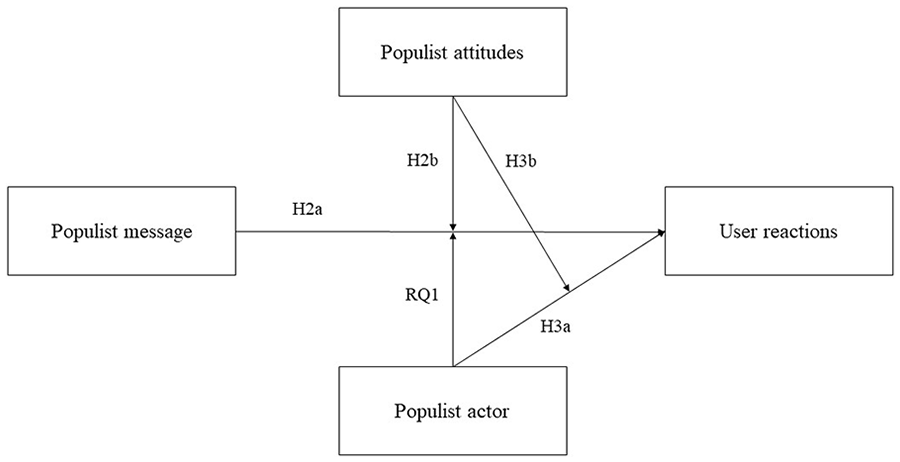
The influence of populist messages and populist actors on user reactions: a moderation model.
Finally, although they can all be interpreted as indicators of popularity or virality, different types of user reactions such as likes, shares, and comments can be differentiated with regard to their degree of activation (Berger & Milkman, 2012) and the user intention behind them (Bene, 2017b). Liking a Facebook post requires minimal action and implies the rather passive expression of approval, agreement, or affirmation. Sharing a post requires a stronger activation of users, who disseminate the message within their own network and may add an individual annotation or opinion to the original post. Finally, by commenting, users may voice their opinions about the content or source of an original post, engage in a dialogue with the source, or interact with other users. Thus, populist messages and actors may differently affect the likelihood of recipients liking, sharing, or commenting. Since there has not been much research on this, we have formulated an open question in this regard.
RQ2. Do populist messages and populist actors as well as recipients’ populist attitudes have different effects on users’ likelihood to like, share, and comment on a post?
Methods
Participants
Participants (N = 647) were recruited by the professional market research company Respondi in the German-speaking part of Switzerland with an online access panel. They received a standard incentive for participation. Due to the research interest, participants were asked in the beginning how often they use Facebook for any purpose. Participants who stated that they never use Facebook were excluded from the sample. Of the remaining 647 participants, 6.5% used Facebook less than monthly, 10% monthly, 19.5% weekly, 31.7% daily, and 32.3% used Facebook several times a day. Through a quota procedure, we additionally aimed at a sample representative of the Swiss population regarding gender, age, and education. Women accounted for 50.9% of the participants. The participants were between 18 and 69 years old (M = 43.23, SD = 13.66). With regard to education, 55.8% had a university or college degree, 32.6% completed high school or vocational training, and 11.3% had only mandatory education.
Design and Procedure
The experiment was administered online in February 2019. The participants were informed that they will see a political Facebook post and will be asked questions about this post. However, they were not informed in advance about the central concepts of interest in the study. After giving informed consent, the participants were randomly assigned to one of four treatment groups: (1) a populist message by a typically populist politician, (2) a nonpopulist message by a typically populist politician, (3) a populist message by a typically nonpopulist politician, or (4) a nonpopulist message by a typically nonpopulist politician.
Each group was presented with a Facebook post that was designed for the purpose of this study. The posts consisted of a message arguing for a stronger control of immigration and a picture of a link to a nonfictitious article by the Neue Zürcher Zeitung on the negative long-term consequences of immigration. The claim (for more control of immigration) was consistent across all stimuli, whereas the exact wording and the sender of the post were adjusted according to the experimental manipulation.
While seeing the Facebook post, the participants were able to react directly to the post by using imitations of Facebook’s user reactions (like/reactions, share, and comment). Afterward, the participants reported their intention to like, share, or comment on the post, and their political orientation, populist attitudes, and support for the promoted claim. Furthermore, the participants’ perceptions of populist communication and the politicians’ party affiliation were assessed as a treatment check. Finally, the participants were thanked and informed about the fictitiousness of the posts and the purpose of the study.
Manipulation of Independent Variables
Populist versions of the post included three populist key messages blaming the political elite, approaching the people, and demanding the people’s sovereignty. These populist key messages were formulated based on content analyses measuring populist communication in politicians’ speeches, social media posts, or the media (Wirth et al., 2016). A pretest (N = 107) using the same items as in the treatment check (see next section) confirmed that the populist version of the post was perceived to be significantly more populist than the nonpopulist version of the post.
Two real Swiss politicians were chosen as the senders of the Facebook posts. We selected two well-known official representatives of typically populist and nonpopulist parties who are regularly present in the media. Based on a pretest (N = 65) assessing the image of politicians, Roger Köppel, a national councilor for the Swiss People’s Party (SVP), was chosen as the typically populist actor. As the typically nonpopulist politician, Gerhard Pfister, a national councilor and party leader of the Christian Democratic Party (CVP), was chosen.
Measurement of Dependent and Control Variables
User Reactions
While seeing the Facebook post, the participants were able to directly react to the post by clicking on imitations of Facebook’s popularity cues for likes, reactions (“love,” “wow,” “haha,” “angry,” “sad”), and shares, or by using a comment box. In addition, after seeing the post, the intention or willingness of the participants to react to the post was measured by three items asking them to estimate the likelihood that they would like, share, or comment on the post on a scale from 1 (very unlikely) to 5 (highly likely). As the dependent variable for H2a to RQ2, an index was built computing the mean values for the willingness to like, share, or comment on the post (Cronbach’s α = .791).
If the participants reported a likelihood above 3 for either liking, sharing, or commenting on the post, the motive behind this intention was asked for. The participants indicated on a scale from 1 (does not apply at all) to 5 (fully applies) which of the six to eight proposed motives applied (e.g., “by clicking on ‘Like’ on this Facebook post, I want to signal that I like the content of the post” or “by sharing this Facebook post, I want to show my friends that I’ve read the post”). If the participants reported a likelihood below 3 for liking, sharing, or commenting on the post, they were similarly asked to indicate on a scale from 1 (does not apply at all) to 5 (fully applies) which motives applied to not reacting to the post (e.g., “I do not agree with the content of the post”).
Populist Messages
The main objectives were to test (1) whether populist actors influence the perception of the message as containing populist elements and (2) whether populist communication fosters user reactions. To test these hypotheses, it was essential to assess whether participants perceived the Facebook posts as representing populist communication, that is, containing people-centrist statements, anti-elitist statements, or statements demanding popular sovereignty. Therefore, a treatment check was implemented after the measurement of the dependent variables. On a scale from 1 (does not apply at all) to 5 (fully applies), participants indicated their perception of populist messages (eight items, for example, “The Facebook post demanded more political influence for the people”). An index was built by computing the mean values for all items (Cronbach’s α = .696).
Populist Attitudes
Populist attitudes were measured with a scale by Schulz, Müller, et al. (2018). The items reflected three subdimensions of the populist ideology: anti-elitism, the perceived homogeneity of the virtuous people, and a demand for people’s sovereignty. All items were measured on a scale ranging from 1 (do not agree at all) to 5 (totally agree). An index was built using all 12 items of the scale, which showed good reliability (Cronbach’s α = .846).
Party Affiliation
As an indicator of whether the participants recognized and correctly identified the politicians, they had to specify to which party they believed the politicians belonged. This was asked with a single-choice question with the five largest Swiss parties, “other” and “do not know” as possible answers.
Political Orientation
As a control variable, political left–right orientation was measured with a single item ranging from 1 (left) to 7 (right).
Support of the Promoted Claim
The participants were asked to indicate how much they agreed with the central claim of the Facebook post that immigration to Switzerland should be curtailed. The participants were asked whether they agreed with this claim on a scale from 1 (do not agree at all) to 5 (totally agree).
Results
Treatment Check
Before testing our hypotheses, we performed two treatment checks to assess participants’ perception of the experimental manipulation. First, we checked whether the participants were familiar with the political actor and correctly identified his party affiliation. This was a necessary precondition for the experimental manipulation of the source, as the effect of a typically populist versus nonpopulist source can only occur when participants know the respective actors. Roger Köppel, the populist actor, was correctly identified by 71.5% of the sample, while Gerhard Pfister, the nonpopulist actor, was correctly identified by 29.3% of the sample. In the following, we will run analyses both based on the full sample (N = 647) and based only on the subset of participants who correctly recognized the politicians (n = 327).
Second, the perceived degree of populism in the posts was assessed. Neglecting the two different sources, the perception of the populist messages in the populist and nonpopulist posts was compared by means of an analysis of variance (ANOVA). The analysis revealed that the recognition of populist messages varied significantly between the groups and in the expected direction. Populist messages were recognized significantly more by the participants in the populist message group (M = 3.357) than by the participants in the nonpopulist message group, M = 2.948, F(2, 647) = 69.267, p < .001, η2 = .097.
Effect of the Actor on the Perception of Populism
H1 postulates that not only the populist message but also the populist actor may activate a populism schema and thus influence the perception of a Facebook post as populist. To test this hypothesis, a two-factor ANOVA was conducted with the populist versus nonpopulist message and the populist versus nonpopulist actor as independent variables and the index of the perception of populist messages as the dependent variable. We restricted the sample to those participants who correctly identified the party affiliation of the political actor in the post (n = 327), as the manipulation of the source depends on the recognition of the actors (i.e., the manipulation can only be effective if the participants recognize the actors as populist or nonpopulist). After ensuring the condition of recognition, both the content (populist message), F(2, 327) = 35.408, p < .001, η2 = .099, and the source (populist actor), F(2, 327) = 10.060, p < .01, η2 = .030, have a significant main effect, but there is no significant interaction, F(2, 327) = 1.521, ns. As expected, the Facebook posts were perceived as more populist if the message was populist or the source was a typically populist politician. The estimated marginal means analyses (see Figure 2) further show that for both politicians, the posts that contained populist messages were perceived as more populist. Furthermore, posts that did not contain any populist messages were perceived as significantly more populist when the source was a populist politician. Thus, the presence of a typically populist actor as the source of a message contributed to the perception of populism in a message, even if the message itself did not have any populist elements. H1 can thus be confirmed for participants who were familiar with the source of the message.

Estimated means and confidence intervals for the perception of populism for populist vs. non populist message and actor.
Effects of Populism on User Reactions
In the next step, we investigated the effects of populist messages and populist actors as sources on user reactions to posts. Overall, 56.6% of participants (n = 366) clicked on at least one of the simulated user reactions. The most clicked was the “like” button with 23.5% (n = 152), followed by the “share” button with 11.9% (n = 77), the possibility to write a direct comment (10.8%, n = 70), and the reactions “angry” (10.5%, n = 68) and “sad” (9.1%, n = 59). Less clicked were the reactions “wow” (6.8%, n = 44), “haha” (4.5%, n = 29), and “love” (0.3%, n = 2). The reported likelihood of interacting with the post was relatively low overall (M = 1.848, SE = 1.192). This index presents a mean value for the willingness to like, share, and comment. 1 The willingness to “like” the post was the highest (M = 2.07, SE = 1.655), followed by the willingness to “comment” on the post (M = 1.76, SE = 1.229) and the willingness to “share” the post (M = 1.71, SE = 1.340).
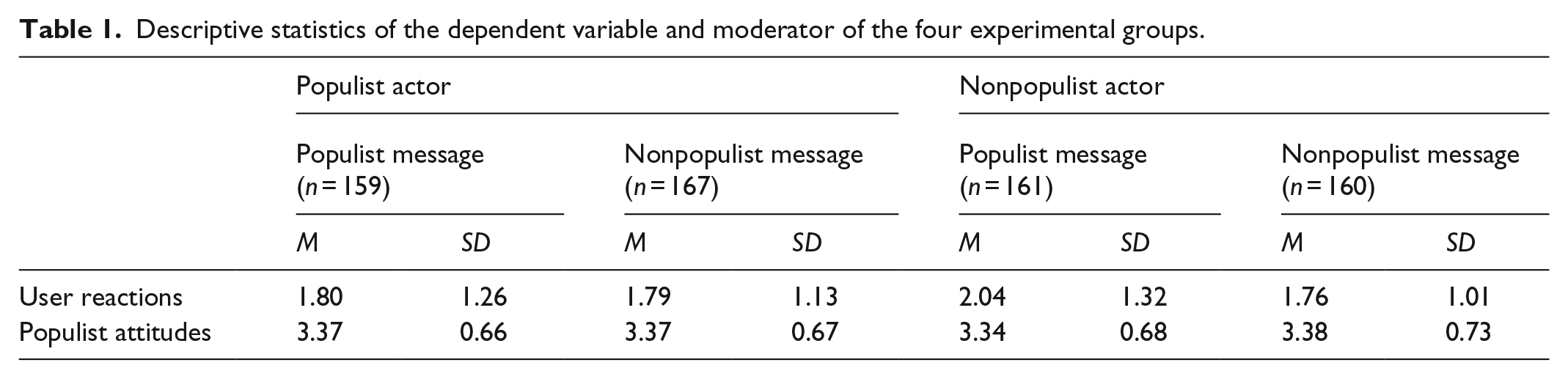
To address the remaining hypotheses, a moderation model was computed using PROCESS (Hayes, 2018), model 2. 2 As depicted in Figure 3, this model assesses the direct effects of the message (populist vs. nonpopulist), the source (populist vs. nonpopulist), and populist attitudes on participants’ willingness to interact with the post. Furthermore, the model estimates the interaction effects of the message and source and of both of these factors with populist attitudes. In addition, age, sex, political orientation, and support of the promoted claim were included as covariates. The variables were mean-centered for products, and HC3 correction was used to obtain heteroscedasticity-consistent standard errors (Hayes & Cai, 2007). Overall, the model explained a significant amount of the variance in the likelihood of interacting with the post, F(10, 647) = 17.38, p < .001, R2 = .26. Table 1 lists the descriptive statistics for the dependent variable and the moderator.

Statistical model of the moderation (based on Hayes, 2018).
Descriptive statistics of the dependent variable and moderator of the four experimental groups.
First, the analysis estimates the effect of the populist message compared to the nonpopulist message. There is a tendency for the populist message to elicit a higher willingness for user reactions (b = .139, SE = 0.083, p < .1), but the effect is narrowly above the standard p-value threshold. Thus, H2a can only be supported in terms of a tendency. However, there was a significant interaction effect between the treatment of the populist message and populist attitudes on the likelihood of reacting to the post (b = .274, SE = 0.132, p < .05). This supports H2b. While there was no difference for individuals with low populist attitudes, individuals with high populist attitudes were more likely to react to the populist Facebook post than to the nonpopulist Facebook post (see Figure 4). In addition, higher populist attitudes by themselves also contributed significantly to the willingness to react to the post (b = .319, SE = 0.072, p < .001).

Interaction effect of the populist message and populist attitudes on user reactions.
Second, the model compares the effect of the populist actor to the nonpopulist actor as the source of the message. The populist actor as a source does not have a significant main effect (b = –.135, SE = 0.083, ns) on the likelihood of user reactions, and there is no significant interaction between the actor and populist attitudes (b = –.195, SE = 0.165, ns). There is also no significant interaction between the populist actor and the populist versus nonpopulist message (b = .035, SE = 0.044, ns). However, as argued above, the recognition of the political actor is crucial for triggering a cognitive schema.
Therefore, we restricted the sample to those participants who correctly identified the party affiliation of the two politicians (n = 327) and tested the same moderation model. Again, the model was significant overall, F(10, 327) = 9.12, p < .001, R2 = .29. With the restricted sample, the main effects of the populist actor and the interaction with populist attitudes remain nonsignificant. However, we find a tendency toward a negative interaction between the populist message and the populist actor (b = –.491, SE = 0.269, p = .069). Thus, the difference between populist and nonpopulist messages seems to be larger for the nonpopulist actor than for the typically populist actor (see Figure 5). Therefore, H3a and H3b must be rejected, and this rather unexpected result with regard to RQ1 will be addressed in the “Discussion” section.

Interaction effect of the populist vs. nonpopulist message and the populist vs. nonpopulist actor on user reactions.
With regard to the control variables, political orientation (b = .178, SE = 0.064, p < .01) and support for the claim (b = .164, SE = 0.062, p < .01) have a positive effect on the likelihood of reacting to the posts. This means that participants were more willing to react to the Facebook post when they were more right wing and more supportive of a stronger control of immigration.
In the final step, to answer RQ2, we tested the moderation model for the intentions to like, share, or comment on the posts separately and found interesting differences for the different types of user reactions. For the intention to like the Facebook post as the dependent variable, there are no significant effects of the populist message, populist actor, populist attitudes, and no significant interactions. The likelihood to like the Facebook post was, however, higher for individuals who had a more right-wing political orientation (b = .267, SE = 0.077, p < .001) and who supported the claim of the posts (b = .362, SE = 0.078, p < .001). For the intention to share the Facebook post, we find a significant effect of populist attitudes (b = .402, SE = 0.177, p < .05), a tendency for populist messages (b = .242, SE = 0.132, p = .067), and a significant interaction between populist messages and populist attitudes (b = .418, SE = 0.209, p < .05). However, there were no significant main effects or interactions with regard to the populist actor. Finally, for the intention to comment on the post as the dependent variable, we again find a rather unexpected significant negative interaction between the populist message and the source of the message (b = –.673, SE = 0.298, p < .05). Participants were more willing to comment on the populist post if it was by the typically nonpopulist politician.
These differences in the results may be partly explained by the different motives behind the willingness to like, share, or comment on a Facebook post. For those who indicated that they would probably like the post (willingness > 3), the three most important motives were to signal that they agree with the source of the post (M = 4.28, SE = 0.919), share the views of the politician (M = 4.23, SE = 0.867), or like the content of the post (M = 4.20, SE = 0.958). For those who indicated that they would probably share the post (willingness > 3), the most important motives were to show that they share the views of the politician (M = 4.13, SE = 1.141), that they agree with the source of the post (M = 4.07, SE = 1.174), and that they would want their friends to also read this post (M = 4.02, SE = 1.122). The most common motives to comment on the post (willingness > 3) were on one hand, similar to liking and sharing, to show that they share the views of the politician (M = 3.25, SE = 1.547) and to express agreement with the content of the post (M = 3.24, SE = 1.516). On the other hand, another common motive for commenting was to criticize the content of the post (M = 3.28, SE = 1.466). In contrast, participants who reported that they would probably not like, share, or comment on the post mostly reported that they generally do not like, share, or comment on any political content (M = 3.78, SE = 1.377), do not share the politician’s views (M = 3.39, SE = 1.486), or do not agree with the source of the content (M = 3.33, SE = 1.499).
Discussion and Conclusion
The aim of this study was, first, to examine whether a typically populist actor elicits a populism schema similar to populist messages and how these two factors—content and source—interact. Adding to previous research on populist communication, we tested whether the perception of populist messages differs for typically populist and nonpopulist politicians. As expected, Facebook posts that did not include populist messages were nevertheless perceived as populist if the source was recognized as a typically populist politician. Thus, our study confirms that communication by populist actors can elicit a populism schema, even if the particular message does not contain populist elements (H1). The second objective of this study was to test the widespread assumption that populist messages and populist actors are more likely to trigger user reactions on SNS. As expected, the effect of populist messages on user reactions was moderated by populist attitudes. Recipients were more likely to react to a populist message than a nonpopulist message but only if they had high populist attitudes. Hence, H2b was supported and H2a only in terms of a tendency.
In contrast, the expectation that user reactions would also be fostered by a typically populist politician (H3a), especially for participants with high populist attitudes (H3b), was not supported. Although the presence of a populist actor as the source of the message increased the perception of the message as representing populist communication, this did not affect participants’ likelihood to interact with the post. Our results thus suggest that user reactions are driven more by the message than by the actor sending the message. Furthermore, there was a negative interaction between the populist actor and populist messages for those participants who recognized the actors (RQ1). On one hand, these findings might be influenced by the specific actors chosen for this study. On the other hand, the findings may at least in part be explained by looking at the three main types of popularity cues on Facebook separately (RQ2).
For likes, we did not find an effect of populist communication or the populist actor. Rather, participants were more willing to like the post if they agreed with the message’s main claim. This could be explained by the fact that liking a post requires a lower degree of activation and may be a rather habitual or an automatic response (Alhabash et al., 2019). For shares, we found the expected interaction effect of populist messages and populist attitudes. Participants were more likely to share populist Facebook posts, especially if they had high populist attitudes. Finally, for comments, we found a negative interaction between populist communication and the actor; recipients were more likely to comment on populist messages if they came from the nonpopulist actor. We can only speculate about the reasons behind this. Comments were driven by both approval and rejection of the message. It may be that the “surprising” use of populist communication by nonpopulist actors leads to more comments, be they affirmative or negative. The unexpected use of populist messages by a moderate politician could on one hand give recipients with high populist attitudes the impression that their views have arrived in mainstream politics. On the other hand, it could also elicit a certain “backlash” effect (see also Hameleers & Schmuck, 2017) by recipients who do not support populist ideas. Future research should investigate the motives for commenting on populist posts in more detail.
Of course, this study does not come without limitations. First, we chose specific political actors and a specific issue for the Facebook posts. Immigration as a topic was chosen because it has been identified as one of the central drivers of populism in Western Europe (Salgado et al., 2019; Stanyer et al., 2019; Taggart, 2017). It remains a question for future research whether Facebook posts on other issues, especially left-wing issues, elicit the same effects on user reactions. However, this focus allowed for better internal and external validity. Whereas the SVP in Switzerland is widely identified as a typically populist right-wing party, there is no equivalent populist left-wing party that could be expected to elicit a similarly strong populism schema. Although we chose prominent politicians who are both often featured in the media, only approximately half of the participants could correctly identify their party affiliation. Specifically, the nonpopulist actor was less known, despite being the leader of the fourth-largest party in Switzerland. This may be explained by the federalist political system of Switzerland. Nevertheless, we would expect stronger effects for more well-known political actors, and future research could include multiple actors to generate more robust findings.
Second, participants in this study were presented with an isolated Facebook post in an experimental context, and we measured their self-reported willingness to interact with this post. Actual behavior in a real-world setting might differ from this hypothetical situation. On one hand, reactions may be overestimated in the experiment, as individuals know about the anonymity of the situation, which is not given in the real-world context. On the other hand, reactions may also be underestimated in an artificial setting due to social desirability and due to the fact that generally only a small, highly active, and motivated proportion of the public shares or comments on political content online (Newman et al., 2016). In comparison to content analyses on user reactions, this is a disadvantage, but only an experimental setting allows the controlling of participants’ populist attitudes. Furthermore, it also allows for including participants in the study who would not interact with a Facebook post, who cannot be accounted for in content analyses. Therefore, content analyses and experiments on this topic should be seen as ideal complements to each other.
Third, we only measured effects of populist messages on a very specific and limited form of intended behavior, namely on the use of reactions on Facebook. The activation of a populism schema and the perception of the people as a deprived in-group and the elites as an out-group threat may have additional consequences on other online and offline behavior that we cannot assess within our study. Future research should investigate whether populist messages has effects on other types of intended or manifest political engagement, and whether these effects are similarly moderated by citizens’ populist attitudes.
Fourth, the perceptions of populism in the posts cluster around the middle response on the scale. This may indicate that the populist stimuli were perceived as only “mildly” populist, while the nonpopulist stimuli were also perceived as somewhat populist. This may have several reasons: First, one group within the nonpopulist treatment had a populist actor as the source of the message, which, as we show, enhances the perception of the posts being populist. Second, also the issue of the newspaper article or the political claim that was made may be perceived as populist. Furthermore, the scale we employed to measure the perception of populist communication in a post was not designed to measure an absolute level of perceptions of populism, but to compare these perceptions between the experimental groups. As the populist posts were perceived to be populist, and the difference between the experimental groups is significant and has a medium effect size, we can conclude that the experimental manipulation was successful. Nevertheless, future research could aim to find stimuli that are perceived more/less populist for the respective conditions.
To summarize, this study demonstrates that the effect of populist communication on user reactions on SNS seems to be moderated by recipients’ populist attitudes but that the effect also depends on the sender as well as the type of user reaction. It relies on a nonstudent sample, and the participants are representative of the Swiss population with regard to gender, age, and education. Overall, this study contributes to research on populist communication in two ways. First, it shows that not only populist messages but also typically populist actors may activate a populism schema. While content analyses have found that populist communication is a rather limited and fragmented phenomenon in the media (Hameleers et al., 2017a; Müller et al., 2017) and on SNS (Ernst et al., 2017), this finding indicates that the perceived amount of populist communication may be much higher. Second, the study complements existing content analyses by demonstrating that the effect of populist communication on user reactions is moderated by recipients’ populist attitudes. Thus, although populist communication may contribute to a higher reach or popularity on SNS, this is dependent on the characteristics of the politicians’ followers.
Footnotes
Declaration of Conflicting Interests
The author(s) declared no potential conflicts of interest with respect to the research, authorship, and/or publication of this article.
Funding
The author(s) disclosed receipt of the following financial support for the research, authorship, and/or publication of this article: This study is part of a project funded by the Swiss National Science Foundation (SNSF) [grant number 174628].
