



Abstract
Theoretical research on political communication between MPs and the public has focused on the role, activities, and perceptions of the MPs themselves without noting the existence of an intermediate layer: parliamentary assistants (PAs). This study attempts to investigate how the public perceives, practically and ethically, the (non)involvement of MPs, that is, reliance on PAs for SNSs (social network sites) communication with the public and to fill out the theoretical void in the discourse process. Questionnaires were sent to all 120 members of the 20th Israeli Knesset (MKs), with 44 responding. We examined the extent of their involvement and the MKs’ use patterns of Facebook, creating a model of four MK involvement levels. The idea was to check the extent of PAs’ authoring posts on behalf of MKs, what we call “Postwriting” (= post ghostwriting) in the MK’s name (or giving the impression that the MKs had themselves posted). Then we conducted a public opinion poll (N = 505) in order to discern what the public thought about the nature of its relationship with MKs on Facebook, compared to the findings that emerged from the model of the MKs’ involvement in actual practice. The two parts of the study also enabled us to investigate the ethical perceptions and implications arising from the study.
Keywords
Theoretical Background
Research on politics and social networks has focused on elected officials’ different perceptions of their social network use (Burger & Ross, 2014; Congressional Management Foundation, 2011; Global Centre for ICT in Parliament, 2012; Tenscher, 2014; Williamson, 2009; Williamson & Fallon, 2011) as well as the public’s perceptions, asking for its opinion on the political use of these tools (Gibson & Ward, 2009; Williamson & Fallon, 2011). On the other hand, the actual process of creating the politicians’ Facebook presence has been neglected, perhaps because it is considered transparent. In short, the theoretical literature deals with the politicians’ perceptions and not the way round, in which their connection with the public is actually created within new media platforms.
For example, numerous studies demonstrate that politicians view social media as a way of communicating with their constituencies (Williamson, 2009), gaining information regarding public preferences (Askim & Hanssen, 2008), and enhancing their reelection chances (Jackson, 2011; Lilleker & Koc-Michalska, 2011). Other politicians’ goal using Facebook was to increase their popularity and heighten public visibility, as well as constituting an important tool for strengthening democracy (Joshi, Thamm, & Wandhoefer, 2011). Others have argued that the Internet transformed the connection between elected officials and their constituents from indirect to direct, by enabling straightforward contact between elected officials and the public, thus offering a sense of an unmediated relationship (Coleman & Blumler, 2009).
Jang and Lee (2011) explored how public figures interact with the public on social media, and the degree to which they influence audience attitudes toward them. That study examined whether the participation of famous personalities—including politicians—in social media created a sense of intimacy and closeness with their fans/supporters or a sense of artificiality/inauthenticity. Their conclusion: messages written by famous personalities, or under their name, gave the audience a feeling of this being “real,” that is, the celebrities were talking to them, leading the fans to provide supportive actions toward the personality.
Carvalho, Chung, and Koliska (2018) found that in the absence of authentic closeness the audience loses confidence with the individual or the platform. This happens, for example, in media that use ghostwriting, especially social media (henceforth: “postwriting”). They argue that even if the audience can be satisfied with some degree of lack of authenticity, they are not willing to tolerate it on a continuous and permanent basis, causing them to lose confidence in such personalities and their content.
Grow and Ward (2013) have shown that the level of MP authenticity in social media is an important factor in influencing public opinion. Other studies similarly demonstrate that the more intense the politician’s social presence the more the public tends to communicate with that person online, and the more positive and interested those citizens will feel about these individuals. Still others detailed how the feeling of closeness to a politician is correlated with a sense of their presence, something palpable on social media (Kruikemeier, van Noort, Vliegenthart, & Vreese, 2013; Lee & Shin, 2012a, 2012b).
Bürger and Ross (2014), who examined the Facebook usage of New Zealand MPs, demonstrated that in spite of much talk about interactivity, the information on Facebook actually flows primarily in one direction—from the politicians to the public (for the Israeli case, see Haleva-Amir, 2010). Even worse, Tenscher (2014) argued that while politicians regard Facebook as an important tool for communicating with the public, they are not always willing to invest resources to maintain a lively presence on that platform.
Unlike the aforementioned studies that focused on elected parliamentarians, this study explores the views of their PAs who act as intermediaries to the target audience of the representatives’ Facebook page, and also delves into the audience’s perceptions about such intermediation. Given that in many (and perhaps most) cases, it is not the MP but rather the PA who manages the Facebook page (including writing the posts) (lev-On, Sabag ben-Porat & Lehman-Wilzig, 2017), it is important to complete the picture by obtaining their perspective of the issues at hand, as they are often the main or even the sole operators of such social media pages.
Assistants play an important role in maintaining MPs’ digital presence (lev-On, Sabag ben-Porat & Lehman-Wilzig, 2017). Belkacem and Busby (2013) identify them as performing three informational functions: filtering information, “synthesizing” relevant information from various sources, and preserving parliamentarians’ positive image and reputation. One of the MPs from the European Union who participated in their study went so far as to call his assistant “my eyes and ears.” They call them “hidden actors,” explaining that they deal with a variety of interface functions that are of great importance to the parliamentarian and therefore an important part of the political decision-making process.
The Israeli unicameral parliament is called the Knesset (Hebrew for “meeting place”), with 120 Members of Knesset (MKs) who until recently could employ only two PAs (Ben-David, 2011); in 2015 this was raised to three. MKs who serve as chairpersons of a Knesset committee, or are government ministers, are entitled to four PAs. MKs also receive a budget for “contact with the public,” intended to cover the costs of employing the staff of the bureau, as well as additional costs such as a website, social media, phone expenses, and so on. For the most part, there is no clear distinction between the PAs’ media and parliamentary functions, and nowhere are they defined a specific role (Saranga, 2001). In general, one of the PAs is responsible for the field of communications and public relations, acting as the MK’s unofficial spokesman (Shperman, 2010).
A similar situation seems to be true in the United States, where a survey of the staff of US Congresspersons found that their assistants perceive themselves as playing a significant role in their office’s Internet activity (Congressional Management Foundation, 2011). However, many staff members were frustrated by the fact that their representative did not use the Internet enough, and thought that Internet use should be increased, especially in interactive communications such as blogs, video calls, and personal sites (Congressional Management Foundation, 2011). Another overseas study looked at the reverse perception and found that many MPs were not satisfied with their staff’s level of Internet knowledge, believing that the staff should undergo further training in these areas (Williamson, 2009).
In Germany, PAs extensively updated their own parliamentarian’s social media page. Here, a major problem arose from the interviews: the German politician’s staff members sometimes write on the social media site as if they were the representative, signing their own name instead of the parliamentarian’s. The ostensible reason for this subterfuge is that the parliamentarians’ social media involvement cannot be high because of the great amount of time involved in such perpetually ongoing activity. The assistants were thus caught in a dilemma: the public desires “authenticity” in their politicians but that is very hard to provide in social media communication given the time outlay involved. As noted, this led on occasion to the PAs’ signing the parliamentarian’s name, but the former insisted that the public not be made aware of such postwriting—clearly an ethical problem (Wandhoefer, Thamm, & Mutschke, 2011).
Israeli PAs have found themselves in the same situation and have acted similarly, updating the MKs’ social media and contacting the public without disclosing the fact that they (the PAs) were speaking and postwriting under the MKs’ name (lev-On, Sabag ben-Porat & Lehman-Wilzig, 2017). The result is that parliamentarians reap the benefit of “direct communication with the public” without revealing the true identity of the postwriter.
This study moves beyond the above works in several ways, as can be seen by the following research questions.
Research Questions
What is the PAs’ level of involvement in authoring/editing social media content for their respective MK’s public Facebook communication?
To what extent does the public think that such involvement actually exists?
To what extent does the public view such PA involvement as legitimate, especially if it is not explicitly noted in the social media communication?
Are public perceptions regarding the characteristics of parliamentary discourse with MKs on social media reflected in the level of public trust in MKs?
As noted earlier, prior studies (Frazer & Macdonald, 2003; Kittilson, 2016) have not found socio-demographic variables to be significantly correlated. Nevertheless, to verify this in the Israeli case, we also ask:
5. Are any important, socio-demographic, statistically significant variables correlated with the level of engagement among the PAs and the public?
Study Design
This study was conducted in two parts: Part A—Discerning the level of the 20th Israeli Knesset’s PA involvement in moderating their MK’s Facebook page, and Part B—Conducting a public opinion survey, mainly to elucidate how the Israeli public perceives PA involvement: degree (practice) and normative legitimacy.
Methodology
For the study’s first part, we contacted all 120 MKs by email and through their Facebook page. In addition, we asked a list of PAs, MK advisors, and spokespersons to answer a questionnaire (written in Hebrew) on the Qualtrics platform. We stipulated that they could answer these questions anonymously, and neither their identity nor their MK’s would be divulged—a critical element, as many PAs expressed unease with such sensitive questions relating to their MKs and the amount of public communication in which the latter are (or are not) involved. Given this sensitivity and the fact that PAs are extremely busy, we were unable to do a pilot test of the questionnaire to determine construct validity; but content validity was tested, scoring medium-to-high (Cronbach’s alpha .70), very reasonable given the relatively low number of questionnaire statements dealing with MK social media involvement. In the end, 56 PAs responded but only 44 answered fully. The drop in the number of questionnaires answered by the PAs (from 56 to 44) was due to the fact that 12 did not complete their questionnaires and therefore we were unable to use them. The 44 who fully answered accounted for over a third of the study population (120 parliamentary MKs), with a generally representative split among the various Knesset parties.
This study’s questionnaire is unique; it could not be based on previous surveys as our research questions have never been published before in any scholarly journal. The questionnaire contained several sections, the most important incorporating nine statements whose purpose was to test the variable “degree of involvement” of PA and MK Facebook content. The respondents were asked to grade each statement on a Likert-type scale from 1 (completely agree) to 6 (disagree completely), so that the higher the score the greater the PA involvement and the lower the MK’s—and vice versa. The reason we did not use the Likert-type scale of 5 or 7 statements is that because of the sensitivity of the interviewees and the length of the survey, we did not want the interviewees to “escape” to the middle position, but rather to answer the closest to what is really happening. Statement 6, however, was listed in reverse order to test for internal reliability; the resulting Cronbach’s alpha was .701, indicating good reliability given the relatively low number of respondents.
These are examples of the statements the respondents were asked to agree/disagree along the 6-point scale, with the understanding that, for example, “mildly disagree” means that in several, but not most, cases the statement does not portray the reality of the MK/PA relationship: “I can freely and independently upload content to my parliamentarian’s Facebook page,” “I am the one who responds to the public’s posts/reactions,” “my parliamentarian must approve any content prior to publication.” Based on the statistical results, we divided the MKs into four cluster-categories (Figure 1).

Categorization of MKs’ level of involvement.
On one pole are the “uninvolved parliamentarians” who do not enter their own Facebook page, are not at all involved in initiating content or responding to the public’s comments/questions, and in general do not feel any need to supervise the PA in this area of endeavor. The “autonomous parliamentarian” is found at the other pole, independently texting and responding on the Facebook page without help from any PA. In between these two archetypes are intermediate categories in which the MK is partly involved in operating and texting on the page but does not closely follow the public’s comments (“less involved”), or will write many (but not all) posts and replies to public comments, while approving all posts written by the PA (“highly involved”). The goal of this schematic categorization was to offer a clear picture of Israel’s parliamentary, social network operation (and that of other parliaments in future research), as well as providing a basis of comparison for the second part of this study: public opinion survey.
The survey’s purpose was to complement the first part of the study by discovering what the public believes is the practice regarding MK and PA involvement in their social media communication, and to what extent PA involvement (postwriting) is ethical in lieu of MK posting and/or supervision—and comparing such perceived practice with the public’s normative judgment.
The two statements dealing with involvement level were as follows:
When I read an MK’s Facebook
When I read the MK’s Facebook page
The combination of these two statements also enabled us to see whether the public differentiated between MK posts and replies. There are two opposing assumptions here: first, because replies are part of the “chat” process, they offer a greater feeling of directness and authenticity; second and conversely, it is not realistic to expect a busy MK to reply to a large number of public posts/comments.
As noted, we also examined the public’s perception of the issue’s ethics. Two statements dealing with it were as follows:
I find it legitimate that MKs publish a post on their Facebook page,
I find it legitimate that MKs publish a post on their Facebook page,
The idea here was to examine whether public perceptions of legitimate MK (non)actions differ based on levels of MK involvement: either full supervision without actual writing (logical, given MKs’ heavy workload) versus no writing involvement or even supervision.
The Public Opinion Survey was conducted by the Shiluv Institute, a highly regarded survey organization that has 25 years of experience in conducting surveys in Israel. The poll included 505 respondents, considered normal in Israeli polling, with a 4% sample error, certainly reasonable given that the issue at hand is not a close election where 1%–2% could completely change the outcome. The respondents comprised a representative sample of Israel’s Jewish population (80% of the country), 90% of whom surf the Internet. 1 As an aside, given significant cultural differences, standard polling in Israel does not include the Arab sector, constituting 20% of the overall population).
The survey had three parts: statements regarding the level of MK social media communication involvement, statements regarding the ethics of various social media practices, and statements exploring the respondents’ “personal political involvement” and “level of political interest.” The poll also included the usual demographic variables: gender, age, level of religiosity, education, income, family situation, and residence.
Among the statistical analyses conducted, we divided the public’s level of perceived PA/MK involvement in their social media communication into four categories, in order to compare these with the actual situation as described by the PAs themselves. This categorization was applied to the poll survey and also to the PA questionnaire responses; a one-way variance test was performed regarding the four categories to ascertain that they represented the research group. In addition, post hoc Bonferroni analysis was undertaken to examine the gaps between the categories; these supported the existence of real variance. After comparing the PA’s versus the public’s scores, a Chi-squared test was performed for each public opinion poll variable (perceptions of involvement and ethics, level of political involvement, and political interest) vis-a-vis every socio-demographic variable separately. In addition, Pearson’s correlations were carried out between the sundry variables.
Findings
Comparison of Group Data
After processing the index data that examined the variable “involvement level” among the PAs, the results of the statements were divided into four categories that showed the highest variance between them (K-means cluster analysis). The division was designed to obtain a picture of the involvement level of Israel’s 20th-Knesset members according to the scale we constructed (Figure 1). Figure 2 shows the distribution of MKs’ involvement level: Column 1 represents the percentage of all MKs who behaved as autonomous parliamentarians, Column 2 the MKs who were highly involved, column 3 relates to less involved MKs, and Column 4 to uninvolved MKs.
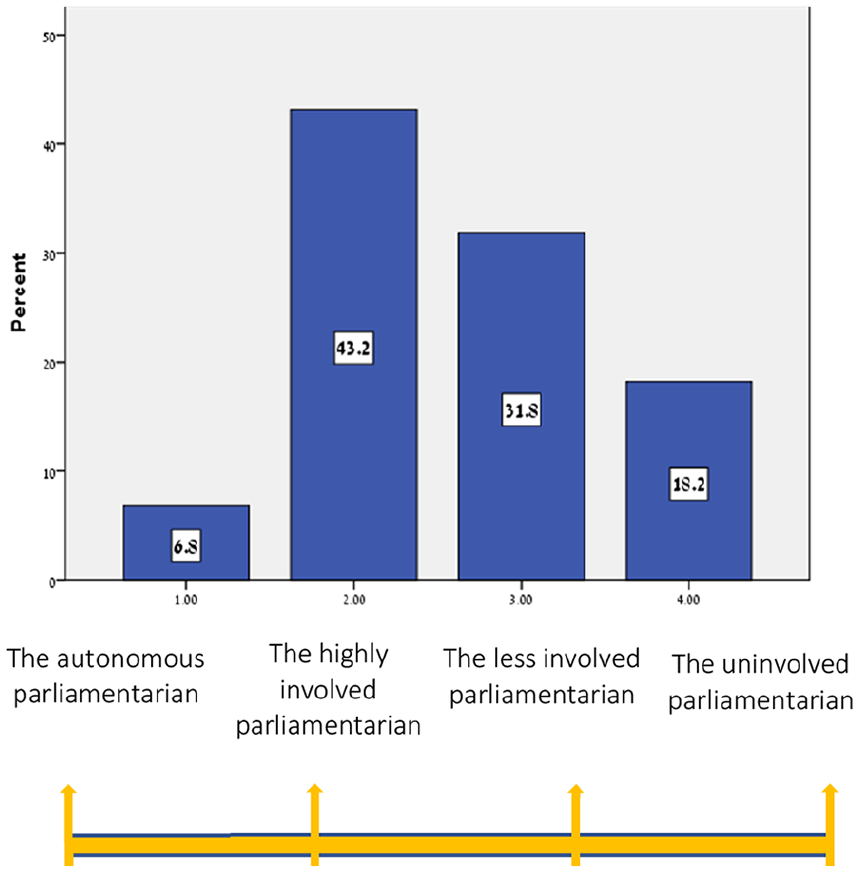
Level of involvement among MKs (based on PA responses).
A “bell” distribution was obtained with fewer MKs at the poles—either a complete level of Facebook involvement or a total lack of operational involvement in writing content, approving the PA’s written posts, or any kind of delegation of authority regarding the Facebook page’s operation. Despite this distribution, the result in Column 4 pointing to 18.2% of MKs not being involved at all is surprising in that they represent close to one fifth of the responding Israeli MKs leaving their social media communication with the public exclusively in the hands of their respective PAs, including writing posts, comments, replies to personal messages, monitoring content, and blocking users.
On the other hand, the largest category (43.2%) comprised MKs involved at a high level, that is, approval of texts published on their pages, sometimes even personally, as well as following what is happening on their Facebook pages. Low-level involvement was found among 31.8% of all MKs. These MKs do not conduct ongoing monitoring (as do “high level” MKs) but they perform occasional monitoring and to some extent are aware of what takes place on their Facebook page. These MKs will usually delegate authority to their PA, so that most of the Facebook writing and operational responsibility, including responding to surfers and monitoring their responses, will be borne by the PA. In short, exactly half of MKs have very minimal or absolutely no involvement in what is ostensibly “their” Facebook communication with the public.
Finally, 6.8% of all MKs were defined by their PAs as “autonomous parliamentarians.” These are MKs who operate, write, and respond by themselves on their Facebook page, without any help from intermediaries and thus are the only MKs who communicate directly with their citizenry through social media.
In order to examine the variance between the different category groups, one-way analysis of variance was performed (Table 1). The test results showed significant differences between the four groups, F (3,40) = 116.85, p < .000. Bonferroni post hoc analyses showed that the level of involvement in the first group, M = 16.33, SD = 2.88, was different from that of the second group (M = 28.36, SD = 3.4), (p < .000), from the third (M = 39.78, SD = 3.3) (p < .000), and from the fourth (M = 48.5, SD = 2.67) (p < .000).
Post hoc Tests of the Four Categories’ Variance of MKs’ Level of Involvement.

ANOVA: analysis of variance.
The high categorical variance points to the significantly different usage patterns among PAs and MKs. When we turned to MKs and asked to be referred to the person who “operated” their social network, several replied that the specific PA was involved in other activities as well, beyond social networking: from absolute operational and writing responsibility, all the way to merely relying on some external assistance, if at all (Figure 3).

The public’s perception of MKs’ level of involvement.
In comparison to the distribution of MKs (Figure 4), almost half (46%) of the public perceived the MK level of involvement in Facebook as “low level” and 27% as nonexistent. In addition, despite the fact that in reality there was a higher percentage of MKs who were highly involved (43.2%) and a bit lower than those who were moderately involved (31.8%), the public’s perception was the exact opposite: far fewer MKs involved at a high level. Moreover, there were actually more autonomous MKs (6.8%) than the public believed (3%).

MKs’ perceived level of involvement versus the public’s perception of it.
In addition to the way the public perceived the level of MK involvement, their ethical perceptions regarding level of involvement were also examined. In Figure 5, the first statement dealt with the legitimacy of writing a post on Facebook by a mediator without an MK reading or approving the content. The public rejected its legitimacy, with 82% choosing the negative side of the scale, expressing disagreement and disapproval. In other words, the public perceived the level of involvement as lower than it was in reality, but (perhaps despite this) it strongly denied the legitimacy of such lack of involvement.

Public perception of ethical aspects.
The second statement dealt with a situation in which the MK is not involved in writing the content but reads and approves it before publication: in this case, only 44% expected MKs to write/operate their Facebook themselves and 15% completely rejected the idea of approval only, that is, a majority of the public did not expect MKs to operate the Facebook page exclusively, and actually granted legitimacy to having some sort of external help.
Beyond the perception of involvement level and ethical legitimacy, the last two variables examined in the public opinion survey were the level of political involvement and the level of the respondents’ political interest; this to discern whether there existed a correlation between the public’s perceptions of MK involvement level, and the public’s personal political involvement and political interest. Pearson’s correlation analysis uncovered no correlation between the variables. In other words, whether dealing with people who were politically involved or expressed political interest, or those who did not, both groups had the same opinion regarding the level of MK involvement, that is, they were statistically dispersed between the various levels of involvement and ethical perception.
Socio-demographic Variables in the Study’s Findings
Despite the low correlations between the level of MK Facebook involvement and the respondents’ level of political involvement and public interest, strong correlations were found between the level of political involvement/political interest of the public, and the various demographic variables. These correlations were consistent with previous studies (Frazer & Macdonald, 2003; Kittilson, 2016); while not directly related to this study, it does indicate that this study relied on a truly representative sample. Thus, for example, a Pearson’s test examined the relationship between gender and the level of audience political involvement. That test result showed a significant, moderately strong correlation between gender and the level of audience political involvement (r = 597, p < .000), with men more politically interested and involved than women.
After performing the initial analyses, we turned to examining the relationship between perception of levels of MK involvement and the audience’s ethical opinion, along the sundry demographic variables noted earlier. To our great surprise, the Chi-square analysis produced results without statistical significance for all the socio-demographic variables tested, regarding the public’s level of MK involvement perception as well as its ethical opinion regarding MK involvement. The lack of significant correlation clearly indicates that at least regarding this phenomenon of perceived (lack of) MK involvement in Facebook communication, and the ethical (il)legitimacy of such, the Israeli public is unified in its opinion, cutting across all socio-demographic groups. This might indicate a low level of public trust, a point to be expanded upon in the ensuing discussion section.
In concluding this “Findings” section, an interesting result bears noting. The PA questionnaire asked whether they wrote Facebook page contents anonymously (or under their own name), or under the name of the MK (in the first person). The statement in the questionnaire was, “When I write on my parliamentarian’s Facebook page, I mention that it’s me.” In all, 81.9% of the respondents stated at different levels of negation that they do not write their own name (66.1% strongly disagree). Only 18% of responders indicated at different positive levels that they do specify their name when they are writing on behalf of their MP.
This is important because a large majority of the PAs write in the name of the MK, so the reader has no way of knowing who is really writing these posts—or worse, they could be under the impression that it is actually the MKs themselves (this is also why content analysis cannot be effective in such a study). This confirms the public’s ethical responses and skepticism regarding claims of MK involvement, as it is almost impossible to know who is behind the texts of MKs on Facebook, texts that in theory could be a mode of direct political communication, but in practice is mostly not. Moreover, in light of the relatively high number of completely uninvolved MKs (18.2%), it is reasonable to assume that there are PAs who exclusively act, write, and respond on the Facebook page, but still do not note their own names, instead posting in the first person on behalf of the MK.
Discussion
This study examined the patterns of interaction between Israeli parliamentarians and the public on the former’s official Facebook page, and whom the audience perceived to be the producers of such political communication: from the completely autonomous MK on the one hand, to the absence of MK involvement on the other hand (with assistants doing all this work). The latter is especially striking given the Knesset’s encouragement of all MKs to open a Facebook page (Mako, 2010) in order to conduct some unmediated communication with the public. Nevertheless, a significant number who did so have since relinquished the entire (or a major part of the) operation to their PAs—contrary to prior research expectations and findings (Coleman, 2005; Coleman & Blumler, 2009; Jackson & Lilleker, 2011). This could be due to a lack of interest; however, it is also possible that the MK cares very much, yet the work burden necessitates delegating this authority to the PA, relying on the PA to do the job well.
A follow-up study in the works is presently examining the variables that might underlie different MK involvement levels, for example, seniority of the PA, MK delegation level of authority in general, and other demographic and behavioral characteristics. In any event, MK absence of real Facebook involvement or even content supervision entails a significant loss in what can be defined as “knowing the audience,” many of whom, after all, are supporters of that specific MK or are general voters at the least. And even if the PA constantly transmits to the MK information about Facebook page discourse, this cannot equal some sort of actual MK presence or, at the least, ongoing supervision of the contents—something lacking in close to one-fifth of all MKs in this study.
Moreover, among all levels of MK involvement, the vast majority of PAs occasionally (or usually) posted content on behalf of the MK. This raises an ethical issue regarding such activity: does the existence of a layer of intermediaries, with a concomitant absence of direct contact with the MK, constitute an act of deceit if it is not explicitly mentioned to the Facebook audience?
In order to answer this question, a public opinion survey was conducted to examine how the audience itself perceived the Facebook relationship with the MK. The main finding was surprising: the audience perceived the connection as even less direct than it really was! In other words, the public does not really view Facebook communication with their MK as constituting direct political communication.
How do we explain this? At first, it seemed reasonable to assume that the public understood the time constraints on the MK, so that it would be unreasonable to expect an MK to be constantly monitoring Facebook discourse. However, the findings regarding the public’s belief in the non-legitimacy of such MK non-activity undercut that initial assumption of “overwork”; instead it is quite possible a function of general mistrust in the political “system.”
On the one hand, we see that the public perceives MKs as much less involved than they really are, but on the other hand they perceive this situation as negative and do not grant it legitimacy. In other words, they have no expectations from the parliamentarians. This is in line with many Israeli (and other democracies’) poll results that show very low public trust in the national parliament.
This conclusion is buttressed by the fact that no audience socio-demographic variables were correlated with the public’s perception of MK level of involvement nor were correlations found between gender, age, and so on, and the public’s ethical perceptions. In short, the public’s low level of ethical expectations in regard to direct Facebook contact with MKs was homogeneous regarding all population strata, as was their perception of this situation’s illegitimacy.
The two additional variables examined in the public opinion survey—the level of the public’s political involvement and the level of its political interest—were also found to be non-influential in terms of MK (non)involvement and the public’s ethical perceptions of such. Here again, it is not lack of political sophistication or comprehension that leads to the public’s feelings of MK inaction illegitimacy, but rather lack of expectations and underlying distrust.
Would an increase in direct communication and greater involvement of MKs on their Facebook page improve the situation? Probably yes. There should be some level of involvement with content written under one’s name. To be sure, the multiplicity of responses on Facebook does not enable the PA to transmit to the MK the full panoply of informational content found on the Facebook “page” (given the quantities involved, “page” is a misleading misnomer). Nevertheless, some exposure (even partial) to such public feedback would provide the MK with a fuller picture regarding supporters and opponents specifically, and citizens in general.
In the absence of true direct communication, we are left with a “chicken and egg” situation: the more the MK’s direct communication with the public on Facebook deepens, the more the MK becomes familiar with the public’s feelings and desires, that then enables the MK to act more representatively in parliamentary and legislative activity, that in turn could lead to greater legitimacy in the public’s eyes for PA-initiated Facebook posts and responses, this time emanating from an understanding and appreciation of the MKs hard legislative workload, itself a function of greater MK familiarity with the general voters’ or political supporters’ demands and feelings as posted on the MK’s Facebook page. At present, the situation is the reverse: a downward spiral of the MK’s low-level Facebook page involvement leading to greater public distrust, and so on.
Current research (Cook, Waugh, Abdipanah, Hashemi, & Rahman, 2014) and political reality point to an even more “severe” direction in social media communication from and to parliamentarians: artificially intelligent chatbots. On certain platforms, contact with the public is not produced by the parliamentarian or the PA, but rather by an inanimate intermediary: a machine. Its main goal is to carry on a conversation and be as indistinguishable from a human as possible (Kuboň, Metheniti, & Hladká, 2017).
Even if it can be shown that chatbots are capable of mimicking the tone and substance of parliamentarians’ communication—perhaps even especially if!—the likelihood is that this newer phenomenon would only deepen the mistrust of parliamentarian political communication in the public’s eye, unless two conditions could be met: first, automatic identification that the communication is being conducted by a chatbot; second, the public is convinced that the chatbot fully and truthfully represents the thinking of the parliamentarian.
Thus, we propose follow-up studies to be conducted, examining the scope of social network chatbots in general, on parliamentarian Facebook (or other social media) specifically, and the public perception of the phenomenon overall—in terms of the nature and quality of the relationship with the parliamentarian and in terms of the perceived ethics of using parliamentarian-approved chatbots, similar to what was discussed above. This is necessary because the unrestricted and non-transparent use of AI (artificial intelligence) chatbots could be destructive in two ways.
First, it could undermine the very raison d’etre of social media, initially brought to life and flourishing because of its ability to widen social discourse among the public at large. As this aspect is only tangential to the research at hand, the point need not be expanded upon here.
Second, and even more problematic, chatbots could constitute the final nail in the democratic communication coffin (between parliamentarians and the public), undermining the very foundations of democracy that is based on “real” give-and-take between the public and its elected representatives. If there is already significant distrust of MK communication with the public when a personal (human) assistant is involved in producing Facebook content, one can just imagine the public’s even deeper disapproval of exploiting nonhuman “systems” for what is—or by now, merely was—intended as the quintessence of direct, nonsynchronous, political communication.
Meanwhile, we are working on a follow-up study that cross-comparatively looks at Facebook political communication with the public in three democratic parliaments. Such a study will broaden our understanding of the phenomenon by examining additional factors that could influence the level of legislators’ involvement in their own parliamentary social media pages, variables such as the nature of the electoral system (district vs proportional), size of electorate per representative, and so on. Given the critical importance of political communication for democracies in general, and the growing use of social media for such discourse with elected representatives specifically, the issue of parliamentarian (non)involvement is too important not to be fully understood and from there improved.
Footnotes
Author’s Note
Chen Sabag Ben-Porat is also affiliated with Ariel University.
Declaration of Conflicting Interests
The author(s) declared no potential conflicts of interest with respect to the research, authorship, and/or publication of this article.
Funding
The author(s) received no financial support for the research, authorship, and/or publication of this article.
