



Abstract
This article considers the continuities afforded by digital platforms for reactivating the 1990s Transgender Nation politics, by providing a means to bond like-minded people into imagined nations cohered into an affective public. The media archeology approach facilitates the investigation into stylistic and conceptual continuities between the 1992 and 1994 Transgender Nation’s “direct action” and militant politics into cases of digital activism from 1995 until 2016. The article further tracks early queer and trans connection and discord into later digital incarnations. The author considers digital culture as a significant site for personal and group transformation, but finds in the touchstone activities of Transgender Day of Remembrance an imagined community styled by necropolitical attunements. Direct actions online are still fueled by contesting hostility to trans life, but the critique of transgender marginalization must also account for sexual and racial dynamics.
Introduction: Imagining Sociality
In a closely cropped color photograph I see a white T-shirt decorated with a black triangle with one point facing downward (see Figure 1). In the middle of the triangle is a white sign melding the masculine insignia (Mars) together with the feminine (Venus) commonly used to denote transgender identities. Emblazoned above the triangle is the name “Transgender Nation” and below it “Washington, D.C.,” and on the back a text in black lettering reads “Gender Oppression Affects Us All” spaced out to fill a thinly lined triangle of the same size as on the front. The cotton appears worn and rumpled, with one small and one larger hole torn on the middle-right side; clearly this was someone’s actual T-shirt that has been lived in. The picture of this T-shirt was taken in a nondescript office with white painted walls. This physical object sits in The Rainbow History Project holdings in Washington, D.C., but I’m able to view this image of it from Amsterdam, The Netherlands through the Digital Transgender Archive (DTA), a portal website that virtually merges trans-related content from the holdings of more than 50 colleges, universities, nonprofit organizations, public libraries, and private collections from around the world, including Wearing Gay History’s digital T-shirt collection (see Figure 2).

Photograph of Transgender Nation T-shirt, Washington, D.C. group.
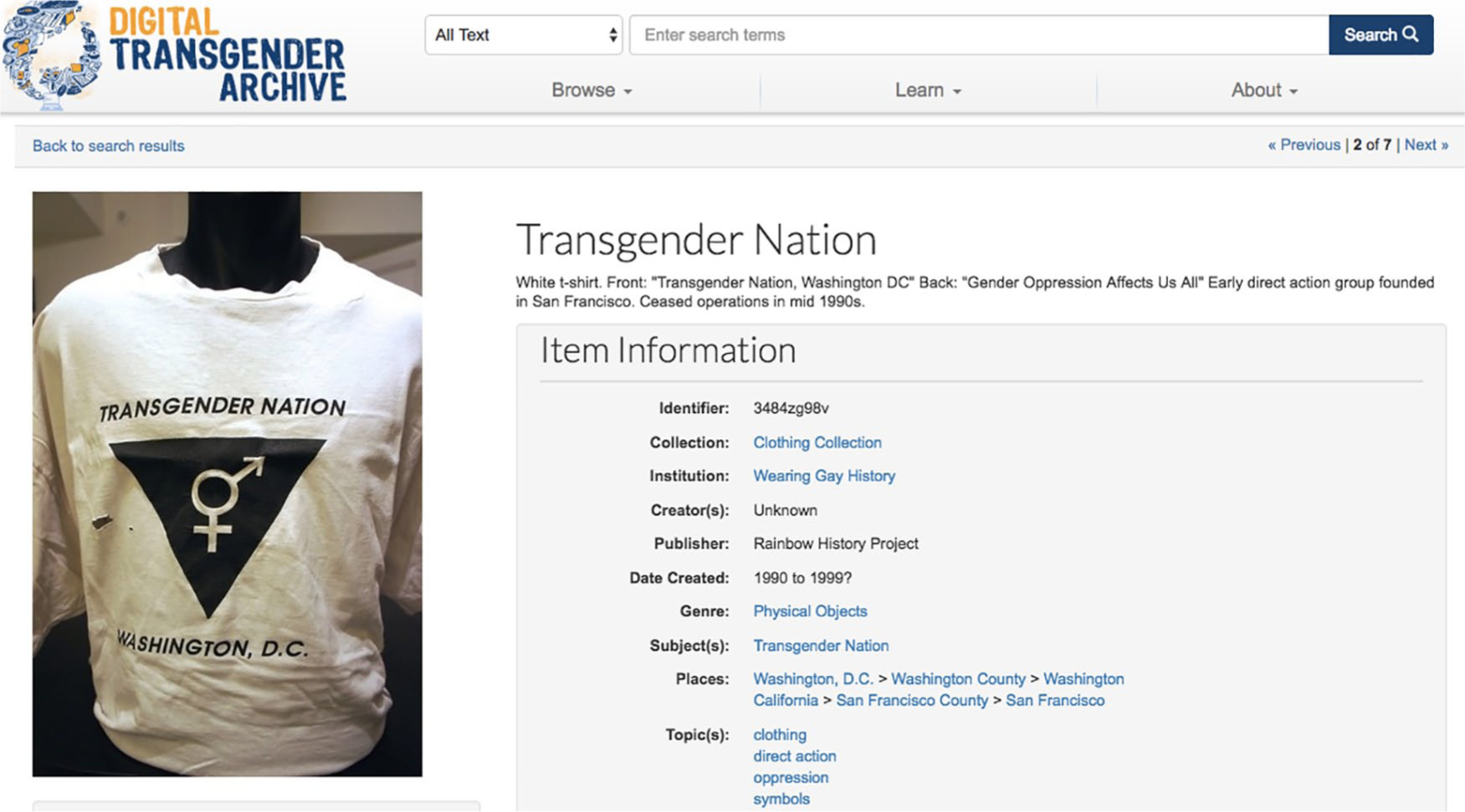
Screenshot of the Digital Transgender Archive Search.
I found this physical object from the early 1990s while searching for ephemera related to the direct action group Transgender Nation (TN) that came about while I was in my early teens, in Fall 1992 to be exact. Perhaps because I was too young to have experienced it firsthand, the idea that a transgender social justice group took root during the heyday of queer activism—and as a group within the Queer Nation movement—has always struck me as an underreported fact. From March 1990, LGBT (lesbian, gay, bisexual, trans and gender non-binary) people came together under the umbrella “Queer Nation” to challenge homophobic street violence and confront media prejudice running rampant in the AIDS crisis with the goal to increase the visibility of queer people and eliminate homophobia. An off-shoot of Act-Up, another “direct action” organization, their disruptive style of politics—kiss-in’s, use of “queer” in chants, hanging banners from billboards reading “Dykes and Fags Bash Back”—was far more militant than the contemporaneous homosexual rights organizations. This digitized image of a TN artifact provides an object lesson in how trans activist content affectively circulates through digital infrastructures. The T-shirt indexes a person’s body that identified with TN, yet the digital photograph of it relays a wider affective attachment to its embodied materiality—the smudges, holes, and creases of lived struggle. This essay considers the affective and discursive continuities afforded by digital platforms for reactivating the 1990s TN politics, namely, calls to action that impart “affective publics” (Papacharissi, 2014, p. 125) with digital means to organize.
Given Queer Nation and TN’s refashioning of the “nation” into an open-ended affinity group based on shared interest and militant actions (that together constitute an affective public), I employ a conceptual analysis methodology to extract the form and meaning of the said nationalism within the TN, and further, to consider its traces in present-day transgender digital activism. Here, I lean on Benedict Anderson’s (1983, p. 6) influential concept of the nation as “an imagined political community” distinguished from other communities “by the style in which [it is] imagined.” Anderson’s emphasis on the organizing power of imagination to form a cohesive community directs my analysis toward the cultural production and aesthetics of affinity. With a media archeology approach, I investigate stylistic and conceptual continuities between the 1992 and 1994 TN’s politics into digital forms of activism. Since 1994, transgender social movements have swelled to global proportions, due in large part to the affordances of digital networks and online presence (Dame-Griff, 2017; Rawson, 2014). Through digital media and digital platforms, transgender people can exchange information that has clear political implications; it is less clear though how the rise of transgender presence in digital media interrelates with the gains and losses of social movements for gender self-determination.
My assessment of transgender digital activists rising up consists of four related cases that foreground transgender experiences of community formation galvanized by discrimination and suffering: the 1995 AOL Gazebo transgender chat room, the 1999 Remembering our Dead digital database inventorying trans deaths, an annual digital campaign about monitoring transgender murders by Transgender Europe begun in 2008, and the 2016 digital video 103 Shots directed by trans visual artist Cassils made in response to the massacre of trans and queer people at Pulse Nightclub. Of these different activism periods and across diverse digital formats I ask, what bodies of the transgender community are emphasized, included, or forgotten? How do they demonstrate direct action or call for an assembly of an affective public in their affective body politics? These cases offer lessons in the “sociality” of social movement building and the potential limits of its transposition into digital activism practices (Castells, 2015; Ellison & boyd, 2013). In different ways they network an imagined TN, but one that foregrounds a community circumscribed by violence. At the close, I reflect on the ways that a “nation” perforce assembles individuals into communities through enforcing borders; acts of attachment then are not just points of shared connection but also of passionate disconnection.
A Feminist Science-Technology-Society Approach to “Gender Programming” of Publics
Feminist science and technology scholarship demonstrates that technology promotes particular values, although it is often presented as neutral (Haraway, 1991; McGlotten, 2013). The online activities of trans users show that “gender programming” cannot be avoided, but can be engaged to different, emancipatory ends. As Katherine Hayles (2008) remarks, programmable code does not have a stable meaning, which allows for pluralized enactments and representations that divert the flow of ideological coding. In Web 1.0 the default Whiteness and maleness of tech innovations largely (though not exclusively) led to a celebration of voluntary identity that could be explored and shed at will, gratifying a fantasy of control. Web 2.0 is often characterized by having more fixed choices for identity preprogrammed into applications and site design, yet the ascendancy of social digital networks seems to allow for more equal access to participation despite identity differences between users. However, those who have access to the Internet and those who do not are compounded by an “innovation inequality” of unevenly distributed tech advances that shapes the horizon of possibilities (Cozzens & Thakur, 2014). Forays into understanding the complexity of technology use for (re-)programming and expressing one’s gender include studies of vlogging, gaming, and virtual reality that show the potential for digital culture to be a crucial form of community support and to affirmatively mirror one’s transitioning self (cf. Cárdenes, 2012; Pozo, 2017; Raun, 2016). Like the colonialized subaltern who turned to print and televisual media to forge an “imagined community” (Anderson, 1983) apart from their colonizer, widespread access to digital technologies might facilitate a sense of belonging to an imaginary TN that stitches cyberspace into live sociality, connecting people in real-time.
I venture that digital activism practices can also be forms of “trans-ing practices” (Stryker, Currah, & Moore, 2008, p. 13), a description that refers to the wide array of means to adjust the sexed body and its gender presentation in ways that cross the border of cultural expectations. Transgender studies’ foundational text “The Empire Strikes Back: The Posttranssexual Manifesto” (Stone, 1989/2006) is by philosopher, engineer, and early Internet adopter Sandy Stone, whose thinking brought together cybernetics with subaltern studies. She explains the problem of mobilizing a visible trans politics as, “it is difficult to articulate a counter-discourse if one is programmed to disappear” (Stone, 1989/2006, p. 230). Programming has a double-sense for Stone: it refers to the medical treatment program that transsexuals must comply with to become unambiguous women, or men, and also to the programmed code that underwrites gender semiotics. To speak as a posttranssexual, and thereby to formulate a counter-discourse, she offers, is to effectively scramble the codes for male and female. But what platforms empower one to appear, write, and speak back to the logics that contest their existence? That is, which platforms have instantiated an affective public that resonates with trans sensibilities and counter-programming practices?
Soft Structures of Feeling: Hostility and Allure Online
I want to first draw on Zizi Papacharissi’s (2014) elaboration of Raymond Williams’ (1961, 1977) analytic “structures of feeling” as the “soft structures of feeling” to name the ways that digital infrastructures such as platforms attune social experiences through the circulation of information in fluid networks. The “soft” aspect of these structures of feeling refers to the digital format or software, which is flexible, porous, and apt to change (Papacharissi, 2014, p. 116). All digital platforms for social communication funnel what Williams (1977) describes as political demands that when emergent are first experienced as an inarticulate feeling. My analytical aim to extract the “soft” digital structures of feeling around what came to be recognized as a “transgender” critique that is organized, patterned, and yet still in formation, requires toggling between the vocabulary of affect and of infrastructures. Structures of feeling have a diagnostic value in that their analysis can help pinpoint arenas of conflict. In the digital environment Athina Karatzogianni and Adi Kuntsman (2012, p. 12) write that their extraction requires scrutinizing “the ways apathy, compassion, hatred or suspicion are shaped by on-line interactions, digital data and information flows” that are embedded within broader political and affective regimes. The spark of collectivity that transfused the on-the-ground formation of TN was lit within the broader affective regime of hostility toward transsexuals based on what Talia Mae Bettcher (2007) has aptly described as being perceived as having an illusory gender identity: “evil deceivers and make-believers.” Valo Vähäpassi’s (2018) article on the transphobic circulation of images depicting Black trans women on a digital video share site demonstrates that this political affective regime of hostility transfers and even becomes amplified in online environments. It is within this arena that trans digital activism takes place.
Politically, in my gay bar cultural upbringing during the late 1990s and early 2000s, I became aware of the tensions between trans and queer social worlds, consisting in mistrust but also allure between them. Most pointedly, the drag show is where these affective impulses cross wires: wild displays of gendered ways of being are celebrated on stage, but some in that space turn skeptical if these wild profusions become everyday. Although “gender oppression affects us all” is a truism, queer sexual subcultures are also limned by a “homonormativity” that disallows and berates gender divergent embodiments and identities. Susan Stryker (2008, p. 145) situates the term emerging in the early 1990s “to articulate the double sense of marginalization and displacement experienced within transgender political and cultural activism,” first by contesting gender norms, and second by opposing sexual orientation models based on those norms. Homonormativity then is a concept for how transgender activists contested heterosexual privilege along with queer militants, but also needed to name homosexuality’s shared basis as a sexual orientation that depends on binary constructions of gender. Stryker (2008, p. 146) relates that “the imagined political alliance of all possible forms of gender antinormativity” seemed eminent within the San Francisco chapter of Queer Nation that made available queerness within a “new transgender” identity. In other words, the structures of feeling queer and feeling transgender emerged within the same period, spread among many of the same groups, but the double sense of marginalization felt by transgender people is reason enough to consider it on the basis of its own particulars.
Productive Anger
The TN T-shirt with which I opened is historical evidence of the founding San Francisco TN direct-action caucus of Queer Nation, initiated by Anne Ogborn, Christine Taylor, and Susan Stryker, with spinoffs as far away as Tokyo, lasting from 1992 to 1994, longer than Queer Nation itself (E. Steinbock, Interview with Susan Stryker by Skype, August 17, 2018). As Stryker (E. Steinbock, Interview with Susan Stryker by Skype, August 17, 2018) relayed to me, all the archived TN files were lost when she was mugged on a San Francisco street while going to copy and mail them to scholar Julian Carter, who was researching this period’s art activism. What remains is the oral history of Ogborn’s productive anger at a Queer Nation member who tore off the “Trans Power” portion of a Day-glow crack-n-peel sticker reading “Trans Power/Bi-Power/Queer Nation” because the wearer “did not consider trans people to be part of the queer movement” (Stryker, 2008, p. 146). Ogborn then protested this person’s hostile anti-trans stance at a Queer Nation meeting, where other members suggested she form a trans caucus. Stryker met Ogborn when she was visiting local trans groups to invite folks to join her transgender caucus. Listening to Ogborn at the open public meeting of the FTM (female-to-male) group, where Stryker was presenting on behalf of the Gay and Lesbian Historical Society, Stryker recounted to me a sense of instant affective recognition (E. Steinbock, Interview with Susan Stryker by Skype, August 17, 2018). A short while later, together with Taylor, they published a founding group statement in the Bay Area Reporter and thereby launched The TN caucus. This platform became the first place for transgender activists to declare that they have a claim to queer politics and an incisive transgender critique. The consequent effect of TN was to amplify the nascent political perspectives termed “posttranssexual” (Stone, 1989/2006) and “transgender liberation” (Feinberg, 1992), which in its association with Queer Nation offered a critique of imperialist White supremacist capitalist heteropatriarchy as being reliant on a policed binary gender system.
Fast-forward to the present: we are living in a time of renewed transgender activism around the world. Transgender social justice groups are pressing for legal gender recognition in all nation-states, affordable and timely treatment based on informed consent, increased public safety including decriminalization of sex work and soft drug use, and access to the labor market and education (cf. Arístigui et al., 2017; Davy, 2011). In this heady moment, post-Trump, post-Brexit, post-Section 377, scholars together with political and cultural activists are looking back to reflect on the history of by trans and for trans organizing. For example, in the edited volume Trap Door: Trans Cultural Production and the Politics of Visibility (Gossett, Stanley, & Burton, 2017), contributions by Treva Ellison, Abram J. Lewis, Grace Dunham, and Morgan M. Page assess the past 150 years of North American activism to glean models for trans resistance that are instructional for tackling what the editors identify as the fundamental paradox of visual representation in the present. This paradox consists in visibility being offered as the pathway for trans people to have livable lives, while in this time of trans hypervisuality, trans women of color are facing increased instances of physical violence—a “radical incongruity” that must give pause to naïve praise of representation (Gossett, Stanley, & Burton, 2017, pp. xv–xvi). In the analysis that follows, I want to address how this “radical incongruity” can be shown to be integral to online environments as well; an incongruity in which the visibility of trans activists against violence (especially articulated and represented by White, wealthy, professionalized trans persons) may actually feed violent attacks (especially against the most vulnerable due to being racialized and criminalized and living in poverty).
1994: Gazebo AOL Chat Room
In 1994, from her home computer in San Francisco, computer programmer Gwendolyn Ann Smith (also known as Gwenners) started the Gazebo AOL chat room, the first specially hosted for transgender people. When she initially signed up for the free AOL account, Smith noticed that there was an embargo on organizing a chat room using the words “transgender,” “transsexual,” and “transvestite,” which led her to press the issue with the company, which reversed the policy by the end of 1992 (Bromberger, 2017). By then the coded “Gazebo” chat room had provided a gathering place and resource center with a bulletin board that within a few years attracted tens of thousands of unique visitors every month, who were rapidly exchanging information about their lives, including the actress and already famous gender activist Kate Bornstein (see Figure 3).

Screenshot of Kate Bornstein Twitter account confirming her AOL handle was “outlawgal,” a nod to her groundbreaking book, Gender Outlaws: On Men, Women and the Rest of Us (Bornstein, 1994).
The important trans digital networks launched by Smith have become established practices. In providing community support for the living, the Gazebo chat room modeled the many other message boards of Web 1.0 and later Web 2.0 sites for sharing transition-related information. Clearly, Web 1.0 also supported the social aspects of what has erroneously being deemed the defining characteristics of Web 2.0’s social media capacities. Trans legal scholar Stephen Whittle’s (1998, p. 390) early assessment of the activities of transsexual and cross-dressing communities’ “usage and facilities of cyberspace,” specifically its forms that facilitated experiencing the freedoms of disembodiment, community development, and spatial reorganization, birthed a politicized “trans-cyberian” identity. This emerging affective public of trans-identified selves that formed through networked media might be dubbed the imagined Digital TN for how it carries forward the political identity of the San Francisco-based direct-action group Transgender Nation, founded on the brink of the Internet boom in 1992.
1999: “Remembering Our Dead” Website and Archive
Just 4 years later in 1999, in response to the murder of trans woman Rita Hester on 28 November 1998, Smith began the “Remembering our Dead” archiving web project to inventory and memorialize all murdered trans persons the world over. Stryker remembers Smith coming to the Gay and Lesbian Historical Society of San Francisco where she was working as an archivist, and asking for help on researching the deaths of trans people. She showed Smith how to use the microfiche readers to search the archived obituaries in the local newspaper, the Bay Area Reporter, where Smith became a regular columnist of “Transmissions” in 2000 and continues to this day (E. Steinbock, Interview with Susan Stryker by Skype, 2018). Ever since 1999 in San Francisco, with the first candlelit reading of the names of those who died in the past year, thousands of local vigils are held annually around the world under the name of “Transgender Day of Remembrance” (TDOR) on 20 November (see Figure 4). The lasting legacy of the TDOR political actions that have a global reach contributes to creating an imagined TN that rises above territorial boundaries. Yet, TDOR’s online and offline actions strum an affective tone of almost certain death and a torture-fueled resilience. This imagined digital TN fosters a style of community bonded through what Achilles Mbembe (2003) identifies as necropolitics, or the consigning of a group to almost certain death.
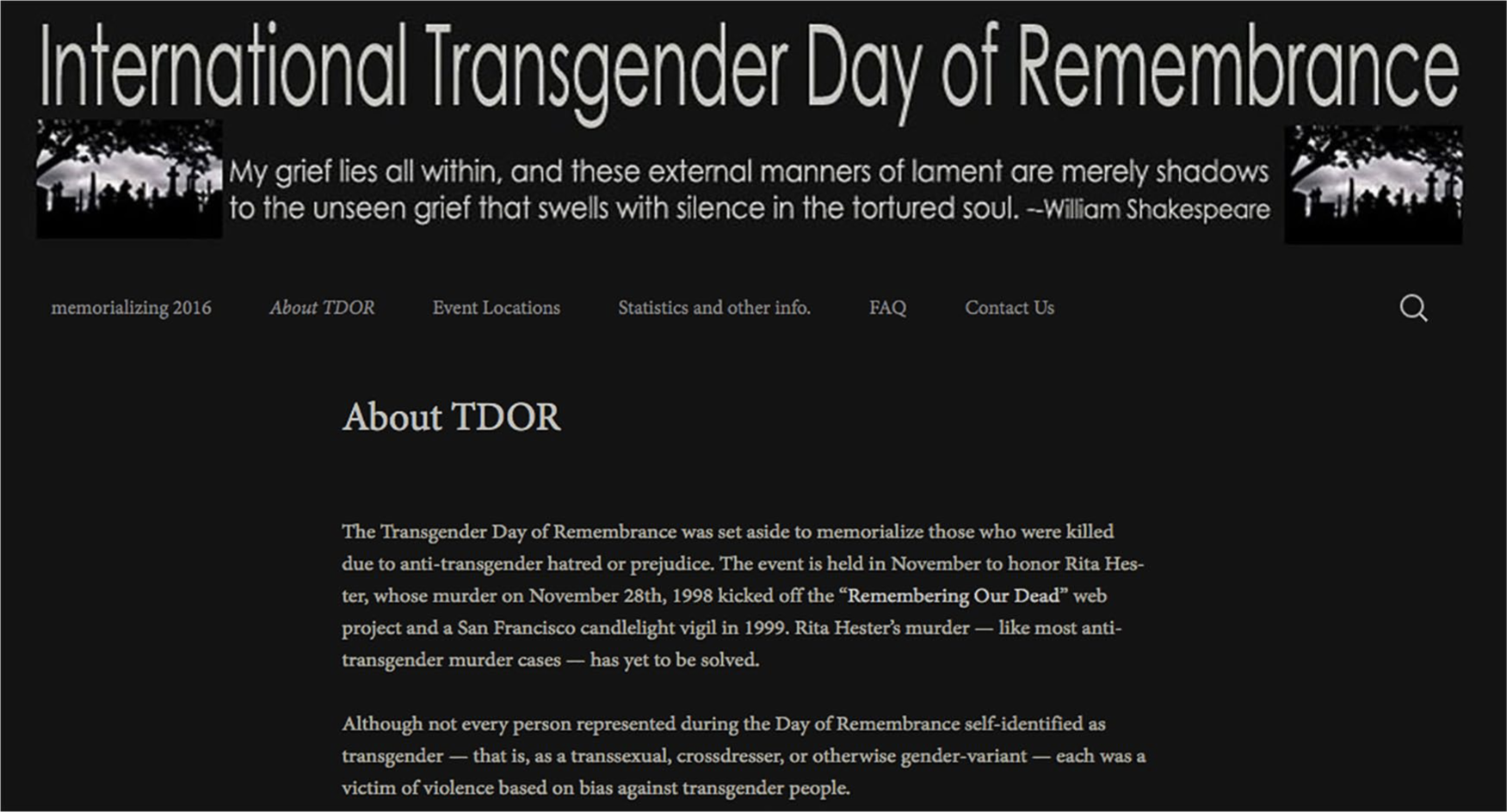
Screenshot of the now offline TDOR site.
Remarkably, as an inventory of lives lost on the TDOR site, it foreshadows the listicle culture of buzzfeed, Mic, and Bustle. The style of the site is a dark, somber memorial page in gray and black, striking a tone that the lists constitute a community of suffering. The quote from Shakespeare—“My grief lies all within, and these external manner of lament are merely shadows to the unseen grief that swells with silence in the tortured soul”—positions the visitor as someone trying to live in a state of grieving, struggling against their tortured soul. Over time, the visitor experience would have been consistent. A side-by-side comparison of the inventory shows that the format of the annual inventory has changed little between the oldest available (2006) and the most recently available (2015) lists accessible through the Internet Archive Wayback Machine (see Figure 5). The categories remain Name, Age, Cause of death, Location of death, and the link to the source was added later. The Cause of death descriptors also became more limited, perhaps to streamline the categorization of metadata, but also potentially less harrowing to read out loud during the vigil.

Screenshots of the Remembering Our Dead Memorial Lists, 2006 and 2015.
Sarah Lamble’s (2008, p. 25) critique of TDOR expresses caution for how narratives of remembrance represent those who cannot speak for themselves, but also for how they operate as constituent practices: they tell us who we are and how we know the world. Yes, TDOR raises public awareness about the extreme violence regularly perpetrated against gender-variant persons, but it does so without addressing violence as a systemic effect of power that differentially affects racialized subjects, colonialized subjects, and sex worker stigmatized subjects. Hence, Lamble (2008) concludes that the listing of the victims without additional information on the crime’s circumstance produces a “universalized body of the dead trans subject” (p. 28). She sees that the very existence of transgender people is verified by their death, and I add, that their death is doubly verified as being due to transphobia when it becomes archived online at TDOR. As a site, it is not used as a resource database solely, it emphatically calls out to be visited annually as a touchstone to remember “our dead” and thereby “who we are” as trans people. The annual TDOR remains the most well known and successful format for memorializing transgender death, in which groups read out the names and the autopsy-like reports of their deaths (cf. Bhanji, 2019). The practice of reading out in first person the description of a murder creates a “spectacle of violence” that Lamble (2008) finds ultimately undermines the antiviolence activism by “sensationalizing brutality, objectifying the dead, and exploiting raw emotion” (p. 36). Rather than the “Bash Back” slogan of Queer Nation’s Pink Panthers that Jack Halberstam excitedly wrote about as early as 1993 as bringing an “imagined violence” into being around queerness as a threat, the online TN seems to emerge under the specter of this imagined violence as a traumatized citizenship. Although Smith no longer updates the lists of the dead, the TDOR annual memorials continue around the world aided by other digital inventorying practices.
2009: Transgender Murder Monitoring Project, an Online Research Portal
Since April 2009, the member organization Transgender Europe’s Transgender Murder Monitoring (TMM) project has primarily taken over the task by launching a systematic collection, monitoring, and analysis of reported killings of gender-variant/trans people worldwide (see Figure 6). They advertise their published findings online two–three times a year, and always coinciding with TDOR, but also as with this graphic version of the report from 2017 posted on Transgender Day of Visibility (TDoV) (see Figure 7). TDoV is primarily a digital activist day with its own hashtag launched to counter the mourning our dead tone with one to celebrate the living. Embedded into a larger data collection of transgender experiences of violence and hate-motivated incidents, the TMM project raises the question, What does enumeration of this data do for our community? Transgender Europe (TGEU) lobbies national and institutional bodies with these records of discrimination that otherwise go un- or under-reported; they use it to advocate for better community support, but in its circulation and enactment in digital communities, it also continues to attune the soft, digital structures of trans feelings to the shock and horror of seemingly inevitable premature death.
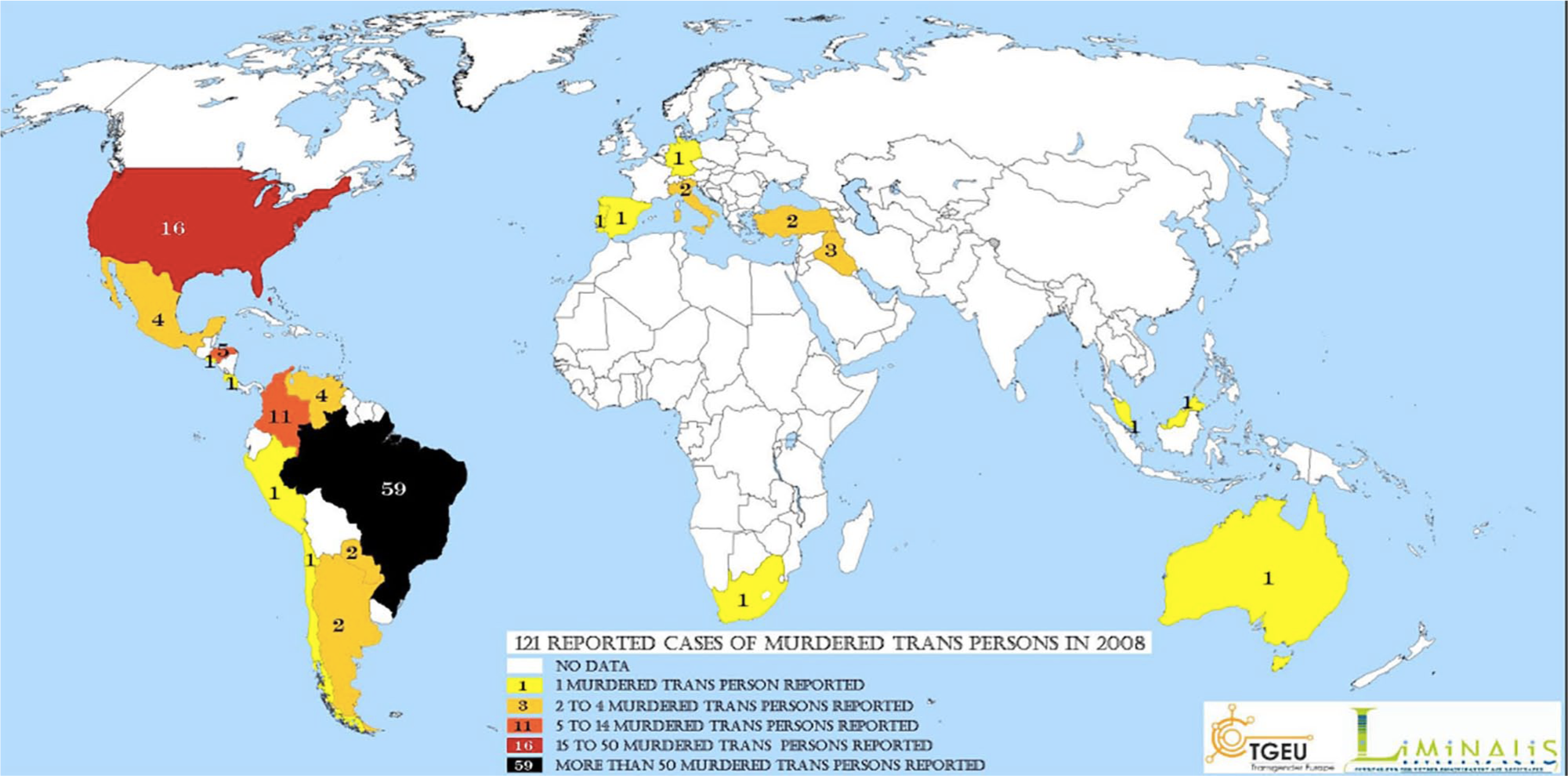
Screenshot of 2009 Transgender Murder Monitoring report, overview of 2008.
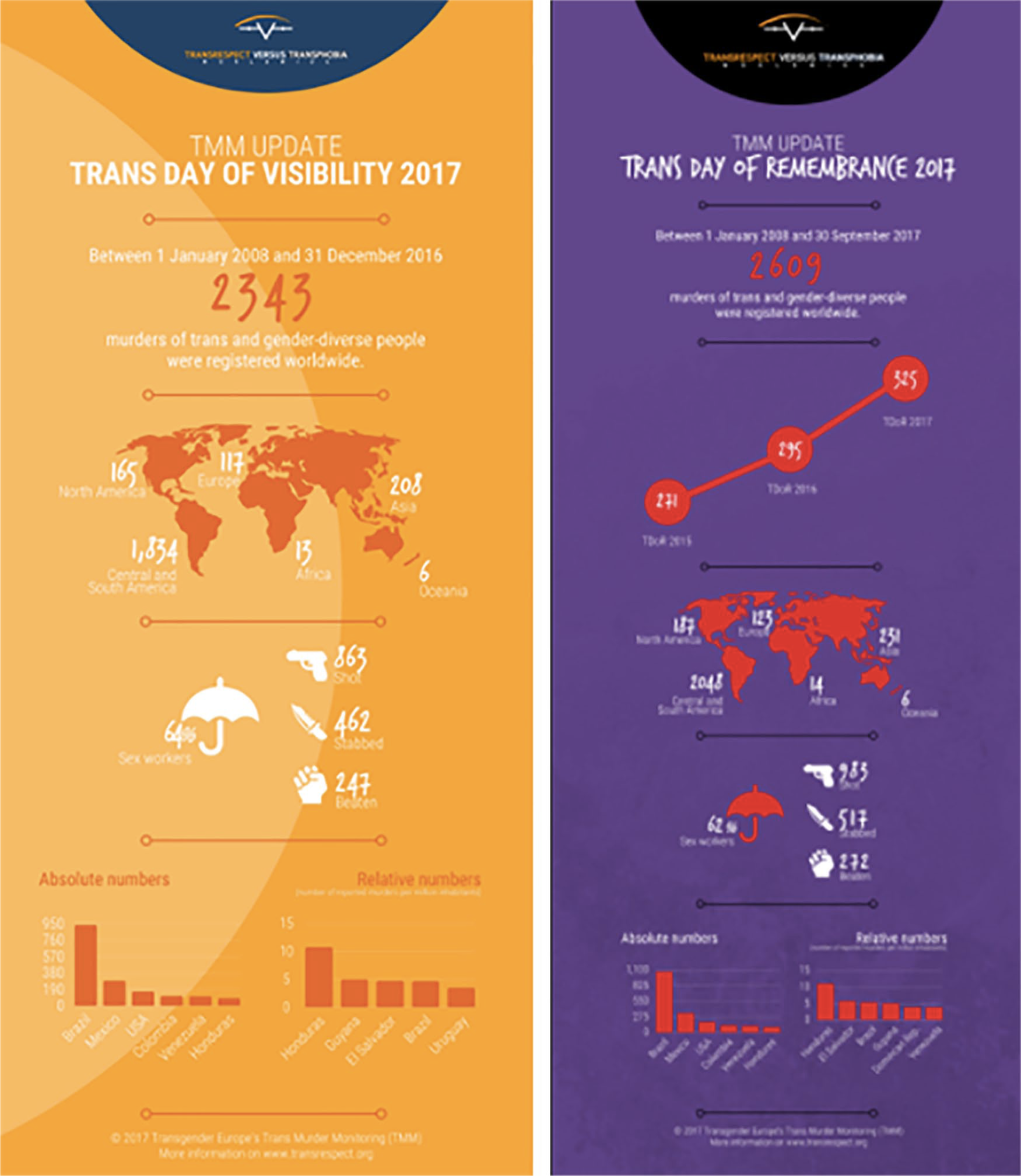
Transgender Europe update from the Transgender Murder Monitoring Research (TMM).
Note that in the infographics, the enumeration is accumulative, so the body count always rises. The factual reality of a targeted group of people is amplified by the sense of rising panic that this increase is unstoppable. Elsewhere, I have asked why a known false statistic about 25 years old being the average age for trans people to die was continuously circulated and cited online (Steinbock, 2017). My analysis of digital commentary on the controversy was that it was shared because it feels like the truth. The ever-mounting enumeration of trans people killed since 1999 strums the affective tuning fork to anticipate living within a death world. Given the racialization of many of the people killed, as an overwhelming number are sex workers (singled out in the infographic), persons of color, and poor, the monitoring, archiving, and memorialization practices function as well as warnings. They also serve then as pedagogical instructions on how being explicitly gender divergent and implicitly being of color are ways of living that lead to dying. Trans of color scholars Jin Haritaworn and C. Riley Snorton (2013, p. 67) write in their searing essay “Trans Necropolitics” that this simultaneous devaluation of trans of color lives and the nominal circulation in death of trans people of color through practices like TDOR actually vitalizes trans theory and politics. Through extracting value from trans of color death for raising the profile and urgency of nonprofits, makes trans of color persons only valuable, in fact, in their afterlife. This parasitic, exploitative relationship between raced trans bodies and progressive politics seems to animate the digital media networks comprising the imagined TN. It should be asked, now more than ever, “How do the deaths, both social and actual, of trans people of color provide the fuel and the raw materials for this process?” (Haritaworn & Snorton, 2013, p. 68). With Lamble, Bhanji, Haritaworn, and Snorton, I want to also question the conception of transgender as first and foremost a structure of feeling that articulates a sense of belonging through being victimized. The violence and negativity that overdetermines and undergirds a trans life has come to constitute a sense of trans belonging to a larger, overarching Nation. This is also historically so within the so-called democratic space of social media, in which sharing about trans possibilities for living also offers a forum to quantify trans impossibility.
The TDOR site and the TGEU project’s quantitative research create opportunities to make informed direct actions to contest being targeted by necropolitics. However, their reach and central presence begs the question of whether a TN affinity can be generated by a different narration, avoiding sensationalism, but still effectively making a sensate impact. My question is whether the affective public emerging through digital trans media and its archives carries forward the queer political sensibility and critique of homonormativity articulated by the San Francisco-based direct-action group Transgender Nation. Thus far, I have suggested that the “self” of transgender self-determination, which Eric Stanley (2014, p. 90) points out is based on “the fiction of the fully possessed rights-bearing subject of Western modernity,” is in practice collectively forged in relation to others through intermeshing digital networks that compose online life, and archives their deaths. The social media concepts of “virality” and “shareability” that explain connection across dispersed networks can also be employed to investigate the ways that trans digital media production surpasses borders.
2016: 103 Shots Viral Video
The digital video 103 Shots was made in response to an unprecedented massive scale of mainly people of color trans and queer people being harmed and killed and to the digital media coverage that emerged in the wake of the massacre at Orlando, Florida’s queer nightclub “Pulse.” I affectively experienced this event through my online networks of friends and the RSS feeds of constantly updating news sites. During closing time on the early hours of 13 June 2016 at Pulse’s Latinx Pride party, Omar Mateen charged in heavily armed and committed a large-scale mass shooting that lasted over 3 hr. As we shared news reports that increasingly listed the names of the dead, along came many compilations of the profile pictures from the murdered victims’ social media profiles (see Figure 8). Through sharing these kinds of digital memorializing projects I felt a possibility to redress and rework the awful negativity surrounding that holy space of the queer bar that had been desecrated. This version of TN building through sharing information and appreciation for lives lived felt vital to my ability to reclaim and reassert what Papacharissi (2014, pp. 124, 126) terms as digital pathways to assert agency in a period when I personally felt trepidations about going out to a queer bar, because that felt like the space of violence. That this highly vulnerable feeling was widely shared made it all the more remarkable that a quickly assembled response video was created with a crowd of volunteers in Delores Park, the epicenter for Pride San Francisco. The video was released online on 27 June 2016, only 13 days after the massacre. Titled 103 Shots after the 49 killed and 54 critically wounded people from the Pulse massacre, it invites the viewer to affectively tune into how the victims of the attack possibly responded to their situation.

Screenshot of the victims of pulse mass-shooting.
Differently from the quantitative framing of projects that list and monitor trans murder, the dimensions of this artwork’s way of handling trans and queer of color afterlife underscores the impossibility to grasp someone’s firsthand experience of violence in a culture saturated with simulated violence. Participating in digital culture obsessions with affect aesthetics denoted as “How it feels when” pics and reaction .gifs, 103 Shots imagines through a proximate gesture the “reaction shot” of those who were shot down; it asks, how did they feel in that moment? How does it feel when you are confused about the source of violence? The confusion of sound is key; one survivor said he thought the gunshot was fireworks going off, or celebratory balloons popping. In the space of a tight camera frame, two or three people press together, embracing, until a balloon wedged between them bursts. The shot sound used for the “shot” in the video is the canned soundtrack of the Foley recording of balloons popping in a cement room, which is regularly used as the sound signal for gunfire. The effect is a disorientation of the indexical marker of sound, and its meaning.
As a made for digital-release art project, it probes how activists might best work with digital media that also constructs trans and queer as both an overexposed and undervalued category of being. That is, it asks about how to show the celebration of transqueer love and life, while also attending to the unrelenting threats against it. The physical, sensate disorientation is achieved through redeploying illusory techniques from mainstream media to break and to draw connections between historically cleaved communities: gay and lesbian from transgender, White queers from queers of color, affluent from poor, protected from vulnerable. This ultimately evasive articulation of violence via the canned Foley sound replicates the disorientation Pulse victims experienced of an imminent death that could not be real. In doing so, 103 Shots offers a secondhand experience of their shock that blurs the mimetic moment of replay and relay between the viewers and victims into an experiential “we.”
Trans Relay: A Collaborative Production of the Imagined TN
In conversation with Nick Couldry, about “Digital In/Justice,” Mary Gray argues that when it comes to the loss of access to media the more pressing injustice is that it forecloses the use of media as processes of contribution, deliberation, contestation, and play in the social, collective, construction of the self (Couldry et al., 2013; p. 613). She follows Lisa Henderson in prioritizing information and technology access as a “precious cultural resource for queer relay—a cultural process of ‘catching and passing on across the divides of difference and capital’” (p. 613). Media access, while a route to individual representation, is also crucial to the relay of a collaborative production of the imagined digital TN that I have shown in the examples of the Gazebo chat room, TDOR quantitative web inventories, and qualitative memorialization practices. Within Cassils’ response video the transqueer relay process powerfully and explicitly draws on the visual style of Act-Up’s artistic direct-action group Gran Fury. It cites their 1989 “Kissing Doesn’t Kill: Greed and Indifference Do” billboard campaign on buses through the kissing embraces and the signature bold, block typology of the Queer Nation’s stickers and fliers, bringing forward a history of aesthetic resilience practices central to transqueer living through the unrelenting plague of HIV, through bashing back to street violence. Yet, it also relays in 103 embraces the 103 shots, one for each life lost or irreparably altered, bringing them into a space of non-extractive value in their afterlife. Cassils explained to me in an interview that if successful, “103 Shots would complicate the discourse at the time about safety, precarity and to show a means of finding your joy in the midst of trauma” (Steinbock, 2019, p. 120). The heady mix of affects swirling—fear, pride, fear, joy, and shock—is invoked by inverting the sounds of celebration that was confused with the sounds of death. Cassils explains this affective confusion and the mimicry of it as an aesthetic and a political decision at once: “in all the images I make, I want to try to hold together the struggle of both sides: the endless inversion of celebration into violence, and empowerment into harsh realities” (Steinbock, 2019, p. 120).
My perusal of an imagined TN’s digital mediascape has looked to how an affective public emerges through accessing histories of and sharing various legacies of digital trans activism. Engaging the affordances of online culture, these acts attribute freedom not to the ability to leave behind the body (the physical “meat”), but to activate possibilities for transforming the subject, including fostering a sense of belonging, gaining a voice, and means for self-representation. Lev Manovich’s (2001) insight that new media programs are being updated perpetually, reflecting a new paradigm for identity that is equally variable and modular, perhaps owes credit to Stone’s imagining of posttranssexual programming to scramble and modulate gender codes. My analysis has also shown how digital forms of transgender activism intersect with other subaltern positions, and especially with racialized and sexualized subjects. Further research into digital forms of trans (de-)programming should take into account the histories of race and computation technologies that undergird normative gender arrangements online (Chun, 2009; McPherson, 2012; Nakamura, 2002; Nakamura & Chow-White, 2012). Transgender use of Internet technologies and broader transgender media presence today continues to be double-edged: (social) media affords greater visibility but also often recaptures transgender identity in pernicious framings shared by sexualized and racialized others, such as categorized as threatening or pathetic. Long-established uneven life chances are being determined now according to digitally revamped forms of biopolitics in the algorithmic age.
Finally, while the group TN aimed for greater personal sovereignty, the invocation of a new nationalism translates into a means to recall and rehabilitate a settler colonialist mind frame. The notion of nation as territory is implicit in Queer Nation’s militant taking-back of street and public culture, but nation can also be seen in the cyberspace territorializing of trans-humanists who wanted to stake turf in what was largely understood to be the “terra nullius” or no man’s land of cyberspace. In our interview, Stryker tells me (E. Steinbock, Interview with Susan Stryker by Skype, 2018) that circa 1992 in Northern California, worlds were colliding that allowed for trans people to see themselves as fluid, transforming subjects, within a scene that felt exploratory and connecting groups of interest that had not been done before. She cited the trans-humanist bent of computer engineering represented in the MONDO 2000 magazine, the queer nation empowerment of sexual subcultures, and the monthly LINKS leather and kink party for all genders (cf. Stryker, 2008). These cultures came together in the mid-1990s Gazebo chat room and also documented in Monika Treut’s (1999) Californian film Gendernauts: A Journey Through Shifting Identities narrated by Sandy Stone.
The soft structures of feeling channeled through the call and response of information pathways, especially via social media, demonstrates that the Digital TN is also a live, active sociality; it affords banding together, but also diffusing affects of hostility. The affective body politics that exude a sense of belonging by connecting and attuning collectivities through images and ideas of suffering and murderous violence can also operate as discriminating nationalisms. Although the digital networks of the Internet that link new media users do not belong to any one nation, these media can act as mechanisms for sociopolitical inclusion and exclusion. To combat this, we should be wary of the necropolitical signature style of digital media and look for ways to propagate an imagined TN with the resounding critique of the double marginalization and displacement that transgender people face.
Footnotes
Declaration of Conflicting Interests
The author(s) declared no potential conflicts of interest with respect to the research, authorship, and/or publication of this article.
Funding
The author(s) received no financial support for the research, authorship, and/or publication of this article.
