



Abstract
This study investigates cross-platform differences in social media by analyzing the contending candidates who represent different political ideology during the 2016 presidential election. Borrowing the frame-building and frame-effect perspectives, it examines the ways in which the two contending candidates (Donald Trump and Hillary Clinton) built their message frames in two different social platforms—Twitter (N = 3,805) and Facebook (N = 655)—and how the frame differences affected audience engagement in each platform. The results showed that Trump’s messages presented more variety in frame selection than Clinton’s, focusing on conflict and negative emotional frames on Twitter while displaying frequent positive emotional frames on Facebook. Clinton’s strategy relied heavily on conflict and positive emotional frames on both Twitter and Facebook. The results also suggested that for both Trump and Clinton followers on Twitter, conflict and morality frames consistently attracted retweeting behaviors and emotional frames attracted favoriting behaviors. However, Facebook engagement behaviors did not show a consistent pattern between the followers of the two candidates.
Introduction
The highly interactive nature of social technologies has fundamentally changed the ways in which political campaigns are organized. Social media platforms, such as Twitter and Facebook, allow candidates to strategically communicate with potential voters. Although some of these efforts may accompany both activities and astroturfing (Ferrara, Varol, Davis, Menczer, & Flammini, 2016; Ratkiewicz et al., 2011), political candidates’ social media presence generates online conversations surrounding political issues (Kümpel, Karnowski, & Keyling, 2015). Since Barack Obama’s success with social media in 2008 and 2012 (Bimber, 2014; Gerodimos & Justinussen, 2015), social media strategy has become a new norm for United States (US) presidential election campaigns (Enli, 2017; Kreis, 2017; Lee & Xu, 2018; Pew Research Center, 2016).
Message framing is an important part of campaign strategy, and social media campaigns are no exception. As Entman (1993) said, “to frame is to select some aspects of a perceived reality and make them more salient in a communicating text” (p. 52), whereby transmitting framed messages can affect individuals’ perceptions of reality (Pan & Kosicki, 1993). The framing process involves two parts. First, frame building refers to the construction of a message through various channels to signify and convey a specific meaning (Entman, 1993; Kuypers, 2009; Reese, 2001). Second, the message on its own does not determine its meaning (Pan & Kosicki, 1993). Instead, a message must interact with audiences to engender the frame effect. While framing research should ideally address both frame building and its effect (Carragee & Roefs, 2004; De Vreese, 2005; Reese, 2001), many studies have been one-sided, focusing on either frame building (e.g., Schwalbe, Silcock, & Keith, 2008; Semetko & Valkenburg, 2000; Seo & Ebrahim, 2016) or frame effect (e.g., Iorio & Huxman, 1996; Powell, Boomgaarden, De Swert, & de Vreese, 2015).
The current study investigates social media framing that political candidates construct for themselves. Social media allows candidates to bypass news media gatekeeping, that is, to “cut out the middlemen of politics” and communicate directly with voters (Von Drehle, 2016). In particular, the current study attempts to fill the gap in the literature by examining cross-platform differences in the ways in which candidates frame their messages and the subsequent effects on audience engagement. Different platforms have different affordances that can result in distinctive framing strategies. We examine audience engagement as a proxy of frame effect in social media platforms (Entman, 1993).
The current study examines how the 2016 presidential campaigns for Republican (GOP) candidate Donald Trump and Democratic candidate Hillary Clinton strategically constructed their political messages (frame building) and how each frame built on different social media platforms (i.e., Twitter and Facebook) influenced the engagement behaviors of their audiences or potential voters (frame effect). We present a frame analysis of Trump and Clinton’s official Twitter accounts and Facebook pages during the 2016 campaign (19 July 2016–09 November 2016), along with the effects of identified frames on the level of audience engagement.
Literature Review
Trump and Clinton Campaigns on Social Media
According to Pew Research Center (2016), 44% of US adults received information about the 2016 presidential election from social media, and 24% turned to social media posts made directly by the candidates to get information about the election. Popular media and academic reports alike have pointed out Trump’s savvy use of social media as part of his campaign strategy. Trump had almost 10 million followers on Twitter, the most among all the candidates. Moreover, Trump had nine million followers on Facebook as of July 2016, double the number of Clinton followers at the same time (Pew Research Center, 2016). A content analysis of Trump’s social media campaign activities by Pew Research Center (2016) indicated higher interactivity with his followers than Clinton had with hers. Trump’s tweets went viral more often; nearly 25% of his Tweets were retweeted compared to 15% for Clinton. Trump also engaged with audiences more than Clinton by retweeting ordinary public tweets; 78% of his retweets were written by ordinary users. These statistics reiterate the strategic importance of politicians’ unmediated interactions with their constituents in digital spaces, from which Trump allegedly maneuvered into the winning game (Enli, 2017; Ernst, Engesser, Büchel, Blassnig, & Esser, 2017).
Clinton and Trump utilized different campaign styles on Twitter. According to Enli (2017), Clinton ran her Twitter campaign to Democratic campaign standards, with 82% of her tweets following the traditional Democratic stylistic standards; in contrast, only 38% of Trump’s tweets followed the traditional Republican stylistic standards, reinforcing Trump’s character and political stance as an anti-establishment outsider. Studies have shown that Trump’s tweets used simple and direct language that conveyed succinct and polarizing messages and employed capitalization and exclamation points frequently. These linguistic and rhetorical styles follow a “common strategy of right-wing populist discourse” (Enli, 2017; Kreis, 2017, p. 615; Ott, 2017). Trump’s strategy for garnering voters’ attention and popular media coverage relied on controversy and conflict, as foreshadowed by his own comment in The Art of the Deal (Trump & Schwartz, 1987):
The point is that if you are a little different, or a little outrageous, or if you do things that are bold or controversial, the press is going to write about you. I’ve always done things a little differently, I don’t mind controversy, and my deals tend to be somewhat ambitious. Also, I achieved a lot when I was very young, and I chose to live in a certain style. The result is that the press has always wanted to write about me. (p. 56)
Framing Research: Constructionist and Cognitive Paradigms
Framing is “making a piece of information more noticeable, meaningful, or memorable to audiences” and, thus, calling “attention to some aspects of reality while obscuring other elements, which might lead audiences to have different reactions” (Entman, 1993, pp. 53-55). This definition affirms that framing is a process of persuasion; framing highlights certain aspects of an issue to influence receivers’ sensemaking (Gamson & Modigliani, 1989).
According to Entman (1993), multiple sources influence framing processes, including communicators, messages, receivers, and culture. Separating these sources can sometimes be difficult because they interact and interplay in the framing process. That is, any given text has sponsorship, such as a communicator (Carragee & Roefs, 2004), and its meaning cannot be separated from the cultural context in which the communicator produces the message (Van Gorp, 2007) or gain power without having an effect on the receiver’s perception or attention (Reese, 2001). Framing research has evolved from various paradigms of meaning construction such as constructionist, cognitive, and critical paradigms (D’Angelo, 2002; McLeod & Shah, 2014). This article highlights the first two: constructionist and cognitive paradigms.
Constructionist Paradigm and Frame Building for the 2016 Presidential Election
The constructionist paradigm investigates ways in which messages are constructed, also known as frame building (De Vreese, 2005). Frame building incorporates various linguistic devices such as metaphors, exemplars, catchphrases, and depictions (Gamson, 1988; Van Gorp, 2007) “to promote a particular problem definition, causal interpretation, moral evaluation, and/or treatment recommendation for the item described” (Entman, 1993, p. 52). In political campaigns, frame building serves as a strategic instrument to pursue candidates’ goal of “being elected” rather than reflecting the “normative ideal” (Bene, 2017, p. 514).
Most studies of frame building have been concerned with news media coverage, where journalistic style, gatekeeping, and newsroom routine intervene in characterizing the frames (Kwon, Chadha, & Pellizzaro, 2017). Furthermore, the framing literature on presidential election campaigns has focused on the role of the “middleman” (i.e., the news media) in constructing political messages (Von Drehle, 2016). With the recent arrival of social media as an avenue for political messages, scholars have attempted to assess the ways in which framed messages are built (Ebrahim & Seo, 2019). For instance, Seo and Ebrahim (2016) examined framing structure of the propagandistic images posted on Facebook pages of Syrian President Bashar al-Assad and the National Coalition of Syrian Revolution and Opposition Forces in 2013 and 2014. However, how the frame images and messages affect audience engagement remained unclear. Social media and framing studies should go beyond this limitation to include how frames affect users’ interaction and dissemination in social media platforms (Entman & Usher, 2018).
Evaluating framing strategies and its effect on social media, Entman and Usher (2018) argued that “the right-wing but not left-wing media ecosystem has reached digital maturity” (p. 300). The digital maturity that right-wing elites have been enjoying may convey selective ideological narratives (frames) that facilitate political polarization. For example, Trump’s narratives in undermining his rivals (e.g., Clinton, Obama, Democratic Party) or delegitimizing the nation’s political and media institutions were accompanied by negative and aggressive linguistic tones (Lee & Xu, 2018; Savoy, 2018), which worked in tandem to encourage his supporters to adopt and make his narratives go viral (Wells et al., 2016). The hyper-partisan climate in social media may “enable the spread of misinformation, polarize citizens, reduce social capital, and thereby undermine cooperative norms vital to democratic stability” (Entman & Usher, 2018, p. 300). Hence, the current study extends Entman and Usher’s (2018) discussion of political framing strategies in social media by examining how right- and left-wing candidates strategically frame their agendas across different social media platforms and how such strategic efforts affect audience engagement.
For exploration, we highlighted generic frames (De Vreese, 2005; Semetko & Valkenburg, 2000) and emotional frames (Lecheler, 2018; Lecheler, Schuck, & De Vreese, 2013; Nabi, 2003). Generic frames are universal elements of mediated political messages (Semetko & Valkenburg, 2000). First, the conflict frame “emphasizes conflict between individuals, groups, or institutions as a mean of capturing audiences’ interests”(Semetko & Valkenburg, 2000, p. 95). For example, Patterson (1994) has shown that the US news coverage of presidential candidates since the 1960s has shifted from being issue-oriented to focusing on the candidates’ campaign tactics and strategies that amplified the competing nature of the election. The conflict between the opposing sides “makes the battlefield the dominant metaphor of election news” (Patterson, 1994, p. 141). The prevalence of the conflict frame is partly attributed to candidates’ aggressive campaign ads that mainly attack opponents rather than promoting their own issues and agendas (Cappella & Jamieson, 1997).
Another widely referenced generic frame is the morality frame, which interprets an issue from a moral (or often religious) perspective (Semetko & Valkenburg, 2000). Boydstun, Gross, Resnik, and Smith (2013) defined the morality frame as “any perspective or policy objective or action (including proposed action) that is compelled by religious doctrine or interpretation, duty, honor, righteousness or any other sense of ethics or social responsibility” (p. 6). Political candidates often use the morality frame to legitimize their positions and choices, while questioning the righteousness of opponents’ positions (Ball-Rokeach & Loges, 1996, p. 279).
There is also the attribution of responsibility frame that “presents an issue or problem in such a way as to attribute responsibility for its cause or solution to either the government or to an individual or group” (Semetko & Valkenburg, 2000, p. 96). That is, the attribution of responsibility frame is concerned with why the issue happens or who/what is responsible for it (Iyengar, 1996).
Whereas these generic frames have appeared commonly in US presidential campaigns (Benoit, 2004; Foster, 2010), what is particularly interesting is that political parties have used these frames somewhat differently. For example, Benoit (2004) analyzed primary and general election debates, television spots, and acceptance statements from 1948 to 2000, finding that Republican candidates use the conflict frame more intensively (e.g., more frequent ad hominem attacks) than Democratic candidates. This tendency was visible during the 2016 presidential campaign as well. While both Trump and Clinton attacked and criticized each other or other politicians, parties, and media (Lee & Xu, 2018; Visser, Book, & Volk, 2017; Yaqub, Chun, Atluri, & Vaidya, 2017), Trump attacked his opponents through Twitter twice as often (18.5%) as Clinton (9.3%) (Lee & Xu, 2018). Also, the morality frame has been prominent in Republican candidates’ campaigns (Benoit, 2004; Foster, 2010). For instance, Republican presidential candidate Ronald Reagan publicly “embraced [the] religious right and its political agenda,” redefining the discourse of faith and morality in politics (Westen, 2007, p. 388).
Although previous research has not clearly examined the use of a responsibility frame among Republican and Democratic candidates, Trump often portrayed himself as an outsider of the established political and media institutions, to which his messages attributed the causes of corruption, failure of domestic and foreign policies, and a poor economy (Enli, 2017; Lee & Xu, 2018). Based on the discussion above, we propose that the building of generic frames would be different between the two candidates’ social media campaigns.
H1. Trump’s campaign will use (a) conflict frame, (b) morality frame, and (c) attribution of responsibility frame more frequently than Clinton’s campaign on Twitter.
H2. Trump’s campaign will use (a) conflict frame, (b) morality frame, and (c) attribution of responsibility frame more frequently than Clinton’s campaign on Facebook.
In addition to the generic frames, emotional frames have also received scholarly attention in the context of political campaigns (Himelboim et al., 2016; Lecheler, 2018; Nabi, 2003; Seo & Ebrahim, 2016). Emotional frames pertain to a rhetorical strategy for capturing audience interest. Emotional frames highlight the use of “affective languages,” defined as “linguistically expressed feelings, attitudes and relational dispositions of all types” (Kryk-Kastovsky, 1997, p. 155). Building emotional frames has been emphasized in political campaign contexts because it helps mobilize, dramatize, or personalize political causes (Nabi, 2003; Semetko & Valkenburg, 2000).
Studies have taken two approaches in operationalizing emotional frames: discrete categories such as fear, anger, anxiety, excitement, and enthusiasm (Sahly, 2016) or valence (e.g., positive and negative). For example, Ridout and Searles (2011) examined four discrete emotions (fear, anger, enthusiasm, and pride) and their occurrences in US Senate campaign ads since 2004. They found that fear and anger worked similarly in these campaigns, concluding that campaign managers considered emotional valence more important than identifying specific sub-categories of emotions. That is, “a traditional model that distinguishes emotions depending on their valence still may have something to offer” (Ridout and Searles, 2011, p. 456). Likewise, persuasion studies have typically used positive and negative emotional valences as predictors (Dillard, 2012). Positive and negative emotions have also been operationalized based on linguistic cues, such as the use of positive (e.g., sweet, nice, and love) and negative words (e.g., worried, hate, and sad) (Kahn, Tobin, Massey, & Anderson, 2007; Sahly, 2016). Drawn from these studies, the current study adopts valence-based emotional frames by referring to the candidates’ language use.
Some studies have suggested that political ideology may align with the preference for emotional frames (Bronstein, 2013; Gerodimos & Justinussen, 2015). For example, Republican candidates have relied on emotional frames (Foster, 2010), whereas Democratic candidates have tended to use rationality-based rhetoric (Westen, 2007). Gerodimos and Justinussen (2015) examined the Facebook page of then-candidate Obama’s 2012 election campaign, finding that audiences interacted most often with deliberative rather than emotional messages. More recent studies have shown that Trump frequently sent out negative emotional messages throughout his campaign, particularly via Twitter (Liu & Lei, 2018; Ott, 2017; Savoy, 2018). In contrast, Clinton used argumentative, positive, and rational language in her campaign messages more often than Trump (Savoy, 2018). Based on the above review, we propose the following hypotheses:
H3. Trump’s campaign will use the negative emotional frame more frequently than Clinton’s campaign on (a) Twitter and (b) Facebook.
H4. Clinton’s campaign will use the positive emotional frame more frequently than Trump’s campaign on (a) Twitter and (b) Facebook.
Cognitive Paradigm and Social Media Engagement (Frame Effect)
Scholars have recently pointed to the roles of social media in campaign framing and made efforts to connect frame building and frame effects based on audience engagement (Bene, 2017; Entman & Usher, 2018). The cognitive paradigm helps elaborate how such efforts align with traditional framing research. The cognitive paradigm contends that frames have a real impact on audiences’ perceptions, judgments, and attitudes toward the framed issue (D’Angelo, 2002; Entman, 1993). That is, audiences perceive, organize, and activate the received information consistent with the ways in which the message is framed (Fiske & Taylor, 1991; Iyengar & Kinder, 1987).
Cognitive paradigm scholarship has established two lines of research: idealist and pragmatic approaches (McLeod & Shah, 2014). The idealist approach is based on experimental studies, focusing on how individuals interpret news frames and activate stored frames for future events (Iorio & Huxman, 1996; Powell et al., 2015). Rhee (1997), for example, conducted an experiment examining how individuals used available knowledge to interpret news frames regarding the 1991 Philadelphia mayoral election. In contrast, the pragmatic approach examines frame effects in a more natural setting by using survey or opinion polls (e.g., Valenzuela, Piña, & Ramírez, 2017). Audience engagement can be used as a new means for pragmatic frame-effect research in the social media context (Bene, 2017; Bronstein, 2013).
Audience engagement refers to the level of user participation and interactivity in real time on social media platforms (Lim, Hwang, Kim, & Biocca, 2015; Seo, Harn, Ebrahim, & Aldana, 2016). Social media are known to enhance civic and political participation (Kim, Hsu, & de Zúñiga, 2013) and facilitate collective actions (Kwon, Nam, & Lackaff, 2011) and collective sensemaking (Oh, Kwon, & Rao, 2010). Highly engaging messages are more effective in propagating information to a wider scope of users. In contrast, low-engaging messages can reduce the visibility of information (Bene, 2018). Various engagement functions are available in social media platforms, such as “retweet” and “favorite” on Twitter and “comment,” “share,” and “like” (also “reactions”) on Facebook. All these functions are conducive to a message’s visibility by increasing the probability that an individual audience is exposed to the message, which is also called “personal network exposure,” the degree to which an individual user witnesses networked others’ informational preferences (Kwon, Stefanone, & Barnett, 2014, p. 1352).
Specifically, “liking” on Facebook and “favoriting” on Twitter serve as indicators of endorsement or agreement (Alhabash & McAlister, 2015). Note that Twitter has recently re-named the “favorite” function as “like,” although this article uses the term “favorite” to differentiate between Twitter and Facebook. Liking also implies “exposure, attention, and some sort of affirmation, ratification, or endorsement of what is posted” (Gerodimos & Justinussen, 2015, p. 117). Facebook recently extended the “liking” function by adding “reactions” composed of five additional animated emojis (Stinson, 2016). When liking leaves a digital footprint in the liker’s social media profile or timeline, the liked message is then broadcast to his or her friends and followers.
Meanwhile, commenting on Facebook and Twitter reflects discursive interactivity (Bene, 2017; Gerodimos & Justinussen, 2015). Commenting leaves a trace of discussions in social media timelines, through which the commenter’s followers can check out not only the given comment, but also the original message. If liking and commenting on Twitter and Facebook represent a “one-off interaction mode” that mostly determines a message’s visibility within a user’s personal network, “sharing” on Facebook and “retweeting” on Twitter have the potential to create cascading effects—or “chains of sharing”—beyond one’s own network (Bene, 2017, p. 517; Sahly, 2016).
When frames are strategically built to gain audience minds, different frames may have varying short- and long-term effects (Price & Tewksbury, 1996). For example, generic frames may take longer to be effectual than emotional frames while their effects may become more persistent (Gamson & Modigliani, 1989; Reese, 2001). Therefore, it is possible that the effects of the aforementioned frames possess dissimilar durational effects in a social media context. When it comes to social media engagement, a durable framing effect may be represented by a volume change in retweets, sharing, or commenting over time. Conversely, a short-lived effect (Fiske & Taylor, 1991) may be represented by liking or favoriting as these actions are even more instantaneous than retweeting, sharing, and commenting.
Lee and Xu (2018) found that conflict frames influenced retweeting and favoriting behaviors in Trump and Clinton’s campaigns on Twitter. Lee and Xu (2018) provided a good starting work that linked frame building and frame effects in the context of social media campaigns. That said, understanding frame effects can be enriched by testing the relative effects of multiple frames across different platforms. We expand on Lee and Xu’s (2018) discussion by considering multiple generic frames and emotional frames, as well as by comparing two major social media platforms—Twitter and Facebook. Considering that few studies showed cross-platform comparisons of frame effects, we posit research questions instead of hypotheses.
RQ1. How do different frames (i.e., conflict frame, morality frame, attribution of responsibility frame, positive emotional frame, and negative emotional frame) affect audience engagement with Trump and Clinton’s campaigns on Twitter?
RQ2. How do different frames (i.e., conflict frame, morality frame, attribution of responsibility frame, positive emotional frame, and negative emotional frame) affect audience engagement with Trump and Clinton’s campaigns on Facebook?
Method
Data Collection
We used Twitter’s and Facebook’s Application Programming Interfaces (APIs) to access Twitter and Facebook data, starting from the candidate’s official nomination day, 19 July leading up to the election day, 9 November 2016. This time period was selected to capture the full period of the presidential campaign after the official nomination was announced. In this timeframe, a total of 1,277 tweets from Trump’s official Twitter account, (https://twitter.com/realDonaldTrump) and 2,528 from Clinton’s official Twitter account (https://twitter.com/HillaryClinton) were captured. For each captured tweet, engagement metrics were also collected including the number of retweets and favorites. Moreover, a total of 303 posts from Trump’s official Facebook account (https://www.facebook.com/DonaldTrump/) and 352 from Clinton’s Facebook account (https://www.facebook.com/hillaryclinton/) were captured. The engagement metrics associated with the Facebook posts included the number of shares, comments, and likes and reactions (likes and reactions used as a combined variable).
Measurement
Two graduate students were trained for content analysis with four sessions over 12 days, 3 hr for each training session. During the training sessions, definitions for frames were articulated, followed by clear inclusion criteria and concrete examples derived from tweets and posts. The trained coders then independently analyzed a subset of randomly selected 446 tweets and posts (10% of the final sample) to establish intercoder reliability, resulting in acceptable Cohen’s Kappa: for the conflict frame K = .91 (p < .001), the morality frame K = .75 (p < .001), the attribution of responsibility frame K = .75 (p < .001), the positive emotional frame K = .85 (p < .001), and the negative emotional frame K = .87 (p < .001).
Frames
Using each tweet and post as a unit of analysis, we adjusted Semetko and Valkenburg’s (2000) coding framework to analyze generic frames associated with Twitter and Facebook messages. For positive and negative emotional frames, we tracked the explicit use of positive and negative words. Each frame was treated as an independent binary variable (1, if exists), resulting in multiple frames simultaneously constructing a message. Table 1 summarizes frame variables, coding schemes, and example messages.
Representation of Frame Building and Its Operational Definition.

FBI: Federal Bureau of Investigation.
Social Media Audience Engagement
The frame-effect variables represent the level of audience engagement with each frame. We measured three engagement functions: (a) the number of comments, available only on Facebook, refers to the level of audience interactions (Bene, 2017; Gerodimos & Justinussen, 2015); (b) the number of likes (Facebook) or favoriting (Twitter) represents the degree of endorsement (Gerodimos & Justinussen, 2015); and (c) the number of shares (Facebook) or retweets (Twitter) represents the viral potential of the frame (Bene, 2017).
Analytic Plans
We conducted a content analysis to identify frame variables. To statistically assess frame building, we used t-test and Chi-square test. To address frame effects on audience engagement, negative binomial regression models were performed, considering that the engagement metrics are based on count variables. All analyses were conducted using SPSS Version 25.
Results
Our data showed that Trump significantly tweeted less words per tweet on Twitter (M = 16.13, SD = 7.52) than Clinton (M = 17.46, SD = 4.82), t (3808) = –5.78, p < .001; however, there were no significant differences found on Facebook between Trump’s word count (M = 25.06, SD = 23.33) and Clinton’s (M = 23.33, SD = 31.33), t (653) = .79, p = .42.
In terms of audience engagement, Trump’s messages on Twitter and Facebook received higher engagement compared to Clinton’s messages. On Twitter, Trump’s tweets received a higher number of retweets (M = 10,979.39, SD = 11,824.43; N = 14,020,689) and favorites (M = 28,600.65, SD = 23,380.37; N = 36,523,031) than Clinton’s retweets (M = 4,234.55, SD = 15,613.86; N = 10,704,941) and favorites (M = 9,938.48, SD = 31,316.34; N = 25,124,465). On Facebook as well, Trump’s posts generated higher numbers of shares (M = 22,596.72, SD = 46,405.05; N = 6,846,807), likes (M = 92,097.02, SD = 69,900.05; N = 27,905,397), and comments (M = 40,193.01, SD = 102,013.30; N = 12,178,482) than Clinton’s shares (M = 12,529.14, SD = 38,303.37; N = 1,272,039), likes (M = 47,570.25, SD = 60,492.48; N = 16,405,844), and comments (M = 9,135.59, SD = 25,898.83; N = 3,149,308).
The first set of hypotheses proposed that (a) conflict frame, (b) morality frame, (c) and attribution of responsibility frame appear in Trump’s campaign more frequently than Clinton’s on Twitter. The results suggest that both the Trump and Clinton campaigns used conflict frame quite extensively on Twitter. That said, the morality and responsibility frames occurred less frequently in Clinton’s than in Trump’s. Chi-square tests confirmed that Trump’s campaign employed conflict frame (H1a, χ2(1) = 15.87, p < .001), morality frame (H1b, χ2(1) = 125.11, p < .001), and responsibility frame (H1c, χ2(1) = 10.35, p < .001) more than Clinton’s campaign on Twitter. Thus, H1a, H1b, and H1c were supported.
The second set of hypotheses proposed that (a) conflict frame, (b) morality frame, and (c) attribution of responsibility frame appeared in Trump’s campaign more than in Clinton’s campaign on Facebook. In line with the Twitter result, Clinton’s frame building showed a lesser use of morality and responsibility frames than Trump. Chi-square tests confirmed that Trump used the morality frame (H1b, χ2(1) = 22.07, p < .001) and the responsibility frame (H1c, χ2(1) = 26.26, p < .001) more frequently than Clinton on Facebook. Meanwhile, the conflict frame did not differ significantly between the two candidates. Therefore, H1b and H1c were supported.
The third set of hypotheses indicated that Trump’s campaign used negative emotional frame more than Clinton’s campaign on (a) Twitter and (b) Facebook. Chi-square tests confirmed that, on Twitter, Trump’s campaign showed more frequent use of the negative emotional frame than Clinton’s campaign (H3a, χ2(1) = 50.22, p < .001). However, the difference was not significant on Facebook. Thus, only H3a was supported.
The fourth hypothesis indicated that Clinton’s campaign used the positive emotional frame more often than Trump’s campaign on (a) Twitter and (b) Facebook. The results showed no significant differences in terms of the positive emotional frame between the two candidates on Twitter, rejecting H4a. Furthermore, the results suggested the opposite pattern to H4b, showing that it was Trump’s campaign, not Clinton’s, that used the positive emotional frame more frequently (H4b, χ2(1) = 52.06, p < .001). Table 2 summarizes the results of these hypotheses tests.
Chi-Square Test of Frame-Building Differences Between Trump and Clinton on Twitter (N = 3,805) and Facebook (N = 655).

Chi-square test was used.
p < .001; **p < .01; *p < .05.
Negative binomial regression models were run to address the research questions. The first research question (RQ1) asked whether different frames (i.e., conflict frame, morality frame, attribution of responsibility frame, positive emotional frame, and negative emotional frame) would affect audience engagement with the two candidates’ Twitter campaigns. An omnibus test indicates significant overall model effects across all models: for retweeting (χ2 = 388.88, p < .001) and favoriting (χ2 = 296.82, p < .001) on Trump’s Twitter campaign, for retweeting (χ2 = 2187.59, p < .001) and favoriting (χ2 = 1776.37, p < .001) on Clinton’s Twitter campaign.
In retweeting models, parameter estimates resulted that the conflict frame (Trump, b = .17, χ2 = 51.87, p < .001; Clinton, b = .32, χ2 = 135.29, p < .001) and morality frame (Trump, b = .10, χ2 = 26.84, p < .001; Clinton, b = .12, χ2 = 8.02, p < .001) increased retweets among both Trump’s and Clinton’s followers. On the other hand, the negative emotional frame (b = .04, χ2 = 4.79, p < .05) increased retweets only among Trump followers.
In favoriting models, the emotional frames were the only variables that increased engagement on Twitter for both candidates: for positive emotional frame (Trump, b = .11, χ2 = 25.12, p < .001; Clinton, b = .19, χ2 = 46.98, p < .001), and for negative emotional frame (Trump, b = .09, χ2 = 20.92, p < .001; Clinton, b = .09, χ2 = 0.09, p < .01). Interestingly, the morality and responsibility frames had decreasing effects on favoriting for Trump’s Twitter campaign (b = –.09, χ2 = 17.17, p < .001 for morality frame; b = –.07, χ2 = 13.27, p < .001 for responsibility frame) (Table 3).
Negative Binomial Regression Models of Frame-Building Effect on Engagement Behavior for Trump’s Campaign (N = 1,277) and Clinton’s Campaign (N = 2,528) on Twitter.
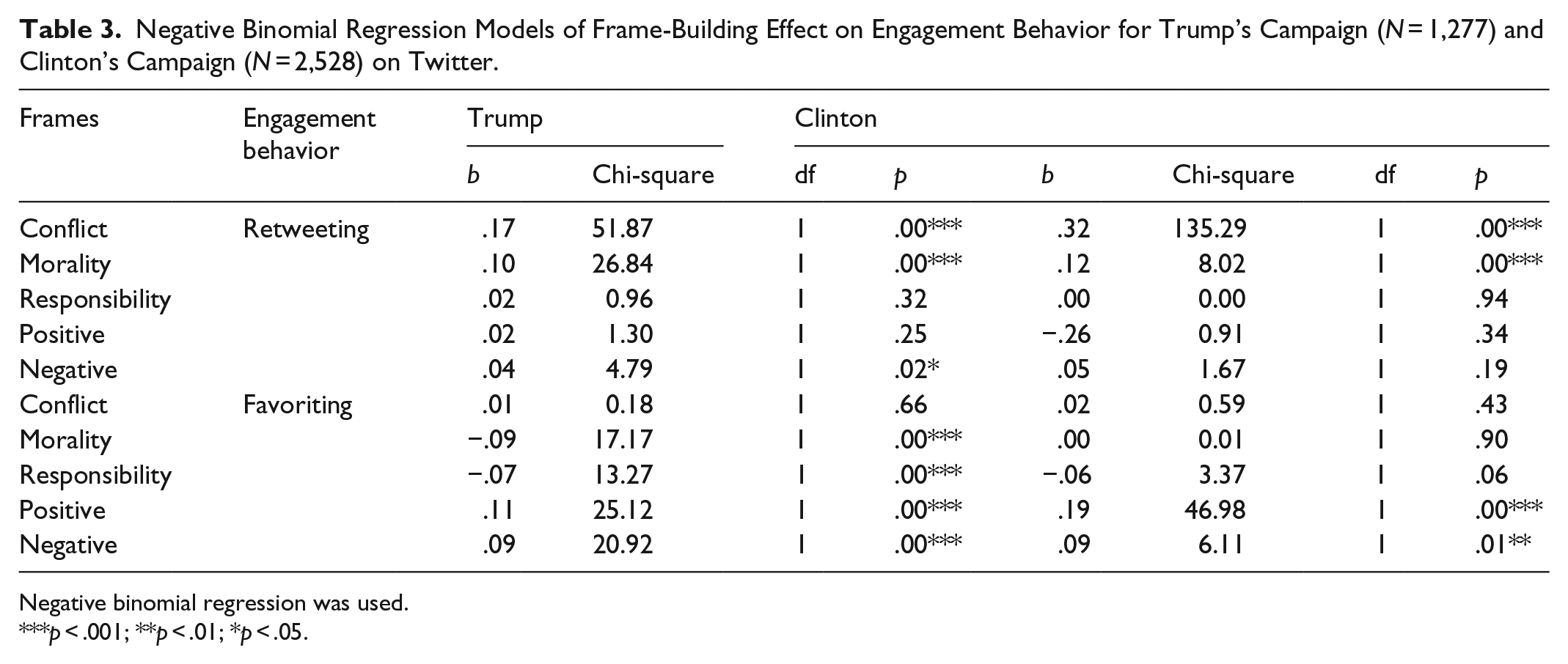
Negative binomial regression was used.
p < .001; **p < .01; *p < .05.
The second research question (RQ2) asked whether different frames would affect audience engagement with the two candidates’ Facebook campaigns. A series of omnibus tests suggested significant overall frame-building effects across all models: for sharing (χ2 = 221.40, p < .001), liking (χ2 = 64.32, p < .001), and commenting (χ2 = 639.02, p < .001) on Trump’s Facebook; and for sharing (χ2 = 393.24, p < .001), liking (χ2 = 137.91, p < .001), and commenting (χ2 = 283.79, p < .001) on Clinton’s Facebook.
Whereas the frame effects were largely consistent between Trump and Clinton Twitter campaigns, Facebook revealed somewhat different patterns between the two candidates. Specifically, whereas the morality frame (b = .32, χ2 = 6.45, p < .01) and negative emotional frame (b = .65, χ2 = 25.94, p < .001) increased audiences’ sharing behaviors on Trump’s Facebook page, neither was significant on Clinton’s Facebook. Instead, it was the conflict frame (b = .57, χ2 = 18.28, p < .001) that increased the sharing behaviors on Clinton’s Facebook page.
Furthermore, while Trump’s negative emotional frame had negative effects on likes (b = –.25, χ2 = 6.11, p < .01), Clinton’s positive emotional frame increased likes (b = .26, χ2 = 6.33, p < .01). Finally, Trump’s conflict frame (b = –.30, χ2 = 7.76, p < .001), positive emotional frame (b = –.97, χ2 = 66.51, p < .001), and negative emotional frame (b = –.50, χ2 = 14.25, p < .001) showed consistently negative effects on commenting, while none of Clinton’s frames had a significant effect on commenting behavior (Table 4).
Negative Binomial Regression Models of Frame-Building Effect on Engagement Behavior for Trump’s Campaign (N = 303) and Clinton’s Campaign (N = 352) on Facebook.

Negative binomial regression was used.
p < .001; ** p < .01; *p < .05.
Discussion and Conclusion
Social media have become strategic spaces vital to contemporary political campaigns. The interactivity of social media allows candidates to build direct relationships with their constituents without intermediaries (e.g., traditional media). It is unsurprising that campaign strategists have prioritized social media as a main channel for message delivery and persuasion. Accordingly, understanding the ways in which political campaigners build their own message frames via social media has become as important as understanding traditional media framing. Audiences’ social media engagement may serve as a useful indicator of the persuasive effects of campaign frames.
This study advances political campaign research by investigating social media frame building and its effects on audience engagement during the 2016 presidential election campaigns. Specifically, this study took a comparative approach by examining cross-platform differences of frame building and effects, as well as the differences between the contending candidates who represented different political ideology. We examined how the Trump and Clinton camps framed their campaign messages on Twitter and Facebook by analyzing the occurrences of generic frames (i.e., conflict frame, morality frame, and attribution of responsibility frame) and emotional frames (i.e., positive and negative emotion). We then explored the effect of each frame on audience engagement on each platform. The study underscores two main findings. First, the framing strategy of the two candidates differed significantly in each platform. Second, the effects of conflict, morality, and emotional frames on Twitter audience engagement were similar between the two candidates, while such frame effects were inconsistent on Facebook.
Frame Building: Generic and Emotional Frames
The results of this study correspond with other studies contending that Republican candidate Trump’s Twitter campaign reflected his digital savviness in mobilizing, polarizing, and widening his audience base on social media (Entman & Usher, 2018). Our qualitative reading of Trump’s messages aligned with previous findings, revealing prevalent attacks against media outlets, the current US political system, and his rivals and opponents, all of which reflected polarizing, brazen, and flagrant populist discourse created during Trump’s campaign (Enli, 2017; Kreis, 2017). This was particularly so when Trump castigated opponents for alleged immoral values or actions (morality frame) and called them out for not redressing alleged misconduct (responsibility frame). He also expressed negative emotions (negative emotional frame) on Twitter more frequently than his Democratic opponent, Clinton.
Trump’s Twitter messages were constructed deliberatively to mesh with populist right-wing ideology. Conveying selective ideological narratives heightened the conflict frame and negative emotional frame, which in turn contributed to polarizing audiences. Hitt and Searles (2018) suggested that such framing effects were “unlikely to return to a baseline” (p. 15). Thus, we suggest that with the populist discourse Trump’s campaign used on social media, particularly Twitter, similar kinds of aggressive populist discourses may recur in future elections, posing potential harms of dividing public sentiment and upending democratic norms.
That said, one interesting finding of this study is that Trump’s negative and conflict-oriented framing on Twitter shifted to more positive framing on Facebook: more than half of Trump’s Facebook posts contained a positive emotional frame. In fact, the conflict frame dropped from 40% on Twitter to 24% on Facebook, with fewer occurrences of negative language and ad hominem attacks. This finding suggests that Trump’s Facebook campaign diverged from the Twitter campaign possibly because the architecture of Facebook enables campaigners to target audiences by specific geographic locations (Bossetta, 2018).
Meanwhile, Clinton’s framing strategies were similar on Twitter and Facebook. Her messages focused mostly on the conflict frame and positive emotional frame. Despite her campaign’s dominant use of the conflict frame, Clinton used this frame far less than Trump on Twitter and proportionally equal to Trump on Facebook. Clinton used the conflict frame in about a third of her total Twitter messages in which she criticized and attacked Trump’s character to mitigate the voters’ perception of Trump as a qualified presidential candidate.
Proportionally equal to Trump, Clinton used the positive emotional frame on Twitter, displaying expressions of hope, inspiration, and sympathy, especially when she wrote about issues that were central to her presidential plans. Overall, Clinton’s campaigns on Twitter and Facebook were less offensive, more rational and argumentative, and more informative than Trump’s social media campaigns. Such message style findings were consistent with previous studies on the Democratic Party’s campaign rhetoric (Enli, 2017; Gerodimos & Justinussen, 2015).
Clinton’s campaign also focused on popular issues, such as women’s rights, children and education, and the rights of people with disabilities, “most of [which] were . . . Democratic Party-owned issues” (Lee & Xu, 2018, p. 207). In line with Lee and Xu (2018), on some occasions we found that Clinton sent unframed and inconspicuous textual messages, leaving the core of the messages implicit. Moreover, Clinton quoted some of Trump messages without stating her own position (e.g., Trump: “I love war, in a certain way”; “If I were in charge, they would know . . . waterboarding is how we’d baptize terrorists”—Sarah Palin, Trump supporter). Such reposts made some coding equivocal from the frame-building perspective.
Frame Effect: Audience Engagement
The results showed that the conflict frame, morality frame, and emotional frames (positive and negative) contributed to increasing audience engagement for both candidates as well as on both platforms. Some of the frame effects on Twitter were consistent between the two candidates. Specifically, the conflict frame and morality frame increased retweeting of both Trump and Clinton messages on Twitter. In addition, the emotional frames increased the favoriting of both Trump and Clinton messages on Twitter. The retweeting potential of generic frames may suggest that generic frames are important devices of persuasion in social media environments because they help messages propagate broadly. While we could not analyze the depth of retweet chains, a large number of retweets of generic frames may allude to the possibility of message persistence. In comparison, the favoriting potential of emotional frames may suggest that emotional frames can trigger audiences’ instantaneous liking to messages.
When comparing the results between Twitter and Facebook, an interesting pattern was observed. That is, emotional frames increased favoriting on Twitter while reducing commenting on Facebook. This inconsistent finding between the platforms and the modes of engagement makes sense because favoriting is an instantaneous activity that expresses how audiences “feel,” whereas commenting is a deliberative activity that articulates how audiences “think.” The results suggest that emotional frames might be effective in soliciting immediate engagement, but could be counterproductive if a campaigner intends to mobilize discursive, deliberative participation. This suggests that campaign strategists should consider the anticipated mode of audience engagement when building emotional framing.
Another note in terms of Facebook results is that some framing effects on Facebook seemed somewhat inconsistent. For example, Trump’s followers were more likely to share the morality frame whereas Clinton’s followers more often shared the conflict frame. Furthermore, Clinton’s posts mobilized more likes by using the positive emotional frame while Trump’s use of the negative emotional frame tended to garner fewer likes. One possible explanation for such inconsistency is that Facebook messages were often accompanied by visual materials, which might have created an unanticipated framing effect. In fact, our data demonstrated that 85.7% of Trump’s and 85.5% of Clinton’s Facebook posts contained visual cues along with the textual messages. Visual cues can limit our interpretation of the findings because our coding scheme was designed mainly for textual cues.
Finally, in contrast to the earlier discussion on the prevalence of responsibility frames in traditional news media coverage (e.g., Iyengar, 1996), the responsibility frame seemed relatively less effective for audience engagement on social media. One possible explanation for this is that responsibility attribution requires a contextual understanding of an issue, which may be too cognitively effortful to process through a click-based engagement.
In sum, this study contributes to social media and political campaign literature by demonstrating how similar or different frame building and frame effects could become between candidates and between platforms. This study attempts to integrate constructionist and cognitive paradigms to explore the unmediated political framing process on social media. Despite different ideological stances (right or left), Twitter users have shown similar behavioral engagement of the framed messages. Messages with conflict or moral cues have the potential to circulate longer through retweeting. Messages with emotional cues may be useful to generate a short-lived yet immediate effect. This pattern, however, was not found in Facebook, possibly due to different technological affordances of the platform.
Several limitations of this research merit attention. While the data of this study focused on Trump and Clinton’s 2016 campaigns and social media audience engagement, it was difficult to disambiguate the extent to which audience engagement occurred organically as opposed to as a result of astroturfing. Also, we did not intend to generalize our findings across all types of political campaign contexts or to the whole US population. Finally, our frame analysis was based on text messages and thus was not able to address the impact of visual cues.
Future research may benefit by separating organic audience engagement from sponsored engagement, as well as accounting for other variables that may confound framing effects, such as message formats and temporal effects. Future research can explore discrete emotional frames (e.g., fear, anger, and anxiety) on audience engagement behavior. Finally, another valuable research direction would be to investigate issue-specific domains (e.g., economy, women’s rights, and immigration). Such issue domains can interplay with frame-building strategies in mobilizing audience engagement on social media platforms.
Footnotes
Declaration of Conflicting Interests
The author(s) declared no potential conflicts of interest with respect to the research, authorship, and/or publication of this article.
Funding
The author(s) received no financial support for the research, authorship, and/or publication of this article.
