



Abstract
This article proposes a contextualist approach to machine learning and aesthetics, using LANDR, an online platform that offers automated music mastering and that trumpets its use of supervised machine learning, branded as artificial intelligence (AI). Increasingly, machine learning will become an integral part of the processing of sounds and images, shaping the way our culture sounds, looks, and feels. Yet we cannot know exactly how much of a role or what role machine learning plays in LANDR. To parochialize the machine learning part of what LANDR does, this study spirals in from bigger contexts to smaller ones: LANDR’s place between the new media industry and the mastering industry; the music scene in their home city, Montreal, Quebec; LANDR use by DIY musicians and independent engineers; and, finally, the LANDR interface and the sound it produces in use. While LANDR claims to automate the work of mastering engineers, it appears to expand and morph the definition of mastering itself: it devalues people’s aesthetic labor as it establishes higher standards for recordings online. And unlike many other new media firms, LANDR’s connection to its local music scene has been essential to its development, growth, and authority, even as they have since moved on from that scene, and even as the relationship was never fully reciprocal.
“Create, we’ll do the rest,” insists the tagline for LANDR, an online music mastering service (About LANDR, n.d.). Echoing Kodak’s 1888 slogan, “You press the button, we do the rest,” LANDR promises its customers ease, seamlessness, and simplicity for the final stages of recording and releasing music: mastering and distribution. With a single click (and a credit card transaction), LANDR users can distribute finished tracks across major music platforms like Spotify, Apple Music, Google Play, Tidal, Deezer, “and everywhere else that matters” (About LANDR, n.d.). But this option is offered by many services on the Internet. The more unique service LANDR offers is automated music mastering, built on top of supervised machine learning (ML), branded as artificial intelligence (AI). Their stated goal is to use ML to automate the kinds of decisions usually made by human mastering engineers. This simple claim hides as much as it reveals: the term “artificial intelligence” has become a marketing buzzword in recent years, papering over many different kinds of ML that are in use (see MacKenzie, 2017, p. 5). Moreover, it blurs the boundary between a business or operation that might use some kind of ML for part of what it does, versus an enterprise that consists entirely (or mostly) of ML. For the purposes of this essay, we consider LANDR’s claims to be an AI-based firm as socially or culturally relevant, while not assuming that their primary work involves ML, or that ML is the only important application of AI.
LANDR’s promise to replace human mastering engineers also begs the question of what they are actually automating, or if automation is even the right word for what they do, since firms and technological systems often redefine the human tasks they claim to replace. As of now, LANDR’s core service is a kind of signal processing. Every image that appears on a screen and every sound that comes out of speakers is manipulated to look or sound a particular way. This work of manipulation (or modulation) is called signal processing (Sterne & Rodgers, 2011), and mastering engineers are the group of people who apply a final round of signal processing to audio before it is made public through a formal release (such as an album, a film or a TV show), or simply through uploading to a website or streaming service. Mastering engineers are the last line of ears before sound comes out of speakers. For our academic readers, mastering might best be understood as the audio equivalent of typesetting and the creation of page proofs for a publication. As Mandy Parnell (2017), an engineer who has mastered recordings for artists like Björk, Feist, The XX, and Tim Hecker explains, “we need to make it fit inside the world. How is it going to sound on the radio or on a playlist?”.
To do this for music, a mastering engineer usually receives a stereo recording (or in the case of game or film audio, a multichannel mix) and then adjusts the relative loudness of different frequencies (equalization, or EQ), the stereo balance, and the relative loudness of different parts of the music (dynamic range). They may make other adjustments as well. Mastering studios are usually more carefully acoustically tuned than recording studios—especially in the range of bass frequencies. Because bass frequencies are harder to reproduce and hear, this marks one audible aesthetic difference between mastering and other kinds of audio work, a difference we will explore later in the article. Mastering engineers are often (though not always) specialists, doing only mastering day after day. And though mastering engineers may use the commercial software widely available to musicians, they also often have expensive, highly customized, or customizable audio processors as part of their studio setup.
Like any other technology, AI exists within webs and flows of culture and power. Recent scholarship on AI has focused on its implications for labor, privacy, bias, and governance (Campolo, Sanfilippo, Whittaker, & Crawford, 2017). But increasingly, ML will become an integral part of the processing of sounds and images, shaping the way our culture sounds, looks, and feels (see also Manovich, 2018). LANDR represents an early example of a self-described ML application in the domain of media aesthetics, and they are one of a group of businesses using ML for audio signal processing. For example, the software company Izotope uses ML to design processing routines for software that resides on an end user’s computer. Their products include audio mastering software, forensic applications, and applications for mixing vocals and music. CloudBounce offers a mastering service similar to LANDR’s, but it leaves more to the end user in terms of decision-making and therefore requires a more practiced end user. There is also a long history of automatic mastering applications in hardware and software (a recent, free to try example is Curioza’s Auto Audio Mastering System that works by comparison), some of which allow the user to input a “reference track,” which provides a set of sonic goals for the processing of a new track. We chose to study LANDR in depth over these others in part because it falls in a sweet spot of delegation and opportunity. Compared to CloudBounce and Izotope, LANDR makes more choices for its end users, thus making the strongest claim toward aesthetic automation. We were also particularly well-positioned to study LANDR: we are both situated in Montreal and could visit its offices, talk with its current and former employees (some of whom we knew socially), and treat it as an institution “on the ground,” as well as an interface and a platform. It has existed in our social world for years, and Jonathan first met employees of LANDR before it was even a mastering company. A brief comparison to Izotope’s approach appears below, and we offer a fuller institutional history of LANDR, as well as its place in the history of audio mastering in a companion piece (Sterne & Razlogova, forthcoming). For now, it is enough to know that LANDR is not the first or only attempt to automate mastering, and that mastering itself has a dynamic and varied history. It is not just one thing.
Kate Crawford (2016) has argued that to understand algorithmic systems we need to “broaden our scope to include the array of human and algorithmic actors developing a space—sometimes in collaboration, sometimes seeking to counter and outwit each other” (p. 81). We understand LANDR, mastering, and AI more broadly, as sets of tools, protocols, and practices that operate in the world and that are shaped by people. This is especially important when studying corporate applications. We cannot know how LANDR actually works, or where ML happens in the process. While it could be fully automated, comparing a recording to a massive dataset and then reconstructing it to match the dataset entirely through machine learning-based processes, this is unlikely, as the research literature on automated audio mastering shows no progress in this area, and we can find no evidence of patent filings by LANDR or anyone else for an entirely AI-based approach to mastering. More likely, it uses ML for part of the process, for instance in analyzing the sound of an uploaded audio track, and then selecting from a matrix of preset possibilities for processing. We will discuss this ambiguity further below, but it is actually a constitutive feature of studying software “in the wild” (Seaver, 2017). LANDR’s opacity results from a combination of “intentional secrecy, technical illiteracy, and the sheer scale and functional protocols of machine learning” (Burrell, 2016, pp. 4–5; see also Pasquale, 2015). Rather than understanding the secrecy around its algorithms as a block to our study (though of course, we would love to know everything about how it works), we instead treat LANDR’s obfuscation of its own internal workings as a constitutive feature of its social and cultural existence. We also do not assume that its use of ML is a radical break from other signal processing techniques.
Thus, in the spirit of Crawford, Seaver, and Burrell, we offer an analysis of LANDR through a series of nested contexts and fields: industries, scenes, users, interface, signal processing, and sound. We spiral in from bigger contexts to smaller ones to parochialize the ML part of what LANDR does. LANDR’s operations at each level are all related but not in a necessary or predictable way. Nor does one context—for instance, the AI aspect of what they do—automatically determine how they act on other levels. To show that the “effects” of AI are heavily shaped by the social fields and contexts in which it is allowed to operate, we examine several agonistic contexts for LANDR: their place between the new media industry and the mastering industry; the music scene in their home city, Montreal, Quebec; DIY users and independent engineers; and, finally, just one user’s experience of the LANDR interface and the sound it produces. Throughout, we emphasize how the technology reveals itself in points of dissonance or breakdown (Ahmed, 2006, pp. 46, 48). To this end, we interviewed users and the co-founder of LANDR. We conducted additional ethnographic discussions with musicians and mastering engineers and participated in related public events at LANDR headquarters and local film festivals. We studied the interface and the company’s public speech as discourse. We studied LANDR’s impact on the local independent music scene. Elena, a show host at McGill station CKUT since 2013, featured and interviewed dozens of local bands on the air, and interviewed the same musicians before and after LANDR came on the scene. Ours is the second published media study of LANDR. Thomas Birtchnell’s study (2018; it appeared as ours was under review) is built around studio site visits in Australia and interviews with audio engineers. It provides valuable ethnographic evidence of how engineers understand mastering, and how they view the potential threat of automation of mastering work. Our study lends additional support to his claim that although LANDR suggests itself as an alternative to working with a mastering engineer, it actually has not eliminated jobs, instead leading to a reassessment of what mastering “is.” This suggests that the claim that AI will eliminate jobs because of its technological dimensions is at best incomplete: context matters. Elsewhere, our approaches diverge because of geography: we were able to subject LANDR itself to ethnographic scrutiny by visiting the office and talking with current and former employees (only some of whom we can directly quote in this article). We talked with musicians, as well as recording engineers and industry experts (including one notable public critic of LANDR). We are considerably more agnostic about the role ML plays in LANDR’s software than Birtchnell (2018, p. 2). We also found that some of the most important “effects” of LANDR come not from its approach to algorithms or ML, but its status as a venture capital-funded corporation, one working on a Silicon Valley inspired model of the so-called industrial disruption. Thus, the politics of AI cannot be separated from the politics of corporate capitalism, regulation, and resistance.
The period of working on this article coincided with Jonathan mixing three records (he has played, recorded, and mixed music since the late 1980s). He took advantage of this opportunity to do some comparative analysis. He ran all of the mixes through LANDR, as well as taking two finished sets of mixes to mastering engineers. LANDR’s sales pitch is that what they do is equivalent to what a human mastering engineer does. As we will show, this claim depends entirely on what you mean by “mastering.” LANDR’s success is defined in part by limiting the problems it is trying to solve while finding ways to market new uses for its products. All of Jonathan’s mixes featured musicians playing original music on “standard” rock and jazz instruments (guitars, keyboards, synths, drums, winds, vocals, and computer) with some signal processing done during the recorded performance and some done afterwards in mixing. For an instrumental post-rock record (Volte, “Selfie, gluten, et lâcher-Prise”), he hired Harris Newman at Grey Market Mastering in Montreal. Newman helped define the Montreal post-rock sound, is a well-respected independent mastering engineer, and is a part of the Montreal scene. Jonathan and Newman have an ongoing professional relationship, since they have worked together before. For a vocal- and lyric-driven Canadiana record (Hard Red Spring, “Summerpool”), 1 Jonathan hired Freddy Knop of Listeners Mastering in Berlin, whom he found through an Internet search. Knop is an independent mastering engineer and also co-founded HEDD, a high-end speaker company. Both mastering engineers work alone and are at the middle level of the industry. They are not the high-end mastering houses that define the sound of major label releases, like Sterling Sound, Gateway Mastering, Abbey Road, or Masterdisk, and their prices are more affordable for independent musicians and smaller labels. At the same time, they are both successful professionals in the field and have established reputations in their niches. As part of the research for this article, we also interviewed Larry Crane, editor of Tape Op, the world’s largest recording magazine, and a working engineer and producer. Crane has a synoptic view of the industry and has been a vocal critic of LANDR. Yet he also pointed out that the differences between the kinds of mastering engineers Jonathan used for the project (who charge between US$75 and US$150 per hour or per track) and US$5–US$6,000 per record mastering houses at the top of the business are miniscule at best: in fact, he advises his own clients to avoid these studios (L. Crane, Interview by Jonathan Sterne, July 28, 2018). While mastering engineers at the top studios might have more expensive equipment and more experience, their work process is not fundamentally different from that of the two engineers we studied for this article. A top-level mastering house might have more elaborate sound treatment, or a wider range of high-end audio processors to choose from, but Newman and Knop were already working with high precision, highly specialized equipment. At the top level of the industry, artists and labels are paying for a curriculum vitae as much as a skill set: to be mastered by the same engineer who did other famous recordings. Newman, meanwhile, spoke of keeping his prices affordable to serve a certain stratum of musicians whose music he values. As of the time of submission of this article, LANDR offered plans between US$4 and US$25 per month for unlimited mastering of audio tracks (the cost difference has to do with the audio definition of the final product—the lowest usable plan is probably US$9 a month), as well as options for high-definition mastering of individual tracks. This makes them much less expensive for individuals and also places them in a different kind of economy, as we will discuss throughout this piece.
Both Newman and Knop are deeply connected to their own local music scenes, and neither is short of work. LANDR was also a part of the Montreal music scene at first but in a very different way. It collaborated with local institutions, employed local artists, and used their tracks and experience to perfect its mastering algorithm. While initially this relationship was a symbiosis of sorts, it became more problematic as LANDR reinvented itself as a platform, expanding into other services such as digital distribution and promotion. Yet its connection to a scene was also essential for LANDR’s claims about why musicians should trust it. We document how the company operated within these and other social relationships. LANDR, therefore, offers an early test case for AI’s relationships to other kinds of media industries and practices. LANDR also offers an early test case for arguments about AI and labor, showing its effects on the labor force can be uneven and contradictory, shaped by the specific contours and limits of the industry rather than the “impact” of AI itself (Levy, 2015).
While Newman may have helped to define the sound of a genre, his practice in itself does not require him to try to define or limit ideas of what other mastering engineers can do. LANDR’s approach, meanwhile, means that it aims to stabilize the referents of the term mastering for its purposes (MacKenzie, 2017, p. 212). It extends some of the methods of classification of sound media aesthetics first developed for music recommendation and recognition engines (Freire, 2008; Seaver, 2013; Razlogova, 2013, 2018), building out a kind of auditory media standard. In other words, if you accept LANDR’s definition of mastering, then it can master music. If you do not, then it cannot. This is at the heart of many controversies around AI replacing human labor, and something with which philosophers and science fiction writers have struggled for decades (e.g., Bolter, 1984; Dreyfus, 1972). For the purposes of this article, we strategically accept LANDR’s invitation to compare it to mastering engineers, but we do so to highlight this process of redefinition of an activity for the purposes of making an AI-based practice socially commensurate with it. For any ML to be successful at a given cultural task, the people behind it need to circumscribe the terms on which it can be successful: a “finished” recording is an aesthetic judgment and a moving target. In other words, the entrance of AI into a cultural field marks a moment of social and definitional contest.
Mastering Houses as Firms: LANDR Versus Independent Engineers
Grey Market’s, Listeners’, and LANDR’s physical layouts as businesses can reveal aspects of their operating logics and media practice (Martin, 2003, p. 9). The mastering studios visited for this study (and they are typical in this respect) look like professional recording studios in miniature. There is no space for performance or tracking, and a large multichannel mixing board is not necessary. They are more like workshops for crafting sound, designed for careful comparison and auditioning and for independent work. They highlight mastering as an artisanal practice, undertaken by a skilled professional, who works at one project at a time.
Grey Market is located in a post-industrial building, off to the side of a major local analog recording studio, Hotel2Tango. As depicted in Figure 1, the studio is a single room, acoustically treated for maximum clarity. Newman works at a desk full of equipment: some is for signal processing and some is for comparing the processed and unprocessed sound. Freddy Knop’s studio (Figure 2) is more makeshift but follows the same pattern. A smaller room than Newman’s, in an old Berlin apartment, Listeners Mastering also uses high-end speakers, acoustic treatment, and a few small racks of specialized mastering gear.

The view from Newman’s mixing desk at Grey Market Mastering. One can see the specialized equipment, high-end full range speakers, and acoustic treatment behind the speakers. Note that the darkness is an artifact of the photograph—the room itself is sunny and well-lit. Photo by (and courtesy of) Harris Newman, used with permission.

Freddy Knop in motion at Listeners Mastering in Berlin. Again, the specialized equipment and acoustic treatment are visible. Photo courtesy of Knop and used with permission.
In contrast, LANDR’s corporate headquarters has all the trappings of a new media company. LANDR presents itself as both a music business and a new media business, but the emphasis is on the latter. Set up in a post-industrial space, in a building that is turning over from artist lofts to businesses, the main corporate office has the usual islands of cubicles and desks in the middle of the space, surrounded by a ring of acoustically isolated meeting rooms, as shown in Figure 3. Like other music tech companies, LANDR has dedicated, acoustically isolated rooms for listening to and manipulating audio and a small performance space, where musicians can play. The space is adorned with the usual new media business comforts: a pinball machine, good coffee, and comfortable seating that show the Silicon Valley-style disdain for “traditional” office culture (see Ross, 2003; Saval, 2014, pp. 259–277; Turner, 2009). Even from the hallway outside the business, you would never know LANDR is an audio mastering company. Although all three firms have repurposed space—Grey Market is also in a post-industrial space, and Listeners is in an apartment—LANDR’s layout reflects an ideal of organizational flexibility that is part of the turn toward open plans among corporations since World War II. While Grey Market and Listeners both take advantage of the flexibility of architectures, their layouts represent clear commitments to a single organizational model: the mastering engineer in a workshop. In contrast, LANDR’s layout embodies a culture that anticipates and thrives upon its own volatility (Thomas, in press, p. 31).

LANDR executive Pascal Pilon in the corporate office. We were not able to take photos on our visit and instead had to rely on the readily available photos from the web.
As a new media business, LANDR is aggressively committed to promotion, and partakes of some of the “disruption” talk popularized by companies like Uber and AirBNB (Graham & Shaw, 2017). This is a major departure from traditional mastering firms. As a business, mastering is like a throwback to the professional and promotional practices of an earlier era in the history of music production. Whereas self-promotion and a legible and ongoing relationship with their audiences have become essential for working musicians (Baym, 2018), mastering engineers still largely work by word of mouth and reputation. It is true that one can find advertisements for new mastering engineers online and in magazines like Tape Op, and that mastering studios’ websites are search engine optimized. But promotion for mastering engineers is a matter of some social subtlety, tied to the profession’s self-conception. Few mastering engineers maintain an aggressive social media presence as mastering engineers. Success means not having to promote yourself too much or too loudly. Indeed, the latter actions can be read by other people in the business as a sign of not being good enough at what you do. In this way, the promotional culture of mastering engineers mirrors that of artists before the age of social media: when a certain level of mystery worked as well in some cases as familiarity and transparency.
LANDR’s marketing rhetoric echoes the claims to ease, seamlessness, and creative flow that most media companies now pitch to their users—even if that is not the actual goal of most interface designs (Coyne, Parker, & Rebelo, 2004; Manovich, 2013, p. 100; Kember and Zylinska 2015, p. 18; Simon, 2018). By new media business standards, they are following established business practices. By more established mastering industry standards, their approach might be considered both uncouth and a direct threat. LANDR’s website is considerably more elaborate and detailed than the sites of traditional mastering houses. LANDR has active feeds on Facebook, Instagram, and Twitter. They buy ads on Facebook and Google—and both authors have seen ads for LANDR pop up on our screens (though our participation in this project could also have something to do with that). Over their existence, they have promoted themselves aggressively through press releases, participation on industry panels, tech business pitch-offs, and partnerships with other industry players. In our interview with Justin Evans, he remarked on Larry Crane calling LANDR “the devil.” When asked about it, Crane did not recall the exact context, but he objected to LANDR’s business model more than anything else: “it doesn’t come from a place of making art,” he said, referring to their approach to marketing and their reliance on venture capital. Even if it could be argued that LANDR is more honest about their promotional strategies, where mastering engineers are traditionally more discreet, LANDR’s brash promotional campaigns clearly signal that it is more like a new media company and less like a mastering house.
But there is more to it than that. LANDR is not like a mastering house that needs to bring in enough income to cover operating costs and feed an engineer or two. LANDR has investors who have cumulatively poured CAN$10.4 million into the company (LANDR). With investors come benchmarks—the need to reach a particular size and income level at a particular time—and all of the requirements that come with taking in venture capital, irrespective of the kind of business under consideration. Few successful mastering houses aim to diversify the portfolio of services they offer clients apart from those specific to mastering. In fact, it could be argued that the most successful mastering studios are the most specialized: they just do mastering. Knop is an interesting exception here that proves the rule. He only derives part of his income from mastering and the rest from his work at a speaker company. Though obviously there is some relationship in terms of involvement with audio, he presents these as two entirely separate activities, and does not appear to use his work at HEDD to promote his mastering (apart from a mention on his website), or vice versa.
LANDR, meanwhile, aims to diversify its services. During the period of our study, they moved into music distribution; they created mechanisms for sharing and commenting on tracks during the mastering process; they created an instant “release” button; they released a set of sample packs for people to use in their music; they published advice columns for musicians and engineers; they held parties and educational events in their Montreal headquarters; and they have begun a music promotion service, cutting into the work of “dream merchants” like Taxi and other music publishers.
This is not the strategy of a mastering engineer looking to expand their business. This is a classic platformization strategy, and is not unique to ML or AI in any way. LANDR defines itself as “the creative platform for musicians,” and the differences between a platform and a mastering house are legion. Platforms are defined by semantic ambiguity. Platformization allows companies to represent themselves differently to different audiences (Gillespie, 2010, p. 359). It also allows for ambiguity of business model, a fluidity of function, and a much more variable set of potential relations to its user base than mastering engineers or mastering houses would have with their clients (Van Dijck, 2013, pp. 89–109). Most of LANDR’s business strategies involve trying to get its users to engage in more ways, more often, and more fully. And although LANDR does not own a musician’s tracks, their user agreement appears designed to give them the rights to the data and metadata derived from the analysis and processing of those tracks. Though this fits a new media business model well, this is not traditionally how mastering businesses develop, whether they ultimately succeed or fail.
Local Context: LANDR’s Shifting Relationship to the Montreal Music Scene
LANDR built up its initial reputation and data bank by relying on its connection with the Montreal music scene. The city has produced a disproportionate share of award-winning Canadian artists. Montreal hosts a large number of self-employed young musicians and promoters (DIY 2 ), as well as a dozen festivals, such as MUTEK and POP Montreal, several freeform AM–FM and online radio stations, and a slew of underground performance spaces (Campbell, 2013; Straw, 2014). National and provincial music grants, such as FACTOR, combined with still relatively low rents, make it possible to produce records and organize events in the city with less cash than in most North American cities of the same size (Piper, 2014). On average, Montrealers go to more live concerts than Canadians in Toronto and other cities. With tickets as cheap as CAN$10 or pay-what-you-can, touring musicians report encountering less profit but a more enthusiastic audience in Montreal than elsewhere in Canada (A. Lumley, Interview by Elena Razlogova, May 20, 2013).
Although LANDR has aimed at business growth and profits as much as any Silicon Valley digital startup, it has benefited from Montreal’s low-cash music economy. The music industry context mattered especially because LANDR, founded in 2014, predated the emergence of Montreal as an AI hub by 2016, when researchers Jean-François Gagné and Yoshua Bengio founded Element AI, the largest private AI lab in Canada, and especially in 2017, when Microsoft purchased local company Maluuba, reinvented as the Microsoft Research lab (Stark & Pylyshyn, 2018). When we first visited LANDR, many employees, including Evans, played in local bands or had other music-related projects. LANDR’s employees have included Public Relations and Artist Relations Manager Tasha Anestopoulos, then a DJ and radio host at McGill’s station CKUT, and event curator and blogger Laetiticia Trandafir, aka electronic musician Softcoresoft. Both already had long-standing connections allowing them to organize special events and online features with Montreal musicians and producers. For several years, LANDR partnered with electronic music festival MUTEK, curating special programs at the festival. In turn, local programmers appeared at public panel discussions organized at LANDR headquarters.
Software companies tend to describe themselves as software companies that provide a certain kind of service. Uber and AirBNB do not want to be thought of as being in the taxi or hotel business. Conversely, LANDR was somewhat unusual in trying to pitch itself as part of a local music scene. In 2016 and 2017, LANDR hosted a series of events featuring local electronic artists and music promoters. In itself, this was somewhat unusual. Elena attended one such event, on “music curation,” in August 2016, featuring Patti Schmidt of MUTEK, Anthony Galati of Never Apart gallery, Dan Seligman of POP Montreal Festival, and Sarah Lamb of Hushlamb electronic music collective. This small informal gathering included (mostly Anglophone) local musicians, promoters, radio hosts, and fans. Many in the audience knew each other, the speakers, and the projects they represented. Newcomers, including an incoming McGill student and new CKUT volunteer, seemed comfortable participating. The in-depth discussion included informed questions from the audience, and focused, among other things, on strategies of organizing events responsive to local racial, gender, and language politics, and on producing innovative shows on a limited budget. Beer was served. Elena left feeling that the LANDR offices functioned as a hub that made new practical solutions and new collaborations possible. The gathering included no formal publicity for LANDR, but the atmosphere of an activist block party certainly contributed to its credibility with local musicians. All of these events evidence LANDR’s concerted effort to act as a hub for the Montreal music scene. Yet this should not be taken as evidence of success: in our own travels through various iterations of the city’s music scenes, LANDR was present as a force and an employer, but nobody we spoke with outside LANDR itself presented it as any kind of cultural hub.
LANDR’s publicity and platform expansion strategies draw upon local wisdom as well. Its slick booklet The No-Bullshit Musician’s Guide to DIY Self-Promotion (2016), ghostwritten by a local hip-hop musician, delivers a slice of advice Elena heard directly from local artists and label representatives at “Lil’ Biz” seminars organized for novice musicians by POP Montreal several times a year (J. Sadler, Interview by Elena Razlogova, November 29, 2018). Among other things, The Guide advises readers to use SoundCloud and distribution services TuneCore and CD Baby. LANDR had partnered with these three platforms early on because independent artists use them to disseminate their music. When in 2017, LANDR offered its own distribution services, the move was a well-informed practical step in its evolution. LANDR subscribers can now choose to distribute their tracks for free to all major streaming services. Clients can also forego mastering services and pay for a distribution-only option.
At the same time, LANDR presumes certain kinds of DIY practices to take advantage of them and leaves out the rest. For example, The Guide omits some DIY issues featured prominently in POP Montreal workshops, such as taxes for self-employed artists and grant applications, which confront the harsh economics of trying to make it as a DIY musician. Although The Guide advises musicians to use Bandcamp, LANDR did not partner with Bandcamp. When asked why, Evans explained that Bandcamp artists already use LANDR (J. Evans, Interview by authors, August 24, 2016). This is not exactly the case: as of August 2018, out of hundreds of Montreal artists on Bandcamp, only 39 have listed mastering with LANDR. A more likely explanation may be that TuneCore and other LANDR partners are better integrated in digital licensing and large-scale online markets than Bandcamp, making cross-promotion and bundling of services more profitable. TuneCore not only sells digital distribution to all major streaming services but also offers marketing help, detailed financial reports, and placement of tracks on Spotify playlists. Conversely, Bandcamp does not offer distribution to streaming services: it caters to musicians who value autonomy album-like formats for digital releases. Having to please its investors, LANDR orients its relationships with distribution platforms to fit its financial growth strategy.
LANDR has benefited from state support for music in the city and a larger, eager, and relatively cheap labor pool. Their employees from the local music scene focused on their own creative projects on the side and happily filled short-term public relations and artist relations positions, following a standard digital gig economy model. As a result, LANDR saved on salaries, attracted new clients through these employees’ connections, and used the local music tracks to perfect its algorithm in genres that could help the company expand into markets elsewhere. LANDR’s PR wing clearly believed that this approach was important for establishing credibility and trust. In our interview with Evans, he stressed their desire to be understood as part of the music industry. Evans also reported working with local EDM (Electronic Dance Music) and hip-hop musicians to perfect the algorithm’s ability to master EDM and hip-hop music (J. Evans, Interview by authors, August 24, 2016). Drawing on local DIY practices has helped LANDR to keep hold on its original base of beginner and amateur musicians and build its credibility with users, even as it expands into mastering for TV, advertising, film, and other highly capitalized fields.
However, this connection to the local community appears to have been only a temporary step in the company’s growth, and it has led to rifts, as one local mastering engineer’s story shows. While developing his expertise at mastering EDM, he held down a good-paying job at a local college. Recruited by LANDR to help them with their EDM mastering, he resigned from his teaching job, ostensibly for LANDR’s better salary and benefits. But after he had trained the software to better work with EDM tracks, LANDR laid him off. He is now running an independent mixing, mastering, and audio assistance service in Montreal (Anonymous, Interview by authors, September 6, 2018). While this appears to be a classic example of AI replacing laborers, the truth shows a more mixed story: this engineer now runs a thriving business, has plenty of clients, and a growing local reputation in the electronic music scene, even being brought in as an expert for festivals like MUTEK. At the same time, we should not romanticize the outcome: LANDR did not treat him well. But while it may have replaced him inside the company, it did not, in the end, eliminate the space for his work as a mastering engineer. In fact, his own testimony about LANDR shows those contradictions: while he is clearly angry with the company for how he was treated, he also acknowledges that their software can work reasonably well. At the same time, he has also had clients who sought him out because they were not satisfied with LANDR’s masters. This is exactly the kind of agonistic scenario outlined by Crawford: LANDR at once offers corporate employment to a mastering engineer who otherwise would not have it and takes it away; LANDR promotes its own mastering service as an alternative to mastering engineers, and at the same time users’ dissatisfaction with LANDR can lead to more business for local mastering engineers.
As of 2018, LANDR had stopped hosting intimate public events at its offices (it continues to coproduce music shows with galleries and festivals in Montreal). Evans left the company. LANDR has also set up offices in Los Angeles and Berlin. Montreal may be becoming less and less relevant as the company courts Hollywood investors and clients, and electronic music labels in Europe. As start-up founders pass the reins to financiers and management experts, the role of practicing musicians and DIY scenes in the creation of the algorithm is easy to forget.
Who Gets to Master? Under What Circumstances? LANDR’s Users
LANDR’s echo of the Kodak pitch—“create, we’ll do the rest”—is not accidental. Eastman Kodak aimed to make photography an amateur pursuit, freeing the photographer from the laborious task of reloading film into a camera after each photo as well as photo development, and touting the promises of standardization, mass production, and the 19th century fantasy of a simple button press leading to something happening (Marvin, 1988). A hundred thirty years later, LANDR uses the same language in a different landscape to appeal to amateur musicians who have taken on board the idea that they can do everything themselves. Rory Seidel, Executive Creative Director at LANDR, speaking on a POP Montreal panel about music and technology on September 28, 2018, likened AI in LANDR to an “autofocus on your camera,” a simple tool that “applies a custom chain for mastering.” Seidel told the audience that he joined the company early on as an independent musician looking for “tools to solve problems that I and my friends had.” The irony is that LANDR suggests that the musician’s main work is to create. Yet DIY has been all about role collapse and compounding responsibilities: a self-managed artist writes, records, mixes, performs, manages an online social media presence, promotes their work, and handles finances (Bell, 2014). In that context, LANDR presents itself as a combination of labor savings and sound improvement.
Musicians may use LANDR for cost savings as a substitute for commercial mastering, as part of a DIY ethos, or as an alternative to spending nothing at all on mastering. We surveyed all Bandcamp tracks using LANDR and originating from Montreal. Bandcamp “is emblematic of the paradigmatic turn within the music industry triggered by digitization” (Kribs, 2017, p. 6): fulfilling some of the functions of a label, a store, a streaming service, and a band website, it allows musicians to keep a higher proportion of the money from sales of their music than iTunes or Spotify, and it is (as of this writing) more profitable than SoundCloud. We chose it because it is a preferred platform for independent musicians and bands and also because it has much more robust facilities for credits. Because its interface takes more from a traditional “album” model, musicians are more likely to credit a mastering engineer or service on Bandcamp than on SoundCloud or Beatport. iTunes and Spotify actively remove a wide range of liner note information from albums that originally came with it, anonymizing and minimizing the work of a host of laborers, engineers included. The tracks we surveyed range from amateur tracks composed, performed, recorded, and mixed by the person at home (Natation, In Circles, 2018), to a performance recorded live in a club or a radio studio (CJLO 1690AM—Baked in the Oven, Vol. 3, Chrispy Chords, 2015), to a professional album produced in a recording studio and mixed by an engineer (CO/NTRY, Africa, What You Doing With The Bottled Water?, 2014). In the first case especially, LANDR provides artists with confidence because it gives some kind of external confirmation that their tracks are “mastered” and may also add a pleasing sonic sheen. The second and third cases show how the choice of mastering or not, and how, can be used selectively by the same artist depending on their political purpose, genre aesthetics preferences, and the type of funding.
Cost, activist politics, and genre seem to be the main factors for Heathers. Elena first met the band during their live performance at CKUT in 2013, as a new post-punk grunge trio of female friends formed as a Sleater-Kinney cover band for a Rock Camp for Girls benefit. Their first album, recorded and mixed by a friend, Dorian Scheidt, in 2014, has no mastering credits. The next three are all mastered by LANDR and mixed by Patrick McDowall, using the studio at Concordia University’s radio station CJLO, where he is a production engineer. McDowall routinely uses LANDR to master tracks from live sets aired at CJLO. In 2016, a member of Heathers confirmed to Elena in conversation that cost was their main consideration in going with LANDR (H. Hardie, Personal conversation with Elena Razlogova, June 18, 2016). By 2018, the band has achieved considerable recognition in the city and has toured in North America. They could probably manage to afford a mastering engineer. But Heathers members are still focused on the local DIY scene. They continue to play benefit and free shows at underground venues in the city, and for their 2018 album, they stayed with Patrick McDowall and LANDR.
State funding and genre seem to govern the choices of electroacoustic musician Nick Schofield. Elena first interviewed Schofield in 2013, when he had already been playing for a few years, having established connections in the industry as a host of a popular CKUT radio show Underground Sounds, covering the local music scene (N. Schofield, Interview by Elena Razlogova, May 21, 2013). He has participated in several projects since then. Saxsyndrum, a raucous rock band composed of two to four male performers at different times, used LANDR once when mastering an unfunded album, also mixed by McDowall. But the group professionally recorded and mastered all albums funded by FACTOR and/or SOCAN. Rêves Sonores, released by an activist Howl Arts Collective, a more personal and experimental electronic interpretation of acoustic performances, issued one album mastered by a local engineer who ran a studio out of his apartment, Dimitri Condax, and another mastered by Schofield himself. Schofield’s latest project, an electronic duo called Best Fern, released its first album in 2018 with FACTOR support and used Harris Newman of Grey Market for mastering. Another, a solo unfunded 2018 project, Water Sine, composed and performed with one synthesizer, one effect pedal, and a field recorder, was mastered by Evan Tighe, a friend and a freelance drummer who also does “boutique” mastering (N. Schofield, Interview by Elena Razlogova, November 20, 2018). Here, LANDR helped musicians to master in between grants but was abandoned once funding, or friends, became available.
In Montreal, then, using LANDR does not seem to compromise one’s status as a serious musician, underground artist, or activist. None of the musicians Elena talked to considered it illegitimate for other bands with limited budgets to use LANDR. At the same time, all expressed preference and admiration for local mastering engineers. Harris Newman, in particular, has been called an “album therapist,” who can help an artist to let go of an album in emotional as well as technical ways (N. Schofield, Interview by Elena Razlogova, November 20, 2018). For many independent musicians, using LANDR is simply one choice among many, depending not just on their financial means but on how they perceive their craft. It depends on whether they choose to apply or not for government grants, whether they choose a career in experimental music (works worse with LANDR) or grunge rock (works better with LANDR), or whether they can rely on a discount from a friend to mix and master their records. Within a universe of contradictory and limited options, LANDR is sometimes seen as a legitimate, cost-effective, and—despite its claim to replace mastering engineers—ethical choice for mastering.
At the same time, algorithmic mastering forecloses some aesthetic developments in DIY music making that interaction with a live engineer would foreground. Darcy Proper, a Grammy-winning mastering engineer from Wisseloord Studios, argues that DIY musicians who mix in “an uncontrolled environment” of a home studio may “fix” an emotionally evocative but flawed sound that an experienced mastering engineer would advise to keep: I think that’s an important part in the decision-making process. If you leave those decisions to the people who have been on that journey the whole time, their tendency might be to fix things that aren’t broken and thereby take the beauty and the joy out of the nuances and the beautiful flaws. (Toulson, 2016)
LANDR may smooth over unconventional sounds—it has no other option than to make normative mastering choices. This may be the reason why artists like Nick Schofield do not use LANDR for experimental tracks.
In promoting its version of sound improvement, LANDR creates new uses for mastering. Consider the experience of “Luke,” 3 an Atlanta-based hip-hop producer interviewed during this project in 2016. Luke produces sound beds for rappers to use in their music—he makes beats, which he then sells. Beat making and production are central to how hip-hop gets made, which is different from the DIY and band operations described above. Rappers will often purchase beats to rap over, rather than coming up with the music themselves or associating with a single beat maker over a long term. Luke is also an early career musician, looking to build his business. When asked about his practice in August 2016, around the time we visited the LANDR offices, he responded that he had “really gotten into mastering.” By this, he meant running his finished beats through LANDR, to give them more oomph and pop, to help them stand out in a very competitive environment—he is one of many producers in the Atlanta scene—where he wanted his work to stand out and appeal to potential clients. Here, LANDR appears as a kind of value added, an additional layer of polish in a competitive environment and it also represents a kind of definitional shift. In a more traditional music production context, a recording like Luke’s would not be mastered until after the rapper’s vocal track had been recorded and the track fully arranged. Mastering was also expensive, and not something one would normally do in the beat-making business. That would be for the client or their label to take care of. In the “normal” way of doing things, mastering was not a logical thing for him to do.
This approach also introduces a sonic problem into the music. If LANDR treats a track as “finished” when it is mastered, adding vocals could lead to level-balancing problems at the next stage of production. One thing LANDR does is raise the average volume of a recording. Imagine a cup filled with water. An unmastered track has enough headroom to add a rap vocal over it. A mastered track might well go right up to the rim. But unlike a cup, a digital audio track cannot spill over when it is full: it has a hard “ceiling.” Instead, it just rams up against a ceiling, reducing dynamics—the space for sounds to get louder and quieter—which are an important part of music. Thus, Luke might benefit from running his beats through LANDR’s processing before marketing, but his clients would benefit from using the unmastered versions.
LANDR’s innovation is thus commercial and procedural: it is cheap enough for Luke to use, and it becomes something that happens in the middle of the production process as well as at the end. As Harris Newman explained, LANDR’s version of music mastering here is more like adding another layer in an ongoing music production process. In this way, LANDR works like other labor-saving technologies: it automates a process previously done by people that requires effort, skill, and time. But in so doing, it also potentially transforms expectations of what unfinished music and audio may sound like. As Ruth Schwartz Cowan (1983) wrote about labor-saving devices in a domestic context, they may have eliminated drudgery and they also increased the standards for cleanliness: “a senseless tyranny of spotless t-shirts and immaculate floors,” effectively requiring more work for the same result (p. 216). The comparison is apt: though Cowan is writing about traditionally feminine gendered domestic labor, it should not be lost on us that Luke’s work also happens in a home studio, in the context of amateur production of something that could—but does not always—enter a money economy. If all producers were to adopt Luke’s approach, the standards for what an unfinished beat should sound like would change, and LANDR’s “savings” of money and labor would cross over into being an expected expense. The result is that a class of cultural producers who did not have to pay for any kind of mastering now pay for “cheap and easy” automated mastering, while those who do not pay for it produce music that no longer sounds as polished or “right” to clients. In other words, automation often has hidden labor costs for those who use it. It does not simply simplify the tasks it claims to automate. One can find many laments of the increasing perfectionism musicians have imposed on themselves as digital tools have become cheaper, more accessible, and easier to use (see, for example, Butler, 2014; Provenzano, 2018). It is true that LANDR did not start this trend, but if its users leaned into the trend further in terms of the services it provides, LANDR would benefit financially.
Of Chaînes Opératoires and Mastering Chains
As the Luke example shows, mastering is an ever-changing set of techniques, practices, and technologies, undertaken in a particular order in a particular social setting. Popularized by Andre Leroi-Gourhan, (1993) as an extension of Marcel Mauss’ (1973) idea of body techniques, the chaîne opératoire, or operational sequence, describes a set of repeated and repeatable actions that involve some understanding of goals, causes, and effects. Mastering engineers will often speak of their “workflow” to describe the sequence of actions they undertake in mastering a track, combining a set of tasks, judgments, and technologies. They are not alone: “workflow” has moved from a term used in logistics to a term widely used in creative industries and by independent artists. Yet it implies a kind of logistical mastery that is not often in effect in actual mastering situations (or other creative situations), which are much more iterative and dialogical (Fuller & Goffey, 2012, pp. 105–110; Sterne, 2014). In choosing operational sequence over workflow, we aim to suggest mastering music belongs to a wide world of human activities that are ordered and sequenced, without the analogical baggage of the modern corporation or a formally worked out logic as the assumed background. As an operational sequence, mastering represents a combination of body techniques, listening techniques, and technological practices toward a particular end—mastering. Our use of the term is meant to highlight a methodological agnosticism regarding who or what is carrying out the operations. By contrasting the experience of mastering sessions with people and mastering sessions with LANDR, we consider the differences between what mastering can be with a person versus what mastering can be with an AI-based platform.
Most mastering sessions are “unattended.” The client uploads a track or album to the mastering engineer’s server, the mastering engineer works on it, returns it to the client, they discuss, and usually some revisions are made. However, attended mastering sessions, where the client is present, are also part of the business, and for our purposes, made the most sense as a research approach. Jonathan’s session with Harris Newman at Grey Market Mastering in Montreal mostly takes place over a single day. Jonathan arrives at Grey Market in the morning, having previously uploaded his finished tracks to a web server. Newman gives all eight tracks a brief listen sometime before the session, loads them as a single file in his software, and skips around the record, listening to the loudest and quietest parts, applying baseline settings for EQ and compression, modulating them, and comparing them with one another. Throughout the day-long session, Newman will compare tracks with one another on the record, making sure that they sound compatible—not always similar to one another, but that they work together. He will also frequently compare the mastered and unmastered tracks at the same volume, to make sure that he is improving the sound. As issues come up, they talk them through. They take a lunch break, walk around Montreal’s Mile End, and eat takeout in Hotel2Tango’s kitchen. Jonathan has also brought his laptop to make quick edits on any problems in mixes. At the end of the day, Jonathan leaves with masters and shares them with the band. Within 10 days, the project is finished, with a new order for songs and some minor changes to the relative volume of different tracks on the album.
Knop works slightly differently. Jonathan and the drummer for the project meet Knop at an apartment in Berlin that has been transformed into a multiuse space. After tea and conversation, they transition into working on the record. They enter the studio and listen to the record together, and Knop makes notes in his notebook about issues the band members hear, or things that jump out at him in the mix. Again, with a laptop present, Jonathan is able to make small edits to mixes to make Knop’s job easier. Both mastering engineers begin from some initial settings that they know tend to work for the kind of music at hand, and then they make small tweaks, often after overemphasizing a particular frequency or timbre to bring it out, and then boosting or cutting as needed. They also apply various sweetening techniques to the mixes, working with the stereo image, front to back sound, dynamics, harmonics, and phase relationships. Knop makes “draft” masters of a couple tracks in their presence, and then they leave for the day (but not before also having lunch and more conversation). Approximately 2 weeks later, he sends masters of the full record, after which he and the band members correspond regarding changes; there is some back and forth. Final mastering takes a few more weeks between delays with the band, Freddy’s other projects, and the Christmas holidays.
That both engineers work at the album level is important. LANDR is designed to work primarily at the level of the track. For most of our study, it was only possible to master individual tracks on LANDR; there was not any album option. But in July 2018, as we were submitting this essay for initial review, they added an “album” option. It appears to only be an add-on to their process and not a rethinking of it. In Fall 2018, Jonathan uploaded the unmastered versions of the album mastered by Freddy to test it, and it was clear that even with this option, LANDR does not frame mastering in terms of albums: all the songs Jonathan uploaded were processed to be at the same loudness, so that an acoustic guitar ballad actually sounded comparatively louder than a downtuned rock song with heavy distortion on all the instruments and voices. This is the exact opposite of the desired result, and something a mastering engineer would hear and begin adjusting for in their initial pass through the songs. The levels on the ballad were lower before mastering, so LANDR actively altered the overall levels and dynamic range to flatten it out in an unhelpful way. Compared with Knop’s work, LANDR’s album option flattened out the music, giving it consistency from track to track but the wrong kind—consistency at the expense of musical coherence. In its instructions for album mastering, LANDR also offloads album typical mastering engineer tasks—like track timing and pauses, playlisting, and fade-ins and fade-outs—on to users. Again, LANDR’s claims to automate a process through AI hide the ways in which LANDR actually creates labor for its users.
In discussions about his practice and its relation to LANDR, Harris questioned whether LANDR is really mastering if it works on single songs only. His sense of what mastering is comes from the “album” moment of musical history, the form of mastering that took shape in the 1990s with the wider availability of digital tools. For him, a mastering engineer works with finished tracks in their relation to one another for the purpose of creating an album. Mastering involves not only the songs themselves but also the relations between them: how they sound together, how they flow from one to the next, fade-ins and fade-outs, pauses between songs, and timing of the entire record. This is a historically specific understanding of mastering, since mastering engineers have in the past worked on single tracks as well. Newman began his work in the era of using specialized software to assemble records and compact discs (CDs), where the average musician could not make a CD at home, and where production plants had rigorous requirements for the formatting of a master disk for reproduction. So for him, mastering requires a concept of the album. LANDR is, in his words, “just another layer of production” (H. Newman, Interview by J. Sterne, August 14, 2017). As Newman would have predicted, Jonathan’s work with LANDR diverged wildly from working with the two mastering engineers. For one thing, it did not have to be scheduled, and it was not necessarily an event. He was able to run mixes through LANDR before they were finished to share drafts with band members. He was able to work and audition at his home studio, which is also acoustically treated but not as thoroughly as either of the mastering studios. In this way, working at home was both an advantage (convenience) and a disadvantage (in terms of critical listening). He interacted with LANDR entirely through its web interface and email.
Inasmuch as it is a music company, LANDR takes its interface cues from other web-based music applications, especially major music recommendation and recognition services, such as Shazam and Spotify. These cues are visible in its strategies for self-presentation and algorithm development. As of this writing LANDR’s website conforms to the modern aesthetics of clean, sparse web design with lots of white space. The interface follows typical conventions common for web applications that handle files in a myriad of ways. In this way, it looks more like any other cloud file service—like Dropbox or Box.com—and less like an audio product. Instead of the skeuomorphs of knobs, faders, flashing lights, and pictures of wood panels that one often finds on commercial audio software, they aimed to make it more like file transfer services. When we asked about the reason for a clean interface that does not allude to traditional music tools, Evans said, “How do you create a new behavior that isn’t threatening to people? We did a lot of thinking about interfaces that are not going to feel like ‘oh my god, what am I doing here?’” (J. Evans, Interview by authors, August 24, 2016).
Figure 4 shows LANDR’s user page upon sign in. It contains all previous uploaded tracks, as well as the possibility to sort by project. To master a track, a user drags and drops or clicks the big blue “master” button and selects a track from a folder on their computer. In this way, LANDR encourages its users to treat their audio like any other kind of data, and audio mastering like any other kind of data service. Yes, LANDR requires a specific format (as do the mastering houses generally), but it is the protocols of uploading, organizing, and making choices about the music where the mastering experience is entirely different.

Screenshot of Jonathan’s LANDR account page, as of August 20, 2018—note that interfaces like this change frequently; interface images are necessarily snapshots. Photo by author.
Figure 5 shows the mastering interface. Users can audition the sounds before selecting and paying for a mastered track, and choose from three “intensities,” which they describe in terms of overall loudness, but might also be understood in terms of limiting dynamic range: in our hydraulic metaphor, higher “intensity” fills the cup closer to the rim. What LANDR is doing under the name of “intensity” is applying compression and dynamic equalization, along with other processes, to the uploaded file. For an actual mastering engineer, there would be many microscopic sonic choices and adjustments to make along the way. For a LANDR user, there are only three choices the user makes, and in making those choices, they do not see what adjustments LANDR actually makes to the recording. Its operational sequence cannot be known to users, between corporate secrecy, ever-changing back ends, and the status of algorithms as golem-like assemblages. In a companion piece, we explore this more fully (Sterne & Razlogova, forthcoming). But for now, we simply note that while LANDR could work entirely by an ML process, it is much more likely that ML is simply used in one small part of the process. In this, they are not alone. Ozone 8, mastering software offered by Izotope, one of LANDR’s competitors, is also trumpeted as an AI application. Yet, when Jonathan attended a demonstration of the software at the National Association of Music Merchants (NAMM) in January 2019, it was clear that while engineers may have used ML in the design of the application, it was not actually doing any ML when it was processing audio on a user’s computer—it was processing the audio like any other program would. Jonathan confirmed this with some pointed questions to the presenter afterwards, who conceded this point, even though he had used the phrase “now it’s doing some machine learning” while waiting for the software to run a routine during the presentation. LANDR also clearly plays on this ambiguity: AI becomes synecdochic for everything the software does, and in so doing, works more like a marketing term than an explanation of anything. Beyond the critique of hype is a more serious methodological point: as scholars, we need to be careful to place AI operations within the organizational and cultural contexts, lest we overestimate its reach and impact apart from everything else.

Screenshot of LANDR Mastering screen from Jonathan’s work.
Contrast LANDR’s operational sequence with the actions and decisions available to Freddy Knop at Listeners Mastering. Figure 6 shows one of the three equipment panels available to him in real time (along with all the parameters inside his computer). The pictured rack shows two equalizers, which allow for many precise changes to the frequency balance across the audio spectrum, ranging from the subtle to the extreme; the top device is a compressor for adjusting the dynamic range of the audio and making separate sounds gel with one another. A mastering studio like Listeners is set up to present a mastering engineer with dozens, maybe hundreds or thousands, of choices from second to second, but to make the most common choices (or ranges) available quickly. Mastering involves making all of these tiny choices in real time. In contrast, LANDR’s Mastering interface presents its user with a single choice consisting of three options.

A rack of gear at Listeners Mastering in Berlin. Photo courtesy of Freddy Knop and used with permission.
Understood in terms of operational sequence, Freddy is a special kind of listener and musician, and the work of signal processing is subordinate or predicate to listening. If LANDR listens, its listening must be predicate to data processing, and its interface foregrounds its understanding of music as data first, music second.
Once a user selects one of LANDR’s three options, it takes a few minutes to receive a mastered recording. Figure 7 shows the mastered track view, which is reminiscent of the SoundCloud waveform display, allowing for comparison of the uploaded and mastered track, sharing of the track, and moment-by-moment commentary on the track by multiple users. The model here is other cloud-based collaborative platforms designed to provide opportunities for remote dialogue and co-work.
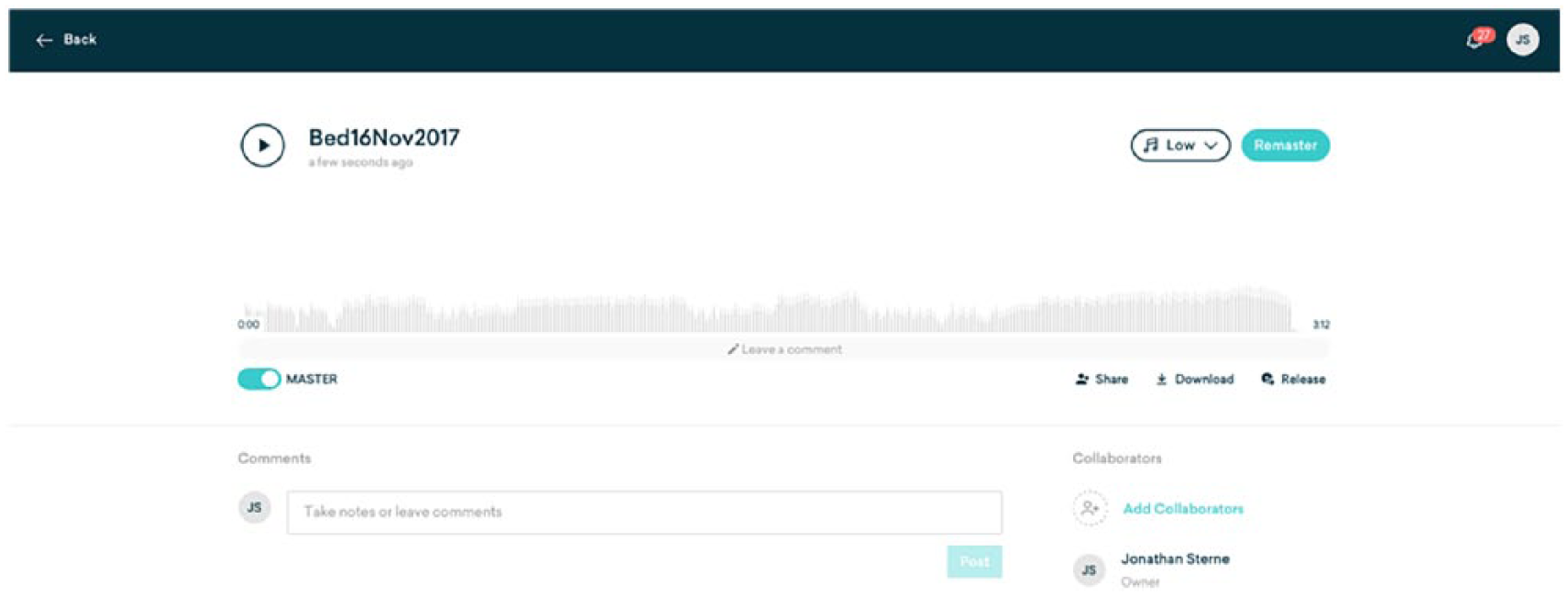
Screenshot of a mastered track with options for commentary, sharing, download, and release, again from Jonathan’s work.
In a certain sense, LANDR’s interface is ideological in the way every other software interface is ideological: the representational strategies of computer interfaces are designed to conceal some processes and decisions, while drawing attention to others; to mark some actions and orientations as “preferred” or “not preferred.” As Wendy Chun (2011) argues, “from ideology as false consciousness to ideology as fetishistic logic, interfaces seem to concretize our relation to invisible (or barely visible) ‘sources’ and substructures” (p. 59). Interfaces like LANDR attempt to construct a seamless unity out of a set of arbitrarily connected processes. As such, they represent their preferred chains of operations as “natural” for the intended user (even if in actual use, there is resistance to the scripts they set out), and they suggest analogies to understand their use. As they describe the tasks they lay out before the intended user, they also use their description of the world to make prescriptions regarding how it should be (Bourdieu, 1991). By referring to things that musicians use that are not like studio technology, such as file transfer services, and by rigorously following mainstream web design conventions, LANDR has designed an interface that calls attention to itself only to suggest that mastering is as straightforward as other things artists might do with completed audio files online. In other words, it frames mastering as one kind of commoditized service (web file service) that wholly subsumes another (audio mastering), while emphasizing ease and familiarity of use. It at once aims to demystify mastering by making it accessible and to re-mystify mastering by creating new associations for the process in the mind of the user while hiding the inner workings of the process as much as possible.
While mastering engineers draw from the history and traditions of audio engineering, LANDR draws from the tradition of web-based audio applications from Winamp on down (Morris, 2015). While users may interact with the scripts set out for them in myriad ways, the overall effect of LANDR’s approach is to transform the status of mastering from something whose inner workings are obscured for the user because of the structure of the audio industry to something that is obscured from the user because of the inner workings of its status as a web-based software service. This is a significant change. It is “technical transcoding … that nevertheless coexists with an exceedingly high level of ideological fetishism and misrecognition” (Galloway, 2012, p. 60). Software and mastering operate as meshes of discourses, materials and practices that aim to shape a corner of the auto-technical universe. Certainly, recording and mastering studios like the ones Jonathan has visited are also fetishistic and ideological in terms of how they set themselves apart from other spaces of everyday life: they use the visual rhetoric of mid-20th century electronics, evoking giant mainframe computers, telephone switchboards, or space travel (Meintjes, 2003, pp. 72, 84). But these are two totally different stories about music and technology: LANDR tells a story of consumer web services and music as data that represent sound; the blinking lights and psychocosmetics of Grey Market and Listeners tell a story about control over sound and music as vibrations in the air and as electricity that represents sound.
Frequencies Have Meanings: LANDR Versus Two Bass Hermeneutics
LANDR’s approach to control over sound also differs markedly from that of mastering engineers, and further elucidates what it means to delegate an aesthetic process to an ML-based platform. According to Evans, as well as the available evidence online, a large cross section of LANDR’s users mix music in home studios or other spaces that may not have much acoustic treatment. One of the issues for people who work in this kind of space is that they cannot hear or properly manage low frequencies. Because of their relatively longer wavelengths, low frequencies are especially prone to building up or canceling out one another in the small and imperfect spaces of amateur audio engineers. This means that LANDR gets many recordings with bass problems. If there is too much bass, LANDR clamps it down, disciplines it, and makes sure it does not overwhelm the track or blow up the speakers of anticipated future listeners. LANDR cannot tell the difference between a bass drum, a synth bass, a bass drop, a bass voice, a bass clarinet, a bass guitar, or simply “unruly” bass frequencies.
When Jonathan uploads a rock mix with a distorted bass solo, LANDR clamps down hard. It shoves it back into the music, flattening it out. In a way, this action makes sense in context. Bass solos are relatively unusual in rock songs; they break with the customary tonal palette of the style. In most music, bass and low-frequency sounds are relatively consistent. It is statistically more likely that a mix uploaded to LANDR has bass problems than a bass solo. When it gets the song, LANDR analyzes the sudden and temporary boost in low-midrange frequencies in a bass solo, treats it as something that is not supposed to happen in the music, and, therefore, reacts to it as a mistake, as a problem to fix. Over the course of several hours, in two separate sessions, Jonathan tries to game the algorithm: boost the bass more, LANDR clamps down harder; change the frequency balance, LANDR smooths it out. Nothing he can do will produce the desired result with LANDR.
LANDR does not provide any specific feedback on mixes, which exacerbates the problem here. Rather, its approach to mixes is based on feedback loops in its own operations, which it cannot explain to users (Sculley, Phillips, Ebner, Chaudhary, & Young, 2014, p. 3). A mixing engineer has to guess what LANDR will do, knowing only the inputs to and outputs from the mastering process. They can try to game the result by reverse engineering what happened, but they can only guess. It is impossible to tell just listening whether the software is an ML-based process that is doing the same thing to the audio because it detects different iterations of the same phenomenon, or whether it is simply applying a preset and Jonathan’s changes are not big enough to trigger an analysis that would yield selection of another preset. There is not enough audio evidence to deduce a cause or causes, and no amount of fiddling on Jonathan’s part changed that: opacity is actually a constitutive feature of systems like LANDR (Burrell, 2016).
Mastering engineers can also be opaque in their decision-making process, but that opacity matters in a different way. A few months after his bass solo experiments at home, Jonathan is at Listeners Mastering in Berlin. The same song with the bass solo that gave LANDR trouble plays over the speakers. Knop, a bassist himself, immediately hears the solo, tweaks a couple knobs on the EQ to bring it out more clearly as the section plays over and over, and adjusts the compression for the whole song slightly. After a few minutes of working like this, the bass solo rings through loud and proud. The drums, however, just are not working. We listen together, he makes some suggestions, Jonathan makes a few adjustments to the mix on his laptop and passes the track back to Freddy for another pass through the software. This time it sounds more dynamic and exciting to the three of us present. Knop’s decisions are still ultimately opaque to Jonathan: he did not leave the session able to reproduce Knop’s series of decisions and actions himself. But because the situation was dialogic, and because Knop heard the music as music, rather than as data, he was able to make adjustments that were more aesthetically satisfying to Jonathan and his bandmates. In this case, opacity did not matter for achieving the desired aesthetic results.
Although the two cases of back and forth are superficially similar, they reflect two very different operational sequences. In one case, the mixing engineer must go through a series of trial and error scenarios to produce a mix appropriate for the algorithm to produce a desired result. The engineer cannot talk to the algorithm, and the algorithm cannot provide a satisfactory explanation for the problem the engineer hears, so experimentation is the only option. Even if the engineer could talk with the people who produced the algorithm, they may or may not be able to explain its decisions. And even if that were the case, the algorithm might make a different decision when the revised track was uploaded. It would be wrong to render Jonathan’s interaction with Freddy as some kind of transparent revelation of mastering techniques: it most certainly was not. But because of how the mastering process was set up, it was possible to achieve a desired result.
LANDR may do different things to the same track on different days, but that would depend on how ML is implemented in their process (e.g., actually transforming the audio rather than selecting collections of presets), and whether their engineers have made a change in the ways LANDR processes audio since the date of the previous attempt. A human mastering engineer might also make two slightly different decisions on different days for the same piece of music, might also begin from “preset” ideas of how to process aspects of the sound that are built into their standard operational sequences when first working with new recordings, and different engineers will make different judgments on a given track (in fact, the variety of mastering styles is considered a good thing for the industry and for musicians). But this is not to overstate the similarity. It is common for mastering engineers to speak of knowing when to leave a track alone or even to undo their work, as when mastering engineer Bob Ludwig, describing his work on Bruce Springsteen’s Nebraska, says “I corrected the azimuth and speed of the tape, but Bruce liked it left alone” (Ketterer & Ludwig, 2015). In contrast, LANDR will never leave a track alone. In user tests, they found that the software had to do something to the unmastered track in order for users to trust it (J. Evans, Interview by authors, August 24, 2016; Piotrowska, Piotrowski, & Kostek, 2017).
The lessons learned through working with mastering engineers are transferable to work with other mastering engineers. For another mix, Jonathan kept increasing the volume of a somewhat veiled drum fill at the drummer’s request. At Grey Market Mastering, Newman heard it and—unprompted—immediately said it sounded wrong to him, and explained why. Together, mixing and mastering engineers were able to find a way to highlight the fill without it overwhelming the rest of the music. Prior work with Harris shaped how Jonathan worked with low frequencies in general. When he arrived at Listeners in Berlin, Knop had less work to do on the low end of that mix because of Jonathan’s prior learning about how to mix sound with mastering in mind. Thus, we see two kinds of learning here: both involve trial and error, both involve trust. But mastering with people relies on personal, pedagogical relationships and shared aesthetic understandings. The skills learned here are more likely to translate because the engineer has a better understanding of cause and effect. In LANDR’s case, the mixing engineer may get better at mixing for LANDR, but has no way of testing or confirming their understandings of cause and effect, and thus is not in a good position for their skills to be useful in other contexts. This works perfectly with LANDR’s platformization strategy but does nothing to prepare its users for interactions with mastering engineers—or other mixing engineers or musicians—in the future. Joseph Klett (2016) describes the deliberate obfuscation of cause-and-effect by software like LANDR as “baffling,” by which he means that the user is no longer able to fully “define the situation” in which the software acts, as it produces sound “made meaningful-to-measure.” LANDR refuses to explain its process fully, baffling its users both in the sense of confusing them about the process to which their audio is subjected, and separating them from that processwhile attempting to locate them into a particular set of economic and social relationships. The difference between using LANDR and using a mastering engineer is not the isolation of software vs. the interaction of interpersonal communication (since working with a mastering engineer can also be highly impersonal), but rather the balance of relationships and agencies in a given situation. both the company and the people “serve” their clients, but LANDR serves its own platform; Newman and Knop serve their scenes. In part, one could argue the difference is between artisanal and industrial capitalism in a cultural domain. But this would be to isolate mastering too much from other cultural processes: it would be more accurate to say that what Newman and Knop do feels more like artisanal capitalism in the highly customized spaces and experiences they provide; LANDR’s lack of customization feels more industrial, but also more, for lack of a better term, platformy.
Conclusion
The relationship between mastering engineers and LANDR is not a John Henry-like battle between man and machine. To tell the story in that way is to obscure the degree to which AI for music is still intertwined with human action and decision-making. After much agonized comparison of freeform DJs and recommendation systems, in 2014, Spotify quietly began to rely on human curators in creating many of its most popular playlists. It is now a standard practice in the industry, adopted by Apple Music and Google Play (Ugwu, 2016). More than once, app creators had to tweak their algorithms to adapt to human expectations. As we have seen, the LANDR algorithm has to master a track even if it determines that a change is not necessary, just because its users expect a change. Likewise, Apple had to change its algorithm for random song plays in iTunes because users were upset when the same song came up twice in a row—a normal consequence of true randomization (Levy, 2006).
LANDR is not a stable entity; and neither is mastering. Venture capital has led the company to expand in different ways. Requests from users led it to take on album mastering in form if not in substance. It has used the local music scene as a source for talent, as a lever for legitimation, and as a place to try out different identities. Its interface and advertising rhetoric have undergone changes during the period of our study, and we expect that its back end has undergone changes as well, though we cannot prove that. The rhetoric around AI and labor is that it automates jobs away from people, but this is not what has happened with LANDR, at least not yet. Rather, it has morphed the definition of mastering, possibly expanding it, though potentially in problematic ways. The service may, in time, take jobs from low-level mastering engineers. It may also find other markets as its service improves, like mastering for film, TV, or advertising (at the time of our study, LANDR did offer unadvertised services to larger firms). But no music mastering engineer we met in this study expressed any concern about LANDR as a threat to their business. Larry Crane noted the same indifference as well in his world. The app gives mastering options to amateur and cash-strapped musicians who otherwise would not have them, at the same time as it reshapes standards and expectations for their demos and samples. Independent artists have participated in the creation of the algorithm as LANDR employees and collaborators, but with only temporary financial gain and with little credit given in the end, as with other new media companies. And any individual artist may use or not use LANDR depending on availability of funds and aesthetic goals for a particular project. Artists and engineers who have access to a human mastering engineer still have a much better chance to learn and improve in their craft in a way that makes sense for all future work; LANDR teaches engineers to produce better mixes for LANDR. The mastering industry is also changing for reasons that have nothing to do with LANDR: when Jonathan started recording, mastering involved conversion from one format to another and had no online component. Today most mastering houses have integrated the internet into their business in one way or another. High quality software and easier access to knowledge about sound and acoustics has theoretically reduced barriers to entry into the business, while shrinking major label budgets has squeezed the top end of the business. But mastering shows no sign of being automated out of existence, despite the claim of services like LANDR. If anything, they are offering mastering to clients who might otherwise not paid for it at all.
The LANDR story suggests a set of questions we should ask as AI-enabled applications move further into aesthetic domains. Like algorithms that correct photo and video images, mastering algorithms (and music recognition algorithms) seem unknowable—“black boxed”—if we zoom in too closely on their operational protocols, but their social existence is legible with a little analysis and comparison. They exist within operational sequences that go far beyond the simple facts of signal processing. AI and ML are often represented as complete breaks with prior technical practice, and in some spheres, they might be. But we should be wary of exaggerating the role of AI in isolation from other factors. From the standpoint of culture, as of yet AI has not produced a major paradigm change, and it requires analysis through the already available tools of media studies, science and technology studies, and more generally the tools of the humanities and social sciences. Researchers should not assume that the most important expertise for the critical study of AI is in the internal workings of ML.
Inasmuch as online platforms have tended toward concentration of ownership and market share, we should attend to the political, technical, industrial, and cultural stakes of removing aesthetic decisions from the cultural contexts in which they occur and locating them instead in a “platform” context. After all, companies sell music as a product or service; people make music for all sorts of reasons, and the making can be an important part of the social and economic life of a scene or community, as the Montreal scene and both Berger’s and Knop’s careers show. Like art, film, games, literature, journalism, and countless other cultural practices, music is more than “data” to be processed, “content” to be shared, though of course it can be that as well. Larry Crane’s main concern about LANDR seemed to be that it devalues the creative process and the people involved in making music; in this, they are hardly alone among new media businesses. LANDR’s organizational strategies are focused around return-on-investment for venture capitalists and around a diversified platform of services designed to maximize user engagement and generate a valuable data set. At the same time, LANDR is clearly of use to many of its users—including Jonathan. But that utility comes as much in spite of LANDR’s organizational and technical values as because of them. Far from the spectacular rhetoric around AI as an emergent form of nonhuman agency, in learning from LANDR we find a very a familiar set of agencies—financial, corporate, technical, musical, and human—hard at work in a new setting.
Footnotes
Acknowledgements
We would like to thank everyone who took time to talk with us about our research and educate us about their work and art. For comments on drafts, we thank Carrie Rentschler, Nick Seaver, David Suisman, Andy Stuhl, members of the CATDAWG and Bits, Bots, and Bytes working groups at McGill, as well as audiences at the Association of Internet Researchers, Penn State, Humboldt University, Stanford, Vanier College, and AI Now.
Declaration of Conflicting Interests
The author(s) declared no potential conflicts of interest with respect to the research, authorship, and/or publication of this article.
Funding
The author(s) disclosed receipt of the following financial support for the research, authorship, and/or publication of this article: This work was supported by the Social Sciences and Humanities Research Council of Canada.
