



Abstract
The 2016 US Presidential Election provided an opportunity to examine how political candidates’ use of social media can affect voting intentions. This study considers how political candidates can use social media to increase potential supporters’ perceptions that they will win the election, providing them extra motivation to go out and vote. Results from a two-wave survey provide evidence that following the in-group candidate (Trump or Clinton) relates to voting intentions through the increased belief that the candidate would win. However, this mediation effect occurs for only supporters of Trump or Clinton, but not for partisans of the opposing party.
Introduction
The 2016 US Presidential Election cycle was historic. A woman won the Democratic Party’s nomination and a businessperson with no experience in public office won the Presidency. Mainstream news media reported on the campaign and candidates in relatively predicable ways: who was ahead in the polls, campaign events, and to a lesser extent, about specific policies. Despite constant news attention and a high level of citizen interest in the election, many citizens were unenthusiastic about the prospects of voting for either candidate, as Trump and Clinton were among the least popular presidential candidates in recent history (Saad, 2016). Consequently, an atypically large number of voters, including some partisans, were undecided about whom they would vote for (Silver, 2016). In this context, the candidates were faced with the task of rallying potential voters to support their campaign. Trump and Clinton utilized the opportunities afforded by social media platforms to communicate about their campaign, critique the opposing candidate, and provide an optimistic outlook about their chances of winning the election. This study considers how political candidates can use social media to increase potential supporters’ perceptions that they will win the election, providing them extra motivation to go out and vote.
Perception of a candidate’s viability can have an important effect on citizens’ voting behavior (Abramowitz, 1989; McAllister & Studlar, 1991; Utych & Kam, 2013). In a tumultuous election, apathetic partisans may look for confirmation that their candidate is likely to win. Partisans who followed Trump and/or Clinton on social media were likely to find an overly optimistic narrative. Trump’s social media messages often described himself as an outsider, looking to “drain the swamp,” “Make America Great Again” at the same time suggesting he would beat “Crooked Hillary” in spite of “Fake News” and “Rigged Elections.” Comparatively, many of Clinton’s messages maintained that Trump was unfit to be President and subtly assured followers that her presidency was inevitable.
Political candidates commonly use social media platforms to craft alternative election narratives (Howard, 2006; Kreiss, 2012). Different political narratives can affect citizens’ political perceptions and orientations, which, ultimately, provide the framework through which political action ensues (Edelman, 1988; Entman, 1993). However, the extent to which a citizen is likely to buy into a candidate’s portrayal of election outcomes should depend upon whether they share the same party affiliation. When partisans follow an in-group candidate on social media, receiving information directly from the “horse’s mouth,” they should readily accept a narrative that supports their partisan goals, leading to an increased perception that the candidate is poised to win the election. Conversely, members of the opposing party may dismiss the information or think about how to counter-argue it (see Slothuus & De Vreese, 2010). Such perceptions may be particularly important in elections where enthusiasm is low, as a citizen’s perceptions about the likelihood a candidate will win the election may help determine whether that citizen is motivated to vote for that candidate (Abramowitz, 1989; McAllister & Studlar, 1991; Utych & Kam, 2013).
This study considers the relationship between attention to social-mediated candidate communication, perceptions of candidates’ likelihood of winning an election, and intention to vote for candidates. The 2016 US Presidential Election provides a unique case study to examine these relationships. This study employs a two-wave survey with a national sample to test our expectations that following the in-group candidate (Trump and Clinton) on social media relates to intentions to vote for them through the perception that a candidate was likely to win the election. Our results show the importance of using social media to facilitate favorable attitudes among candidates’ supporters.
Literature Review
Controlling the Message: Candidate Social Media Communication
Today, citizens can choose to get their political information from a wide variety of options. Many citizens do, of course, still turn to the news media to retrieve political information (Massanari & Howard, 2011; Sydnor & Psimas, 2017). During election periods, news media cover candidates in different ways. They may report on who is ahead in polls, debates, and speeches, and sometimes to a lesser extent, policy issues. Exposure to news frames can affect citizens’ political attitudes and orientations (De Vreese, 2004; Entman, 2003) and influence how they think and feel about political issues and events (Lecheler, Keer, Schuck, & Hänggli, 2015; Pfau, Cho, & Chong, 2001; Scheufele, Kim, & Brossard, 2007; Schuck et al., 2013).
Although political candidates have limited control over how mainstream news media frame the election, candidates are increasingly using social media platforms to craft alternative election narratives (Howard, 2006; Kreiss, 2012). Candidates have adopted digital communication for strategic purposes, allowing supporters to engage with the campaign in ways beneficial to the candidate (Stromer-Galley, 2014). Truly interactive communication between candidates and constituents via social media is limited. Kreiss (2016) showed that during the 2012 Presidential Election, campaign staffers understood the “virality” of a campaign moment and disseminated social media information that would influence journalists and fulfill expectations of social media followers.
During the 2016 US Presidential Election, Donald Trump and Hillary Clinton used social media to befit their campaigns in divergent ways (Enli, 2017). Enli suggests Trump used an “amateurish” approach and turned away from the traditional norms of organization, strategy, and content, whereas Clinton’s more “professional” posts resembled established norms. Trump’s continual posts about “fake news” were a rallying point for his supporters, but he also posted contestable and sometimes categorically inaccurate content. By doing so, Trump was able to deflect the impact of criticisms of his own inaccuracies by saying news media were doing the same thing (A. S. Ross & Rivers, 2018). Importantly, candidates may come across as most honest on social media, compared with talk shows, speeches, and news interviews, primarily because they are perceived as created by the candidate, users can provide feedback, and individuals may trust candidates posting on a relatively “new” medium (Enli & Rosenberg, 2018).
Altogether, social media affords politicians the ability to frame political moments in ways that align with their campaign strategy. This may include providing an overly optimistic portrayal of their chances of winning an election, regardless of the realities of the campaign. Posting about positive poll numbers and endorsements or attacking the shortcomings of another candidate or media coverage may foster a positive feeling for those supporting the candidate. In the case of Trump, posts about “Crooked Hillary,” “Fake News,” or “Making America Great Again” likely spurred confidence and perhaps anger for his supporters. Similarly, Clinton posting about endorsements, mainstream news coverage showing her leading polls, and attacks on Trump’s temperament likely encouraged optimism about her likelihood of winning. The degree to which citizens buy into and internalize the candidate’s portrayal will depend, in larger part, on whether they are members of the same or opposing party as the candidate.
Social Media Following and Partisan Motivated Reasoning
According to partisan motivated reasoning, partisans often interpret and process information in a way that is consistent with their party identification (Druckman, Peterson, & Slothuus, 2013; Leeper & Slothuus, 2014; Taber & Lodge, 2006). Partisans tend to dismiss or counter-argue political arguments if they are inconsistent with their partisan goals. Information that supports their party, on the other hand, is often sought out, eagerly accepted, and perceived to be more convincing (Druckman et al., 2013; Kim, Taber, & Lodge, 2010; Slothuus & De Vreese, 2010). This biased processing can lead to attitude polarization, as partisans accept and internalize congruent information, while rejecting incongruent information (Taber & Lodge, 2006).
Partisan motivated reasoning can often be activated by source cues. When partisans receive information sponsored by the political in-group, they will be motivated to support the opinions, attitudes, or policy positions expressed by their party (Petersen, Skov, Serritzlew, & Ramsøy, 2013; Slothuus & De Vreese, 2010). Conversely, if the political out-group presents the same information, they would be more likely to oppose and counter-argue the information (Bolsen, Druckman, & Cook, 2014; Druckman et al., 2013). Slothuus and De Vreese (2010) show that partisans are more likely to accept and favorably assess a political frame disseminated by members of their party. Furthermore, this tendency to accept a party sponsored frame, while rejecting frames promoted by the opposition, is heightened during partisan conflict (Slothuus & de Vreese, 2010).
Social media provides ample opportunities to accept or reject the information based on partisan identification. Bode and Vraga (2015) show exposure to social media news feed posts about an issue reflecting their opinion resulted in rating it favorably. Similarly, users exposed to posts aligning with their political views are more likely to rate the post as accurate, compared with users seeing the post that did not align with their views. Posts with misinformation are also rated differently based on personal views (Kahne & Bowyer, 2017).
In the context of an election, when partisans encounter political frames sponsored by their party’s political candidate (i.e., candidate’s social media), they should be more likely to accept and internalize the arguments. When they encounter arguments sponsored by the opposing candidate, they should be more likely to either dismiss the message outright, or engage in effortful counter-arguing. Thus, when partisans are regularly exposed to messages sponsored by the in-group candidate that indicate they are likely to win the election, partisans should assimilate this perspective and grow more confident in their candidate’s prospects. Alternatively, if they see such an optimistic portrait from the opposing candidate, they are likely to reject the message as misguided, perhaps becoming even more confident that the perspective is wrong (i.e., attitude-polarization; see Taber & Lodge, 2006). Based on this rationale, we predict:
H1: Partisans will be more likely to believe the in-group candidate will win the election when following that candidate on social media.
H2: Partisans will be less likely to believe the out-group candidate will win the election when following that candidate on social media.
Perceived Likelihood of Winning Election
Believing a candidate will win an election can have an important effect on citizens’ voting behavior during elections (Abramowitz, 1989; Miller, Wang, Kulkarni, Poor, & Osherson, 2012). When candidates are perceived to be viable, individuals are more likely to seek out information about that candidate, to favorably evaluate that candidate, and to vote for that candidate (Utych & Kam, 2013). It has long been argued that citizens are more likely to join the “bandwagon” and vote for candidates that they believe are doing well in the polls (McAllister & Studlar, 1991). Polls can encourage individuals to follow the majority opinion, while discouraging those with minority opinions (Rothschild & Malhotra, 2014). Crucially, citizens’ perceptions about candidates’ electoral prospects are more influential on their likelihood of voting than the actual reality of the electoral competition (McDonald & Tolbert, 2012).
Therefore, the degree to which a candidate can affect a citizen’s perceptions about the likelihood that they will win the election may help determine whether the citizen is motivated to vote for that candidate. These perceptions should be highly influenced by the political information a citizen has been exposed to. Politicians, news media, and partisans can discuss polling numbers, political momentum, public opinion, and recent events in very different ways. Thus, an individual’s exposure to a candidate’s social media communication can have important consequences for their perception of what will happen in an upcoming election. Candidates’ social media posts and users’ attitudes developed after seeing them likely carries over to participating politically, including voting (Towner & Dulio, 2011; Williams & Gulati, 2008). We therefore predict:
H3: Perceived likelihood that a candidate will win the election will be related to higher intention to vote for that candidate.
Finally, based on the predicted chain of events hypothesized above, we also predict the following indirect effects:
H4: Partisans who follow the in-group candidate on social media will be more likely to vote for that candidate through increased perceptions that the candidate will win the election.
H5: Partisans who follow the out-group candidate on social media will be less likely to vote for that candidate through decreased perceptions that the candidate will win the election.
Method
Data
To test our hypothesized model, we employed a two-wave national panel. Participants were recruited by Survey Sampling International (SSI). SSI recruits potential participants from its panels, online communities, social media, and websites and compensates them via cash, prizes, charitable donations, and various other incentives. 1201 US adults were initially recruited over a 1-week period in early October 2016. Participants who completed the survey were invited to participate in a follow-up survey during the first week of November 2016. A total of 498 participants completed the second survey. The sample was 45.6% Democrat, 25.5% Republican, and 27.1% independent. Our analysis focused on Democrats and Republicans, giving us a final sample of 354 participants (64.7% Democrat and 35.3% Republican).
Measures
Candidate Social Media Following
The degree to which participants followed each presidential candidate on social media was measured by asking respondents: “How often do you use the following sources to get news and information about the 2016 presidential election: Facebook page, Twitter account, Snapchat account, Instagram account, and personal website” (1 = never; 7 = very frequently). Participants’ scores for each candidate’s social media sites were merged to create a social media following variable. Participants’ scores for following Hillary Clinton (Cronbach’s α = .98; M = 2.51; SD = 2.05) or Donald Trump (Cronbach’s α = .97; M = 2.20; SD = 1.81) were then matched to partisan affiliation to create in-group and out-group social media following variables. That is, the in-group social media following variable (M = 3.01; SD = 2.22) included Democrats’ scores for Clinton following and Republicans’ scores for Trump following; the out-group social media following variable (M = 2.22; SD = 1.89) included Democrats’ scores for Trump following and Republican’ scores for Clinton following. To note, the large standard deviations for these variables suggest that while some respondents likely don’t get news and information from candidate’s social media accounts, others do at least occasionally and still others somewhat frequently.
Perceiving Likelihood of Candidate Winning Election
To measure respondents’ perception that the in-group or out-group candidate would likely win the 2016 US Presidential Election, participants were asked, “Just your best guess—how likely do you think it is that the following candidates will win the presidential election?”(1 = very unlikely; 7 = very likely). Respondents reported believing Clinton had a better chance to win the election (Wave 1: M = 5.10; SD = 1.78; Wave 2: M = 5.05; SD = 1.91) than did Trump (Wave 1: M = 3.68; SD = 1.99; Wave 2: M = 3.76; SD = 2.03). Perceiving Likelihood of the In-group Candidate Winning (Wave 1: M = 5.60; SD = 1.55; Wave 2: M = 5.60; SD = 1.64) was constructed by including Democrats’ perception that Clinton would win the election and Republicans’ perception that Trump would win. Perceiving Likelihood of the Out-group Candidate Winning (Wave 1: M = 3.32; SD = 2.00; Wave 2: M = 3.38; SD = 1.99) was constructed by including Democrats’ perception that Trump would win the election and Republicans’ perception that Clinton would win.
Likelihood of Voting for Candidate
Our dependent variable measured the likelihood that a participant would vote for either the in-group or out-group candidate. Participants were asked, “How likely are you to vote for the following presidential candidates?” (1 = very unlikely; 7 = very likely). Overall, participants expressed a greater likelihood of voting for Hillary Clinton (Wave 1: M = 4.45; SD = 2.55; Wave 2: M = 4.41; SD = 2.61) than Donald Trump (Wave 1: M = 3.40; SD = 2.50; Wave 2: M = 3.48; SD = 2.54). Likelihood of Voting for the In-group Candidate (Wave 1: M = 5.97; SD = 1.65; Wave 2: M = 5.85; SD = 1.86) was constructed by combining Democrats’ expressed likelihood of voting for Clinton and Republicans’ expressed likelihood of voting for Trump. Likelihood of Voting for the Out-group Candidate (Wave 1: M = 2.26; SD = 2.00; Wave 2: M = 2.34; SD = 1.99) was constructed by combining Democrats’ expressed likelihood of voting for Trump and Republicans’ expressed likelihood of voting for Clinton.
Controls
Candidate Favorability
To account for the influence of pre-existing support for a candidate, we controlled for how favorably participants felt toward the candidates at Wave 1. Participants’ favorability toward the in-group and out-group candidates was measured with a 100-item slider scale where 0 represented unfavorable evaluations and 100 represented favorable evaluations. Participants were asked how favorably they felt about Clinton (M = 48.61, SD = 36.76) and Trump (M = 35.75, SD = 35.69). In-group Candidate Favorability (M = 69.81, SD = 30.02) was constructed by combining Democrats’ favorability toward Clinton with Republicans favorability toward Trump. Out-group Candidate Favorability (M = 20.74, SD = 27.84) was constructed by combining Democrats’ favorability toward Trump with Republicans favorability toward Clinton.
Demographics
Demographic control variables included age (M = 40.22; SD = 14.66), gender (41.6% female), race (86.7% Caucasian), education level (some high school = 1.6%, high school/GED equivalent = 17.6%, some college = 21.9%, college graduate = 39.1%, and postgraduate degree = 19.8%), and income level (less than US$29,999 = 18.3, US$30,000 to US$59,999 = 26.4%, US$60,000 to US$99,999 = 31.8%, US$100,000 to US$149,999 = 14.5%, and US$150,000 or more = 9.1%).
News Media Exposure
Participants were asked whether they read or watch news from a wide range of sources (1 = never; 7 = very frequently). Indices were created for mainstream news, conservative news, and liberal news. Mainstream news included national newspapers, local newspapers, national television news broadcast, local television news broadcast, online national TV news websites, online local news websites, online national newspaper websites, and online news magazine websites (Cronbach’s α = .93; M = 4.31; SD = 1.70). Conservative news included cable news programs on Fox News and conservative news websites (Spearman–Brown = .62, M = 3.73; SD = 2.06). Liberal news included cable news programs on MSNBC, cable news programs on CNN, and liberal news websites (Cronbach’s α = .89; M = 3.84; SD = 2.02)
Political Orientation
We also controlled for participants’ general political orientation. These variables included ideology (1 = very liberal; 7 = very conservative; M = 4.08; SD = 1.82), and political interest (“How interested are you in what’s going on in government and politics?” [1 = not at all interested; 7 = extremely interested; M = 5.61; SD = 1.44]).
Analytic Technique
Analysis was performed using the SPSS Macro PROCESS Model 4 (Hayes, 2012), which examines the relationship between an X variable (social media following), a Y variable (intention to vote), and an M (mediating) variable (perceived likelihood candidate will win election). We used an autoregressive model, where the Wave 1 score on social media following was used to predict the Wave 2 scores for intention to vote and perceived likelihood a candidate would win the election, with the Wave 2 measures (T2) for voting intentions and perceived likelihood of winning regressed on the Wave 1 measures (T1) to to control for the influence of the prior levels of the variables (Maxwell, Cole, & Mitchell, 2011). The model also included candidate favorability at Wave 1, along with several demographic and political orientation control variables. Figure 1 displays our analytic model.

Conceptual model for following political candidate on social media.
Prior to analysis, all variables were standardized so that the resulting regression coefficient can be interpreted as a fully standardized score. Indirect effects were examined using a bootstrap analysis with 5,000 bootstrap samples and a 95% confidence interval (CI). Using this method, when an indirect path’s CI does not overlap zero (e.g., .3 to .5) it is considered significant at p < .05, and if it does overlap zero (e.g., −.3 to .5) it is considered nonsignificant.
Results
Likelihood of Voting for In-Group Candidate
Our first hypothesis predicted that following the in-group candidate on social media would lead to a higher perception that they were likely to win the election. As shown in Table 1, following the in-group candidate on social media is significantly related to perceiving that he or she will win the presidential election (β = .25; p = .002). Thus, H1 was supported.
Following In-Group Candidate on Social Media Model.

< .10.
p < .05
p < .01.
p < .001.
Next, we hypothesized that citizens who believed a candidate was going to win the election would be more likely to express intentions to vote for that candidate. As expected, we found that those who believed the in-group candidate would be elected were significantly more likely to vote for the in-group candidate (β = .40; p < .001). We therefore find support for H3.
Finally, as expected, we find a significant indirect effect from following the in-group candidate on social media on likelihood of voting for the in-group candidate through perceived likelihood that candidate would be elected b = 0.10, SE = 0.03 (CI: 0.04, 0.17), p < .05. Thus, H4 was supported.
Likelihood of Voting for the Out-Group Candidate
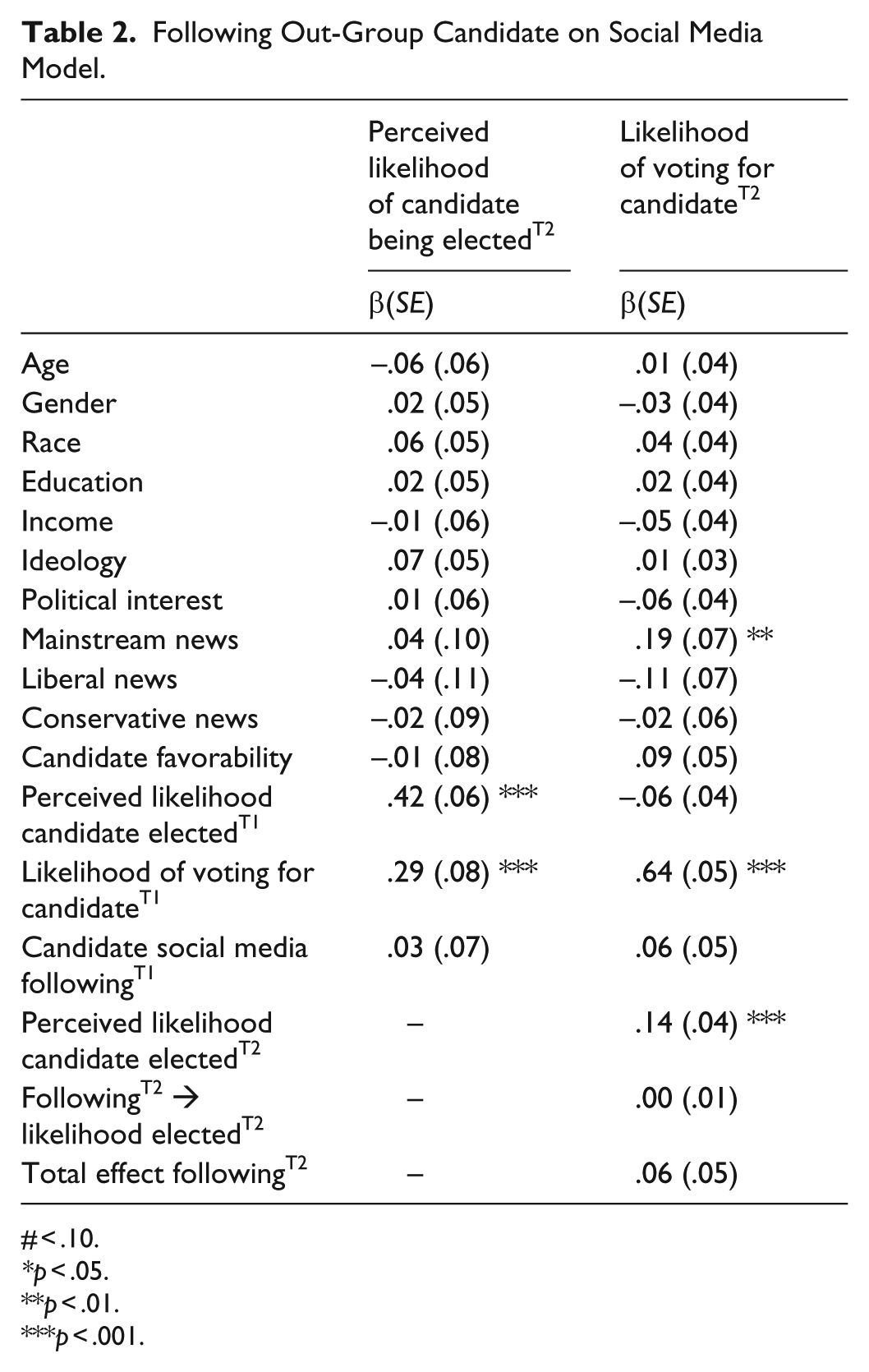
Our second hypothesis predicted that following the out-group candidate on social media would lead to a decreased perception that the candidate would win the election. As seen in Table 2, following the out-group candidate on social media was not significantly related to perceiving that he or she will win the presidential election (β = .03; p = .656). H2 was not, therefore, supported.
Following Out-Group Candidate on Social Media Model.
< .10.
p < .05.
p < .01.
p < .001.
Next, we see that those who believed the out-group candidate would be elected (β = .14; p < .001) were significantly more likely to vote for the out-group candidate. This provides additional support for H3.
Finally, there was not a significant indirect effect from following the out-group candidate on social media on likelihood of voting for the out-group candidate through perceived likelihood that the candidate would be elected b = 0.00, SE = 0.01 (CI: − 0.02, 0.04), ns. We therefore fail to find support for H5.
Discussion
Candidates’ social media use for campaign communication continues to evolve, and its role in influencing electoral politics is undeniable. Candidates can control the message they communicate to supporters via these media, painting an overwhelmingly positive and optimistic portrayal of their candidacy. Doing so is important to contrast other media coverage that may provide a more negative portrayal of their political campaign. Indeed, both mainstream news sources as well as partisan sources influence how voters perceive the candidates and their campaigns. Our study considers how during a period shortly before the 2016 US Presidential Election individuals’ attitudes and voting intentions were influenced by Hillary Clinton’s and Donald Trump’s social media posts. The results suggest that following these candidates relates to intending to vote for the candidate through the increased belief that the candidate would win. However, this mediation effect occurs for only supporters of Trump or Clinton, but not for partisans of the opposing party.
Results of our study show that when partisans follow the in-group candidate, they become more likely to perceive the candidate will win the election, which increases their intentions to vote for the candidate. When partisans follow the opposing candidate, on the other hand, they do not appear to buy into the narratives being promoted by that candidate—as following is not related to perception that the candidate will win the election. These results are consistent with partisan motivated reasoning, which suggests that partisans are willing to quickly accept and internalize the political frames promoted by the in-group party, while resisting the messages promoted by the out-group party (Petersen et al., 2013; Slothuus & De Vreese, 2010). We believe this is important, contributing to the literature signifying the power social-mediated campaign communication plays in influencing attitudes in a complex news media environment (Bimber, 2014; K. Ross & Bürger, 2014).
The way that various sources explain electoral politics can have important implications for citizen attitudes. News media play an important role in explaining politics, oftentimes reporting on current events in ways that contribute to individuals’ attitudes about those issues. This explanation tends to be repeated in news media over time, leading individuals to understand complex issues in relatively simple ways. When specific coverage puts candidates in a negative light (e.g., they are likely to lose or a controversy is likely to hurt them), candidates must attempt to refocus on positive characteristics about their candidacy, highlighting specific themes, topics, and interpretations that favor them. Although candidates have limited control of how mainstream news media report about them, social-mediated communication provides an opportunity for candidate to reshape the election narrative (Kreiss, 2012), potentially providing some much needed optimism and enthusiasm for partisans who may be feeling apathetic about their party’s candidate.
This study demonstrates partisans who followed Donald Trump or Hillary Clinton on social media had different perspectives of the 2016 Presidential Election. The election included Trump, who wanted to “drain the swamp” of political elites in federal government. Despite Trump’ populist appeal, mainstream news media consistently reported on public opinion polling showing him losing to Clinton. Via social media, especially on Twitter, Trump lambasted “fake news” reports on these polls and assured his followers he would win the election. He also repeatedly tweeted about how “crooked Hillary” was unfit to be President and that he would “make American great again.” These messages, we argue, created a distinct narrative for his supporters who followed him on social media—one where Trump’s chances of being elected were far greater than reported in the news media. Supporters who followed Trump saw consistent information: mainstream news media couldn’t be trusted and were attempting to ruin his candidacy, he was a better choice for president compared with Hillary Clinton, and he would win the election.
Clinton also used social media to control messages about her campaign and critique Trump’s candidacy. To be sure, these messages likely enhanced positive feelings for followers who supported her. Clinton used social media to promote herself as a conventional candidate for president and critique Trump as an unimaginable candidate. She also used social media to supplement mainstream news media’s reporting on her ahead in the polls—helping to reinforce beliefs that her election was inevitable. Clinton’s supporters saw consistent and similar messages via her social-mediated campaign communication and mainstream news media. From this perspective, not only were the polls correct that Clinton would win the election, but the alternative (Trump winning) was likely interpreted as out of the realm of possibility.
The mediation role of perceiving the candidate would win the election mattered for those from the same party of either Trump or Clinton, not those opposing party’s candidate. We did expect that partisans who followed the opposing candidate on social media would engage in effortful counter-arguing (e.g., finding reasons to believe that candidate was unelectable), which would actually make them more confident that the opposing candidate would lose the election. While we did not find a significant negative relationship between following the out-group candidate and perceived likelihood of winning, the lack of a significant relationship still implies that, at the very least, partisans from the opposing party are not likely to accept the narratives promoted by the out-group candidate.
Thus, our results provide evidence suggesting partisans interpret and process political candidates’ social media messages in ways consistent with their party identification. Clinton’s traditional, professional use of social media such as posting endorsements, popular public opinion polls showing her in the lead, and other mainstream news media reports likely did not alter attitudes for those reporting affiliation with the Republican Party, even if they were skeptical of Trump as President. These followers may have perceived politics as usual or a perpetuation of the mainstream Trump lambasted. Likewise, those following Trump but not supporting him may have done so for the spectacle of their perceived amateurization of social media use as well as to confirm their beliefs he was unfit for President. These results support research showing people tend to accept messages from their in-group and reject messages from the out-group, especially during partisan conflict (Slothuus & De Vreese, 2010), including on social media (Bode & Vraga, 2015; Kahne & Bowyer, 2017).
Importantly, we employ a two-wave panel approach using an autoregressive model in an attempt to draw causal conclusions like other research examining similar relationships (Dimitrova, Shehata, Strömbäck, & Nord, 2014; Kruikemeier & Shehata, 2017; Maxwell et al., 2011). We show that during the final month of the campaign, the candidates’ social media messages affected their followers’ attitudes and subsequently, their voting intentions. As mainstream news media continued to report about the election in similar ways, the candidates’ social media messages simultaneously continued to influence their supporters’ attitudes. Trump’s social media posts against the mainstream and Clinton’s posts with the mainstream mattered. The two-wave panel approach allows us to be more confident that there is a causal effect of the candidates’ message dissemination on individuals’ political behavior than could be inferred from cross-sectional date. In addition, by controlling for candidate favorability, we are able to account for the high correlation between following a candidate and perceiving they will win the election and/or being likely to vote for them.
At the same time, our study does have some notable limitations. One main limitation revolves around variable operationalization. The study does not measure actual voting behavior, rather only intentions to vote. Although we anticipate voting intentions to be similar voting, especially because we asked days before the election, we cannot rule out respondents changing their vote or not voting at all. Another potential limitation is that we measured social media following as a whole, limiting the understanding of the extent to which sites like Facebook and Twitter and content may play different roles in campaign communication. The nuanced nature of social media suggests that there is value in examining platform-specific and content-specific effects on political attitudes and behavior. These distinctions may be particularly important given that candidates can use social media platforms in different ways. Readers should also note some respondents rarely get news and information from the candidates’ social media accounts, but many others do so at least occasionally.
Furthermore, political campaigns are increasingly using sophisticated data analytics to direct targeted messages to potential voters (Bimber, 2014; Kreiss, 2016; Stromer-Galley, 2014). Indeed, algorithms often determine which messages a citizen will encounter on a specific social media platform (Yeo, Cacciatore, & Scheufele, 2015). This is all to say that we cannot assume that by “following candidates on social media” partisans were encountering the same messages. The very high reliability scores for our social media following variables, however, do provide some degree of confidence that citizens who do follow a candidate on social media are likely to follow them on multiple platforms, leading to exposure to an overarching narrative. Furthermore, we should expect that these messages generally contain an optimistic and overly positive portrayal of the candidate’s campaign, regardless of message personalization. However, the study did not measure the actual message frames; interpretation of the results should be in the realm of patterns of information gathering. Finally, the low attrition rate for our sample is a limitation, as is our over-representation of Democrats. However, because our expectations were based on partisan motivated reasoning, Democrats and Republicans should have the same underlying motivations for how they process and interpret messages from the in-group and out-group candidates.
Despite these limitations, our findings provide insight into an important mechanism by which candidate social media communication influences election outcomes. Information from individuals’ social network is vital for their understanding and attitudes about politics, and these attitudes influence participating in democracy (Ancu & Cozma, 2009; Blumler & Kavanagh, 1999; Serazio, 2014; Xenos & Foot, 2005). Because candidates need to convince citizens to vote for them and citizens get information from a variety of sources, social media provides candidates an opportunity to persuade followers about their campaign and elections as they see fit (Gerodimos & Justinussen, 2015). Doing so is important when other information sources, including mainstream news media, discuss a candidate’s campaign is ways not consistent with the candidate’s message. A candidate’s social media campaign communication can combat this information, leading to a narrative that can help being elected.
Footnotes
Declaration of Conflicting Interests
The author(s) declared no potential conflicts of interest with respect to the research, authorship, and/or publication of this article.
Funding
The author(s) received no financial support for the research, authorship, and/or publication of this article.
