



Abstract
This article examines how social media consumption habits predict non-monosexuals’ (people who are neither gay nor straight) communication with dominant groups. Using a survey (N = 716), the study applies co-cultural theory to evaluate how they respond to discrimination. The findings of this study indicate that non-monosexuals are heavy users of social media and that it plays a significant role in their perceptions of their environment. Several lifestyle variables, including their field of experience, ability, and perceptions of costs and rewards, can predict the outcomes that non-monosexuals seek when responding to discrimination. Furthermore, social media moderate those relationships. Overall, the sample preferred an outcome of accommodation, indicating that they hope for equality and acceptance.
In the last several years, US society has made significant progress toward sexual orientation equality legally (Bumiller, 2011; de Vogue, 2017) and culturally (Domonoske, 2016; Zappulla, 2017). However, mainstream conceptualizations of gender and sexuality are largely grounded in binaries that view people as either gay or straight or male or female (MacInnis & Hodson, 2012; Roberts, Horne, & Hoyt, 2015). And yet, millions of people defy these limitations. Non-monosexuals, people who are neither gay nor straight, may be attracted to more than one gender or may not experience sexual attraction at all. Their identities are rejected by mainstream society. As a result, they are invalidated, stereotyped, threatened, and excluded from LGBTQ+ (lesbian, gay, bisexual, trans, queer, and other additional sexualities and genders) spaces.
This study explores the relationship between social media consumption habits of non-monosexuals and their communication practices in the face of monosexism. Using co-cultural theory, this study examines whether social media moderate the relationship between a non-monosexual person’s experience and the way they choose to communicate in the face of discrimination. The goal of this study is to encourage the academic analysis of non-monosexual identities and evaluate the impact of media on the communication habits of a marginalized community.
What is Non-Monosexuality?
This research focuses on non-monosexuals. Monosexuality is the romantic or sexual attraction to only one gender (Galupo, Mitchell, & Davis, 2015). Non-monosexuality encompasses all sexual orientations that exist outside of this gay/straight dichotomy (Flanders, Robinson, Legge, & Tarasoff, 2016). These include bisexuality, pansexuality, queerness, and several sexual–asexual orientations.
As a sexual orientation, bisexuality is the capacity to form romantic or sexual attractions to more than one gender (Wilde, 2015). However, the term “bisexuality” can also be used as an umbrella term to encompass all sexualities that include attraction to more than one gender, including pansexuality, and those who choose to label themselves “queer” (GLAAD, 2016; Hilton-Morrow & Battles, 2015). Through-out this study, “bisexuality” will refer to this larger, all-encompassing interpretation. Asexuality refers to a lack of sexual attraction, but not necessarily a lack of romantic affection (Overview, n.d.). Like bisexuality, asexuality can be used as an umbrella term to include a spectrum of sexual orientations with little or no sexual attraction (Beemyn, 2015) including demisexuality and gray-asexuality (“Under the ace umbrella,” Asexual Visibility and Education Network [AVEN], 2012; van Anders, 2015). “Asexuality” will similarly refer to this general experience in this study.
According to a British survey, approximately, 1.05% of the population identified as asexual in 2004 (Bogaert), though no comparable study has been performed in the United States. Some studies report that up to 5.5% of women and 2% of men may be bisexual (Walters, Chen, & Breiding, 2013). Although there is no definitive statistic for what percentage of the population is non-monosexual, it represents millions of people who have been largely overlooked by the research community.
The Impacts of Monosexism
Monosexism refers to the attitude that all sexuality is binary and that people can only be either heterosexual or homosexual (Roberts et al., 2015). This outlook trivializes the complex individual experiences of those who do not fit the dichotomous view of sexuality (Roberts et al., 2015). Monosexism contributes to various forms of oppression and marginalization which negatively affect non-monosexual individuals.
Non-monosexuals face discrimination, violence, and marginalization in various ways. Reportedly, 46.1% of bisexual women have been raped (compared to 13.1% of lesbians and 17.4% of straight women). In addition, 74.9% of bisexual women and 47.4% of bisexual men have experienced non-rape sexual assault (Walters et al., 2013). No research has been done to assess physical violence that may be experienced by asexuals.
Bisexuality and asexuality are frequently met with skepticism about their validity; many outsiders refuse to acknowledge sexual orientations other than homo- and heterosexuality (Robbins, Low, & Query, 2016; Ross, Dobinson, & Eady, 2010). Non-monosexuals report that visibility in society is a struggle for their communities (AVEN, n.d.; Callis, 2013). For sexualities falling under the bisexuality umbrella, the visibility they do get is largely negative; they are seen as indecisive, deceptive, promiscuous, or attempting benefit from passing as straight (Gurevich, Bower, Mathieson, & Dhayanandhan, 2007). Bostwick and Hequembourg (2014) found that bisexuals also face dating exclusion, pressure to change, and hypersexuality. Citing Kaysen, Lehavot, Balsam, Hodge, and Blayney (2011), who found associations between sexual orientation microaggressions and mental health problems and alcohol use, Bostwick and Hequembourg argue that these forms of discrimination are emotionally harmful to bisexuals.
Because mainstream culture posits that sexuality is normal and healthy, asexuality is stigmatized (Yule, Brotto, & Gorzalka, 2013). In a bias study conducted by MacInnis and Hodson (2012), heterosexuals viewed asexual people as having fewer human traits and experiencing fewer human emotions than other heterosexuals, homosexuals, and bisexuals. Research suggests that asexual people show higher rates of mental health and social problems than their sexual counterparts, possibly because of the stress associated with negotiating an asexual lifestyle in a sexual world (Yule et al., 2013).
This study addresses the concerns of monosexism and examines how non-monosexuals react when they are faced with it. Because there are very few models through which non-monosexuals can learn to address these problems, this study focuses on social media, where non-monosexuals can find each other and interact.
Non-Monosexuals’ Internet Use
The Internet has become an important part of helping LGBTQ+ individuals find or construct their identities (Seargeant & Tagg, 2014). Online media are an important part of identity development for all youth (Marwick, Diaz, & Palfrey, 2010), but sexual minority youth report using social media for identity growth more than heterosexual youth (Ceglarek & Ward, 2016). Online new media have been shown to give LGBTQ+ people space to explore their identities (Craig & McInroy, 2014), participate in social learning (Fox & Ralston, 2016), and have access to more perspectives than what is typically available in traditional media and offline (McKie, Lachowsky, & Milhausen, 2015). Research shows that LGBTQ+ youth who have access to online media are less bound to stereotypes than those who do not (Marshall, 2010). Furthermore, those who use social media for sexual identity development report positive mental health outcomes (Ceglarek & Ward, 2016).
Social media are an important tool for the LGBTQ+ individuals as it creates a safe place in which they can connect with others who can offer them support and understanding (Chong, Zhang, Mak, & Pang, 2015). This increased connectivity and support fosters resilience in queer youth (DiFulvio, 2011). Furthermore, people who are having difficulty in real life with bullying and stigmatization use social media to form relationships with others for support (Chong et al., 2015).
Social media also provide space for sexual minorities to practice navigating the coming out process. The relatively low risks involved in anonymous social media interactions allow for the opportunity to practice and experiment with coming out so that they can build confidence (Alexander & Losh, 2010). Thus, social media are impacting the coming out process. Craig and McInroy (2014) explain that in addition to practicing online anonymously, social media also allow for some to discuss their coming out narrative on their own terms.
One example of this phenomenon is the AVEN. AVEN was founded in 2001, and its purpose is to raise awareness of asexuality and create an asexual community. It has since become the world’s largest asexual community with over 100,000 members (AVEN, n.d.). This research measures the potential positive influences of online support by examining how often people use social media, which platforms they prefer, and where they talk openly about their sexual orientation.
Despite the benefits of social media, it can also be a source of bullying and discrimination for many people. Significant research has shown that cyberbullying is a pervasive problem for LGBTQ+ adolescents (Berlan, Corliss, Field, Goodman, & Austin, 2010) which, in conjunction with school bullying, can contribute to lower academic performance (Beran & Qing, 2007), depression (Tynes & Giang, 2009), and suicide attempts (Kim & Leventhal, 2008).
RQ1. What are the social media habits of non-monosexuals?
Co-Cultural Theory
This research examines how media consumption habits predict non-monosexuals’ communication with dominant groups. This communication is assessed using co-cultural theory, which asserts that dominant groups shape the communication practices of society, thus requiring non-dominant group members to live co-culturally within both ways of life (Orbe, 1998b). Co-cultural groups are so named because they must exist within the dominant society while also living the culture of their marginalized identity (Orbe, 1998a). As Orbe (1998b) describes it, the term co-culture is used “to avoid the negative or inferior connotations of past descriptions (i.e., subculture) while acknowledging the great diversity of influential cultures that simultaneously exist in the United States” (p. 2).
When interacting with dominant groups, co-cultural group members alter their communication based on their desired outcomes (assimilation, accommodation, and separation) as well as their strategies (non-assertive, assertive, and aggressive; Orbe, 1998b). These outcomes and strategies are combined to form nine variations of co-cultural communication tactics. This study focuses on non-monosexuals’ preferences for desired outcomes. Assimilation includes an attempt to minimize differences between the dominant and non-dominant groups. The goal of assimilation is to fit in, and it sometimes occurs at the expense of the unique characteristics of the non-dominant culture. Accommodation involves encouraging the dominant groups to adapt so that they can integrate the non-dominate culture into society. This preferred outcome strives for equality within the existing society. The last preferred outcome is separation, which argues against altering the non-dominant culture to suit the dominant groups, often because they see change as impossible (Orbe, 1998b).
RQ2. Which preferred outcomes do non-monosexuals favor?
Influential Factors
Preferred outcomes are influenced by four other factors that have an impact on the co-cultural experience: field of experience, abilities, perceived costs and rewards, and situational context (Orbe, 1998b). Field of experience refers to a person’s entire past, which can include the way they were raised, their education, or any other event from their lives. This is a broad category that informs each individual’s understanding of how to communicate with the dominant group (Orbe & Roberts, 2012). Abilities refer to the skills and communication practices available to individual co-cultural group members (Orbe & Roberts, 2012). Orbe and Roberts (2012) explain that certain skills and capacities, like the ability to get confrontational or access to a network of other co-cultural group members, can influence which communication orientations individuals may choose. Perceived costs and rewards also affect communication orientations. As they are choosing how to interact with dominant group members, co-cultural group members attempt to anticipate how the interaction will unfold. Different group members perceive the cost and rewards of each orientation in their own way (Orbe & Roberts, 2012). The final influential factor, situational context, also affects communication orientations. Co-cultural group members tailor their communication orientation to what is appropriate in their environment at the time (Orbe, 1998b). For example, an individual who typically chooses an aggressive orientation may not do so when in a professional situation. Because situational context cannot be moderated by social media experience, the contexts of the situations are built into the survey instrument. Although these factors have been identified as influences on co-cultural group members’ communication orientations, no study thus far has quantitatively determined whether they are measurable predictors of these behaviors.
Research has found that social media can help stigmatized people like non-monosexuals create supportive communities and gain visibility (Chong et al., 2015; Gal, Shifman, & Kampf, 2015). It stands to reason that these benefits would influence a non-monosexual person’s response to discrimination. Because social media are such an integral facet of modern life for LGBTQ+ people (Craig & McInroy, 2014), this study seeks to see if a non-monosexual person’s social media experiences impact their communication preferences as well. Thus, the two final research questions are as follows:
RQ3. To what extent do a non-monosexual person’s field of experience, abilities, and perceived costs and rewards predict their preferred outcomes?
RQ4. To what extent does social media experience moderate the effects of field of experience, ability, and costs and rewards on preferred outcomes?
Orbe and Roberts (2012) explain that a network of other group members can impact a person’s co-cultural experience. These research questions posit that the quality of a non-monosexual person’s social media experience could inform those behaviors.
Previous research has situated homosexuality as a co-cultural group (Bie & Tang, 2016; Fox & Warber, 2014). As Fox and Warber (2014) describe, although LGBT+ individuals may not share a collective identity, given the experience of coming out and the resultant positioning within contemporary hegemonic power structures, they have common experiences of marginalization in terms of the dominant, heteronormative culture. (p. 82)
While this reasoning certainly applies to non-monosexuals, no research has looked at non-monosexuality through this lens independently of homosexuality. While bisexuals and asexuals certainly experience different forms of discrimination, they share the experiences of erasure and stigmatization (Robbins et al., 2016; Ross et al., 2010) that could be alleviated through a positive social media experience. Furthermore, they stand to experience discrimination not just from the straight majority, but also from other members of LGBTQ+ community.
Methods
This study uses a survey instrument to quantify the role that social media play in non-monosexuals’ communication strategies and preferred outcomes (Creswell, 2014). This study aims to understand whether social media act as a moderator in co-cultural communication choices, which cannot be assessed effectively through qualitative means. Furthermore, very little research has been done that looks at co-cultural theory from a quantitative lens, which has left a gap in the understanding of predictors for strategies and outcomes (Lapinski & Orbe, 2007).
Research Design
The survey was conducted online to avoid any geographical or age-related limitations (Best & Harrison, 2009). The data from the survey instrument were interpreted by running ordinary least squares (OLS) regressions.
Sexual Orientation
The instrument has four total sections. The first section is an expanded demographic assessment. The questions asking about sexual orientation are broken down into several dimensions: self-identification, romantic orientation, sexual attraction, sexual experience, romantic attraction, romantic experience, and fantasy. These are an adaptation of the Klein Sexual Orientation Grid, but with more than two genders implemented (Klein, 1993). This allows for nuance for people who may be questioning their sexual orientation or who may choose a label for themselves that do not fit the typical definition.
Lifestyle Variables
The second section of the survey instrument assesses the independent variables: field of experience, abilities, and costs and rewards. These were presented as a Likert-type scale ranging from 1 to 7 to allow for statistical comparison, where 1 = strongly disagree and 7 = strongly agree. The field of experience questions measure whether participants are out and supported by the people in their lives, whether they grew up in an environment that was open-minded about sexuality, and whether they were taught to speak their minds. The abilities questions measure whether respondents feel comfortable standing up for themselves, sharing their experiences, and if they have a community of others like them. The costs and rewards questions measure how participants feel about the benefits and risks of speaking up. For benefits, it assesses if they feel they can change people’s minds, if they feel good about themselves when they speak up, and if it they believe it important for equality to be open to people who do not understand them. The costs questions ask whether they find standing up for themselves to be draining, unsafe, or a risk to their self-esteem.
Social Media
The third section is designed to evaluate participants’ social media experiences, which is the moderating variable in this study. It focuses on participants’ use of three social media platforms: Facebook, Tumblr, and Twitter. These three platforms were chosen because they fit three criteria that facilitate conversation surrounding sexual orientation. Those criteria are (1) the option for text-based communication, (2) the option to set the profile to a private mode, and (3) the ability to interact with both personal acquaintances and strangers.
This section evaluates how often respondents use each platform as well as which ones they are out on and how their experience of their sexual orientation varies across different platforms. These questions are based on a 1–7 Likert-type scale where 1 = strongly disagree and 7 = strongly agree. This allows for the evaluation of how much they use social media to foster a community of people who share their sexual orientation, which has proven to be an important aspect of growth in LGBTQ+ communities (Gal et al., 2015). The social media questions also measure how much negativity is experienced online, whether respondents talk about LGBTQ+ issues on different platforms, and if they feel accepted online.
Preferred Outcomes
The last section is the co-cultural orientations section and the dependent variables. This is presented as five different scenarios that account for five different situational contexts and types of discrimination: witnesses friends make a stereotypical joke about someone with their sexual orientation, receiving disparaging comments after talking about personal experiences anonymously online, having a coworker assume that they are monosexual, a person at a party offering inappropriate sexual advances in response to learning about their sexual orientation, and a family member ignoring their sexual orientation. For each scenario, the respondent is asked to rate how much they agree with 12 different statements: 2 for each co-cultural preferred outcome (assimilation, accommodation, and separation) and communication strategy (assertive, non-assertive, and aggressive). These questions are an adaptation of Lapinski and Orbe’s (2007) co-cultural scales. While Lapinski and Orbe’s scales were suited to everyday life, these questions were modified to be in the first person and to apply to the fictional scenarios created for the study. For example, one of Lapinski and Orbe’s items read, “There are many aspects of my background that the majority group should embrace,” and the question in this scenario read, “I would want them to embrace my experiences.”
Sampling
The population that was surveyed in this study are non-monosexuals. This study recruited 728 participants using Amazon Mechanical Turk (MTurk), a crowdsourcing platform that has been shown to be an effective recruiting tool that produces quality data (Schleider & Weisz, 2015). A notice was placed on MTurk for a “Human Intelligence Task” (HIT) that reads “Survey: A study concerning social media use by people who do not consider themselves to be strictly gay or straight.” The posting included the following keywords: social media, LGBT, asexuality, bisexuality, pansexuality, queer, Facebook, Tumblr, and Twitter. After they completed the survey instrument, respondents were compensated US$0.75 for their time.
The study used purposive sampling to recruit non-monosexuals. There are limitations to this task, however, because this is a relatively small percentage of the population (Bogaert, 2004; The Williams Institute, 2011) and many behaviorally non-monosexual people do not necessarily identify that way (Savin-Williams, 2014). To circumvent these issues, the recruiting material on MTurk specified that survey participants should be people who do not consider themselves strictly gay or straight. This language allows the inclusion of people who may not identify as non-monosexual but consider themselves to be sexually fluid.
Survey Administration
When respondents accept the HIT on MTurk, they were redirected to the instrument, which was hosted by Qualtrics. It was restricted on Qualtrics so that only users coming from MTurk had access to it, which eliminated the risk of outsider respondents who may skew the sample. The instrument took between 10 and 20 min to complete. It was pretested by 41 non-monosexual participants who did not receive compensation. The pretest employed a purposive sample using social media and personal connections for recruiting.
Reliability and Validity
Reliability in survey research refers to the consistency of the measurement in the questions (Babbie, 2015). The measurements in this survey instrument are framed as closed-ended Likert-type scale questions to increase reliability (Best & Harrison, 2009). Questions have also been written clearly and one confusing question was re-written after pre-testing. Cronbach’s alpha was used to establish reliability. To achieve validity, the co-cultural questions were adapted from scales that were already shown to be valid (Lapinski & Orbe, 2007). The questions about sexuality were offered with several options and dimensions of sexual and romantic attraction, including an “other” option so that participants were not limited to options that do not describe their experiences.
Index Construction
Social Media
This study sought to understand whether social media impacted how non-monosexuals react in the face of discrimination. Respondents were asked about their use of Facebook, Tumblr, and Twitter. Of the non-monosexuals sampled, 92% used Facebook, 35% used Tumblr, and 55% used Twitter. To measure the overall social media experience of the sample, respondents answered a series of Likert-type questions on a 7-point scale (where 1 = strongly disagree and 7 = strongly agree) about each platform. These questions were focused on their social media experiences living as non-monosexual person and included measures such as whether they are out on each platform, whether they feel comfortable talking about their sexual orientation, and whether they face backlash for talking about their sexual orientation. These individual indices were shown to be reliable using Cronbach’s alpha for Facebook (α = .85), Tumblr (α = .88), and Twitter (α = .89). They were additionally combined into one overall social media experience index (α = .94). The mean social media experience score was 4.46 (SD = .78). Social media scores were then centered upon the mean for ease of interpretation.
Lifestyle Variables: Field of Experience, Abilities, and Costs and Rewards
To measure the sample’s overall lifestyle variables, respondents answered a series of Likert-type questions on a 7-point scale about their field of experience, abilities, and their perceived costs and rewards (where 1 = strongly disagree and 7 = strongly agree). These were measured as individual indices that were shown to be reliable using Cronbach’s alpha (field of experience α = .76, abilities α = .80, and costs and rewards α = .71). However, for the costs and rewards index, one question (“I can change people’s minds about my sexual orientation by engaging them in conversation”) had to be removed from the index to ensure reliability. Another question in abilities was modified after the pretest. It was changed from “I can get confrontational if necessary” to “I can stand up for myself if necessary.” The mean field of experience score was 4.44 (SD = 1.23), the mean ability score was 4.97 (SD = 1.2), and the mean costs and rewards score was 4.49 (SD = .90). All lifestyle variables were then centered upon the mean for ease of interpretation.
Preferred Outcomes
In this sample, each preferred outcome was measured separately. Each was an index of two Likert-type questions measured on a scale of 1–7 and presented in five different scenarios. Thus, each preferred outcome index comprised 10 questions. For Scenario 4, the wording was changed for people who identified under the bisexual or asexual umbrellas. Thus, Scenario 4 was not presented to people who identified as heterosexual or homosexual. Each index was tested for reliability using Cronbach’s alpha (assimilation α = .90, accommodation α = .87, and separation α = .83). The mean scores for preferred outcomes were assimilation: 4.02 (SD = 1.26), accommodation: 4.59 (SD = 1.13), and separation: 4.34 (SD = 1.07), thus indicating accommodation was the preferred outcome.
Data Analysis
Data were analyzed using the statistical software Stata. Social media questions were averaged to create an index that describes their overall online experience. Questions concerning negative experiences were reverse-coded. Questions concerning field of experience, abilities, and perceived costs and rewards were also indexed, though each of the three categories was treated as three distinct independent variables. Preferred outcome questions were averaged and scored into one of three outcomes (assimilation, accommodation, and separation). The impact that social media experience has on the relationship between the lifestyle variables, strategies, and outcomes were measured using OLS regressions.
Results
There were 728 initial responses to the survey instrument on MTurk. However, several responses were dropped for various reasons. Nine responses were dropped for substantial missing data and three were dropped because they included responses that suggested that they might not have answered the questions seriously. In total, there were 716 complete responses included in this study.
Demographic Information
Demographic information of the sample is provided in Table 1. The modal age category was 25–34 years, while responses ranged from the 18- to 24-year category to the over 65 years category. The most common education response was a 4-year degree, representing 39% of the sample, followed by some college, which represented 25%. The modal marital status was never married (42%), followed by single and living with a partner (23%). The sample had a racial breakdown of 67% White, 14% Asian or Pacific Islander, 8% Black, 8% Latinx, 2% Native American, and 1% Mixed race. For the purposes of analysis, race was reduced to White (67%) and non-White (33%).
Frequencies and Percentages of Sample Population Characteristics.

HS: high school; GED: general education development.
Gender and Sexual Orientations
In this study, gender and sexual orientations were measured with several dimensions. Respondents were asked to choose from 11 different gender options. The responses showed that the sample largely consisted of cisgender respondents, those who identify with the gender they assigned at birth (The Williams Institute, 2011), with 48% women and 35% men (Table 1). Therefore, in most analyses, gender was captured by three categories: cisgender women (48%), cisgender men (35%), and non-cisgender people, including trans, intersex, and non-binary respondents (17%).
The instrument provided nine sexual orientations. Because some response categories contained very few, or no, responses, they were collapsed into three categories: asexual spectrum, which included asexual and demisexual (14%); respondents under the bisexual umbrella, which included bisexual, pansexual, and queer (62%); and respondents who do not identify as non-monosexual, which included those who identified as heterosexual, homosexual, unsure, or who had selected “other” and provided the further description of “heteroflexible” (24%). These participants, who will be referred to as “flexible” going forward, are included in the sample because they met other criteria for consideration as a non-monosexual person, including sexual and romantic feelings or experiences with the same sex, despite choosing not to adopt a non-monosexual label.
Research Questions
This study’s research questions were addressed using a variety of statistical tests. Many of the questions were evaluated using the overall sample and then examined further by comparing the results of different demographic groups.
RQ1. What are the social media habits of non-monosexuals?
Non-monosexuals are heavy users of social media. Most of the sample were Facebook users (92%), while slightly over half (55%) used Twitter, and slightly over a third (35%) used Tumblr (Table 2). When asked how often they use each social media platform, the modal response for all platforms was “several times a day” (Table 2).
Frequencies and Percentages of Time Spent on Each Social Media Platform.

The next set of analyses compares the average score of the positivity of the social media experience across the three platforms. Their responses could range from 1 = strongly disagree to 7 = strongly agree. The mean overall social media score was 4.46 (SD = .78), which indicates that the sample overall has a slightly positive social media experience. However, there was some variation by platform. While Facebook (M = 4.39, SD = .79) and Twitter (M = 4.33, SD = .89) were relatively similar, the Tumblr experience mean was a bit higher (M = 5.03, SD = .98).
Tumblr consistently scored higher than Facebook and Twitter on questions related to outness and comfort. For example, in a question that asked whether users were out on each specific platform, Tumblr users agreed at a higher rate than Facebook or Twitter (Tumblr: M = 5.16, SD = 1.88; Facebook: M = 4.42, SD = 1.96; Twitter: M = 4.24, SD = 1.99). They also scored higher when asked whether they feel comfortable discussing their sexual orientation on that platform (Tumblr: M = 5.14, SD = 1.78; Facebook: M = 4.4, SD = 1.9; Twitter: M = 4.19, SD = 1.97), whether people would understand their sexuality if they were to talk about it on that platform (Tumblr: M = 5.15, SD = 1.72; Facebook: M = 4.41, SD = 1.7; Twitter: M = 4.41, SD = 1.66), and whether they felt that platform helped them feel connected to a community of people like them (Tumblr: M = 5.27, SD = .65; Facebook: M = 4.32, SD = 1.77; Twitter: M = 4.31, SD = 1.79). In addition, more Tumblr users report that seeing other people’s conversations on the site helped them understand their own sexuality (Tumblr: M = 5.12, SD = 1.86; Facebook: M = 4.03, SD = 1.79; Twitter: M = 3.98, SD = 1.85).
RQ2. Which preferred outcomes do non-monosexuals favor?
Respondents were categorized into assimilation, accommodation, or separation by determining their highest scoring preference. Those who scored equally in at least two categories were put into a fourth category. The sample showed a slight preference for accommodation (40%) over separation (35%) with less preference for assimilation (16%; Table 3). However, these distinctions largely fell along certain identity lines. For example, as shown in Table 4, asexuals and non-White respondents preferred separation (48% and 37%, respectively), while bisexuals, flexible non-monosexual, and White respondents preferred accommodation (43%, 38%, and 42%, respectively). Cisgender men and non-cisgender people tended to prefer accommodation and separation similarly, while cisgender women preferred accommodation outright (Table 4). A chi-square analysis shows that this categorical preference is only statistically significant for asexuals preferring separation (χ2 = 9.20, p ≤ .05) over assimilation and accommodation and bisexuals preferring accommodation over the other outcomes (χ2 = 10.09, p ≤ .05).
Frequencies and Percentages of Sample Preferred Outcomes.

Frequencies and Percentages of Sample Preferred Outcomes by Sexuality, Race, and Gender.

RQ3. To what extent can field of experience, ability, and perceived costs and rewards predict preferred outcomes for non-monosexuals?
Measuring the predictive relationship between these lifestyle variables and preferred outcomes was done using OLS regression. An OLS regression model was estimated to predict participants’ individual outcome index score from their field of experience index score, their ability index score, and their costs and rewards index score, controlling for sexuality, race, and gender. Sexuality was broken into three dummy variables: asexuality spectrum, bisexual umbrella, or flexible, which is the base in these regressions. Gender was one dummy variable of cisgender or non-cisgender. Race was one dummy variable of White or non-White. Separate models were estimated for each strategy index. The results of RQs 3 and 4 are discussed together.
RQ4. To what extent does social media experience moderate the effects of field of experience, ability, and costs and rewards on the preferred outcomes?
To test the moderation effects of social media on the lifestyle variables in the preferred outcome models, the interaction of social media with field of experience, ability, and costs and rewards was added to the models. Then, an F-test was run using a nested regression to find the significant variables for each strategy. The reported findings are from the final models. Each outcome will be explained separately, addressing RQ3 and RQ4 at once.
Assimilation
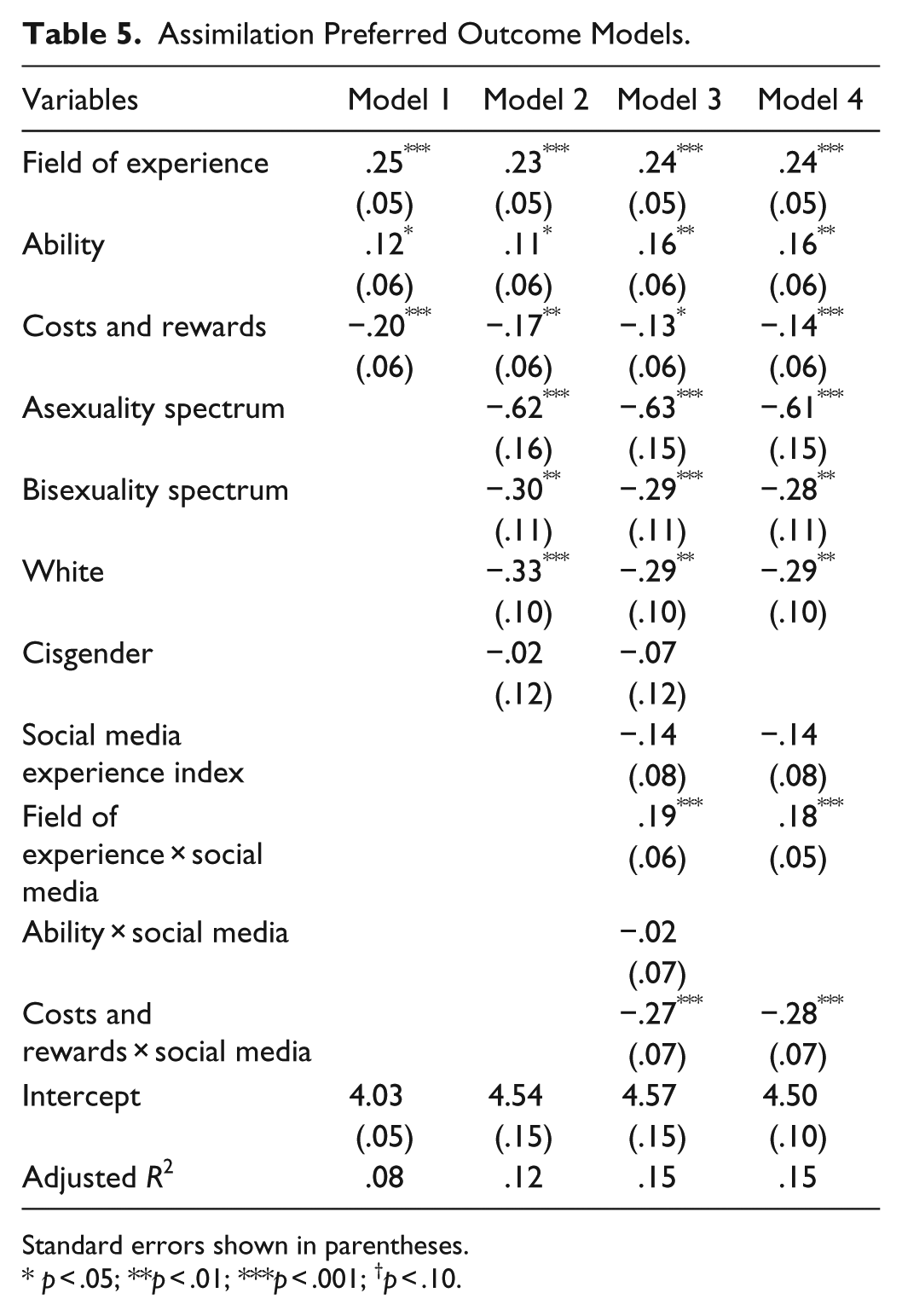
The first preferred outcome is assimilation. Field of experience, ability, and costs and rewards are all statistically significant predictors of the assimilation strategy index (Model 1, Table 5). Field of experience and ability had positive relationships with assimilation (b = .25, p ≤ .001; b = .12, p ≤ .05, respectively), while costs and rewards had a negative relationship (b = –.20, p ≤ .001). Model 2 reflects the addition of the controls. Aside from gender, all controls were statistically significant. In Model 2, on average, asexual and bisexual respondents both have lower assimilation outcome scores than flexible non-monosexuals (b = –.62, p ≤ .001; b = –.30, p ≤ .05, respectively) controlling for field of experience, ability, costs and rewards, race, and gender. Similarly, White respondents’ average assimilation scores are .33 units lower than those of non-White respondents (p ≤ .001). On average, for every unit increase in field of experience, the assimilation outcome index increases by .23 (p ≤ .001), net of ability, costs and rewards, sexual orientation, race, and gender. Every unit increase in ability increases the assimilation index by .11 (p ≤ .05), controlling for field of experience, costs and rewards, sexual orientation, race, and gender. Finally, on average, every unit increase in costs and rewards decreases the assimilation index score by .17 units (p ≤ .01), net of field of experience, ability, sexual orientation, race, and gender. The variance inflation factor (VIF) values all stay below 3, suggesting little chance of multicollinearity.
Assimilation Preferred Outcome Models.
Standard errors shown in parentheses.
p < .05; **p < .01; ***p < .001; †p < .10.
Model 3 of Table 5 includes the social media experience index as well as the interaction of social media and all three lifestyle variables, while Model 4 includes only the statistically significant variables. In Model 4, as social media increases, the effect of field of experience on the assimilation index score is increased (b = .18, p ≤ .001), controlling for sexual orientation, race, and the other lifestyle variables. On average, for every unit increase of the social media experience index, the effect of field of experience on the assimilation index increased by .18 (p ≤ .001), controlling for ability, costs and rewards, the interaction between social media and costs and rewards, sexual orientation, and race. Conversely, the costs and rewards interaction effect is negative. On average, for every unit increase of the social media experience index, the effect of costs and rewards on the assimilation outcome index reduced by .28 (p ≤ .001), controlling for field of experience, ability, the interaction between social media and field of experience, sexual orientation, and race.
The assimilation outcome seeks to have dominant group members see co-cultural group members as just like them (Orbe, 1998b). The most notable relationship in the assimilation outcome index was the interaction between social media and costs and rewards in Model 4. When non-monosexuals value the rewards of speaking up to discrimination, they score lower on the assimilation index. Social media strengthen this relationship. The adjusted R2 for the final assimilation model was .15, which is an increase from the original model. An F-test reveals that this is a statistically significant improvement (F = 8.91, p ≤ .001, change in R2 = .07).
Accommodation
Accommodation is the second preferred outcome. In Model 1, in the regression analysis in Table 6, field of experience, ability, and costs and rewards are all positive and statistically significant predictors of the assertive strategy index. Model 2 includes the addition of the controls of sexual orientation, race, and gender. Only asexuality and race were statistically significant. This model reflects that, on average, asexual respondents have accommodation outcome scores that are .17 units lower than flexible non-monosexuals (p ≤ .05) controlling for field of experience, ability, costs and rewards, race, and gender. Similarly, White respondents’ average accommodation scores are .26 units lower than those of non-White respondents (p ≤ .001). On average, for every unit increase in field of experience, the accommodation outcome index increases by .16 (p ≤ .001), net of ability, costs and rewards, sexual orientation, race, and gender. Every unit increase in ability increases the accommodation index by .22 (p ≤ .001), controlling for field of experience, costs and rewards, sexual orientation, race, and gender. Finally, on average, every unit increase in costs and rewards increases the accommodation index score by .19 units (p ≤ .001), net of field of experience, ability, sexual orientation, race, and gender. The VIF values all stay below 3.
Accommodation Preferred Outcome Models.

Standard errors shown in parentheses.
p < .05; **p < .01; ***p < .001; †p < .10.
Model 3 of Table 6 includes the social media experience index as well as the interaction of social media and all three lifestyle variables. Model 4 includes only the statistically significant variables. In Model 4, as social media increases, the effect of costs and rewards on the accommodation index score is decreased by .11 (p ≤ .05), controlling for field of experience, ability, asexuality, and race.
In the accommodation regressions, no variable is notably more influential than the others. The only significant social media interaction in Model 4 is costs and rewards, and even then, it is a weak relationship. Overall, these results suggest that while some variables can predict the accommodation index score, it is mostly influenced by the way they work together, rather than one variable taking preference over the others. The adjusted R2 for accommodation was .25, which is an increase from the original model’s R2 of .22. An F-test reveals that this is a statistically significant improvement (F = 6.16, p ≤ .001, change in R2 = .03).
Separation
The last preferred outcome is separation. Ability and costs and rewards are statistically significant predictors of Model 1 in the separation regression analysis in Table 7. While ability had a positive relationship with assimilation, costs and rewards had a negative relationship. Model 2 reflects the addition of the controls of sexual orientation, race, and gender. Race was the only significant control, showing that White respondents had separation scores that were, on average, .27 units lower than non-White respondents (p ≤ .001), controlling for the lifestyle variables, sexuality, and gender. On average, every unit increase in ability increases the separation index score by .21 (p ≤ .001), controlling for field of experience, costs and rewards, sexual orientation, race, and gender. Finally, on average, every unit increase in costs and rewards decreases the separation index score by .14 units (p ≤ .01), net of field of experience, ability, sexual orientation, race, and gender. The VIF values all stay below 3, suggesting little chance of multicollinearity.
Separation Preferred Outcome Models.

Standard errors shown in parentheses.
p < .05; **p < .01; ***p < .001; †p < .10.
Model 3 of Table 7 includes the social media experience index as well as the interaction of social media and all three lifestyle variables, while Model 4 includes only the statistically significant variables. In Model 4, as social media increases, the effect of field of experience on the separation index score is decreased by .08 units (p ≤ .05), controlling for race and the other lifestyle variables.
In Model 4 of the separation outcome regressions, none of the variables are particularly stronger predictors than the others. In addition, the adjusted R2 for separation was only .06; however, it is still an increase from the original model’s R2 which was .04. While, an F-test does reveal that this is a statistically significant improvement (F = 8.94, p ≤ .001, change in R2 = .03), it still explains very little of the variance in this model. This result suggests that overall, separation is not as influenced by social media as the other strategies and outcomes.
Discussion
This study stands as an important foundation to consider non-monosexuals as a co-cultural group. It measured non-monosexuals’ social media habits, their overall lifestyle variables, and their co-cultural responses to discrimination. This section discusses the findings of the study, presents the implications of those findings, considers its limitations, and suggests future research.
Non-Monosexual Social Media Use
The first research question of this study asked about the social media habits of non-monosexuals. Non-monosexuals are heavy social media users, with over 60% of the Facebook users in the sample logging on several times a day, over 40% of Twitter users on multiple times daily, and over 25% of the Tumblr users blogging several times a day. This is higher than the statistics of social media use by the general population reported by Smith and Anderson (2018) at the Pew Research Center in which 51% of Facebook users and 26% of Twitter users reportedly visited the platforms at those rates (Tumblr use was not measured). The social media experience scores ranged from one to seven, with seven being the highest possible score. The mean social media experience score for non-monosexuals was 4.46, which is slightly higher than the midpoint of possible scores, suggesting that overall, non-monosexuals have slightly positive experiences on social media as it relates to their sexuality. The data suggest that while Tumblr presents the most positive social media experiences for non-monosexuals, which mirrors findings from previous research (Cavalcante, 2018), only 35% of the sample used it. However, this is still much higher than the general public, of which only 10% uses the platform, according to The Pew Research Center (2015). It also indicates that social media play a role in connecting non-monosexuals to a likeminded community and in modeling behavior for helping them understand their own sexualities.
Preferred Outcomes
The second research question focused on which preferred outcomes non-monosexuals would prefer. Overall, the sample preferred accommodation, which Glenn and Johnson (2012) had positioned as the ideal preferred outcome that their sample of Black male students at predominantly White educational institutions aspired to obtain. This was because they believed it was important to challenge the dominant culture’s view of them. This finding is also in line with how people with disabilities responded to discrimination (Cohen & Avanzino, 2010). While non-monosexuals do not have immediately visible “otherness” like people of color or people with disabilities, their sexual orientation is still visible in their lives through their performance of their sexuality. For example, their romantic partnerships, or lack thereof, are visible to the outside world. Thus, it is fitting that non-monosexuals seek preferred outcomes similar to those of these other co-cultural groups.
Separation was also chosen by over a third of the sample. The preference for separation, however, fell along identity lines. Asexuals and non-White respondents preferred separation, while other groups preferred accommodation. This is possibly because of the added element of racism that the non-White respondents face, as well as the overall societal unfamiliarity with asexuality (Glenn & Johnson, 2012; MacInnis & Hodson, 2012), leaving those groups with less reason to believe that they will be accepted if they try. In addition, separation was the model that explained the least variance, indicating that giving up on any idea of being accepted by the dominant culture cannot be as easily predicted as other outcomes. Other factors, such as experiences of harsher discrimination, class, disability, and location may contribute to this discrepancy.
Predictors and Interactions
Orbe (1996) argued that several lifestyle variables, including field of experience, abilities, and costs and rewards, would influence a person’s preferred outcomes. RQ3 sought to determine whether these lifestyle variables could be measured quantitatively and if they would significantly predict those outcomes. This research found that all three variables were significant predictors of all three outcomes, with the exception of field of experience in the separation model. In other words, a person’s field of experience, abilities, and their assessment of the costs and rewards of speaking up for themselves do predict the extent to which they are likely to seek assimilation, accommodation, or separation. This confirms Orbe’s theoretical claims that these qualities have an influence on the way that co-cultural groups interact with dominant group members.
This research also sought to determine whether social media, which are known to have an influence on non-monosexuals’ access to community (Hefner, & Drogos, 2009), would moderate the effects of the lifestyle variables on the preferred outcomes, as explored in RQ4. These regressions reveal that social media do not influence the extent to which a non-monosexual’s abilities predict their discrimination response. This is notable, as Orbe (1998b) has suggested that a sense of community support theoretically influences ability. Social media support, therefore, does not serve this function. This warrants further investigation into the claim that community has an influence on ability. It remains to be seen whether social media support is indeed not as effective as in-person support or whether community has any influence on ability at all.
Social media have a positive interaction with field of experience in the assimilation model. As those preferring assimilation seek an outcome wherein the dominant group ignores the co-cultural person’s differences (Orbe, 1998b), it is unexpected that this timidity is increased by a field of experience that reflects positivity and acceptance. This warrants further inquiry into the relationship between those two variables.
The interaction between social media and field of experience is negative for separation. This indicates that social media serve as a mitigating factor; for non-monosexuals whose field of experience would encourage them to prefer separation, social media alleviate some of that effect. This may be because social media provide them with an alternate perspective than what they experience in their daily lives.
Finally, the interaction between costs and rewards and social media was significant for assimilation and accommodation but not separation. This finding suggests that people who choose a separatist mentality are not swayed by a social media community. However, this may require future research, as it is possible that communities of people who prefer the separatist mentality were underrepresented in this sample. This interaction is small and negative for assimilation and accommodation. Therefore, social media experience actually reduces the impact that costs and rewards has on how non-monosexuals rate those outcomes.
Race and Sexuality
In implementing the controls, very few were found to be statistically significant. However, White respondents scored lower than their non-White counterparts in all three outcome regressions. Regardless of which outcome they chose, the experience of racial marginalization intensified the reaction to monosexism. This suggests that the experience of living co-culturally is compounded when a person faces more than one form of marginalization. This reflects the findings of Bie and Tang (2016) that cultural experience influences communication outcomes. This warrants further investigation into the experience of non-monosexuals of color and the intersections of those identities.
Implications
This study confirms that social media have a notable influence on non-monosexuals’ perceptions of and reactions to their environments. Due to the impact that social media have on the field of experience and costs and rewards variables, it is clear that social media shape non-monosexuals’ perceptions of their lives. Although there is no definitive census determining how many people are non-monosexual, the best estimates suggest that it is between 3% and 6% of the population (Bogaert, 2004; The Williams Institute, 2011; Walters et al., 2013), indicating a large number of people who may be being overlooked by major social institutions. Further research that examines the experiences of non-monosexuals who do not use social media may provide more insight into this phenomenon.
These findings also indicate that co-cultural theory is limited in its ability to measure how non-monosexuals will respond to discrimination. Many of the models in this study were very similar, which suggests that non-monosexuals do not consider the different strategies and outcomes to be mutually exclusive choices. This brings into question the value of measuring the distinctions in their reactions in this way (as operationalized in Lapinski & Orbe, 2007). Rather than measuring how people respond to discrimination, there may be more value in discovering how those responses make them feel about themselves. Furthermore, it may be more advantageous to look beyond perceived costs and rewards to examine the actual costs and rewards of their behaviors. Overall, co-cultural theory provides context in which to examine non-monosexuals’ perceptions, but it is limited in its practical applications for positive change.
Finally, this research confirms that marginalization is not the same for all groups. Even within the context of monosexism, people with different sexual orientations responded differently. A major goal of this research was to study non-monosexuals separately from gays and lesbians. The results of this study indicate that there may indeed be more value in studying the non-monosexual orientations individually, rather than as a homogeneous group. Non-monosexuals who are also racial minorities respond differently than those who are not. This suggests that these groups need to be studied intersectionally and that disempowerment is a crucial element of understanding co-cultural choices. Ultimately, each lifestyle variable touches on the issue of empowerment, though none entirely measures this phenomenon.
Limitations
While this study contributes to the research about non-monosexuals’ online activity and response to discrimination, it has some limitations. The sample largely consisted of White bisexuals, which necessitated reducing the demographics into simpler and reductive categories. In addition, although MTurk is an effective way to recruit respondents, it is still based online, which may result in an over-representation of heavy Internet users. However, as this is a study about how non-monosexuals use online media, an online survey still provides valuable information about their experiences.
Another limitation of the study is that there is no way of knowing if respondents accurately predicted how they would respond in the fictional scenarios presented in the survey instrument. With survey data, there is always a possibility that respondents are answering the questions based on how they would like to act, rather than how they would actually respond in their own lives (Babbie, 2015). This does not mean that the data are invalid, however, because they still provide insight into how non-monosexuals feel about themselves and how they would react.
In addition, the survey instrument was not designed to consider the preferred outcomes as mutually exclusive choices. This allowed respondents to score different outcomes similarly, which limits the opportunities to make definitive claims about the individual behaviors. This provides notable insight into how co-cultural groups react and suggests that people fall somewhere in between these different categories.
Future Research
This study stands as an important foundation to consider non-monosexuals as a co-cultural group. Future research could work to investigate each component of co-cultural theory separately to understand the intricacies of what informs the behavior of non-monosexuals and other co-cultural group members. In addition, future research could compare online experiences to those offline. It could utilize experimental methodologies to observe how non-monosexuals actually respond to discrimination in the offline world.
This study also examines the social media habits of non-monosexuals. The next step would be to dive further into these experiences by reaching more people who identify as non-monosexual and considering each sexuality separately. Despite the advertisement for this study asking for people who do not consider themselves strictly gay or straight, several people who identify as hetero- or homosexual participated. Future research could examine what facts influence how people identify their sexual orientation and whether social media influence that decision. Future research could also determine whether non-monosexuals adopt different strategies if the discrimination is coming from a gay or straight monosexual, as those experiences and reactions may vary. In addition, the number of respondents who identified as pansexual or demisexual was very low. Subsequent studies could reach out to these non-monosexual groups. It would also be important to consider asexuals separately from bisexuals to gain a deeper understanding of the discriminations they face both on and offline.
Finally, future research could work to consider how other co-cultural experiences inform these behaviors. This study found some evidence that race informs how non-monosexuals respond to discrimination. This, along with other experiences of marginalization like disability and class, is an important component to co-cultural and non-monosexual online habits. Qualitative research could be employed to find the intersections of these experiences.
Footnotes
Acknowledgements
I would like to thank Carol Liebler for her guidance and support throughout the development of this study. I also thank the anonymous reviewers for their contribution to the improvement of my work.
Declaration of Conflicting Interests
The author(s) declared no potential conflicts of interest with respect to the research, authorship, and/or publication of this article.
Funding
The author(s) received no financial support for the research, authorship, and/or publication of this article.
