



Abstract
This article is concerned with how different agencies play out in shaping public debate online and, for this purpose, employs an approach that acknowledges the role not just of algorithms seen in isolation, but in context with users. The empirical case is YouTube video search results related to Islam in Danish, Norwegian, and Swedish. As such, the article makes a contribution by adding a comparative layer to the discussion of “ranking cultures,” which has so far focused on individual cases or English-language searches. The analysis is based on a mapping of the highest-ranking videos, as well as a qualitative exploration of these videos’ content and context. Findings illustrate how intricate practices of re-posting and re-framing of videos is key to understand the ways YouTube’s search function contributes to shape the public image of an issue differently in different language areas and social settings. Findings are related to previous studies of immigration coverage in mainstream news media in the case countries. The discussion highlights the merits of the approach, not only for bringing out nuances in how YouTube shape political issues in different contexts but also for pointing to questions of the broader public debate.
Almost 10 years have passed since Burgess and Green (2009) started their book about YouTube with the statement “Love it or loathe it, YouTube is now part of the mainstream media landscape” (p. vii). YouTube is an immense resource for audiovisual content of practically all kinds, an arena for online discussion, and among the web’s most visited sites. In Gillespie’s (2010) influential discussion of online content providers as “platforms,” as “curators of public discourse,” he highlighted YouTube as one of a handful of “primary keepers of the cultural discussion” (p. 348; also Gillespie, 2015). Since then, in wealthy countries, as broadband connections have gotten more widespread, as social media sharing has become an everyday practice, and as broadcast television viewing has declined, YouTube appears even more important to public debate. Reportedly, it is the second largest search engine on the web (Forbes, 2017). But how does YouTube contribute to shape political issues?
This article aims to contribute to answer this question. In so doing, it is insufficient to approach the site as a homogeneous platform, with an algorithmic-driven presentation of content. Context-awareness is needed. A recent study suggests interrogating YouTube’s search function as a “socio-algorithmic process” that yields “ranking cultures,” meaning “distributed and heterogeneous agencies that converge in producing actual result lists” (Rieder, Matamoros-Fernández, & Coromina, 2018, p. 54). Rieder et al. (2018) find different kinds of issues to be ordered differently over time, and they show how rankings do not correspond directly with YouTube’s popularity metrics. On one hand, YouTube as a platform matters for every issue’s “ranking culture,” but on the other hand, different issues show distinct kinds of ranking and different dynamics over time (Rieder et al., 2018). However, the aspect of language and societal context has so far not been scrutinized, given that most contributions on YouTube search results rely on English-language data. How does different agencies play out in shaping public debate on YouTube when we compare across different languages and societies?
The article presents a comparative analysis of the “ranking culture” (Rieder et al., 2018) of “Islam”. In Europe, in the first decades of the 2000s, Islam has taken center stage in public debates on freedom of speech, national security, and foreign policy, as well as immigration and social issues. As such, Islam constitutes a keyword for a range of public issues. The analysis is comparative between Danish, Swedish, and Norwegian language video searches, thus facilitating a cross-national analysis of what kind of resource YouTube constitutes for members of the public who seek out information on a burning political issue. The case countries are similar in terms of political as well as media systems (e.g., Syvertsen, Enli, Mjøs, & Moe, 2014) and with high levels of use of information and communication technologies (ICTs). Yet, comparisons of these countries’ print media coverage of immigration, and Islam has identified differences, with the Danish having a starker threat-focus, contrasted to the Swedish media’s attention to humanitarian framing (Hovden & Mjelde, 2018). Thus, the selection of cases allows for a nuanced discussion of how the different agencies involved in shaping public debate around Islam on YouTube differ across language-based searches.
Data collection is based on the YouTube Data Tools (Rieder, 2015), used to retrieve lists of top-ranking videos for search terms associated with “Islam” in the three languages over 4 weeks in early 2018. These lists are then compared in an analysis of the degree of dynamic changes to the different “ranking cultures” (Rieder et al., 2018) and their individual composition. The top-ranking videos in the period are also explored qualitatively with a focus on genre, channel contexts, and the origin of the content, in particular to understand how re-publication in different ways is important.
The article first discusses YouTube as a platform, and the contributions of related studies of YouTube’s algorithms, before presenting the rationale for scrutinizing the issue of Islam in Scandinavia. Next, the method for data collection and the analytical approach is explained before the analysis is presented in two steps. Step one maps the general “ranking culture” (Rieder et al., 2018) in each case and looks at how ranking changes over time. Step two presents the qualitative analysis of the highest-ranking videos to explore difference in genre through textual features, modes of address, and the issues they cover, as well as contextual presentation positioning videos in the debate on Islam. Here, relations to mainstream media providers and other offline actors are highlighted.
The analysis emphasizes how the intricate practices of re-posting and re-framing of videos are key to understand the ways YouTube’s rank algorithms contribute to shape the public debate of an issue differently in different language areas and social settings. The article further discusses “ranking culture” dynamics in small language queries compared to analysis based on English-language queries. Findings suggest alignment to previous studies of mainstream news media coverage in the countries. Based on the analysis, suggestions for further research is given, underlining how the approach of this study points to questions of the specific institutionalizations of interest groups, their media literacy, and their position in public life more generally.
YouTube: Platforms, Algorithms, and Social Contexts
In different societies across the world, YouTube has gained increasing importance for a range of purposes and practices (Cunningham, Craig, & Silver, 2016; Miller et al., 2016, p. 133 for recent historical discussion; Arthurs, Drakopoulou, & Gandini, 2018 for general overview of YouTube research). Along with MySpace (Mjøs, 2012) and Wikipedia (Bruns, 2008), YouTube was a focal point for scholars trying to make sense of the ways online media impacted on society in the years leading up to 2010. That year, Gillespie (2010) brought attention to the commercial aspects of the video site, underlining how the term “platform” might make us forget that providing server space for users’ audiovisual content is not a mission driven by the urge to create an even playing field or secure egalitarianism.
Some years later, attention turned to new services—like Facebook and Twitter in the Western parts of the world. When van Dijck and Poell (2013) defined “social media logic,” YouTube did, however, remain a central example of the channeling of “social traffic” (p. 5). Van Dijck and Poell (2013) argued that a new kind of programmability characterized social media logic—based on often invisible technological mechanisms which trigger and guide users’ “creative or communicative contributions,” while still allowing for steering and outright refusal by the users (pp. 5-6). This latter point is important: discussions of the role of algorithms and platforms more generally tend to concentrate on the production and distribution side of the communication chain, for example, through fields of business studies, political economy, and software studies (Helmond, 2015; Nieborg & Poell, 2018). It is, however, crucial to give sustained attention to contextually aware, more focused empirical studies incorporating the user side. Indeed, contributions from qualitative traditions critique the lack of understanding of cultural factors and contextual frameworks in “platform studies” (Costa, 2018). Qualitative work on YouTube has highlighted different phenomena, such as the creation and monetization of memes (Soha & McDowell, 2016) and thus illustrates how platform policy changes and technological updates not necessarily result in prescribed changes of use. Traditional quantitative approaches have also contributed to such focused analysis, typically through content analysis of YouTube videos, for example, looking for violence to compare the online site with television (Weaver, Zelenkauskaite, & Samson, 2012). Such approaches do, however, not engage directly with YouTube’s technological mediation.
Like other online providers of media content, YouTube relies on algorithms to sort out which specific videos to present to each user through filtering and recommendation. This poses a challenge for research. As Kitchin (2017) argues, “just as algorithms are not neutral, impartial expressions of knowledge, their work is not impassive and apolitical” (p. 18). The application programming interface (API) is a key to study how the algorithms work in different settings, as it allows queries of data from the platform’s servers. Work employing and critiquing APIs is growing. Bärtl (2018), for instance, used the YouTube API to randomly retrieve close to 20,000 channels and roughly 5.5 million videos, which he analyzed to find differences between video genres and distribution of views. He found that “the top 3% most viewed channels account for 28% of all uploads and 85% of all views” (p. 26). Möller, Kühne, Baumgartner, and Peter (2018) performed an analysis of traces left by users (view numbers, [dis]likes, and comments) using API data, comparing entertainment and political videos. Airoldi, Beraldo, and Gandini (2016) “followed” the YouTube recommender algorithm to study networks of music videos. Some similar studies also thematically concern issues of immigration, race, and politics. O’Callaghan, Greene, Conway, Carthy, and Cunningham (2015) used the YouTube API to retrieve metadata on extreme right videos, arguing that the recommendation algorithm leads to an “ideological bubble in just a few short clicks” (p. 459). Van Zoonen, Vis, and Mihelj (2011) also relied on API retrieval in their study of “responses” to a Dutch anti-Islam film. This adds to a number of studies which have also utilized data from other platforms’ APIs to analyze communication related to immigration debate or terror attacks (e.g., Giglietto & Lee, 2017 on Twitter). Yet, others have focused on the ethical and methodological issues with restricted access through social media APIs (boyd & Crawford, 2012). Carter (2016) discusses the limitation following such restrictions not for researchers, but for marketers interested in boosting influencer reach and argues for “connecting the analysis of technical platforms with the practices of individuals” (p. 11, also Kitchin, 2017, p. 25).
Rieder et al. (2018) propose to use computer-assisted data collection to mix rank visualizations, quantitative measurement of dynamic changes to such ranking, and qualitative categorizations of video content to study what they term “rank cultures.” Emphasis is here on describing the assemblages of interactions between the algorithms and the viewer and uploader practices. Based on a number of searches linked to different political issues (including Syria and candidates running for the US Presidency), Rieder et al. (2018) argue, first, that the “ranking cultures” depend on different ordering over time (e.g., stable, “newsy,” and mixed rank morphologies); second, that rankings do not correspond directly with popularity metrics (e.g., view counts or likes); and third, that issue and platform vernaculars are important. The two latter terms are adopted from Gibbs, Meese, Arnold, Nansen, and Carter’s (2015) study of “how particulars genres and stylistic conventions emerge within social networks” (p. 258). For Rieder et al. (2018), platform vernaculars describe how specific communication practices emerge on specific platforms—that is, within particular online services (p. 54). Issue vernacular refers to communication practices around a topic or a community. The argument is that YouTube as a platform matters across the different issues (e.g., in the way native content is highlighted over mainstream news media) but that the issue at hand also matters for the specific “ranking culture.”
While the actual reception of the media content falls outside the scope of such a study (Venturini, Bounegru, Gray, & Rogers, 2018), it is a fruitful way to improve our understanding of how YouTube works as a resource for the public. The aim of this article is to scrutinize “ranking cultures” (Rieder et al., 2018) not across different issues or platforms but across different societal contexts. The question is whether a comparison of one issue (Islam as a proxy for debates over immigration) on one platform (YouTube) with different language queries will bring out differences, and if so, how to understand them.
Scandinavia, Immigration, Islam, and the Media
Denmark, Norway, and Sweden are three neighboring small nation states (5-9 million inhabitants), which together make up the geographical region Scandinavia. They are all multi-party parliamentarian democracies with distinct languages, but with a history that links them together in different ways. Until 1814, Norway was a state under the Danish crown, and for the next almost 100 years, Norway shared a union with Sweden. Sweden and Denmark are European Union (EU) member states, and Norway is bound by most EU policies through a special agreement. This includes the so-called Schengen Agreement, which largely abolished internal border checks within the EU, in exchange for increased external border protection. The three countries tend to cluster together in studies of political systems, described as a certain type of welfare state that goes beyond providing a safety net for citizens to aim for leveling out differences (Esping-Andersen, 1995). In comparisons of media systems, the three countries are also often grouped together. The case countries further share high penetration of ICTs (Syvertsen et al., 2014).
All three countries have historically had a Lutheran state church, which have gained some independence in later years. On an overarching level, Sweden, Denmark, and Norway earlier had similar policies relating to immigration (e.g., Midtbøen, 2015 on citizenship law). Islam first appeared in these countries following immigration in the second half of the 1900s—first in Sweden from the east and later also in Denmark and Norway (through guest workers). The following decades saw an increase both in the number of Muslim inhabitants, and in the debate on Islam and religion in these societies. The wars in Yugoslavia during the 1990s brought Islam to the fore of public attention, both through refugees and through UN and NATO involvement in the conflicts. After 9/11, radical Islam took center stage in public debate in the case countries, increasingly so following the invasion in Afghanistan, Iraq, the war in Libya (all of which Danish and Norwegian military troops contributed to), and Syria. All three countries have experienced terrorism connected with religious views: In a 2015 attack on a public venue during a meeting on freedom of speech and a Jewish synagogue in Copenhagen, Denmark; a 2017 attack with a lorry in Stockholm; and the combined bomb in Oslo and shooting massacre at Utøya in 2011, in Norway. While the two former were directly linked to Islamist extremism, the latter was carried out by a Norwegian male attacking perceived multicultural policies, and opposing religious and ethnic diversity in Europe.
Research supports a claim that Islam is central to debates on immigration in the countries. An elaborate study of how Scandinavian newspapers have covered immigration during the last decades found that Islam was the only religious identity to be mentioned. During the period 1970-2016, “Islam” appears in 15% of the articles in the representative sample from two newspapers in each of the three countries (Hovden & Mjelde, 2018). “After 2010, a quarter of all Norwegian and Danish items and one in five Swedish articles explicitly mention Islam” (p. 7). This, the authors argue, seems to support the claim put forward by Yilmaz (2016) that immigration in Scandinavian media has changed from a debate about workers to a debate about Islam. Today, in these countries, Islam serves as a prism for debates ranging from refugees’ conditions, through the wearing of religious symbols in public to issues of defense policy and privacy law.
Beyond these similarities in political systems, media systems, immigration policies, relations to Islam, experiences with terrorism, and attention given to Islam in the media, there are differences. Some concern the media systems, which show nuanced differences (e.g., Moe, in press-a on differences in paying for online journalism) and some are deep-rooted and historical (e.g., Storsveen, 2004 on differences in “national identity” in Norway and Denmark). Others are more specific and harder to assess due to their close proximity to the present, such as the actual institutionalization of certain religious or interest groups (e.g., Hussein, 2018 on the role of imams for the perception of Islam in Denmark).
In terms of media coverage of immigration, Hovden and Mjelde (2018) found persistent differences in the three countries, with, on one hand, the Danish newspapers being “more strongly (and increasingly) threat-focused, and with an increasing focus on Islam in the later period” and, on the other hand, “Sweden as constantly emphasizing the humanitarian side of immigrants as victims, and with racism as a continually important issue” (p. 16). Analysis of online platforms has found related differences, for example, in how the different language versions of Wikipedia portrayed Islam: the Norwegian Wikipedia presents Islam in a matter-of-factly way as a religion, to which the Swedish version added the perspective of Islam as culture (e.g., through sections on scholarship, art, and architecture). In contrast, the Danish Wikipedia focuses on identity, presenting Islam through discussions of gender and family roles, sexuality, and social rules (Moe, in press-b).
This article relates the findings from the analysis of the Danish, Norwegian, and Swedish data to those presented in research based on English-language queries. In addition, the article compares the three cases against each other to bring out nuances and attempts to explain differences in sociotechnological assemblages that facilitate the YouTube “ranking culture” (Rieder et al., 2018) in each instance. In explaining such differences, then, findings from studies of mainstream media coverage of immigration and Islam, as well as related studies of online platforms, serve as a basis, and the specific institutionalizations and roles of actors in each case constitute an important level of explanation.
Method and Approach
Data collection is based on the YouTube Data Tool “Video list” (Rieder, 2015). The YouTube Data Tools is a web-based, free-to-use collection of software utilizing the YouTube API to query and retrieve different sorts of data. The “Video List” tool allows the researcher to input a search term and retrieve data and metadata from YouTube’s “search/list” API, including video ID, video title, channel, time of publication, as well as counts for views, comments, and so on (Rieder, 2015). The data are identical to a search generated by any user on YouTube—bar localization and personalization (Rieder et al., 2018).
For this analysis, the terms used are as follows: “Islam Norge,” “Islam Sverige,” and “Islam Danmark.” The terms were chosen after initial testing using Google trends to explore potential search phrases (including native language variations of “immigration”) to grasp the keyword assumed to be important for basic searches on the issue at hand. It was also important to separate distinct words in the three languages to mimic the perspective of a Danish, Swedish, and Norwegian user. The use of the native language name of each country does not guarantee a clear-cut “national” result. However, on a site such as YouTube, it would make little meaning to attempt strict divisions between languages, not least attempting to block English language publishers, videos, and users. The idea is rather to prompt the API to deliver related results to each social context. For the same reason, no language or region parameters were used. Order parameter was set to “relevance,” which means videos are sorted according relevance to the search query—relevance according to YouTube, that is.
Data collection was conducted every second day for a month, from 27 January to 26 February 2018, to get insights into how ranking changes over time and to minimize the effect of singular events on specific dates or data errors. It was assumed that collection at every other day would capture dynamics and allow for a sound analysis of the timeline, and still keep the number of data points down. The data are neither meant to be representative of YouTube at large, nor of Islam-related videos in the three languages. As Venturini et al. (2018) argues, with a digital methods approach, “the best you can do is to describe explicitly the various operations of selection and transformation that connects the original traces to the final corpus and reflect on their analytical consequences” (p. 16).
The data are analyzed in two steps: first, to get an overview of basic characteristics of how the “ranking cultures” change over time. RankFlow (Rieder, 2016) is employed to map the 20 highest ranking videos for each second day throughout the period. RankFlow is a visualization tool that maps as well as calculates the degree of dynamic changes for each search. The latter metric, labeled Rank-Biased Distance (RBD) quantifies changes from one data entry to the next—in this case from one day to the second—and can be summed up to present an average over the period studied (avRBD). The metric is based on Webber, Moffat, and Zobel (2010). RankFlow’s RBD metric allows the setting of a p-value that controls the weighting of changes at the top of the list (0.01) versus treating all changes the same (0.99). For the analysis, p-value is set to 0.8, emphasizing the importance also of changes below the very highest-ranking videos in a list of 20. Beyond generating a map of the “ranking cultures” of the issue in each language, the aim of step one is to compare findings with similar analysis of English-language data to bring out differences related to language area sizes.
The second analytical step employs the results generated by the Video list tool as a starting point for further analysis to describe and compare the characteristics of the videos and their presentation. Again, focus is on the videos that rank among the top 20 throughout the period (making up 300 potential listings). Since the degree of dynamic changes is dissimilar between the cases, the number of videos is also different depending on how often the ranking algorithm replaces videos on the top 20-list (Denmark: 41, Norway: 36, and Sweden: 51 videos). Rather than attempting a quantitative comparison of manifest features, this part of the analysis focuses on specific videos and their presentations. Through investigation of the video contents, a categorization into genres was suggested (Larsen, 2008). The categorization builds on the videos’ textual features, modes of address, and the issues they cover. In addition, where relevant, the position vis a vis Islam was scrutinized. This is not limited to labeling videos which are explicitly argumentative. Rather, to understand the videos, it appeared crucial to also investigate the characteristics of the channel, as well as titles and video descriptions (or “local paratexts,” Brügger, 2008), that is their close context. The analysis entailed going back and forth between videos to compare (e.g., finding cases where the same content was re-posted several times). It also required identifying and understanding the re-posting of content which originated in sometimes very different contexts (e.g., snippets or collages of videos of mainstream news reports in different, sometimes mixed, and languages), amounting to a kind of textual iterative “‘digital ethnographic’ fieldwork” (Murthy & Sharma, 2018).
The data lend itself to such an approach, but the choice is also motivated by the assumption that framing of video content will be an important feature—and that framing defies quantitative measurements. What is more, the analysis depends on contextualization to situate the different actors within their respective societies and to allow for comparison across cases. While the first step of the analysis concentrates on the overall compositions of, and dynamic changes to, the rankings of Islam videos in the cases, the second step of the analysis focuses on key similarities and differences in the videos and their contexts.
Analysis
Overview of Rankings and Their Dynamics
To probe and compare the sociotechnological assemblages across three different languages, consider as a first step Figure 1. The figure visualizes the 1-month period of top 20 ranking of videos resulting from searches for “islam [country],” with the Danish to the left, Norwegian in the middle and Swedish to the right.
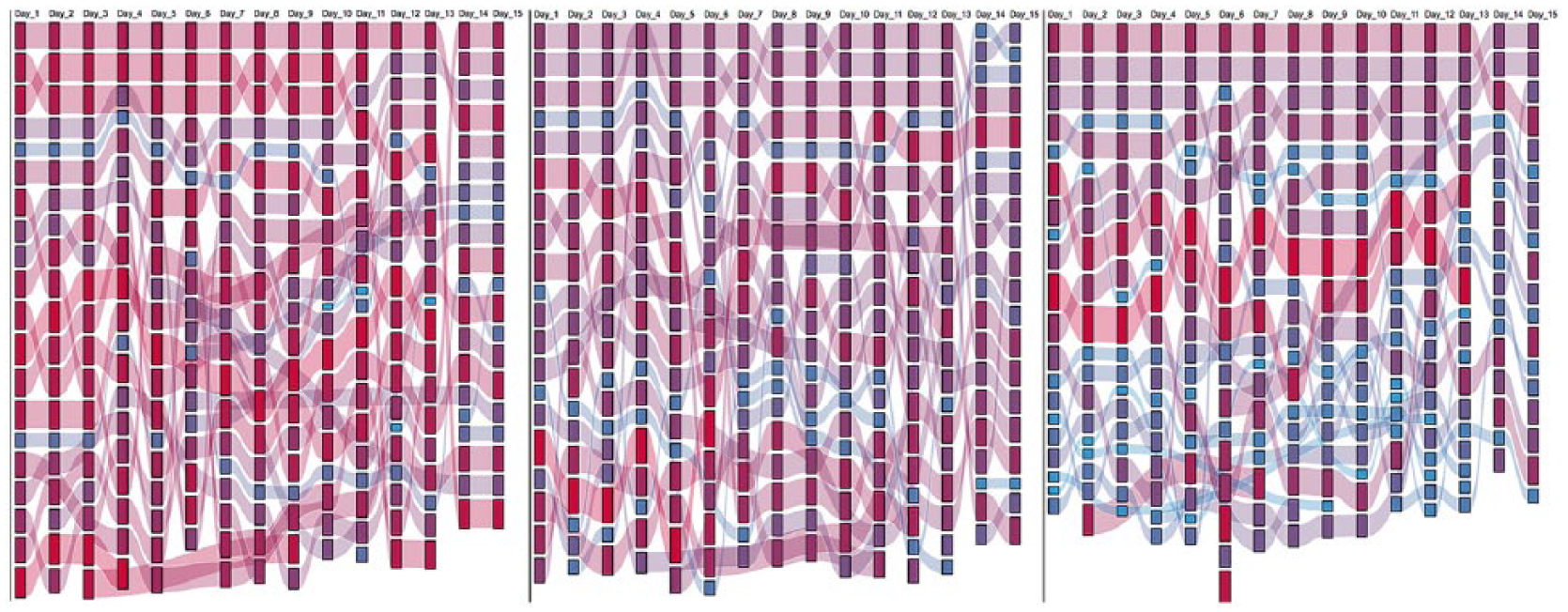
Ranking, top 20 videos, every other day, 27.01.18-26.02.18. Left to right: “Islam Danmark,” avRBD: 0.16; “Islam Norge,” avRBD: 0.22; and “Islam Sverige,” avRBD: 0.13.
Figure 1 shows changes in ranking during the period. Columns represent days. Blocks are individual videos, where the highest-ranking video appears on top of the column. Color and bar height both indicate the view count for each video, with red signaling high numbers. From the figure, it is clear that the ranking is not the result of popularity in the sense of views: Blue and low bars, indicating videos with low view counts, show up high on the ranking of all the searches. For instance, at the start of the period, the three top ranking videos in the Danish case have between 32,000 and 67,000 views, which is at the higher end among the videos analyzed here. The next two (ranking as number 4 and 5) have 2400 and 186 views. Similar instances can be seen across the two other cases. The algorithmic sorting of relevant videos, then, propels content which have attracted minimal attention to the top end of searches—a finding that confirms the complex workings of such result list generations (cf. Rieder et al., 2018; also Smit, Heinrich, & Broersma, 2017). It should be noted, though, that the cases display an overall shorter distance between the videos with the highest view count and the lower compared to related analysis of English-language content. Generally speaking, three figure view counts are low, and the finding that those videos can be presented high on search result lists for a broad key word such as Islam illustrates the importance of the social and cultural context when assessing the agencies that combine in the shaping of public debate on YouTube.
The calculation of the degree of dynamic changes to the three cases (avRBD) shows Sweden at 0.13, Denmark at 0.16, and Norway at 0.22 (with the maximum possible value being 1). This signals relatively stable rankings across the period, corresponding to how the order changes little from one slice to the next in the figure. There are internal movements as a video climbs or falls a step or two, particularly in the lower end of the selected list, but the general impression is one of continuity. This translates into a ranking order that would return a similar prioritization of videos from one day to the next. A comparable analysis of “Islam Australia” (Rieder et al., 2018) showed a similar pattern of dynamics in the lower end, but an even less dynamic ranking over time (avRBD: 0.02). Again, this underlines the difference between English-language content, which has a potential for global reach and therefore can earn extremely high view counts, and languages used by small populations such as the Scandinavian ones.
This first general mapping of the tendencies in the changes of rankings over time triggers the need for further scrutiny of the videos, to better grasp the nuances between the three cases.
Individual Videos: Genres, Contexts, and Re-Framing
Turning to step two of the analysis, focus is on comparing the content of the videos, to bring out and then facilitate the explaining of similarities and differences. Table 1 provides an overview of seven different types or genres of videos found, their origin (YouTube native vs. broadcast media), and their general position toward Islam as well as their occurrence in the cases. In what follows, the categorization is elaborated on through examples from the data. This leads to a discussion of the re-framing of videos.
Overview of Discussed Aspects With Top Ranking Videos Throughout the Period, “Islam [Country],” Denmark, Norway, and Sweden.
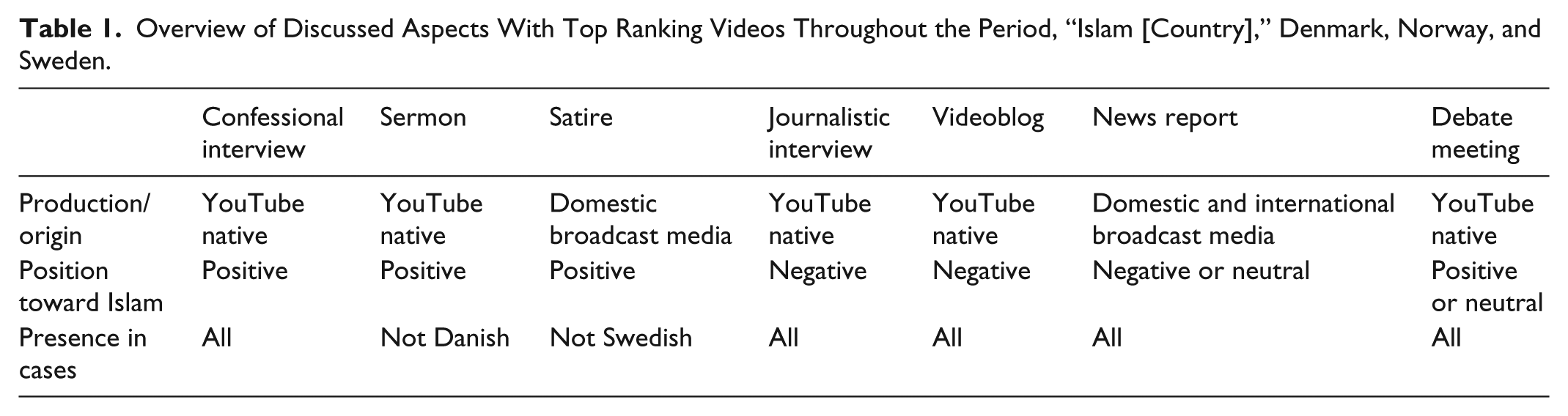
All three cases show a clear and persistent presence of native, amateur content. A key genre can be labeled confessional interview. A prime example is the video ranked as number one in the Norwegian case for 10 of the days data were collected (100% honest [all titles translated from native languages unless noted]), is a long vox pop-style video where young interviewers, apparently Muslims, ask people on the streets of a Norwegian city about their impressions or knowledge of Islam. The general tone is one of respect and curiosity. This type of video also encompasses interviews with a convert, often but not always young, documenting, for the posters of the video, the growth of Islam in the respective country (e.g., To be a convert in Denmark, and Adam, aged 14 converts to Islam). These are consistently present across the cases.
Such convert confessions are related to a second type of video that also often has low production values, and like the former genre presents Islam in a clearly positive light: the sermon. In the Swedish case, as many as 14 of the 51 videos are taped sermons from a Mosque or staged for the camera. In most instances, the videos are either in the native language or in Arabic, less often taken from the vast pool of similar English-language videos. The view counts vary greatly—some sermon videos are presented with no contextualization regarding the name of the Imam, and posted by anonymous uploaders (e.g Norwegian—Islam in Norway—Norwegian Spoken—“The importance of respect (ta’azeem) in Islam”], while others mimic professional television productions and features high profile names (e.g., When you are lonely—Abo Abdurahman Islam Sweden). The sermon videos do not figure among the 41 videos analyzed from the Danish list. This is a first notable difference between the cases.
Another genre which is present in two of the cases, but not the third, is satire. In Denmark, as well as Norway, videos from public service broadcasters (TV2 and NRK) are among the highest ranking, with content mocking prejudices against Muslims and immigrants in general. These videos, originally produced for broadcast shows or as part of the public service institutions’ online content provision, are either posted by the broadcaster themselves (in the Norwegian case) or by individuals outside the organizations—a finding that aligns with Rieder et al. (2018). Such humorous programming was not found in the Swedish case.
The three types of videos noted so far (confessional interviews, sermons, and satire) have a general positive take on the issue at hand. There is, however, also a clear presence in the data of videos critical of Islam. These videos take three different forms, all of which are found in all three cases.
A first is the YouTube native journalistic interview, where an interviewer (e.g., a representative from so-called right-wing alternative media sites such as Resett in Norway and Den korte avis in Denmark) meets an intellectual, researcher or journalist with a clear message, for instance that Islam equals extremism (e.g., Lily Bandehy warns Europa of Islam). A second type is the videoblog with a monolog against Islam, in some cases posted by individual users with little context, and in some cases posted by alternative media outlets or politicians. The third kind worth noting is news reports. Apart from the satire clips found in the Danish and Norwegian cases, news reports represent the main category of non-YouTube native content. In the data set, the majority of these videos are presented as negative toward Islam—but in different and sometimes complex ways.
Some news report videos have a clear bias, presenting Islam and Muslim immigration as a problem. These videos are re-posted, and originally stem not from domestic news providers, but from US media such as Fox and CGTN America. In other instances, the bias is found not in video content as such, but in certain framings: Content from mainstream domestic broadcast news or debate programs is re-posted with hostile descriptions and/or on channels with a clear position against immigration or against the political Left. A prominent example from the Danish case is the channel Nationalkonservativ. It is represented with five videos in the data set and self-describes as “a platform for national conservatism in Denmark.” The channel stupidsweden takes aim at mainstream media (“A BIG FUCK U SVT & TV4” reads the channel info page, in English) and publishes short clips from political debate shows and news reportages (mostly in Swedish) with a descriptive text criticizing the Left or the broadcasters. In other instances, long collages of what appears to be old clips from news broadcasts, in different languages, are re-posted with no description or explanation, but framed as negative through a new video title.
Such re-framing of videos takes quite complex forms. For instance, in the Danish case, anonymous user “Khoms II” (assumingly a reference to the Islamic concept of taxation of spoils of war) mostly posts Sylvester Stallone–related fan clips but also re-posts mainstream media content. In the data set is one such video, a long interview with Adnan Avdic, known in the Danish public as a controversial figure, for example, with strong opposition against democratic rule. While the interview is clearly critical of Avdic, it stems from public service channel TV2, is civil in tone and provides the interviewee a position to speak from. Neither the title nor the description frames it as negative toward Islam in itself, but the comments are overly hostile, in some cases racist (cf. Murthy & Sharma, 2018 for a different approach that shows the prevalence of racist discourse; also Matamoros-Fernández, 2017).
In other instances, news reports are, deliberately or not, misinterpreted in their re-posting. One example is a long clip on gang-related crime in Oslo, Norway, originating from a mainstream online news site, re-framed as a portrayal of problems with Muslim gangs—although religion or Islam take no part in the video (Muslims in Norway). The re-framing also works the other way around, for example, when IslamNet, a Norwegian organization promoting “information about Islam to the general society,” re-posts a clip from a tv studio debate where its leader Fahad Qureshi faces overwhelming criticism (Should Norway be open for “extremist” Muslim preachers?). In the description, IslamNet highlights the criticism as “biased,” but apart from that, the clip itself is left as it was originally broadcast. A single video clip, then, can be framed differently, inviting different interpretations. The “ranking cultures” in these cases are, as such, marked by videos traveling across different social settings as well as through time, when old mainstream media clips are brought forward as stand-alone or as part of collages.
The most entwined example of re-framing practices in the data set belongs to the final main category: videos documenting public meetings. The video in question shows a conference in Norway, organized by IslamNet with a large audience, seemingly mainly of young Muslim men. In the clip, the aforementioned Qureshi, a Norwegian born to Pakistani parents, asks the audience in English to signal support for different statements on, for example, the separation of men and women and the status of Islamic law. Qureshi’s point seems to be to illustrate that opinions which mainstream media often describe as extremist among radical imams are really views any Muslim has. The clip is posted by IslamNet, assumingly to document their successful conference and disseminate information on their religion.
But the video also surfaces in the data set as re-posted several times. In these instances, it is framed as an exposé of Muslims (e.g., Impossible to separate Islam from Islamism) by users with a stark anti-establishment or anti-immigration view (e.g., on channel Gov TookMyRights), by think tanks (e.g., Swedish Aletheia), but also by mainstream media (e.g., Asks Norwegian Muslims if they support stoning, posted by mainstream Norwegian tabloid newspaper Dagbladet). The video is also the only one in the data set found in more than one of the case countries.
Being in English, the clip is well-suited to travel. The content also invites different interpretations and goes to the core of news worthy debates (such as support for Sharia law). Still, the intricate ways in which it travels—across borders and from a Muslim organization to those attacking the religion—also speaks to the potential of videos for opinion formation: On one hand, the re-framing might illustrate how YouTube videos have the potential to trigger processes of opinion-formation among viewers. On the other hand, one could see this finding as an example of trench warfare dynamics in online debate, with strong opinions and little understanding between opponents (Karlsen, Steen-Johnsen, Wollebæk, & Enjolras, 2017). Re-posting facilitates users with different opinions to see the same video, but the re-framing could make understanding across different perspectives harder (Smit et al., 2017). The finding of such extensive practices of re-posting also provides nuance to previous studies’ discussion of native versus external YouTube content (Rieder et al., 2018). Content stemming from external producers abound here, but the videos are almost exclusively posted by amateurs—individuals or interests groups—not the journalistic news media that originally broadcast the material. As such, the “ranking culture” of YouTube in this analysis seems to clearly favor videos from “native YouTubers” or non-media actors, irrespectively of the contents’ origin.
In terms of differences between the three cases, the analysis brings out how certain video genres are present in some cases but not in all (sermons in Norway and Sweden, satire in Norway and Denmark). The overall impression resonates with findings from print media coverage of immigration in the three countries (Hovden & Mjelde, 2018): the Danish case stands out as more adversary, with more hostile claims made, while the Swedish results is marked by cultural contextualization and less on hard politics. The Norwegian seems less easy to pin down, as it shares some of the features of both the two other cases.
These differences are, however, subtle, and they illustrate the value of close readings of the videos, and the importance of contextualizing difference. In the Norwegian case, the 10-year-old organization IslamNet not only dominates the ranking, as noted. The organization’s leader also takes part in mainstream media debates, which, as the analysis has showed, is then re-posted. While the Swedish data include a range of videos by a group with a similar purpose, these videos are more akin to sermons, and show no traces of involvement in mainstream public debates. In Denmark, representatives of Muslims comparable to IslamNet’s Qureshi come across as more extremist through their participation in mainstream media clips as well as in their own videoblogs. They apparently lack a clear organizational standing (Avdic mentioned above), and their videos bear the marks of low production values, especially compared to the Swedish. Systematic cross-media analysis is needed to substantiate these findings. The point is that the analysis of the “ranking cultures” (Rieder et al., 2018) triggers questions of the broader public debate. What is the importance of the institutionalization of Muslim or immigrant groups in each society? Based on the findings here, it seems to matter not only how such groups have succeeded in embracing YouTube as an informational platform for instance through tagging and other aspects of a successful strategy for posting, but also in being represented in mainstream media coverage.
A related finding that substantiates how the specific roles of organizations in each society might help explain differences stems from the Norwegian data set, which includes five 35+ minutes videos of debate meetings organized by the Freedom of Speech Foundation. With titles such as Islam in Norway—Young voices in secularism and acceptance of faith, these videos document public meetings that appear as deliberative and nuanced discussions between representatives with moderate views. The videos stand out in the material, not just in their content but also since no equivalent actor or organization is represented in the two other cases and highlights how institutions in civil society has impact on online resources for public debate.
Conclusion
Starting from the observation that we need to improve our understanding of how political issues appear on YouTube, this article has asked how different agencies play out in shaping public debate across different languages. The article took inspiration from Rieder et al.’s (2018) concept “ranking cultures” to study the sociotechnological combinations at work in shaping public debate on an online platform. Utilizing APIs to harvest data from YouTube, the analysis has combined mappings of general trends and dynamics over time with qualitative exploration of video content and their contextual presentation.
Findings indicate the presentation of Islam in these cases to be relatively stable over time, during a period with no extraordinary public events concerning the issue at hand. Most changes to the rankings happened within a batch of high-ranking videos, as opposed to a radical substitution of videos on the top list. In adition, the analysis confirms that popularity measures such as view counts and likes are not the key to understand the ranking culture of YouTube: seldom seen videos from low key channels abound among the highly ranked across the cases. In the second step of the analysis, key genres were identified and discussed with attention to content origin and differences between the cases. Here, attention was given to how re-posting and re-framing of videos constitute a crucial practice. Especially through the use of contextual information, similar content is put forward as arguments for directly opposing views on Islam. Furthermore, this re-posting and re-framing means external content, often from mainstream broadcast media, makes up a solid portion of the videos. Such content is, however, uploaded by third parties, sometimes presented in full and sometimes edited together with seemingly unrelated old or recent clips from different sources. As such, the analysis provides nuance to our understanding of how YouTube favors native over external content.
Considering differences between the three cases, the finding of distribution of genres among the highest ranked videos seem reasonable in light of previous studies: In Swedish, Islam is portrayed as a religion (through sermon videos), with less critical clips stemming from domestic media but with a clear presence of anti-Islam postings. The religious videos were not central in the Danish data, which instead presents a range of clips from domestic media with agitated debate over the role of Islam. There are fewer traces of domestic political debate compared to its neighboring countries. In Norwegian, “Islam” appears as a mix of the features found in the two other cases: it shares satiric content with the Danish language data, but the religious videos are found here, as in the Swedish case.
The analysis has shed light on how the “ranking culture” (Rieder et al., 2018) on one platform and one issue differs between languages. The discussion points to how offline institutions in each country matter. General coverage of the issue in domestic news media is important here, but the analysis also showed how an organization facilitating deliberation between moderate representatives colors the list of high-ranking videos in one case (Norway). Moreover, it is important to understand the character and strategies of Islamic organizations, as illustrated by IslamNet in Norway compared to Sweden and Denmark.
A limitation lies in the comparison being between quite similar cases. Further expansion to different societal settings could prove an interesting way forward. More studies on platform-specific practices are needed to understand how information spreads and is transformed by users to give it different meanings. In addition, to further pursue the role of re-posting and re-framing of audiovisual content online, it seems important to cover how YouTube content gets embedded and linked to from outside the platform, as well as how these videos and the actors posting and commenting use other online platforms. The difficult but important task for media scholars is to understand how the social and the technological converge on different platforms in different contexts and how that plays together not just across platforms but also across media.
Footnotes
Declaration of Conflicting Interests
The author declared no potential conflicts of interest with respect to the research, authorship, and/or publication of this article.
Funding
The author disclosed receipt of the following financial support for the research, authorship, and/or publication of this article: The author received financial support from The Research Council of Norway, grant no. 250598.