



Abstract
How do you produce an authentic self on social media? This question is increasingly critical for the modern politician. Many voters prize authenticity as more important than policies, and social media is playing an ever-greater role in electoral politics. Further critical attention is required to understand how politicians are using social media to present an authentic self as a strategy to win votes. Whereas previous research has focused on how the content of politicians’ messages affects their authenticity, this article explores how authenticity is produced through formal aspects of self-presentational cues. To do so, the article analyzes the authenticity cues in Donald Trump’s tweets during the 2016 United States election. In what was widely dubbed as “the authenticity election,” Trump was able to present an authentic self on Twitter using little more than 140 alphanumeric characters. What cues were at play, and why did they work? By analyzing how news media narrated Trump’s authenticity, and applying a semiotic analysis based on the theory of Charles Sanders Peirce, this article uncovers the key authenticity cues in Trump’s tweets, and examines the semiotic mechanisms behind them. I show that Trump’s authenticity depended upon the deployment of indexes, signs that bear a causal link to the object they refer to. Trump’s indexes of the self—the typographic texture, the tweets’ timestamps, and the operating system tags—combined to produce an authentic form for Trump’s tweets to inhabit. I then close with observations of indexical authenticity being leveraged by other politicians.
How do you produce an authentic self on social media? This question is increasingly critical for modern politicians, as authenticity plays an ever-more prominent role in Western elections. In the United Kingdom, the political environment has been characterized as “the battle for authenticity” (Moore, 2017), while the 2016 US presidential election was widely dubbed as “the authenticity election” (Richman, 2015; Sargent, 2015; Zimmer, 2015). Many voters now prize authenticity as more important than policies (Echelon Insights, 2015). As politicians turn to social media to create an authentic persona to appeal to voters, understanding how authenticity is produced on these platforms is increasingly urgent.
As has been noted for some time, any self-presentation on social media comes down to the deployment of verbal and nonverbal cues (Marwick, 2005; Papacharissi, 2011). Using the right emoji, punctuation, cultural reference, or selfie can be the difference between constructing an authentic persona and being renounced as a fake. Social media is an environment where intense scrutiny is applied to minute presentational cues (Ellison, Heino, & Gibbs, 2006; Salisbury & Pooley, 2017). This means that individuals, politicians included, must engage in sophisticated semiotic strategies to be viewed as authentic.
However, research into political authenticity on social media is yet to address the semiotic components of politicians’ self-presentation. Critical attention has so far focused on how perceived authenticity is influenced by messages’ content (e.g., Dumitrica, 2014; Grow & Ward, 2013), but is yet to explore the formal architecture that these messages inhabit. With the role of authenticity cues being highlighted in other contexts, such as vloggers’ use of amateurish features (e.g., Abidin, 2017), and researchers advocating a semiotic approach to political authenticity for some time (e.g., van Leeuwen, 2001), an account of the role of cues in political authenticity is overdue.
To address this critical gap, I undertake a close reading of Donald Trump’s tweets during the 2016 presidential election and his early presidency. Trump was widely regarded as having produced an authentic persona on Twitter during his election campaign, making his corpus of tweets highly relevant to this inquiry. In the words of CNN Editor-at-large Chris Cillizza (2017), “Twitter is the authentic Trump, the one not lawyered up and filtered down,” while numerous other media commentators referred to Trump’s tweets as “a window to his thoughts” (Rebala & Wilson, 2017; Tapper, 2017; Tsur, Ognyanova, & Lazer, 2016). Such claims reflect a discourse of authenticity that sees Trump’s tweets not as a calculated communications strategy, but expressive of the “real” Trump. Trump was able to deploy little more than 140 alphanumeric characters to produce an authentic persona that many regard as instrumental in his ascension to president of the United States.
To contribute to the understanding of how Trump achieved this, and what this can tell us about political authenticity on social media more widely, I undertake a close textual analysis of the tweets’ formal qualities. Rather than focus on what Trump said, my interest here is in how he said it. What cues did Trump deploy that encouraged readers to accept his messages as authentic? What semiotic mechanisms were at play?
To answer these questions, I look to mainstream media’s narrativization of Trump’s authenticity, and the signifiers upon which they draw. Rather than use mainstream media’s readings as a proxy for public perception, I turn to their commentaries (which were numerous) as instructive of a highly influential interpretive logic. As Perry-Giles (2001, p. 14) notes, “news media serve as an arbiter of political authenticity.” An understanding of their interpretative logic is therefore critical to understanding how reputations of political authenticity are able to develop. By applying the semiotic framework of Charles Sanders Peirce (1868, 1982) to their interpretations of the tweets, and reconciling them with the tweets themselves, I advance the argument that the authenticity cues in Trump’s tweets were indexes. Indexes are signs that relate to their object through a direct causal link. By identifying three cues that were central to mainstream media’s interpretations of the tweets’ authenticity—typographical texture, timestamps, and operating system tags—I show how indexes provided an architecture of authenticity for Trump’s messages to inhabit.
In doing so, I provide a theoretical account for the types of cues that can produce authenticity on social media. Although Trump’s particular cues are idiosyncratic, the indexical mechanism underlying them is not, and can be seen in action in other contexts during the election and further afield, which I briefly discuss. I then close with some reflections on why the index might be playing a salient role in digital media.
Political Authenticity and Texts of the Self
Seifert (2012, p.3) argues that authenticity has become “the dominant cultural terrain on which modern [electoral] campaigns are waged.” Much of this can be traced to news media. American media has been transfixed by political authenticity for some time (see Perry-Giles, 2001), with eager attempts at evaluating candidates’ competing claims to authenticity. This perhaps reached its apex in the 2016 presidential race being dubbed “the authenticity election.” But while it is a particular fixation of news media, voters too are highly invested in candidates’ authenticity. In the run-up to the 2016 election, Trump supporters reported caring more about authenticity than policies (Echelon Insights, 2015).
The kind of authenticity mobilized in the electoral context must be distinguished from the philosophical concept of authenticity. Philosophical authenticity pertains to a personal ethic of being true to one’s self, borne out through self-knowledge and an ongoing negotiation with the demands of society (Berman, 1970; Trilling, 1972). While philosophical authenticity concerns a private ethical struggle, political authenticity is a question of public perception. Scholars have isolated various criteria for what this perception must entail, ranging from the perception that “this guy’s like me” (Seifert, 2012, p. 3), to the sense of being “real”—real beliefs, real stories, real emotions (Grindstaff & Murray, 2015; Perry-Giles, 2001). But as Enli (2015, p. 2) notes, authenticity is “continually adapting to changes and trends, and it is impossible to capture its meaning with any single, static definition.” Signifiers of authenticity can become tired, over-used, and outdated.
However, while signifiers change and adapt, their fundamental claim is the same: that the candidate is presenting their true selves rather than a calculated and artificial persona. As professionalized communication methods became more apparent to the public in the latter half of the 20th century, the need to make this claim increased. Politicians needed to shake the image that they are “dishonest schemers who present a false image to the public in order to advance their quest for power” (Jamieson & Waldman, 2003, p. 30). At the same time, they have to cater to a public that is weary and wary of strategic self-presentation. A climate of “exasperation with spin” (Greenberg, 2016, p. 44) led to the need for political authenticity, which is a denial of spin and strategy. Hence the image of a politician dramatically abandoning their speech to speak from the heart has become something of a political cliché, traceable back to Eisenhower throwing away prepared speeches and pretending to fire his speechwriters (Greenberg, 2016; Seifert, 2012). Although this particular signifier has become a trope, its claim endures: the politician is unscripted.
The politician’s abandonment of a literal or figurative script to reveal their true self can be understood as a particular relation between front and backstage performances. Goffman’s (1956) concept of the front stage describes the public arena in which an individual performs for others according to certain conventions and expectations. The backstage is that which is kept from public view, where “the performer can relax; he can drop his front, forgo speaking in his lines, and step out of character” (Goffman, 1956, p. 70). The demand for political authenticity is a demand for backstage access, to see the politician as they really are, behind the front they strategically present to the public. The authenticity of reality TV is based on a similar premise, whereby its stars’ outbursts of emotion “take the backstage of everyday life and put it up front, onstage, making public events of personal experience” Grindstaff (2002, p. 18). Moments of emotional outburst—what Grindstaff refers to as “the money shot”—are particularly adept at communicating authenticity precisely because they are ordinarily hidden backstage (Grindstaff & Murray, 2015). While we might not expect a politician to habituate emotional outbursts, occasional tears and cracks in the voice signify access to a politician’s private emotional world, as does the performative act of going off-script: glimpses of the backstage behind the artifices of the front.
The advent of social media has provided politicians with a new set of “expressive equipment” (Goffman, 1956, p. 18) with which to render these performances. Politicians’ appropriation of new technology for these ends has a long history (Horton & Wohl, 1956), and social media companies have gone to great lengths to market themselves as authentic expressive equipment. Salisbury and Pooley (2017) found that major social media platforms are “marinated with authenticity claims,” such as a former Twitter CEO’s remark that “authenticity is absolutely the key to a great tweet” (quoted in Kim, 2013). Social media’s discourse of authenticity is based on the promise that their expressive apparatus—tweets, vlogs, selfies, and so on—allows users to construct an authentic self mediated through various texts. Salisbury and Pooley’s (2017) concept of the “#nofilter self” speaks of this ideal: that the successful deployment of features will allow one to present an authentic self to others.
To understand how politicians leverage social media for politicial authenticity, one must pay close attention to these texts of the self and how they are constructed. Social media users are provided with an array of verbal and nonverbal cues with which to produce a #nofilter self, such as words, punctuation, images, videos, filters, emojis, and so on. As Papacharissi (2011) notes, all social media users must gain a tacit expertise in deploying these cues, as they are called upon to “engage in multiple mini performances that combine a variety of semiological references” (p. 307). This is especially the case as the geographies of social media are complex and ambiguous, involving blurred distinctions between public and private, and familial, social, and professional contexts (Marwick, 2005; Papacharissi, 2011). Researchers have found that individuals will even manipulate words at the level of the letter, expressively elongating certain vowels (e.g., “hiiiii”) to carefully modulate tone (Bamman, Eisenstein, & Schnoebelen, 2014). Nuanced deployment of cues has become a necessity in this new arena of impression management (Ellison et al., 2006).
As individuals become increasingly skillful in their deployment of cues, so too do they gain skill in their detection. The very possibility of a #nofilter self carries with it the threat of a filtered one, and the need to discern real from fake. Users therefore have a heightened suspicion of the micro-presentational strategies employed on the platform. In the case of selfies, for example, Lobinger and Brantner (2015, p. 1855) find that “perceived authenticity of self-photographs [is] highly dependent on the estimated amount of photo work, editing after image capture, and use of filters.” More generally, Salisbury and Pooley (2017, p. 7) find that “social-media performative control—given that most users are well-versed in its arts—draws special scrutiny to authenticity claims. We are all, in other words, artifice detectives on social media.” Individuals are attuned to textual nuances, and will “carefully attend to subtle, almost minute cues in others” presentational messages’ (Ellison et al., 2006, p. 424). Dumitrica (2014) found that, for politicians in particular, individuals “gain a certain tacit expertise in assessing the content made available to them; i.e., how to ‘read’ posts . . . confident in their ability to spot ‘fake authenticity’” (Dumitrica, 2014). Social media is an environment where authenticity is simultaneously promised, demanded, and disputed, each of which is achieved through heightened sensitivity to cues.
To understand how politicians produce authenticity on social media, it is necessary to account for the role these sorts of cues play in their messages. Like any social media user, politicians are impression managers, and depend upon the appropriate deployment of signifiers for producing an authentic self. It is on the basis of these cues that their authenticity will be judged.
This is not to say that they do not face unique challenges. Spin-fatigue and skepticism about their motives mean that politicians are met with “a wall of suspicion” when communicating with the public (Coleman & Wright, 2008; see also Bakir & Barlow, 2007; Margaretten & Gaber, 2012). In the United States, the public has never been less convinced of the authenticity of their politicians (Jones, 2016). A politician therefore enters the arena of social media facing distrust by default, from users that are particularly fastidious at detecting fakery.
What is more, despite social media platforms’ promises of guaranteed authenticity, politicians may even face fresh doubts over their authenticity simply by using social media; as Marwick and boyd (2011, p. 124) found, for Twitter users even the very act of “consciously speaking to an audience is perceived as inauthentic.” This is exacerbated by an awareness that politicians often do not run their own account (Francoli & Ward, 2008; Plante, 2014). In order for a politician to even signify that they are writing their own posts, they must skillfully deploy the available cues in the appropriate ways.
Research into political authenticity on social media has so far been focused upon the content of rather than the form of politicians’ posts. Margaretten and Gaber (2012) have argued for the importance of self-disclosure, such as talking about a favorite TV program, as a way of cultivating an authentic persona (see also Grow & Ward, 2013). These kinds of personal details provide “symbolic indicators of their ordinariness” (Coleman & Wright, 2008, p. 2) and help to present politicians as down-to-earth. Similarly, Grow and Ward (2013) state that photographs of politicians partaking in volunteer efforts help to produce the appearance of authenticity. Dumitrica (2014) also demonstrates the importance of replying to constituents’ queries through social media platforms.
What has been neglected, though, is the formal qualities necessary for these messages to be taken as authentic rather than opportunistic. As Gaden and Dumitrica (2015) have shown, politicians seek to cultivate “strategic authenticity”—the calculated attempt to manufacture authenticity for strategic ends. What makes a post seem authentic rather than strategic?
Academic literature is yet to account for the formal architecture that politicians’ messages must inhabit to be received as authentic. Selecting the right filter, emoji, vowel elongation, and so on, can be the difference between a politician producing an authentic and inauthentic tweet. In the case of Hillary Clinton, a single reference to emojis on Twitter resulted in her being widely mocked as inauthentic (Castillo, 2015). Given this sort of forensic scrutiny, attention must be paid to not only what a politician says on social media, but how they say it.
This gap becomes more pronounced when compared with the critical approach to authenticity in other contexts, such as vlogging, where scholars have paid close attention to the authenticating effects of formal qualities such as grainy or blurred footage and “clumsy” editing (e.g., Abidin, 2017; Hall, 2015; Tolson, 2010). And where allusions have been made to formal qualities in the context of politicians, they are often dealt with in vague and undefined terms such as “voice” (e.g., Gaden & Dumitrica, 2015), when an understanding of what constitutes an authentic voice is precisely what is at stake.
To interrogate exactly how an authentic persona for a politician on social media might be constructed, I turn to the tweets of Donald J. Trump. Trump has amassed a following of over 40 million people on Twitter, has been described as “a social media genius” (Parkinson, 2016), and is regarded to have “mastered” Twitter (Lee, quoted in Barbaro, 2016; Kosoff, 2016). Trump’s success with the platform has led many to believe it was instrumental in his electoral victory (Johnson, 2016; Parkinson, 2016), including himself: “Without the tweets, I wouldn’t be here,” Trump was quoted as saying (in Barber, Sevastopulo, & Tett, 2017). What is particularly relevant for the current inquiry is that he has succeeded in using tweets as a tool for constructing an authentic self. This perception is observable in political commentators’ repeated recourse to the metaphor of a window to Trump’s thoughts: “President Trump’s Twitter feed is perhaps the most reliable window into his thoughts” (Rebala & Wilson, 2017); “Donald Trump’s tweets are the best window into his unfiltered thoughts” (Cillizza, 2017); “windows into his soul – unfiltered” (Tapper, 2017); “a one-of-a-kind window onto Trump’s brain” (Tsur et al., 2016). Trump’s tweets are perceived as a “#nofilter self” par excellence.
From a semiotic perspective, what is remarkable is that Trump has achieved this by using little more than 140 alphanumeric characters. Not only has Trump selected a severely constrained communicative tool in Twitter, but also within this constraint he almost always limits himself to text, avoiding images and video: 79.3% of his tweets were text-only, compared with 41.7% of Hillary Clinton’s (Lee & Lim, 2016). The present analysis therefore marks a departure from the current critical focus on authenticity in visual media (e.g., Abidin, 2017; Crago, 2002; Hall, 2015; Lobinger & Brantner, 2015), while also evidencing the substantial role that minute textual cues play in political authenticity.
Through an analysis of Trump’s tweets, I therefore do not intend not to explain the Trump phenomenon in its entirety, but to seek a better understanding of how authenticity is formally constructed even when it is under conditions of heightened scrutiny. Through a Peircian analysis of the most salient cues used by Trump, I will show that it was a particular mode of signification—the use of indexes—that fostered the authentic quality of Trump’s tweets.
Methodology
Existing analyses of authenticity in social media have tended to adopt an ethnographic methodology, interviewing Twitter users to elicit when, how, and why they perceive authenticity in digital texts (e.g., Dumitrica, 2014; Marwick & boyd, 2011; Lobinger & Brantner, 2015). This approach avoids the issues that arise when attempting to identify authenticity as a philosophical concept, such as positing a stable, “core” self to which one can be true (Dumitrica, 2014). Instead, they focus on the perception of authenticity, on “what Twitter users consider authentic” (Marwick & boyd, 2011, p. 119).
My approach differs in two regards. First, my focus is on mainstream media’s narratization of the tweets’ authenticity, rather than sampling individual impressions. In the context of an election, media narrative is highly influential in coding candidates’ authenticity. As Perry-Giles, (2001, p. 214) argues, “news media serve as an arbiter of political authenticity” by “actively examining, critiquing, and assessing competing depictions of authenticity.” News media are, in this respect, the “carrier agents” of authenticity, actors with narrative capacity to influence what is perceived as authentic (Sheinheit & Bogard, 2016). An account of their interpretive logic is therefore critical to understanding how reputations of political authenticity are able to develop.
Second, I adopt a semiotic analysis of the cues on which this narrative focused. This can be described as a qualitative digital inquiry (Caliandro & Gandini, 2017) that bears similarities to content analyses undertaken by other researchers (e.g., Papacharissi, 2012), which adopt a close reading of texts of self-presentation. Where it differs is in its particular attention to verbal and nonverbal signifiers (van Leeuwen, 2001), and the semiotic mechanisms that underlie them.
More specifically, I draw on the semiotic framework of Charles Sanders Peirce. The advantage of such a framework is it pays particular attention to the relationships between signs and their objects, helping us to look beyond what signifies authenticity, to consider how it does so. A Peircian framework has also been fruitful for describing the relationship between certain signifiers and authenticity in other fields, such as consumer studies (e.g., Beverland & Farrelly, 2010; Ewing, Allen, & Ewing, 2012; Grayson & Martinec, 2004; Grayson & Shulman, 2000). What is more, by identifying the underlying semiotic mechanisms, it is possible to understand how different modes of signification relate to authenticity, and how they may emerge in different media formats.
The data set I drew on first were mainstream media commentaries on Trump’s tweets, primarily from mainstream media (n = 31). These were identified through online searches focused on Trump’s election campaign and early presidency (July 2016—April 2017), using the keywords “Trump,” “Twitter,” and “authentic” and variations thereof. This provided an overview of the popular discourse surrounding the authenticity of Trump’s tweets, and allowed me to identify consensus regarding certain authenticity cues where they existed, reconcile these with Trump’s corpus of tweets, and then apply a semiotic analysis to those cues.
These mainstream media pieces took the form of blog posts, tweets, videos, TV shows, and news articles. They tend to range from rigorous statistical analyses to speculative claims, but in each case offer an interpretation for how we can tell which of Trump’s tweets are authentic. They were featured in influential news publications, including The New York Times, The Washington Post, Wall Street Journal, The Guardian, and The Atlantic. They were significant both in terms of reflecting and constructing the discourse of authenticity around Trump’s tweets.
Having identified the most salient authenticity cues in these readings, I turned to Trump’s corpus of tweets during his electoral campaign and early presidency, reconciling the media interpretation with discernable features in the tweets. I undertook a close reading of Trump’s tweets from July 2016 to April 2017 (n = 2375), focusing on the tweets relevant to Trump’s election campaign and early presidency. To contextualize this period within Trump’s wider corpus, I also make reference to tweets from the rest of his account. I accessed these tweets on Trump’s public profile (twitter.com/realDonaldTrump) so as to see them in their original context, and the “Trump Twitter Archive” (trumptwitterarchive.com), a searchable online database of all of Trump’s tweets (including those that were deleted after September 2016). My attention was primarily on the tweets’ formal qualities. As Barthes (1999) remarks, “semiology is a science of forms, since it studies significations apart from their content” (p. 111). I was not interested in the content of Trump’s tweets, but how recurrent textual cues and formal features signified the tweets’ authenticity. Having identified the most common signifiers drawn upon by media commentaries, I sought these cues in the corpus of tweets, validating their occurrence and analyzing how they inflected and coded the tweets as authentic. By reconciling media narrative with identifiable properties in the tweets, I was able to identify three key authenticity cues that were influential in their reading as authentic but also grounded in actual signifiers. The three cues that emerged from this process—typographic texture, timestamps, and operating system—provided the basis for semiotic analysis.
Analysis
Donald Trump is prolific on Twitter, having sent over 38,000 tweets. He has used it to discuss everything from celebrity relationships to highly sensitive international relations (Trump, 2017e). A part of (and arguably a precondition for) this success is the fact that Trump’s tweets have been widely regarded as an authentic portrayal of his thoughts and feelings. Repeatedly portrayed as a window to his thoughts, commentators often point to the immediacy of his tweets as emanating from his mind without revision or reflection, appearing to “shoot straight from his amygdala” (McGill, 2016). News outlets have even employed psychologists to interpret Trump’s mental state via his tweets, with titles such as “Signals from a distressed man” (Balick, 2017), reinforcing the notion that his tweets give us access to his inner identity and even mental health, rather than a calculated communications strategy. Highly popular news media commentaries (e.g., Dreyfuss, 2015; McGill, 2016; Nerdwriter, 2016; Robinson, 2016; Sargent, 2015; Tsur et al., 2016) attest to the belief that not only are Trump’s tweets written by him personally (as opposed to a staffer), but also that they put us in direct contact with his thoughts.
The following section is dedicated to identifying how Trump’s tweets construct such an impression. If self-presentation on social media depends on verbal and nonverbal cues (Papacharissi, 2011), which did Trump use, and why did they work? The following section addresses three formal qualities of Trump’s tweets that were the most salient with regard to authenticity production. I identify three cues in Trump’s tweets that combined to construct a formal architecture of authenticity. These were (1) typographical texture, (2) the timestamps, and (3) the operating system tags. I show how these three signifiers provided an authenticating form for Trump’s messages to inhabit. I will also show how their removal produces the inverse effect, of de-authenticating the tweets.
Typographical Texture
Trump’s tweets are perhaps most famous for their distinctive use of spelling, punctuation, and grammar. Kelly (2017) aptly captures some of their idiosyncrasies: “there’s the unexpected CAPITAL letters (plus snarky brackets!), overuse of dashes–and, above all, whiny and patronising exclamation marks!!” He has often tweeted out misspellings such as “tapp my phones” (Trump, 2017b) and typos such as “he is do totally biased,” as well as the now-iconic neologisms “unpresidented” and “covfefe.” He uses unconventional punctuation, with up to eight consecutive full stops (Trump, 2017d), four consecutive hyphens (Trump, 2017c), four consecutive exclamation marks (Trump, 2017a), three consecutive commas (Trump, 2017f), and nine consecutive spaces (Trump, 2017g). In the 2375 tweets I analyzed, 2545 words were in uppercase with 10 tweets entirely in uppercase; there were 31 instances of multiple exclamation marks, and 47 ellipses with 4 or more dots. Typos, punctuation, and capitalization collectively produce a distinctive typographical texture.
Many commentators point to the way Trump’s use of punctuation and syntax help to suggest intonation, rhythm, and tone. This has contributed to what has become known in the media as “Trump-voice” (Nerdwriter, 2016; Sargent, 2015). Trump’s “voice” here is constituted by this use of rhythm and tone, conveyed through staccato sentences and question and exclamation marks, imbuing the tweets with an aural quality. As scholars have observed, there is a relationship between authenticity and the cultivation of a unique voice (Blood, 2000; Gaden & Dumitrica, 2015). But the dots, dashes, exclamation points, and so on cultivate a distinctively material texture, affording Trump’s tweets a visual, almost analog quality, like specks and splatters of ink. This provides Trump’s tweets with a distinctive visual quality that is akin to handwriting. And, like handwriting, Trump’s sui generis style of (mis)typing serves as an identifier for his authorship: the ones with the dots and dashes appear to be from his thumbs. This view is evident that close attention that has been paid to typographical cues, such as Scott’s (2017) interpretation of the percentage of capital letters in Trump’s tweets before and after the election for The Telegraph. Like a graphologist, Scott uses these typographical details to infer information about whether Trump authored the tweets, and also about changes in Trump’s state of mind.
For many commentators, the typographical texture tells us about Trump’s personality and emotional state. It implies a speed of composition, impulsivity, and the lack of PR intervention. Commentators often refer to this as their “unpolished” feel (Heffernan, 2016), his authenticity implicitly evidenced by typographic “mistakes.” In Wired magazine, Weinberger (2016) directly links this unfiltered esthetic with authenticity: “the lack of a filter, the weird punctuation, the very clumsiness of its expression makes Trump’s Internet speech seem much more authentic than Clinton’s.” Salisbury and Poole (2017, p. 3) note that “the impression of an unrefined passion helps to furnish an aura of authenticity,” and it is typical for journalists to infer from the apparent impulsivity a passionate state of mind. The hyphens, dots, and exclamation marks are often treated as fragments or traces of a certain emotional state. Scott’s (2017) uses capital letters to infer how angry Trump was at the time of composition. Heffernan (2016) imagines Trump having “typed furiously, rat-a-tat-tat,” while Barbaro, Haberman, and Rappeport (2016) speak of Trump’s propensity to “tap out bursts of digital fury.” The fast-paced tapping and typing, apparently evidenced by typographic mistakes, signify Trump’s unfiltered representation of his thoughts. The typographical texture is therefore the most visually conspicuous signifier of Trump’s authenticity, implicitly evidencing his authorship and #nofilter self.
Timestamps
The second authenticity cue that requires attention is Trump’s deployment of the timestamp. Trump has a notorious habit of tweeting in the middle of the night, at times ranging from 1 to 5 in the morning. This is highly unusual for a politician, who is usually (presumably) asleep or not working during these hours. While Trump does not claim that he writes all his tweets, he does insist that some of them come directly from him, and he has made explicit claims that only he tweets after 7 pm (McGill, 2016). Also reinforced by Trump’s claims on the campaign trail that he barely sleeps (Haglage, 2016), the timing of the tweets thereby function as a signifier for Trump’s authorship. This echoes Dumitrica’s (2014) finding that contextual information about an account can substantiate claims that tweets are written by the politician in-situ, rather than by a campaign staffer.
This places considerable significance—that is to say, significatory power—on the tweets’ timestamps. A timestamp is a small feature that states the date and time a tweet was sent, and accompanies every tweet. While it is a feature that might ordinarily go unnoticed or ignored, Trump’s late-night tweeting and insistence that only he has access to the account during these times has resulted in the mobilization of the timestamp as a focal point of his tweets and a signifier for his authorship.
As a result, a swathe of popular journalistic interpretations have based theories of authorship on the timestamps, often producing elaborate graphs and interactive charts (e.g., Bump, 2016; Casino, 2016; Dreyfuss, 2015; McGill, 2016; Rebala & Wilson, 2017; Robinson, 2016; Sargent, 2015; Scott, 2017). These authors treat the timestamp in a similar regard as the typographical texture: Robinson (2016) refers to them as a “signature,” not unlike handwriting.
In total, 74 of Trump’s tweets were written between 12 midnight and 6 am. While this only makes up 3% of his tweets, they were some of his most widely reported on. A series of tweets sent between 3 and 6 am on 30 September 2016 saw wide press coverage that depicts Trump having “awoke[n] from his slumber” (Miller, 2016), as if the timing of the tweets offers us an intimate insight into Trump’s life. Despite the somewhat unusual content of these tweets (e.g., sex tapes), coverage focused first and foremost on the timing: headlines often contained the phrase “Trump’s early morning tweets” (e.g., Cassidy, 2016; Miller, 2016). The timing of the tweets is treated as evidence that there is no “political strategy being displayed” (Miller, 2016). While ostensibly a criticism, it is nonetheless underpinned by a claim, perhaps the ultimate claim, of authenticity. Even Clinton’s (2016) retort on Twitter (“What kind of man stays up all night to smear a woman with lies and conspiracy theories?”) similarly subscribes to the notion that Trump’s tweets, and in particular their timing, can tell us what kind of man Trump is. This episode exemplifies what Grindstaff (2000) calls “the money shot”: an emotional outburst that tells us we are witness to an authentic backstage moment.
In a similar logic to the typographic texture, which is viewed to prove a lack of editorial intervention from a campaign team, a middle-of-the-night tweet is viewed to have been sent without the oversight of his PR team (who are, presumably, asleep). Barbaro et al.’s (2016) coverage for the New York Times use the timestamp (“3:20 a.m.”) to depict just this: “a restless figure stirred in the predawn darkness . . . when Mr. Trump is alone with his thoughts, and untethered from his campaign staff.”
In addition to being “untethered,” the timestamp serves to imply that Trump may be half-asleep or restless, and therefore not filtered by his own best judgment. In The Atlantic, McGill (2016) states that in “the wee hours of the morning, it appears his voice is still his own, unfiltered,” depicting him as “restless,” and his tweets “off-the-cuff.” Similarly, in The Washington Post, Bump (2016) argues that his late-night tweets are about “things that were making him angry,” reflecting his emotions rather than a premeditated communications strategy. Cassidy (2016) questions whether he was “brooding, fuming, suffering from insomnia, or a combination of all three?” The timestamp is therefore mobilized as an authenticity cue, implying qualities very similar to his typographical texture: authorship, unfiltered independence from staff, and emotional authenticity.
Operating System Tags
Where typographical texture is highly conspicuous, and the timestamp is a small detail easily unnoticed, then the third authenticity cue in Trump’s tweets is the least visible of all. Hidden in the metadata, tweets will state which client was used to send it, for example, “via Twitter for iPhone” or “via Twitter for Android.” Much like the timestamp, this would not be significant (or even observed) were it not for the fact that Trump popularized contextual information: that he tweets from a Samsung phone, which runs on Android software (see Robinson, 2016). If the tweet comes with the Android operating system tag (n = 1168; 49% of Trump’s tweets), they can (theoretically) be traced back to Trump’s phone.
This theory was first popularized by a Todd Vaziri (Figure 1). The number of retweets, in excess of 10,000, attests to a significant public interest in the theory. It has since been further promoted and researched in many high profile analyses. The theory provided the basis for Robinson’s (2016) statistical analysis of Trump’s tweets, which claims to provide evidence that the operating system tags signify Trump’s authorship. This analysis has been widely circulated, shared over 46,000 times, and covered by The Guardian, The Independent, The Washington Post, and Mashable. Many other journalists have sought to mount a similar argument based on the operating system tags (e.g., McGill, 2016; Nerdwriter, 2016; Robinson, 2016; Sargent, 2015; Tsur et al., 2016). Often the presence of the tag is then correlated to certain keywords that appear to evidence Trump’s emotional state, such as anger (Robinson, 2016).
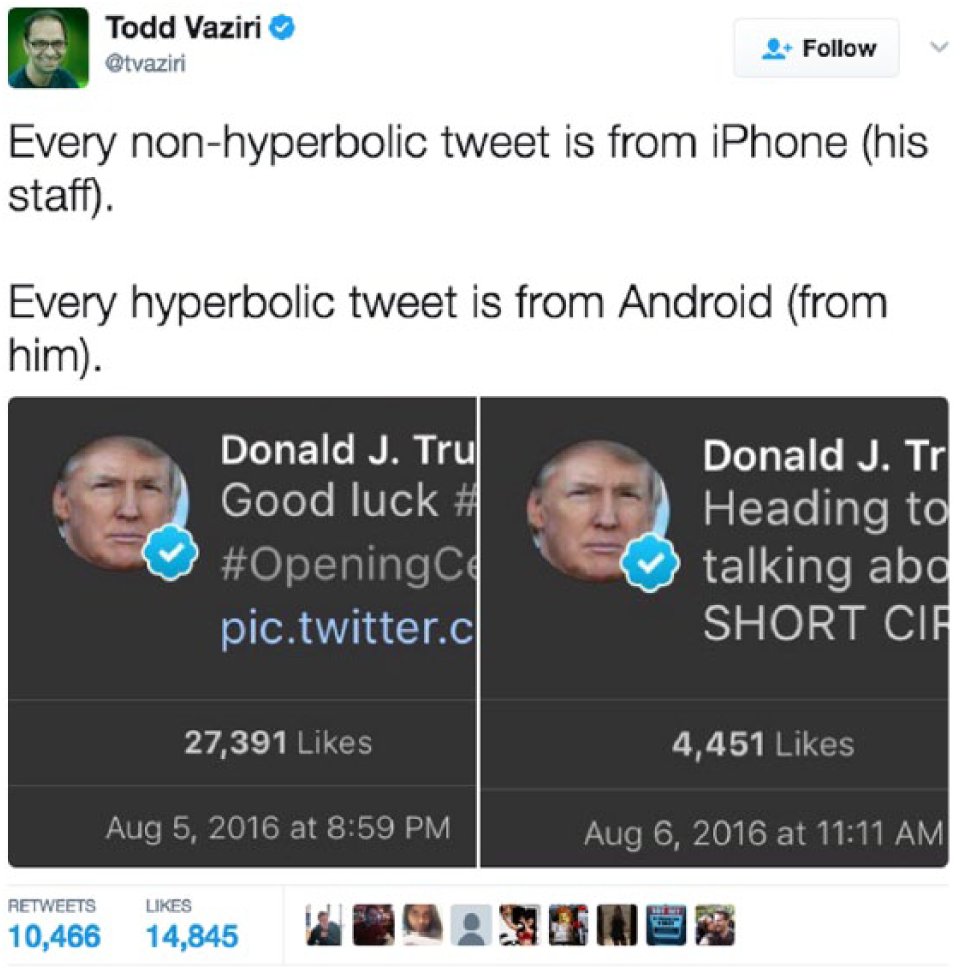
Tweet by Todd Vaziri.
The operating tags possess several distinct qualities. Like the typographic texture and timestamps, they provide a cue as to how we should read the tweet: in this case, as coming directly from Trump’s phone, rather than his team. By presencing the phone specifically, they indicate that it is something that could have come from Trump privately, possibly without the knowledge or approval of his team. They also help to anchor the tweets to a real-world event. Barbaro et al. (2016) imagine Trump seething “on his Android phone” (they note his operating system rather than his model, a Samsung), offering a detail that helps us to feel like we know what’s going on behind the scenes. What is more, a part of their rhetoric is the fact that the tags are apparently unintentional, an accidental by-product rather than a tactical cue. By providing a link to the compositional event, the tags produce a sense of connection through an empirical assurance that we are getting the words directly from Trump’s thumbs.
Indexes of the Self
We have seen that certain cues have been consistently drawn upon by American media to narrate Trump’s tweets, and by extension him, as authentic. Even where the commentary is ostensibly critical, it is underpinned by the claim that Trump’s tweets are authored by him and tell us something about who he is as a person. This created a hydra effect: the more the tweets were attacked, the more their claim to authenticity was strengthened.
Even contending interpretations of Trump’s tweets, such as that they are designed as a distraction, fall back on the same assumptions regarding the same authenticity cues. Wolffe (2017), writing for The Guardian, portrays this theory as “a deliberate pattern of distraction and diversion in the early morning tweets that are the product of the president’s prodigious fingers. When the media coverage . . . gets too tough.” When characterizing Trump’s strategy as deliberate, there is still an image of impulsive fingers, references to the timings, and the suggestion that it tells us something about Trump’s emotional state: when things get “too tough.”
What is it about Trump’s authenticity cues—the typographical texture, timestamps, and operating system tags—that make the tweets appear as authentic? Are they arbitrary mechanisms that could have just as easily been narrated as inauthentic by American media, or is there an underlying logic to why they are able to produce this effect?
In the following section, I advance the argument that these cues produce authenticity through a specific semiotic mechanism that can be best described by Charles Sanders’ Peirce’s concept of the index. Peirce’s semiotic taxonomy describes how signs relate to their objects. It therefore allows us to ask how authenticity is signified through these cues, and then start to consider why. As we will see, the three cues I have identified have an indexical relationship to Trump, and it is because of this indexicality that Trump’s semiotic strategy was so effective.
In Peirce’s model, signs fall into one of three categories: symbols, icons, and indexes. These categories describe the relationship between the sign and their object. Symbols refer to signs which relate to their object “by virtue of a law, usually an association of general ideas” (Peirce, 1868, p. 292). The word “fire,” for example, signifies fire because of the rules set out in the English language. Icons, on the other hand, relate to their object through a shared quality, most commonly physical resemblance. A drawing or painting of fire would therefore be an iconic sign. Peirce’s (1868) third category is the index, which signifies its object through “being really affected by that Object” (p. 291). Krauss (1977) elaborates Peirce’s meaning: “indexes establish their meaning along the axis of a physical relationship to their referents (p. 70). They are the marks or traces of a particular cause, and that cause is the thing to which they refer.” An indexical signifier of fire would therefore not be a word or picture, but something physically caused by the fire; smoke would therefore be an index of fire. Other examples of indexes include medical symptoms as signifiers for an illness (Krauss, 1977), the movement of a weathervane for wind (Peirce, 1868), or a footprint for a foot; each has a physical, causal link to their object.
By analyzing the typographical texture, timestamps, and operating system tags in terms of these three categories, we can see that they are not symbols or icons: there is no rule or convention which states these qualities signify authenticity, nor is there a resemblance to it. Instead, they bear a causal link with Trump and his personality. They are indexes of Trump, traces of his personality embodied in the tweets. The cues are caused by his frenetic thumbs, impulsive personality, nocturnal restlessness, unrefined passion, insistence using his personal phone, and independence from his campaign team. This causal connection is of course merely supposed; we do not know for certain that any of the tweets were authored by Trump. But the semiotic rhetoric tells us that they are based upon a relationship between sign and object that is causal, and thus indexical. They are not symbolic gestures, but indexes that are expressions of the real Trump.
The typographical texture is implicitly caused by Trump’s idiosyncratic manner of speech and his unfiltered emotional state; the middle-of-the-night timestamp is caused by Trump’s restlessness, fury, and separation from his team; the Android operating system tag is caused by his Samsung phone. Like handwriting, they provide an idiosyncratic texture that distinguishes Trump’s authorship. Like footprints, they suggest physical imprints, hence numerous references to Trump’s thumbs and fingers. They do not explicitly claim to be authentic, but provide us with implicit fragments of authenticity, apparently unintentional glimpses of the backstage. These authenticity cues can be best described as indexes, and Trump’s tweets’ authenticity can be best described as indexical.
Indexical Versus Symbolic Authenticity
While it is beyond the scope of this article to provide a systematic comparison between Trump and Clinton’s use of Twitter during the elections, we can nonetheless make a few observations that illuminate how their authenticity cues differed semiotically. As Grazian (2003) notes, authenticity is always manufactured in “contradistinction to something else,” and Clinton was Trump’s most foremost point of contradistinction (p. 11). Clinton attempted to identify authentic tweets by signing them off with her initials, “-HRC,” as is a common practice for politicians. Here, authenticity is signified in the symbolic register: authorship is established through an arbitrary convention: “-HRC” = authentic. This strategy assumes rather than earns trust. Why should we believe that the “-HRC” tweets are from her, rather than a cheap means of emphasis? There is also a semiotic ambiguity that separates us from her: does the sign-off mean she typed it out herself, that she wrote it, or that she just personally approved it? The symbolic mechanism employed here constructs a weak and deferred relationship to Clinton’s authentic self.
More generally, Clinton’s prevalent use of rich media, especially her high-quality graphics (17.1% of her tweets compared with 1% of Trump’s) have led scholars such as Lee and Lim (2016) to summarize her approach to Twitter as generally more “planned.” Her tweets rarely include any typographic idiosyncrasies or errors, consistently using fully and correctly punctuated sentences. Like the bespoke campaign font “Unity” used on her graphics, deployed as “a visual signifier with meaning” according to its designers (James, 2016), Clinton’s semiotic strategy on Twitter was more overtly symbolic than Trump’s. This is well illustrated by Clinton’s attempt to use emojis as symbols of youth, which was widely mocked as “disingenuous” and “inauthentic” (Castillo, 2015). Such a dependency upon symbolic signification contributed to the media narrative that she was continually following a script. The high-quality design and symbolic oversaturation conveyed that we are watching an opaque front stage performance.
Trump’s tweets signified authenticity through a wholly different mechanism. Instead of signing-off tweets using his initials or using symbols of authenticity, he litters his tweets with indexical traces that evidence authorship and convey a spontaneous emotional tenor. Trump does not tell us to trust his authenticity, but provides us with evidence for it. Numerous scholars have noted this evidentiary quality of the index. Hamlyn (2011, p. 80) describes indexes as “traces that evidence a certain situation existed in the room where the event took place,” while Doane (2007, p. 132) argues they provide “sheer evidence that something has happened.” This is precisely the effect we have seen in Trump’s tweets, where journalists consistently narrated his indexes as telling us about the circumstances of composition—what happened in the room—even when they have no information other than the indexical cues. We can see the evidentiary function of the index in operation in the satirical TV show The Colbert Report, in which the presenter enlarges a “6:35 AM” timestamp on one of Trump’s tweets (Figure 2) as if uncovering a piece of evidence under a magnifying glass. Colbert then goes on to question “who wakes up that angry? That’s furious, somebody give this guy a Xanex” (Colbert, 2017). This resonates with Salisbury and Pooley’s (2017) claim that social media users are “artifice detectives,” looking for clues and cues of authenticity. Indexes provide us with evidence for Trump’s authenticity, rather than symbolic claims. We are not told to believe the authenticity through the insistence upon a convention, but rather are invited to piece this perception together ourselves through the provision of evidence.

Screengrab from TV show Colbert Report.
The semiotic contradistinction between the symbolic and indexical registers is perhaps most striking not between Trump and Clinton’s tweets, but within Trump’s own diverse practices. The significance of an Android operating system tag in some of Trump’s tweets is reliant on the existence of iPhone operating system tags in others; the significance of a late-night tweet gains significance in its distinction from more conventional day-time tweets.
One tweet demonstrates the contradistinction between semiotic registers particularly well. On 22 January, the day of Trump’s inauguration, protesters filled the streets of Washington. In an uncharacteristically diplomatic tweet, Trump recognizes the rights of protesters (Figure 3). However, as he does so, he strips the tweet of its indexicality, leaving only symbolic signifiers (i.e., the words themselves). The tweet erases Trump’s usual signifiers of authorship (erratic punctuation, spelling and grammar, unusual timing). The withdrawal of these indexical traces produces an implicit disavowal of the message, which, whether or not performed self-consciously, demonstrates the power of Trump’s mobilization of indexical signification. The sudden shift from a typically indexical register to a symbolic one serves to de-authenticate the tweet. Correspondingly, responses to the tweet are littered with claims that it was not written by him: “he didn’t tweet that. That’s not his verbiage” (JCrongeyer, 2017). These contradistinctions reveal the role of indexical signification in Trump’s tweets, and the way in which they construct a rhetorical argument for their authenticity.

A tweet from Trump stripped of its indexicality.
Indexical Authenticity in Contemporary Digital Politics
We have seen that Trump’s distinctive formal architecture on Twitter, and its narrativization as authentic, was based upon the indexes of the self. Previous studies of authenticity on social media have argued that “what we consider authentic constantly changes, and what symbols or signifiers mark a thing as authentic or inauthentic differ contextually” (Marwick & boyd, 2011, p. 119), suggesting that there is a certain arbitrariness to how authenticity is signified. But the recurrence of indexes in media commentaries, based on an interpretive logic that was credible to and popular with the public, suggests that indexicality bears more than an arbitrary relationship with authenticity. Other examples of indexicality in contemporary politics further indicate that indexicality possess an authentic resonance on social media.
One might consider, for example, the role of handwriting in Bernie Sanders’ fundraising emails (see Wallace-Wells, 2016) during the Democratic primaries (see Figure 4). Sanders’ handwriting indexically signified his authorship and thus his personal and emotional involvement. Despite being very hard to read, Sanders’ handwritten letters were highly popular, indicating the indexical signification (the handwriting) mattered more than the symbolic signification (the words’ meaning) when it came to assessing Sanders. On a Reddit thread dedicated to deciphering the handwriting, one commentator remarked that “Sanders probably doesn’t have much experience ‘keyboarding’ thus the handwritten is sincere to me,” as if evidencing a technological naivety (Chicago for Bernie, 2015). More generally, handwriting held a particular appeal throughout the 2016 election, where many attempts at graphology were undertaken by journalists to better understand the “real” politician (e.g., Dresbold, 2015). Once again, it is the indexical register where authenticity is sought.

Excerpt from Bernie Sanders’ handwritten email fundraiser.
One might also look at examples further afield, such as British politician Johnny Mercer’s “accidentally” tweeted drawing by his daughters (Figure 5). While his bio states that he is a “father of two” in the symbolic register, this tweet tells us “I am a father” indexically, through a causal relationship to his children. His most popular tweet, one follower describes it as “oddly innocent” (Mel_O_Dramat1c, 2017), while another simply states “covfefe,” in reference to one of Trump’s own “typos” (peterthepig, 2017). Whether or not a genuine accident, Mercer refrains from deleting the tweet, presumably perceiving its value. Eventually, he capitalizes on the response by following up with the full picture drawn by his daughters (Mercer, 2017).

Tweet by British politician Johnny Mercer on 25 November 2017.
For a politician, indexicality holds a particular political currency. As citizens become more attuned to the sophisticated, data-driven communication strategies employed in election campaigns, indexes carry with them an authority of non-intentionality. Emotional outbursts such as tears and cracks in the voice—aka “the money shot”—operate with a similar logic: because we suppose that tears cannot be summoned at will, we see them as the symptoms, rather than symbols, of an emotion. Insofar as emotional expressivity is symbolic, it merely sustains the front stage performance; insofar as it is indexical, it is seen to be the unintentional glimpse of the back.
The apparent non-intentionality of indexes can suggest a certain naivety, as if their rhetorical power is unbeknownst to the author. As noted in research into vloggers (e.g., Abidin, 2017; Hall, 2015; Tolson, 2010, p. 281), amateurish features such as blurry footage, off-focus shots, or clumsy editing imply an editorial naivety. Indexical traces of production present people who “are assumed merely to record things with the technologies available to them rather than skillfully manufacture or manipulate them” (Paasonen, 2011, p. 80). In a world of media-trained politicians, this rhetoric of naivety and non-intentionality has a particular currency. Hence, while Trump’s use of indexes may seem highly idiosyncratic, it is possible to observe the index’s rhetorical power at play in other political contexts. The index offers politicians something they have been seeking since long before the digital age: a claim to innocence.
Footnotes
Acknowledgements
I would like to thank Carolina Bandinelli for encouraging me to pursue this line of thought, and her crucial feedback on early drafts.
Declaration of Conflicting Interests
The author(s) declared no potential conflicts of interest with respect to the research, authorship, and/or publication of this article.
Funding
The author(s) received no financial support for the research, authorship, and/or publication of this article.
