



Abstract
This article studies uses of Instagram by members of Indonesia’s Hijabers’ Community. It shows how hijabers employ Instagram as a stage for performing middle-classness, but also for dakwah (“the call, invitation or challenge to Islam”), which they consider one of their primary tasks as Muslims. By enfolding the taking and sharing of images of Muslimah bodies on Instagram into this Quranic imperative, the hijabers shape an Islamic-themed bodily esthetic for middle class women, and at the same time present this bodily esthetic as a form of Islamic knowledge. The article extends work on influencer culture on Instagram, which has considered how and whether women exert control over their bodies in post-feminist performances of female entrepreneurship and consumer choice on social media. In it, we argue that examining the “enframement” of hijaberness on Instagram show it to be both a Muslim variant of post-feminist performances on social media, and a female variant of electronically-mediated Muslim preaching. That is, hijabers’ performances of veiled femininity structure and are structured by two distinct fields - a dynamic global digital culture and a changing field of Islamic communication – and point to a “composite habitus,” similar to that identified by Waltorp.
Introduction
One of the most striking developments of the late-20th and early 21st century Indonesia has been the rapid increase in the number of Muslim women who wear the veil—a development with its roots in the growth of political and public Islam beginning in the 1990s. In the 1980s, veiling served as a sign of opposition to the authoritarian New Order regime, which was determined to quash the growth of political Islam. But after the Suharto regime relaxed restrictions on political Islam in the 1990s, and as the consumer economy began to expand, notions of consumer choice began to infuse veiling practices, rendering veiling a sign of the individual transformation consumerism makes possible (Beta, 2014, 2016; Bucar, 2016; Jones, 2010, 2017)
In the Indonesian context, then, hijab-wearing needs to be understood as a socially progressive move linked to women’s increasing visibility with the expansion of consumer culture, rather than a socially conservative move aimed at preserving long-standing notions of Muslim femininity. As Slama and Barendregt (2018) point out, many young Southeast Asians are opting “to live ‘the modern life’ religiously and often in ways more orthodox than their parents or grandparents would have done only one or two generations before them” (p. 4). Indeed, when Pramiyanti asked her research participants to qualify what constitutes a modern Muslim woman, they invoked a sense of veiling as something modern, and also a sense of dwelling in a heavily mediated Muslim marketplace, which presented them with an expanding array of choices.
Oh, a modern Muslimah (Muslim woman) is veiled but free to do as she wishes because now there are no limitations on veiled women. It used to be the case that it was difficult for veiled women to find a job—you had to unveil if you wanted to work. But now with the rise of Muslim fashion on Instagram, it’s considered fine for veiled women to work (Interview 13 October 2016).
I decided to don the veil when I started to see all the different styles on Instagram, and on television. From 2014 on hijab fashion has been growing, with more and more designers emerging. All the fun different styles on Instagram are so inspiring. There are so many online shops, too—all selling fun designs and some are really weird (Interview, 13 October 2016)
The decision to don the veil presents women with a number of style choices, including the jilbab (a simple piece of cloth pinned under the chin), the kerudung (short veil loosely draped over the head leaving the hair partially visible), the cadar (a long, knee-length veil covering the face) and the hijab (colorful fabrics wrapped closely around the head, often associated with high end fashion trends). Part of an increasingly crowded Islamic popular cultural field, including public intellectuals, tele-preachers, soap operas, Islamic-themed vigilante groups, Muslim boy bands, and Muslim style leaders, these various styles of veiling are not free-floating signs but, like many of the other identities available for adoption from the Muslim marketplace, often tethered to established class positions, signaling various degrees of proximity to the modern and the global. Therefore, they exist in varying degrees of antipathy and affinity to one another. Islamic intellectuals, for example, look down upon tele-preachers, and the hijabers are keen to distance their style of veil from the simpler jilbab.
The hijabers’ style has its genesis in the online Hijabers Community (hereon HC) established on Facebook by four “modest fashion” designers—Dian Pelangi, Jenahara, Ria Miranda and Ghaida Tsuraya, in 2011. Since that time, HC’s activities migrated to Twitter and again, more recently, to Instagram. 1 The designers employed strategies common to the cultivation of microcelebrity—a global phenomenon in which ordinary people draw on social media affordances to develop popular following among niche audiences, typically using performative strategies that evince an authentic self well within reach of his or her fans (Abidin, 2016; Marwick, 2015; Senft, 2008). They adopted the term hijab to distinguish their style of veiling from practices associated with the jilbab and deemed “improper.” The so-called “jilbab gaul” (trendy veil), and later “jilboobs,” phenomenon, by which women combined jilbab wearing with tight-fitting jeans and tops showing their curves and sometimes their skin—was criticized by Islamic scholars, who deemed it failed to qualify as Islamic dress (Beta, 2016, p. 26). 2 The hijabers’ use of the term hijab worked to differentiate the style from jilbab gaul, but it also worked to mark it with global nuances.
The term “hijabers” is specific to Indonesia, but its appearance in Indonesian lexicons coincided with that of resonant terms, like hijabistas (hijab and fashionista) or hijabsters (hijab and hipster) in Malaysia, Singapore, Middle East, UK, and North America (Lewis, 2015; Tarlo, 2010; Tarlo & Moors, 2013). Use of the term gestures toward the global—being a hijaber marks one as part of a global community of transnationally mobile Muslimah keen to present themselves as at once fashion conscious, tech-savvy, transnationally mobile career women in possession of considerable buying power. 3
In many respects the hijabers’ sense of their own power is warranted. They are certainly agents in the molding of Islamic pop culture, possessing not only consumer power as individuals but also the ability to generate new publics, 4 involving the production, circulation and consumption of images by women and for women. These woman ride high on the myth of social media’s epochal transformative power, using their cell phones and social media affordances to produce themselves, and design paths for circulating their self-productions, sparking dialogues across distant sites among female strangers commonly engaged in crafting the ideal look of the modern Muslimah. Moreover, by claiming the circulation of their images on Instagram as a form of dakwah, the hijabers impinge on forms of religious knowledge and authority formerly reserved for men.
There can be little doubt that the hijabers are enhancing the visibility of women who lay claim to empowerment, or that they develop technological prowess to forge trans-local connections among Muslim women who commonly idealize such values. Therefore, in Castellian terms, they posess “network making power” (Castells, 2010, p. 773):, that is “power wielded by actors and networks of actors with the capacity to set up and program a network” (Meng, 2012, p. 470). However, by virtue of their socio-economic position and capacity to consume, they also possess “networking power” (Castells, 2010, p. 773): “the power that actors in global networks exert over those excluded from the network” (Meng, 2012, p. 470). Indeed, the performance of hijaberness to a large degree rests on spectacular exhibitions of such networking power; the hijabers are at pains to construct the hijaber habitus as a distinctly middle class one, to which only those with advanced consumer power may belong. Such efforts work to link women’s power exclusively to their identities as consumers, and validate the idea that the ideal woman is a consuming woman.
Reading the Hijabers’ Instagram Posts
The case of the hijabers touches on key questions in the analysis of microcelebrity, a subset of celebrity defined by its relationship to particular media forms (the use of social media to gain celebrity status) and media practices (new branding and marketing strategies that take advantage of the affordances and cultures of social media platforms). Such work centers on debates concerning the extent to which women’s uses of social media to present the consuming woman as empowered, in fact, empowering. Some scholars lament microcelebrities’ problematic embodying of post-feminist ideas, in which female power is entangled with consumer power and “individual choice, independence and modes of expression rooted in the consumer marketplace” are celebrated (Duffy & Hund, 2015, p. 3). Duffy and Hund contend that digital culture entrenches rather than challenges post-feminism by positing the consuming woman as the ideal woman: “What is especially problematic about digital expressions of post-feminist self-brands is the extent to which visibility gets articulated through normative feminine discourses and practices, including those anchored in the consumer marketplace.” But for Abidin (2016), by using social media platforms to stage disintermediated relationships between their performances of femininity labor and those who gaze upon it, microcelebrities capitalize on post-feminist ideology and extend ownership over the means of production. Their image-making endeavors are subversive, because they reframe selfies—constructed in the dominant discourse as frivolously vain—as a “prized asset” the production of which makes visible women’s tacit “femininity labor” and reveals their intimate knowledge of how to manipulate, arrange and adorn their bodies to extend/ augment its commodity value, enacting “subversive frivolity” (Abidin, 2016, pp. 15-16).
In the article, we engage with these debates, but we also contend that a reading of the hijabers’ identity performance is complicated by their historical positioning at the intersection of digital uptake and rising consumerism, democratization and Islamicisation in Indonesia. This positioning requires acknowledging the multiple lineages globalizing digital cultures—that is, beyond those inferred in Euro-American trajectories of digital change—to grasp the hijabers’ gender politics. Indeed, as we will see below, such lineages bear their trace in the hijabers’ Instagram posts, and prompt us to conceptualize hijabers’ performances as revealing of a “composite habitus” (Waltorp, 2015, p. 50), for they orient to two distinct fields: microcelebrity culture and digitally mediated Islam. We aver, the term “composite habitus” accommodates both an acknowledgment of the historical agency of technologies, and a nuanced analysis of variations in cultures of their of use. As we will see, such variations cannot always be accounted for through reference to long-standing ways of doing things in the locale. They may well be rooted in global processes that elude a West-centric vision of digital change.
In her study of young Danish Muslim women’s social media use, Waltorp argues that the women use social media to augment to spaces available to them for identitity experimentation. On and offline, they play with various subject positions in various fields. This kind of practice is evidence of what Waltorp (2015) calls a “composite habitus” (p. 50)—bodily comportments that betray the acute sensibilities both structured by and necessary to the successful navigation of distinct social environments that become available through smartphone use. Composite habitus is usefully applied the the hijabers. Unlike the veiled women of which Waltorp writes, the hijabers don the veil both on and offline, maintaining a coherent identity. Nevertheless, our research finds that hijaberness is concurrently structured by and oriented to two distinct fields, with distinct implications for the hijabers’ gender politics: first, a culture of microcelebrity on Instagram in which dominant gender norms are largely reproduced, and second, a dynamic field of Islamic communication, in which “normative” feminine practices are contested and in flux.
We shall review the scholarship attending to contemporary developments in Islamic communication more thoroughly below. Suffice to note here that such work observes the considerable fragmentation of Muslim authority in recent years, as digital uptake and the commoditisation of global Islam prompts the proliferation of knowledge sharing activities outside the mosque (Echchaibi, 2011; Scholz, Selge, Stille, & Zimmermann, 2008). Some scholars argue, this re-spatialising of knowledge-sharing not only prompts new contests among male religious authorities; it also affords women greater power in shaping the way preachers address audiences at preaching events (Millie, 2017; Slama, 2017). Below, we show how the hijaber case is revealing of women’s use of Instagram to advance such feminisation in ways that disrupt familiar and long-standing modes of Muslim communication.
Methods
This article is based on a conception of identity as performed and constantly negotiated, rather than given. As Meldelson and Papacharissi (2011) note: In everyday life, people consciously and unconsciously work to define the way they are perceived. … Contemporary scholars from a variety of disciplines argue that identity is performed, in its many iterations, in contexts that are both virtual and real, mediated or not, offline or online.” (p. 252)
Numerous scholars have argued that the Internet expands opportunities for what Goffman (1959) calls front-stage self-making (Abidin, 2016; Duguay, 2016; Mendelson & Papacharissi, 2011; Sundén, 2003), and with the advent and popularization of web-based image-sharing, such self-making increasingly proceeds through strategic manipulation and posting of photographs. Alluding to the rise of Instagram as evidence of the increasing importance of visual texts in contemporary culture, Highfield and Leaver (2016) point to the urgent need for greater attention to images in the study of online identity performances, and Marwick (2015) argues that images offer qualitatively different resources for identity construction, and calls for new frameworks for understanding identity construction online.
Available studies of visual social media, however, offer few methods for qualitatively reading images—that is, for analyzing their contents but also for understanding how their particular social efficacies might be distinct from those of text-based forms of identity construction. Abidin (2016), for example, relies heavily on interviews and observational methods to understand the tacit labor involved in making and engaging with microcelebrity images. In their article exploring “methodological and ethical considerations” for studying visual social media, Highfield and Leaver (2016, p. 47) also rely on hashtags rather than visual analysis methods to understand what Instagram images mean, and Marwick uses Instagram images as hooks to discuss microcelebrity practice rather than to analyze their special potency as images. Frosh (2015) alludes to this gap in his article in which he positions selfies in an historical trajectory of the evolution of photography as a media form, noting how “non-representations and technological changes are made analytically pre-eminent in work on visual social media” (p. 1607).
In this article, we use Spyer and Steedly’s notion of enframement to hone in on images in a qualitative reading of the hijabers’ Instagram posts. They write: “[b]y ‘enframement’ we mean the various ways the image is foregrounded or separated from its general environment to be apprehended as an image,” and lay out a range of devices for enframing images (Spyer & Steedly, 2013, p. 19). These include border effects enclosing an image; depth of field and camera angles, which present the viewer with a framework by which to understand an image, bringing certain objects to the fore and relegating others to the background; frames of reference, or “sets of ideas that direct how the image should be evaluated, viewed or comprehended”; and finally, language, including captions, but also the time stamps that appear on digital photographs, or thought balloons.
Most other studies of microcelebrities focus on particular influencers (Kavakci & Kraeplin, 2017; Marwick, 2015), but our study applies the same treatment to elite and non-elite (founders and ordinary members) all included in the cohort of 26 hijabers interviewed by Pramiyanti between May and October 2016. This treatment is apt because our interest here is in the discursive fields structuring hijabers rather than the tactics used by individual micro-celebrities to self-brand. Participants were recruited by targeting key elites (founders and social media administrators) and then snowball sampling ordinary members in Jakarta, Bandung and Yogyakarta. In order to understand how members of HC use Instagram to construct hijaberness, we analyzed interviewees’ accounts. Posts were coded manually by looking for core and common patterns.
We discuss these patterns below, drawing attention to how multiple tactics are used to enframe hijaberness on Instagram. Attention to enframement in the hijabers’ Instagram posts brings the qualities of their front-stage self-making on Instagram to light—its orientation to both a transnationally manifest culture of Instagram’s use and developments in Islamic communication, thereby revealing the operation of composite habitus. First, the hijabers’ posts emplace them in particular socio-geographic settings that mark them as high-end consumers, and this mode of identity performance locates them in microcelebrity culture and draws attention to the growing role images of place are playing in it. Second, by captioning their posts with dakwah-related messages, the hijabers mark themselves as authentically pious, and this positions them as knowledge holders, not just hedonistic consumers. This mode of identity performance positions the hijabers in a field of Islamic communication, and shows how the hijabers’ phenomenon not only validates consumerist ideology; it also bolsters a broader challenging and fragmentation of male religious authority.
Enframing Hijabers
Existing studies show how Muslim women use Instagram to link veiling to prevailing notions of feminine beauty (Jones, 2017; Kavakci & Kraeplin, 2017), and they do so by presenting images of the hijabi body situated in non-places or culturally evacuated backgrounds that work to focus the viewer’s gaze on the hijab-enframed face, suggesting its inherent beauty across space and time. In such images, the hijabi self appears evacuated of context (the background is blacked out or the portrait is taken at such close range that the background is unidentifiable), inviting an exclusive focus on the body and face, and allowing the hijabis to demonstrate that their veiled selves are well able to conform to conventional notions of beauty.
This practice is also discernible in some of the hijabers’ posts. For example, in one post, Syifa Fauziah, Chairwoman of Hijabers Community Jakarta, appears as little more than a hijab-enframed face. Seated in the back of a car—a taxi perhaps—in an unidentifiable location, Fauziah looks away from the camera toward the light falling on her cheeks, her hand held delicately under her chin, as if to gesture to her averted gaze. Fauziah’s face is heavily made up—lipstick, foundation and rouge all clearly visible on her fair skin and pert smile (Figure 1).

@syifaf. Screengrabbed, July 2017.
But images depicting the hijaber as a passive beauty are not common in the corpus of posts we collected. What distinguishes the Indonesian hijabers from those Kavakci and Kraeplin (2017) and Jones (2017) study is their interest in presenting as not only “beautiful” but also especially empowered and independent Muslimah, and this requires a certain kind of enframement—setting her in a broader social world featuring performances of bodily and intellectual strength. Such strength is communicated in the posts in several ways. Some post images of themselves engaged in vigorous physical activity, others include posts that show them to be intrepid travelers, and others still that highlight their roles as equal partners in marriage.
For example, contrasting the above-described post, in which Fauziah’s veiled face occupies the entire frame of the photograph, a travel snap pans well back from her face, and shows her modestly dressed body engulfed by the well-recognizable rugged landscape of the Grand Canyon. This reframing directs the viewers gaze away from her beautifully veiled face, and toward her emplacement in iconic exotic settings. This image shows how depth of field is being used to evince a sense of the hijaber as empowered for her mobility. What is being performed here is an agentive, active mode of Muslimah publicness: not a publicness limited to inviting a gaze, but one that gazes back, if not into the camera, then at the ‘other’; the dry, rough-hewn American landscape (Figure 2).

@syifaf. Screengrabbed, July 2017.
The image of the hijabers as Muslimah in possession of agency is further reinforced by their posts showing them engaged in sporting activities. In Figure 3 Irina confidently rides a horse, and Figure 4 shows Ghina at an archery range. These posts, too, contrast those focussing on the veiled Muslimahs’ physical beauty—rather than resting on her face, the camera pans back to enframe the hijaber in social settings attesting to her independence and physical vigor. In both images, too, the hijabers appear alone—unaccompanied by a man—and in both they also wear practical, sporty outfits—pants, mid-length hijabs and runners.

@irineorene. Screengrabbed, January 2017.

@ghinaafaa. Screengrabbed, January 2017.
When hijabers appear side by side their husbands, it is in posts that posit the ideal marriage as one in which husband and wife enjoy equal status. In the posts below, Udhe and Fitri sit or stand at the same height as their husbands. Fitri and her husband are shown looking at an unknown object out of frame, suggesting a common purpose, and Udhe and her husband gaze into eachothers’ eyes, suggesting reciprocity (Figure 5 & 6). Udhe captions her post thus: It becomes difficult if both parties don’t make an effort. If one person has already tried to be romantic but the other person doesn’t even try, everything starts to fall away. Try to make habit of doing little things for each other, like opening the car door, eating from the same plate, feeding each other, being gentle with each other, giving each other presents, or going out once in a while. … From the simple to the complex things, the important thing is that both put in equal effort to keep the relationship happy and romantic until old age, noting the importance of keeping the harmony and intimacy between husband and wife.

@ulydarojah. Screengrabbed, April 2017.
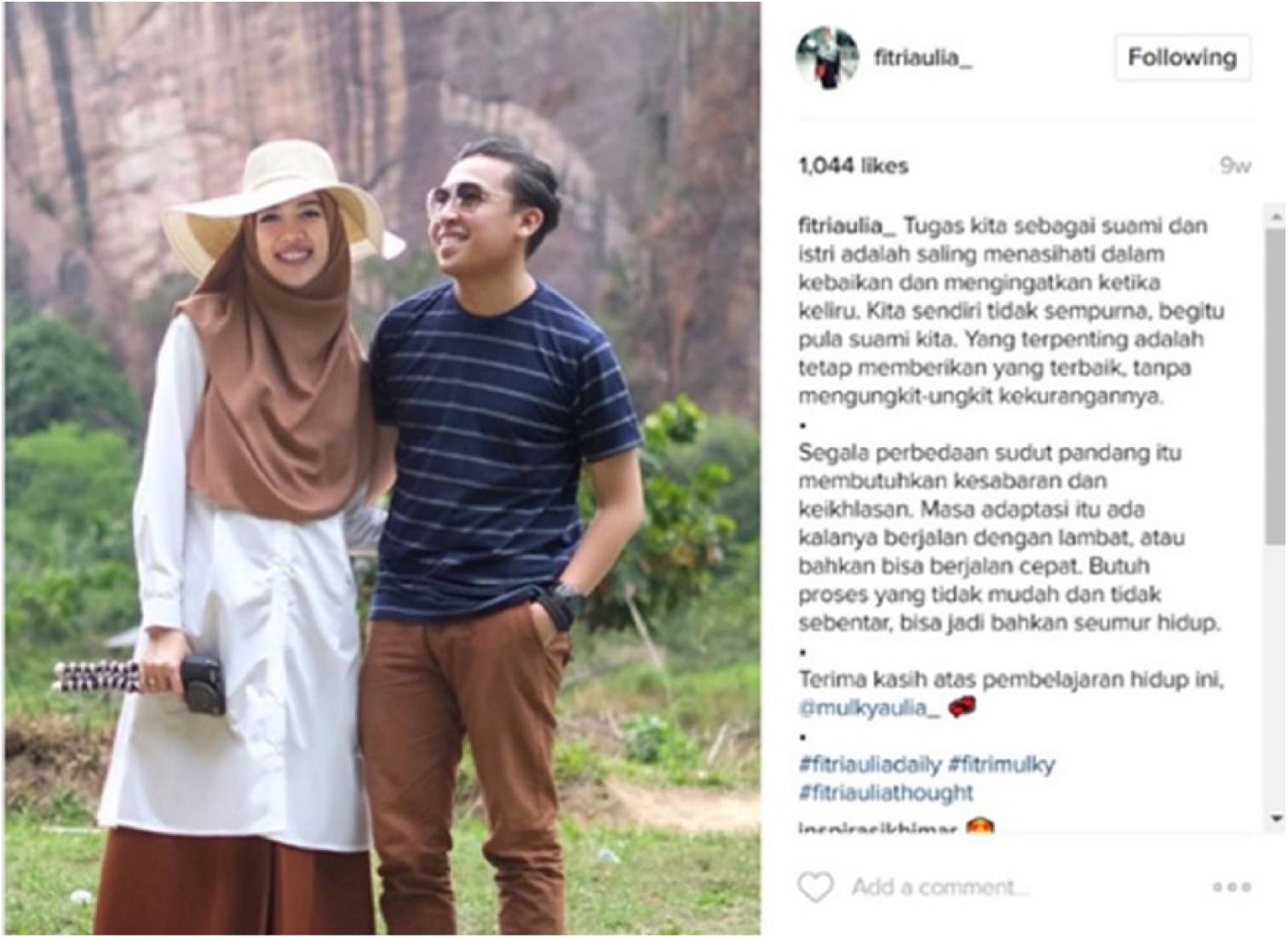
@fitriaulia. Screengrabbed, April 2017.
This orienting of the Hijaber Community toward the ideal of the independent Muslimah, and especially the way the hijabers use the trope of the empowered Muslimah wife, is significant in light of a Muslim feminist agenda, which for some time has been focussed on agitating for the reform of the institution of marriage. In an article exploring how Islamicisation and democratization co-constituted one another in early 21st century Indonesia, Suzan Brenner (2011) reviews a number of Muslim initiatives that dedicated themselves in the 2000s to legislative reform on polygamy, domestic violence, marital rape and child brides (p. 478). Lobbying and campaigning by such groups resulted in the passing of a bill criminalizing domestic violence in 2004, although their efforts to outlaw polygamy in the same year failed. Notably, more recently the call for reforming the institution of marriage emerged again, after the world’s first congress of Muslim scholars in Cirebon, West Java in 2017, which resulted in a fatwa denouncing these practices. Reporting on the Congress, Kathy Robinson writes: “Violence against women and women’s rights within the family were key issues. … The congress ended with . . . fatwa reinforcing the value of female religious authority. The first fatwa argued for a minimum age of marriage of 18; the second, that sexual violence against women, including within marriage, is haram (forbidden)” (Robinson, 2017, n.p.). The hijabers do not explicitly reference the feminists’ arguments, but their orientation toward transnational mobility, physical activity and, most notably, equality in marriage, implicitly challenges discourse of Muslimah femininity sanctioning marital rape and polygamy, 5 thereby providing a soft popular cultural scaffolding for the Muslim feminist agenda.
At the same time, however, the social settings that enframe the hijabers as mobile and independent women also identify them as those with access to sites and spaces restricted to people of considerable economic means. Consistently, these settings depict a world of high-end consumption featuring luxury sports, fancy restaurants, foreign foods and international tourism. Such consistency reveals the high end setting as a key piece of visual vocabulary employed by the hijabers as they write themselves into Instagram, and works to limit the hijabers’ empowerment to a those who inhabit a middle class subject positioning.
Interestingly too, these spaces often reflect a decidedly Western orientation. For example, the hijabers’ posts about their holidays depict them as independent and intrepid explorers, but also as those whose affinities for travel orient to the West rather than Muslim majority countries, identifying them as a subset of a global, cosmopolitan elite, Muslim and otherwise. Food posts similarly work to identify the hijabers as members of a middle class. By posting an image of ramen, Wanda is able to register her presence at a Japanese restaurant—a setting surely well beyond the reach of any ordinary Indonesian. Indeed, Wanda suggests as much on the caption she pens to accompany the post (Figure 7): I am so grateful that Allah has blessed me with the ability to eat delicious food. I can buy anything I want. All my cravings can be satisfied. When I got home I felt so full I could barely stand. This turned my mind to people who live on the street—do they forget what it feels like to have a full stomach? Thankyou Allah, please allow me to pass on your blessings to others.

@pratiwanda. Screengrabbed, July 2017.
Posts calling on Muslimah to enact acts of kindness during the fasting month, organized around the hashtag “ibadah jangan kendor” (Don’t let your worship slack off), also provide opportunities to showcase this middle class habitus. The two images below were posted during this Ramadhan challenge program organised around the hastag Figure 8 depicts an image of a pair of thongs (flip-flops), adorned with the words #ibadahjangankendor across the toe-line, which dafinamaalina donated to her office musholla (prayer room), and identifies her as a white-collar worker in a clean, carpeted office. Figure 9 depicts an image of prayer mats atop a washing machine -in the comments, meiswari explains that these are the prayer mats she has taken home from the office to wash, in her expensive front-loader washing machine—an item that marks her as a woman of means: most Indonesians handwash their clothes in a bucket.


@hijaberscommunity. Screengrabbed, July 2017.
Indeed, in her study of the Hijaber Community in Instagram, Beta also notes its discursive construction as a sign of middle classness and consumer power. She contends that the hijabers proffer a tame alternative to both the vulgar style of “jilbab gaul” and the “gloomy Arabic veils”; they flaunt “their ability to adjust to a level of colorfulness —the fun, safe Muslims—that requires respectable financial means and in turn accretes as cultural capital: an ability to be accepted as global and cosmopolitan” (Beta, 2014, p. 385). Our research affirms this finding, but we propose an extended interpretation of it. In Beta’s analysis, the taming of the veil is presented as a consequence of the expansion of Islamic consumer culture in Indonesia, whereas we contend that hijabers’ rendering as “fun, safe” Muslims may also be seen as a function of a transnational culture of Instagram’s use.
According to Marwick (2013) and Duguay (2016), a culture of Instagram’s use—that is, modes of identity performance not determined by the technical structures of the platform, but by user understandings of acceptable comportment on it—makes the platform especially amenable to taming or mainstreaming identity performances associated with microcelebrity. In Marwick’s (2015) study, Instagrammers display an affinity for emulating “the tropes and symbols of traditional celebrity culture, such as glamourous self-portraits, designer goods and luxury cars” (p. 139). Duguay’s comparative study of queer influencer Ruby Rose’s accounts on Vine and Instagram highlights the how the platform tames marginalized identities by presenting them as a subset of mainstream culture. On Vine, Rose appears in a full-throated embrace with her girlfriend but on Instagram the couple pose in shots depicting their coupledom as a variant of bourgeois, sex-evacuated bliss.
Similar dynamics are at play in the hijaber case. In their glossy, thoughtfully composed images of their middle class everyday, the hijabers both emulate corporate media (they make hijaberness look like a tv ad or a glossy magazine), and bring threatening identities in to a mainstream fold (ie, the retrieve veiling from the threat of jilboobs and jilbab gaul). In light of Marwick’s and Duguay’s arguments, we may surmise that this taming is a function of a transnational culture of Instagram use, and not just a consequence of the hijabers’ specific geographic and historical locatedness in Indonesia. It is also linked to how Instagram is discursively constituted as a media form, and demonstrates the operation of what Spyer and Steedly (2013) refer to as frames of reference: “sets of ideas that direct how the image should be evaluation, viewed or comprehended” (p. 19). In other words, a culture of Instagram’s use works alongside captions, borders and depth of field to attach meaning to images on Instagram.
The case of the hijabers also proffers new insights into recent developments in cultures of using Instagram, particularly the new roles location is playing in constituting the culture of the platform. Earlier we distinguished the Indonesian hijabers Instagram posts from those that position the hijabi in a “nowhere” in order to focus attention on her facial beauty, and draw connections between hijab-wearing and conventional feminine beauty. By contrast, the hijabers post images of themselves in recognizable places, and this may be seen as a function of the increasing importance of location data in uses of social media; geographic location plays an important role in the way the hijabers constitute themselves as exemplars of an ideal middle class Muslim femininity. Such tactics entangle them in power dynamics emerging from what Mitchell and Highfield (2017) call the “digital spatial turn” (n.p.), in which ubiquitous uses of location by the makers and users of social media platforms are working to make the internet an ever more grounded space. Not only are geo targeted ads are becoming more important to the ways social media corporations do business (“over the next five years, location-based ads will make up over 40% of mobile ad spend [and] the number of location aware apps is expected to triple by 2019”). There is also an increasing tendency among everyday users to incorporate location data into their social media posts (in 2013 “30% of adult users included location in their social media posts, up 14% two years prior”) (Mitchell & Highfield, 2017, n.p.). Clearly, the hijabers contribute to this grounding by according distinctive socio-geographies such a prominent place in their Instagram identities. Moreover, their use of geographic settings to mark themselves as being in possession of consumer power reveals how location data is being drawn into frontstage self-making endeavors (Goffman, 1959) on Instagram. The hijabers wilfully curate location data to compose coherent and ordered Instagram identities that belie the messy subject positions suggested by a vast backstage archive of geodata, being produced in ever greater volume by ordinary social media users (Mitchell & Highfield, 2017).
We see two possible readings of the implications of Instagram’s packaging of the hijabers for their gender politics. Instagram expands the field of everyday image-making, and contributes to the visibilising of Muslim women and their enhanced role in public life. Hijabers use this tool to link hijaberness to bodily and mental agency, which they articulate by providing visual evidence of their well-to-do existence. This particular articulation of women’s power emerges from a context of the expansion of consumer culture and the attendant commoditisation of Islam in Indonesia. But it is also significantly bolstered by a culture of Instagram’s use, which favors the glossy, the high-end, the luxurious. Instagram cements the hijabers’ reliance on “feminine discourses and practices. . . anchored in the consumer marketplace” (Duffy & Hund, 2015, p. 3) in order to articulate their empowerment-—problematic from a feminist perspective because it limits such empowerment to women’s capacity to consume. At the same time, by presenting themselves first and foremost as objects of consumer desire, the hijabers gain an opportunity to “slide under the radar” (Abidin, 2016, p. 2). Framing their relationships with their husbands as a feature of a middle-class consumer culture, they capitalize on Instagram’s valorisation of the consuming woman to present controversial female subjectivities (for example, the Muslimah wife who stands on an equal footing with her husband) in a palatable format. In this way, they shape Muslimah pop culture consumers’ aspirations in a way synchronous with an Indonesian feminist agenda to reform the institution of marriage.
In the next section, we move to a consideration of the posts’ captions, which affords a different interpretation again. Diverging from microcelebrity practice chronicled by other scholars, entailing the use of captions for product promotion, 6 the hijabers use captions to interpret their posts through reference to scripture—the Qur’an and Hadith. This enables them to claim their activities on Instagram as forms of dakwah, thereby framing hijaberness as something more than a subset of microcelebrity culture—it is also a mode of Islamic communication, analysis of which requires an engagement with work on contemporary developments in the mediation of Islamic knowledge. By claiming the sharing of images of their consuming bodies as forms of dakwah, the hijabers attest to the fragmentation of Muslim authority; a phenomenon linked variously to electronic mediation (Echchaibi, 2011; Scholz et al., 2008) and the increasingly important role female consumers are playing in shaping interpretations of scripture (Millie, 2017; Slama, 2017).
Islamicising Through Captioning
Captions allow the hijabers to present themselves as pious subjects, aware of their good fortune, au fait with scripture and confident in its interpretation, observant of the daily rhythm of prayer, and always eager to do good deeds. In the posts we collected, hijabers’ dakwah efforts are abundantly evident. For example, Syifa Fauziah interprets the above-discussed image of herself at the Grand Canyon by way of a flowery citation from the Qur’an which reads: “Who has created the seven heavens layering one upon the other, you can see no fault in the creations of the Most Beneficent. Then look again: Can you see any rifts? Then look again and yet again, your sight will return to you in a state of humiliation.” (Surat Al-Mulk verse 3-4). Similarly, Wanda to a post depicting sites featured in her tour of Europe, Wanda appends a caption expressing her humility as a subject of Allah (Figure 10): Allah, please allow me to add more stars as many as possible on Your blessed earth. It is not only about taking pictures to feed my Instagram, but it is more to feed my soul. Because little that I knew, a tinie-tiny human like me needs to learn more from other creatures in other places. I go somewhere as no-one, then I come home still as no-ne but with many stories to tell. May this map always (leeds) to you. #alhamdullilah #travelgram #traveling #solotravel #backpacking #tourist #europetrip #map #lessonlearned #terimakasihlpdp
7

@pratiwanda. Screengrabbed, July 2017.
Other posts feature more flippant or humourous captions. Ghaida Tsuraya, for example, captions an image of herself outside a mosque in Turkey with a passing reference to the “Keep Calm and Carry On” dictum—in this case amended to refer to dzikir (devotional occurences), offered as an appropriate remedy for a state of anxiety: “Galau? (Confused?) Keep Calm and dzikir on,” she advises.
In her analysis of the Instagram accounts UkhtiSally (Sister Sally) and Duniajilbab (World of jilbab), Eva Nisa (2018) argues that Indonesian Muslimah are using the platform to develop a “soft” form of dakwah—ie a form of proselytizing imparted by way of glossy images, depicting women as key actors in the consumer economy, and woven into lucrative social media-based businesses (pp. 68-71). The hijabers’ dakwah efforts may be similarly described as “soft” for their reliance on images and discourses of consumption, and both cases—the hijaber case and Nisa’s study—extend discussion of the feminisation of Muslim publics proceeding as part of what a the fragmentation of Muslim authority (Echchaibi, 2011; Scholz et al., 2008) (Figure 11).

@gdaghaida. Screengrabbed, June 2017.
As mentioned earlier in the essay, recent scholarship on contemporary developments in Islamic communication has focussed on such fragmentation, a function of digital uptake and the broader commoditisation of global Islam, both of which result in in increased opportunities for undertaking and participating in preaching activities outside of the mosque. Echchaibi chronicles the rise of Baba Ali, a US-based preacher who uses humor and everyday language to deliver sermons on Youtube. Echchaibi sees Baba Ali as exemplary of a new clutch of Muslim preachers who are using digital media to reach transnational audiences, thereby delocalising sources of Muslim authority, “generating new producers and locales of religious meaning in Dubai, London, Paris and Los Angeles” (Echchaibi, 2011, p. 25; for other examples see Alatas, 2017; Scholz et al., 2008).
In Alatas,’ Echchaibi’s and Scholz et al’s studies, males employ new media to renegotiate existing authority structures. But scholars focussing on Indonesian Islam show how gender binaries are also being dismantled as preaching events increasingly extend beyond the mosque. Millie and Slama both note the marked feminisation of Muslim audiences, and the new roles women are playing in shaping the articulation of authority. In Millie’s study of preaching events in West Java, for example, women commonly constitute 70% of the audience. Therefore, they play a pivotal role in sustaining the viability of preaching as a vocation, and preachers take care to orient themselves to the women attendees. They craft their oratory in ways designed to grab the women’s attention, by telling jokes, singing songs and proffering interpretations of scripture that are sensitive to women’s realities (Millie, 2017, p. 132). And Slama shows how mobile digital devices digital social media endow the Muslimah with consumer agency in their dealings with preachers. Discussing the use of WhatsApp and Blackberry Messenger by middle class women in Yogyakarta to seek affective connections and emotional support from ustadz (preachers)—a practice they refer to as “charging their hearts,” he writes: “Put simply, ustadzs cannot risk ignoring the emotional needs of their female followers. If they cannot find the right words at the right time, their followers will choose to charge their hearts elsewhere” (Slama, 2017, n.p.).
Milllie’s and Slama’s studies show how the fragmentation of Muslim authority affords new roles for women in public Islam. As audience members and consumers, women are positioned to shape preaching practices. But the hijaber case extends this work attending to women’s expanded role in public Islam, because it shows how they exert power not only as consumers of religious authority. They, like the Instagrammers of which Nisa writes, style themselves as religious authorities, interpreting images of their consumerist selves through reference to the Quran and Hadith to offer Islamically-flavored style and lifestyle advice for a young Muslimah middle class public on Instagram. This use of Instagram positions the hijabers as not only a subset of post-feminist microcelebrity culture on Instagram, but also a feature of the fragmentation of Muslim authority, entailing the proliferation of Muslim authority figures whose power rests on their ability to command audiences outside of mosque contexts. Advanced concurrently by consumerist ideology and digital uptake, this fragmenting transforms the gender politics of Muslim public-ness. It feminizes Muslim audiences, Muslim address and even (in the case of the hijabers) the notion of Muslim authority.
Conclusion
In this article, we analyzed the hijabers’ self-images through reference to debates about the implications of the microcelebrity phenomenon for women’s power. Using visual analysis to understand how meanings of hijaberness are communicated via combinations of images and captions, we drew on Spyer and Steedly (2013, p. 19) to study the enframement of hijab-wearing in the posts. The analysis shows that any one post undergoes multiple enframements (even prior to its circulation—a process that entails the ongoing re-enframement of the image through reposts, the addition of hashtags and @mentions), rendering the posts polysemic.
Hijabers enframe their Instagram images largely by playing with borders, depth of field, frames of reference, and captions. Other hijabi celebrity accounts feature self-portraits taken at a close range, often with a non-identifiable or out-of-focus background (Jones, 2017; Kavakci & Kraeplin, 2017). In such portraits, the hijab borders the face, accentuating its Muslim-ness, offering the hijabers opportunities to demonstrate that hijab-wearing conforms to conventional notions of feminine beauty, denoted by the youthful, made-up, fair-skinned face. Some such portraits appear in the corpus we collected, but the hijabers favor self-portraits that emplace them in a deeper field: broader “everyday” settings revealing of her bodily and mental agency, and identify her as more than just an object of a gaze. Consistently, such everyday settings enhance the hijabers’ performance of empowerment on Instagram by identifying her as a certain kind of social subject—one who enjoys free access to spaces limited to the well-to-do. Frames of reference work to naturalize a claim to empowerment that is contingent on class privilege; a culture of Instagram’s use deems the performance of advanced consumer power a fit and proper bodily comportment on the platform. Finally, the hijabers also enframe their images through use of captions to interpret the visual evidence of their bodily agency, independence and consumer power as key elements of Islamic practice.
These multiple enframings reveal HC’s locatedness in two distinct fields, each of which holds distinct implications for analyzing the gender politics inherent to HC. The first is a global consumer culture, Muslim and otherwise, accessible only to the well-to-do, constructed from a visual grammar alluding to holidays in Europe and the US, fine dining and white-collar careers. In this, the hijabers reflects a broader culture of Instagram use favoring representations of femininity in keeping with a mainstream (Duguay, 2016; Marwick, 2015), and limiting women’s power to their consumer power, affirming Duffy and Hund’s (2015) argument that microcelebrity culture reproduces dominant gender norms. Nevertheless, with a nod to Abidin’s (2016) “subversive frivolity,” we posit that cloaking themselves in middle class consumer culture enables the hijabers to present controversial female subjectivities in a palatable format.
The second is a field of specifically Islamic communication, rapidly changing as new technologies and new practices for imparting and consuming Islamic knowledge emerge in context of Indonesian society’s increasing Islamicisation. This latter field harbors a more nuanced gender politics than the former, partly because of a context of flux in Islamic communication, rendering dominant gender norms somewhat up for grabs. Therefore, works such as Duffy and Hund’s, which presume a settled consensus on what constitutes “normative feminine discourses and practices” are inapplicable to this context, and for the same reason “subversive frivolity” poorly describes how the hijabers use Instagram to write themselves into this field. If the hijabers are to be considered agentive in the shaping if Islamic communication, it is not for the way they capitalize on post-feminist ideology to extend ownership of the means of producing femininity. Rather, it is for the way they interpret images of their consuming selves through reference to the Qur’an or Hadith, thereby positioning themselves as holders and imparters of Islamic knowledge. On Instagram, hijabers adopt the tactics of microcelebrity culture to posit their consuming bodies as those capable of authoritatively addressing Muslimah in the interpretation of scripture.
As a conceptual tool, composite habitus is therefore useful because it affords access to the complex gender politics inherent to the hijaber phenomenon, at once problematic from a feminist perspective because it makes empowered womanhood contingent on elite modes of consumption, and yet perhaps to be championed for their role in feminizing Muslim authority. But, as touched on earlier, this approach can also provide a framework for exploring digital cultures’ multiple provenances—that is, those that stretch beyond the Euro-American trajectory of techno-social change. The hijabers certainly adhere to norms governing “proper” bodily comportment on Instagram, and such adherence constructs them as a subset of a global cosmopolitan elite, Muslim and otherwise. We can understand this mode of self-presentation through reference to existing work on cultures of Instagram use, and its implications for women’s media power. But the way the hijabers use captions to enact dakwah is also instructive. This draws the posts more squarely into a realm of specifically Islamic communication, which cannot be understood without referring to the transformation of that field, and its gender implications, in recent times.
A dual interpretation is therefore crucial to the agenda for internationalizing digital media studies because it retrieves non-Western digital cultures from the lowly scales of local specificity to position them as part of global histories, albeit sorely understudied, being forged in and through platforms. The “composite habitus” framework is useful because it opens space for acknowledging both the powerfully homogenizing effects of platforms’ cultures of use, and their important variations. As argued above, more innovative understandings of such variations are needed; they cannot always be accounted for through reference to ‘local specificities’; and may well result from other global historical processes that sit outside the well-rehearsed Euro-American trajectory. “Composite habitus,” we aver, advances the agenda for internationalizing digital media studies by retrieving digital cultures evolving in the Global South from conceptual frames that relegate them to the catacombs of derivation and particularity.
Footnotes
Declaration of Conflicting Interests
The author(s) declared no potential conflicts of interest with respect to the research, authorship, and/or publication of this article.
Funding
This article was produced with funding from the Australia Research Council (“Mobile Indonesians: social differentiation and digital literacies in the 21st century” DP130102990) and the Indonesian Directorate General of Higher Education