




Abstract
This article investigates the issue of Arab collective identity manifested in the mediated type of communication taking places on social media. The study employs multiple methodologies to provide a better understanding of Arab audiences’ online engagements with four MBC TV shows that are regarded as among the most popular throughout the MENA region as contestants from almost all Arab countries have the chance to participate in them. These shows use Arabic as a bond that unites Arab viewers from different national, religious, and racial backgrounds into distinct online communities. In total, the study offers an analysis of over 839,000 comments from four Facebook pages including Arab Idol, Arabs Got Talent, The Voice, and The Voice Kids. We argue that the notion of Arab identity is an imagined concept since the mediated communication on social media shows different identity affiliations especially toward the national one.
Introduction
The empirical study of social media by Arab publics has been largely limited to the Arab Spring events, news organizations, and terrorism-related issues (Al-Rawi, 2014; Al-Rawi, 2015; Douai & Moussa, 2016); hence, the empirical study of online Arab identity remains under-researched and requires more scholarly attention. This study provides new empirical insight into computer-mediated communication and the issue of Arab identity on social media. Different datasets, online tools, and methodologies are used to have a better understanding of Arab audiences’ online engagements with four popular pan-Arab competition TV shows. By building on the theoretical concepts of cultural identities and imagined communities, we argue that Arab identity is a fluid concept that is continuously negotiated in mediated forms of communication, yet Arabic language remains a vital link that binds Arab audiences together. The social media outlets of these TV shows bring Arabs from different states together forming online communities despite their differences to discuss common issues. The TV shows themselves offer tremendous financial benefits for MBC especially through collecting huge sums of money from SMS messages and advertising, but the channel’s use of Arabic language especially the classical version cerates what is called meso-public spheres “which normally comprise millions of people interacting at the level of the nation-state framework” (Keane, 1995, p. 8). In other words, these TV shows and their social media platforms assist in consolidating an imagined Arab identity that is centered around Arabic language expression and some imagined and real political and economic mutual concerns. Indeed, the social media platforms in particular assist in creating this online Arab sphere (Tufekci, 2014) that seems homogeneous on the surface because all users interact in the same online communities, but they are quite heterogeneous in nature due to various national affiliations and local differences.
We selected the four competition TV shows because of their popularity based on their audience reception (Szalai, 2012) and high number of Facebook page followers. MBC regional channel is a Saudi-run station which is regarded as one of the oldest satellite channels in the Arab world. It has started broadcasting from London in 1991 and is currently based at Dubai Media City. MBC runs 18 different TV channels like Al-Arabiya (news), MBC1 (family entertainment), MBC2 (Western movies), MBC3 (children), and MBC4 (modern women) (MBC, 2017). Due to regional competition in news production, Al-Arabiya was established to counter the ideological rhetoric and political narrative of the Qatari-based Al-Jazeera channel (Al-Rawi, 2016). When making a worldwide search for the words “Arab,” “Arabs,” and “عرب” (Arabs) using Google Explore, we found that many top references are associated with the TV shows examined here in this study (see Table 1 in Appendix). All these TV shows are produced by MBC sometimes in coordination with the Lebanese channel LBC including Arab Idol (2011–ongoing; four seasons), Arabs Got Talent (2011–ongoing; five seasons), The Voice- “أحلى صوت” (Best Voice; three seasons; 2012–ongoing), and The Voice Kids—“أحلى صوت” (Best Voice; 2016–ongoing; one season). By examining the geographical distribution of Google searches of one TV show (Arab Idol), we found that the searches come from different Arab countries, providing an indication of the widespread popularity of such shows throughout the Arab world and even beyond (see Table 2 in Appendix). Upon investigating the geographical locations of the TV shows’ fans on Facebook, we found that the majority come from Egypt, Iraq, and Algeria, which might be attributed to their large populations including high number of online users in these countries interested in these shows. There is similar evidence on the way audiences are located in almost all Arab countries (see Table 3 in Appendix), and all the above data provided us with evidence on the popularity of these TV shows throughout the Arab world.
It is important to mention here that the TV show producers involve contestants from all Arab countries to garner more attention and financial revenues which are estimated to be millions of dollars, while the judges are also diverse to give the impression that there is objectivity and inclusiveness. The main claim made by the show producers is the need to unite Arabs audiences through identifying the best talents; however, there is evidence that the shows enhance a sense of local national identities rather than a collective Arab one, as will be explained in the following. In the following section, a discussion on Arab identity is provided with a focus on the concept of imagined communities.
What Is An Arab Identity?
To better understand the nature of the Arab identity, one has to define its meaning first. According to Hamilton Gibb (1940), an Arab is someone who “cherish[es] the Arabic tongue and its cultural heritage as their common possessions” though he linked it to being Muslim. This is, of course, a limitation as there are many non-Muslim Arabs (Naff, 1993, p. 15). However, Satti’ al-Husri links language and history together as the two elements seem to “define Arab national identity” (Suleiman, 2003, p. 36). Similarly, Suleiman emphasizes that the concept of “nation is often associated with language as a marker of its identity” (Suleiman, 2003, p. 27). Following the Ottoman reforms in the early 20th century the calls for Turkification, many independent movements and thinkers in the Arab world reacted by stressing how Arabic language can function as the basis of forming a national identity because it is the core “ingredient which unites all the Arabic-speaking peoples regardless of their religious affiliation” (Suleiman, 2003, p. 78). Starting in the late 19th century, Arab nationalism and the pan-Arab movement emerged especially in Syria and Lebanon to achieve political independence and assert a distinct Arab identity to be distinguished from the Ottoman Turkish one (Dawn, 1991). Despite the importance of Islam in shaping the cultural identity of many people in the MENA region, it was not a defining prerequisite in categorizing who was an Arab because this secular movement emphasized instead the shared history of Arab people and their language. This was partly due to the influence of “some Christian Arabs [who] participated in the Arab nationalist movement” (Ibid., p. 11) such as Amin al Rihani and Najib ‘Azuri. For example, the latter was one of the advocates who supported breaking up the Ottoman empire to establish smaller Arab states, claiming that the Turks “ruined the Arabs” (Dawisha, 2016, p. 25). Another development occurred to the concept of Arab nationalism after the Second World War with voices calling for enhancing local identities often accompanied with appeals for unity among Arab states to counter the perceived Western hegemony and imperialism (Henry, Amara, Al-Tauqi, 2003; Jankowski, 2002; Rubin, 1991).
In general, Arabic language remains a defining feature that shapes Arab identity, yet one has to identify as an Arab to “become” one by performing this ethnic identity. For example, Wonho Chung, a stand-up comedian who was born in Jeddah in Saudi Arabia from Asian parents, speaks fluent Arabic. He once revealed in Bassem Yousef’s comedy show that he “looks from outside as Korean but from within he feels like an Arab” since he fully identifies as an Arab person despite the fact that he faced challenges and doubts from some group members who find it difficult to accept him (Albernameg, 2014).
It is important to mention here that this sense of identity is a psychological state of mind which might be imagined rather than real. In this regard, Benedict Anderson (2006) discussed the concept of “imagined communities” to describe members of a group who are loosely connected to each other. It is an imagined community because “the members of even the smallest nation will never know most of their fellow members, meet them, or even hear of them, yet in the minds of each lives the image of their communion” (Anderson, 2006, p. 224). Indeed, this “imagined community” has several positive functions like “offering a sense of unity, hope, and strength to its individuals which will ultimately provide psychological and social empowerment” (Al-Rawi, 2017a).
With the emergence of mass communication channels and social media outlets, a more distinct (online) Arab public sphere has been formed wherein Arab publics from different countries including those living in the diaspora continuously participate in re-shaping it. Within such a context, geographical borders do not seem to play a significant role, for the old dominance of state-structured and territorially bounded public life mediated by radio, television, newspapers, and books is coming to an end. Its hegemony is rapidly being eroded by the development of a multiplicity of networked spaces of communication which are not tied immediately to territory, and which therefore irreversibly outflank and fragment anything formerly resembling a single, spatially integrated public sphere within a nation-state framework. (Keane, 1995, p. 8)
Indeed, pan-Arab TV channels like Al-Jazeera TV and MBC-affiliated channels like Al-Arabiya benefit from the increasing connectedness of Arab publics and the blurring of psychological rather than physical borders to link them together under the same platforms, mostly for financial and sometime ideological reasons. In this regard, several important theoretical and critical media studies have been written on the influence of Arab television on audiences with a focus on the business strategies of Arab TV channels (Sakr, 2003) and reality TV shows (Kraidy, 2009). Many other studies provided extensive research on Al-Jazeera channel since it introduced several bold programs and offered new insights into Arab and Muslim politics, culture, and society (El-Nawawy & Iskander, 2002; Miles, 2006). Other studies argue that the Arab regional satellite television like Al-Jazeera and Al-Arabiya help in creating transnational pan-Arabism (Phillips, 2012), and Rinnawi (2006) rightly argues that Al-Jazeera assisted in creating a new pan-Arab sphere which he called McArabism, a term that is coined from the combination of the impact of globalization (McWorld) and localization or Arab tribalism (Rinnawi, 2006, p. 7). McArabism is described as an imagined concept which is focused on a “pan-Arab, regional expression of Arab identity conveyed though transnational television, particularly al-Jazeera and other main Arab regional channel players” (Rinnawi, 2006, p. 20), such as MBC. In other words, Arab audiences are drawn together into the same (social) media platforms with the use of Arabic language, and they are becoming active consumers at the same time (Khalil & Kraidy, 2009). Also, Nisbet and Myers (2010) conducted empirical research and found evidence that exposure to transnational Arab TV increases the probability of transnational Muslim and Arab political identification at the expense of national political identities, though the influence of transnational TV on identity salience varied significantly across levels of education. (p. 347)
In this context, the concept of convergence seems relevant, for Henry Jenkins mentions that convergence is taking place within the same platforms, companies, and fandoms, stressing that the relationship between media industries and audiences is rather symbiotic. The former are becoming increasingly active in targeting audiences who are by their turn actively selective in their media consumption habits. Within such a context, convergence remains “a top-down corporate-driven process and a bottom-up consumer-driven process. . . Sometimes, these two forces reinforce each other, creating closer, more rewarding, relations between media producers and consumers” (Jenkins, 2004, p. 37). In the following section, a theoretical framework is discussed on cultural identities.
Formation of Cultural Identities
Since the focus of this study is on identity formed through speaking the same language, it is important to discuss the notion of cultural identity which is defined by several elements including ethnicity, gender, sex, religion, language, and nationalism (Romanucci & De Vos, 1995). In this regard, identity theories developed in the late 1980s by several theorists like Henri Tajfel and John Turner (2004), Young Yun Kim, and Stella Ting-Toomey are relevant here. Tajfel (1982), for example, defines social identity as the “individuals’ self-concept which derives from their knowledge of their membership of a social group (or groups) together with the value and emotional significance attached to that membership” (p. 2). Similar to social identity theory, Ting-Toomey (2005) describes the cultural identity salience concept as the emotional importance given by members of a community to their sense of belonging or attachment to a larger society or national culture. In other words, cultural identity is a relative matter since it is related to one’s own feelings of belonging to a certain cultural group.
Aside from the emotional aspect of cultural identity formation, Kim (2005) and other social science theorists stress the importance of interindividual identity negotiation process in restructuring intergroup membership with a focus on the psychological and sociological dimensions. This is one of the defining features of cultural identity which emphasizes the way individuals continually negotiate and construct their cultural identities that are performed through verbal and non-verbal communication. In other words, cultural identity is not a static one-faceted condition but rather fluid and multifaceted. Furthermore, performance through communication is vital in shaping cultural identities which can be only be visible, appreciated, and distinguished in comparison to other cultural groups. In this regard, Mary Jane Collier (1998, 2005) emphasizes the multivocality or different means of expressions in the way individuals perform identities since each person demonstrates multiple kinds of cultural identities at the same time like religious, ethnic, racial, political, gender, sexual, and national identities. In this regard, Michael Smith (1992) mentions that people perform “a multiplicity of roles” that shape who they are: These produce a “self” experienced not as a single, completed identity, but as multiple, incomplete, and partial identities, formed in historically specific relation to the different social spaces people inhabit over time. Viewed in this light, the constitution of personal identity is best understood as necessarily contextualizing and historicizing the subject in all his or her spatial particularities and temporal contradict. (p. 501)
Previous research on ethnic identity in social space seems to be more focused on non-Western immigrants’ life experiences in multicultural societies (Duany, 1998; Mobasher, 2006; Swyngedouw & Swyngedouw, 2009). Those immigrants use their collective memory (Leonard, 1992) to invoke an idea of an imagined homeland and collective identity (Anderson, 2006). As discussed above, this is an imagined identity because each member can have different memories and visions of what it means to be part of a certain ethnic community living in deterritorialized spaces (Appadurai, 1996). In the context of this study, physical space and borders are, however, very important because they demarcate and define the national and identities of people. As a result, a “political community” can be shaped that has “a definite social space, a fairly well demarcated and bounded territory, with which the members identify and to which they feel they belong” (Smith, 1991, p. 9). In other words, spaces, especially offline ones, are vital in forming national and regional identities whether among diasporic groups or in their own original homelands. This is regarded as a significant demarcation indicator that is used to define various cultural groups in what is called ethnicization that is focused on “the affirmation of difference” and “promises a continuation of categorical belonging . . . [by] creat[ing] islands of identity in the sea of contingency” (Berking, 2003, p. 257). In other words, the division of space remains important because it highlights the “distinctiveness of societies, nations, and cultures” based on the assumption that a group of people “occupy ‘naturally’ discontinuous spaces” (Gupta & Ferguson, 1992, p. 6). For instance, many Latino communities living in North America use neighborhoods to “retain sacred space” to enhance their “cultural identity, group survival, and representation” (Flores, 1997, p. 263).
In relation to media productions, some reality TV shows have been examined in relation to the formation and enhancement of national identities such as the case of So You Think You Can Dance Canada (Boyd, 2012; Quail, 2015). In relation to this study, we argue that Arab Facebook users who are engaged in pan-Arab TV shows feel mutually connected due to their interethnic membership that is represented by the use of classical and sometime colloquial Arabic language; however, other types of cultural identities especially the national one seems to be as important if not more significant than the former type of ethnic identity. In other words, collective ethnic identity largely depends on the sense of psychological and emotional affiliation one has to a larger ethnic group. Similarly, Kraidy (2009) argues that Arab Reality TV shows that are built on competitions have “promoted a ‘new’ Arab nationalism centered on reaffirming individual nation-states at the expense of pan-Arab identity” (p. 17). In this regard, national mass media productions assist in shaping the national culture and identity of many Arab countries such as the case of Egypt (Armbrust, 2009). By examining a number of national media productions, other studies argued that these works can enhance national identity. For example, many Egyptian television dramas have played a role in consolidating an Egyptian national identity in 1990s (Abu-Lughod, 2008, p. 137), and the same argument applies to the way the Syrian Bab al-Hara (The Neighborhood Gate) TV series “contribute[d] to the imagination of identity and memory in ways that are used by different national groups to bolster and contest political positions” (Al-Ghazzi, 2013, p. 586).
In brief, the Arab ethnic identity is mostly shaped by the collective sense of shared language and possibly history, but it remains a largely imagined concept because it is relative to individuals’ feeling of cultural affiliation. To “be” an Arab is connected to various and often unique interpretations, practices, and performances, while the feeling of affiliation remains an important indicator of belonging to the collective Arab ethnic identity. These feelings of affiliations might be strong or weak, and they often alternate within the same individual with the change in time, location, and political and economic circumstances. At the same time, (social) media outlets in the Arab world are increasingly used as platforms for identity negotiation due to the fact that Arabic language often draws various audiences to the same platforms shaping distinct online communities, but this does not mean that these platforms and communities are homogeneous in their nature or that they are unifying audiences’ values and cultural identities.
This article attempts to answer the following research question: What is the nature of identity negotiation by Arab publics on the Facebook pages of pan-Arab TV shows?
Method
For this research study, we investigated four pan-Arab competition TV shows that are periodically aired on the Saudi-run channel, MBC. The Facebook pages of these shows were mined in March and August 2017 which have a total of 839,354 comments and 33,605,304 likes as of 23 August 2017. The TV shows’ Facebook pages are as follows: Arab Idol (https://www.facebook.com/ArabIdol/; 10,393,619 likes) with 206,925 audience comments, The Voice (https://www.facebook.com/MBCTheVoice/; 10,108,368 likes) with 59,512 comments, Arabs Got Talent (https://www.facebook.com/arabsgottalent/; 8,249,652 likes) with 547,991 comments, and The Voice Kids (https://www.facebook.com/mbcthevoicekids; 4,853,665 likes) with 24,926 comments.
The rationale behind choosing these specific TV programs is that they are regarded as among the most popular shows since they target audiences of various Arab countries, and the contestants are mostly Arabs. We used different webometric tools such as N-Capture (Al-Rawi, 2014, 2016, 2017) and Netvizz (Rieder, 2013) as well as a social network visualization software called Gephi (Bastian, Heymann, & Jacomy, 2009). Our data have exceeded 839,000 social media comments that gave us the appropriate raw materials to conduct our research on the online Arab sphere. Our investigation is centered on examining the presence or lack thereof of an online Arab identity by studying the sentiments expressed around these TV shows.
Sentiment analysis is used in this study because the dataset is large, and it is difficult to conduct a manual content analysis. The method has been used in many previous studies that examined a variety of issues such as predictions of general elections (Tumasjan, Sprenger, Sandner, & Welpe, 2010), the publics’ political preferences in France and Italy (Ceron, Curini, Iacus, & Porro, 2014) as well as sentiments toward political figures and/or places (Godbole, Srinivasaiah, & Skiena, 2007). In sentiment analysis, it is important to study the way words and phrases are associated with other terms as they provide insight into the overreaching meanings and sentiments (Pang & Lee, 2008; Taboada, Brooke, Tofiloski, Voll, & Stede, 2011). With the assistance of a computer program called QDA Miner—WordStat 6, I examined a wide array of words and phrases classifications in order to explore the sentiments in various contexts (Al-Rawi, 2017b; Das & Chen, 2001; Diakopoulos & Shamma, 2010; O’Connor, Balasubramanyan, Routledge, & Smith, 2010; Tong, 2001) because “there are certain words people tend to use to express strong sentiments” (Pang, Lee, & Vaithyanathan, 2002, p. 2). This is an integrative approach because there is a clear human intervention in interpreting a selection of relevant words and terms assisted by computational analysis. In such a large dataset, it is very difficult to manually code all the content, and it is also challenging to identify relevant themes. However, fully automated sentiment analysis have many limitations as well because it mostly depends on the type of dictionaries used, and there is usually some bias toward assigning positive attributes to words (Taboada, 2016). Finally, Jaccard’s coefficient is employed in order to calculate the links among various words and phrases. The range of the coefficient is between 0.0 for no co-occurrence and 1.0 for complete co-occurrence (Tan, Steinbach, & Kumar, 2006).
Results and Discussion
As stated above, this article investigates the sentiments expressed on four Facebook pages that belong to pan-Arab TV shows. Over 830,000 comments are analyzed using a computer program, and a manual classification of the words as well as phrases and their associations is conducted to identify the general publics’ sentiments.
To answer the study’s research question, we first examined the top 10 posts written by the Facebook page administrators to understand what mostly drives Arab publics. The findings show that the top posts contain general questions to assess their overall attitudes and sentiments toward some of the contestants. Other posts include general announcements, invitations to be part of the shows, and news on new contestants (see Table 4 in Appendix). The most liked post (n = 144,754) is from The Voice, announcing the winner of Season 3, Nedaa Sharara followed by the top posts from Arabs Got Talent which seems to garner far more attention than all the other Facebook pages (total of 1,002,163 likes). Interestingly, some of the top posts from Arab Idol refer to some of the contestants’ countries, which seems to be a defining feature of their identities. For example, one contestant is called “Amru from Egypt” (ranked 6), while another post refers to a Palestinian contestant called Muhammed Al-Diri who showcased a picture of Yasser Arafat (1929–2004) during his performance (ranked 9). Arafat is regarded by many as a national hero who united Palestinians, and Al-Diri seems to emphasize a national pride in the figure of the former Palestinian leader.
In relation to the social networking analysis of the four Facebook pages (see Figures 1 to 4 in Appendix), we found that the pages are closely connected to similar ones based on the degree of associations. What is interesting is that the majority of pages belong to MBC-affiliated channels like MBC Max, MBC Action, and MBC 2. Other shows produced by MBC Group are closely connected to the four Facebook pages like “Kalam Nawaem” (Soft Talk), “Good Morning Arabs,” and “MBC in a Week,” while the Facebook pages of the judges are tightly associated especially with the Voice page such as Kadim Al Sahir, Sherine Abdel-Wahab, and Assi El Hallani’s pages. The Facebook page of one co-host of Arabs Got Talent show, Raya Abirached, is strongly linked to the show’s Facebook page including her cinema program “Scoop with Raya.” Furthermore, many commercial companies that regularly advertise on MBC such as Pepsi, KFC, and Oreo are very prominent especially on The Voice Kids and Arab Idol pages. Finally, Mohammed Assaf’s page is closely linked to Arab Idol’s page as the singer has become a celebrity in Palestine and his Facebook page has currently over 10 million likes (https://www.facebook.com/MohammedAssafOfficial/).
As for the textual analysis of the Facebook pages, Figure 5 (in Appendix) provides a visual representation of the top 300 most recurrent words, while Table 5 (in Appendix) shows the top 50 most recurrent words. In this regard, we can see that (22) words are proper names which are directly linked to the best contestants in the four TV shows. This indicates the kind of engagement online audiences have on social media as they are mostly trying to highlight the positive features of each contestant. The most frequent names of competitors are Ali (Yousef; n = 786,210), Nedaa (Sharara; n = 334,618), Hamza (Al-Fadlawi; n = 261,532), Ammar (Al-Azki; n = 148,687), and Christine (Said; n = 103,202).
More importantly, a number of Arab countries are frequently mentioned in the most frequent words especially Yemen (n = 11,507), Egypt (n = 7,721), and Palestine (n = 7,664), which provides an indication that the audiences are interested in identifying the contestants based on their national identity. As will be shown below, there is interest in Yemen and Palestine possibly due to the unique circumstances Yemenis and Palestinians have been through. For example, the civil conflict in Yemen that started in 2015 seems to be playing a role in enhancing the attention to this country whether by people inside or outside Yemen. Also, the Israeli–Palestinian conflict has been a pressing issue discussed for decades among Palestinians in particular and Arabs in general especially in relation to the maintenance of national identity (Khalidi, 2010; Mavroudi, 2008).
By selecting the top 300 words, we find more evidence on the use of specific countries in the audiences’ comments including Egypt, Morocco, Syria, Iraq, Algeria, Yemen, Jordan, and Palestine. Table 6 (in Appendix) shows the frequencies of these countries and the strongest associations with other words that are shown in the online chatter. We can see that “الأردن اولا” (Jordan First) has the strongest association and is ranked second in terms of co-occurrences (Jaccard coefficient <0.386). In this regard, “Jordan First” was a campaign launched by the Jordanian government in 2002 whose aim was to enhance the sense of nationalism and unity among Jordanians (Alsawt, 2010). The former term is followed by “ابن اليمن” (Yemen’s Son; Jaccard coefficient <0.181) which is the first ranked in relation to co-occurrences, followed by “العربي المغرب” (Arab Maghreb; Jaccard coefficient <0.135), “شباب العراق” (Iraq’s Youth; Jaccard coefficient <0.086), and “الدنيا العراق” (Iraq’s world; Jaccard coefficient <0.082). From the top 20 words and their associations, we can see that Iraq comes first indicating the recurrent references to this country which is followed by Yemen and Morocco. Also, among the top words we find, “مبروك” (Congratulations; n = 18,382) is associated with a number of Arab countries listed as follows based on the strength they have with this word: Morocco (Jaccard coefficient <0.016), Syria (Jaccard coefficient <0.001), Algeria (Jaccard coefficient <0.007), Jordan (Jaccard coefficient <0.007), Egypt (Jaccard coefficient <0.006), Palestine (Jaccard coefficient <0.006), Iraq (Jaccard coefficient <0.004), and Yemen (Jaccard coefficient <0.003). Finally, the top 400 words include “وطن” (homeland; n = 3669) and “بلدي” (my country; n = 2,406) which both provide indications on the way Arab publics often relate to and feel affiliation toward their homelands more than any other entity. For example, “My country’s son” (Jaccard coefficient <0.003) as well as “my country’s daughter” (Jaccard coefficient <0.003) show the kind of national affiliation many users have with some of the TV shows’ contestants. Many other associated words show similar sentiments which can be seen in Table 7 (in Appendix).
Aside from proper names and prepositions that have been ignored, we find that all the most frequent words used by the online audiences express positive attitudes toward specific contestants. For example, the top words include “احلى” (most beautiful; n = 17,727), “رائع” (wonderful; n = 15,997), “حلو” (sweet or beautiful; n = 14,232), and “جميل” (lovely or beautiful; n = 11,593) which are all positive in nature and are mostly associated with the word “voice” in different formats. Finally, there are three other words which express supplication and good wishes for the contestants including “الله” (Allah; n = 74,618), “والله” (By Allah; n = 25,176), and “ربنا” (Our Lord; n = 7,348). For instance, our lord is linked with thriving “ربنا يوفقك” (Let our lord make you thrive; Jaccard coefficient <0.091), while Allah is strongly connected with “succeed” “الله يفوز” (Jaccard coefficient <0.063) to express positive feelings toward some contestants. In brief, the textual examination of the most frequent words indicate the obvious emphasis given to specific contestants and the Arab countries from which they originate, while the sentiment analysis shows highly positive emotions expressed toward the TV shows and their best contestants.
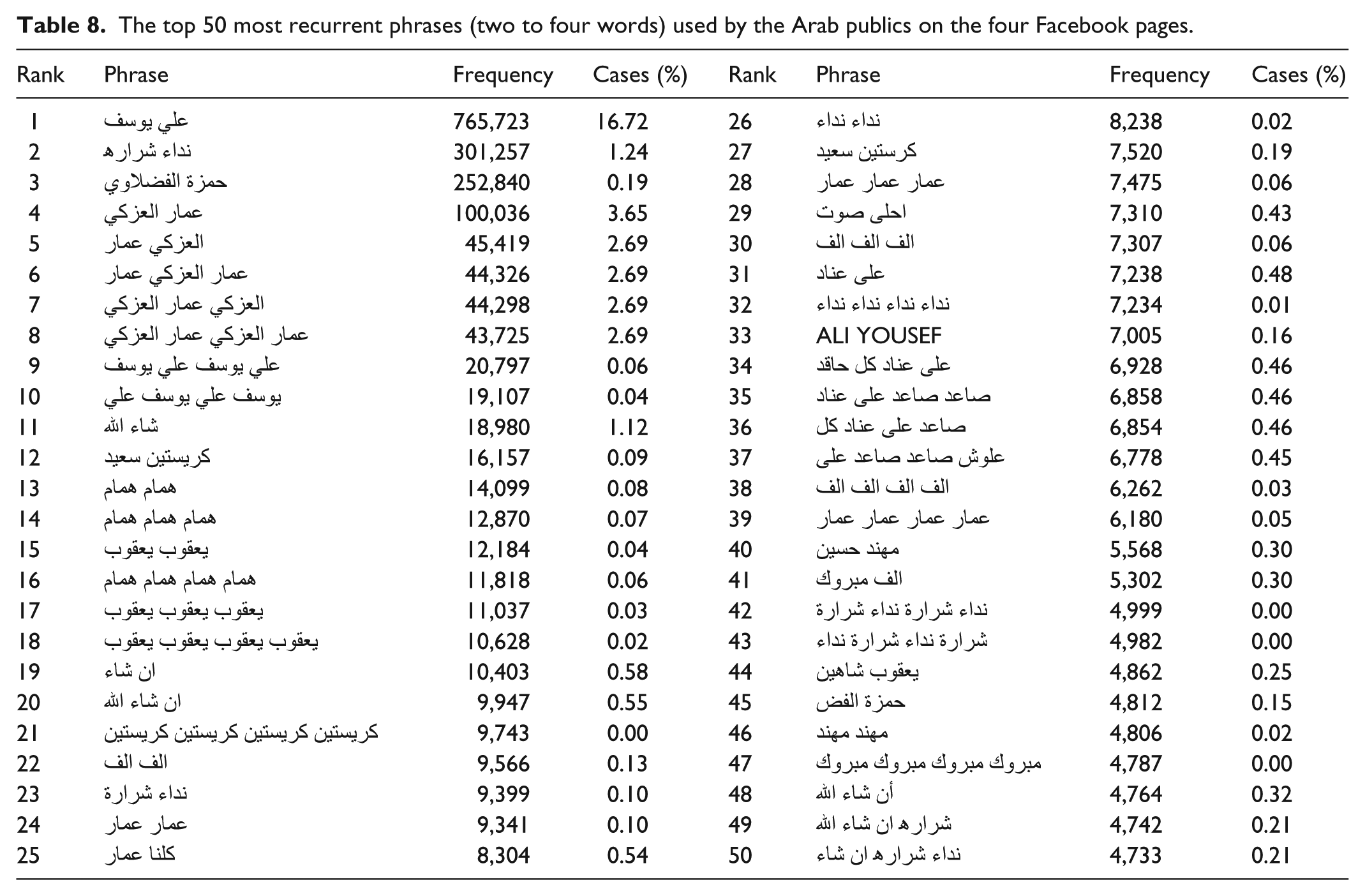
As for the most recurrent phrases, Figure 6 (in Appendix) provides a visualization of the top 100 phrases that are made up of two to four words, while Table 8 (in Appendix) shows the top 50 phrases used by Arab publics along the four Facebook pages. We can clearly see that the majority of phrases are related to specific contestants starting from Ali Yousef (n = 765,723), an Iraqi singer and one of the four finalists in The Voice (Season 3, 2015), followed by Nedaa Sharara (n = 301,257), a veiled Jordanian female singer, who won The Voice contest in the same season, and Hamza Al-Fadhlawi, another finalist in The Voice in the same season. Indeed, Yousef and Sharara are the two most prominent persons highlighted by the online audiences. What is interesting here is the fact that there are only 59,512 comments mined from the Facebook page of The Voice, and these audience comments constituted a relatively low percentage of the overall text corpus (7%). Yet, we find that the most recurrent phrases used belong to The Voice page which also include “Christine Said” in two different formats (n = 23,677) who was the third finalist.
Furthermore, the fourth ranked phrase belongs to Ammar Al-Azki, a Yemeni contestant and finalist in Arab Idol (Season 4, 2017). There are different phrasal formats that express strong positive sentiments toward Al-Azki including “Ammar Ammar” (n = 9,341), “We’re all Ammar” (n = 8,304), and “Ammar Ammar Ammar” (n = 7,475). Other contestants include Humam (Ibrahim), an Iraqi singer on Arab Idol, and Yacoub (Shaheen), a Palestinian singer and winner of Arab Idol in the same season. Both are also highlighted by the audiences with the use of various phrasal formats. By examining the proximity plot of the phrase “Arab Idol” in two Arabic formats (ارب ايدل) and (ارب ايدول), we find it is mostly associated with Yacoub (Shaheen), Ammar Al-Azki, Muhanad Hussein (Iraqi singer who did not reach the finals), and Ameer Dandan (Palestinian singer who ranked second in Season 4; see Figure 7 in Appendix). In this regard, the proximity plot of the phrase “اجمل صوت” (most beautiful voice) shows that Dandan has the strongest association with this phrase (Jaccard coefficient <0.018), indicating the audiences’ preferences followed by Muhanad Hussein (Jaccard coefficient <0.010) and “Ammar Muhammed” (Al-Azki; Jaccard coefficient <0.009; see Figure 8 in Appendix). Finally, there is evidence that some users try to refer to a collective national identity with the use of “كلنا” (We’re all) with certain contestants to show solidarity and support like “Humam” (n = 2,215) in different formats, “Ammar” (n = 1,450), “with you” (n = 941), and “Muhanad” (n = 327).
In relation to non-proper names and phrases, we find that the overall sentiments are also very positive. Most of the recurrent phrases contain supplications like “ان شاء الله” (By Allah’s willing) in different formats which are strongly associated with “success” and/or “winning,” clearly denoting positive emotions. A second recurrent phrase is “الف مبروك” (A thousand congratulations) in many formats which also indicates similar sentiments, while a third phrase is “صاعد على عناد” and “كل حاقد” which is roughly translated into “Triumphing despite the haters.” The phrase contains mixed sentiments though it is still relatively positive because it wishes certain contestants success, yet it also indicates a kind of national pride.
Similar to the above discussion on Arab countries, many users write their posts and sign by referring to their names and then their countries of origin. By examining the top 300 phrases, we find that the preposition “من” (from) usually precedes the country. In this context, the most recurrent phrases include “from Egypt” (n = 1,369), “from Morocco” (n = 1,053), “from Yemen” (n = 1,027), “from Palestine” (n = 831), “from Algeria” (n = 777), and “from Iraq” (n = 611). Also, the phrase “فرحة وطن” (A nation’s joy) became a viral hashtag on Twitter as it was associated with Ammar Al-Azki (Nasser, 2017). The proximity plot of this phrase shows that the strongest association it has is with “Yemen’s son” (Jaccard coefficient <0.084) in reference to Al-Azki followed by several other phrases that refer to the same artist. In this regard, another popular phrase is “صوت أحلى” (Most beautiful voice) is strongly associated with “a nation’s joy” (Jaccard coefficient <0.011) too. It is important to note here that this kind of national affiliation expression is not unique to the Arab world, for a previous study on the way the Canadian Idol reached similar conclusions in the sense that the show enhanced regional local rivalries instead of consolidating a unified national identity (de B’béri and Middlebrook, 2009).
In brief, almost all the top phrases carry positive sentiments toward some of the best contestants and express clear national pride in their talents, skills, and achievements. These findings are similar to the discussion on the general publics’ sentiments expressed with the use of words. While the Facebook pages discussed here function as online platforms that host Arab online communities linked due to their shared language, they remain vital venues for the expression of national identity which seems to be far more important and relevant than language affiliation. The empirical findings presented above indicate that the online Arab public sphere is not homogeneous but rather polarized based on the local fans’ connections to the TV shows’ contestants; however, there is an overwhelming civility and positive sentiments expressed by the majority of online publics.
As discussed above, Anderson’s “imagined communities” concept assists in explaining the way Arab audiences imagine who they are. Despite the fact that they are scattered in different countries including many in the diaspora, the members of the online public sphere are connected along the same platforms and communities due to their shared linguistic understanding though they have multiple perceptions of their Arab identity. This is due to the fact that cultural identity remains an imagined state of mind that is constantly changing, for individuals have varying and fluid emotional attachments to a larger national or local culture (Ting-Toomey, 2005). Most importantly, cultural identity is multifaceted because individuals perform many identities such as political, gender, sexual, and national ones (Collier, 1998, 2005). Indeed, identity performances occur both online or offline, and individuals exhibit specific identities based on the proper circumstances and needs for intergroup affiliation. The findings of this study indicate that national identity expressions are far more dominant than any other types of identity manifestations including shared language and/or history. For example, when Mohammed Assaf won the Arab Idol contest in 2013, he became a national hero in Palestine more than anywhere else. He was even viewed as a unifier of different political factions (BBC News, 2013), elevating him to the status of a Palestinian popular culture icon. Also, the Syrian government of Bashar Assad is believed to have exploited the participation of Ghana Bu Hamdan in MBC The Voice Kids in 2016 and her choice of song to send a political message. Bu Hamdan sang about the war in Syria and its impact on children which moved Arab audiences and further divided them due to their varied ideological affiliations and stance toward Assad’s government (Al-Arabi Al-Jadeed, 2016; CNN Arabic, 2016). Indeed, MBC TV shows examined here attempt to sell the concept of unified Arab audiences collectively watching and consuming the same Arabic language content, but these publics remain strongly attached to their national identities despite their active interactions along the same online communities.
Future empirical research is needed to explore other aspects of Arab identity with a focus on religious, political, and sectarian dimensions as they represent other important aspects of people’s lives. Furthermore, different sources of data which can be retrieved from large-scale surveys, interviews, and questionnaires are also lacking which can be useful in conducting cross-national comparisons around identity and affiliation issues.
Footnotes
Appendix
The top 50 most recurrent phrases (two to four words) used by the Arab publics on the four Facebook pages.
| Rank | Phrase | Frequency | Cases (%) | Rank | Phrase | Frequency | Cases (%) |
|---|---|---|---|---|---|---|---|
| 1 | علي يوسف | 765,723 | 16.72 | 26 | نداء نداء | 8,238 | 0.02 |
| 2 | نداء شراره | 301,257 | 1.24 | 27 | كرستين سعيد | 7,520 | 0.19 |
| 3 | حمزة الفضلاوي | 252,840 | 0.19 | 28 | عمار عمار عمار | 7,475 | 0.06 |
| 4 | عمار العزكي | 100,036 | 3.65 | 29 | احلى صوت | 7,310 | 0.43 |
| 5 | العزكي عمار | 45,419 | 2.69 | 30 | الف الف الف | 7,307 | 0.06 |
| 6 | عمار العزكي عمار | 44,326 | 2.69 | 31 | على عناد | 7,238 | 0.48 |
| 7 | العزكي عمار العزكي | 44,298 | 2.69 | 32 | نداء نداء نداء نداء | 7,234 | 0.01 |
| 8 | عمار العزكي عمار العزكي | 43,725 | 2.69 | 33 | ALI YOUSEF | 7,005 | 0.16 |
| 9 | علي يوسف علي يوسف | 20,797 | 0.06 | 34 | على عناد كل حاقد | 6,928 | 0.46 |
| 10 | يوسف علي يوسف علي | 19,107 | 0.04 | 35 | صاعد صاعد على عناد | 6,858 | 0.46 |
| 11 | شاء الله | 18,980 | 1.12 | 36 | صاعد على عناد كل | 6,854 | 0.46 |
| 12 | كريستين سعيد | 16,157 | 0.09 | 37 | علوش صاعد صاعد على | 6,778 | 0.45 |
| 13 | همام همام | 14,099 | 0.08 | 38 | الف الف الف الف | 6,262 | 0.03 |
| 14 | همام همام همام | 12,870 | 0.07 | 39 | عمار عمار عمار عمار | 6,180 | 0.05 |
| 15 | يعقوب يعقوب | 12,184 | 0.04 | 40 | مهند حسين | 5,568 | 0.30 |
| 16 | همام همام همام همام | 11,818 | 0.06 | 41 | الف مبروك | 5,302 | 0.30 |
| 17 | يعقوب يعقوب يعقوب | 11,037 | 0.03 | 42 | نداء شرارة نداء شرارة | 4,999 | 0.00 |
| 18 | يعقوب يعقوب يعقوب يعقوب | 10,628 | 0.02 | 43 | شرارة نداء شرارة نداء | 4,982 | 0.00 |
| 19 | ان شاء | 10,403 | 0.58 | 44 | يعقوب شاهين | 4,862 | 0.25 |
| 20 | ان شاء الله | 9,947 | 0.55 | 45 | حمزة الفض | 4,812 | 0.15 |
| 21 | كريستين كريستين كريستين كريستين | 9,743 | 0.00 | 46 | مهند مهند | 4,806 | 0.02 |
| 22 | الف الف | 9,566 | 0.13 | 47 | مبروك مبروك مبروك مبروك | 4,787 | 0.00 |
| 23 | نداء شرارة | 9,399 | 0.10 | 48 | أن شاء الله | 4,764 | 0.32 |
| 24 | عمار عمار | 9,341 | 0.10 | 49 | شراره ان شاء الله | 4,742 | 0.21 |
| 25 | كلنا عمار | 8,304 | 0.54 | 50 | نداء شراره ان شاء | 4,733 | 0.21 |
Declaration of Conflicting Interests
The author(s) declared no potential conflicts of interest with respect to the research, authorship, and/or publication of this article.
Funding
The author(s) received no financial support for the research, authorship, and/or publication of this article.