




Abstract
In the context of the 2016 U.S. Presidential Election, President Donald Trump’s use of Twitter to connect with followers and supporters created unprecedented access to Trump’s online political campaign. In using the campaign slogan, “Make America Great Again” (or its acronym “MAGA”), Trump communicatively organized and controlled media systems by offering his followers an opportunity to connect with his campaign through the discursive hashtag. In effect, the strategic use of these networks over time communicatively constituted an effective and winning political organization; however, Trump’s political organization was not without connections to far-right and hate groups that coalesced in and around the hashtag. Semantic network analyses uncovered how the textual nature of #MAGA organized connections between hashtags, and, in doing so, exposed connections to overtly White supremacist groups within the United States and the United Kingdom throughout late November 2016. Cluster analyses further uncovered semantic connections to White supremacist and White nationalist groups throughout the hashtag networks connected to the central slogan of Trump’s presidential campaign. Theoretically, these findings contribute to the ways in which hashtag networks show how Trump’s support developed and united around particular organizing processes and White nationalist language, and provide insights into how these networks discursively create and connect White supremacists’ organizations to Trump’s campaign.
Keywords
Social media has changed the nature of political organization, discourse, and engagement. From likes, retweets, shares, and memes, everyday users have an amplified voice in the online, public-political sphere. Since 2004 with Howard Dean’s attempt to gain momentum for the Democratic candidacy and even more evident in the 2008 elections and the advent of Twitter and YouTube, the emergence of online political campaigns, political theatrics, and political discourse are everyday occurrences (Highfield, 2016). Due in part to the access afforded by social media, individual supporters have new ways to engage with, voice concern for, and even criticize political leaders (Garimella, Weber, & De Choudhury, 2016). With everyday individuals being able to take part in the political process, scholars have directed efforts toward social media to understand the changing research landscape (for a review and study of online information sources, see Nikolav, Oliveira, Flammini, & Menczer, 2015). Some have explored the nature of political candidates’ social media campaigns and web presence to find that certain candidates are lightning rods of support and criticism (DiGrazia, McKelvey, Bollen, & Rojas, 2013).
Although U.S. Presidential campaigns have long been sources of fierce conversation and polarizing discourse, the 2016 campaign has been characterized by veteran journalist, Dan Rather, in the following way: This has been sort of a dumpster fire of an election campaign, in which both sides, and I’m not giving false equivalency here, one side more than the other—racism, chauvinism, some jingoism, just name it. It’s been so darn dirty. (para. 2, quoted in Griffiths, 2016)
Within the 2016 race, the racist, sexist, xenophobic echo chambers have been deafening due in part to an online proliferation of memes and tweets, which have prompted questions related to the nature of political communication and its corresponding impact on and enactment of online organizations. Republican candidate, Donald Trump, has long been characterized as a beacon for and mouthpiece of hate speech in both offline and online contexts; however, research has yet to systematically explore the content generated in social networks related to Trump’s slogan “Make America Great Again” and its communicative connections to hate organizations. Building on the idea that communication constitutes organization, I argue that Trump’s campaign hashtag, #MakeAmericaGreatAgain, offers an online, conversational space that creates and links to online hate groups. However, to situate the hashtag within a Communicative Constitution of Organization (CCO) perspective, this study draws on affordances literature as an integral conceptual linkage in online CCO. Affordances enable people and groups to connect via hashtags and user accounts.
With a goal of investigating Trump’s hashtag as a communicative organizing site for White supremacist groups, this study examines tweets within the network boundary of #MakeAmericaGreatAgain and #MAGA from a randomly selected day during a week following Trump’s election in November 2016. These data are analyzed using text mining and semantic network analytics to create networks of Twitter text and hashtags networks pertaining to Donald Trump’s presidential campaign. The results illuminate the overtly White supremacist far-right content and hashtag conversation spaces shared and embedded within #MakeAmericaGreatAgain. Finally, I discuss the theoretical possibilities of affordances as organizing communicative processes in the constitution of hate groups online.
Literature Review
The CCO argues that organizations, as part of the socially constructed world, are products of interactive processes between individuals. Embedded within these assumptions are the ideas that (1) organizations are a dynamic by-product of the interaction of their members and (2) influenced by environmental interactions (Schoeneborn et al., 2014). In online settings, organizations, too, communicatively constitute organizations as individuals engage in conversation with one another; the technocultural environments that combine media platforms, norms of engagement, and technological features of social media potentially contribute to this communicative constitution. In other words, technocultural environments contribute to interactions through affordances that enable asynchronous interactions within online settings.
Affordances have been discussed and conceptualized in a variety of ways, including technical, social, relational, and communicative (see Bucher & Helmond, 2018, for a review). A primary way that affordances have impacted online political campaigns is that they give increasing access linking people to campaigns through social networking sites like Twitter and Facebook. The effect of this linkage allows these collectivities “to contribute to, discuss, challenge and participate in diverse aspects of politics in a public, shared context” (Highfield, 2016, p. 10). In what follows, I provide a brief overview of the theoretical foundation of CCO that undergirds this project and link literature on affordances to CCO perspectives on political organizing. Then, I discuss the ways in which affordances link directly to White supremacist and hate group messages. Finally, I provide the research questions that guide this project.
CCO: An Affordance Approach
Organizations are constituted through interaction and conversations through communication networks. Communi-cation networks are produced through “the production and comprehension of text; action is mediated by text, but only when the text has been submitted to an interpretation” (Taylor, Cooren, Giroux, & Robichaud, 1996, p. 6). Interpretation, through sensemaking perspectives, can aid in providing communicative construction of organizations (and their activities) by engaging texts in interactions known as conversations (Cooren, Kuhn, Cornelissen, & Clark, 2011). Text and conversations, then, serve as building blocks for organizations. More specifically, text is agentic in that symbols and spaces “participate in the channeling of behaviors, constitute and stabilize organizational pathways, and broadcast information/orders” (Cooren, 2004, p. 388). Cooren (2004) further contends that organizing, as a process, involves both human and nonhuman interactions (text), which constitute organizations. The dual interaction between text and human communicators catalyze the organizing processes of organizations. Over time, these interactions converge to communicatively enact the organization as a dynamic and conversational process (Taylor et al., 1996). Human and nonhuman interactions occur through message boards as well as activities within social networking sites like Twitter and Facebook, which become an entry point into exploring CCO in online spaces. Online spaces, though, have certain discourse architectures known as affordances that are built that encourage certain types of textual engagement. Given Cooren’s description, the interaction between humans and nonhuman interactions creates a possible linkage of online affordances within a constitutive approach. While human interactions are explicitly defined, nonhuman interactions in online spaces can be murkily conceptualized.
Affordances
Affordances have been broadly defined. Originally defined by Gibson (2015) in relational terms, affordances enable people to interact with the world around them relative to what and how they perceive possibilities for (inter)action. Challenging Gibson’s relational definition, technological affordances are the manifestations of and ability to use certain functions within an online setting to communicate (boyd, 2010), discourse architectures that engender specific content and engagement (Freelon, 2015), and a form of technical socializing (Ellison & Vitak, 2015). As an example, “Facebook’s affordances enable users to employ features like status updates and wall posts to request a variety of resources, including emotional support and information, from their connections on the site” (Ellison & Vitak, 2015, p. 207). Within a Twitter context, the technological affordance of hashtags serves to coordinate large-scale discussion spaces that many can engage in at once. Hashtags blend elements of technological affordances with communicative approaches.
Related to the technological affordances, communicative approaches to affordances seek to examine the interaction between individuals and technological functionality of sites. More specifically, communicative approaches consider “what combinations of material features allow people to do things that were difficult or impossible to do without the technology” (Treem & Leonardi, 2012, p. 147). Technological affordances often do not acknowledge the social and communicative nature of individuals’ interactions. For instance, some social networking sites offer messaging functions that can be employed to target and attack individuals. These messages, through affordances, become educative and reinforce socially constructed messages. For instance, Recuero (2015) writes, When people share the message that girls should aspire to be pretty, they are reproducing a discourse of thoughts of years of patriarchate. Even though it is something unconsciously done, its effects are devastating because it helps the naturalization of these ideas about women. Not only is one person saying this, but rather hundreds of people are reinforcing this discourse. (p. 2)
The affordances built into social networking sites both educate and reinforce regressive and problematic attitudes and behaviors. While Recuero (2015) notes that certain messages in context are problematic in that they reinforce negative stereotypes, other affordances have enacted a relational approach between the socio-technical engagement of a space through communicative acts. Relational affordances provide an important context in hypothesizing why certain types of content are shared on social media sites.
Features of social media site can often support ways that users and organizations engage and behave in digital spaces. For instance, imagined affordances of anonymity in online spaces can embolden individual’s and group’s enactment of communicative identities in several ways. On an individual level, Suler (2004) describes a phenomenon known as the online disinhibition effect that supports the ways in which people are less inhibited online. This effect lends itself to the ways in which users can engage in problematic discourse through hate-filled behavior, cybertrolling, flame wars, and harassing behaviors. Suler (2004) notes, “different modalities of online communication (e.g., email, chat, video) and different environments (e.g., social, vocational, fantasy) may facilitate diverse expressions of self. Each setting allows us to see a different perspective on identity” (p. 325). Groshek and Cutino (2016) extended Suler’s original framework using hashtags of three controversial issues on Twitter to show that communication shared on the hashtags is often more uncivil and impolite than other forms of Internet communication. Moreover, in their roundtable conversation on hate speech online, Shepherd, Harvey, Jordan, Srauy, and Miltner (2015) discussed the hashtag infrastructure. Although the affordances of the hashtag have emboldened protesters to mobilize for social and political causes, it can be used to normalize and organize both hate and hate groups online. In other words, groups online can use these types of affordances to interact and mobilize activities; moreover; throughout time, they are able to communicatively constitute an online form of organization. As such, imagined affordances of anonymity also exist in group-level communication.
Anonymity also plays a role in engaging in group communicative behavior. Postmes, Spears, and Lea (1998) hypothesized that online spaces create a deindividuation effect on individuals called the Social Identity Deindividuation Effect (SIDE) model. One angle of the SIDE model posits that because people perceive anonymity online, they are likely to adopt group-level norms and identities of like-minded individuals. Extending the SIDE model, Rösner and Krämer’s (2016) experimental study on aggressive language in online spaces considered the role of anonymity in affecting peer activity and found that peer influence online and anonymity often increases the likelihood of engaging in aggressive online behaviors and comments. These types of behaviors and comments online are beginning to receive both media and scholarly attention. Considering this study’s goal of investigating extremist and White supremacist activity online, communities and spaces like hashtags become amplifying spaces through which organizations and communities converge as a collective entity of offline beliefs, values, actions, and messages (Fox, Cruz, & Lee, 2015). McNamee, Peterson, and Peña (2010) conducted a grounded theory analysis of online hate groups to qualitatively showcase major themes of message content in online hate groups, and discovered one type of hate group message that is centered “indicting external groups and organizations” (p. 277). These groups target outsiders and enemies to their causes. Considering Trump’s continual invocation of threats to the American democracy from internal and external sources, his online communication can manifest itself in more visceral ways. Hateful rhetoric in online spaces are an increasingly prevalent phenomenon.
As the SIDE model posits, these messages become normed through group-level approval and support. These norms are formed via a symbolic leader that helps to create an online space and site that becomes an echo chamber of these beliefs. In this case, the symbolic leader, Donald Trump, using his campaign’s slogan, “Make America Great Again,” offers a breeding ground for online hate speech and fringe organizations on sites like Twitter. While Trump may also be a symbolic leader, his omnipresence within media systems (television, print news, and social media) is reinforced by Scacco and Coe’s (2016) ubiquitous presidency. Scacco and Coe argue that the modern president cultivates a constant presence within American life and is accessible to citizens. Social media sites, like Twitter, have offered politicians and political organizations new ways to connect with and interact with their constituents in both political and nonpolitical ways.
Twitter, Politics, and Trump
Twitter, as a microblogging platform, has been used in a variety of ways, and its utility fostering political discourse has been well researched (Highfield, 2016). Studies have examined affordances of Twitter within the political process. For instance, Garimella et al.’s (2016) exploration of the Quote RT (retweet) function on the Twitter platform focused on retweets as fostering political discourse and diffusion of ideas. While there are possibilities inherent within the platform for the diffusion and exchange of ideas and conversations, Conover et al. (2011) explored the highly polarized nature of political discourse within the 2010 U.S. midterm election. Overall, they found that “Twitter remains highly partisan. Many messages contain sentiments more extreme than you would expect to encounter in face-to-face interactions, and the content is frequently disparaging of the identities and views associated with users across the partisan divide” (Conover et al., 2011, p. 95). Twitter may also serve as an educative space that is cultivating and engaging in problematic communicative organizing; however, research is beginning to examine hashtags as a space for political engagement. For instance, Korn (2015) examined how the #FuckProp8 hashtag served as a site for interest convergence related to politics and sexuality, and provided an online community space to collaborate. More recently, Neiwert and Posner (2016) conducted an analysis of Twitter activity during September 2016 for evidence of “connections between far-right extremists and the Trump campaign . . . [and] compiled a list of hashtags and catchphrases stemming from extremist movements, terms steeped in Holocaust denial, anti-Muslim invective, and other expressions of bigotry and racism” (para. 34). In short, these proliferation groups that share these types of content are a combination of technological, communicative, and relational affordances within networks of Twitter hashtag. These affordances engage groups on sites like Twitter to communicatively create organization and organizational activities in two main ways. First, these communicative patterns are amplified and encouraged in online spaces due in part to the affordances of anonymity, and users can engage with others in communication networks online. Second, the presence of a figurehead that encourages or supports extremist forms of online communication creates an organizing space through hashtags that gives voice to a politically incorrect, radical, and challenging forms of online discourse. This study investigates communication networks of text through Twitter hashtags and examines how the discursive networks link President Donald Trump to extremist and White supremacist groups.
As such, this study is guided by one primary research question:
RQ1. What are the connections between Donald Trump’s campaign hashtag, #MakeAmericaGreatAgain, and extremist groups?
Methods
A network approach is an appropriate method for this project as it proposes a semantic network analysis of hashtags associated with Posner and Neiwert’s (2016) initial survey. Second, considering the use of Twitter data, Rogers (2018) contends that network analyses are an appropriate method for investigating digital spaces. Third, in considering the large volume of text data, text mining and semantic network analysis enables researchers to investigate the various conversational topics that appear within a text body. Text mining as a methodological strategy is also useful in identifying underlying associations between words and concepts shared in the text body (Lambert, 2017). Considering the choice of Twitter tweets and hashtags (conversational spaces), researchers can uncover the possible conversational topics and spaces bolstered by a then-President-Elect that legitimized and gave voice to extremist groups through his campaign hashtag.
Data Collection
The network is comprised of Twitter data collected using Twitter Archiver, a Google Sheets add-on application (Agarwal, 2015). Twitter Archiver collects tweets using hashtag or search terms. The tweets used in this analysis come from publicly available and viewable tweets. The usernames and other potentially identifiable information were removed; however, the essence of the content of the tweets (hashtags, comments, etc.) is examined in the research project as they relate to broad content themes.
The Twitter data were created using the hashtag search term, #MAGA, and its expanded version, #MakeAmericaGreatAgain. The first hashtag, #MAGA, was a central component to Donald Trump’s campaign as it was the acronym for his campaign slogan, “Make America Great Again.” The preliminary data collection using Twitter Archiver resulted in 39,698 tweets from the time frame of November 17 to November 23, 2016. This post–U.S. Election time frame was chosen as President-Elect Trump was beginning to make his choices regarding Cabinet positions (“This Morning From CBS News, Nov. 18, 2016,” 2016). When considering the volume of Twitter data collected, the sample was further isolated to the tweets of one, randomly selected day during this time frame: November 18, 2018. The final data set resulted in 7,968 tweets, which serve as the foundation for the semantic network analysis. In addition, the text corpus was further separated into co-occurring pairs for hashtags. Within the levels of analysis, there are multiple nodes. For the total semantic network, the text of the tweets represents the nodes in the network as their content is important in understanding the semantic content that exists within the network. For the hashtag semantic network, hashtags represent the nodes. Edges in both instances are the co-occurrence of words and hashtags to one another.
Data Analysis
The Twitter content data were analyzed using a procedure called text mining. Text mining is an automated computer process that enables researchers to find patterns of a seemingly unconnected and unstructured text corpus. Lambert (2017) describes the process in the following way: “Text mining is one strategy for analyzing textual data archives that are too large to read and code by hand, and for identifying patterns within textual data that cannot be easily found using other methods” (p. 3). When considering the sheer volume of social media data, text mining is an apt analytical tool that helps to investigate and explore patterns within a large text corpus. He, Zha, and Ling (2013) argue that text mining “can be used to ‘efficiently and systematically identify, extract, manage, integrate, and exploit knowledge from texts’” (p. 456). While there are a variety of computer programs that can automatically mine data, I utilized AutoMap for this project.
To perform text mining within AutoMap, there are multiple steps that need to occur to complete the analysis. First, the data need to undergo preprocessing. Following the steps outlined by Lambert (2017), I performed preprocessing to create a cleaner text corpus that removes additional words and metadata that could alter results. First, I used the AutoMap function, “Perform All Cleaning,” which is a basic function in AutoMap that removed simple data issues (i.e., removing extra spaces, fixing pronouns, and metadata). Second, I used the text preparation function, “Remove Noise Words.” This was important in that it removed dates, numbers, and other text irregularities. Third, I additionally ran “Remove Numbers” to further clean the text of numbers and other small irregularities within the Twitter data. Fourth, I used “Apply Stemming” to consolidate similar words into their root words. This aids in providing more consistency within the text corpus for similar words and phrases. Finally, I utilized the “Apply Delete List” function to delete common occurring words and articles that were not needed within the analysis. To see the effects of the preprocessing, I, then, generated a concept list to see how “clean” the data were because of my initial preprocessing.
Opening the concept list within an Excel spreadsheet, I sorted the data by frequency. After doing this, I noticed several instances of Twitter data and hyperlinks not effectively cleaned. To remedy this, I opened an intermediary .txt file using an AutoMap function and manually replaced phrases like “RT” to “xxx”—the standard AutoMap text that is omitted from processing. I also found every instance of a hyperlinked text and replaced those with “xxx.” In addition, I made changes to names and concepts that were the same but with different formatting. I found instances of “Donald,” “Mike,” Kellyanne,” and so on, and I changed those into full proper names. For example, “Donald” became “Donald_Trump.” I saved the .txt file and then repeated the preprocessing steps again until the data were cleaned. After the preprocessing of the data, AutoMap generated a co-occurrence list of terms and phrases that frequently appear together. The initial list of co-occurring terms for the overall semantic network generated a list of 20,504 pairs; however, I analyzed the top 1,899 co-occurring pairs, which had frequencies ranging from 1,300 times (“#maga” and “#americafirst” appeared together the most) to 6 times, which had 250 different pairs of words. For the hashtag co-occurrence network, pairs are linked when a hashtag appears with another hashtag; this subnetwork has a total of 3,282 co-occurring pairs. Per Lambert (2017), the co-occurring word pair list was then used to visualize the network using NodeXL software (Smith et al., 2010). Next, semantic networks were analyzed using the Clauset–Newman–Moore (Clauset et al., 2004) cluster algorithm in NodeXL to investigate any underlying semantic structures. This analysis places nodes within clusters when they co-appear more frequently with one another, and share similar structural connections to other nodes. Cluster analyses can be useful in providing deeper context of conceptual topics that emerge within the semantic network analyses. Considering the nature of the content, the clusters can reveal similar thematic elements within bodies of text. My primary analysis of the network is a dual exploration of (1) the global semantic network and (2) hashtag networks. For the hashtag network, corresponding cluster analyses examined the specific themes within the networks that illuminate connections between Trump’s campaign and extremist and White supremacist hate groups. In the next section, I describe and showcase the findings of the semantic network analysis of the Twitter data.
Results
Using semantic network analysis, the analysis uncovered explicit references to both extremist and White supremacist content and organizing shared within the #MAGA network. The content was present in both the total semantic network and the hashtagged network. Although the total semantic network contained a few instances of content and users, the hashtag network provided several unique and illustrative instances of both extremist conspiratorial conversational spaces and overtly White supremacist slogans, spaces, and networks.
The Overall #MAGA Semantic Network
The overall semantic network is a diverse collection of text, hashtags (denoted as “hashtag_”), and users (denoted as “at_”). In constructing the network, I ran graph metrics to find central words. Lambert (2017) describes, “metrics can be calculated at the individual word level (node level metrics) to understand how many connections exist between particular pairs of words. Metrics can also be calculated to understand qualities of the overall graph (graph level metrics)” (p. 30). Using the Harel–Koren Fast Multiscale Layout (Koren, 2002), measures of degree centrality are visually shown in the network graph by node size and node color corresponds to their clusters.
Table 1 of Appendix A provides an overview of the graph metrics of the top 20 nodes within the network; “#maga” is the most central node within the entire semantic network. Its degree centrality score is 202. Degree centrality refers to the volume of connections that a node has with other nodes in the network; in other words, a highly connected node would have multiple connections with many other nodes within the network. Considering #maga served as the main network boundary, this metric is an appropriate assessment of the connective nature of the node. In responding to the RQ1, the graph metrics do not offer much. Cluster analyses of the total semantic data, though, showcased the hashtag, #PJNet within the largest cluster, Group 1, which contained 192 vertices. Cluster analysis of the Group 1 data revealed that within Group 1, #PJNet is the 10th most central node within the cluster. Figure 1 highlights #PJNet’s connection to other central nodes, #MAGA and #TrumpTrain. Within its cluster, #PJNet is also directly connected to #isis.
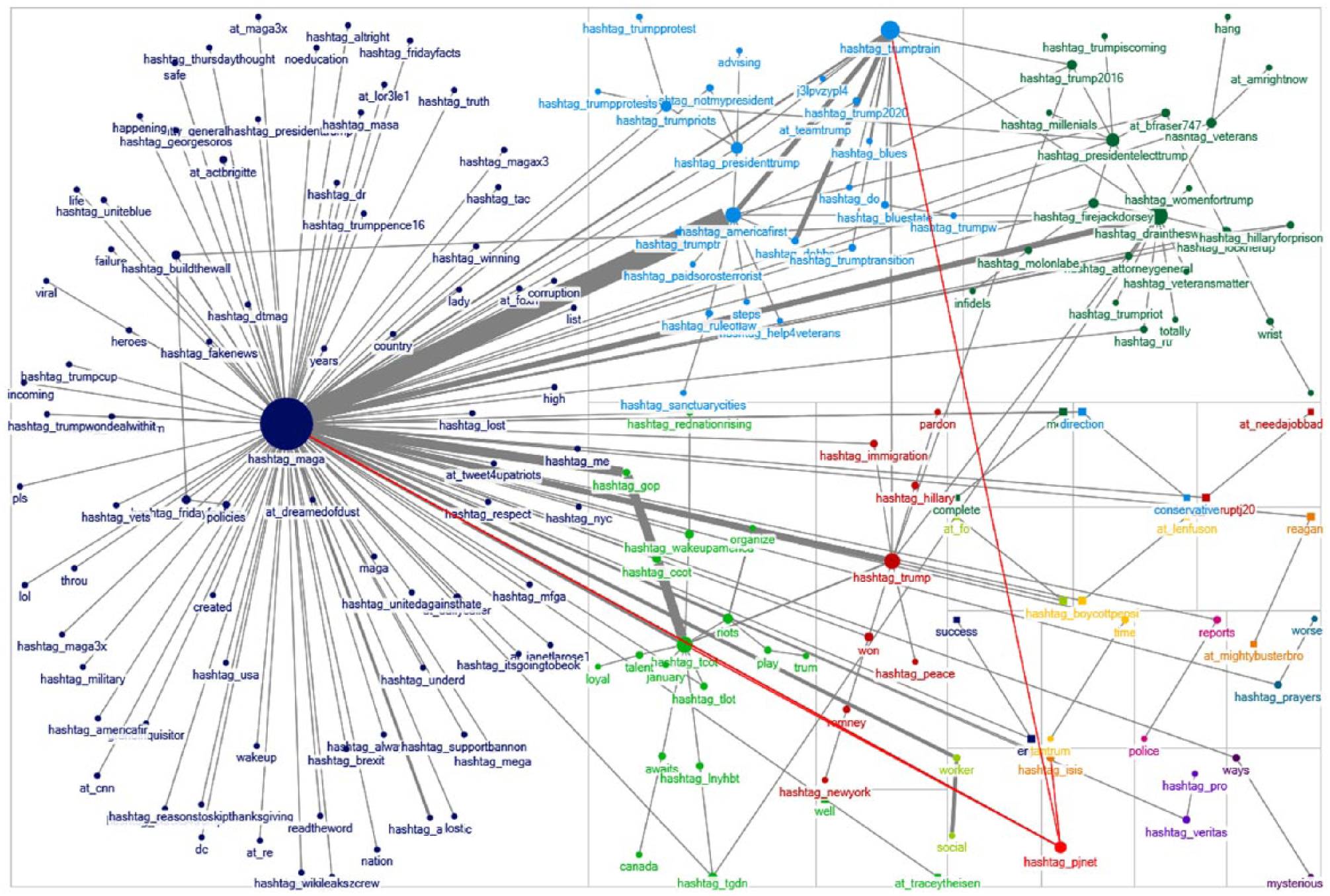
#PJNet’s semantic connections to #MAGA.
#PJNet is the hashtag site for the Patriot Journalist Network. According to Timberg (2017), the Patriot Journalist Network claims more than 230 members who work together to push issues in line with Prasek’s conservative Christian politics, using such hashtags as “#UnbornLivesMatter,” “#TeaParty” and “#IStandWithIsrael.” With a combined 2.2 million followers, members of the group can post hundreds of pre-written tweets by clicking a series of on-screen buttons. They can build their own tweets from a “Meme Library” of pre-selected images. (para. 3)
In the total network, though, #PJNet has a degree centrality of four, which is also the same measure for 29 other nodes in the network; however, this score placed #PJNet within the top 4% of the degree centrality measures. #PJNet also has a betweenness centrality of 128.49, which is within the top 16% of the measures for the co-occurrence network. Betweenness centrality measures the level of connectivity within the network and is a measure that explores the paths between nodes in the network. That is, #PJNet can be considered both highly connected and networked throughout the semantic network. The connections to and conversations centered around this hashtag provide an instance in which the Trump’s #MAGA has an overt connection to the hyper-conservative news organization, Patriot Journalist Network.
Although #PJNet does not inherently engage in hate speech and White supremacist organizing, the content shared with this hashtag can constitute a form of extremist political conversation, which contributes to the overall hyper-partisan and fringe nature of Trump’s #MAGA network. Many of the tweets using #PJNet referred to right-wing conspiracies about Hillary Clinton, her emails, and the Clinton Foundation. An example of the content shared with this hashtag in the following way: @USER: “America, @HillaryClinton, is the most famous unindicted criminal in the world. #LockHerUp #MAGA #PJNet”
Moreover, the strategic use of “Patriot” as a moniker for their network has some connections to the emerging “Patriot” movements within the United States. The Southern Poverty Law Center, 2010 describes the Patriot movement in the following way: People who generally believe that the federal government is an evil entity that is engaged in a secret conspiracy to impose martial law, herd those who resist into concentration camps, and force the United States into a socialistic “New World Order”—also has been propelled by people who were key players in the first wave of the Patriot movement in the mid-1990s, there are also a large number of new players. (“Meet the ‘Patriots’ (2010)” para. 3)
Again, while these findings are not inherently problematic, the rhetoric and political sentiment of fringe and extremist groups is part and parcel that which has been echoed throughout Trump’s Presidential campaign (Miller, 2016). These overt connections to movements provide evidence to possible linkages to online hate groups and speech. The presence of #PJNet draws upon this as the hyper-conservative, extremist nature of this journalistic organization is directly connected to and embedded within Trump’s Twitter network. This connection, though, is further examined and illuminated within the hashtag networks.
The Hashtagged Semantic Network
The use of hashtags has been documented in a variety of ways and represents the ways that users engage in conversations on social networking sites. Rambukkana (2015) argues that “hashtags, as a form of digital intimacy, are a way that things in the world touch other things in the work and form networks with them” (p. 5). Hashtagged networks, then, create a web of connection and meaning that exist within this text corpus; moreover, they act organizationally through their constitution within the interactive nature of the conversation. The hashtag network was analyzed in two distinct ways. Like the total semantic network analysis described above, a whole network approach was utilized to examine centrality measures of the hashtag co-occurrence networks. As shown in Table 2 of Appendix B, the data are dominated by hashtags such as #maga, #draintheswamp, #trump, #trumptrain, and #pjnet; however, again, in investigating some of the least central hashtag nodes, there were hashtags that made direct connections to hate speech and connected to Trump’s campaign slogan.
In Figure 2, there were several instances of the hashtag, #davidduke, a former Ku Klux Klan (KKK) leader, and support of White supremacists in the United States (Bridges, 2016). Tweets using this hashtagged attempted to argue that the focus on race—particularly racial incidents—is not evidence of White supremacy in the United States; however, @DrDavidDuke appeared within this network and shared messages like the following: “Now it’s time for—LAW & ORDER! #PatriotsUnited #AmericaFirst #BuildTheWall #MAGA.” Within this tweet is the reference to Patriots, which links back to the Patriot movement discussed previously. In addition, within this subgroup are references to #NWO, which contained tweets referencing a new world order attempting to silence critics against the global elites theorized to be running the world. Connected to the Patriot movement, the inclusion of #NWO creates a connection to the conspiracy theories pushed by the Patriot movement. Trump supporters within the hashtag network claimed to be silenced by the #NWO. Other examples of hate speech within network are shown in the pride over Trump’s Cabinet picks. One user tweeted #WhitePride and #MAGA when retweeting an NBC journalist’s observation that Trump’s cabinet picks up to November 18 had been White men. White supremacy also appeared evident in Subgroup 4.
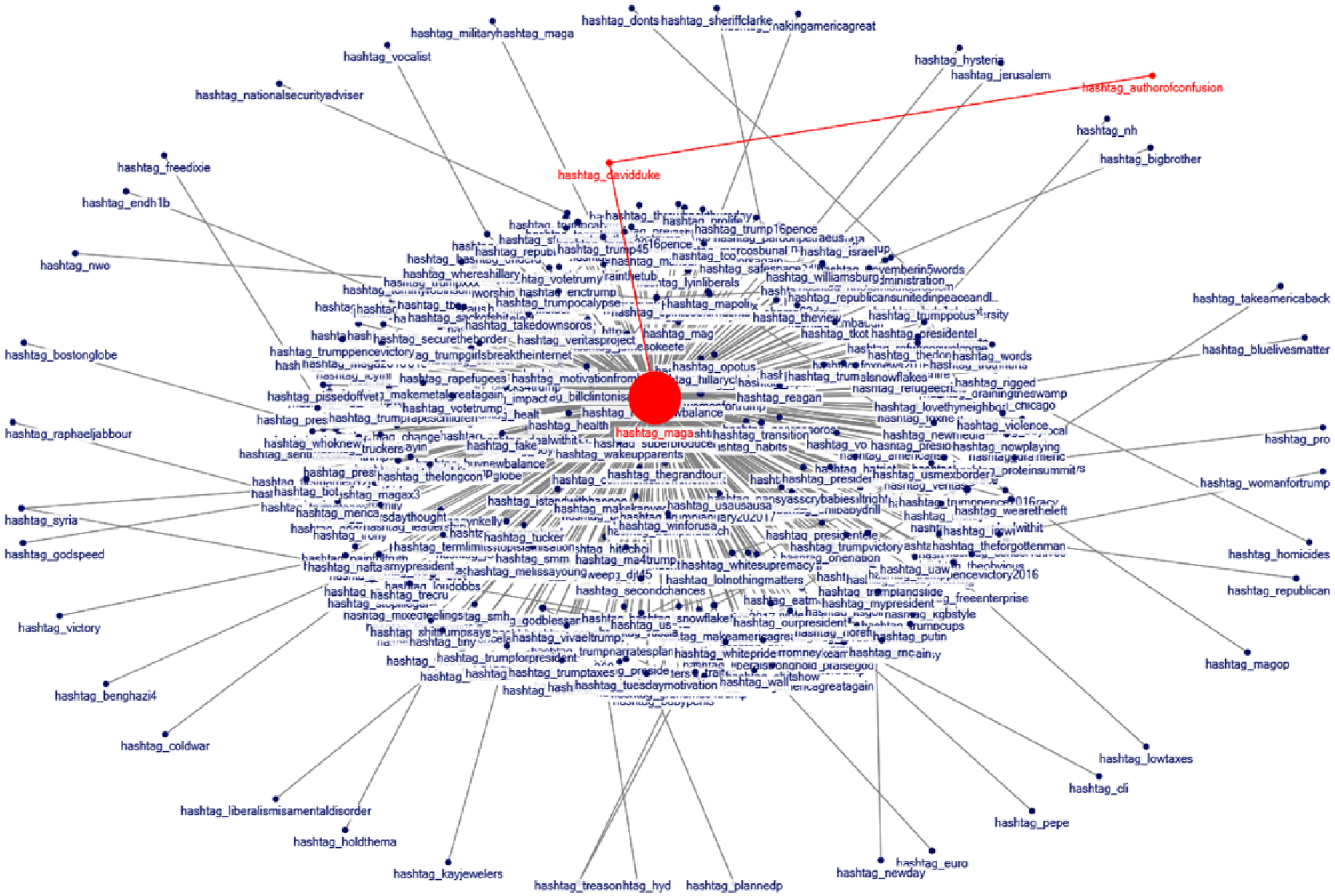
#davidduke’s semantic connection to #MAGA.
The fourth subgroup is grouped together around notions of safety within the United States; however, telling within this group is the ways in which safety is framed. As shown in Figure 3, the hashtagged network includes references to #2a (the Second Amendment), #makeamericasafeagain #veterans. These nodes are central within the network; however, within this grouping is a fearfulness of a nefarious and undefined “other” that serves to undermine the U.S. society. This is illuminated within the subgroup through overt references to far-right, White supremacist thought.
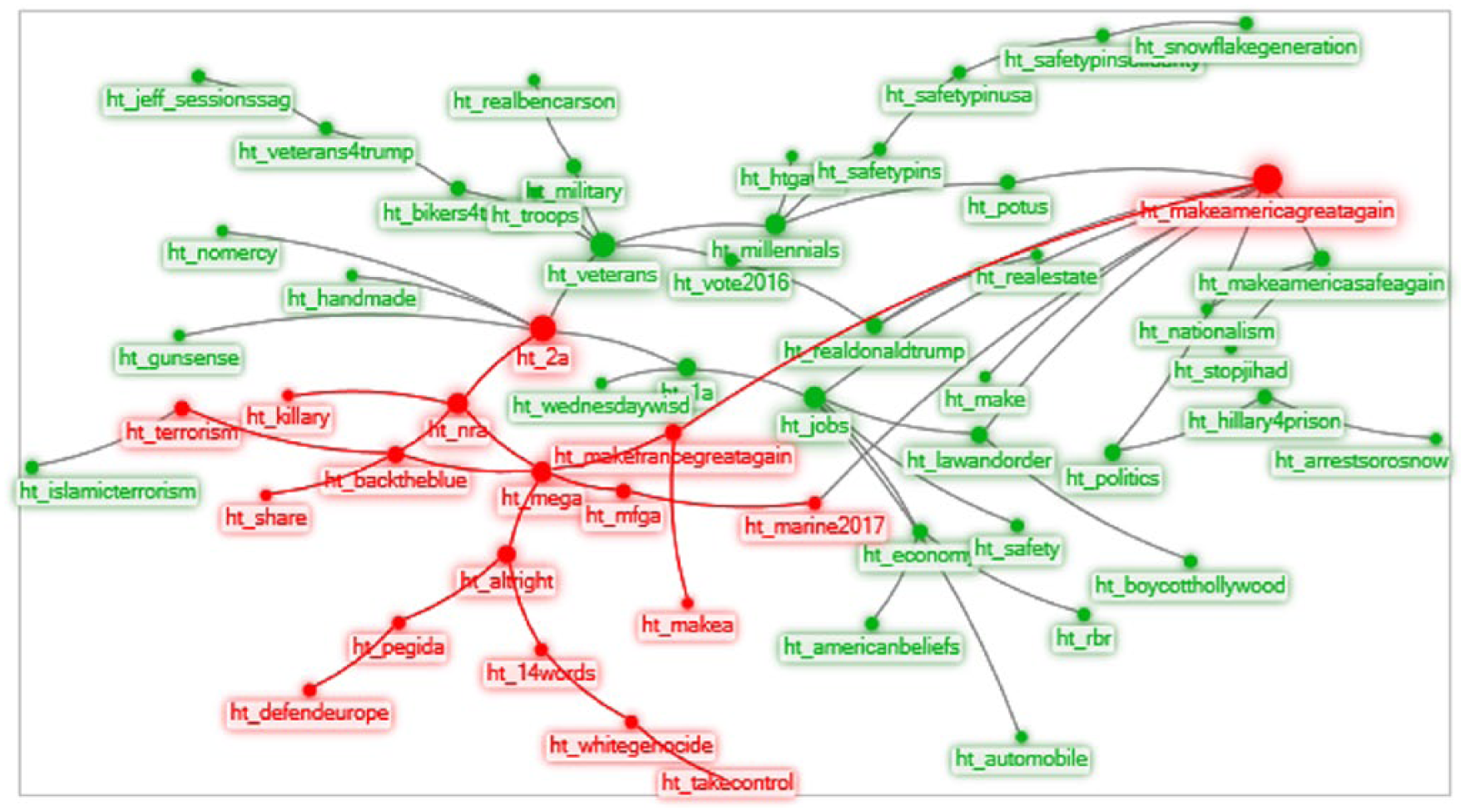
Cluster analysis of Subgroup 4.
First, this subnetwork has a strand of hashtags that directly reference reclaiming control of society. This is evident in the paths between #mega (“make Europe great again”) to #altright to #14words to #whitegenocide. #14words is a direct reference to White nationalist David Lane’s (“David Lane |Southern Poverty Law Center”, n.d.) motto: “We must secure the existence of our people and a future for White children.” In addition, within this subgroup is the hashtag, #pegida, which is the conversation space for the U.K.-based group. PEGIDA is a German acronym translated to mean “Patriotic Europeans Against the Islamisation of the Occident” (Lowe, 2016). The nefarious “other” within this group directly refers to the threat of radical Islam terrorism. Tweets within this subgroup using these hashtags are similar to the following: @User: #MAGA will help us to #MakeEuropeGreatAgain #altright ##14words #pegida #whitegenocide
As such, these connections directly respond to and address RQ1 by illuminating a discursive link between White supremacist organizing found within the #MAGA hashtag network. Through Subgroup 4, these connections within the #MAGA conversation directly connect to White supremacists, their mottos, their beliefs, and White nationalist groups organizing against Islam and a fear for White safety. The implications of this study are discussed in the next section.
Discussion
This study uncovered and confirmed discursive connections to extremist and White supremacist content embedded within President Donald Trump’s campaign hashtag, “Make America Great Again.” Whereas journalists have sought to link his rhetoric to hate groups, and have successfully demonstrated a mimicked rhetoric that is used by groups, this study found direct connections within the text corpus to #MAGA both in the overall semantic content and in the hashtag network (Neiwert & Posner, 2016). Although CCO provided the broad theoretical grounding, this study considers affordances as a necessary linkage in the emergence of online organization through the context of Twitter networks.
The implications for this study are twofold. First, theoretically, #MAGA created an organizational space to engage in a global White supremacist discourse, which can be enabled by examining the technological and social affordances within Twitter. Hashtag networks, then, serve as an organizing discursive space for extremist and White supremacist groups. This combination of affordances enabled both the sharing and organizing of content shared within and through the #MAGA hashtag network. Second, the use of #MAGA as a space for engagement lends itself to the types of content shared: subtle and overt. This type of content is reflected in Trump’s own rhetoric in both on- and offline settings. Put differently, Trump’s use of coded, “dog whistle” rhetoric appeals to and reinforces extremist and White supremacist communication within #MAGA.
Responding to RQ1, this study found textual and conversational linkages between hate groups within the United States and abroad. Taylor et al. (1996) argued that the transactional quality of conversations is part of organizing, and, from an affordance perspective, the study showed linkages to the growing Patriot movement in the United States and PEGIDA in the United Kingdom using semantic network analysis. These groups are utilizing the #MAGA back channel as a digital space through which to organize and voice their feelings of aggrieved entitlement, which is “the belief in the system, having something yet to lose, and feeling that they’re not getting what they deserve” (Kimmel, 2013, p. 23). These groups are responding to and addressing the feelings that they have something to lose as societies trend even further equity. These tensions within the hashtagged conversation enact a discursive, transactional space that “organizes the performances of members by establishing mutual, if always negotiable, commitments” (Brummans, Cooren, Robichaud, & Taylor, 2014, p. 178). That is, the dynamic and conversational nature of Twitter’s technological affordances offers users and groups an opportunity to engage with one another throughout time, space, and location.
The asynchronicity of social media, particularly Twitter, affords members and supporters of extreme, conspiratorial, and prejudiced visions of the U.S. society an opportunity to be organized around and converse with one another through similar topic areas. Hashtags exist as a form of networked conversations, which “[create a web of mutual obligations linking complementary practices of two (or more) human agents who co-orient by focusing on a single (and shared object)” (Brummans et al., 2014, p. 177). Twitter hashtags, then, can be considered a “third place” in that these networks provide both a place to share information, express viewpoints, and engage in political activism in mediated forms. In the similar vein to trolling research, Higgins (quoted in Highfield, 2016) suggests that “anons who engage in racist, sexist, and homophobic trolling are also representative of a larger effort to preserve the Internet as a space free of politics and thus free of challenge to white masculine heterosexual hegemony” (p. 135). Moreover, the ways that these groups’ (and their users’) fears are framed are representative of the ways in which there is a very real threat of a racialized “other” attacking the status quo of society. There is a quest to silence, breed division, and engage in fearmongering. One key example of this is the prevalence of the hashtag #rapefugees within this semantic network. #Rapefugees refer to a Breitbart News–promoted narrative that frames Syrian refugees as rapist, which furthers opposition open borders within both the United Kingdom and the United States (Deacon, 2016). Not surprisingly, groups like PEGIDA are sponsoring this type of organizing in efforts to garner support for and reification of White lives in both the United States and the United Kingdom.
As such, this study also highlights how Donald Trump’s followers echoed and amplified his messages in extreme forms through the hashtagged network, #MAGA. Undeniably, Trump’s power, influence, and voice become a central organizing force within the hashtagged space. Overall, groups like PEGIDA and other extremist organizations (i.e., the Patriot Movement) are emboldened by Trump’s subtle (and not-so-subtle) references to and retweets of White nationalist messages and Twitter users (Lanktree, 2017). Neiwert and Posner (2016) describe members of the alt-right’s fealty toward Trump’s rhetoric. In an interview, Rachel Pendergast, organizer of the Knights Party (a descendant of David Duke’s KKK), notes, White people are realizing they are becoming strangers in their own country and they do not have a major political voice speaking for them . . . Trump is one example of the alternative-right candidate Knights Party members and supporters have been looking for. And we feel that through continued grassroots mobilization . . . (Posner & Niewert, 2016, para. 56)
The grassroots organizing is occurring in online conversational spaces. The text and hashtagged conversations that are shared within these spaces “participate, like other agents, in the daily production of organizational life” (Cooren, 2004, p. 374). While their engagement is often eclipsed by other parts of the conversation, their discourse occurs within the shadows. As previously discussed, the conspiratorial and extremist speech and hate groups engaging in the #MAGA space are not central or influential within the semantic networks; however, they exist within and around these spaces. Once existing and operating in the shadows, these groups have been given a spotlight to highlight and legitimize radical and troublesome organizations through the discursive connections with #MAGA.
Limitations and Future Directions
This study is limited by a variety of issues. First, the data set emerged from a time frame that may not have been emblematic of the type of discursive content that some have researched in online settings. Future studies should look at a broader swatch of data and perhaps explore semantic networks in multiple time contexts. In doing so, researchers could more fully understand the formation, mobilization of, and continual organizing that occurs for both existing and emergent extremist and hate groups online. Second, this study is limited by its search terms. Expanding and/or changing the boundaries to the search would provide different and deeper knowledge about problematic political discourse related to fringe groups online. Future studies could look more specifically at targeted phrases that are more closely connected to groups like the alt-right and understand the ways that political discourse constitutes (or does not) White supremacist organizations in online contexts. Third, the study is limited by the social network site chosen. While Twitter is useful for amassing a large amount of data easily, it could easily be considered a superficial network due in part to its microblogging platform. Future research could explore communities within Reddit, comment sections of news sites, or even discussion forums to uncover deeper threads of political discourse.
Footnotes
Appendix A
Summary of Graph Metrics on the Top 20 Nodes Within the Total #MAGA Data.

| Node | Degree centrality | Betweenness centrality |
|---|---|---|
| #MAGA | 202 | 194,244.96 |
| Donald Trump | 48 | 42,814.84 |
| @RealDonaldTrump | 22 | 12,242.81 |
| Great | 19 | 13,017.82 |
| #DrainTheSwamp | 19 | 4,082.05 |
| #TCOT | 17 | 15,326.65 |
| American | 16 | 23,273.78 |
| #TrumpTrain | 16 | 6,322.55 |
| #AmericaFirst | 14 | 5,429.22 |
| Congress | 12 | 9,318.58 |
| #PresidentElectTrump | 11 | 8,735.98 |
| Ford | 11 | 5,689.34 |
| #Trump | 11 | 4,107.34 |
| Jeff Sessions | 11 | 3,998.14 |
| America | 10 | 6,888.23 |
| @GenFlynn | 10 | 5,091.79 |
| @LouDobbs | 9 | 16,629.20 |
| President | 8 | 2,424.65 |
| Team | 7 | 4,897.63 |
| Man | 6 | 5,371.02 |
Appendix B
Summary of Graph Metrics on the Top 20 Nodes Within the #MAGA Hashtag Network.

| Node | Degree centrality | Betweenness centrality |
|---|---|---|
| #maga | 227 | 67,268.81 |
| #trump | 42 | 7,539.80 |
| #draintheswamp | 31 | 4,288.63 |
| #trumptrain | 24 | 3,328.20 |
| #tcot | 17 | 1,873.13 |
| #americafirst | 17 | 1,091.42 |
| #lockherup | 15 | 3,869.77 |
| #trumptransition | 8 | 263.87 |
| #pjnet | 8 | 182.09 |
| #notmypresident | 8 | 1,467.93 |
| #trumpwon | 7 | 917.14 |
| #attorneygeneral | 6 | 218.25 |
| #sessions | 6 | 768.73 |
| #trumpcup | 6 | 1,077.98 |
| #trump2016 | 6 | 4.78 |
| #foxnews | 6 | 3,150.82 |
| #veterans | 6 | 507.50 |
| #usa | 6 | 746.20 |
| #brexit | 6 | 3,408.00 |
| #wakeupamerica | 5 | 557.15 |
Declaration of Conflicting Interests
The author(s) declared no potential conflicts of interest with respect to the research, authorship, and/or publication of this article.
Funding
The author(s) received no financial support for the research, authorship, and/or publication of this article.