



Abstract
We examine the patterns of social polarization, with the case of Michael Brown shooting as an empirical basis for discussing the role of social media in promoting polarized viewpoints. In doing so, we test a model that synthesizes the interplay between text polarity in Twitter and four attributes of U.S. cities (N = 216): (1) geographic location, (2) race, (3) poverty, and (4) technological condition. Our findings supported hypothesized functions of socio-environmental traits. However, the extents of polarization in tweet-texts were subtler than expected. Furthermore, the finding concerning poverty suggests that certain urban environments are more conducive to exacerbating racial tensions, reproducing them into social media narratives. We suggest future studies and discuss the implications for societal divide.
Divide in Ferguson: Social Media, Social Context, and Division
Popular accounts of social polarization posit that the U.S. society is divided in a predictable pattern of fragmentation (McCloskey, Hoffman, & O’Hara, 1960). According to this view, individuals tend to select only preferred views of the world and insulate themselves from opposing viewpoints. Likewise, scholars (e.g., Sunstein, 2009; Zuckerman, 2013) suggested that technological capacities of filtering algorithm intensify this trend. Applying these premises, we argue that the question of how social division occurs and is reinforced on a wide range of public issues is fundamental in understanding societal effects played by social media (Neuman, 2001; Neuman, Guggenheim, Jang, & Bae, 2014).
We designed this work as a field case study to explore the issue of social polarization in social media. By social polarization, we mean the polar-opposite distribution of beliefs or opinions in the prevalence of one perspective over the other (DiMaggio, Evans, & Bryson, 1996). Tracking polarized viewpoints in social media is a daunting task. We used Twitter “firehose,” which made it possible for us to access an estimated 100 million active Twitter users’ tweets (1) by geographically specific attributes and (2) by time periods. By tracking tweet-texts in daily contexts, we aim to test the extent to which polarized narratives compete or crowd out each other over time.
The city of Ferguson, Missouri, illustrates in some great details the social tension emerging in the U.S. urban settings. The fallout from the city government’s failure to effectively handle the death of Michael Brown, an unarmed young Black man killed by a White Ferguson police officer, has entailed sharp debates over who was responsible for what went wrong. Some accused the officer, Darren Wilson, of racially charged police practice, while others vigorously came to his defense. The Ferguson tensions caused many to ponder persistent and deepening societal chasms in which increasingly polarized views about the same event perpetuate (Drake, 2014). We see the Ferguson shooting as the lens that brings social polarization into focus.
The one that intrigues us is social divide at the collective level of urban settings. Certainly, there is a considerable debate on whether the sharp divisions as seen in political issues also exist in social issues. The Ferguson incident offers an opportunity to explore the role of social media in enabling socially sensitive debates across unsympathetic beliefs and interests. We bring these debates to social media context in which citizens can expose themselves to preferred viewpoints and select to narrate only within insulated circles.
Polarization of Social Media in Social Context
A starting point of our account is the premise that social polarization occurs “horizontally” as beliefs, preferences, and interests are differentiated among regions, classes, and/or ethnic communities within a society (DiMaggio, Hargittai, Neuman, & Robinson, 2001; Dutton & Reisdorf, 2017; Neuman, 2001; cf. Wellman, 2005). It is an assessment of tension along with multiple societal factors of a community. This premise offers the immediate promise for empirical analysis, with normative concern about the character of emerging public spheres, such as social media. We posit that for any tensions at stake, social media use can be regarded as the important collective experience of social cleavages, as relevant societal conditions shape conflicting viewpoints of subgroups (DiMaggio, Evans, et al., 1996). Likewise, it is our contention that empirical analysis of polarized social media can be best placed in the larger social contexts that incubate conflicting perspectives.
Many of the early studies spoke to the theme of social cohesion and related concerns such as the disappearance of commons—once-shared spaces of community matters and shared conversation (Ball-Rokeach & Hoyt, 2001; Habermas, 1991). These can be grouped into several popularized terms: “echo chamber” (Sunstein, 2009), “daily me” (Negroponte, 1995), and “homophily” (Zuckerman, 2013). The common thread in connecting all these arguments is the fear that like-minded people are inclined to flock together (homophiles) to voice and share only supportive perspectives (echo chamber) and that this tendency is exacerbated by the growing capacity to receive only self-filtered information (daily me).
Few have explicitly tied social polarization to the characteristics of new media. Yet some scholars (e.g., Bennett & Iyengar, 2008; DiMaggio, Evans, et al., 1996; Neuman, 1991, 2001) successfully argued that polarization can be attributed to increasing availability of new media through which people can easily align themselves with the views that are congruent with their immediate interests. What is disruptive is that social media users take it upon themselves to decide which aspects of an event are important, digest them, and highlight particular interpretations to narrate the stories to peers in their social circles. The point is that the traditional “media effect” model, in which repeated exposure to a message leads to the persuasion or change in attitude, began to lose externally valid applicability (cf. Holbert, Garrett, & Gleason, 2010; see Neuman, 2016, for discussion).
This is a powerful account of how personally tailored digital technologies make it possible to tune in to agreeable information and to be resistant to attitude-discrepant information. Instead, digital media use and exposure, with no obvious mechanism of tracing back to a single source of effect, are hardly exogenous and rarely occur outside the social-ecological contexts within which a user is situated. In this vein, it is abundantly clear that social media may not exist in societal vacuum but prone to reinforcing predisposed positions because users not only exercise greater control over information flow but also can easily volunteer to represent social events in their own narratives.
Our fundamental premise is that whether deliberately or not, people draw upon prior life experiences and knowledge to recognize incoming information and construct meanings at the point of media exposure (Neuman, 1991, 2001). Gamson (1988) showed that people tend to invoke such cognitive schemas to interpret social issues like affirmative action in ways that are congruent with preexisting beliefs and attitude. Cognitive dissonance theory also posits that attitude or viewpoint change as a result of media consumption rarely occurs when new information does not fit into a reinforceable schema or preexisting frame of references (McGuire, 1969). Extending this line of reasoning, we argue that social media use, immersed in interactions with people from similar social experiences and surrounding environments, does not happen in a vacuum but can be best treated as “endogenous” and predisposed to creating sharply opposed viewpoints.
Attributes of Social Environments
Our focus is on the collective level of polarization shown in a social media platform, notably Twitter. We are intrigued by how different attributes of urban environments may deepen social polarization. Our view is that the impact of social environments is multifaceted and deeply intertwined with (1) race, (2) poverty, (3) regional circumstances, and (4) technological access conditions (Ball-Rokeach & Hoyt, 2001; DiMaggio, Evans, et al., 1996; Dobransky & Hargittai, 2016; Dutton & Reisdorf, 2017; Mossberger, Tolbert, & Franko, 2012; Mossberger, Tolbert, & Gilbert, 2006; Nakamura & Chow-White, 2011; Neuman, 2001; Park, 2018a, 2018b; Robinson et al., 2015; Schradie, 2012). From this, we predict that social polarization that is deeply rooted in offline environments will be reflected in social media use. This is likely so, because voluntary characteristics of social media—in helping users subscribe to agreeable perceptions—reinforce existing beliefs deriving from societal conditions.
For instance, racism, according to Sears, Sidanius, and Bobo (2000), remains entrenched in existing social and political inequalities and serves as a powerful endurance that cannot be eliminated in political or institutional vacuum. Scholars (e.g., Golash-Boza, 2016) have also suggested that race, in intersection with existing social inequalities such as education, poverty, and access to resources, cannot be understood without other social context when the idea of race and its distinction itself are in fact socially constructed. Simply put, what is paramount in understanding social polarization, especially around racial tension, is the collective function of antecedent environmental factors which potentially reinforce respective silos of insulated viewpoints (see Figure 1).

Urban disparities, polarization, and ecological contexts.
The case of Ferguson typifies the tensions that are deeply rooted in the United States. Note that the inner cities remain highly segregated and have been criticized for instigating social divisions and structural disadvantages for certain communities. Ferguson, for example, is 67% Black, even though the city is surrounded heavily by White communities. The poverty rate doubled over 12 years, reaching 44% in 2012. As seen in Ferguson, major U.S. metropolitan areas tend to show the deeply ingrained economic and societal gaps between Blacks and Whites. Scholars (Ball-Rokeach et al., 2001; Wellman, 2005) noted the widespread concern that the new information age has brought serious infrastructural quality problems in inner-city areas, with serious inequities persisting in poor urban settings. Because Michael Brown’s shooting involved two polar-opposite figures—a Black teen and a White police officer—and because it symbolized the testy relationship between those with and without power (i.e., government vs. citizens), one can expect similarly polarized interpretations of the event to emerge across the social spectrum.
Highly polarized public reactions to the O. J. Simpson verdict in 1995 provide an important analogy. Particularly, a dramatic perceptional disagreement between Whites and Blacks demonstrated the gulf of mistrust and, perhaps, the breakdown of social glue. Back then, however, people were responding to a court drama televised on three relatively homogeneous networks. In addition, the number of media outlets through which audiences could express themselves was quite limited. This begs a question about the social media effects of actively “pulling” certain interpretations and narratives, rather than “being pushed” by packaged mass media events (Neuman, Park, & Panek, 2012). Feeding the development of strongly opposed popular narratives of the same event, the characteristics of social media may well reinforce preexisting societal contexts that harness users’ viewpoints.
Contribution of the Current Study
Recently, a venerable body of empirical evidence began to pile up in social media use and division (Conover et al., 2011; Larsson & Moe, 2012). Notably, Conover et al. (2011) demonstrated how political partisanship divided social media into two distinctive ideological lines of “red” and “blue.” This was among the first works to show how two homogeneous communities of retweeting networks sharply aligned against each other at the collective, mass public level. In a broader vein, these works support our initial premise that people tend to flock by connecting to people who are already connected, who are comfortable with each other, and who share similar viewpoints (Zuckerman, 2013)—tendency potentially exacerbated by the social media features like “follow,” “like,” “share,” or “retweet.”
It is significant to note that earlier studies (Colleoni et al., 2014; Conover et al., 2011) focused on the macro-level structural analysis of polarity emerging from social media, while the studies done in polarized urban contexts (Ball-Rokeach, & Hoyt, 2001; Mossberger, Tolbert, & Franko, 2012; Mossberger, Tolbert, & Gilbert, 2006; Park, 2018a, 2018b) examined on the function of social environments in conditioning individual uses. Combined, the contributions from both strands of studies offer critical insights regarding the polarizing process emerging from social media at the broader societal level. Recently, scholars (e.g., Carney, 2016) also looked at #BlackLivesMatter, bringing critical lens to texts expressed in tweets. But earlier studies (e.g., Carney, 2016; Hoffman, Granger, Vallejos, & Moats, 2016) investigated polarized racial tensions as part of a specific social movement, in an attempt to understand how multiple and conflicting knowledges about a critical event like the Michael Brown incident were produced and reproduced. We focus more on daily contexts, in which ordinary people converse about a critical social event, and see social media not necessarily producing new opportunities but reflecting what’s been embedded in offline environments. Our proposition is that the societal effects played by social media may reproduce and reinforce existing beliefs and interests, while accelerating the passions from both sides of debates as dramatic social events arise.
As we apply these insights to the case of Ferguson, important tasks remain. First, most studies have focused on political polarity based on partisan affiliation. This is a critical difference from social polarity because a clear demarcation of political preference can be more readily conducive to polarization than the tensions deriving from socially sensitive topics related to race. Second, because evidence concerning social media remains almost exclusively at the macro-structural level, little known is the nature of social conversations (what people talk about) beyond the meta-level choice of connection (whom to talk to). In other words, we do know the structure of (political) polarization through which people interact in social media, but what viewpoints glue them in two opposite polarities is less known. Third, analytically, the presumed relationship between offline social environments and polarization is rarely put to an explicit test, despite the posited function of preexisting societal conditions (Sunstein, 2009; Turow, 2012) in reinforcing predisposed values.
Therefore, the insights from prior studies should be extended to address social tensions in newly emerging public spheres. Data from Twitter, for instance, are increasingly accessible for analysis. We are also encouraged by the possibility of applying previous insights into the collective level, as this will open up a line of empirical inquiries on a variety of socio-environmental cleavages (Scharkow & Vogelgesang, 2011). Warranted is a systematic investigation that will enable us to bring the issue of polarization into broader contexts so that we can understand how societal conditions, ingrained different ways across different subgroups (DiMaggio, Evans, et al., 1996), influence social media effect.
Hypotheses and Research Question
In sum, our study tests the explicit premise of social polarization, as applied to the incident of Ferguson, and examines social media texts from two polar-opposite perspectives (i.e., Michael Brown and Darren Wilson) over time. We dissect polarization (1) by different geographical attributes and (2) by precise time periods at the collective level of urban environment. Scholars (DiMaggio, Evans, et al., 1996; DiMaggio, Hargittai, et al., 2001; Neuman, 1991) theorized polarization as a socializing process that unfolds over time and encouraged the assessment of how different social spectrums influence such a dynamic process.
Following this insight, we first predict that the more closely aligned urban settings are to either of two predisposed positions, the more supportive narratives will emerge in line with one perspective over the other. Conversely, the less closely aligned an environment is, the more an opposing viewpoint discrepant with a particular perspective will prevail (H1). In predicting polarization more closely, however, it is critical to dissect the multiple social factors of a given community (Neuman, 2001). Prior studies (Ball-Rokeach & Hoyt, 2001; DiMaggio, Evans, et al., 1996; Kim, Jung, & Ball-Rokeach, 2006, for between-group comparison; Mossberger, Tolbert, & Franko, 2012; Mossberger, Tolbert, & Gilbert, 2006) have also pointed out consistent roles of social and technological conditions of different geographical regions, class, status, race, and technological access in incubating social silos.
The posited tension in support of either Brown or Wilson may be evident along the dividing line of race. Yet, the Ferguson shooting also involves regional circumstances (Stern, Adams, & Elsasser, 2009; cf. Valentino & Sears, 2010) in which social tensions are entangled with peculiarities of surrounding areas. For instance, Ferguson, Missouri, is the product of complex social histories of the Midwest as the Southern Blacks migrated to northern cities in the 1970s in search of jobs, while Whites moved out of the inner cities. Proximity to the Midwest represents regional histories tangled with the sudden influx of Blacks, the resistance in White neighborhoods, and memories about racial segregation and tensions. In this context, the polarity that pervades the urban environment could be defined as much (or more) by poverty as by race in line with those “haves” and “have-nots” (Cassiers & Kesteloot, 2012; DiMaggio & Mukhtar, 2004; Dutton & Reisdorf, 2017; Nakamura & Chow-White, 2011; Park & Yang, 2017; Pearce & Rice, 2017; Stern et al., 2009). Finally, technological access condition can provide a status marker that might be conducive to self-filtering in the exclusion of opposing viewpoints (Sunstein, 2009; Turow, 2012; Zuckerman, 2013). In this vein, we are interested in the four lines of intergroup polarity as follows:
H1a. There will be a difference between Blacks and Whites in the prevalence of one perspective concerning the Ferguson tragedy.
H1b. There will be a difference between the surrounding Midwest and other regions in the prevalence of one perspective.
H1c. There will be a difference between the rich and the poor in the prevalence of one perspective.
H1d. There will be a difference between technology “haves” and “have-nots” in the prevalence of one perspective.
Here, it is reasonable to expect the presence of interactive effects among socio-environmental traits. The main effect of a single factor, when examined alone, may not be present, because each stratum representing a variety of social-technological conditions is most likely to function not in isolation. Instead, they may work in interaction that conditions respective effects, while deepening societal chasms.
RQ1. Is there any interaction effect among the traits of regional circumstances, economic status, race, and technological access?
Methods
The first 5 weeks after the day of the Ferguson shooting (August 9, 2014) were tracked to assess an overtime trend of tweets. In the interest of ecological validity, we sought naturalistic settings that closely mirrored social media text to which we would like our results to generalize. The key was to capture the range of naturally occurring tweet-texts in daily contexts. Using the digital archive of tweets, we obtained an aggregate total of texts for city-by-city analysis (unit).
For the investigation of aggregate-level variances, we employed the Metropolitan Statistical Areas (MSAs), classified by the U.S. Census Bureau (2012), as the social context. Each metropolitan area, which has at least one urban setting of 50,000 or more residents, signals the existence of various ties. The primary city in each metropolitan area plays an anchoring role for economic, social, and cultural activities of the surrounding area. It is in this context that primary cities (N = 216) in the U.S. metropolitan areas formed the baseline sample from which we obtained the tweets corresponding to specific texts. Thus, fluctuations in the volumes indicate differences in the prevalence of particular viewpoints of each urban setting. We pooled the data to track tweets by aggregate geographical locations over time.
Tweets for this study were collected using the Sysomos media analysis. Sysomos, Inc., captures the full “firehose” of all tweets but removes “spam” tweets (e.g., Twitter bots) to discern active Twitter accounts by users. We included retweets and replies in our analysis because they are an effective indicator of the extent to which tweets are perceived to be important in a social media circle (Larsson & Moe, 2012). Importantly, Sysomos monitors metadata attached to every single tweet. This allows us to filter the entire dataset and retrieve specific texts that are linked to time (days/weeks) and location (cities), thereby enabling the assessment of aggregate dynamics of tweet volumes over time.
Twitter-Text Polarity
Our measures occupy two poles of the conflict related to the Ferguson event: (1) Michael Brown and (2) Darren Wilson. We had two dimensions in polarity. The first dimension is one of non-valence in which tweet-texts were prevalent with the simple mention of Michael Brown or Darren Wilson. The second dimension is that of valence in which tweets in either mention of the polar-opposite protagonists appeared with supportive texts. Associated valence texts were defined by Sysomos’ word cloud system, which listed common keywords in Twitter users’ tweets mentioning either of two protagonists. The keywords included the following terms: (1) “killed,” (2) “teenager,” and (3) “unarmed” for Brown; (1) “support,” (2) “donate,” and (3) “We are [Darren Wilson]” for Wilson.
These are machine-generated keywords from the cloud system, and they were adapted by human coders to validate the valence of the texts attached to either supportive or opposing viewpoint. Some of the valence texts were as follows: “We Are Darren Wilson. We will fight on your honor.” For Brown, the examples included the following: “Teenager shot, killed in Ferguson apartment complex by Police”; “Michael Brown who was killed by police in Ferguson, MO. When ur black, if u get in to 20 universities, or get shot dead by the police with ur hands up, racists r going to characterize u negatively”; “You may remember #MichaelBrown, but what most folks have forgotten is that by August 9th 2014, five unarmed Black men had been killed by police in just four days.”
In the selection of associated valence texts, contextual decisions by human coders were crucial in dropping a few machine-generated keywords. Our strategy was to take a contextual look at any extraneous term with critical eyes. For instance, we dropped syntax words such as “it” or “if” in our tweet retrieval. This was based on our judgment calls involving an iterative process as coders moved back and forth between reading the valence texts and deciding on central terms that accurately reflected their themes (see Park & Jang, 2017). In other words, as no prior studies established a dominant rule for extracting texts, we opted for contextual flexibility in combining the machine algorithm and human judgment. We knew that creating an exhaustive, precise list of keywords was practically impossible, but that frequently used terms could provide a representative list in a parsimonious fashion.
The control condition without valence (in which a proportion of prevalent tweet-texts were withheld and removed entirely) was necessary to establish the basis to track the focus of mass attention and interest as compared to those with apparent valence. This provides us with a (2 × 1) logic by which to assess the prevalence of texts by 2 (with and without valence) for 1 (each polarity of protagonists). Each of two conditions (with and without valence) had two dependent variables pertaining to the viewpoints expressed in people’s tweets: (1) prevalence, that is, the proportion of texts produced of one protagonist in relation to another and (2) total count, that is, the raw number of texts produced of each protagonist during the sample period. They were modeled separately because these are two discrete measures: One with the proportion of tweet-texts prevalent of the one relative to the other, and the other with the raw count of texts independent of each other.
The general Boolean rule applied to the tweet retrieval was as follows: (All texts with Ferguson + one protagonist + associated valence texts, minus all texts with Ferguson and the other protagonist)
A mention of protagonists was qualified with Ferguson (OR Ferguson, Missouri). “Ferguson, Missouri” was not necessarily redundant with “Ferguson,” because “Ferguson” was also a person’s last name. In other words, this Boolean construct was to avoid extraneous texts and ensure the text of an individual tweet posting was related to the city of Ferguson, not to a person.
Analytical Strategies
Our analyses were modeled on a city-by-city basis, as the Ferguson event became polarized into two viewpoints in the prevalence of either Brown or Wilson. Here, our focus was on the extent of social polarization as extrapolated by a variety of societal strata. We examined these by comparing each stratum representing social and technological traits of the primary cities in the U.S. metropolitan areas (N = 216). The four traits were assessed as follows: (1) geographic area: Midwestern urban areas (located in the same region as Ferguson) coded as 1 and 0 otherwise (M = 0.20, standard deviation [SD] = 0.40); (2) race proportion or geographic density of racial groups, by percentage (Blacks: M = 20.19, SD = 17.97; Whites: M = 54.04, SD = 20.39); (3) poverty rate, by percentage (M = 17.91, SD = 13.04); and (4) technological access, in terms of percentage of the population with an Internet download speed of 6 Mbps or higher, which is according to the Federal Communications Commission (FCC) the speed generally required for using video-rich broadband applications and services (M = 99.23, SD = 1.83). The dataset was collected based on U.S. Census Bureau (2012) and FCC Broadband Map: Community Summary 2014.
To test our hypotheses, we conducted hierarchical multiple regressions, such that our models were given weight in multifaceted characteristics of social chasms. Direct examination of bivariate correlation would be inappropriate as it would be confounded with changes in other environmental factors. To isolate specifically the effects of overtime, we created a time (5-week) variable (coded as 1, 2, 3, 4, and 5 in accordance with the 5 weeks of the study period). A positive coefficient indicates an increase in polarized tweet-texts during the sampled period over time. We standardized variables to examine interaction effects.
Results
Describing Polarity Toward Brown Versus Wilson
Table 1 shows the distributions of tweets in the four clusters of valence and non-valence conditions. For the tweets in valence, a large percentage of people’s tweets related to the Ferguson were on Michael Brown and a far smaller percentage was on Darren Wilson. When valence was withheld, the same pattern persisted. Furthermore, the miniscule levels of prevalence (Wilson relative to Brown: .169 for valence, .139 for non-valence) show that viewpoints expressed in tweet-texts, via social media, were immensely skewed toward Brown. A closer look at Table 1 shows additional insights. First, although the Ferguson discussion was dominated with tweets related to Michael Brown, there was no discernible difference in the text volume of Brown between the valence and non-valence conditions. Second, this is not the case of Darren Wilson as we found a larger percentage of texts in the valence condition. In other words, when people engaged with Wilson-related tweets, the texts tended to carry more valence in support of his position.
Ferguson in Two Tales of Michael Brown and Darren Wilson.

Note. Numbers are average text volumes, with standard deviations in parentheses.
From the standpoint of trends over time, Figure 2 dissects the 5-week pattern of tweet volumes in the valence condition. We note the similar patterns for both Brown and Wilson texts. That is, there was an explosive increase during Week 2, but text volumes decreased drastically during Weeks 3, 4, and 5, as shown in the upper figure. The explosive intensification was particularly evident in Wilson valence from Week 1 to Week 2 (see the lower figure), and the subsequent decrease in Wilson tweets was drastic. Overall, the intensity of texts declined over time in a similar fashion, suggesting that the two perspectives did not seem to differ in their sensitivity to time variation.

Overtime pattern in valence.
Testing Hierarchical Regression Model
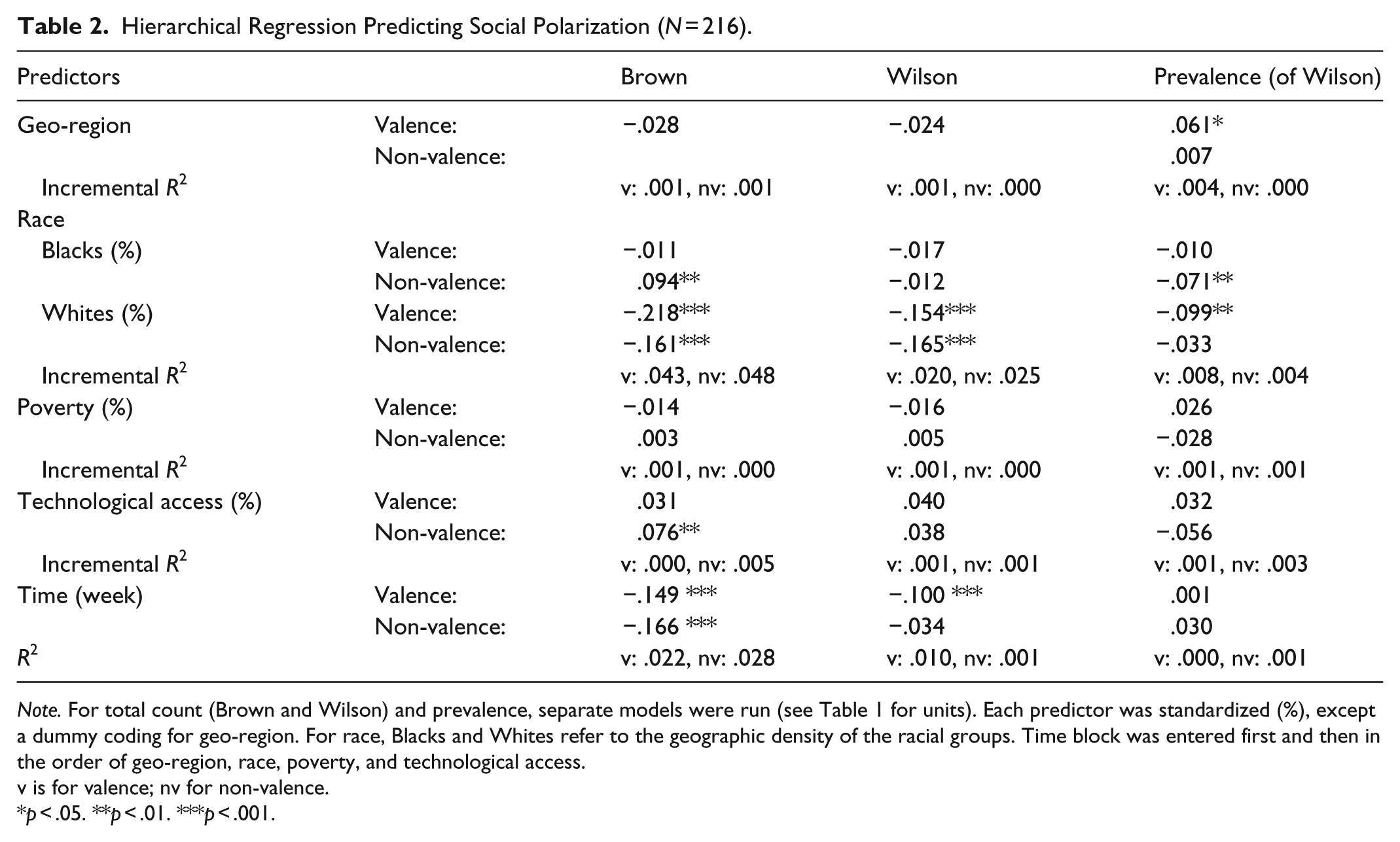
In estimating the influences of multivariate strata, the proposed models hypothesized the effects of geographical location, race, poverty, and technological access over time. Table 2 shows the results of analyses in terms of (1) total counts of Brown and Wilson and (2) the prevalence of Wilson (relative to Brown).
Hierarchical Regression Predicting Social Polarization (N = 216).
Note. For total count (Brown and Wilson) and prevalence, separate models were run (see Table 1 for units). Each predictor was standardized (%), except a dummy coding for geo-region. For race, Blacks and Whites refer to the geographic density of the racial groups. Time block was entered first and then in the order of geo-region, race, poverty, and technological access.
v is for valence; nv for non-valence.
p < .05. **p < .01. ***p < .001.
The findings revealed support for H1 on the significant role of social strata in incubating polarization. The support was robust for race (H1a) and the explanatory power of the race block (incremental R2) accounted for .043, .020, and .008 in the valence condition and .048, .025, and .004 in the non-valence condition. But the support was multifaceted, when specified into Blacks and Whites. In the non-valence condition, the effect of being Blacks was negative for the prevalence of Wilson (β = −.07, p < .01) but positive for Brown (β = .09, p < .01). For Whites, the significance was negative in both valence and non-valence conditions (For Wilson: β = −.15, p < .001; β = −.16, p < .001; β = −.09, p < .01. For Brown: β = −.21, p < .001; β = −.16, p < .001), indicating that urban settings with predominantly White populations were less engaged in the tweets on both Brown and Wilson.
There was a support for the posited association between geographic location and Wilson tweets, when indicated by prevalence (H1b) (β = .06, p < .05). The regression results also supported the critical function of technological access, consistent with H1d: The increase of Brown tweets was evident with increased technological access in the non-valence condition (β = .07, p < .01) as seen in the first column in Table 2. Yet, the supports for the main models were mixed. Poverty alone provided no support for H1c in any of the dependent variables. The effect sizes were also relatively small in supported hypotheses. We found the consistent and negative effects of time on tweets related to the two protagonists (β = −.14, β = −.10, for Brown; β = −.16, for Wilson, all at p < .001), which shows the decline of overall attention.
To examine RQ1, the nine interaction terms between the respective strata were analyzed. Overall, each interaction block accounted for the explanatory power greater than any block in prior main models. In the non-valence condition (see the bottom half of Table 3), there were sizable interactions for poverty (β = .32, p < .001, for Brown) and technological access (β = .13, p < .05, for Wilson)—both with geographic location. That is, the urban settings closer to Ferguson tended to incubate Wilson tweets with increased technological access, but these settings also nurtured Brown tweets with the higher poverty rate. Furthermore, the effect of being in a predominantly White setting diverged in its interaction with technological access, with the effect being negative for Brown (β = −.08, p < .05) but positive for Wilson (β = .34, p < .001). The effect of being in a high proportion of Black population on Brown tweets was magnified by poverty (β = .14, p < .001), which had no apparent interactive effect on Wilson.
Interactive Relationships Predicting Social Polarization (N = 216).

Note. Prior blocks included all variables including time (week). Each predictor was standardized (%), except a dummy coding for geo-region. Blacks and Whites refer to the geographic density of the racial groups.
p < .05. **p < .01. ***p < .001.
In the valence condition (see the upper half of Table 3), there were significant interactions between Blacks and poverty (β = .07, p < .05) and between Blacks and geographic location (β = −.30, p < .001). This indicates that the urban settings with the predominant Black population were more likely to tweet for Brown (1) in the higher poverty condition, but less likely to do so (2) in the region outside of the Midwest. We also found significant interactions between technological access, poverty (β = .10, p < .05), and geographic location (β = .15, p < .05), as increased technological access tended to facilitate Brown texts for the urban settings (1) with the higher poverty rate and (2) with the greater proximity to Ferguson. Similarly, the interaction between race and geographic location was not only consistent but also complex. For instance, the places with a higher proportion of Blacks, as they were beyond the proximity of the Midwest, were less likely to tweet Wilson (β = −.19, p < .001; β = −.37, p < .001).
However, predominantly White settings, beyond the proximity of the Midwest, were also less likely to be engaged with the texts of Wilson as well as Brown (β = −.23, p < .01; β = −.38, p < .001; β = −.42, p < .001). 1 Figure 3 displays the pattern of interactive effects of poverty and Blacks in the valence condition. Note a contrast between (1) the higher concentration of Blacks, where the high poverty facilitates Brown texts (upper panel) but decelerates Wilson texts (lower panel), and (2) the lower concentration of Blacks, where no such interaction existed.
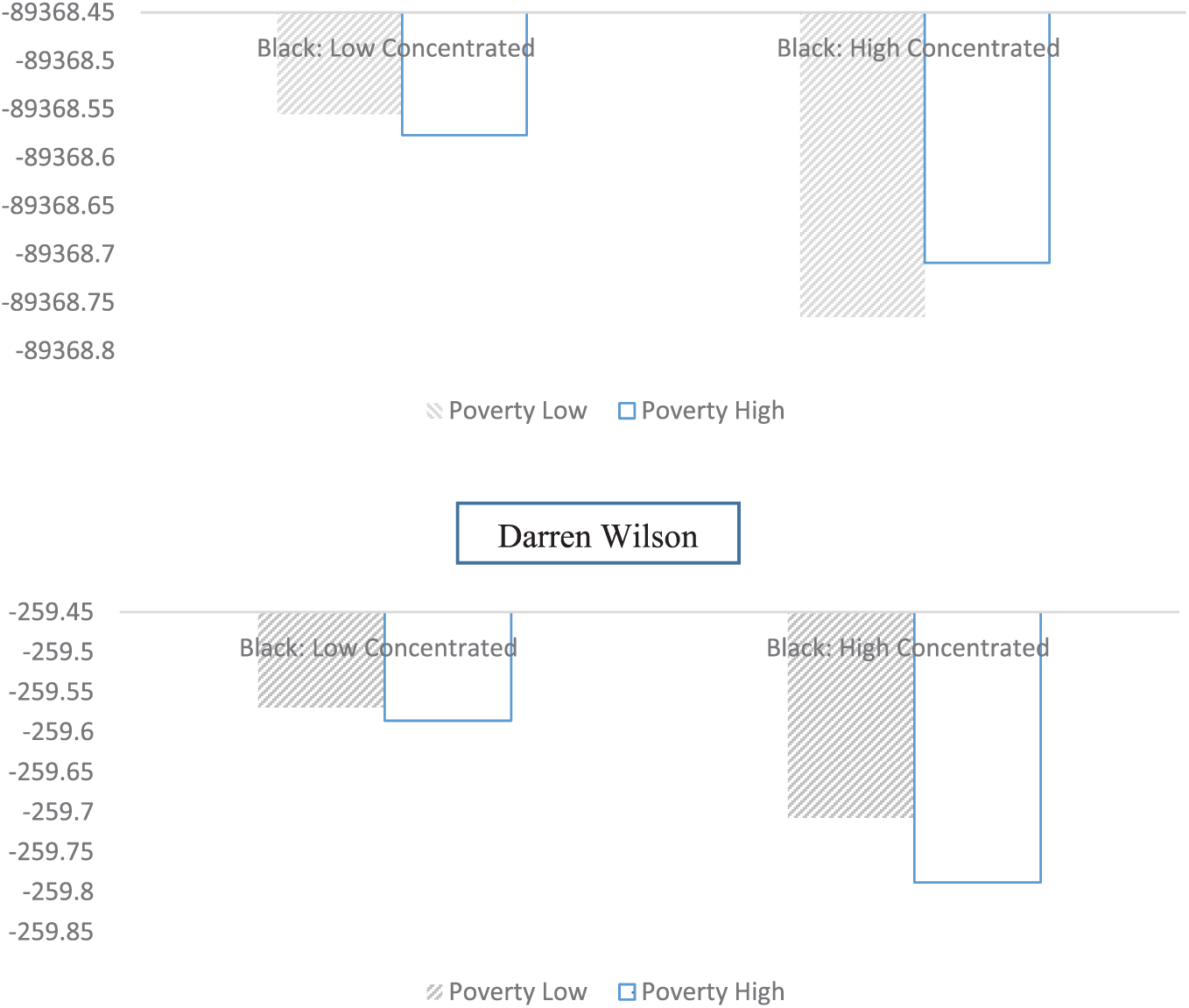
Interactive relationship between race and poverty.
Discussion
The aim of our study was to examine multivariate factors of social polarization in a predictable model. Our focus was on social and technological conditions, with a concern on the Ferguson incident, which serves as a critical event triggering underlying societal divisions at the collective level. We included gradient measures of tweet-texts in the discrete conditions of valence and non-valence. Our contention is that polarization in social media is a dynamic process that unfolds over time with the offline societal conditions that are ingrained different ways across relevant subgroups (Neuman, 1991, 2001). Accordingly, societal effects played by social media may reproduce existing beliefs and interests, potentially consolidating chasms among different social spectrums (DiMaggio, Evans, et al., 1996; DiMaggio, Hargittai, et al., 2001; Dutton & Reisdorf, 2017; Wellman, 2005; Zuckerman, 2013).
Our overall findings supported the main hypothesis that derived from prior studies grounded on (1) polarized urban contexts of U.S. cities (Ball-Rokeach et al., 2001; Kim et al., 2006; Mossberger, Tolbert, & Franko, 2012; Mossberger, Tolbert, & Gilbert, 2006) and (2) sharp division as seen in social media spheres (Conover et al., 2011; Zuckerman, 2013). However, the extent of polarization as shown in tweets on Brown and Wilson was also subtle, when specified into each of the four socio-environmental traits that we considered. In this sense, it is important to document that the urban settings with predominantly White populations, the most direct trait that one might expect to be most closely associated with Wilson tweets, provided negative significance. This suggests that during the intensive public debate period in the first 5 weeks after the Ferguson incident, the places where a majority of the populations were Whites may have remained mostly out of the Ferguson debates in social media circles, not necessarily tapping into one perspective over the other.
Moreover, although the urban settings with higher level of Black populations were associated (1) negatively with Wilson tweets and (2) positively with Brown tweets, the findings were multifaceted when poverty, geographic location, and technological access were taken into account. The respective interactive effects provided limited (in some cases of Wilson tweets) or no support at all for a simple division by race. Collectively, the interaction concerning race showed that polarization on social media platforms is far from monolithic, highly contingent upon discrete social traits, such as a geographical proximity.
Discrete patterns of interaction were manifest in the valence condition. In exacerbating the text polarity for Brown, poverty helped to extend the distance from Wilson tweets by incubating more Brown texts for the Black populations in poor urban areas. This way, poverty had an enduring impact because it also produced a lesser prevalence of Wilson texts while deepening chasms between the two races. This is a significant finding because it suggests that certain environments can be conducive to accelerating prior social and racial tensions and reproducing them into social media narratives (Mossberger, Tolbert, & Gilbert, 2006; Nakamura & Chow-White, 2011).
With regard to the interactive effects in the non-valence condition, we also have evidence that shows the sizable effect of poverty for those living close to Ferguson (in producing Brown-related tweets). On the other hand, the increased technological access functioned in favor of Wilson in the urban settings closer to Ferguson. With no such finding for Brown, this underscores that the effect of technological access, while likely to congeal a narrower viewpoint to the exclusion of others, can differ by the type of texts emerging from the similar geographical circumstances. In general, the larger explanatory power of respective interactive blocks points to the likelihood that direct effects remain relatively small inasmuch as the extent of polarization played by social media is substantially modified by other social variables.
The finding of a negative coefficient for time showed that the Ferguson tweets on both sides significantly declined over the course of the 5 weeks. In this regard, no matter how we analyzed data by different time frames (as operationalized as day or week), the negative effect remained, with almost identical results for other variables. 2 This raises a possibility that social media have the effect of quickly drowning out pertinent information in favor of short-term narratives. We plotted the 5-week descriptive trend to underscore our overall thesis. Figure 4 summarizes the contrast between Black- and White-dominated urban areas. In the left column of Figure 4, the correlations show that for each of the 5 weeks since the Ferguson event, the places with the higher proportion of Black populations tuned in Brown tweets (the upper lines of positive correlations), whereas the White populations stayed out of both Brown and Wilson tweets (the lower lines of negative correlations). 3
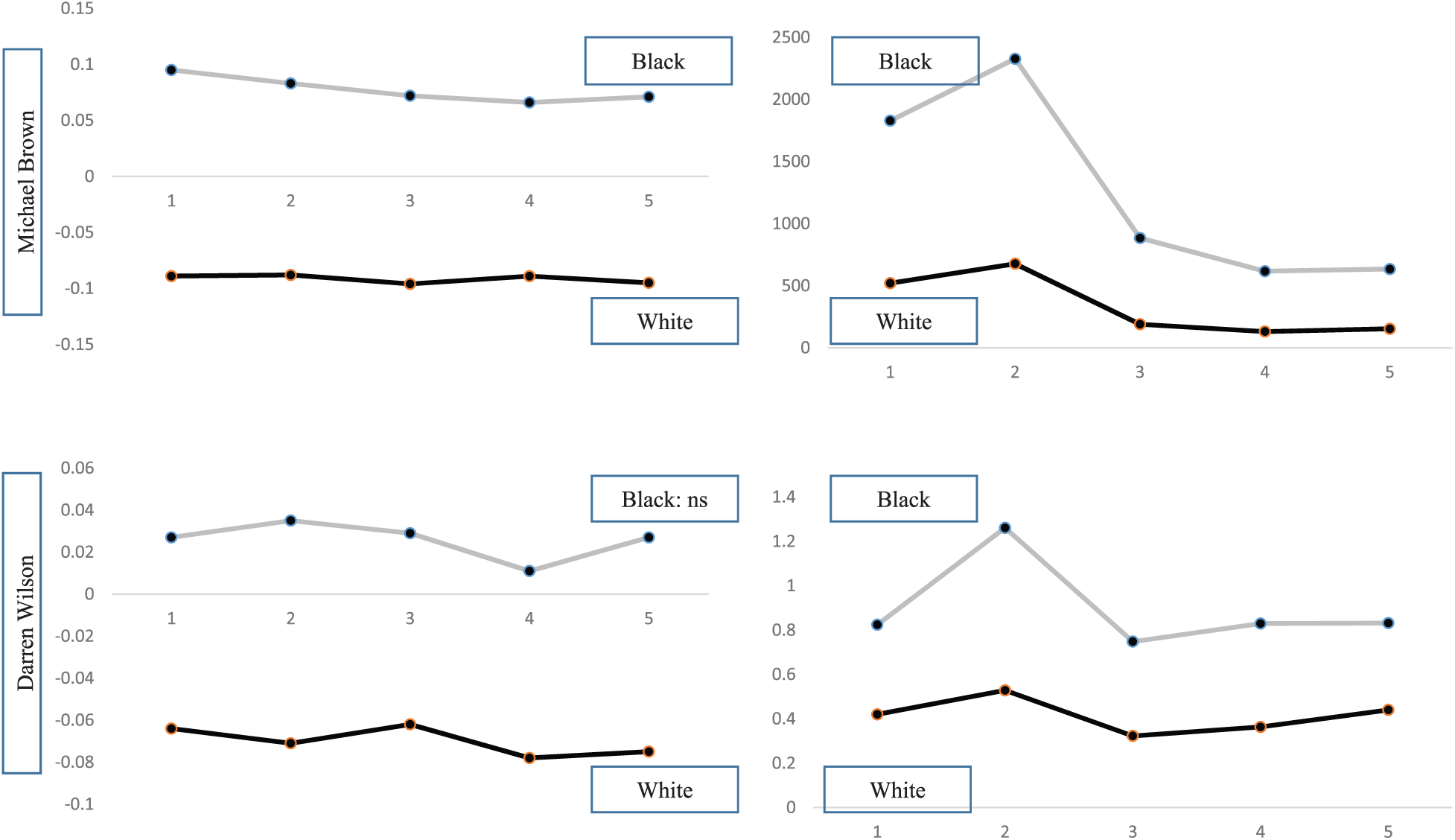
Correlations and average text volumes by race.
The difference is noteworthy. First, this allows us to speculate that a gulf of gap may run deep and exist at the fundamental level, even when much-heated elements of tweets in the valence were withheld. This also raises a possibility that polarization is embedded in a layer of public awareness and attention. For instance, by inspecting the distance between two groups of Whites and Blacks (the right column of Figure 4), we see the stability of the chasm as well as the parallel fluctuations of text volumes over time. That is, the societal gaps may not necessarily be congealed with emotionally charged debates with explicit viewpoints, but stray on a narrow ridge to the extent that each group engages (or disengages) themselves with the issue. 4
Conclusion and Future Studies
Our point is that social polarization is a function of complex, multi-layered, and densely interwoven societal chasms (Neuman, 2001), while the divide seems to be reinforced by interactive characteristics of social media. Given the polarization, in effect, has been built into social-technological fabrics of the urban environment, it may be hard to undo growing rifts by focusing on social media alone. This resonates the rightful concern raised about the breakdown of converged spaces of conversation (Ball-Rokeach & Hoyt, 2001; Habermas, 1991) and the extent of social media effect in consolidating the boundaries between different groups. The informal nature of tweets makes this study’s findings a powerful demonstration of indifference and distance across multiple social facets.
Important puzzles remain. First, our data do not capture such deep-seated beliefs as to how people believed the justice system at large needed to be fixed, who should be held responsible for the Ferguson shooting, and whether the shooting was racially motivated (Drake, 2014). The answers to these questions will provide better clues to guide how to build potential bridges across different communities. In this regard, a survey in a traditional method of acquiring a representative sample will give us a fuller picture of the extent to which people’s perceptional lens on Ferguson diverges along the lines of racial, economic, and technological divides. 5 We did not have any access to metadata that describe the characteristics of individual Twitter users. It remains unknown whether a big data company like Sysomos uses metadata, such as precise locations, to typify users. It would have been a tremendous insight on potential limits of our dataset if we knew a precise mechanism built in Sysomos’ propriety algorithm. Alternatively, social media data like those used in this study would best complement the individual-level survey in illuminating the patterns of collective-level polarity entrenched in different life experiences of socio-economic and ecological constraints (see Hampton, 2017). One possibility is that having content analysis coders judge the locations of a random sample of users using only Twitter-provided metadata and then compare the results to the Sysomos labels. We would need to achieve an acceptable level of agreement between coders and the Sysomos labels to use them. Future studies will benefit from those combinations between conventional and newer big data methodologies.
With regard to the characteristics of medium itself, we do not know how visual images in lieu of texts carry polarizing social media phenomenon. This is an important aspect amiss in our analysis because of a growing popularity of image-based texting in social platform such as Instagram. Content analysis of photo images (or tweet links to such images) can be a next step for researchers possibly slicing metadata by geographic- or demographic-specific attributes. Third, dissecting social media connection (node) by each societal attribute examined in this work will generate insights on the precise structure of linkages, that is, how and to which places particular texts may spread out. Finally, we acknowledge that other sensitive social issues such as abortion, sexuality, or immigration policies may be of wider significance and perhaps generate even greater provocation. Nevertheless, we began to unlock the puzzle of how social division can occur in social media, of which the effects reside within the parameters of predisposed societal positions.
Footnotes
Acknowledgements
The authors wish to express their gratitude to colleagues of their respective institutions for any related comments and feedbacks at the inception of this work.
Declaration of Conflicting Interests
The author(s) declared no potential conflicts of interest with respect to the research, authorship, and/or publication of this article.
Funding
The author(s) received no financial support for the research, authorship, and/or publication of this article.